Posted in SAINT of the DAY

Saint/s of the Day – 20 October – Blessed Daudi Okelo (1902 ca.-1918) and Jildo Irwa (1906 ca.-1918)

Saint/s of the Day – 20 October – Blessed Daudi Okelo (1902 ca.-1918) and Jildo Irwa (1906 ca.-1918) – Martyrs, Catechists.

The martyrs Daudi Okelo and Jildo Irwa were two young catechists from Uganda at the beginning of the 20th century.   They belonged to the Acholi tribe, a subdivision of the large Lwo group whose members even today live mostly in the North of Uganda but they are also present in Southern Sudan, Kenya, Tanzania and Congo.   They lived and were martyred in the years immediately following the foundation of the mission of Kitgum by the Comboni Missionaries in 1915.

bl daudi okelo and Jildo Irwa.1

Daudi Okelo

Daudi Okelo was born around 1902 in Ogom-Payira, a village on the road Gulu-Kitgum. The son of pagan parents, Lodi and Amona, at 14-16 years of age he attended the instruction to receive baptism.   Baptised by Fr Cesare Gambaretto on 1 June 1916, Daudi received his first holy communion on the same day and was confirmed on 15 October 1916.   After completing his formation, Daudi accepted to be enrolled as a catechist.

At the beginning of 1917, Antonio, the catechist in charge of Paimol, died.   Daudi went to Fr Cesare, then superior at the mission of Kitgum, offering to take Antonio’s place. Daudi’s appointment came only towards the end of that year, during one of the catechists’ monthly meeting.   The young Jildo Irwa was to go with him as his assistant. Before setting off, the two of them went to Fr Cesare who informed them of the difficulties of their work, like the long travelling distance—the village was about 80 km from Kitgum—and, in particular, the frequent in-fights of the local people, instigated also by gangs of raiders and traders of slaves and gold, sporadically visiting the area.   To all this Daudi is alleged to have answered:  “I am not afraid to die. Jesus, too, died for us!”.

So around November-December 1917, with Fr Cesare’s blessing, Boniface, the head-catechist of Kitgum, accompanied Daudi and Jildo to Paimol.   Here Daudi immediately began his work by gathering children willing to take religious instruction.

At dawn he beat the drum to call his catechumens for morning prayers and, for Jildo and himself, also for the Rosary.   He taught them the prayers and the catechism’s questions and answers, repeated often in a sign-song like manner during the lesson, to facilitate the memorising.   It was a matter of teaching the first elements of faith, the so-called Lok-odiku (the words of the morning), namely the essential parts of the catechism.   To this activity Daudi added the visits to the nearby small villages from where the catechumens were coming, busy during the day in assisting their parents to look after the cattle or work in the fields.

At sunset, Daudi gave the signal for common prayer and the Rosary, always closing with a song to Our Lady.   On Sunday, he held a longer prayer service, often enlivened by the presence of catechumens and catechists of the area.

Daudi of Payira is described as young man of peaceful and shy character, diligent in his duties as a catechist and loved by all.   He never got involved in tribal or political disputes, fairly frequent at that time, as submission to the British government was often followed by ill-concealed intolerance.   In fact, due to an unhappy decision taken by the District Commissioner, there rose a serious tension.   Raiders, Muslim elements and witchdoctors took advantage of the violent situation to get rid of the new religion brought by Daudi.

During the weekend of 18-20 October 1918, long before dawn, five people headed for the hut where Daudi and Jildo were staying with the clear intention of killing them.   A village elder confronted the new comers telling them they were not allowed to kill the catechists, as they were his guests.   Daudi appeared at the door of his hut and entreated the elder not to get involved.   Then the intruders entered into Daudi’s hut and insisted with him that he gave up teaching catechism.   Realising that Daudi was not giving in to their threats, they dragged him outside, pushed him to the ground and pierced him with their spears.   He was about 16-18 years old.

His body was then left unburied until a few days later some people, tying a rope around the neck, dragged the body over a nearby empty termite hill.   The mortal remains, collected in February 1926, were later placed in the mission church of Kitgum, at the foot of the altar of the Sacred Heart.bl daudi okelo and Jildo Irwa.2
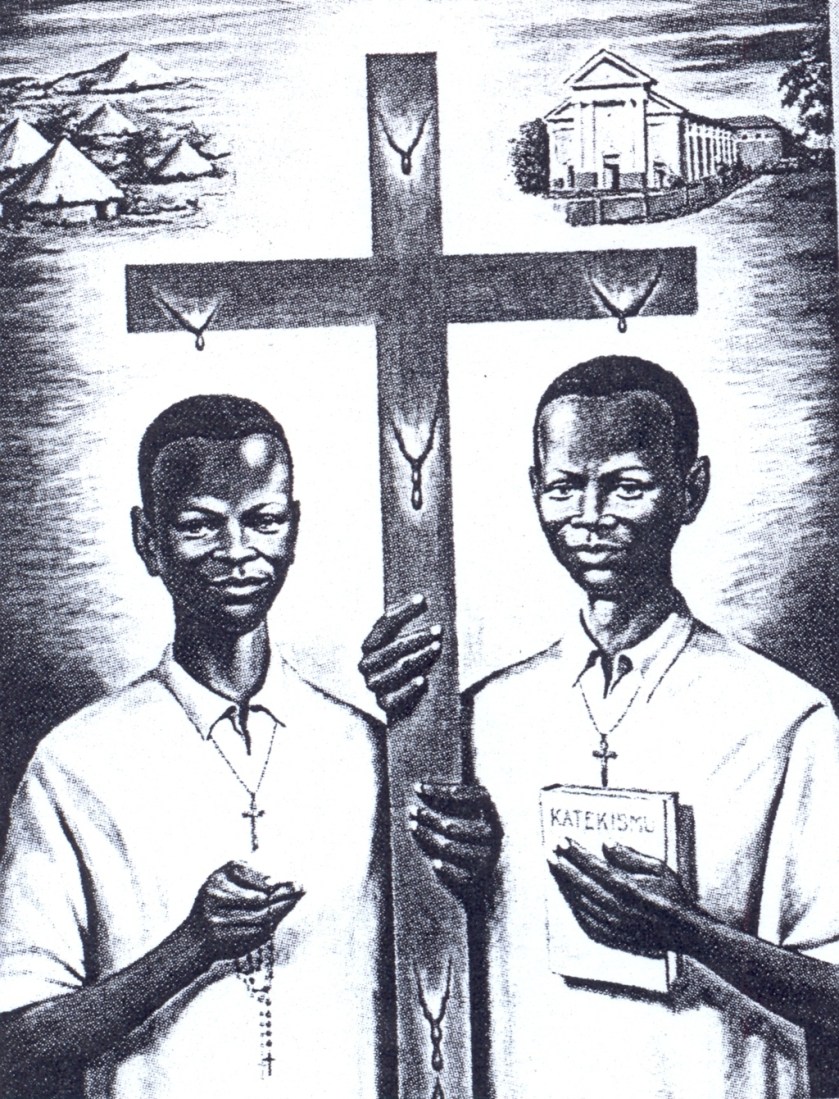
Jildo Irwa

Jildo Irwa was born around 1906 in the village of Bar-Kitoba, North-West of Kitgum, from pagan parents:   Ato, his mother, and Okeny, his father who later became a Christian.

He was baptised by Cesare Gambaretto on 6 June 1916, at the age of 10-12 years;  on the same day he received his first Holy Communion and was confirmed on 15 October 1916.

Father Cesare wrote about him “Jildo was much younger than Daudi. Of lively and gentle nature, like many Acholi youngsters, he was quite intelligent and occasionally acted as secretary to the vice-chief Ogal who had given hospitality in Paimol. He was of great help to Daudi in gathering the children for the instruction with his gentle way and infantile insistence.   He knew also how to entertain them with innocent village games and noisy and merry meetings. He had recently received baptism, whose grace he preserved in his heart and let it transpire by his charming behaviour”.

He had spontaneously and very willingly offered to go with Daudi to teach God’s word in Paimol.   Here he was loved by everyone because he was always available and exemplary in his duties as assistant-catechist.

On the morning of their martyrdom Jildo answered to Daudi who was warning him about a possible cruel death, “Why should we be afraid?   We have done nothing wrong to anyone; we are here only because Fr Cesare sent us to teach the word of God. Do not fear!”

He repeated the same words to those who were urging him to leave that place and his duty as assistant-catechist.   “We have done nothing wrong”, he was saying in tears “For the same reason you killed Daudi you must also kill me, because together we came here and together we have been teaching God’s word”.   Having said this, somebody grabbed him, pushed him outside the hut and, placing him at a distance of two steps, pierced him through with a spear.   Then one of them struck Jildo’s head with a knife.   He was about 12-14 years old.
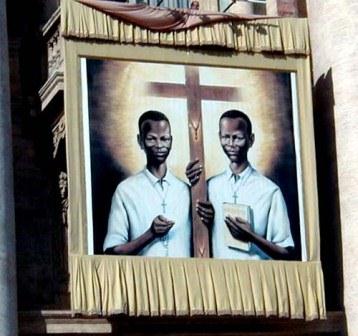
bl daudi okelo and Jildo Irwa

The martyrdom of these two young catechists from Uganda is very meaningful for the current events the country is going through.   It is a matter, first of all, of two young lay catechists who together carried out and remained faithful to their assignment to spread the Gospel by words and deeds.   Furthermore, by courageously accepting to move to a place outside the influence of their own ethnic clan, they have become in their environment a sign of the catholicity and unity of the Church.   Finally, having lived during a period of tribal fights, colonial interests and still flourishing domestic slavery, they represent the integrity of a Gospel that always protects and safeguards personal dignity and promotes peace among peoples, ethnic groups and cultures.   For this, even today they are remembered in their land as Christ’s true “witnesses by blood”.bl daudi okelo and Jildo Irwa.3
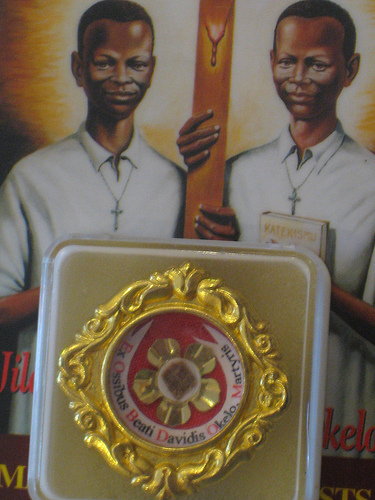
Posted in SAINT of the DAY

Memorials of the Saints – 20 October

St Acca of Hexham
St Adelina
St Aderald
St Aidan of Mayo
St Andrew of Crete
St Artemius Megalomartyr
St Barsabias
St Bernard of Bagnorea
St Bradan
St Caprasius of Agen
Bl Daudi Okello & Jildo Irwa
Bl Gundisalvus of Silos
St Irene
St Leopardo of Osimo
St Lucas Alonso Gorda
St Maria Bertilla Boscardin
St Martha of Cologne
St Maximus of Aquila
St Orora
St Saula of Cologne
St Sindulphus of Rheims
St Usthazanes
St Vitalis of Salzburg

Posted in MORNING Prayers, PAPAL ENCYLICALS, PRAYERS for PRIESTS, PRAYERS of the SAINTS, QUOTES of the SAINTS, SAINT of the DAY

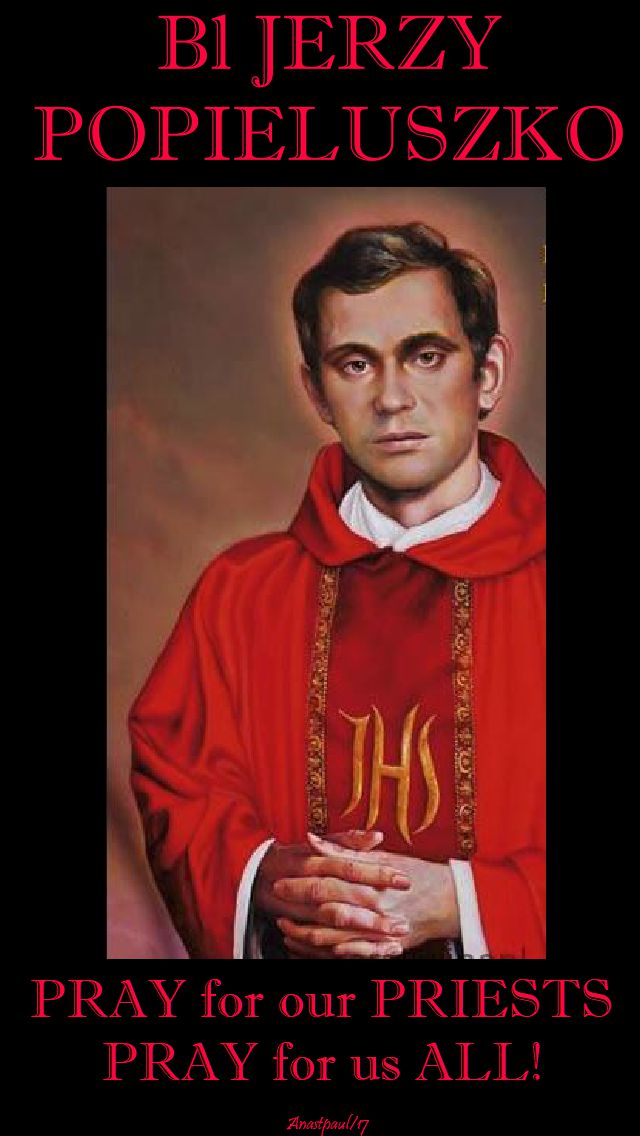
Thought for the Day – 19 October – The Memorial of Blessed Jerzy Popiełuszko (1947-1984)

Thought for the Day – 19 October – The Memorial of Blessed Jerzy Popiełuszko (1947-1984)

Fr Jerzy Popiełuszko, a priest and martyr,….exercised his generous and courageous ministry beside all those who were working for freedom, for the defence of life and for its dignity. His work at the service of goodness and truth was a sign of contradiction for the regime governing Poland at the time. Love of the Heart of Christ led him to give his life and his witness was the seed of a new springtime in the Church and in society.
If we look at history, we can note how many pages of authentic spiritual and social renewal were written with the crucial contribution of Catholic priests, motivated solely by passion for the Gospel and for human beings and for their true freedom, both religious and civil.
How many initiatives of integral human promotion have been born from the intuition of a priestly heart! (13 June 2010, Pope Benedict XVI)
And so, let us pray for all our priests:

Pope Benedict’s Prayer for Priests

LORD JESUS CHRIST,
Eternal High Priest, You offered Yourself to the
Father on the altar of the Cross and through the
outpouring of the Holy Spirit gave Your priestly
people a share in Your redeeming sacrifice.
Hear our prayer for the sanctification of our priests.
Grant that all who are ordained to the ministerial
priesthood may be ever more conformed to You,
the divine Master.
May they preach the
Gospel with pure heart and clear conscience.
Let them be shepherds according to Your own Heart,
single- minded in service to You and to the Church
and shining examples of a holy,simple and joyful life.
Through the prayers of the Blessed Virgin Mary,
Your Mother and ours,draw all priests and the flocks
entrusted to their care to the fullness of eternal life where
You live and reign with the Father and the Holy Spirit,
one God, for ever and ever.
AMEN
BENEDICTUS PP. XVIpope benedict's prayer for priests - 19 oct 2017

Blessed Jerzy Popiełuszko, Pray for our Priests, pray for us all!bl jerzy pray for us

Posted in MORNING Prayers, NOVENAS

NOVENA to St John Paul the Great: DAY SEVEN – 19 OCTOBER

NOVENA to St John Paul the Great: DAY SEVEN – 19 OCTOBER

Little Known Fact #7:  While he was Bishop of Kraków, Karol Wojtyla visited many of sick people in his archdiocese during the Lenten season.   Additionally, whenever he visited parishes he always visited the parishioners who were most gravely ill in their homes.   This also extended to every convent he visited, whereby he would always visit the sisters in the infirmary.   He did all of this not only to minister to their needs but also to ask for their prayers. He told one group of sisters:
Although I am young and strong, although I fly in airplanes, climb mountains, ski, I still turn to the weakest, so that by the riches of their suffering they may bring down the strength and power of the Holy Spirit and the blessing of God upon my work in the Archdiocese.”

REFLECTION:   “Blessed are those who have not seen and yet have come to believe” (Jn 20:29). In today’s Gospel Jesus proclaims this beatitude: the beatitude of faith.   For us, it is particularly striking because we are gathered to celebrate a beatification but even more so because today the one proclaimed blessed is a Pope, a Successor of Peter, one who was called to confirm his brethren in the faith.   John Paul II is blessed because of his faith, a strong, generous and apostolic faith.   We think at once of another beatitude: “Blessed are you, Simon, son of Jonah!   For flesh and blood has not revealed this to you, but my Father in heaven” (Mt 16:17).   What did our heavenly Father reveal to Simon?   That Jesus is the Christ, the Son of the living God.   Because of this faith, Simon becomes Peter, the rock on which Jesus can build his Church.   The eternal beatitude of John Paul II, which today the Church rejoices to proclaim, is wholly contained in these sayings of Jesus:  “Blessed are you, Simon” and “Blessed are those who have not seen and yet have come to believe!”   It is the beatitude of faith, which John Paul II also received as a gift from God the Father for the building up of Christ’s Church.” ….. Pope Benedict XVI on the Beatification of St John Paul.day seven - novena st john paul 19 oct 2017

Let us Pray:

O Holy Trinity, we thank You for having given to the Church Pope John Paul II and for having made him shine with Your fatherly tenderness, the glory of the Cross of Christand the splendour of the Spirit of love.

He, trusting completely in Your infinite mercy and in the maternal intercession of Mary, has shown himself in the likeness of Jesus the Good Shepherd and has pointed out to us the way of holiness as the path to reach eternal communion with You Grant us, through his intercession, according to Your will, the grace that we implore,

………………….. [state your intention here].

Continue, beloved St John Paul, we implore you, to sustain from heaven the faith of God’s people. We praise and thank You Father that St John Paul has been numbered among Your saints and make our prayer through our Lord Jesus Christ with the Holy Spirit, one God forever.

Totus Tuus, Amen.

Quote Day Seven:   “Faith and reason are like two wings on which the human spirit rises to the contemplation of truth; and God has placed in the human heart a desire to know the truth- in a word, to know Himself- so that, by knowing and loving God, men and women may also come to the fullness of truth about themselves.”  ― John Paul II, Fides et Ratio: On the Relationship Between Faith and Reasonfaith and reason - st john paul - 19 oct 2017

Posted in MORNING Prayers, QUOTES of the SAINTS, SAINT of the DAY

Quote/s of the Day – 19 October – The Memorials of St Paul of the Cross and Blessed Jerzy Popiełuszko

Quote/s of the Day – 19 October
The Memorials of St Paul of the Cross and Blessed Jerzy Popiełuszko

“Look upon the face of the Crucified,
who invites you to follow Him.
He will be a Father, Mother–everything to you.”look upon the face - st paul of the cross 19 oct 2017

“Do not live any longer in yourself
but let Jesus Christ live in you in such a way
that the virtue of this Divine Saviour may be resplendent
in all your actions, in order that all may see in you
a true portrait of the Crucified and sense,
the sweetest fragrance of the holy virtues of the Lord,
in interior and exterior modesty,
in patience,
in gentleness,
suffering,
charity,
humility
and in all others that follow.”

St Paul of the Cross (1604-1775) do not live - st paul of the cross - 19 oct 2017

“It is not enough for a Christian to condemn evil,
cowardice, lies and use of force, hatred and oppression.
He must at all times be a witness to
and defender of justice, goodness, truth, freedom and love.
He must never tire of claiming these values
as a right both for himself and others.”

Blessed Jerzy Popiełuszko (1947-1984)it is not enough - bl jerzy popieluszko - 19 oct 2017

Posted in JESUIT SJ, MORNING Prayers, QUOTES of the SAINTS, SAINT of the DAY, The WORD

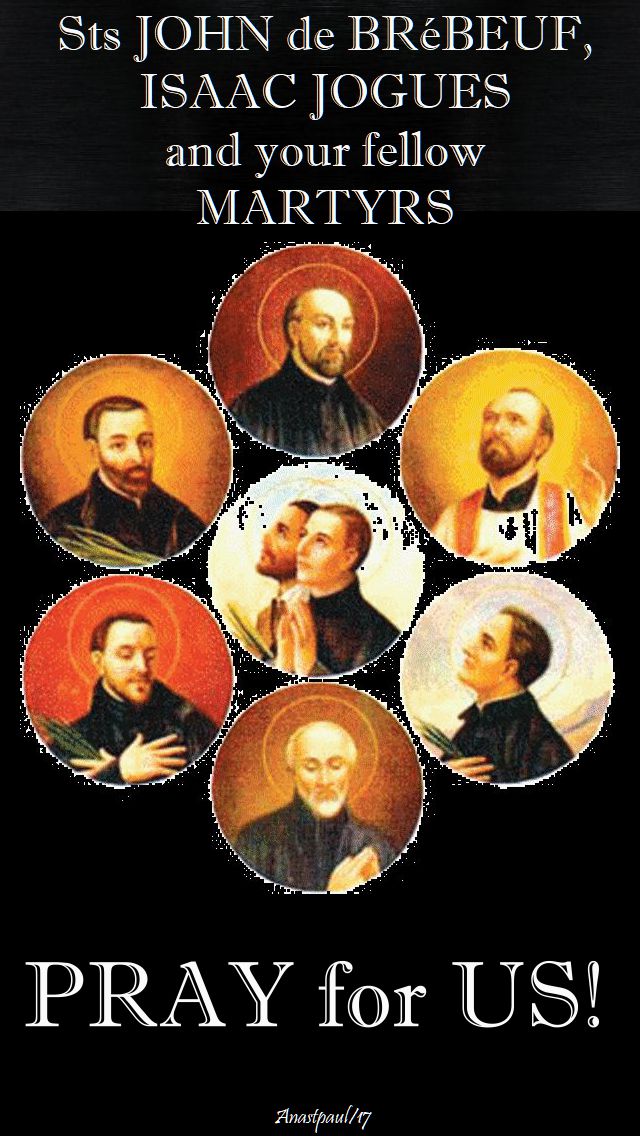
One Minute Reflection – 19 October – The Memorial of Saints John de Brébeuf and Isaac Jogues, Priests and Companions, Martyrs

One Minute Reflection – 19 October – The Memorial of Saints John de Brébeuf and Isaac Jogues, Priests and Companions, Martyrs

Do not grow lazy but imitate those who through faith and patience, are inheriting the promise .…Hebrews 6:12hebrews 6-12 - 19 oct 2017 - north american martyrs

REFLECTION – “My confidence is placed in God, who does not need our help for accomplishing His designs.
Our single endeavour should be to give ourselvs to the work and to be faithful to Him.”…..St Isaac Jogues SJ (1607-1646)my confidence is placed in god - st isaac jogues sj - 19 october 2017

PRAYER – My Lord and patient God, help me to practice patience in doing good. No matter what may occur, allow me to face each day with quiet courage and without complaint, knowing You are always at my side and that all is part of Your divine plan.   I pray for total abandonment to Your Will.  Sts John de Brébeuf, Isaac Jogues and your fellow Martyrs, please pray for us all, amen.19 OCT 2017 - One Minute Reflection JESUIT MARTYRS OF NORTH AMERICA - pray for us -

Posted in MORNING Prayers, SAINT of the DAY

Our Morning Offering – 19 October – The Memorial of St Paul of the Cross

Our Morning Offering – 19 October – The Memorial of St Paul of the Cross

Morning Offering
by Passionist Fr Chris Gibson CP

Lord,
here I am in Your Presence.
I am entirely Yours.
I adore You.
I offer You my whole heart.
I wish only to do Your will.
I offer You all my efforts
I offer You all my sufferings.
I offer You this day
with all that it brings.
I offer them now,
but especially in the Eucharist,
in union with Your Sacrifice
on the Cross,
and in union with all those
who offer themselves to You
for the Salvation of the World.
Amen.

“In this we know what love is:  in that he died for us.
We too should lay down our life for one another”       1 John 3:16lord here I am - passionist fr chris gibson on the feast of st paul of the cross - 19 oct 2917

Posted in SAINT of the DAY

Saint of the Day – 19 October – St Paul of the Cross (1604-1775) CP

Saint of the Day – 19 October – St Paul of the Cross CP (1604-1775) Priest, Mystic, Preacher, endowed with miraculous powers of healing and prophecy, Founder of the Passionists – born  Paolo Francesco Danei on 3 January 1694, in the town of Ovada, Italy and he died at 81 on 18 October 1775, at the Retreat of Saints John and Paul (SS. Giovanni e Paolo), Rome.   By the time of his death, the congregation founded by Saint Paul of the Cross had one hundred and eighty fathers and brothers, living in twelve Retreats, mostly in the Papal States.    There was also a monastery of contemplative sisters in Corneto (today known as Tarquinia), founded by Paul a few years before his death to promote the memory of the Passion of Jesus by their life of prayer and penance.   Saint Paul of the Cross was beatified on 1 October 1852 by Pope Pius IX and Canonised on 29 June 1867 by the same Pope.   His relics are also in the Church of Sts John and Paul, Rome.     Patronages – The Passionist Orders of Priests and Sisters, of Ovado Italy and the Diocese of Pitigliano-Sovana-Orbetello also in Italy. st paul of the cross - header

Paul Daneo was born on January 3, 1694, in Ovada, Italy, the second of 16 children.   Even as a young person, Paul felt strongly connected to God and moved by the passion of Christ.   At the age of 19, Paul’s father wanted him to become a merchant like himself. Marriage was a possibility looming in the future.   At times Paul dreamed of becoming a soldier and even enlisted in the Venetian army when volunteers were requested by the Pope.   But he soon realised that neither the adventure of a military career, the financial promise of the business world, nor the joys and sorrows of marriage were to be his life’s journey.   Listening one day to a simple sermon on the sufferings of Jesus, Paul suddenly experienced what he called his “conversion.”   He heard the voice of God calling him to a life of the spirit and a path of spiritual rigour.

He spent long hours in prayer, wrestling often with his own inner darkness and fierce temptations, a struggle that continued throughout 40 years of his life.   But it was in his connection to the Crucified Jesus that Paul found solace and meaning and in his meditations on Christ’s passion that new inner directions opened up for Paul.   His prayer life became an experience for him of the tremendous love God has for us.

Paul could see how many of his contemporaries did not know that God’s love had not deserted them.   The sick, the poor, the ordinary people of his day had few hours of rest, little hope of healing and lived in crippling fear of war and bloodshed.   Few found spiritual strength in the ritualistic services of the Church, which had became increasingly inaccessible to those who were living at the margins of society.   It was these abandoned people who Paul wanted to reach and eventually, it was to their side that Paul traveled long hours throughout the harsh countryside to preach a message of faith, compassion and loving redemption.

Paul had dreamed of gathering companions who would live together in community and promote this new message.   But it took from 1720 to 1741—twenty-one years of humble service as a hospital chaplain and traveling preacher combined with quiet perseverance in the face of official Church rejection—for Paul to receive his first papal authority to found his religious order, “The Congregation of the Passion.”paul-50

For over 40 years, Paul and his “like-minded companions,” the Passionists, preached the loving memory of the passion and death of Jesus Christ.   Paul would challenge his hearers to die a mystical death with Christ so as to rise up with Christ to a life of faith and love.  The sick and the poor remained special recipients of Paul’s care but he would also preach to the clergy and remind them of their obligations to serve the neglected. After many years of preaching, teaching and serving the Passionist community as its founder and leader, Paul died in 1775.

Paul received gifts of prophecy and healing from the Holy Spirit.   He was so powerful when he preached and so gentle in confession that he brought many sinners back to the Lord.   Paul once said, “England is always before my eyes, and if ever again it becomes Catholic, the benefit to the Church will be immeasurable.”   Within 65 years, a Passionist named Blessed Dominic Barberi went to England to help reconcile John Henry Newman and others to the Catholic Church, aiding the revival of Catholicism there.

Posted in SAINT of the DAY

Memorials of the Saints – 19 October

St Paul of the Cross (Optional Memorial)

North American Martyrs (Optional Memorial) – 8 saints: Two priests and six lay-brothers, all Jesuits, who were sent as missionaries to the area of modern Canada and New York and who were murdered by the locals for their work.
• Saint Antoine Daniel
• Saint Charles Garnier
• Saint Gabriel Lalemant
• Saint Isaac Jogues
• Saint Jean de Brébeuf
• Saint Jean de la Lande
• Saint Noel Chabanel
• Saint Rene Goupil
Canonised – 29 June 1930 by Pope Pius XI

Bl Agnes of Jesus
St Altinus
St Aquilinus of Evreux
St Asterius of Ostia
St Beronicus of Antioch
St Desiderius of Longoret
St Ednoth
St Ethbin
St Eusterius of Salerno
St Frideswide
Bl Jerzy Popieluszko
St Laura of Cordoba
St Lucius of Rome
St Luke Alonso Gorda
St Lupus of Soissons
St Matthaeus Kohyoe
St Pelagia of Antioch
St Peter of Alcantara
St Philip Howard
St Potenzianus of Sens
St Ptolemy of Rome
St Sabiniano of Sens
St Theofrid
St Varus of Kemet
St Verano of Cavaillon

Martyred in the Spanish Civil War: 18 Beati
• Blessed Antonio Elizalde Garvisu
• Blessed Constantino Miguel Moncalvillo
• Blessed Dionisio Arizaleta Salvador
• Blessed Emiliano Pascual Abad
• Blessed Eusebio de Las Heras Izquierdo
• Blessed Ferran Castán Messeguer
• Blessed Francesc Solá Peix
• Blessed Francisco Marco Martínez
• Blessed Francisco Milagro Mesa
• Blessed Francisco Simón Pérez
• Blessed Josep Ferrer Escolà
• Blessed Josep Ribé Coma
• Blessed Julio Leache Labiano
• Blessed Juan Senosiaín Zugasti
• Blessed Manuel Font y Font
• Blessed Narcís Simón Sala
• Blessed Nicolas Campo Giménez
• Blessed Pere Vives Coll

Posted in FEASTS and SOLEMNITIES, MARIAN QUOTES, MORNING Prayers, QUOTES of the SAINTS, SAINT of the DAY, The APOSTLES & EVANGELISTS

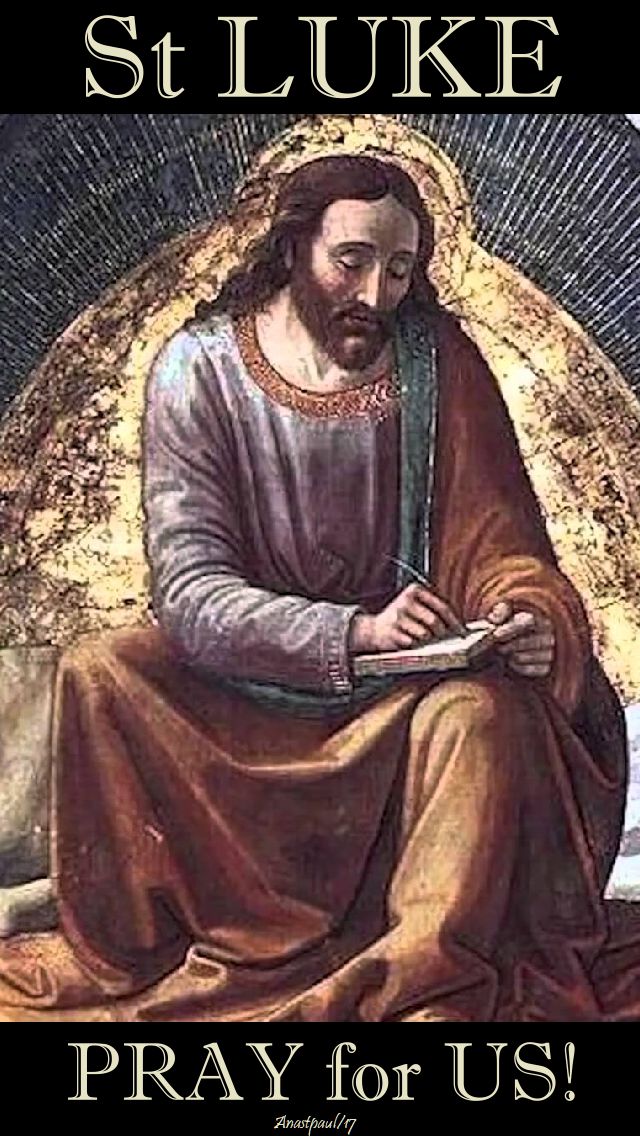
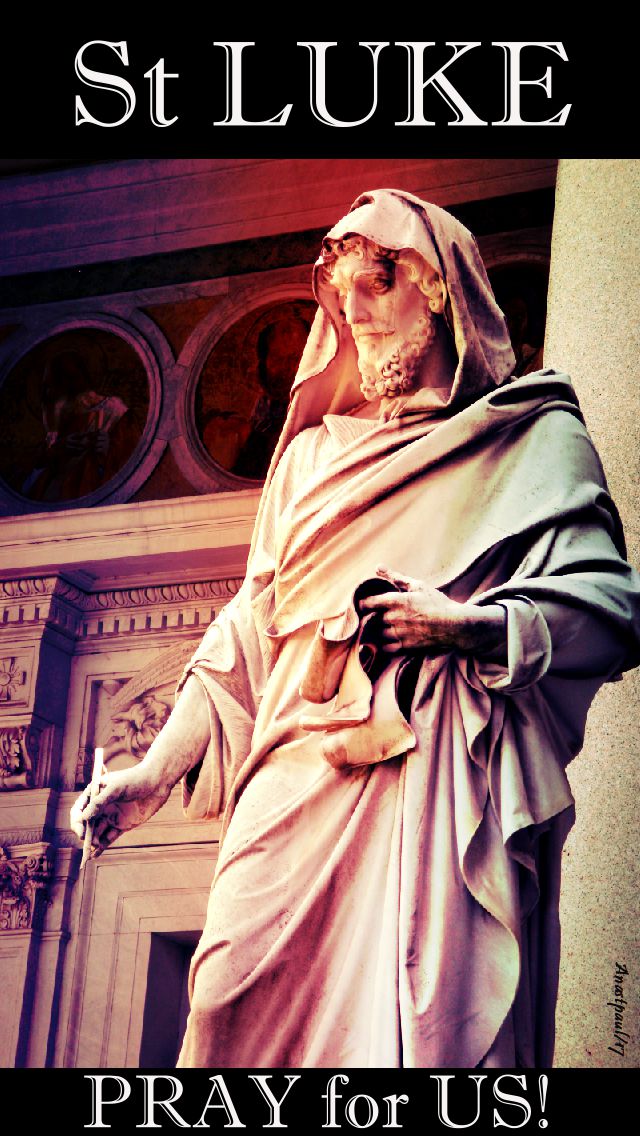
Thought for the Day – 18 October – The Feast of St Luke the Evangelist

Thought for the Day – 18 October – The Feast of St Luke the Evangelist

According to a pious tradition, Luke is thought to have painted the image of Mary, the Virgin Mother.   But the real portrait that Luke draws of Jesus’ Mother is the one that emerges from the pages of his work:   in scenes that have become familiar to the People of God, he draws an eloquent image of the Virgin.   The Annunciation, the Visitation, the Nativity, the Presentation in the Temple, life in the home of Nazareth, Jesus’ discussion with the doctors and his being lost and Pentecost have provided abundant material down the centuries for the ever new creations of painters, sculptors, poets and musicians.

What is most important however is to discover that, through pictures of Marian life, Luke introduces us to Mary’s interior life, helping us at the same time to understand her unique role in salvation history.

Mary is the one who says fiat, a personal and total “yes” to God’s invitation, calling herself the “handmaid of the Lord” (Lk 1: 38).   This attitude of total assent to God and unconditional acceptance of his Word represents the highest model of faith, the anticipation of the Church as the community of believers.

The life of faith grows and develops in Mary through sapiential meditation on the words and events of Christ’s life (cf. Lk 2: 19, 51).   She “ponders in her heart” to understand the deep meaning of his words, in order to assimilate it and share it with others.

The Magnificat hymn (cf. Lk 1: 46-55) shows another important aspect of Mary’s “spirituality”: she embodies the figure of the poor person, capable of putting all her trust in God, who casts down the mighty from their thrones and raises up the lowly.

Luke also describes the figure of Mary in the early Church, showing that she is present in the Upper Room as they await the Holy Spirit:  “All these [the 11 Apostles] with one accord devoted themselves to prayer, together with the women and Mary the mother of Jesus, and with his brethren” (Acts 1: 14).

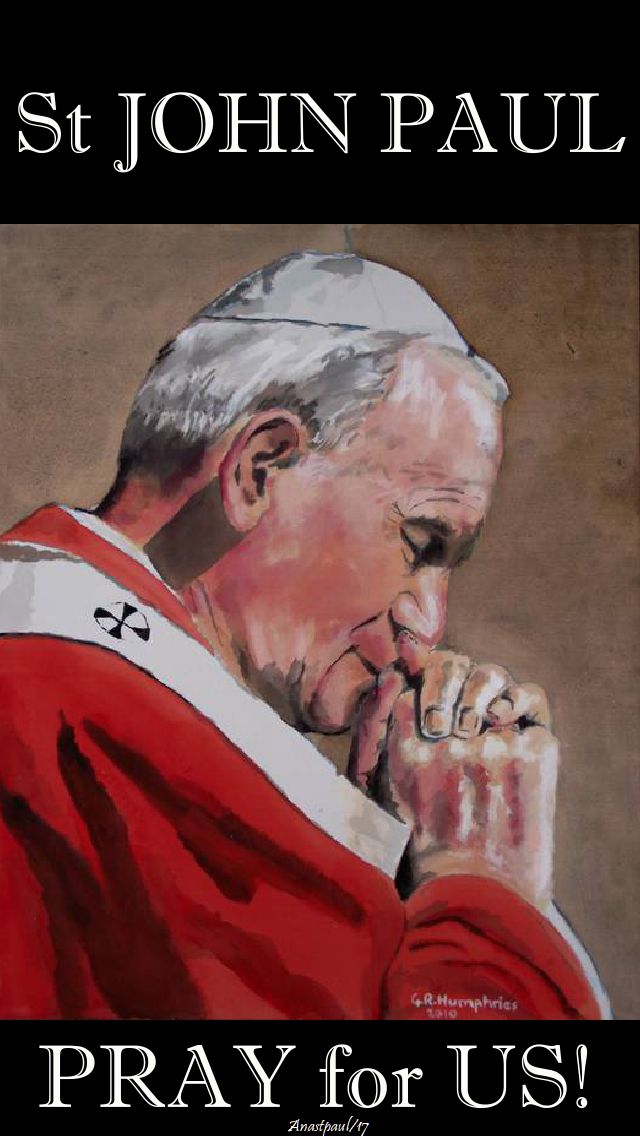
The group gathered in the Upper Room forms the original nucleus of the Church.   Within it Mary carries out a double role:  on the one hand, she intercedes for the birth of the Church through the Holy Spirit; on the other, she shares her experience of Jesus with the newborn Church. (St John Paul on the Feast of St Luke, Padua 2000 at the Shrine of St Luke)

Luke wrote as a Gentile for Gentile Christians.   His Gospel and Acts of the Apostles reveal his expertise in classic Greek style as well as his knowledge of Jewish sources.   There is a warmth to Luke’s writing that sets it apart from that of the other synoptic Gospels and yet it beautifully complements those works.   The treasure of the Scriptures is a true gift of the Holy Spirit to the Church and the Marian writings of St Luke are a great treasure to us all!

St Luke, pray for us.
Holy Mother of God, pray for us.
St John Paul, pray for us.st luke pray for us 18 oct 2017 - no 2HOLY MARY MOTHER OF GOD - PRAY FOR USst john paul pray for us

Posted in FEASTS and SOLEMNITIES, MORNING Prayers, SAINT of the DAY, The APOSTLES & EVANGELISTS, The WORD

One Minute Reflection – 18 October – The Feast of St Luke the Evangelist

One Minute Reflection – 18 October – The Feast of St Luke the Evangelist

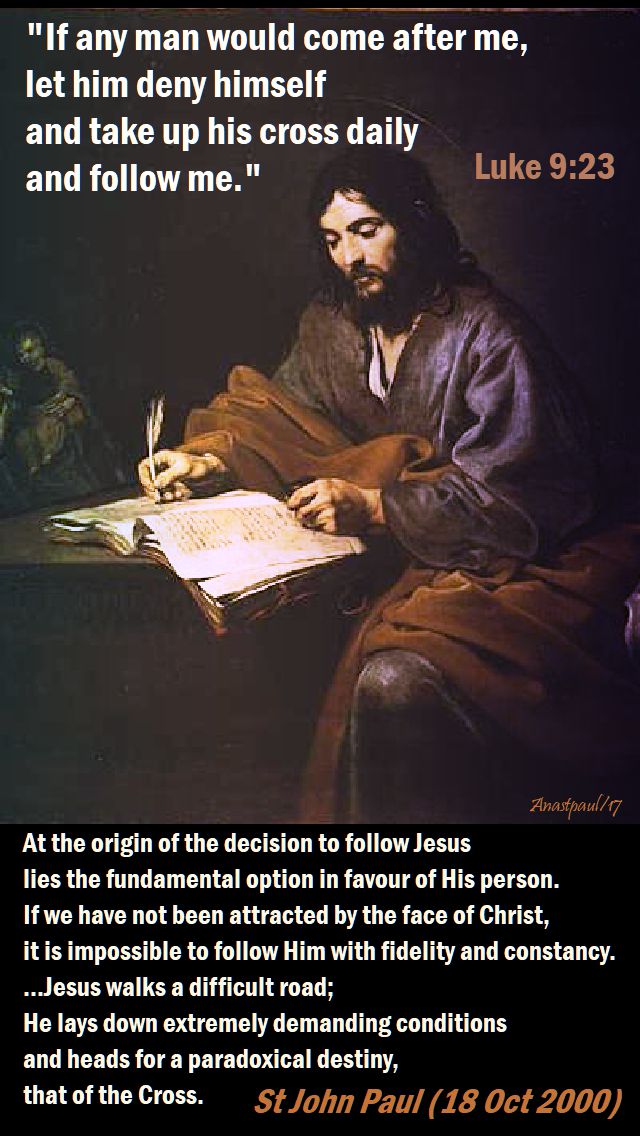
“If any man would come after me, let him deny himself and take up his cross daily and follow me.”…Luke 9: 23.

REFLECTION – “To be a Christian for Luke means to follow Jesus on the path that he takes.  It is Jesus Himself who takes the initiative and calls us to follow Him and He does it decisively, unmistakably, thus showing His extraordinary identity,   His mystery of being the Son who knows the Father and reveals Him.   At the origin of the decision to follow Jesus lies the fundamental option in favour of His person.   If we have not been attracted by the face of Christ, it is impossible to follow Him with fidelity and constancy. This is also because Jesus walks a difficult road;  He lays down extremely demanding conditions and heads for a paradoxical destiny, that of the Cross. Luke emphasises that Jesus does not like compromises and requires a commitment of the whole person, a decisive detachment from any nostalgia for the past, from family demands, from material possessions (cf. Lk 9: 57-62; 14: 26-33).”….St John Paul 18 Oct 2000at the origin of the decision - st john paul - feat of st luke 18 oct 2017

PRAYER – Lord God, You chose St Luke to reveal the mystery of Your love in his preaching and his writings. Grant, we pray, that we may grow in love for the Holy Face of Christ, His words and His directions, revealed to us in the Gospels, in the example of your saints. Today, on his feast, we especially look to St Luke, to guide, teach and pray for us. We make our prayer through our Lord Jesus Christ, with the Holy Spirit, one God with You, forever and ever, amen.st luke pray for us 18 oct 2017

Posted in CATHOLIC DEVOTIONS of the Month, FEASTS and SOLEMNITIES, franciscan OFM, MARIAN PRAYERS, MORNING Prayers, PRAYERS of the SAINTS

Our Morning Offering – 18 October 

Our Morning Offering – 18 October

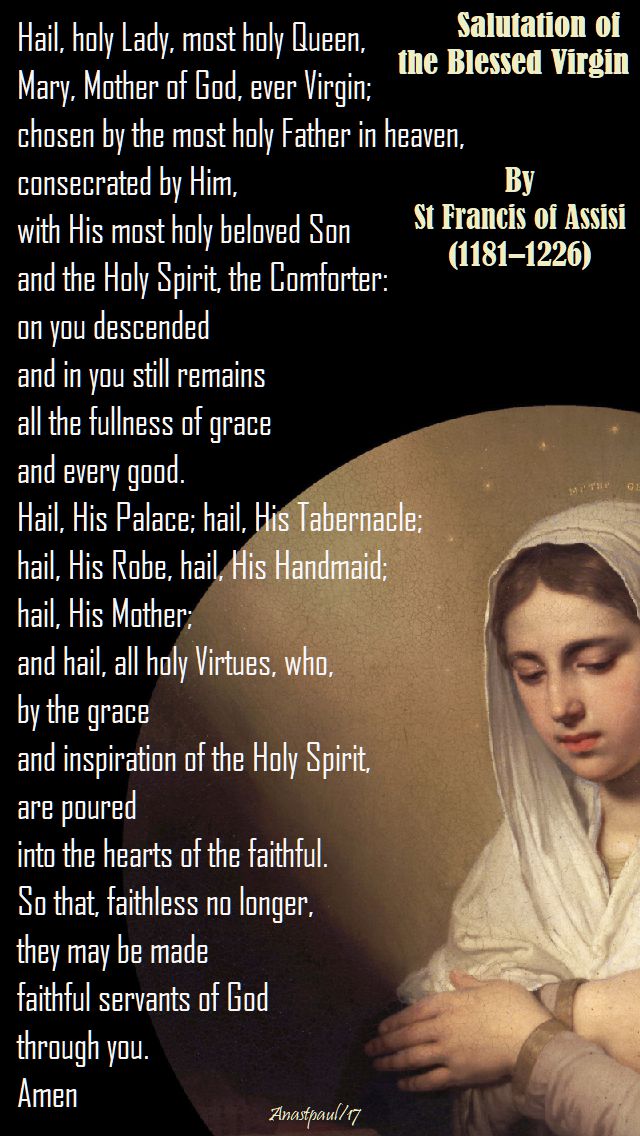
Salutation of the Blessed Virgin
By St Francis of Assisi (1181–1226)

Hail, holy Lady, most holy Queen,
Mary, Mother of God, ever Virgin;
chosen by the most holy Father in heaven,
consecrated by Him,
with His most holy beloved Son
and the Holy Spirit, the Comforter:
on you descended and in you still remains
all the fullness of grace and every good.
Hail, His Palace; hail, His Tabernacle;
hail, His Robe, hail, His Handmaid;
hail, His Mother;
and hail, all holy Virtues, who,
by the grace and inspiration of the Holy Spirit,
are poured into the hearts of the faithful.
So that, faithless no longer,
they may be made faithful servants of God
through you.
Amenhail holy lady - st francis of assisi - morning prayer on the feast of st luke 18 oct 2017

Posted in BREWERS, DOCTORS, / SURGEONS / MIDWIVES., FEASTS and SOLEMNITIES, Of BACHELORS, Of LAWYERS & CANON Lawyers, Attorneys, Solicitors, Barristers, Notaries, Para-Legals, SAINT of the DAY, The APOSTLES & EVANGELISTS

Saint of the Day – St Luke the Evangelist – 18 October

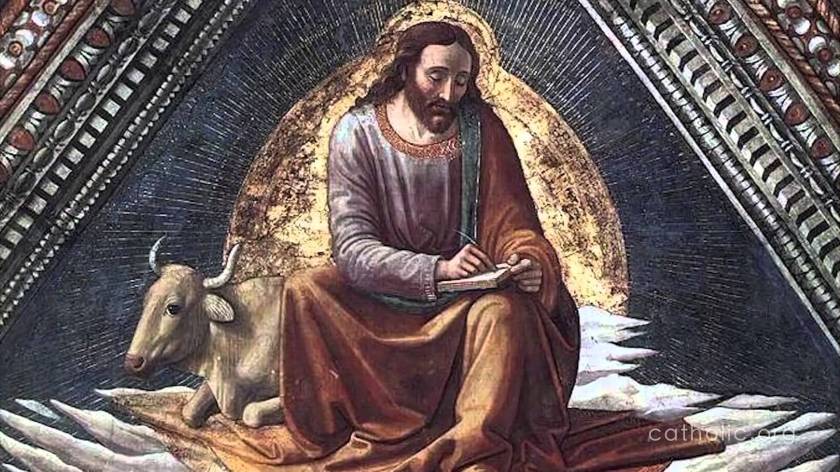
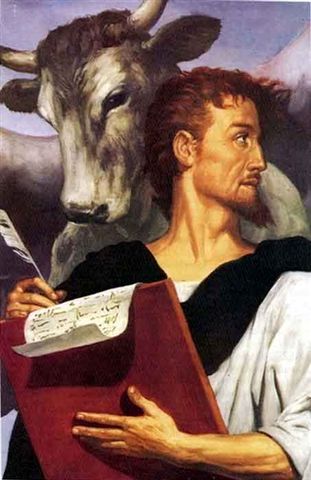
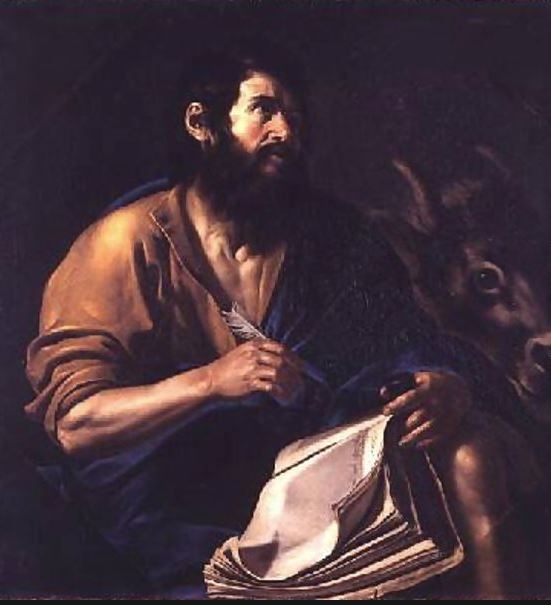
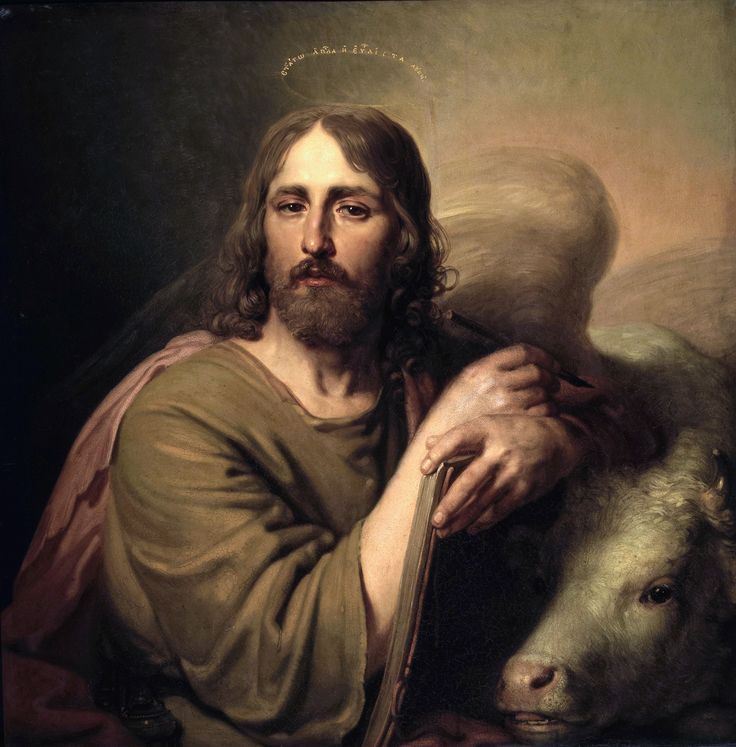
Saint of the Day – St Luke the Evangelist – 18 October – Physician,Ddisciple of St Paul, Evangelist, Author of the Gospel according to Luke and the Acts of the Apostles.   Tradition says he was an Artist too.  He was born at Antioch and Died in c 74 in Greece.   Some say he was Martyred, others that he died of natural causes.  His relics reside at Padua, Italy.   Patronages – artists, bachelors, bookbinders, brewers, butchers, doctors, glass makers, glassworkers, glaziers, gold workers, goldsmiths, lacemakers, lace workers, notaries, painters, physicians, sculptors, stained glass workers, surgeons, 2 cities.   Attributes – Evangelist, Physician, a Bishop, a book or a pen, a man accompanied by a winged ox/winged calf/ox, a man painting an icon of the Blessed Virgin Mary, a brush or a palette (referring to the tradition that he was a painter).   St Luke is one of the Four Evangelists—the four traditionally ascribed authors of the canonical Gospels.   The early Church Fathers ascribed to him authorship of both the Gospel according to Luke and the book of Acts of the Apostles, which would mean Luke contributed over a quarter of the text of the New Testament, more than any other author.   Prominent figures in early Christianity such as Jerome and Eusebius later reaffirmed his authorship.   The New Testament mentions Luke briefly a few times and the Pauline epistle to the Colossians refers to him as a physician (from Greek for ‘one who heals’);  thus he is thought to have been both a physician and a disciple of Paul. Christians since the faith’s early years have regarded him as a saint.   He is believed to have been a martyr, reportedly as having been hanged from an olive tree, though some believe otherwise.

HEADER - st luke

Luke came from the large metropolitan city of Antioch, a part of modern-day Turkey.   In Luke’s lifetime, his native city emerged as an important center of early Christianity. During the future saint’s early years, the city’s port had already become a cultural center, renowned for arts and sciences.   Historians do not know whether Luke came to Christianity from Judaism or paganism, although there are strong suggestions that Luke was a gentile convert.SOD-1018-SaintLuke-790x480

Educated as a physician in the Greek-speaking city, Luke was among the most cultured and cosmopolitan members of the early Church.   Scholars of archeology and ancient literature have ranked him among the top historians of his time period, besides noting the outstanding Greek prose style and technical accuracy of his accounts of Christ’s life and the apostles’ missionary journeys.LUKE!!!luke

Other students of biblical history adduce from Luke’s writings that he was the only evangelist to incorporate the personal testimony of the Blessed Virgin Mary, whose role in Christ’s life emerges most clearly in his gospel.   Tradition credits him with painting several icons of Christ’s mother and one of the sacred portraits ascribed to him – known by the title “Salus Populi Romano – Salvation of the Roman People”– survives to this day in the Basilica of St Mary Major.

Some traditions hold that Luke became a direct disciple of Jesus before His ascension, while others hold that he became a believer only afterward.   After St Paul’s conversion, Luke accompanied him as his personal physician– and, in effect, as a kind of biographer, since the journeys of Paul on which Luke accompanied him occupy a large portion of the Acts of the Apostles.   Luke probably wrote this text, the final narrative portion of the New Testament, in the city of Rome where the account ends.

Luke appears in Acts during Paul’s second journey, remains at Philippi for several years until Paul returns from his third journey, accompanies Paul to Jerusalem and remains near him when he is imprisoned in Caesarea.   During these two years, Luke had time to seek information and interview persons who had known Jesus.   He accompanied Paul on the dangerous journey to Rome where he was a faithful companion   After the martyrdom of St Paul in the year 67, St Luke is said to have preached elsewhere throughout the Mediterranean and possibly died as a martyr.   However, even tradition is unclear on this point.   Fittingly, the evangelist whose travels and erudition could have filled volumes, wrote just enough to proclaim the gospel and apostolic preaching to the world.

Luke’s unique character may best be seen by the emphases of his Gospel, which has been given a number of subtitles:
1) The Gospel of Mercy
2) The Gospel of Universal Salvation
3) The Gospel of the Poor
4) The Gospel of Absolute Renunciation
5) The Gospel of Prayer and the Holy Spirit
6) The Gospel of Joy

luke 3.Евангелист Лука

Posted in FEASTS and SOLEMNITIES, SAINT of the DAY

Feast of St Luke the Evangelist and Memorials of the Saints – 18 October

St Luke the Evangelist (Feast)

St Acutius of Pozzuoli
St Asclepiades of Antioch
St Brothen
Bl Burchard I of Halberstadt
St Cadwaladr of Brittany
Bl Domenico of Perpignano
St Eutychius of Pozzuoli
St Gwen
St Gwen of Tagarth
St Gwendoline
St Isaac Jogues
St Julian the Hermit
St Justus of Beauvais
Bl Margherita Tornielli
St Monon of Nassogne
St Proculus of Pozzuoli
Bl Theobald of Narbonna
St Tryphonia of Rome

Martyrs of Africa – 9 saints: A group of Christians martryed together in Africa. The only details that have survived are the names – Beresus, Dasius, Faustinus, Leucius, Lucius, Martialis, Victoricus, Victrix and Viktor. They were martyred in c.300 in Africa.

Martyred in the Spanish Civil War:
• Blessed Alfredo Almunia López-Teruel
• Blessed Francisco Roselló Hernández
• Blessed Isidro Juan Martínez

Posted in FATHERS of the Church, MORNING Prayers, QUOTES of the SAINTS, SAINT of the DAY

Quote/s of the Day – 17 October – The Memorial of St Ignatius of Antioch (c 35-c 107) Father of the Church

Quote/s of the Day – 17 October – The Memorial of St Ignatius of Antioch (c 35-c 107) Father of the Church

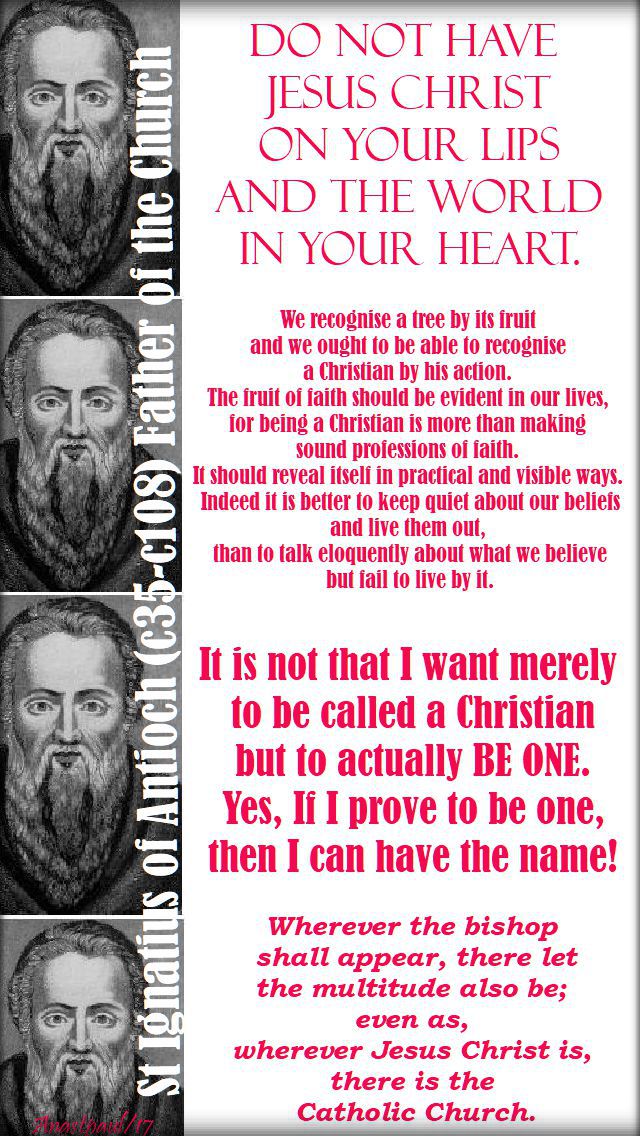
“Do not have Jesus Christ on your lips
and the world in your heart.”

“We recognise a tree by its fruit
and we ought to be able to recognise
a Christian by his action.
The fruit of faith should be evident in our lives,
for being a Christian is more than making
sound professions of faith.
It should reveal itself in practical and visible ways.
Indeed it is better to keep quiet about our beliefs
and live them out,
than to talk eloquently about what we believe
but fail to live by it.”

“It is not that I want merely
to be called a Christian
but to actually BE ONE.
Yes, If I prove to be one,
then I can have the name!”

“Wherever the bishop shall appear,
there let the multitude also be;
even as, wherever Jesus Christ is,
there is the Catholic Church.”do not have - st ignatius of antioch - 17 oct 2017

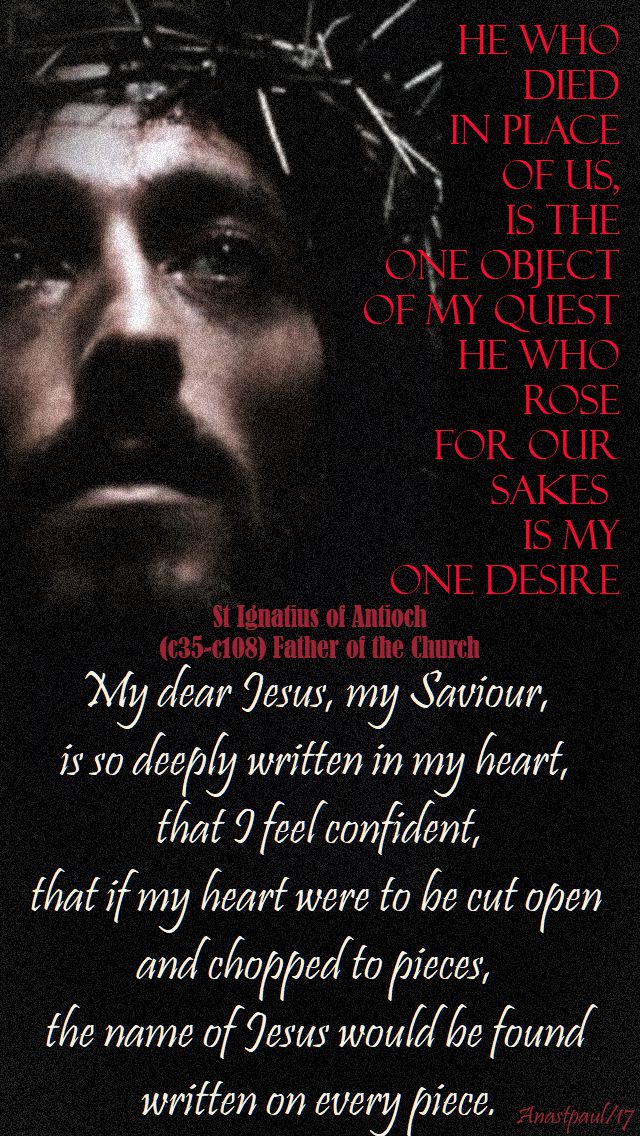
“He who died in place of us,
is the one object of my quest.
He who rose for our sakes
is my one desire.”

“My dear Jesus, my Saviour,
is so deeply written in my heart,
that I feel confident,
that if my heart were to be cut open
and chopped to pieces,
the name of Jesus would be found
written on every piece.”

he who died - st ignatius of antioch 17 oct 2017

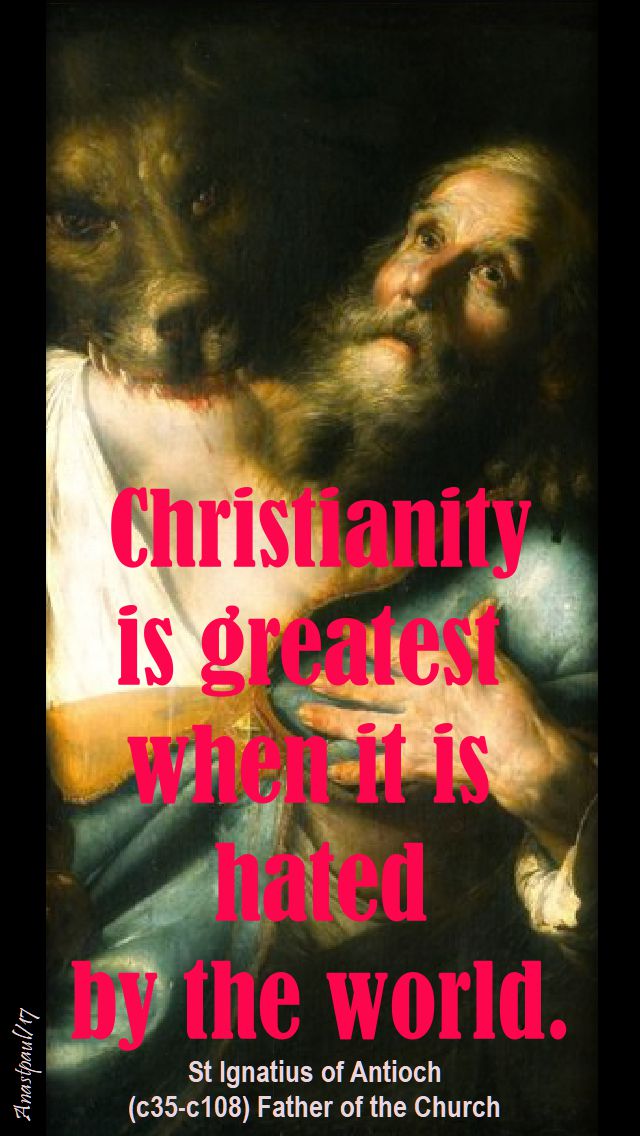
“Christianity is greatest when it is hated by the world.”CHRISITIANITY IS GREATEST - 17 OCT 2017

St Ignatius of Antioch (c35-c108) Father of the Church

Posted in MORNING Prayers, NOVENAS, QUOTES of the SAINTS

NOVENA to St John Paul the Great: DAY FIVE – 17 OCTOBER

NOVENA to St John Paul the Great: DAY FIVE – 17 OCTOBER

Little Known Fact #5:  Father Karol Wojtyla was only 38 when he was made a Bishop. It did not change his lifestyle at all. True, instead of walking everywhere he had a bicylce and even a rather ancient car and chauffeur to get around the diocese and in order not to waste time, he had a table and a light fixed into the car, to allow him to read and work on necessary journeys.

REFLECTION:  ” ………reflecting on the assassination attempt, he said: “In sacrificing himself for us all, Christ gave a new meaning to suffering, opening up a new dimension, a new order:  the order of love … It is this suffering which burns and consumes evil with the flame of love and draws forth even from sin a great flowering of good” (pp. 189-190). Impelled by this vision, the Pope suffered and loved in communion with Christ and that is why the message of his suffering and his silence proved so eloquent and so fruitful.”Pope Benedict at St John Paul’s Funeral

DAY FIVE - NOVENA ST JOHN PAUL - 17 OCT 2917

Let us Pray:

O Holy Trinity, we thank You for having given to the Church Pope John Paul II and for having made him shine with Your fatherly tenderness, the glory of the Cross of Christand the splendour of the Spirit of love.

He, trusting completely in Your infinite mercy and in the maternal intercession of Mary, has shown himself in the likeness of Jesus the Good Shepherd and has pointed out to us the way of holiness as the path to reach eternal communion with You Grant us, through his intercession, according to Your will, the grace that we implore,

………………….. [state your intention here].

Continue, beloved St John Paul, we implore you, to sustain from heaven the faith of God’s people. We praise and thank You Father that St John Paul has been numbered among Your saints and make our prayer through our Lord Jesus Christ with the Holy Spirit, one God forever.

Totus Tuus, Amen.

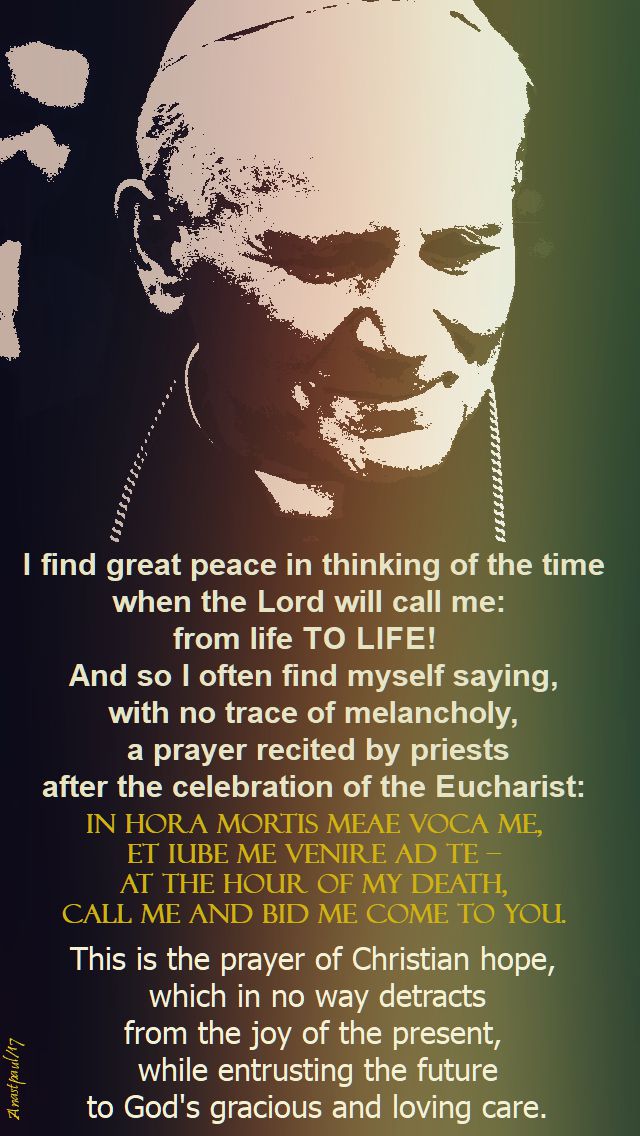
Quote Day Five:  “I find great peace in thinking of the time when the Lord will call me: from life to life!   And so I often find myself saying, with no trace of melancholy, a prayer recited by priests after the celebration of the Eucharist:   In hora mortis meae voca me, et iube me venire ad te – at the hour of my death, call me and bid me come to you. This is the prayer of Christian hope, which in no way detracts from the joy of the present, while entrusting the future to God’s gracious and loving care.”

i find great peace - st john paul - 17 OCT 2017

Posted in FATHERS of the Church, MORNING Prayers, QUOTES of the SAINTS, SAINT of the DAY, The WORD

One Minute Reflection – 17 October – The Memorial of St Ignatius of Antioch (c35-c108) Father of the Church

One Minute Reflection – 17 October – The Memorial of St Ignatius of Antioch (c35-c108) Father of the Church

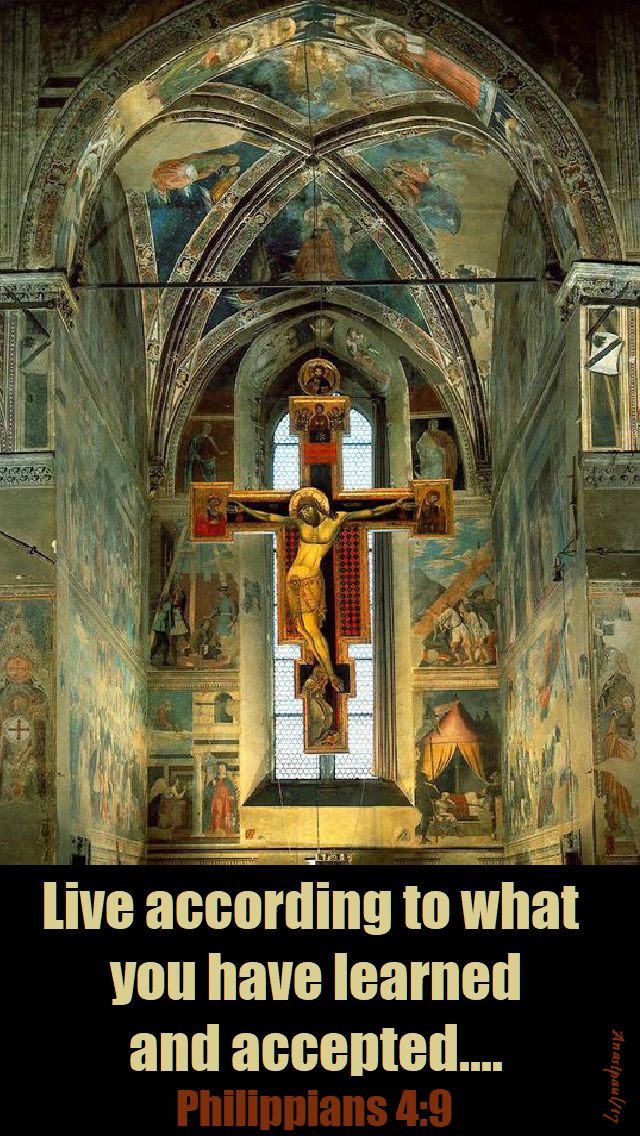
Live according to what you have learned and accepted…. Philippians 4:9Philippians 4-9

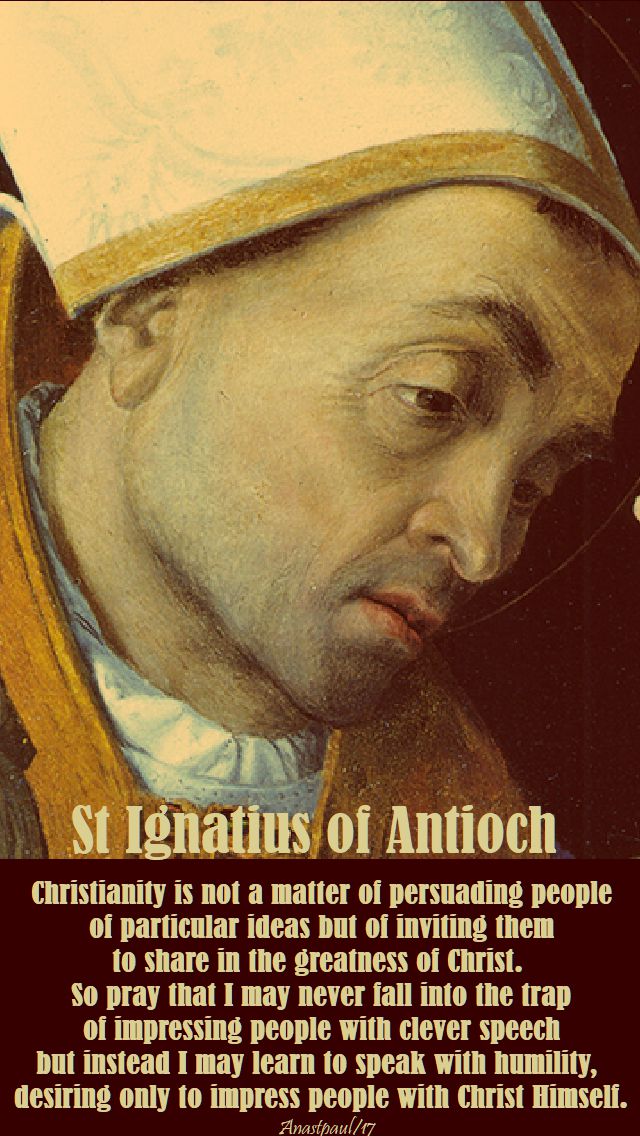
REFLECTION – “Christianity is not a matter of persuading people of particular ideas but of inviting them to share in the greatness of Christ. So pray that I may never fall into the trap of impressing people with clever speech but instead I may learn to speak with humility, desiring only to impress people with Christ Himself.”…St Ignatius of Antiochchristianity is not a matter - st ignatius of antioch - 17 oct 2017

PRAYER – Heavenly Father, grant that I may believe what I have learned, never presuming to know better than the teachings of Holy Mother Church and that I may put into practice what I believe. Let my commitment be like unto the Martyr, St Ignatius of Antioch, who went with joy to his horrific death, for the faith in Christ, Your Son, one God with You and the Holy Spirit. St Ignatius, pray for us, amen.st ignatius of antioch pray for us - 17 oct 2017

Posted in DOCTORS of the Church, MORNING Prayers, PRAYERS of the SAINTS

Our Morning Offering – 17 October

Our Morning Offering – 17 October

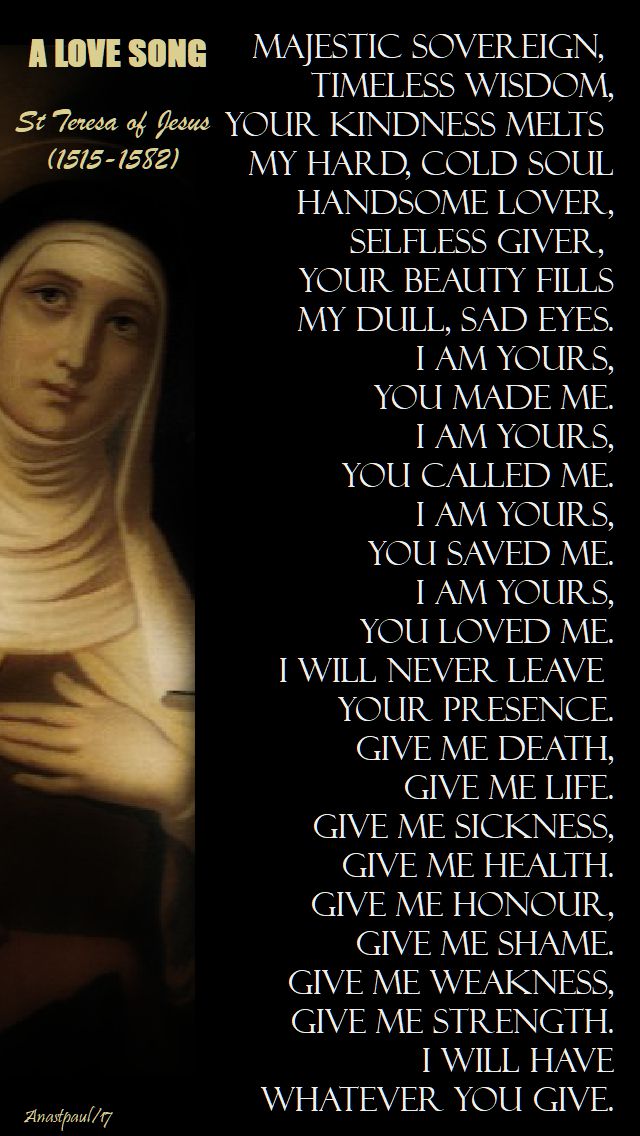
A Love Song
By St Teresa of Jesus

Majestic Sovereign, timeless Wisdom,
Your kindness melts my hard, cold soul.
Handsome Lover, selfless Giver,
Your beauty fills my dull, sad eyes.
I am Yours, You made me.
I am Yours, You called me.
I am Yours, You saved me.
I am Yours, You loved me.
I will never leave Your presence.
Give me death, give me life.
Give me sickness, give me health.
Give me honour, give me shame.
Give me weakness, give me strength.
I will have whatever You give.
AmenA LOVE SONG BY ST TERESA OF JESUS - 17 OCT 2017

Posted in Against SORE THROATS, COUGHS, WHOOPING COUGH,, FATHERS of the Church, SAINT of the DAY

Saint of the Day – 17 October – St Ignatius of Antioch (c 35 – c 108) Martyr,Bishop, Martyr, Apostolic Father of the Church

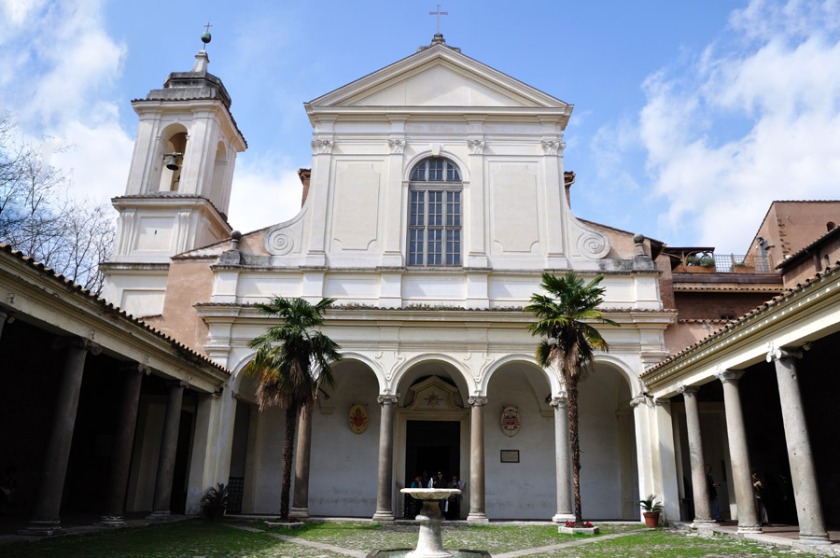
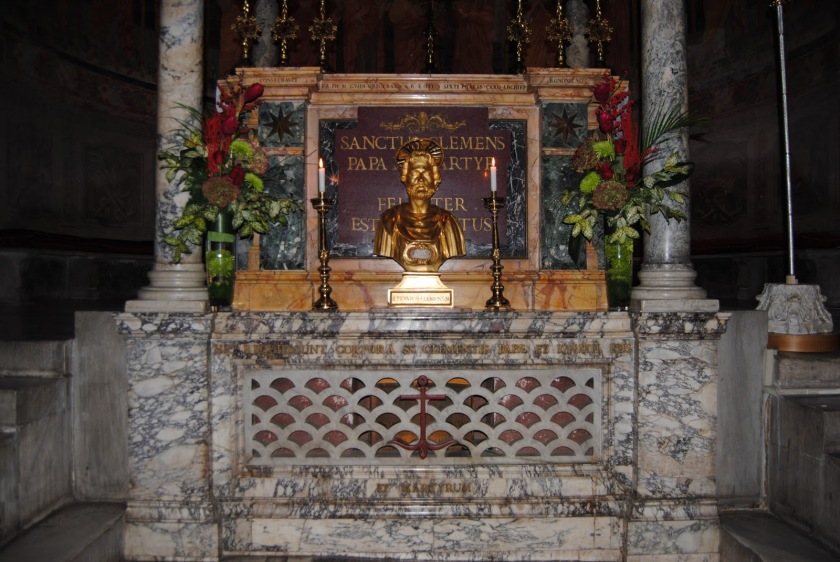
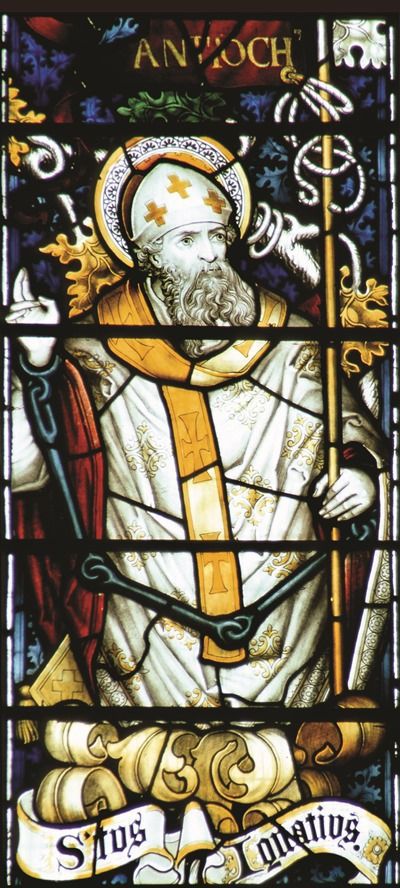
Saint of the Day – 17 October – St Ignatius of Antioch (c 35 – c 108) Bishop, Martyr, Apostolic  Father of the Church – Bishop of Antioch, Theologian, Teacher, Writer.  He was Martyred by being thrown to wild animals c 108 at Rome, Italy.   His Relics are at Saint Peter’s Basilica, Rome with his major Shrine being at the Basilica of San Clemente in Rome.   Patronages -• against throat diseases• the Church in eastern Mediterranean• the Church in North Africa.   Canonised pre-congregation by John The Apostle (mentioned in later writings of the Church.)   En route to Rome, where he met his Martyrdom, Ignatius wrote a series of letters. (Read them here: https://www.catholicculture.org/culture/library/view.cfm?id=3836).HEADER - ST IGNATIUS

This correspondence now forms a central part of the later collection known as the Apostolic Fathers.   His letters also serve as an example of early Christian theology. Important topics they address include ecclesiology, the sacraments and the role of bishops.   In speaking of the authority of the church, he was the first to use the phrase “catholic church” in writing.   He wrote in this regard:  See that you all follow the bishop, even as Jesus Christ does the Father, and the presbytery as you would the apostles;   and reverence the deacons, as being the institution of God.   Let no man do anything connected with the Church without the bishop.   Let that be deemed a proper Eucharist, which is administered either by the bishop, or by one to whom he has entrusted it.   Wherever the bishop shall appear, there let the multitude of the people also be;   even as wherever Jesus Christ is, there is the Catholic Church. —Letter to the Smyrnaeans, Ch 8

His sentiments before his approaching martyrdom are summed in his word in the Communion antiphon,  “I am the wheat of Christ, ground by the teeth of beasts to become pure bread.”   

The sixth letter was to Polycarp, bishop of Smyrna, who was later martyred for the faith. The final letter begs the Christians in Rome not to try to stop his martyrdom. “The only thing I ask of you is to allow me to offer the libation of my blood to God. I am the wheat of the Lord; may I be ground by the teeth of the beasts to become the immaculate bread of Christ.”

SOD-1017-SaintIgnatiusofAntioch-790x480
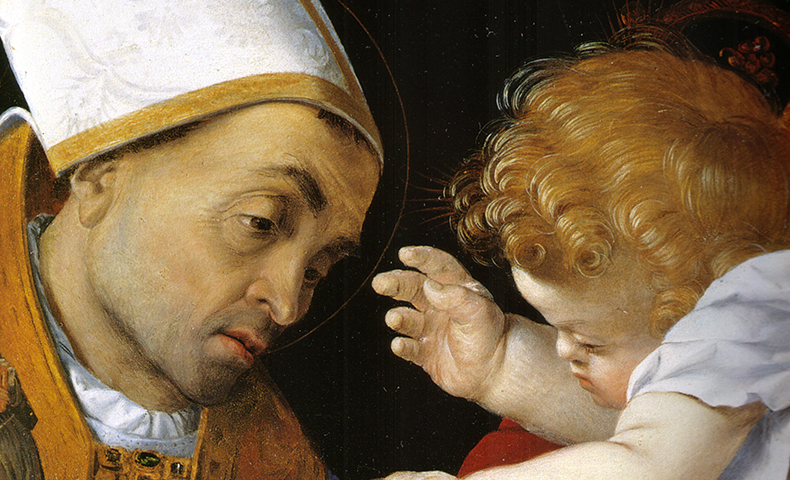
Detail | Saint Ignatius with Madonna and Child | Lorenzo Lotto

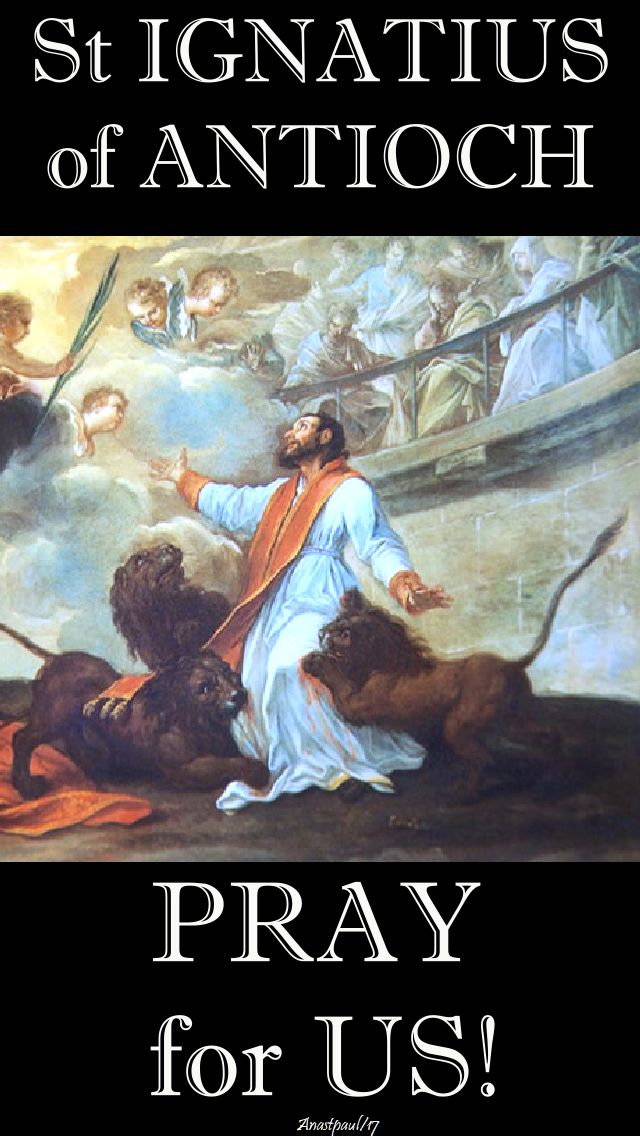
Ignatius bravely met the lions in the Circus Maximus.

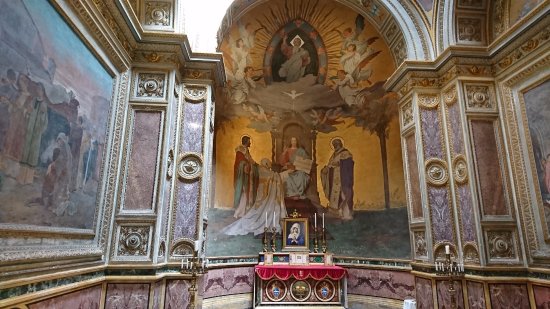
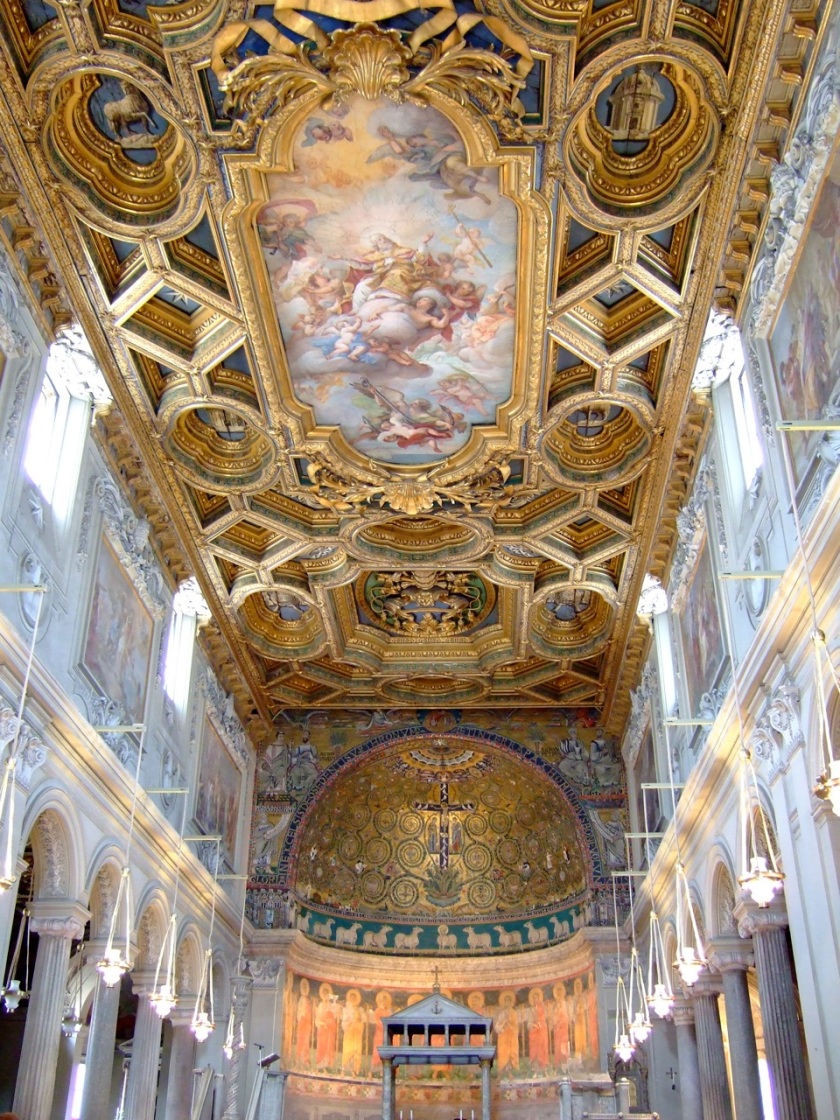
basilica-san-clementebasilica-di-san-clementebasilica-san-clemente-ceilingpope st. clement tomb i

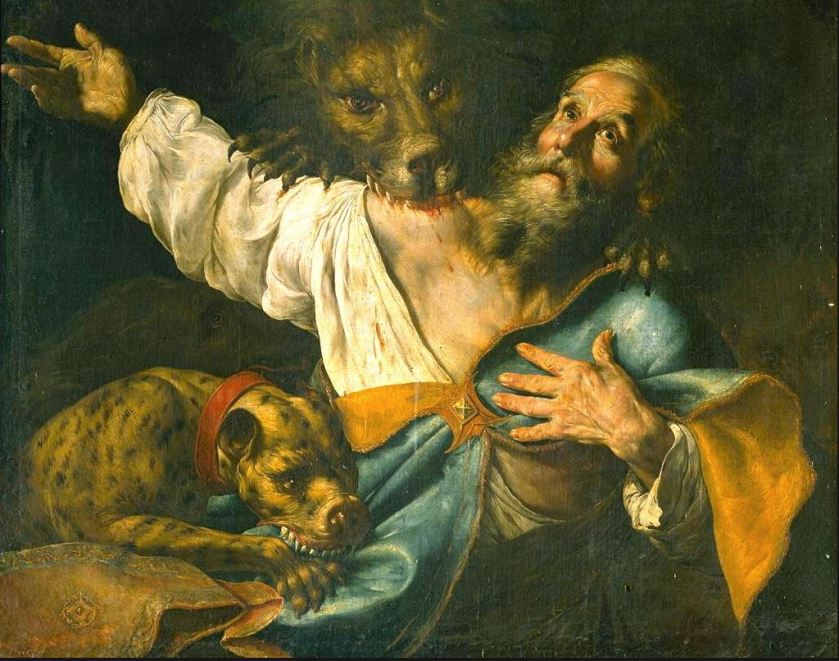
In the Martyrology we read: “At Rome, the holy bishop and martyr Ignatius. He was the second successor to the apostle Peter in the see of Antioch. In the persecution of Trajan he was condemned to the wild beasts and sent in chains to Rome.   There, by the emperor’s order, he was subjected to most cruel tortures in the presence of the Senate and then thrown to the lions.   Torn to pieces by their teeth, he became a victim for Christ.”

The bishop and martyr Ignatius occupies a foremost place among the heroes of Christian antiquity.   His final journey from Antioch to Rome was like a nuptial procession and a Way of the Cross.   For the letters he wrote along the way resemble seven stations of the Cross;   they may also be called seven nuptial hymns overflowing with the saint’s intense love for Christ Jesus and his longing to be united with Him.   These letters are seven most precious jewels in the heirloom bequeathed to us by the Church of sub-apostolic times.

The year of St Ignatius’ death is unknown but scholars place it at c 108;   perhaps it occurred during the victory festivities in which the Emperor Trajan sacrificed the lives of 10,000 gladiators and 11,000 wild beasts for the amusement of the bloodthirsty populace. The scene of his glorious triumph and martyrdom was most likely the Circus Maximus;   that mammoth structure, glittering with gold and marble, had then been just completed.

“From Syria to Rome I must do battle with beasts on land and sea. For day and night I am chained to ten leopards, that is, the soldiers who guard me and grow more ferocious the better they are treated. Their mistreatment is good instruction for me, yet am I still far from justified. Oh, that I may meet the wild beasts now kept in readiness for me. I shall implore them to give me death promptly and to hasten my departure. I shall invite them to devour me so that they will not leave my body unharmed as already has happened to other witnesses. If they refuse to pounce upon me, I shall impel them to eat me. My little children, forgive me these words. Surely I know what is good for me. From things visible I no longer desire anything; I want to find Jesus. Fire and cross, wild beasts, broken bones, lacerated members, a body wholly crushed, and Satan’s every torment, let them all overwhelm me, if only I reach Christ.”

ignatius-of-antioch

The saint, now condemned to fight the wild beasts, burned with desire for martyrdom. On hearing the roar of the lions he cried out:   “I am a kernel of wheat for Christ. I must be ground by the teeth of beasts to be found bread (of Christ) wholly pure”.
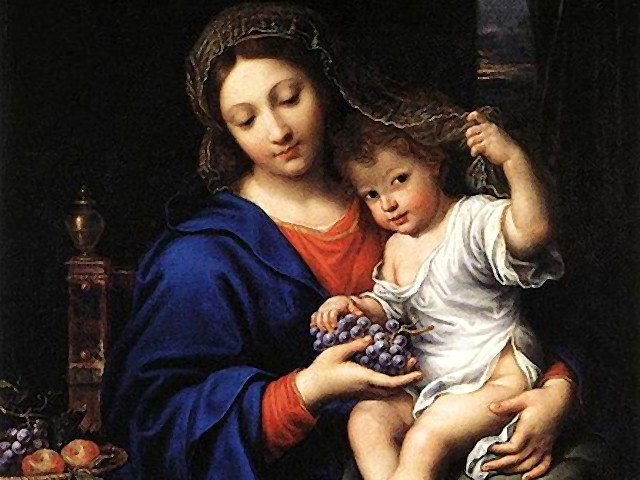
St Ignatius is also the first Father of the Church who wrote about Mary.   He defended the veracity of the humanity of Christ against the docetists by affirming that Jesus pertained to the line of David because he was born of Mary.   Jesus was conceived by Mary – He came from her – and this conception was virginal and pertains to the most hidden mysteries in the silence of God.   mary and jesus with raisins
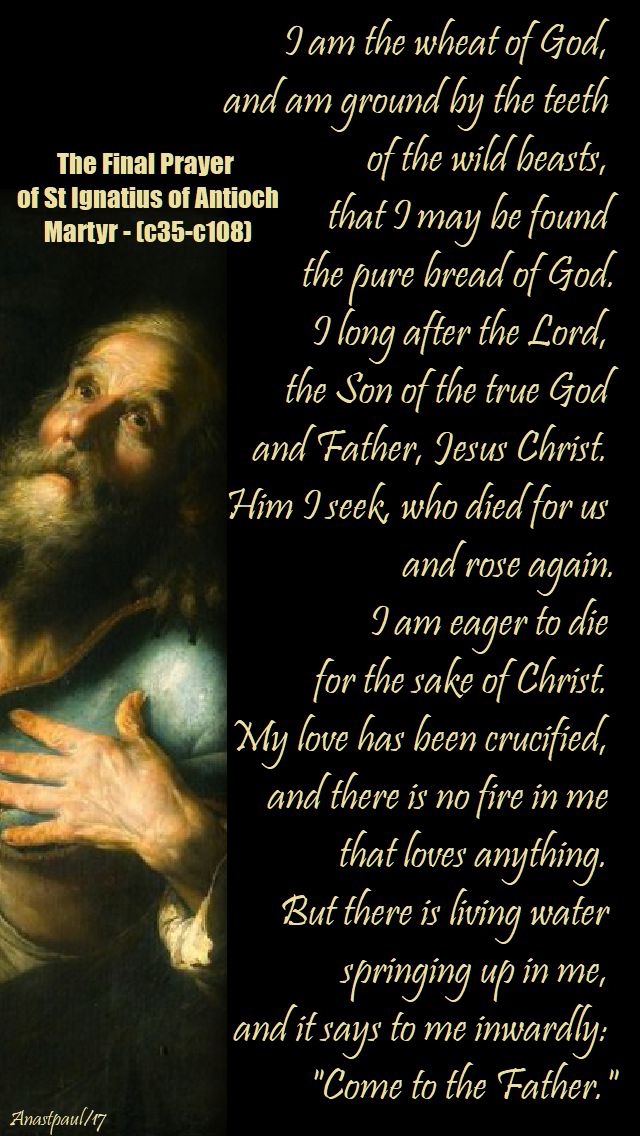
The Final Prayer of St Ignatius of Antioch

I am the wheat of God,
and am ground by the teeth of the wild beasts,
that I may be found the pure bread of God.
I long after the Lord,
the Son of the true God and Father, Jesus Christ.
Him I seek, who died for us and rose again.
I am eager to die for the sake of Christ.
My love has been crucified,
and there is no fire in me that loves anything.
But there is living water springing up in me,
and it says to me inwardly:
“Come to the Father.”the final prayer of st ignatius of antioch - 17 oct 2017

Posted in SAINT of the DAY

Memorials of the Saints – 17 October

St Ignatius of Antioch (Memorial) – https://www.youtube.com/watch?v=vKNS1qq2QIc

St Anstrudis of Laon
Bl Balthassar of Chiavari
Bl Battista de Bonafede
St Berarius I of Le Mans
St Catervus
St Colman of Kilroot
Bl Contardo Ferrini
St Ethelbert of Eastry
St Ethelred of Eastry
St Florentius of Orange
St Francois Isidore Gagelin
Bl Gilbert the Theologian
St Heron of Antioch
Bl Jacques Burin
St John the Short/Dwarf
St Louthiern
St Mamelta of Persia
St Nothelm of Canterbury
St Richard Gwyn
St Rudolph of Gubbio
St Rufus of Rome
St Serafino of Montegranaro
St Solina of Chartres
St Zosimus of Rome

Martyrs of Nicomedia – 3 saints: A group of Christians martyred in the persecutions of Diocletian. The only details about them that have survived are their names – Alexander, Marianus and Victor. 303 in Nicomedia (in modern Turkey).

Martyrs of Valenciennes -5 beati: A group of Ursuline nuns martyred in the persecutions of the French Revolution.
• Hyacinthe-Augustine-Gabrielle Bourla
• Jeanne-Reine Prin
• Louise-Joseph Vanot
• Marie-Geneviève-Joseph Ducrez
• Marie-Madeleine-Joseph Déjardins

Martyrs of Volitani: A group of martyrs who were praised by Saint Augustine of Hippo. In Volitani, proconsular Africa (in modern Tunisia).

Martyred in the Spanish Civil War:
• BlessedFidel Fuidio Rodriguez
• BlessedJosé Sánchez Medina
• BlessedPerfecto Carrascosa Santos
• BlessedTársila Córdoba Belda de Girona

Posted in MORNING Prayers, QUOTES of the SAINTS, SACRED and IMMACULATE HEARTS, SAINT of the DAY

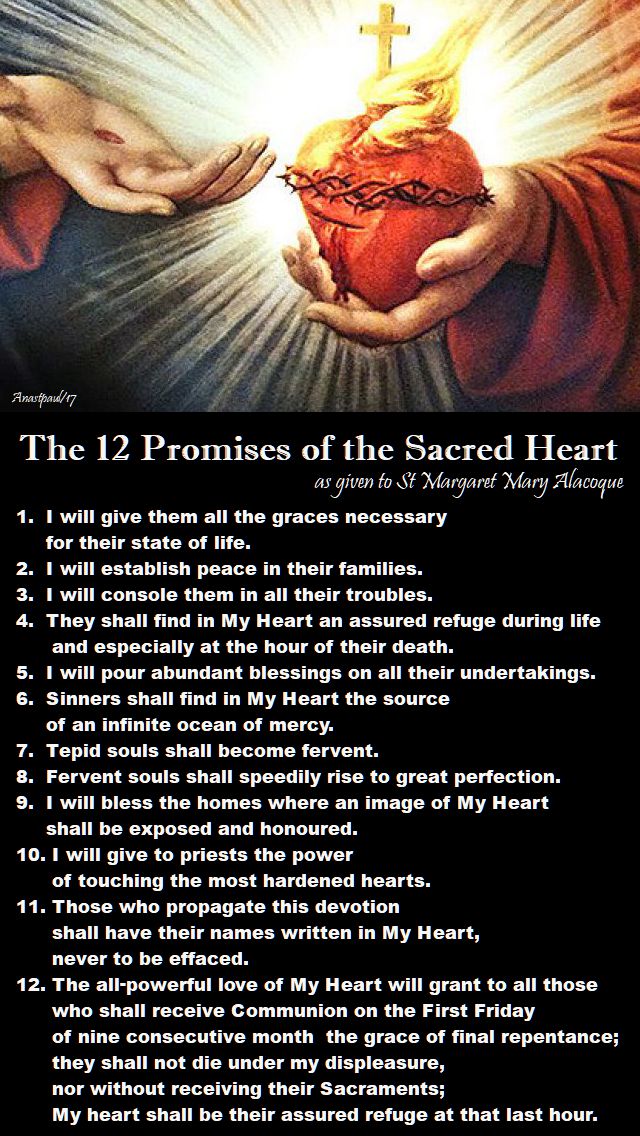
Thought for the Day – 16 October – The Memorial of St Margaret Mary Alacoque (1647-1690) The Twelve Promises of Jesus to Saint Margaret Mary for those Devoted to His Sacred Heart:

Thought for the Day – 16 October – The Memorial of St Margaret Mary Alacoque (1647-1690)

The Twelve Promises of Jesus to Saint Margaret Mary

or those Devoted to His Sacred Heart:

1.   I will give them all the graces necessary for their state of life.
2.   I will establish peace in their families.
3.   I will console them in all their troubles.
4.   They shall find in My Heart an assured refuge during life
and especially at the hour of their death.
5.   I will pour abundant blessings on all their undertakings.
6.   Sinners shall find in My Heart the source of an infinite ocean of mercy.
7.   Tepid souls shall become fervent.
8.   Fervent souls shall speedily rise to great perfection.
9.   I will bless the homes where an image of My Heart
shall be exposed and honoured.
10.  I will give to priests the power of touching the most hardened hearts.
11. Those who propagate this devotion shall have their names
written in My Heart, never to be effaced.
12.  The all-powerful love of My Heart will grant to all those
who shall receive Communion on the First Friday of nine consecutive months
the grace of final repentance;
they shall not die under my displeasure, nor without receiving their Sacraments;
My heart shall be their assured refuge at that last hour.

From Saint Margaret Mary Alacoque’s Vision of Jesusthe 12 promises of the sacred heart - 16 oct 2017

Our scientific-materialistic age cannot “prove” private revelations.   Theologians, if pressed, admit that we do not have to believe in them.   But it is impossible to deny the message Margaret Mary heralded:  that God loves us with a passionate love.   Her insistence on reparation and prayer and the reminder of final judgment should be sufficient to ward off superstition and superficiality in devotion to the Sacred Heart while preserving its deep Christian meaning.

St Margaret Mary, Pray for us!st margaret mary pray for us 2

Posted in MORNING Prayers, NOVENAS

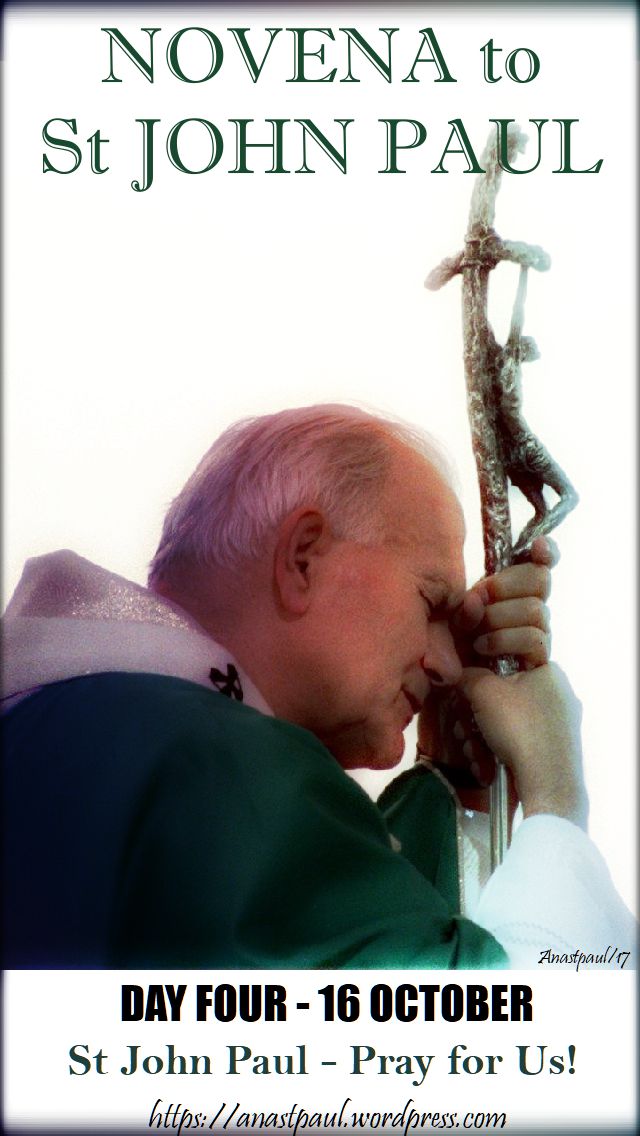
NOVENA to St John Paul the Great: DAY FOUR – 16 OCTOBER

NOVENA to St John Paul the Great: DAY FOUR – 16 OCTOBER

Little Known Fact #4:  In his second assignment as a newly ordained priest, Father Karol Wojtyla took a new approach to training altar boys. He would hold frequent evenings of instruction, whereby one priest would give catechesis to the boys while another priest taught the parents educational psychology as well as catechesis in the liturgy.   In addition to these meetings, Father Wojtyla and the other parish priests would take the boys on outings.   This model proved to be a great success as the number of altar boys went from 10 in 1946 to 100 in 1952.

REFLECTION:   ” In the first years of his pontificate, still young and full of energy, the Holy Father went to the very ends of the earth, guided by Christ.   But afterwards, he increasingly entered into the communion of Christ’s sufferings;  increasingly he understood the truth of the words:  “Someone else will fasten a belt around you.”   And in this very communion with the suffering Lord, tirelessly and with renewed intensity, he proclaimed the Gospel, the mystery of that love which goes to the end (cf Jn 13:1).” – Pope Benedictday four - novena to st john paul - 16 oct 2017

Let us Pray:

O Holy Trinity, we thank You for having given to the Church Pope John Paul II and for having made him shine with Your fatherly tenderness, the glory of the Cross of Christand the splendour of the Spirit of love.

He, trusting completely in Your infinite mercy and in the maternal intercession of Mary, has shown himself in the likeness of Jesus the Good Shepherd and has pointed out to us the way of holiness as the path to reach eternal communion with You Grant us, through his intercession, according to Your will, the grace that we implore,

………………….. [state your intention here].

Continue, beloved St John Paul, we implore you, to sustain from heaven the faith of God’s people. We praise and thank You Father that St John Paul has been numbered among Your saints and make our prayer through our Lord Jesus Christ with the Holy Spirit, one God forever.

Totus Tuus, Amen

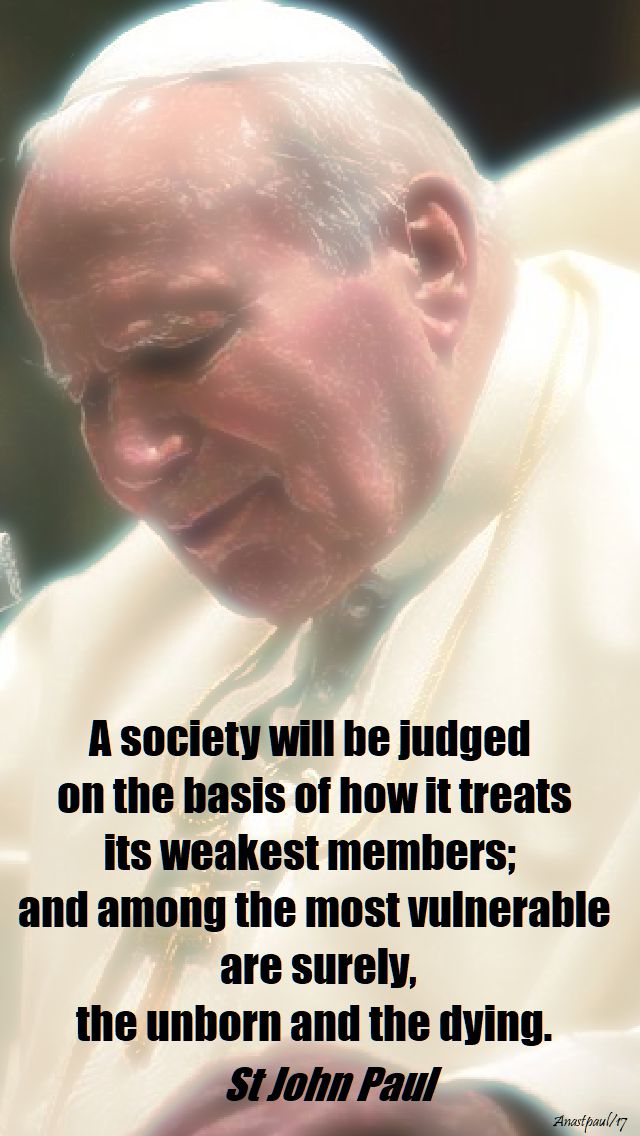
Quote Day Four:  “A society will be judged on the basis of how it treats its weakest members;  and among the most vulnerable are surely the unborn and the dying.”a society will be judged - st john paul 16 oct 2017

Posted in MORNING Prayers, PRAYERS of the SAINTS, SACRED and IMMACULATE HEARTS, SAINT of the DAY

Our Morning Offering – 16 October – The Memorial of St Margaret Mary Alacoque (1647-1690)

Our Morning Offering – 16 October – The Memorial of St Margaret Mary Alacoque (1647-1690)

A Salutation TO THE SACRED HEART
By St Margaret Mary Alacoque (1647-1690)

Hail, Heart of Jesus, save me!
Hail, Heart of my Creator, perfect me!
Hail, Heart of my Saviour, deliver me!
Hail, Heart of my Judge, grant me pardon!
Hail, Heart of my Father, govern me!
Hail, Heart of my Spouse, grant me love!
Hail, Heart of my Master, teach me!
Hail, Heart of my King, be my crown!
Hail, Heart of my Benefactor, enrich me!
Hail, Heart of my Shepherd, guard me!
Hail, Heart of my Friend, comfort me!
Hail, Heart of my Brother, stay with me!
Hail, Heart of the Child Jesus, draw me to Yourself!
Hail, Heart of Jesus dying on the Cross, redeem me!
Hail, Heart of Jesus in all Your states, give Yourself to me!
Hail, Heart of incomparable goodness, have mercy on me!
Hail, Heart of splendour, shine within me!
Hail, most loving Heart, inflame me!
Hail, most merciful Heart, work within me!
Hail, most humble Heart, dwell within me!
Hail, most patient Heart, support me!
Hail, most faithful Heart, be my reward!
Hail, most admirable and most worthy Heart, bless me!  Amena salutation to the sacred heart - st margaret mary alacoque - 16 oct 2017

Posted in INCORRUPTIBLES, JESUIT SJ, SACRED and IMMACULATE HEARTS, SAINT of the DAY

Saint of the Day – 16 October – St Margaret Mary Alacoque (1647-1690) V.H.M.

Saint of the Day – 16 October – St Margaret Mary Alacoque (1647-1690) V.H.M. Virgin, Nun, Mystic, Saint and Apostle of the Sacred Heart.  Born Marguerite-Marie Alacoque on 22 July 1647 at L’Hautecourt, Burgundy, France – 17 October 1690 of natural causes.   Patronages – against polio, against the death of parents, devotees of the Sacred Heart, polio patients.   She was Beatified on 18 September 1864 by Pope Blessed Pius IX and Canonised on 13 May 1920 by Pope Benedict XV.   When her tomb was canonically opened in July 1830, two instantaneous cures were recorded to have taken place.   Her incorrupt body rests above the side altar in the Chapel of the Apparitions, located at the Visitation Monastery in Paray-le-Monial and many striking blessings have been claimed by pilgrims attracted there from all parts of the world.SacretHeart-fcp-atp BESTchapel-of-the-apparitionsst mm shrine

She was born in 1647 AD at Janots, a small town of Burgundy, the fifth of seven children, of Claude and Philiberte Alacoque.    Her father was a prosperous notary;  the family owned a country house and farmland and had some aristocratic connections.   Margaret’s godmother was a neighbour, the Countess of Corcheval.    As a small child Margaret spent a great deal of time with her but these visits were brought to a sudden end by the death of the countess.   The father died of pneumonia when Margaret was about eight and this was another severe shock to her.   Claude had loved his family dearly but had been short-sighted and extravagant and his death put them in hard straits.   However, Margaret was sent to school with the Urbanist Sisters at Charolles.   She loved the peace and order of the convent life and the nuns were so impressed by her devotion that she was allowed to make her First Communion at the age of nine (normally around the age of 12 at that time).   A rheumatic affliction kept her bedridden for four years.   During that time she was brought home, where some of her father’s relatives had moved in and taken over the direction of the farm and household.   She and her mother were treated almost as servants.  This painful situation grew more acute after Margaret’s recovery, for the relatives tried to regulate all her comings and goings.   Not allowed to attend church as often as she pleased, the young girl was sometimes seen weeping and praying in a corner of the garden.   It grieved her deeply that she could not ease things for her mother.   Her eldest brother’s coming of age saved the day, for the property now reverted to him and the family again had undisputed possession of their home.

Philiberte had expressed a hope that Margaret would marry;  the girl considered this but at the age of twenty, inspired by a vision, she put aside all such thoughts and resolved to enter a convent.   While awaiting admission, she tried to help and teach certain neglected children of the village.   At twenty-two she made her profession at the convent of the Visitation at Paray-le-Monial.   The nuns of the Order of the Visitation, founded in the early years of the seventeenth century by St. Francis de Sales, were famed for their humility and selflessness.   As a novice Margaret excelled in these virtues.   When she made her profession, the name of Mary was added and she was called Margaret Mary. She began a course of mortifications and penances which were to continue, with more or less intensity, as long as she lived.   We are told that she was assigned to the infirmary and was not very skillful at her tasks.

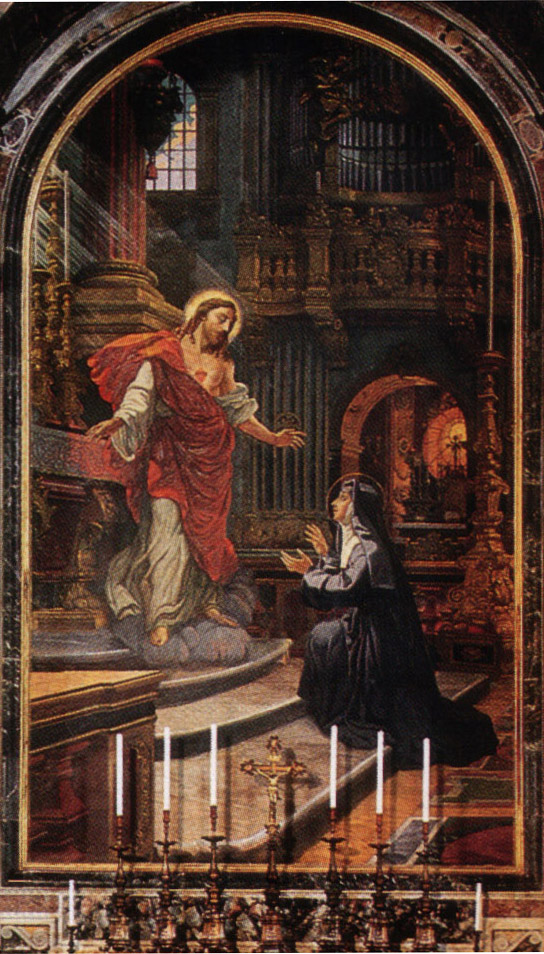
Some years passed quietly in the convent and then Margaret Mary began to have experiences which seemed to be of supernatural origin.   The first of these occurred on 27 December 1673, when she was kneeling at the grille in the chapel.   She felt suffused by the Divine Presence and heard the Lord inviting her to take the place which St John had occupied at the Last Supper.   The Lord told her that the love of His heart must spread and manifest itself to men and He would reveal its graces through her.   This was the beginning of a series of revelations covering a period of eighteen months.  When Margaret Mary went to the Superior, Mother de Saumaise, with an account of these mystical experiences, claiming that she, an humble nun, had been chosen as the transmitter of a new devotion to the Sacred Heart, she was reprimanded for her presumption.   Seriously overwrought, Margaret Mary suffered a collapse and became very ill.   The Mother Superior reflected that she might have erred in scorning the nun’s story and vowed that if her life were spared, she would take it as a sign that the visions and messages were truly from God.   When Margaret Mary recovered, the Superior invited some theologians who happened to be in the town—they included a Jesuit and a Benedictine—to hear the story.   These priests listened and judged the young nun to be a victim of delusions.   Their examination had been a sheer torture to Margaret Mary. Later a Jesuit, Father Claude de la Columbiere, talked to her and was completely convinced of the genuineness of the revelations.   He was to write of the nun and to inaugurate this devotion in England.

For many years, Margaret Mary suffered from despair, from self-inflicted punishments and also from the slights and contempt of those around her.    In 1681, Father Claude returned to the convent and died there the following year.   Margaret Mary was appointed assistant and novice-mistress by a new Mother Superior who was more sympathetic towards her.   In 1683, opposition in the community ended after an account of Margaret Mary’s visions was read aloud in the refectory from the writings left by Father Claude, who had taken it upon himself to make known to the world the nun’s remarkable experiences.    Mother Melin was elected Superior and named Margaret Mary her assistant.   That she was finally vindicated was to her a matter of indifference. She later became Novice Mistress, saw the convent observe the feast of the Sacred Heart privately beginning in 1686 and two years later, a chapel was built at the Paray-le-Monial to honour the Sacred Heart;  soon observation of the feast of the Sacred Heart spread to other Visitation convents.   When she was forty-three, while serving a second term as assistant superior, Margaret Mary fell ill.   Sinking rapidly, she received the Last Sacraments, saying, “I need nothing but God, and to lose myself in the heart of Jesus.” Margaret Mary died at the Paray-le-Monial on October 17, 1690.   Margaret Mary was canonised a saint in 1920.    She, St John Eudes, and St Claude La Colombiere are called the “Saints of the Sacred Heart”;  the devotion was officially recognised and approved by Pope Clement XIII in 1765, seventy-five years after her death.

In seventeenth-century France, the faith of the people had been badly shaken;  there had been rebellion against the Church and neglect of its teachings; the rise of Protestantism and the spread of the heresy of Jansenism both had a part in the weakening of the structure built up through the ages.   But as every threat brings its response, so now there rose up fresh, strong forces to counter these trends.   Three famous religious, who are today venerated as saints, were particularly effective:  Saint John Eudes and StClaude de la Columbiere were French Jesuit priests and writers;   Saint Margaret Mary Alacoque was a simple nun of the order of the Visitation.   Their special work was to popularise the devotion to the Sacred Heart of Jesus.  Although the devotion to the Sacred Heart of Jesus was practiced before this time, it now gained a strong new impetus through the work of Father John Eudes and the writings of Father Claude.   “The Sacred Heart is the symbol of that boundless love which moved the Word to take flesh, to institute the Holy Eucharist, to take our sins upon Himself and, dying on the Cross, to offer Himself as a victim and sacrifice to the eternal Father.”

The devotion to the Sacred Heart first became popular in France, then spread to Poland and other countries.   The first petition to the Holy See for the institution of the feast was from Queen Mary, consort of James II of England.   The month of June is appointed for this devotion and since 1929 the feast has been one of the highest rank and is celebrated on the Friday after the Solemnity of the Body and Blood of Christ.

Posted in SAINT of the DAY

Memorials of the Saints – 16 October

St Hedwig of Andechs (Optional Memorial)
St Margaret Mary Alacoque (Optional Memorial) – https://www.youtube.com/watch?v=ZsyHW9zvqiY

St Amandus of Limoges
St Ambrose of Cahors
Bl Anicet Koplinski
Bl Augustine Thevarparampil
St Balderic
St Baldwin
St Bertrand of Comminges
St Bolonia
St Conogon of Quimper
St Dulcidius of Agen
St Eliphius of Toul
St Eremberta of Wierre
St Florentinus of Trier
St Gall
St Gerard Majella
Bl Gerald of Fossanuova
Bl Jesús Villaverde Andrés
Bl Józef Jankowski
St Junian
St Lull
St Magnobodus of Angers
St Marguerite d’Youville
St Martinian of Mauretania
St Mummolinus
St Saturian of Mauretania
St Silvanus of Ahun
St Victor of Cologne
St Vitalis of Noirmoutier

Martyrs in Africa – 220 saints: A group of 220 Christians martyrs about whom we know nothing but that they died for their faith.

Martyrs of North Africa – 365 saints: A group of 365 Christians who were martyred together in the persecutions of the Vandal king Genseric. The only details that have survived are the names of two of the martyrs – Nereus and Saturninus. 450 in North Africa.

Posted in CARMELITES, DOCTORS of the Church, MORNING Prayers, QUOTES of the SAINTS, SAINT of the DAY

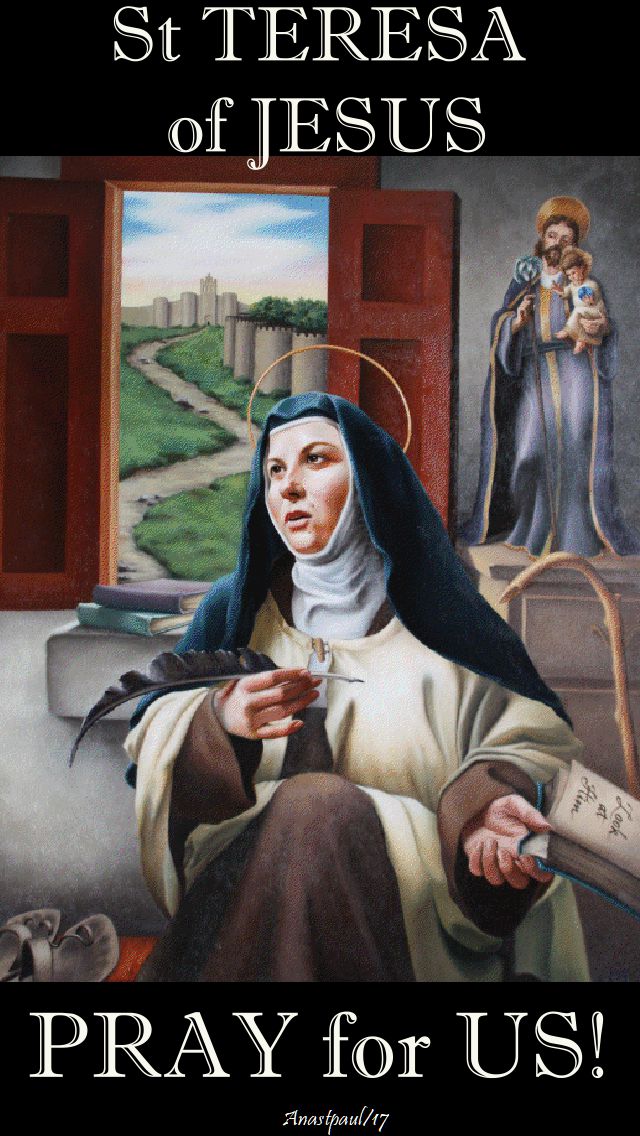
Thought for the Day – – 15 October – The Memorial of St Teresa of Jesus/Avila (1515-1582) Doctor of the Church

Thought for the Day – – 15 October – The Memorial of St Teresa of Jesus/Avila (1515-1582) Doctor of the Church

Since her encounter with Jesus, St Teresa lived “another life”; she become a tireless communicator of the Gospel (cf. Life, 23, 1).   Eager to serve the Church and in the face of serious problems of her time, she did not limit herself to being a spectator of the reality around her.   In her position as a woman and with her health difficulties, she decided, she said, “to do what little depended on me … that is to follow the evangelical counsels as perfectly as possible and to ensure that these few nuns who are here do the same” (The Way, 1, 2).   Thus began the Teresian reform, in which she asked her sisters not to lose time negotiating with God “interests of little importance,” while “the world is in flames” (ibid., 1, 5).   This missionary and ecclesial dimension has always marked the Carmelites and Discalced Carmelites.

As she did then, even today the saint opens new horizons for us, she calls us to a great undertaking, to see the world with the eyes of Christ, to seek what He seeks and to love what He loves. (Pope Francis in a letter to to Carmelite Father Xavier Cannistrà)

Ours is a time of turmoil, a time of reform, and a time of liberation. Modern women have in Teresa a challenging example.   Promoters of renewal, promoters of prayer, all have in Teresa a woman to reckon with, one whom they can admire and imitate.

St Teresa of Jesus, Pray for us!st teresa of jesus- pray for us 2

Posted in CARMELITES, DOCTORS of the Church, MORNING Prayers, QUOTES of the SAINTS, SAINT of the DAY

Quotes of the Day – 15 October – The Memorial of St Teresa of Jesus/Avila (1515-1582) Doctor of the Church

Quotes of the Day – 15 October – The Memorial of St Teresa of Jesus/Avila (1515-1582) Doctor of the Church

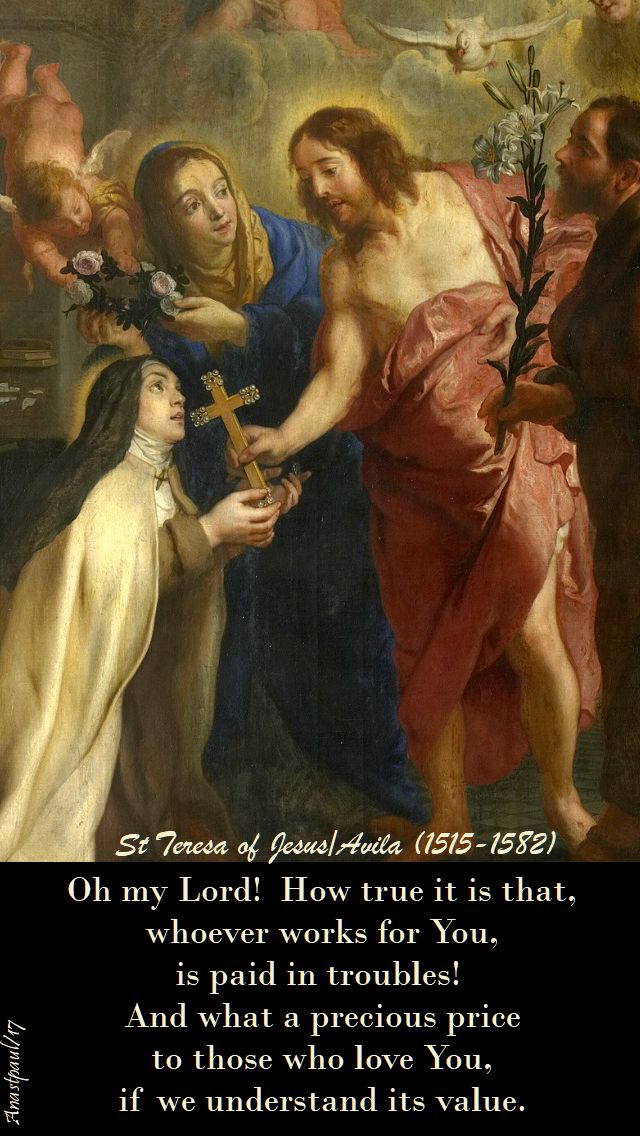
“Oh my Lord!
How true it is that,
whoever works for You,
is paid in troubles!
And what a precious price
to those who love You,
if we understand its value.”oh my lord - st teresa of jesus - 15 oct 2017

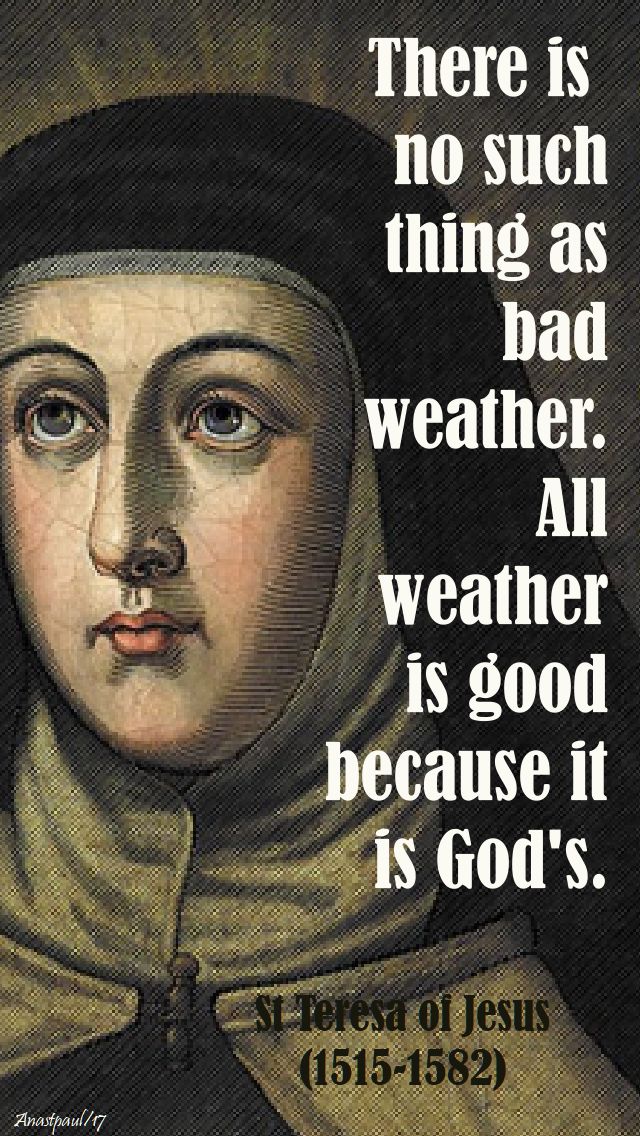
“There is no such thing as bad weather.
All weather is good because it is God’s.”there is no such thing - st teresa of jesus - 15 oct 2017

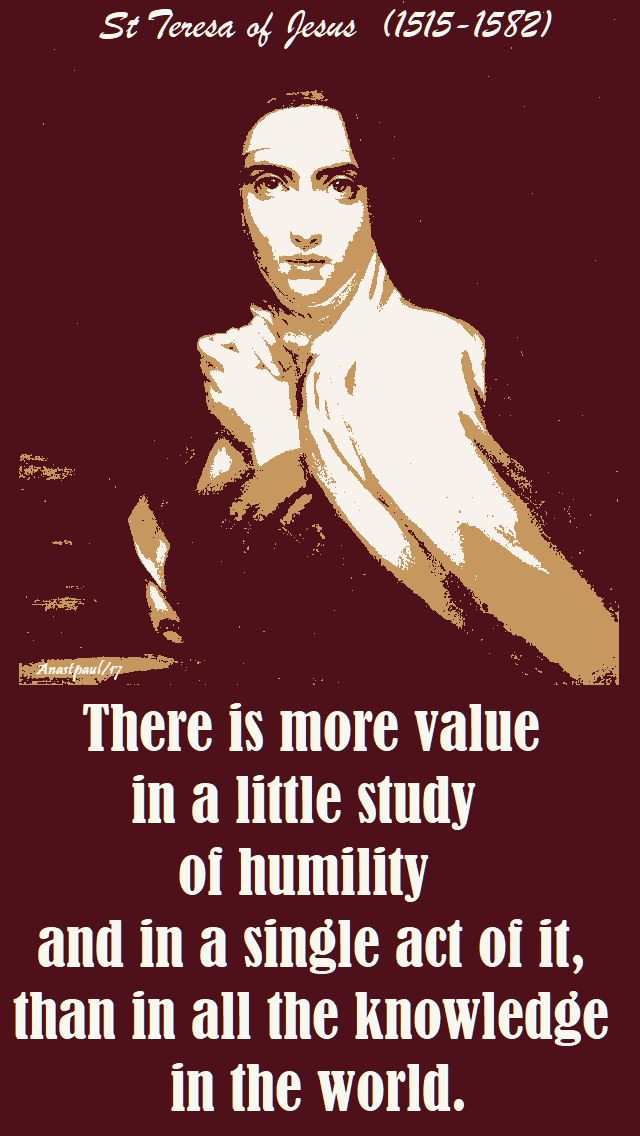
“There is more value in a little study of humility
and in a single act of it,
than in all the knowledge in the world.”there is more value - st theresa of jesus - 15 oct 2017

“We need no wings to go in search of Him
but have only to look upon Him,
present within us.”we need no wings - st teresa of jesus - 15 oct 2017

“Hope, O my soul, hope.
You know neither the day nor the hour.
Watch carefully, for everything passes quickly,
even though your impatience makes doubtful,
what is certain and turns
a very short time into a long one.”

St Teresa of Jesus (1515-1582)hope o my soul hope - st teresa - 15 october 2017

Posted in CARMELITES, DOCTORS of the Church, MORNING Prayers, PRAYERS of the SAINTS, SAINT of the DAY

Our Morning Offering – 15 October – The Memorial of St Teresa of Jesus/Avila (1515-1582)

Our Morning Offering – 15 October – The Memorial of St Teresa of Jesus (1515-1582)

To Redeem Lost Time
By St Teresa of Jesus
(1515-1582) Doctor of the Church

O my God! Source of all mercy!
I acknowledge Your sovereign power.
While recalling the wasted years that are past,
I believe that You, Lord,
can in an instant turn this loss to gain.
Miserable as I am,
yet I firmly believe that You can do all things.
Please restore to me the time lost,
giving me Your grace,
both now and in the future,
that I may appear before You in “wedding garments.”
Amenprayer to redeem lost time by st teresa of jesus - 15 oct 2017

Posted in CARMELITES, DOCTORS of the Church, MORNING Prayers, QUOTES of the SAINTS, SAINT of the DAY, The WORD

One Minute Reflection – 15 October – The Memorial of St Teresa of Jesus/Avila (1515-1582) Doctor of the Church

One Minute Reflection – 15 October – The Memorial of St Teresa of Jesus/Avila (1515-1582) Doctor of the Church

If we have died with him
we shall also live with him;
if we persevere
we shall also reign with him.
But if we deny him
he will deny us.
If we are unfaithful
he is always faithful,
for he cannot disown his own self..…2 Timothy 2:11-13

REFLECTION – “If Christ Jesus dwells in a man as his friend and noble leader, that man can endure all things, for Christ helps and strengthens us and never abandons us.   He is a true friend.   And I clearly see that is we expect to please Him and receive an abundance of His graces, God desires that these graces must come to us from the hands of Christ, through His most sacred humanity, in which God takes delight.   All blessings come to us through our Lord.   He will teach us, for in beholding His life we find that He is the best example.   What more do we desire from such a good friend at our side? Unlike our friends in the world, He will never abandon us when we are troubled or distressed.   Blessed is the one who truly loves Him and always keeps Him near. Whenever we think of Christ we should recall the love that led Him to bestow on us so many graces and favours and also the great love God showed in giving us in Christ a pledge of His love;  for love calls for love in return.   Let us strive to keep this always before our eyes and to rouse ourselves to love Him.   For if at some time the Lord should grant us the grace of impressing His love on our hearts, all will become easy for us and we shall accomplish great things quickly and without effort.” – Saint Teresa of Jesusif christ jesus dwells in a man - st teresa of jesus - 15 oct 2017

PRAYER – Almighty God, our Father, You sent St Teresa of Jesus to be a witness in the Church to the way of perfection.   Sustain us by her spiritual doctrine and kindle in us, the longing for true holiness.   Through Christ, our Lord, in union with the Holy Spirit.   St Teresa pray for us, amenst teresa of jesus - pray for us

Posted in CARMELITES, DOCTORS of the Church, Of the SICK, the INFIRM, All ILLNESS, PATRONAGE - HEADACHES, QUOTES of the SAINTS, SAINT of the DAY

Saint of the Day – 15 October – St Teresa of Jesus/of Avila (1515-1582) Doctor of the Church

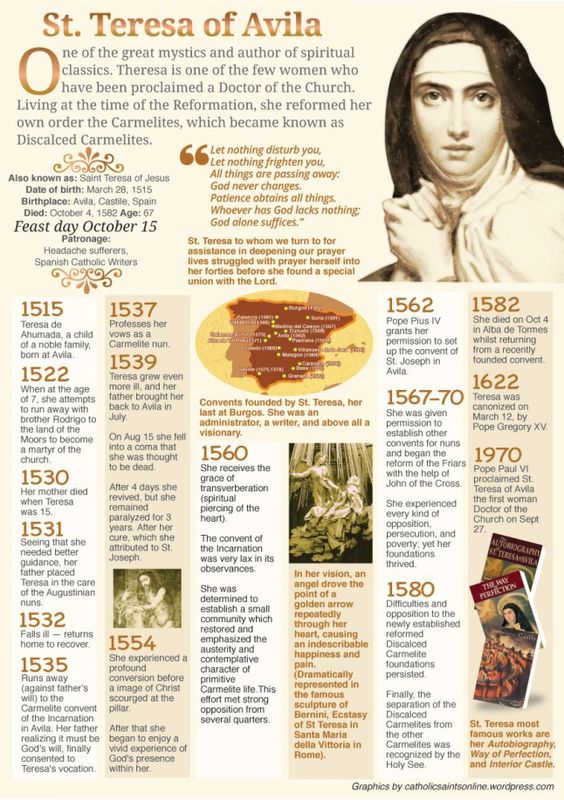
Saint of the Day – 15 October – St Teresa of Jesus/of Avila (1515-1582) Virgin, Mystic, Ecstatic, Reformer, Apostle of Prayer, Writer, Doctor of the Church.    Born as Teresa Sanchez Cepeda Davila y Ahumada  at Avila, Old Castile, on 28 March 1515 –  died at Alba de Tormes, 4 October 1582 of natural causes in the arms of her secretary and close friend Blessed Anne of Saint Bartholomew.  Her relics are preserved at Alba – her heart shows signs of Transverberation (piercing of the heart), and is displayed, too.   Her Body is incorrupt.  Patronages: • sick people; against bodily ills or sickness • against headaches • against the death of parents • lace makers or lace workers • people in need of grace • people in religious orders • people ridiculed for their piety • World Youth Day 2011 • Amos, Canada, diocese of • Avellaneda-Lanús, Argentina, diocese of • Berzano di Tortona, Italy • Pozega, Croatia • Spain.   Attributes –   Habit of the Discalced Carmelites, Book and Quill, arrow-pierced heart.   St Teresa was Beatified on 24 April 1614 by Pope Paul V and Canonised on 12 March 1622, only forty years after her death, by Pope Gregory XV.   Tradition associate Saint Teresa with the Infant Jesus of Prague with claims of former ownership and devotion.   On 27 September 1970 St Teresa, was named a Doctor of the Church by Pope Paul VI.   Her books, which include her autobiography (The Life of Teresa of Jesus) and her seminal work El Castillo Interior (trans.: The Interior Castle), are an integral part of Spanish Renaissance literature as well as Christian mysticism and Christian meditation practices.   She also wrote Camino de Perfección (trans.: The Way of Perfection).

original portait by Fray Juan de la Miseria in 1576
Original Portrait by Frei Jual de la Miseria in 1576

st teresa info

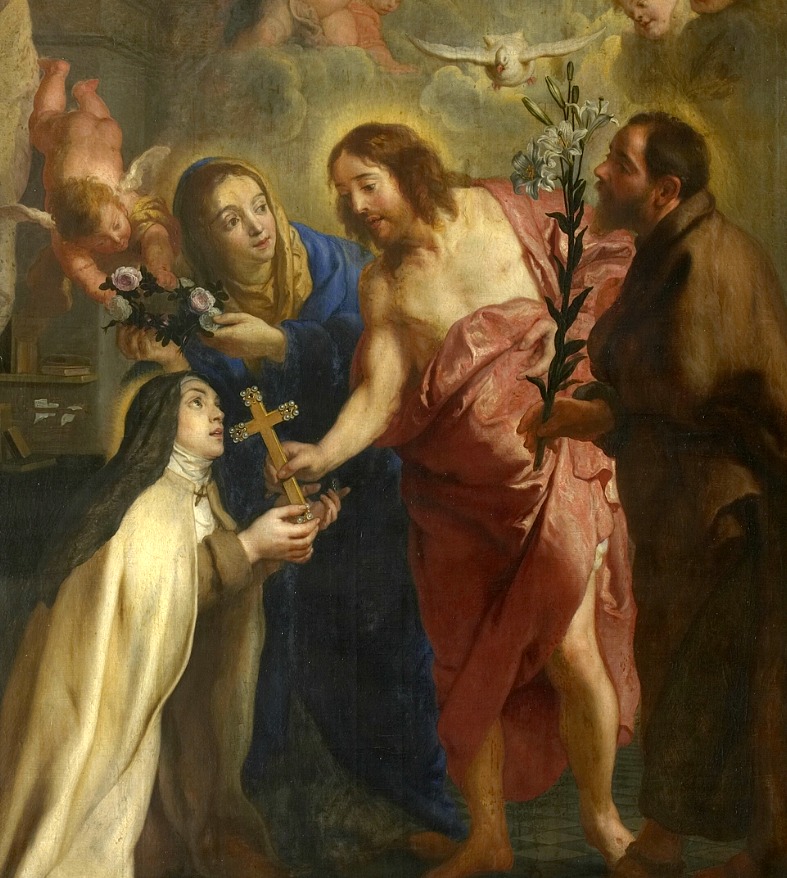
The third child of Don Alonso Sanchez de Cepeda by his second wife, Doña Beatriz Davila y Ahumada, who died when the Teresa was in her fourteenth year, Teresa was brought up by her saintly father, a lover of serious books and a tender and pious mother.   After her death and the marriage of her eldest sister, Teresa was sent for her to the Augustinian nuns at Avila but owing to illness she left at the end of eighteen months and for some years remained with her father and occasionally with other relatives, notably an uncle who made her acquainted with the Letters of St Jerome, which determined her to adopt the religious life, not so much through any attraction towards it, as through a desire of choosing the safest course.   Unable to obtain her father’s consent she left his house unknown to him to enter the Carmelite Convent of the Incarnation at Avila, which then counted 140 nuns.   The wrench from her family caused her a pain which she ever afterwards compared to that of death. However, her father at once yielded and Teresa took the habit.St. Teresa of Avila Receives the Veil and Necklace from the Virgin and

Teresa lived in an age of exploration as well as political, social and religious upheaval.   It was the 16th century, a time of turmoil and reform.   She was born before the Protestant Reformation and died almost 20 years after the closing of the Council of Trent.

The gift of God to Teresa in and through which she became holy and left her mark on the Church and the world is threefold:   she was a woman;   she was a contemplative;   she was an active reformer.

As a woman, Teresa stood on her own two feet, even in the man’s world of her time.   She was “her own woman,” entering the Carmelites despite strong opposition from her father.   She is a person wrapped not so much in silence as in mystery.   Beautiful, talented, outgoing, adaptable, affectionate, courageous, enthusiastic, she was totally human.   Like Jesus, she was a mystery of paradoxes:  wise, yet practical;  intelligent, yet much in tune with her experience;  a mystic, yet an energetic reformer;  a holy woman, a womanly woman.

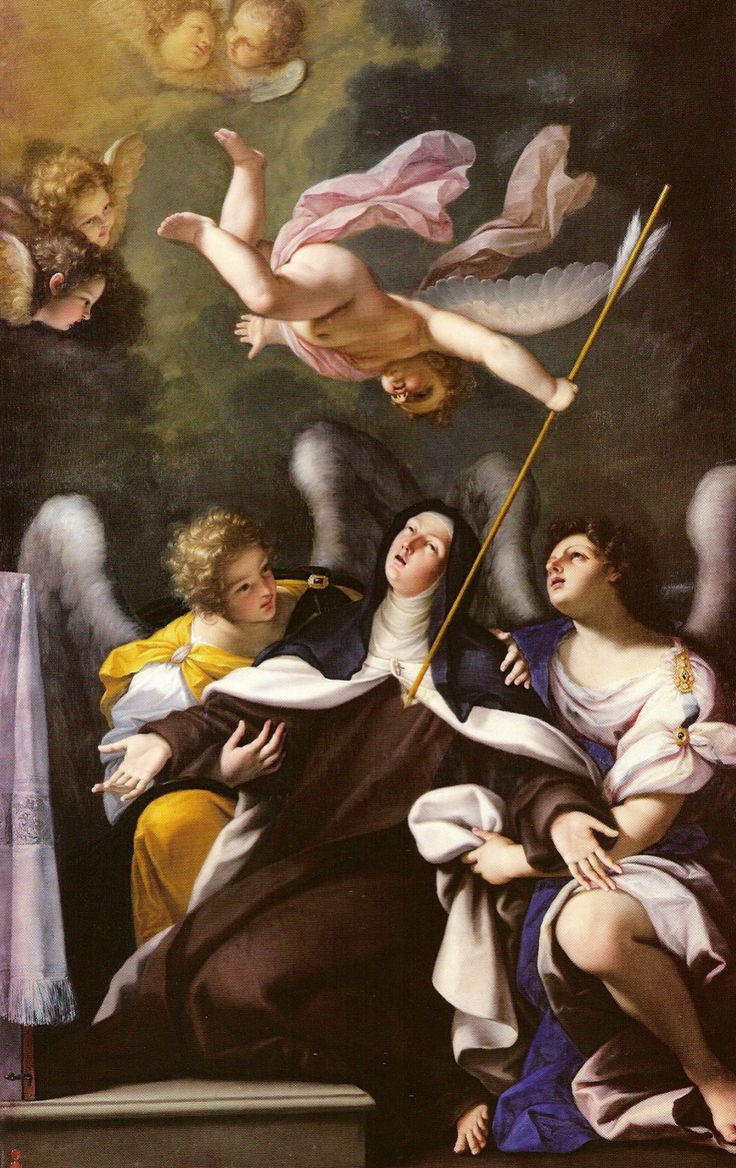
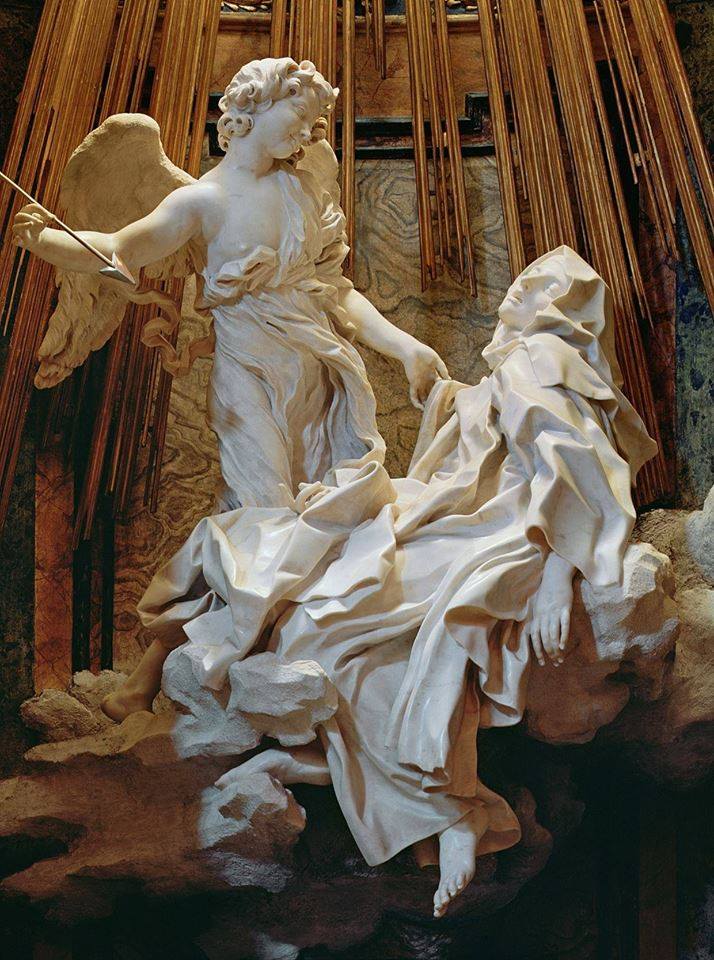
On St Peter’s Day in 1559, Teresa became firmly convinced that Jesus Christ presented Himself to her in bodily form, though invisible.   These visions lasted almost uninterrupted for more than two years.   In another vision, a seraph drove the fiery point of a golden lance repeatedly through her heart, causing an ineffable spiritual-bodily pain.st teresa avila Gaspar_de_Crayer_-_The_vision_of_St_Theresa_of_Avila

I saw in his hand a long spear of gold and at the point there seemed to be a little fire.   He appeared to me to be thrusting it at times into my heart and to pierce my very entrails;   when he drew it out, he seemed to draw them out also and to leave me all on fire with a great love of God.   The pain was so great, that it made me moan;  and yet so surpassing was the sweetness of this excessive pain, that I could not wish to be rid of it…avila - ecstasy

This vision was the inspiration for one of Bernini’s most famous works, the Ecstasy of Saint Teresa at Santa Maria della Vittoria in Rome.avila - berniniavila - bernini altar

The memory of this episode served as an inspiration throughout the rest of her life and motivated her lifelong imitation of the life and suffering of Jesus, epitomised in the motto usually associated with her:  Lord, either let me suffer or let me die.St.-Teresa-of-AvilaGiuseppe_Bazzani_-_The_Ecstasy_of_St_Therese_-_WGA01527

Teresa was a woman “for God,” a woman of prayer, discipline and compassion.   Her heart belonged to God.   Her ongoing conversion was an arduous lifelong struggle, involving ongoing purification and suffering.   She was misunderstood, misjudged and opposed in her efforts at reform.   Yet she struggled on, courageous and faithful;  she struggled with her own mediocrity, her illness, her opposition.   And in the midst of all this she clung to God in life and in prayer.   Her writings on prayer and contemplation are drawn from her experience:  powerful, practical and graceful.   She was a woman of prayer;  a woman for God.

Teresa was a woman “for others.”   Though a contemplative, she spent much of her time and energy seeking to reform herself and the Carmelites, to lead them back to the full observance of the primitive Rule.   She founded over a half-dozen new monasteries.   She traveled, wrote, fought—always to renew, to reform.   In her self, in her prayer, in her life, in her efforts to reform, in all the people she touched, she was a woman for others, a woman who inspired and gave life.

Her final illness overtook her on one of her journeys from Burgos to Alba de Tormes.   She died in 1582, just as Catholic nations were making the switch from the Julian to the Gregorian calendar, which required the removal of 5–14 October from the calendar.   She died either before midnight of 4 October or early in the morning of 15 October which is celebrated as her feast day.   Her last words were:  “My Lord, it is time to move on. Well then, may your will be done. O my Lord and my Spouse, the hour that I have longed for has come.  It is time to meet one another.”

Her writings, especially the Way of Perfection and The Interior Castle, have helped generations of believers.   She and St Catherine of Siena were the first women so honoured as Doctors of the Church.

Interesting fact – her Spiritual Director was St Francis Borgia whose Feast Day we celebrated on 10 October.