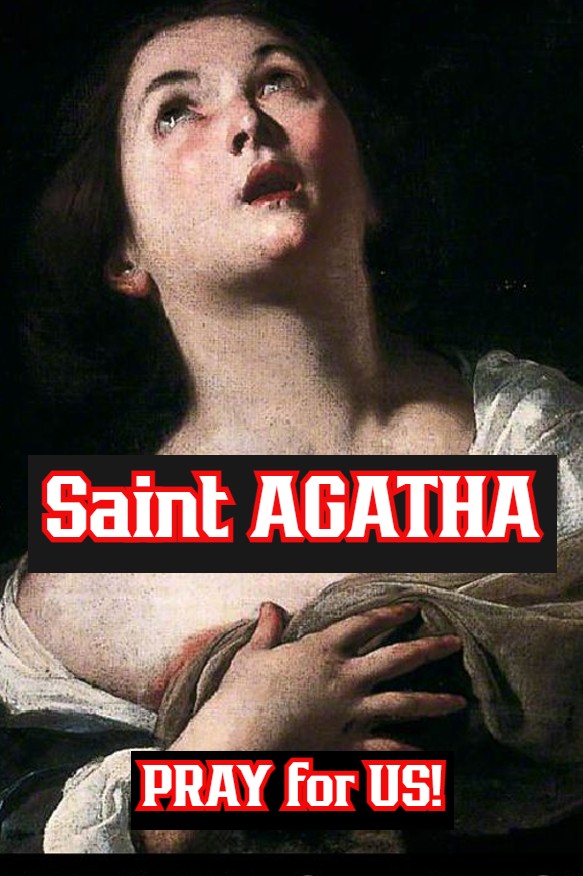
Quote/s of the Day – 5 February – St Agatha (c 231- c 251) Virgin and Martyr – 1 Corinthians 1:26-31, Matthew 19:3-12
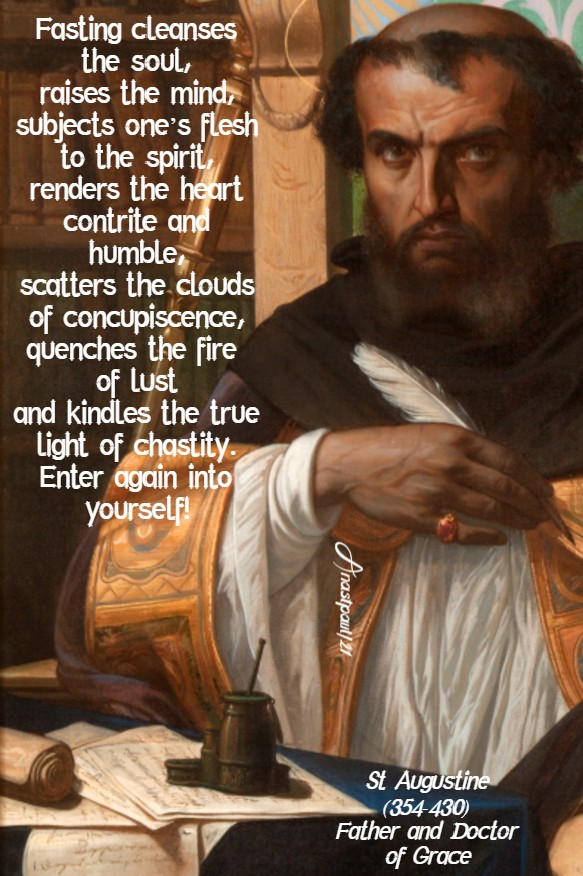
“Fasting cleanses the soul, raises the mind, subjects one’s flesh to the spirit, renders the heart contrite and humble, scatters the clouds of concupiscence, quenches the fire of lust and kindles the true light of chastity. Enter again into yourself!”
St Augustine (354-430) Bishop of Hippo Father and Doctor of Grace
“If the poison of pride is swelling up in you, turn to the Eucharist and that Bread, Which is your God humbling and disguising Himself, will teach you humility.
If the fever of selfish greed rages in you, feed on this Bread and you will learn generosity.
If the cold wind of coveting withers you, hasten to the Bread of Angels and charity will come to blossom in your heart.
If you feel the itch of intemperance, nourish yourself with the Flesh and Blood of Christ, Who practiced heroic self-control during His earthly life and you will become temperate.
If you are lazy and sluggish about spiritual things, strengthen yourself with this heavenly Food and you will grow fervent.
Lastly, if you feel scorched by the fever of impurity, go to the banquet of the Angels and the spotless Flesh of Christ, will make you pure and chaste.”
St Cyril of Alexandria (376-444) Father and Doctor
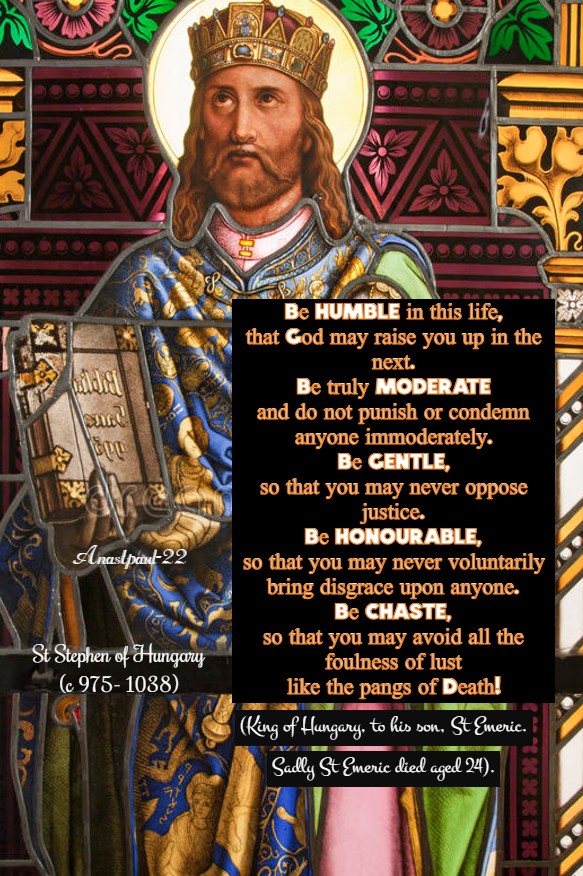
“Be HUMBLE in this life, that God may raise you up in the next. Be truly MODERATE and do not punish or condemn anyone immoderately. Be GENTLE, so that you may never oppose justice. Be HONOURABLE, so that you may never voluntarily bring disgrace upon anyone. Be CHASTE, so that you may avoid all the foulness of lust like the pangs of death.”
St Stephen of Hungary (c 975- 1038)
(King of Hungary, to his son, St Emeric. Sadly St Emeric died aged 24 but had taken a private vow of Celibacy.)
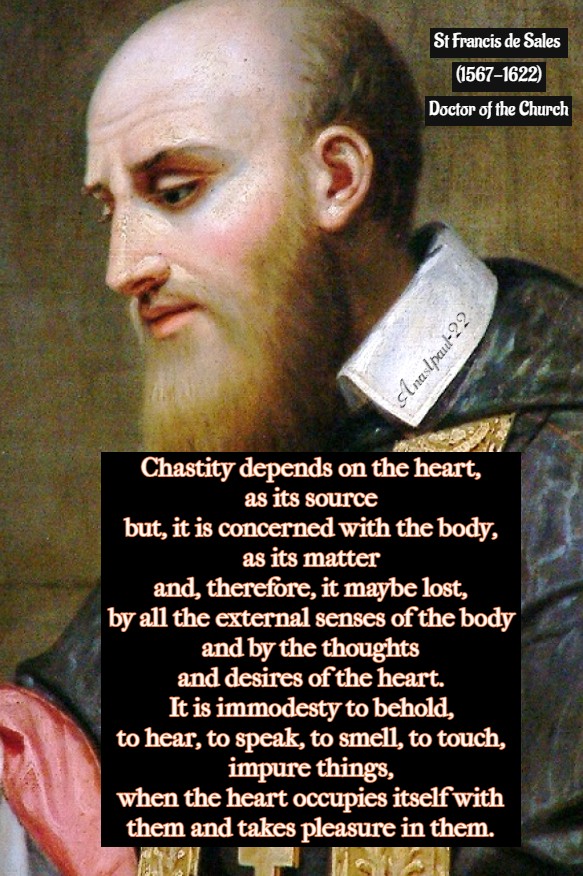
“Chastity depends on the heart, as its source but, it is concerned with the body, as its matter and, therefore, it maybe lost, by all the external senses of the body and by the thoughts and desires of the heart. It is immodesty to behold, to hear, to speak, to smell, to touch, impure things, when the heart occupies itself with them and takes pleasure in them.”
St Francis de Sales (1567-1622) Doctor of the Church
(Introduction to the Devout Life Part Three Chap 13).
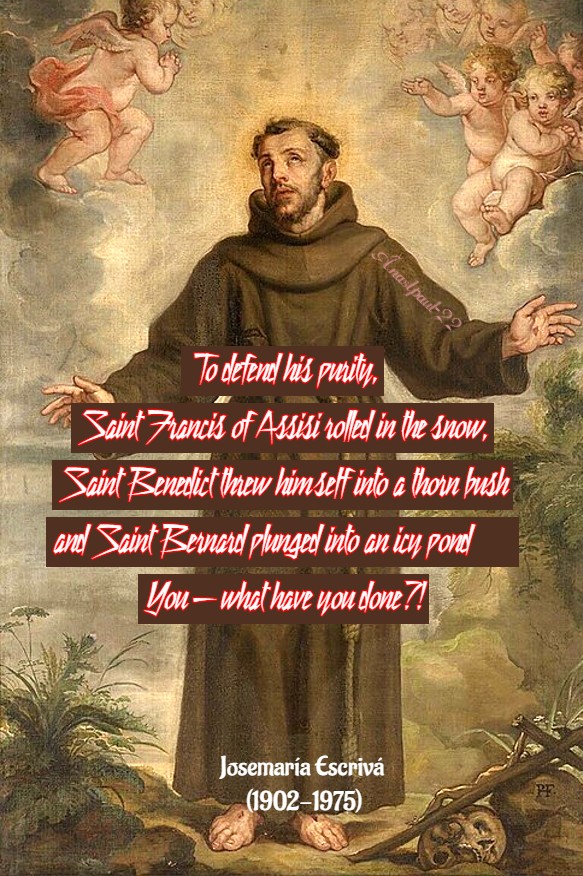
“To defend his purity, Saint Francis of Assisi rolled in the snow, Saint Benedict threw himself into a thorn bush and Saint Bernard plunged into an icy pond… You – what have you done?”
One Minute Reflection – 5 February – St Agatha (c 231- c 251) Virgin and Martyr – 1 Corinthians 1:26-31, Matthew 19:3-12
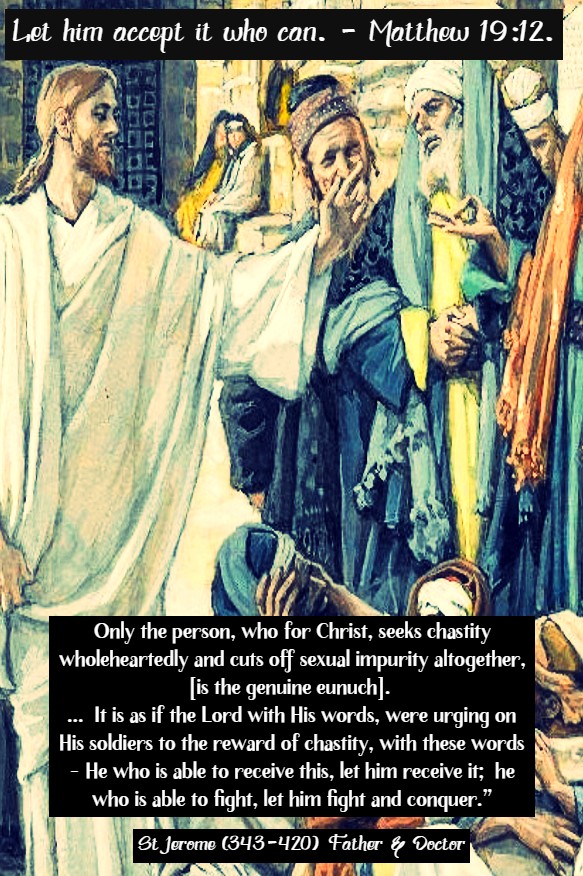
“For there are eunuchs who were born so, from their mother’s womb and there are eunuchs who were made so, by men and there are eunuchs who have made themselves so, for the sake of the kingdom of heaven. Let him accept it who can..” – Matthew 19:12.
REFLECTION – “There are three kinds of eunuchs, two carnal and the third spiritual. One group are those who are born this way. Another are those who are made into eunuchs by captivity or for pleasuring older women. The third are those who “have made themselves eunuchs for the kingdom of heaven” and who become eunuchs for Christ, although they could be whole men. The last group are promised the reward. The other two, for whom chastity is not a matter of willing but necessity, are due nothing at all. We can put it another way. There are eunuchs from birth, who are of a rather frigid nature and not inclined to lust. There are others, who are made eunuchs by men, those who are made so by philosophers, others who are made weak toward sex from their worship of idols and still others, who by heretical persuasion feign chastity, so as to falsely claim the truth of religion. None of the above is receptive to the Kingdom of Heaven.
Only the person, who for Christ, seeks chastity wholeheartedly and cuts off sexual impurity altogether, [is the genuine eunuch]. So he adds, “He who is able to receive this, let him receive it,” so that each of us should look to his own strength, as to whether he can carry out the commands of virginity and chastity. Chastity in itself is agreeable and alluring but one must look to one’s strength, so that “he who is able to receive this may receive it.” It is as if the Lord with His words, were urging on His soldiers to the reward of chastity, with these words – He who is able to receive this, let him receive it; he who is able to fight, let him fight and conquer.” – St Jerome (343-420) Translator of Sacred Scripture (the Vulgate), Father and one of the original four Doctors of the Latin Church (Commentary on Matthew 3).
PRAYER – O God, Who among other wonders of Your power have given the victory of martyrdom even to the gentler sex, graciously grant that we, who commemorate the anniversary of the death of blessed Agatha, Your Virgin and Martyr, may come to You by following her example. Through Jesus Christ, Thy Son our Lord, Who lives and reigns with Thee, in the unity of the Holy Ghost, God, world without end. Amen (Collect).
Our Morning Offering – 5 February – Mary’s Saturday
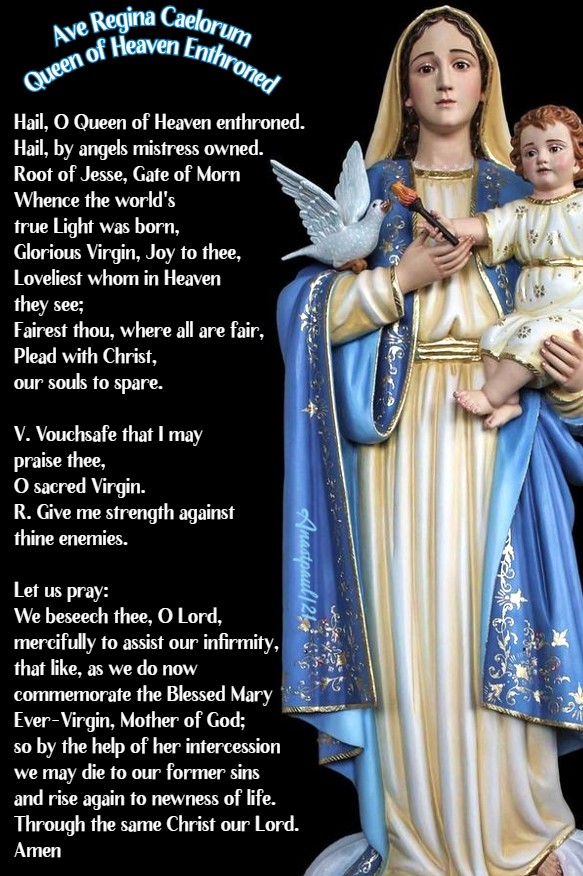
Ave Regina Caelorum Queen of Heaven Enthroned
Hail, O Queen of Heaven enthroned. Hail, by Angels mistress owned. Root of Jesse, Gate of Morn Whence the world’s true Light was born, Glorious Virgin, Joy to thee, Loveliest whom in Heaven they see; Fairest thou, where all are fair, Plead with Christ, our souls to spare.
V. Vouchsafe that I may praise thee, O sacred Virgin. R. Give me strength against thine enemies.
Let us pray: We beseech thee, O Lord, mercifully to assist our infirmity, that like, as we do now commemorate the Blessed Mary Ever-Virgin, Mother of God; so by the help of her intercession we may die to our former sins and rise again to newness of life. Through the same Christ our Lord. Amen
“Ave Regina caelorum” is one of the Marian antiphons said or sung in the Liturgy of the Hours at the close of compline. In the Roman Breviary as revised by Pope Pius V in 1569 it was assigned for this use from compline of 2 February until compline of Wednesday of Holy Week. The original author is unknown – it has been found in a manuscript from the twelfth-century. It has been set to music by various composers including Hyden and many others.
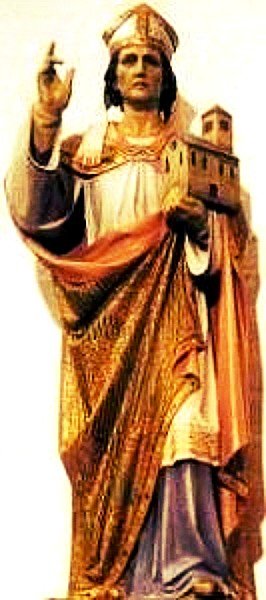
Saint of the Day – 5 February – Saint Albinus of Brixen (Died 1005) Bishop of Brixen, Advisor to both Emperors of the Holy Roman Empire, Otto II and Henry II. Born in the 10th century Carinthia, Austria and died on 5 February 1005 in Brixen, Italy of natural causes. Patronages – against drought, the City of Brixen, Italy and the Diocese of Brixen, Italy. Also known as – Albinus of Sabion, Albinus of Bressanone, .lbuin, Alboino, Albuino, Albuinus
The Roman Martyrology: states: “In Bressanone (Brixen) in South Tyrol, commemoration of St Albuino, Bishop, who transferred the Episcopal Chair from Sabion to this seat.”
Albinus was born in the first half the 10th Century. He was the son of Blessed Agatha Hildegardis of Carinthia and Count Paul, Margrave of Carinthia, of the noble and powerful Ariboni family,
As a young man he attended the schools of the Cathedral of Brixen, then entered the clergy and became the Bishop of the City of Sabion, South Tyrol (in modern Italy) around 975.
During his Episcopal term he brought many gifts, lands and properties, endowed both by his family and by the Emperors Otto II and Henry II, in gratitude for his counsel, the latter to whom, Albinus was related, as well as being his close friend. Some of these endowments, for example, were: a property in Regensburg and another in Villach in his native Carinthia, which included a Castle and which was transformed by him, into a Church. This beautiful Church still stands today. Land was also awarded to him in Krain.
In 991 , he moved his Bishopric from Brixen (now Bressanone), closer to the Diocese that the See should govern. Thus he became the last Bishop of Sabion and the First of Bressanone (previously Brixen). He also arranged for the translation of the relics of St Ingenuinus (Died 605) a predecessor Bishop of Sabion.
He died on 5 February 1005, after over 30 years of ruling his See.
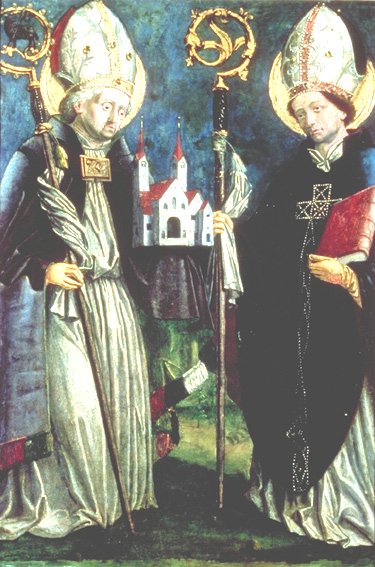
At the end of the 11th century he was already venerated as a saint and associated with Ingenuinus. Blessed Artmann (a successor) gathered the relics of both under the same Altar and from that time, their names were inserted together on 5 February in calendars, while their cult extended to the Dioceses of Trent, Freising and Eichstaett.
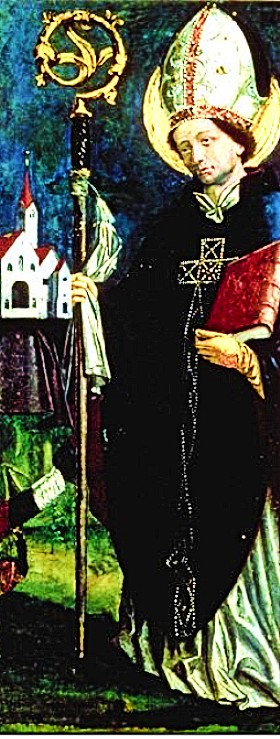
St Ingenuinu left and St Albinus on the right
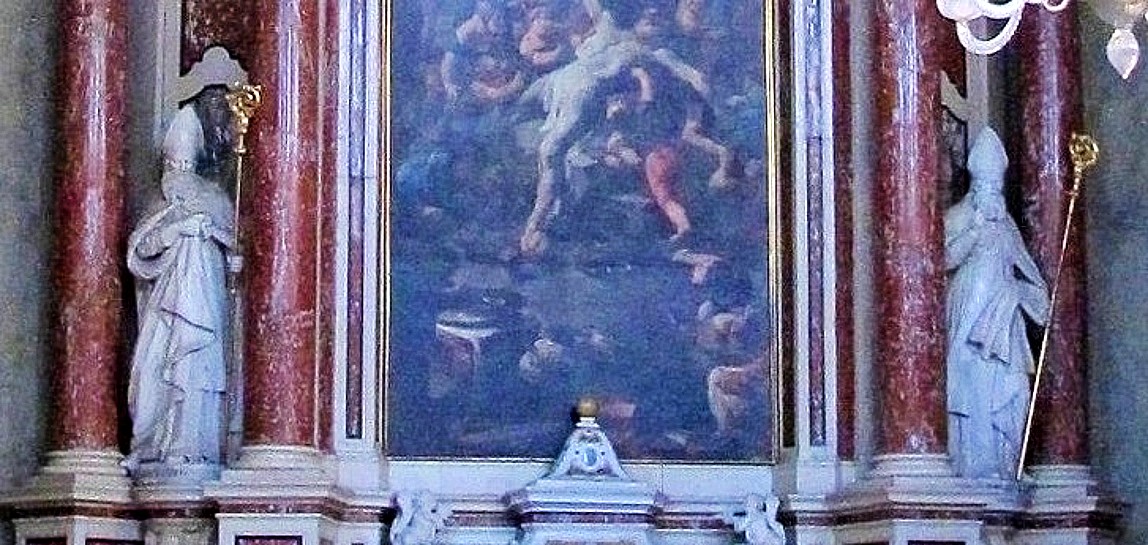
The relics of the two Saints are kept on the Altar of St Cassian in the Basilica of Bressanone, which also contains a Chasuble which is believed to have belonged to St Albinus, while their heads are kept in two silver reliquaries.
St Bertulph St Buo of Ireland St Calamanda of Calaf St Dominica of Shapwick St Fingen of Metz Bl Françoise Mézière St Gabriel de Duisco St Genuinus of Sabion St Indract St Isidore of Alexandria St Jesús Méndez-Montoya Bl John Morosini St Kichi Franciscus St Luca di Demenna St Modestus of Carinthia
Bl Primo Andrés Lanas St Saba the Younger St Vodoaldus of Soissons
Martyrs of Pontus: An unknown number of Christians who were tortured and martyred in assorted painful ways in the region of Pontus (in modern Turkey) during the persecutions of Maximian.
The Twenty-Six Martyrs of Japan: 26 Saints – the First Martyrs of Japan. Martyred on 5 February 1597 by Crucifixion, also known as Pedro Bautista Blasquez y Blasquez and 22 companions, along with Paulus Miki and 2 companions, were Beatified on 14 September 1627 by Pope Urban VIII, and Canonised on 8 June 1862 by Pope Pius IX.
Thought for the Day – 4 February – Meditations with Antonio Cardinal Bacci (1881-1971)
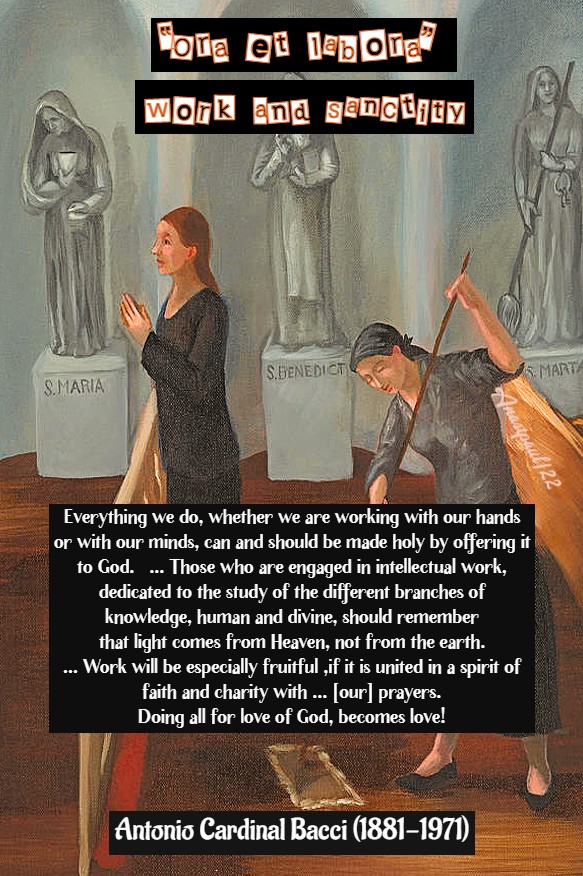
“Ora et labora” – Work and Sanctity
“Everything we do, whether we are working with our hands or with our minds, can and should be made holy by offering it to God. The peasant who toils in the heart of the sun or in the hardship of winter, to wring a living from the hard soil, the workman who strikes the anvil with his hammer, or who extracts coal from the bowels of the earth, or who controls some complicate piece of machinery in order to produce the press, electricity or other services for men – all these can and should raise their minds frequently in adoration and thanksgiving to God, the Creator and Giver of every good.
In the same way, those who are engaged in intellectual work, dedicated to the study of the different branches of knowledge, human and divine, should remember that light comes from Heaven, not from the earth. They should, therefore, ask in their prayers for God’s help. Science without God is cold and soulless. It can do more harm than good. It fills the soul with pride and dries up the heart. It can lead, as experience has shown us, to the destruction, instead of the wellbeing, of the human race. Students and scientists must be investigators of the mysteries of God, as well as those, of the universe. Only in God will they find an answer to the problems of the spirit.
There are some who work with both their minds and hearts. These include priests, teachers, doctors, good sisters sacrificing their lives in the hospitals, the mothers of families and many others. Their work will be especially fruitful, if it is united in a spirit of faith and charity with their prayers. Doing all for love of God, becomes love!”
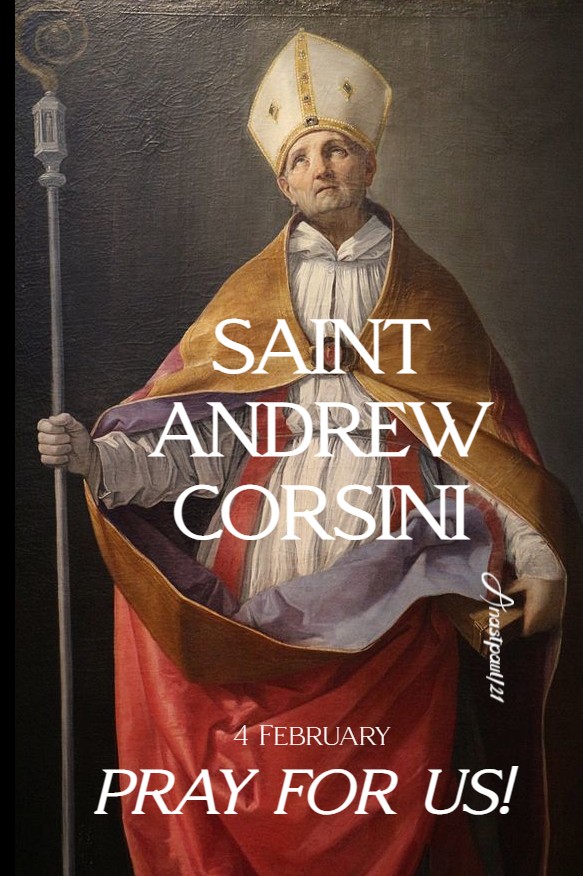
Quote/s of the Day – 4 February – The Memorial of St Andrew Corsini O.Carm (1302-1373) Bishop, Confessor r – Sirach 44:16-27; 45:3-20, Matthew 25:14-23
“And he who had received the five talents went and traded with them, and gained five more.”
Matthew 25:16
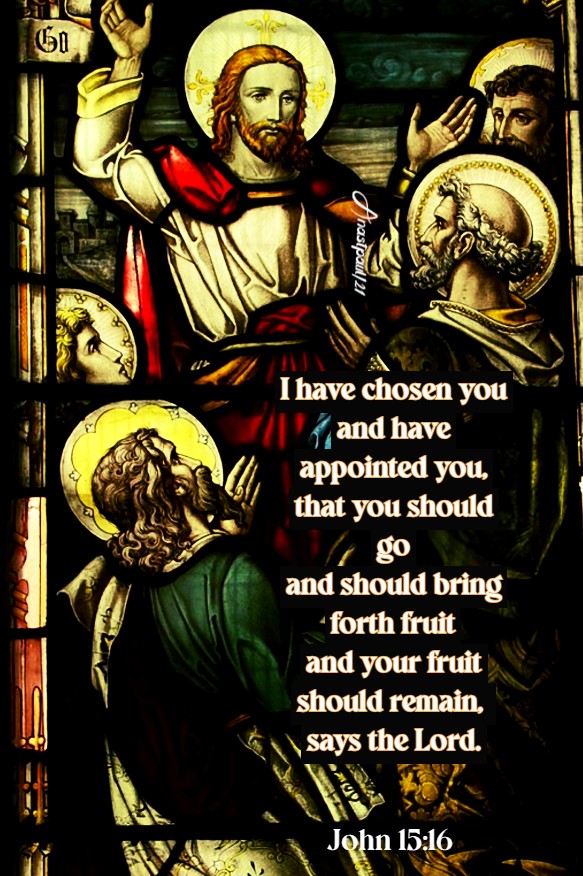
“I have chosen you and have appointed you, that you should go and should bring forth fruit and your fruit should remain, says the Lord.”
John 15:16
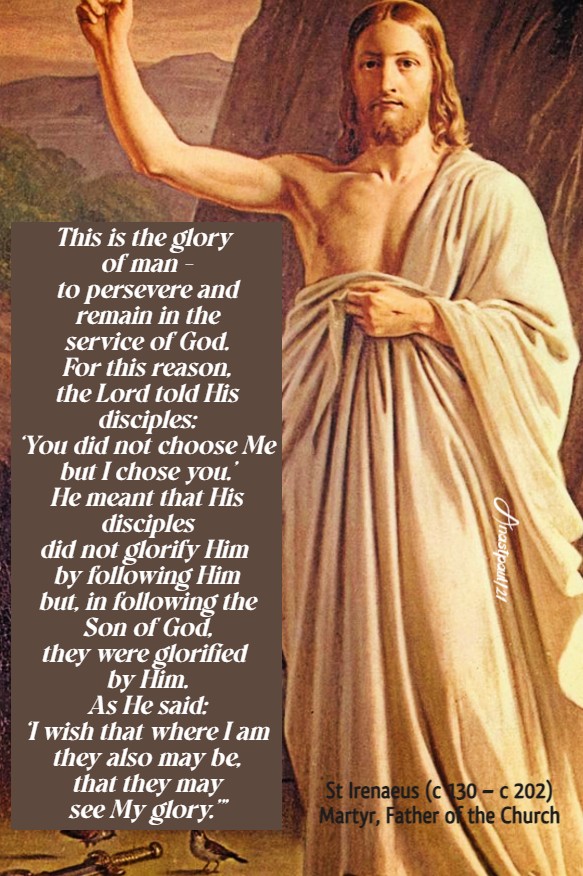
“This is the glory of man – to persevere and remain in the service of God. For this reason, the Lord told His disciples: ‘You did not choose Me but I chose you.’ He meant that His disciples did not glorify Him by following Him but, in following the Son of God, they were glorified by Him. As He said: ‘I wish that where I am they also may be, that they may see My glory.’”
St Irenaeus (c 130 – c 202) Bishop & Martyr, Father of the Church
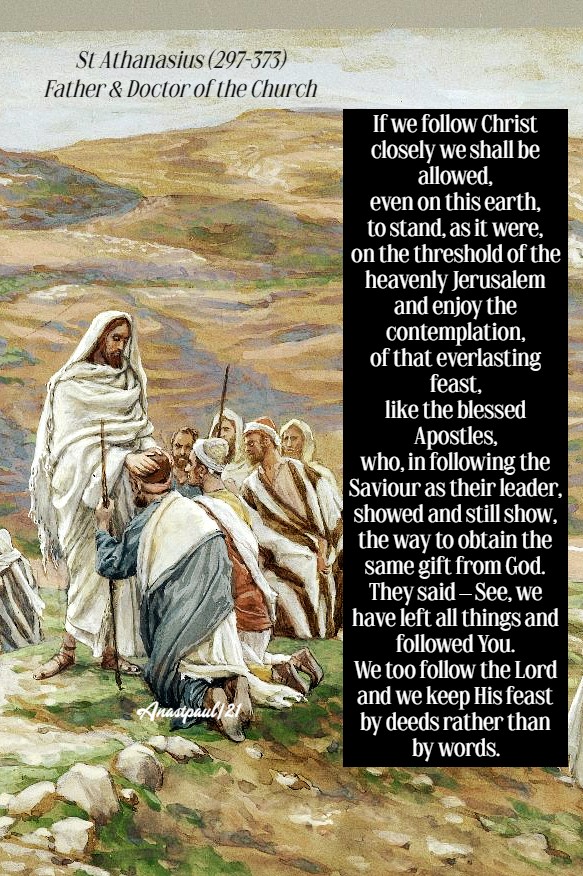
“If we follow Christ closely we shall be allowed, even on this earth, to stand, as it were, on the threshold of the heavenly Jerusalem and enjoy the contemplation, of that everlasting feast, like the blessed Apostles, who, in following the Saviour as their leader, showed and still show, the way to obtain the same gift from God. They said – See, we have left all things and followed You. We too follow the Lord and we keep His feast by deeds rather than by words.”
St Athanasius (297-373) Father & Doctor of the Church
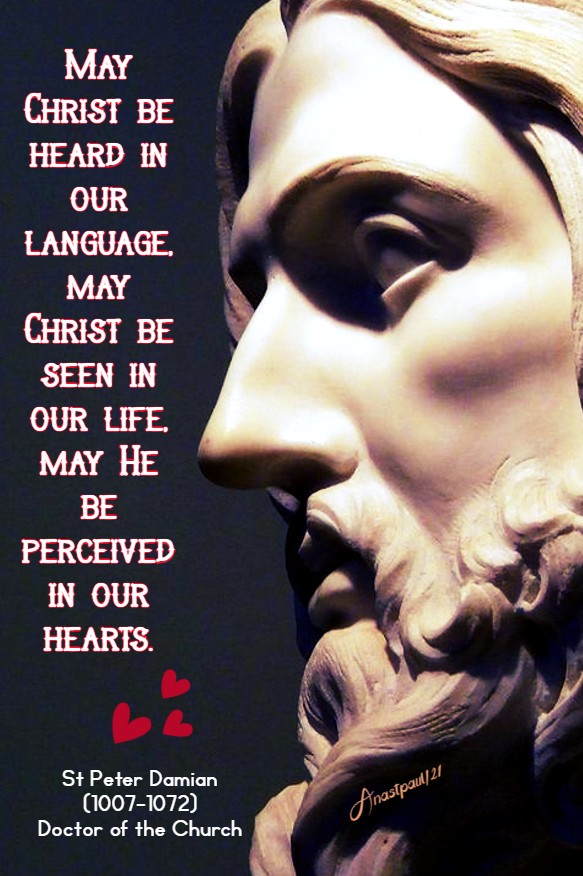
“May Christ be heard in our language, may Christ be seen in our life, may He be perceived in our hearts”
St Peter Damian (1007-1072) Father and Doctor of the Church
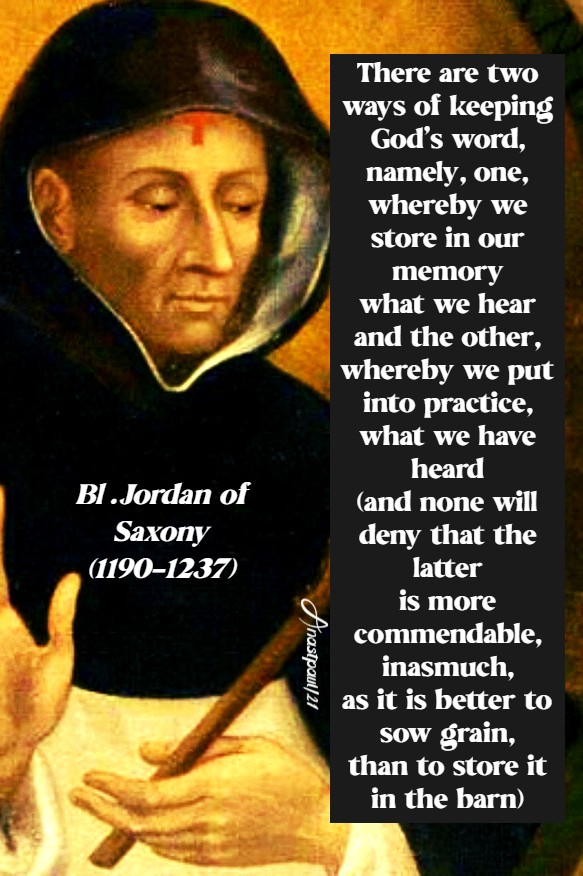
“There are two ways of keeping God’s word, namely, one, whereby we store in our memory what we hear and the other, whereby we put into practice, what we have heard (and none will deny that the latter is more commendable, inasmuch, as it is better to sow grain, than to store it in the barn).”
One Minute Reflection – 4 February – The Memorial of St Andrew Corsini O.Carm (1302-1373) Bishop, Confessor and St Gilbert of Sempringham (c 1083-1189) Priest, Founder – Sirach 44:16-27; 45:3-20, Matthew 25:14-23
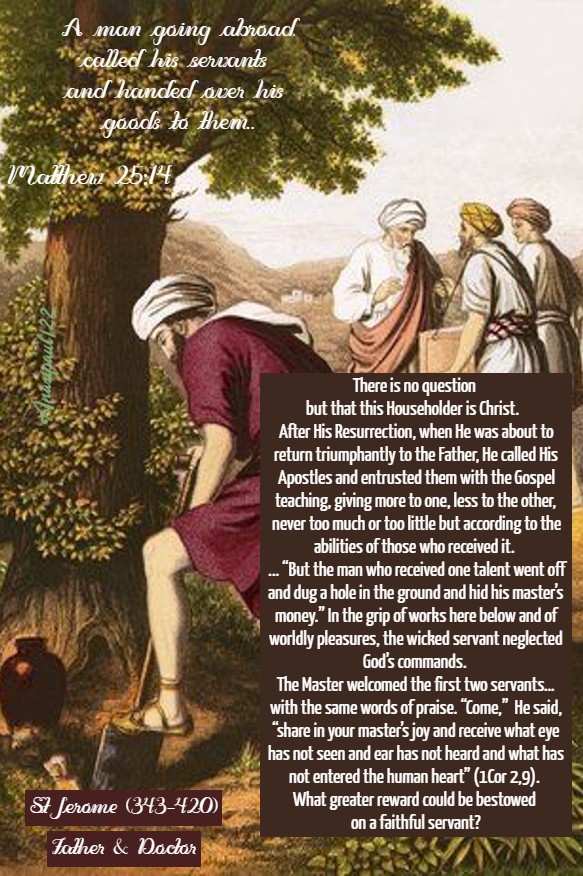
“A man going abroad, called his servants and handed over his goods to them.” – Matthew 25:14
REFLECTION – “There is no question but that this Householder is Christ. After His Resurrection, when He was about to return triumphantly to the Father, He called His Apostles and entrusted them with the Gospel teaching, giving more to one, less to the other, never too much or too little but according to the abilities of those who received it. In the same way, the Apostle Paul said that he had fed with milk those unable to take solid food (1Co 3,2)…
Five, two, one talent: let us take these to be the different graces granted to each, whether the five senses for the first; understanding of faith and works for the second; the reasons for distinguishing us from other creatures for the third. “The one who received five talents went away and traded with them and made another five.” That is to say, besides the physical and material senses he had received, he added knowledge of heavenly things. His knowledge was raised from the creatures to the Creator, from the corporal to the incorporeal, from the visible to the invisible, from the transient to the eternal. “The one who received two made another two.” This one likewise, according to his ability, doubled in the school of the Gospel what he had learned in the school of the Law. Or perhaps we could say, that he understood that knowledge of faith and the works of this present life, lead to future happiness. “But the man who received one talent went off and dug a hole in the ground and hid his master’s money.” In the grip of works here below and of worldly pleasures, the wicked servant neglected God’s commands. However, let us note that, according to another evangelist, he wrapped it in a linen cloth – by this we could understand that he took away the force of his Master’s teaching, by a life of softness and pleasure…
The Master welcomed the first two servants… with the same words of praise. “Come,” He said, “share in your master’s joy and receive what eye has not seen and ear has not heard and what has not entered the human heart” (1Cor 2,9). What greater reward could be bestowed on a faithful servant?” – St Jerome (343-420) Translator of Sacred Scripture (the Vulgate), Father and One of the Original Four Doctors of the Latin Church .
PRAYER – O God, Who establish ever new examples of virtue in Your Church, grant that Your people may follow the footsteps of blessed Andrew, Your Confessor and Bishop, so that they may also obtain his reward. Through Jesus Christ, Thy Son our Lord, Who lives and reigns with Thee, in the unity of the Holy Ghost, God, world without end. Amen (Collect).
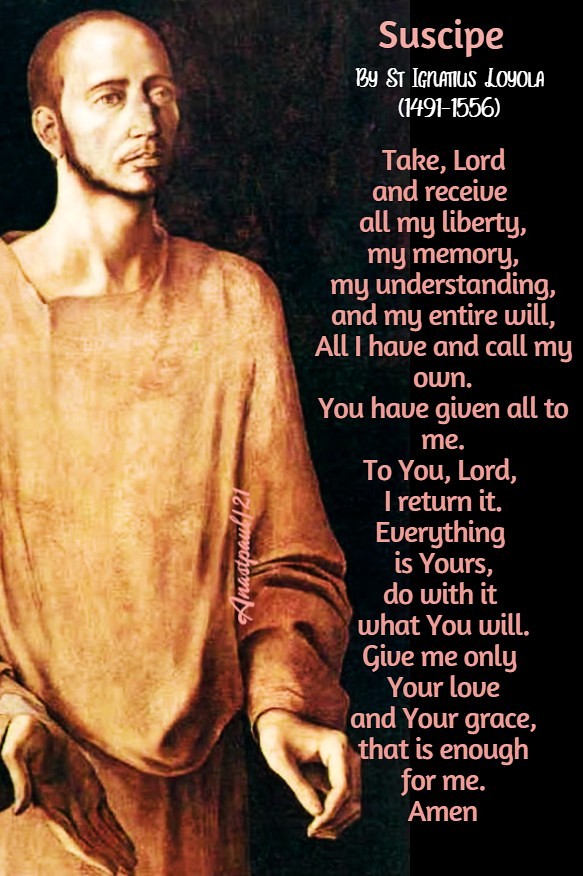
Take, Lord and receive all my liberty, my memory, my understanding, and my entire will, All I have and call my own. You have given all to me. To You, Lord, I return it. Everything is Yours, do with it what You will. Give me only Your love and Your grace, that is enough for me. Amen
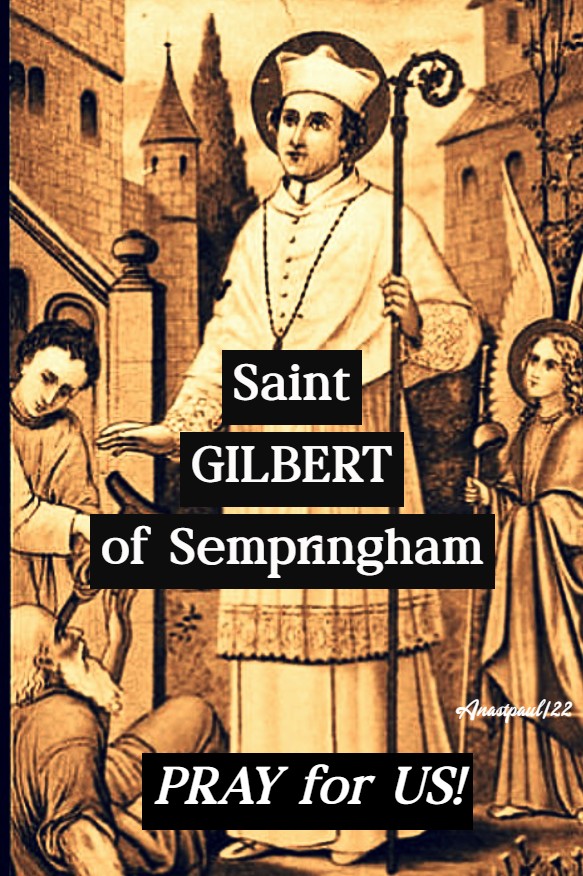
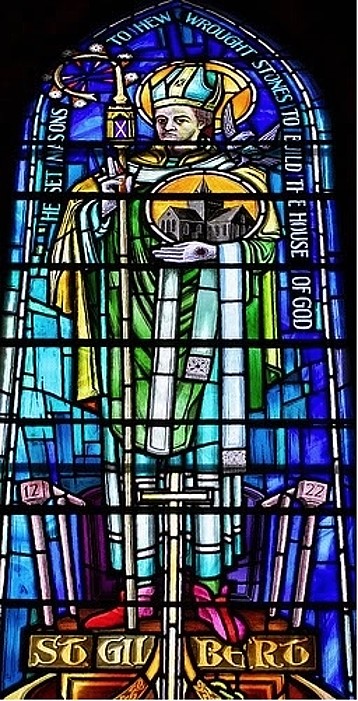
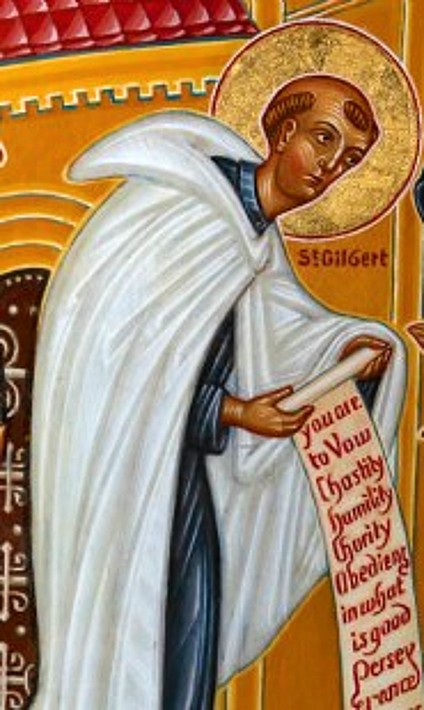
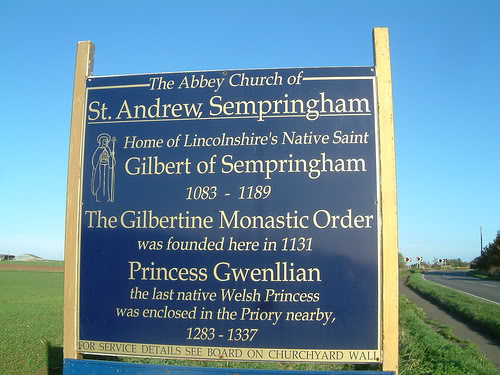
Saint of the Day – 4 February – St Gilbert of Sempringham (c 1083-1189) Priest, Founder of the Gilbertine Order, Founder of 13 Monasteries and Churches, schools, homes and hostels for the sick and orphanages, Miracle-worker. Born in c. 1083 at Sempringham, Lincolnshire, England and died on 4 February 1189 at Sempringham, Lincolnshire. The Gilbertines came to an end in the 16th century at the time of the Dissolution of the Monasteries.
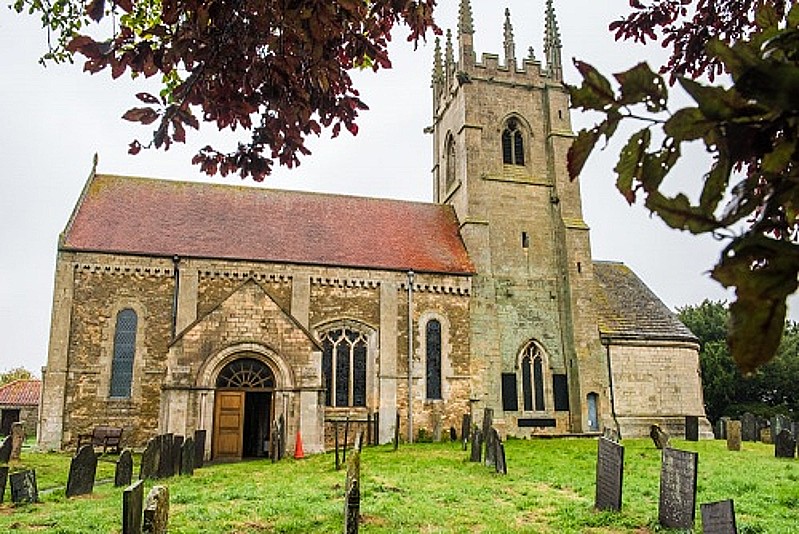
A narrow track from the main road in the Lincolnshire Village of Sempringham leads eventually to the tiny Church dedicated to St Andrew. Standing on a hilltop and noticeably isolated are the visible remains where St. Gilbert of Sempringham began his work, which resulted in the only English monastic Order for nuns, canons,lay brothers and sisters being founded. Little may be known about him but his influence, even after some 900 years, has not been forgotten.
Gilbert was the eldest son of Jocelyn, a Norman Knight and his low born Anglo-saxon wife. He was born around 1083 (in most biographies it is 1083), his mother had a vision that he would be special before his birth. It was a time within memory of the Norman invasion of England and he was half Norman half Saxon.
He is said to have been born with some form of disability and a variety of suggestions have been made as to the form that this was manifest – curvature of the spine being one. Whatever it was, he was unfit for military service and in his very early childhood seemed to have no enthusiasm of learning and is said to have been cared for by his mother and this is maybe why he had such an affinity and kindness for women – in an age when women were not generally allowed an education. At some point, however, his education led him to France . He returned having acquire the title of Master, by which he was known for posterity.
When he returned we see him educating the local children, of both sexes, which was unusual for the time in his district of Lincolnshire. His father was impressed with his education and abilities and his religious manner and presented him with the Churches of Sempringham and West Torrington. At that time, he was a Deacon and for a time, joined the household of the Bishop of Lincoln, firstly with Robert Bloet (died 1123) and with Alexander (1123-1148.
He was not Ordained to the Priesthood until his 40th year, due to his reservations of being unworth and for similar reasons, he refused the position of Archdeacon in the Diocese, which stretched from the Humber to the Thames and was the largest Diocese in Europe .
In 1131 he founded a home for girls whose residence was attached to his Church at Sempringham and hired a Priest named Geoffrey and they shared rooms above the Church entrance. In 1139 he moved his small community to a new site, a field’s distance from his Church and in due course, this became the Motherhouse for the Gilbertine Order of Sempringham. He was later to add lay sisters, Priests and lay brothers. In 1147, Gilbert travelled to France hoping to persuade the Cistercian Order to adopt his community of Nuns. This was refused but with the encouragement of Pope St Eugene III, who himself had been a Cistercian Monk and St Bernard of Clairvaux, he drew up the Institutes of the Gilbertine Order.
Back in England Gilbert became “Master” of the Order by the Popes decree. He was not attached to any particular house and was not the Prior of Sempringham. It was his responsibility to visit all the houses.
At the point when in old age he became blind he transferred, with the consent of the Order, his responsibility to Roger, the Prior of Malton. Gilbert did not take the vows of the Gilbertine Order until he was close to death. He felt that doing so would be a sign of arrogance, as he had written the Gilbertine Rule.
Miracles were attributed to him during his lifetime as well as after his death. When he reached his centennial year he felt compelled to “pass from this life in which he was so greatly broken for penance which he had endured in God’s service but yet all his members were whole,… save his sight.”
On Christmas night in 1188, whilst at his island house of Cadney, he was taken ill. He was given Extreme Unction and carried by his companion Roger and chaplain to Sempringham, a distance of forty miles. On 3 February of 1189, the Priors of all his Convents went to Sempringham to receive his blessing. On the last day, he lay unconscious with Roger (Prior of Malton), his successor, at his bedside. He died the following morning about the hour of Matins. He was buried three days later. His tomb was placed between the Altars of St Mary and St Andrew, on either side of the wall which divided the Priests from the Nuns, so that all alike might see him. During his lifetime Gilbert had built 13 Monasteries, nine for men and women together, four for men only. Besides these he had also built hostels for the poor, the sick, the lepers, the widows and the orphans
Eleven years after his death, Hubert Walter, Archbishop of Canterbury sent the Priors of the Lincolnshire Gilbertine houses of Swineshead, Bourn and Croxton to make inquisition to write an account of his life and his miracles. On 9 January 1201, King John and some of his nobles, visited Gilbert’s tomb. The Abbots arrived the same day and were satisfied as to the truth of the miracles . The King, Archbishop, Bishops and the three Priors sent letters to Pope Innocent III, asking for the Canonisation of Gilbert of Sempringham. The Pope decreed a three day’s fast on the whole Order and a further investigation into the life and miracles of Gilbert; the fast took place, on24 September 1202 with the inquisition on the third day.
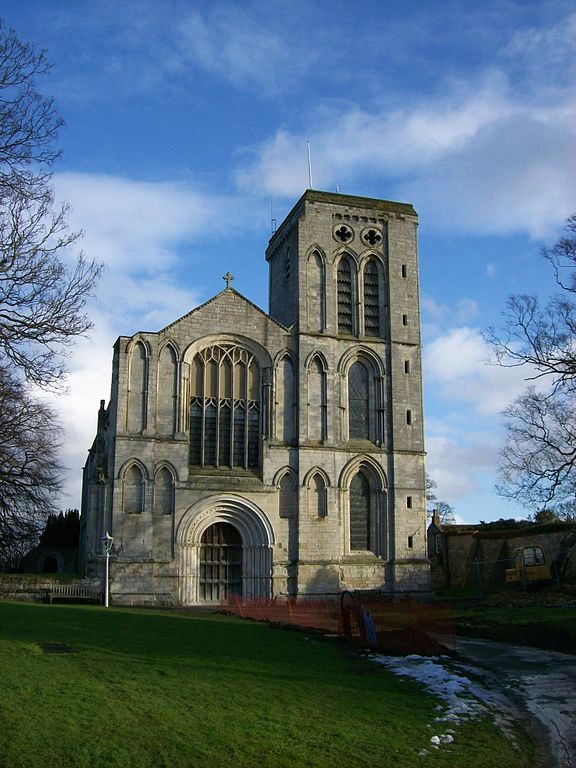
Sempringham Abbey
Five canons and six men cured of infirmities by Gilbert, set out for Rome arriving on 31 December 1202 . The Pope gave the decree on 11 January and the feast of St Gilbert was commanded to be on h February, The Papal Bull was issued on 30 January 1202 and sent to the two Archbishops (Canterbury & York) and the Gilbertine Order.
The occasion of the translation of St Gilbert’s relics is detailed in depth “marked by the manifestations of bright lights, sweet odours and incorrupt clothing.” Additionally the Archbishop of Canterbury was privileged with a cure from illness which threatened to prevent him continuing with the lengthy ceremonies. The Archbishop issued an indulgence of 40 days and an additional one of 169 days from Bishops assisting at the translation, to all those visiting the Shrine or making grants to the priory.
In the centuries which have followed the life and death of St Gilbert of Sempringham, little is now visible of the Convents and Monasteries that he founded. The Priory Church of Malton in Yorkshire is still in use, Chicksands, however, has the most substantial remains of a cloister of the twenty five that were built in England . In 1984 a group of parishioners met at the Cistercian Abbey of Mount St Bernard , Leicestershire. As a result, an apostolate was formed, “The Oblates of St. Gilbert,” who meet regularly to recite the Gilbertine liturgy and exercise charity for the needy.
Bl Dionisio de Vilaregut St Donatus of Fossombrone St Eutychius of Rome St Filoromus of Alexandria St Firmus of Genoa Bl Frederick of Hallum St Gelasius of Fossombrone St Geminus of Fossombrone St Gilbert of Limerick (c 1070–1145) Bishop St Gilbert of Sempringham (c 1083-1189) Priest, Founder of the Gilbertine order, St Isidore of Pelusium
St Jane de Valois O.Ann.M and TOSF (1464-1505) Princess, Queen, Founder, Religious Sister, Mystic, Teacher. Founded the monastic Order of the Sisters of the Annunciation of Mary. From this Order later sprang the religious congregation of the Apostolic Sisters of the Annunciation, founded in 1787 to teach the children of the poor. Biography: https://anastpaul.wordpress.com/2018/02/04/saint-of-the-day-4-february-saint-jane-of-valois-o-ann-m-1464-1505/
St Rembert St Themoius St Theophilus the Penitent St Vincent of Troyes St Vulgis of Lobbes
Jesuit Martyrs of Japan: A collective memorial of all members of the Jesuits who have died as Martyrs for the faith in Japan.
Martyrs of Perga – 4 Saints: A group of shepherds martyred in the persecutions of Decius. The only details we have about them are the names – Claudian, Conon, Diodorus and Papias. They were martyred in c 250 in Perga, Asia Minor (in modern Turkey).
Thought for the Day – 3 February – Meditations with Antonio Cardinal Bacci (1881-1971)
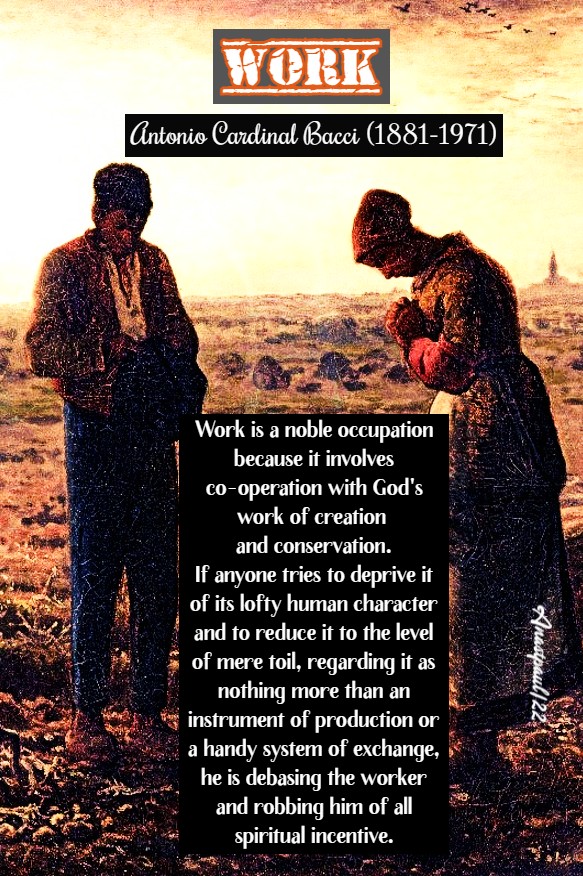
WORK
“God created man master of the world. He commanded him to populate it and to rule it (Cf Gen 1:28). He placed him in an earthly paradise, “to till it and to keep it” (Gen 2:15).
As long as man remained in the state of innocence, however, work was a pleasure. It gave him the joy of collaborating with God in the work of creation. Today, work is still a pleasure. By working, we co-operate with God because, it was His intention, tbat the resources of the earth should be explored by human industry and intelligence and should benefit both the individual and society. Work is a noble occupation because it involves co-operation with God’s work of creation and conservation. If anyone tries to deprive it of its lofty human character and to reduce it to the level of mere toil, regarding it as nothing more than an instrument of production or a handy system of exchange, he is debasing the worker and robbing him of all spiritual incentive.”
Quote of the Day – 3 February – The Memorial of St Blaise Bishop Martyr (Died c 316)
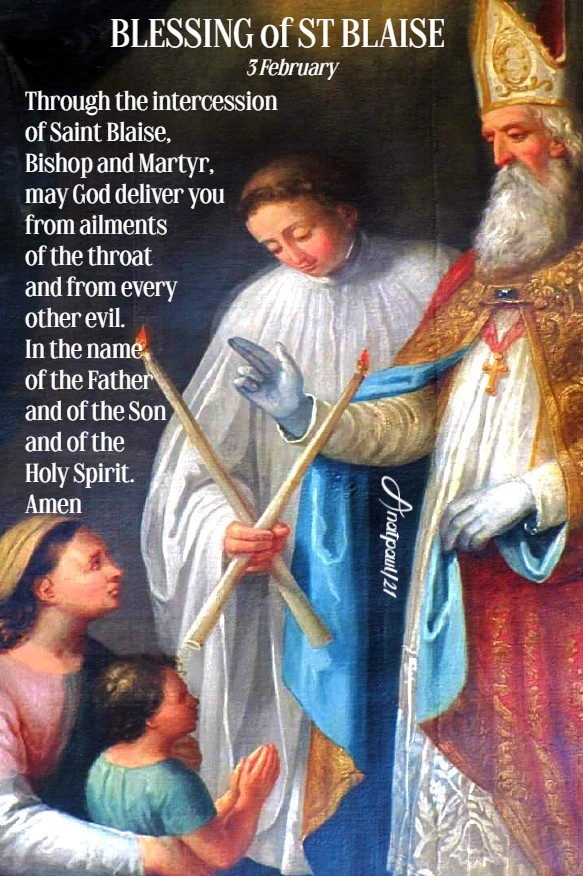
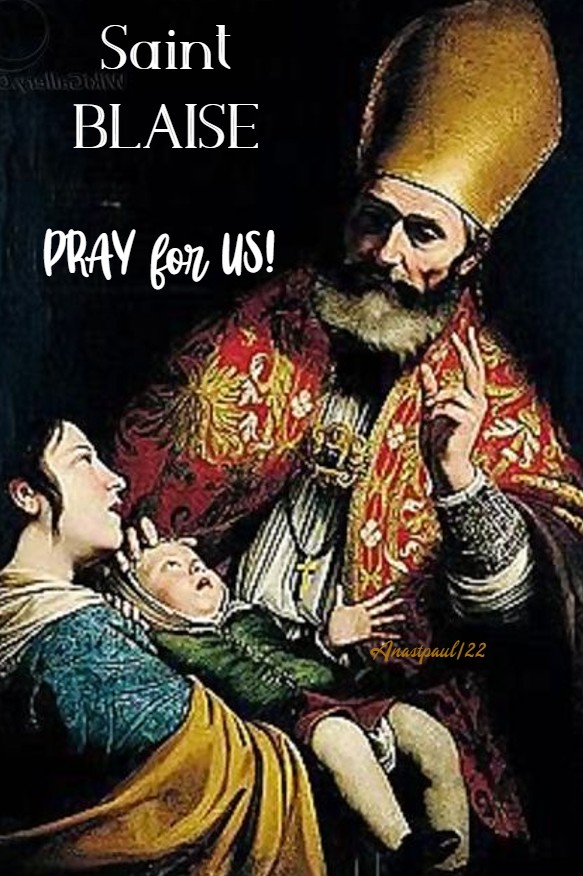
The Blessing of the Throats is a Sacramental of the Church, ordinarily celebrated today, the Feast day of Saint Blaise.
THE BLESSING of ST BLAISE Through the intercession of Saint Blaise, Bishop and Martyr, may God deliver you from ailments of the throat and from every other evil. In the name of the Father and of the Son and of the Holy Spirit. Amen
One Minute Reflection – 3 February – St Blaise Martyr (Died c 316) – Romans 13:8-10, Matthew 8:23-27
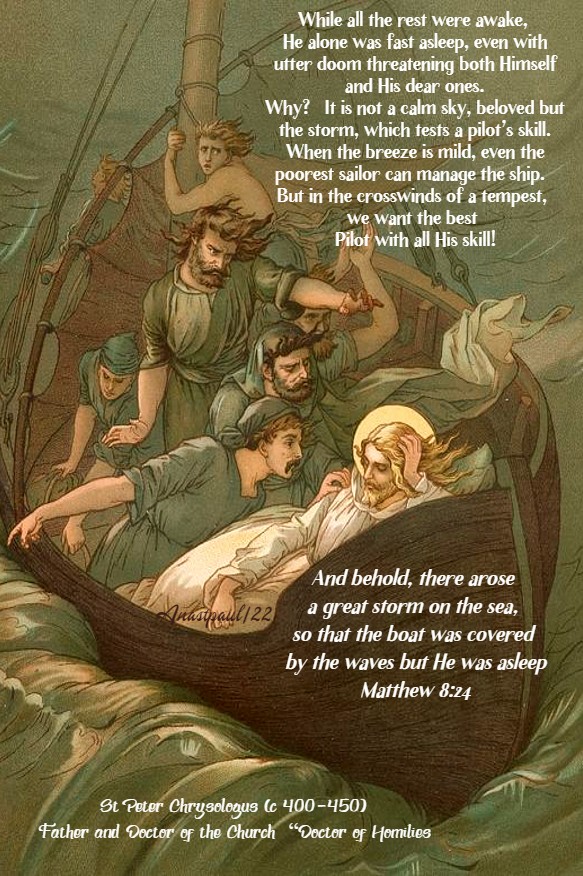
“And behold, there arose a great storm on the sea, so that the boat was covered by the waves but He was asleep.”- Matthew 8:24
REFLECTION – “The sea offered its heaving back for Christ to walk upon. Now, it leveled its crests to a plain, checked its swelling and bound up its billows. It provided rocklike firmness, so He could walk across the waterway.
Why did the seas heave so and toss and pitch, even as if threatening its Creator? And why did Christ Himself, Who knows all the future, seem so unaware of the present, that He gave no thought to the onrushing storm, the moment of its height and the time of its peril? While all the rest were awake, He alone was fast asleep, even with utter doom threatening both Himself and His dear ones. Why? It is not a calm sky, beloved but the storm, which tests a pilot’s skill. When the breeze is mild, even the poorest sailor can manage the ship. But in the crosswinds of a tempest, we want the best Pilot with all His skil!.” – St Peter Chrysologus (c 400-450) Bishop of Ravenna, Father and Doctor of the Church “Doctor of Homilies” (Sermon 20).
PRAYER – O God, You Who know that our human frailty cannot stand fast against the great dangers that beset us, grant us health of mind and body, that with Your help we may overcome what we suffer on account of our sins. Through Jesus Christ, Thy Son our Lord, Who lives and reigns with Thee, in the unity of the Holy Ghost, God, world without end. Amen (Collect).
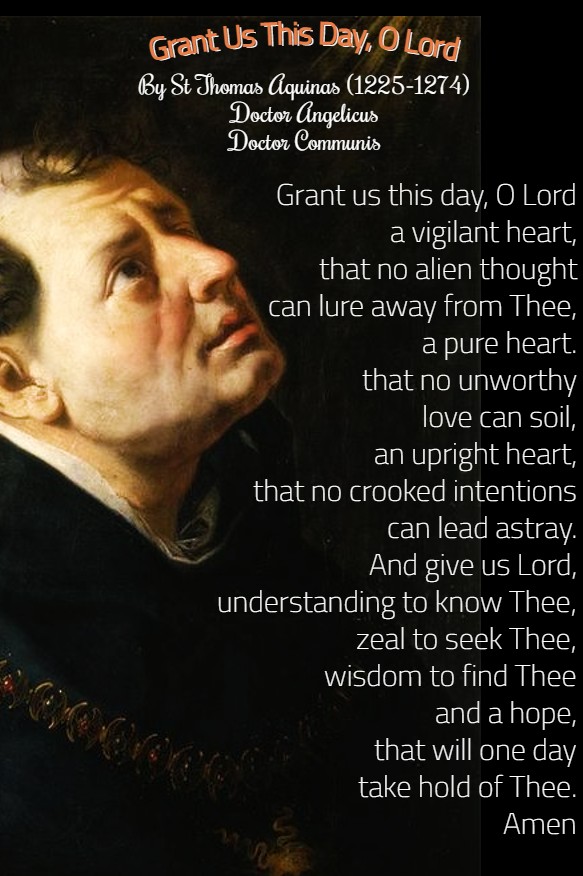
Grant Us This Day, O Lord By St Thomas Aquinas (1225-1274) Doctor Angelicus Doctor Communis
Grant us this day, O Lord a vigilant heart, that no alien thought can lure away from Thee, a pure heart. that no unworthy love can soil, an upright heart, that no crooked intentions can lead astray. And give us Lord, understanding to know Thee, zeal to seek Thee, wisdom to find Thee and a hope, that will one day take hold of Thee. Amen
Saint of the Day – 3 February – Blessed Stephen Bellesini OSA (1774-1840) Priest and Friar of the Augustinian Hermits, Teacher and mentor of the youth, Apostle of the poor, Parish Priest. Born as Luigi Giuseppe in 1774 in Trento, Italy and died on 2 February 1840 in Genazzano, Italy of natural causes. Also known as – Stefano and Luigi Belleni.
Stephen was born of the aristocracy in Trento on 25 November 1774. In 1790, aged just 16, despite his father’s opposition, he entered the Order of Saint Augustine at the Convent of Saint Mark of Trento. He completed his novitiate in Bologna, where he took his religious vows and the name of Stefano. He was then sent to Rome for his studies of philosophy and theology whereafter he returned to Bologna.
Fidelity in challenging circumstances was something Stephen had learned early on as an Augustinian. Just three years after his religious profession, and still only twenty-two years of age, he experienced the effects of a rising revolutionary campaign that forced him to leave the Monastery in Bologna where he was studying for the priesthood and return to his native City to continue his education under the guidance of tutors
In 1797 he was Ordained Priest in Trento. His years as a young priest were spent in the trying circumstances of a Church under siege by a government desirous of limiting the Church’s influence and eventually, putting an end to the religious way of life which Stephen had professed. Finally, after several years of tension and uncertainty, Stephen and his community were expelled from their Monastery for good, forbidden to wear any longer, the habit of their religious profession. They would never return. The Monastery would never re-open.
Stephen went to live with his brother and opened a school where he devotes himself to the education of poor children, providing free education and food and clothing where needed. Seven years later, the Priest Stephen, by now a successful and respected teacher who had championed the rights of poor and underprivileged children, won the admiration and love of the people. Even the materialistic local authorities came to respect his work. Eventually he was named Inspector of Schools in Trent.
However,, he missed religious life and in 1814,when he had the chance to return to community life, Stephen resigned his important post in Trent and went to join the Augustinian community in Bologna. Political leaders in Trent begged Stephen to return to his work in the schools there, offering to increase his pay. But Stephen refused, writing to them, “You would surely not ask me (to return to Trent) if you realised the unbreakable bond between a Friar and his God, who is the King of Kings. Before his altar, I have solemnly promised to be faithful to those vows.“
Stephen spent several years as Director of Novices, mentoring and teaching young Augustinians the principles of community life in the Order.
In his later years, Stephen served as Parish priest in Genazzano. There his ministry included a special emphasis on the needs of the poor and of children. In January, 1840, while answering a call to care for a sick parishioner, he tripped and fell. A cut on his leg became infected and he developed a high fever.
He tried to remain active for the next two days but the fever never went away., it is believed he might have contracted the Typhus after attending at many of the sick in his Parish. He died ON 2 February1840 in Genazzano. His remains are at the Shrine of Our Mother of Good Counsel in Genazzano.
Stephen’s sanctity was well-known and highly respect. Champion of youth, advocate for justice, comforter of the sick, guardian of the poor, his message is timely, his life is exemplary and his love for and commitment to religious life, are signposts to all religious and to the faithful. Pope Pius X Beatified Stephen on 27 December 1904. His cause continues, seeking a second miracle at his intercession – “how will they call on him, if they have not heard of him?” Blessed Stephen pray for us!
At the entrance to the Chapel of the General Curia in Rome there is a familiar painting of the Augustinian Blessed, Stephen Bellesini. It is a copy of an original work done by G Toeschi in 1905, depicting a crowning moment and possibly one of the last, of Stephen’s life. He stands close to the bedside of an infirm man, administering perhaps Extreme Unction or simply offering him some comfort, while the man’s wife presses her head to the bed, seemingly overcome with grief or exhaustion. Two young children look on anxiously. The artist touchingly captured here an important aspect of the ministry which occupied the latter part of Stephen’s life, as he visited the homes of the townspeople, bringing them the comfort of the Sacraments and oftentimes ,material assistance as well, during the typhus epidemic which struck Genazzano in the Spring of 1839. As we know, less than a year later, Stephen, himself, would fall victim to the pestilence and would succumb – a martyr of charity – faithful to the end.
St Anna the Prophetess St Berlinda of Meerbeke St Blasius of Armentarius St Blasius of Oreto St Caellainn St Celerinus of Carthage St Claudine Thevenet St Clerina of Carthage St Deodatus of Lagny St Eutichio St Evantius of Vienne St Felix of Africa St Felix of Lyons St Hadelin of Chelles Bl Helena Stollenwerk Bl Helinand of Pronleroy St Hippolytus of Africa St Ia of Cornwall St Ignatius of Africa Bl Iustus Takayama Ukon
Bl John Zakoly St Laurentinus of Carthage St Laurentius of Carthage St Lawrence the Illuminator St Liafdag St Lupicinus of Lyon St Margaret of England Bl Marie Rivier St Oliver of Ancona St Philip of Vienne St Remedius of Gap St Sempronius of Africa Blessed Stephen Bellesini OSA (1774-1840) Priest of the Hermits of St Augustine St Tigrides St Werburga of Bardney St Werburga of Chester
Benedictine Martyrs: A collective memorial of all members of the Benedictine Order who have died as Martyrs for the Faith.
Thought for the Day – 2 February – Meditations with Antonio Cardinal Bacci (1881-1971)
The Purification of Our Lady
“In the Gospel narrative of St Luke (Cf 2:22-31), another character also appears. He intrudes upon the scene without any apparent right to be there but, he had been inspired by God. This is the old and saintly Simeon. He was not a priest. He was an upright man, careful in the observance of the law, who was waiting longingly for the coming of the promises Redeemer. The Holy Spirit dwelt in him and had revealed, that he would not die until he had seen the Saviour. He was inspired to go to the Temple, where he saw Jesus. He took Him in his arms and was overcome with joy. Then he blessed God and declared that he was now prepared to accept death, as he had been able to see and embrace the Saviour, as God had promised. “Now thou dost dismiss thy servant, O Lord, according to thy word, in peace” (Lk 2:29). It was a beautiful way to meet death, to be able to hold Jesus close to his heart and see his long life of hope and expectation rewarded by the loving embrace of his Lord.
Let us try and live like Simeon, with our minds and hearts turned towards Jesus. Let us think chiefly of Him, love Him, above everything else and work only for Him. Then our death will be as beautiful as his. In fact, we shall be even more fortunate, for we can go further than receiving Jesus into our arms. We shall be able to receive Him into out hearts. He will be at hand to give us the supernatural strength which we shall need on our great journey into eternity.”
Quote/s of the Day – 2 February – The Feast of the Purification of the Blessed Virgin
“The day will come when this Child will no longer be offered in the Temple, nor in Simeon’s arms but outside the City in the arms of the Cross. The day will come when He will not be redeemed by the blood of a sacrifice but redeem others , with His own Blood. …” That will be the evening sacrifice; this is the morning sacrifice; this one is the happiest but that one is the most complete; for this one was offered at the time of birth and that one will be offered in the fullness of time,..”
“But what shall we offer, brothers, what shall we give Him for all the benefits He has given us? He offered the most precious Victim He possessed for our sake; in truth, He could not have had anything more precious. So let up, too, do what we can, let us offer Him the best we have, that is to say, ourselves! He offered Himself, so who are you, to hesitate to offer yourself?”
St Bernard (1091-1153) Mellifluous Doctor of the Church
One Minute Reflection – 2 February – The Feast of the Purification of the Blessed Virgin, Candlemas – Mal 3:1-4, Luke 2:22-32
“And inspired by the Spirit he came into the temple and when the parents brought in the child Jesus, to do for him according to the custom of the law, he took him up in his arms and blessed God …” – Luke 2:27-28
REFLECTION – “Your lamps must be burning in your hands” (Lk 12:35). By this outward sign let us remind ourselves of the joy of Simeon, carrying the Light in his hands … We must be burning with love and radiant with good deeds and so, take up Christ in our hands with Simeon … Let us discuss this charming custom of the Church of bearing lights aloft on this feast day … Could anyone hold up a lighted candle in his hands on this day, without at once remembering that old man, who on this same day, took up in his arms, Jesus, God’s Word, clothed in flesh like a candle-flame clothed in wax and affirmed Him to be “the Light which would be a beacon for the Gentiles.” Surely he was that “burning and radiant lamp” (Jn 5:35; 1,7) which bore witness to the Light. For this purpose he came in the Spirit, who had filled him, into the temple, that he might “receive, O God, your loving-kindness in the midst of your temple” (Ps 48[47]:10) and declare him to be loving-kindness indeed and the light of your own people.
Truly, O holy Simeon, in the quiet contentment of old age, you carried this Light not simply in your hands but in the very dispositions of your heart. You were like a lamp-standard, seeing so clearly how much the Gentiles would one day be lit up, while reflecting … the bright rays of our faith. Old, yet still sincere, you can now be happy, in that, you really see what once you but foresaw. Gone is the world’s gloom, “the Gentiles bask in this light of yours,” “the whole earth is full of his glory” (Is 60:3; 6:3).” … Blessed Guerric of Igny O.Cist. (c 1080-1157) Cistercian Abbot
PRAYER – Almighty, eternal God, we humbly beseech Your majesty that, as Your only-begotten Son was this day presented in the temple in the nature of our flesh, so may You grant us to be presented to You, with purified minds. Through Jesus Christ, Thy Son our Lord, Who lives and reigns with Thee, in the unity of the Holy Ghost, God, world without end. Amen (Collect).
Our Morning Offering – 2 February – The Feast of the Purification of the Blessed Virgin. Candlemas
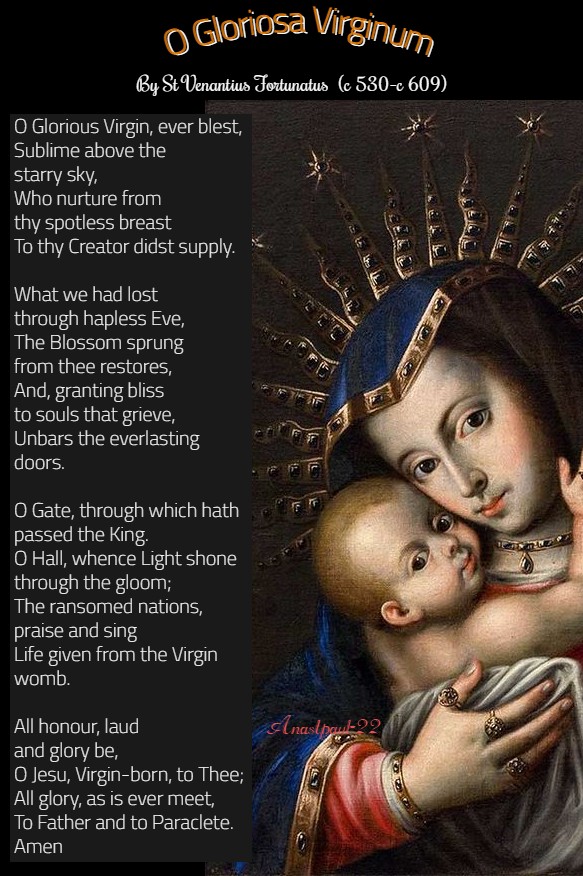
O Gloriosa Virginum By St Venantius Fortunatus (c 530 – c 609)
O Glorious Virgin, ever blest, Sublime above the starry sky, Who nurture from thy spotless breast To thy Creator didst supply.
What we had lost through hapless Eve, The Blossom sprung from these restores, And, granting bliss to souls that grieve, Unbars the everlasting doors.
O Gate, through which hath passed the King. O Hall, whence Light shone through the gloom; The ransomed nations, praise and sing Life given from the Virgin womb.
All honour, laud and glory be, O Jesu, Virgin-born, to Thee; All glory, as is ever meet, To Father and to Paraclete. Amen
O Gloriosa Domina is the second half of the hymn: Quem Terra, Pontus, Aethera. It was composed by St Venantius Fortunatus (c 530 – c 609) the Bishop of Poitiers. In 1632, in accordance with revisions made to the hymns of the Divine Office by Pope Urban VIII (1568-1644), it was altered and changed to O Gloriósa Vírginum. It is sung in the Common of the Blessed Virgin Mary of the Roman Breviary. It is said that St Anthony of Padua (1195-1231) was always singing this hymn. His mother sang it to him as a baby,and even on his death bed after receiving Extreme Unction, he intoned the hymn.
Saint of the Day – 2 February – Saint Lawrence of Canterbury (Died 619) the Second Archbishop of Canterbury the successor of St Augustine of Canterbury from 604 until his death in 619, but he was Consecrated as Archbishop by his predecessor, St Augustine, during Augustine’s lifetime, to ensure continuity in the office, Benedictine Monk, Missionary. He was a member of the Gregorian mission sent from Italy to England to Christianise the Anglo-Saxons. Born in the 6th Century and died on 2 February 619 in Canterbury, England of natural causes. Also known as – Lorenzo.
The Roman Martyrology states: “In Canterbury in England, St Lawrence, Bishop, who after St Augustine ruled this Church and greatly increased it by converting King Edbald to the Faith.”
Lawrence, a Monk of the Monastery of St Andrea al Clelio in Rome, arrived in England with St Augustine of Canterbury, to accompany him on his new mission in a land that was still pagan. The expedition had been strongly desired by Pope St Gregory the Great, informed by the Christian Queen of Kent, of the need for shepherds to convert the Anglo Saxons. The missionaries, after a long and dangerous journey, landed in 597 on the island of Thanet, in the kingdom of Kent. Everything that is known about Lawrence’s life is due to the first two books of “Ecclesiastical history” written by St Bede the Venerable.
In 601, following the Baptism of King St Ethelbert, Lawrence was sent to Rome to announce the success of the mission to the Pontiff and receive further instructions on how to proceed.
On the death of Augustine, in 604, he was succeeded by ,Lawrence, whom he himself had designated as his successor. The new Bishop consecrated “the Church dedicated to the Holy Apostles Peter and Paul, so that the bodies of Augustine, all the bishops of Canterbury and the Kings of the Cantia could be buried.”
Lawrence also attempted to continue the consolidation policy already pursued by Augustine among the Anglo-Saxons of south-east England but was unable, like his predecessor, to intensify collaboration with the Irish and British Bishops of the western part of the country, still linked to the island traditions. To the Irish shepherds he address a letter that would find lasting echo in England in the following centuries: “Before understanding the actual situation, we held in high esteem the religious practice of the British and the Irish […]. Having known the British, we thought that the Irish would have been better. But now we have understood […] that the Irish do not surpass the Britons in ecclesiastical observance.” In the same tone he also wrote to the British Bishops but, as Bede pointed out, he made absolutely no profit with this attitude and, therefore, had to face the worsening of the situation even in Kent itself. The latter phenomenon culminated in 616 with the accession to the throne of Edbald, son of Ethelbert, who refused to embrace the Christian faith accepted by his father.
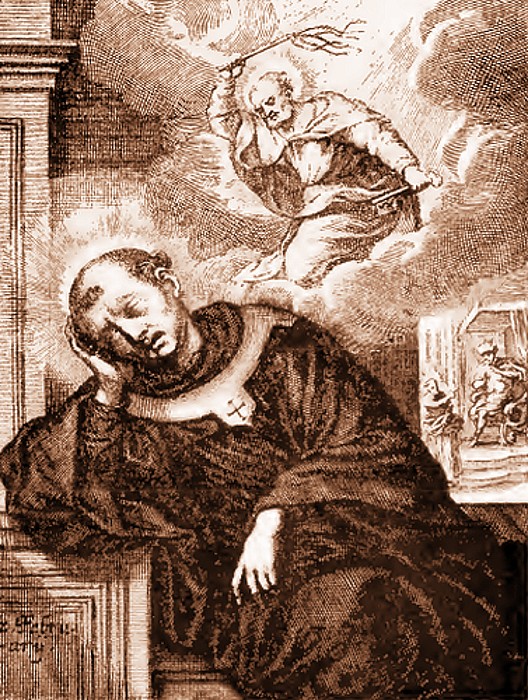
StLawrence’s vision of St Peter
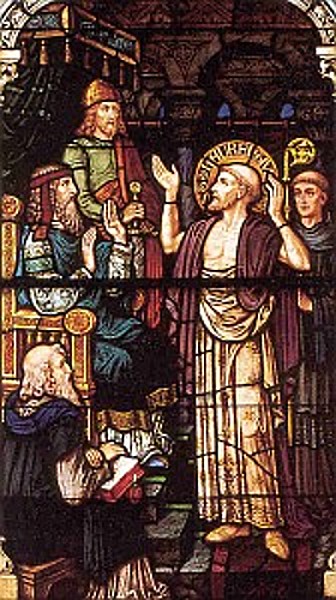
Two Monks, followers of ,Lawrence, St Mellitus (24 April) and St Justus (10 November), preferred to return to Gaul, in order to avoid getting involved in any bloody persecutions against Christians. Lawrence, after having meditated on this for a long time, in the end preferred to remain in his chair and face the new King. According to an ancient local tradition, also reported by St Bede, Lawrence changed his mind about his departure ,following a very concrete apparition of St Peter, who actually whipped Lawrence for his cowardice. “The servant of Christ, Lawrence, went immediately to the King and, opening his robe, showed him how many wounds he had received.” Edbaldo was greatly impressed by this extraordinary display of supernatural power and decided to convert to Christianity immediately. Granted the resumption of the development of the Church in Kent, Mellitus and justus also soon returned to their positions.
St Lawrence shows King Edbald his wounds
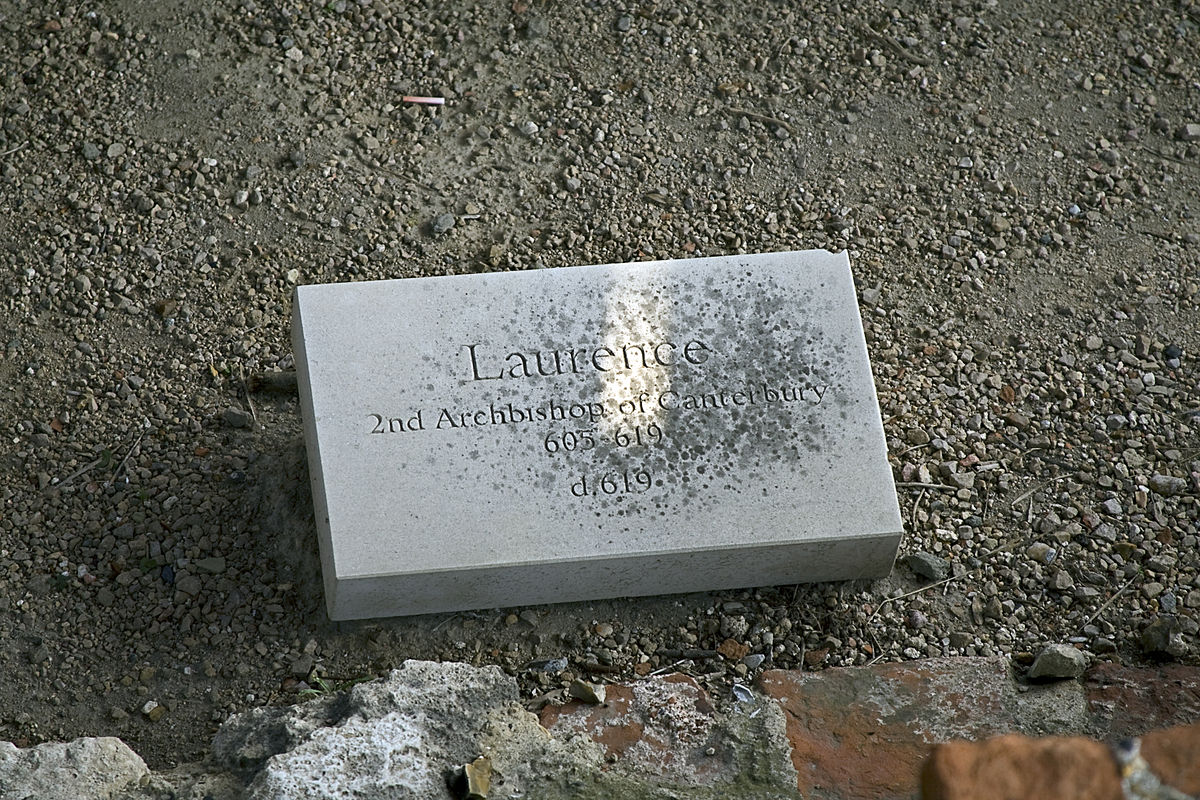
Lawrence died on 2 February 619 and was buried next to St Augustine in Canterbury Abbey. The tomb was opened in 1091 by Abbot Guido, to transfer the relics to a more eminent place and an intense perfume came out that invaded the entire Monastery. Another inspection of his tomb again took place in 1915.
Gravestone marking the site of St Laurence’s burial in St Augustine’s Abbey, Canterbury
The antiquity of the worship paid to the holy Bishop is attested by the Irish Missal of Stowe, which set the date of his feast at 3 February, a commemoration that remained unchanged until the last edition of the Martyrology moved it to 2 February, the actual anniversary of his birth into Heaven.
The iconography relating to St Lawrence usually depicts him in the act of showing King Edbald his wounds.
Our Lady of the Candles – (formally known as Nuestra Señora de la Purificación y la Candelaria) is a Marian title and image venerated by Filipino Catholics. The image, which is enshrined on the balcony of Jaro Cathedral, is known as the patroness of Jaro District of Iloilo City and the whole of the Western Visayas. The feast day of Our Lady of the Candles is on Candlemas (2 February) and is celebrated in Iloilo City with a Solemn Pontifical Mass presided by the Archbishop of Jaro.
St Adalbald of Ostrevant St Adeloga of Kitzingen St Agathodoros of Tyana St Andrea Carlo Ferrari St Apronian the Executioner St Bruno of Ebsdorf St Burchard of Wurzburg St St Candidus the Martyr St Columbanus of Ghent St Cornelius the Centurion St Felician the Martyr St Feock St Firmus of Rome St Flosculus of Orléans St Fortunatus the Martyr St Hilarus the Martyr St Jeanne de Lestonnac St Lawrence of Canterbury (Died 2 February 619) The Second Archbishop of Canterbury Bl Louis Alexander Alphonse Brisson
St Rogatus the Martyr St Saturninus the Martyr St Sicharia of Orleans St Simon of Cassia Fidati St Theodoric of Ninden St Victoria the Martyr
Martyrs of Ebsdorf: Members of the army of King Louis III of France under the leadership of Duke Saint Bruno of Ebsdorf. The Martyrs died fighting invading pagan Norsemen, and defending the local Christian population. Four bishops, including Saint Marquard of Hildesheim and Saint Theodoric of Ninden, eleven nobles, and countless unnamed foot soldiers died repelling the invaders. They were martyred in the winter of 880 in battle at Luneberg Heath and Ebsdorf, Saxony (modern Germany).
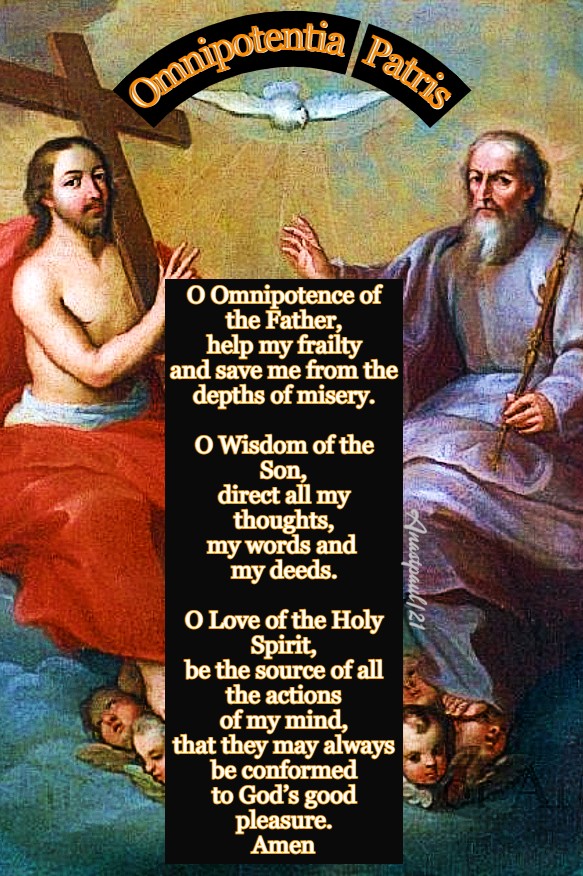
February is traditionally the Month of the Blessed Trinity, with the Holy Family being celebrated together with the Holy Name of Jesus in January.
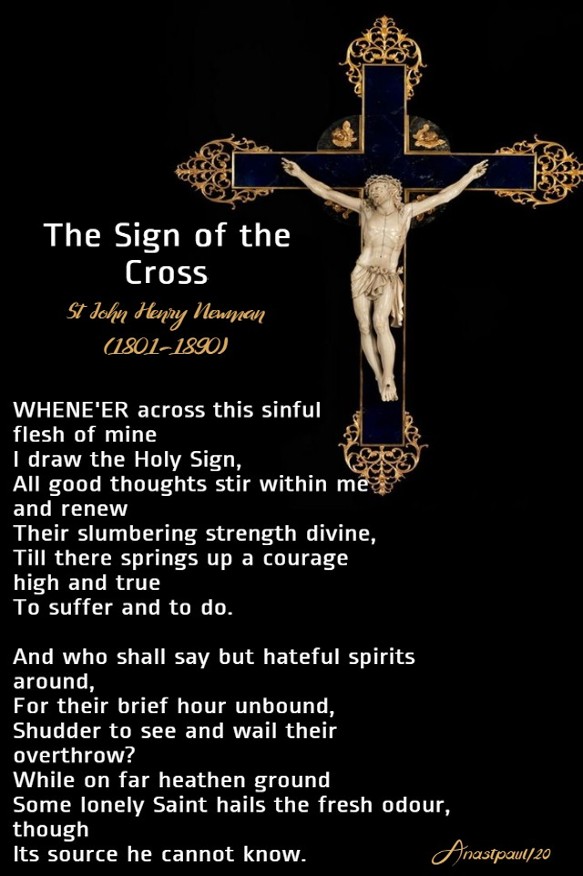
The Sign of the Cross
In the name of the Father and of the Son and of the Holy Ghost.
(50 Days. 100 Days if made with Holy Water Blessed Pope Pius IX, 1865.)
WHENE’ER across this sinful flesh of mine I draw the Holy Sign, All good thoughts stir within me and renew Their slumbering strength divine, Till there springs up a courage high and true To suffer and to do.
And who shall say but hateful spirits around, For their brief hour unbound, Shudder to see and wail their overthrow? While on far heathen ground Some lonely Saint hails the fresh odour, though Its source he cannot know.
John Henry Newman (1801-1890) Oxford – 25 November 1832
A pious practice among Catholics, is to write “✝ J M J ✝” often flanked by two Crosses at the top of letters, cards, documents and personal notes as a reference to Jesus, Mary and Joseph as the Holy Family. Where it is written, “✝ J M J ✝” the writer appeals for the blessing and protection of the Holy Family.
O Gente Felix O House of Nazareth The Blest By Pope Leo XIII (1810-1903)
O house of Nazareth the blest, Fair hostess of the Lord, The Church was nurtured at thy breast And shared thy scanty hoard.
In all the spreading lands of earth. The wandering sun may see No dearer spot, no ampler worth Than erst was found in thee!
We know thy humble tenement Was heaven’s hermitage: Celestial heralds came and went In endless embassage.
There, whatsoever Joseph asks Christ hastens to fulfil; While Mary loves the household tasks That wait her joyous will.
There, Joseph toileth at her side Her joys and griefs to share, With thousand ties knit to his bride, Of love and work and prayer.
Yet how their bosoms constant burn And deeper ardours prove In love of Christ, whose eyes return Tokens of mutual love.
O then, in all the homes of earth, Be Love the bond of life: May it enthrone at every hearth The peace that husheth strife.
All praise to thee, O Jesus, Who parents dost obey; Praise to the sovereign Father And Paraclete for aye. Amen.
Thought for the Day – 1 February – Meditations with Antonio Cardinal Bacci (1881-1971)
“Unless You Turn and Become Like Little Children, You Will Not Enter into the Kingdom of Heaven”
“At the beginning of their ministry, before they had been strengthened and enlightened by the Holy Spirit, the Apostles were as ambitious as most other men. One day, the mother of John and James, the sons of Zebedee, came to Jesus and asked Him, if her two sons could have precedence over the other Apostles and sit on the highest thrones in His Kingdom, one at His right hand and the other at His left. Jesus disapproved of this desire to predominate. “Whoever wishes to become great among you,” He said, “shall be your servant and, whoever wishes to be first among you shall be your slave; even as the Son of Man has not come to be served but to serve and to give his life as a ransom for many” (Mt 20:26-28).
On another occasion, the Apostles came to Jesus and asked Him, which of them would be the greatest in the Kingdom of Heaven. Jesus’ only answer was to call a little child and to place him in the centre of the group. “Amen, I say to you, unless you turn and become like little children, you shall not enter into the kingdom of heaven. Whoever, therefore, humbles himself as this little child, he is the greatest in the kingdom of heaven” (Mt 18:3-4).
This is the lofty teaching of the Gospel. If we wish to be great and pleasing in the eyes of God, we must be unimportant in our own regard and in our relations with men. The Gospel involves an overthrow of human values. Anyone who makes himself insignificant, will become great. Anyone who tries to make himself out to be a great man, becomes of little account in the eyes of God. “God resists the proud but gives grace to the humble” (Cf Js 4:6; 1 Peter 5:5). If we wish to please the Sacred Heart of Jesus, the first thing we must do, is become as little children. In other words, we shall have to suppress our ambition and vanity and destroy our self-love, so that, the Sacred Heart may fill our hearts with the love of God alone!”
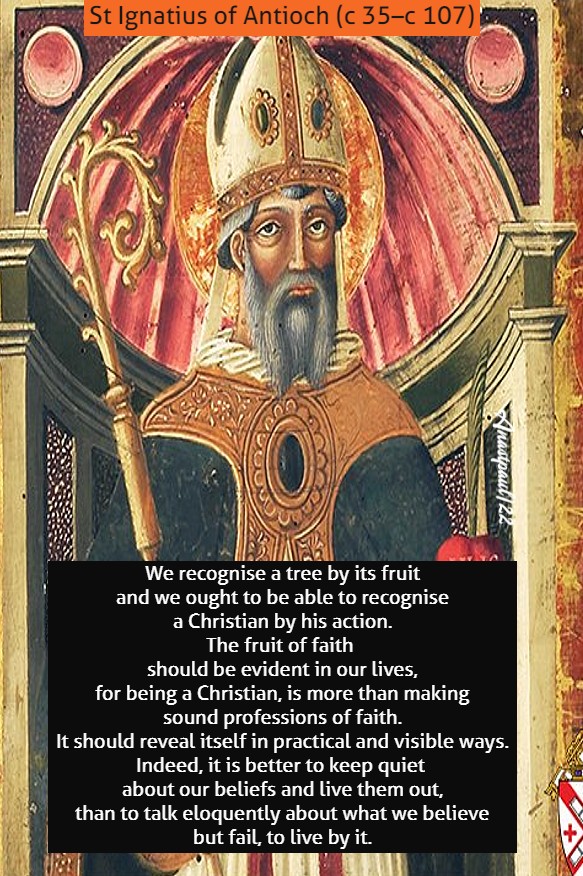
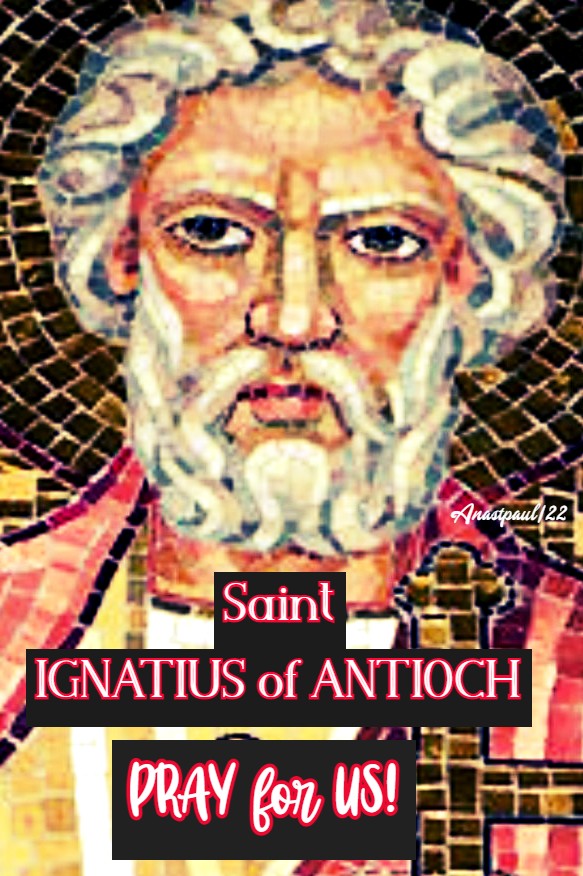
Quote/s of the Day – 1 February – The Memorial of St Ignatius of Antioch (c 35– c 107) Bishop and Martyr
“We recognise a tree by its fruit and we ought to be able to recognise a Christian by his action. The fruit of faith should be evident in our lives, for being a Christian, is more than making sound professions of faith. It should reveal itself in practical and visible ways. Indeed, it is better to keep quiet about our beliefs and live them out, than to talk eloquently about what we believe but fail, to live by it.”
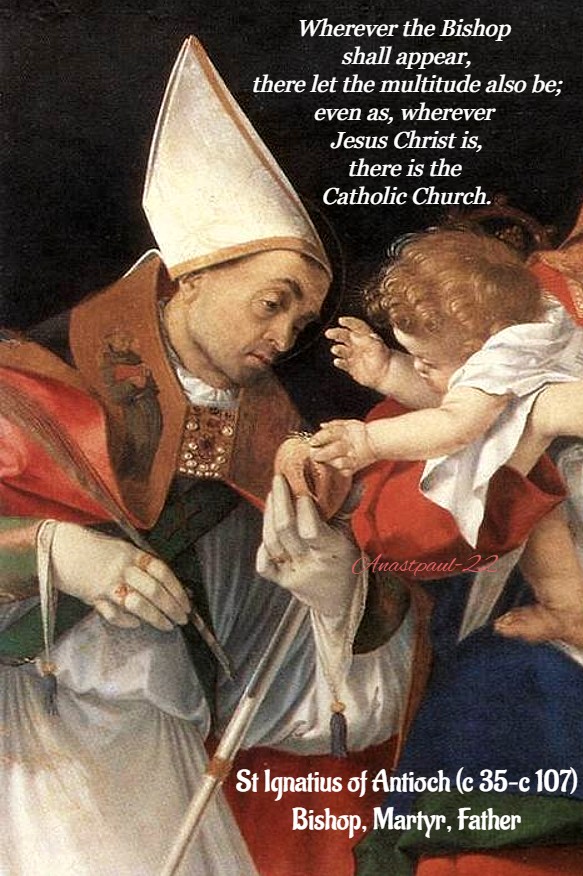
“Wherever the Bishop shall appear, there let the multitude also be; even as, wherever Jesus Christ is, there is the Catholic Church.”
(St Ignatius is also responsible for the first known use of the Greek word ‘katholikos’ or Catholic, meaning “universal”, “complete” and “whole” to describe the Church.)
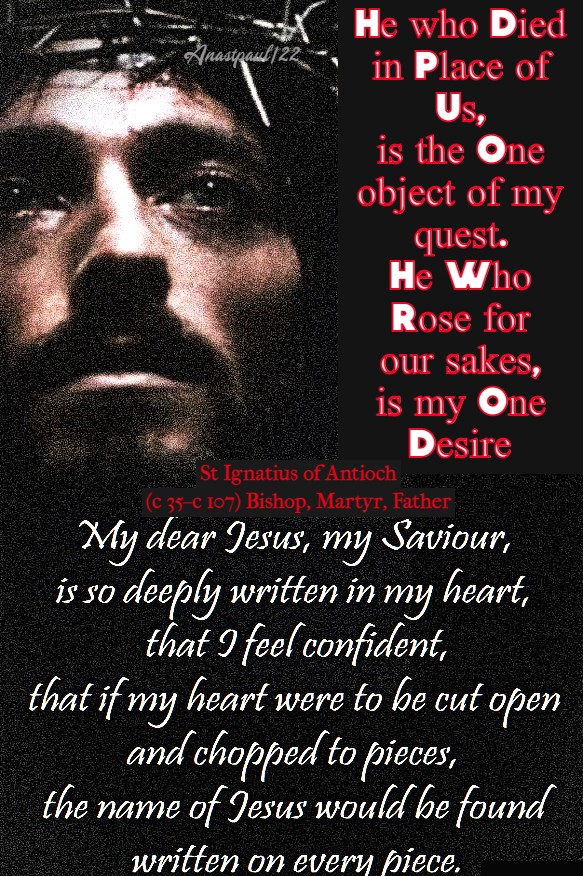
“He who died in place of us, is the one object of my quest. He who rose for our sakes, is my one desire.”
“My dear Jesus, my Saviour, is so deeply written in my heart, that I feel confident, that if my heart were to be cut open and chopped to pieces, the name of Jesus would be found written on every piece.”
One Minute Reflection – 1 February – “Month of the Most Blessed Trinity” – St Ignatius of Antioch (c 35 – 107) Bishop and Martyr – Romans 8:35-39, John 12:24-26
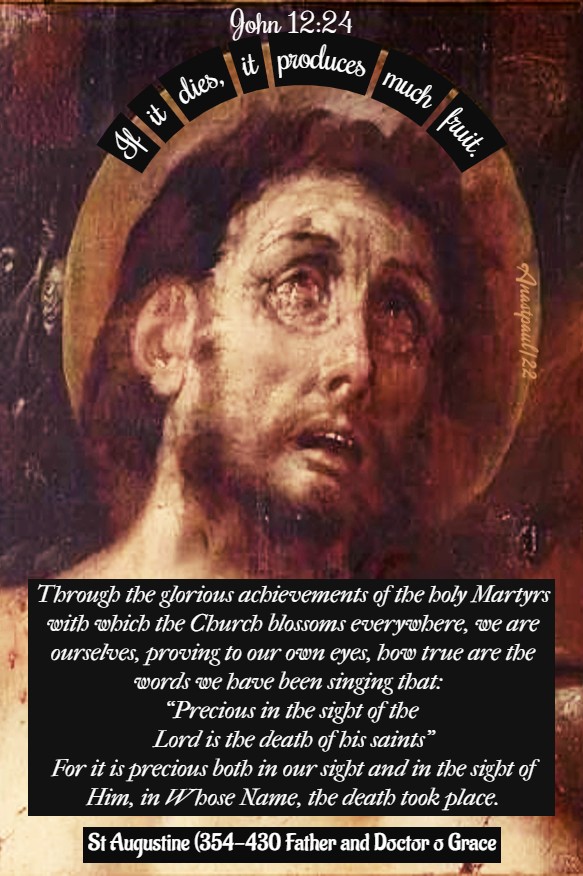
“If it dies, it produces much fruit” – John 12:24
REFLECTION – “Through the glorious achievements of the holy Martyrs with which the Church blossoms everywhere, we are ourselves, proving to our own eyes, how true are the words we have been singing that: “Precious in the sight of the Lord is the death of his saints” (Ps 116[115]:15). For it is precious both in our sight and in the sight of Him, in Whose Name, the death took place.
But the price of those deaths is the death of One Man. How many deaths did that One Man purchase by His death, for, if He had not died, the grain of wheat would not be multiplied? You heard His words when He drew near His passion, that is, when He was drawing near to our Redemption: “Unless a grain of wheat falls into the earth and dies, it remains alone but if it dies, it bears much fruit.” On the Cross He carried out a vast transaction; there the purse of our price was unfastened and, when His side was opened by the lance of the soldier, there streamed the price for the Redemption of the whole earth (cf. Jn 19:34).
Now the faithful ones and Martyrs have been purchased but the faithfulness of the Martyrs, has been proved – their blood is the proof … “As Christ laid down his life for us, so we ought to lay down our lives for the brethren” (1Jn 3:16). In another place it is stated: “At a grand table you have sat; now carefully consider what has been put before you, since it is your duty to prepare for such things” (cf. Prv 23:1). That table is great where the Lord of the table is Himself the Meal. No-one feeds guests with Himself as food but this is exactly what the Lord Christ does, He, Himself is the host who invites; He, Himself is the food and the drink. Therefore, the Martyrs have recognised what they were eating and drinking, so as to be able to repay such gifts. But whence can they make such return, unless He Who first paid the cost, supplies the source from which restitution may be made? That is the reason for the Psalm, where we sing what is written: “Precious in the sight of the Lord is the death of his saints.” ... St Augustine (354-430) Bishop of Hippo, Father and Doctor – (Sermon 329, for the Feast of the Martyrs, 1-2 ; PL 38, 1454).
PRAYER – Be mindful of our weakness, O almighty God and since the burden of our deeds is grievous to us, grant that the glorious intercession of blessed Ignatius Thy Martyr and Bishop, may protect us. Through Jesus Christ, Thy Son our Lord, Who lives and reigns with Thee, in the unity of the Holy Ghost, God, world without end. Amen (Collect).
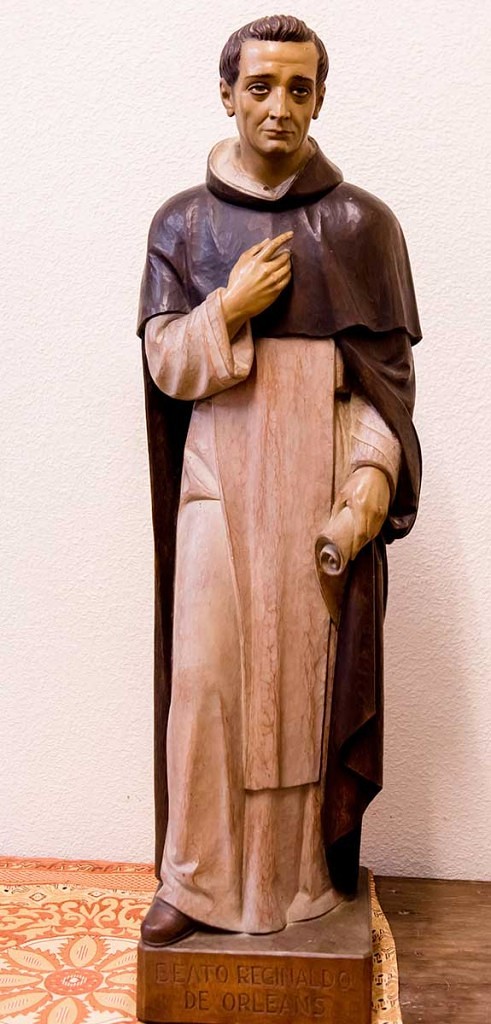
Saint of the Day – 1 February – Blessed Reginald of Orléans OP (c 1180 – 1220) Priest and Friar of the Order of Preachers, Canon Lawyer, renowned Preacher, Born in c 1180 in Orléans, France and died in early February 1220 in Paris, France of natural causes. Also known as – Réginald de Saint-Gilles, Reginaldo… Additional Memorial – 12 February (Dominicans).
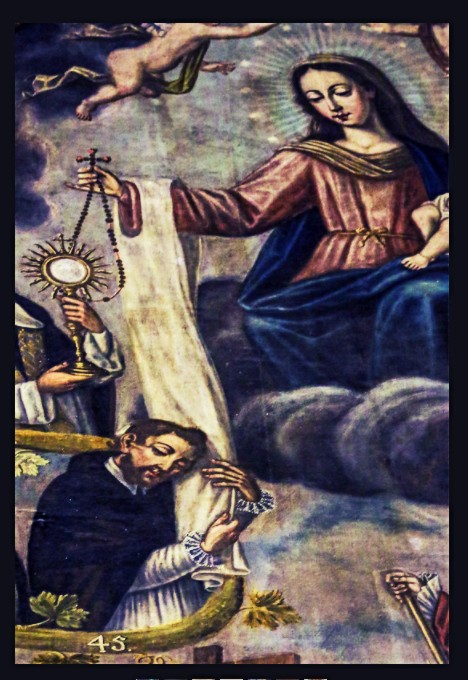
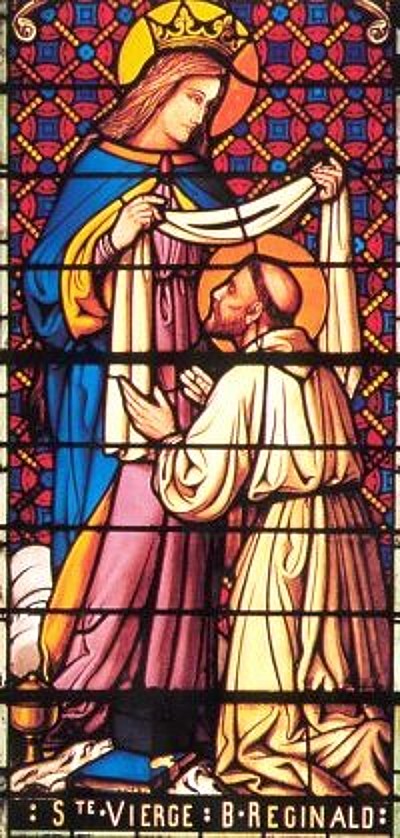
The Miraculous cure of Blessed Reginald by the Blessed Virgin Mary
Reginald of Orleans was known, even during his lifetime, for his brilliance, his prayer, his austerity and his kindness toward others, especially the poor. Originally a powerful Preacher and esteemed Canonist associated with the University of Paris, Reginald encountered St Dominic in Rome. Reginald was captivated by the apostolic way of life championed by Dominic and decided to join the newly-founded Order. Blessed Reginald is one of the great early Dominicans who were acquainted with Dominic himself and seemed to be given a share of the Founder’s spirit.
Blessed Reginald’s life story can be divided into two parts: one before he met St Dominic,and the other, after he had met the Founder. He was born in Orleans, France in c 1180 and having been Ordained a Priest, he had become a Doctor of Canon Law and a well-known figure in the Church in Paris. Many must have looked at him and thought that he had everything he wanted. But, in reality, he was feeling dissatisfied with his life: as was commonplace in the Church in those times he had a very comfortable and well-off lifestyle, yet he knew that his calling from Jesus Christ was to something greater than mere comfort and prestige. And so he was in a dilemma.
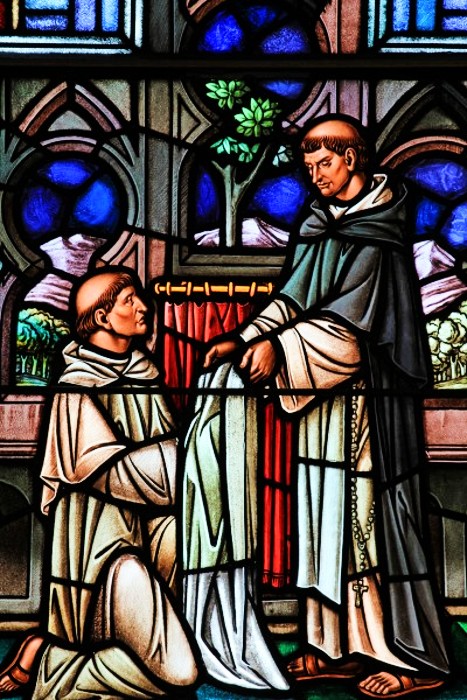
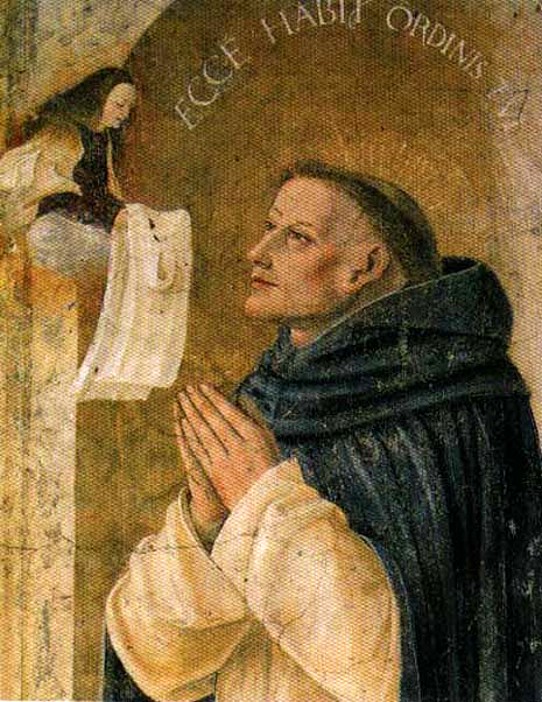
Blessed Reginald receives the Habit from the hands of St Dominic
In the year 1218 Reginald was in Rome, when he fell seriously ill. As it happened, Dominic was also in Rome and a mutual acquaintance told him about the condition of Reginald, so that he went to visit him. The biographers tell us, that there was immediately, a perfect understanding between the two men – Reginald saw, that the new Dominican Friars were living the sort of ideal he had been longing for and there and then, he made his religious profession into the Order of Preachers. There was a great sign given to mark this moment of decision: as Reginald lay sick, his life in danger, he was favoured with a vision of the Blessed Virgin Mary who anointed him with oil and held out to him the Dominican habit. Blessed Reginald found himself completely cured and began with great energy to live the Dominican life.
It was quickly apparent to everyone, that he was a changed man. In the City of Bologna where he was assigned and became the Prior of the Dominican Convent there, he became known to the whole City, as a great Preacher of the Gospel, preaching with overflowing faith and conviction. An early biographer wrote, that his preaching ‘like a burning torch, inflamed the hearts of all his hearers.Very few people were so stony-hearted that they could resist the effects of this fire.’.
And, if it is a mark of a true apostle, that he will gather followers to his side, then Reginald, more than passed the test: he attracted a great number in Bologna to join him in the Order of Preachers. Many of them were like him, educated university men and like him, they found the Gospel way of life they had been looking for.
Blessed Reginald was not to enjoy a long life as a Dominican. Early in 1220 he again became ill and this time he died peacefully. . But his place in the history of the Dominican family was assured by the memories of those who had known him in Bologna and had seen a saintly apostle on fire with the love of God and of souls. His meeting with St Dominic gave the final meaning to his life – the beautiful calling, which is given to all those who follow the Lord, to preach the Gospel of Jesus in word and in deed.
“I have no fears for the struggle, nay, I rather look forward to it with impatience, for ever since the Mother of God anointed me with her virginal hands in Rome, I have never ceased to put my whole trust in her and now joyfully await the hour of my deliverance, that I may hasten to see her once more. However, that I may not seem to make little of the Church’s anointing, I profess myself willing to receive it and I humbly ask for it at your hands.”– the final words of Blessed Reginald.





































 AnaStpaul
You must be logged in to post a comment.