Posted in AUGUST - The Immaculate Heart of Mary

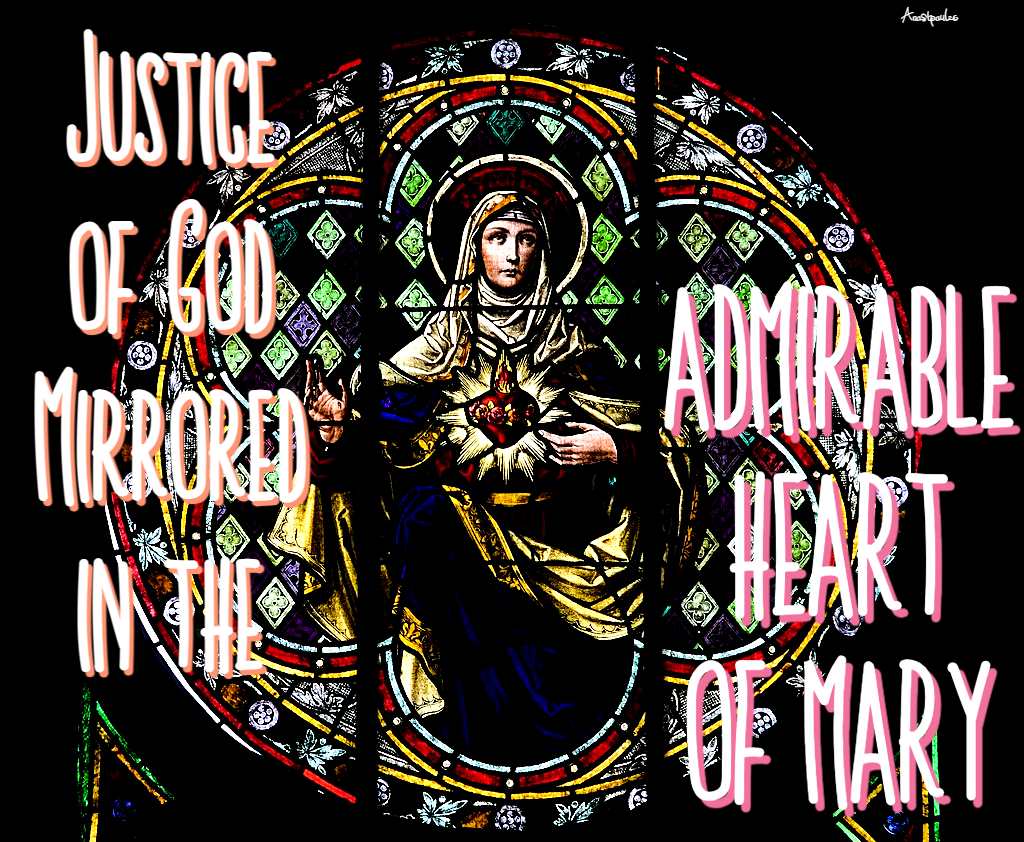
Thought for the Day – 31 August – Justice of God Mirrored in the Admirable Heart of Mary

St John Eudes – The Admirable Heart of Mary

Justice of God Mirrored in the Admirable Heart of Mary

Mercy and justice resemble two sisters, inseparable and holding each other by the hand. Wherever mercy is, there also is justice; where justice goes, mercy follows. Hence King David sang to God: “Mercy and judgment I will sing to thee, O Lord.”

We have studied how divine mercy reigns and triumphs in the gentle Heart of Mary; we shall now contemplate divine justice establishing therein the throne of its glory. “In this perfect Heart,” says Richard of St. Lawrence, “mercy and justice gave each other the kiss of peace.”

In God there are two kinds of justice: the first, is distributive; the second, vindictive justice. “Distributive justice,” says St. Dionysius, “gives to each one what belongs to him, according to his rank and merit. It allots and dispenses to each thing the proportion, beauty, arrangement, good order and all other things proper to it within the bounds and limits that are just and equitable.” The chief characteristic of vindictive justice is infinite hatred of sin and a desire to destroy it in the souls of men, thereby delivering them from its cruel tyranny.

Now these two types of justice have ever held sovereign sway in the most just Heart of the Blessed Virgin Mary. In the first place, she always rendered to God and to all God’s creatures, in a most faithful and perfect manner, what she owed to them. To God, she accorded adoration, fear, dependence, gratitude, honor, glory, praise, love and the sacrifice of all she possessed and of her very self. She observed all the Mosaic laws very devotedly and with exact obedience. She exercised respect, veneration and humility towards her parents, St. Joachim and St. Anne, towards the persons who had charge of her while she dwelt in the Temple of Jerusalem, and towards St. Joseph, her most worthy spouse. She punctually obeyed even the edicts of Emperor Augustus, though he was a pagan idolator. She held her own self in very low esteem and in great contempt, knowing she was a creature drawn from nothing and a daughter of Adam, who would have come under the curse common to all his children, if God had not preserved her from it. In a word, she faithfully practised the words of the Holy Ghost even before they were spoken by St. Paul: “Render therefore to all men their dues. Tribute, to whom tribute is due; custom, to whom custom: fear, to whom fear: honor, to whom honor. Owe no man anything, but to love one another.” This last is a debt which no one can ever finish paying.

In the second place, divine justice had so completely filled her Heart with such an unfathomable hatred for sin that this holy Virgin was always ready to undergo the sufferings of as many hells as God’s omnipotence could create rather than commit the least venial sin.

What is still more admirable, however, is that, having the same Heart and mind as the Eternal Father, according to the inspired words: “He who is joined to the Lord, is ‘one spirit,” Our Lady united her will to His concerning the Passion of her Son, and gave her consent to the painful death of her dearly Beloved so that He might destroy sin. This sacrifice demonstrates a hatred of sin greater than suffering the torments of all imaginable hells to cooperate in its destruction; for it cannot be doubted that if Our Lady had given her choice, she would have preferred all such sufferings for herself rather than see the treatment inflicted on her beloved Son at the time of His cruel and ignominious Passion.

If the Holy Heart of Mary is filled with such terrible hatred of sin that she consented to the cruel death of her beloved Son, because she saw Him loaded with the sins of men; if she readily sacrificed Him to divine justice in order to crush the mortal enemy of God and men, who can doubt that she still hates the infernal monster wherever she finds it? She hates sin to the point of sometimes uniting herself to divine vengeance in order to destroy it in souls, especially in those souls who are their own enemies to the extent of supporting evil and opposing its destruction.

They force their sweet Mother, as it were, to relinquish the tenderness of her maternal love and to participate in the severity of divine justice in order to punish the obduracy of a rebellious soul hardened in malice. O most holy Virgin, since thou hast but one Heart and one spirit with thy divine Son and since thou hast no other sentiments save His, thou dost love what He loves and thou dost hate what He hates. Hence, as Christ has an infinite hatred for sin, thou also dost hate it beyond all thought and words. Thy hatred for the infernal monster is equal to the love thou hast for God.

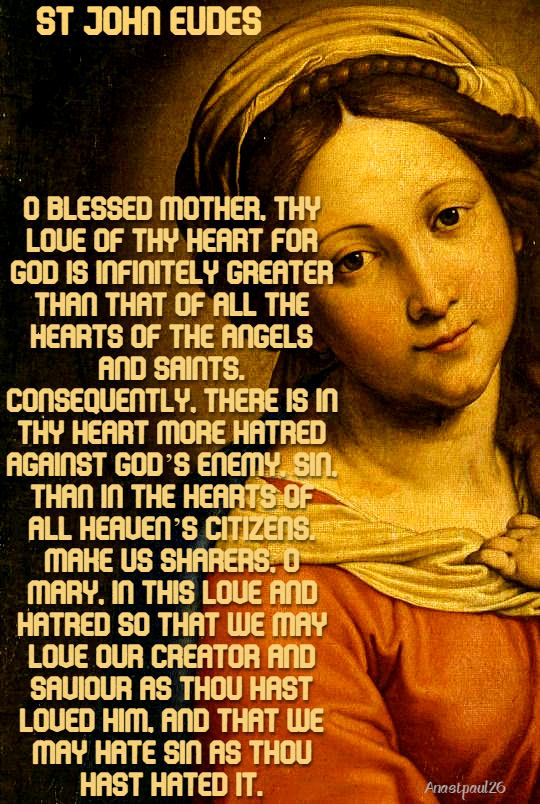
O Blessed Mother, thy love of thy Heart for God is infinitely greater than that of all the hearts of the angels and saints. Consequently, there is in thy Heart more hatred against God’s enemy, sin, than in the hearts of all heaven’s citizens. Make us sharers, O Mary, in this love and hatred so that we may love our Creator and Saviour as thou hast loved Him, and that we may hate sin as thou hast hated it.
Posted in AUGUST - The Immaculate Heart of Mary

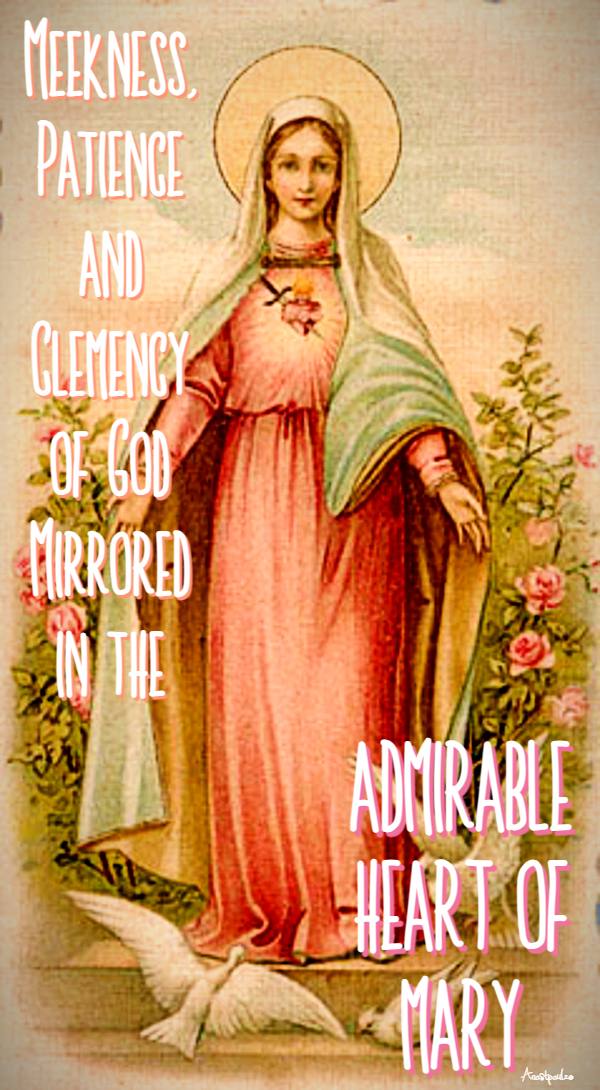
Thought for the Day – 30 August – Meekness, Patience and Clemency of God Mirrored in the Admirable Heart of Mary

St John Eudes – The Admirable Heart of Mary

Meekness, Patience and Clemency of God Mirrored in the Admirable Heart of Mary

God’s meekness, patience and clemency are three divine perfections which are joined with mercy to form one and the same perfection, although their effects are different.

Mercy regards the misery of creatures in general, to relieve and to deliver them from its fetters. The first and greatest of miseries, the source of all wretchedness is sin. When man is so unhappy as to offend God mortally, he at once becomes the object of God’s wrath which would crush him the very instant he consents to sin, as he infinitely deserves to be. But divine meekness prevents the destruction and arrests the torrent of God’s just anger, ready to pour upon the sinner. If man perseveres in his crime, he deserves to be cast upon divine vengeance, but divine patience interposes and persuades God to suffer the sinner and await his repentance with admirable goodness. These are the effects of divine meekness and patience. God’s clemency is manifested by remitting entirely or in part the punishment due to sin.

Now these three divine perfections live and reign in the Heart of the Mother of Mercy, communicating their own divine inclinations most excellently. After the Heart of God Himself there never was and never shall be a heart so full of meekness, patience and clemency as the noble Heart of Mary.

While she dwelt on earth, she beheld the world filled with idols and idolators. With the exception of a very small number, men generally were armed against God, trying, if possible, to dethrone Him, to put Him under their feet and annihilate Him. They would set His enemy in His place and sought to procure for the usurper the adoration and honor which belong to God alone. As the Most Blessed Virgin Mary loved God with a love so great that we cannot describe it, she experienced an indescribably great sorrow at the sight of the crimes committed against His Divine Majesty.

But who can appreciate her greater grief over the atrocious torments inflicted on her beloved Son by the perfidy of the Chosen People? She knew Him to be Innocence and Sanctity incarnate; yet she saw Him persecuted and tormented as though He were the greatest of criminals. Now what did she do, the Mother of Sorrows, as she beheld her treasure, her most innocent Lamb torn, flayed and slain? She loved Him with a peerless love. Did she cry out against His pitiless Murderers? Did she lament of the wrong and injustice wreaked upon Him? Did she implore the Eternal Father’s justice? No. She remained silent; not a word was heard from her lips; only her stifled sighs, her tears alone were seen. Her most gentle Heart fought against the entry of any sense of injury or movement of impatience, or aversion or bitterness towards her cruel tormentors. Her Heart abounded with meekness, patience and clemency, so that she imitated her son, Jesus, and sought to excuse the men who with such distorted rage were killing Him, repeating in her Heart the words He uttered with His lips: “Father, forgive them, for they know not what they do.” She offered for their salvation the very Blood they shed, the sufferings they inflicted upon Him, the cruel death they perpetrated. She was prepared, if necessary, to sacrifice herself together with her Son, to obtain mercy for those wicked men.

Nor is that all. The glorious Virgin now reigning in heaven can see much more clearly the numberless multitude and frightful enormity of the sins committed against God. She sees this earth of ours which should be a paradise since the God of Heaven honored it with His presence and made it His dwelling place; yet it is filled with sinners and enemies of God, who blaspheme and dishonor Him without ceasing, even more than the devils and the damned in hell.

Our Lady knows that her Son, the Son of God, came into the world to save all men; that salvation cost Him infinite labor, ignominies, tears and blood to deliver mankind from the bondage of the devil and hell, and reconcile them to His Father. And yet she sees men turning their back on God, denying and forsaking Him, to side with Satan and cast themselves headlong into hell. She sees innumerable atheists and blasphemers making every effort to exterminate the Holy Church founded by her Jesus Christ through the shedding of the last drop of His Blood, and to render His sacred name despicable, abominable and odious to the entire’ world: “They have set me an abomination to themselves.”

Our heavenly Mother perceives all these crimes and all the wickedness most clearly, and her inconceivably great love for God and for her Son is wounded beyond anything we can imagine, even though she is glorious and incapable of suffering. She is Queen of Heaven and earth, and God has given her sovereign power over all created things; therefore she would not lack the power, if such were her will, to avenge most justly the many atrocious insults offered by men to their God and Saviour. But far from doing this, she permits herself to be induced by her very patient and gentle Heart to use the power of her merits and intercession in order to halt the just fury of divine vengeance, and to arrest the torrent of God’s wrath ready to burst on the hapless heads of sinners. She obtains from His divine Majesty that He punish them not as enemies but as children, not like a severe judge but as a merciful father, not to exterminate them but to correct and convert them.

True the Blessed Virgin Mary does not entertain the same sentiments for all sinners, nor does she treat them all alike. She distinguishes between those in Hell, whom she knows to be irreconcilable enemies of God, and those on earth, whom she considers still capable of being reconciled to His divine Majesty. Hence her Heart is filled with very great and just indignation towards the wretched creatures in hell, for she is most perfectly united to God, and therefore shares in all His adorable inclinations. She loves what God loves and hates what He hates, approves what He approves, and condemns what He condemns. As the damned will forever be the object of God’s wrath: “They shall be called the people with whom the Lord is angry forever,” so shall they forever be the object of the anger of God’s Mother. Her love and charity for God and the friends of God are greater than the ardor of all angels and saints together, so also is her hatred of God’s irreconcilable enemies greater than that of all the denizens of heaven.

But towards sinners who are still in this world, which is a place of mercy where our all-bountiful Mother has established the throne and empire of her mercy and clemency, her Heart is so filled with sweetness and benignity that the venerable and holy Abbot Blosius declares: “The world does not hold any sinner so detestable that this pious Virgin should not be disposed to open to him the arms of her clemency and her most merciful Heart. Provided he seek her assistance, she will always have the power and the will to reconcile him to her Son.” Blosius says further: “As long as the time of grace endures, this merciful Mother cannot avert her eyes from miserable sinners who invoke her with a sincere desire of conversion. With the Heart of a Mother and a sister, she continually offers up her prayers to God on behalf of men, and takes special care of their salvation. No one who shall invoke this Mother of grace with devotion and perseverance, can possibly perish forever.”

“O sweetest and most holy Virgin, look down with the eyes of thy mercy on all the afflictions and all the afflicted that fill the earth. Behold the many poor people, the many widows and orphans, the sick troubled with so many diseases, the captives and prisoners, the thousands who are cursed and persecuted by the malice of men, the defenceless persons oppressed by the strong and the mighty, the seafarers and pilgrims struggling against perils on sea and land, the missionaries exposed to countless dangers in their task of saving endangered souls. Look down upon the number of afflicted minds, of anguished hearts, of souls tormented by manifold temptations, and of souls suffering the frightful penalties of Purgatory. But above all, have pity on the countless souls that are in the state of sin and perdition and are groaning under the tyranny and the bondage of hell.

“Finally, O gentlest of Virgins, take pity on the great number of wretches who people the universe, whose innumerable miseries are so many voices crying to thee: O Mother of Mercy, comforter of the afflicted, refuge of sinners, open the eyes of thy clemency to see our desolation, the ears of thy bounty to hear our supplications. “To thee do we cry, poor banished children of Eve; to thee do we send up our sighs, mourning and weeping in this vale of tears,’ Yes, Eve’s miserable children, banished from the house of their heavenly Father, groaning and weeping in this valley of tears, have recourse to thine incomparable benignity. Hear our sighs and our cries; behold our weeping and our tears. “Turn then, O gracious Advocate, thine eyes of mercy towards us, and after this our exile show unto us the blessed fruit of thy womb, Jesus.’

Posted in AUGUST - The Immaculate Heart of Mary

Thought for the Day – 29 August – Further Divine Perfections Mirrored in the Admirable Heart of Mary

St John Eudes – The Admirable Heart of Mary

Further Divine Perfections Mirrored in the Admirable Heart of Mary

Divine Mercy is a perfection directed towards the miseries of creatures, tending to alleviate them and even to free them from created things when such a liberation enters into the designs of Divine Providence, which does all things with measure, number and weight. This adorable mercy extends, like goodness itself, to all God’s works: “His tender mercies are over all His works.” God’s mercy overshadows the works of nature, the works of grace and the works of glory.

Among the effects of divine Mercy, we must enumerate three principal realities, which in turn embody numberless effects. The first is the Incarnation of the God-Man; the second, His Mystical Body, namely Holy Church; the third is the Mother of the God-Man, namely the Most Blessed Virgin Mary. These constitute three admirable masterpieces of divine mercy.

Beyond this, God not only willed to become man that men might become partakers of the divine nature, but He willed that His only Son should become the Son of Man that men might become sons of God. God willed that His Son come into this world by being born of the seed of Adam and of a daughter of Adam that we might have the God-Man for our brother and the Mother of God for our mother. Thus we have the same father and the same mother as the Son of God Himself. We are His brothers, and as He is our mediator with His Father, so His heavenly Mother is a mediatrix between Himself and us.

In order to render His admirable Mother paramountly able to exercise her double office of Mother and Mediatrix, so that she might protect, favor and assist us with greater efficacy in all our needs, Divine Mercy constituted her, first of all, most agreeable and holy. Secondly, Mercy gave her dominion over everything in heaven and on earth. Thirdly, it gave her the mildest, sweetest and most loving heart save that of the God- Man. To the Heart of Mary God communicated in great abundance His merciful inclinations and established in it the throne and reign of His Mercy more gloriously than in the heart of any other creature, save the sacred humanity of Christ. Divine Mercy reigns so perfectly in Mary’s Heart that she bears the name of Queen and Mother of Mercy. And this most loving Mary has so completely won the heart of God’s mercy that He has given her the key to all His treasures and made her absolute mistress of them.

St. Bernard says: “She is called the Queen of Mercy because she opens the abyss and treasure of divine mercy to whom she chooses, when she chooses and as she chooses.” Divine Mercy holds such complete sway over Mary’s Heart and fills it with so much compassion for sinners and for all persons in need that St. Augustine addresses her thus: “Thou art the sinner’s only hope,” after God. “My dearest children,” says St. Bernard, “her heart is the ladder by which sinners go up to heaven; this is my reliance, this the only reason of my hope.” Euthymius, one of the ancient Fathers who lived over seven centuries ago, adds: “O most merciful Virgin, deign to cast thy pitiful eyes on thy poor servants, for, after God, we have placed all our hope in thee who are our life, our glory, and, as it were, our substance and our being.” St. John Damascene tells us that Our Lady is the only relief of the afflicted, the sovereign comforter of anguished hearts; and St. John Chrysostom declares her to be a boundless ocean of mercy.

Would you know in what further manner divine mercy lives and reigns in the Heart of the Mother of Mercy? Listen to St. Bonaventure: “Great was Mary’s mercy towards the wretched while she was living in exile here below; but immeasurably greater still now that she is happily reigning in heaven. She manifests this greater mercy through innumerable benefits, now that she possesses a clearer insight into the numberless woes of mankind. She does not require past merits, but grants the petitions of all men, out of charity, and opens the bosom of her clemency to everyone. She relieves every need and necessity with an incomparable affection and tenderness of heart.”

Her gentle Heart is so filled with mercy that it overflows on all sides and spreads itself in heaven, on earth and even in hell. Let us again listen to St. Bernard proclaiming this truth: “Who can comprehend, O Blessed – Virgin, the length, the width, the height and the depth of thy mercy? Its length extends to the last day in the life of those who invoke thee; its width encompasses the whole world; its height reaches to heaven, there to repair the losses of the heavenly Jerusalem; its depth has penetrated hell to obtain the deliverance of them that sit in the darkness and shadow of death.”

The virginal Heart of the Mother of Grace is filled with such exceeding mercy that she exercises it not only in favor of sinners who wish to be converted, but also towards many persons who never think of their eternal salvation. She implores her Blessed Son to inspire them, to excite in their hearts sentiments of fear of God and terror at the thought of His judgments. She asks Him to chastise them in divers ways, to raise in their midst persons leading holy and exemplary lives, whose example will draw them to Himself, and to use all other means of obtaining their conversion, or at least, if they will not mend their ways, to prevent them from multiplying their sins, that their damnation may be less terrible.

But what is even more, the Heart of Mary is so full of mercy that, using the extraordinary privileges God has granted to her alone, and out of her incomparable goodness, she often saves from eternal perdition souls who in the ordinary course of divine Justice would have been cast into hell. Such is the mind of that ancient and excellent author, Raymund Jourdain, who succeeded in hiding his name, but not the extent of his learning and holiness: “The Mother’s mercy often saves many whom the justice of the Son would have otherwise condemned.”

Hence St. Germanus, Patriarch of Constantinople, addresses these beautiful words to Mary: “O purest, best and most merciful Lady, help and relief of the faithful, powerful comforter of the afflicted and assured refuge of sinners, forsake us not, but keep us ever under thy protection. If thou forsake us, to whom shall we have recourse? What would become of us without thee, most holy Mother of God, who are the spirit and life of Christians. Even as respiration is an infallible sign of life in our bodies, so is thy holy name, when it is constantly on the lips of thy servants, on all occasions, at every time and in all places, not only a sign, but a veritable cause of life, happiness and protection.”

Posted in AUGUST - The Immaculate Heart of Mary

Thought for the Day – 28 August – Goodness and Providence of God Mirrored in the Admirable Heart of Mary

St John Eudes – The Admirable Heart of Mary

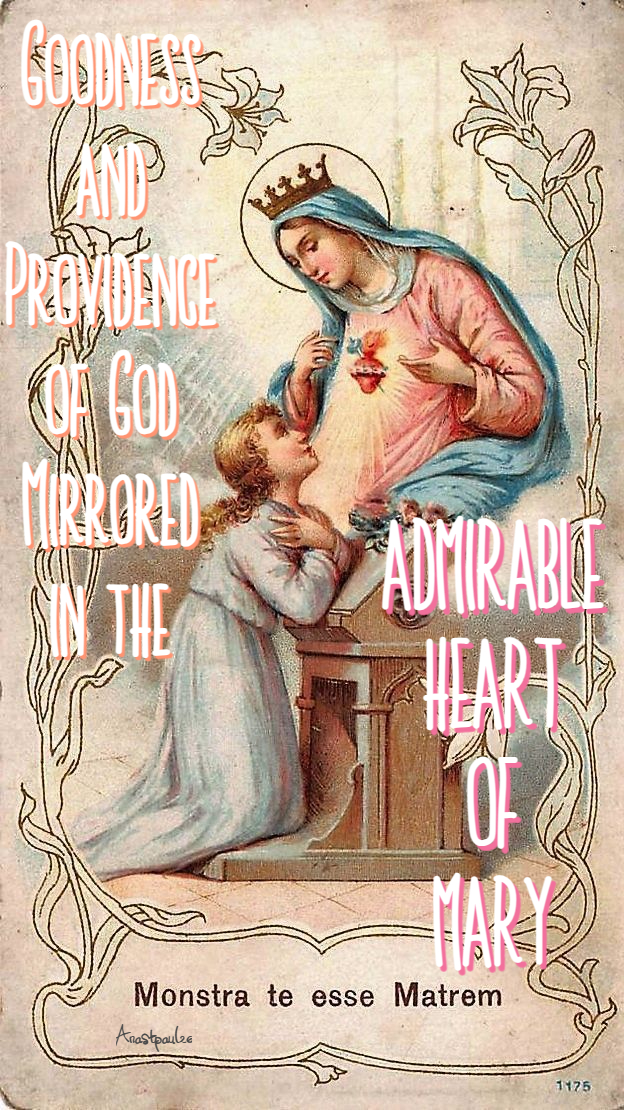
Goodness and Providence of God Mirrored in the Admirable Heart of Mary

Sacred theology distinguishes in God three kinds of goodness, which are fundamentally one and the same: natural goodness, moral goodness and goodness of benevolence or bounty, which is sometimes called benignity. Natural goodness is none other than the perfection and beauty of divine nature, containing the infinite excellences of the Godhead. Moral goodness comprises all the moral virtues that God possesses so eminently and in so high a degree that they are infinitely beyond what a created spirit can think or express. The goodness of benevolence or bounty is God’s infinite inclination to communicate Himself and it proceeds from His natural goodness. In the order of glory God communicates Himself most fully and perfectly to all the souls in heavenly bliss, clothing them in His radiant glory, surrounding them with His felicity, enrapturing them with His holy joys, and making them partakers of all the goodness He Himself possesses.

The superlative Goodness communicates Its adorable perfections to the holy Heart of Mary with much greater abundance and plenitude than to all other creatures put together. Next to the Heart of God, there never was and never shall be a heart so good, liberal, benevolent, magnificent and so replete with kindness as the most admirable Heart of Mary.

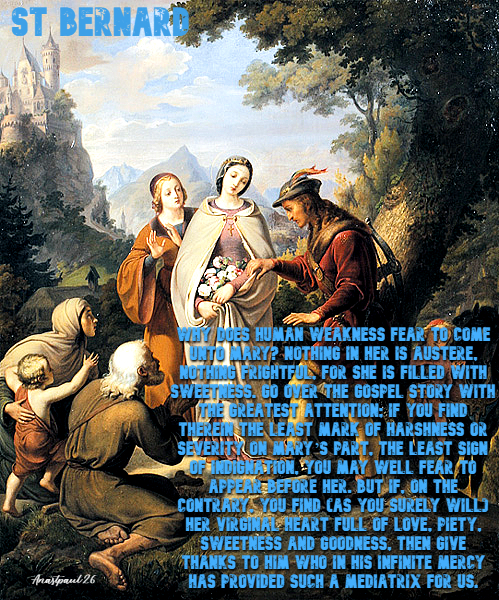
The Heart of Mary is so full of goodness that St. Bernard thus speaks of her: “Why does human weakness fear to come unto Mary? Nothing in her is austere, nothing frightful, for she is filled with sweetness. Go over the Gospel story with the greatest attention; if you find therein the least mark of harshness or severity on Mary’s part, the least sign of indignation, you may well fear to appear before her. But if, on the contrary, you find (as you surely will) her virginal Heart full of love, piety, sweetness and goodness, then give thanks to Him who in His infinite mercy has provided such a mediatrix for us.”

“Her Heart is so alive with pity that she never rejects any suppliant coming to her with humility and confidence,” says Raymund Jourdain. It is this loving confidence that we express as often as we recite that beautiful prayer, attributed by many annotators to St. Bernard, and by others to St. Augustine: “Remember, O most gracious Virgin Mary, that never was it known that anyone who fled to thy protection, implored thy help and sought thine intercession, was left unaided.”

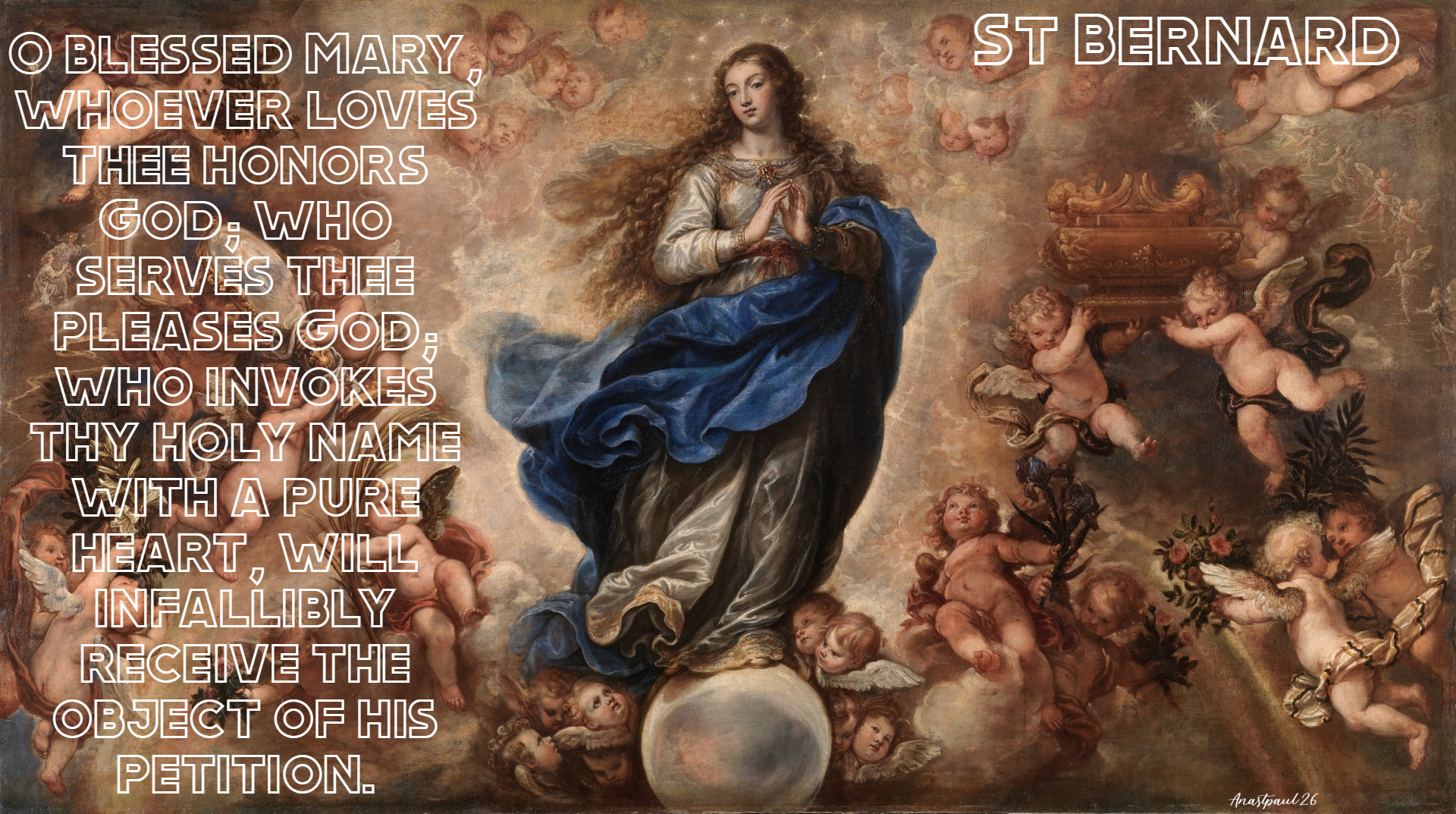
Her Heart is so filled with bounty that she readily grants whatever we ask of her. St. Bernard says: “O blessed Mary, whoever loves thee honors God; who serves thee pleases God; who invokes thy holy name with a pure heart, will infallibly receive the object of his petition.”

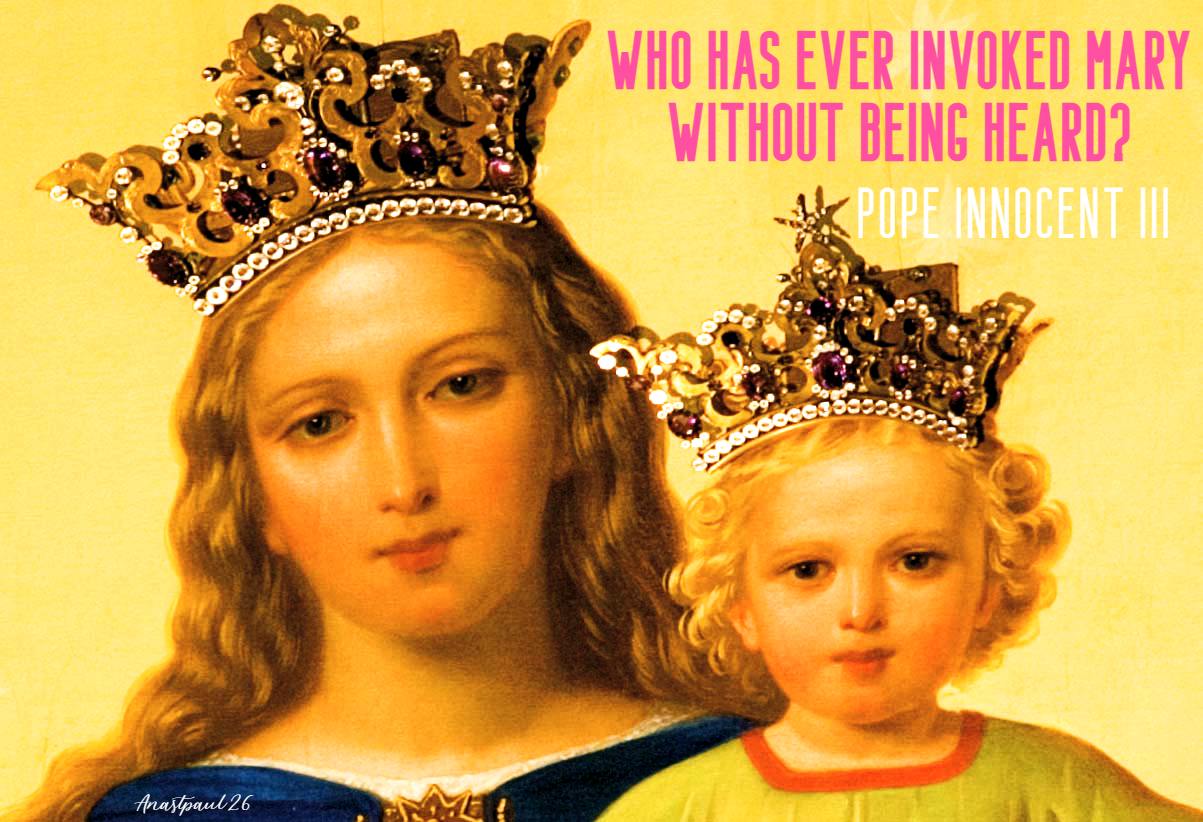
“Who has ever invoked Mary without being heard?” says Pope Innocent III. The venerable Abbot Blosius adds: “She rejects no one but lends a favorable ear to the petitions of all.” “Heaven and earth would sooner perish, than Mary refuse her help to such as invoke her seriously and with affection,” reiterates St. Bernard, adding: “Let him be silent in praise of thy mercy, O most Blessed Virgin, who having invoked thee in his necessities, should remember not having received thy help.”

Her Heart is so good and merciful that she extends her kindness not only to the good but also to the wicked, not only to the faithful but to sinners as well. “In this life, thou art a help to the just and unjust,” says Raymund Jourdain. “Thou dost aid the just man and the sinner; the former by keeping him in the state of grace, wherefore the Church calls thee the Mother of Grace; the latter by bringing them back to divine Mercy, for which thou art named the Mother of Mercy.” Our Lady’s Heart is so kind and gentle that she helps not only those who implore her aid, but even the careless souls who neglect to invoke her. Listen again to St. Bernard: “Why should we marvel to see her stretch a helping hand to such as beseech her, if she assist even them who do not pray to her?”

Her Heart is so merciful that she loves even those who hate her. Mary always renders good for evil because she willingly sacrificed her own beloved Son to save the reprobates who crucified Him. Other Fathers of the Church express the same thoughts and assure us that the almost boundless charity of the Heart of Mary extends to all places, times and things in general, through a most abundant communication and eminent participation of God’s infinite goodness and likewise of His divine providence.

She leads all created things to the last end for which God made them, namely the glory of His Divine Majesty. But her special care is the guidance of rational beings, above all, of Christians, and most particularly of her own devout children, who strive faithfully to honor, serve and imitate her.

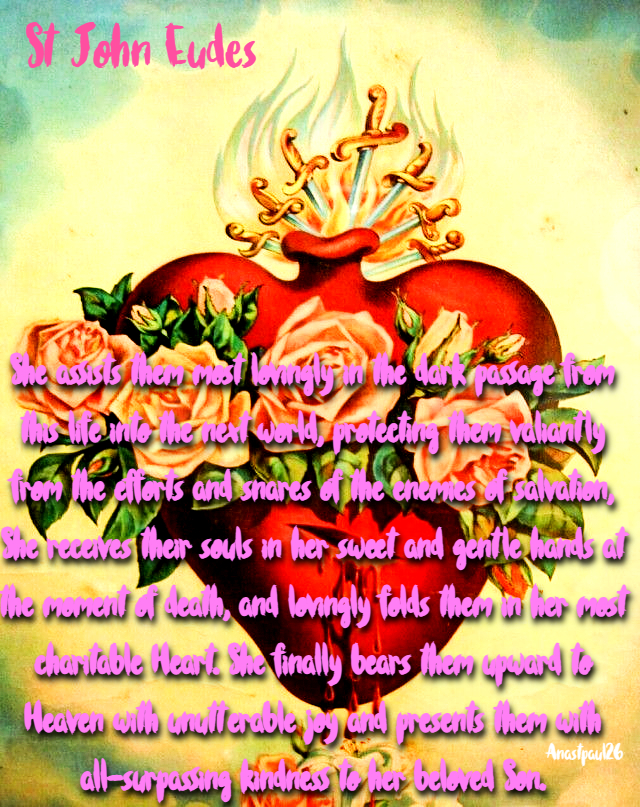
Her maternal Heart protects and cherishes her devotees in a unique manner, having her eyes ever intently fixed upon them. She preserves and guards them as the apple of her eye, and assumes the guidance and conduct of their entire life and actions. She leads them by the hand in all their ways, removing from their path the obstacles and hindrances which might make them stumble, or retard their progress. She obtains the assistance and the means whereby they will receive strength and advance more rapidly. She bears their soul in her arms and on her virginal breast through the dangerous crises where their peril is greatest. She assists them most lovingly in the dark passage from this life into the next world, protecting them valiantly from the efforts and snares of the enemies of salvation, She receives their souls in her sweet and gentle hands at the moment of death, and lovingly folds them in her most charitable Heart. She finally bears them upward to Heaven with unutterable joy and presents them with all-surpassing kindness to her beloved Son.

If such is the miraculous goodness of Mary to those who love and venerate her, how can there possibly be any Christians who hold back from devotion to the center and principle of her benignity, her Admirable Heart?

Praise, honour and glory be forever to the Most High, who has thus caused the Heart of this incomparable Mother to reflect to mankind the perfect image of His goodness and all-merciful providence!

Posted in AUGUST - The Immaculate Heart of Mary

Thought for the Day – 27 August – Wisdom and Truth of God Mirrored in the Admirable Heart of Mary

St John Eudes – The Admirable Heart of Mary

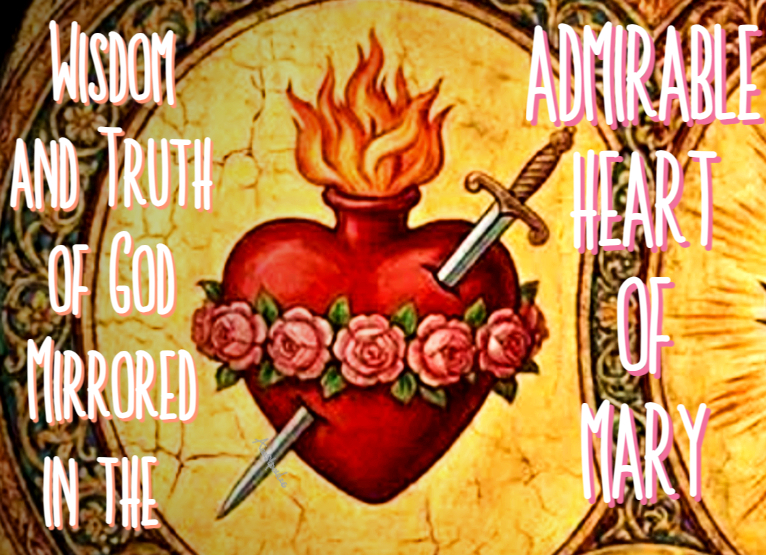
Wisdom and Truth of God Mirrored in the Admirable Heart of Mary

Divine wisdom and truth are communicated to the holy Heart of the Blessed Virgin Mary in no lesser degree than Divine power and strength. If the Holy Ghost assures us that the soul of the just man is the seat of Divine Wisdom, we can well say that the Heart of Mary, Mother of Jesus, is the throne of this same Wisdom, the highest and most magnificent throne that it ever had or shall have on earth and in heaven.

The Heart of Mary is not merely the throne of Wisdom, but its living image, for it is the Heart of the Mother of Him whom Sacred Scripture calls “the wisdom of God.” In Christ are all the treasures of the wisdom and knowledge of God, and He certainly dispensed them in an incomparably higher manner to His Mother than to King Solomon and all the sages and wise men of the universe. Mundane prudence and the wisdom of the flesh never found admittance into her wise Heart, which was and still is an inexhaustible treasure and bottomless abyss of angelic prudence, holy science, heavenly light and wisdom divine, because her luminous Heart always was and ever shall be the abode of the Eternal Sun and of Uncreated Wisdom, Who has always dwelt therein. It is the city mentioned by the Prophet Isaias: “One shall be called the city of the Sun.”

St. Bernardine of Siena expressly states that Our Lady was so completely filled with the light of Divine Wisdom from her mother’s womb that from the initial moment of her existence she possessed a perfect general knowledge of the Creator and of all irrational, rational and intellectual creatures. Our Lady knew all these things in God, as in their first and universal cause, for God was the single object of her gaze as well as of her love. She saw God in all things, and all things in God.

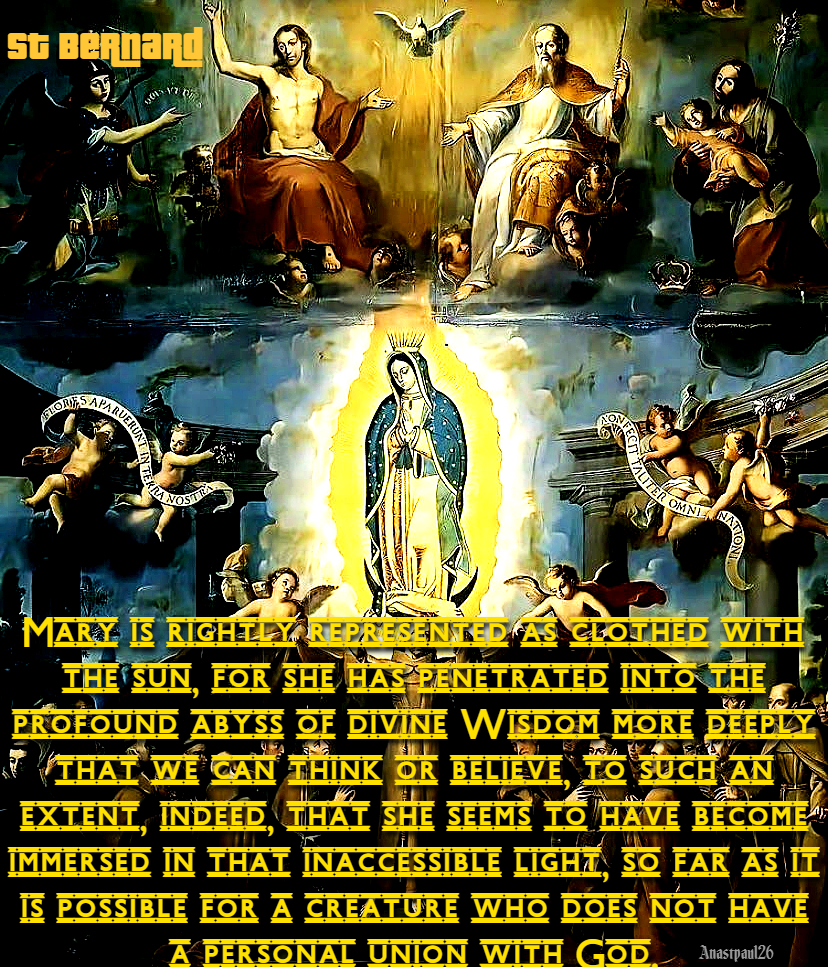
“Mary is rightly represented as clothed with the sun,” says St. Bernard, “for she has penetrated into the profound abyss of divine Wisdom more deeply that we can think or believe, to such an extent, indeed, that she seems to have become immersed in that inaccessible light, so far as it is possible for a creature who does not have a personal union with God.”

Our Lady possesses a special knowledge of those who are most devoted to her; she knows God’s designs concerning them, the road they should follow to reach God, the state and dispositions of their souls, all the accidents that befall them, all their possible perils, the pains they suffer, interiorly and exteriorly. She knows the temptations that assail them, the evil schemes of their enemies and all their corporal and spiritual needs, so that she may assist, protect, defend and strengthen her faithful followers, obtain from her divine Son the help they need most, and be herself the best of mothers to them. From this you can estimate the happiness and advantages enjoyed by those who make themselves worthy to be numbered among the true children of Our Lady’s loving Heart.

Such are some of the effects wrought by Divine Wisdom in this admirable Heart. We shall now contemplate in it the workings of the Eternal Truth of God. Divine veracity stamps its image most excellently on the Blessed Virgin’s Heart. As God is paramountly the God of all truth and calls Himself the Holy and True One, so is the Heart of the Mother of God filled with truth. Only of the Heart of Mary can it be said, speaking of simple creatures, that truth always filled it, because it was the only Heart ever completely faithful to its divine rule and exemplar, the Heart of God Himself. Give me all the hearts of the children of Adam, and I shall repeat of them all the words of the Holy Spirit: “Their heart is vain,” for none will be found who were always truthful and faithful to God.

Only of the Heart of the Mother of Him who is essential and uncreated Truth, could it be said from the first to the last moment of her life: “The Heart of Mary is holy and truthful,” because it always conforms to God’s eternal decrees. “Whatever was done in her,” says St, Jerome, “was all purity and simplicity, sanctity and truth.”

Furthermore, as God is infallible in His judgments and knowledge and can commit no error, knowing and judging all things in His own truth, so also He gave the Blessed Virgin Mary a knowledge of the truth which enlightened all her judgments. Her Heart was ever filled and possessed by the spirit of truth, which guided her with the infallible light of faith that can truly be called a participation of divine truth.

Finally, as all the actions and words of God are imbued with Truth itself, in like manner were the words and actions of God’s Mother always truthful, that is, they were always conformable to the holiness, perfection and truth of the deeds and words of God. This was because they stemmed from a Heart most holy, perfect, and truthful, and the Son of God Himself teaches us that man’s heart is the principle of all his thoughts, words and actions, be they good or bad.

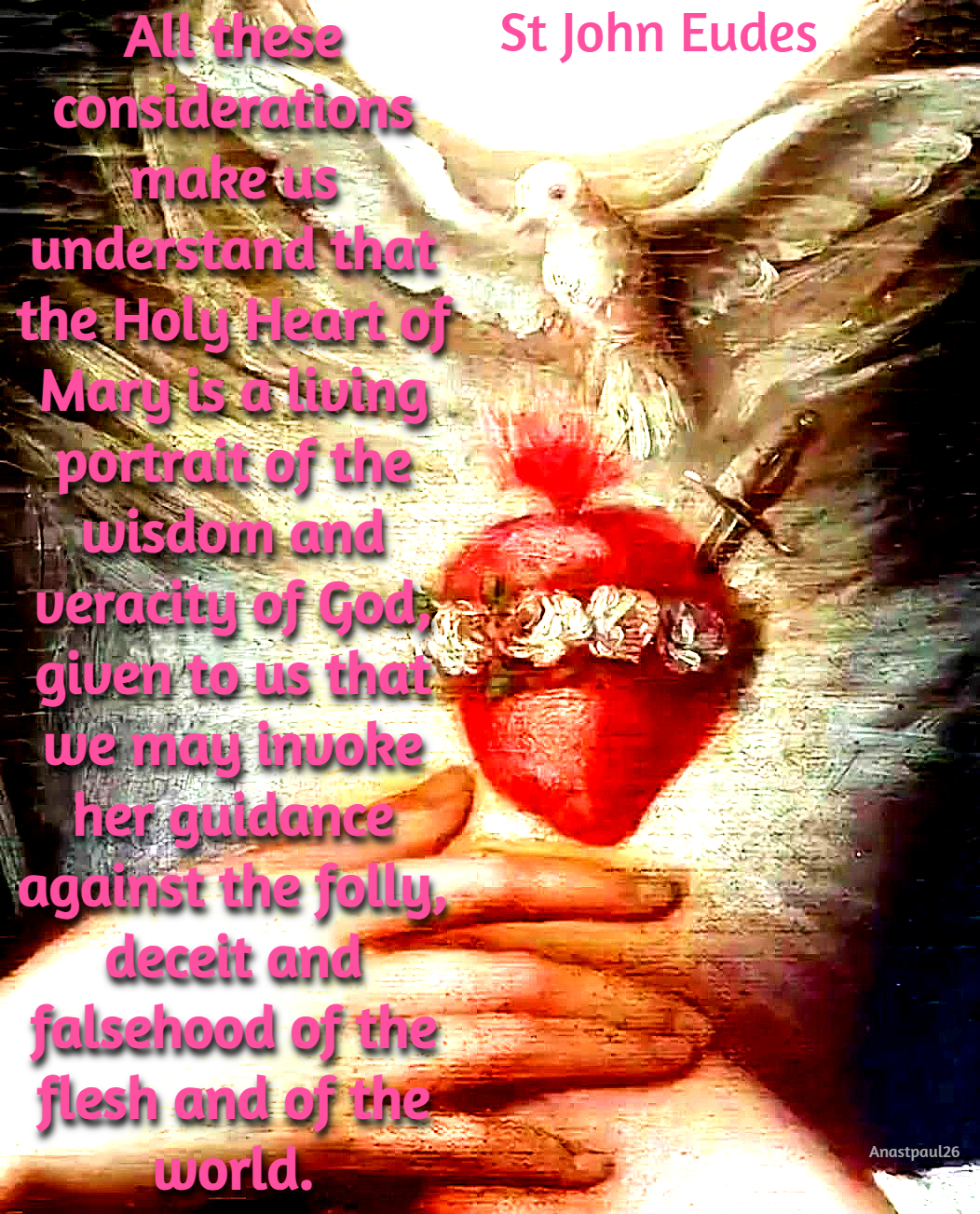
All these considerations make us understand that the Holy Heart of Mary is a living portrait of the wisdom and veracity of God, given to us that we may invoke her guidance against the folly, deceit and falsehood of the flesh and of the world.

Posted in AUGUST - The Immaculate Heart of Mary

Thought for the Day – 26 August – Strength and Power of God Mirrored in the Admirable Heart of Mary

St John Eudes – The Admirable Heart of Mary

Strength and Power of God Mirrored in the Admirable Heart of Mary

The principal and most common appellations given to God in Sacred Scripture are the words strong and mighty. He says of Himself: “I am the most mighty God? and “I am God Almighty.” If you should ask how these two attributes differ from each other, I would answer that in God power and strength are one and the same perfection; yet there is some difference between their effects. It belongs to all-powerfulness to work great and admirable wonders and the characteristic of strength is to accomplish all things easily, without pain or fatigue.

Let us now see the strength and power operate in the Heart of our august Queen. I visualize their image engraved on her pure Heart most perfectly. Consider the power which the Heart of the Mother of the Almighty exerts over Him Who has chosen to obey her as His Mother: “And he was subject to them.” The maternal authority and power God has given Mary over Himself will never be separated from her divine maternity, for the Son of Mary will never relinquish the nature He assumed in His Beloved Mother’s womb and never will He withdraw the privileges He once conferred upon her.

If the heart of the faithful Christian, who believes in Jesus Christ, finds everything possible according to His holy word: “All things are possible to him that believeth,” what can be impossible for the maternal Heart of Mary who conceived the Son of God in her sacred womb, gave Him birth, nourished Him, took care of Him in childhood, accompanied Him in all labors and sufferings, and loved Him more than all the hearts of Heaven and earth put together?

“If all things are possible to him who believes, how much more must this be true of her who loves Him?” says Gerson. “And of her who bore Him, adds St. Bernardine of Siena.

Hers is the Heart of the valiant woman spoken of by Solomon, always inspired with vigorous and manly virtue, through which she accomplished all things with sovereign perfection and without the least defect. This valiant woman’s Heart bore the sharpest pain and the most violent anguish with marvellous constancy and unshakeable fortitude. Her intrepid Heart crushed the infernal dragon’s head, that is, sin, prefigured by Holofernes, and the powers of hell fear the Immaculate Heart even as an army in battle array’ because Our Lady fought courageously against all God’s enemies and obtained a glorious Victory.

But what is more, she vanquished, so to speak, the Almighty Himself, for I hear an angel saying to Jacob: “Thou shalt no longer be called Jacob, but thy name shall be Israel,” which means according to St. Jerome and the Septuagint “strong against God.” This interpretation agrees with the Angel’s own explanation, for after having said: “Thy name shall be Israel,” he adds; “for if thou hast been strong against God, how much more shalt thou prevail against men?” Jacob had overcome only an angel, but that angel represented God; hence he was told he had overcome God Himself,

Jacob’s holy daughter, the worthy Mother of Christ, has, in a way really overcome God Himself. How often has she not, through the efficacy of her prayers and merits, and by the power of her love, disarmed the anger of God and arrested the torrent of His indignation, which would otherwise have flooded and destroyed the world because of its innumerable crimes? How many times has Our Lady besought divine vengeance to lay aside the thunderbolts ready to be hurled against criminal mankind? How often has her Heart’s incomparable charity clasped the hands of God’s terrible justice and stopped Him from punishing men as they deserve? “How powerful is her love,” says Richard of St. Victor, “since it overcomes the Almighty.” Yes, the love and charity of Mary’s Heart are powerful, and have as it were vanquished God Himself!

History is filled with instances where Our Lady has shown her incomparable power on behalf of those who invoke her protection, manifesting publicly to armies and nations the strength that she also extends to each Christian in his own inner struggle against sin. But her strength is for those who invoke, love, honor and venerate her heart. O Glorious Queen of the World, make us sharers in the divine power which fills thy holy Heart and give us strength against the enemies of thy Divine Son, who is all and does all in thee!

Posted in AUGUST - The Immaculate Heart of Mary

Thought for the Day – 25 August – Purity and Sanctity of God Mirrored in the Admirable Heart of Mary

St John Eudes – The Admirable Heart of Mary

Purity and Sanctity of God Mirrored in the Admirable Heart of Mary

Mary’s Heart bears a striking resemblance to divine purity and sanctity. The most pure and holy Heart of Our Lady is a living image of those two adorable perfections, which are one and the same, for St. Dionysius tells us that sanctity is perfect purity, purity meaning freedom from the slightest imperfection.

The most holy Heart of Mary is indeed an excellent image of divine purity and holiness. Not only was her most pure and holy Heart always far removed from every kind of sin, but it was entirely free from attachment to created things, and intimately united to God by its pure and holy love for Him together with the eminent practice of all the other virtues which Mary’s Heart possessed in so high a degree. The Queen of Virtues is called by St. John Damascene “the abode and the sanctuary of all virtues.” Even though Our Lady dwelt for years in this world full of filth and abomination, poisoned by the venom of sin, and among wicked and perfidious Jews, her most holy Heart never contracted the least stain or blemish, was never attached by an inordinate affection to any creature nor even to God’s gifts and graces. The Blessed Virgin remained intimately united to God, as though nothing else existed save God and herself.

The most holy Heart of the Queen of all Saints remained forever immaculate, preserved in eminent purity and holiness, and entirely filled with the purity and sanctity of God Himself. Her being was transformed and submerged in divine purity and holiness, to the surpassing extent that her Heart merited to obtain the world’s salvation. As St. Anselm expresses it: “The pure sanctity and holy purity of Mary’s devout Heart, surpassing by far the purity and sanctity of all other creatures, merited for her the sublime dignity of becoming the Restorer of the world wrapped in perdition.”

If you would find a place in the sanctuary of Mary’s admirable Heart, which so perfectly mirrors the purity and sanctity of the Most High, you must purify your heart and realize the meaning of the words: “This is the will of God, your sanctification.” These words are not meant just for souls specially consecrated and set apart. You must apply them to yourself, you who bear the name and imprint of Christ and membership in His mystical Body. The sanctification of your spirit, heart and body is more than a commandment; it is a privilege, a participation, granted to you through the purity and sanctity of the heart of Mary, Mother of the Redeemer and your own Mother.

Posted in AUGUST - The Immaculate Heart of Mary

Thought for the Day – 24 August – Some Essential Divine Perfections Mirrored in the Admirable Heart of Mary

St John Eudes – The Admirable Heart of Mary

Some Essential Divine Perfections Mirrored in the Admirable Heart of Mary

In the first place, His divine Love most perfectly draws its own image in His Mother’s amiable Heart. Next to the infinite love burning in the immense furnace of the adorable Heart of Jesus, there never was and never shall be a love so strong, exalted, extensive, ardent and pure, as the love which always possessed, filled and inflamed the virginal Heart of His Mother. This all compassing love in turn stamps upon her a perfect image of all the other divine attributes.

Her admirable Heart is, first of all, a living image of divine Unity. God is alone and unique in the infinite eminence of all His grandeurs. He is the only mighty, the only good, the only wise,’ merciful, just, immortal and blessed Being, the King of kings and the Lord of lords.’ Likewise there is in the whole universe only one Heart of the one Mother of God, unique in dignity, excellence and perfections. It surpasses in power, wisdom, goodness, mercy, piety, love, charity and every other virtue and eminent quality the most perfect heart of any angel or saint. The unique Heart of Our Lady never knew any love other than the purest love of God. It never suffered from the multiplicity of superfluous thoughts, aimless desires and vain affections which usually fill and divide the miserable hearts of the children of Adam. Her heart held one thought, one purpose, one will, one intention, one single affection and one desire only: to please God and to fulfil in all things and everywhere His adorable will.

The admirable Heart of our great Queen bears a true resemblance to divine Simplicity. Duplicity, disguise, deceit, falsehood, curiosity, singularity, worldly wisdom, mundane prudence, the self-love which prompts so many faulty thoughts and reflections concerning ourselves and our actions, these and all other things contrary to holy simplicity never had the least part in the Heart of the heavenly Dove. She was always filled, possessed and animated by the spirit of truth, sincerity, candor and simplicity, that her Son bade us follow when He said: “Be ye . . . as simple as doves.”


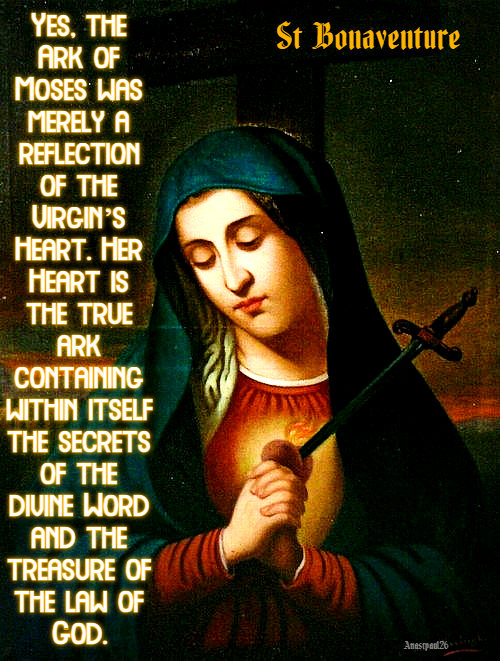
The incomparable Heart of the Mother of God enjoys marvellous participation in and resemblance to the Infinity and Incomprehensibility of God Himself, because the almost infinite dignity of the Mother of God ennobles and raises to the highest degree even the smallest details concerning her. Mary’s admirable Heart also received an abundant communication of the immensity of God, a singular faculty to express His immeasurability. Let us listen to St. Bonaventure. “O Mary,” says the Seraphic Doctor, “I behold in thee an immense grandeur and capacity. Tu Maria immensissima. | see in thee three kinds of immensity. The first is the immensity of thy blessed womb, which enclosed Him who is immense and infinite, whom the Heavens and the entire universe cannot contain. The second is the immensity of thy mind and heart, for thy virginal Heart is more vastly immense than thy sacred womb. The third is the immensity of thy grace and charity, because thy Heart being immense, replete with grace and charity, the charity and grace that fill it must necessarily be immense.”

Yes, Mother of Fair Love, thy charity knows no bounds or measure; it not only reaches all ages, all places and everything that God has made, but it is so vast and great that it would encompass a countless number of worlds!

The most constant Heart of the Queen of Angels is likewise an excellent representation of divine Stability and Immutability. It remained always steadfast, firm, unalterable and resolute in its perfect love of God and all the holy dispositions which render a heart entirely pleasing to God. The holy Heart of our great Princess is a beautiful representation of the eternity of God, not only because her affections were always entirely free from temporal attachments and securely fixed upon eternal things, but also because Mary was filled with the spirit of prophecy, which is a participation in the Eternity that renders all things present in the sight of the divine Majesty of God.

The blessed Heart of the Queen of Heaven displays a perfect imitation of the Plenitude and Self-sufficiency of God, who bears the name of Saddai, meaning precisely self-sufficient. Almighty God has need of nothing, being filled with every good. The Son of God, speaking to His Father, exclaims: “Thou art my God, for thou hast no need of my goods.” In like manner, the virginal Heart of the Mother of God, loving God alone, being always free and empty of every alien affection, was constantly filled with God much more perfectly than the Ephesians, to whom St. Paul wrote that he bowed his knees to the Father of Our Lord Jesus Christ to obtain for them the grace that they might “be filled unto all the fulness of God.”

The blessed Heart of Our Lady never desired, sought or found any delight or satisfaction outside of God. Her Heart always enjoyed imperturbable rest and peace because being filled to capacity with the plenitude of God, it remained always fully satisfied and incomparably happier and content than the heart of a man possessing a million possible worlds.

Consider well, dear reader, how perfectly the Admirable Heart of your Queen fulfils the mandate to “seek but one thing” and to make God her portion and her heritage for ever. To be happy, give and offer your heart constantly, exclaiming with Mary, St. Thomas and St. Francis: “My God and my All.”

Posted in AUGUST - The Immaculate Heart of Mary

Thought for the Day – 23 August – Our Lord Jesus Christ, Teacher of the Devotion to the Admirable Heart of Mary

St John Eudes – The Admirable Heart of Mary

Our Lord Jesus Christ, Teacher of the Devotion to the Admirable Heart of Mary, Part Two

I have bestowed upon you the royal Heart of your great Queen to be regent of your hearts, to rule and govern them according to the most adorable will of my heavenly Father that you may be entirely fashioned according to His Heart.

I have likewise given you the admirable Heart of my most worthy Mother, which is identified with my own Heart, that it may be your true Heart as well; that my children may possess only one Heart with their Mother, and my members the same Heart as their Head. Thus you may serve, adore and love God with a Heart worthy of His infinite goodness: Corde magno et animo volenti, that is, with an immense and measureless Heart, with a Heart all pure and holy, so that you may sing His divine praises and accomplish all your actions in the spirit, love, humility and all the holy dispositions of her admirable Heart. But in order to make this come true, you must renounce entirely your own heart, that is, your mind, your will and your love of self. Strive, therefore, to rid yourself of your earthly heart that is depraved and wicked, and you shall receive an entirely heavenly, holy and divine Heart.

I have finally given this marvellous Heart as an inestimable treasure containing every possible blessing. It is for you, beloved children, to engrave in your hearts a high esteem, a profound respect and a particular affection for so rich a treasure, and to preserve it jealously by the continuation and increase of your veneration for a Heart so holy and amiable.

It is to encourage you to do so that I have said these things, Set down my words in your hearts and practise them faithfully. In this way, you will become the true children of my holy Mother’s Heart, and you will live according to my own. My eyes and my Heart shall ever watch over your necessities. I will carry you in my innermost Heart. You will yourselves be my Heart, my joy and my delight. I will love you as my own Heart, and I will prepare a glorious habitation for you throughout eternity in my Heart and in the Heart of my blessed Mother, which is one with my own. You shall abide forever in our Hearts, and live by their life, you shall possess all the treasures enclosed in our Hearts, and be immersed and buried in their joys. Our Hearts shall be your paradise, the life of your life, the Heart of your heart.

In the love of these Hearts, or rather, this one Heart, you will eternally love, bless and glorify my holy Mother and the sovereign monarch of all hearts, which is the adorable Heart of the most Holy Trinity. May It be forever praised, adored, and loved by all the hearts of angels and of men!

After listening to the divine words of Our Divine Saviour encouraging us to love and honor the most amiable Heart of His Blessed Mother, we shall now contemplate the operations of His adorable Heart towards the maternal Heart of Mary, whereby He teaches us even more effectively than by His eloquent words. Oh, who could worthily describe the least spark of the Divine Heart of Jesus, that furnace of love, towards the Heart of His admirable Mother?

Our Lord has so loved and honored her maternal Heart that He has exalted it above all the hearts of the universe, and made it the most august empire of His glory and the glorious triumph of His love. He has so loved and honored her Heart as to constitute it a Heaven higher and more brilliant than all the heavens in which He is glorified and loved more ardently than in the empyrean heaven.

God has loved and honored His Mother to such an extent that from the first instant in which He gave her blessed Heart its being, He worked in it countless great miracles, imparting the most abundant communication of His own divine perfections, and rendering it most worthy, noble, perfect, mighty, wise, holy, just, merciful, kind, liberal; He has made it the richest, happiest, most glorious, most amiable and most admirable of all hearts.

Posted in AUGUST - The Immaculate Heart of Mary

Quote/s of the Day – 22 August – The Immaculate Heart of Mary

Quote/s of the Day – 22 August – Month and Feast of the Immaculate Heart of Mary (Octave Day of the Assumption)

In the end,
my Immaculate Heart
will triumph.

Let us decide to become one,
with all the faithful,
in offering the prayers and actions
and sufferings of each day
to the Sacred Heart of Jesus,
through the Immaculate Heart of His Mother Mary.
We shall certainly receive showers of graces,
both for ourselves
and for the salvation of the souls of our neighbours.

Antonio Cardinal Bacci (1881-1971)

Prayer to the Two Holy Hearts of Jesus and Mary

O Heart of Jesus pierced for our sins
and giving us Your Mother on Calvary!
O Heart of Mary pierced by sorrow
and sharing in the sufferings of your divine Son
for our redemption!
O sacred union of these Two Hearts!
Praised be the God of Love who united them together!
May we unite our hearts and every heart
so that all hearts may live in unity and in imitation
of that sacred unity which exists in these Two Hearts.
Triumph, O Sorrowful and Immaculate Heart of Mary!
Reign, O Most Sacred Heart of Jesus!
– in our hearts, in our homes and families,
in the hearts of those who as yet do not know You
and in all nations of the world.
Establish in the hearts of all mankind the sovereign triumph
and reign of your Two Hearts so that the earth may resound
from pole to pole with one cry:
Blessed forever be the Most Sacred Heart of Jesus
and the Sorrowful and Immaculate Heart of Mary!
Obtain for me a greater purity of heart
and a fervent love of the spiritual life.
May all my actions be done for the greater glory of God
in unions with the divine heart of Jesus
and the Immaculate Heart of Mary.
Hear and answer our prayers and intentions
according to Your most merciful will.
Amen

Posted in AUGUST - The Immaculate Heart of Mary

Thought for the Day – 22 August – Our Lord Jesus Christ, Teacher of the Devotion to the Admirable Heart of Mary

St John Eudes – The Admirable Heart of Mary

Our Lord Jesus Christ, Teacher of the Devotion to the Admirable Heart of Mary, Part One

WE HAVE every reason to consider the adorable Heart of Jesus as the second foundation of the devotion to the admirable Heart of Mary. The supremely ardent love for the Heart of His dearest Mother, burning in the Sacred Heart of Jesus, makes Him the herald of this devotion, which He teaches to us both by word and example.

Would you know how the Only-begotten Son of God, who is also the Son of Mary, exhorts us to venerate His glorious Mother’s loving Heart? Listen to what He revealed in 1300 to St. Mechtilde, one of the most glorious daughters of St. Benedict, whose writings have been approved by learned and devout doctors. One day during Advent, as the Saint sought to salute the Mother of God in a most pleasing manner, Our Lord Himself deigned to instruct her as follows:

“Thou shalt salute my holy Mother’s virginal Heart as an ocean replete with heavenly grace and a treasure filled with myriad blessings for mankind.

“Thou shalt honor it as the purest Heart after mine own because she was the first to take the vow of chastity.

“Thou shalt hail it as the humblest Heart of any simple creature, for her humility drew me from my Father’s bosom and rendered her worthy to conceive me in her chaste womb by the power of the Holy Ghost.

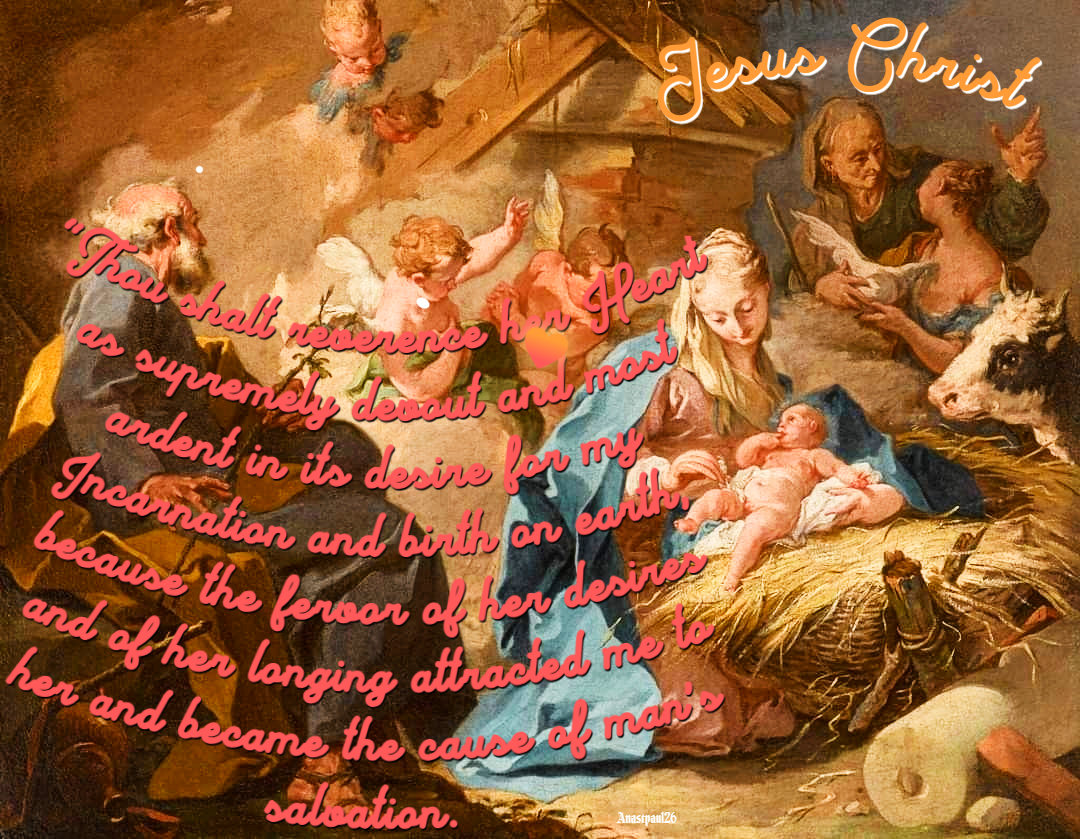
“Thou shalt reverence her Heart as supremely devout and most ardent in its desire for my Incarnation and birth on earth, because the fervor of her desires and of her longing attracted me to her and became the cause of man’s salvation.

“Thou shalt honor her Heart as most glowingly inflamed with love for God and man. Thou shalt salute it as the wisest and most prudent, for she kept in her Heart the memory of each event of my childhood, youth and adult life and made a most holy use of this remembrance.

“Thou shalt greet her Heart as the most faithful, for she not only consented to permit me, her only Son, to be sacrificed, but she also offered me to my Eternal Father as a sacrifice for the redemption of the world.

“Thou shalt salute her Heart as the most vigilant and most zealous for the interests of the nascent Church, for the care she took to pray unceasingly could not be disregarded.

“Thou shalt glorify her Heart as raised to the highest degree of uninterrupted contemplation, for no tongue can worthily speak of the graces and favors that men owe to the power of her intercession.”

I have always been and shall forever be the most singular object of all the affections of her Holy Heart, as she herself has always been and will forever be, after my Eternal Father, the first object of my love. All who truly love me must, therefore, be particularly zealous in honoring and teaching others to honor the Heart that I love more and that gives me greater glory and love than the hearts of all the angels and men together.

I have given my Mother’s Heart to you as a divine Sun to enlighten you through the darkness of the world, to warm you in the frosts of mortal life, to gladden and to comfort you in the sorrows, pains and miseries of earth, and to vivify and strengthen you against the decline and weakness of human frailty. I have given her Heart to you as a beautiful mirror, into which you should often gaze in order to see the stains that tarnish your souls, so that you may cleanse them. With the aid of this celestial mirror, you should array your souls with becoming ornaments that they may become pleasing in the sight of my divine majesty.

I have given her Heart to you as a heavenly chronicle and book of life, that you may study its pages unceasingly, and learn to know perfectly and to love ardently the ravishing beauty of those Christian virtues whose faithful practice gives eternal life. But what you should learn above all from this book are the marvellous merits of holy humility and the means to practice it, so as to crush in your hearts the cursed serpent of pride and vanity that wreaks such havoc, not only in the souls of children of perdition, but in my own children’s hearts as well.

I have given the Heart of my incomparable Mother to you as a holy Rule that will enable you to become saints, if you faithfully observe it.

I have given her Heart to you as a precious vessel, filled with manna from heaven and the nectar of paradise, to nourish your hearts with the meat of the angels, even in this world, and so to inebriate them with heavenly wine, that the things of the earth and time may be forgotten entirely and the sole delight of your hearts rest in those things which are heavenly and eternal.

Posted in AUGUST - The Immaculate Heart of Mary

Thought for the Day – 21 August – Mary’s Heart, the Hill of Calvary

St John Eudes – The Admirable Heart of Mary

Mary’s Heart, the Hill of Calvary

Last in my series of symbolic pictures of the holy Heart of the spotless Virgin I show you Calvary, as it reveals the sorrows of the crucified Heart of Mary at the time of her Son’s Passion.

What is Calvary? It is a mountain, the most important and notable mountain of the Holy Land. What is the Heart of the Mother of God? Is it not also a mountain, the most illustrious mountain of that blessed land referred to in these words of Sacred Scripture: “Lord, thou has blessed the land.” This land is the Blessed Virgin Mary, and her Heart is the noblest and highest peak of her body and of her soul.

What is Calvary? It is Mount Moriah on which God commanded Abraham to slay his son, Isaac. The Hebrew rendition of the twenty second chapter of Genesis reads: “Go into the land of Moriah,” instead of the usual version: “Go into the land of vision.” ? It is the place where King David raised an altar and offered sacrifice that God might stop the plague that ravaged his people, and also the site on which Solomon erected the Temple of Jerusalem, for Mount Sion is the same as Mount Moriah, and Calvary is part of the same chain of hills.

What is Calvary? It is the place where the Cross of Jesus was raised. And was the Cross of Salvation not raised first of all in Mary’s holy Heart? What is Calvary? It is the place stained with the Precious Blood of Jesus Christ. But Mary’s Heart was bathed with It through love and compassion and the Precious Blood of her beloved Son penetrated and impregnated His Mother far more than it soaked the soil of Calvary.

On Calvary, we behold the thorns that wounded the adorable head of our Saviour, the nails that pierced His hands and feet, the lance that opened His Heart, the ropes that bound Him, the gall and vinegar He was given to drink, and the wounds which covered His body from head to foot. We can see the same wounds in the maternal Heart of His saintly Mother. “The Cross and the nails which crucified the Son’s body, crucified the Mother’s Heart as well.” St. Jerome quotes St. Sophronius, Patriarch of Jerusalem, as saying: “All the wounds which covered the body of Jesus, had their counterpart in Mary’s Heart. The whips, the thorns, the nails which pierced and tore the Saviour’s body, ran through His holy Mother’s Heart and shattered it. Every blow rending the body of the Son had its cruel echo in the Heart of His Mother.”
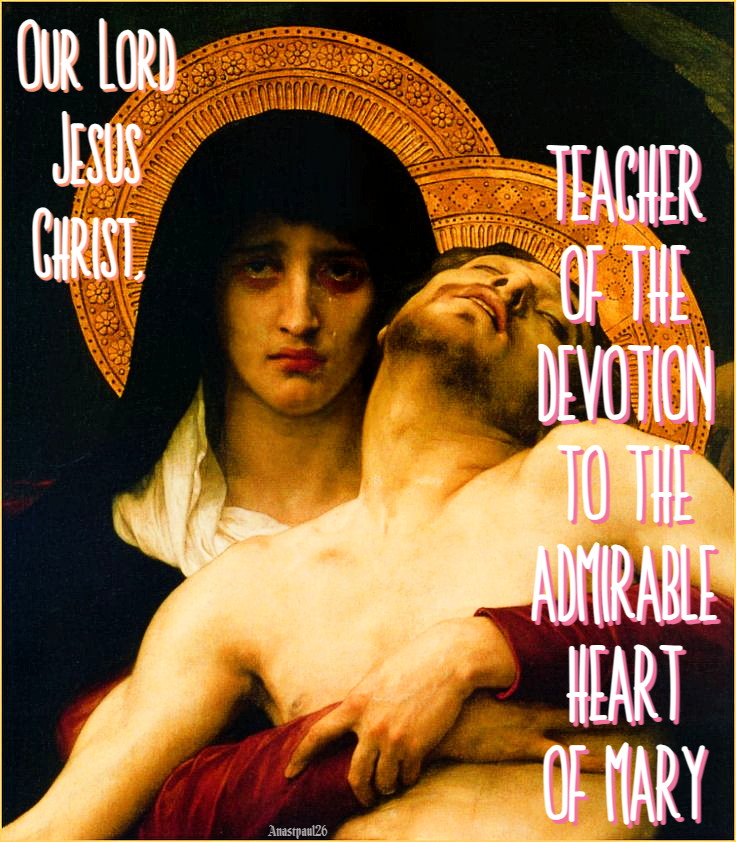
“O my Queen,” exclaims St. Bonaventure, “Thou art not only standing near the Cross, but thou art with Thy Son on the Cross; Thou dost suffer, thou art crucified with Him, the only difference being that while He suffers in His body, thou dost suffer in thy loving Heart. All the wounds scattered over His body are united in thy Heart, because the sword of sorrow has pierced thy very soul. Thy virginal Heart, O my sovereign Lady, is wounded by the lance, pierced by the nails and thorns, heaped with opprobrium, ignominy and imprecations, saturated with vinegar and gall. Why wouldst thou, most honored Lady, be immolated for us? Is not our Saviour’s Passion sufficient for our salvation? Must the mother also be crucified with her Son? O sweetest Heart, so full of love, must thou then be changed into bitter sorrow? I seek to behold thy loving Heart, my dearest Mistress, but it seems to have vanished and in its place I find only the bitterness of gall, myrrh and absinth. I seek the Mother of God and I find only thorns, nails, a lance, a sponge and vinegar. I look for Mary on the Cross, and I see only spittle, insults, lashes and wounds, so truly has she been overwhelmed by outrages.” I see my Redeemer crucified, suffering, agonizing, dying and finally dead on Calvary. I also behold His sorrows, suffering, agony and death in His Blessed Mother’s Heart. “She had lived of her Son’s life, and when He died on the Cross, she died with Him,” says a holy Premonstratensian Abbot.

“Both Mother and Son were nailed to the Cross, the Son in the body, the Mother in her Heart,” exclaims St. Lawrence Justinian,’ the sainted Patriarch of Venice. “Could not Mary die in her Heart, as Jesus died in His body?” asks St. Bernard.

On Calvary, the only Son of Mary gave us an inestimable gift, when in the excess of His incomprehensible goodness He addressed Himself to each one of us in the person of St. John and speaking of His holy Mother, said to us: “Behold thy Mother.” And from Calvary, the Mother of Jesus, whose sentiments and will are one with those of her beloved Son, gives herself to us to be our Mother with the same Heart and with an equal love. Having enshrined the words of her Son in her maternal Heart, she echoes them again, and adopts each one of us in particular. Thus both Jesus and Mary say to us: “Behold thy Mother.”

Posted in AUGUST - The Immaculate Heart of Mary

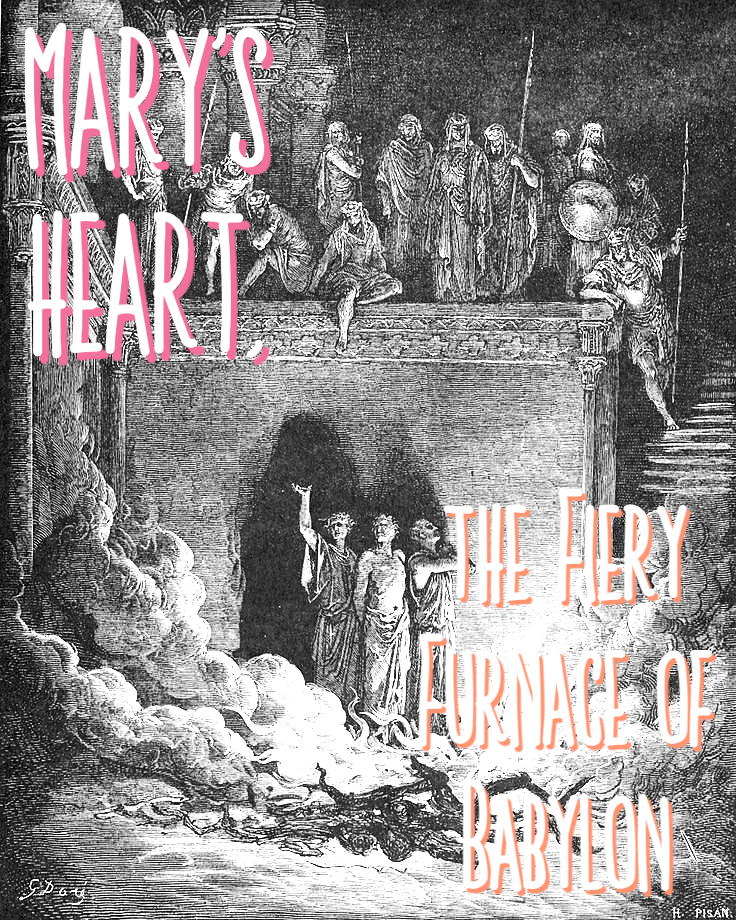
Thought for the Day – 20 August – Mary’s Heart, the Fiery Furnace of Babylon

St John Eudes – The Admirable Heart of Mary

Mary’s Heart, the Fiery Furnace of Babylon

Another symbolic picture of the admirable Heart of the most Holy Mother of God is the miraculous furnace described in the third chapter of the Prophet Daniel. St. John Damascene and many other holy Doctors affirm that the fiery furnace was a figure of the sinless Heart of the Blessed Virgin Mary and its burning fire a reflection of the heavenly fire in the holy breast of the Mother of Fair Love. Here are St. John Damascene’s words: “Is it not true,” he says addressing Our Lady, “that this furnace, filled with a fire at once burning and refreshing, was a faithful image of thee and an excellent picture of the divine and eternal fire dwelling within thee?”

But you may well ask how anything so noble and holy as the Heart of the Queen of Heaven could be represented by the furnace of Babylon, an instrument of torture designed by the wickedness and cruelty of King Nabuchodonosor? Remember that the three young men, Sidrach, Misach and Abdenago, thrown into the furnace to be burnt to ashes, belonged to the people of Israel, and everything that happened to the Israelites was a figure and a foreshadowing of the great miracles that were to be fulfilled in Christianity, and in the Father and Mother of Christians. “All these things happened to them in figure.” Remember also that St. Augustine and St. Gregory the Great tell us that Sacred Scripture mentions many objects which though profane and wicked in themselves, are nevertheless a representation of good and holy thoughts.

Certainly that furnace was the product of Nabuchodonosor’s impious rage, but divine Providence, without whose order and permission nothing can happen, designated it to show the extent of the power of God and the marvels of His goodness, through the miraculous protection given to His faithful friends.

In the furnace of Babylon we behold many marvels wrought by God’s omnipotence. Consider that in the midst of the furnace filled with fire and flame, there should be a refreshing wind, likened to fragrant dew. “The angel made the midst of the furnace like the blowing of a wind bringing dew.” What a marvel it is to behold a burning furnace whose flames protect those inside its crucible, while they destroy those who remain outside! What a miracle to see fire comforting and refreshing those cast into the sevenfold heat of its flames, while burning to death those standing at a safe distance! How miraculous for three young men to survive in a furnace whose flames leapt to a height of forty-nine cubits, not suffering injury but walking about with joy as in a place of delight! The three gladly sang the praises of Almighty God and emerged from their ordeal with greater strength and vigor than before while the fire could not so much as singe a single fibre of their clothing. Great indeed are the marvels to be found in Babylon’s furnace; yet they merely foreshadow the miracles which we find in the furnace of the glowing Heart of the Queen of Angels.

It is a great miracle to witness fire and water subsisting side by side in the furnace of Nabuchodonosor. The fire did not turn the cooling water into steam nor did the water quench the burning heat of the fire. What manner of fire is this? It is the fire of divine love burning in the Virginal Heart of Mary. What is the cooling dew? It is the water of tribulation, which so often flooded the holy Heart of the Mother of Sorrows. The fire of love did not dry up the waters of affliction; and the waters of tribulation were unable, I shall not say to extinguish, but even to diminish in the least degree the divine ardor of that heavenly fire.

Love has the virtue of fire, that it may unceasingly inflame the Virgin Mother’s purest Heart with its sacred ardour, and also the properties of water, as it extinguishes entirely the fire of self-love and of attachment to vain and perishable things. Is it not a great miracle to behold a fire refreshing, consoling and filling with joy the children of the Mother of God, while it pursues, burns, devours its enemies? Her virginal Heart, which is ablaze with love for her true children, directs the fire and flame of its anger against those who injure or scandalize her loved ones.

Three Hebrew children walked safely in the first furnace; yet the prophet saw there four, and the fourth was like the Son of God. “The form of the fourth is like the Son of God.” Actually it was an angel, representing the Only-begotten Son of God in the Babylonian furnace, but this same Son of God resides and dwells in person in the glowing Heart of His most holy Mother. He is all fire and flame of love and charity. “The Lord thy God is a consuming fire.”

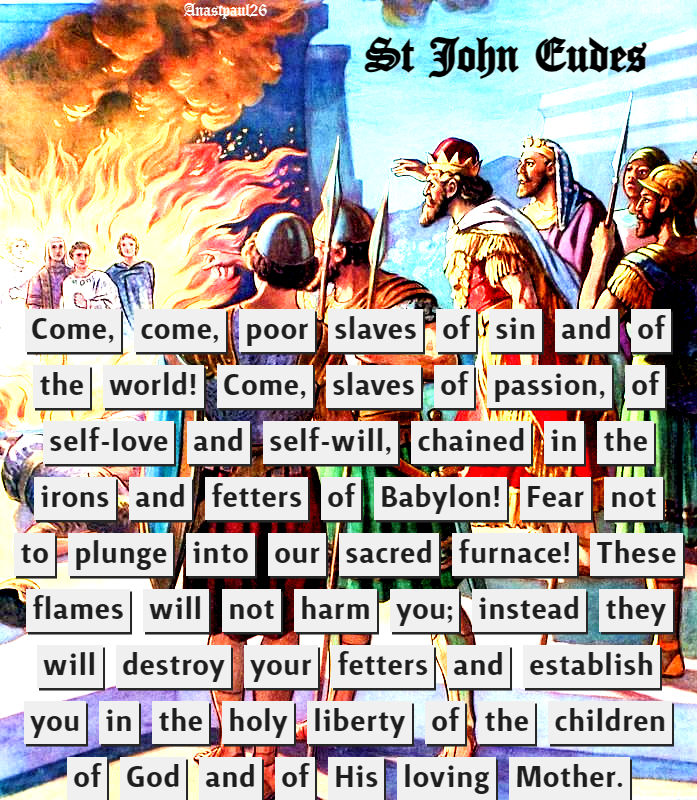
We also notice that the three young men were bound hand and foot when thrown into the furnace, but immediately their bonds were consumed by the fire and they were freed within the furnace. Come, come, poor slaves of sin and of the world! Come, slaves of passion, of self-love and self-will, chained in the irons and fetters of Babylon! Fear not to plunge into our sacred furnace! These flames will not harm you; instead they will destroy your fetters and establish you in the holy liberty of the children of God and of His loving Mother. They will inflame your hearts with the fire of heavenly love, they will transform them into divine fire itself.

Your hearts must become furnaces of eternal love, if they would avoid being ranked with the miserable hearts of the wicked against whom the terrible sentence was uttered: “Thou shalt make them as an oven of fire, in the time of thy anger.” What dost Thou will to do, O Lord, with the ungrateful wretches, whom Thou didst create to love Thee, whose obligations to love Thee are boundless, yet who have loved everything but Thee, and have even kindled fires of insult and heaped outrages upon Thee? Thou shalt make of them furnaces of wrath, in the time of Thy terrible vengeance. Thou shalt hurl them into the eternal fire prepared for Satan and his minions, where they will be swallowed, burned and penetrated by the infernal fire. In life these souls would not permit the sweet and radiant flames of Thy holy love to burn within them, so they shall be yielded to the eternal torments of devouring fire in endless hell.

Would you avoid this tragedy, the greatest of all misfortunes? Then give your hearts to your admirable Queen, imploring her to offer them to her beloved Son with the prayer that He may kindle in them the fire He came to spread on earth, the fire He so greatly desires should be lighted. On your part, correspond by removing every obstacle from your hearts, and if this sacred flame is already burning there, make every effort to increase it more and more, by the practice of Christian virtues, the meditation of the gospel and especially the exercise of divine love and charity.

Posted in CATHOLIC Quotes, AUGUST - The Immaculate Heart of Mary

Quote/s of the Day – 20 August – St Bernard

Quote/s of the Day – 20 August – “The Month of the Immaculate Heart of Mary” and the Memorial of St Bernard (1090-1153) Abbot, Confessor, “Doctor Mellifluus” of the Church and the Last Father of the Church,“The Bard of Mary”

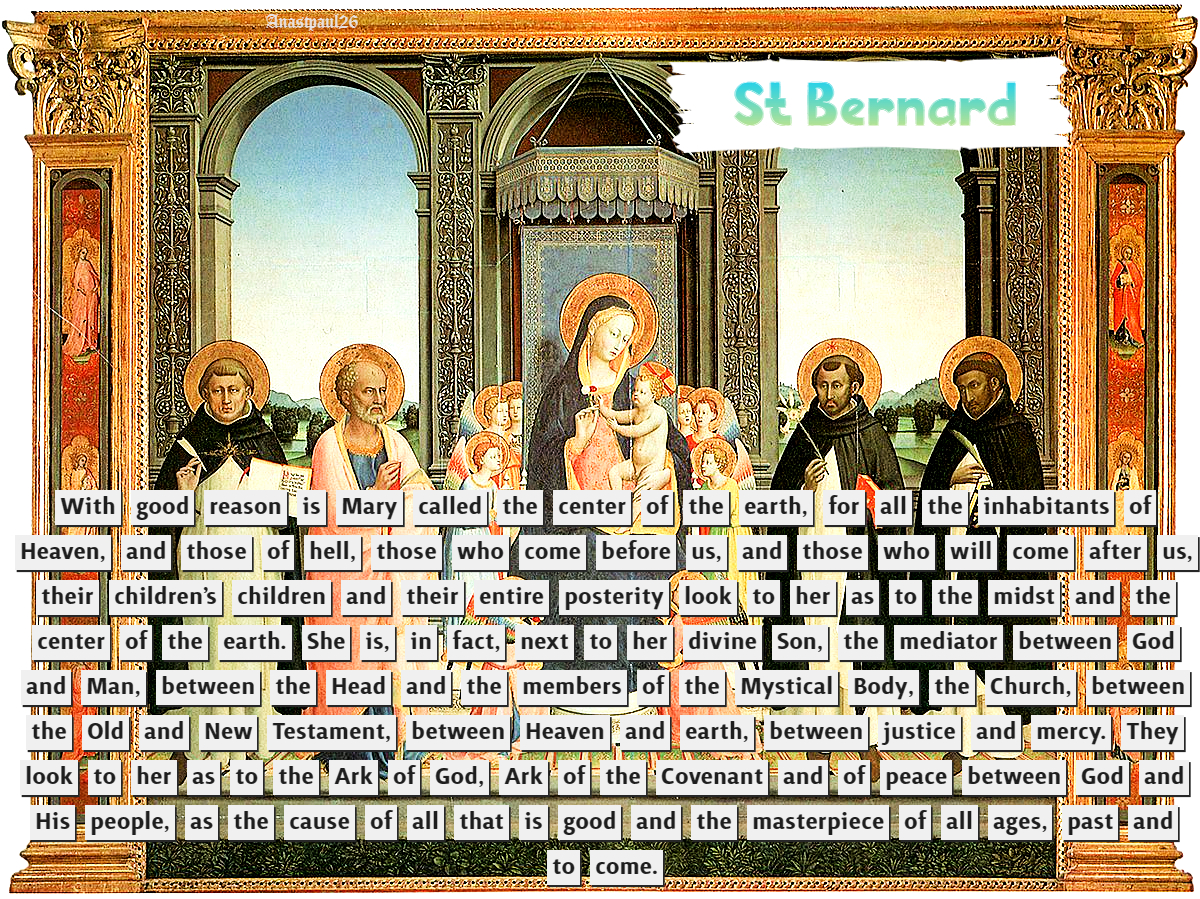
With good reason is Mary called the center of the earth, for all the inhabitants of Heaven, and those of hell, those who come before us, and those who will come after us, their children’s children and their entire posterity look to her as to the midst and the center of the earth. She is, in fact, next to her divine Son, the mediator between God and Man, between the Head and the members of the Mystical Body, the Church, between the Old and New Testament, between Heaven and earth, between justice and mercy. They look to her as to the Ark of God, Ark of the Covenant and of peace between God and His people, as the cause of all that is good and the masterpiece of all ages, past and to come.

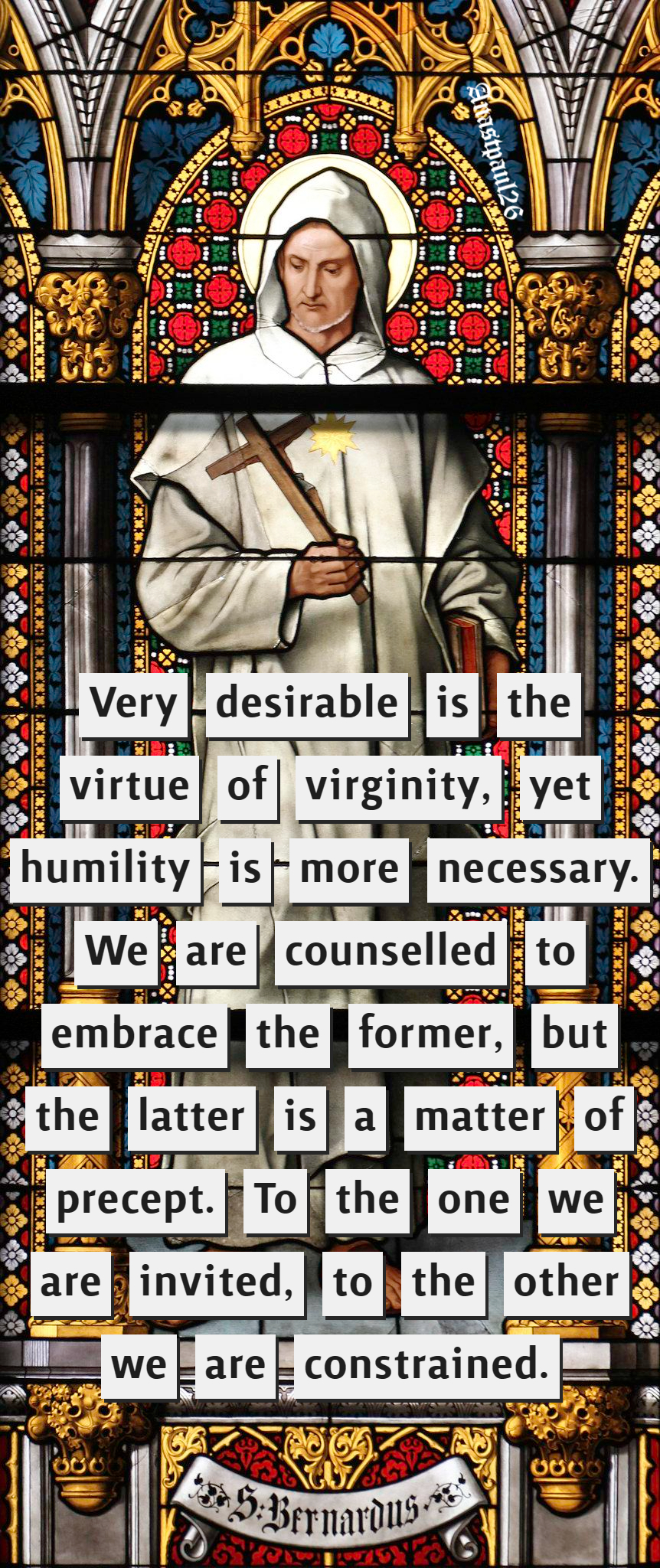
Very desirable is the virtue of virginity, yet humility is more necessary. We are counselled to embrace the former, but the latter is a matter of precept. To the one we are invited, to the other we are constrained. Concerning virginity the Saviour only says, ‘He that can take it, let him take it’, whereas He speaks thus of humility: ‘Unless you be converted and become as little children you shall not enter into the kingdom of heaven.’ The first, therefore, is commended with the promise of a special reward, whilst the second is exacted as a debt.  

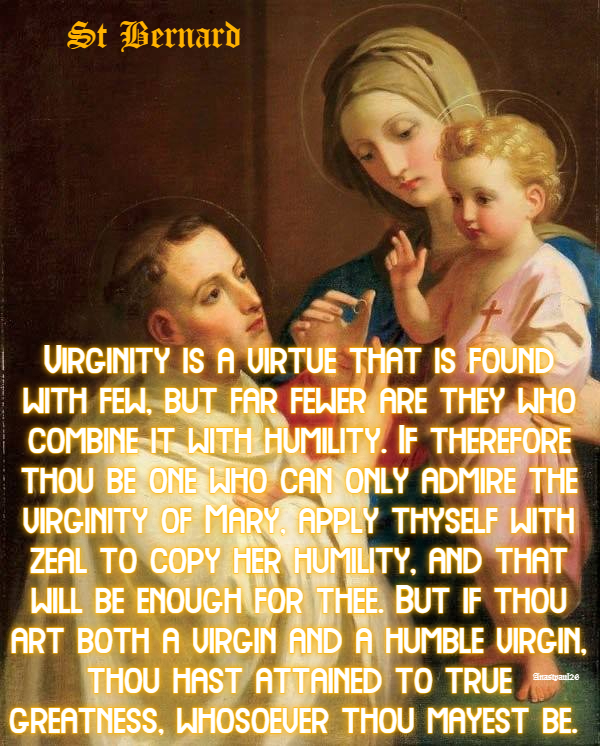
Virginity is a virtue that is found with few, but far fewer are they who combine it with humility. If therefore thou be one who can only admire the virginity of Mary, apply thyself with zeal to copy her humility, and that will be enough for thee. But if thou art both a virgin and a humble virgin, thou hast attained to true greatness, whosoever thou mayest be.

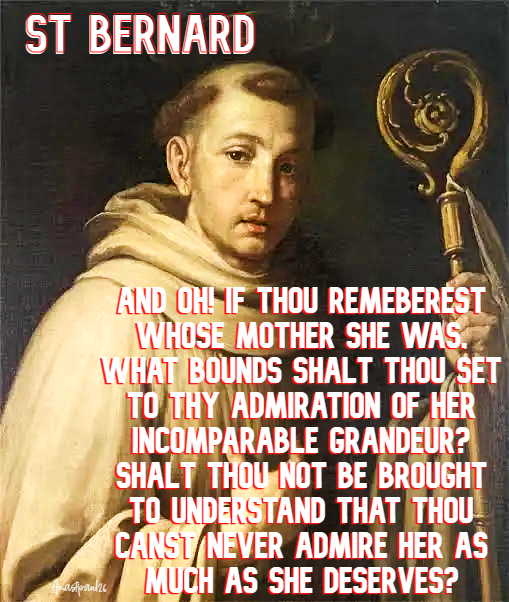
Nevertheless, there is something further for thee to admire in Mary, something even more wonderful than this union of humility with virginity. I refer to that prerogative by which she unites integrity with fruitfulness. For ‘from the beginning of the world it hath not been heard that any” woman was at one and the same time a mother and a virgin. And oh! If thou remeberest Whose Mother she was, what bounds shalt thou set to thy admiration of her incomparable grandeur? Shalt thou not be brought to understand that thou canst never admire her as much as she deserves?

Is not the God of the universe and the Lord of the angels called Son by Mary, who, as the Evangelist St Luke, tells us, once said to Him, “Son, why hast Thou done so to us?” Which of the celestial princes would dare to use such language? Mary, remembering that she is His Mother, gives with confidence the name of Son to that awful Majesty Whom angels are happy to serve with lowly reverence.

The inhabitants of Heaven, that is, the angels, look to her as to the one through whom the losses inflicted on them by sin will be repaired; those who are in the fiery torment, which here means purgatory, look to her as to the one through whose mediation they will be delivered, those who came before us see in her the fulfilment of the ancient prophecies, those who shall follow us consider her as the means whereby they will one day be crowned with immortal glory.

MORE

Posted in AUGUST - The Immaculate Heart of Mary

Quote/s of the Day – 19 August – St John Eudes

Quote/s of the Day – 19 August – “The Month of the Immaculate Heart of Mary” – and the Memorial of St John Eudes (1601-1680) Confessor, “The Apostle of Two Hearts”

The crosses with which our path
through life is strewn,
associate us with Jesus
in the Mystery of His Crucifixion
.”

No-one who shall invoke
this Mother of Grace,
with devotion and perseverance,
can possibly perish forever.”

Let infidels and heretics,
let the relatives and the friends
of bad Catholics,
weep without consolation
and weep unceasingly,
for the death of their departed ones!

Thy royal heart is our pure light, our refuge safe. Why should I fear? Her goodness is firm support of our lives, Nothing can trouble our hearts.

Consider how strange it is! The world offers nothing but crumbs and dregs of feasting, empty fame, wealth and fleeting pleasure, but it sells you these stale crumbs and dregs at the costly price of worry, pain, bitterness, restlessness, anguish, often even at the price of your very life. On the other hand, the Divine Son of God and of Mary offers you the refreshment and rapture of the fountain of the fulness of the House of God, of which you are free to drink forever. O what blind, blind folly it is to choose the goblet of sin instead of the chalice of Our Saviour!

Blessed indeed are the hearts of the true children of Mary, who strive to live in conformity with the most holy Heart of their Mother most admirable!

Posted in AUGUST - The Immaculate Heart of Mary

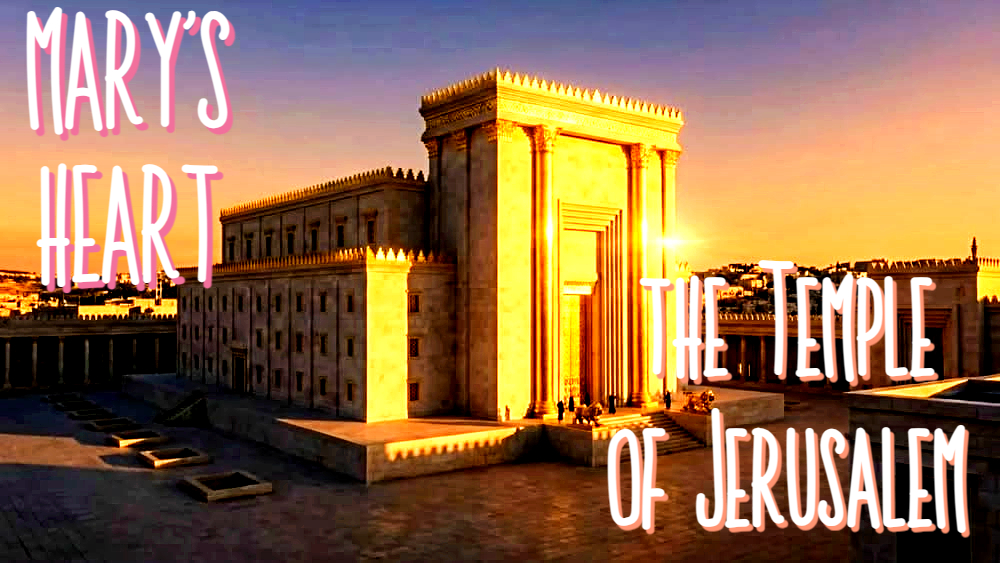
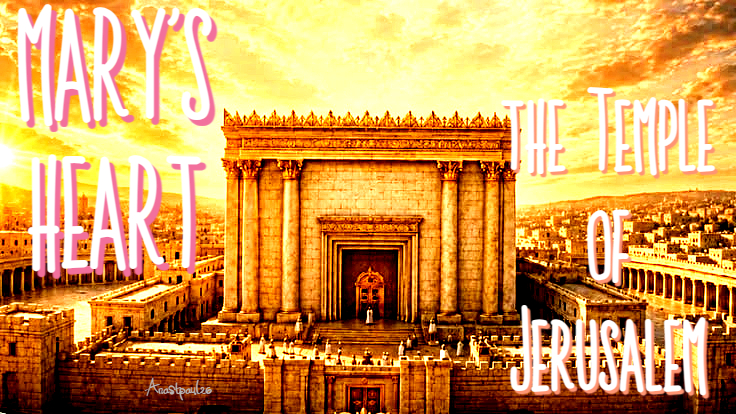
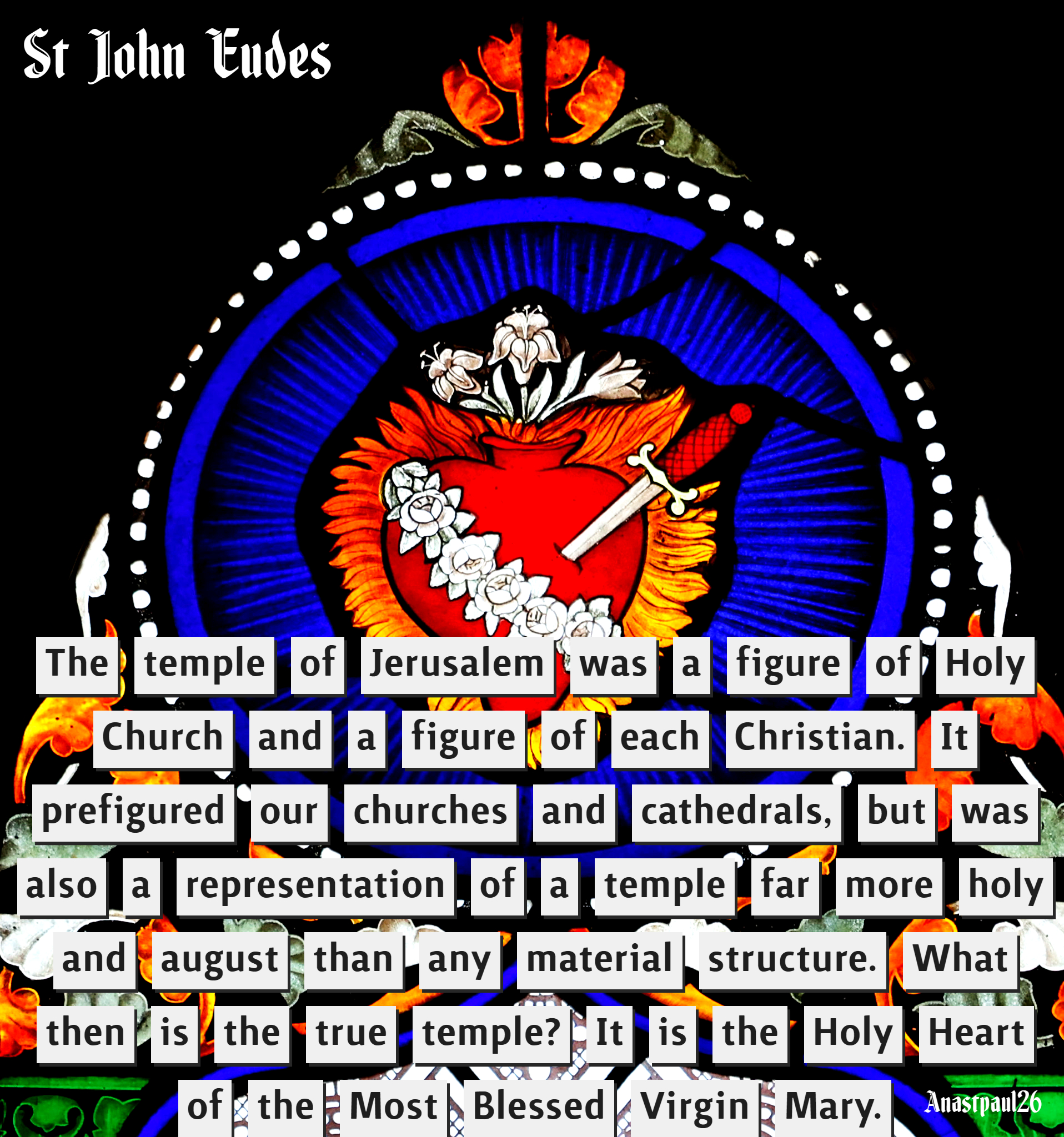
Thought for the Day – 19 August – Mary’s Heart, the Temple of Jerusalem

St John Eudes – The Admirable Heart of Mary

Mary’s Heart, the Temple of Jerusalem Part Two

St. Epiphanius and St. John Damascene, together with several other Doctors, tell us that the golden candlestick is a figure of the Holy Mother of God. Next to Jesus, her beloved Son, Mary is the most luminous torch and the brightest light of the House of God. “O virginal candlestick,” says St. Epiphanius,” which enlightened those who sat in the shadow of death! O virginal torch, which dissipated the gloom of hell, and caused the brilliance of heaven to shine in our souls! O radiant lamp, ever filled with the oil of grace and light, with the fire of divine love, lighting our minds and inflaming our hearts! This virginal light has spread its splendour throughout the world!”

The remarkable table in Solomon’s temple, described in the twenty fifth chapter of Exodus, was made by divine command from the wood of Setim, not a common variety of cedar, but according to the Septuagint, a most rare and altogether incorruptible wood. The table was completely covered with gold-plate and edged with a gold-plated cornice or border surrounding it like a crown while two additional golden crowns embellished it. It was designed to hold the loaves of proposition that were offered to God daily by the priests, and were thus named because they lay in the temple as a perpetual sacrifice proposed or exposed to the Divine Majesty. Afterwards they were consumed by the priests.
The Fathers of the Church all agree that the loaves of proposition were a figure of Our Lord Jesus Christ, the royal bread that came down from Heaven. Christ is the bread of the angels, the bread of God, the bread of the children of God, a bread which is the nourishment and life of the Christian soul, and all Christians are called priests in Sacred Scripture: Fecisti nos Deo nostro sacerdotes. Some are priests by office and bear the special character of consecrated priesthood; others share it by participation. What is the table bearing this divine bread, prefigured by the table carrying the loaves of proposition? St. Germanus, Patriarch of Constantinople, answers that it was the Blessed Virgin Mary and St. Epiphanius confirms his words.

Is not the table designed to receive the bread and food laid on it? Is it not true that the Heart of the Mother of God was the first to receive Our Lord as He came forth from the bosom of the Eternal Father? Did she not receive Him in order to give Him to us? Is it not true that the Eternal Father carries His Beloved Son in His all-glorious Heart from all eternity and that the Blessed Virgin will carry her Son in her Heart for all eternity? Hence we hear the words which the Holy Ghost puts on Mary’s lips: “I was with him,” that is, with the Eternal Father, “forming all things.” In the Hebrew version this passage reads: “I was with Him and near Him as a nurse,” which reveals Mary’s role as the Mother who gives nourishment to mankind.

Several learned interpreters of Sacred Scripture teach us that the altar of perfumes of the Mosaic temple represents the hearts of the faithful, which are symbolized as altars on which each one should offer a perpetual sacrifice of prayer and praise to God. Now if the hearts of the children of God were figured by this altar, how much more truly does it symbolize the Heart of the Mother of God, which is after the Heart of Jesus, the first and holiest of all altars? It is “the golden altar, which is before the throne of God,” mentioned in the eighth chapter of the Apocalypse. On this altar the Mother of the Saviour offered to God a sacrifice of love, adoration, praise, thanksgiving and prayer far more to His Divine Majesty than all the sacrifices that ever were or ever shall be offered on all other altars.

If we consult the Fathers of the Church we learn particularly from St. Ambrose that the Ark of the Covenant was a figure of the Blessed Virgin Mary, and therefore of her most holy Heart, the holy Heart, the first and noblest part of her person. “Yes,” exclaims the seraphic St. Bonaventure “the Ark of Moses was merely a reflection of the Virgin’s Heart. Her Heart is the true ark containing within itself the secrets of the divine Word and the treasure of the law of God.” A holy Abbot of the Cistercian Order calls Mary the Ark of Sanctification, containing revelations written by the hand of God. She is the holy Ark of the Covenant, the Covenant by which God reconciled us with Himself and pledged His alliance with us forever. Next to God, Mary’s Heart should be the first object to which we look up when we pray.


But let us remember that the Heart of Mary is a tower of ivory, zurris eburnea, which does not suffer within its precincts anything defiled and unclean. It is the tower of David, open only to those who follow the meekness of Jesus Christ, the true David.

St. Gregory of Nyssa states that the Tables of the Mosaic Law kept in the temple of Solomon were a figure symbolic of the hearts of the Saints. Now, if the hearts of the Saints are real tables of the evangelical law, what shall we say of the holy Heart of the Queen of Saints, who is the Mother of the Saint of saints? Her glorious Heart is the first and holiest table of the Christian law. It is not made of stone, but of gold, or better still, of diamond; it is not dead but living; not breakable like the tables of Moses but indestructible. On it the Holy Ghost, the finger of God, has written and engraved in golden letters, not merely the will of God and His laws, but all the counsels, maxims and-truths of the gospel as well. They are so deeply engraved that the united forces of hell and of earth could more easily snatch the sun from the sky and-destroy the world than remove a single iota or tarnish a single letter of this sacred writing.

The Propitiatory is regarded as another figure symbolic of the glorious Virgin because by her intercession the flame of God’s wrath was extinguished, His Divine Majesty was turned to look upon mankind with favor and His infinite mercy moved Him to compassion for our infirmities. For this reason St. Ildephonsus calls the Mother of Grace; Propitiatio humanae salutis. “The propitiation of man’s salvation.” St. Andrew of Crete styles Mary: Universi mundi commune propitiatorium. “The universal propitiatory of the entire world.”

St. Augustine, St. Gregory the Great, and several other Fathers say that the Altar of Holocausts also symbolized the hearts of all the Saints, who are the real altars on which God is honored by the spiritual sacrifices offered day and night to His Divine Majesty. Yet much more truly can this be said of the Holy Heart of Mary. “Her Heart is the true altar of holocaust,” says the illustrious John Gerson, “and on it the sacred fire of divine love blazed day and night.” The Mother of the Sovereign Priest constantly offered to God sacrifices of love, praise, thanksgiving, expiation for the sins of the world and every possible sacrifice. On the altar of her Heart Mary sacrificed to God all the things of the world and every creature of the universe as so many different victims. She sacrificed her being, life, body, soul, all her thoughts, words and actions, the employment of her senses and faculties, and in general, all that she was, all that she possessed and every power of her soul. She offered to the Divine Majesty the very sacrifice that her Son Jesus Christ offered on Calvary. Our adorable Saviour offered Himself to the Eternal Father only once on the altar of the Cross, but His holy Mother immolated Him ten thousand times on the altar of her pure Heart.

What veneration is then due to this sacred altar! Be thou blessed, O God of my heart, for having consecrated this most worthy altar to the glory of thy most adorable majesty. Deign to transform our cold hearts into glowing altars on which we may offer Thee an unremitting sacrifice of praise and love.

Posted in AUGUST - The Immaculate Heart of Mary

Thought for the Day – 18 August – Mary’s Heart, the Temple of Jerusalem

St John Eudes – The Admirable Heart of Mary

Mary’s Heart, the Temple of Jerusalem Part One

In the time of the Mosaic Law one of the greatest wonders of the world was the temple of Jerusalem. Yet this stupendous temple was merely a figure and an image of the multitude of temples to be found in the Christian world. It prefigured particularly the Sacred Humanity of the Son of God, for Christ referring to His own body said to the Jews: “Destroy this temple, and in three days I will raise it up.”

The temple of Jerusalem was a figure of Holy Church and a figure of each Christian. It prefigured our churches and cathedrals, but was also a representation of a temple far more holy and august than any material structure. What then is the true temple? It is the Holy Heart of the Most Blessed Virgin Mary. The Church says of her person that Mary is “the temple of the Lord, the sanctuary of the Holy Ghost,” and we can apply these words with still better reason to her admirable Heart, having seen that it is the source of all the qualities and excellences with which she is adorned. If, according to the divine Word, the body of each Christian is the temple of God, who will dare to deny this characterization to the most worthy Heart of the Mother of all Christians? I affirm, therefore, that the Holy Heart of Mary is the true temple of the Divinity, the sanctuary of the Holy Ghost, the Holy of Holies of the Blessed Trinity.


This temple was not like Solomon’s built by a host of workmen, but by the Almighty Hand of God, Who can achieve greater wonders in a single instant than all the powers of Heaven and earth can accomplish during the whole of eternity. The temple of Mary’s Heart was consecrated by the Sovereign Pontiff, Our Lord Jesus Christ Himself. It was never profaned by the slightest sin and stood adorned with a tremendous wealth of ordinary and extraordinary graces, and by all Christian virtues practised in the highest degree.

Not only is her Heart entirely covered with King Solomon’s gold, but it is itself wrought of the finest and purest gold, of a metal infinitely more precious than all the material gold to be found in the universe. The Heart of our amiable Mother is filled with love of God and charity towards us. It is entirely transformed into love and charity, and completely identified with the purest love and the most perfect charity. Its love is more ardent, more pure and divine, its charity more fervent, holier and more excellent than the love and charity of all the Seraphim. The temple of Mary contains all the riches of God together with all the treasures of Heaven and earth because it keeps within its cloister all the mysteries of the life of the Son of God. “His Mother kept all these words in her heart.” Her Heart possesses the very Son of God Himself, the treasure of the Eternal Father, Who encompasses all the wealth and beauty of the Most Holy Trinity.

In this temple Christ, the Sovereign Priest, offered His first sacrifice at the time of the Incarnation. Christ, the Doctor of doctors and the Preacher of preachers, Who taught and preached so often in the temple of Jerusalem, imparts to us from the temple of His Mother’s Heart as many instructions and lessons as there are virtues exemplified in this virginal Heart.

In this temple God is adored more profoundly and worthily, praised and glorified more perfectly than in all other material or spiritual temples that ever were and shall be in Heaven and on earth, the sacred humanity of Jesus alone excepted. The smallest acts of virtue and even the prayerful thoughts of Mary’s holy Heart are more agreeable to the Divine Majesty and render God greater honor and glory than the greatest actions of the foremost among the Saints.

The Heart of the heavenly Mary is indeed a temple and a temple filled with rarest marvels. God entrusted to King David a description of the temple of Jerusalem written by His own hand, as recorded in the words: “All these things came to me written by the hand of the Lord.” The Eternal Father willed to place several remarkable objects in this temple to foreshadow and represent many great and wondrous mysteries that were to be found in the admirable Heart of His holy Mother. Among them I notice seven principal objects that add significance to this symbolic picture, namely: the golden candlestick, the table with the loaves of proposition, the altar of perfumes, the Ark of the Covenant, the Tables of the Law, the Propitiatory and Oracle which reposed on the Ark, and the Altar of Holocausts.

Posted in AUGUST - The Immaculate Heart of Mary

Thought for the Day – 17 August – Mary’s Heart, the Throne of King Solomon

St John Eudes – The Admirable Heart of Mary

Mary’s Heart, the Throne of King Solomon

Among the many beautiful qualities attributed by the Holy Ghost to the Blessed Virgin Mary, one stands out preeminently. It is contained in these words of the eighty-sixth psalm, which Holy Church and her Doctors apply to the Mother of God: “Glorious things are said of thee, O city of God.” Mary is indeed the great and glorious city of God, the holy city, the city of Jerusalem, the city of peace, the royal city, “the city of the great King.” The King of Kings built this city with His own hands; He exempted her entirely from the infamous tribute of sin; He honored her with countless great and extraordinary privileges; He enriched her with inestimable gifts and treasures and He established His first and most glorious abode within her Heart. In her He chose to reveal the rarest marvels of His power and royal magnificence.

Now, if Mary is the palace of the King of Kings, her heart must be the King’s imperial throne. This magnificent throne is perfectly represented by the throne of King Solomon, as described in the Book of Kings. We read there that this great king erected a throne of ivory in his house on Lebanus and covered it with brilliant gold. Six steps led up to this throne; the top of it was rounded at the back, and there were two hands on either side to hold the seat, with two large lions standing near, while small lions stood upon either side of the six steps. Never was any similar throne made in any kingdom of the world.

The throne and the couch of Solomon symbolize the same representation, namely the holy Heart of the Queen of the world, the couch representing the Heart in contemplation, the litter describing in it action. Mary’s Heart is at once the throne and the bed of the true Solomon, Jesus Christ, Our Lord. It is the bed on which He rests in the sweetness and calm of contemplation. It is the litter in which love and charity that set Him on this throne, carry Him from place to place, that He may reign everywhere for the glory of God and the salvation of souls.

St. Gregory of Nyssa tells us that this throne of Solomon is “a figure of the heart of every faithful Christian,” and a famous Doctor says that “the heart of the true Christian is the litter of the Son of God, because it goes where the one it bears wills that it should go, and never elsewhere.” This was fulfilled more perfectly in the Heart of the holy Virgin than in the hearts of even the holiest of creatures. Her virginal Heart never experienced inclinations or affections other than those it derived from the Master who held absolute sway over it.
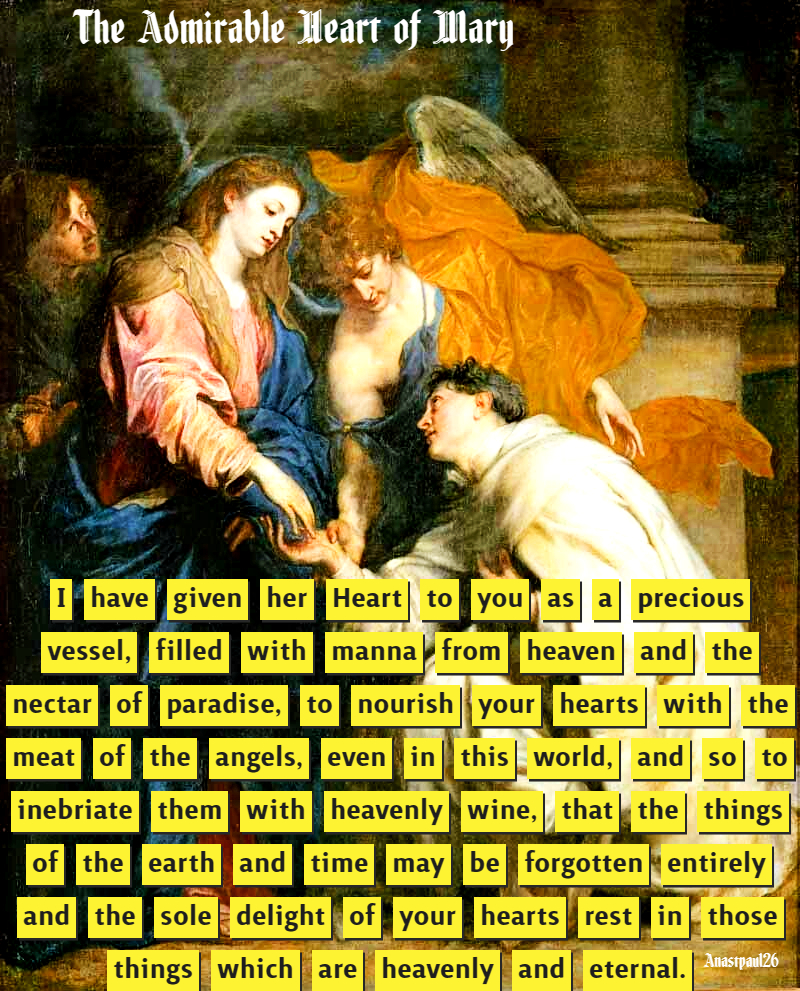
Solomon’s throne was made of incorruptible wood of the cedar of Libanus, to show that the Immaculate Heart of the Mother of God was not only preserved from the corruption of sin, but also that its superabundance of heavenly graces rendered it incapable of sin by grace, as God is incapable of sin by nature.

The four columns of Solomon’s throne are the four cardinal virtues, which sustain the throne of the true Solomon, namely justice, prudence, fortitude and temperance. The pillars made of silver denote the candor of innocence preserved in the heart that possesses them. This symbol was eminently verified in the most pure and innocent Heart of the Queen of all virtues.

The gold seat represents free-will transformed by love into the adorable love of God. It Every human will attaining this state of submission becomes the seat of the throne of Jesus, and in the will of His Blessed Mother this was accomplished in a most perfect manner. Therefore St. Peter Damian calls her “the golden seat on which, after the tumult and disorder occasioned by the sins of angels and men, He sought and found His rest.” The “going up” or back of purple represents ardent desire for the glory of God, for the sanctification of His name and the accomplishment of His will on earth as it is accomplished in heaven. It symbolizes the divine love that constantly urged the zealous Heart of the Mother of Love upward and onward to do and suffer great things towards the fulfillment of the designs of the Creator.

Finally, our beloved Christ prefigured by Solomon, filled His throne with Charity for the daughters of Jerusalem, that is, for all souls, especially for each Christian soul, and more particularly still for the beloved children of His Blessed Mother’s Heart. These are the humble, pure and charitable souls who entertain a singular devotion towards her maternal Heart. Yes, our lovable Solomon filled the virginal Heart with charity towards us, for He did everything for us. In like manner, if He willed to have a true Mother on earth, it was for our sake. If He made her so good, so wise, so powerful, so full of incomparable privileges and extraordinary powers, it was that she might possess the knowledge, power and desire to protect and assist us in all our necessities.

He gave her a Heart filled with charity, benignity, zeal, care and vigilance towards us, that we might profit thereby, if we but invoke it in our needs with utmost confidence. Our Lord grants with extraordinary goodness the requests presented by those who render to Him, in the Heart of His most honored Mother, the homage He desires to receive there. He wishes to be praised and glorified in the hearts and even in the bodies of His saints and “Glorify and bear God in your body.” How much more, then,should we not honor and magnify Our Saviour in the Heart of His Blessed Mother?

Posted in AUGUST - The Immaculate Heart of Mary

Thought for the Day – 16 August – Mary’s Heart, the Harp of King David

St John Eudes – The Admirable Heart of Mary

Mary’s Heart, the Harp of King David

The mysterious harp of King David, mentioned in several passages of Sacred Scripture, is another symbolic picture of the Holy Heart of Mary. It is an excellent representation because her pure Heart was indeed the harp of the true David, namely Our Lord Jesus Christ. He fashioned it with His own hands; He alone always possessed it. No other fingers but His ever evoked its melodies, because her virginal Heart never vibrated with sentiments, affections or impulses other than those inspired by the Holy Ghost.

The strings of this royal harp are the virtues of Mary’s Heart, especially her faith, hope, love of God, charity towards her neighbor, religion, humility, purity, obedience, patience, mercy, hatred of sin, love of the cross. On these twelve strings the Divine Spirit played with wondrous harmony melodious canticles of love which so greatly charmed the ears of the Eternal Father that He forgot His anger against sinners, He laid aside the thunderbolts wherewith He vowed to destroy mankind and gave His own Son to be the Saviour of humanity.

Sacred Scripture tells us that King David employed his harp specially on four great occasions and we see Jesus, the Son of David, using His mystical harp to accomplish four infinitely greater achievements. In the first instance, David, the man of God, by the mere sound of his harp, put to flight the evil spirit which possessed Saul. Similarly, the new David used the Heart of His loving Mother as a sublime harp and consequently freed by its divine music the human race that grovelled under the evil dominion of Satan.

The prophet David also employed His harp to sing many psalms and canticles to the honor and glory of God. Our true David, likewise, sang with His instrument five types of canticles in praise of the Most Blessed Trinity. The first were canticles of love, the strongest, purest, most perfect love that ever was or shall be. The second were canticles of praise and thanksgiving for the benefits of divine goodness on behalf of all creatures, for the Blessed Virgin Mary did not limit herself to thanking God for the infinite favors she received from His hand, but she praised Him unceasingly for the graces He pours on all created beings. The third were canticles of sorrow, of anguish and bereavement at the time of the sufferings and death of her beloved Son. The fourth were canticles of triumph for all the victories won by herself as general of the great King’s armies over His enemies and, we may truly say, over Himself, having so often disarmed divine vengeance when it stood ready to destroy the world and punish its innumerable crimes. The fifth were canticles of prophecy to announce the great designs of God for the future, many of which were foretold by the Queen of Prophets in the wonderful canticle she composed when greeting her cousin St. Elizabeth.

The third purpose for which King David used his harp was to praise God and especially to praise Him with joy. In like manner, Christ the second David, not only attuned His holy Mother’s Heart to praise and bless His divine Majesty in every way, but He also induced Mary to seek her joy and bliss exclusively in His praises, and in all the acts she performed for His glory and in His service.

King David chose as the fourth function of his harp to excite and attract other men to the praise of God, with hearts full of joy and gladness like his own. So too Christ the King attracts innumerable souls to the love and praise of His heavenly Father by the sweet sound of His precious harp, that is, by means of the blessed Heart of His glorious Mother. The extraordinary virtues of her vibrant Heart resound so loudly and harmoniously throughout the entire Christian Church that numberless persons of all ranks and conditions find themselves urged to imitate the perfections which adorn it, thus beginning to carry out on earth what the angels and saints achieve in Heaven. In other words, they place their entire contentment and felicity in all that concerns the sovereign Monarch in Heaven and earth.

Posted in AUGUST - The Immaculate Heart of Mary

Thought for the Day – 15 August – Mary’s Heart, the Burning Bush of Moses

St John Eudes – The Admirable Heart of Mary

Mary’s Heart, the Burning Bush of Moses

John Gerson, very learned and devout chancellor of the famous University of Paris, when commenting on the Magnificat, says that Mary’s incomparable Heart was prefigured by the burning bush seen by Moses on Mount Horeb.! Gerson does not speak thus without good reason. The extraordinary spectacle of a bush burning in the midst of a blazing fire without being consumed is a beautiful representation of the Heart of Mary, which it excellently portrays in several ways.

First, we should consider that the mountain on whose slopes the bush grew is called in Sacred Scripture “the mountain of God,” mons Dei? It is also spoken of as “a holy mountain,” for Moses heard a voice saying to him: “The place whereon thou standest is holy ground.” We shall easily be convinced, therefore, that it represents the most Blessed Virgin Mary, who is the true mountain of God, a mountain of holiness of whom we can well say with St. Gregory the Great that she is the mountain foretold by the Prophet Isaias as the peak towering above all other heights: “A mountain . . . on the top of mountains,” because God has raised her in dignity, in sanctity and power above the chief Seraphim and the greatest saints.

Secondly, we ought not to despise this insignificant bush, a lowly shrub, the least of all plants. On the contrary, we should regard it with respect, since God so honored this bush as to choose it in preference to the tallest cedars of Lebanon for this manifestation of His glory, amid the fire and flames of its miraculous blaze. Would you know the reason of this? Listen to the Holy Ghost: “The Lord is high and looketh on the low: and the high he knoweth afar off.” Though God is most high and infinitely above His creatures, nevertheless it delights His divine Providence to look with a kind and loving eye at that which is small and lowly. While He draws near to the humble, He surveys the great and mighty from afar, as though He disregarded and despised them. Thus was He attracted by the humility of Mary, His handmaid. Respexit humilitatem ancillae suae.” St. Bernard speaks as follows of the profound humility of Mary’s Heart: “She who in her own mind and heart was the least of all creatures, has rightly been made the first, because, even though she was in fact the first, she considered herself as being the last.” This humility of the Heart of Heaven’s Queen is represented by the lowliness of the mysterious bush of Mount Horeb.

Thirdly, we must not be frightened or horrified by the sharp thorns which guard this bush on all sides, both outside and inside. This should, on the contrary, make us love it more, because God Himself loves it for this reason. It is obvious that God loves all His creatures and hates none of the works of His hands, for it is written: “Thou lovest all things that are, and hatest none of the things which thou hast made.” It is also obvious that God cherished a specially tender love for this little bush, that His Heart was there and that He took pleasure in it. He chose it to be His throne, the place where He would manifest His glory to His servant Moses, where He would speak to His prophet, disclose divine secrets and reveal His providential designs to deliver the Chosen People from Egyptian bondage.

God loved the burning bush because the fire that encompassed without consuming it represented the fire of divine love which filled the Heart of Mary, a love far greater than that of all the hearts of men and angels. The thorns symbolized the bitter sorrow and unspeakable anguish which pierced the Heart of the Mother of God, suffering that she accepted for the love of God and the salvation of mankind.

Moreover, God descended from Heaven into the bush on Mount Horeb and manifested Himself to Moses, “in the flame of fire,” to show His love and charity towards his people, and spoke “from the midst of the bush,” or according to another version “from the heart of the bush,” to declare His intention of delivering the children of Israel from the captivity of Pharaoh through the instrumentality of Moses. In like manner the Son of God, in the excess of His love, descended from the bosom of the Eternal Father into His Mother’s Heart, ablaze as it was with love for God and charity towards men, in order to bring about our redemption and to associate her with Himself as the instrument of this great work.

Likewise, dear reader, do not forget that your heart must burn with the loving fire that enkindled the virginal Heart of Mary, the fire that the Son of God came to spread upon earth, or else it must burn forever in the dreadful conflagration prepared for the devil and his cohorts. Oh, what a difference between these two kinds of fire! The devouring flames that torment eternally without consuming, and the delightful, joyous flames that constantly ravish the hearts of the ardent seraphim! Rejoice, each one of you who reads or listens to these words! Give thanks to God that you are still alive, that yours is still the power to choose which of these fires shall enkindle your heart. Strive earnestly to extinguish the flame of self-love, of worldliness, the burning of anger, lust, envy and ambition. Give your heart entirely to Jesus Christ, asking Him to set it on fire with His love. For this purpose there is no better prayer than the words of St. Augustine:

“O divine fire that burneth always and is never extinguished; O love always ardent and never growing cold, enkindle my being! Set me on fire completely, so that I may become nothing but a glowing flame of love for Thee.”

Posted in AUGUST - The Immaculate Heart of Mary

Quote/s of the Day – 14 August – The Blessed Virgin

Quote/s of the Day – 14 August – “Month of the Immaculate Heart of Mary” – Readings: Ps 44:13; 44:15-16., Ps 44:2, Sir 24:23-31, Luke 11:27-28

I am the mother of fair love, and of fear, and of knowledge, and of holy hope.

Sir 24:23-31

We believe that God was born of the Virgin, because we read it. That Mary was married after she brought forth, we do not believe, because we do not read it. Nor do we say this to condemn marriage, for virginity itself is the fruit of marriage; but because when we are dealing with saints we must not judge rashly. If we adopt possibility as the standard of judgment, we might maintain that Joseph had several wives because Abraham had, and so had Jacob, and that the Lord’s brethren were the issue of those wives, an invention which some hold with a rashness which springs from audacity not from piety. You say that Mary did not continue a virgin: I claim still more, that Joseph himself on account of Mary was a virgin, so that from a virgin wedlock a virgin son was born. 
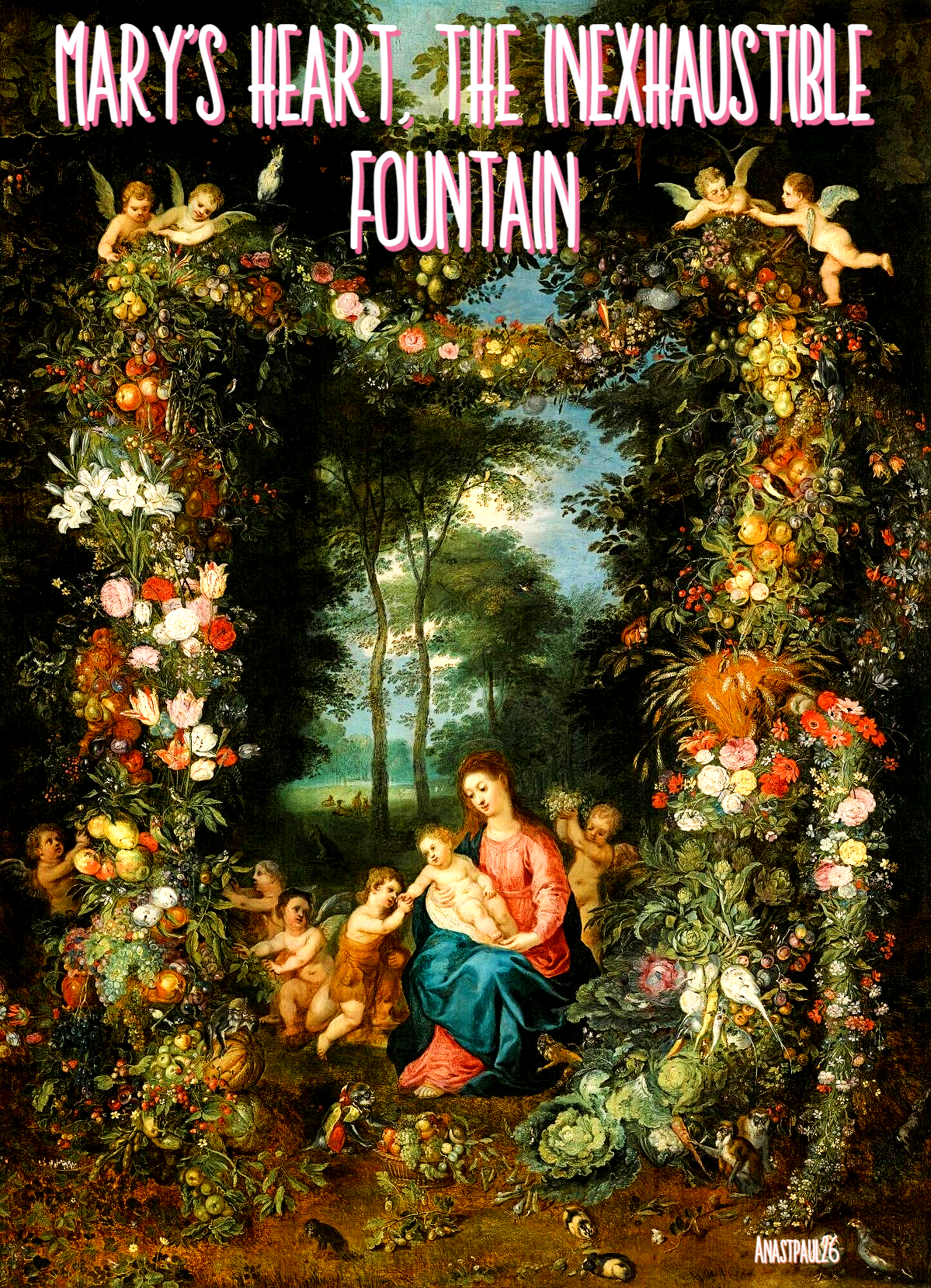
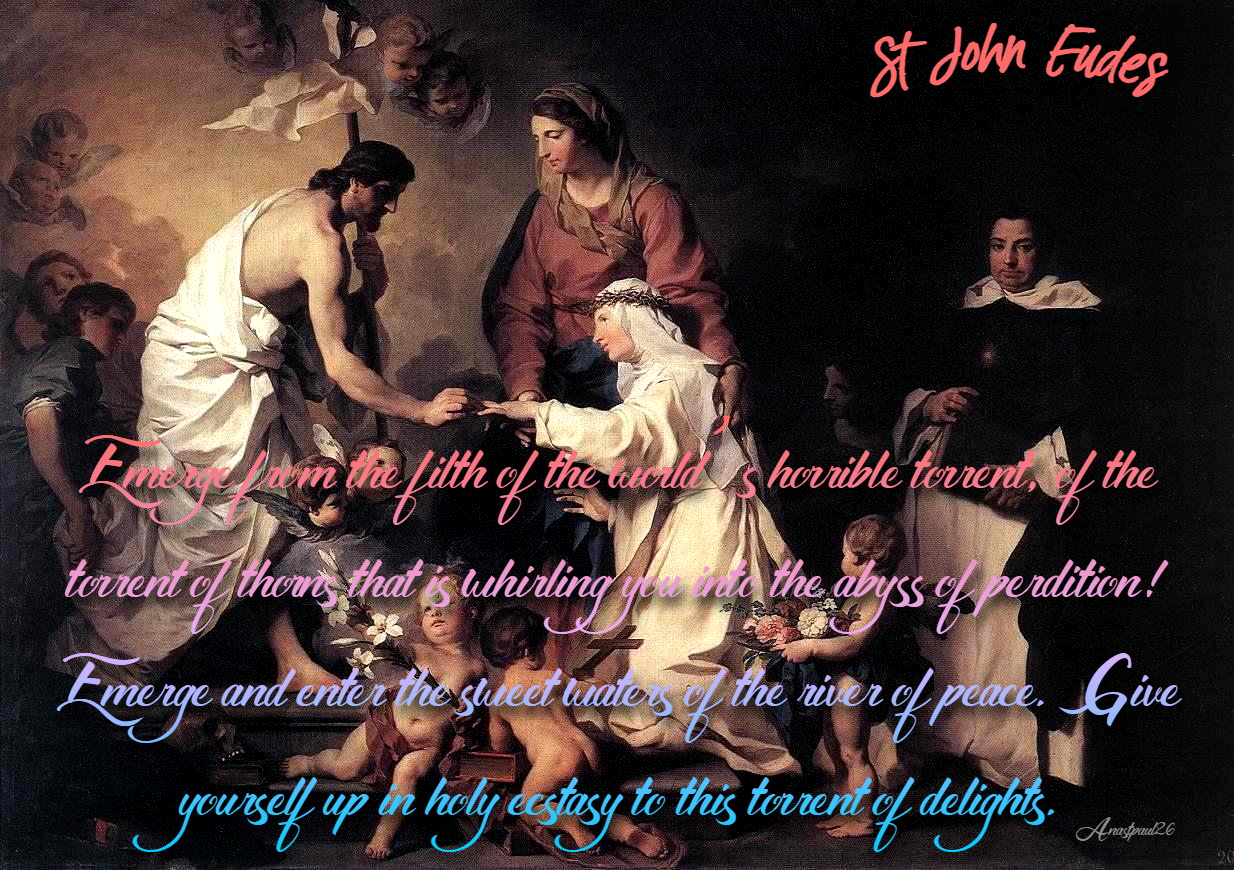
St Jerome

 I have become rhetorical, and have disported myself a little like a platform orator. You compelled me, Helvidius; for, brightly as the Gospel shines at the present day, you will have it that equal glory attaches to virginity and to the marriage state. And because I think that, finding the truth too strong for you, you will turn to disparaging my life and abusing my character (it is the way of weak women to talk tittle-tattle in corners when they have been put down by their masters), I shall anticipate you. I assure you that I shall regard your railing as a high distinction, since the same lips that assail me have disparaged Mary, and I, a servant of the Lord, am favoured with the same barking eloquence as His mother.

St Jerome

It is Mary alone who has found grace before God, without the aid of any other mere creature: it is only by her that all those who have found grace before God have found it at all; and it is only by her that all those who shall come afterwards shall find it. She was full of grace when she was saluted by the Archangel Gabriel, and she was superabundantly filled with grace by the Holy Ghost when He covered her with His unspeakable Shadow; and she has so augmented, from day to day and from moment to moment, this double plenitude, that she has reached a point of grace immense and inconceivable; in such sort that the Most High has made her the sole treasurer of His treasures, and the sole dispenser of His graces, to ennoble, to exalt, and to enrich whom she wishes; to give the entry to whom she wills into the narrow way of heaven; to pass whom she wills, and in spite of all obstacles, through the strait gate of life; and to give the throne, the sceptre, and the crown of the King to whom she wills. Jesus is everywhere and always the Fruit and the Son of Mary; and Mary is everywhere the veritable tree, who bears the Fruit of life, and the true Mother, who produces it.
St Louis de Montfort

Cling to His most sweet Mother who carried a Son whom the heavens could not contain; and yet she carried Him in the little enclosure of her holy womb and held Him on her virginal lap.

St Clare of Assisi

He that is a friend loveth at all times; and a brother is proved in distress.” True friends and relatives are not known in times of prosperity, but in the season of adversity and misery. Worldly friends do not desert their friend when he if in prosperity; but if any misfortune over takes him, particularly in the hour of death, immediately his friends abandon him. Not so does Mary desert her devoted servants. In their distresses, and especially at the trying hour of death, when our sufferings are the greatest that can be endured on earth, she our good Lady and mother cannot abandon her faithful servants; and as she is our life in the time of our exile, so is she also our sweetness in the hour of death, by obtaining for us that it may be sweet and blessed. For since that great day in which it was the lot and the grief of Mary to be present at the death of Jesus, her Son, who was the head of the elect, she obtained the grace of aiding at death all the elect. 

St Alphonsus Liguori

Posted in AUGUST - The Immaculate Heart of Mary

Novena to Our Lady of the Assumption – Day Nine – 14 August

Novena to Our Lady of the Assumption

DAY NINE

Daily Prayer:
Lord Jesus Christ,
Thou has destroyed the power of death
and given the hope of eternal life,
for body and soul.
Thou granted Thy Mother
a special place in Thy glory
and did not allow decay to touch her body.
As we rejoice in the Assumption
of the Blessed Virgin Mary,
grant us renewed confidence
in the victory of life over death.
Amen

Day 9:
O Blessed Mother Assumed into Heaven,
after years of heroic martyrdom on earth,
we rejoice that thou hast at last
been taken to the throne
prepared for thee in Heaven by the Holy Trinity.
Lift our hearts with thee in the glory of thy Assumption
above the dreadful touch of sin and impurity.
Teach us how small earth becomes
when viewed from Heaven.
Make us realise,
that death is the triumphant gate
through which we shall pass to thy Son
and that someday, our bodies shall rejoin our souls
in the unending bliss of Heaven.
From this earth, which we tread as pilgrims,
we look to thee for hope and help.
In honour of thy Assumption into Heaven,
we ask for this favour:
………………………………..
(Mention your request)

At the hour of our death,
lead us safely to the presence of Jesus
to enjoy the vision of God for all eternity
together with thee.
O Queen Assumed into Heaven, pray for us,
that we may be made worthy of the promises of Christ.

Amen

Posted in AUGUST - The Immaculate Heart of Mary

Thought for the Day – 14 August – Mary’s Heart, The Garden of Eden Part 2

St John Eudes – The Admirable Heart of Mary

Mary’s Heart, The Garden of Eden Part 2

Such then are the trees to be found in the first’and the second gardens of Eden. Are any flowers to be found there? Sacred Scripture does not mention the presence of any blossoms in the first garden; yet who can doubt that a garden of delight must have contained flowers in great abundance? It is certain, however, that the garden of Jesus is filled with heavenly flowers, the most beautiful and sweet-scented imaginable. The Heart of Christ’s Mother is a celestial flower-bed dotted with the holy blossoms of all Christian virtues, immortal flowers, which never fade, whose ravishing beauty and delightful fragrance remain in every season. They fill the universe with their sweet perfume and give joy to the Angels, yea, even, to God Himself. They are at once flowers and fruits, for the Holy Ghost inspires the words: “My flowers are the fruit of honour and riches.”

The Eternal King adorns His garden with these flowers, and by means of their divine fragrance attracts innumerable hearts to Himself. He eats of these fruits, which are among the choicest viands of His heavenly table, and gives them as nourishment to His children. He assures us, moreover, that He takes His rest and refreshment in the works of mercy which are among the first flowers of His garden: “This is my rest, refresh the weary, and this is my refreshing.” So also does He feast with delight on the other acts of virtue which proceed from devoted hearts, and especially from the perfect Heart of His glorious Mother. With them He nourishes and strengthens the souls of His children.

This is what God meant when He said that He came into His garden, ate His honey and drank His wine with milk, and then invited His friends and children o eat, drink and be inebriated with Him. Among the flowers in Mary’s Garden for her divine Spouse, St. Bernard admires especially the perfume of violets, the whiteness of lilies and brilliant color of the roses. Here are his words: “Thou art an enclosed garden, O Mother of God, wherein we cull all kinds of flowers. Among them, we gaze with particular admiration on thy violets, thy lilies and thy roses, which fill the House of God with their sweet fragrance. Thou art, O Mary, a violet of humility, a lily of chastity, and a rose of charity.” We may add: “Thou art, O Mary, a carnation of mercy, a double carnation,-because thy wondrous Heart is filled with mercy and compassion, not only for our corporal infirmities, but still more for our spiritual misery, which is infinitely more painful and complex than our bodily ills can ever be. O Mother of Mercy, have pity on all who are miserable, and especially on those who remain unaware of their own misery.

And now I go on to another object to be envisioned in the earthly paradise. In the second chapter of Genesis, we read that God brought to the first man the animals and the birds He had created that Adam might give them suitable names, as a sign of his dominion over them and of their dependence on him. We may now ask if any qualities of the Heart of the Queen of Heaven can have been symbolized by such humble things as animals and birds? Yes, and this should not surprise you, since her Son, Who is God Himself, willed to be represented by oxen, sheep, lambs, and several other beasts which, under the Old Law, were sacrificed to God.

What, then, is represented by the animals and birds subjected by God to the dominion of Adam in Paradise? They represent the natural passions that have their seat in the corporal and physical heart of man. These passions are of two kinds, that is, the more earthly and animal instincts, such as anger, hatred, fear, sadness, aversion, distrust, which are represented by the animals, and the more spiritual emotions, such as love, desire, hope, courage and joy typified by the birds.

All these passions existed as we have seen, in the Heart of the Blessed Virgin Mary, Just as they are found in the hearts of all children of Adam, but she enjoyed the great privilege that in her Heart they were completely subject to reason, just as the savage beasts were under the complete con-trol of Adam in the earthly paradise. The spirit of Christ, the new man, reigned so perfectly in Mary’s Heart and so absolutely ruled her passions, that they never experienced any motivation contrary to the will of God. She never employed them except under the guidance of God’s Holy Spirit and for the glory of His Divine Majesty. She never loved anything besides God; she never desired anything except to please Him; she feared nothing save to displease Him. All the difficult tasks she undertook were accomplished in His service and for His glory, the sole cause of her joy, even as the offence and dishonor afforded Him by sin were the only motives of her hatred, her aversion, and her anger. So truly were her natural passions uplifted and almost annihilated towards the world and all worldly objects and concerns, even with regard to herself and her own interests, that her emotions existed and vibrated only for what was pleasing to Him who possessed, animated and directed them in all thoughts. From this we learn that the Heart of the Blessed Virgin Mary was truly the Earthly Paradise, in which there was no war, trouble or disorder of any kind, but peace, tranquility and marvellous order, combined with ceaseless praise and adoration of the God who had established His throne in this Paradise.

Now let us study the gardeners. In the first terrestrial paradise, Adam was appointed “to dress it, and to keep it,” but instead of cherishing his beautiful garden, he sold it to his arch-enemy the serpent, for a mere taste of the forbidden fruit. Instead of cultivating the Garden of Eden, Adam brought sin into it, filling it with thorns and thistles. What an unfaithful guardian! What a wicked gardener!

But in the second Paradise, the enclosed garden of the Heart of Mary, the gardener is Wisdom, eternal, watchful and faithful, and the three assistant gardeners are Love, which digs and prepares the soil to receive the seed of heavenly inspiration, Grace which sows the seed, and Patience that cultivates it to fruition by perseverance. Thus the flowers of Mary’s heart grow ever more beautiful, more admirable to us and more delightful to God, while the fruits of her garden multiply a hundred thousandfold.

In the first garden, God pronounced sentence upon the serpent: “The woman shall crush thy head and thou shalt lie in wait for her heel.” In the garden of Mary’s heart, this pronouncement was fulfilled. Her Immaculate Conception crushed original sin, her sanctity routed the powers of evil, and her love obtained the commutation of our death sentence, bringing us the Saviour of the world.

Man, having rebelled against God in the first paradise, was driven from that garden and banished forever with all his posterity, and at the gate was placed an angel with a flaming sword in his hand to prevent the children of Adam from re-entering the Garden of Eden. From this we learn that to enter and share the second paradise, namely the pure heart of the Mother of the new Adam, we must cease to be sons of Adam and become children of Jesus Christ, that is, our old life must die. This death seems fearful; the sword of the cherubim is terrifying; yet actually it is a sword of love, which wounds, or even slays the blessed, in order to heal their souls and make them live the life of God. “Precious in the sight of the Lord is the death of his saints” ” says Sacred Scripture, meaning the death that is not death but the beginning of eternal life.

Now that I have shown you, dear reader, the admirable Heart of Mary as the garden of delectation of the God-Man, I would warn you that your own heart must be one of two things, either a hell of torment for yourself, or a paradise of delights for you and for Jesus Christ. If you banish sin and self-love from the garden of your heart, opening wide the door to grace and to the King of Virtue, He will enter in and find repose in that place. If you drive away grace and mortification, letting sin grow in your garden, then the demons will enter and make it their abode, a veritable hell instead of paradise. But if you strive to imitate Mary, your Queen, tending your heart with wisdom, love, grace and patience, God will not refuse you the full measure of His gifts so that you may cultivate your garden fruitfully, and make it, like Mary’s, a paradise of delight for your Lord and Saviour, as well as a place of refreshment, deep sweetness and peace for yourself.

Posted in AUGUST - The Immaculate Heart of Mary

Thought for the Day – 13 August – Mary’s Heart, The Garden of Eden

St John Eudes – The Admirable Heart of Mary

Mary’s Heart, The Garden of Eden Part 1

The Garden of Eden described in the second and third chapters of Genesis is one of the most expressive figures drawn by the omnipotent and all-wise hand of God to represent the Heart of His beloved Daughter, the Blessed Virgin Mary. His infinite goodness has given us an excellent picture of her immaculate Heart. The earthly paradise of Scripture is the perfect representation of another paradise; it is the paradise of the first man, Adam, excellently portraying the paradise of the second man, Jesus Christ, Our Redeemer.

To view this picture in its true light, we must consider many aspects of it. Let us begin with the name. If we consult Sacred Scripture, we shall learn that the first paradise was called “a paradise of pleasure,” “a place of pleasure.” The name of the garden of delights can very properly be applied to the admirable Heart of the Mother of God, true paradise of the new man, Jesus Christ. It is a garden of the Beloved, a garden sealed and doubly barred, a garden of delights. The Divine Spirit gives three names to the Heart of His holy bride, and they contain many profound meanings.

In the first place Mary’s Heart is the Garden of the Beloved. Do we not hear the Holy Ghost inspiring her to say: “Let my beloved come into his garden.” Who is the beloved of whom she speaks? Is it not her Son Jesus, the single and only object of her love? Into what garden does she invite Him to come, if it be not her virginal Heart, into which He was attracted, as we have said, by her humility and her love? Such is the explanation of the learned Balingham. The Garden of the Beloved, therefore, is the Heart of the Beloved Bride; the Heart of Mary is the Garden of Jesus.

In the second place, the Admirable Heart of the Mother of God is a sealed garden. Her heavenly Spouse says of her: “My sister, my spouse, is a garden enclosed, a garden enclosed, a fountain sealed up.” But why does He twice repeat that it is an enclosed garden? He thereby means to teach us that the Heart of His Beloved Bride is absolutely shut against two things: it is shut against sin, which together with the serpent, the author of sin, never entered there: and it is shut against the world and all things of the world, against everything that is not God. He alone has always occupied this garden entirely, and there never existed place in it for anything else.

The third name given by the Holy Ghost has reference to the prophetic figure, the first Paradise, and He calls it a garden of delights, locus voluptatis, paradisus voluptatis.” Mary’s spotless heart is indeed a garden of rapture for the Son of God a garden where He experienced joys which were His greatest delights after those enjoyed from all eternity in the heart and bosom of His Eternal Father.

If Thou dost assure us, O Jesus, that Thy delight is to be with the children of men, even though they are full of sin, ingratitude and infidelities, what must not have been Thy delight in the most amiable Heart of Thy Blessed Mother, where Thou didst never meet anything displeasing to Thee, but found Thyself always praised, glorified and loved more perfectly than in the Paradise of the Cherubim and Seraphim? One can easily say that, after the adorable Bosom of the Eternal Father, no place ever was or will be so holy, so worthy of Thy majesty, so filled with glory and contentment for Thy delectation as the virginal Heart of Thy most amiable Mother.

I see three principal objects in the garden of the First Adam. I see the Tree of Life and the Tree of Knowledge of Good and Evil, planted in the centre of Paradise. I see also many other trees bearing all kinds of fruit, agreeable to look upon and delightful to taste. In the second Garden, I behold incomparably better trees, of which the first are but shadows. I see the real Tree of Life, Jesus Christ, the only Son of God, Whom the Father planted in the midst of this divine paradise of the virginal Heart of His most Holy Mother, when the Angel said to her: “The Lord is with thee.” St. Augustine thus explains this passage: “The Lord is with thee, to abide first in thy Heart and then in thy virginal womb, to fill thy soul before descending into thy chaste bosom.”

Was it not the fruit of this Tree of Life that restored to us the eternal life which we had lost by eating another fruit given to us by a woman whose name was Eve? Was not the fruit of everlasting life given to us by the hands of a celestial woman whose name was Mary? “What didst thou say, O Adam?” exclaims St. Bernard. “ “The woman whom Thou didst give to me gave me of the fruit, and I did eat” These words tend to increase thy guilt, rather than diminish it. Change this unjust excuse into words of gratitude, and say: ‘Lord, the woman thou gavest me, gave me of the fruit of the Tree of Life, and I did eat, and my mouth found it sweeter than honey, because by this precious fruit Thou hast restored me to life.’ ” Then the Saint adds: “O Marvellous Virgin, worthy of every honor! O woman to whom the highest veneration is due, who are admirable above all others, who hast repaired thy parents’ fault and hast imparted life to those who will come after thee!”

Such is the first tree I behold in the second Paradise, the Virginal Heart of Mary, which is more of Heaven than of earth. But I also see there the Tree of Knowledge of Good and Evil, because the luminous and most enlightened Heart of the Mother of God has been filled with the science of the Saints, with the wisdom and science of Jesus Christ, the Saint of Saints. Her Heart is the dwelling-place of the Sun, ever united to Him in Whom all the treasures of God’s wisdom and knowledge are hidden. Mary’s heart has therefore perfectly known the sovereign good, which is God, and the supreme evil, which is sin. She did not know sin, however, as Adam and Eve knew it, by transgressing the commands of God; she knows sin in the light of God and as God knows it, hating it as God hates it.

Posted in AUGUST - The Immaculate Heart of Mary

Novena to Our Lady of the Assumption – Day Eight – 13 August

Novena to Our Lady of the Assumption

DAY EIGHT

Daily Prayer:
Lord Jesus Christ,
Thou has destroyed the power of death
and given the hope of eternal life,
for body and soul.
Thou granted Thy Mother
a special place in Thy glory
and did not allow decay to touch her body.
As we rejoice in the Assumption
of the Blessed Virgin Mary,
grant us renewed confidence
in the victory of life over death.
Amen

Day 8:
Mary, Queen Assumed into Heaven,
we rejoice that thou art the Queen of Heaven and Earth.
Thou hast given thy holy fiat to God
and thou art the Mother of our Saviour.
Obtain peace and salvation for us
through thy prayers,
for thou have given birth
to Christ our Lord, the Saviour of all mankind.
Intercede for us
and bring our petitions before the Throne of God.
……………………………….
(Mention your request)

Through thy prayers,
may our souls be filled
with an intense desire to be like thee
a humble vessel of the Holy Spirit
and a servant of the Almighty God.
O Queen Assumed into Heaven, pray for us.
Amen

Posted in AUGUST - The Immaculate Heart of Mary

Novena to Our Lady of the Assumption – Day Seven – 12 August

Novena to Our Lady of the Assumption

DAY SEVEN:

Daily Prayer:
Lord Jesus Christ,
Thou has destroyed the power of death
and given the hope of eternal life,
for body and soul.
Thou granted Thy Mother
a special place in Thy glory
and did not allow decay to touch her body.
As we rejoice in the Assumption
of the Blessed Virgin Mary,
grant us renewed confidence
in the victory of life over death.
Amen

Day 7:
Mary, Queen of every heart,
accept all that we are
and bind us to Jesus and to thyself,
with the bonds of love,
so that we may be thine forever
and may be able to say in all truth:
“I belong to Jesus through Mary.”
Our Mother, Assumed into Heaven
and Queen of the Universe,
ever-Virgin Mother of God,
obtain for us our petitions,
if it be for the glory of God
and the good of our souls.
………………………………..
(Mention your request)

Our Mother, assumed into Heaven, we love thee.
Give us a greater love for Jesus
and for thee.
O Queen Assumed into Heaven, pray for us.
Amen

Posted in AUGUST - The Immaculate Heart of Mary

Thought for the Day – 12 August – The Blessedness of the Merciful

St John Eudes – The Admirable Heart of Mary

Mary’s Heart, The Sea

The Admirable Heart of the Blessed Virgin Mary is not only a fountain, as we have seen, it is also a sea, of which the ocean created by God on the Third Day is a beautiful figure. This is the fifth symbolic picture or representation of Our Lady’s immaculate Heart.

The Holy Ghost declares that Mary, His most worthy Bride, is a sea. A humble and learned writer who, while revealing his brilliant gifts in his excellent commentary on the psalms, has chosen that his name and person remain unknown, teaches us that the name of sea is given in Sacred Scripture to the glorious Virgin because she is indeed a sea of purity, vast in extent and in usefulness. We shall consider shortly that Mary is an ocean in purity and in extent. As for usefulness, this holy Doctor tells us that just as the sea does not permit the adjoining land to remain sterile, so the souls who approach the Mother of God with true devotion bring forth abundant fruits of benediction, thanks to the graces she lavishly bestows on them. Let us say of her Heart that it is a sea full of great and wondrous riches.

In the order of nature, the sea is one of the greatest marvels of God’s omnipotence. “Wonderful are the surges of the sea.” * God, Who is great everywhere, is especially admirable in the sea. “Wonderful is the Lord in the depths.” The holy Heart of Mary is an ocean of wonders and an abyss of miracles, It is the extraordinary masterpiece of essential and un-created Love, in which the effects of infinite power, wisdom and goodness shine more brilliantly than in all the hearts of angels and men.

What is the sea? It is the gathering of the waters, says Sacred Scripture, or if you prefer, it is the place where all the waters are gathered. “Let the waters that are under the heaven, be gathered together into one place.” And the sacred text adds: “The gathering together of the waters, he called Seas.” Now what is the august Heart of Mary? It is the place where are gathered and united the living waters of all graces springing from the Heart of God, as from their first source. St. Jerome says: “Grace is divided among other saints, but Mary possesses the plenitude of sanctity.”

All the graces of heaven and earth merge their waters in the great sea of the Holy Heart of the Mother of the Saint of Saints. “In me is all grace of the way and the truth.” In Mary’s Heart are all the graces of the angels and of men, all the graces of the Seraphim, Cherubim, Thrones, Dominations, Virtues, Powers, Principalities, Archangels and Angels, all the graces of the holy Patriarchs, Prophets, Apostles, Evangelists, disciples of Jesus, martyrs, priests and levites, confessors, hermits, virgins and widows, of the Holy Innocents and of all the blessed in heaven. There is no overflow of grace in Mary; she is not overwhelmed, for her Heart is worthy of all the gifts and all the liberalities of God’s infinite goodness, and is capable of receiving and using them all for the glory of His Divine Majesty.

St. Bernardine of Siena tells us that all the gifts and graces of the Holy Ghost descended into the soul and heart of this heavenly Virgin in such fulness, especially when she conceived the Son of God within her chaste womb, that her Heart forms an abyss of grace which no human or angelic intellect can comprehend. The mind of God, that of her Son, Jesus Christ, and her own, are alone capable of understanding the abundance and perfection of this ocean of grace.

The sea does not hoard its waters, but freely dispenses them to the earth through the rivers, which flow into the ocean only to come out of it again, that they may water the whole earth and make it bear all kinds of fruit. “Unto the place from whence the rivers come, they return, to flow again.” The Heart of our munificent Queen does not withhold any of the graces she receives from the generous hand of God. She returns them all to the first source, and waters the barren earth of our hearts to the extent needed to make them fruitful for God and for eternity. “That we may bring forth fruit to God.”

Her heart is an ocean more strong than the firmament itself, that sea of which St. John speaks in the Apocalypse: “And in the sight of the throne was, as it were, a sea of glass like to crystal; a sea of glass mingled with fire, and them that had overcome the beast . . . standing on the sea of glass, having the harps of God.”

Posted in AUGUST - The Immaculate Heart of Mary

Novena to Our Lady of the Assumption – Day Six – 11 August

Novena to Our Lady of the Assumption

DAY SIX

Daily Prayer:
Lord Jesus Christ,
Thou has destroyed the power of death
and given the hope of eternal life,
for body and soul.
Thou granted Thy Mother
a special place in Thy glory
and did not allow decay to touch her body.
As we rejoice in the Assumption
of the Blessed Virgin Mary,
grant us renewed confidence
in the victory of life over death.
Amen

Day 6:
Mary, our dear Mother and mighty Queen,
take and receive our poor hearts
with all their desires,
all the love and all the virtues and graces
with which they may be adorned.
All we are and all we might be,
all we have and hold in the order of nature
as well as of grace,
we have received from God,
through thy loving intercession.
Help us dear Mother,
to surrender to God,
all that we have,
including our petitions.
…………………………………
(Mention your request)

Our Lady and Queen, into thy gentle hands,
we entrust all,
that it may be returned to its noble origin.
O Queen Assumed into Heaven, pray for us.
Amen

Posted in AUGUST - The Immaculate Heart of Mary

Thought for the Day – 11 August – Mary’s Heart, The Inexhaustible Fountain Part 2

St John Eudes – The Admirable Heart of Mary

Mary’s Heart, The Inexhaustible Fountain Part 2

Her most generous Heart is indeed a fountain of living waters whose salutary streams flow on all sides, over the land of the wicked as well as of the just, in imitation of the All-good and All-merciful Heart of our Heavenly Father who causes His providential rain to fall on the good and the bad alike. This is the reason why the Holy Ghost calls the charitable Heart of the Mother of Mercy “the fountain of gardens,” fons hortorum. In another passage He names it the fountain that “shall water the torrent of thorns.” What are these gardens, what is this torrent of thorns, watered by this beautiful fountain?

The gardens are all the Orders of the Church that lead a truly Christian and holy life. They are delicious gardens for the Son of God, blooming with flowers and fruit that the Spouse longs for when she exclaims: “Stay me up with flowers, compass me about with apples: because I languish with love.” These mystical gardens likewise represent all holy souls, no matter what their state or condition, in whom the heavenly Bridegroom finds His delight among the flowers of holy thoughts, desires and affections, and among the refreshing fruits of virtues and good works.

The thorns represent the wicked, whose lives are infested with the thorns of their sins, This torrent is the world, which resembles an impetuous torrent, full of refuse and evil odors, making much noise, but flowing swiftly past, dragging the majority of men into the abyss of perdition. “The world passeth away, and the concupiscence thereof.”

But the Heart of the Mother of Mercy is so full of goodness that its effects are felt even by the torrent of thorns, or rather, by the poor thorns which are swept in this torrent to be thrown into the eternal whirlpool of hell. The wonderful waters of her holy fountain, coming in contact with these barren and dead thorns, fit only for eternal fire, cause many of them to awaken to new life, and some are even transformed into beautiful trees that bear quantities of good fruit, worthy to be placed on the table of the Eternal King. The reason is that this fountain’s divine waters are not only living, but lifegiving. Mary’s Heart is, therefore, not only a fountain of living waters but a fountain of life, and of life eternal.

But it is not enough to love life without furnishing the substance to nourish and sustain it. For this reason, Mary’s maternal Heart is not only a fountain of living and life-giving waters; it is, moreover, a fountain of milk, of honey, of oil and of wine.

The Heart of the Mother of Fair Love is a fountain of milk and honey for all her children, especially for those who are still weak, tender and delicate, not yet capable of taking more solid food.

Her Heart is also a fountain of oil, that is, of mercy for all sinners. It is, moreover, a fountain of wine to give strength and vigor to the weak and comfort to the sorrowful and afflicted, according to the divine words: “Give strong drink to them that are sad: and wine to them that are grieved in mind.”

All those who comfort other men for the sake of charity, and, above all, who work for the salvation of their neighbor, should be inebriated with the wine of divine love! To such as these our charitable Mother, ever burning with zeal for the salvation of souls, cries in a loud voice:

“Come, children, come beloved of my Heart, come, draw from the fountain of your Mother’s Heart the heavenly wine of divine love; drink long and deep; filled with the rapture of the spirit, you need fear no excess. Drink, and be inebriated, my dearly beloved. Drink of this pure wine, father of virginity and of all holy virgins. ‘Wine springing forth virgins.’

“This heavenly wine fills the Seraphim with delight; it inebriated the Apostles of my Divine Son; it filled the Redeemer Himself with holy rapture when, in the excess of His love for you, He renounced the grandeurs of His divinity and humbled Himself in the lowly crib and on the ignominious Cross. Drink with Him of this delicious wine, that you may forget and despise what the world loves and esteems, that you may love and value God alone, and exert yourself with all your might to establish the reign of His love and His glory in the souls of men. Thus will you become the beloved children of His Heart and of my own.”

Who will give me a voice strong enough to be heard in all the world, crying to all men: “All you that thirst, come to the waters: and you that have no money make haste, buy, and eat: Come ye, buy wine and milk without money, and without any price.”

You who thirst vainly after the false honors of the world, come instead to the most honorable Heart of the Queen of Heaven, and you will learn by the example of this Heart’s thirst for the glory of God alone, that true honor consists in following His Divine Majesty: “It is great glory to follow the Lord.” Every other honor is only smoke, vanity and illusion.

You who thirst after the riches of earth, come hither, and you will find incomparable treasures. You who thirst after worldly pleasures, come and you will find the contentment of the angels, the delights of God, the peace and joy of the children of God and of God’s Mother, according to the divine promise addressed to each faithful soul: “Behold I will bring upon her as it were a river of peace, and as an overflowing torrent the glory of the Gentiles.”

Emerge from the filth of the world’s horrible torrent, of the torrent of thorns that is whirling you into the abyss of perdition! Emerge and enter the sweet waters of the river of peace. Give yourself up in holy ecstasy to this torrent of delights.

Posted in AUGUST - The Immaculate Heart of Mary

Novena to Our Lady of the Assumption – Day Five – 10 August

Novena to Our Lady of the Assumption

DAY FIVE

Daily Prayer:
Lord Jesus Christ,
Thou has destroyed the power of death
and given the hope of eternal life,
for body and soul.
Thou granted Thy Mother
a special place in Thy glory
and did not allow decay to touch her body.
As we rejoice in the Assumption
of the Blessed Virgin Mary,
grant us renewed confidence
in the victory of life over death.
Amen.

Day 5:
O merciful and loving Mother,
may thy glorious beauty
fill our hearts with a distaste
for earthly things
and an ardent longing
for the joys of Heaven.
May thy merciful eyes
glance down upon our struggles
and our weakness
in this vale of tears.
Hear then loving Mother,
our request and plead to Jesus for us.
………………………………..
(Mention your request)

Crown us with the pure robe of innocence
and grace here
and with immortality
and glory in Heaven.
O Queen Assumed into Heaven, pray for us.
Amen