St John Eudes – The Admirable Heart of Mary
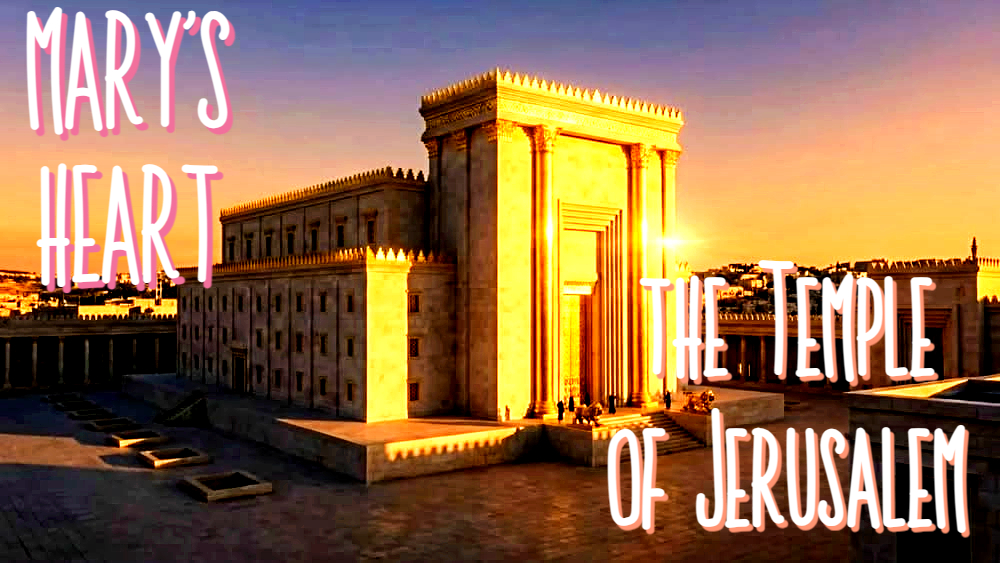
Mary’s Heart, the Temple of Jerusalem Part Two
St. Epiphanius and St. John Damascene, together with several other Doctors, tell us that the golden candlestick is a figure of the Holy Mother of God. Next to Jesus, her beloved Son, Mary is the most luminous torch and the brightest light of the House of God. “O virginal candlestick,” says St. Epiphanius,” which enlightened those who sat in the shadow of death! O virginal torch, which dissipated the gloom of hell, and caused the brilliance of heaven to shine in our souls! O radiant lamp, ever filled with the oil of grace and light, with the fire of divine love, lighting our minds and inflaming our hearts! This virginal light has spread its splendour throughout the world!”
The remarkable table in Solomon’s temple, described in the twenty fifth chapter of Exodus, was made by divine command from the wood of Setim, not a common variety of cedar, but according to the Septuagint, a most rare and altogether incorruptible wood. The table was completely covered with gold-plate and edged with a gold-plated cornice or border surrounding it like a crown while two additional golden crowns embellished it. It was designed to hold the loaves of proposition that were offered to God daily by the priests, and were thus named because they lay in the temple as a perpetual sacrifice proposed or exposed to the Divine Majesty. Afterwards they were consumed by the priests.
The Fathers of the Church all agree that the loaves of proposition were a figure of Our Lord Jesus Christ, the royal bread that came down from Heaven. Christ is the bread of the angels, the bread of God, the bread of the children of God, a bread which is the nourishment and life of the Christian soul, and all Christians are called priests in Sacred Scripture: Fecisti nos Deo nostro sacerdotes. Some are priests by office and bear the special character of consecrated priesthood; others share it by participation. What is the table bearing this divine bread, prefigured by the table carrying the loaves of proposition? St. Germanus, Patriarch of Constantinople, answers that it was the Blessed Virgin Mary and St. Epiphanius confirms his words.
Is not the table designed to receive the bread and food laid on it? Is it not true that the Heart of the Mother of God was the first to receive Our Lord as He came forth from the bosom of the Eternal Father? Did she not receive Him in order to give Him to us? Is it not true that the Eternal Father carries His Beloved Son in His all-glorious Heart from all eternity and that the Blessed Virgin will carry her Son in her Heart for all eternity? Hence we hear the words which the Holy Ghost puts on Mary’s lips: “I was with him,” that is, with the Eternal Father, “forming all things.” In the Hebrew version this passage reads: “I was with Him and near Him as a nurse,” which reveals Mary’s role as the Mother who gives nourishment to mankind.
Several learned interpreters of Sacred Scripture teach us that the altar of perfumes of the Mosaic temple represents the hearts of the faithful, which are symbolized as altars on which each one should offer a perpetual sacrifice of prayer and praise to God. Now if the hearts of the children of God were figured by this altar, how much more truly does it symbolize the Heart of the Mother of God, which is after the Heart of Jesus, the first and holiest of all altars? It is “the golden altar, which is before the throne of God,” mentioned in the eighth chapter of the Apocalypse. On this altar the Mother of the Saviour offered to God a sacrifice of love, adoration, praise, thanksgiving and prayer far more to His Divine Majesty than all the sacrifices that ever were or ever shall be offered on all other altars.
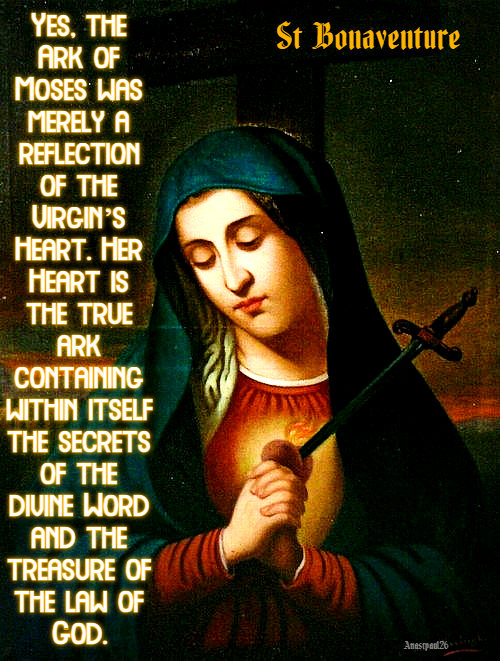
If we consult the Fathers of the Church we learn particularly from St. Ambrose that the Ark of the Covenant was a figure of the Blessed Virgin Mary, and therefore of her most holy Heart, the holy Heart, the first and noblest part of her person. “Yes,” exclaims the seraphic St. Bonaventure “the Ark of Moses was merely a reflection of the Virgin’s Heart. Her Heart is the true ark containing within itself the secrets of the divine Word and the treasure of the law of God.” A holy Abbot of the Cistercian Order calls Mary the Ark of Sanctification, containing revelations written by the hand of God. She is the holy Ark of the Covenant, the Covenant by which God reconciled us with Himself and pledged His alliance with us forever. Next to God, Mary’s Heart should be the first object to which we look up when we pray.
But let us remember that the Heart of Mary is a tower of ivory, zurris eburnea, which does not suffer within its precincts anything defiled and unclean. It is the tower of David, open only to those who follow the meekness of Jesus Christ, the true David.
St. Gregory of Nyssa states that the Tables of the Mosaic Law kept in the temple of Solomon were a figure symbolic of the hearts of the Saints. Now, if the hearts of the Saints are real tables of the evangelical law, what shall we say of the holy Heart of the Queen of Saints, who is the Mother of the Saint of saints? Her glorious Heart is the first and holiest table of the Christian law. It is not made of stone, but of gold, or better still, of diamond; it is not dead but living; not breakable like the tables of Moses but indestructible. On it the Holy Ghost, the finger of God, has written and engraved in golden letters, not merely the will of God and His laws, but all the counsels, maxims and-truths of the gospel as well. They are so deeply engraved that the united forces of hell and of earth could more easily snatch the sun from the sky and-destroy the world than remove a single iota or tarnish a single letter of this sacred writing.
The Propitiatory is regarded as another figure symbolic of the glorious Virgin because by her intercession the flame of God’s wrath was extinguished, His Divine Majesty was turned to look upon mankind with favor and His infinite mercy moved Him to compassion for our infirmities. For this reason St. Ildephonsus calls the Mother of Grace; Propitiatio humanae salutis. “The propitiation of man’s salvation.” St. Andrew of Crete styles Mary: Universi mundi commune propitiatorium. “The universal propitiatory of the entire world.”
St. Augustine, St. Gregory the Great, and several other Fathers say that the Altar of Holocausts also symbolized the hearts of all the Saints, who are the real altars on which God is honored by the spiritual sacrifices offered day and night to His Divine Majesty. Yet much more truly can this be said of the Holy Heart of Mary. “Her Heart is the true altar of holocaust,” says the illustrious John Gerson, “and on it the sacred fire of divine love blazed day and night.” The Mother of the Sovereign Priest constantly offered to God sacrifices of love, praise, thanksgiving, expiation for the sins of the world and every possible sacrifice. On the altar of her Heart Mary sacrificed to God all the things of the world and every creature of the universe as so many different victims. She sacrificed her being, life, body, soul, all her thoughts, words and actions, the employment of her senses and faculties, and in general, all that she was, all that she possessed and every power of her soul. She offered to the Divine Majesty the very sacrifice that her Son Jesus Christ offered on Calvary. Our adorable Saviour offered Himself to the Eternal Father only once on the altar of the Cross, but His holy Mother immolated Him ten thousand times on the altar of her pure Heart.
What veneration is then due to this sacred altar! Be thou blessed, O God of my heart, for having consecrated this most worthy altar to the glory of thy most adorable majesty. Deign to transform our cold hearts into glowing altars on which we may offer Thee an unremitting sacrifice of praise and love.