Posted in FEASTS and SOLEMNITIES

The Assumption of the Blessed Virgin Mary and Memorials of the Saints – 15 August

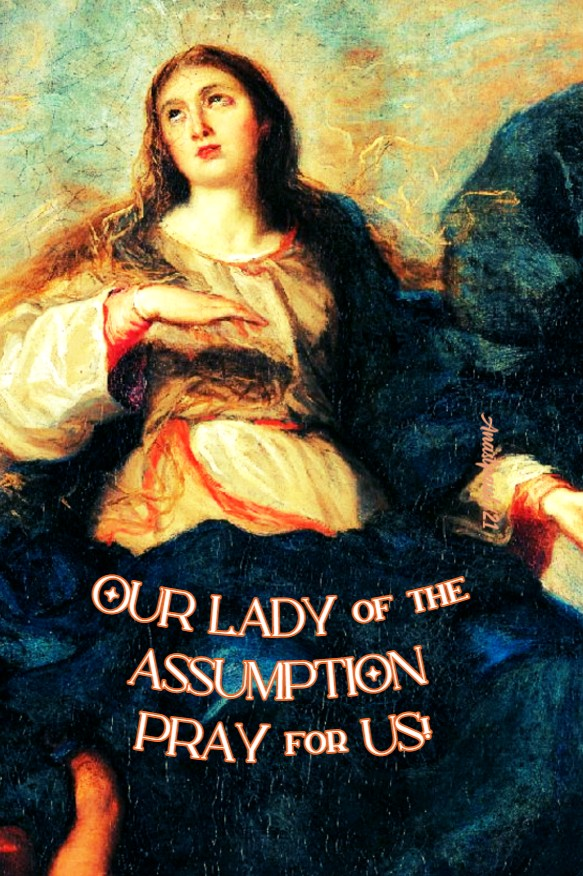
The Assumption of the Blessed Virgin Mary

The Feast celebrates the Assumption of the body of the Blessed Virgin Mary into heaven upon her death. According to Pope Benedict XIV, it is a probable opinion, which it is impious to deny, though not an article of faith but has since in 1950 has been raised to a DOGMA of the Faith. The origin of the Feast day is not known but it was celebrated in Palestine before the year 500. It is a holy day of obligation, it’s Vigil being a fast day, in many English-speaking countries.

In 1950, Pope Pius XII proclaimed Mary’s Assumption a Catholic Dogma:
the Immaculate Mother of God, the ever Virgin Mary, having completed the course of her earthly life, was assumed body and soul into heavenly glory” (Munificentissimus Deus). He did not specify whether she died first – Catholic Doctrine leaves that open. St Epiphanius of Salamis (Cyprus, died 403) had written, “No-one knows how her life ended.” But the Assumption of Mary is a nexus of Catholic faith in God’s power to resurrect the body and unite it with the soul in everlasting life. Among the many masters who have painted the subject of the Assumption are Fra Angelico, Ghirlandaio, Rubens, Del Sarto and Titian.

Patronages – Acadians, Cajuns, Cistercian Order, Cistercians, fish dealers, fish-mongers, French air crews, harness makers, France, Guatemala, India, Jamaica, Malta, Paraguay, Slovakia, east Africa (region of east Africa which includes diverse countries, proclaimed on 15 March 1952 by Pope Pius XII) South Africa. The Assumption is, therefore, the Patronal Feast of the Country of South Africa – proclaimed on 15 March 1952 by Pope Pius XII), 24 dioceses, 38 cities.
St Alypius of Thagaste (Died 430) Bishop

Blessed Alfred of Hildesheim OSB (Died 874) Bishop, Benedictine Monk, Confessor, Founder of Essen Abbey, Hildesheim Cathedral, many Convents, Schools and Seminaries, Royal Spiritual Adviser to the East Frankish King Louis the German, Diplomatic Peacemaker, he was known for his great devotion to the Blessed Virgin Mary.

Bl Agustín Hurtado Soler
St Arduinus of Rimini
Bl Claudio Granzotto
Bl George Halley

St Napoleon of Alexandria

St Simplician (c 320-c 401) Archbishop of Milan and Successor of St Ambrose (340-397) Doctor of the Church in the Archdiocese of Milan, Teacher, Catechist, Writer, Mystic. St Ambrose used to call Simplician father, as a sign of spiritual relationship but they were also great friends. Simplician took also an active part in the conversions of both Alypius of Thagaste and Augustine of Hippo. The meeting between Augustine and Simplican occurred in Milan in 386 and it is recorded in Augustine’s Confessions. After his conversion, Augustine also called Simplician father and in 397 he dedicated to Simplician two books on the issue of predestination, known as De Diversis Quaestionibus ad Simplicianum. St Augustine, remembered and referred to him with deep gratitude, calling him the “spiritual father of my soul” and would submit his own writings to him to review and comment.

St Stanislaus Kostka SJ (1550-1568) Polish Jesuit Novice.
On the evening of the Feast of Saint Lawrence (10 August), Stanislaus felt a mortal weakness, magnified by a high fever and clearly saw, that his last hour had come. He wrote a letter to the Blessed Virgin begging her to call him to the skies, there to celebrate with her, the glorious Anniversary of her Assumption (15 August). His confidence in the Blessed Virgin, which had already brought him many favours, was this time again rewarded – on 15 August 1568, towards 4:00 in the morning, while he prayed to God, to the Saints and to the Virgin Mary, he died. Many in the City proclaimed him a saint and people hastened from all parts to venerate his remains and to obtain, if possible, a relic. St Stanislaus was Beatified on 19 October 1605 by Pope Paul V and Canonised on 31 December 1726 by Pope Benedict XIII.

St Tarcisius (3rd century) Martyr of the Eucharist – Patronages – altar servers, first communicants.

Martyrs of Nicomedia – 3 saints: Three Christians martyred together. No details survive but the names – Eutychian, Philip and Straton. They were martyred in Nicomedia, Bithynia (in modern Turkey).

Martyred in the Mexican Revolution: 4 Saints –
St David Roldán Lara
St Luis Batiz Sainz
St Manuel Moralez
St Salvador Lara Puente

Martyred in the Spanish Civil War: Thousands of people were murdered in the anti-Catholic persecutions of the Spanish Civil War from 1934 to 1939.
• Blessed Agustì Ibarra Angüela
• Blessed Carmelo Sastre y Sastre
• Blessed Clemente Vea Balaguer
• Blessed Francisco Míguez Fernández
• Blessed Ildefonso Alberto Flos
• Blessed Jaume Bonet Nadal
• Blessed Joan Ceró Cedó
• Blessed Josep Santonja Pinsach
• Blessed Juan Francisco Barahona Martín
• Blessed Juan Mesonero Huerta
• Blessed Luis Ros Ezcurra
• Blessed Manuel Formigo Giráldez
• Blessed Miguel Alberto Flos
• Blessed Sebastià Balcells Tonijuan
• Blessed Severiano Montes Fernández
Posted in Our MORNING Offering

Our Morning Offering – 15 August – Prayer in Honour of the Assumption

Our Morning Offering – 15 August – The Solemnity of the Assumption of the Blessed Virgin Mary

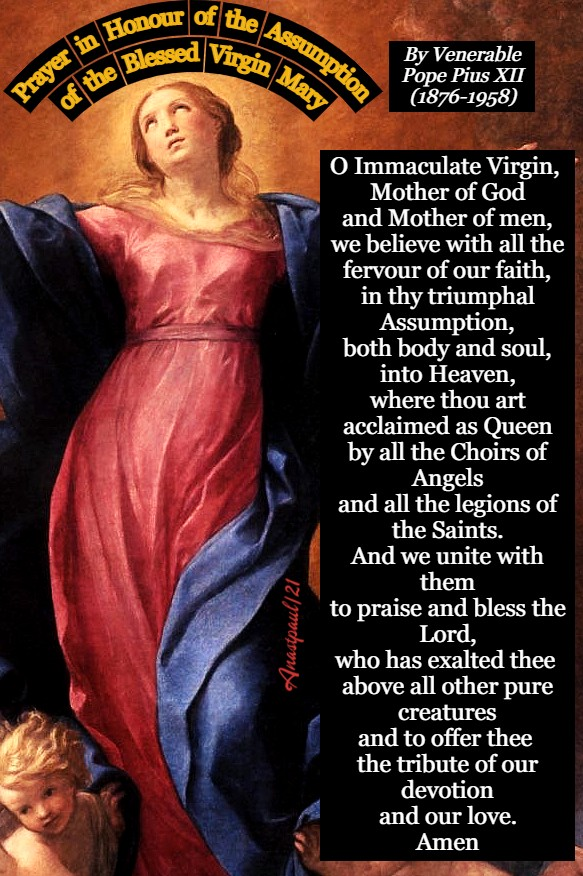
Prayer in Honour of the Assumption
of the Blessed Virgin Mary
By Pope Pius XII (1876-1958)

O Immaculate Virgin,
Mother of God
and Mother of men,
we believe with all the fervour of our faith,
in thy triumphal Assumption,
both body and soul, into Heaven,
where thou art acclaimed as Queen
by all the Choirs of Angels
and all the legions of the Saints.
And we unite with them
to praise and bless the Lord,
who has exalted thee
above all other pure creatures
and to offer thee
the tribute of our devotion
and our love.
Amen

Posted in ONE Minute REFLECTION

One Minute Reflection – 15 August – “From henceforth all ages will call me blessed”

One Minute Reflection – 15 August – Solemnity of the Assumption of the Blessed Virgin Mary into Heaven, Readings: Apoc 12:1, Ps 97:1, Judith 13:22-25; 13:15; 13:10, Luke 1:41-50

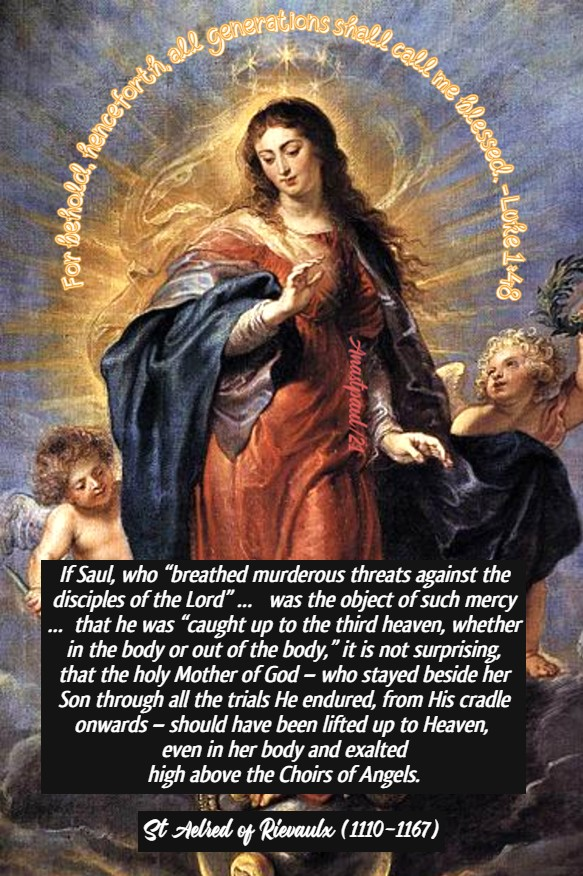
“For behold, henceforth, all generations shall call me blessed.”

Luke 1:48

REFLECTION – If Saint Mary Magdalene – who had been a sinner and from whom the Lord had cast out seven demons – merited to be glorified by him to the extent that her praise abides forever among the assembly of the saints, who can measure the extent to which “the upright rejoice and dance for joy in the presence of the Lord” with regard to holy Mary, who knew not man? If the apostle Peter – who was not only unable to watch for one hour with Christ but who even went so far as to deny him – afterwards won such favor that the keys of the Kingdom of heaven were entrusted to him, of what praises is holy Mary not worthy, who bore the king of angels himself in her womb, he whom the heavens cannot contain? If Saul, who “breathed murderous threats against the disciples of the Lord” was the object of such mercy that he was “caught up to the third heaven, whether in the body or out of the body”, it is not surprising that the holy Mother of God – who stayed beside her son through all the trials he endured from his cradle onwards – should have been lifted up to heaven, even in her body, and exalted high above the choirs of angels.

If there is “joy in heaven before the angels over one sinner who repents”, who can tell what joyful and lovely praises rise up before God concerning holy Mary who never sinned? Indeed, if those who “once were darkness” and have now become “light in the Lord” “will shine like the sun in the kingdom of their Father”, who is able to tell “the eternal weight of glory” of holy Mary, who came into the world “like dawn arising, beautiful as the moon, resplendent as the sun” and of whom was born “the true light which enlightens everyone coming into the world”? Moreover, since our Lord said: “Whoever serves me must follow me, and where I am there will my servant also be”, where do we think his mother must be who served him with such eagerness and fidelity? If she followed him and obeyed him even to death, no one can wonder that now, more than anyone else, she “follows the Lamb wherever he goes.”

PRAYER – God our Father, You crowned the Blessed Virgin Mary on the day of her Assumption with a glory beyond compare. You had looked on her lowliness and had made her the Mother of our Lord Jesus Christ, Your only-begotten Son. Grant that by her prayers, we may be saved by the mystery of Your redemption and share with her in the glory of eternal life. We make our prayer through Christ Your Son, our Lord, in the unity of the Holy Spirit, one God now and for all eternity, amen.

Posted in THE ASSUMPTION

Quote/s of the Day – 15 August – The Assumption

Quote/s of the Day – 15 August – Solemnity of the Assumption of the Blessed Virgin Mary into Heaven

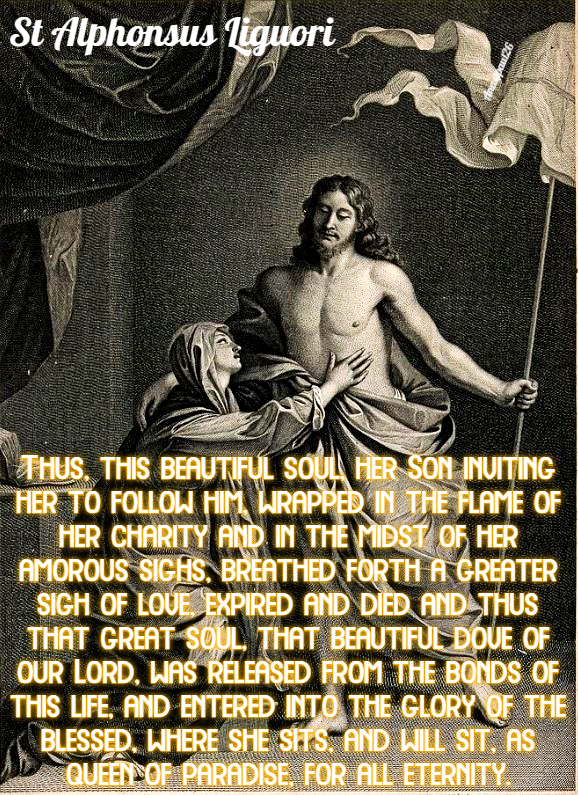
And now death came, not indeed clothed in mourning and sadness, as it comes to others, but adorned with light and joy. But why death, why death? Rather should we say that divine love came to cut the thread of that noble life. And as a lamp before going out, her life, amid these last flickerings, flashed forth more brightly, and then expired. Thus, this beautiful soul, her Son inviting her to follow him, wrapped in the flame of her charity and in the midst of her amorous sighs, breathed forth a greater sigh of love, expired and died and thus that great soul, that beautiful dove of our Lord, was released from the bonds of this life, and entered into the glory of the blessed, where she sits, and will sit, as queen of paradise, for all eternity.

St Alphonsus Liguori

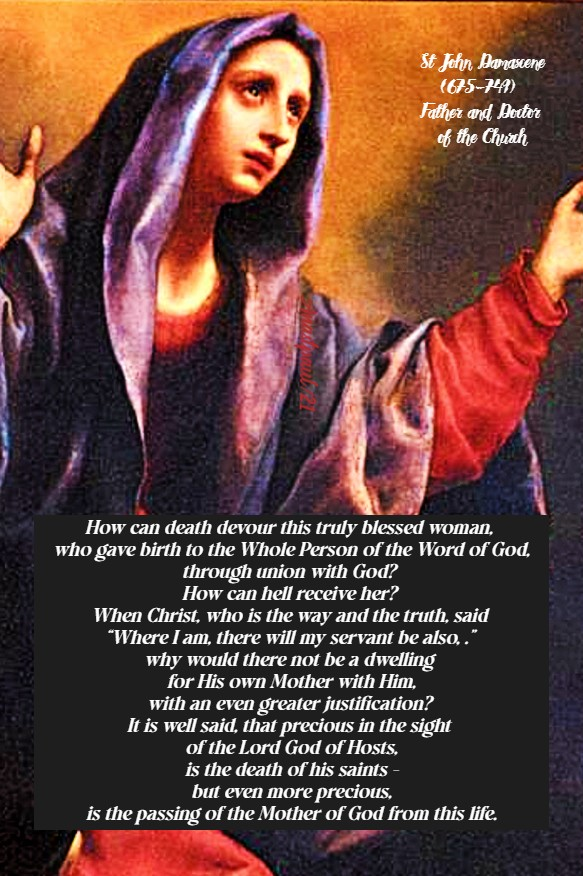
“How can death devour this truly blessed woman,
who gave birth to the Whole Person of the Word of God,
through union with God?
How can hell receive her?
When Christ, who is the way and the truth, said
“Where I am, there will my servant be also, .”
why would there not be a dwelling
for His own Mother with Him,
with an even greater justification?
It is well said, that precious in the sight
of the Lord God of Hosts,
is the death of his saints –
but even more precious,
is the passing of the Mother of God from this life..”

St John Damascene

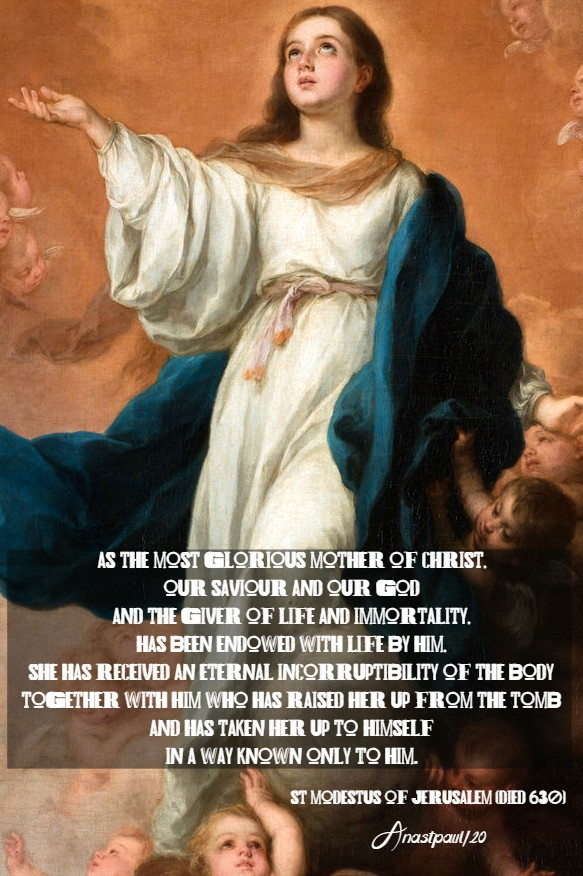
“As the most glorious Mother of Christ,
our Saviour and our God
and the giver of life and immortality,
has been endowed with life by Him,
she has received an eternal incorruptibility of the body
together with Him who has raised her up from the tomb
and has taken her up to Himself
in a way known only to Him.”

St Modestus of Jerusalem 

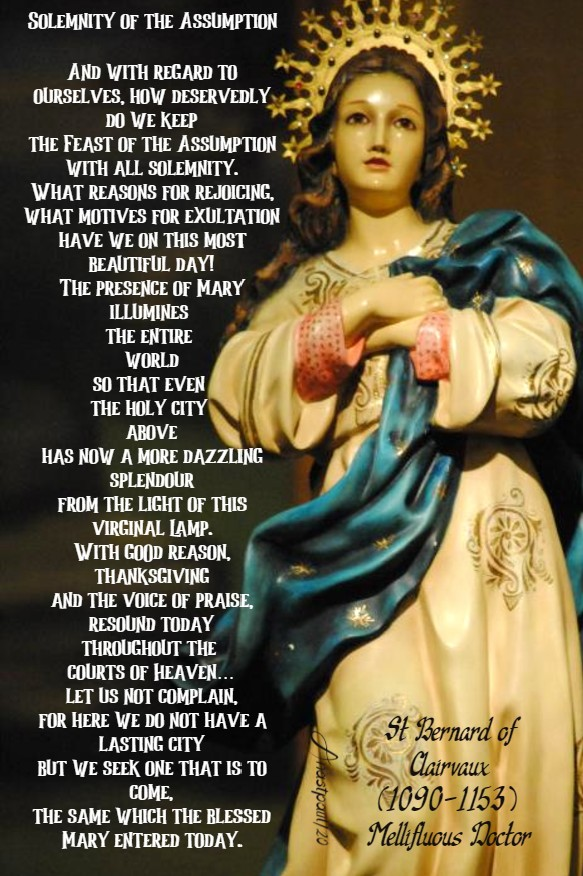
“And with regard to ourselves,
how deservedly do we keep
the Feast of the Assumption with all solemnity.
What reasons for rejoicing,
what motives for exultation
have we on this most beautiful day!
The presence of Mary illumines the entire world
so that even the holy city above
has now a more dazzling splendour
from the light of this virginal Lamp.
With good reason,
thanksgiving and the voice of praise,
resound today throughout the courts of Heaven…
let us not complain,
for here we do not have a lasting city
but we seek one that is to come,
the same which the blessed Mary entered today.”

St Bernard of Clairvaux

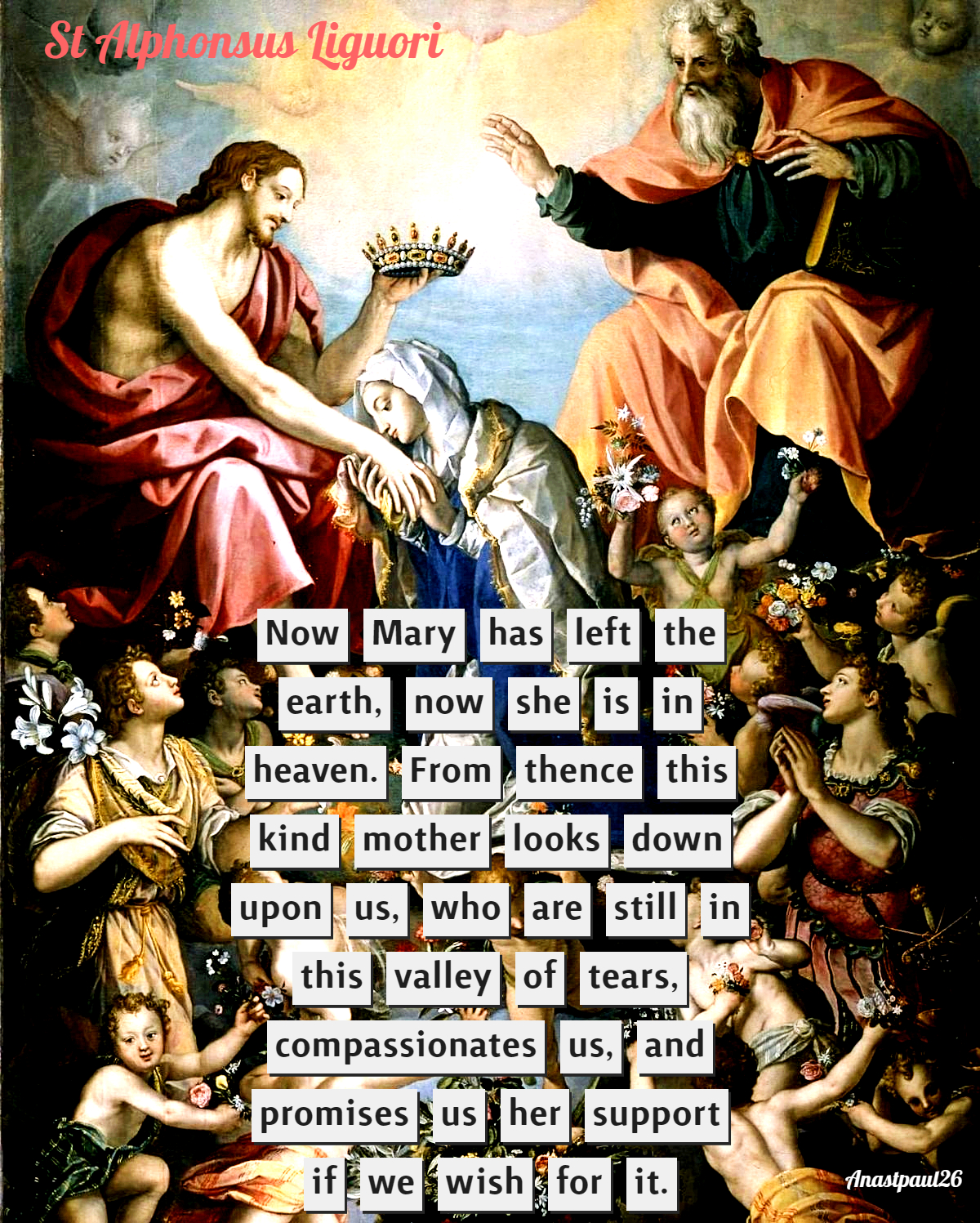
Now Mary has left the earth, now she is in heaven. From thence this kind mother looks down upon us, who are still in this valley of tears, compassionates us, and promises us her support if we wish for it. Let us pray her always that by the merits of her blessed death she may obtain for us a happy death; and if it please God, that she may obtain for us to die on a Saturday, which is dedicated to her honor, or on a day of the Novena, or of the octave of some of her feasts, as she has obtained for so many of her servants, and especially for St. Stanislas Kostka, for whom she obtained to die on the day of her glorious Assumption.

St Alphonsus Liguori

Posted in AUGUST - The Immaculate Heart of Mary

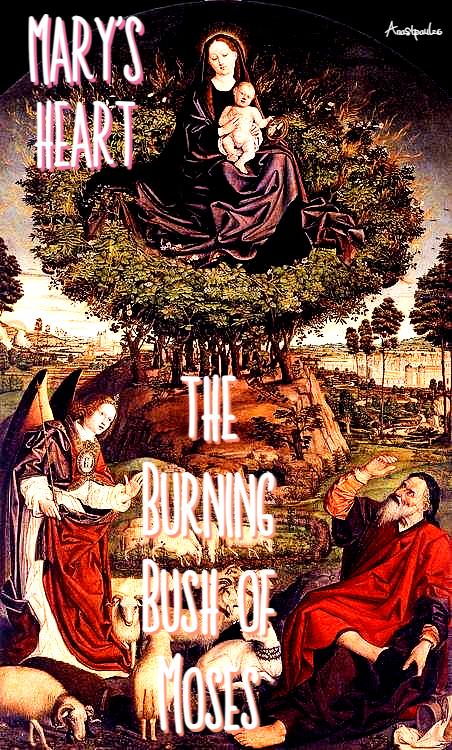
Thought for the Day – 15 August – Mary’s Heart, the Burning Bush of Moses

St John Eudes – The Admirable Heart of Mary

Mary’s Heart, the Burning Bush of Moses

John Gerson, very learned and devout chancellor of the famous University of Paris, when commenting on the Magnificat, says that Mary’s incomparable Heart was prefigured by the burning bush seen by Moses on Mount Horeb.! Gerson does not speak thus without good reason. The extraordinary spectacle of a bush burning in the midst of a blazing fire without being consumed is a beautiful representation of the Heart of Mary, which it excellently portrays in several ways.

First, we should consider that the mountain on whose slopes the bush grew is called in Sacred Scripture “the mountain of God,” mons Dei? It is also spoken of as “a holy mountain,” for Moses heard a voice saying to him: “The place whereon thou standest is holy ground.” We shall easily be convinced, therefore, that it represents the most Blessed Virgin Mary, who is the true mountain of God, a mountain of holiness of whom we can well say with St. Gregory the Great that she is the mountain foretold by the Prophet Isaias as the peak towering above all other heights: “A mountain . . . on the top of mountains,” because God has raised her in dignity, in sanctity and power above the chief Seraphim and the greatest saints.

Secondly, we ought not to despise this insignificant bush, a lowly shrub, the least of all plants. On the contrary, we should regard it with respect, since God so honored this bush as to choose it in preference to the tallest cedars of Lebanon for this manifestation of His glory, amid the fire and flames of its miraculous blaze. Would you know the reason of this? Listen to the Holy Ghost: “The Lord is high and looketh on the low: and the high he knoweth afar off.” Though God is most high and infinitely above His creatures, nevertheless it delights His divine Providence to look with a kind and loving eye at that which is small and lowly. While He draws near to the humble, He surveys the great and mighty from afar, as though He disregarded and despised them. Thus was He attracted by the humility of Mary, His handmaid. Respexit humilitatem ancillae suae.” St. Bernard speaks as follows of the profound humility of Mary’s Heart: “She who in her own mind and heart was the least of all creatures, has rightly been made the first, because, even though she was in fact the first, she considered herself as being the last.” This humility of the Heart of Heaven’s Queen is represented by the lowliness of the mysterious bush of Mount Horeb.

Thirdly, we must not be frightened or horrified by the sharp thorns which guard this bush on all sides, both outside and inside. This should, on the contrary, make us love it more, because God Himself loves it for this reason. It is obvious that God loves all His creatures and hates none of the works of His hands, for it is written: “Thou lovest all things that are, and hatest none of the things which thou hast made.” It is also obvious that God cherished a specially tender love for this little bush, that His Heart was there and that He took pleasure in it. He chose it to be His throne, the place where He would manifest His glory to His servant Moses, where He would speak to His prophet, disclose divine secrets and reveal His providential designs to deliver the Chosen People from Egyptian bondage.

God loved the burning bush because the fire that encompassed without consuming it represented the fire of divine love which filled the Heart of Mary, a love far greater than that of all the hearts of men and angels. The thorns symbolized the bitter sorrow and unspeakable anguish which pierced the Heart of the Mother of God, suffering that she accepted for the love of God and the salvation of mankind.

Moreover, God descended from Heaven into the bush on Mount Horeb and manifested Himself to Moses, “in the flame of fire,” to show His love and charity towards his people, and spoke “from the midst of the bush,” or according to another version “from the heart of the bush,” to declare His intention of delivering the children of Israel from the captivity of Pharaoh through the instrumentality of Moses. In like manner the Son of God, in the excess of His love, descended from the bosom of the Eternal Father into His Mother’s Heart, ablaze as it was with love for God and charity towards men, in order to bring about our redemption and to associate her with Himself as the instrument of this great work.

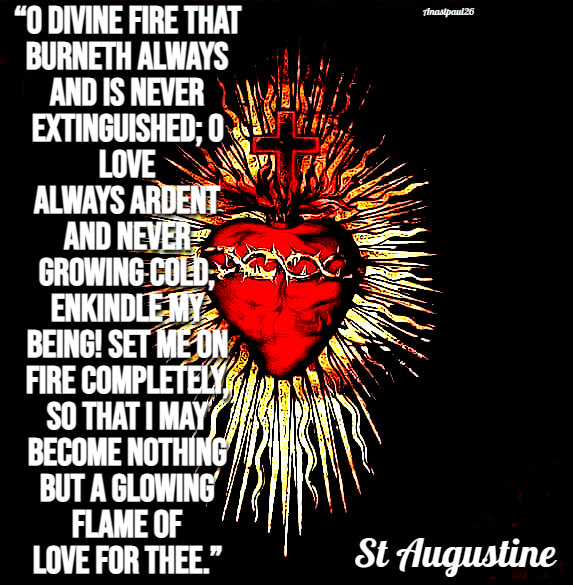
Likewise, dear reader, do not forget that your heart must burn with the loving fire that enkindled the virginal Heart of Mary, the fire that the Son of God came to spread upon earth, or else it must burn forever in the dreadful conflagration prepared for the devil and his cohorts. Oh, what a difference between these two kinds of fire! The devouring flames that torment eternally without consuming, and the delightful, joyous flames that constantly ravish the hearts of the ardent seraphim! Rejoice, each one of you who reads or listens to these words! Give thanks to God that you are still alive, that yours is still the power to choose which of these fires shall enkindle your heart. Strive earnestly to extinguish the flame of self-love, of worldliness, the burning of anger, lust, envy and ambition. Give your heart entirely to Jesus Christ, asking Him to set it on fire with His love. For this purpose there is no better prayer than the words of St. Augustine:

“O divine fire that burneth always and is never extinguished; O love always ardent and never growing cold, enkindle my being! Set me on fire completely, so that I may become nothing but a glowing flame of love for Thee.”

Posted in FEASTS and SOLEMNITIES

15 August – The Assumption of the Blessed Virgin into Heaven

The Assumption of the Blessed Virgin into Heaven by St Alphonsus Liguori

On this day the Church proposes to us to celebrate two solemn observances in honor of Mary: one, her happy departure from this earth; the other, her glorious assumption into heaven. In the present discourse we shall speak of her departure from this earth, and in the next of her assumption.

How precious was the death of Mary! 1st, On account of the special grace which attended it; 2d, On account of the manner of it.

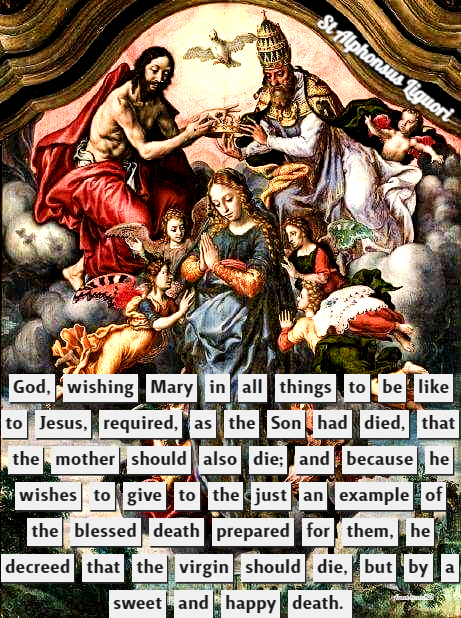
Death being the punishment of sin, it would seem that the divine mother, all holy and exempt from every stain, should not be subject to death, nor suffer the same misfortune as the children of Adam, who are infected by the poison of sin. But God, wishing Mary in all things to be like to Jesus, required, as the Son had died, that the mother should also die; and because he wishes to give to the just an example of the blessed death prepared for them, he decreed that the virgin should die, but by a sweet and happy death. 

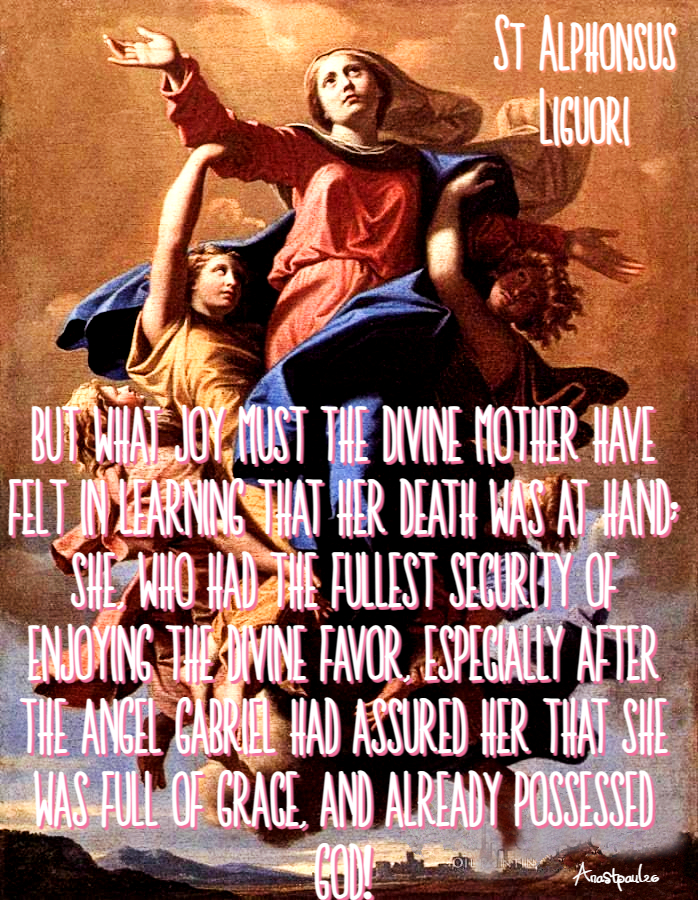
Death is called a passage, since, through death we pass from this short life to life eternal. And, as the dread is great of those who die in doubt of their salvation, and who approach the solemn moment with just fear of passing into an eternal death, thus, on the other hand, very great is the joy of the saints at the end of life, hoping with some security to go and possess God in heaven. A. nun of the order of St. Theresa, when the physician announced to her that death was near, was so full of joy that she said to him: “And how does it happen, sir, that you tell me this good news and ask no fee for it?” St. Lawrence Justinian being at the point of death, and seeing his friends weeping around him, said to them : “Away, away with your tears, this is no time for tears.” Go elsewhere to weep; if you will remain with me you must rejoice, as I rejoice, in seeing the gate of paradise open to unite me with my God. And thus, also, a St. Peter of Alcantara, a St. Louis of Gonzaga, and so many other saints, on hearing that death was at hand, burst forth into ex clamations of joy and gladness. And yet they were not certain of the divine favor, nor secure of their own sanctity, as Mary was secure of hers. But what joy must the divine mother have felt in learning that her death was at hand; she, who had the fullest security of enjoying the divine favor, especially after the angel Gabriel had assured her that she was full of grace, and already possessed God! “Hail, full of grace, the Lord is with thee …. thou hast found grace.” And well did she herself know that her heart was burning continually with divine love, for that as Bernardine de Bustis says, Mary, by a singular grace not granted to any other saint, loved, and was always actually occupied in loving God every moment of her life, and so ardently, that, as St. Bernard says, it required a perpetual miracle to preserve her life in the midst of such burning flames.

Cedrenus, Nicephorus, and Metaphrastes, relate, that the Lord, some days before his death, sent to her the angel Gabriel, the same who once announced to her that she was the blessed woman chosen to be the mother of God: My Lady and Queen, said the angel to her, God has already graciously heard thy holy desires, and he has sent me to tell thee to prepare to leave the earth, for he wishes thee with him in paradise. Come then, to take possession of thy kingdom, for I and all its holy citizens await and desire thee. After receiving this precious intelligence, she imparted it to St. John, and we may imagine with what grief and tender emotion he heard this news; he who for so many years had been near her as a son, and had enjoyed the celestial conversation of this most holy mother. She then visited anew the holy places of Jerusalem, tenderly taking leave of them, especially of Calvary, where her beloved Son had died. And then she returned to her poor dwelling to prepare for death. During this time the angels did not cease to come and visit this their beloved queen, consoling themselves with the thought that they should soon see her crowned in heaven. 

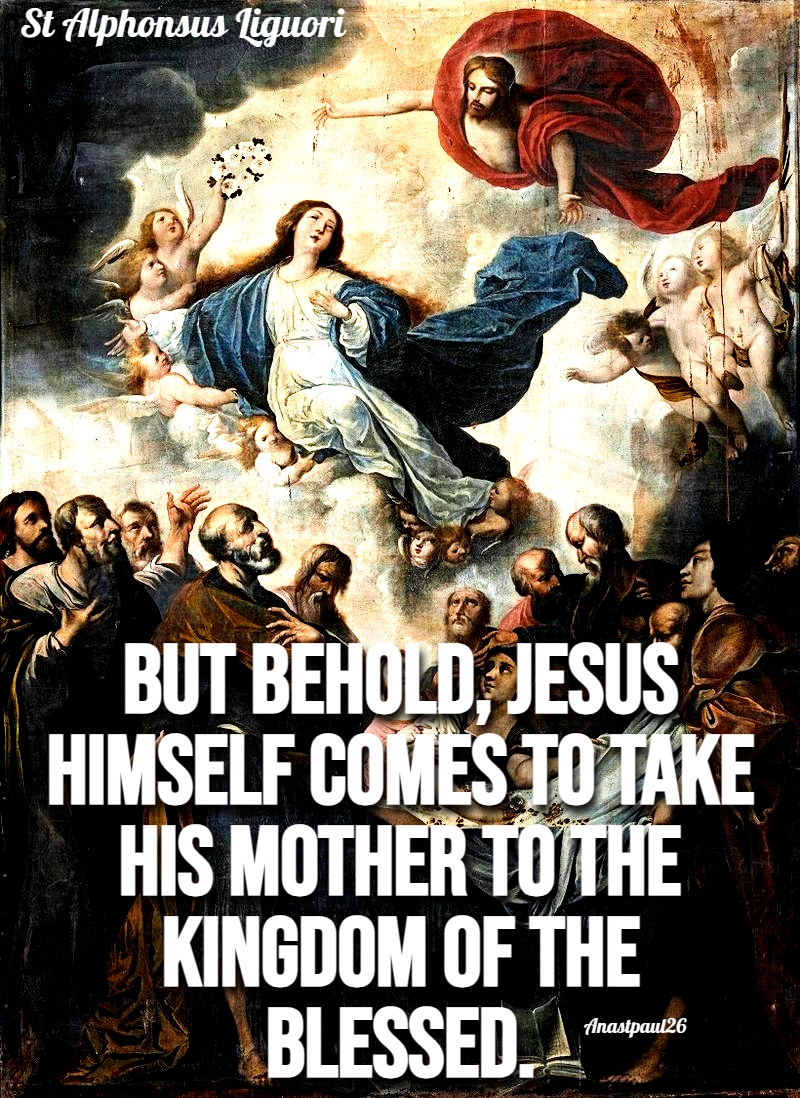
But behold, Jesus himself comes to take his mother to the kingdom of the blessed.