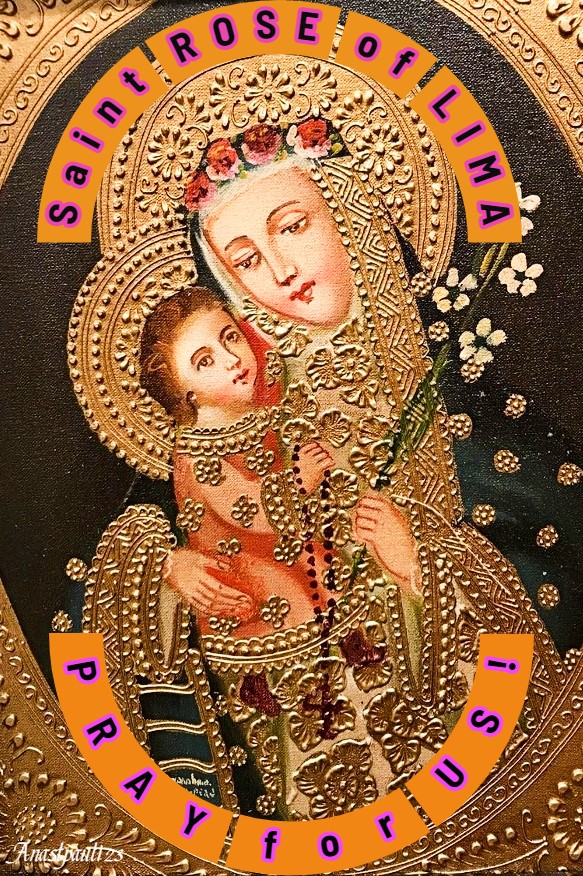
St Rose of Lima OP (1586-1617) Virgin and Penitent, Mystic, Visionary, Stigmatist (invisible), Apostle of the Poor. Also known as “St Rose of Saint Mary” – her Religious name.
St Adauctus AND St Felix of Rome (Died c303) St Agilus St Arsenius the Hermit St Boniface of Hadrumetum St Bononius of Lucedio Bl Bronislava of Poland Bl Edward Shelley Bl Ero di Armenteira Bl Eustáquio van Lieshout St Fantinus of San Mercurius
Saint Fiacre (Died 670) Priest, Abbot, Monk, Hermit, Apostle of charity, gardener.
St Gaudentia of Rome
Blessed Giovanni Giovenale Ancina CO (1545–1604) Bishop of Saluzzo, member of the Oratory of St Philip Neri, Scholar, Musician and Composer, renowned Preacher Doctor of Medicine. Commonly known as Blessed Juvenal Ancina.
St Pammachius (c340 – 410) Senator, Monk, Apostle of Charity, friend of St Jerome and he was praised by St Augustine.
St Pelagius the Hermit St Peter of Trevi Bl Richard Flower Bl Richard Leigh Bl Richard Martin St Rumon of Tavistock St Sylvanus the Hermit St Thecla of Hadrumetum St Theodosius of Oria
Martyrs of Colonia Suffetulana – 60 Saints: A group of 60 Christians Martyred for destroying a statue of Hermes. They were Martyred in Colonia Suffetulana, Africa.
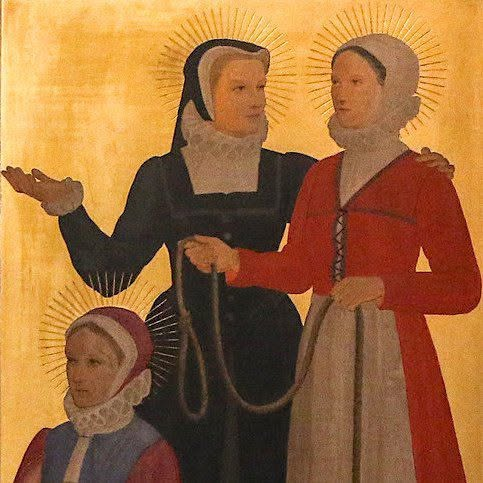
Blessed Margaret Ward, known as the Pearl of Tyburn, a martyr during the reign of Elizabeth I. Margaret was born a gentlewoman in Congleton, Cheshire, in Northwest England, in 1550. Later she travelled to London and went to work in the home of a woman of distinction called Whitall.
Whilst in London she assisted a priest called William Watson, who was imprisoned in the Bridewell prison. Ward befriended the gaoler’s wife, took food to Watson, and smuggled in rope to help Watson escape. She arranged for two Catholic watermen to meet Watson on the Thames below the prison walls; even though he broke his arm and leg during his escape, he was picked up by the watermen, “who rowed him to a safe hiding place”. The rope was traced back to Ward. She was arrested, charged, and tried for “aiding a traitor to escape” and was tortured by being hung by her wrists and beaten for eight days.
Margaret Clitherow, Anne Line, and Margaret Ward
Blessed Robert Southwell said Ward “was flogged and hung up by the wrists, the tips of her toes only touching the ground, for so long a time that she was crippled and paralyzed, but these sufferings greatly strengthened the glorious martyr for her last struggle”. Blessed John Roche was arrested and tried with Ward. They were offered release if they asked for the queen’s pardon and agreed to “conform to the established Church”, but they refused and were hanged at Tyburn on 30 August 1588. Ward and Roche were beatified in a large group in 1929.
Possibly such a woman could not have been slain unless she herself had willed it, because she was feared by the impure spirit.
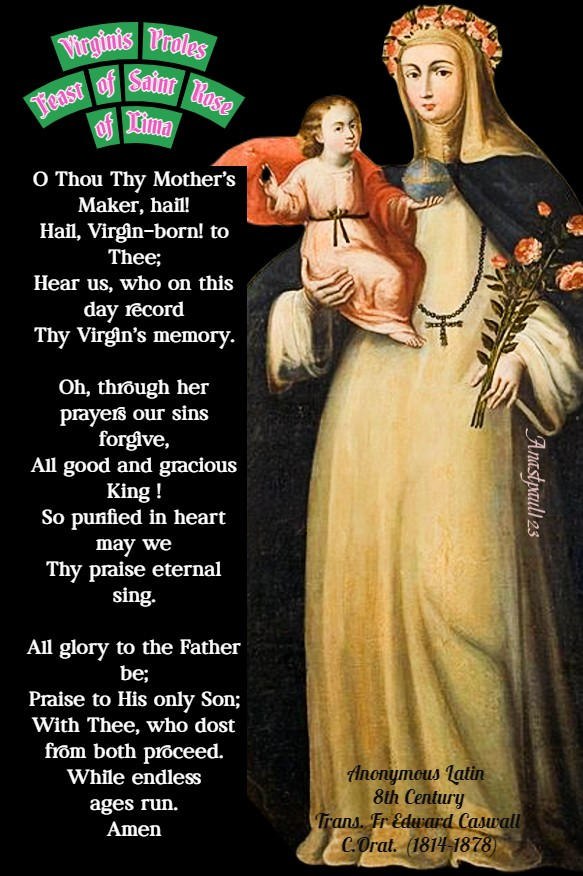
Our Morning Offering – 30 August – St Rose of Lima OP (1586-1617) Virgin
Virginis Proles Anonymous Latin, 8th Century Trans. Fr Edward Caswall C.Orat. (1814-1878)
O Thou Thy Mother’s Maker, hail! Hail, Virgin-born! to Thee; Hear us, who on this day record Thy Virgin’s memory.
Oh, through her prayers our sins forgive, All good and gracious King ! So purified in heart may we Thy praise eternal sing.
All glory to the Father be; Praise to His only Son; With Thee, who dost from both proceed. While endless ages run.
This Hymn is used for Matins in the Common of Virgins in the Extraordinary form of the Roman Breviary. Verses 1, 4 and 5 above, are used for a Virgin who is not a Martyr.
One Minute Reflection – 30 August – St Rose of Lima OP (1586-1617) Virgin – Readings: Ps 83:10-11, Ps 83:2-3, Gal 5:16-24, Matt 6:24-33
Therefore I say to you, do not be anxious for your life, what you shall eat; nor yet for your body, what you shall put on. Is not the life a greater thing than the food, and the body than the clothing?
Matt 6:24-33
REFLECTION – If spiritual things hold first place in our lives, material needs will cause us no concern, for God in his goodness will give them to us in abundance. On the other hand, if we devote ourselves entirely to earthly pursuits and neglect our spiritual life, concern for what this life has to offer will lead us to neglect our souls. I urge you, therefore, let us not overturn the established order. We know that our Master is good, so let us commit everything to him and not be taken up with the cares of this life. “Your heavenly Father knows that you need all these things even before you ask him”.
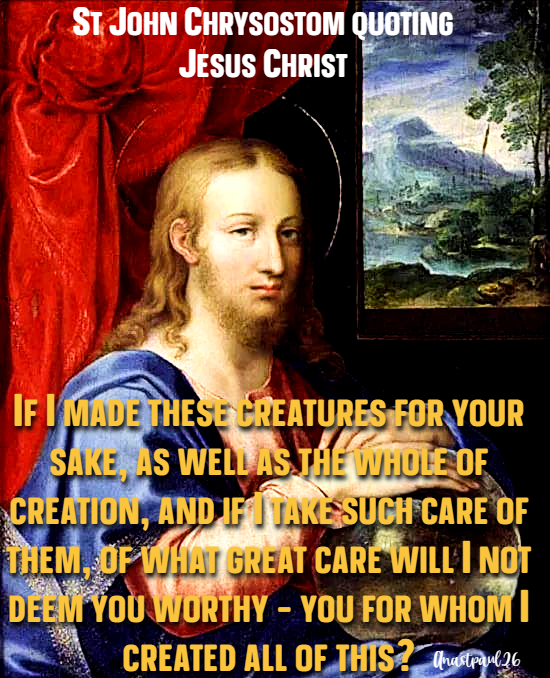
Jesus wishes us, then, to be free from every anxiety regarding temporal affairs, and to have all possible leisure for the things of the Spirit. He says: "Your part is to seek spiritual blessings, and I myself will provide amply for your material needs. Look at the birds in the sky. They neither sow nor reap nor gather crops into barns, and yet your Father feeds them." In other words, "If I take such care of irrational birds as to supply them with all they need without plowing or sowing, I will take much greater care of you who are endowed with reason, if only you make up your minds to put spiritual things before temporal ones. If I made these creatures for your sake, as well as the whole of creation, and if I take such care of them, of what great care will I not deem you worthy - you for whom I created all of this?"
St John Chrysostom (Baptismal catechesis, no.8)
PRAYER – Almighty God, Giver of all good things, Who willed that blessed Rose, imbued in early life with the dew of heavenly grace, should bloom among the Indians with the beauty of virginity and patience, grant unto us, Thy servants that, following the fragrance of her sweetness, we may be found worthy to become a sweet savour of Christ. Who livest and reignest with God the Father, in the unity of the Holy Ghost, God, world without end. Amen
Quote/s of the Day – 30 August – St Rose of Lima OP (1586-1617) Virgin
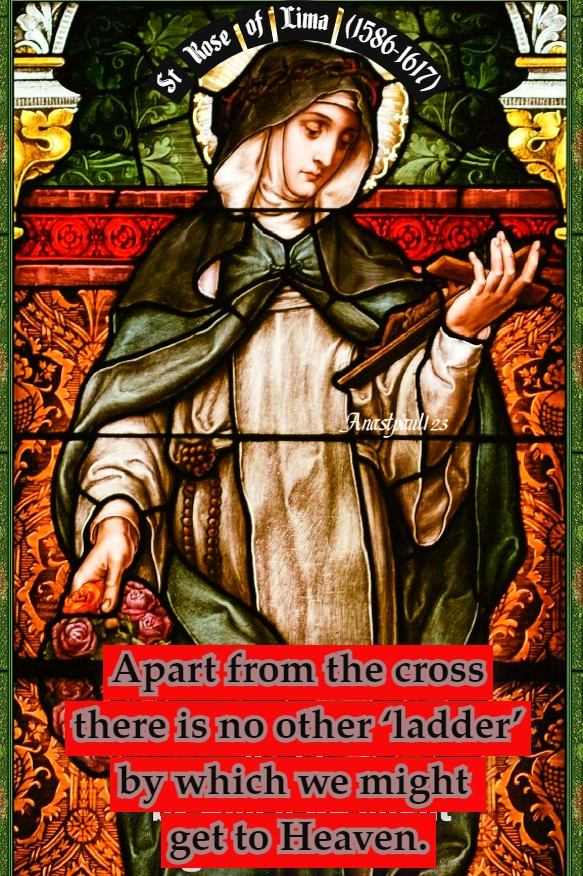
“Apart from the cross there is no other ‘ladder’ by which we might get to Heaven.”
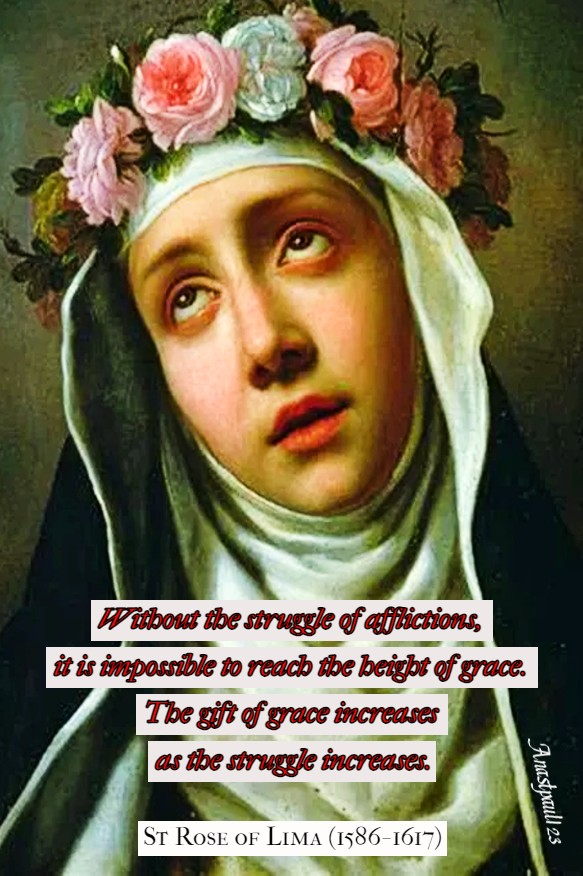
“Without the struggle of afflictions, it is impossible to reach the height of grace. The gift of grace increases as the struggle increases.”
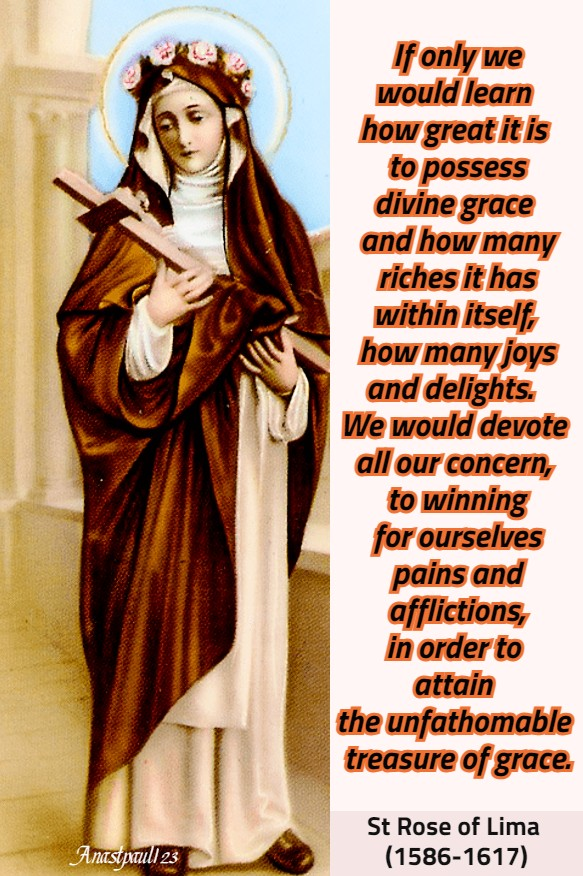
“If only we would learn how great it is to possess divine grace and how many riches it has within itself, how many joys and delights. We would devote all our concern, to winning for ourselves pains and afflictions, in order to attain the unfathomable treasure of grace.”
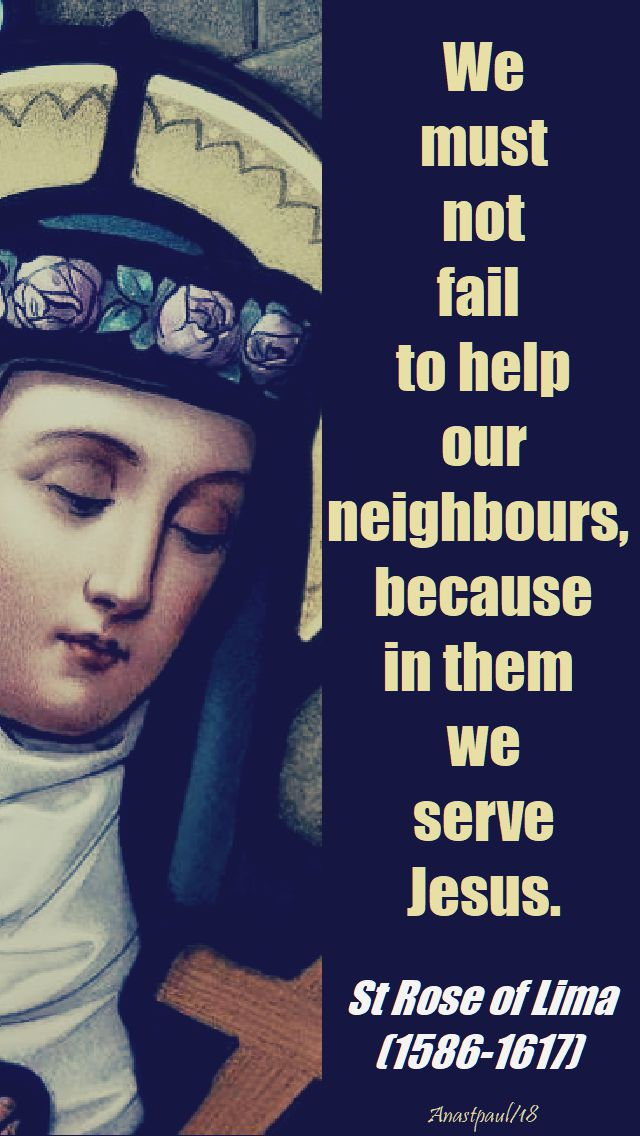
“We must not fail to help our neighbours, because in them we serve Jesus.”
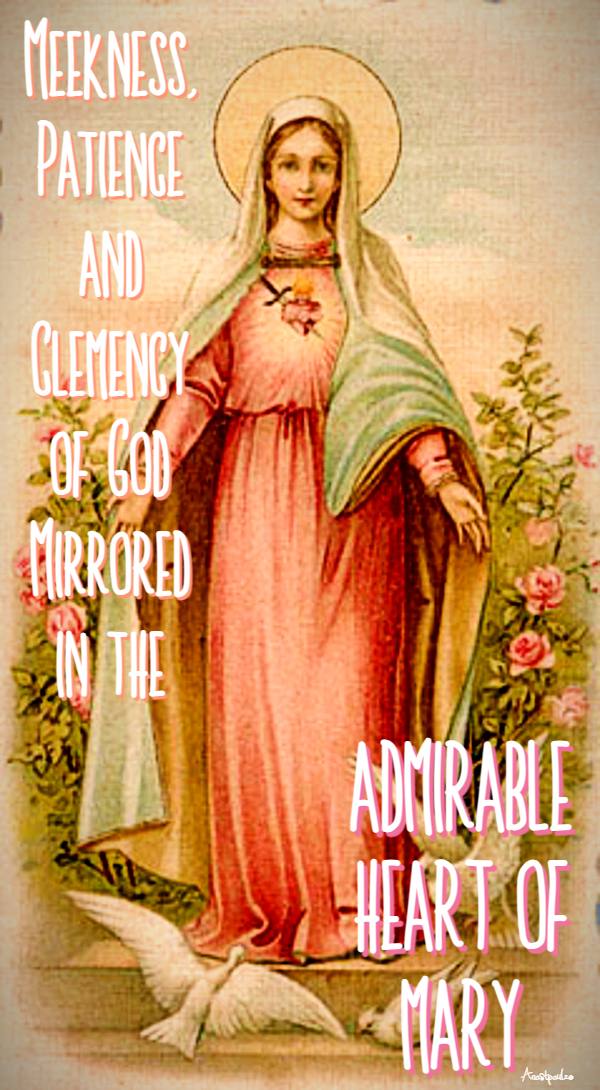
Meekness, Patience and Clemency of God Mirrored in the Admirable Heart of Mary
God’s meekness, patience and clemency are three divine perfections which are joined with mercy to form one and the same perfection, although their effects are different.
Mercy regards the misery of creatures in general, to relieve and to deliver them from its fetters. The first and greatest of miseries, the source of all wretchedness is sin. When man is so unhappy as to offend God mortally, he at once becomes the object of God’s wrath which would crush him the very instant he consents to sin, as he infinitely deserves to be. But divine meekness prevents the destruction and arrests the torrent of God’s just anger, ready to pour upon the sinner. If man perseveres in his crime, he deserves to be cast upon divine vengeance, but divine patience interposes and persuades God to suffer the sinner and await his repentance with admirable goodness. These are the effects of divine meekness and patience. God’s clemency is manifested by remitting entirely or in part the punishment due to sin.
Now these three divine perfections live and reign in the Heart of the Mother of Mercy, communicating their own divine inclinations most excellently. After the Heart of God Himself there never was and never shall be a heart so full of meekness, patience and clemency as the noble Heart of Mary.
While she dwelt on earth, she beheld the world filled with idols and idolators. With the exception of a very small number, men generally were armed against God, trying, if possible, to dethrone Him, to put Him under their feet and annihilate Him. They would set His enemy in His place and sought to procure for the usurper the adoration and honor which belong to God alone. As the Most Blessed Virgin Mary loved God with a love so great that we cannot describe it, she experienced an indescribably great sorrow at the sight of the crimes committed against His Divine Majesty.
But who can appreciate her greater grief over the atrocious torments inflicted on her beloved Son by the perfidy of the Chosen People? She knew Him to be Innocence and Sanctity incarnate; yet she saw Him persecuted and tormented as though He were the greatest of criminals. Now what did she do, the Mother of Sorrows, as she beheld her treasure, her most innocent Lamb torn, flayed and slain? She loved Him with a peerless love. Did she cry out against His pitiless Murderers? Did she lament of the wrong and injustice wreaked upon Him? Did she implore the Eternal Father’s justice? No. She remained silent; not a word was heard from her lips; only her stifled sighs, her tears alone were seen. Her most gentle Heart fought against the entry of any sense of injury or movement of impatience, or aversion or bitterness towards her cruel tormentors. Her Heart abounded with meekness, patience and clemency, so that she imitated her son, Jesus, and sought to excuse the men who with such distorted rage were killing Him, repeating in her Heart the words He uttered with His lips: “Father, forgive them, for they know not what they do.” She offered for their salvation the very Blood they shed, the sufferings they inflicted upon Him, the cruel death they perpetrated. She was prepared, if necessary, to sacrifice herself together with her Son, to obtain mercy for those wicked men.
Nor is that all. The glorious Virgin now reigning in heaven can see much more clearly the numberless multitude and frightful enormity of the sins committed against God. She sees this earth of ours which should be a paradise since the God of Heaven honored it with His presence and made it His dwelling place; yet it is filled with sinners and enemies of God, who blaspheme and dishonor Him without ceasing, even more than the devils and the damned in hell.
Our Lady knows that her Son, the Son of God, came into the world to save all men; that salvation cost Him infinite labor, ignominies, tears and blood to deliver mankind from the bondage of the devil and hell, and reconcile them to His Father. And yet she sees men turning their back on God, denying and forsaking Him, to side with Satan and cast themselves headlong into hell. She sees innumerable atheists and blasphemers making every effort to exterminate the Holy Church founded by her Jesus Christ through the shedding of the last drop of His Blood, and to render His sacred name despicable, abominable and odious to the entire’ world: “They have set me an abomination to themselves.”
Our heavenly Mother perceives all these crimes and all the wickedness most clearly, and her inconceivably great love for God and for her Son is wounded beyond anything we can imagine, even though she is glorious and incapable of suffering. She is Queen of Heaven and earth, and God has given her sovereign power over all created things; therefore she would not lack the power, if such were her will, to avenge most justly the many atrocious insults offered by men to their God and Saviour. But far from doing this, she permits herself to be induced by her very patient and gentle Heart to use the power of her merits and intercession in order to halt the just fury of divine vengeance, and to arrest the torrent of God’s wrath ready to burst on the hapless heads of sinners. She obtains from His divine Majesty that He punish them not as enemies but as children, not like a severe judge but as a merciful father, not to exterminate them but to correct and convert them.
True the Blessed Virgin Mary does not entertain the same sentiments for all sinners, nor does she treat them all alike. She distinguishes between those in Hell, whom she knows to be irreconcilable enemies of God, and those on earth, whom she considers still capable of being reconciled to His divine Majesty. Hence her Heart is filled with very great and just indignation towards the wretched creatures in hell, for she is most perfectly united to God, and therefore shares in all His adorable inclinations. She loves what God loves and hates what He hates, approves what He approves, and condemns what He condemns. As the damned will forever be the object of God’s wrath: “They shall be called the people with whom the Lord is angry forever,” so shall they forever be the object of the anger of God’s Mother. Her love and charity for God and the friends of God are greater than the ardor of all angels and saints together, so also is her hatred of God’s irreconcilable enemies greater than that of all the denizens of heaven.
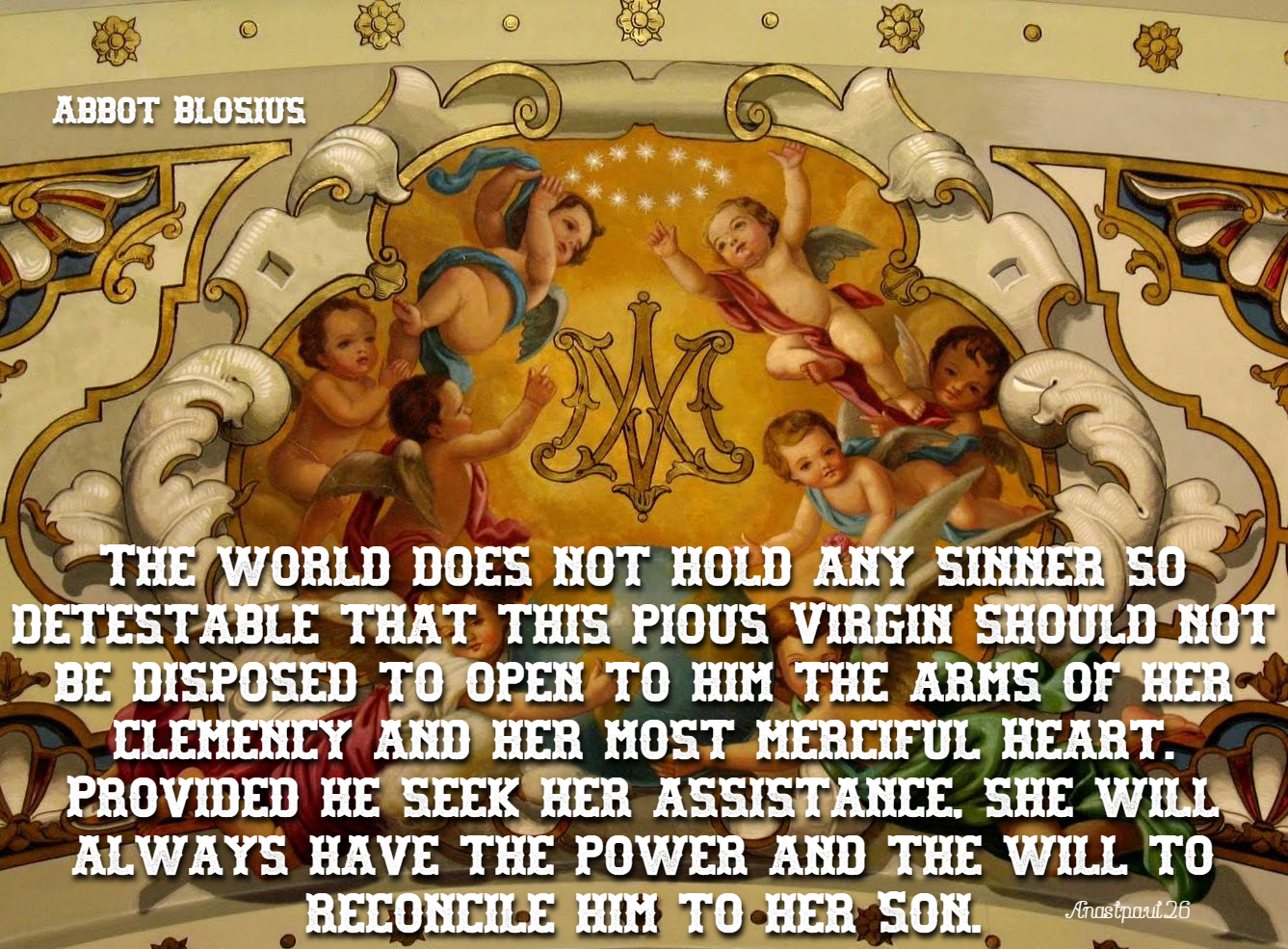
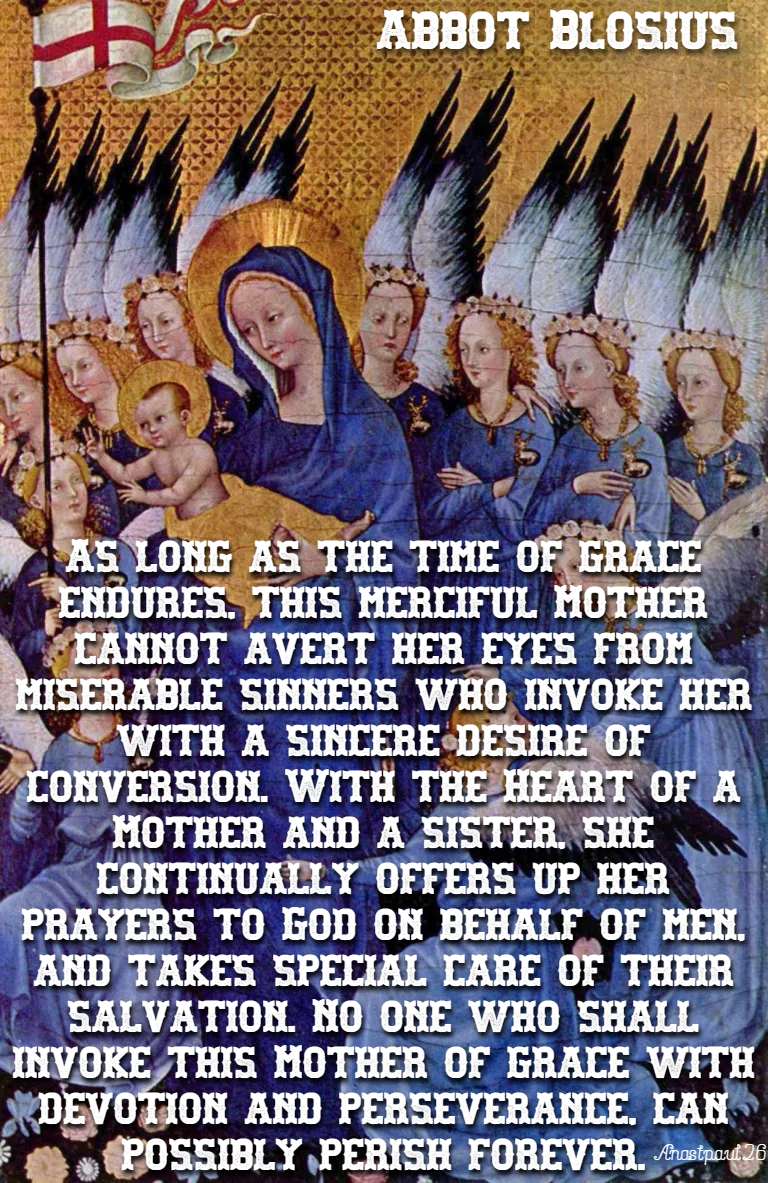
But towards sinners who are still in this world, which is a place of mercy where our all-bountiful Mother has established the throne and empire of her mercy and clemency, her Heart is so filled with sweetness and benignity that the venerable and holy Abbot Blosius declares: “The world does not hold any sinner so detestable that this pious Virgin should not be disposed to open to him the arms of her clemency and her most merciful Heart. Provided he seek her assistance, she will always have the power and the will to reconcile him to her Son.” Blosius says further: “As long as the time of grace endures, this merciful Mother cannot avert her eyes from miserable sinners who invoke her with a sincere desire of conversion. With the Heart of a Mother and a sister, she continually offers up her prayers to God on behalf of men, and takes special care of their salvation. No one who shall invoke this Mother of grace with devotion and perseverance, can possibly perish forever.”
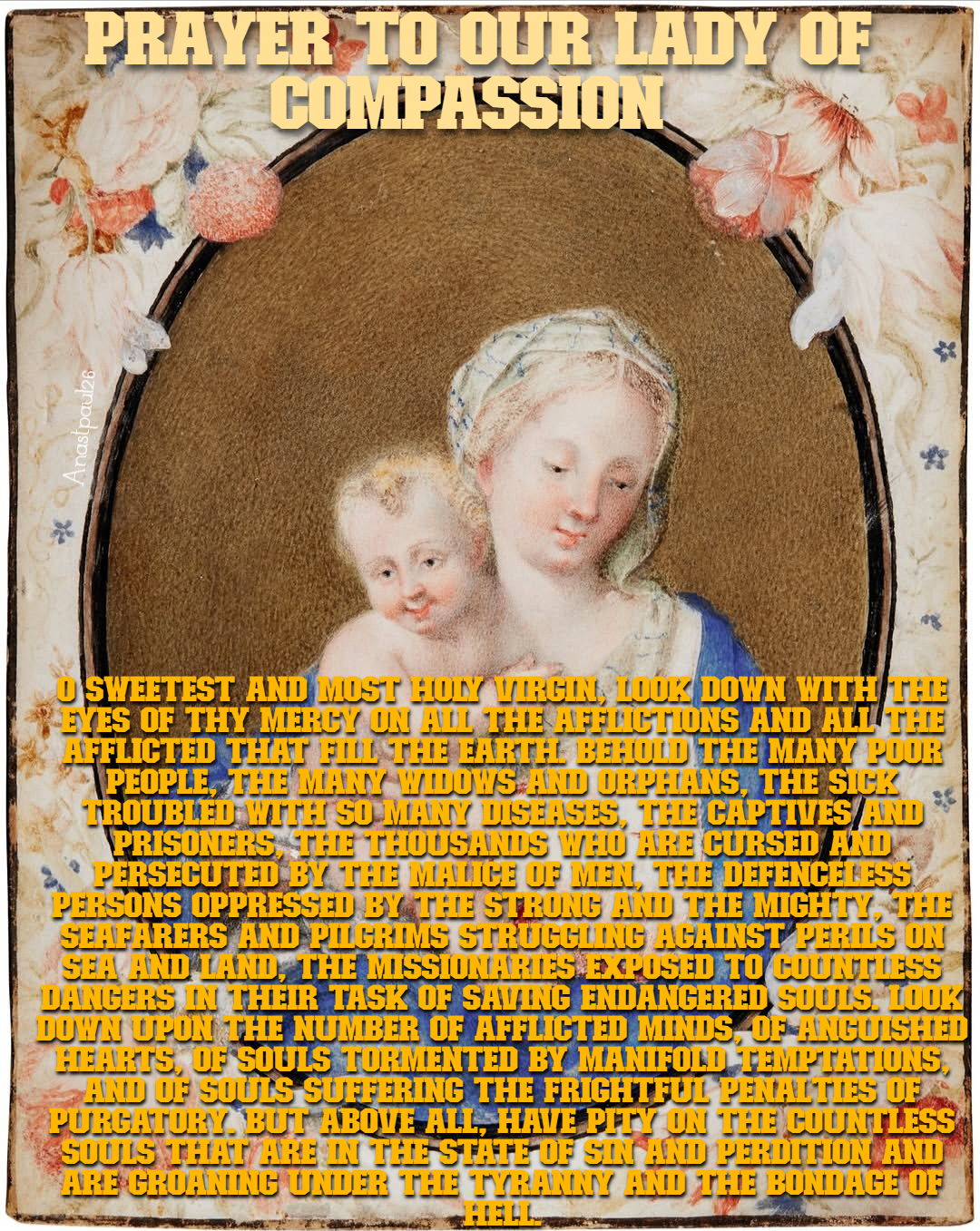
“O sweetest and most holy Virgin, look down with the eyes of thy mercy on all the afflictions and all the afflicted that fill the earth. Behold the many poor people, the many widows and orphans, the sick troubled with so many diseases, the captives and prisoners, the thousands who are cursed and persecuted by the malice of men, the defenceless persons oppressed by the strong and the mighty, the seafarers and pilgrims struggling against perils on sea and land, the missionaries exposed to countless dangers in their task of saving endangered souls. Look down upon the number of afflicted minds, of anguished hearts, of souls tormented by manifold temptations, and of souls suffering the frightful penalties of Purgatory. But above all, have pity on the countless souls that are in the state of sin and perdition and are groaning under the tyranny and the bondage of hell.
“Finally, O gentlest of Virgins, take pity on the great number of wretches who people the universe, whose innumerable miseries are so many voices crying to thee: O Mother of Mercy, comforter of the afflicted, refuge of sinners, open the eyes of thy clemency to see our desolation, the ears of thy bounty to hear our supplications. “To thee do we cry, poor banished children of Eve; to thee do we send up our sighs, mourning and weeping in this vale of tears,’ Yes, Eve’s miserable children, banished from the house of their heavenly Father, groaning and weeping in this valley of tears, have recourse to thine incomparable benignity. Hear our sighs and our cries; behold our weeping and our tears. “Turn then, O gracious Advocate, thine eyes of mercy towards us, and after this our exile show unto us the blessed fruit of thy womb, Jesus.’






You must be logged in to post a comment.