Posted in MARIAN TITLES

Feast Saint Peter in Chains, the Portiuncula Indulgence, Nuestra Señora de las Mercedes / Our Lady of Mercy, Barcelona, Spain (1218) and Memorials of the Saints – 1 August

Month of the Immaculate Heart of Mary

Feast Saint Peter in Chains

Portiuncula Indulgence:
An Indulgence which may be gained in any Church so designated by the Bishop, by all the faithful who, after Confession and Holy Communion, visit such Churches between noon of 1 August and midnight of 2 August, or on the Sunday following. The Indulgence is toties quoties and is applicable to the souls in Purgatory.

Nuestra Señora de las Mercedes / Our Lady of Mercy, Barcelona, Spain (1218,) Founding of the Mercedarian Order – 1 August, 24 September :
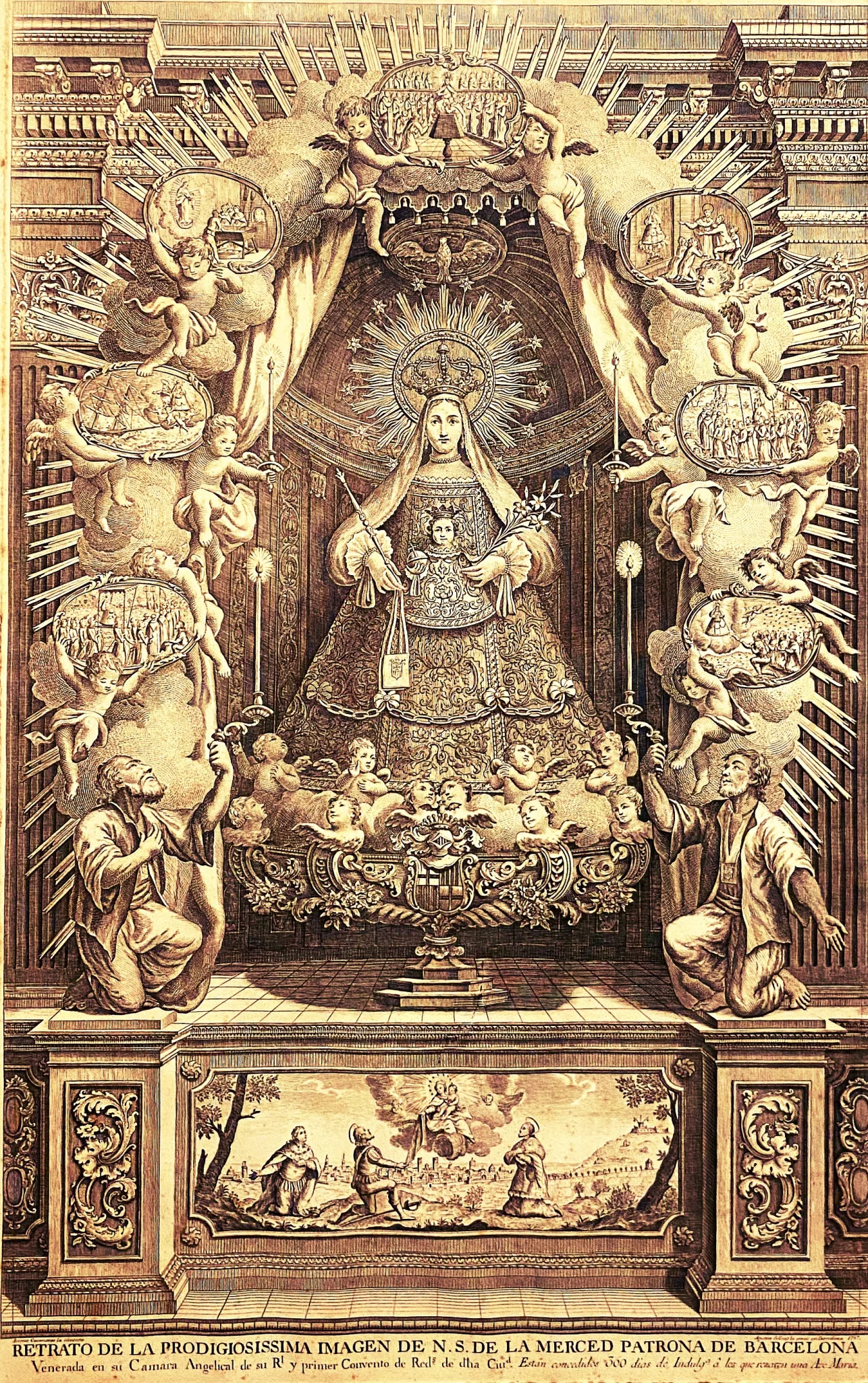
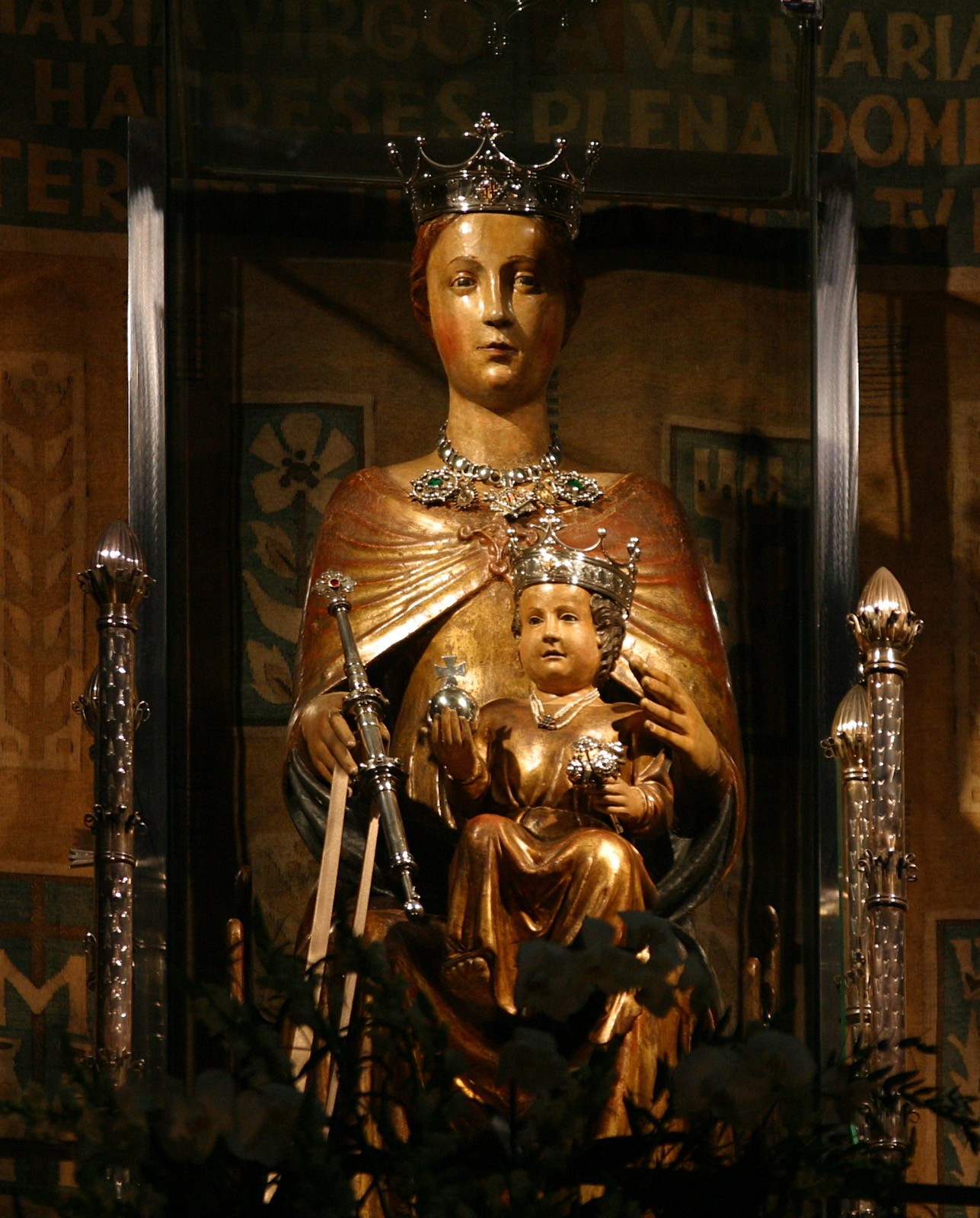
On 1 August of 1218, St Peter Nolasco, St Raymund of Penafort and James, King of Aragon, each had a vision of the Virgin Mary asking them to found a religious Order devoted to freeing Christian captives from the Muslims, who still held much of Spain. The Order of the Blessed Virgin Mary of Mercy grew quickly, collecting alms for ransom and sometimes offering themselves in exchange for prisoners. The Statue of the Mother of God of Mercy in Barcelona (below) dates from the 1300s. She became the City’s Patron after saving it from a plague of locusts in 1687. Before the counter-reformation, the Mercedarian Order celebrated the Feast of Our Lady of Ransom on 1 August, the date when she showed St. Peter Nolasco their white habit. The Vatican changed the date to 24 September when it extended the feast to entire Church in 1696. Since Vatican II, Catholic observance of Our Lady of Mercy’s day is limited to places and organisations that claim her as Patron.

Meanwhile, the Mercedarians have changed their mission to teaching and chaplaincy and the Barcelona soccer team visits the Basilica of La Mercè after victories in thanksgiving for her help. Her fiesta in Barcelona is a spectacular sequence of processions, dances, music, games and fireworks.
St Adela Mardosewicz
Bl Aleksy Sobaszek
St Alexander of Perga
St Almedha
St Arcadius
St Attius of Perga
St Buono
St Brogan
St Charity
St Ethelwold of Winchester (c 912-984) Bishop
St Exuperius of Bayeux
St Faith
St Faustus
St Felix of Gerona
St Friard
Bl Giovanni Bufalari
St Hope
St Jadwiga Karolina Zak
St Jonatus
St Justin of Paris
St Kenneth of Wales
St Leontius of Perga
St Maur
St Nemesius of Lisieux
Bl Orlando of Vallombrosa
St Peregrinus of Modena
St Rioch
Bl Rudolph
St Secundel
St Secundus of Palestrina
St Sophia
St Verus of Vienne

Holy Maccabees: Jewish dynasty which began with the rebellion of Mathathias and his five sons against the Syrian king, Antiochus IV (168 BC) and ruled the fortunes of Israel until the advent of Herod the Great. Syrian attempts to force Greek paganism on the Jews, the profanation of the Temple at Jerusalem and the massacre which followed, brought the nation to arms under Mathathias, a priest of the sons of Joarib. At the death of Mathathias, Judas Machabeus, his third son, drove the Syrians and Hellenists out of Jerusalem, rededicated the Temple and began an offensive and defensive alliance with the Romans. Before the treaty was concluded, however, Judas, with 800 men, risked battle at Laisa with an overwhelming army of Syrians under Bacchides, and was slain. He was succeeded in command by his youngest brother, Jonathan (161 BC). Jonathan defeated Bacchides, revenged the death of his brother and made peace with Alexander who had usurped the throne of Demetrius, the successor to Antiochus. A period of peace followed in which Jonathan ruled as high priest in Jerusalem but Tryphon, who was plotting for the throne of Asia, treacherously captured him at ptolemais and later put him to death. The captaincy of the armies of Israel then fell to Simon, the second son of Mathathias. Under him the land of Juda flourished exceedingly. He obtained the complete independence of the country and a grateful people bestowed upon him the hereditary kingship of the nation. His rule marked five years of uninterrupted peace. He was treacherously slain by his son-in-law, Ptolemy, about the year 135 BC After Simon the race of the Machabees quickly degenerated. In 63 BC the Romans thought it necessary to interfere in the fratricidal war between Hyrcanus II and Aristobulus II. With this interference and the advent of Herod the Great the sceptre passed forever from the land of Juda. The story of the Machabees is written in the two books of the Old Testament which bear that name.

Martyrs of Nowogrodek – 11 beati: A group of eleven Holy Family of Nazareth nuns who were murdered by the Nazi Gestapo in exchange for 120 condemned citizens of Nowogrodek, Belarus who were scheduled for revenge killings. They are –
• Adela Mardosewicz
• Anna Kukolowicz
• Eleonora Aniela Józwik
• Eugenia Mackiewicz
• Helena Cierpka
• Jadwiga Karolina Zak
• Józefa Chrobot
• Julia Rapiej
• Leokadia Matuszewska
• Paulina Borowik
• Weronika Narmontowicz
They were machine-gunned by firing squad on 1 August 1943 by the Gestapo about three miles outside Novogrudok (Nowogródek), Hrodzyenskaya voblasts’, in Nazi occupied Belarus and buried on the site of the execution in a common grave. One of their surviving sisters, Maria Malgorzata Banas, located the grave on 19 March 1945 and tended to it until her death in 1966. Their relics have since been re-interred in a common sarcophagus in the chapel of the Novograd Farny Church (the Church of the Transfiguration, also known as Biala Fara or the White Church).
Posted in SAINT of the DAY

Saints of the Day – 1 August – Saints Faith, Hope, Charity and Sophia

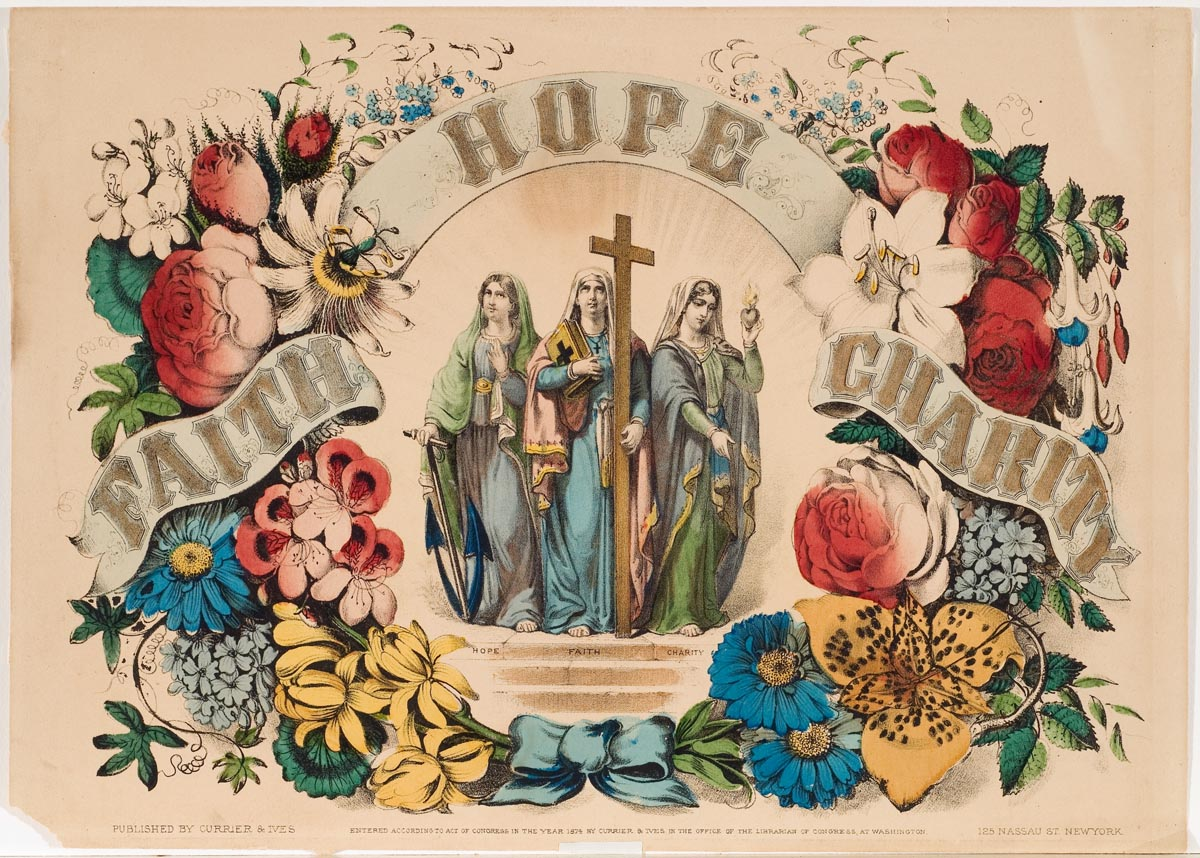
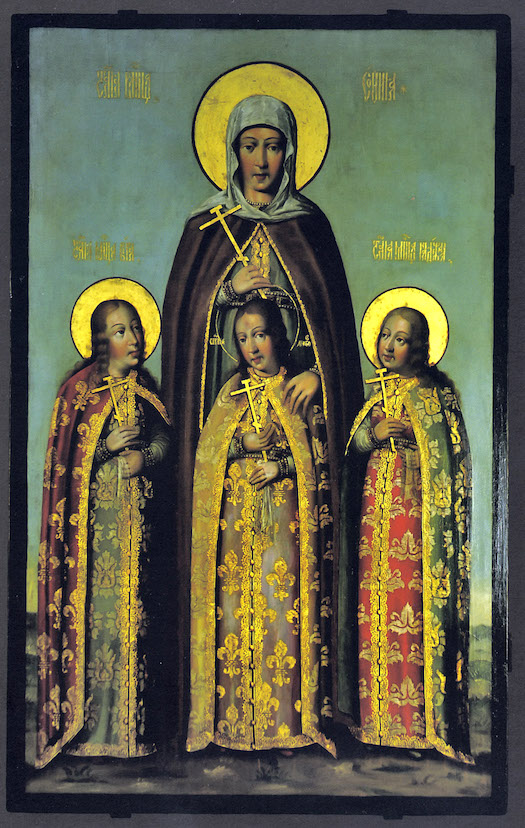
Saints Faith, Hope and Charity were the daughters of Saint Sophia (Wisdom). Sophia was a widow of Milan who gave away her possessions and moved to Rome with her daughters. Her daughters were martyred before her and she buried them at Via Appia. She died a natural death three days later while praying at their grave. Their tomb in a crypt beneath the church afterwards erected to Saint Pancratius was long a place of pilgrimage, as detailed in various documents of the seventh century. Oils were gathered from their tombs and sent to Queen Theodelinda in the time of Gregory the Great.

Early Christians from the 4th century often took in baptism mystical names indicative of Christian virtues, and Sophia, Sapientia, and Fides are attested as names of Christian women in Catacomb inscriptions. While still children, the daughters were tortured and martyred in the persecutions of Hadrian. They were scourged, thrown into a fire, and then beheaded.

Posted in Our MORNING Offering

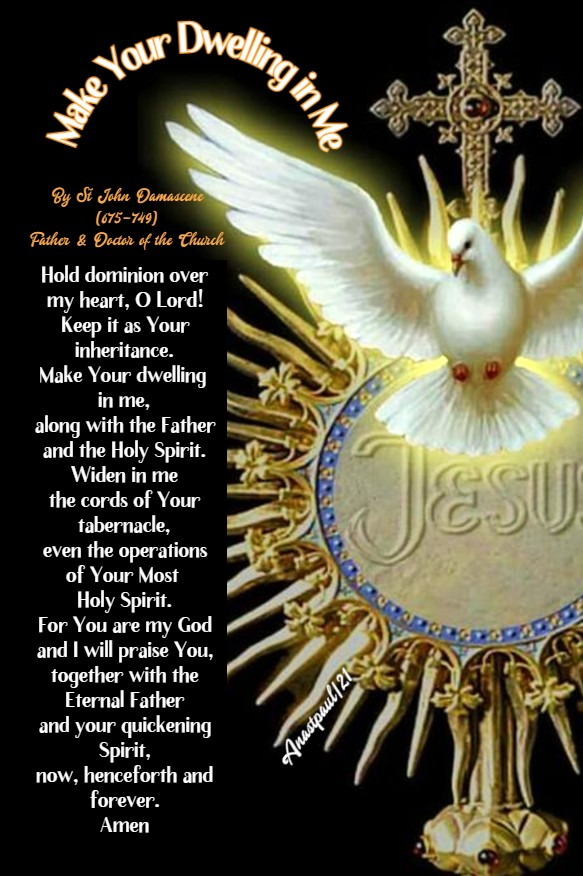
Our Morning Offering – 1 August – Make Your Dwelling in Me

Make Your Dwelling in Me
By St John Damascene (675-749)
Father & Doctor of the Church

Hold dominion over my heart, O Lord!
Keep it as Your inheritance.
Make Your dwelling in me,
along with the Father and the Holy Spirit.
Widen in me
the cords of Your tabernacle,
even the operations
of Your Most Holy Spirit.
For You are my God
and I will praise You,
together with the Eternal Father
and your quickening Spirit,
now, henceforth and forever.
Amen

Posted in ONE Minute REFLECTION

One Minute Reflection – 1 August – “Blessed are those who hear the word of God and observe it”

At that time, as Jesus was speaking to the multitudes, a certain woman from the crowd lifted up her voice and said to Him, Blessed is the womb that bore You, and the breasts that nursed You. But He said, Rather, blessed are they who hear the word of God and keep it.

Luke 11:27-28

REFLECTION – “Happy the one who bore you and she who nursed you at the breast.” How great is the devotion, how great the faith are expressed in the words of this woman in the gospel. Whereas scribes and Pharisees put the Lord to the test and blaspheme against him, this woman acknowledges his incarnation before them all with such loyalty and confesses it with such assurance that she undoes the calumny of her contemporaries and the false faith of heretics to come. Offending against the works of the Holy Spirit, Jesus’ contemporaries deny he is really the Son of God, consubstantial with the Father. Later on people also denied that Mary ever-Virgin had, through the working of the Holy Spirit, provided the substance of her flesh to the Son of God, who would be born with a truly human body. They denied he was really Son of man with the same nature as his mother. But the apostle Paul condemns this opinion when he says of Jesus that he was “born of a virgin, subject to the Law”. For, conceived in the womb of the Virgin, he took his flesh, not out of nothing, nor from some other source, but from the body of his mother. Otherwise it would not be correct to call him truly Son of man.

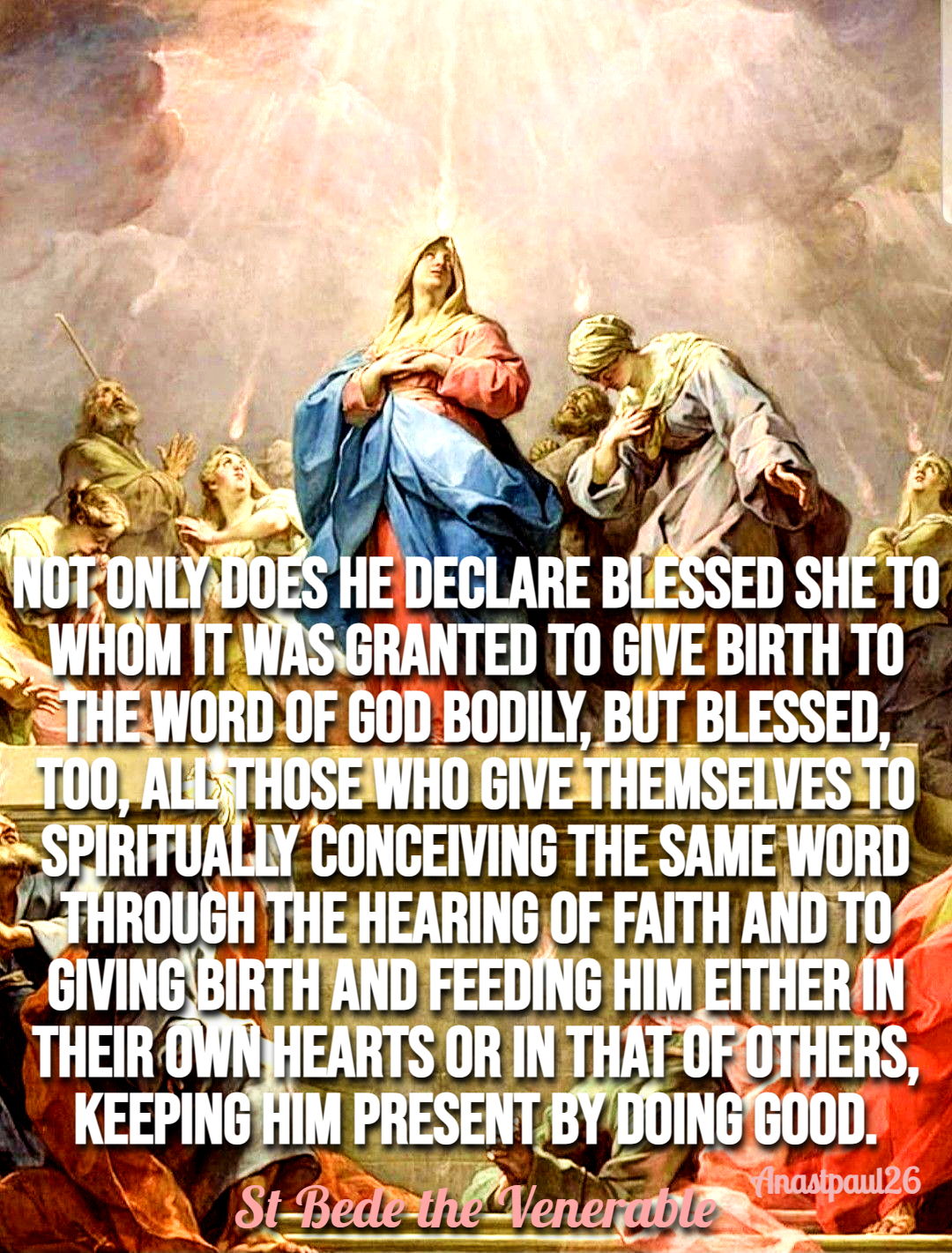
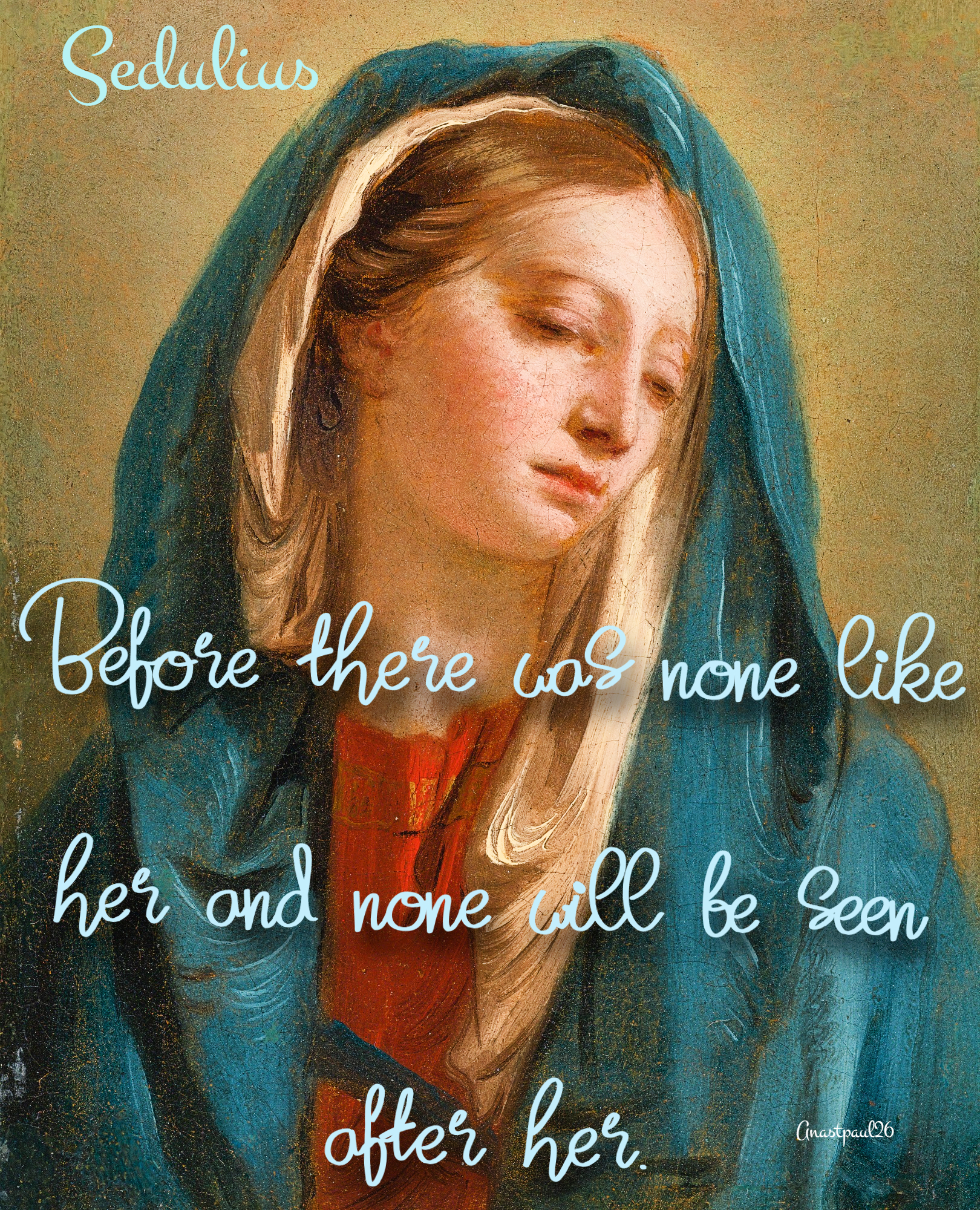
O truly happy mother who, in the words of the poet: “has given birth to the King who, through all ages, rules heaven and earth. She has the joy of motherhood and the honor of virginity. Before there was none like her and none will be seen after her”. Nevertheless the Lord adds: “Happy, rather, are those who hear the Word of God and keep it”. The Savior gives magnificent confirmation to this woman’s testimony. Not only does he declare blessed she to whom it was granted to give birth to the Word of God bodily, but blessed, too, all those who give themselves to spiritually conceiving the same Word through the hearing of faith and to giving birth and feeding him either in their own hearts or in that of others, keeping him present by doing good.

Saint Bede the Venerable (Homily on St Luke)

PRAYER – Forgive the sins of Your people Lord and since of ourselves, we are unable to do what pleases You, lead us on the way of salvation in Your divine Son who lives in us and gives us life. May the prayers of Mary, His Mother help us to constantly meditate on His eternal sustenance. He is our food, our Lord Jesus Christ, who lives and reigns with You and the Holy Spirit, God forever and ever, amen.

Posted in AUGUST - The Immaculate Heart of Mary

Quote/s of the Day – 1 August – Hail, holy Mother

Quote/s of the Day – 1 August – “Month of the Immaculate Heart of Mary” – Readings: Sedulius, Ps 44:2, Ecclus 24:14-16, Luke 11:27-28

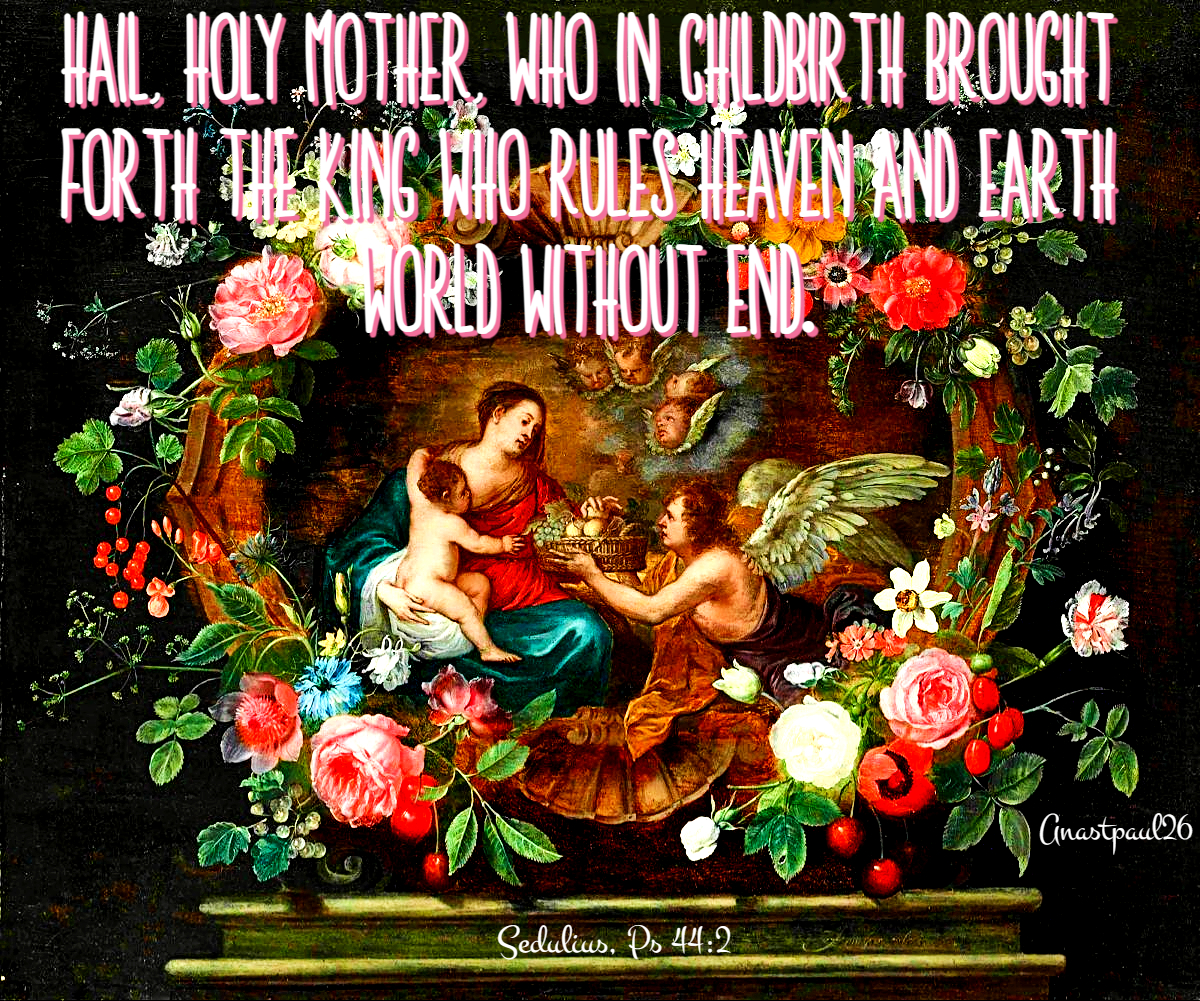
Hail, holy Mother, who in childbirth brought forth the King Who rules heaven and earth world without end.

Sedulius, Ps 44:2

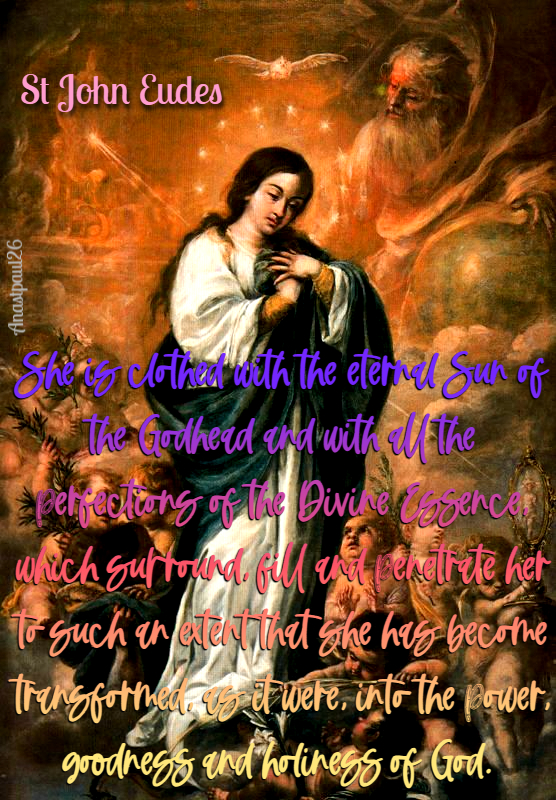
She is clothed with the eternal Sun of the Godhead and with all the perfections of the Divine Essence, which surround, fill and penetrate her to such an extent that she has become transformed, as it were, into the power, goodness and holiness of God.

St John Eudes (The Admirable Heart of Mary)

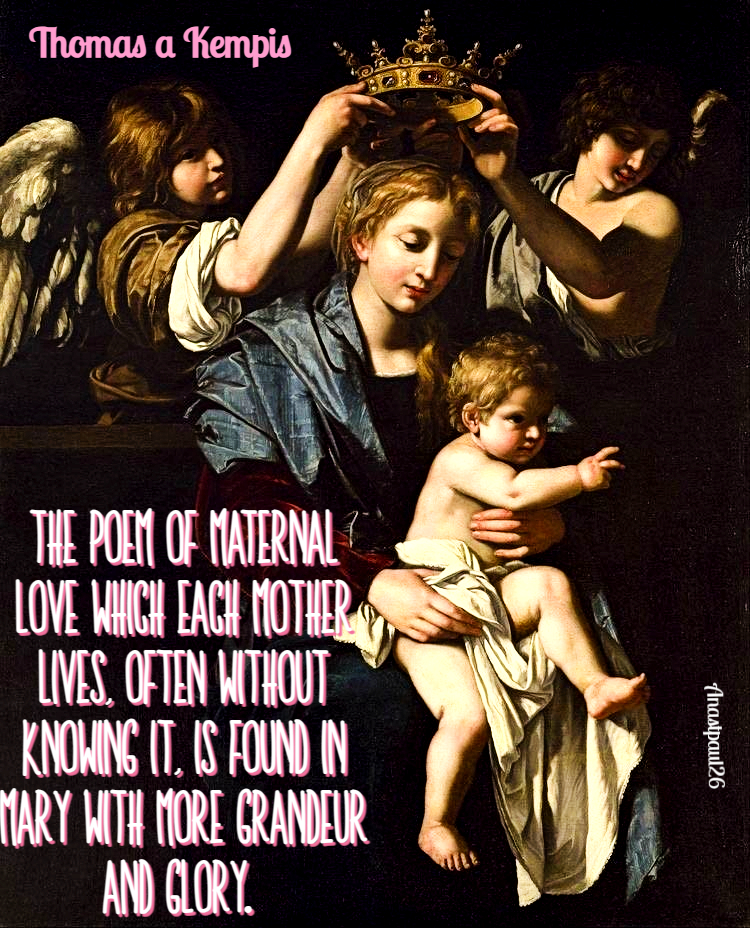
That which denotes the grandeur and the charm of maternity in a woman are grief and tenderness. Grief which rends the heart as it rends the body in order to give life. Tenderness which binds the child to the mother and the mother to the child in such a way as to form only one being, as they form only one flesh. All these characteristics are found physically in the human maternity of Mary, in her relations with Jesus, and mystically in the spiritual maternity of Mary vis-a-vis all Christians but more especially Religious. The poem of maternal love which each mother lives, often without knowing it, is found in Mary with more grandeur and glory.

Thomas a Kempis (The Imitation of Mary)

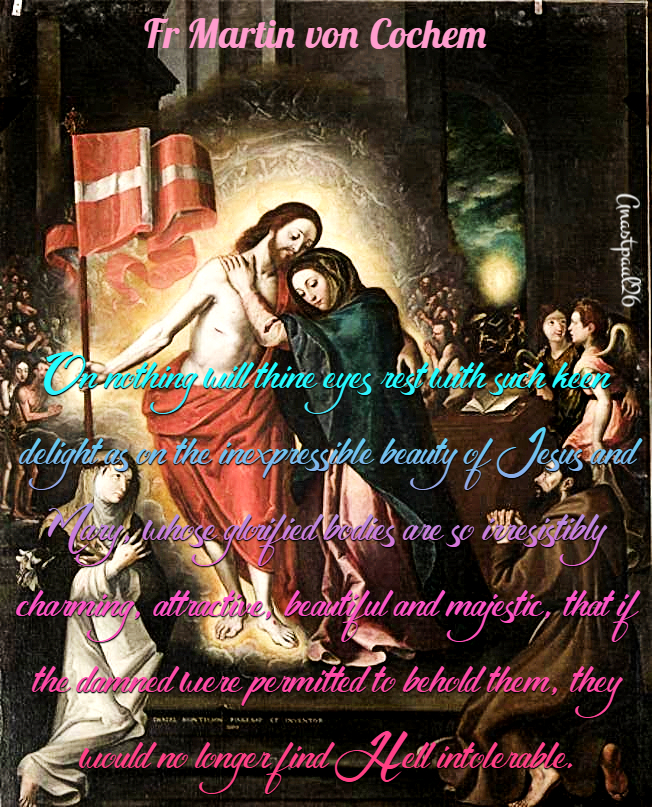
Fifthly, on nothing will thine eyes rest with such keen delight as on the inexpressible beauty of Jesus and Mary, whose glorified bodies are so irresistibly charming, attractive, beautiful and majestic, that if the damned were permitted to behold them, they would no longer find Hell intolerable.

Father Martin von Cochem (The Four Last Things: On Heaven)

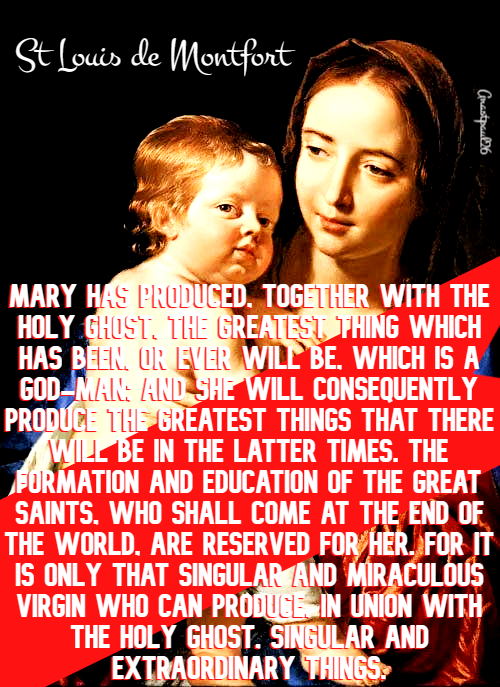
Mary has produced, together with the Holy Ghost, the greatest thing which has been, or ever will be, which is a God-Man; and she will consequently produce the greatest things that there will be in the latter times. The formation and education of the great Saints, who shall come at the end of the world, are reserved for her. For it is only that singular and miraculous Virgin who can produce, in union with the Holy Ghost, singular and extraordinary things.

St Louis de Montfort (True Devotion to Mary)

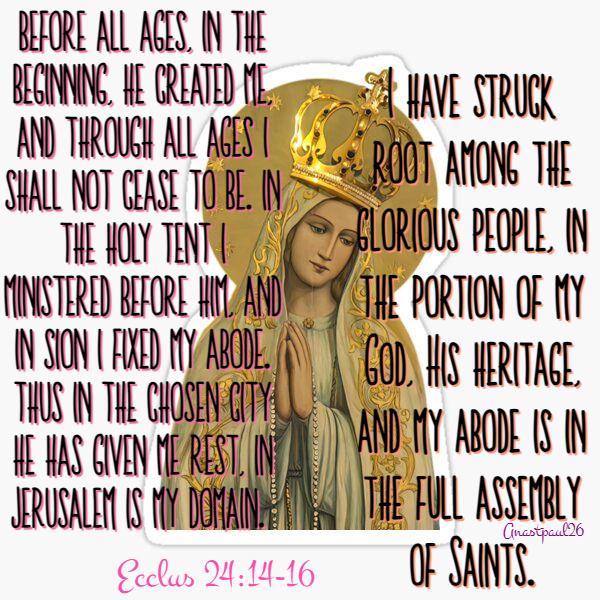
Before all ages, in the beginning, He created me, and through all ages I shall not cease to be. In the holy Tent I ministered before Him, and in Sion I fixed my abode. Thus in the chosen city He has given me rest, in Jerusalem is my domain. I have struck root among the glorious people, in the portion of my God, His heritage, and my abode is in the full assembly of Saints.

Ecclus 24:14-16

Posted in AUGUST - The Immaculate Heart of Mary

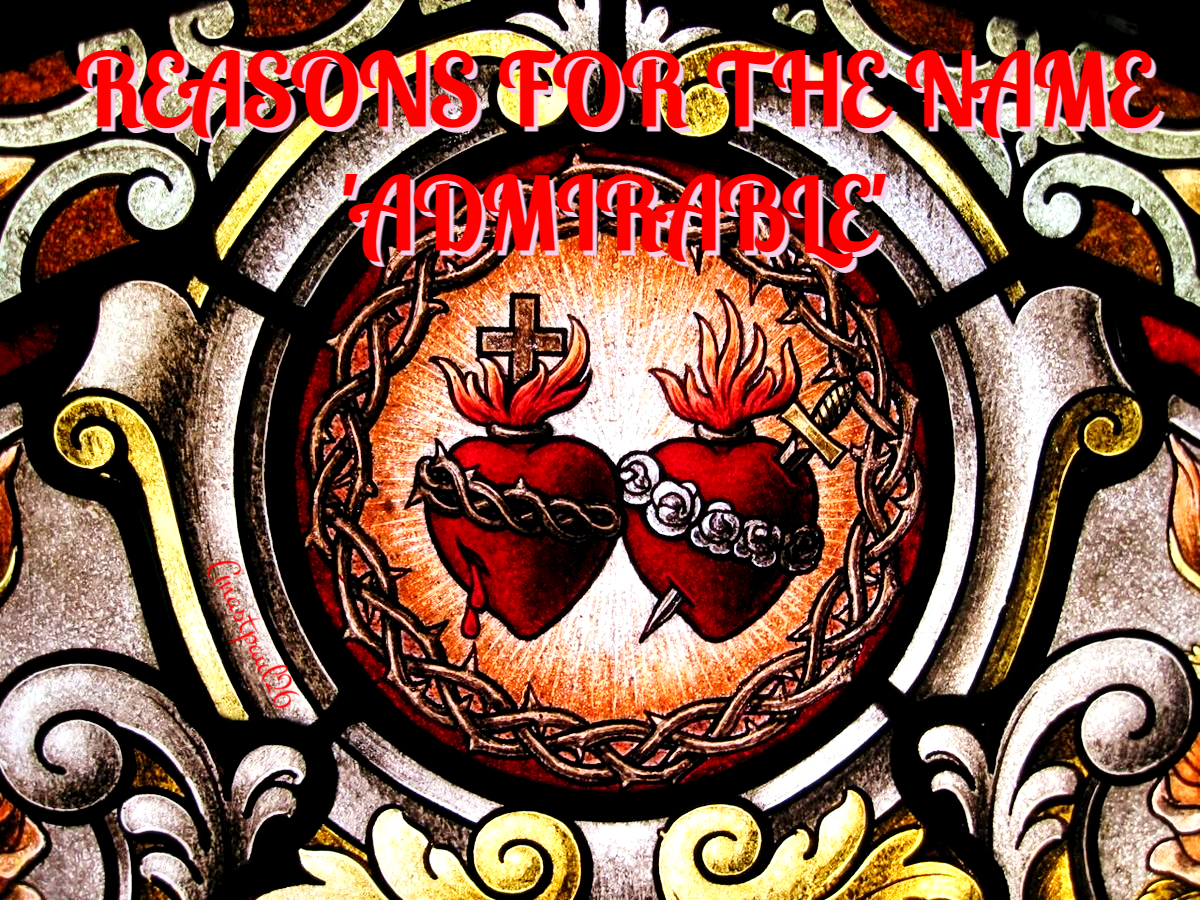
Thought for the Day – 1 August – Reasons for the name ‘Admirable’

St John Eudes – The Admirable Heart of Mary

Reasons for the name ‘Admirable’

Jesus Christ, the Only-Begotten Son of God, chose the incomparable Virgin Mary from among all creatures to be His Mother and deigned to be nourished and governed by her. In His infinite goodness He also gave her to us to be our Queen, our Mother and our sure Refuge in all our needs. He therefore wishes us to honor her as He honors her and to love her as He loves her.

According to the Apostle St. Paul, Christ is the Head of His Mystical Body, the Church, and we are the members. We must therefore be animated by His Spirit; we must follow His inspirations, walk the path He has traced, and continue, as it were, His life on earth by practising the virtues which were His own. It follows that our devotion to His Holy Mother must be a continuation of His devotion to her. We must be filled with the sentiments of respect, submission and affection which He entertained for her on earth and still entertains in heaven. Mary always held and will hold forever the first place in the Sacred Heart of her Divine Son; she always was and will never cease to be the first object of His love after the Eternal Father; and so He wishes that, next to God, she should be the principal object of our devotion. For this reason, after the veneration we owe to the Divine Majesty of God, we cannot render a greater service to Jesus Christ or do anything more pleasing to Him than to serve and honor His most worthy Mother.

Among the divinely inspired passages of Sacred Scripture I select one from the twelfth chapter of the Apocalypse, which is a compendium of all the great things that can be said or thought of our marvellous Queen. “A great sign appeared in heaven: A woman clothed with the sun, and the moon under her feet, and on her head a crown of twelve stars.”

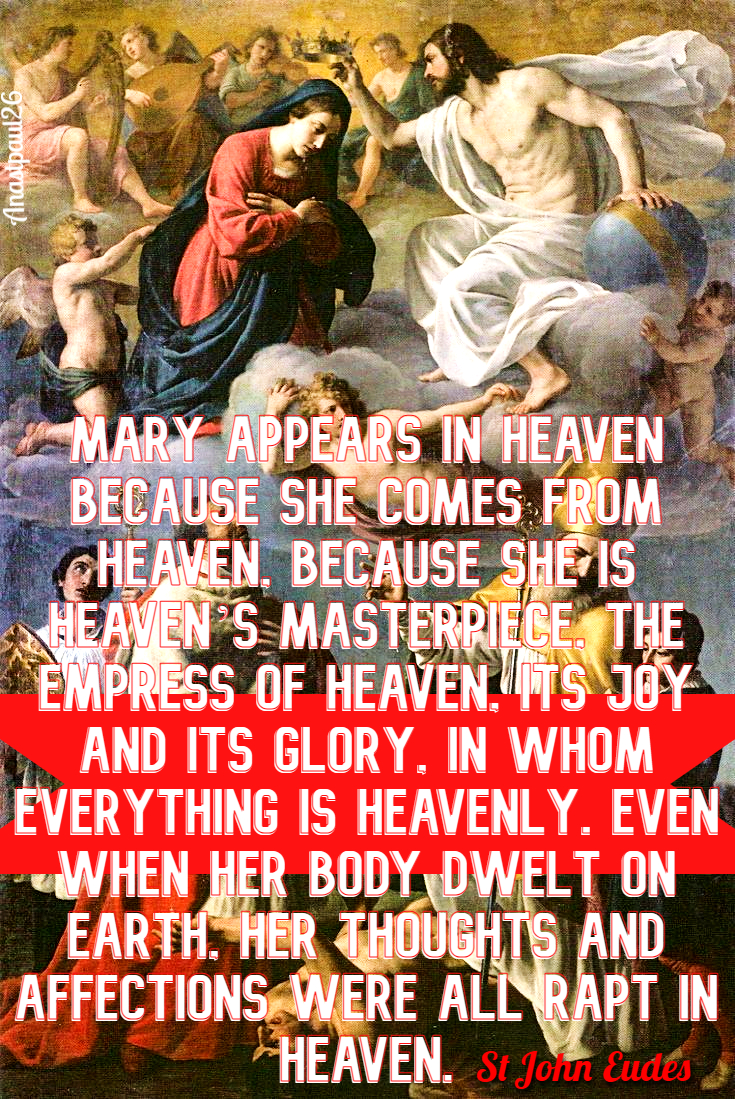
What is this great sign? Who is this miraculous woman? St. Epiphanius, St. Augustine, St. Bernard and many other holy doctors agree that the woman is Mary, the Queen among women, the Sovereign of angels and men, the Virgin of virgins. She is the woman who bore in her chaste womb the perfect man, the God-Man. “A woman shall compass a man.” Mary appears in heaven because she comes from heaven, because she is heaven’s masterpiece, the Empress of Heaven, its joy and its glory, in whom everything is heavenly. Even when her body dwelt on earth, her thoughts and affections were all rapt in heaven.

She is clothed with the eternal Sun of the Godhead and with all the perfections of the Divine Essence, which surround, fill and penetrate her to such an extent that she has become transformed, as it were, into the power, goodness and holiness of God. She has the moon under her feet to show that the entire world is beneath her. None is above her, save only God, and she holds absolute sway over all created things.

Posted in AUGUST - The Immaculate Heart of Mary

AUGUST – The Month of the Immaculate Heart of Mary

Do not be surprised if I say that the virginal Heart of this Mother of Fair Love is an admirable Heart indeed. Mary is admirable in her divine Maternity because as St. Bernardine of Siena says, “to be Mother of God is the miracle of miracles,” miraculum miraculorum.

But the august Heart of Mary is also truly admirable, for it is the principle of her divine Maternity and of the wonderful mysteries this privilege implies.

Of Mary’s admirable Heart I shall attempt to speak in this book although to speak and write worthily of the holy Heart of God’s own Mother one would need a heart of fire. To know and proclaim the perfections of the noble Heart of the Queen of Angels one should have the intellect of a cherub and the flaming love of a seraph. Nay more, it would be necessary to possess the mind, the heart, the tongue and the hand of Jesus Christ, the King of all hearts, to understand, honor, proclaim or commit to writing the treasures of sanctity contained in the holy Heart of Mary, the worthiest, most royal and most marvellous of all hearts after the most adorable Heart of our Saviour Himself.

Mary is truly admirable in all her perfections and in all her virtues?
But what is most admirable in her is her virginal heart. The heart of the
Mother of God is a world of marvels, an abyss of wonders, the source and principle of all the virtues which we admire in our glorious Queen: “All the glory of the king’s daughter is within.”

St John Eudes