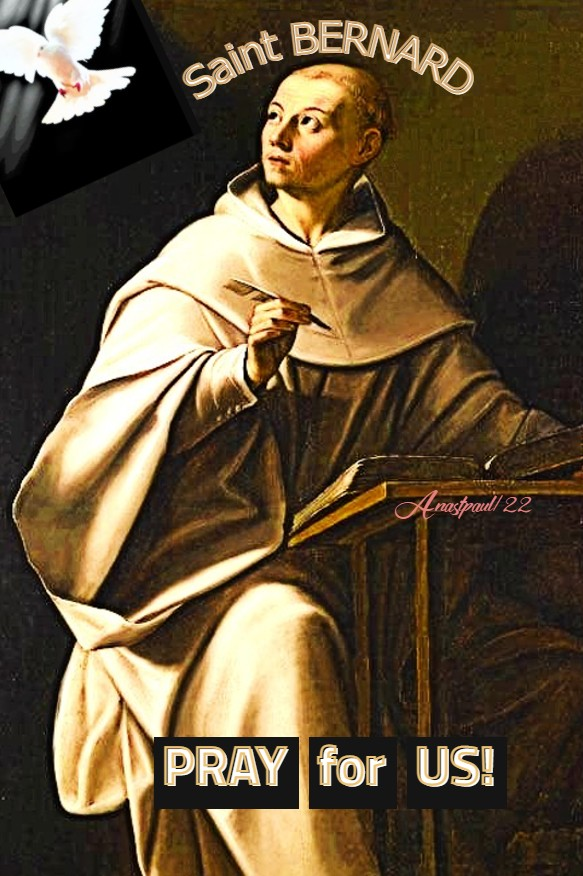
St Bernard O.Cist. (1090-1153) Abbot of the Order of Citeaux (the Cistercians), Confessor, “Doctor Mellifluus” of the Church and the Last Father of the Church,“The Bard of Mary”- Theologian, Reformer, Writer, Mystic, Preacher, Mariologist, Advisor, Mediator, Poet. St Bernard, the Founding Abbot of Clairvaux Abbey in Burgundy, France, was one of the most commanding Church leaders in the first half of the twelfth century, as well as, one of the greatest spiritual masters of all time and the most powerful propagator of the Cistercian reform.
St Brogan St Burchard of Worms St Christopher of Cordoba St Cristòfol Baqués Almirall St Edbert of Northumbria Bl Georg Hafner Bl Gervais-Protais Brunel St Gobert of Apremont St Haduin of Le Mans St Heliodorus of Persia St Herbert Hoscam St Leovigild of Cordoba Bl Louis-François Lebrun St Lucius of Cyprus St Maximus of Chinon
Blessed Maria de Mattias ASC (1805-1866) Founder of the religious Congregation of the Sisters Adorers of the Blood of Christ, Mystic, Teacher, Preacher, Catechist
St Oswine of Deira (Died 651) King, Martyr, King of Deira in northern England.
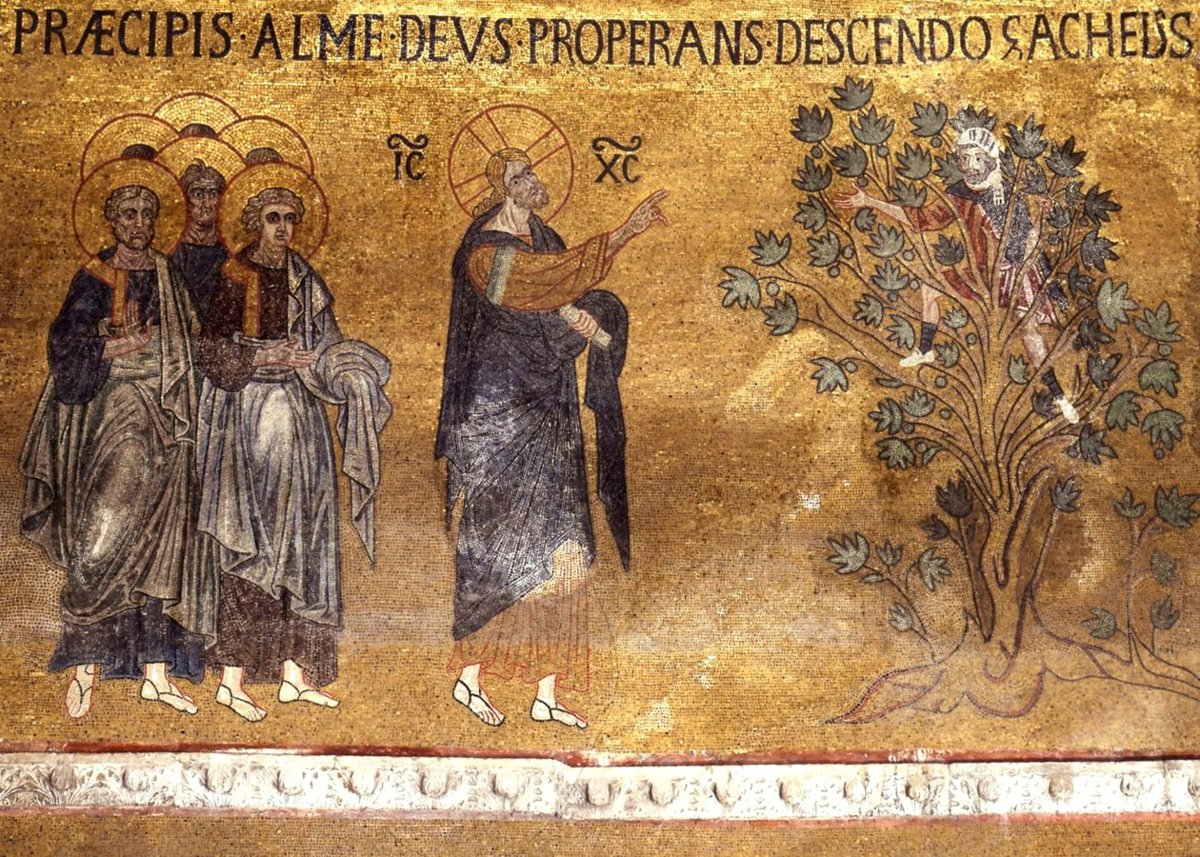
Saint Zacchaeus the Publican, also known as Zaccheo, whose name means “pure, innocent”, was a chief tax-collector at Jericho, who climbed a tree in order to see Jesus because he couldn’t see over the crowd. Jesus decided to go to the man’s house, and when the locals grumbled that Christ was friendly with sinners, Zacchaeus showed his conversion by making retribution to any he had harmed, and by giving largely to charity.
Jesus invites Zacchaeus to come down from the sycamore tree
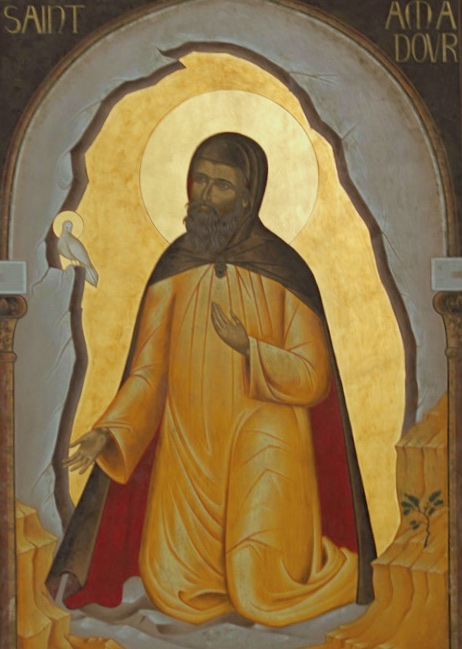
Many things are reported of him after this, including that he married Saint Veronica, that he became bishop of Caesarea in Palestine, and that he is Saint Amadour who was an early hermit in France. At Jericho there is a large, square tower, which by tradition is named the House of Zacchaeus.
Saint Amadour, also known as Amadour of Lucca, Amadour of Rocamadour, Amadoro, Amator, Amatore. In 1126 or 1162 (records vary), the body of this saint was found, possibly incorrupt, in a tomb with indications that the person had died about 1000 years earlier. No doubt for good reasons, people at the time decided that he was Saint Zacchaeus the Publican who changed his name when he converted to Christianity. Tradition records that he was a servant in the house of the Holy Family. He married St. Veronica, going with her to Gaul where they spread the Christian faith around Bordeaux. Amadour is also recorded as having gone to Rome to witness the martyrdom of Sts. Peter and Paul. He returned to Gaul and after the death of St. Veronica he became a hermit at Quircy, France, where he built a shrine to the Blessed Virgin Mary.
There is also a pilgrimage path closeby to his shrine, and some relics enshrined at the Saint Michelotto Franciscan convent.
Our Morning Offering – 20 August – “The Month of the Immaculate Heart of Mary” and the Memorial of St Bernard (1090-1153) Confessor, “The Bard of Mary”
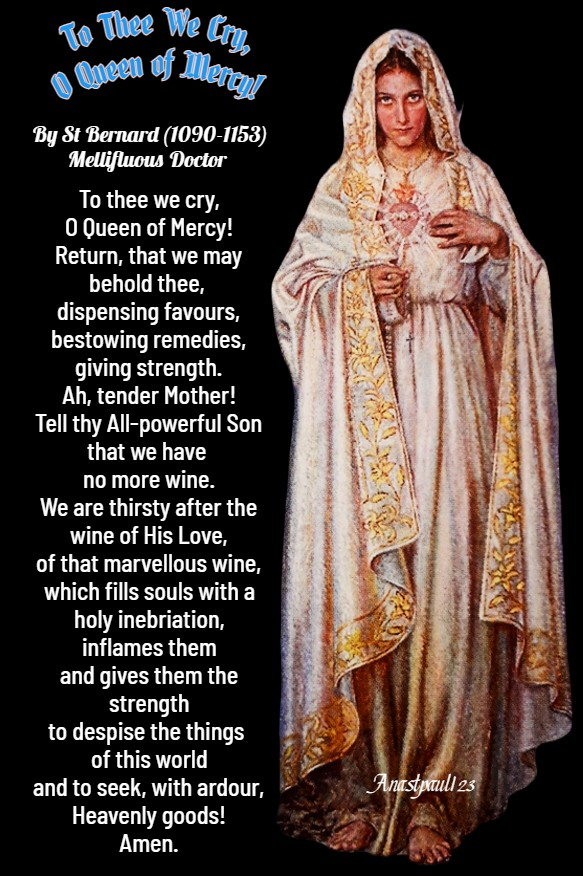
To Thee We Cry, O Queen of Mercy! By St Bernard (1090-1153) Mellifluous Doctor of the Church
To thee we cry, O Queen of Mercy! Return, that we may behold thee, dispensing favours, bestowing remedies, giving strength. Ah, tender Mother! Tell thy All-powerful Son that we have no more wine. We are thirsty after the wine of His Love, of that marvellous wine, which fills souls with a holy inebriation, inflames them and gives them the strength to despise the things of this world and to seek, with ardour, Heavenly goods. Amen.
One Minute Reflection – 20August – “The Month of the Immaculate Heart of Mary” and the Memorial of St Bernard (1090-1153) Confessor – Readings: Sir 15:5, Ps 91:2, Ecclus 39:6-14, Matt 5:13-19
Do not think that I am come to destroy the law, or the prophets. I am not come to destroy, but to fulfill.
Matt 5:13-19
REFLECTION – “I have come not to abolish the law, but to fulfill it”… Indeed, at that time, by his own power and in his own person, the Lord fulfilled all the mysteries the law foretold concerning himself. All prophecies were fulfilled by his passion. When, as holy David predicted, a sponge full of vinegar was offered him on the cross, he accepted it and said: “It is fulfilled”; and bowing his head, he gave up his spirit.
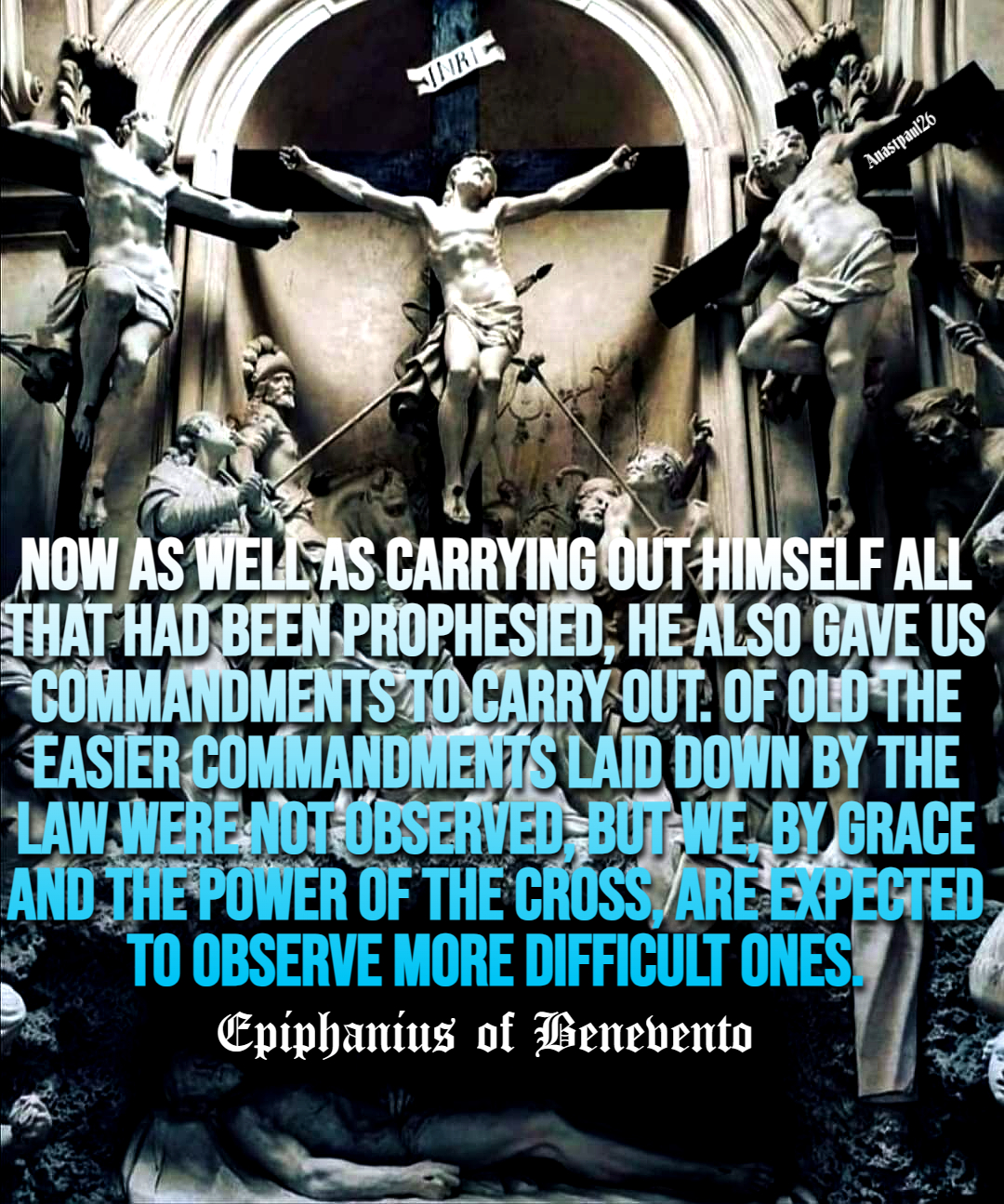
Now as well as carrying out himself all that had been prophesied, he also gave us commandments to carry out. Of old the easier commandments laid down by the law were not observed, but we, by grace and the power of the cross, are expected to observe more difficult ones.
Epiphanius of Benevento (5th-6th centuries)
PRAYER – O God, Who gave to Thy people, blessed Bernard, as a minister of salvation, grant, we beseech Thee, that we, who cherished him on earth as a teacher of life, may be found worthy to have him as an intercessor in Heaven.Through Jesus Christ, Thy Son our Lord, Who lives and reigns with Thee, in the unity of the Holy Ghost, God, world without end. Amen
Quote/s of the Day – 20 August – “The Month of the Immaculate Heart of Mary” and the Memorial of St Bernard (1090-1153) Abbot, Confessor, “Doctor Mellifluus” of the Church and the Last Father of the Church,“The Bard of Mary”
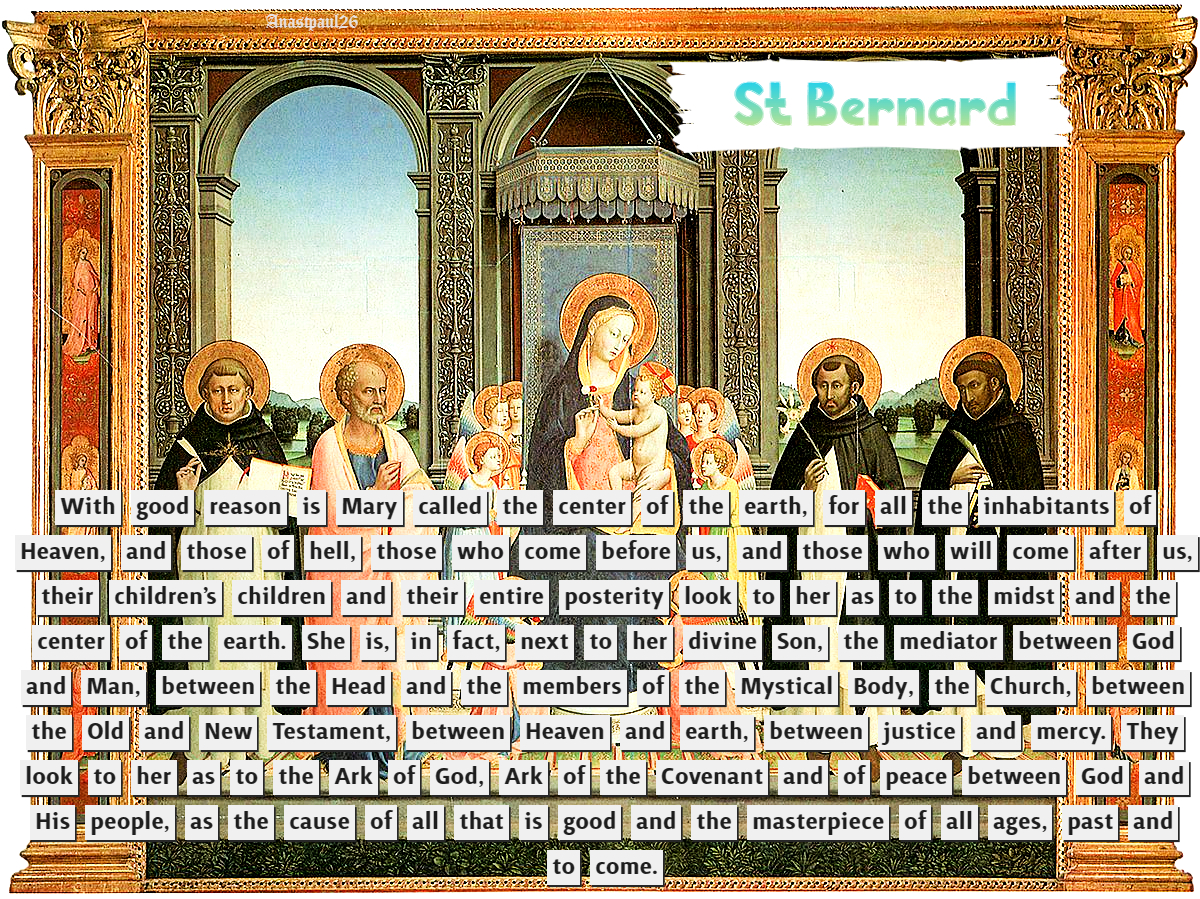
With good reason is Mary called the center of the earth, for all the inhabitants of Heaven, and those of hell, those who come before us, and those who will come after us, their children’s children and their entire posterity look to her as to the midst and the center of the earth. She is, in fact, next to her divine Son, the mediator between God and Man, between the Head and the members of the Mystical Body, the Church, between the Old and New Testament, between Heaven and earth, between justice and mercy. They look to her as to the Ark of God, Ark of the Covenant and of peace between God and His people, as the cause of all that is good and the masterpiece of all ages, past and to come.
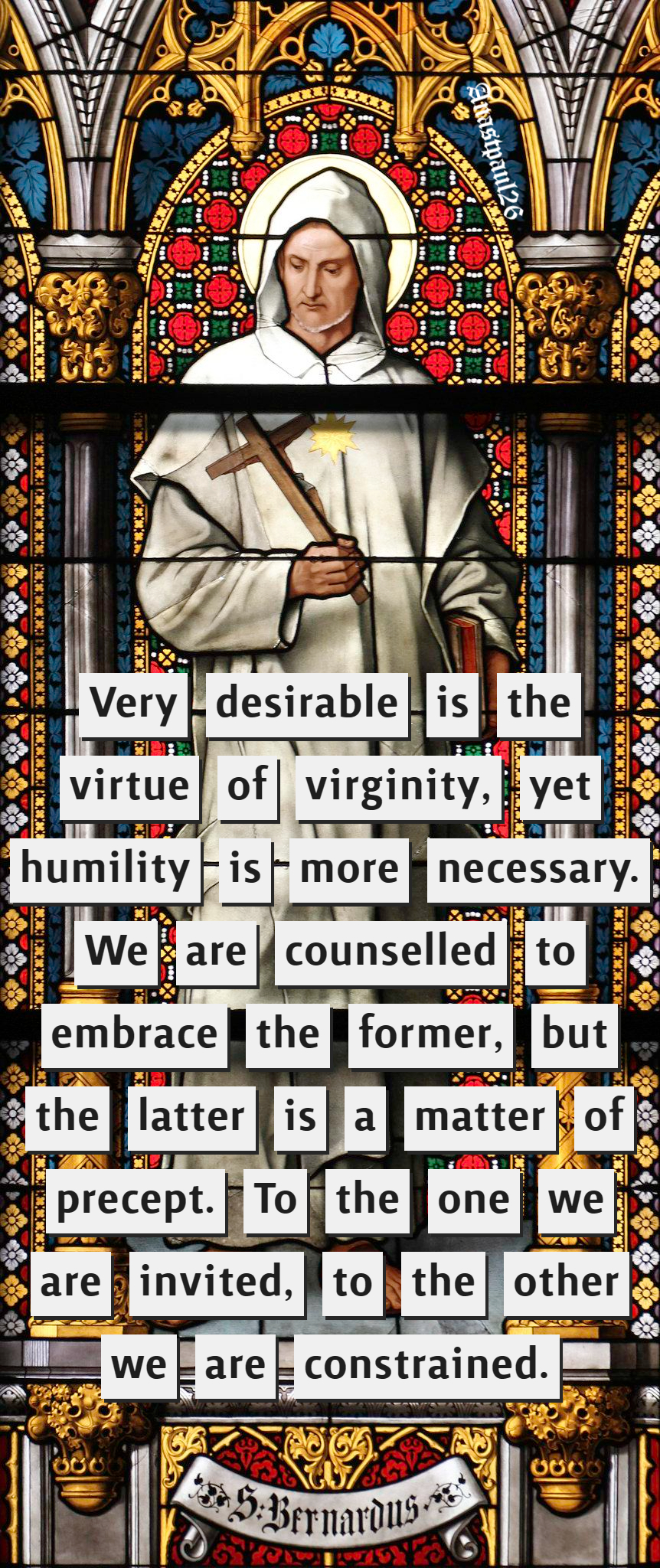
Very desirable is the virtue of virginity, yet humility is more necessary. We are counselled to embrace the former, but the latter is a matter of precept. To the one we are invited, to the other we are constrained. Concerning virginity the Saviour only says, ‘He that can take it, let him take it’, whereas He speaks thus of humility: ‘Unless you be converted and become as little children you shall not enter into the kingdom of heaven.’ The first, therefore, is commended with the promise of a special reward, whilst the second is exacted as a debt.
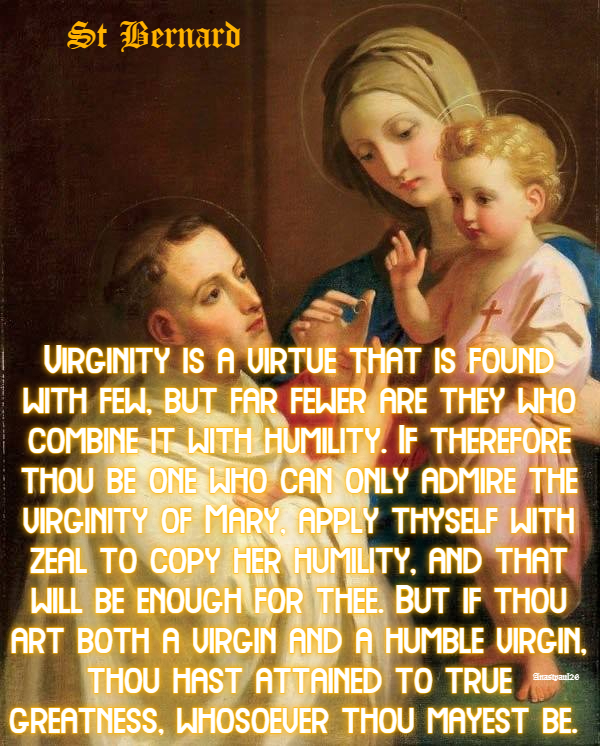
Virginity is a virtue that is found with few, but far fewer are they who combine it with humility. If therefore thou be one who can only admire the virginity of Mary, apply thyself with zeal to copy her humility, and that will be enough for thee. But if thou art both a virgin and a humble virgin, thou hast attained to true greatness, whosoever thou mayest be.
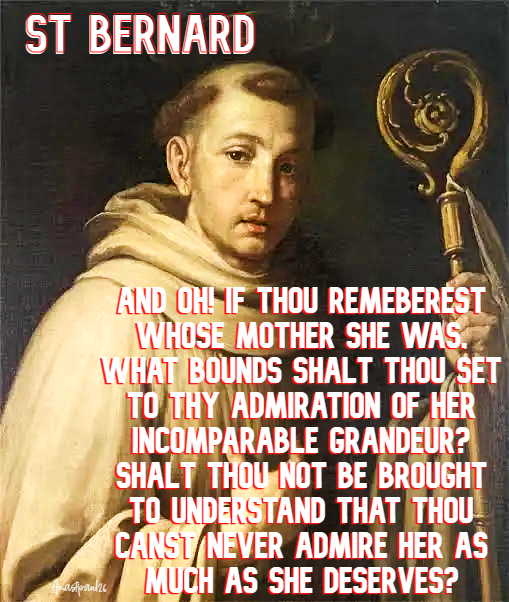
Nevertheless, there is something further for thee to admire in Mary, something even more wonderful than this union of humility with virginity. I refer to that prerogative by which she unites integrity with fruitfulness. For ‘from the beginning of the world it hath not been heard that any” woman was at one and the same time a mother and a virgin. And oh! If thou remeberest Whose Mother she was, what bounds shalt thou set to thy admiration of her incomparable grandeur? Shalt thou not be brought to understand that thou canst never admire her as much as she deserves?
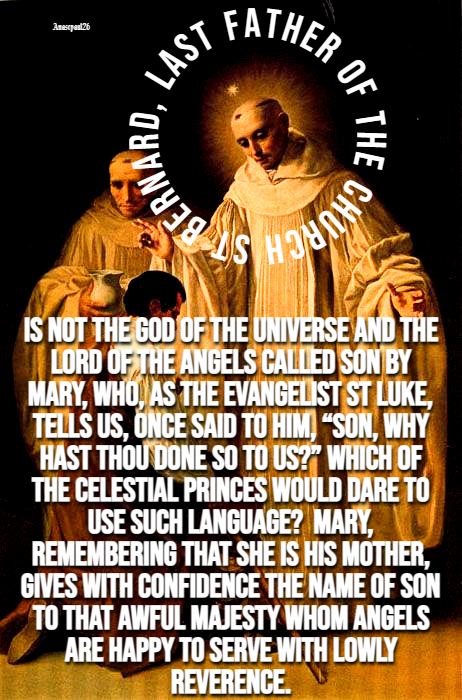
Is not the God of the universe and the Lord of the angels called Son by Mary, who, as the Evangelist St Luke, tells us, once said to Him, “Son, why hast Thou done so to us?” Which of the celestial princes would dare to use such language? Mary, remembering that she is His Mother, gives with confidence the name of Son to that awful Majesty Whom angels are happy to serve with lowly reverence.
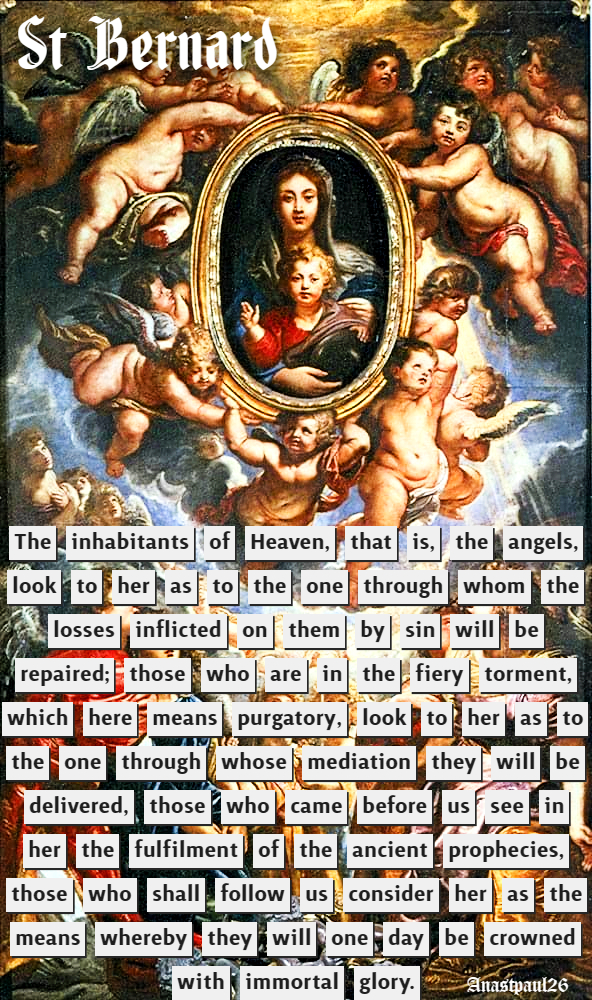
The inhabitants of Heaven, that is, the angels, look to her as to the one through whom the losses inflicted on them by sin will be repaired; those who are in the fiery torment, which here means purgatory, look to her as to the one through whose mediation they will be delivered, those who came before us see in her the fulfilment of the ancient prophecies, those who shall follow us consider her as the means whereby they will one day be crowned with immortal glory.
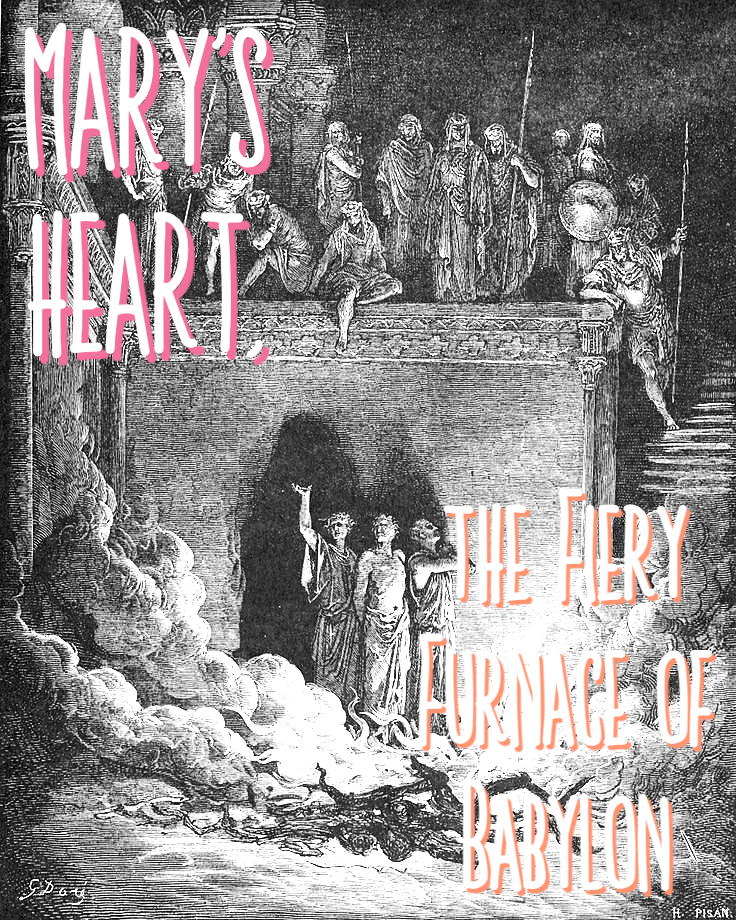
Another symbolic picture of the admirable Heart of the most Holy Mother of God is the miraculous furnace described in the third chapter of the Prophet Daniel. St. John Damascene and many other holy Doctors affirm that the fiery furnace was a figure of the sinless Heart of the Blessed Virgin Mary and its burning fire a reflection of the heavenly fire in the holy breast of the Mother of Fair Love. Here are St. John Damascene’s words: “Is it not true,” he says addressing Our Lady, “that this furnace, filled with a fire at once burning and refreshing, was a faithful image of thee and an excellent picture of the divine and eternal fire dwelling within thee?”
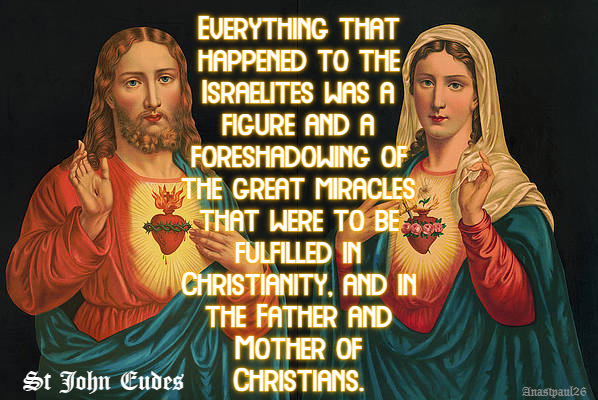
But you may well ask how anything so noble and holy as the Heart of the Queen of Heaven could be represented by the furnace of Babylon, an instrument of torture designed by the wickedness and cruelty of King Nabuchodonosor? Remember that the three young men, Sidrach, Misach and Abdenago, thrown into the furnace to be burnt to ashes, belonged to the people of Israel, and everything that happened to the Israelites was a figure and a foreshadowing of the great miracles that were to be fulfilled in Christianity, and in the Father and Mother of Christians. “All these things happened to them in figure.” Remember also that St. Augustine and St. Gregory the Great tell us that Sacred Scripture mentions many objects which though profane and wicked in themselves, are nevertheless a representation of good and holy thoughts.
Certainly that furnace was the product of Nabuchodonosor’s impious rage, but divine Providence, without whose order and permission nothing can happen, designated it to show the extent of the power of God and the marvels of His goodness, through the miraculous protection given to His faithful friends.
In the furnace of Babylon we behold many marvels wrought by God’s omnipotence. Consider that in the midst of the furnace filled with fire and flame, there should be a refreshing wind, likened to fragrant dew. “The angel made the midst of the furnace like the blowing of a wind bringing dew.” What a marvel it is to behold a burning furnace whose flames protect those inside its crucible, while they destroy those who remain outside! What a miracle to see fire comforting and refreshing those cast into the sevenfold heat of its flames, while burning to death those standing at a safe distance! How miraculous for three young men to survive in a furnace whose flames leapt to a height of forty-nine cubits, not suffering injury but walking about with joy as in a place of delight! The three gladly sang the praises of Almighty God and emerged from their ordeal with greater strength and vigor than before while the fire could not so much as singe a single fibre of their clothing. Great indeed are the marvels to be found in Babylon’s furnace; yet they merely foreshadow the miracles which we find in the furnace of the glowing Heart of the Queen of Angels.
It is a great miracle to witness fire and water subsisting side by side in the furnace of Nabuchodonosor. The fire did not turn the cooling water into steam nor did the water quench the burning heat of the fire. What manner of fire is this? It is the fire of divine love burning in the Virginal Heart of Mary. What is the cooling dew? It is the water of tribulation, which so often flooded the holy Heart of the Mother of Sorrows. The fire of love did not dry up the waters of affliction; and the waters of tribulation were unable, I shall not say to extinguish, but even to diminish in the least degree the divine ardor of that heavenly fire.
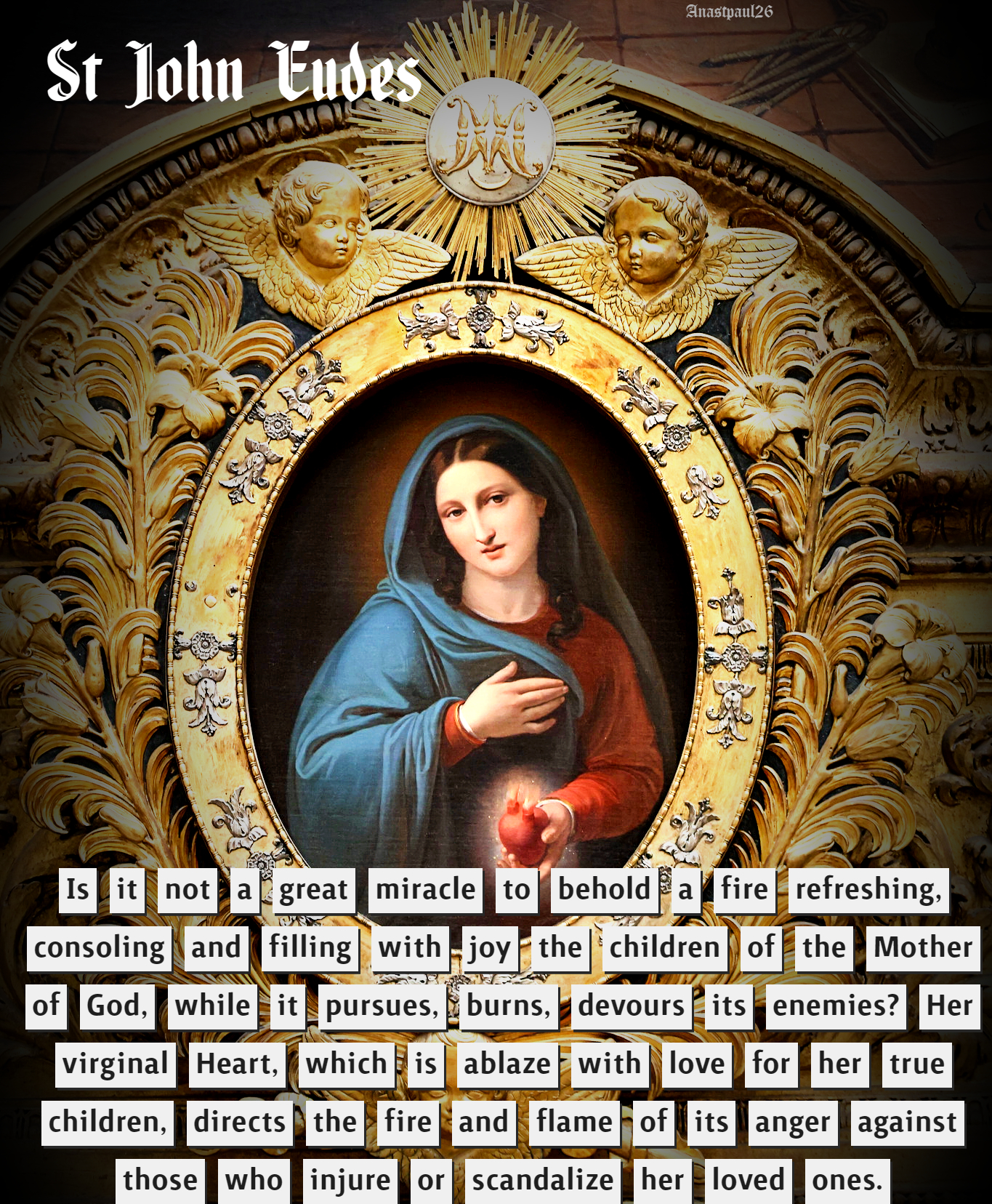
Love has the virtue of fire, that it may unceasingly inflame the Virgin Mother’s purest Heart with its sacred ardour, and also the properties of water, as it extinguishes entirely the fire of self-love and of attachment to vain and perishable things. Is it not a great miracle to behold a fire refreshing, consoling and filling with joy the children of the Mother of God, while it pursues, burns, devours its enemies? Her virginal Heart, which is ablaze with love for her true children, directs the fire and flame of its anger against those who injure or scandalize her loved ones.
Three Hebrew children walked safely in the first furnace; yet the prophet saw there four, and the fourth was like the Son of God. “The form of the fourth is like the Son of God.” Actually it was an angel, representing the Only-begotten Son of God in the Babylonian furnace, but this same Son of God resides and dwells in person in the glowing Heart of His most holy Mother. He is all fire and flame of love and charity. “The Lord thy God is a consuming fire.”
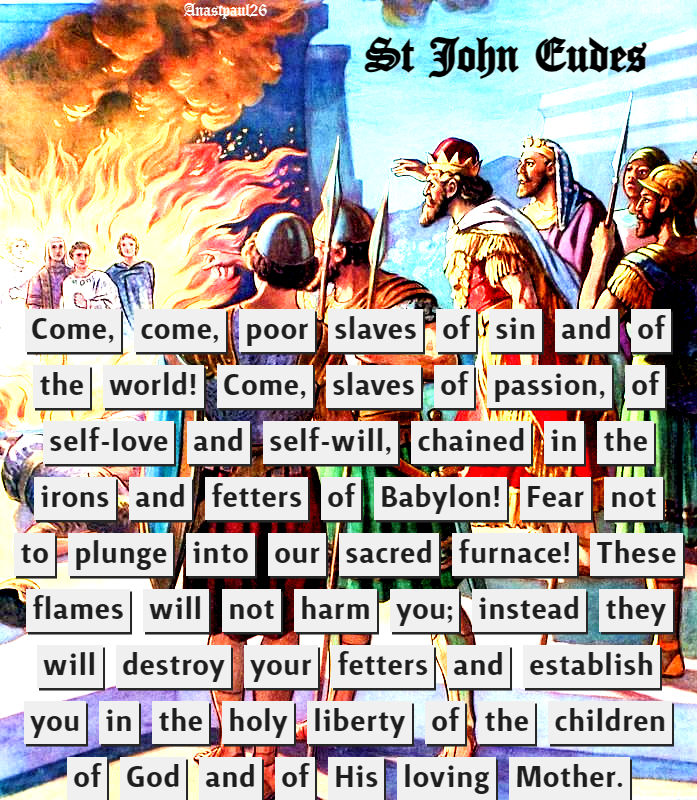
We also notice that the three young men were bound hand and foot when thrown into the furnace, but immediately their bonds were consumed by the fire and they were freed within the furnace. Come, come, poor slaves of sin and of the world! Come, slaves of passion, of self-love and self-will, chained in the irons and fetters of Babylon! Fear not to plunge into our sacred furnace! These flames will not harm you; instead they will destroy your fetters and establish you in the holy liberty of the children of God and of His loving Mother. They will inflame your hearts with the fire of heavenly love, they will transform them into divine fire itself.
Your hearts must become furnaces of eternal love, if they would avoid being ranked with the miserable hearts of the wicked against whom the terrible sentence was uttered: “Thou shalt make them as an oven of fire, in the time of thy anger.” What dost Thou will to do, O Lord, with the ungrateful wretches, whom Thou didst create to love Thee, whose obligations to love Thee are boundless, yet who have loved everything but Thee, and have even kindled fires of insult and heaped outrages upon Thee? Thou shalt make of them furnaces of wrath, in the time of Thy terrible vengeance. Thou shalt hurl them into the eternal fire prepared for Satan and his minions, where they will be swallowed, burned and penetrated by the infernal fire. In life these souls would not permit the sweet and radiant flames of Thy holy love to burn within them, so they shall be yielded to the eternal torments of devouring fire in endless hell.
Would you avoid this tragedy, the greatest of all misfortunes? Then give your hearts to your admirable Queen, imploring her to offer them to her beloved Son with the prayer that He may kindle in them the fire He came to spread on earth, the fire He so greatly desires should be lighted. On your part, correspond by removing every obstacle from your hearts, and if this sacred flame is already burning there, make every effort to increase it more and more, by the practice of Christian virtues, the meditation of the gospel and especially the exercise of divine love and charity.




You must be logged in to post a comment.