Quote/s of the Day – 20 August – “The Month of the Immaculate Heart of Mary” and the Memorial of St Bernard (1090-1153) Abbot, Confessor, “Doctor Mellifluus” of the Church and the Last Father of the Church,“The Bard of Mary”
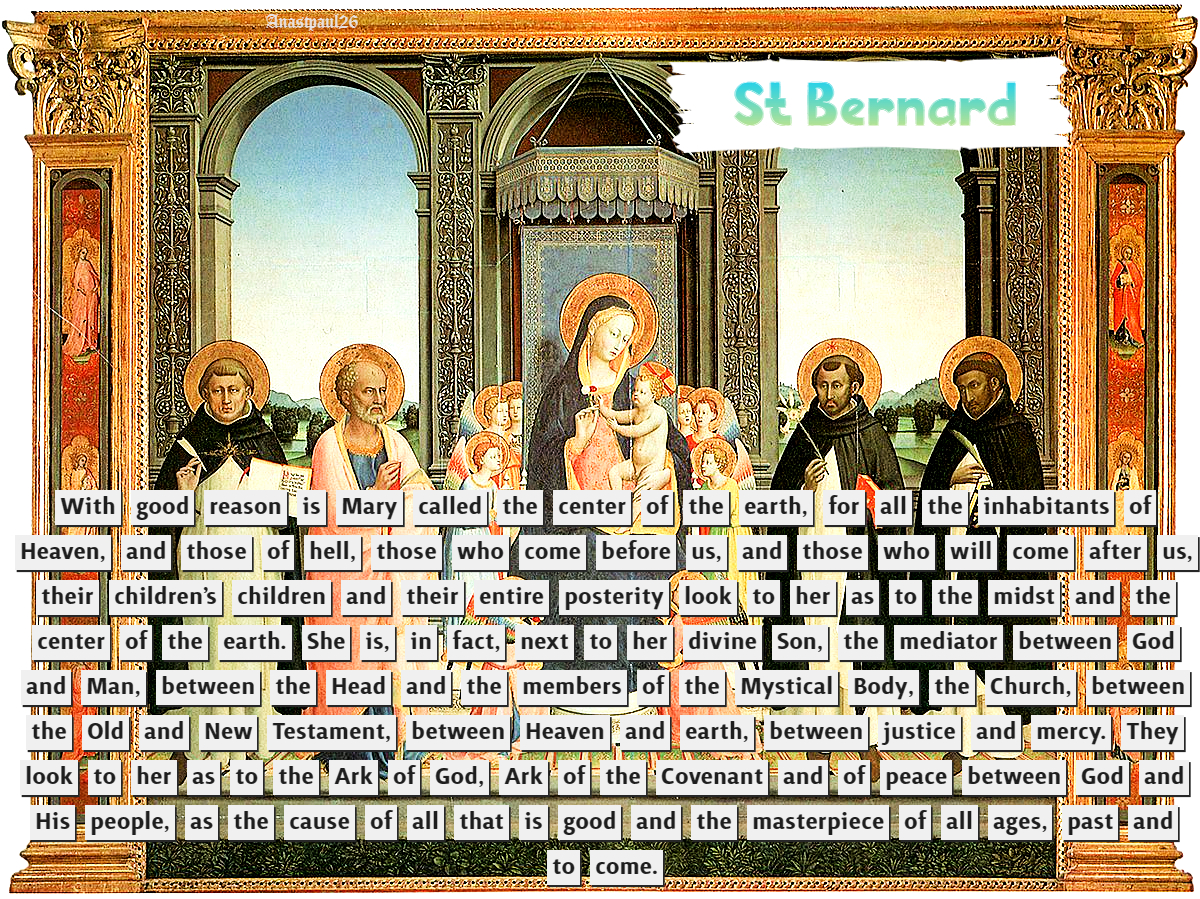
With good reason is Mary called the center of the earth, for all the inhabitants of Heaven, and those of hell, those who come before us, and those who will come after us, their children’s children and their entire posterity look to her as to the midst and the center of the earth. She is, in fact, next to her divine Son, the mediator between God and Man, between the Head and the members of the Mystical Body, the Church, between the Old and New Testament, between Heaven and earth, between justice and mercy. They look to her as to the Ark of God, Ark of the Covenant and of peace between God and His people, as the cause of all that is good and the masterpiece of all ages, past and to come.
Very desirable is the virtue of virginity, yet humility is more necessary. We are counselled to embrace the former, but the latter is a matter of precept. To the one we are invited, to the other we are constrained. Concerning virginity the Saviour only says, ‘He that can take it, let him take it’, whereas He speaks thus of humility: ‘Unless you be converted and become as little children you shall not enter into the kingdom of heaven.’ The first, therefore, is commended with the promise of a special reward, whilst the second is exacted as a debt.
Virginity is a virtue that is found with few, but far fewer are they who combine it with humility. If therefore thou be one who can only admire the virginity of Mary, apply thyself with zeal to copy her humility, and that will be enough for thee. But if thou art both a virgin and a humble virgin, thou hast attained to true greatness, whosoever thou mayest be.
Nevertheless, there is something further for thee to admire in Mary, something even more wonderful than this union of humility with virginity. I refer to that prerogative by which she unites integrity with fruitfulness. For ‘from the beginning of the world it hath not been heard that any” woman was at one and the same time a mother and a virgin. And oh! If thou remeberest Whose Mother she was, what bounds shalt thou set to thy admiration of her incomparable grandeur? Shalt thou not be brought to understand that thou canst never admire her as much as she deserves?
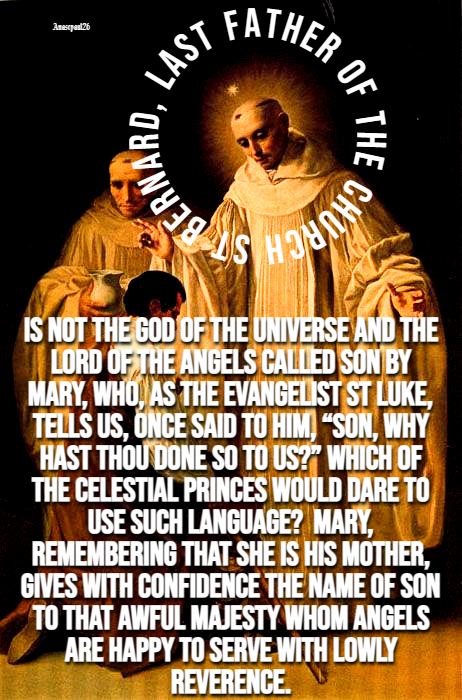
Is not the God of the universe and the Lord of the angels called Son by Mary, who, as the Evangelist St Luke, tells us, once said to Him, “Son, why hast Thou done so to us?” Which of the celestial princes would dare to use such language? Mary, remembering that she is His Mother, gives with confidence the name of Son to that awful Majesty Whom angels are happy to serve with lowly reverence.
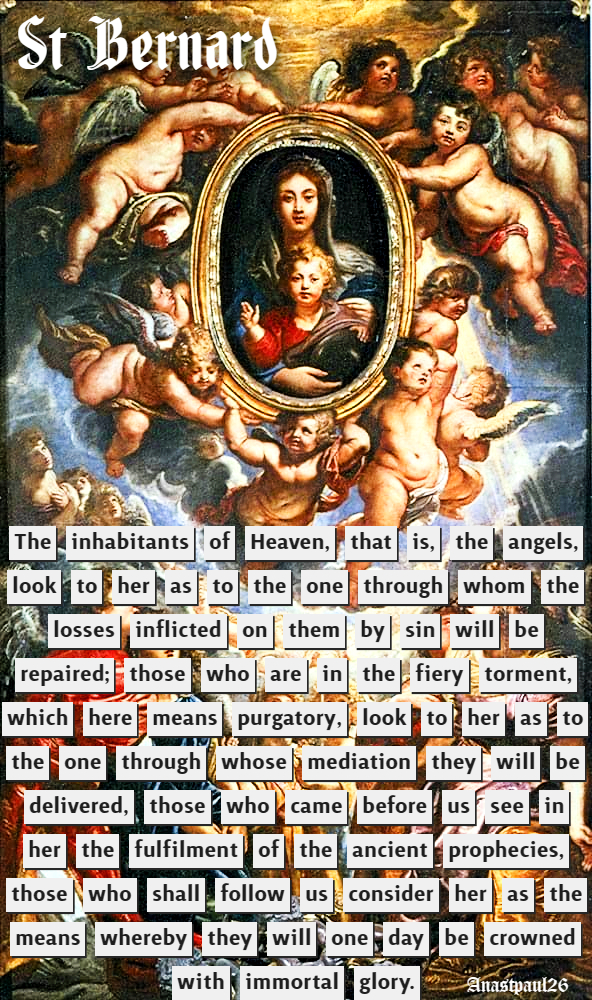
The inhabitants of Heaven, that is, the angels, look to her as to the one through whom the losses inflicted on them by sin will be repaired; those who are in the fiery torment, which here means purgatory, look to her as to the one through whose mediation they will be delivered, those who came before us see in her the fulfilment of the ancient prophecies, those who shall follow us consider her as the means whereby they will one day be crowned with immortal glory.