Posted in SEPTEMBER-The SEVEN SORROWS of MARY and The HOLY CROSS

Thought for the Day – 30 September – Lamentation of Mary

LAMENTATION OF MARY AT THE FOOT OF THE CROSS, WITH HER DEAD SON IN HER ARMS


I.

Whilst Mary’s arms her lifeless Son
Close to her bosom press’d,
Deep drawn and bitter sighs broke out
From her maternal breast ;
Long did she view with tearful eyes
His bleeding corpse, and then
In broken accents thus bewail’d
The cruelty of men.


II.

“Ah, me!” she said, “and can it be,
I’ll never more rejoice
To gaze upon thy beauteous smiles,
Or hear thy tender voice;

Alas! how throbs my sinking breast
To see Thee thus, my Son;
My heart must break, as thine has broke,

For both hearts make but one.


III.

“Gone from thy lips are those sweet
smiles
That played around them once,
Gone from thy eyes that look of love
That graced thy countenance;
I see thy face all bath’d in blood,
That face whose looks could win
The hearts of all, and even hearts
Long steep’d in loathsome sin.


IV.

“Those eyes once, like the stars of night, Shed lustre all around,
And even shone upon all those
In sin’s dark prison bound;
But now extinguished is their light,
And with thy blood suffused,
Distorted by insulting blows, And, oh! so cruelly bruised.

V.

“Oh cruel lance! Oh scourges cruel!
Oh torturing thorny crown! Why thus combine my Son’s fair form
In his own Blood to drown?
He is the King of Heaven, yet
His flesh you have ill-used,
Ah, see! His clotted Blood lies thick!
See! all his limbs are bruised.


VI.

” And Thou art dead ! Thou, whom I’ve
nursed
And kissed so many times;
Man! thou hast conquered, sinful man!
And conquered by thy crimes;
Ah! ne’er shall I rejoice again,
Nor seek to get relief, My joy shall be in weeping, My only comfort grief.


VII.

“But say, my martyred Jesus, say
Whose sin has thus deserved
For Thee such cruel and bitter pangs;
For Thee! th’ Eternal Word.

Ah! I know well, my Jesus, yes

And all earth’s creatures know,
It was the sins of guilty men That clothed Thee here below.


VIII.

“How strange to see the God of Love
So spotless and so pure,
All these sad pains for others’ sins
Thus suffer and endure;
Oh power of hell! Oh power of sin!
It seems that at thy nod,
The great and the immortal has
Become a mortal God.
“O Father! look from heaven, look
Upon thy murdered Child;
Cruel men his limbs have torn and cut;
Yet He-so meek, so mild
So like a bruised rose he lies
All crushed beneath their feet!
Yet mercy for all sinners
Through the Sinless I entreat.”

X.

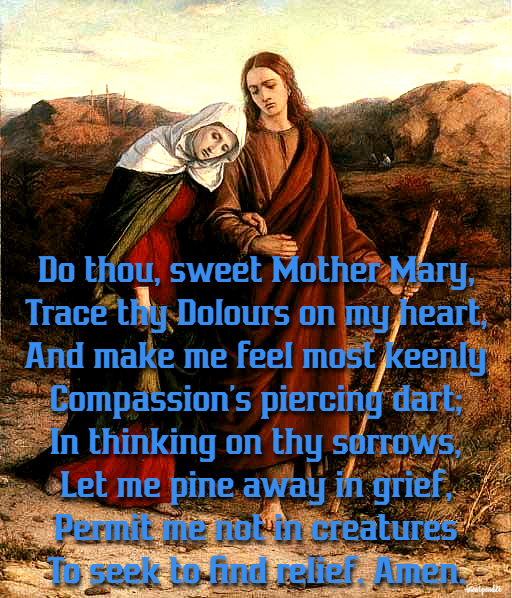
Do thou, sweet Mother Mary,
Trace thy Dolours on my heart,
And make me feel most keenly Compassion’s piercing dart;
In thinking on thy sorrows,
Let me pine away in grief, Permit me not in creatures
To seek to find relief. Amen.

Posted in SEPTEMBER-The SEVEN SORROWS of MARY and The HOLY CROSS

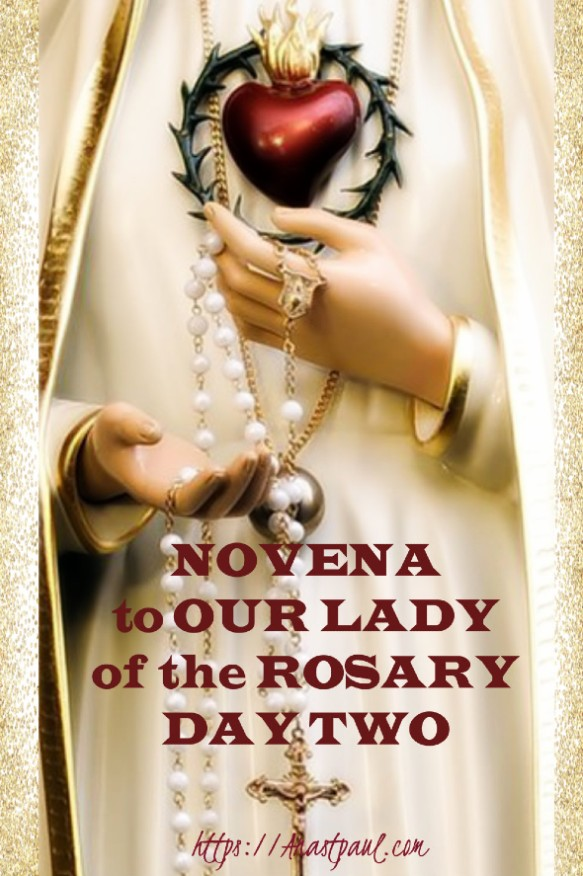
Novena to Our Lady of the Rosary – Day Two – 29 September

Day Two – We pray for the Persecuted Church
and our personal intention:

The joy of the Spirit, which was in the heart of Jesus and Mary, is ours in the experience of sincere prayer.

  1. We pray for the gift of the Holy Spirit for the leaders of the Church and all the baptised, that we may walk faithfully the way of Jesus Christ.
  2. We pray for a deep devotion to Mary, the Mother of Jesus
    and in our prayer to her know that we are primarily opening our hearts to the God of love.
  3. We pray for those who are oppressed by war and poverty,that they
    may take courage from God who loves us constantly and unconditionally.
    Let us pray to the Lord.

Daily Prayer along with our Daily Rosary:

My dearest Mother Mary, behold me, your child, in prayer at your feet.
Accept this Holy Rosary, which I offer you in accordance with your requests at Fatima, as a proof of my tender love for you, for the intentions of the Sacred Heart of Jesus, in atonement for the offenses committed against your Immaculate Heart and for this special favour which I earnestly request in my Rosary Novena: ………………………….. (Mention your request).

I beg you to present my petition to your Divine Son.
If you will pray for me, I cannot be refused.
I know, dearest Mother, that you want me
to seek God’s holy Will concerning my request.
If what I ask for should not be granted,
pray that I may receive that which will be of greater benefit to my soul.

I offer you this spiritual Bouquet of Roses because I love you.
I put all my confidence in you,
since your prayers before God are most powerful.
For the greater glory of God and for the sake of Jesus,
your loving Son, hear and grant my prayer.
Sweet Heart of Mary, be my salvation.

Our Lady of the Rosary,
pray for our Holy Mother Church
and for our country.

Sweet Heart of Jesus,
be my love.

Sweet Heart of Mary,
at the hour of my death,
lead me home.

Posted in SEPTEMBER-The SEVEN SORROWS of MARY and The HOLY CROSS

Thought for the Day – 29 September – Litany Of Our Lady Of Sorrows by Pius VII

Manual of Devotions in Honour of The Seven Dolors of the Blessed Virgin Mary by Father Sebastian

LITANY OF OUR LADY OF SORROWS.

Lord have mercy on us.

Christ have mercy on us.

Lord have mercy on us.

Christ hear us.

Christ graciously hear us.

God the Father of heaven, Have mercy on us.
God the Son, Redeemer of
the world, Have mercy on us.
God the Holy Ghost, Have mercy on us.
Holy Trinity, one God, Have mercy on us.
Holy Mary, Pray for us.

Holy Mother of God, Pray for us.

Holy Virgin of virgins, Pray for us.

Mother Crucified, Pray for us.
Mother most sorrowful, Pray for us.
Mother most tearful, Pray for us.
Mother most afflicted, Pray for us.
Mother most forsaken, Pray for us.
Mother most desolate, Pray for us.
Mother bereft of thy Child, Pray for us.

Mother transfixed with the sword, Pray for us.
Mother consumed with grief, Pray for us.
Mother filled with anguish, Mother crucified in heart, Pray for us.
Mother most sad, Pray for us.
Fountain of tears, Pray for us.
Mass of suffering, Pray for us.
Mirror of patience, Pray for us.
Rock of constancy, Pray for us.
Anchor of confidence, Pray for us.
Refuge of the forsaken,

Shield of the oppressed, Pray for us.
Subduer of the unbelieving, Pray for us.
Comfort of the wretched, Pray for us.
Medicine of the sick, Pray for us.
Strength of the weak, Pray for us.
Harbour of the wrecked, Pray for us.
Allayer of tempests, Pray for us.
Resource of mourners, Pray for us.
Terror of the treacherous, Pray for us.
Treasure of the faithful, Pray for us.
Eye of prophets, Pray for us.
Staff of apostles, Pray for us.
Crown of martyrs, Pray for us.
Light of confessors, Pray for us.
Pearl of virgins, Pray for us.
Consolation of widows, Pray for us.

Lamb of God, who takest away the sins
of the world,
Graciously hear us, O Jesus.
Lamb of God, who takest away the sins
of the world,
Graciously hear us, O Jesus.
Lamb of God, who takest away the sins
of the world,
Have mercy on us, O Jesus.
Look down upon us and deliver
us from all trouble, in the power of Jesus Christ. Amen.
Imprint, O Lady, thy dolours upon
my heart, that I may read therein
sorrow and love: sorrow, to endure
every sorrow for thee; love, to despise
every love for thee.
Credo, Salve Regina, three Ave
Marias
in honour of the Most Aflicted
Heart of Mary.

PRAYER.

O most afflicted Queen and Mother, by all thou didst endure during the three long hours Jesus hung upon the cross, but more especially by the bitter pangs which thou didst undergo at the moment of his death, I supplicate thee to engrave deeply on my heart his Wounds and thy Dolours; and when I come to die, prepare me by thy presence and prayers to pass from this world of sorrow to a happy eternity. Amen.

This Litany was written by Pius VII in
his captivity, who granted a plenary indulgence to all who recite it with a contrite heart on Fridays.

Posted in SEPTEMBER-The SEVEN SORROWS of MARY and The HOLY CROSS

Thought for the Day – 27 September – Devotion of St Paul of The Cross Towards the Dolours

Manual of Devotions in Honour of The Seven Dolors of the Blessed Virgin Mary by Father Sebastian

DEVOTION OF ST. PAUL OF THE CROSS TOWARDS THE DOLOURS OF THE BLESSED VIRGIN MARY

Extract from the Life of Saint Paul of the Cross, Founder of the Congregation of the Most Holy Cross and Passion of our Lord Jesus Christ.

The Dolours of Mary, in particular, were most vividly and profoundly imprinted in his heart. He always wore round his neck the devout little habit of our Lady of Sorrows, and in Missions fervently promoted the devotion to her Dolours. Though he was not in the habit of making processions, he sometimes, to increase devotion in the people towards the sorrows of our dear Lady, took them in procession to some church where our Lady of Sorrows is venerated. This he did at Ischia, the first time he gave a Mission there. With all the people, he went to visit the Church of the Servants of Mary, and, on arriving at the church door, made a very fervent discourse, wept bitterly, and severely disciplined himself. Compunction and tears were general amongst the people, and from that time sprang up a new fervour of filial devotion, and of tender loving compassion for our Lady of Sorrows, which remains even to this day.

To all, generally, he recommended meditation on the Dolours with great fervour. With the same zeal with which he promoted the remembrance of our Lord’s Passion, he promoted the devotion to the Dolours; for, as he said himself,if we go to the Cross, there is the Mamma; where the Mamma is, there is the Son. It was certainly enough to soften the hardest hearts to hear him speak of the bitter Dolours of Mary. He meditated and considered them with filial piety, great compassion and devotion. He sometimes imagined tender dialogues between the loving Mother and the suffering Son; but with such deep feeling that the hearers were dissolved in tears of compassion and grief.

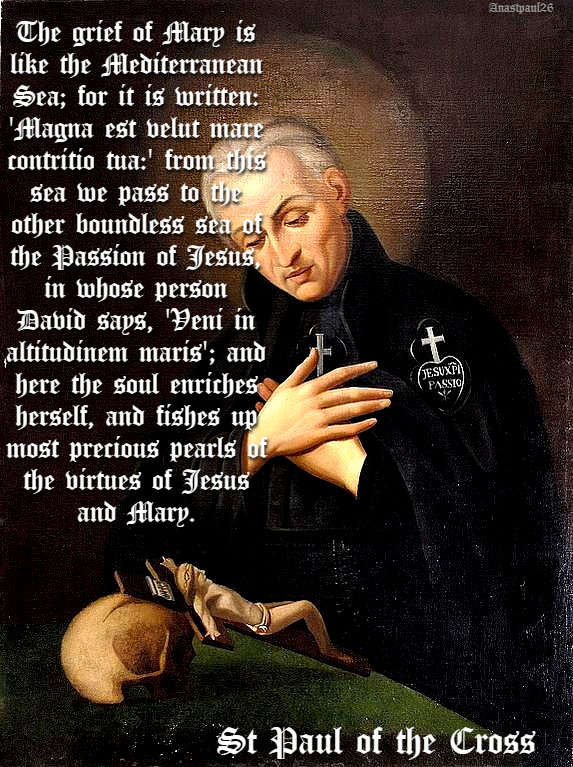
He compared the sufferings of the Son and the griefs of the Mother, to two seas, and said that we pass from the first to the second. “The grief of Mary (these are his words) is like the Mediterranean Sea; for it is written: ‘Magna est velut mare contritio tua:’ from this sea we pass to the other boundless sea of the Passion of Jesus, in whose person David says, ‘Veni in altitudinem maris’; and here the soul enriches herself, and fishes up most precious pearls of the virtues of Jesus and Mary.”

With the passion of Jesus he had always in his mouth the Dolours of Mary, and said, that his hopes lay in the Passion of the Son, and in the sorrows of the Mother. Though he spoke of them constantly, he always seemed to say something new, because he always spoke of them with new affection, so deeply was he penetrated with them in his heart. Most frequently when he spoke thus, he wept bitterly, and changed colour, becoming first red, then pale; he then burst forth into these words, which came from the profoundest depths of his heart: “Ah, poor Mother! Ah, dear Mother!” On Good Friday, as we have said, oppressed by grief, and spiritually drowned in the bitterness of that great day, he could not even take food. Often he was heard to say, that Mary’s greatest sorrow was when she saw her beloved Son dead in her arms, and saying this, he cried out, more by tears than words, with the affection of a truly loving heart, “Oh, grief above grief!” He himself related, in reference to this, that on one occasion, our Blessed Lady was seen in that most sorrowful act of receiving into her arms the lacerated Body of so dear a Son, and through her great sorrow and affliction, her face was like that of one dead.

We do not know precisely who had this vision, but we find it deposed in the processes, that the servant of God, speaking one day with a priest, a dear friend of his, on the Passion of Jesus and the Dolours of Mary, drew from his sleeve, with a countenance all on fire, as was customary with him when he felt devotion, a little picture, representing Our Lady of Sorrows, drawn by Cavaliere Conca, who, being at the same time a skilful and excellent painter and a good Christian, painted it with great skill and devotion, at the request of the servant of God, who begged him to express her grief as strongly as he could, saying to him : “Here, I give it to you because it is not sorrowful enough. I have seen her in greater sorrow;” and with these words gave him the holy picture, which is now preserved in the Monastery of Mount Carmel, at Vetralla.

In the last years of his life, also, this most merciful Mother condescended to show herself to her faithful servant pierced with grief, as she was at the time of the most bitter passion of her dear Son; for in the retreat of Saints John and Paul, when after Mass he was making his thanksgiving in the room next the little chapel where he celebrated, she appeared to him with a sword through her heart, and tears in her eyes; and speaking of her Dolours, gave him so deep a sense of them, and used words of such tenderness, that they would even have rent a heart of stone. She gave him to understand that her sufferings were beyond measure, terrible, and overpowering, from the ardent love she bore to her Son, and the incomparable amplitude of her soul, capable of a sea of sorrows; the Queen of Sorrows complained of the false devotion of those who say they are devout to the Blessed Virgin, and then outrage by sin her Beloved Son; and with great force and tenderness exhorted her dear servant to promote, as he always did, devotion to the Sacred Passion of her Son, and to her Dolours.

This Mother of Mercy, desiring to help a poor priest whose soul was in a wretched condition, manifested to Father Paul his necessities, and this priest having come into his presence afterwards, the servant of God, who saw his interior, said to him with a tone of certainty, “You appear to me as ugly as a devil.”

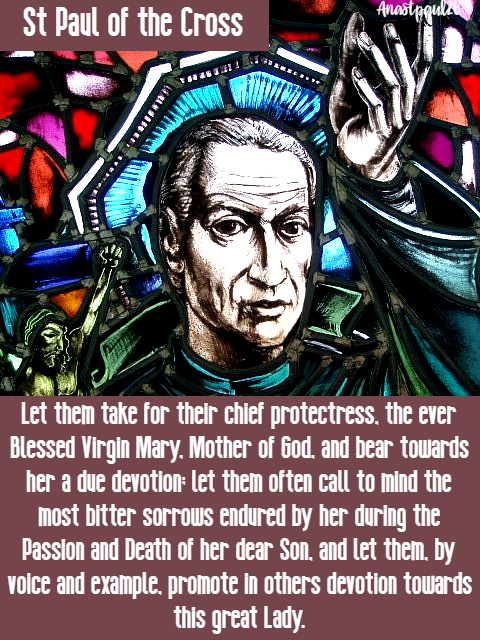
At these words, the priest entering into himself, and acknowledging his dreadful state, prostrated himself in confusion and grief at the venerable Father’s feet, promising to amend his life, and thus showed the truth of the apparition of Our Lady of Sorrows, who wished to draw him from the path of perdition. It is not, therefore, surprising that the servant of God, after such visions and so deep a perception of the Dolours of the Blessed Virgin, spoke of them with so much affection, tenderness, and compassion. As he knew what a treasure true devotion to our Blessed Lady is, he ardently desired that his children should enjoy the abundance of it. He inculcated, and with great fervour recommended, that they should be devout to our dear Lady. “Let them take,” he says in the rules, “for their chief protectress, the ever Blessed Virgin Mary, Mother of God, and bear towards her a due devotion; let them often call to mind the most bitter sorrows endured by her during the Passion and Death of her dear Son, and let them, by voice and example, promote in others devotion towards this great Lady.”

Posted in SEPTEMBER-The SEVEN SORROWS of MARY and The HOLY CROSS

Announcing a Novena to Our Lady of the Rosary – Begins 28 September

The Memorial of Our Lady of the Rosary is on 7 October.

Please join me in praying a Novena in honour of Our Lady of the Rosary for the nine days preceding her Feast on 7 October and, of course, October is the Month of the Holy Rosary.

This Feast was instituted to commemorate the victory of Christianity over the forces of Islam at the battle of Lepanto on 7 October 1571.   The victory was brought about through the recitation of the Rosary.   In thanksgiving for another victory over the same foes in Hungary in 1715, the Feast was extended to the entire Church.

In the course of centuries the Rosary has been a source of abundant blessings. In her apparitions at Lourdes, France, in 1858 and again at Fatima, Portugal, in 1917, Mary urged Catholics to pray the Rosary daily in order to bring about the conversion of sinners and a lasting world peace. Resolve to say your Rosary every day. Besides being a beautiful tribute of love and filial piety, to your Heavenly Mother, it will be your support and joy in life and your consolation at the hour of death.

Posted in SEPTEMBER-The SEVEN SORROWS of MARY and The HOLY CROSS

Thought for the Day – 26 September – Manual of Devotions in Honour of The Seven Dolors

Manual of Devotions in Honour of The Seven Dolors of the Blessed Virgin Mary by Father Sebastian

OBLIGATIONS AND PRACTICES OF PIETY

The faithful who wear the Scapular of our Blessed Lady, are not bound by any particular obligation in order to gain the Indulgences attached. The visit to some Church of the Order, one of the conditions requisite for certain Indulgences, may be commuted by a confessor for any other pious work, when there is any infirmity or hindrance of a grave nature, which prevents such a visit being made; such for instance would be the too great distance from the church, and in such a case it would be well to ask the confessor to appoint in its place some other sanctuary, as for instance a parish church.

This faculty of commutation was granted by a brief of Clement XIII, on the 17th August, 1762. If there be any Confraternity of the Seven Dolours established in the place, they ought to endeavour to fulfil their obligations, the principal of which are to assist at the public exercises of the Confraternity ; to say daily seven Paters and Aves in memory of the Dolours of the Mother of God, and to repeat the same prayers at the death of any member of the association, for the repose of his soul. Lastly, the frequent recital of the Rosary is recommended.

INDULGENCES ATTACHED TO THE SCAPULAR OF THE DOLOURS

Plenary Indulgences

I. On the day on which the Scapular is received.

II. At the hour of death, by invok- ing by tongue or in heart the Holy Name of Jesus.

III. The day on which a member makes an hour’s spiritual exercise in honour of the Dolours.

IV. By assisting at the monthly procession, or by fulfilling what is ap- pointed by the confessor in place of said procession.

V. Once in the month for those who repeat daily three Paters in memory of our Saviour’s Passion, and three Aves in commemoration of the Dolours, for those that are in their last agony.

VI. Once in the month also for those who say every day seven Hail Marys and the verse:- “Holy Mary, pierce me through, In my heart each wound renew, Of my Saviour crucified.”

VII. During the Forty Hours Devotion.

VIII. Passion Sunday.

IX. Feast of the Seven Dolours.

X. The Saturday following the Commemoration of the Seven Dolours.

XI. The Annunciation of the Blessed Virgin Mary.

XII. The Assumption of our Blessed Lady.

PARTIAL INDULGENCES

I. Seven years and seven quarantines on the Feast of Christmas, the Annunciation, the Purification, the Assumption, and all Fridays throughout the year, by reciting five Our Fathers and five Hail Marys in memory of the Passion.

II. Five years and as many quarantines, when members accompany the Blessed Sacrament to the sick.

III. Three hundred days once a day for those who say seven Hail Marys, followed by the verse Holy Mother, &c.

IV. One hundred and fifty days every time they meditate on the Passion or on the Dolours, and say seven Our Fathers and seven Hail Marys with the “Stabat Mater,” or perform the spiritual exercises practised in the Churches of the Servites.

V. One hundred days for those who recite the “Stabat Mater.”

VI. Sixty days for each work of Charity.

Posted in SEPTEMBER-The SEVEN SORROWS of MARY and The HOLY CROSS

Thought for the Day – 25 September – Scapular of the Seven Sorrows of Mary

Manual of Devotions in Honour of The Seven Dolors of the Blessed Virgin Mary by Father Sebastian

OF THE SCAPULAR AND THE ROSARY OF OUR LADY OF SEVEN DOLOURS.

Devotion to our Blessed Lady is as ancient as the Church herself. But the long wars and dissensions which had desolated Europe, the ignorance, neglect of duties, and the consequent brutality of manners which ensued from this state of things, had greatly diminished it. However, an immense number of miracles which took place in the early part of the thirteenth century, communicated to it a new vigour and a wider extension. The instruments of mercy which the Blessed Virgin made use of to produce this effect were the Rosary, which was revealed to St. Dominic, in the year 1206, and the Scapulars of the Seven Dolours and of Mount Carmel, the first of which she herself gave to the seven Founders of the Order of Servites, and the second to St. Simon Stock.

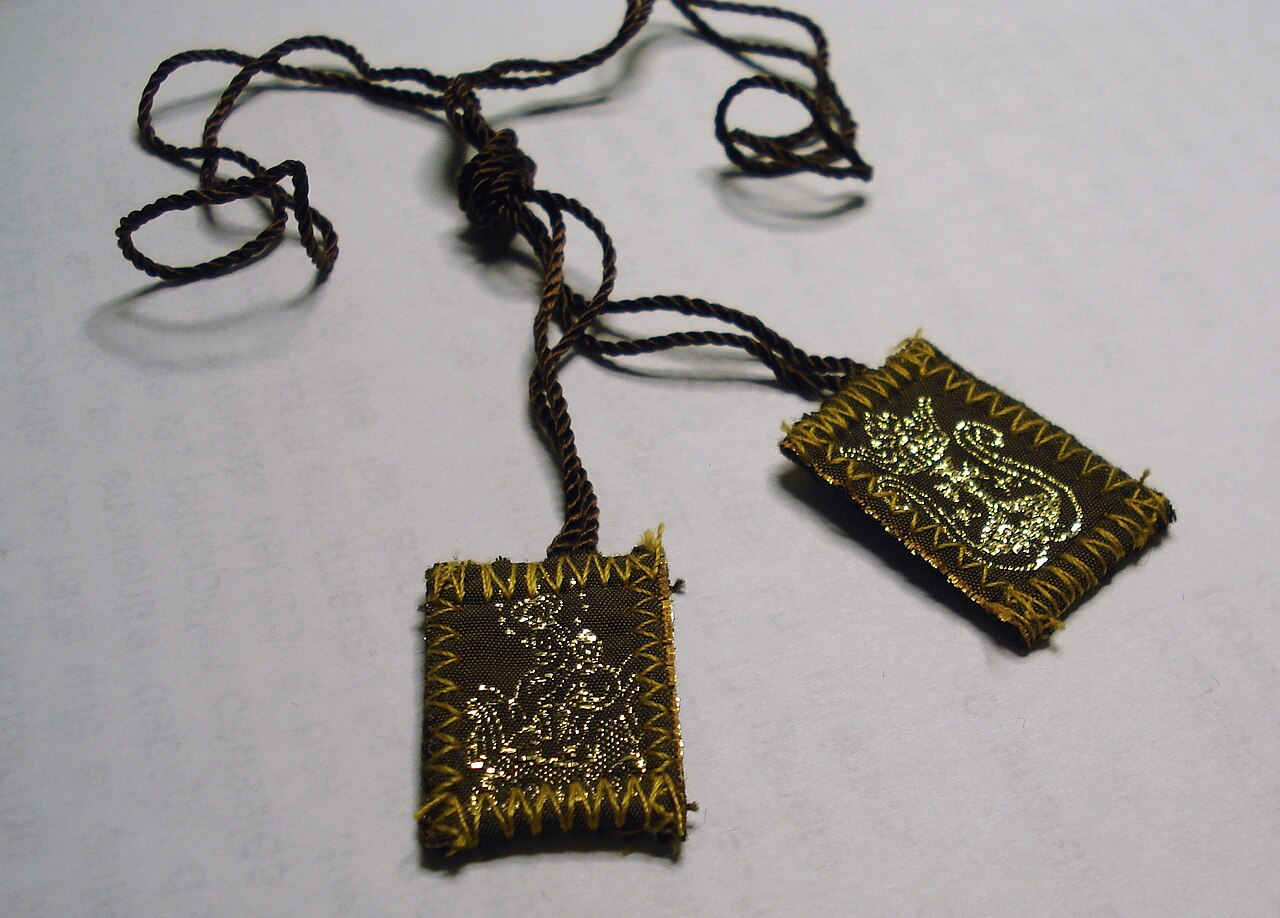
Scapular of the Seven Sorrows of Mary

In the year 1233 seven noblemen of the city of Florence, whose names were Buonfiglio Monaldi, Buonagiunta Manetti, Manetto dell’ Antella, Amedeo degli Amidei, Ugiccione Uguccioni, Tostegno de’ Tostegni, and Alexis Falconieri, members of a pious Confraternity for honouring the Blessed Virgin, had assembled on the festival of the Assumption, to pay their homage and celebrate her triumph. At one and the same time the Mother of God appeared to each, and told them that they were to quit the world, and embrace a more perfect state of life. They did not hesitate to obey this heavenly voice, and having consulted with the blessed Ardingo, Bishop of Florence, as to the mode of life which they should adopt, they renounced their dignities, distributed their goods to the poor, and clothed themselves in grey habits, and retired to a small house outside the town, on the feast of the Nativity of their holy Patroness (8th September, 1233).

If, at any time, they were obliged to enter the city of Florence, in order to consult the Bishop, the people assembled about them in crowds, and the little children used to exclaim, “Here are the servants of Mary! Here are the servants of Mary!” Amongst these children was St. Philip Benizzi, who was then hardly five months old, and who, in after years, was called by our Blessed Lady to assume the habit of her servants. This humble retreat of the seven Solitaries soon became so besieged by visitors, that they were obliged to look out for a more retired place.

Their good Mother indicated to them the summit of Mount Jenario, where they removed and passed six years, principally occupied about their own sanctification, in the practice of the most austere penance, and assiduous meditation on the Passion of our Lord, and on the Dolours of his Blessed Mother. The venerable Bishop Ardingo had more than once exhorted them to establish an Order devoted to the Blessed Virgin, but in vain. The co operation of heaven became necessary to overcome the diffidence of these holy men, and triumph over their humility. On the evening of one Good Friday, whilst they were absorbed in profound meditation, they saw their august patroness descending from heaven, surrounded by a number of heavenly spirits, some of whom carried the instruments of the Passion; another, the rules of St. Augustine; one amongst them had in his hand a palm; another a scroll,on which the following words were engraven in golden letters, “Servants of Mary.” Finally there was one who carried in his hands a black habit of a new form.

The seven anchorites, filled with astonishment at this glorious apparition, waited respectfully for the Blessed Virgin to make known her will. Mary, in the attitude of a Mother overwhelmed with affliction, and, at the same time, full of maternal tenderness, approached them, and, pointing to the objects placed before their eyes, said : “Receive this habit which I present to you, and receive also the rule of St. Augustine, which you are to follow, so that, being designated by the name of my servants, you may one day obtain the palm of eternal life offered to you.” The holy Solitaries immediately adopted the habit of their new Institute, by the spirit of which they, and so many of the faithful, were to be sanctified, through the continual meditation on the Passion of Jesus Christ, and on the bitter sorrows of his Holy Mother.

In order that all the world might be able to clothe themselves in the livery of the Servants of Mary, they instituted a smaller habit of the same form, material, and colour, with that of the religious of the Order, and desiring also to give to the faithful an easy method of honouring the principal Dolours of Mary, they instituted a Rosary divided into seven parts, each of which is composed of one Pater and seven Aves. Mary promised to the seven holy founders, and more particularly to the Blessed Alexis, to protect in a special
manner, on all occasions, but particularly at the hour of death, those who
honour her Dolours.

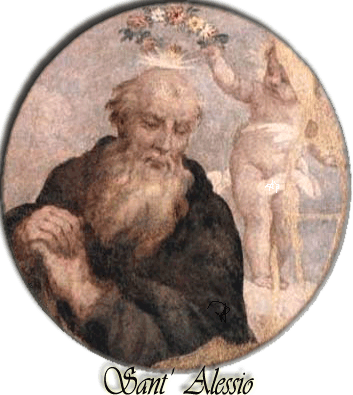
St Alexis, last to die

But if we desire to secure this precious protection of the Blessed Virgin Mary, we must not be satisfied with meditating at long intervals on her Dolours, and with wearing the habit of mourning which reminds us of them. Our compassion, if it be a true one, ought to cause us to avoid that which is the true cause of her sorrow-that is to say, everything that offends God.

Ceiling in the Servite mother church, Santissima Annunziata, Florence
Posted in SEPTEMBER-The SEVEN SORROWS of MARY and The HOLY CROSS

Thought for the Day – 24 September – A Short Method of Meditating on the Seven Dolors

Manual of Devotions in Honour of The Seven Dolors of the Blessed Virgin Mary by Father Sebastian

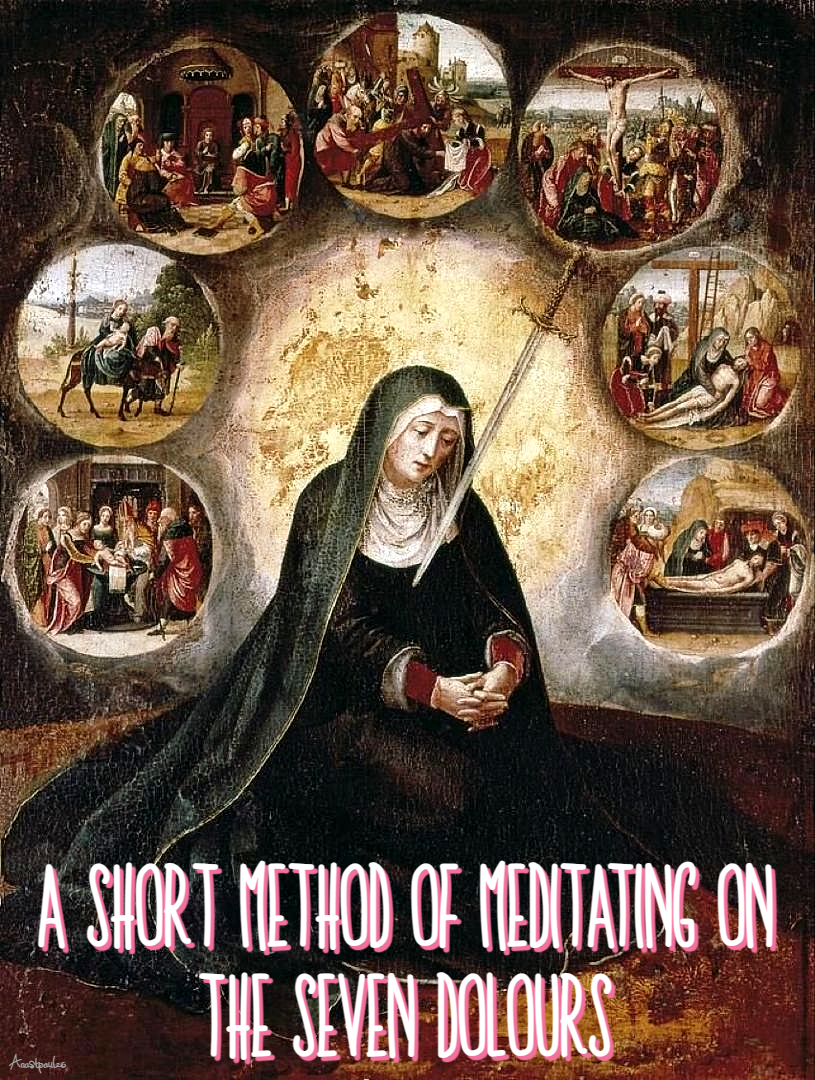
A SHORT METHOD OF MEDITATING ON THE SEVEN DOLOURS

I. Place yourself in spirit at the feet of the Queen of Martyrs, and offer her your meditation.
II. Ask her blessing and assistance.
III. Think what Mary suffers in the Dolour on which you wish to meditate.
IV. Think who Mary is that suffers.
V. Think why Mary suffers.
VI. Think how Mary suffers.
VII. Think how you suffer.
VIII. Think which is the principal virtue taught by Mary in that Dolour upon which you are meditating.
IX. Think whether you practice that virtue or not; if not, beg pardon of God, and promise amendment.
X. Finish by making some very praсtical resolutions, and by praying to Mary for relief in all your wants, both spiritual and temporal.

Prayer to the Most Desolate Virgin.
Hail Mary, full of sorrows, the Crucified is with thee; most sorrowful art thou amongst women, and most sorrowful is the fruit of thy womb, Jesus. Holy Mary, Mother of the Crucified, beg tears for us, the crucifiers of thy Son, now and in the hour of our death.
Amen.

An Indulgence of 100 days was granted by his Holiness Pius IX., on December 23rd, 1847, for each recital of this prayer.

Posted in SEPTEMBER-The SEVEN SORROWS of MARY and The HOLY CROSS

Thought for the Day – 23 September – Devotions in Honour of The Seven Dolors – Via Matris

Manual of Devotions in Honour of The Seven Dolors of the Blessed Virgin Mary by Father Sebastian

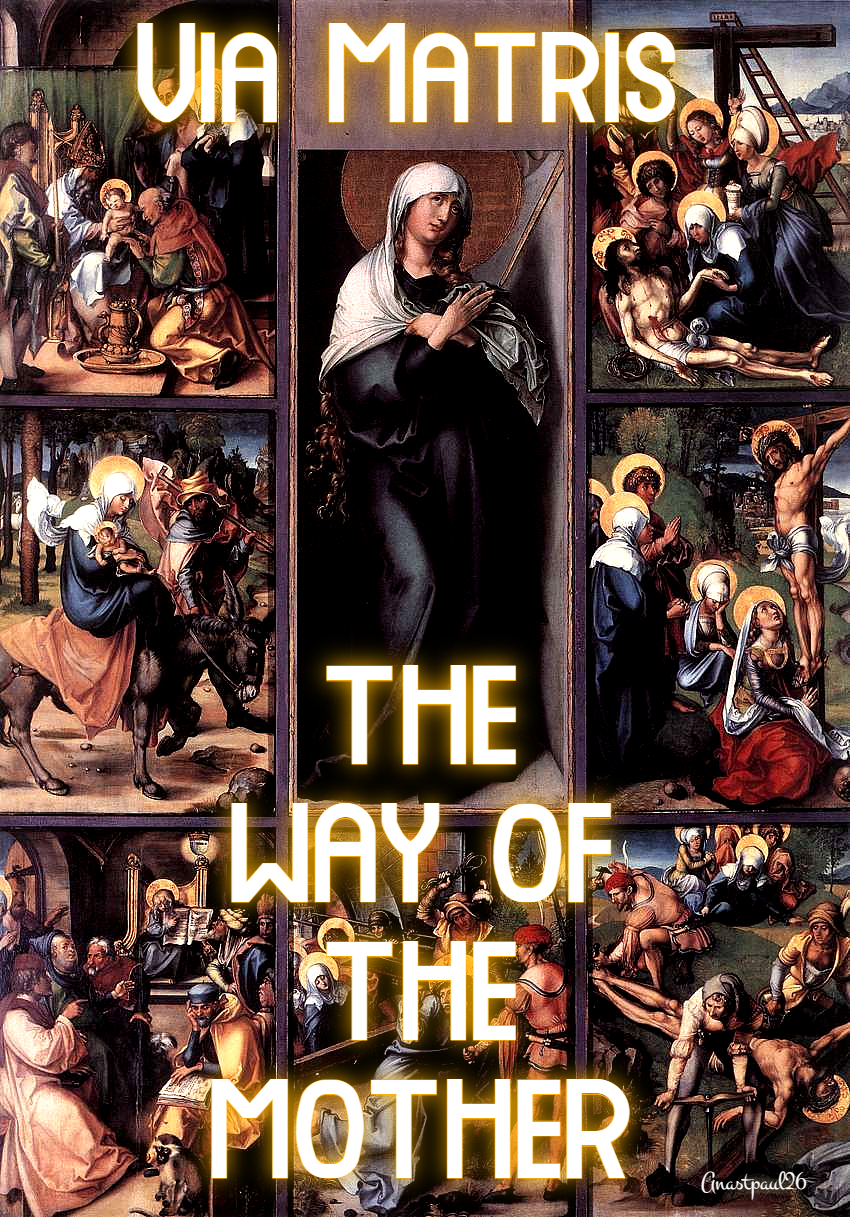
THE WAY OF THE MOTHER

Whatever act of homage is practised by the faithful in honour of the Blessed Virgin is welcomed by her with singular love, but above all she is pleased at seeing us occupied in compassionating her Dolours. Such a devotion is so gratifying to Mary, that when she found it in the time of St. Bridget very much neglected, she complained to her in these words:- “There are few who remember my sorrows.”

Wherefore, in order to assist you in meditating upon the Dolours of Mary, we propose to you this devout exercise of the Stations of her Seven Dolours, which can be practised in public or private, in the same manner as the Way of the Cross. This holy exercise has been instituted for some time, and is every day spreading. It was publicly practised in Rome A.D. 1836, in the Church of St. Marcellus, and has been enriched by copious Indulgences of the holy memory of Gregory XVI. A Plenary Indulgence was granted, on July 31st, 1887, to those who on any day shall visit seven times the Stations of the Dolours, and for each time seven years’ Indulgence.

V. Come Holy Ghost, replenish the hearts of the faithful.
R. And enkindle in them the fire of thy love.
V. Send forth thy spirit, O Lord, and they shall be regenerated.
R. And Thou shalt renew the face of the earth.
V. Remember thy congregation.
R. Which Thou hast possessed from the beginning.
V. Lord, hear my prayer.
R. And let my cry come unto Thee.
V. The Lord be with thee.
R. And with thy spirit,

Act of Contrition.
Oh most afflicted Virgin! Alas, with what unthankfulness in my past life have I acted towards God! with what ingratitude have I corresponded to his innumerable benefits! Now, however, I am truly penitent, and in the bitterness of my heart and the sorrow of my soul, I humbly beg pardon for having. outraged his infinite bounty, resolving for the future, by his grace, never more to offend Him. Oh! by all the Dolours which thou hast borne in the Passion of Jesus, I pray thee with tears to implore from Him pity and mercy for my many grievous sins. Receive this holy devotion, which I am about to perform, in memory of those pains and Dolours. Grant! oh grant that those seven daggers which pierced through thy soul may likewise pierce through mine, and that I may live and die in the friendship of the Lord, and enjoy eternally the glory which He has acquired for me by his most precious Blood. Amen.

STATION I. FIRST DOLOUR

How great was the shock to Mary’s heart at hearing the sorrowful words, in which holy Simeon told the bitter Passion and death of her sweet Jesus, since in that same moment she realized in her mind all the insults, blows, and torments which the impious men were to offer to the Redeemer of the world. But a still sharper sword pierced her soul. It was the thought of men’s ingratitude to her beloved Son. Now consider that, because of your sins, you are unhappily among the ungrateful, and casting yourself at the feet of the Mother of Dolors, say with sorrow:

Virgin beloved, who did feel so bitter pangs of soul at seeing the abuse which I, wretch that I am, would make of the Blood of your dear Son, obtain for me, I pray you, by your riven heart, that in time to come, I may better correspond to God’s mercies, profit by his heavenly grace, receive not in vain his lights and inspirations, and so be among the blessed number of those who are saved by the bitter passion of Jesus. Amen.

Amen. Ave Maria.
Virgin most sorrowful, pray for us.
O Mary, sweetness of my life,
Stamp on my soul thy bitter strife,
And pray for me, that I may see Thy joys for all eternity.

STATION II. SECOND DOLOUR

Consider the sharp sorrow which Mary felt when, Saint Joseph being warned by an angel, she had to flee by night in order to preserve her beloved Child from the slaughter decreed by Herod.

What anguish was hers in leaving Judea, lest she should be overtaken by the soldiers of the cruel king ! How great her privations in that long journey ! What sufferings she bore in that land of exile, what sorrow amid that people given to idolatry ! But consider how often you have renewed that bitter grief of Mary, when your sins have caused her Son to flee from your heart. Wherefore repent, and turn to her, humbly saying:

Sweetest Mother, once and once only Herod obliged you to flee with your Jesus, to escape the slaughter which he had commanded; but I, how often have I forced my Redeemer, and you with him, to flee from my heart, when I have admitted into it accursed sin, hateful to you and to my loving Lord. With tears and contrition I humbly beg for pardon. Mercy, dear Lady, mercy ! And I promise you that, for the future, with the help of God, I will ever maintain my Savior and you in complete possession of my soul. Amen.

Amen. Ave Maria.
Virgin most sorrowful, pray for us.
O Mary, sweetness of my life,
Stamp on my soul thy bitter strife,
And pray for me, that I may see Thy joys for all eternity.

STATION III. THIRD DOLOUR

How dreadful was the grief of Mary, when she saw that she had lost her beloved Son ! And, as if to increase her sorrow when she sought him diligently among her kinfolk and acquaintances, she could hear no tidings of him. No hindrances stayed her, nor weariness, nor danger; but she forthwith returned to Jerusalem, and for three long days sought him sorrowing.

Great be your confusion, O my soul, who has so often lost your Jesus by your sins, and has given no heed to seek him at once: a sign that you do make of very little or of no account the precious treasure of divine love. Weep then for your blindness, and turning yourself to that Lady of sighs, your Mother, say with compunction:

Virgin most afflicted, obtain that I may learn from you to seek Jesus when I have lost him by giving ear to my passions and to the evil suggestions of the devil; obtain that I may find him again, and when I possess him once more, that I may ever repeat the words of the Spouse, “I found Him whom my soul loveth; I held Him, and I will not let him go.” Amen.

Amen. Ave Maria.
Virgin most sorrowful, pray for us.
O Mary, sweetness of my life,
Stamp on my soul thy bitter strife,
And pray for me, that I may see Thy joys for all eternity.

STATION IV. FOURTH DOLOUR

Come, O you sinners, come and see if you can endure so sad a sight. This Mother, so tender and loving, meets her beloved Son, meets him amidst an impious rabble, who drag him to a cruel death, wounded, torn by stripes, crowned by thorns, streaming with blood, bearing his heavy Cross. Ah, consider, my soul, the grief of the blessed Virgin thus beholding her Son! Who would not weep at seeing this Mother’s grief? But who has been the cause of such woe? I, it is, who with my sins have so cruelly wounded the heart of my sorrowing Mother! And yet I am not moved; I am as a stone, when my heart should break because of my ingratitude.

Virgin most holy, I crave pardon for the sorrows I have caused you. I know and confess that I deserve it not, for it is I through whom your Jesus was so treated; yet do you call to mind that you are the Mother of mercy. Show mercy then to me, and I promise to be more faithful to my Redeemer in the time to come, and thus to console you for the many sorrows I have offered to your afflicted heart. Amen.

Amen. Ave Maria.
Virgin most sorrowful, pray for us.
O Mary, sweetness of my life,
Stamp on my soul thy bitter strife,
And pray for me, that I may see Thy joys for all eternity.

STATION V. FIFTH DOLOUR.

In this fifth Dolour, imagine thyself, oh my soul, on the heights of Calvary when the most afflicted Virgin saw her beloved Son die. Meditation. Come, oh devout soul! come to Calvary, where are being offered to God two sacrifices; one is the Body of Jesus, the other is the heart of Mary. Оh! sorrowful spectacle, to look upon this good Mother in such a sea of woe beholding Him, who is more dear to her than life itself, martyred by the most cruel death. Alas! every blow of the hammer, every wound, every lacera- tion which the Saviour of the world received on his sacred Body, Mary received upon her heart. She stood there at the foot of the cross, so penetrated with pain and transfixed with such agony that it could not be decided which should be the first to expire Jesus or Mary. Fixing her eyes on her Blessed Son she sees that He is already breathing forth his last breath; she gazes upon his sunken eyes, his ghastly looks, his livid lips, and listens to his difficult breathing, and at last she knows that He no longer lives, and that He has already yielded his blessed spirit to his Eternal Father. Ah! surely she wished that at that moment her soul could be separated from her body and united to the soul of Jesus. And who could bear such a sight as this? Oh, most afflicted of all mothers! instead of returning from Calvary to be free from such bitter suffering, thou didst remain there immovable as a rock in order to drink to the last drop the chalice of thy affliction.

What confusion must this be for me, my soul, who strive in every way to remove those little crosses and light sufferings which God thinks fit to send me for my greater good. Grant! oh grant that I may know the value of sufferings and that I may become so attached to them, that not being satisfied with those thou sendest to me, I may cry out with St. Francis Xavier,
“Plura, Domine, plura:” “More sufferings, oh my God-oh yes, more sufferings.”

Amen. Ave Maria.
Virgin most sorrowful, pray for us.
O Mary, sweetness of my life,
Stamp on my soul thy bitter strife,
And pray for me, that I may see Thy joys for all eternity.

STATION VI. SIXTH DOLOUR.

In this sixth Dolour contemplate, oh my soul, the Blessed Virgin when she received into her arms her dead Son after He was taken down from the cross. Meditation. Consider the pang which penetrated the heart of Mary when she held in her arms the dead Body of her Son. Ah! when she fixed her weeping eyes upon his gaping wounds, when she counted his sorrows and saw Him shedding so much blood, how terrific must have been the shock to her mind, and how deadly the blow which broke her sacred heart; and, indeed, she would have fallen down dead, through agony, but for the assistance of Divine power. Oh poor Mother! yes, Mother of Martyrs, thou didst bear to the tomb the dear object of thy most tender care, who, from being fair as the rose, became like to a bed of thorns by the ill-treatment and lacerations given by the executioners.

And who would not pity thee, who would not feel themselves struck by sorrow at seeing thee in sorrow, such as would move to pity the most stony heart? I behold St. John inconsolable, Mary Magdalen with the other Marys in bitterest grief, Nicodemus not able to stand under his afflictions. And I, alas! I alone cannot shed a tear in the midst of such sorrow, ungrateful and unthankful creature that I am. Oh, my dear Mother Mary, grant that my heart may be transfixed by those same daggers which passed through thy most afflicted heart, and that I may now become truly penitent for those sins which caused thee such a cruel martyrdom.

Amen. Ave Maria.
Virgin most sorrowful, pray for us.
O Mary, sweetness of my life,
Stamp on my soul thy bitter strife,
And pray for me, that I may see Thy joys for all eternity.

STATION VII. SEVENTH DOLOUR.

In this seventh Dolour, contemplate, oh my soul, the most sorrowful Virgin at the Sepulchre of her dead Son. Meditation. Consider how full of woe must have been the sigh which the most afflicted heart of Mary sent forth when she placed in the tomb her amiable Jesus. Oh! what pain, what great woe, must she have felt in her soul, when she beheld the rock lifted with which that sacred monument was to be closed; she could not be separated from the side of the sepulchre, and her sorrow was such that it rendered her immovable, nor was she ever satisfied with looking at those cruel wounds. And when the tomb was closed, so great was her grief that she could hardly live.

Oh! most cruelly-tortured Mother, thou wilt depart presently in body from this place, but here will thy heart remain with thy true treasure. Оh grant that here too all my affections and my love may rest. How is it possible not to be struck with love for the Saviour who has given his Precious Blood for our salvation? And how is it possible not to love thee, who hast suffered so much for love of us?

Oh! by all thy Dolours upon which we have meditated, grant this favour, that the memory of those pains may always remain impressed upon our minds, hat our poor hearts may be inflamed with love of God and thee, most sweet Mother, and that the last sighs of our lives may be united to those which thou didst send forth from the depth of thy heart at the Passion of Jesus; to whom be honour, glory, and thanks for ever and ever.

Amen. Ave Maria.
Virgin most sorrowful, pray for us.
O Mary, sweetness of my life,
Stamp on my soul thy bitter strife,
And pray for me, that I may see Thy joys for all eternity.

At the end, returning to the altar, say one part of the Stabat Mater.
V. Pray for us, most sorrowful Virgin
R. That we may be made worthy of
the promises of Christ.

Prayer.
O God, in whose Passion, according to the prophecy of Simeon, the sword of sorrow pierced the soul of thy most glorious Mother, the Virgin Mary, mercifully grant that we who meditate upon her Dolours may obtain happіness by the effects of thy Passion.
Amen.

Posted in SEPTEMBER-The SEVEN SORROWS of MARY and The HOLY CROSS

Thought for the Day – 22 September – Manual of Devotions in Honour of The Seven Dolors

Manual of Devotions in Honour of The Seven Dolors of the Blessed Virgin Mary by Father Sebastian

LITANY OF THE SEVEN DOLOURS OF
THE BLESSED VIRGIN

Lord have mercy on us. Lord have mercy on us.
Christ have mercy on us. Christ have mercy on us.
Lord have mercy on us. Lord have mercy on us.
Christ hear us. Christ graciously hear us.
God the Father of Heaven, Have mercy on us.
God the Son, Redeemer of the World, Have mercy on us.
God the Holy Ghost, Have mercy on us.

Holy Trinity, one God, Have mercy on us.

Mother of Dolours, Pray for us.

Thou who didst find no room in the inn, Pray for us.
Who wast forced to take refuge in a stable, Pray for us.
Who didst lay thy first-born in a manger, Pray for us.

Who didst witness the circumcision of thy Son, Pray for us.
Who didst hear that thy Son was set as a sign that should be contradicted, Pray for us.

Who didst hear that thy own soul should be pierced with a sword, Pray for us.
Who didst fly into Egypt with thy Son, Pray for us.
Who didst grieve for the murder of the Innocents, Pray for us.
Who for three days didst seek sorrowing thy Son, lost in the
Temple when He was twelve years old, Pray for us.
Who didst note the constant hatred of the Jews against Him, Pray for us.
Who on the day of the last Supper didst bid farewell to thy Son going to Jerusalem to die. Pray for us.

Who didst learn that He was betrayed by Judas, and led away captive, Pray for us.
Who didst see Him delivered us as a malefactor by the chief priests, Pray for us.
Who didst hear that He was falsely accused, Pray for us.
Who didst learn that his blessed face was struck, Pray for us.
Who didst learn that He was most cruelly treated by the Jews and
the soldiers, Pray for us.

Who didst hear thy Son rejected for Barabbas, Pray for us.
Who didst behold Him beaten with scourges and crowned with thorns, Pray for us.
Who didst hear sentence pronounced against Him, Pray for us.
Who didst go to meet thy Son loaded with the Cross, Pray for us.
Who didst see his blessed hands and feet pierced with nails, Pray for us.
Who didst receive the last words of Jesus upon the Cross. Pray for us.
Who didst stand by Him in his agony, Pray for us.

Who didst receive into thy bosom the lifeless Body of thy Son taken down from the Cross, Pray for us.
Who after the Body of Jesus was buried didst return home all sad and desolate. Pray for us.
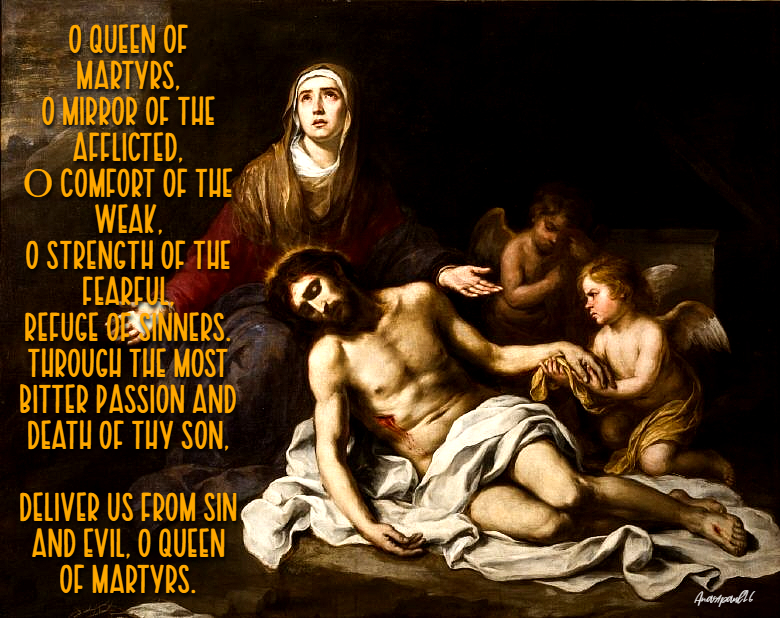
O Queen of Martyrs,
O Mirror of the afflicted,
Ο Comfort of the weak,
O Strength of the fearful,
Refuge of Sinners.
Through the most bitter Passion and Death of thy Son,

Deliver us from sin and evil, O Queen of Martyrs.
Through the most poignant sorrow
of thy heart, Deliver us from sin and evil, O Queen of Martyrs.
Through thy exceeding sadness and desolation, Deliver us from sin and evil, O Queen of Martyrs.
Through thy extreme anguish, Deliver us from sin and evil, O Queen of Martyrs.
Through thy groans and tears, Deliver us from sin and evil, O Queen of Martyrs.
Through thy maternal compassion, Deliver us from sin and evil, O Queen of Martyrs.

Through thy most powerful patronage, Deliver us from sin and evil, O Queen of Martyrs.

From immoderate sadness, Deliver us from sin and evil, O Queen of Martyrs.
From a pusillanimous spirit, Deliver us from sin and evil, O Queen of Martyrs.
From every occasion and danger of sin, Deliver us from sin and evil, O Queen of Martyrs.
From the snares of the devil, Deliver us from sin and evil, O Queen of Martyrs.
From hardness of heart, Deliver us from sin and evil, O Queen of Martyrs.
From impenitence, Deliver us from sin and evil, O Queen of Martyrs.
From sudden and unprovided death, Deliver us from sin and evil, O Queen of Martyrs.
From eternal damnation, Deliver us from sin and evil, O Queen of Martyrs.
We sinners,
Beseech thee hear us.
That thou wouldst vouchsafe to preserve us by thy patronage in true faith, hope, and charity,
We beseech thee hear us.
That thou wouldst vouchsafe to obtain for us perfect sorrow and repentance for our sins, We beseech thee hear us.
That thou wouldst vouchsafe to bring consolation and assistance to those who call upon thee, We beseech thee hear us.
That thou wouldst vouchsafe to succour us in the agony of death, We beseech thee hear us.
That thou wouldst vouchsafe to obtain for us a happy death, We beseech thee hear us.
Mother of God, We beseech thee hear us.
Lamb of God, who takest away the sins of the world,
Spare us, O Lord.
Lamb of God, who takest away the sins of the world,
Graciously hear us, O Lord.
Lamb of God, who takest away the sins of the world,
Have mercy on us, O Lord.
Christ hear us,
Christ graciously hear us.
Lord have mercy on us,
Christ have mercy on us.
Lord have mercy on us.
V. In all our tribulations and
afflictions,
R. Succour us, O Virgin Mary,

PRAYER.
Write, O afflicted Mother, on my repentant heart thy Seven Dolours and the five bleeding Wounds which thy dear Son bore, that I may read therein sorrow and true love; sorrow, to endure for Jesus and for thee every sorrow; love, to despise every love for Him and for thee. Live, crucified Jesus and heartbroken Mary, for ever and ever! Through the same Jesus Christ our Lord. Amen.

Memorare Triste.
Remember, O Virgin Mary, most sorrowful of the afflicted daughters of suffering Eve, that from all ages it has never been known that anyone imploring thy assistance failed to gain thy compassion and protection. Animated with the confidence which this inspires, to thee, O Queen of Martyrs and Virgin Mother, I come, as a contrite sinner, weeping and kneeling. Do not, O Mother of Jesus crucified, despise my suppliant voice, but hear and grant my prayer. Amen.
Posted in SEPTEMBER-The SEVEN SORROWS of MARY and The HOLY CROSS

Thought for the Day – 21 September – Manual of Devotions in Honour of The Seven Dolors

Manual of Devotions in Honour of The Seven Dolors of the Blessed Virgin Mary by Father Sebastian

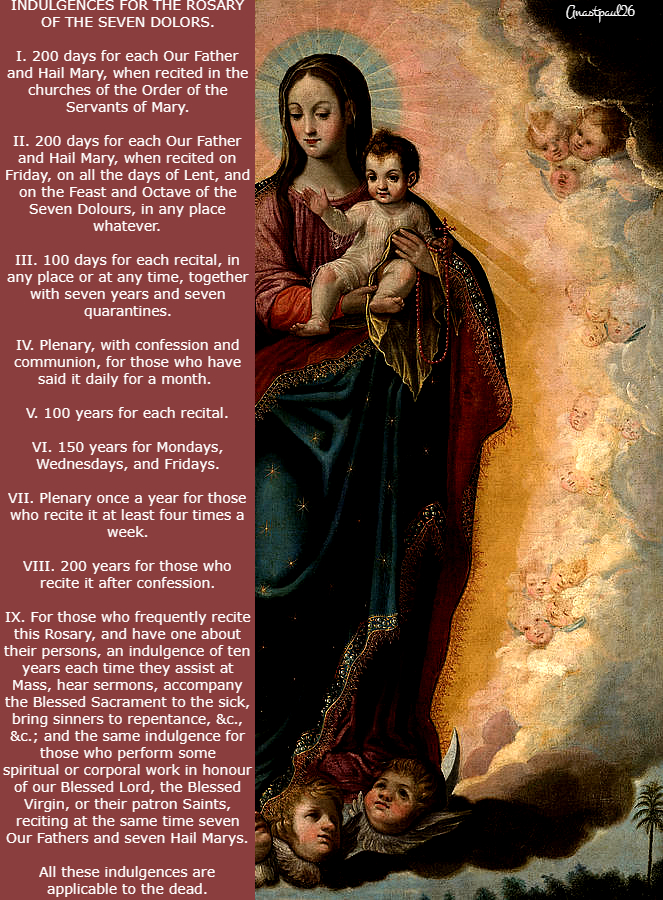
ROSARY OF THE SEVEN DOLORS OF THE BLESSED VIRGIN MARY

I. The heartrending anguish which Mary felt in her pure soul when she heard from the prophetic lips of Holy Simeon the future sufferings of her Son.
One Our Father and seven Hail Marys.

II. The sword of grief which transfixed Mary’s heart during the flight into Egypt.
One Our Father and seven Hail Marys.

III. Mary’s misery and woe when Jesus was lost for three days.
One Our Father and seven Hail Marys.

IV. Mary meets Jesus carrying his cross, and she faints at his feet.
One Our Father and seven Hail Marys.

V. Mary stands beneath the cross, beholds Him die, and falls into the arms
of St. John, with a broken heart. One Our Father and seven Hail Marys.

VI. Mary recovers from her swoon, and receives on her lap the corpse of her Son. One Our Father and seven Hail Marys.

VII. Mary with tears in her eyes follows her Son to the tomb and sees Him buried. One Our Father and seven Hail Marys.

In honour of the tears Mary shed during her Dolours.
Three Hail Marys.

V. Pray for us, O sorrowful Mother of Jesus.
R. That we may be made worthy of the promises of Christ.

PRAYER.
Grant, we beseech Thee, O Lord Jesus Christ, that the Blessed Virgin thy Mother may intercede for us with thy clemency, now and at the hour of our death; who, in the hour of thy Passion, was pierced in her most holy soul by a sword of sorrow ; grant this, O Jesus Christ, Saviour of the world, who livest and reignest with the Father and the Holy Ghost, world without end. Amen.
INDULGENCES FOR THE ABOVE ROSARY.

I. 200 days for each Our Father and Hail Mary, when recited in the churches of the Order of the Servants of Mary.

II. 200 days for each Our Father and Hail Mary, when recited on Friday, on all the days of Lent, and on the Feast and Octave of the Seven Dolours, in any place whatever.

III. 100 days for each recital, in any place or at any time, together with seven years and seven quarantines.

IV. Plenary, with confession and communion, for those who have said it daily for a month.

V. 100 years for each recital.

VI. 150 years for Mondays, Wednesdays, and Fridays.

VII. Plenary once a year for those who recite it at least four times a week.

VIII. 200 years for those who recite it after confession.

IX. For those who frequently recite this Rosary, and have one about their persons, an indulgence of ten years each time they assist at Mass, hear sermons, accompany the Blessed Sacrament to the sick, bring sinners to repentance, &c., &c.; and the same indulgence for those who perform some
spiritual or corporal work in honour of our Blessed Lord, the Blessed Virgin, or their patron Saints, reciting at the same time seven Our Fathers and seven Hail Marys.

All these indulgences are applicable to the dead.

Posted in SEPTEMBER-The SEVEN SORROWS of MARY and The HOLY CROSS

Thought for the Day – 20 September – Manual of Devotions in Honour of The Seven Dolors – Prayers

Manual of Devotions in Honour of The Seven Dolors of the Blessed Virgin Mary by Father Sebastian

DEVOUT PRAYERS IN HONOUR OF THE SEVEN DOLOURS.


V. O God, stretch forth to aid me.

R. O Lord, make haste to help me.

Glory be to the Father, etc.

I. O most sorrowful Mary, I compassionate the grief of thy tender heart at the prophecy of Simeon. O beloved Mother, through that afflicted heart obtain for me the virtue of humility and the gift of the fear of God. Hail Mary.

II. O most sorrowful Mary, I compassionate those afflictions which thy most sensitive heart endured during the flight into Egypt and thy dwelling there. O beloved Mother, by that afflicted heart obtain for me the virtue of liberality, specially towards the poor, and the gift of pity. Hail Mary.

III. O most sorrowful Mary, I compassionate that intense distress which thine anxious heart experienced in the loss of thy dearest Jesus. O beloved Mother, by that deeply- troubled heart obtain for me the virtue of chastity and the gift of knowledge. Hail Mary.

IV. O most sorrowful Mary, I compassionate the consternation which thy maternal heart experienced when thou didst see Jesus bearing the cross. O beloved Mother, of thy tender heart obtain for me the virtue of patience and the gift of fortitude. Hail Mary.

V. O most sorrowful Mary, I compassionate that martyrdom which thy generous heart endured in witnessing the last agony of Jesus. O beloved Mother, by that martyred heart obtain for me the virtue of temperance and the gift of counsel. Hail Mary.

VI. O most sorrowful Mary, I compassionate that wound which thy mournful heart endured from the lance which tore the side of Jesus and wounded his heart. O beloved Mother, by thy pierced heart obtain for me the virtue of fraternal charity and the gift of understanding. Hail Mary.

VII. O most sorrowful Mary, I compassionate the convulsions which thy most loving heart experienced at the burial of Jesus. O beloved Mother, by this extreme grief of thy sacred heart obtain for me the virtue of diligence and the gift of wisdom. Hail Mary.

V. Pray for us, O Dolorous Virgin Mother of God.

R. That we may be made worthy of the promises of Christ.

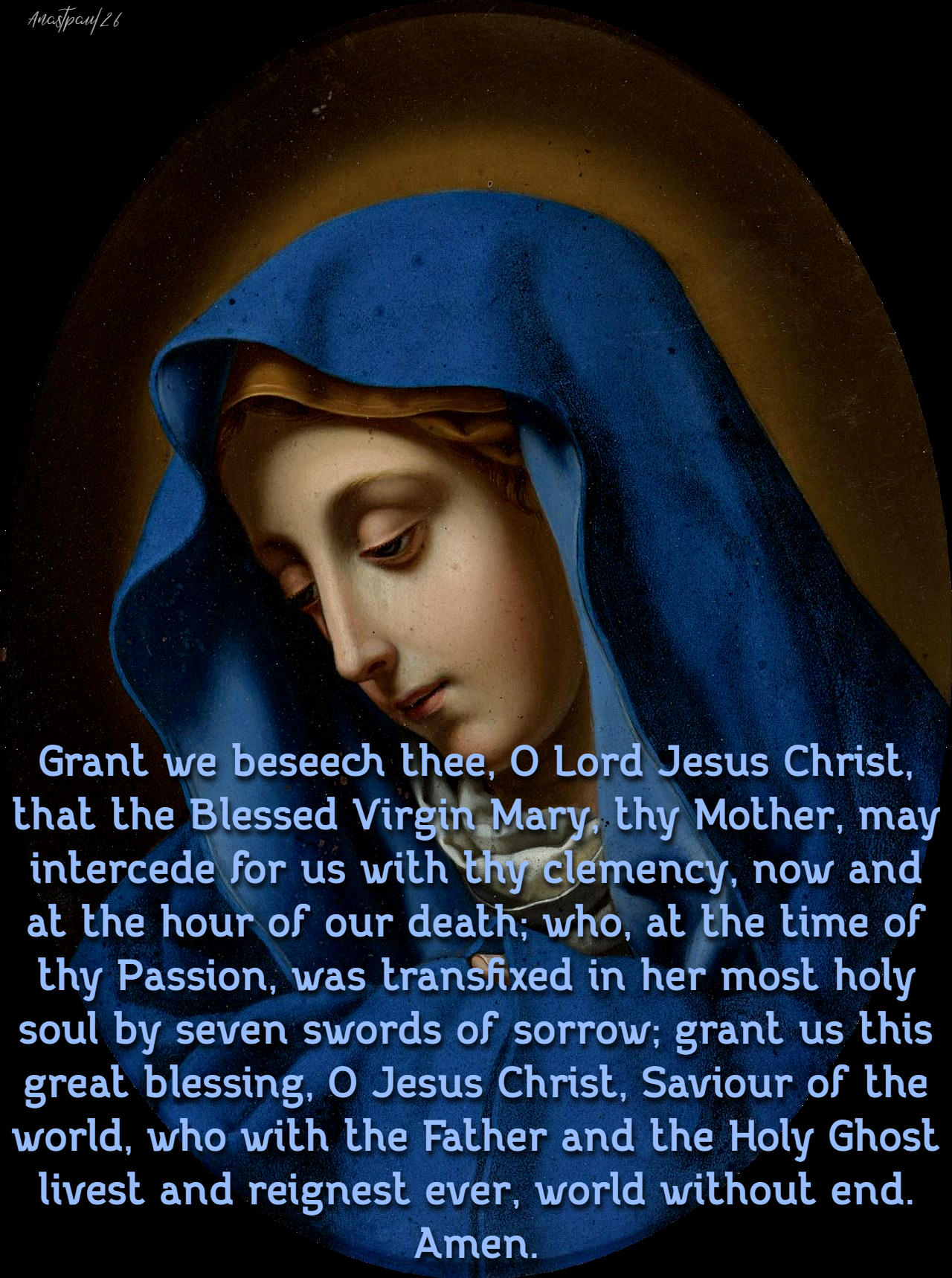
Let us Pray.
Grant we beseech thee, O Lord Jesus Christ, that the Blessed Virgin Mary, thy Mother, may intercede for us with thy clemency, now and at the hour of our death; who, at the time of thy Passion, was transfixed in her most holy soul by seven swords of sorrow; grant us this great blessing, O Jesus Christ, Saviour of the world, who with the Father and the Holy Ghost livest and reignest ever, world without end. Amen.
NOTE. – A perpetual indulgence of 300 days applicable to the dead, to all Christians every time they recite the above exercise in honour of Mary’s Woes.

Posted in SEPTEMBER-The SEVEN SORROWS of MARY and The HOLY CROSS

Thought for the Day – 19 September – Manual of Devotions in Honour of The Seven Dolors

Manual of Devotions in Honour of The Seven Dolors of the Blessed Virgin Mary by Father Sebastian

A dutiful child, beloved reader, is never unmindful of the sorrows of his mother. Her sighs and labours are ever deeply imprinted on his memory, and he is bent on fulfilling that sacred command of Heaven which venerable Tobias gave to his faithful son : “Thou must be mindful what and how great were the perils which thy mother suffered for thee;” and which Ecclesiasticus, inspired by the Holy Ghost, gives to all mankind, in these words: “Forget not the groanings of thy mother.”

As Christians, we are all children of Mary. “As Christ has begotten us,” says St. Antoninus, “to a spiritual life, in the word of truth, by suffering on the cross, so, likewise, Mary has begotten us, and brought us forth in the midst of most acute pains, by sharing in the sufferings of the crucifixion of her Son.” Ah, then, never let us forget her sighs and groans, her bitter pains and sorrows. Deeply should we fix them in our memory, and day after day call them to mind.

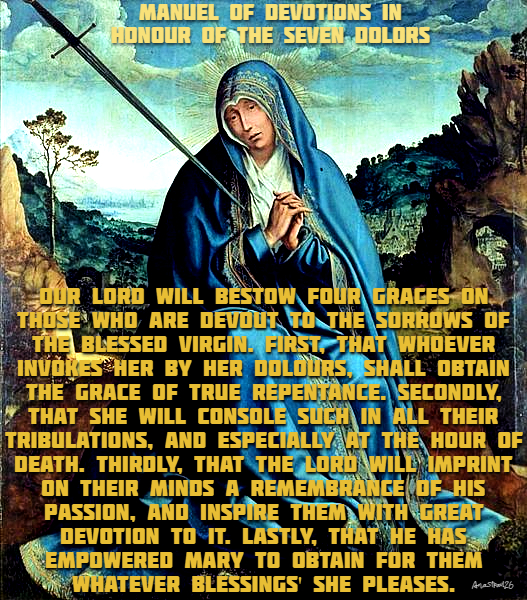
But that you, my dear reader, may be still more encouraged to think of the Seven Dolours, let me remind you of some other advantages which you will gain from this most beautiful and consoling devotion. It was revealed to St. Elizabeth, a Benedictine nun, that our Lord will bestow four graces on those who are devout to the sorrows of the Blessed Virgin. First, that whoever invokes her by her Dolours, shall obtain the grace of true repentance. Secondly, that she will console such in all their tribulations, and especially at the hour of death. Thirdly, that the Lord will imprint on their minds a remembrance of his Passion, and inspire them with great devotion to it. Lastly, that He has empowered Mary to obtain for them whatever blessings’ she pleases.

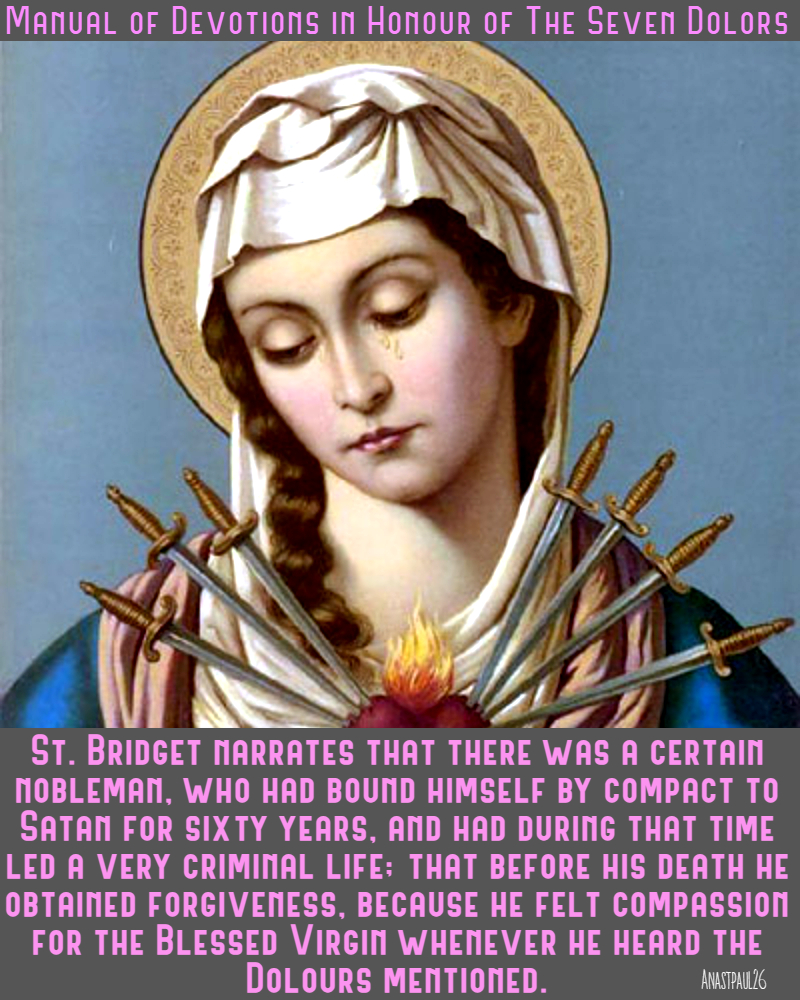
The following striking example, revealed to St. Bridget, will greatly confirm the promises made to St. Elizabeth. She narrates that there was a certain nobleman, who had bound himself by compact to Satan for sixty years, and had during that time led a very criminal life; that before his death he obtained forgiveness, because he felt compassion for the Blessed Virgin whenever he heard the Dolours mentioned.

Therefore, I present this little book of Mary’s sorrows. Receive it with affection, and peruse it attentively; and as the bee, when it lights upon a flower, does not leave it until it has gathered all the honey that flower affords, so if you meet with anything which may touch or move your heart, dwell upon that until you have derived from it all the profit you can.

Posted in SEPTEMBER-The SEVEN SORROWS of MARY and The HOLY CROSS

Thought for the Day – 18 September – The Seventh Dolor

Reflections on each of the Seven Dolors of Mary by St Alphonsus Liguori

The Burial of the Body of Jesus

When a mother is by the side of a suffering and dying child, she no doubt then feels and suffers all his pains; but when the afflicted child is really dead and about to be buried, and the sorrowful mother takes her last leave of him, oh God! the thought that she is to see him no more is a sorrow that exceeds all other sorrows. Behold, the last sword of sorrow which we are to consider, when Mary, after being present at the death of her Son upon the cross, after having embraced his lifeless body, was finally to leave him in the sepulchre, never more to enjoy his beloved presence.

Thus Mary, clinging to her Son, was dissolved in grief; but those holy disciples, fearing lest this poor mother would expire there through agony, went to take the body of her Son from her arms, to bear it away for burial. Therefore, with reverential force they took him from her arms, and having embalmed him, wrapped him in a linen cloth already prepared, upon which our Lord wished to leave to the world his image impressed, as may be seen at the present day in Turin. And now they bear him to the sepulchre. The sorrowful funeral train sets forth; the disciples place him on their shoulders; hosts of angels from heaven accompany him; those holy women follow him; and the afflicted mother follows in their company her Son to the grave. When they had reached the appointed place, how gladly would Mary have buried her self there alive with her Son! “Oh how willingly,” said the Virgin to St. Bridget, “would I have remained there alive with my Son, if it had been his will!” But since this was not the divine will, the authors relate that she herself accompanied the sacred body of Jesus into the sepulchre, where, as Baronius narrates, they deposited the nails and the crown of thorns. In raising the stone to close the sepulchre, the disciples of the Saviour had to turn to the Virgin, and say to her: Now, oh Lady, we must close the sepulchre; have patience, look upon thy Son, and take leave of him for the last time. Then, oh my beloved Son, must the afflicted mother have said, then shall I see thee no more? Receive then, this last time that I look upon thee, receive the last farewell from me thy dear mother, and receive my heart which I leave buried with thee.

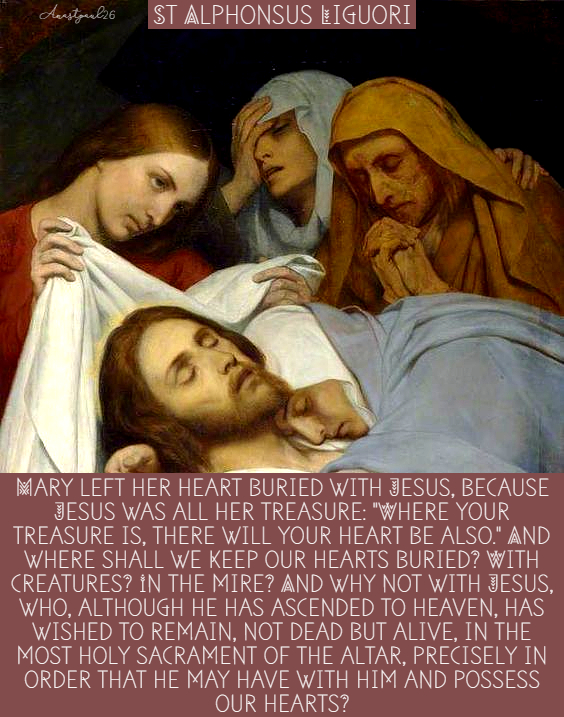
Mary left her heart buried with Jesus, because Jesus was all her treasure: “Where your treasure is, there will your heart be also.” And where shall we keep our hearts buried? With creatures? In the mire? And why not with Jesus, who, although he has ascended to heaven, has wished to remain, not dead but alive, in the most holy sacrament of the altar, precisely in order that he may have with him and possess our hearts? But let us return to Mary. Before quitting the sepulchre, according to St. Bonaventure, she blessed that sacred stone, saying: Oh happy stone, that doth now inclose that body which was contained nine months in my womb, I bless thee, and envy thee; I leave thee to guard my Son for me, who is my only good, my only love. And then turning to the eternal Father, she said: Oh Father, to thee I recommend him, who is thy Son and mine; and thus bidding a last farewell to her Son, and to the sepulchre, she returned to her own house. This poor mother went away so afflicted and sad, according to St. Bernard, that she moved many to tears even against their will: “Multos etiam invitos ad lacrymas provocabat;” so that wherever she passed, all wept who met her: “Omnes plorabant qui obviabant ei,” and could not restrain their tears. And he adds, that those holy disciples, and the women who accompanied her, mourned for her even more than for their Lord.

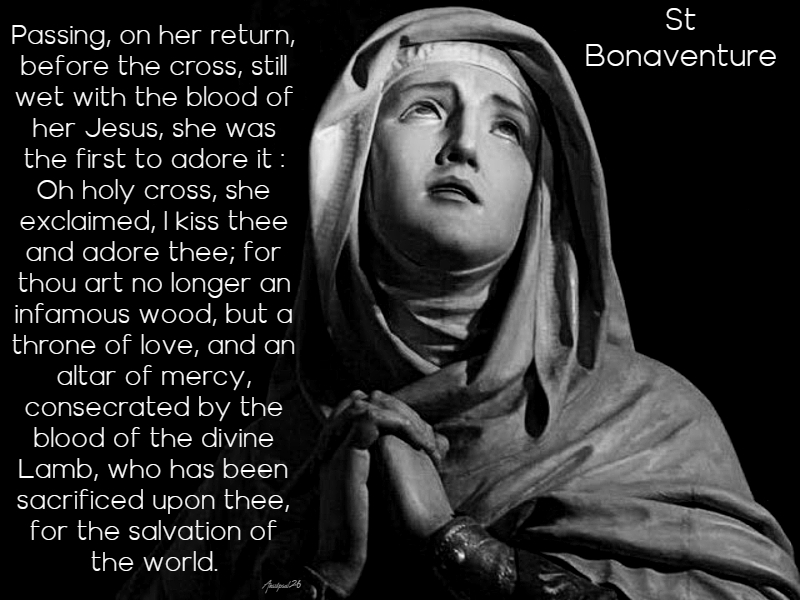
St. Bonaventure says, that her two sisters covered her with a mourning cloak: The sisters of our Lady wrapped her in a veil as a widow, covering as it were her whole countenance. And he also says, that passing, on her return, before the cross, still wet with the blood of her Jesus, she was the first to adore it : Oh holy cross, she exclaimed, I kiss thee and adore thee; for thou art no longer an infamous wood, but a throne of love, and an altar of mercy, consecrated by the blood of the divine Lamb, who has been sacrificed upon thee, for the salvation of the world.

Posted in SEPTEMBER-The SEVEN SORROWS of MARY and The HOLY CROSS

Thought for the Day – 17 September – On the Sixth Dolor

Reflections on each of the Seven Dolors of Mary by St Alphonsus Liguori

The Piercing of the Side of Jesus and His Descent From the Cross

And now we are to consider to-day the sixth dolor which afflicted this sorrowful mother. Attend and weep. Hitherto the dolors of Mary tortured her one by one, but to-day they are all united to assail her.

That the joy of the following Paschal Sabbath should not be disturbed, the Jews wished the body of Jesus to be taken down from the cross; but because they could not take down a criminal until he was dead, they came with iron mallets to break his legs, as they had already done to the two thieves crucified with him. And Mary, while she remains weeping at the death of her Son, sees those armed men coming towards her Jesus. At this sight she first trembled with fear, then she said : Ah, my Son is already dead, cease to maltreat him, and cease to torture me a poor mother longer. She implored them not to break his legs : “Oravit eos, ne frangerent crura,” as St. Bonaventure writes. But while she is thus speaking, oh, God she sees a soldier with violence brandishing a spear, and piercing the side of Jesus : “One of the soldiers with a spear opened his side, and immediately there came out blood and water.” The cross shook at the stroke of the spear, and, as was revealed to St. Bridget, the heart of Jesus was divided : “Ita ut ambae paries essent divisse.” There came out blood and water, for only a few drops of blood remained, and those also the Saviour wished to shed, in order to show that he had no more blood to give us. The injury of that stroke was offered to Jesus, but the pain was inflicted on Mary: Christ, says the devout Lanspergius, shared with his mother the infliction of that wound, for he received the insult and his mother the pain. The holy Fathers explain this to be the very sword predicted to the Virgin by St. Simeon ; a sword, not of iron, but of grief, which pierced through her blessed soul in the heart of Jesus, where it always dwelt. Thus, among others, Si. Bernard says: The spear which opened his side passed through the soul of the Virgin, which could not be torn from the heart of Jesus. And the divine mother herself revealed the same to St. Bridget, saying: When the spear was drawn out, the point appeared red with blood; then I felt as if my heart were pierced when I saw the heart of my most dear Son pierced.” The angel told St. Bridget, that such were the sufferings of Mary, that she was saved from death only by the miraculous power of God. In her other dolors she at least had her Son to compassionate her; and now she had not even him to take pity on her.

The afflicted mother, still fearing that other injuries might be inflicted on her Son, entreats Joseph of Arimathea to obtain from Pilate the body of her Jesus, that at least after his death she may be able to guard it and protect it from injuries. Joseph went to Pilate, and made known to him the sorrow and the wish of this afflicted mother; and St. Anselm thinks that compassion for the mother softened the heart of Pilate, and moved him to grant her the body. of the Saviour. And now Jesus is taken from the cross. Oh most holy Virgin, after thou with so great love hadst given thy Son to the world for our salvation, behold the world returns him to thee again! But oh, my God, how dost thou return him to me? said Mary to the world. My Son was white and ruddy: “Dilectus meus candidus et rubicundus:” but thou hast returned him to me blackened with bruises, and red, not with a ruddy color, but with the wounds thou hast inflicted upon him; he was beautiful, now there is no more beauty in him; he is all deformity. All were enamored with his aspect, now he excites horror in all who look upon him. Oh, how many swords, says St. Bonaventure, pierced the soul of this mother, when she received the body of her Son after it was taken from the cross: ” O quot gladii animam matris pertransierunt!” Let us consider what anguish it would cause any mother to receive the lifeless body of a son!

She sees his mouth open, his eye shut, she examines the lacerated flesh, and those exposed bones; she takes off the crown, and sees the cruel injury made by those thorns, in that sacred head; she looks upon those pierced hands and feet, and says: Ah, my Son, to what has the love thou didst bear to men reduced thee! But what evil hath thou done to them, that they have treated thee so cruelly. Thou wast my Father, Bernardino de Bustis imagines her to say, my brother, my spouse, my delight, my glory, my all. Oh, my Son, behold how I am afflicted, look upon me and console me; but thou dost look upon me no more. Speak, speak to me but one word, and console me; but thou dost speak no more, for thou art dead. Then turning to those barbarous instruments, she said: Oh cruel thorns, oh nails, oh merciless spear, how could you thus torture your Creator? But what thorns, what nails? Alas! sinners, she exclaimed, it is you who have thus cruelly treated my Son.

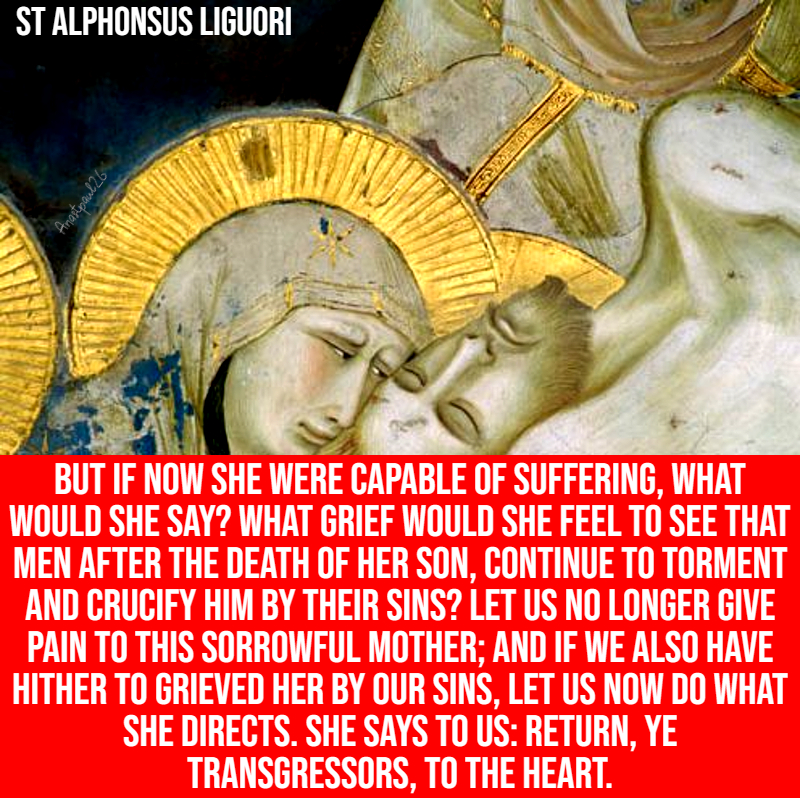
Thus Mary spoke and complained of us. But if now she were capable of suffering, what would she say? What grief would she feel to see that men after the death of her Son, continue to torment and crucify him by their sins? Let us no longer give pain to this sorrowful mother; and if we also have hither to grieved her by our sins, let us now do what she directs. She says to us: Return, ye transgressors, to the heart: “Redite, prsevaricatores, ad cor.” Sinners, return to the wounded heart of my Jesus; return as penitents, for he will receive you. Flee from him to him, she continues to say with Guerric the Abbot; from the Judge to the Redeemer, from the tribunal to the cross. 

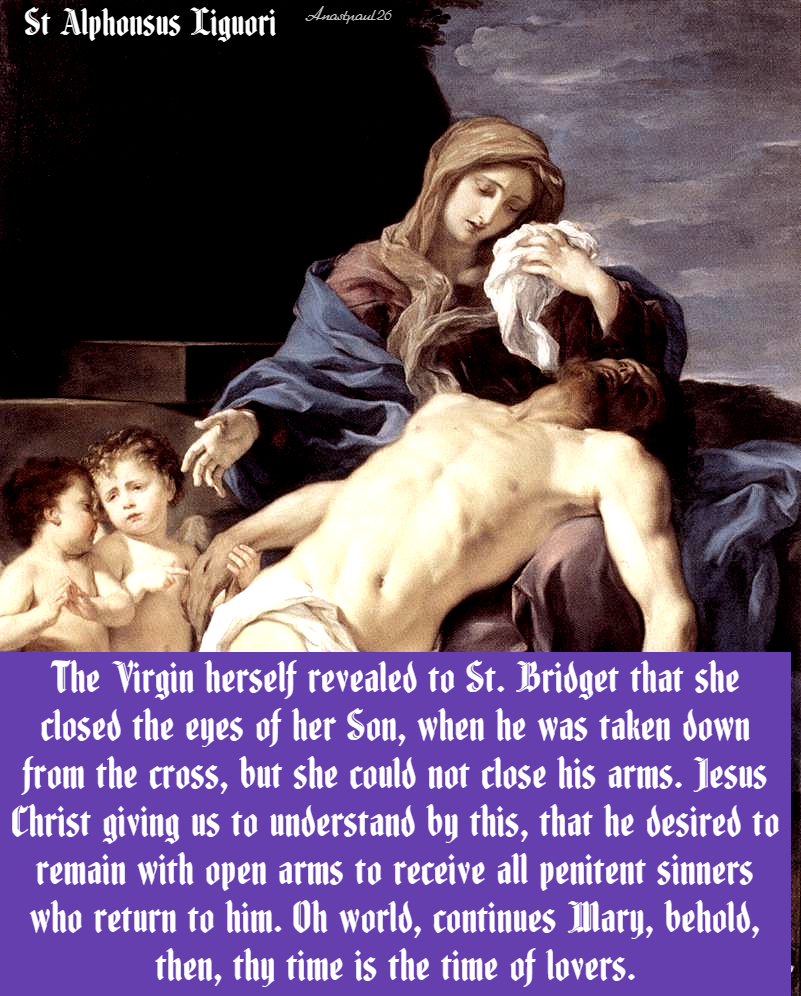
The Virgin herself revealed to St. Bridget that she closed the eyes of her Son, when he was taken down from the cross, but she could not close his arms: “Ejus brachia flectere non potui.” Jesus Christ giving us to understand by this, that he desired to remain with open arms to receive all penitent sinners who return to him. Oh world, continues Mary, behold, then, thy time is the time of lovers.

Posted in SEPTEMBER-The SEVEN SORROWS of MARY and The HOLY CROSS

Thought for the Day – 16 September – The Fifth Dolor

Reflections on each of the Seven Dolors of Mary by St Alphonsus Liguori

The Death of Jesus

And now we have to admire a new sort of martyrdom, a mother condemned to see an innocent son, whom she loved with all the affection of her heart, put to death before her eyes, by the most barbarous tortures. There stood by the cross of Jesus his mother: “Stabat autem juxta crucem mater ejus.” There is nothing more to be said, says St. John, of the martyrdom of Mary: behold her at the foot of the cross, looking on her dying Son, and then see if there is grief like her grief.

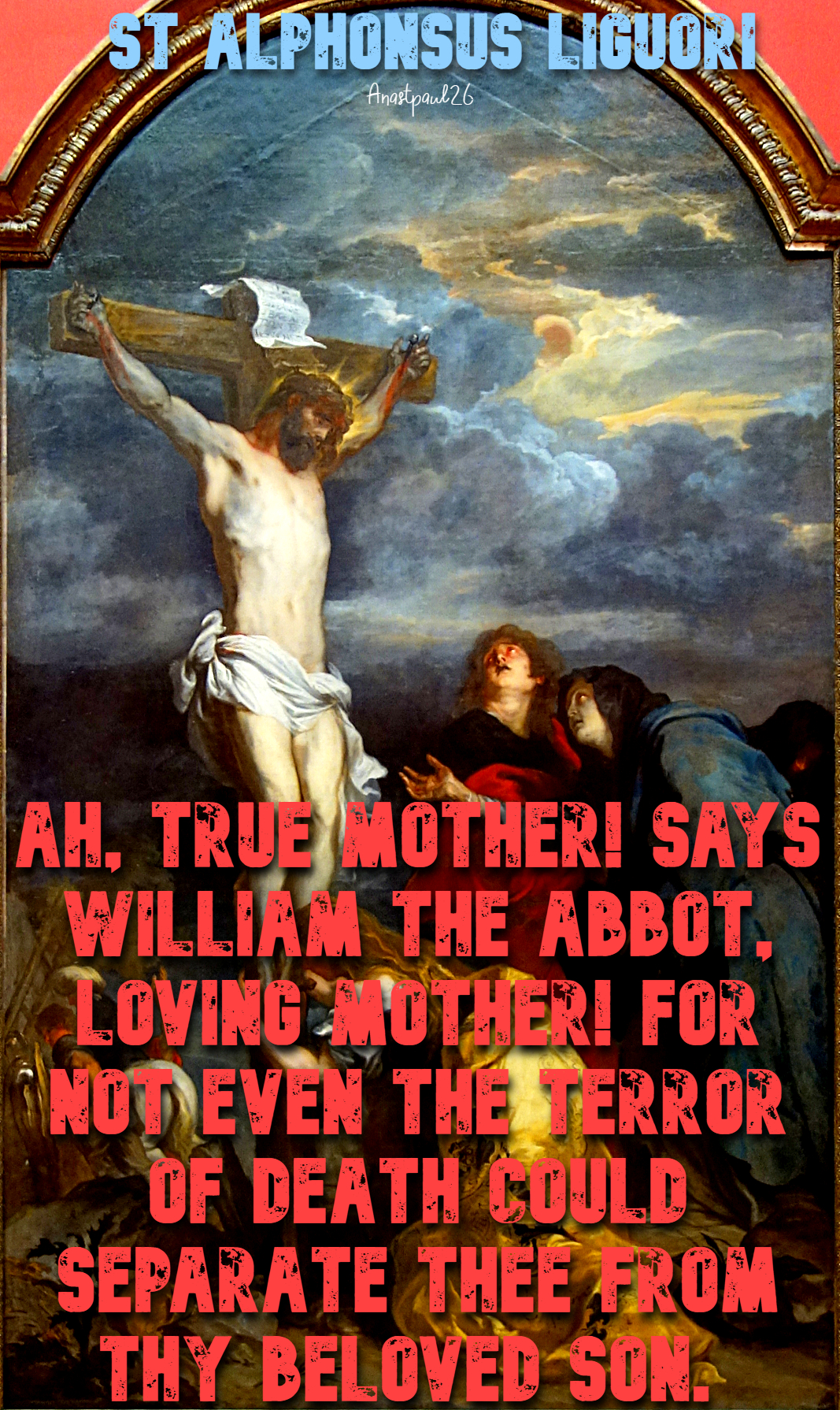
As soon as our afflicted Redeemer had ascended the hill of Calvary, the executioners stripped him of his garments, and piercing his sacred hands and feet with nails, not sharp, but blunt: “Non acutis, sed obtusis;” as St. Bernard says, and to torture him more, they fastened him to the cross. When they had crucified him, they planted the cross, and thus left him to die. The executioners abandon him, but Mary does not abandon him. She then draws nearer to the cross, in order to assist at his death. But what did it avail, oh Lady, says St. Bonaventure, to go to Calvary to witness there the death of this Son? Shame should have prevented thee, for his disgrace was also thine, because thou wast his mother; or, at least, the horror of such a crime as that of seeing a God crucified by his own creatures, should have prevented thee. But the saint himself answers: Thy heart did not consider the horror, but the suffering: “Non considerabat cor tuum horrorem, sed dolorem.” Ah, thy heart did not then care for its own sorrow, but for the suffering and death of thy dear Son; and therefore thou thyself didst wish to be near him, at least to compassionate him. Ah, true mother! says William the Abbot, loving mother! for not even the terror of death could separate thee from thy beloved Son. But, oh God, what a spectacle of sorrow, to see this Son then in agony upon the cross, and under the cross this mother in agony, who was suffering all the pain that her Son was suffering!

Mary also suffered all these pains of Jesus. Every torture inflicted on the body of Jesus, says St. Jerome, was a wound in the heart of the mother. Any one of us who should then have been on Mount Calvary, would have seen two altars, says St. John Chrysostom, on which two great sacrifices were consummating, one in the body of Jesus, the other in the heart of Mary. But rather would I see there, with St. Bonaventure, one altar only, namely, the cross alone of the Son, on which, with the victim, this divine Lamb, the mother also was sacrificed. 

Mothers fly from the presence of their dying children; but if a mother is ever obliged to witness the death of a child, she procures for him all possible relief; she arranges the bed, that his posture may be more easy; she administers refreshments to him; and thus the poor mother relieves her own sorrows. Ah, mother, the most afflicted of all mothers! oh Mary, it was decreed that thou shouldst be present at the death of Jesus, but it was not given to thee to afford him any relief. 

And what caused her the greatest sorrow was to see that, by her presence and her grief, she increased the sufferings of her Son. The sorrow itself, says St. Bernard, that filled the heart of Mary, in creased the bitterness of sorrow in the heart of Jesus. St. Bernard also says, that Jesus on the cross suffered more from compassion for his mother than from his own pains: he thus speaks in the name of the Virgin: I stood and looked upon him, and he looked upon me; and he suffered more for me than for himself. Passino writes that Jesus Christ himself, speaking one day to the blessed Baptista Varana, of Camerino, said to her, that he was so afflicted on the cross at the sight of his mother in such anguish at his feet, that compassion for his mother caused him to die without consolation. So that the blessed Baptista, being enlightened to know this suffering of Jesus, exclaimed: Oh my Lord, tell me no more of this thy sorrow, for I can not bear it.

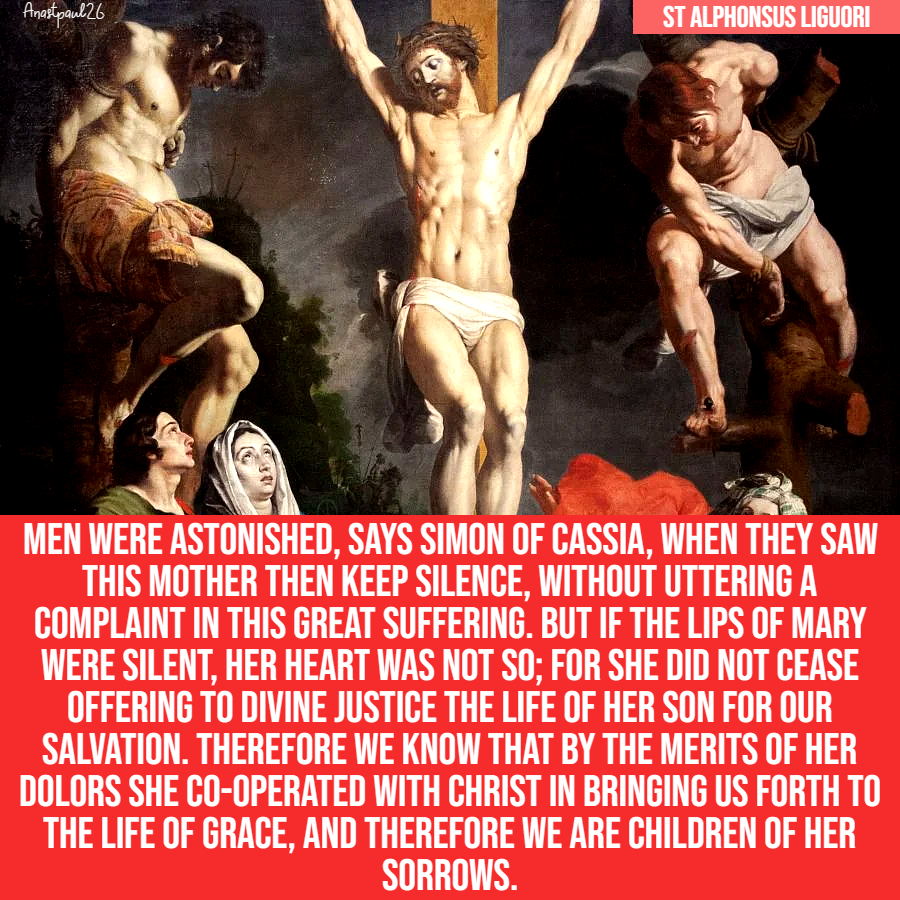
Men were astonished, says Simon of Cassia, when they saw this mother then keep silence, without uttering a complaint in this great suffering. But if the lips of Mary were silent, her heart was not so; for she did not cease offering to divine justice the life of her Son for our salvation. Therefore we know that by the merits of her dolors she co-operated with Christ in bringing us forth to the life of grace, and therefore we are children of her sorrows. And from that time Mary began to perform for us this office of a good mother; for, as St. Peter Damian declares, the penitent thief, through the prayers of Mary, was then converted and saved: Therefore the good thief repented, because the blessed Virgin, standing between the cross of her Son and that of the thief, prayed her Son for him; thus rewarding, by this favor, his former service. For as other authors also relate, this thief, in the journey to Egypt with the infant Jesus, showed them kindness; and this same office the blessed Virgin has ever continued, and still continues to perform.

Posted in SEPTEMBER-The SEVEN SORROWS of MARY and The HOLY CROSS

Quote/s of the Day – 15 September – When Mary Weeps

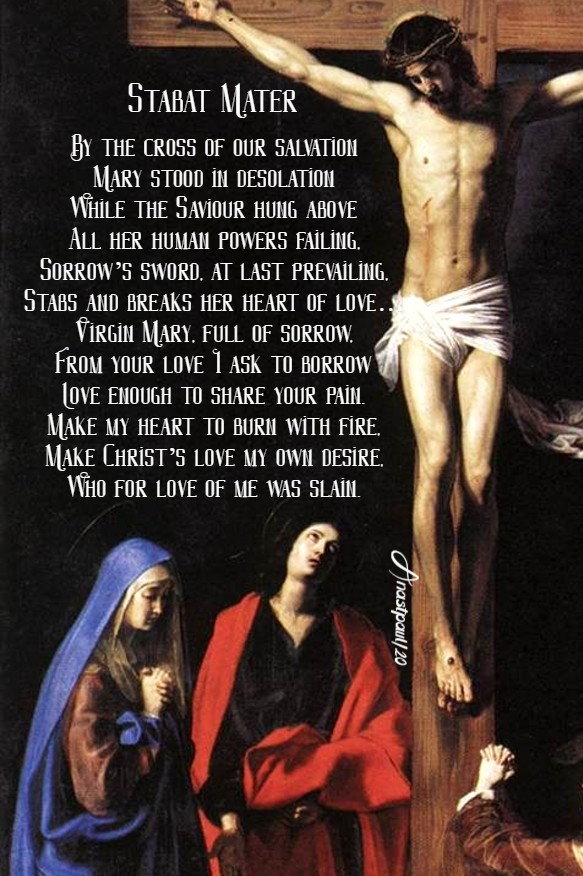
‘By the cross of our salvation
Mary stood in desolation
While the Saviour hung above
All her human powers failing,
Sorrow’s sword, at last prevailing,
Stabs and breaks her heart of love…
Virgin Mary, full of sorrow,
From your love I ask to borrow
Love enough to share your pain.
Make my heart to burn with fire,
Make Christ’s love my own desire,
Who for love of me was slain.’

Stabat Mater

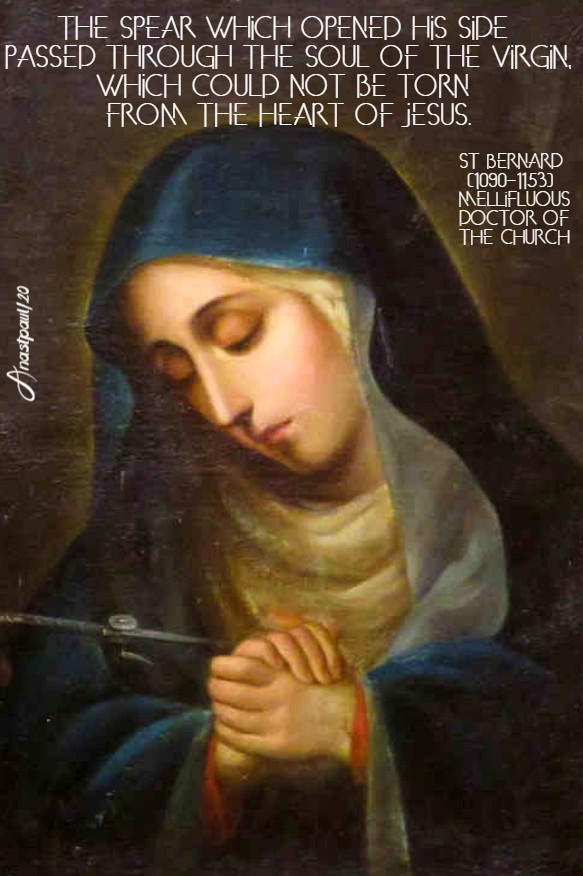
“The spear which opened His side
passed through the soul of the Virgin,
which could not be torn
from the heart of Jesus.”

St Bernard

“Whoever you are, who love the Mother of God,
take note and reflect
with all your innermost feelings,
upon her, who wept for the Only-Begotten as He died…
The grief she felt in the Passion of her son,
goes beyond all understanding.”

St Amadeus of Lausanne

“Near the cross stood His mother, speechless;
living she died;
dying she lived.
”

St Alphonsus

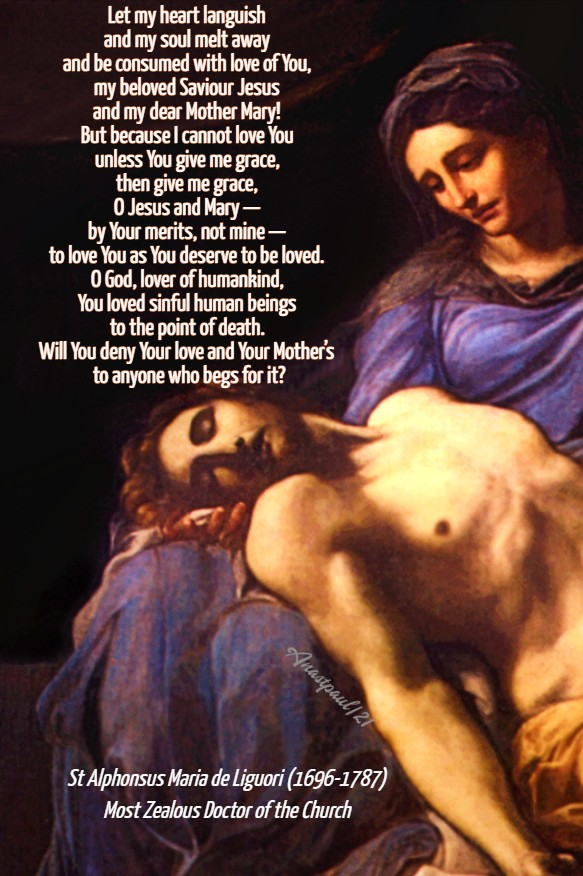
“Let my heart languish
and my soul melt away
and be consumed with love of You,
my beloved Saviour Jesus
and my dear Mother Mary!
But because I cannot love You
unless You give me grace,
then give me grace,
O Jesus and Mary —
by Your merits, not mine —
to love You as You deserve to be loved.
O God, lover of humankind,
You loved sinful human beings
to the point of death.
Will You deny Your love and Your Mother’s
to anyone who begs for it?”

St Alphonsus Maria de Liguori 

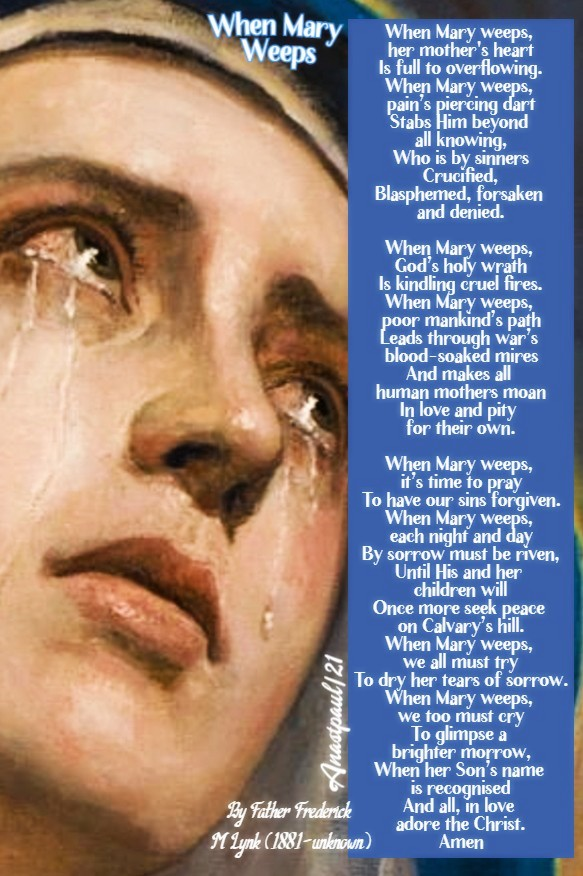
When Mary Weeps
By Father Frederick M Lynk (1881-unknown)

When Mary weeps, her mother’s heart
Is full to overflowing.
When Mary weeps, pain’s piercing dart
Stabs Him beyond all knowing,
Who is by sinners Crucified,
Blasphemed, forsaken and denied.

When Mary weeps, God’s holy wrath
Is kindling cruel fires.
When Mary weeps, poor mankind’s path
Leads through war’s blood-soaked mires
And makes all human mothers moan
In love and pity for their own.

When Mary weeps, it’s time to pray
To have our sins forgiven.
When Mary weeps, each night and day
By sorrow must be riven,
Until His and her children will

Once more seek peace on Calvary’s hill.
When Mary weeps, we all must try
To dry her tears of sorrow.
When Mary weeps, we too must cry
To glimpse a brighter morrow,
When her Son’s name is recognised
And all, in love adore the Christ.

Amen

Posted in SEPTEMBER-The SEVEN SORROWS of MARY and The HOLY CROSS

Thought for the Day – 15 September – On the Fourth Dolor

Reflections on each of the Seven Dolors of Mary by St Alphonsus Liguori

On the Meeting of Mary With Jesus When He Went To Death

The blessed Virgin revealed to St. Bridget that at the time when the passion of our Lord was drawing nigh, her eyes were always filled with tears, as she thought of her beloved Son whom she was about to lose on this earth. Therefore, as she also said, a cold sweat covered her body from the fear that seized her at that prospect of approaching suffering. Behold, the appointed day at length arrived, and Jesus came in tears to take leave of his mother before he went to death. St. Bonaventure, contemplating Mary on that night, says: Thou didst spend it without sleep, and while others slept, thou didst remain watching. Finally, for I omit the rest to come to my point, St. John came and announced to Mary that the most unjust Pilate had already condemned him to death upon the cross. I say the most unjust, for, as St. Leo remarks, this unjust judge condemned him to death with the same lips with which he had pronounced him innocent.

Mary goes with St. John, and she perceives by the blood with which the way was sprinkled, that her Son had already passed there. This she revealed to St. Bridget: “By the footsteps of my Son I traced his course, for along the way by which he had passed, the ground was sprinkled with blood.” St. Bonaventure imagines the afflicted mother taking a shorter way, and placing herself at the corner of the street to meet her afflicted Son as he passed by. This most afflicted mother met her most afflicted Son: Mcestissima mater mcestissimo filio occurrit, said St. Bernard. While Mary stopped in that place how much she must have heard said against her Son by the Jews who knew her, and perhaps also words in mockery of herself! Alas ! what a commencement of sorrows was then before her eyes, when she saw the nails, the hammers, the cords, the fatal instruments of the death of her Son borne before him! And what a sword pierced her heart when she heard the trumpet proclaiming along the way the sentence pronounced against her Son ! But behold, now, after the instruments, the trumpet, and the ministers of justice had passed, she raises her eyes and sees; she sees, oh God, a young man covered with blood and wounds from head to foot, with a crown of thorns on his head, and two heavy beams on his shoulders; she looks at him and hardly knows him, saying, then, with Isaias: ” And we have seen him, and there was no sightliness. 

But at length love recognizes him, and as soon as she knows him, ah, what was then, as St. Peter of Alcantara says in his meditations, the love and fear of the heart of Mary! On the one hand, she desired to see him ; on the other, she could not endure to look upon so pitiable a sight. But at length they look at each other. The Son wipes from his eyes the clotted blood, which prevented him from seeing ( as was revealed to St. Bridget), and looks upon the mother; the mother looks upon the Son. Ah, looks of sorrow, which pierced, as with so many arrows, those two holy and loving souls. When Margaret, the daughter of Sir Thomas More, met her father on his way to the scaffold, she could utter only two words, oh,father! oh, father! arid fell fainting at his feet. At the sight of her Son going to Calvary, Mary fainted not; no, be cause it was not fitting that his mother should lose the use of her reason, as Father Suarez remarks, neither did she die, for God reserved her for a greater grief; but if she did not die, she suffered sorrow enough to cause her a thousand deaths.
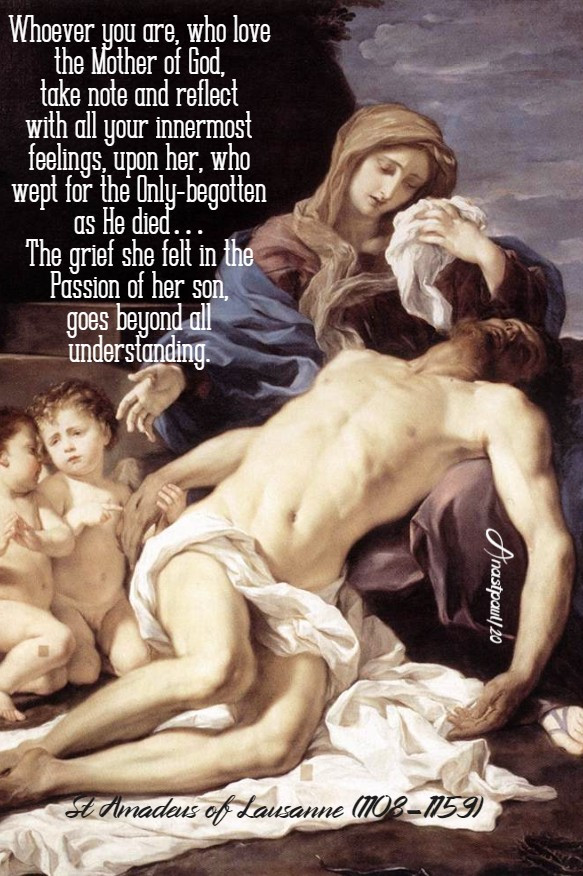
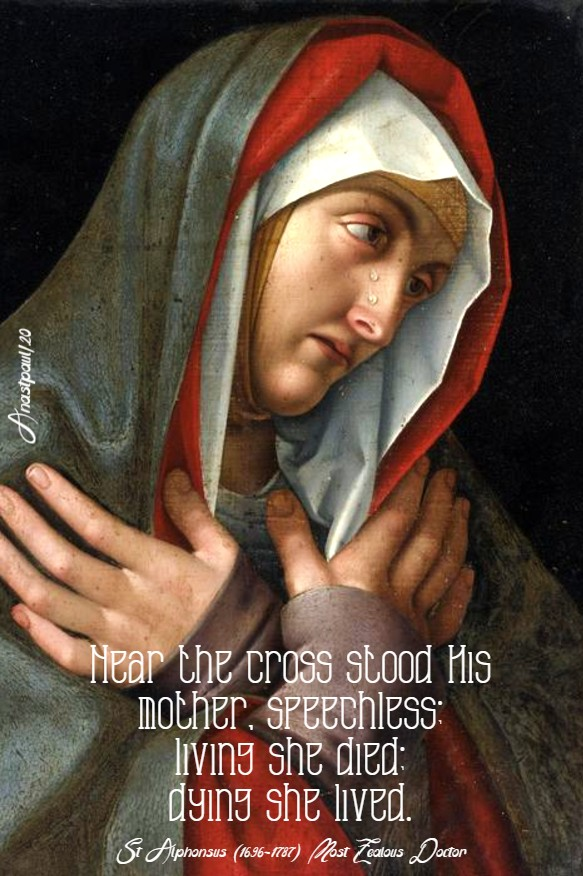
The mother wished to embrace him, as St. Anselm says, but the officers of justice thrust her aside, loading her with insults, and urge onward our afflicted Lord. Mary follows. Ah, holy Virgin, where art thou going? To Calvary! And canst thou trust thyself to see him who is thy life hanging from a cross? And thy life shall be as it were hanging before thee: “Et erit vita tua quasi pendens ante te.” Ah! my mother, stop, says St. Lawrence Justinian, as if the Son himself had then spoken to her; where dost thou hasten? Where art thou going? If thou comest where I go, thou wilt be tortured with my sufferings, and I with thine. But although the sight of her dying Jesus must cost her such cruel anguish, the loving Mary will not leave him. The Son goes before, and the mother follows, that she may be crucified with her Son, as William the Abbot says: The mother took up her cross, and followed him, that she might be crucified with him. We even pity the wild beasts: “Ferarum etiam miseremur;” as St. John Chrysostom has said. If we should see a lioness following her whelp as he was led to death, even this wild beast would call forth our compassion. And shall we not feel compassion to see Mary following her im maculate Lamb, as they are leading him to death ? Let us then pity her, and endeavor also ourselves to accompany her Son and herself, bearing with patience the cross which the Lord imposes upon us. Why did Jesus Christ, asks St. John Chrysostom, desire to be alone in his other sufferings, but in bearing the cross wished to be helped by the Cyrenean ? And he answers: That thou mayest understand that the cross of Christ is not sufficient without thine. The cross alone of Jesus is not enough to save us, if we do not bear with resignation also our own, even unto death.

Posted in SEPTEMBER-The SEVEN SORROWS of MARY and The HOLY CROSS

Thought for the Day – 14 September –On the Third Dolor

Reflections on each of the Seven Dolors of Mary by St Alphonsus Liguori

Of The Loss Of Jesus In the Temple

Saint James the Apostle has said, that our perfection consists in the virtue of patience. “And patience hath a perfect work, that you may be perfect and entire, failing in nothing.” The Lord having then given us the Virgin Mary as an example of perfection, it was necessary that she should be laden with sorrows, that in her we might admire and imitate her heroic patience. The dolor that we are this day to consider is one of the greatest which our divine mother Buffered during her life, namely, the loss of her Son in the temple. He who is born blind is little sensible of the pain of being deprived of the light of day; but to him who has once had sight and enjoyed the light, it is a great sorrow to find himself deprived of it by blindness. And thus it is with those unhappy souls who, being blinded by the mire of this earth, have but little knowledge of God, and therefore scarcely feel pain at not finding him. On the contrary, the man who, illuminated with celestial light, has been made worthy to find by love the sweet presence of the highest good, oh God, how he mourns when he finds himself deprived of it !

From this we can judge how painful must have been to Mary, who was accustomed to enjoy constantly the sweet presence of Jesus, that third sword which wounded her, when she lost him in Jerusalem, and was separated from him for three days.

Some writers assert, and not without reason, that this dolor was not only one of the greatest, but that it was the greatest and most painful of all. For in the first place, Mary in her other dolors had Jesus with her; she suffered when St. Simeon uttered the prophecy in the temple; she suffered in the flight to Egypt, but always with Jesus; but in this dolor she suffered at a distance from Jesus, without knowing where he was: “And the light of my eyes itself is not with me.” Thus, with tears, she then exclaimed: Ah, the light of my eyes, my dear Jesus, is no more with me; he is far from me, I know not where he is! Origen says, that though the love which this holy mother bore her Son, she suffered more at this loss of Jesus than any martyr ever suffered at death. Ah, how long: were these three days for Mary! they appeared three ages.

Secondly. Mary well understood the cause and end of the other dolors, namely, the redemption of the world, the divine will ; but in this she did not know the cause of the absence of her Son. The sorrowful mother was grieved to find Jesus withdrawn from her, for her humility, says Lanspergius, made her consider herself unworthy to remain with him any longer, and attend upon him on earth, and have the care of such a treasure. And perhaps, she may have thought within herself, I have not served him as I ought. Perhaps I have been guilty of some neglect, and therefore he has left me. They sought him, lest he perchance had left them, as Origen has said. Certainly there is no greater grief for a soul that loves God than the fear of having displeased him. And therefore Mary never complained in any other sorrow but this, lovingly expostulating with Jesus after she found him : “Son, why hast thou done so to us? Thy father and I have sought thee sorrowing.”! By these words she did not wish to reprove Jesus, as the heretics blasphemously assert, but only to make known to him the grief she had experienced during his absence from her, on account of the love she bore him.

This sorrow of Mary ought, in the first place, to serve as a comfort to those souls who are desolate and do not enjoy the sweet presence they once enjoyed of their Lord. They may weep, but let them weep in peace, as Mary wept in the absence of her Son. Let them take courage, and not fear that on this account they have lost the divine favor, for God himself said to St. Theresa: “No one is lost without knowing it; and no one is deceived without wishing to be deceived.” If the Lord departs from the sight of that soul who loves him, he does not therefore depart from the heart. He often hides himself that she may seek him with greater desire and love. But those who would find Jesus must seek him, not amid the delights and pleasures of the world, but amid crosses and mortifications, as Mary sought him: We sought thee sorrowing, as she said to her Son: “Dolentes quasrebamus te.”

Moreover, in this world we should seek no other good than Jesus. Job was not unhappy when he lost all that he possessed on earth; riches, children, health, and honors, and even descended from a throne to a dunghill; but because he had God with him, even then he was happy. St. Augustine, speaking of him, says: He had lost all that God had given him, but he had God himself

Posted in SEPTEMBER-The SEVEN SORROWS of MARY and The HOLY CROSS

Thought for the Day – 13 September – On the Second Dolor

Reflections on each of the Seven Dolors of Mary by St Alphonsus Liguori

Of The Flight of Jesus Into Egypt

Herod having heard that the expected Messiah was born, foolishly feared that the new-born King would deprive him of his kingdom. Hence St. Fulgentius, reproving him for his folly, thus says: “Why, oh Herod, art thou that disturbed? This King who is born has not come to conquer kings by arms, but to subjugate them, in a wonderful manner, by his death.” The impious Herod, therefore, waited to learn from the holy magi where the King was born, that he might take from him his life; but finding himself deceived by the magi, he ordered all the infants that could be found in the neighborhood of Bethlehem to be put to death. But an angel appeared in a dream to St. Joseph, and said to him:” Arise, and take the child and his mother, and fly into Egypt.”

According to Gerson, immediately, on that very night, Joseph made this command known to Mary; and taking the infant Jesus, they commenced their journey, as it seems clearly from the Gospel itself: Who arose and took the child and his mother by night, and retired into Egypt.” And then the afflicted Mary knew that already the prophecy of Simeon, regarding her Son, was beginning to be verified: ” He is set for a sign which shall be contradicted.” Seeing that scarcely is he born,when he is persecuted to death. What suffering it must have been to the heart of Mary, writes St. John Chrysostom, to hear the tidings of that cruel exile of herself with her Son! Flee from thy friends to strangers, from the holy temple of the only true God, to the temples of demons. What greater tribulation than that a new-born child, clinging to its mother’s bosom, should be forced to fly with the mother herself!

Every one can imagine how much Mary must have suffered on this journey. It was a long distance to Egypt. Authors generally agree with Barrada that it was four hundred miles; so that at least it was a journey of thirty days. The way, as St. Bonaventure describes it, was rough, unknown, through woods, and little frequented. The season was winter, and therefore they had to travel in snow, rain, wind, and storms, and through bad and difficult roads. Mary was then fifteen years of age, a delicate virgin, unaccustomed to such journeys. They had no servant to attend them. Joseph and Mary, said St. Peter Chrysologus, had no man servant nor maid-servant; they were themselves both masters and servants. Oh God, how piteous a spectacle it was to see that tender Virgin, with that newly born infant in her arms wandering through this world! St. Bonaventure asks, Where did they obtain food? Where did they rest at night? How were they lodged ? What other food could they have, than a piece of hard bread which Joseph brought with him or begged in charity? Where could they have slept (particularly in the two hundred miles of desert through which they travelled, where, as authors relate, there were neither houses nor inns) except on the sand, or under some tree in the wood, in the open air, exposed to robbers, or those wild beasts with which Egypt abounded? Ah, if any one had met these three greatest personages of the world, what would he have believed them to be but three poor, roving beggars?

They lived in Egypt, according to St. Anselm, Heliopolis, first called Memphis, and now Cairo. And here let us consider the great poverty they must have suffered for the seven years they were there, as St. Antoninus, St. Thomas, and others assert, They were foreigners, unknown, without revenues, without money, without kindred; hardly were they able to support them selves by their humble labors. As they were destitute, says St. Basil, it is manifest what effort they must have made to obtain there the necessaries of life. Moreover, Landolph of Saxony has written, and let it be repeated for the consolation of the poor, that so great was the poverty of Mary there, that sometimes she had not so much as a morsel of bread, when her Son, forced by hunger, asked it of her.

St. Matthew also relates that when Herod was dead, the angel again appeared, in a dream, to St. Joseph, and directed him to return to Judea. St. Bonaventure, speaking of his return, considers the greater pain of the blessed Virgin, on account of the sufferings which Jesus must have endured in that journey, having arrived at about the age of seven years an age, says the saint, when he was so large that he could not be carried, and so small that he could not go with out assistance.

The sight, then, of Jesus and Mary wandering like fugitives through this world, teaches us that we should also live as pilgrims on the earth, detached from the goods which the world offers us, as having soon to leave them and go to eternity.

Posted in SEPTEMBER-The SEVEN SORROWS of MARY and The HOLY CROSS

Thought for the Day – 12 September – On the First Dolor

Reflections on each of the Seven Dolors of Mary by St Alphonsus Liguori

Saint Simeon’s Prophecy

In this valley of tears, every man is born to weep, and every one must suffer those afflictions that daily befall him. But how much more miserable would life be, if every one knew also the future evils which are to afflict him! Too unhappy would he be, says Seneca, whose fate was such. The Lord exercises his compassion towards us, namely, that he does not make known to us the crosses that await us; that if we are to suffer them, at least we may suffer them only once. But he did not exercise this compassion with Mary, who, because God wished her to be the queen of dolors, and in all things like his Son, and to see always before her eyes, and to suffer continually all the sorrows that awaited her; and those were the sufferings of the passion and death of her beloved Jesus. For St. Simeon in the temple, after having re ceived the divine child in his arms, predicted to her that this child was to be the mark for all the opposition and persecution of men; “Set for a sign which shall be contradicted;” and that therefore the sword of sorrow should pierce her soul: “And thy own soul a sword shall pierce.”

The holy Virgin herself said to St. Matilda, that at the announcement of St. Simeon all her joy was changed into sorrow. For, as it was revealed to St. Theresa, the blessed mother, although she knew before this that the life of her Son would be sacrificed for the salvation of the world, yet she then learned more particularly and distinctly the sufferings and cruel death that awaited her poor Son. She knew that he would be contradicted in all things.

When David, in the midst of all his pleasures and royal grandeur heard from Nathan the prophet, that his son should die “The child that is born to thee shall surely die” he could find no peace, but wept, fasted, and slept upon the ground. Mary received with the greatest calmness the announcement that her Son should die, and peacefully continued to submit to it; but what grief she must have continually suffered, seeing this amiable Son always near her, hearing from him words of eternal Iife and beholding his holy demeanor. Abraham suffered great affliction during the three days he passed with his beloved Isaac, after he knew that he was to lose him. Oh God ! not for three days, but for thirty three years, Mary had to endure a like sorrow. Like, do I say? A sorrow as much greater as the Son of Mary was more lovely than the son of Abraham. The blessed Virgin herself revealed to St. Bridget, that while she lived on the earth there was not an hour when this grief did not pierce her soul: As often, she continued, as I looked upon my Son, as often as I wrapped him in his swaddling clothes, as often as I saw his hands and his feet, so often was my soul overwhelmed as it were with a fresh sorrow, because I considered how he would be crucified. 

The evangelist says, that as Jesus Christ advanced in years, so also he advanced in wisdom and in grace with God and men. That is, he advanced in wisdom and in grace before men or in their estimation; and before God, according to St. Thomas, inasmuch as all his works would continually have availed to increase his merit, if from the beginning grace in its complete fulness had not been conferred on him by virtue of the hypostatic union. But if Jesus advanced in the esteem and love of others, how much more did he advance in Mary’s love! But oh God, as love increased in her, the more increased in her the grief of having to lose him by a death so cruel. And the nearer the time of the passion of her Son approached, with so much greater pain did that sword of sorrow, predicted by St. Simeon, pierce the heart of the mother; precisely this the angel revealed to St. Bridget, saying: “That sword of sorrow was every hour drawing nearer to the Virgin as the time for the passion of her Son drew nearer.”

If, then, Jesus our King and his most holy mother did not refuse, for love of us, to suffer during their whole life such cruel pains, there is no reason that we should complain if we suffer a little. Jesus crucified once appeared to sister Magdalene Orsini, a Dominican nun, when she had been long suffering a great trial, and encouraged her to remain with him on the cross with that sorrow that was afflicting her. Sister Magdalene answered him complainingly: “Oh Lord, thou didst suffer on the cross only three hours, but it is more than three years that I have been suffering this cross.” Then the Redeemer replied: “Ah! ignorant soul, what dost thou say? I, from the first moment I was conceived, suffered in heart what I afterwards suffered on the cross. ” If, then, we too suffer any affliction and complain, let us imagine that Jesus and his mother Mary are saying to us the same words.

Posted in SEPTEMBER-The SEVEN SORROWS of MARY and The HOLY CROSS

Thought for the Day – 11 September – The Fourteen Rules Continued

Letter to the Friends of the Cross by St Louis de Montfort

[Suffer all sorts of crosses, without exception and without choice]


10) My dear Friends of the Cross, make the resolution to suffer any kind of cross without excluding or choosing any: any poverty, injustice, loss, illness, humiliation, contradiction, slander, spiritual dryness, desolation, interior and exterior trials, saying always, “My heart is ready, O God, my heart is ready.” Be prepared, then, to be forsaken by men and angels, and seemingly by God himself; to be persecuted, envied, betrayed, slandered, discredited and abandoned by everyone; to suffer hunger, thirst, poverty, nakedness, exile, imprisonment, the gallows, and all kinds of torture, even though you have done nothing to deserve it.

Finally, imagine that you have been deprived of your possessions and your good name, and turned out of your home, like Job and St. Elizabeth of Hungary; that you are thrown into the mire, like St. Elizabeth, or dragged onto the dung heap, like Job, all covered with ulcers, without a bandage for your sores or a piece of bread to eat – something people would not refuse to a horse or a dog. Imagine that, in addition to all these dreadful misfortunes, God leaves you a prey to every assault of the devil, without imparting to your soul the least feeling of consolation. You should firmly believe that this is the highest point of heavenly glory and of genuine happiness for the true and perfect Friend of the Cross.

[Four considerations for suffering well]


11) To help you to suffer in the right spirit, acquire the good habit of reflecting on these four points:

[a. The eye of God]

Firstly, the eye of God, who, like a great king from the height of a tower, observes with satisfaction his soldier in the midst of battle, and praises his courage. What is it that attracts God’s attention on earth? Is it kings and emperors on their thrones? He often regards them only with contempt. Is it great victories of armies, precious stones, or whatever is great in the eyes of men? No, “what is thought highly of by men is loathsome in the sight of God.” What, then, does he look upon with pleasure and satisfaction, and about which he inquires of the angels and even the devils? It is the one who is struggling with the world, the devil, and himself for the love of God, the one who carries his cross cheerfully. As the Lord said to Satan, “Did you not see on earth a great wonder, at which all heaven is filled with admiration? Have you seen my servant Job, who is suffering for my sake?”

[b. The hand of God]

Secondly, consider the hand of God. All natural evils which befall us, from the smallest to the greatest, come from the hand of God. The same hand that killed an army of a hundred thousand men on the spot also causes a leaf to fall from the tree and a hair from your head; the hand which pressed so heavily on Job gently touches you with a light tribulation. It is the same hand which makes both day and night, sunshine and darkness, good and evil. He has permitted the sinful actions which hurt you; he is not the cause of their malice, but he permits the actions. If anyone, then, treats you as Shimei treated King David, heaping you with insults and throwing stones at you, say to yourself, “We must not take revenge. Let him carry on, for the Lord has commanded him to act in this way. I know I deserve every kind of insult, and that it is only right that God should punish me. My hands, keep yourselves from violence; refrain, my tongue, from speaking; do not strike, do not say a word. It is true this man attacks me, that woman reviles me, but they are God’s representatives, who have come on behalf of his mercy to punish me as his love alone knows how. Let us not offend his justice by usurping his rights to vengeance. Let us not slight his mercy by resisting the loving strokes of his lash, lest he should deliver me, instead, to the absolute justice of eternity.”

On the one hand, God in his infinite power and wisdom bears you up, while with the other he afflicts you. With one hand he deals out death, while with the other he dispenses life. He humbles you to the dust and raises you up, and with both arms he reaches from one end of your life to the other with kindness and power; with kindness, by not allowing you to be tempted and afflicted beyond your strength; with power, by supporting you with his grace in proportion to the violence and duration of the temptation or affliction; with power again, by coming himself, as he tells us through his holy Church, “to support you on the edge of the precipice, to guide you on the uncertain road, to shade you in the scorching heat, to protect you in the drenching rain and biting cold, to carry you in your weariness, to aid you in your difficulties, to steady you on slippery paths, to be your refuge in the midst of storms” (Prayer for a Journey).

[c. The wounds and sufferings of Christ crucified]

Thirdly, reflect on the wounds and sufferings of Christ crucified. He himself has told us, “All you who pass by the way” of thorns and the cross, “look and see.” Look with the eyes of your body, and see through the eyes of your contemplation, whether your poverty, destitution, disgrace, sorrow, desolation are like mine; look upon me who am innocent, and lament, you who are guilty! The Holy Spirit tells us, through the Apostles, to contemplate the crucified Christ. He bids us arm ourselves with this thought, for it is the most powerful and formidable weapon against our enemies. When you are assailed by poverty, disrepute, sorrow, temptation, and other crosses, arm yourselves with the shield, breastplate, helmet and two-edged sword, which is the remembrance of Christ crucified. It is there you will find the solution of every problem and the means to conquer all your enemies.

[d. Heaven above; hell below]

Fourthly, look upwards and see the beautiful crown that awaits you in heaven if you carry your cross well. It was this reward which sustained the patriarchs and prophets in their faith and persecutions; which inspired the apostles and martyrs in their labours and torments. The patriarchs could say with Moses, “We would rather be afflicted with the people of God, and be happy with him forever, than enjoy for a time the pleasures of sin.” And the prophets could say with David, “We suffer persecution for the reward.” The apostles and martyrs could say with St. Paul, “We are as men sentenced to death, put on show in front of the whole universe, angels as well as men, by our suffering, and as the offal of the world, the scum of the earth, for the sake of a weight of eternal glory, which this small and temporary suffering will produce in us.” Let us look upwards and see the angels, who exclaim, “Be careful not to forfeit the crown which is marked out for the cross you have received, if you bear it well. If you do not bear it well, another will carry it in the right spirit and will take your crown with it. Fight bravely and suffer patiently, we are told by all the saints, and you will receive an eternal kingdom.” Finally, listen to our Lord himself, who says to you, “I will give my reward only to the one who suffers and is victorious through his patience.”

Now let us look downward to the place we have deserved and which awaits us in hell in the company of the bad thief and all who have not repented, if we suffer as they did, with feelings of resentment, ill-will and revengefulness. Let us say with St. Augustine, “Lord, treat me as you will in this world for my sins, so long as you pardon them in eternity.”

[Never complain against creatures]

12) Never willingly complain against any person or thing that God may use to afflict you. There are three kinds of complaints we may make in times of distress. The first is natural and spontaneous, as when the body groans and complains, weeps and laments. There is no fault in this, provided, as I have said, that the heart is resigned to the will of God. The second kind of complaint is that of the mind, as when we make known our ills to someone who can give us some relief, such as a doctor or a superior. There may be some imperfection in this if we are too eager to tell our troubles, but there is no sin in it. The third kind is sinful: that is when we criticise our neighbour either to get rid of an evil which afflicts us or to take revenge on him; or when we wilfully complain of what we suffer with impatience and murmuring.

[Accept the cross only with gratitude]

13) Whenever you receive any cross, always welcome it with humility and gratitude. And when God favours you with a cross of some importance, show your gratitude in a special way, and get others to thank him for you. Follow the example of the poor woman who lost all that she had in an unjust law- suit and immediately offered her few remaining coins to have a Mass said in thanksgiving for her good fortune.

[Take up some voluntary crosses]

14) If you want to make yourself worthy of the best kind of crosses, that is, those which come to you without your choosing, then under the guidance of a prudent director, take up some of your own accord. For example, suppose you have a piece of furniture you are fond of, but which is of no use to you. You could give it away to someone who needs it, saying to yourself, “Why should I have things I don’t need when Jesus is so poor?’ Or if you have a distaste for a certain kind of food, an aversion for the practice of some particular virtue, or a dislike for some offensive odour, you could take the food, practice the virtue, accept the odour, and thus conquer yourself. Or again, your fondness for a certain person or thing may be immoderate. Why not see less of that person, or keep away from those things that attract you? If you have a natural inclination never to miss what is going on, to be always doing things, to be in the limelight, to frequent popular places, then guard your eyes, watch your tongue, and stay where you are. Have you a natural aversion for certain persons or things? Then overcome it by not avoiding them.

If you are truly Friends of the Cross, then, without your knowing it, love, which is ever ingenious, will discover thousands of little crosses to enrich you. And you will not need to have any fear of vainglory, which so often spoils the patience which people exhibit under spectacular crosses. And because you have been faithful in little things, the Lord will place you in charge of greater, according to his promise. That is to say, in charge of the greater graces he will bestow on you, of the greater crosses he will send you, of the greater glory he will prepare for you….

Posted in SEPTEMBER-The SEVEN SORROWS of MARY and The HOLY CROSS

Thought for the Day – 10 September – The fourteen Rules Continued

Letter to the Friends of the Cross by St Louis de Montfort

[Humble oneself for one’s faults, without worrying]

5) If you make a blunder which brings a cross upon you, whether it be inadvertently or even through your own fault, bow down under the mighty hand of God without delay, and as far as possible do not worry over it. You might say within yourself, “Lord, here is a sample of my handiwork.” If there is anything wrong in what you have done, accept the humiliation as a punishment for it; if it was not sinful, accept it as a means of humbling your pride. Frequently, even very frequently, God allows his greatest servants, those far advanced in holiness, to fall into the most humiliating faults so as to humble them in their own eyes and in the eyes of others. He thus keeps them from thoughts of pride in which they might indulge because of the graces they have received, or the good they are doing, so that “no-one can boast in God’s presence.”

[God humbles us to purify us]

6) You must realise that through the sin of Adam and through the sins we ourselves have committed, everything in us has become debased, not only our bodily senses, but also the powers of our soul. And so the moment our corrupt minds reflect with self-complacency on any of God’s gifts within us, that gift, that action, that grace becomes tarnished and spoilt, and God no longer looks on it with favour. If the thoughts and reflections of the mind can so spoil man’s best actions and God’s greatest gifts, how much worse will be the evil effects of man’s self-will, which are even more corrupt than those of the mind?

So we need not be surprised that God is pleased to hide his friends in the shelter of his presence, that they may not be defiled by the scrutiny of men or by their own self- awareness. And to keep them hidden, what does this jealous God not permit and even bring about! How often he humiliates them! How many faults he allows them to fall into! By what temptations he permits them to be attacked, as St. Paul was! In what uncertainty, darkness and perplexity he leaves them! Oh, how wonderful is God in his saints, and in the means he adopts to lead them to humility and holiness!


[Avoid the trap of pride in one’s crosses]

7) Do not be like those proud and self-conceited church-goers, imagining that your crosses are heavy, that they are proofs of your fidelity and marks of God’s exceptional love for you. This temptation, arising from spiritual pride, is most deceptive, subtle and full of poison. You must believe (1) that your pride and sensitiveness make you magnify splinters into planks, scratches into wounds, molehills into mountains, a passing word meaning nothing into an outrageous insult or a cruel slight; (2) that the crosses God sends you are loving punishments for your sins rather than marks of God’s special favour; (3) that whatever cross or humiliation he sends you is exceedingly light in comparison with the number and the greatness of your offences, for you should consider your sins in the light of God’s holiness, who can tolerate nothing that is defiled, and against whom you have set yourself; in the light of a God suffering death while overwhelmed with sorrow at the sight of your sins; in the light of an everlasting hell which you have deserved time and again; (4) that the patience with which you bear your sufferings is tinged more than you think with natural and human motives. Witness those little ways of looking after yourself, that unobtrusive seeking for sympathy, those confidences you make in such a natural way to your friends, and perhaps to
your spiritual director, those specious excuses you are so ready with, those complaints, or rather criticisms of those who have done you an injury, expressed in such pleasant words and charitable manner, that keen satisfaction you feel on considering your troubles, that self-complacency of Lucifer which makes you imagine you are somebody, and so on. I should never finish if I were to describe here all the twists and turns of human nature, even in suffering.

[Profit by little sufferings rather than great ones]

8) Take advantage of little sufferings, even more than of great ones. God considers not so much what we suffer as how we suffer. To suffer a great deal, but badly, is to suffer like the damned; to suffer much, even bravely, but for an evil cause, is to suffer as a disciple of the devil; to suffer little or much for God’s sake is to suffer like a saint.

If it is true to say that we may have a preference for certain crosses, let it be particularly for small, obscure ones when they come to us at the same time as great and spectacular ones. To seek and ask for great and dazzling crosses, and even to choose and welcome them, may be the result of our natural pride; but to choose small and insignificant ones and bear them cheerfully can only come from a special grace and a great fidelity to God. So do what a shopkeeper does in regard to his business: turn everything to profit. Do not allow the tiniest piece of the true Cross to be lost, even though it be only an insect-sting or a pin- prick, a little eccentricity of your neighbour or some unintentional slight, the loss of some money, some little anxiety, a little bodily weariness, or a slight pain in your limbs. Turn everything to profit, as the grocer does in his shop, and you will soon become rich before God, just as the grocer becomes rich in money by adding penny to penny in his till. At the least annoyance say, “Thank you, Lord. Your will be done.” Then store up in God’s memory-bank, so to speak, the profitable cross you have just gained, and think no more about except to repeat your thanks.

[Love crosses, not with an emotional love, but with rational and supernatural love]

9) When we are told to love the cross, that does not refer to an emotional love, impossible to our human nature. There are three kinds of love: emotional love, rational love, and the supernatural love of faith. In other words, the love that resides in the lower part of man, in his body; the love in the higher part, his reason; and the love in the highest part of man, in the summit of the soul, that is, the intelligence enlightened by faith.

God does not ask you to love the cross with the will of the flesh. Since the flesh is subject to sin and corruption, all that proceeds from it is perverted and, of itself, cannot be submissive to the will of God and his crucifying law. It was this human will our Lord referred to in the Garden of Olives when he cried out, “Father, let your will be done, not mine.” If the lower part of Christ’s human nature, although so holy, could not love the cross continuously, then with still greater reason will our tainted nature reject it. It is true that we may sometimes experience even a sensible joy in our sufferings, as many of the saints have done; but that joy does not come from the body, even though it is experienced in the body. It comes from the soul, which is so overwhelmed with the divine joy of the Holy Spirit that it overflows into the body. In that way, someone who is suffering greatly can say with the psalmist, “My heart and my flesh ring out their joy to God, the living God.”

There is another love of the cross which I have called rational love and which is in the higher part of man, the mind. This love is entirely spiritual; it springs from the knowledge of how happy we can be in suffering for God, and so it can be experienced by the soul, to which it gives interior joy and strength. But although this rational and perceptible joy is good, in fact, excellent, it is not always necessary in order to suffer joyfully for God’s sake.

And so there is a third kind of love, which is called by the masters of the spiritual life the love of the summit of the soul, and which is known to philosophers as the love of the intellect. In this, without any feeling of joy in the senses or pleasure in the mind, we love the cross we are carrying, by the light of pure faith, and take delight in it, even though the lower part of our nature may be in a state of conflict and disturbance, groaning and complaining, weeping and longing for relief. In this case, we can say with our Lord, “Father, let your will be done, not mine;” or with our Lady, “I am the slave of the Lord: let what you have said be done to me.” It is with one of these two higher loves that we should love and accept the cross.

Posted in SEPTEMBER-The SEVEN SORROWS of MARY and The HOLY CROSS

Thought for the Day – 9 September – The fourteen rules

Letter to the Friends of the Cross by St Louis de Montfort

[D. Let him follow me]


But to suffer is not enough; the evil one and the world have their martyrs. We must suffer and carry our cross in the footsteps of Christ: “Let him follow me,” that is to say, we must suffer the way Jesus did.

To help you to do that, here are the rules to be followed:

[The fourteen rules]

[Not to deliberately cause crosses, by one’s own fault]

1) Do not deliberately contrive to bring crosses upon yourself. We must not do something wrong in order to bring about something good; nor must we, without a special inspiration of God, do things badly so as to draw down ridicule upon ourselves. Rather we ought to imitate our Lord, of whom it was said, “He did all things well,” not indeed out of self-esteem or vanity, but to please God and win over our fellow-men. And if you fulfil your duties as well as you can, you will find no lack of opposition, criticism and ridicule, which will be sent by divine providence without your choosing or wanting it.

[Be aware of one’s neighbour’s good]

2) If you happen to do something which is neither good nor bad in itself, and your neighbour takes scandal at it – although without reason – refrain from doing it, out of charity to him, so as to avoid the scandal of the weak. Such an heroic act of charity will be of greater worth in God’s sight than the action you were doing or intending to do. However, if what you are doing is necessary or beneficial to your neighbour, and some hypocritical or evil-minded person takes scandal without reason, refer the matter to some prudent adviser to find out whether it is really necessary or advantageous to others. If he judges it is, then carry on without worrying about what people say, so long as they do not stop you. And you can say to them what our Lord said to some of his disciples when they told him that the scribes and Pharisees were scandalised at what he said and did: “Leave them alone. They are blind men leading the blind.”

[Admire the sublime virtue of the saints without pretending to attain to it]

3) Although certain great and holy men have sought and asked for crosses, and even by their peculiar behaviour have brought sufferings, scorn and humiliations upon themselves, let us be content with admiring and praising the marvellous work of the Holy Spirit in their souls. Let us humble ourselves at the sight of such sublime virtue without attempting to reach such heights ourselves. Compared with those swift eagles and strong lions, we are timid and faint- hearted sheep.

[Ask God for the wisdom of the cross]

4) You may, and should, pray for the wisdom of the cross, that knowledge of the truth which we experience within ourselves and which by the light of faith deepens our knowledge of the most hidden mysteries, including that of the cross. But this is obtained only by much labour, great humiliations and fervent prayer. If you stand in need of this strengthening spirit which enables us to carry the heaviest crosses courageously; of this gracious and consoling spirit, which enables us, in the higher part of the soul, to take delight in things that are bitter and repulsive; of this sound and upright spirit which seeks God alone; of this science of the cross which embraces all things; in short, of this inexhaustible treasure by which those who make good use of it win God’s friendship – if you stand in need of such, pray for wisdom, ask for it continually and fervently without wavering or fear of not obtaining it, and it will be yours. Then you will clearly understand from your own experience how it is possible to desire, seek and find joy in the cross.

Posted in SEPTEMBER-The SEVEN SORROWS of MARY and The HOLY CROSS

Thought for the Day – 8 September – Nothing is so glorious

Letter to the Friends of the Cross by St Louis de Montfort

[3. Nothing is so glorious]

So rejoice and be glad when God favours you with one of his choicest crosses; for without realising it, you are blessed with the greatest gift of heaven, the greatest gift of God. If you really appreciated it, you would have Masses offered, you would make novenas at the shrines of the saints, you would undertake long pilgrimages, as did the saints, to obtain from heaven this divine gift.

The world calls this madness, degradation, stupidity, a lack of judgement and of common sense. They are blind: let them say what they like. This blindness, which makes them view the cross in a human and distorted way, is a source of glory to us. Every time they cause us to suffer by their ridicule and insults, they are presenting us with jewels, setting us on a throne, and crowning us with laurels.

More than that, as St. John Chrysostom says, “All the wealth and honours and sceptres and jewelled crowns of kings and emperors are not to be compared with the splendour of the cross.” It is greater even than the glory of an apostle or evangelist. “If I had the choice,” continues this holy man, enlightened by the Holy Spirit, “I would willingly leave heaven in order to suffer for the God of heaven. I would prefer dungeons and prisons to the thrones of the highest heaven, and the heaviest of crosses to the glory of the seraphim. I value the honour of suffering more than the gift of miracles, giving me the power to command evil spirits, shake the elements of the world, halt the sun in its course, or raise the dead to life. St. Peter and St. Paul are more glorious in their prison chains than in being caught up into the third heaven or receiving the keys of heaven.”

Indeed, is it not the Cross which has given to Jesus Christ “the name which is above all other names, so that all beings in the heavens, on earth and in the underworld should bend the knee at the name of Jesus?” The glory of one who knows how to suffer is so great that heaven, angels and men, and even God himself, gaze on him with joy as a most glorious sight. And if the saints in heaven desired anything, it would be to return to earth so as to bear some crosses.

But if this glory is so great even on earth, what will it be in heaven? Who could describe it? Who could ever understand fully that eternal weight of glory which a single moment spent in cheerfully carrying a cross obtains for us? Who could understand the glory gained in heaven by a year, and sometimes a whole lifetime, of crosses and suffering?

You can be sure, my dear Friends of the Cross, that something wonderful is awaiting you, since the Holy Spirit has united you so intimately to that which everyone so carefully avoids. And you can be sure, too, that God will make of you as many saints as there are Friends of the Cross if you are faithful to your vocation and willingly carry your cross as Christ did.

Posted in SEPTEMBER-The SEVEN SORROWS of MARY and The HOLY CROSS

Thought for the Day – 7 September – Nothing is so useful and so agreeable

Letter to the Friends of the Cross by St Louis de Montfort

2. Nothing is so useful and so agreeable

But if, on the contrary, you suffer in the right way, the cross will become a yoke that is easy and light, since Christ himself will carry it with you. It will give you wings, as it were, to lift you to heaven; it will become your ship’s mast, bringing you smoothly and easily to the harbour of salvation.

Carry your cross patiently, and it will be a light in your spiritual darkness, for the one who has never suffered trials is ignorant. Carry your cross cheerfully, and you will be filled with divine love; for only in suffering can we dwell in the pure love of Christ.

Roses are only found among thorns. It is the cross alone which nourishes our love of God, as wood is the fuel which feeds the fire. Remember the beautiful saying in the “Imitation of Christ”, “In proportion as you do violence to yourself, by suffering patiently, so will you make progress” in divine love. Do not expect anything from those sensitive and slothful people who reject the cross when it approaches them, and who are careful not to seek out crosses. What are they but an untilled soil which will produce nothing but thorns because it has not been dug up, harrowed and turned over by an experienced farmer? They are like stagnant water, which is unfit for either washing or drinking.

Carry your cross cheerfully and you will draw from it an all-powerful strength which none of your enemies will be able to resist, and you will find in it a delight beyond anything you have known. Indeed, brethren, the true earthly paradise is found in suffering for Christ.

Ask any of the saints, and they will tell you they have never tasted a banquet more delicious for the spirit than when undergoing the severest torments. “Let all the torments of the devil come upon me,” said St. Ignatius the Martyr. “Let me suffer or die,” said St. Teresa of Avila. “Not death but suffering,” said St. Mary Magdalene of Pazzi. “May I suffer and be despised for your sake,” said Blessed John of the Cross. And many others have spoken in the same terms, as we read in their lives.

My dear brothers and sisters, have faith in the word of God, for the Holy Spirit tells us that when we suffer cheerfully for God, the cross is the source of every kind of joy for all kinds of people. The joy that comes from the cross is greater than that of a poor man who suddenly comes into a fortune, or of a peasant who is raised to the throne; greater than the joy of a trader who becomes a millionaire; than of a military leader over the victories he has won; than of prisoners released from their chains. In short, imagine the greatest joy that can be experienced on earth, and then realise that the happiness of the one who bears his sufferings in the right way contains, and even surpasses, all of them.

Posted in SEPTEMBER-The SEVEN SORROWS of MARY and The HOLY CROSS

Thought for the Day – 6 September – Nothing is so necessary

Letter to the Friends of the Cross by St Louis de Montfort

[1. Nothing is so necessary]

Dear Friends of the Cross, we are all sinners; there is not one of us who has not deserved hell, and I more than anyone. Our offences have to be punished either in this world or in the next. If we suffer for them now, we shall not suffer for them after death. If we willingly accept punishment for them, this punishment will be an act of God’s love; for it is mercy which holds sway and chastises in this world, and not strict justice. This punishment will be light and temporary, accompanied by consolation and merit, and followed by rewards both here and in eternity.

But if the punishment due for our sins is put off till the next world, then it will be God’s avenging justice, which puts everything to fire and sword, which will inflict the punishment, a dreadful, indescribable punishment: “Who understands the power of your anger?” Judgement without mercy, without relief, without merit, without limit and without end. Yes, without end. That serious sin you committed in a few brief moments, that deliberate evil thought which now escapes your memory, that word carried away by the wind, that brief action against the law of God – they shall all be punished for eternity, in the company of the devils in hell, so long as God is God. And this avenging God will have no pity on your torments, on your cries and tears, violent enough to cleave the rocks. To suffer forever, without merit, without mercy, and without end.


Do we think of this, my dear brothers and sisters, when we have to suffer some trial in this world? How fortunate we are to be able to exchange a never-ending and unprofitable punishment for a temporary and rewarding one just by bearing our cross with patience! How many of our debts are still unpaid! How many sins have we committed which, despite a sincere confession and heartfelt contrition, will have to be atoned for in purgatory for many years, simply because in this world we contented ourselves with a few slight penances!

Ah, let us settle our debts with good grace in this life by cheerfully carrying our cross. In the next, a strict account is demanded down to the last penny, to the last idle word. If we were able to snatch from the devil the book of death in which he has entered all our sins and the punishment due to them, what a heavy debt we should find, and how delighted we should be to suffer for long years on earth rather than a single day in the world to come!

Friends of the Cross, do you not flatter yourselves that you are, or desire to become, the friends of God? Well then, resolve to drink the cup that you must drink in order to become his friends: “They drank the cup of the Lord and became the friends of God.” Benjamin, the beloved son of Jacob, was given the cup, while his other brothers received nothing but wheat. The beloved disciple of Christ, so dear to his Master’s heart, went up to Calvary and drank of his cup. “Can you drink the cup that I am going to drink?” To desire God’s glory is excellent, but to desire and pray for it without resolving to suffer all things is both foolish and extravagant: “You do not know what you are asking…” “We must experience many hardships before we enter the kingdom of heaven.” To enter this kingdom you must suffer many crosses and tribulations.

Rightly you glory in being God’s children. You should glory, then, in the correction your heavenly Father has given you and will give you in the future, for he chastises all his children. If you are not included among his beloved children, you are, alas, included among those who are lost, as St. Augustine points out. He also tells us, “The one who does not mourn in this world like a stranger and a pilgrim will not rejoice in the world to come as a citizen of heaven.” If your heavenly Father does not send you some worthwhile crosses from time to time, it is because he no longer cares about you and is angry with you; he is treating you as an outsider, no longer belonging to his family and deserving his protection, or as an illegitimate child, who, having no claim to a share of the inheritance, deserves neither care nor correction.

Friends of the Cross, disciples of a crucified God, the mystery of the Cross is a mystery unknown to the Gentiles, rejected by the Jews, and despised by heretics and bad Catholics. But it is the great mystery you must learn to practice in the school of Christ, and which can only be learnt from him. You will look in vain in all the schools of ancient times for a philosopher who taught it; in vain you will appeal to the senses or to reason to throw some light on it. It is only Jesus, through his all-powerful grace, who can teach you
this mystery and give you the ability to appreciate it. Strive then to become proficient in this all-important science under your great Master, and you will understand all other sciences, for it contains them all in an eminent degree. It is our natural and supernatural philosophy, our divine and mystic theology, our philosopher’s stone, which by patience transforms the basest metals into precious ones, the bitterest pains into delight, poverty into riches, the most profound humiliations into glory. The one among you who knows best how to carry his cross, even though in other things he does not know A from B, is the most learned of all.

You are the members of Christ, a wonderful honour indeed, but one which entails suffering. If the Head is crowned with thorns, can the members expect to be crowned with roses? If the Head is jeered at and covered with dust on the road to Calvary, can the members expect to be sprinkled with perfumes on a throne? If the Head has no pillow on which to rest, can the members expect to recline on feathers and down? That would be unthinkable! No, no, my dear Companions of the Cross, do not deceive yourselves. Those Christians you see everywhere, fashionably dressed, fastidious in manner, full of importance and dignity, are not real disciples, real members of Christ crucified. To think they are would be an insult to our thorn-crowned Head and to the truth of the Gospel. How many so-called Christians imagine they are members of our Saviour when in reality they are his treacherous persecutors, for while they make the sign of the cross with their hand, in their hearts they are its enemies!

You know that you are living temples of the Holy Spirit and that, like living stones, you are to be set by the God of love into the building of the heavenly Jerusalem. And so you must expect to be shaped, cut and chiselled under the hammer of the cross; otherwise, you would remain rough stones, good for nothing but to be cast aside. Be careful that you do not cause the hammer to recoil when it strikes you; respect the chisel that is carving you and the hand that is shaping you. It may be that this skilful and loving craftsman wants you to have an important place in his eternal edifice, or to be one of the most beautiful works of art in his heavenly kingdom. So let him do what he pleases; he loves you, he knows what he is doing, he has had experience. His strokes are skilful and directed by love; not one will miscarry unless your impatience makes it do so.

Who, then, would dare claim to be exempt from the cross? Which of us would not hasten to the place where he knows the cross awaits him? Who would refuse to say with St. Ignatius of Antioch, “Come, fire and gibbet, wild beast and all the torments of hell, that I may delight in the possession of Christ.”

No, this accursed earth on which we live is not destined to make us happy; in this land of darkness we cannot expect to see clearly; there is no perfect calm on this stormy sea; we can never avoid conflicts on this field of trial and battle; we cannot escape being scratched on this thorn-covered earth. Willingly or unwillingly, all must carry their cross, both those who serve God and those who do not. Keep in mind the words of the hymn:

Three crosses stand on Calvary’s height;
One must be chosen, so choose aright;
You must suffer like a saint or repentant thief,
Or like a reprobate, in endless grief.

That is to say, if you are not willing to suffer gladly like Jesus, or patiently like the penitent thief, then you will have to suffer like the unrepentant thief. You will have to drink the cup of bitterness to the dregs without the consoling help of grace, and you will have to bear the whole weight of your cross, deprived of the powerful support of Christ. You will even have to carry the deadly weight which the devil will add to it by means of the impatience it will cause you. And after sharing the unhappiness of the impenitent thief on earth, you will share his misery in eternity.

Posted in SEPTEMBER-The SEVEN SORROWS of MARY and The HOLY CROSS

Thought for the Day – 5 September – Let him take up his cross

Letter to the Friends of the Cross by St Louis de Montfort

[C. Let him take up his cross]

“Let him take up his cross,” the one that is his. Let that man (or woman) so rare “far beyond the price of pearls,” take up his cross joyfully, embrace it lovingly, and carry it courageously on his shoulders, his own cross, and not that of another – his own cross which I, in my wisdom, designed for him in every detail of number, measure and weight; his own cross which I have fashioned with my own hands and with great exactness as regards its four dimensions of length, breadth, thickness and depth; his own cross, which out of love for him I have carved from a piece of the one I bore to Calvary; his own cross, which is the greatest gift I can bestow upon my chosen ones on earth; his own cross, whose thickness is made up of the loss of one’s possessions, humiliations, contempt, sufferings, illnesses and spiritual trials, which come to him daily till his death in accordance with my providence; his own cross, whose length consists of a certain period of days or months enduring slander, or lying on a sick-bed, or being forced to beg, or suffering from temptations, dryness, desolation, and other interior trials; his own cross, whose breadth is made up of the most harsh and bitter circumstances brought about by relatives, friends, servants; his own cross, whose depth is made up of the hidden trials I shall inflict on him without his being able to find any comfort from other people, for they also, under my guidance, will turn away from him and join with me in making him suffer.

“Let him take up,” that is, let him carry his cross and not drag it, or shake it off, or lighten it, or hide it. Instead, let him lift it on high and carry it without impatience or annoyance, without intentional complaint or grumbling, without hesitation or concealment, without shame or human respect.

“Let him take it up” and set it on his brow, saying with St. Paul, “The only thing I can boast about is the Cross of our Lord Jesus Christ.” Let him carry it on his shoulders like our Lord, that it may become the source of his victories and the sceptre of his power: “Dominion is laid upon his shoulders.” Let him set it in his heart, where it may, like the burning bush of Moses, burn day and night with the pure love of God without being consumed!

“The cross”: let him carry it, for nothing is so necessary, so beneficial, so agreeable, or so glorious as to suffer something for Jesus Christ.

Posted in SEPTEMBER-The SEVEN SORROWS of MARY and The HOLY CROSS

Thought for the Day – 4 September – Let him renounce himself

Letter to the Friends of the Cross by St Louis de Montfort

[B. Let him renounce himself]

If anyone, therefore, wants to follow me thus abased and crucified, he must glory, as I did, only in the poverty, humiliations and sufferings of my Cross. “Let him renounce himself.”

Excluded, then, from the company of the Friends of the Cross are those who take pride in their sufferings; the worldly-wise, the intellectuals and the sceptics who are attached to their own ideas and puffed up with their own talents.

Away from you those endless talkers who make a great show but produce nothing but vanity. Away from you those so-called devout Catholics who in their pride display the self-sufficiency of proud Lucifer wherever they go, saying, “I am not like the rest of men;” who cannot endure being blamed without making some excuse, being attacked without answering back, being humbled without exalting themselves.

Be careful not to admit into your society those delicate and sensitive people who are afraid of the slightest pin- prick, who cry out and complain at the least pain, who know nothing of the hair-shirt, the discipline or other instruments of penance, and who mingle, with their fashionable devotions, a most refined fastidiousness and a most studied lack of mortification.

Posted in SEPTEMBER-The SEVEN SORROWS of MARY and The HOLY CROSS

Thought for the Day – 3 September – The Practices of Christian Perfection

Letter to the Friends of the Cross by St Louis de Montfort

II. THE PRACTICES OF CHRISTIAN PERFECTION

Christian holiness consists in this:

  1. Resolving to become a saint: “If anyone wants to be a follower of mine;”
  2. Self-denial: “Let him renounce himself;”
  3. Suffering: “Let him take up his cross;”
  4. Acting: “Let him follow

[A. If anyone wants to follow me]

“If anyone,” says our Lord, to point out the small number of chosen ones willing to conform themselves to Christ crucified by carrying their cross. Their number is so small that we would be dumbfounded if we knew it. It is so small that there is scarcely one in ten thousand, as has been revealed to several saints, including St. Simon Stylites, St. Basil, St. Ephrem and others. It is so small that, should it please God to gather them together, he would have to call them one by one as he did of old through his prophet, “You will be gathered one by one;” one from this country, one from that province.

“If anyone wants,” if anyone has a genuine desire, a determination, not prompted by nature, habit, self-love, self-interest, or human respect, but by the all-conquering grace of the Holy Spirit, which is not given to everyone. “It is not given to all men to know this mystery.”

In fact, only a few people have the knowledge of how to live out the mystery of the Cross in daily life. For a man to climb Mount Calvary and allow himself to be nailed to the cross with Christ in the midst of his own people, he must be courageous, heroic, resolute; one who is close to God, and treats with indifference the world and the devil, his own body and his own desires; one who is determined to leave all things, to undertake all things, and to suffer all things for Christ.

You must realise, my dear Friends of the Cross, that should there be anyone among you without this determination, he is only walking on one foot, flying with one wing. He is not worthy to be one of your company, since he is not worthy to be called a Friend of the Cross, which we must, like Jesus, love “with a generous mind and a willing heart.”

It only needs one half-hearted member to spoil the whole group, like a mangy sheep. If such a one has entered your fold through the evil door of the world, then in the name of Christ crucified drive him out as you would a wolf from the flock.

“If anyone wants to be a follower of mine.” If anyone wants to follow me who so humbled and emptied myself that I became a worm rather than a man; who came into the world only to embrace the Cross, to set it in my heart, to love it from my youth, to long for it all the days of my life, to carry it joyfully, preferring it to all the joys and delights that heaven and earth could offer, and not being content till I had died in its divine embrace.