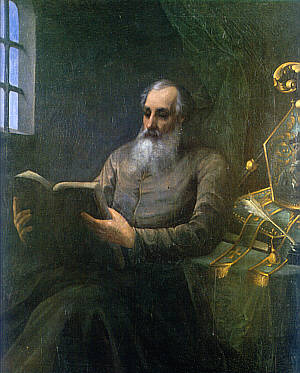
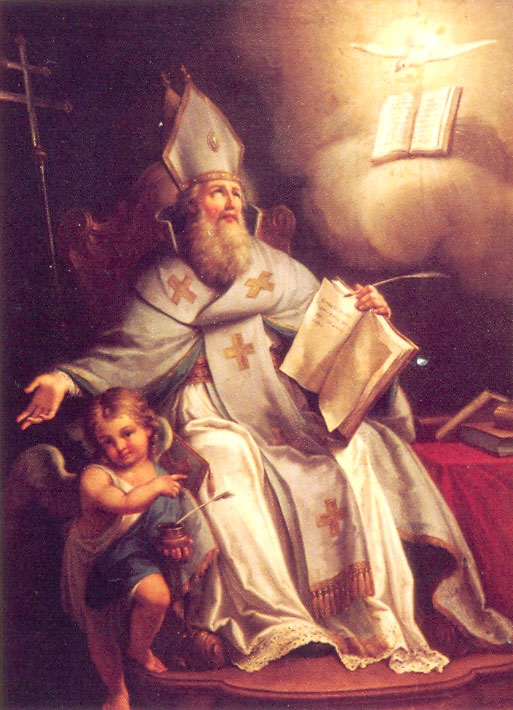
Saint Isaac the Great, also known as Sahak and Parthev, was born in 338, the son of Saint Nerses the Great, Catholicos of Armenia.
Left an orphan at a very early age, he received in Constantinople an excellent education, particularly in the Eastern languages. He was a married layman for several years. When he wife died he became a monk, succeeding his father as Catholicos (Patriarch) of Armenia in 390. He secured recognition from Constantinople of the status, rights and independence of the Armenian Church. From his position he worked to reform the Armenian Church, evangelize the Armenian people, and establish an Armenian identity. Through Isaac’s efforts the churches and monasteries destroyed by the Persians were rebuilt, education was cared for in a generous way, the pagan worship of Ormuzd which Shah Yezdigerd tried to set up was cast out, and three councils held to re-establish ecclesiastical discipline. He was also noted for his ascetic life.
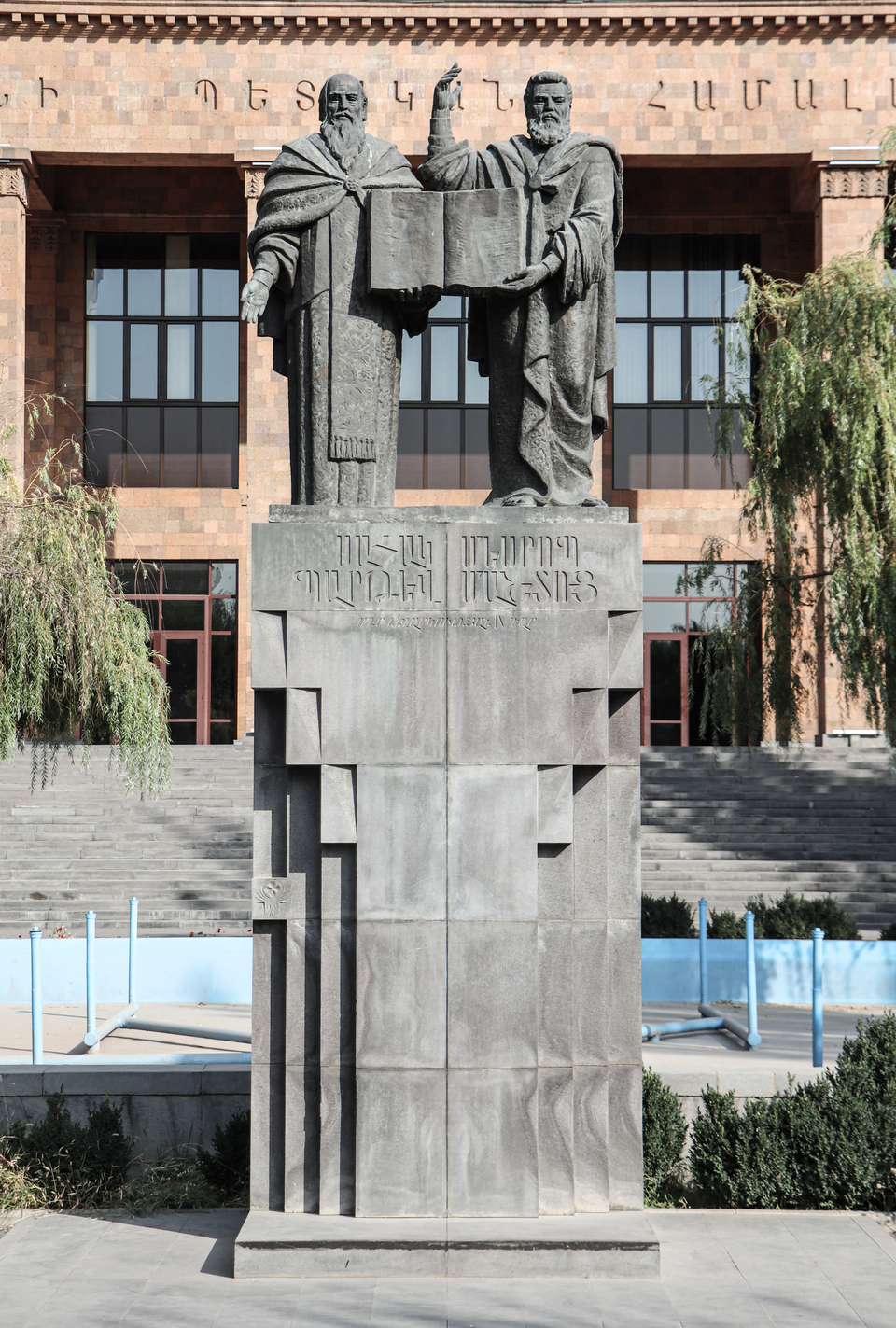
Isaac worked with Saint Mesrop the Teacher to evangelize Armenia, and to develop an alphabet for the Armenian language. He supported the translation of the Bible and the Greek and Syrian Doctors of the Church into Armenian, and translated some of holy scripture himself. Isaac served as both civil and religious ruler of his people, established a national liturgy, and was responsible for the beginnings of Armenian literature. He was driven into retirement in 428 when the Persians conquered part of his territory, but later returned as Catholicos at Ashtishat from where he worked until he death. He is considered the founder of the Armenian Church.
He died at the age of 110 at Ashtishat, of natural causes.
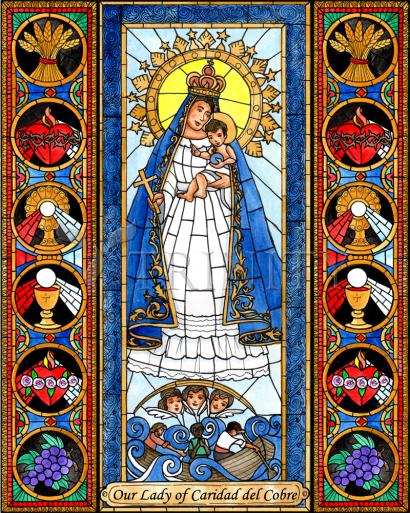
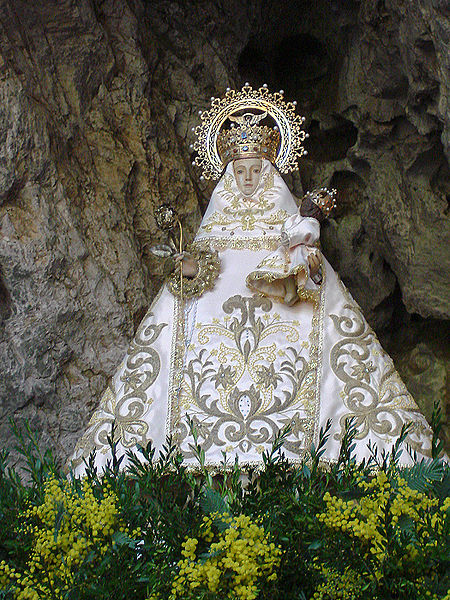
Nuestra Senora de la Covadonga, also named “La Santina” / Our Lady of Covadonga (720) – 8 September:
This is a title of the Blessed Virgin Mary and the name of a Marian Shrine devoted to her at Covadonga, Asturias. The Shrine in northwestern Spain rose to prominence following the Battle of Covadonga in about 720, which was the first defeat of the Moors during their invasion of Spain. A Statue of the Virgin Mary, secretly hidden in one of the caves, was believed to have miraculously aided the Christian victory. Our Lady of Covadonga is the Patron of Asturias, and a Basilica was built to house the current Statue. Our Lady of Covadong’s east day is 8 September.
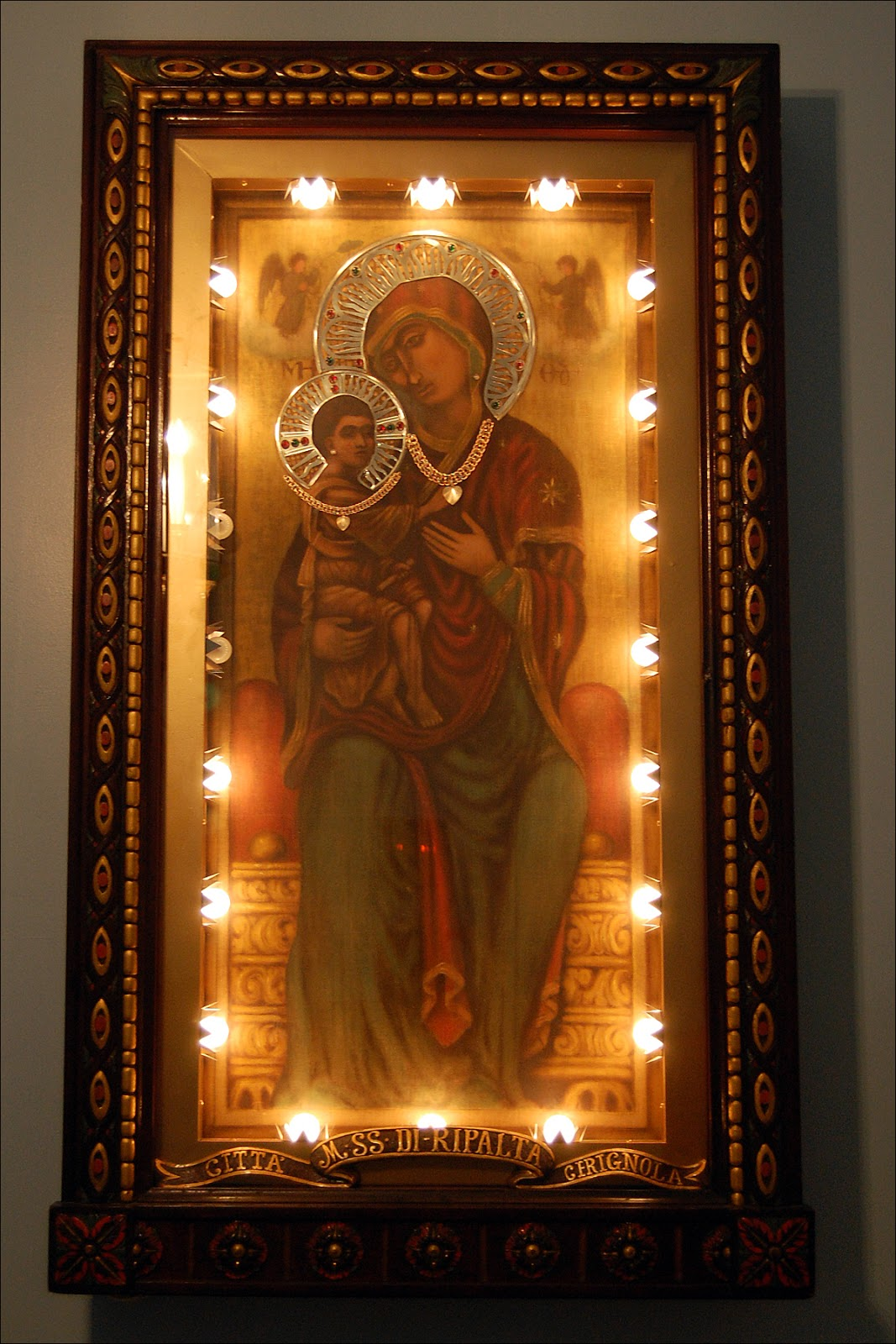
Our Lady of Health of Vailankanni (16th Century) – 8 September:
This is the title given to the Blessed Virgin Mary by people as she twice appeared in the town of Velankanni, Tamil Nadu, India, in the 16th to 17th centuries. The Feast of the Nativity of Mary, is also commemorated as the feast of Our Lady of Good Health. The celebration starts on 29 August and ends on the day of the feast. The feast day prayers are said in Tamil, Marathi, East Indian, Malayalam, Telugu, Kannada, Konkani, Hindi and English.
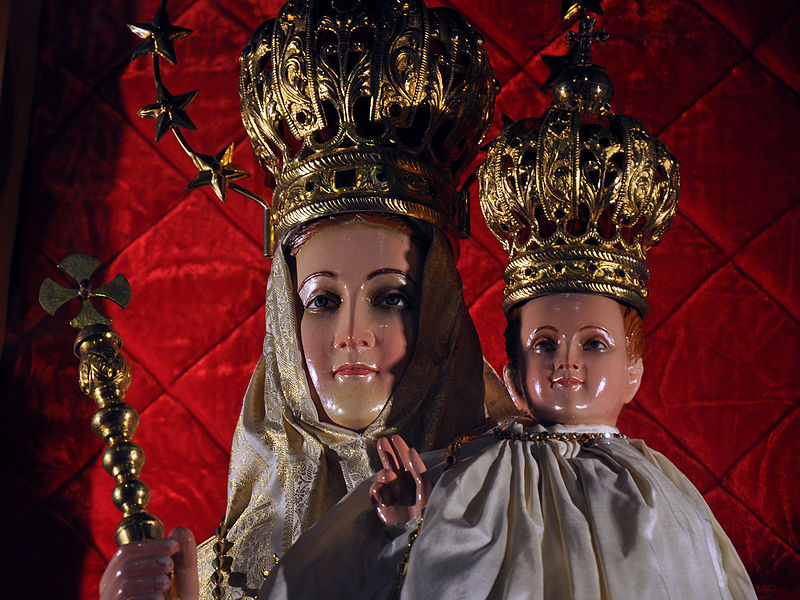
Nuestra Senora de la Meritxell / Our Lady of Meritxell (12th Century) – 8 September:
This is an Andorran Roman Statue depicting an apparition of the Virgin Mary. Our Lady of Meritxell is the Patron Saint of Andorra. On 6 January in the late 12th century, villagers from Meritxell, Andorra were going to Mass in Canillo. Though it was winter, they found a wild rose in bloom by the roadside. At its base was a Statue of the Virgin and Child. They placed the Statue in a Chapel in the Church in Canillo. The next day the Statue was found sitting under the wild rose again. Villagers from Encamp took the Statue to their Church but the next day the Statue had returned to the rose bush. Though it was snowing, an area the size of a Chapel was completely bare and the villagers of Meritxell took this to mean that they should build a Chapel to house the Statue and so they did. On 8-9 September 1972 the Chapel burned down and the Statue was destroyed, a copy now resides in the new Meritxell Chapel. The feast day of Our Lady of Meritxell is 8 September and the Andorran National Day.
St Thomas of Villanova OSA (1488 – 1555) Bishop, Religious Priest of the Order of St Augustine, Confessor, Writer, Preacher, Teacher, Apostle of Charity, Mystic, Miracle-Worker often called “the Almsgiver” and “the Father of the Poor“, Reformer.
St Timothy of Antioch Bl Wladyslaw Bladzinski — Martyrs of Alexandria – (5 saints) A group of Christians martyred together in the persecutions of Diocletian – Ammon, Dio, Faustus, Neoterius and Theophilus. Martyred in Alexandria, Egypt.
Martyrs of Japan – (21 beati): A group of 21 missionaries and converts who were executed together for their faith. • Antonio of Saint Bonaventure • Antonio of Saint Dominic • Dominicus Nihachi • Dominicus of Saint Francis • Dominicus Tomachi • Francisco Castellet Vinale • Franciscus Nihachi • Ioannes Imamura • Ioannes Tomachi • Laurentius Yamada • Leo Aibara • Lucia Ludovica • Ludovicus Nihachi • Matthaeus Alvarez Anjin • Michaël Tomachi • Michaël Yamada Kasahashi • Paulus Aibara Sandayu • Paulus Tomachi • Romanus Aibara • Thomas of Saint Hyacinth • Thomas Tomachi Died on 8 September 1628 in Nagasaki, Japan Beatified on 7 May 1867 by Pope Pius XI
Martyred in England: Bl John Norton Bl Thomas Palaser
Martyred in the Spanish Civil War: • Blessed Adrián Saiz y Saiz • Blessed Apolonia Lizárraga Ochoa de Zabalegui • Blessed Bonifacio Rodríguez González • Blessed Dolores Puig Bonany • Blessed Eusebio Alonso Uyarra • Blessed Ismael Escrihuela Esteve • Blessed Josefa Ruano García • Blessed Josep Padrell Navarro • Blessed Mamerto Carchano y Carchano • Blessed Marino Blanes Giner • Blessed Miguel Beato Sánchez • Blessed Pascual Fortuño Almela • Blessed Segimon Sagalés Vilá • Blessed Tomàs Capdevila Miquel
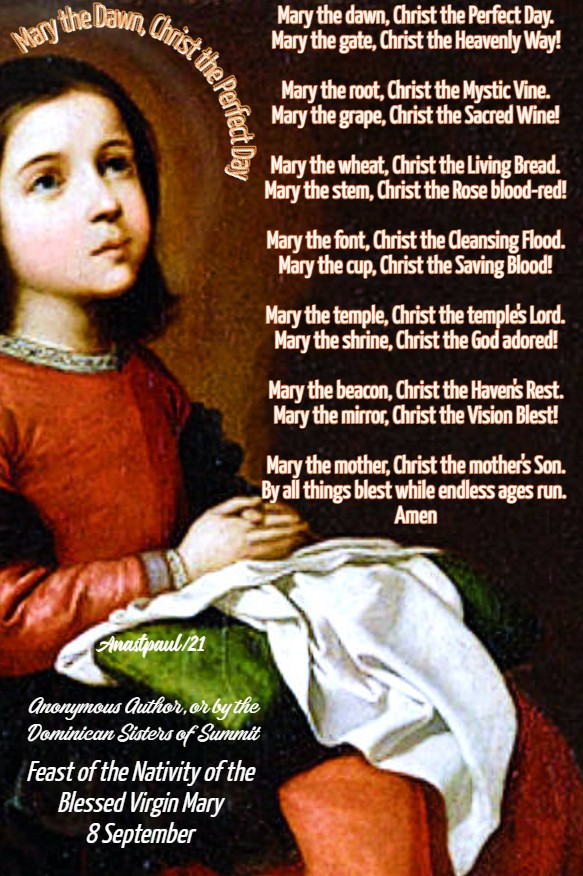
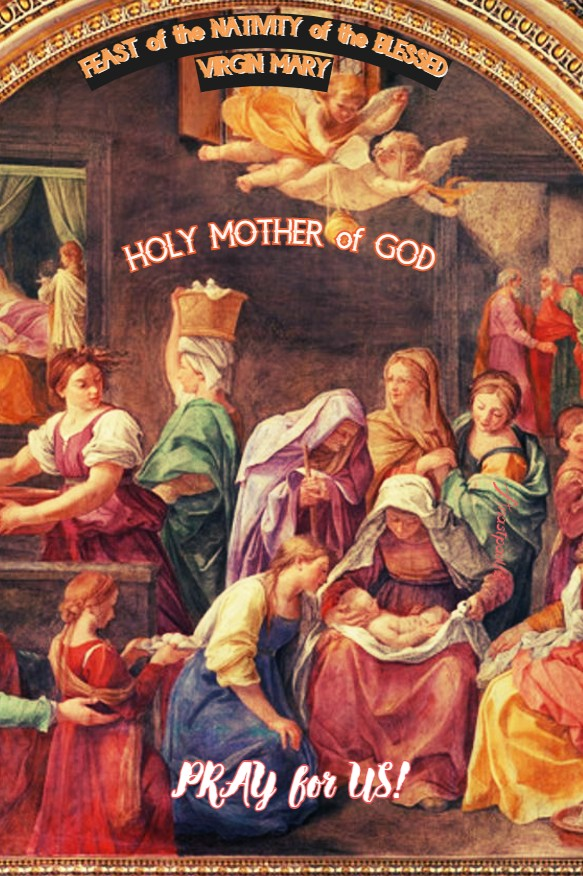
One Minute Reflection –8 September – Feast of the Nativity of the Blessed Virgin Mary – Readings: Sedulius, Ps 44:2, Prov 8:22-35, Matt 1:1-16
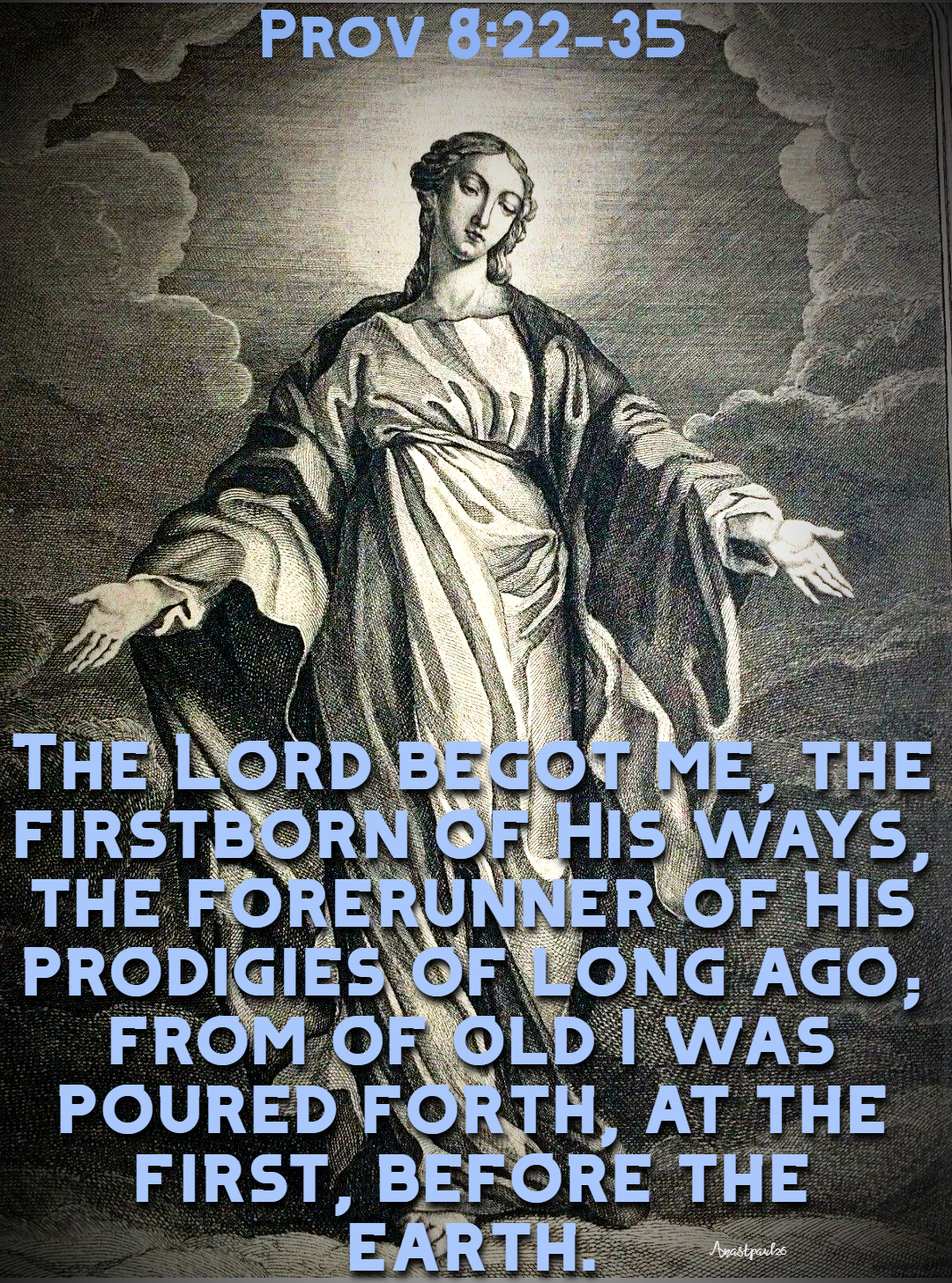
The Lord begot me, the firstborn of His ways, the forerunner of His prodigies of long ago; from of old I was poured forth, at the first, before the earth.
Prov 8:22-35
REFLECTION – Rightly indeed does the Virgin Mary, who truly conceived the first born of all, hold first place in the congregation of the just. For Christ is “the firstborn of many brethren”. And so, in the divinely inspired scriptures, what is said in general of the Virgin Mother the Church is said individually of the Virgin Mary; and what is said in the particular case of the Virgin Mother Mary is rightly understood of the Virgin Mother Church universally; and when mention is made of either, it is to be understood almost indifferently and conjointly of both.
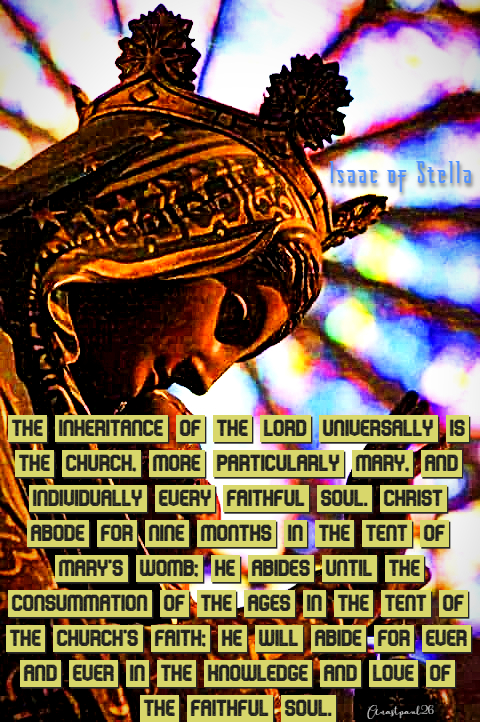
Every faithful soul, spouse of the Word of God, mother, daughter and sister of Christ, is understood to be a virgin with her own form of fertility. This is said of the whole Church, more particularly of Mary, and individually of the faithful soul, by the Wisdom itself of God, the Father’s Word. Therefore, the text continues: “I shall abide in the inheritance of the Lord”. The inheritance of the Lord universally is the Church, more particularly Mary, and individually every faithful soul. Christ abode for nine months in the tent of Mary’s womb; he abides until the consummation of the ages in the tent of the Church’s faith; he will abide for ever and ever in the knowledge and love of the faithful soul.
Isaac of Stella (?-c.1171) Cistercian monk
PRAYER – Lord God, the day of our salvation dawned when the Blessed Virgin gave birth to Your Son. As we celebrate her nativity, grant us Your grace and Your peace. Through Christ, our Lord, Your Son in union with the Holy Spirit. Mary, Mother of God, pray for us, amen.
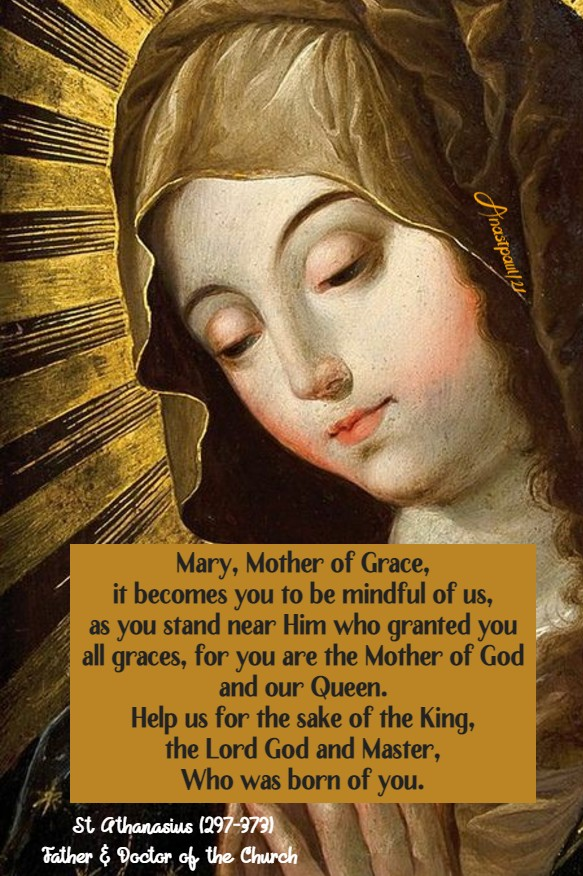
“Mary, Mother of Grace, it becomes you to be mindful of us, as you stand near Him who granted you all graces, for you are the Mother of God and our Queen. Help us for the sake of the King, the Lord God and Master, Who was born of you.”
St Athanasius
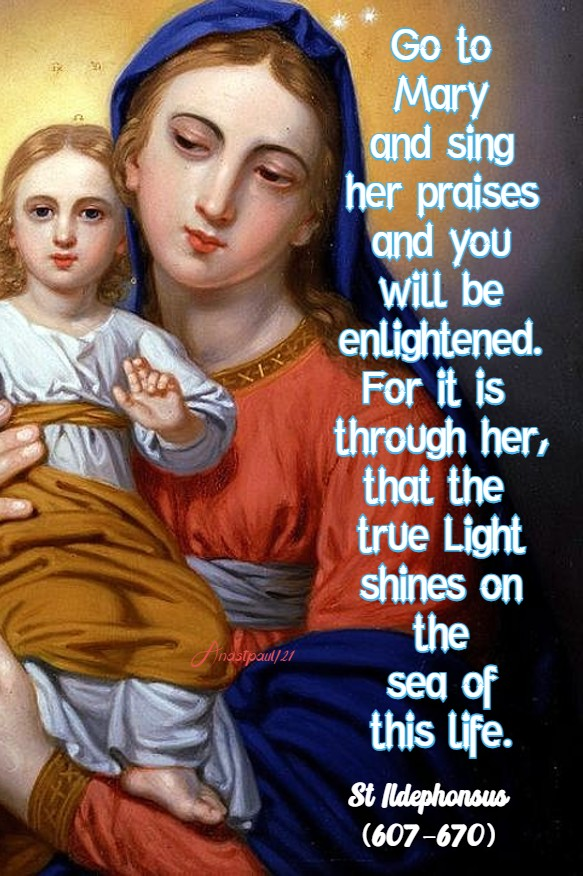
“Go to Mary and sing her praises and you will be enlightened. For it is through her, that the true Light shines on the sea of this life.”
St Ildephonsus
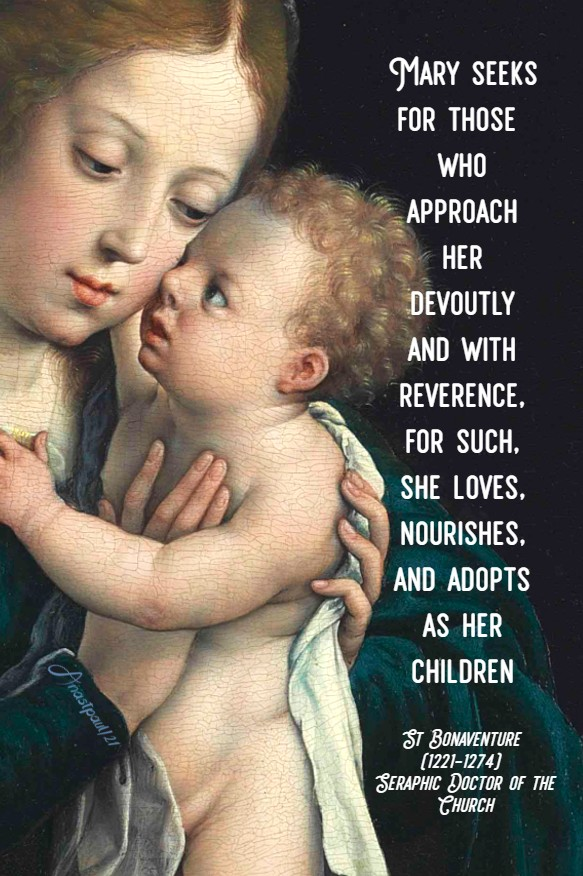
“Mary seeks for those who approach her devoutly and with reverence, for such she loves, nourishes, and adopts as her children. ”
St Bonaventure
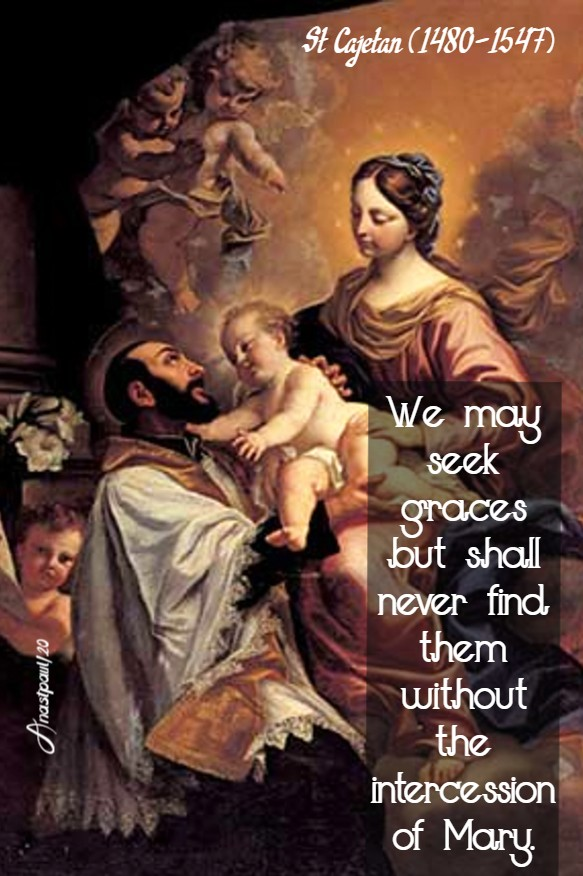
“We may seek graces but shall never find them without the intercession of Mary.”
St Cajetan
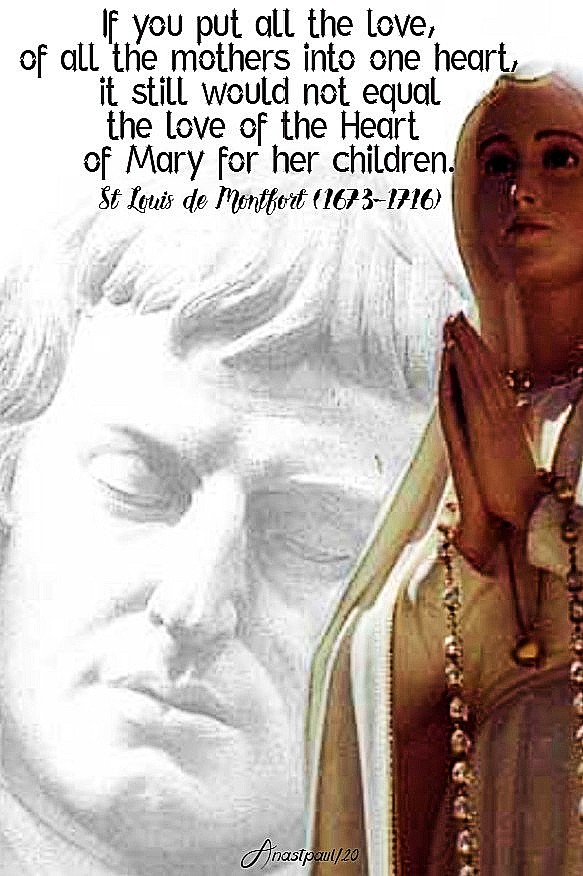
“If you put all the love, of all the mothers into one heart, it still would not equal the love of the Heart of Mary for her children.”
St Louis de Montfort
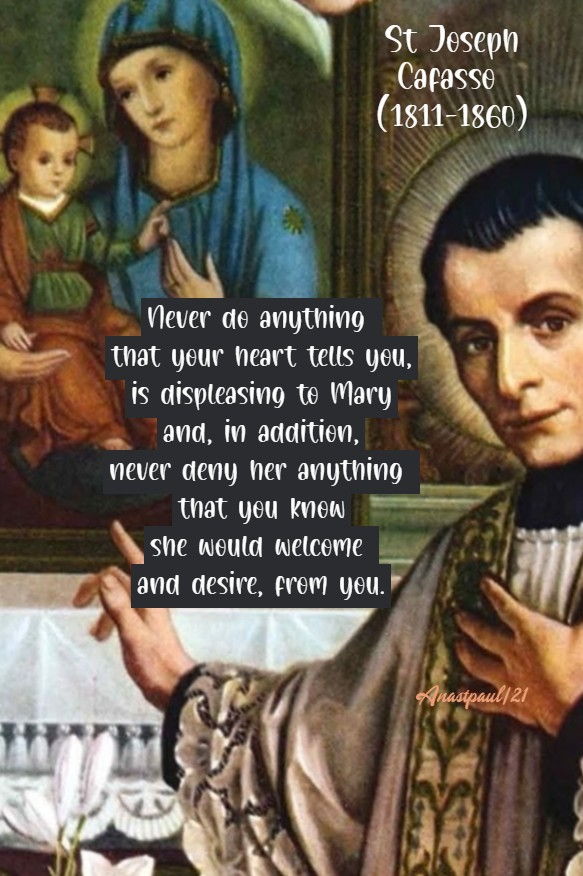
“Never do anything that your heart tells you, is displeasing to Mary and, in addition, never deny her anything that you know she would welcome and desire from you.”
St Joseph Cafasso
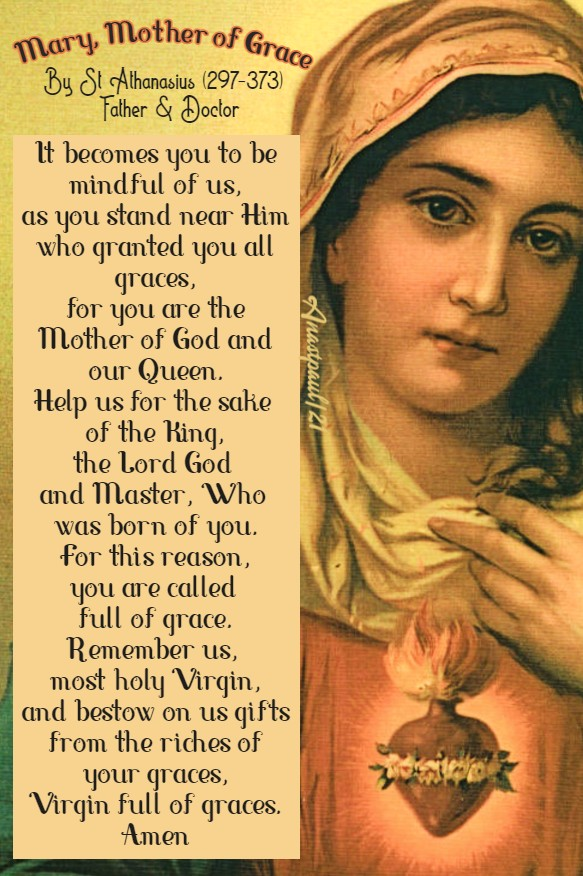
Mary, Mother of Grace St Athanasius (297-373)
It becomes you to be mindful of us, as you stand near Him who granted you all graces, for you are the Mother of God and our Queen. Help us for the sake of the King, the Lord God and Master, Who was born of you. For this reason, you are called full of grace. Remember us, most holy Virgin, and bestow on us gifts from the riches of your graces, Virgin full of graces. Amen
Letter to the Friends of the Cross by St Louis de Montfort
[3. Nothing is so glorious]
So rejoice and be glad when God favours you with one of his choicest crosses; for without realising it, you are blessed with the greatest gift of heaven, the greatest gift of God. If you really appreciated it, you would have Masses offered, you would make novenas at the shrines of the saints, you would undertake long pilgrimages, as did the saints, to obtain from heaven this divine gift.
The world calls this madness, degradation, stupidity, a lack of judgement and of common sense. They are blind: let them say what they like. This blindness, which makes them view the cross in a human and distorted way, is a source of glory to us. Every time they cause us to suffer by their ridicule and insults, they are presenting us with jewels, setting us on a throne, and crowning us with laurels.
More than that, as St. John Chrysostom says, “All the wealth and honours and sceptres and jewelled crowns of kings and emperors are not to be compared with the splendour of the cross.” It is greater even than the glory of an apostle or evangelist.“If I had the choice,”continues this holy man, enlightened by the Holy Spirit, “I would willingly leave heaven in order to suffer for the God of heaven. I would prefer dungeons and prisons to the thrones of the highest heaven, and the heaviest of crosses to the glory of the seraphim. I value the honour of suffering more than the gift of miracles, giving me the power to command evil spirits, shake the elements of the world, halt the sun in its course, or raise the dead to life. St. Peter and St. Paul are more glorious in their prison chains than in being caught up into the third heaven or receiving the keys of heaven.”
Indeed, is it not the Cross which has given to Jesus Christ “the name which is above all other names, so that all beings in the heavens, on earth and in the underworld should bend the knee at the name of Jesus?” The glory of one who knows how to suffer is so great that heaven, angels and men, and even God himself, gaze on him with joy as a most glorious sight. And if the saints in heaven desired anything, it would be to return to earth so as to bear some crosses.
But if this glory is so great even on earth, what will it be in heaven? Who could describe it? Who could ever understand fully that eternal weight of glory which a single moment spent in cheerfully carrying a cross obtains for us? Who could understand the glory gained in heaven by a year, and sometimes a whole lifetime, of crosses and suffering?
You can be sure, my dear Friends of the Cross, that something wonderful is awaiting you, since the Holy Spirit has united you so intimately to that which everyone so carefully avoids. And you can be sure, too, that God will make of you as many saints as there are Friends of the Cross if you are faithful to your vocation and willingly carry your cross as Christ did.




You must be logged in to post a comment.