Posted in MARIAN TITLES

Our Lady of Guadalupe, Spain, (14th century) and Memorials of the Saints – 13 September

Our Lady of Guadalupe in Extremadura, Spain:
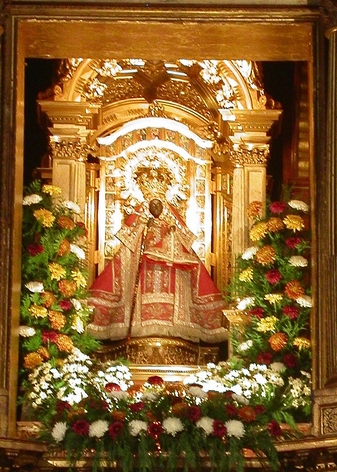
The original Our Lady of Guadalupe in Spain

The Marian shrine of Our Lady of Guadalupe is located in the Extremadura region of what was the Kingdom of Castile. The shrine houses a Black Madonna, a statue crafted by the loving hands of Saint Luke the Evangelist himself and given to Saint Leander, Archbishop of Seville, by Pope Gregory I. It is one of the fifteen Black Madonnas in Spain. The statue was canonically crowned on 12 October 1928 by Pope Pius XI with a crown designed and crafted by Father Felix Granda, and crowned in the presence of King Alfonso XIII of Spain.

Spain was invaded by the Muslims in the year 711. The beloved statue of the Blessed Virgin was taken by the Christians who fled before the advance of the invading hordes, placing the statue in a strongbox and burying it in a cave in the hills near the Guadalupe River in Extremadura. When those who had safeguarded the statue died, the existence of it and the knowledge of its location was lost.

In the year 1326, the Blessed Virgin appeared to a shepherd near the village of Guadalupe, asking him to have priests dig at the site of the apparition. When they did, the priests found the strongbox that had been buried in the earth over 600 years previously. It contained documents that identified the cherished statue that became known as Our Lady of Guadalupe. A Marian shrine was built there in her honor.
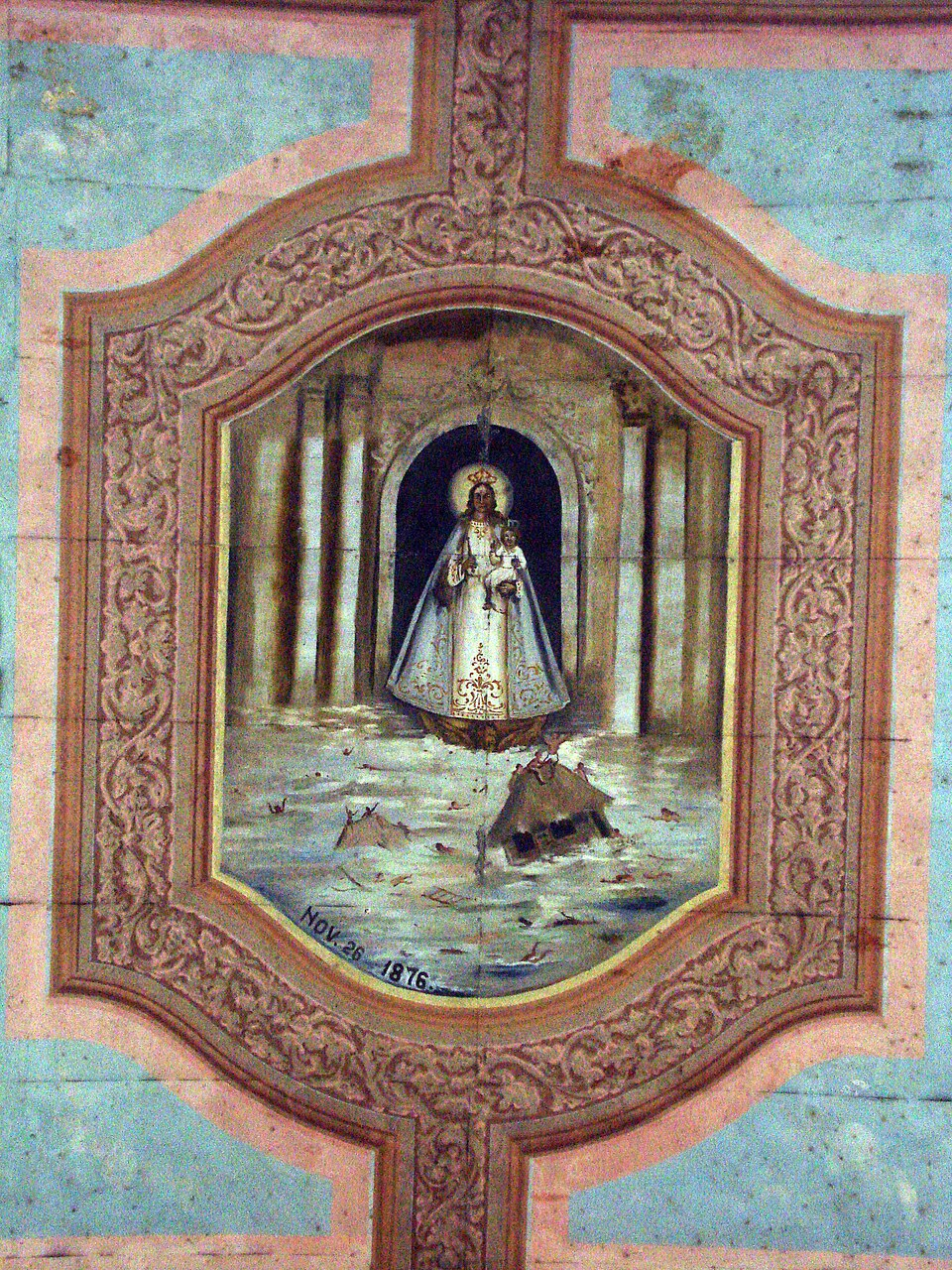
A copy of the Extremaduran image is enshrined in Loboc Church in the island province of Bohol, and has documented miracles attributed to the Virgin.

Immediately pilgrims began to visit the shrine dedicated to Our Lady of Guadalupe, and in 1340, King Alfonso XI endowed the sanctuary over which he took a particular interest. It was in that same year that Abu Hasan of Morocco had invaded the Iberian Peninsula with a huge army, intending to march into Castile and reverse the earlier Catholic expansion into what had been Muslim territory. The battle of Rio Salado had been hard fought, though it ended in a Christian victory that King Alfonso attributed to the intercession of the Blessed Virgin, Our Lady of Guadalupe.
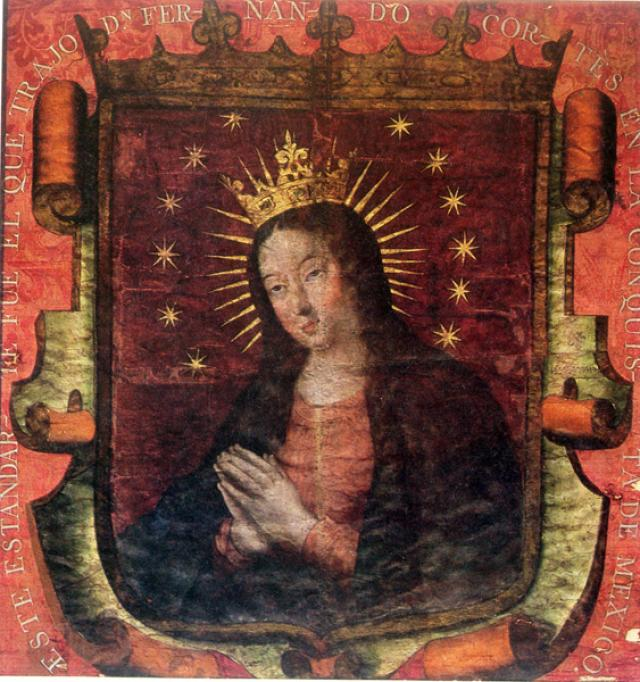
Banner of Cortés preserved in the Army Museum in Toledo (Spain)

In 1389 the Spanish architect, Juan Alphonso, began the church, which has walls ornamented with magnificent votive offerings, attesting to more than three thousand authentic miracles of the Blessed Virgin, Our Lady of Guadalupe.

The veneration for Our Lady of Guadalupe crossed the ocean, and was established by miracles in Mexico. The magnificent captain, Hernan Cortez, conquered the evil Aztec Empire under a Marian standard. Cortez himself was from Extremadura.
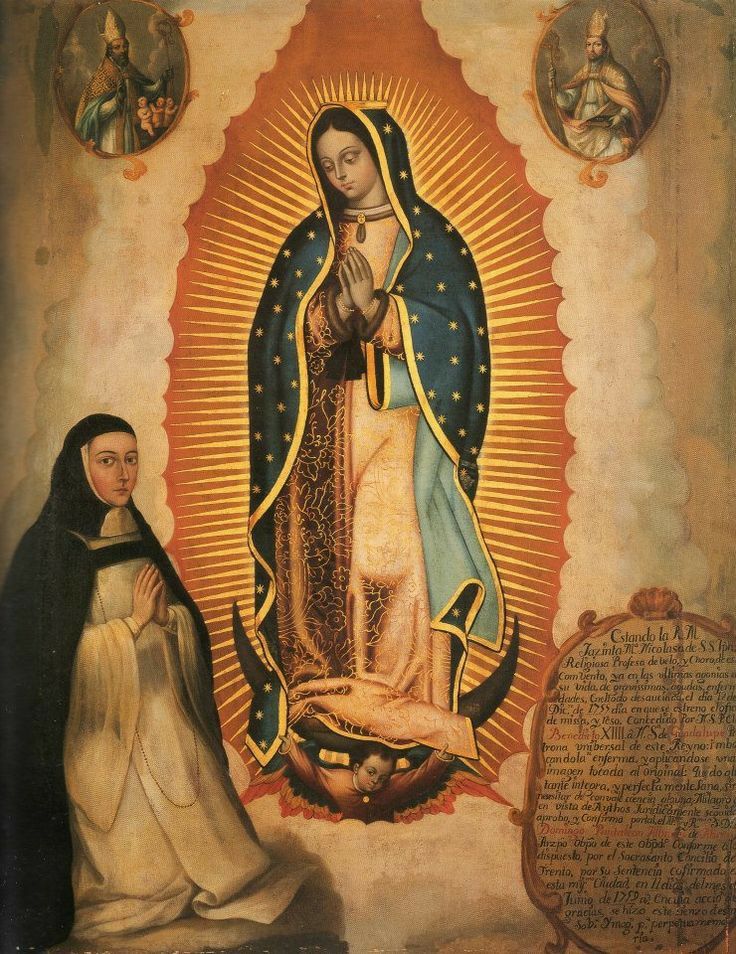
Our Lady of Guadalupe in Mexico

St John Chrysostom (347-407) “Golden Mouthed” Father & Doctor of the Church (Memorial of his Departure).

Dedication of the Basilicas of Jerusalem: Commemoration of the dedications of the Basilicas built on Mount Calvary and the Church of the Holy Sepulchre in Jerusalem.

St Aigulf

St Amatus OSB (c 560-c 627) Monk, Abbot, Hermit, Penitent, miracle-worker, together with St Romaric, he founded Remiremont Abbey.

St Barsenorius
Bl Claude Dumonet
St Columbinus of Lure
St Emiliano of Valence
St Evantius of Autun
St Gordian of Pontus
Bl Hedwig of Hreford
St Julian of Ankyra
St Ligorius
St Litorius of Tours
St Macrobius
St Marcellinus of Carthage
Bl María López de Rivas Martínez

St Maurilius of Angers (c 336-426) Bishop of Angers, Cantor for Saint Ambrose, (Bishop of Milan and Father and Doctor of the Church), Disciple of St Martin of Tours.

St Nectarius of Autun

St Notburga (c 1265-1313) Virgin
St Philip of Rome
St Venerius of Tino

Martyrs of Ireland:
• Blessed Edward Stapleton
• Blessed Elizabeth Kearney
• Blessed James Saul
• Blessed Margaret of Cashel
• Blessed Richard Barry
• Blessed Richard Butler
• Blessed Theobald Stapleton
• Blessed Thomas Morrissey
• Blessed William Boyton

Martyred in the Spanish Civil War including the Martyrs of Pozo de Cantavieja – 11 beati:
• Blessed Bienvenido Villalón Acebrón
• Blessed Emilio Antequera Lupiáñez
• Blessed Florencio Arnáiz Cejudo
• Blessed Francisco Rodríguez Martínez
• Blessed Joaquín Gisbert Aguilera
• Blessed José Álvarez-Benavides de La Torre
• Blessed José Cano García
• Blessed José Román García González
• Blessed Juan Capel Segura
• Blessed Juan Ibáñez Martín
• Blessed Luis Eduardo López Gascón
• Blessed Manuel Alvarez y Alvarez
• Blessed Manuel Martínez Giménez
• Blessed Pío Navarro Moreno
• Blessed Ramiro Argüelles Hevia
• Blessed Sabino Ayastuy Errasti
• Blessed Teófilo Montes Calvo
Posted in SAINT of the DAY

Saint of the Day – 13 September – St Aigulf

Saint Aigulf, also known as Aigulphe, Aygulf or Ayoul. He was Abbot of Lérins, and a martyr.

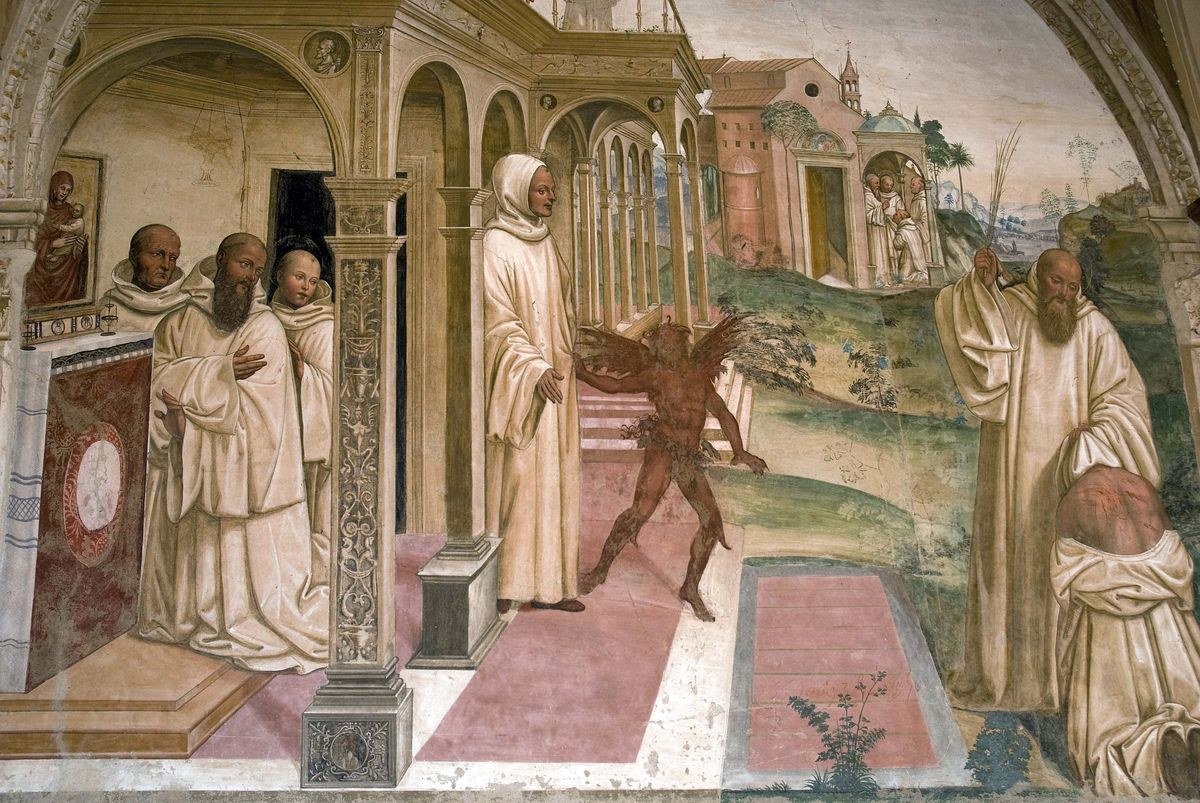
St. Benedict frees a monk possessed by a demon by striking him.

Aigulf was born in 630 in Blois and was a Benedictine monk at Fleury, France. He led a party of monks sent to retrieve the relics of Saint Bernard from the Lombards. Later, he was called upon to reform the Abbey of Saint Honorat.

He became abbot of Lérins around 671 and worked to restore monastic discipline, which had weakened over time. He replaced the monks’ own rules, which had been followed since the abbey’s origins, with the Rule of Saint Benedict. Many of the brothers supported him, but some resisted, and following a riot they conspired to have Aigulf and four of his supporters kidnapped by soldiers, taken to the island of Capri, Italy, blinded, tortured and murdered. The monks of Lérins claimed possession of his relics and have always considered Aygulf a martyr. A chapel was dedicated to him in the fortified monastery. 

Saint Aygulf is invoked for the healing of eye ailments.

Posted in Our MORNING Offering

Our Morning Offering – 13 September – O God, Send forth Your Holy Spirit

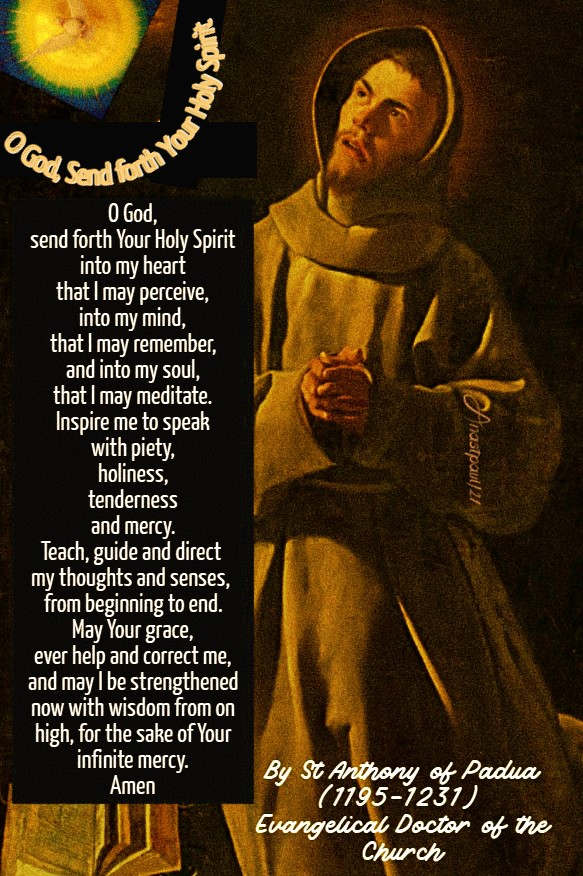
O God, Send forth Your Holy Spirit
By St Anthony of Padua (1195-1231)
Doctor of the Church

O God,
send forth Your Holy Spirit
into my heart
that I may perceive,
into my mind,
that I may remember,
and into my soul,
that I may meditate.
Inspire me to speak
with piety,
holiness,
tenderness
and mercy.
Teach, guide and direct my thoughts
and senses, from beginning to end.
May Your grace,
ever help and correct me,
and may I be strengthened now
with wisdom from on high,
for the sake of Your infinite mercy.
Amen

Posted in ONE Minute REFLECTION

One Minute Reflection – 13 September – Jesus at table with the Pharisees

One Minute Reflection – 13 September – Readings: Ps 85:3; 85:5, Ps 85:1, Eph 3:13-21, Luke 14:1-11

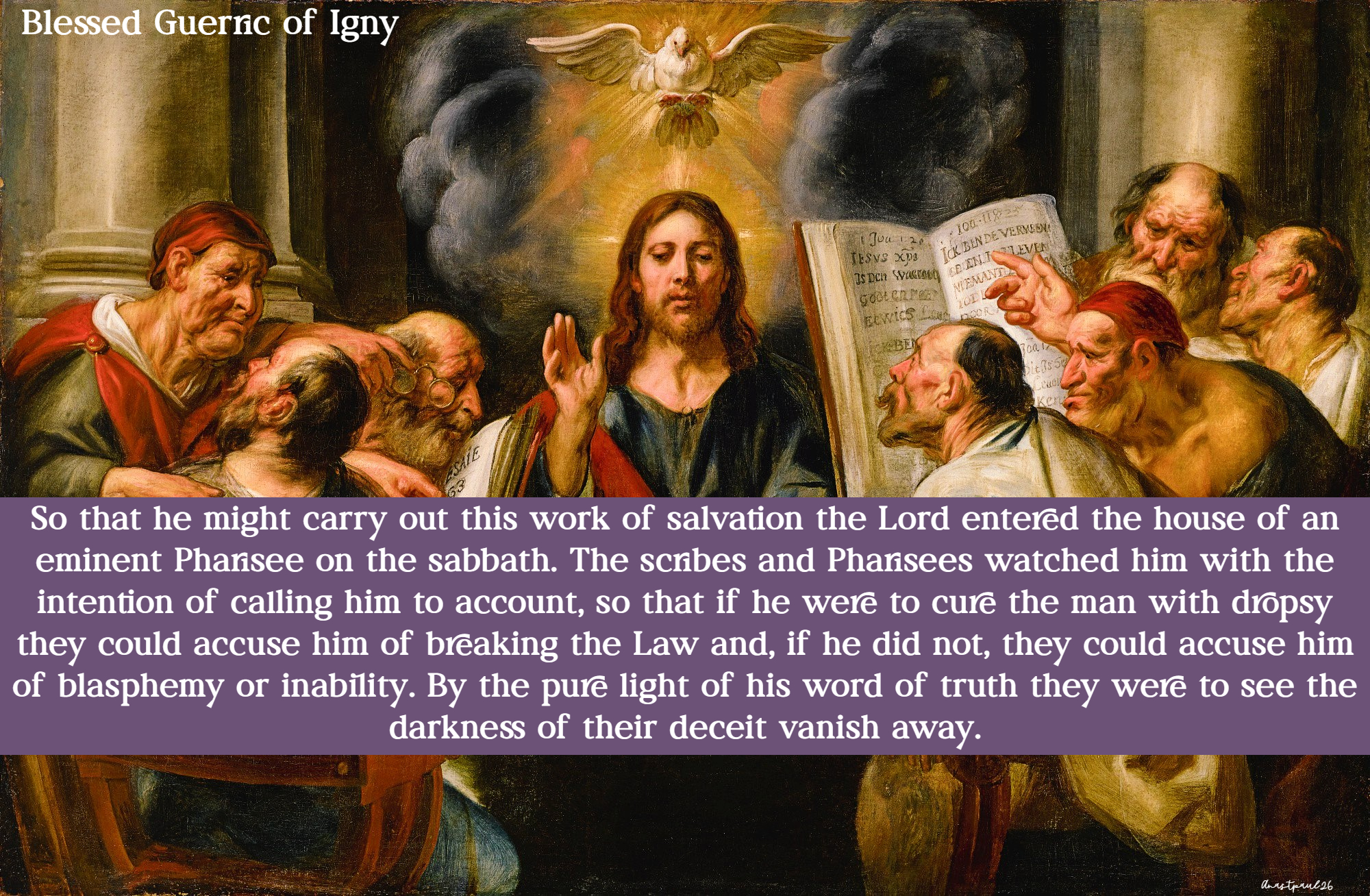
And Jesus asked the lawyers and Pharisees, saying, Is it lawful to cure on the Sabbath? But they remained silent. And He took and healed him and let him go.

Luke 14:1-11

REFLECTION – The world’s eternal and invisible Creator, preparing to save humankind, which for long ages had been hindered by its subjection to the heavy law of death, deigned “in these last days” to become man that in his mercy he might redeem those who in justice he condemned. And so as to show the depth of his love for us, he not only became a man but a poor and humble man so that, by drawing near to us in his poverty, he might make us sharers in his riches. So poor did he become for our sake that he had nowhere to lay his head: “Foxes have dens and the birds of the air have their nest, but the Son of Man has nowhere to lay his head”.

This is the reason why he agreed to go and dine wherever he was invited, not out of an excessive enjoyment in eating but so that he could teach the way of salvation and stimulate faith. There he would fill the guests with light by his miracles and the servants, who were kept busy inside and were not free to go with him, would hear the words of salvation. Indeed, he despised no one and none were considered unworthy of his love because “he has mercy on all; he hates nothing of what he has made and takes care of them all”.

So that he might carry out this work of salvation the Lord entered the house of an eminent Pharisee on the sabbath. The scribes and Pharisees watched him with the intention of calling him to account, so that if he were to cure the man with dropsy they could accuse him of breaking the Law and, if he did not, they could accuse him of blasphemy or inability. By the pure light of his word of truth they were to see the darkness of their deceit vanish away.

Blessed Guerric of Igny

PRAYER – Lord God and holy Father, guard our faith we pray and grace us with Your mercy. Keep us ever faithful to Your precepts and bring us to Your home, to look upon Your Face. May the prayers of Your saints assist us on our journey. In your untiring life of trust in God, And may our Holy and Sorrowful Mother Mary, be our merciful protector. We ask all this through Christ, our Lord with the Holy Spirit, one God forever, amen.

Posted in CATHOLIC Quotes

Quote/s of the Day – 13 September – Wisdom

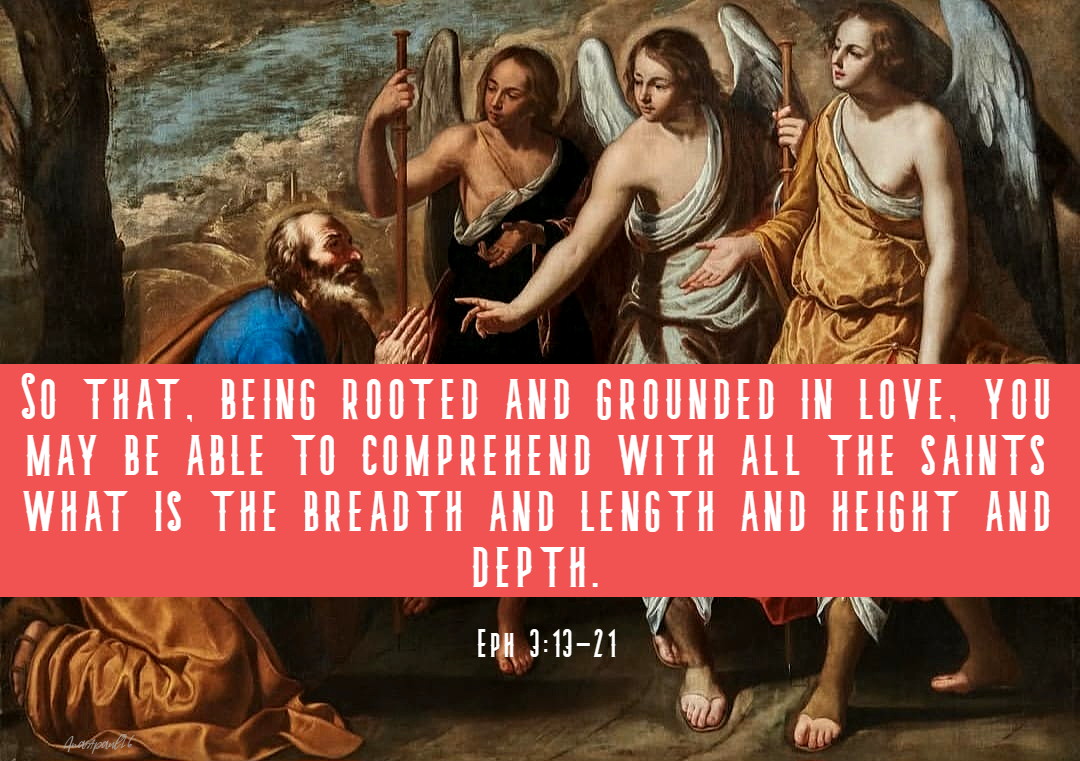
So that, being rooted and grounded in love, you may be able to comprehend with all the saints what is the breadth and length and height and depth.

Eph 3:13-21

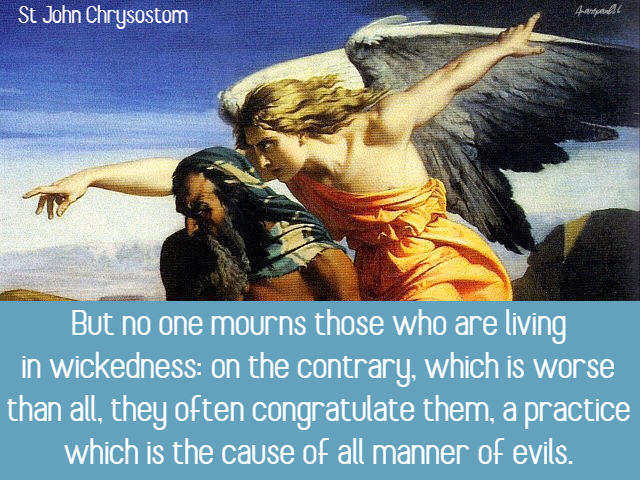
Some bewail and lament the inmates of the prison, some those who have been expelled from their country and transported to the land of exile, others those who have been deprived of their freedom, others those who have been seized and made captives by enemies, others those who have been drowned, or burnt, or buried by the fall of a house, but no one mourns those who are living in wickedness: on the contrary, which is worse than all, they often congratulate them, a practice which is the cause of all manner of evils.

St John Chrysostom

These are the two roads, and both are hard to travel. Wonder, then, at the ignorance and blindness of man, who, having a Road made for him, which causes such delight to those who use It, that every bitterness becomes sweet, and every burden light, yet prefers to walk over the water. 

The Dialogue of St Catherine of Siena

Poverty is good and contains within itself all the good things in the world. It is a great domain – I mean that he who cares nothing for the good things of the world has dominion over them all. What do kings and lords matter to me if I have no desire to possess their money, or to please them, if by so doing I should cause the least displeasure to God? And what do their honours mean to me if I have realised that the chief honour of a poor man consists in his being truly poor?

St Teresa of Avila

We become what we love and who we love shapes what we become. If we love things, we become a thing. If we love nothing, we become nothing.

St Clare of Assisi

True peace is a certain mark of predestination.

Father Segneri S.J (17th Century)

Posted in SEPTEMBER-The SEVEN SORROWS of MARY and The HOLY CROSS

Thought for the Day – 13 September – On the Second Dolor

Reflections on each of the Seven Dolors of Mary by St Alphonsus Liguori

Of The Flight of Jesus Into Egypt

Herod having heard that the expected Messiah was born, foolishly feared that the new-born King would deprive him of his kingdom. Hence St. Fulgentius, reproving him for his folly, thus says: “Why, oh Herod, art thou that disturbed? This King who is born has not come to conquer kings by arms, but to subjugate them, in a wonderful manner, by his death.” The impious Herod, therefore, waited to learn from the holy magi where the King was born, that he might take from him his life; but finding himself deceived by the magi, he ordered all the infants that could be found in the neighborhood of Bethlehem to be put to death. But an angel appeared in a dream to St. Joseph, and said to him:” Arise, and take the child and his mother, and fly into Egypt.”

According to Gerson, immediately, on that very night, Joseph made this command known to Mary; and taking the infant Jesus, they commenced their journey, as it seems clearly from the Gospel itself: Who arose and took the child and his mother by night, and retired into Egypt.” And then the afflicted Mary knew that already the prophecy of Simeon, regarding her Son, was beginning to be verified: ” He is set for a sign which shall be contradicted.” Seeing that scarcely is he born,when he is persecuted to death. What suffering it must have been to the heart of Mary, writes St. John Chrysostom, to hear the tidings of that cruel exile of herself with her Son! Flee from thy friends to strangers, from the holy temple of the only true God, to the temples of demons. What greater tribulation than that a new-born child, clinging to its mother’s bosom, should be forced to fly with the mother herself!

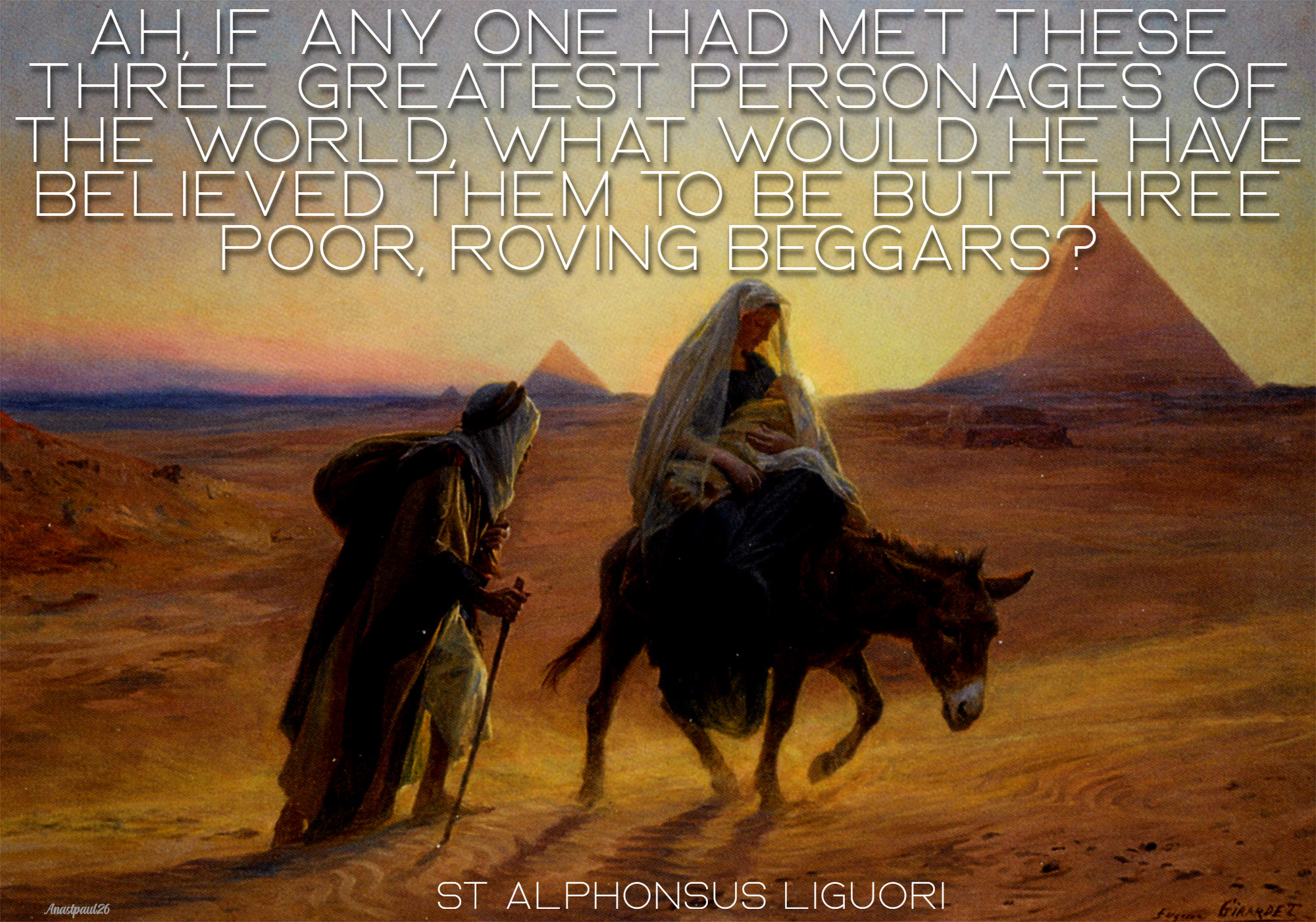
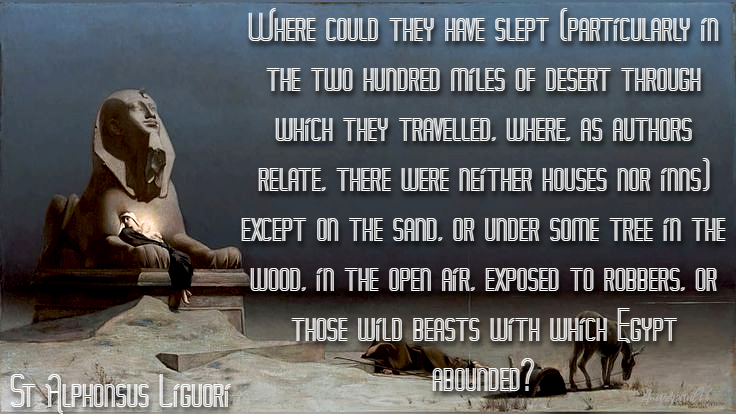
Every one can imagine how much Mary must have suffered on this journey. It was a long distance to Egypt. Authors generally agree with Barrada that it was four hundred miles; so that at least it was a journey of thirty days. The way, as St. Bonaventure describes it, was rough, unknown, through woods, and little frequented. The season was winter, and therefore they had to travel in snow, rain, wind, and storms, and through bad and difficult roads. Mary was then fifteen years of age, a delicate virgin, unaccustomed to such journeys. They had no servant to attend them. Joseph and Mary, said St. Peter Chrysologus, had no man servant nor maid-servant; they were themselves both masters and servants. Oh God, how piteous a spectacle it was to see that tender Virgin, with that newly born infant in her arms wandering through this world! St. Bonaventure asks, Where did they obtain food? Where did they rest at night? How were they lodged ? What other food could they have, than a piece of hard bread which Joseph brought with him or begged in charity? Where could they have slept (particularly in the two hundred miles of desert through which they travelled, where, as authors relate, there were neither houses nor inns) except on the sand, or under some tree in the wood, in the open air, exposed to robbers, or those wild beasts with which Egypt abounded? Ah, if any one had met these three greatest personages of the world, what would he have believed them to be but three poor, roving beggars?

They lived in Egypt, according to St. Anselm, Heliopolis, first called Memphis, and now Cairo. And here let us consider the great poverty they must have suffered for the seven years they were there, as St. Antoninus, St. Thomas, and others assert, They were foreigners, unknown, without revenues, without money, without kindred; hardly were they able to support them selves by their humble labors. As they were destitute, says St. Basil, it is manifest what effort they must have made to obtain there the necessaries of life. Moreover, Landolph of Saxony has written, and let it be repeated for the consolation of the poor, that so great was the poverty of Mary there, that sometimes she had not so much as a morsel of bread, when her Son, forced by hunger, asked it of her.

St. Matthew also relates that when Herod was dead, the angel again appeared, in a dream, to St. Joseph, and directed him to return to Judea. St. Bonaventure, speaking of his return, considers the greater pain of the blessed Virgin, on account of the sufferings which Jesus must have endured in that journey, having arrived at about the age of seven years an age, says the saint, when he was so large that he could not be carried, and so small that he could not go with out assistance.

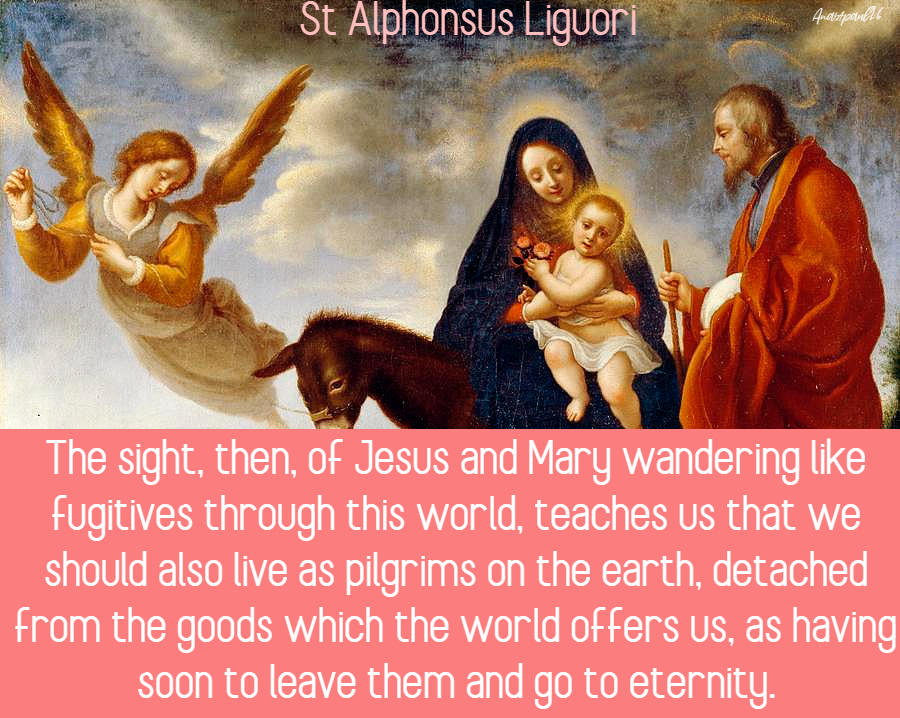
The sight, then, of Jesus and Mary wandering like fugitives through this world, teaches us that we should also live as pilgrims on the earth, detached from the goods which the world offers us, as having soon to leave them and go to eternity.