Posted in MARIAN TITLES

Holy Cross, Nossa Senhora de Nazaré / Our Lady of Nazareth, Portugal (1182) and Memorials of the Saints – 14 September

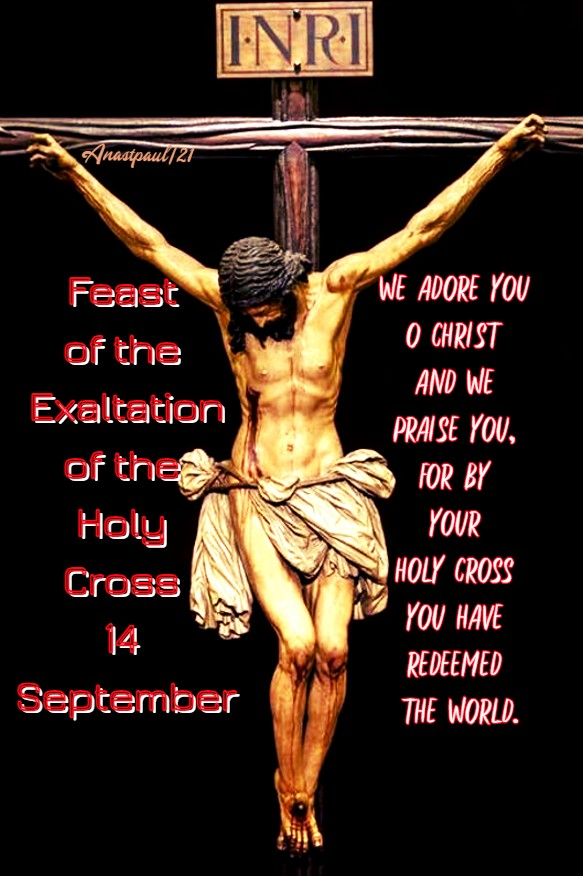
Exaltation of the Holy Cross (Feast) This feast was observed in Rome before the end of the seventh century. It commemorates the recovery of the Holy Cross, which had been placed on Mount Calvary by St Helena.

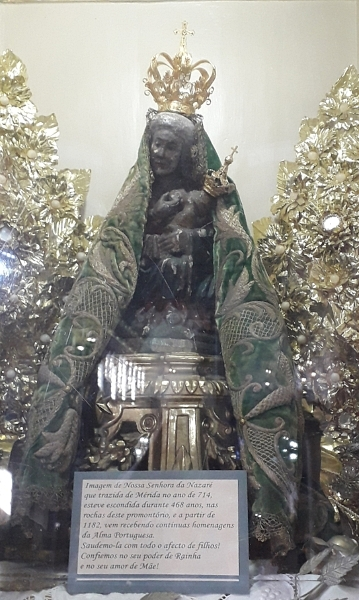
Nossa Senhora de Nazaré / Our Lady of Nazareth, Portugal (1182) -14 September:
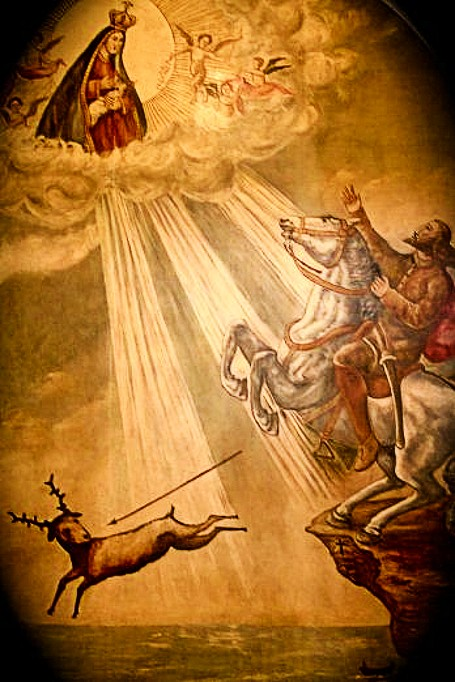
The chronicles of old Portugal report this episode that took place in the year 1182, on the day of the Exaltation of the Holy Cross. Dom Fuas Roupinho, a Knight and vassal of King Afonso Henriques, was out hunting on a foggy day. He was pursuing a deer when it came to an unexpected precipice and fell to its death into the sea below.

The horse, which was in close pursuit, reared on the very edge of the cliff and it seemed certain that Dom Fuas would follow the deer to his death. Knowing that a little distance to his left was a cave with the Statue of the Virgin of Nazareth, Dom Fuas immediately invoked her protection. He was saved and in thanksgiving he built a small “Chapel of memory” (Ermida da Memória) over the cave in her honour.
According to a document found with it, the little Statue of the Virgin had been venerated in Nazareth in the times of early Christianity. When the iconoclast heresy started in Constantinople and the heretics were destroying all the Statues, a Monk called Ciriaco took it to a Monastery in Spain in the proximity of Merida.

In 714, when the Saracens invaded the Iberian Peninsula, King Rodrigo fled with Friar Germano to the Atlantic coast, bearing the Statue with them. They hid the Statue in a small cave off the coast of the site that was later to become Nazaré, where it remained until it was found by a shepherd in 1179.

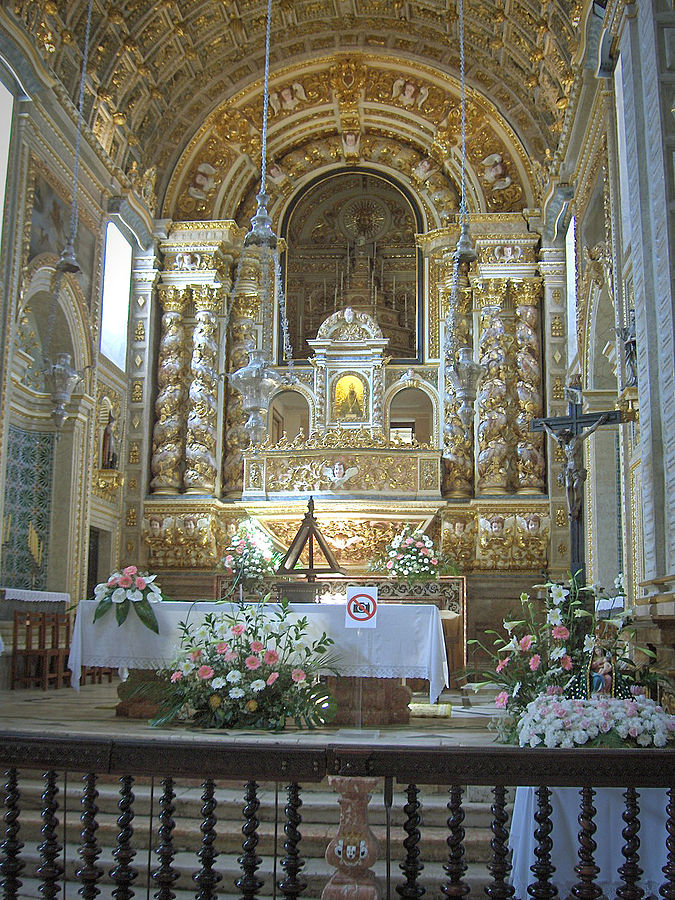
After Our Lady miraculously saved the life of Dom Fuas, the devotion to Our Lady of Nazareth spread throughout the country and was the source of countless graces for the people. In 1377 King Fernando ordered a large Church to be built near the little Chapel, and the Statue is venerated there now.
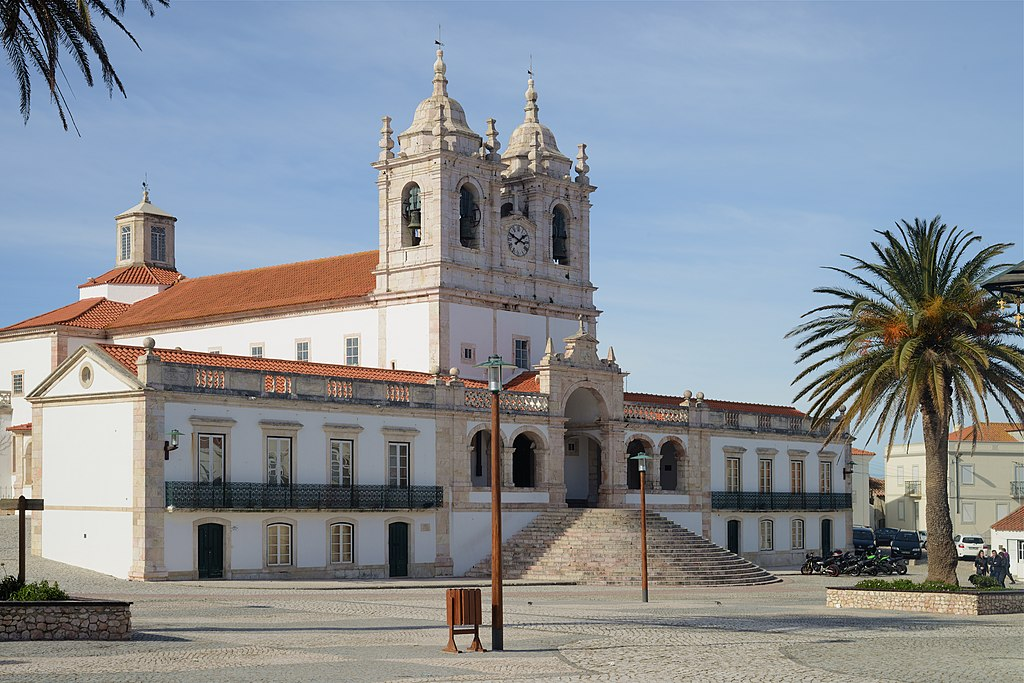
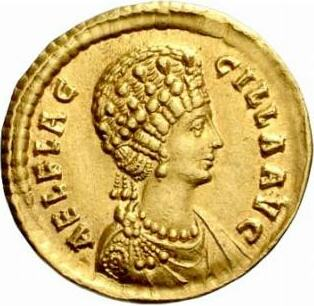
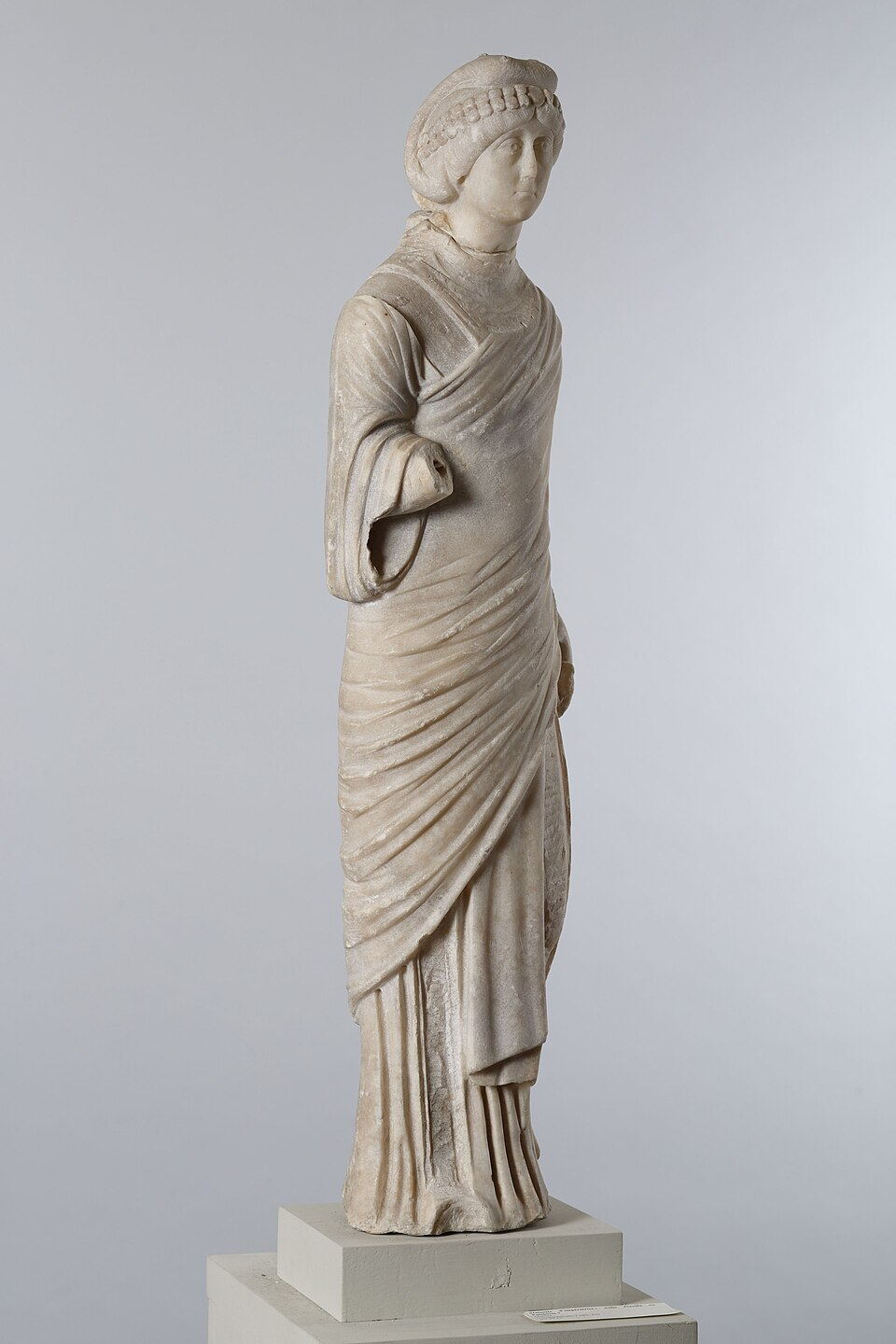
St Aelia Flaccilla

St Albert of Jerusalem (1149-1215) also known as St Albert of Vercelli – Bishop, Canon Lawyer, Diplomat and Peacemaker and is regarded as a Co-Founder of the Carmelite Order.

St Caerealis
Bl Claude Laplace
St Cormac of Cashel
St Crescentian of Carthage
St Crescentius of Rome
St Generalis of Carthage
St Giulia Crostarosa
St Jean Gabriel Taurin du Fresse
St Maternus of Cologne (Died c 325) Bishop

St Peter of Tarentaise O.Cist (1102-1174) Cistercian Monk, Archbishop of Tarentaise from 1141 until his death, Abbot, Apostle of Charity, Miracle-worker.
There are two men named Saint Peter of Tarentaise who lived one century apart. The man we honour today is the younger Peter, born in France in the early part of the 12th century. The other man with the same name became Pope Innocent the Fifth.

Bl Pedro Bruch Cotacáns
St Rosula of Carthage
St Sallustia
St Victor of Carthage
Posted in SAINT of the DAY

Saint of the Day – 14 September – Saint Aelia Flaccilla

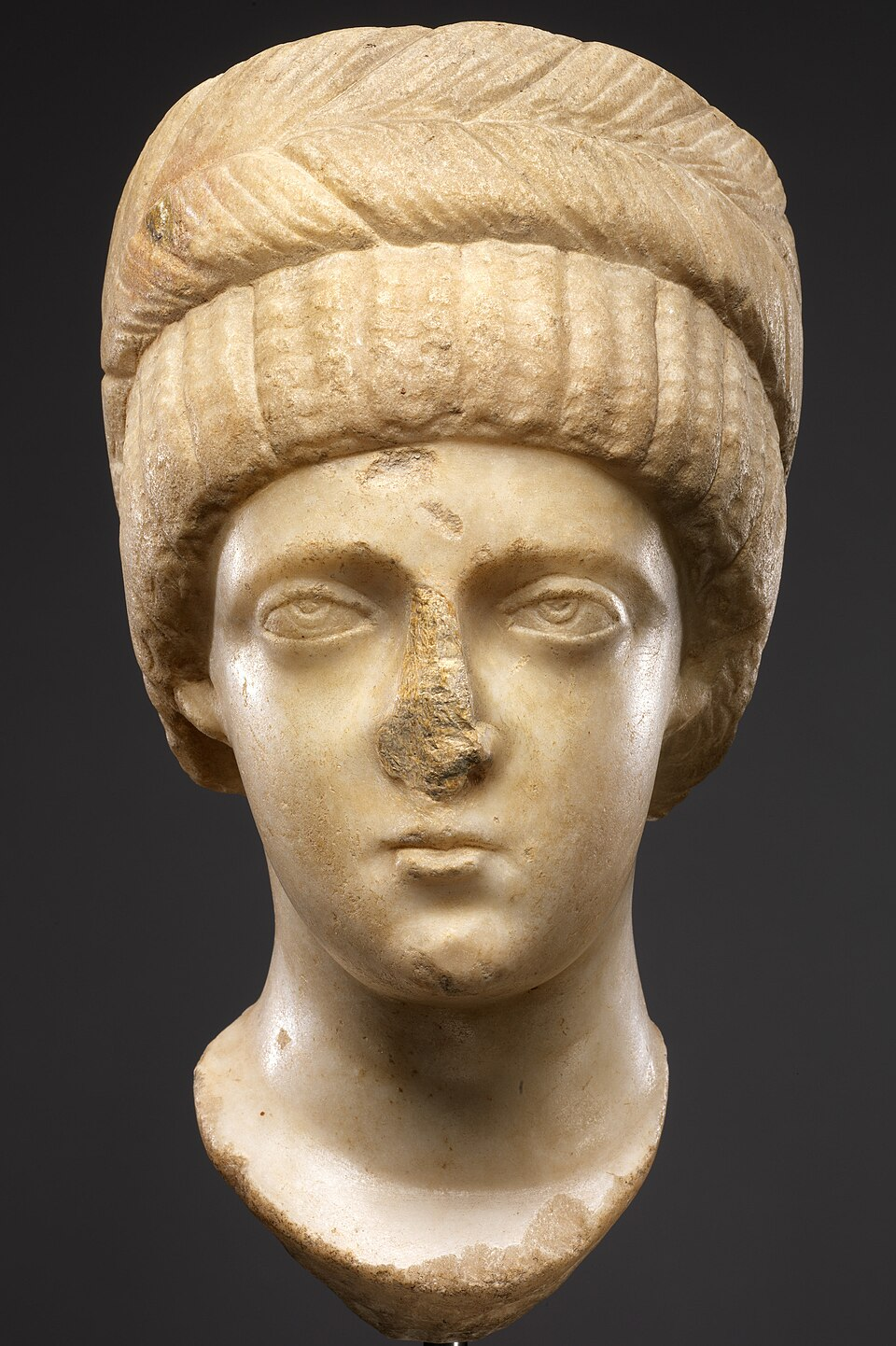
Saint Aelia Flavia Flaccilla, known as Aelia Flacilla or Flacilla, was a Roman empress and may have been the daughter of Claudius Antonius, Prefect of Gaul. She was the first wife of Emperor Theodosius I. She was of Spanish descent. During her marriage to Theodosius, she gave birth to two sons, the future Emperors Arcadius and Honorius, as well as a daughter, Aelia Pulcheria.

Aelia Flacilla was a zealous supporter of the Nicene Creed, and she was considered a pillar of the Church and model of Christian virtue by Saint Gregory of Nyssa and others. She died in 385 of natural causes.

"The greatness of the good gift given her made her love for Him who gave it all the greater, so she bestowed every kind of attention on the maimed and the mutilated, declining all aid from her household and her guards, herself visiting the houses where the sufferers lodged, and providing every one with what he required. She also went about the chambers of the churches and ministered to the wants of the sick, herself handling pots and pans, and tasting broth, now bringing in a dish and breaking bread and offering morsels, and washing out a cup and going through all the other duties which are supposed to be proper to servants and maids. To them who strove to restrain her from doing these things with her own hands she would say, "It befits a sovereign to distribute gold; I, for the sovereign power that has been given me, am giving my own service to the Giver."

-Theodoret, Ecclesiastical History (Book V.18)

"It appears that, during the reign of Valens, had some dispute with his own clergy at Cyzicus, and had in consequence seceded from the Arians, and retired to Bithynia, near Constantinople. Here multitudes resorted to him; some also gathered from different quarters, a few with the design of testing his principles, and others merely from the desire of listening to his discourses. His reputation reached the ears of the emperor, who would gladly have held a conference with him. But the Empress Flacilla studiously prevented an interview from taking place between them; for she was the most faithful guard of the Nicene doctrines, and feared lest Eunomius might, by his powers of disputation, induce a change in the sentiments of the emperor."

-Sozomen, Ecclesiastical History (Book VII)
Posted in Our MORNING Offering

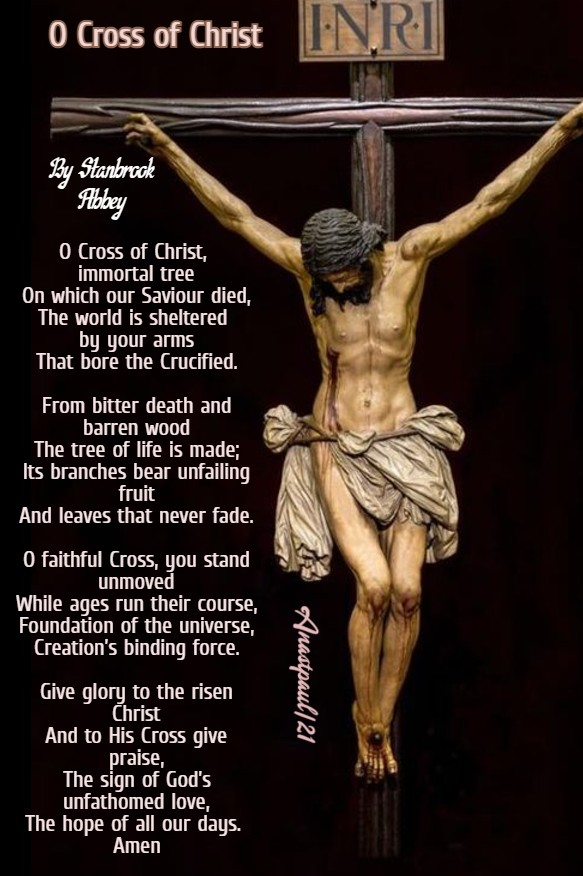
Our Morning Offering – 14 September – O Cross of Christ

Our Morning Offering – 14 September – Feast of the Exaltation of the Holy Cross

O Cross of Christ
Stanbrook Abbey

O Cross of Christ, immortal tree
On which our Saviour died,
The world is sheltered by your arms
That bore the Crucified.

From bitter death and barren wood
The tree of life is made;
Its branches bear unfailing fruit
And leaves that never fade.

O faithful Cross, you stand unmoved
While ages run their course,
Foundation of the universe,
Creation’s binding force.

Give glory to the risen Christ
And to His Cross give praise,
The sign of God’s unfathomed love,
The hope of all our days.
Amen

Posted in ONE Minute REFLECTION

One Minute Reflection – 14 September –  Let us glorify God

One Minute Reflection – 14 September – Feast of the Exaltation of the Holy Cross – Readings: Gal 6:14, Ps 66:2, Phil 2:5-11, John 12:31-36

At that time, Jesus said to the multitudes of the Jews, Now is the judgment of the world; now will the prince of the world be cast out. And I, if I be lifted up from the earth, will draw all things to Myself.

John 12:31-36

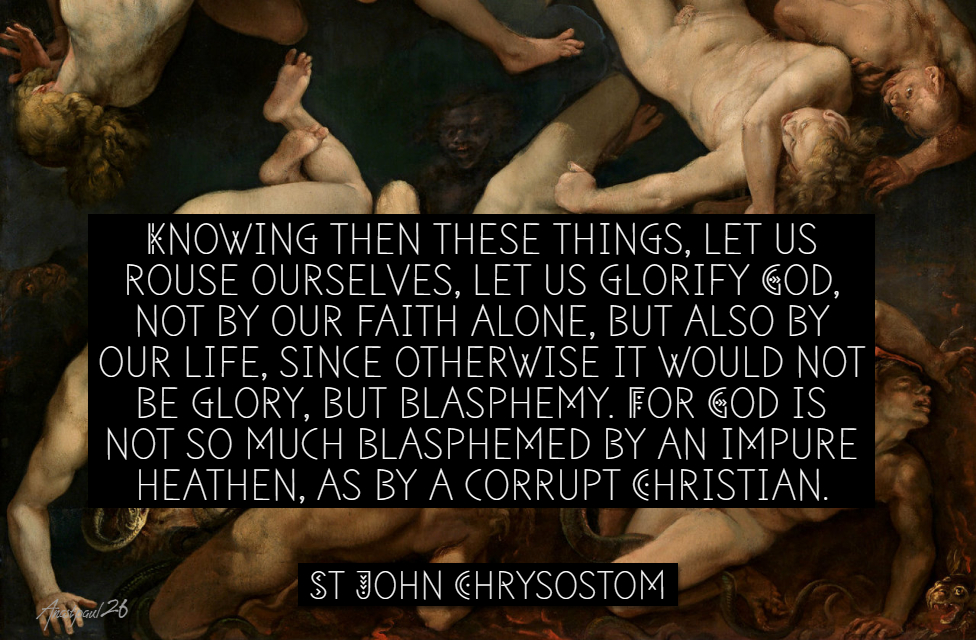
REFLECTION Knowing then these things, let us rouse ourselves, let us glorify God, not by our faith alone, but also by our life, since otherwise it would not be glory, but blasphemy. For God is not so much blasphemed by an impure heathen, as by a corrupt Christian. Wherefore I entreat you to do all that God may be glorified; for, Woe, it says, to that servant by whom the Name of God is blasphemed, (and wherever there is a woe, every punishment and vengeance straightway follows,) but blessed is he by whom that Name is glorified.

Let us then not be as in darkness, but avoid all sins, and especially those which tend to the hurt of others, since by these God is most blasphemed. What pardon shall we have, when, being commanded to give to others, we plunder the property of others? What shall be our hope of salvation? You are punished if you have not fed the hungry; but if you have even stripped one who was clothed, what sort of pardon shall you obtain? These things I will never desist from saying, for they who have not heard today perhaps will hear tomorrow, and they who take no heed tomorrow perhaps will be persuaded the next day; and even if any be so disposed as not to be persuaded, yet for us there will be no account to give of them at the Judgment. Our part we have fulfilled; may we never have cause to be ashamed of our words, nor you to hide your faces, but may all be able to stand with boldness before the judgment-seat of Christ, that we also may be able to rejoice over you, and to have some compensation of our own faults, in your being approved in Christ Jesus our Lord, with whom to the Father and the Holy Ghost be glory forever. Amen.

St John Chrysostom

PRAYER – O God, who willed that Your Only Begotten Son should undergo the Cross to save the human race, grant, we pray, that we, who have known His mystery on earth, may merit the grace of His redemption in heaven. For You placed the salvation of the human race on the wood of the Cross, so that, where death arose, life might again spring forth and the evil one, who conquered on a tree, might likewise on a tree be conquered through Christ. O Cross, You are the glorious sign of victory. Through your power may we share in the triumph of Christ Jesus. We adore You O Christ and we praise You, for by Your Holy Cross You have redeemed the world. Amen.

Posted in CATHOLIC Quotes

Quote/s of the Day – 14 September – Glory in the Cross

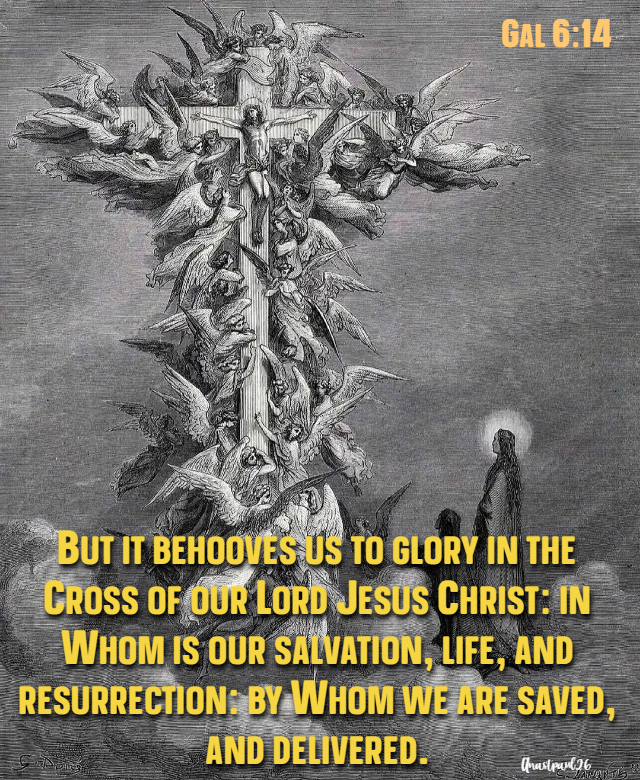
But it behooves us to glory in the Cross of our Lord Jesus Christ: in Whom is our salvation, life, and resurrection: by Whom we are saved, and delivered.

Gal 6:14

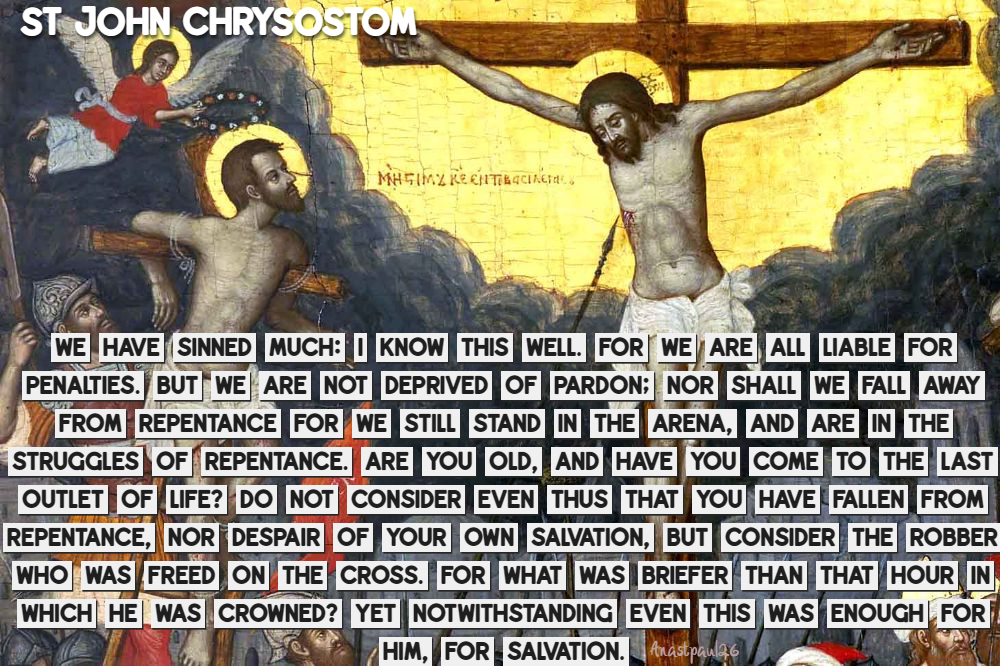
We have sinned much: I know this well. For we are all liable for penalties. But we are not deprived of pardon; nor shall we fall away from repentance for we still stand in the arena, and are in the struggles of repentance. Are You old, and have you come to the last outlet of life? Do not consider even thus that you have fallen from repentance, nor despair of your own salvation, but consider the robber who was freed on the cross. For what was briefer than that hour in which he was crowned? Yet notwithstanding even this was enough for him, for salvation. 

St John Chrysostom

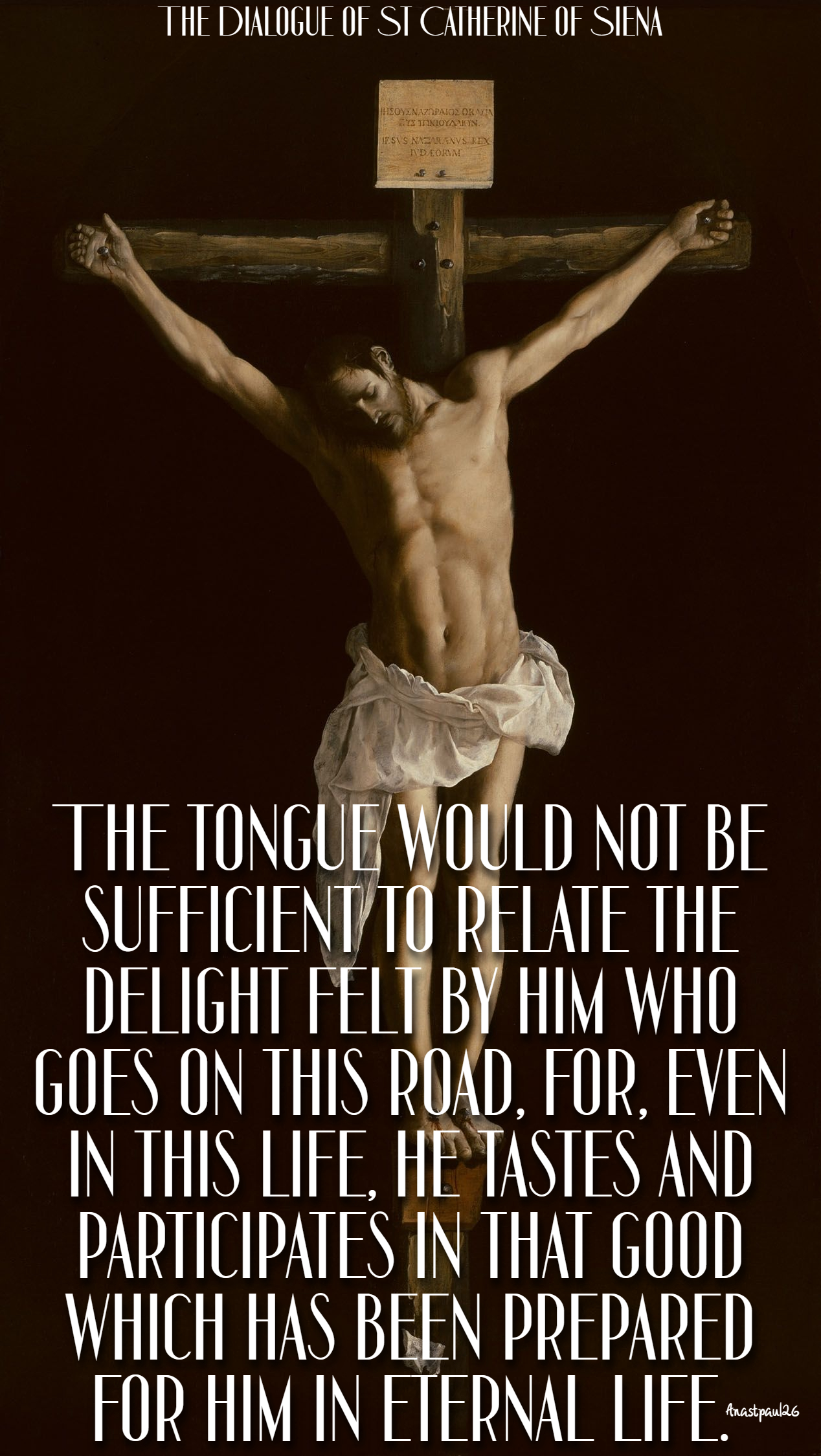
The tongue would not be sufficient to relate the delight felt by him who goes on this road, for, even in this life, he tastes and participates in that good which has been prepared for him in eternal life.

The Dialogue of St Catherine of Siena

Benjamin, in the Old Law, was the figure of the predestinate: accordingly, it is to him that the cup, or chalice, is given – a gift, says St Ambrose, which is presented to only one of all the children of Jacob. To all, indeed, corn was given, but the chalice is reserved for one alone. In fine the great Doctor of our salvation, the Adorable Jesus, teaches us that His disciples shall lament and weep, but the world shall rejoice, the world which knows not God and is the enemy of God.

Henri-Marie Boudon

Heaven is open only to the innocent and to the truly penitent.

Massillon

Alas, my dear brethren, what have we become even since our conversion? Instead of going always forward and increasing in holiness, what laziness and what indifference we display! God cannot endure this perpetual inconstancy with which we pass from virtue to vice and from vice to virtue. Tell me, my children, is not this the very pattern of the way you live?

St John Vianney

Posted in SEPTEMBER-The SEVEN SORROWS of MARY and The HOLY CROSS

Thought for the Day – 14 September –On the Third Dolor

Reflections on each of the Seven Dolors of Mary by St Alphonsus Liguori

Of The Loss Of Jesus In the Temple

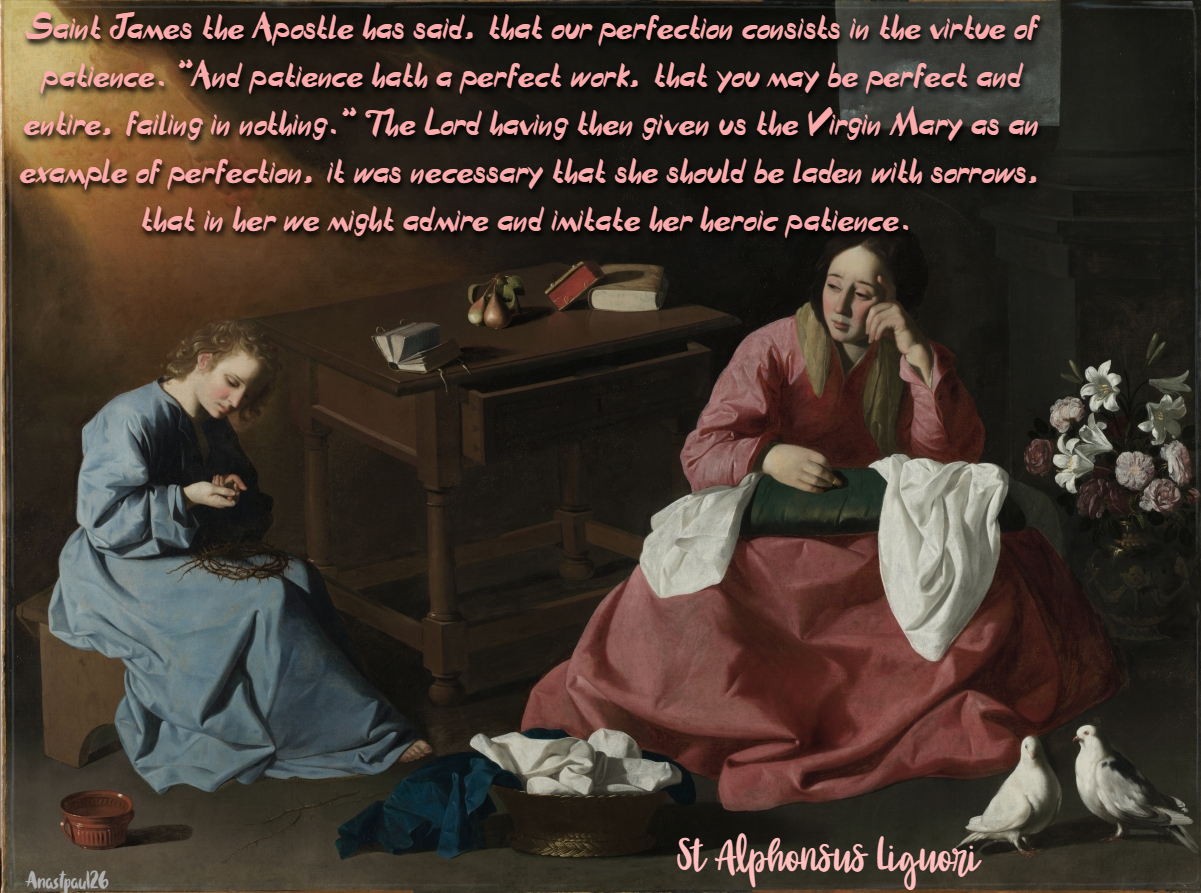
Saint James the Apostle has said, that our perfection consists in the virtue of patience. “And patience hath a perfect work, that you may be perfect and entire, failing in nothing.” The Lord having then given us the Virgin Mary as an example of perfection, it was necessary that she should be laden with sorrows, that in her we might admire and imitate her heroic patience. The dolor that we are this day to consider is one of the greatest which our divine mother Buffered during her life, namely, the loss of her Son in the temple. He who is born blind is little sensible of the pain of being deprived of the light of day; but to him who has once had sight and enjoyed the light, it is a great sorrow to find himself deprived of it by blindness. And thus it is with those unhappy souls who, being blinded by the mire of this earth, have but little knowledge of God, and therefore scarcely feel pain at not finding him. On the contrary, the man who, illuminated with celestial light, has been made worthy to find by love the sweet presence of the highest good, oh God, how he mourns when he finds himself deprived of it !

From this we can judge how painful must have been to Mary, who was accustomed to enjoy constantly the sweet presence of Jesus, that third sword which wounded her, when she lost him in Jerusalem, and was separated from him for three days.

Some writers assert, and not without reason, that this dolor was not only one of the greatest, but that it was the greatest and most painful of all. For in the first place, Mary in her other dolors had Jesus with her; she suffered when St. Simeon uttered the prophecy in the temple; she suffered in the flight to Egypt, but always with Jesus; but in this dolor she suffered at a distance from Jesus, without knowing where he was: “And the light of my eyes itself is not with me.” Thus, with tears, she then exclaimed: Ah, the light of my eyes, my dear Jesus, is no more with me; he is far from me, I know not where he is! Origen says, that though the love which this holy mother bore her Son, she suffered more at this loss of Jesus than any martyr ever suffered at death. Ah, how long: were these three days for Mary! they appeared three ages.

Secondly. Mary well understood the cause and end of the other dolors, namely, the redemption of the world, the divine will ; but in this she did not know the cause of the absence of her Son. The sorrowful mother was grieved to find Jesus withdrawn from her, for her humility, says Lanspergius, made her consider herself unworthy to remain with him any longer, and attend upon him on earth, and have the care of such a treasure. And perhaps, she may have thought within herself, I have not served him as I ought. Perhaps I have been guilty of some neglect, and therefore he has left me. They sought him, lest he perchance had left them, as Origen has said. Certainly there is no greater grief for a soul that loves God than the fear of having displeased him. And therefore Mary never complained in any other sorrow but this, lovingly expostulating with Jesus after she found him : “Son, why hast thou done so to us? Thy father and I have sought thee sorrowing.”! By these words she did not wish to reprove Jesus, as the heretics blasphemously assert, but only to make known to him the grief she had experienced during his absence from her, on account of the love she bore him.

This sorrow of Mary ought, in the first place, to serve as a comfort to those souls who are desolate and do not enjoy the sweet presence they once enjoyed of their Lord. They may weep, but let them weep in peace, as Mary wept in the absence of her Son. Let them take courage, and not fear that on this account they have lost the divine favor, for God himself said to St. Theresa: “No one is lost without knowing it; and no one is deceived without wishing to be deceived.” If the Lord departs from the sight of that soul who loves him, he does not therefore depart from the heart. He often hides himself that she may seek him with greater desire and love. But those who would find Jesus must seek him, not amid the delights and pleasures of the world, but amid crosses and mortifications, as Mary sought him: We sought thee sorrowing, as she said to her Son: “Dolentes quasrebamus te.”

Moreover, in this world we should seek no other good than Jesus. Job was not unhappy when he lost all that he possessed on earth; riches, children, health, and honors, and even descended from a throne to a dunghill; but because he had God with him, even then he was happy. St. Augustine, speaking of him, says: He had lost all that God had given him, but he had God himself