Manual of Devotions in Honour of The Seven Dolors of the Blessed Virgin Mary by Father Sebastian
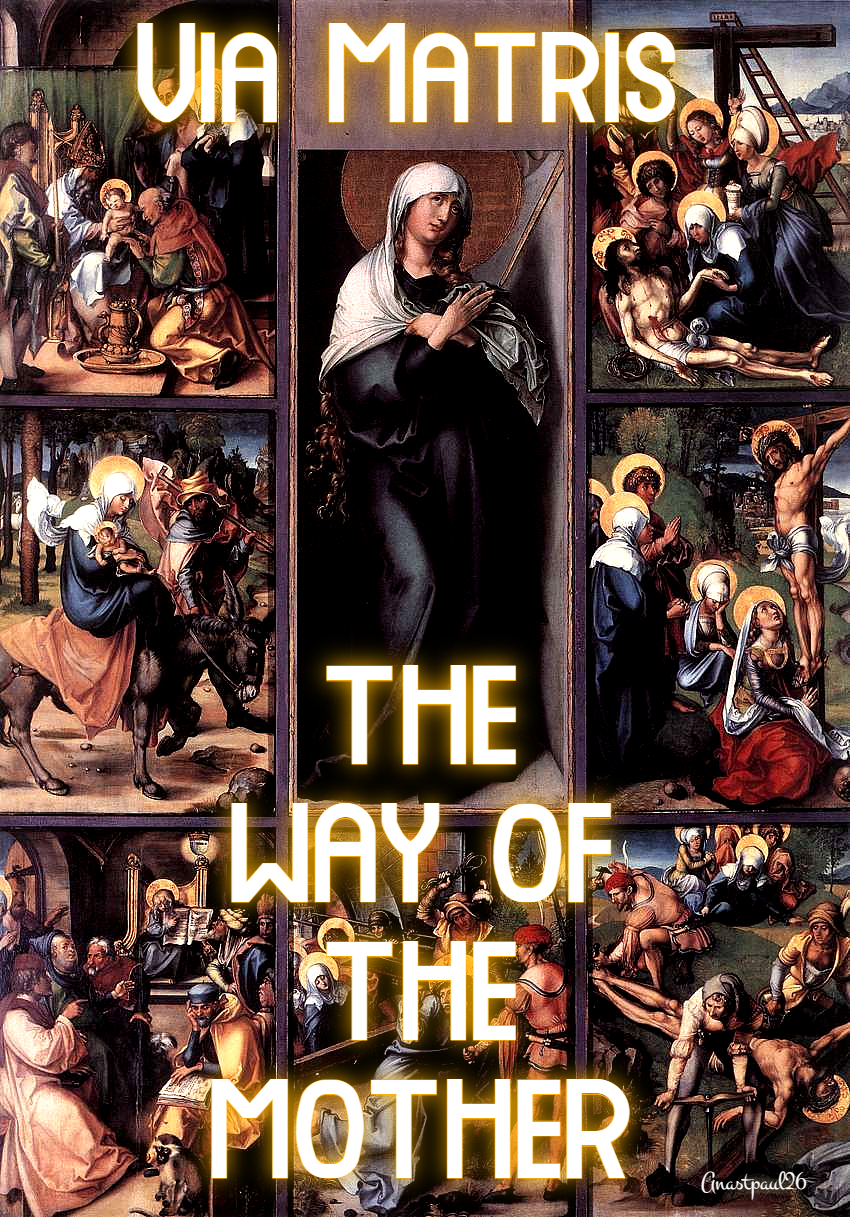
THE WAY OF THE MOTHER
Whatever act of homage is practised by the faithful in honour of the Blessed Virgin is welcomed by her with singular love, but above all she is pleased at seeing us occupied in compassionating her Dolours. Such a devotion is so gratifying to Mary, that when she found it in the time of St. Bridget very much neglected, she complained to her in these words:- “There are few who remember my sorrows.”
Wherefore, in order to assist you in meditating upon the Dolours of Mary, we propose to you this devout exercise of the Stations of her Seven Dolours, which can be practised in public or private, in the same manner as the Way of the Cross. This holy exercise has been instituted for some time, and is every day spreading. It was publicly practised in Rome A.D. 1836, in the Church of St. Marcellus, and has been enriched by copious Indulgences of the holy memory of Gregory XVI. A Plenary Indulgence was granted, on July 31st, 1887, to those who on any day shall visit seven times the Stations of the Dolours, and for each time seven years’ Indulgence.
V. Come Holy Ghost, replenish the hearts of the faithful.
R. And enkindle in them the fire of thy love.
V. Send forth thy spirit, O Lord, and they shall be regenerated.
R. And Thou shalt renew the face of the earth.
V. Remember thy congregation.
R. Which Thou hast possessed from the beginning.
V. Lord, hear my prayer.
R. And let my cry come unto Thee.
V. The Lord be with thee.
R. And with thy spirit,
Act of Contrition.
Oh most afflicted Virgin! Alas, with what unthankfulness in my past life have I acted towards God! with what ingratitude have I corresponded to his innumerable benefits! Now, however, I am truly penitent, and in the bitterness of my heart and the sorrow of my soul, I humbly beg pardon for having. outraged his infinite bounty, resolving for the future, by his grace, never more to offend Him. Oh! by all the Dolours which thou hast borne in the Passion of Jesus, I pray thee with tears to implore from Him pity and mercy for my many grievous sins. Receive this holy devotion, which I am about to perform, in memory of those pains and Dolours. Grant! oh grant that those seven daggers which pierced through thy soul may likewise pierce through mine, and that I may live and die in the friendship of the Lord, and enjoy eternally the glory which He has acquired for me by his most precious Blood. Amen.
STATION I. FIRST DOLOUR
How great was the shock to Mary’s heart at hearing the sorrowful words, in which holy Simeon told the bitter Passion and death of her sweet Jesus, since in that same moment she realized in her mind all the insults, blows, and torments which the impious men were to offer to the Redeemer of the world. But a still sharper sword pierced her soul. It was the thought of men’s ingratitude to her beloved Son. Now consider that, because of your sins, you are unhappily among the ungrateful, and casting yourself at the feet of the Mother of Dolors, say with sorrow:
Virgin beloved, who did feel so bitter pangs of soul at seeing the abuse which I, wretch that I am, would make of the Blood of your dear Son, obtain for me, I pray you, by your riven heart, that in time to come, I may better correspond to God’s mercies, profit by his heavenly grace, receive not in vain his lights and inspirations, and so be among the blessed number of those who are saved by the bitter passion of Jesus. Amen.
Amen. Ave Maria.
Virgin most sorrowful, pray for us.
O Mary, sweetness of my life,
Stamp on my soul thy bitter strife,
And pray for me, that I may see Thy joys for all eternity.
STATION II. SECOND DOLOUR
Consider the sharp sorrow which Mary felt when, Saint Joseph being warned by an angel, she had to flee by night in order to preserve her beloved Child from the slaughter decreed by Herod.
What anguish was hers in leaving Judea, lest she should be overtaken by the soldiers of the cruel king ! How great her privations in that long journey ! What sufferings she bore in that land of exile, what sorrow amid that people given to idolatry ! But consider how often you have renewed that bitter grief of Mary, when your sins have caused her Son to flee from your heart. Wherefore repent, and turn to her, humbly saying:
Sweetest Mother, once and once only Herod obliged you to flee with your Jesus, to escape the slaughter which he had commanded; but I, how often have I forced my Redeemer, and you with him, to flee from my heart, when I have admitted into it accursed sin, hateful to you and to my loving Lord. With tears and contrition I humbly beg for pardon. Mercy, dear Lady, mercy ! And I promise you that, for the future, with the help of God, I will ever maintain my Savior and you in complete possession of my soul. Amen.
Amen. Ave Maria.
Virgin most sorrowful, pray for us.
O Mary, sweetness of my life,
Stamp on my soul thy bitter strife,
And pray for me, that I may see Thy joys for all eternity.
STATION III. THIRD DOLOUR
How dreadful was the grief of Mary, when she saw that she had lost her beloved Son ! And, as if to increase her sorrow when she sought him diligently among her kinfolk and acquaintances, she could hear no tidings of him. No hindrances stayed her, nor weariness, nor danger; but she forthwith returned to Jerusalem, and for three long days sought him sorrowing.
Great be your confusion, O my soul, who has so often lost your Jesus by your sins, and has given no heed to seek him at once: a sign that you do make of very little or of no account the precious treasure of divine love. Weep then for your blindness, and turning yourself to that Lady of sighs, your Mother, say with compunction:
Virgin most afflicted, obtain that I may learn from you to seek Jesus when I have lost him by giving ear to my passions and to the evil suggestions of the devil; obtain that I may find him again, and when I possess him once more, that I may ever repeat the words of the Spouse, “I found Him whom my soul loveth; I held Him, and I will not let him go.” Amen.
Amen. Ave Maria.
Virgin most sorrowful, pray for us.
O Mary, sweetness of my life,
Stamp on my soul thy bitter strife,
And pray for me, that I may see Thy joys for all eternity.
STATION IV. FOURTH DOLOUR
Come, O you sinners, come and see if you can endure so sad a sight. This Mother, so tender and loving, meets her beloved Son, meets him amidst an impious rabble, who drag him to a cruel death, wounded, torn by stripes, crowned by thorns, streaming with blood, bearing his heavy Cross. Ah, consider, my soul, the grief of the blessed Virgin thus beholding her Son! Who would not weep at seeing this Mother’s grief? But who has been the cause of such woe? I, it is, who with my sins have so cruelly wounded the heart of my sorrowing Mother! And yet I am not moved; I am as a stone, when my heart should break because of my ingratitude.
Virgin most holy, I crave pardon for the sorrows I have caused you. I know and confess that I deserve it not, for it is I through whom your Jesus was so treated; yet do you call to mind that you are the Mother of mercy. Show mercy then to me, and I promise to be more faithful to my Redeemer in the time to come, and thus to console you for the many sorrows I have offered to your afflicted heart. Amen.
Amen. Ave Maria.
Virgin most sorrowful, pray for us.
O Mary, sweetness of my life,
Stamp on my soul thy bitter strife,
And pray for me, that I may see Thy joys for all eternity.
STATION V. FIFTH DOLOUR.
In this fifth Dolour, imagine thyself, oh my soul, on the heights of Calvary when the most afflicted Virgin saw her beloved Son die. Meditation. Come, oh devout soul! come to Calvary, where are being offered to God two sacrifices; one is the Body of Jesus, the other is the heart of Mary. Оh! sorrowful spectacle, to look upon this good Mother in such a sea of woe beholding Him, who is more dear to her than life itself, martyred by the most cruel death. Alas! every blow of the hammer, every wound, every lacera- tion which the Saviour of the world received on his sacred Body, Mary received upon her heart. She stood there at the foot of the cross, so penetrated with pain and transfixed with such agony that it could not be decided which should be the first to expire Jesus or Mary. Fixing her eyes on her Blessed Son she sees that He is already breathing forth his last breath; she gazes upon his sunken eyes, his ghastly looks, his livid lips, and listens to his difficult breathing, and at last she knows that He no longer lives, and that He has already yielded his blessed spirit to his Eternal Father. Ah! surely she wished that at that moment her soul could be separated from her body and united to the soul of Jesus. And who could bear such a sight as this? Oh, most afflicted of all mothers! instead of returning from Calvary to be free from such bitter suffering, thou didst remain there immovable as a rock in order to drink to the last drop the chalice of thy affliction.
What confusion must this be for me, my soul, who strive in every way to remove those little crosses and light sufferings which God thinks fit to send me for my greater good. Grant! oh grant that I may know the value of sufferings and that I may become so attached to them, that not being satisfied with those thou sendest to me, I may cry out with St. Francis Xavier,
“Plura, Domine, plura:” “More sufferings, oh my God-oh yes, more sufferings.”
Amen. Ave Maria.
Virgin most sorrowful, pray for us.
O Mary, sweetness of my life,
Stamp on my soul thy bitter strife,
And pray for me, that I may see Thy joys for all eternity.
STATION VI. SIXTH DOLOUR.
In this sixth Dolour contemplate, oh my soul, the Blessed Virgin when she received into her arms her dead Son after He was taken down from the cross. Meditation. Consider the pang which penetrated the heart of Mary when she held in her arms the dead Body of her Son. Ah! when she fixed her weeping eyes upon his gaping wounds, when she counted his sorrows and saw Him shedding so much blood, how terrific must have been the shock to her mind, and how deadly the blow which broke her sacred heart; and, indeed, she would have fallen down dead, through agony, but for the assistance of Divine power. Oh poor Mother! yes, Mother of Martyrs, thou didst bear to the tomb the dear object of thy most tender care, who, from being fair as the rose, became like to a bed of thorns by the ill-treatment and lacerations given by the executioners.
And who would not pity thee, who would not feel themselves struck by sorrow at seeing thee in sorrow, such as would move to pity the most stony heart? I behold St. John inconsolable, Mary Magdalen with the other Marys in bitterest grief, Nicodemus not able to stand under his afflictions. And I, alas! I alone cannot shed a tear in the midst of such sorrow, ungrateful and unthankful creature that I am. Oh, my dear Mother Mary, grant that my heart may be transfixed by those same daggers which passed through thy most afflicted heart, and that I may now become truly penitent for those sins which caused thee such a cruel martyrdom.
Amen. Ave Maria.
Virgin most sorrowful, pray for us.
O Mary, sweetness of my life,
Stamp on my soul thy bitter strife,
And pray for me, that I may see Thy joys for all eternity.
STATION VII. SEVENTH DOLOUR.
In this seventh Dolour, contemplate, oh my soul, the most sorrowful Virgin at the Sepulchre of her dead Son. Meditation. Consider how full of woe must have been the sigh which the most afflicted heart of Mary sent forth when she placed in the tomb her amiable Jesus. Oh! what pain, what great woe, must she have felt in her soul, when she beheld the rock lifted with which that sacred monument was to be closed; she could not be separated from the side of the sepulchre, and her sorrow was such that it rendered her immovable, nor was she ever satisfied with looking at those cruel wounds. And when the tomb was closed, so great was her grief that she could hardly live.
Oh! most cruelly-tortured Mother, thou wilt depart presently in body from this place, but here will thy heart remain with thy true treasure. Оh grant that here too all my affections and my love may rest. How is it possible not to be struck with love for the Saviour who has given his Precious Blood for our salvation? And how is it possible not to love thee, who hast suffered so much for love of us?
Oh! by all thy Dolours upon which we have meditated, grant this favour, that the memory of those pains may always remain impressed upon our minds, hat our poor hearts may be inflamed with love of God and thee, most sweet Mother, and that the last sighs of our lives may be united to those which thou didst send forth from the depth of thy heart at the Passion of Jesus; to whom be honour, glory, and thanks for ever and ever.
Amen. Ave Maria.
Virgin most sorrowful, pray for us.
O Mary, sweetness of my life,
Stamp on my soul thy bitter strife,
And pray for me, that I may see Thy joys for all eternity.
At the end, returning to the altar, say one part of the Stabat Mater.
V. Pray for us, most sorrowful Virgin
R. That we may be made worthy of
the promises of Christ.
Prayer.
O God, in whose Passion, according to the prophecy of Simeon, the sword of sorrow pierced the soul of thy most glorious Mother, the Virgin Mary, mercifully grant that we who meditate upon her Dolours may obtain happіness by the effects of thy Passion.
Amen.





You must be logged in to post a comment.