St Aichardus St Albinus of Lyon Bl Anton Maria Schwartz St Aprus of Toul St Bond of Sens
St Catherine of Genoa (1447-1510) Married laywoman, Mystic, Apostle of the sick, the poor and the needy, Writer. Her body is incorrupt and rests in a glass reliquary at the Capuchin Church in Genoa. Catherine’s writings were examined by the Holy Office and declared to contain doctrine that would alone be enough to prove her sanctity and she was accordingly Beatified in 1675 by Pope Clement X and Canonised in 1737 by Pope Clement XII. Her writings also, became sources of inspiration for other religious leaders such as Robert Bellarmine and Francis de Sales and Cardinal Henry Edward Manning. Pope Pius XII declared her Patroness of the hospitals in Italy.
Bl Camillus Constanzo St Emilas of Cordoba St Eutropa of Auvergne St Hernan Bl Jacinto de Los Ángeles and Bl Juan Bautista St Jeremias of Cordoba St Joseph Abibos St Mamillian of Palermo St Melitina St Mirin of Bangor St Nicetas the Goth St Nicomedes of Rome
St Porphyrius the Martyr St Ribert St Ritbert of Varennes Bl Rolando de Medici Bl Tommasuccio of Foligno St Valerian of Châlon-sur-Saône St Valerian of Noviodunum St Vitus of Bergamo Bl Wladyslaw Miegon — Martyrs of Adrianopolis – 3 saints: Three Christian men martyred together in the persecutions of Maximian – Asclepiodotus, Maximus and Theodore. They were martyred in 310 at Adrianopolis (Adrianople), a location in modern Bulgaria.
Martyrs of Noviodunum – 4 saints: Three Christian men martyred together, date unknown – Gordian, Macrinus, Stratone and Valerian. They were martyred in Noviodunum, Lower Moesia (near modern Isaccea, Romania).
Mercedarian Martyrs of Morocco – 6 beati: A group of six Mercedarians who were captured by Moors near Valencia, Spain and taken to Morocco. Though enslaved, they refused to stop preaching Christianity. Martyrs. – Dionisio, Francis, Ildefonso, James, John and Sancho. They were crucified in 1437 in Morocco.
Martyred in the Spanish Civil War: Bl Antonio Sierra Leyva Bl Pascual Penades Jornet
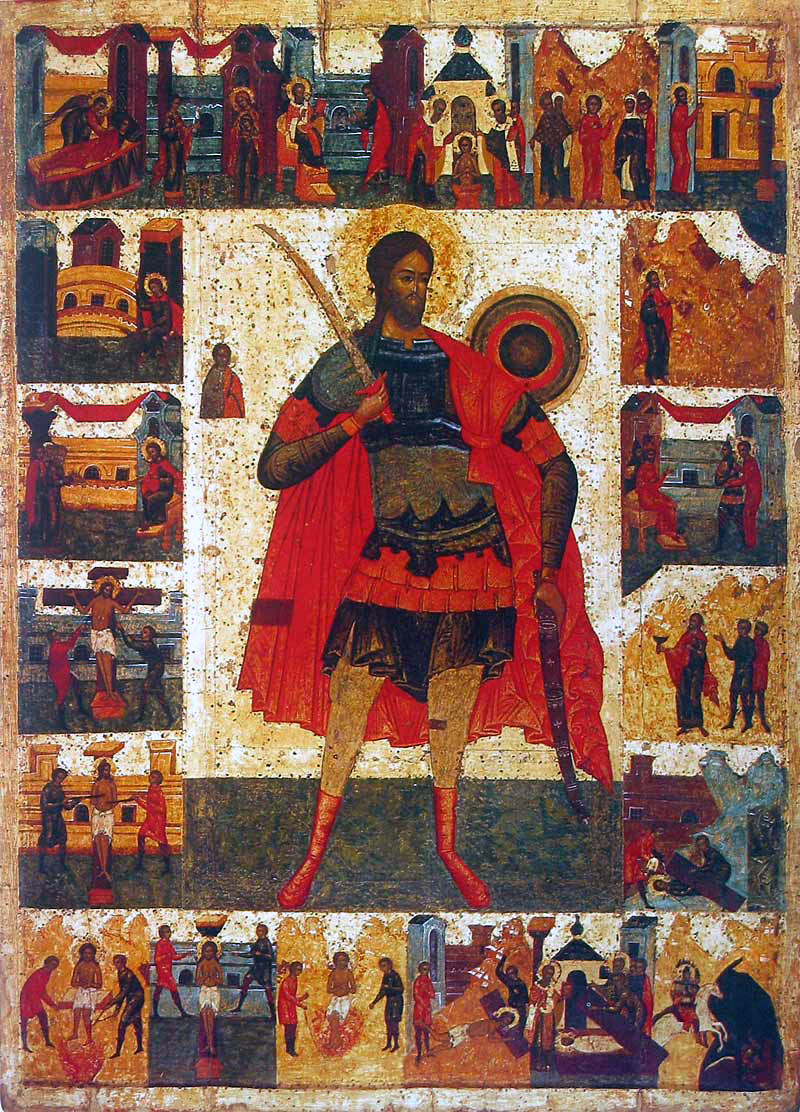
Saint Nicetas the Goth was a soldier and martyr born in the 4th-century, in the Gothic territory north of the Danube River. Coming from the upper class of his people. He was instructed in Christianity by Theophilus of Gothia, a converted bishop, between 325 and 341 AD.
Nicetas received his Greek name on the occasion of his baptism by Theophilus, a participant in the First Ecumenical Council. Pagan Goths began to oppose the spread of Christianity, which resulted in internecine strife. Nicetas fought in the Gothic civil war between the pagan Alaric and the Christian Fritigern. After the defeat of Alaric and after the invention of Gothic alphabets by Ulfilas, Nicetas worked intensely among the Goths for their conversion.
Later, Alaric returned, defeated Fritigern, and resumed his persecution of Christians. The s aint denounced the persecutor for his cruelty and impiety, because he subjected the Christians to severe torments. Nicetas endured many tortures himself and was condemned to the stake in 372. All the while, he hept over his heart, under his robes, an icon of the Blessed Virgin Mary and the Christ Child holding the Cross, carrying this after the Blessed Virgin appeared to him to provide comfort.The devil, shaped as an angel, induced Nicetas to sacrifice to the pagan gods for saving his life; the saint, however, put him to flight by means of prayer and the assistance of St Michael. Although he died at the stake, miraculously the fire did not touch his body, which was buried in Cilicia, and later transferred to Constantinople.
The veneration of this saint gave rise to the Slavic forms of his name: Nikita, Mykyta and Mikita. St Nicetas is prayed to for the preservation of children from birth defects and he is patron of Melendugno, Lecce, Italy.
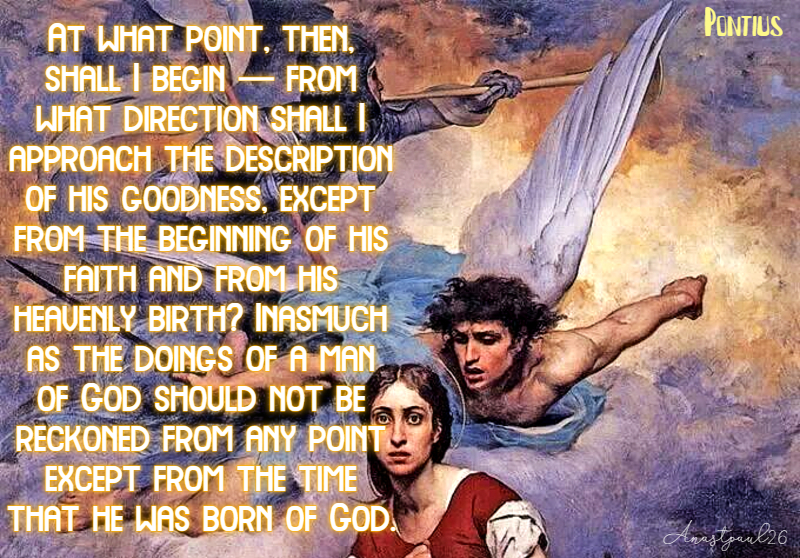
At what point, then, shall I begin — from what direction shall I approach the description of his goodness, except from the beginning of his faith and from his heavenly birth? Inasmuch as the doings of a man of God should not be reckoned from any point except from the time that he was born of God.
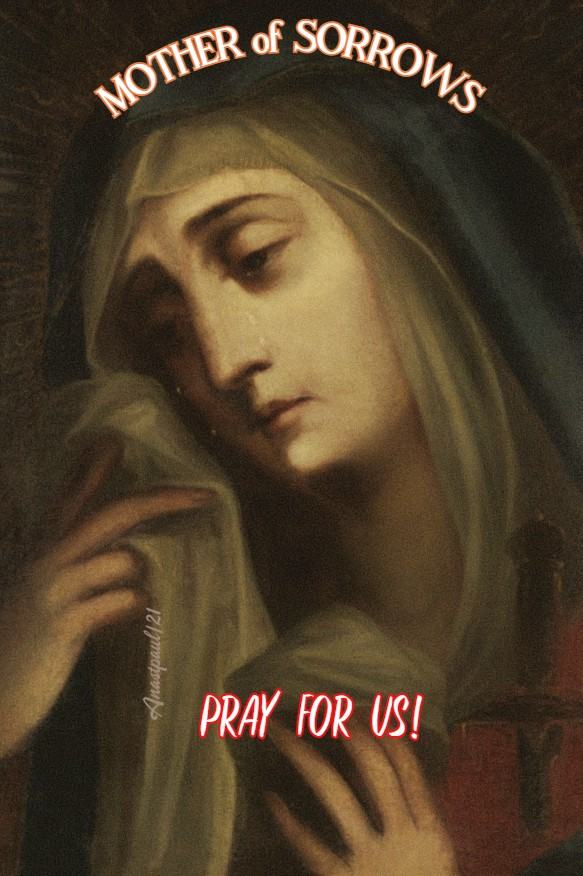
Our Morning Offering – 15 September – “Month of the Seven Sorrows of the Blessed Virgin Mary” and Memorial of the Seven Sorrows of our Mother
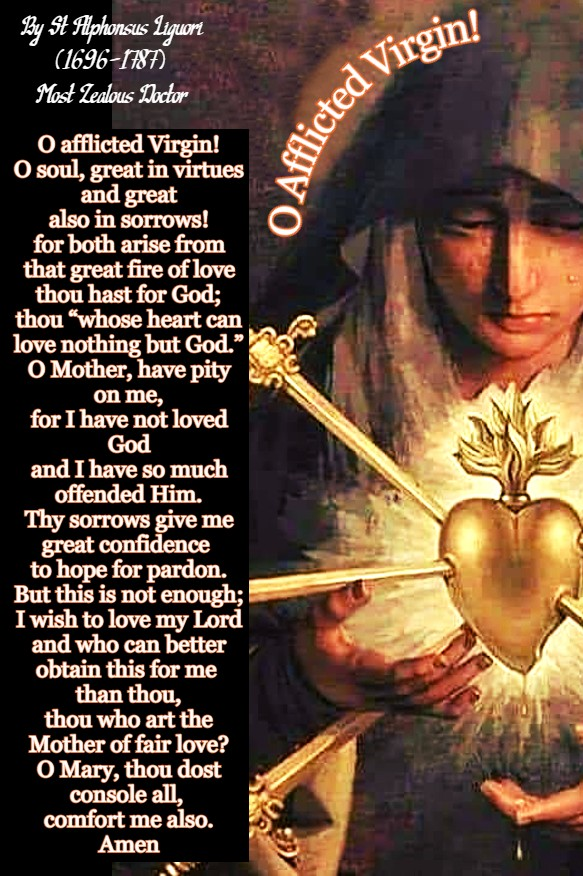
O Afflicted Virgin! By St Alphonsus Liguori (1696-1787) Most Zealous Doctor
O afflicted Virgin! O soul, great in virtues and great also in sorrows! for both arise from that great fire of love thou hast for God; thou “whose heart can love nothing but God.” O Mother, have pity on me, for I have not loved God and I have so much offended Him. Thy sorrows give me great confidence to hope for pardon. But this is not enough; I wish to love my Lord and who can better obtain this for me than thou, thou who art the Mother of fair love? O Mary, thou dost console all, comfort me also. Amen
One Minute Reflection – 15 September – “Month of the Seven Sorrows of the Blessed Virgin Mary” and Memorial of the Seven Sorrows of our Mother – Readings: Jn. 19:25, Jn. 19:26-27, Judith 13:22; 13:25, John 19:25-27
The Lord has blessed you by His power, Who by you has brought our enemies to nought. Blessed are you, O daughter, by the Lord the Most High God, above all women upon the earth.
Judith 13:22; 13:25
REFLECTION – The martyrdom of the Virgin is suggested both by the prophecy of Simeon and by the very narrative of the passion of the Lord. “This one,” said the old man speaking of the child Jesus, “will be a sign of contradiction, and yourself,” he added to Mary, a sword will pierce her soul “. Yes, blessed mother, your soul, a sword pierced her, and besides, it was only by penetrating her that he entered the flesh of your son. In fact, when your Jesus – which is everyone’s, but especially yours – had returned His Spirit, the cruel lance did not reach its soul. If, not saving him – even dead – it opened his side, it could no longer cause Him pain. But your soul, it pierced: at that moment, his was no longer there, but yours could not turn away from him.
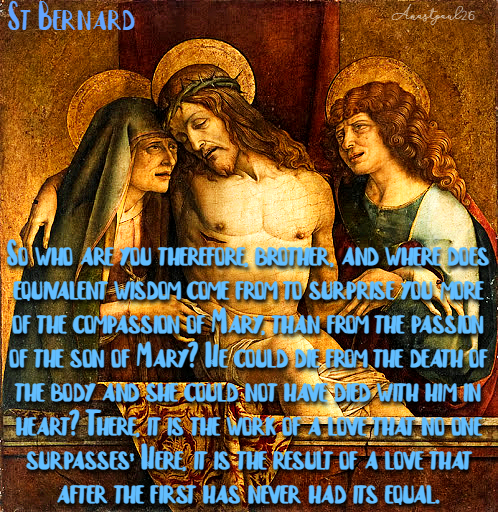
Maybe someone will say, “Didn’t she know in advance that she should die?” Yes, undoubtedly. “Wasn’t she hoping to see him resurrect immediately?” Yes, with confidence. “After that, she suffered when he was crucified?” Certainly, and with what violence! So who are you therefore, brother, and where does equivalent wisdom come from to surprise you more of the compassion of Mary, than from the passion of the son of Mary? He could die from the death of the body and she could not have died with him in heart? There, it is the work of a love that no one surpasses; Here, it is the result of a love that after the first has never had its equal.
Saint Bernard
PRAYER – Our Father, when Jesus Your Son, was raised up on the Cross, it was Your will that Mary, His Mother, should stand there and suffer with Him in her heart. Grant that in union with her, the Church may share in the passion of Christ and so be brought to the glory of His Resurrection. Be our intercessor and our consolation, Our Lady of Sorrows, amen.
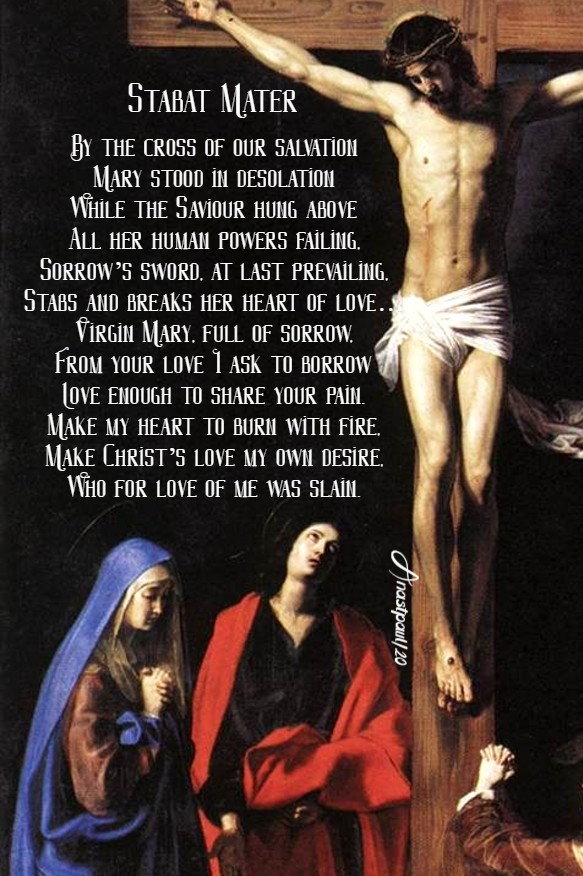
‘By the cross of our salvation Mary stood in desolation While the Saviour hung above All her human powers failing, Sorrow’s sword, at last prevailing, Stabs and breaks her heart of love… Virgin Mary, full of sorrow, From your love I ask to borrow Love enough to share your pain. Make my heart to burn with fire, Make Christ’s love my own desire, Who for love of me was slain.’
Stabat Mater
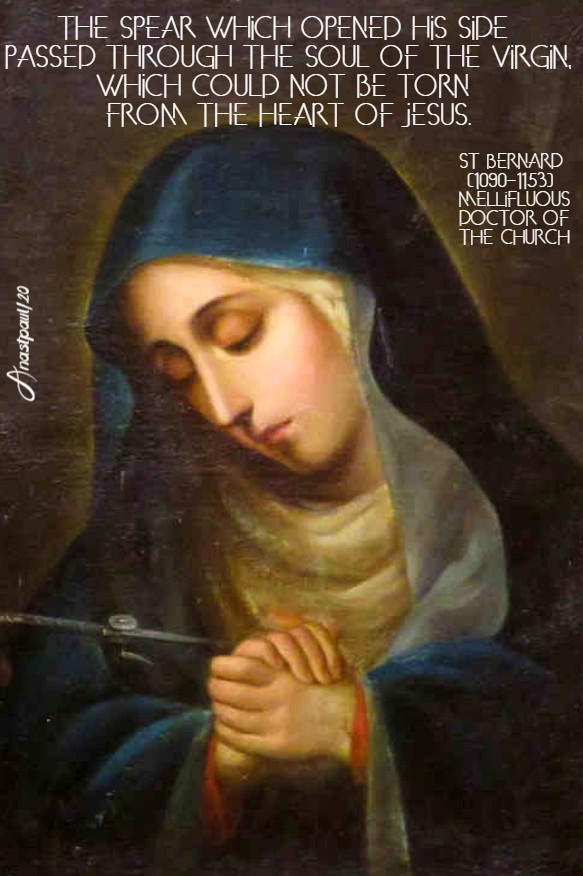
“The spear which opened His side passed through the soul of the Virgin, which could not be torn from the heart of Jesus.”
St Bernard
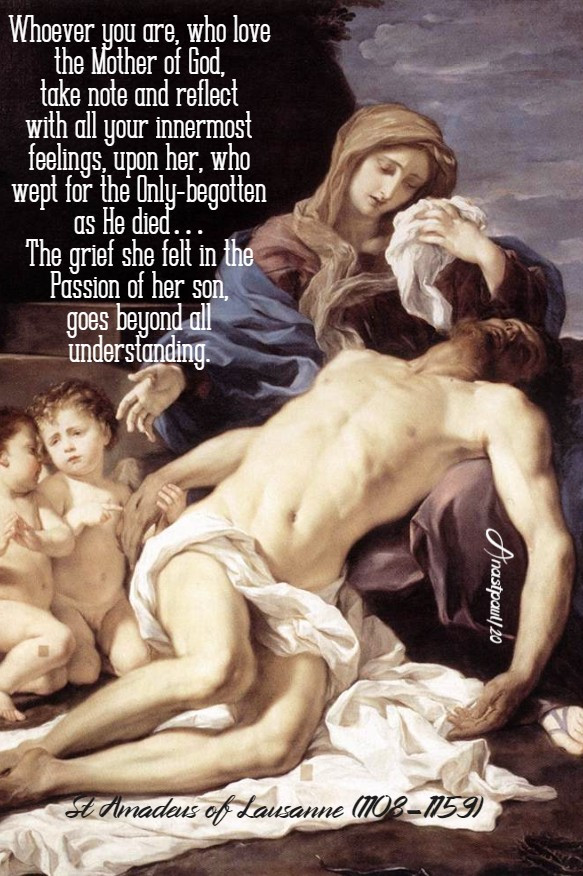
“Whoever you are, who love the Mother of God, take note and reflect with all your innermost feelings, upon her, who wept for the Only-Begotten as He died… The grief she felt in the Passion of her son, goes beyond all understanding.”
St Amadeus of Lausanne
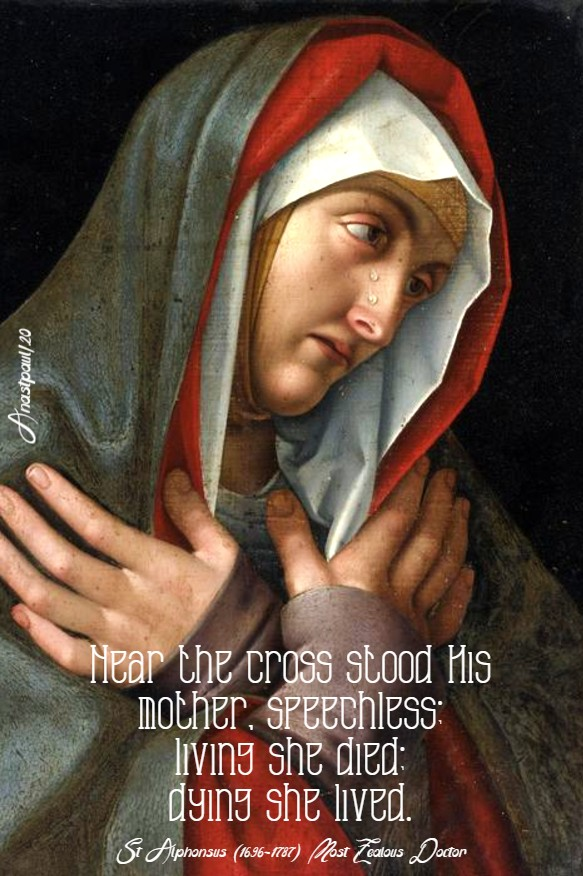
“Near the cross stood His mother, speechless; living she died; dying she lived.”
St Alphonsus
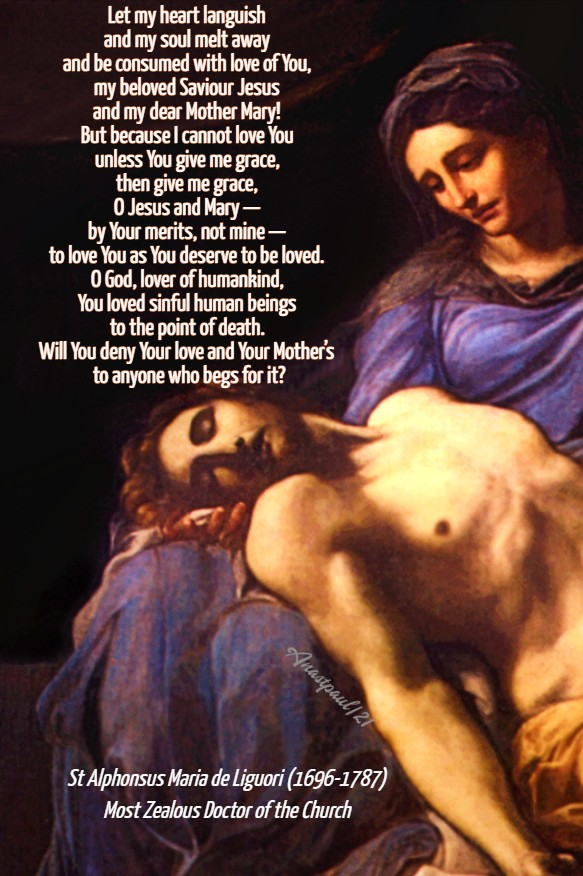
“Let my heart languish and my soul melt away and be consumed with love of You, my beloved Saviour Jesus and my dear Mother Mary! But because I cannot love You unless You give me grace, then give me grace, O Jesus and Mary — by Your merits, not mine — to love You as You deserve to be loved. O God, lover of humankind, You loved sinful human beings to the point of death. Will You deny Your love and Your Mother’s to anyone who begs for it?”
St Alphonsus Maria de Liguori
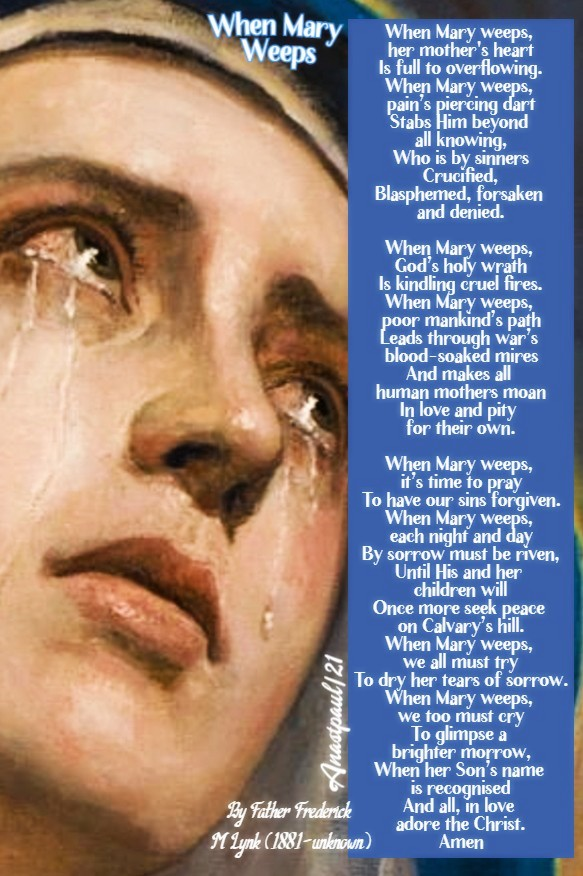
When Mary Weeps By Father Frederick M Lynk (1881-unknown)
When Mary weeps, her mother’s heart Is full to overflowing. When Mary weeps, pain’s piercing dart Stabs Him beyond all knowing, Who is by sinners Crucified, Blasphemed, forsaken and denied.
When Mary weeps, God’s holy wrath Is kindling cruel fires. When Mary weeps, poor mankind’s path Leads through war’s blood-soaked mires And makes all human mothers moan In love and pity for their own.
When Mary weeps, it’s time to pray To have our sins forgiven. When Mary weeps, each night and day By sorrow must be riven, Until His and her children will Once more seek peace on Calvary’s hill. When Mary weeps, we all must try To dry her tears of sorrow. When Mary weeps, we too must cry To glimpse a brighter morrow, When her Son’s name is recognised And all, in love adore the Christ. Amen
Reflections on each of the Seven Dolors of Mary by St Alphonsus Liguori
On the Meeting of Mary With Jesus When He Went To Death
The blessed Virgin revealed to St. Bridget that at the time when the passion of our Lord was drawing nigh, her eyes were always filled with tears, as she thought of her beloved Son whom she was about to lose on this earth. Therefore, as she also said, a cold sweat covered her body from the fear that seized her at that prospect of approaching suffering. Behold, the appointed day at length arrived, and Jesus came in tears to take leave of his mother before he went to death. St. Bonaventure, contemplating Mary on that night, says: Thou didst spend it without sleep, and while others slept, thou didst remain watching. Finally, for I omit the rest to come to my point, St. John came and announced to Mary that the most unjust Pilate had already condemned him to death upon the cross. I say the most unjust, for, as St. Leo remarks, this unjust judge condemned him to death with the same lips with which he had pronounced him innocent.
Mary goes with St. John, and she perceives by the blood with which the way was sprinkled, that her Son had already passed there. This she revealed to St. Bridget: “By the footsteps of my Son I traced his course, for along the way by which he had passed, the ground was sprinkled with blood.” St. Bonaventure imagines the afflicted mother taking a shorter way, and placing herself at the corner of the street to meet her afflicted Son as he passed by. This most afflicted mother met her most afflicted Son: Mcestissima mater mcestissimo filio occurrit, said St. Bernard. While Mary stopped in that place how much she must have heard said against her Son by the Jews who knew her, and perhaps also words in mockery of herself! Alas ! what a commencement of sorrows was then before her eyes, when she saw the nails, the hammers, the cords, the fatal instruments of the death of her Son borne before him! And what a sword pierced her heart when she heard the trumpet proclaiming along the way the sentence pronounced against her Son ! But behold, now, after the instruments, the trumpet, and the ministers of justice had passed, she raises her eyes and sees; she sees, oh God, a young man covered with blood and wounds from head to foot, with a crown of thorns on his head, and two heavy beams on his shoulders; she looks at him and hardly knows him, saying, then, with Isaias: ” And we have seen him, and there was no sightliness.
But at length love recognizes him, and as soon as she knows him, ah, what was then, as St. Peter of Alcantara says in his meditations, the love and fear of the heart of Mary! On the one hand, she desired to see him ; on the other, she could not endure to look upon so pitiable a sight. But at length they look at each other. The Son wipes from his eyes the clotted blood, which prevented him from seeing ( as was revealed to St. Bridget), and looks upon the mother; the mother looks upon the Son. Ah, looks of sorrow, which pierced, as with so many arrows, those two holy and loving souls. When Margaret, the daughter of Sir Thomas More, met her father on his way to the scaffold, she could utter only two words, oh,father! oh, father! arid fell fainting at his feet. At the sight of her Son going to Calvary, Mary fainted not; no, be cause it was not fitting that his mother should lose the use of her reason, as Father Suarez remarks, neither did she die, for God reserved her for a greater grief; but if she did not die, she suffered sorrow enough to cause her a thousand deaths.
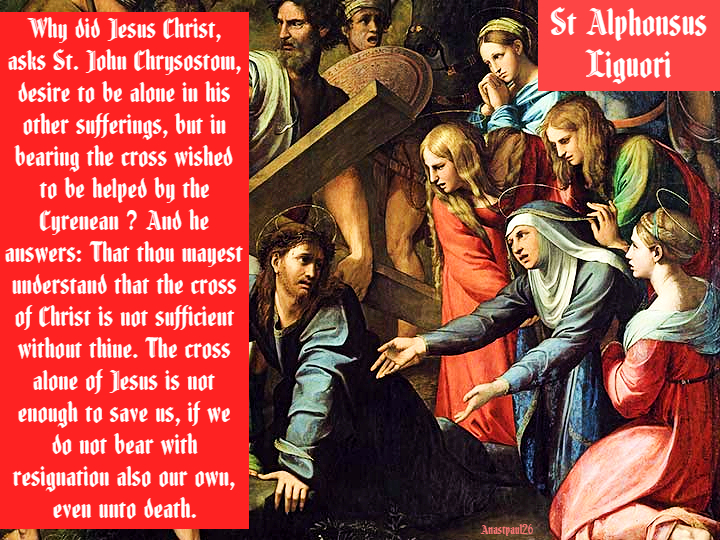
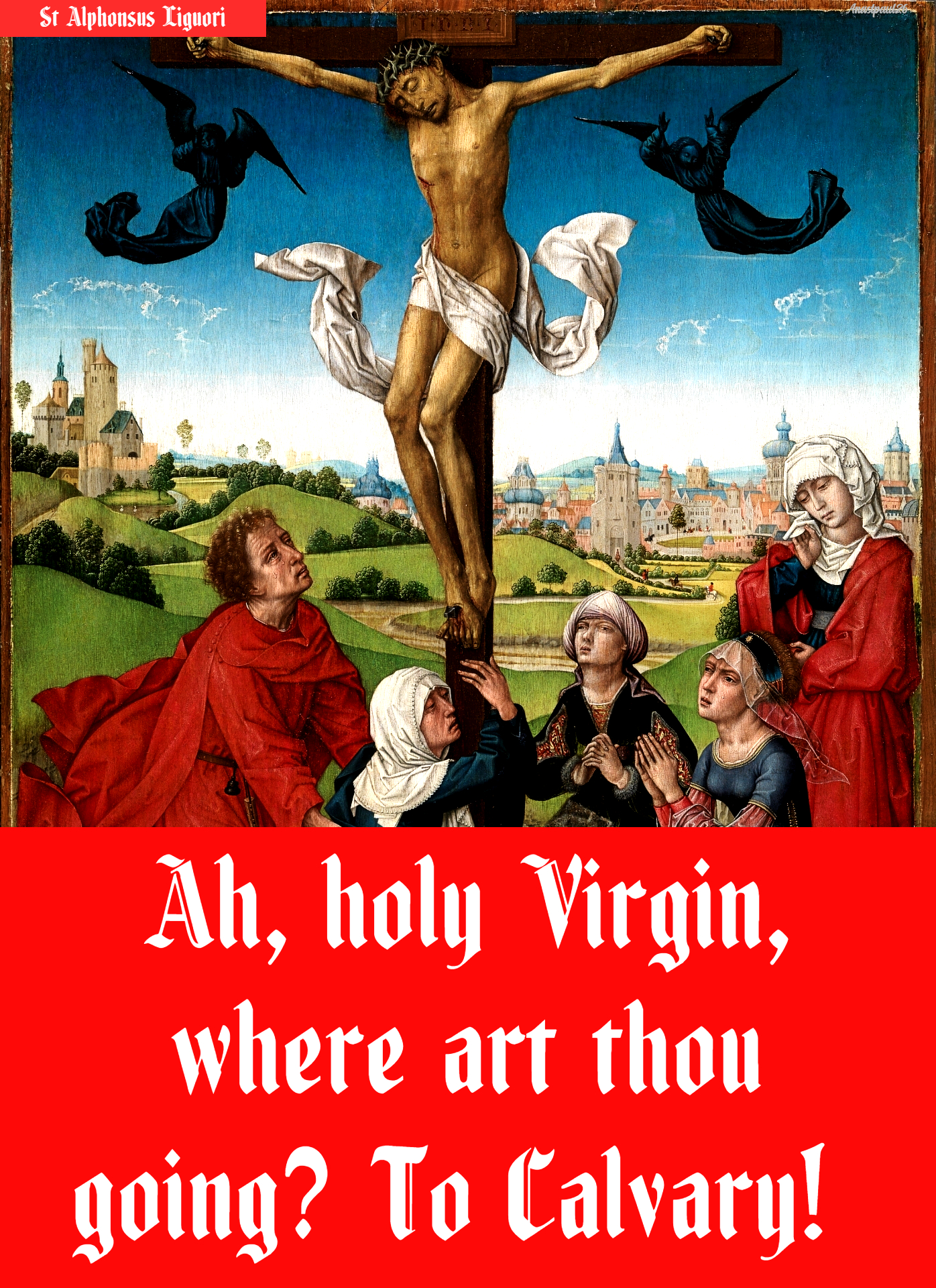
The mother wished to embrace him, as St. Anselm says, but the officers of justice thrust her aside, loading her with insults, and urge onward our afflicted Lord. Mary follows. Ah, holy Virgin, where art thou going? To Calvary! And canst thou trust thyself to see him who is thy life hanging from a cross? And thy life shall be as it were hanging before thee: “Et erit vita tua quasi pendens ante te.” Ah! my mother, stop, says St. Lawrence Justinian, as if the Son himself had then spoken to her; where dost thou hasten? Where art thou going? If thou comest where I go, thou wilt be tortured with my sufferings, and I with thine. But although the sight of her dying Jesus must cost her such cruel anguish, the loving Mary will not leave him. The Son goes before, and the mother follows, that she may be crucified with her Son, as William the Abbot says: The mother took up her cross, and followed him, that she might be crucified with him. We even pity the wild beasts: “Ferarum etiam miseremur;” as St. John Chrysostom has said. If we should see a lioness following her whelp as he was led to death, even this wild beast would call forth our compassion. And shall we not feel compassion to see Mary following her im maculate Lamb, as they are leading him to death ? Let us then pity her, and endeavor also ourselves to accompany her Son and herself, bearing with patience the cross which the Lord imposes upon us. Why did Jesus Christ, asks St. John Chrysostom, desire to be alone in his other sufferings, but in bearing the cross wished to be helped by the Cyrenean ? And he answers: That thou mayest understand that the cross of Christ is not sufficient without thine. The cross alone of Jesus is not enough to save us, if we do not bear with resignation also our own, even unto death.

 AnaStpaul
You must be logged in to post a comment.