Posted in SAINT of the DAY

Saint of the Day – 18 September – Saint Ariadne of Phrygia 

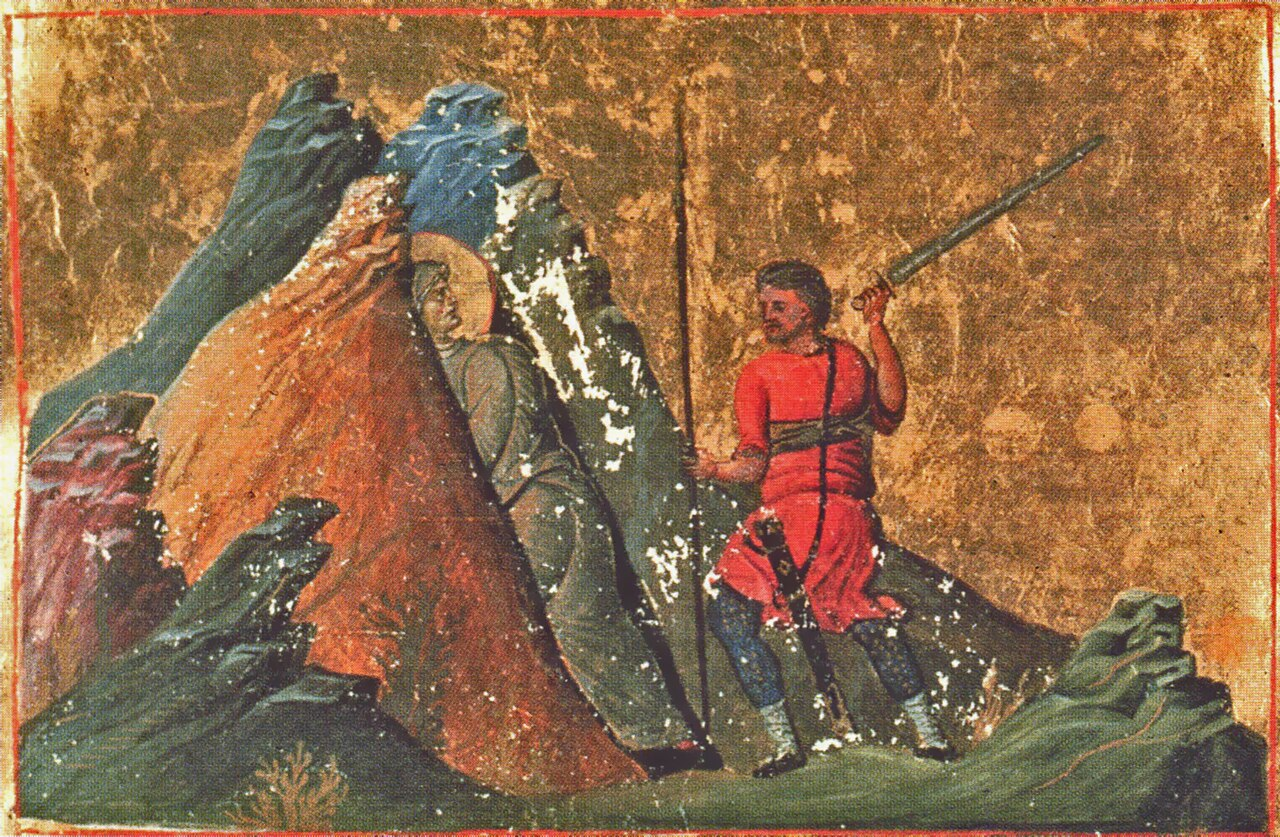
Saint Ariadne of Phrygia, also known as Ariadna, Ariane, Arianna, was a martyr and slave woman in the the 2nd century, who was owned by a Phrygian prince called Tertullus. When by an edict of emperors Hadrian and Antoninus, Christianity was outlawed. When she refused to partake in the pagan rituals on the birthday of Tertullus’ son, she was punished and her case became known to the provincial governor, Gordios.

Both she and Tertullus were convened before a tribunal where Tertullus was acquitted while she was condemned to be crucified. The people of Prymnessus intervened on her behalf to give her three days of repentance in which she then escaped the Roman authorities, fleeing into the nearby mountains where she was saved from her pursuers by a rock which opened miraculously before her and closed behind her, providing her with a tomb.

Posted in MARIAN TITLES

Our Lady of Smelcem, Flanders, (Belgium), and Memorials of the Saints – 18 September

September 18: Our Lady of Smelcem, Flanders

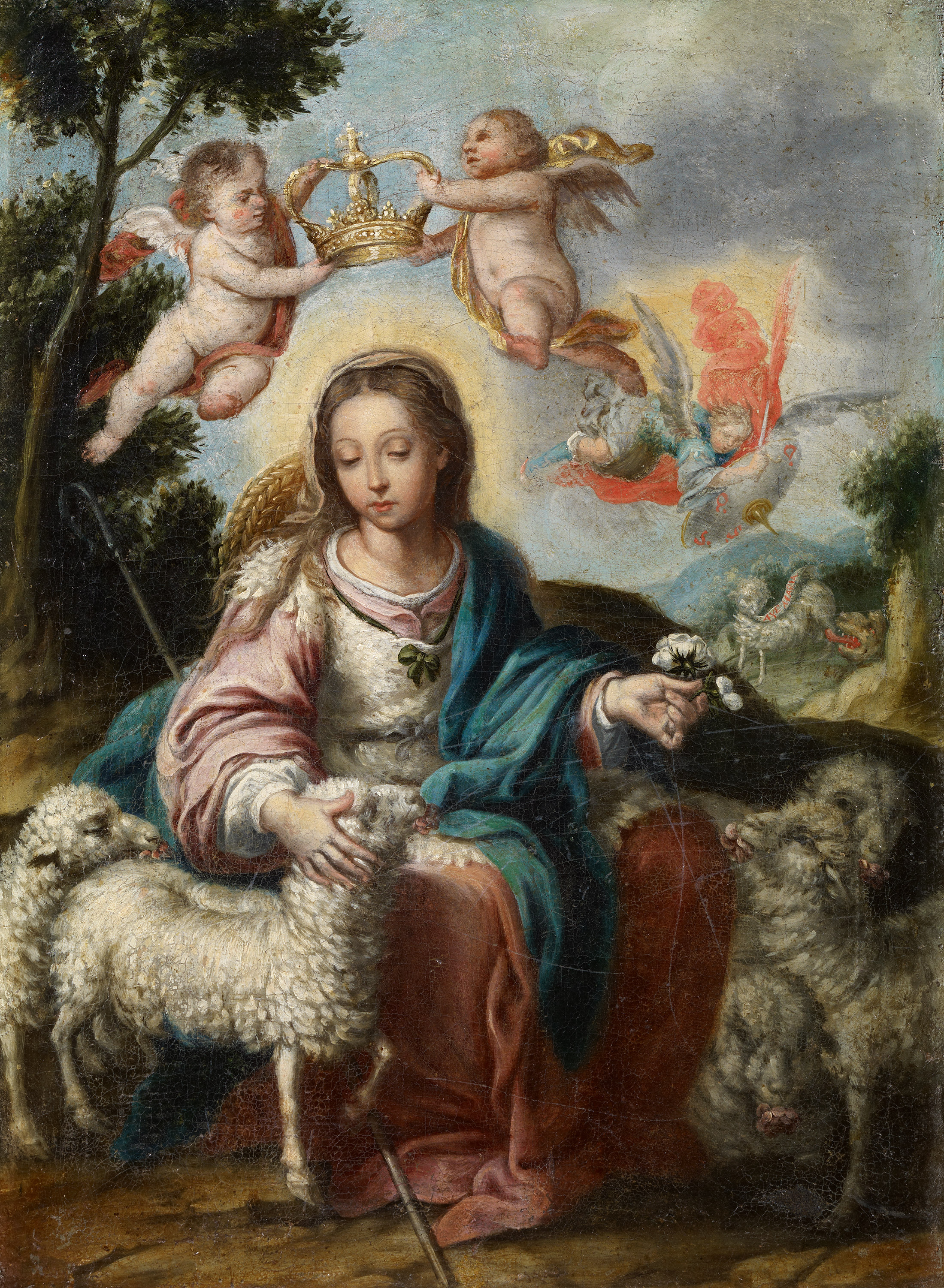
In the 10th century two shepherd boys out tending their flock in a field of Flanders when one of the boys noticed that some of the sheep seemed to be acting strangely.

The boys ran together through the field until they drew closer to the sheep that were acting curiously. Slowing with suspicion as they approached the furthest sheep, the boys carefully made their way through the grazing flock searching the ground and watching for anything unexpected as they neared the place.

When they arrived at the head of the flock, the boys observed that each sheep, upon coming to a certain spot, went down with their front legs bent and their nose touching the ground. Then, gracefully and quickly, they arose and continued to graze. It appeared as if the sheep were bowing in greeting, or even genuflecting, to someone or something. It was all very odd. Turning to look in the direction the sheep faced, the boys suddenly saw a small statue of the Virgin Mary that stood peacefully in the niche of the rocks that marked the end of the pasture.

The news of what the shepherds had experienced when they had observed their sheep bending their knees before the image of the Blessed Virgin, spread throughout all of Flanders. The faith of the people, and the sudden pilgrimages, occasioned Baldwin IV, Count of Flanders and surnamed Fair Beard, to visit Our Lady of Smelcem seeking a cure for a malady from which he had suffered for seventeen years. Praying to the Mother of God for relief, Baldwin was miraculously cured of his malady, and decided to finance the building a church at the place in thanksgiving for having received the favor of the Blessed Virgin Mary.

Blessed Ambrosio María de Torrent (Salvador Chuliá Ferrandis) TC (1866-1936) Priest and Martyr, Friar and Priest of The Amigonian Friars. He was a man of deep piety, a devotee of the Eucharist, a great apostle of the confessional and a competent director of souls.

St Ariadne
St Eumenius Thaumaturgus
St Eustorgius of Milan (Died c 349) Bishop
St Ferreolus the Tribune
St Ferreolus of Limoges
St Hygbald
St Irene of Egypt

St Joseph of Cupertino OFM Conv. (1603-1663) Religious Priest of the First Order of St Francis and Friar, Mystic, Confessor, Miracle-worker.
If ever a tiny child began life with nothing in his favour it was Joseph of Cupertino; he had only one hopeful and saving quality—that he knew it.

St Józef Kut

St Juan Macias OP (1585-1645) Dominican Lay Friar, Mystic, Apostle of Charity and Prayer, MiracleWorker.

St Oceano of Nicomedia

St Richardis (839-c 895) Holy Roman Empress, Benedictine Abbess.

St Sophia of Egypt

Martyred in the Spanish Civil War:
• Blessed Ambrosio María de Torrent (Salvador Chuliá Ferrandis)
• Blessed Carlos Eraña Guruceta
• Blessed Fernando García Sendra
• Blessed Jacinto Hoyuelos Gonzalo
• Blessed Jesus Hita Miranda
• Blessed José García Mas
• Blessed José María Llópez Mora
• Blessed Justo Lerma Martínez
• Blessed Salvador Fernández Pérez
• Blessed Vicente Gay Zarzo
• Blessed Vicente Jaunzarás Gómez

Posted in Our MORNING Offering

Our Morning Offering – 18 September – O Mother of Sorrows, Stand by Me in My Last Agony

Our Morning Offering – 18 September – “Month of the Seven Sorrows of Mary”

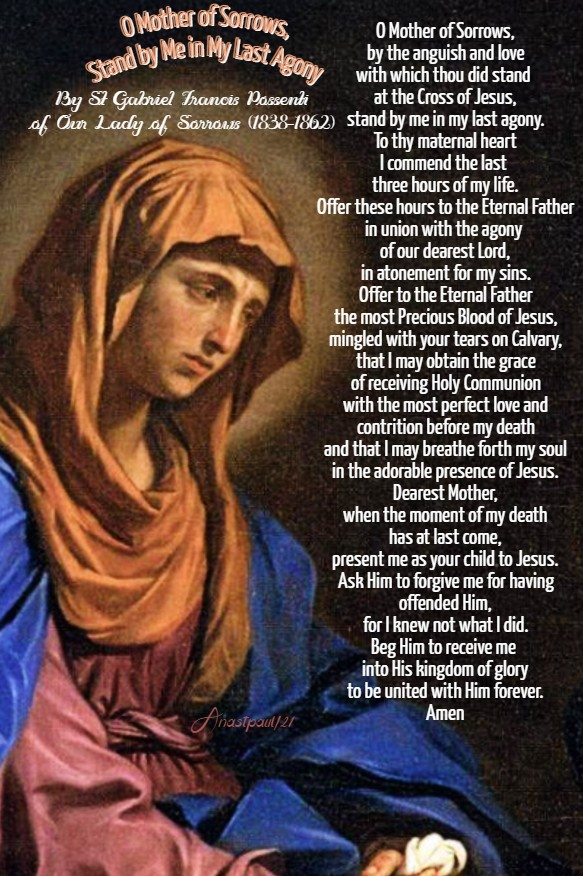
O Mother of Sorrows,
Stand by Me in My Last Agony
By St Gabriel Francis Possenti
of Our Lady of Sorrows (1838-1862)

O Mother of Sorrows,
by the anguish and love
with which thou did stand at the Cross of Jesus,
stand by me in my last agony.
To thy maternal heart
I commend the last three hours of my life.
Offer these hours to the Eternal Father
in union with the agony of our dearest Lord,
in atonement for my sins.
Offer to the Eternal Father
the most Precious Blood of Jesus,
mingled with your tears on Calvary,
that I may obtain the grace
of receiving Holy Communion
with the most perfect love and contrition
before my death
and that I may breathe forth my soul
in the adorable presence of Jesus.
Dearest Mother,
when the moment of my death has at last come,
present me as your child to Jesus.
Ask Him to forgive me for having offended Him,
for I knew not what I did.
Beg Him to receive me into His kingdom of glory
to be united with Him forever.
Amen

Posted in ONE Minute REFLECTION

One Minute Reflection – 18 September – They do not practice what they preach

One Minute Reflection – 18 September – “Month of the Seven Sorrows of Mary” – Readings: Ecclus 1:14-15, Ps 83:2, 1 Cor 13:1-8, Matt 22:1-14

“The marriage feast indeed is ready, but those who were invited were not worthy; go therefore to the crossroads, and invite to the marriage feast whomever you shall find.”

Matt 22:1-14

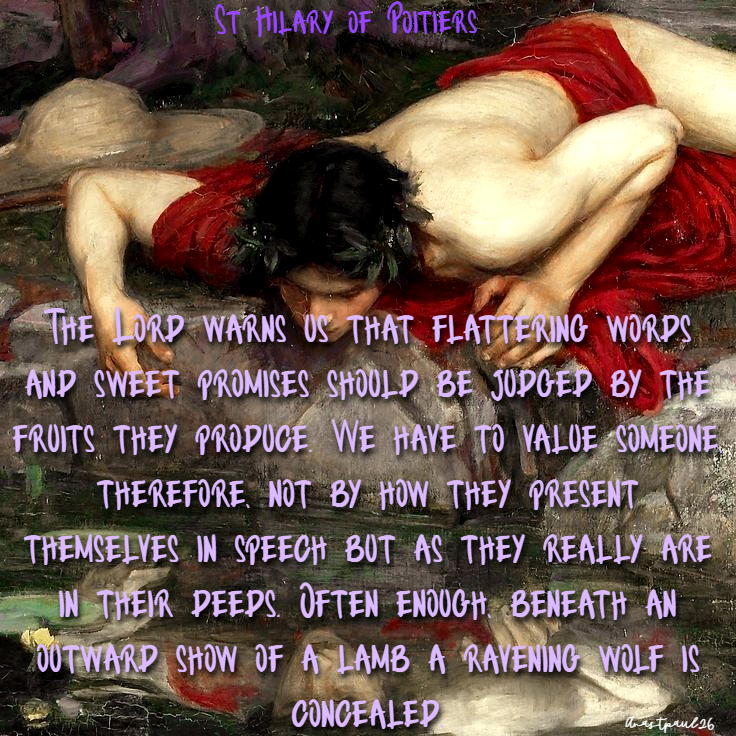
REFLECTION – The Lord warns us that flattering words and sweet promises should be judged by the fruits they produce. We have to value someone, therefore, not by how they present themselves in speech but as they really are in their deeds. Often enough, beneath an outward show of a lamb a ravening wolf is concealed. And just as thorns do not produce grapes nor thistles produce figs, even so, Jesus says, genuinely good works do not consist in fine words such as these. Each one should be judged according to their fruits.

No indeed, a service that was limited to fine words would not suffice to obtain the Kingdom of heaven. It is not those who say “Lord, Lord” who will inherit it. What sense would a holiness be that was limited to the invocation of a name? For the Kingdom of heaven is to be found in obedience to God’s will.

We ought, then, to put something of our own into it if we want to attain eternal blessedness. We have to give something out of our own resources: desire good, avoid evil and obey the divine precepts with all our hearts. An attitude such as this will make us worthy of being acknowledged as one of his own by God. Therefore, let us conform our actions to his will instead of taking pride in his power. For he will resist and reject those who have themselves turned away from him by the injustice of their deeds.

St Hilary of Poitiers

PRAYER – All-powerful, eternal God, splendour of true light and never-ending day, turn our ears and hearts to Your Word, that we may hear and live by the seed You have sown. May all that grows in us be of Your good seed and yield fruit a hundredfold. Grant us the grace of imitating the virtues of Mary, the Mother of Your only-begotten Son and our Mother and may her prayers intercede on our behalf. May we may be filled with courage and love and spread Your Word by our lives. We make our prayer through Jesus, our Lord and Word, with the Holy Spirit, one God with You, forever, amen.

Posted in CATHOLIC Quotes

Quote/s of the Day – 18 September – Hardness of Heart

Brethren: If I should speak with tongues of men and of angels, but do not have charity, I have become as sounding brass or a tinkling cymbal.

1 Cor 13:1-8

Young children, susceptible as they ever are, listen attentively, soon share in their parent’s dislikes, they enter into the passionate feelings of their fathers, they suck in with their milk, so to speak, their corrupt inclinations, and scarcely have they arrived to man’s estate, than they have imbibed through those bad discourses, dispositions which will lead them to perdition.

Pere Jean Lejeune

Those who insult us and treat us contumeliously are anxious for a spiteful sarcastic reply, the silence we then affect, disheartens them, and they cannot avoid showing their vexation, they do all they can to provoke us and to elicit a reply, but the best way to baffle them is to say nothing, refuse to argue with them and to leave them to chew the cud of their hasty anger, This method of bringing down their pride disarms them, and shows them plainly that we slight and despise them.

St Ambrose

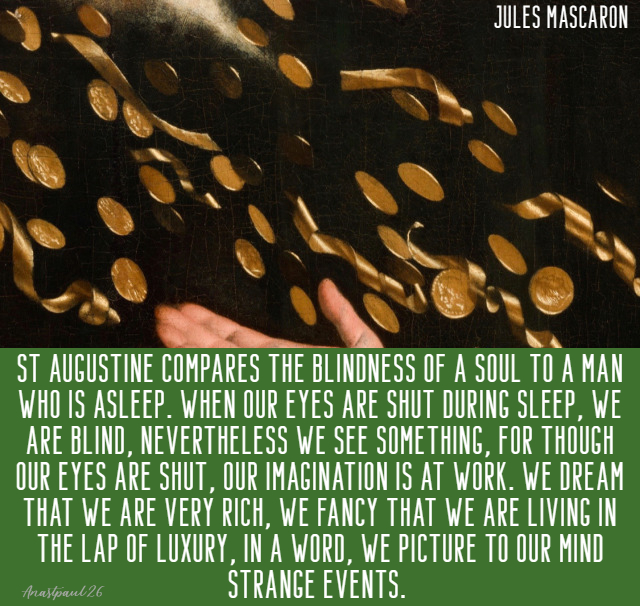
St Augustine compares the blindness of a soul to a man who is asleep. When our eyes are shut during sleep, we are blind, nevertheless we see something, for though our eyes are shut, our imagination is at work. We dream that we are very rich, we fancy that we are living in the lap of luxury, in a word, we picture to our mind strange events. This is our case. We do not see things in the right light, we do not hear the mute language that ought to lead us up to God. We thought to have found true happiness in the wealth and riches of this world, and they have vanished. We sought for earthly joys, and these pleasures have become insipid. When our soul is preparing to leave the body, then our eyes will be opened, and we shall then feel and know our terrible darkness.

Jules Mascaron

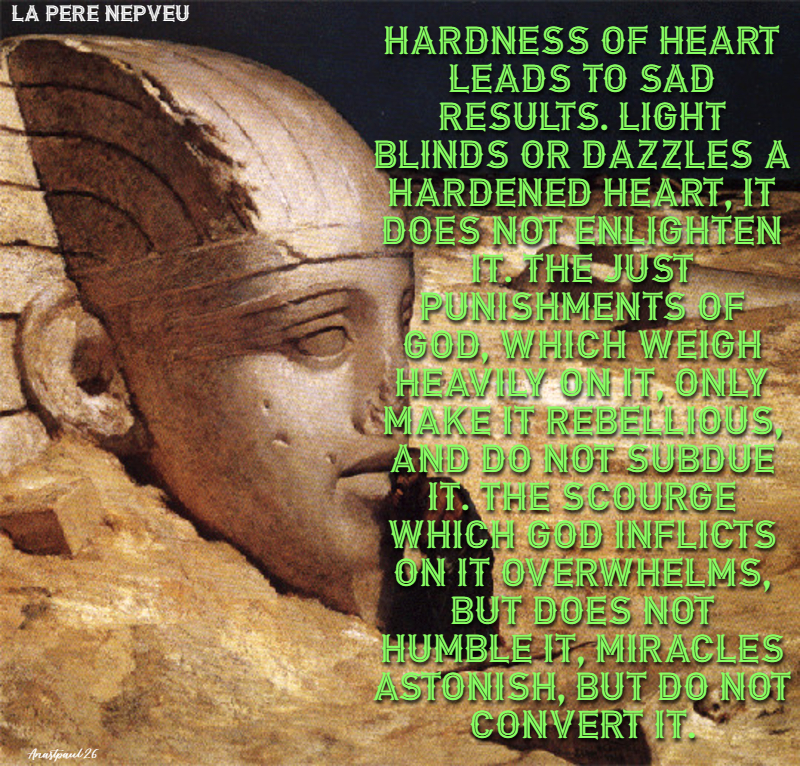
Hardness of heart leads to sad results. Light blinds or dazzles a hardened heart, it does not enlighten it. The just punishments of God, which weigh heavily on it, only make it rebellious, and do not subdue it. The scourge which God inflicts on it overwhelms, but does not humble it, miracles astonish, but do not convert it.

La Pere Nepveu

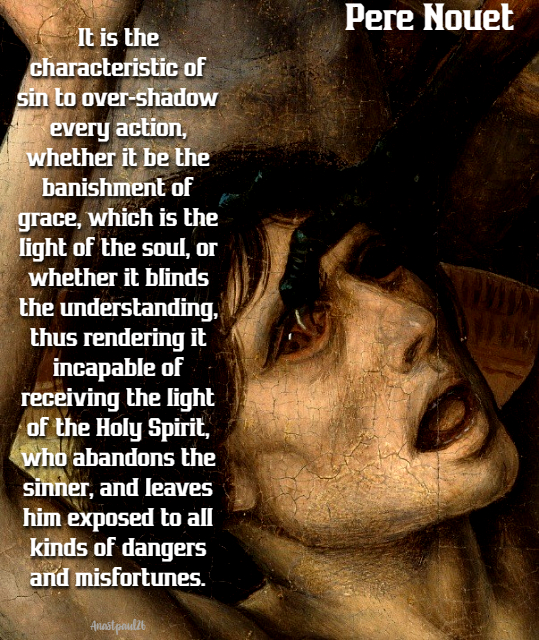
It is the characteristic of sin to over-shadow every action, whether it be the banishment of grace, which is the light of the soul, or whether it blinds the understanding, thus rendering it incapable of receiving the light of the Holy Spirit, who abandons the sinner, and leaves him exposed to all kinds of dangers and misfortunes.

Pere Nouet

Would you wish to know the sure marks of hardness of heart? St Bernard will give them to us. A hardened heart, he says, is a heart unbroken by remorse, unsoftened by devotion, and unmoved by prayer. It yields to no threats, which only harden it the more, it is unmindful of all the blessings of God, and unfaithful to grace. It blushes not at things most shameful, heeds no danger, has no love for brethren, no fear of God.

La Pere Nepveu

Posted in SEPTEMBER-The SEVEN SORROWS of MARY and The HOLY CROSS

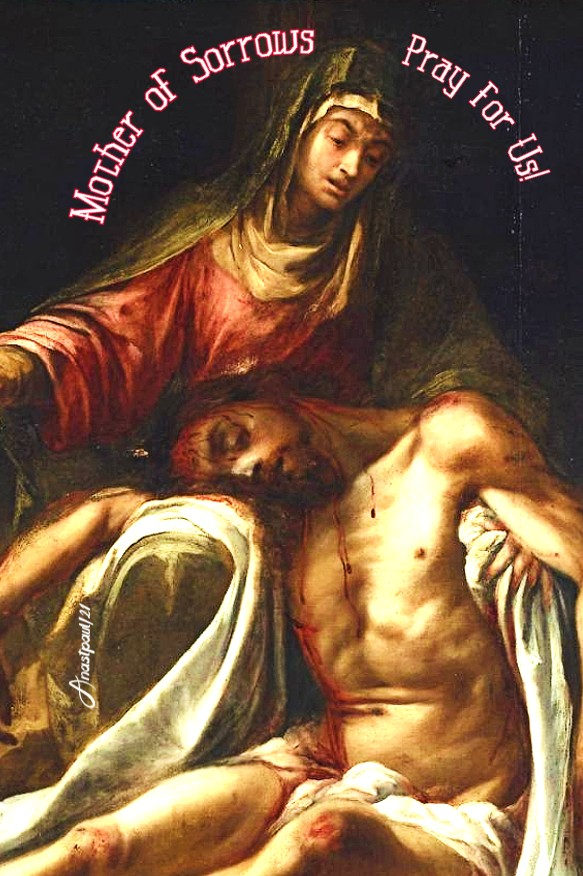
Thought for the Day – 18 September – The Seventh Dolor

Reflections on each of the Seven Dolors of Mary by St Alphonsus Liguori

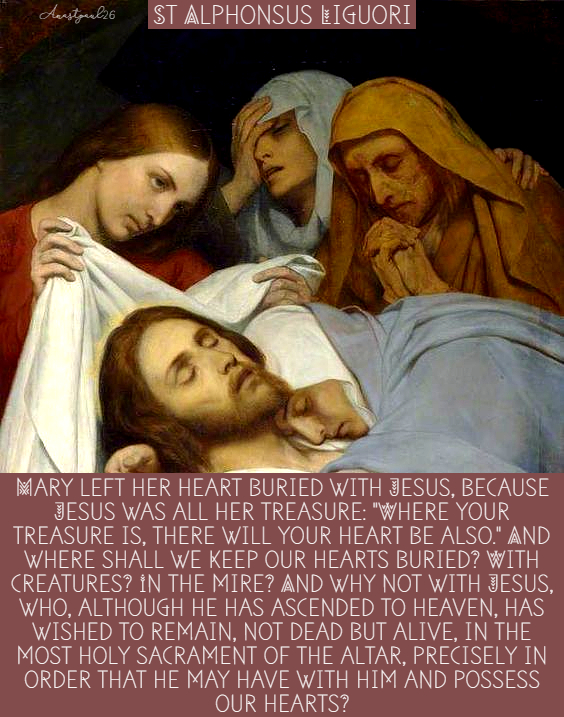
The Burial of the Body of Jesus

When a mother is by the side of a suffering and dying child, she no doubt then feels and suffers all his pains; but when the afflicted child is really dead and about to be buried, and the sorrowful mother takes her last leave of him, oh God! the thought that she is to see him no more is a sorrow that exceeds all other sorrows. Behold, the last sword of sorrow which we are to consider, when Mary, after being present at the death of her Son upon the cross, after having embraced his lifeless body, was finally to leave him in the sepulchre, never more to enjoy his beloved presence.

Thus Mary, clinging to her Son, was dissolved in grief; but those holy disciples, fearing lest this poor mother would expire there through agony, went to take the body of her Son from her arms, to bear it away for burial. Therefore, with reverential force they took him from her arms, and having embalmed him, wrapped him in a linen cloth already prepared, upon which our Lord wished to leave to the world his image impressed, as may be seen at the present day in Turin. And now they bear him to the sepulchre. The sorrowful funeral train sets forth; the disciples place him on their shoulders; hosts of angels from heaven accompany him; those holy women follow him; and the afflicted mother follows in their company her Son to the grave. When they had reached the appointed place, how gladly would Mary have buried her self there alive with her Son! “Oh how willingly,” said the Virgin to St. Bridget, “would I have remained there alive with my Son, if it had been his will!” But since this was not the divine will, the authors relate that she herself accompanied the sacred body of Jesus into the sepulchre, where, as Baronius narrates, they deposited the nails and the crown of thorns. In raising the stone to close the sepulchre, the disciples of the Saviour had to turn to the Virgin, and say to her: Now, oh Lady, we must close the sepulchre; have patience, look upon thy Son, and take leave of him for the last time. Then, oh my beloved Son, must the afflicted mother have said, then shall I see thee no more? Receive then, this last time that I look upon thee, receive the last farewell from me thy dear mother, and receive my heart which I leave buried with thee.

Mary left her heart buried with Jesus, because Jesus was all her treasure: “Where your treasure is, there will your heart be also.” And where shall we keep our hearts buried? With creatures? In the mire? And why not with Jesus, who, although he has ascended to heaven, has wished to remain, not dead but alive, in the most holy sacrament of the altar, precisely in order that he may have with him and possess our hearts? But let us return to Mary. Before quitting the sepulchre, according to St. Bonaventure, she blessed that sacred stone, saying: Oh happy stone, that doth now inclose that body which was contained nine months in my womb, I bless thee, and envy thee; I leave thee to guard my Son for me, who is my only good, my only love. And then turning to the eternal Father, she said: Oh Father, to thee I recommend him, who is thy Son and mine; and thus bidding a last farewell to her Son, and to the sepulchre, she returned to her own house. This poor mother went away so afflicted and sad, according to St. Bernard, that she moved many to tears even against their will: “Multos etiam invitos ad lacrymas provocabat;” so that wherever she passed, all wept who met her: “Omnes plorabant qui obviabant ei,” and could not restrain their tears. And he adds, that those holy disciples, and the women who accompanied her, mourned for her even more than for their Lord.

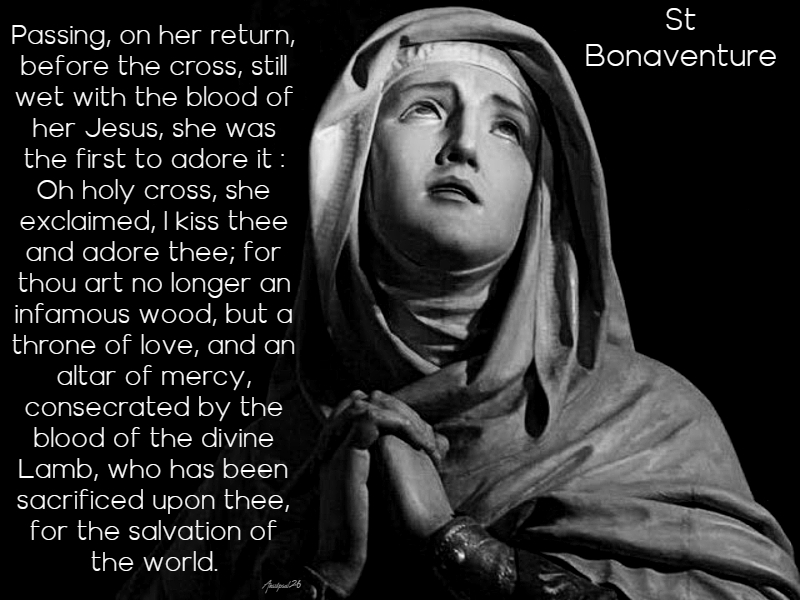
St. Bonaventure says, that her two sisters covered her with a mourning cloak: The sisters of our Lady wrapped her in a veil as a widow, covering as it were her whole countenance. And he also says, that passing, on her return, before the cross, still wet with the blood of her Jesus, she was the first to adore it : Oh holy cross, she exclaimed, I kiss thee and adore thee; for thou art no longer an infamous wood, but a throne of love, and an altar of mercy, consecrated by the blood of the divine Lamb, who has been sacrificed upon thee, for the salvation of the world.