Saint Paphnutius of Egypt, a hermit and martyr. During the persecution under Diocletian (284-305), the governor Hadrian commanded that Paphnutius be brought to him. Instead of waiting to be brought, Paphnutius appeared before the governor, confessed his faith in Christ, and was subjected to torture.
The soldiers involved in his torture, Dionysius and Callimachus, were converted by his faith. They were then beheaded. Cast into prison after the tortures, Paphnutius converted forty prisoners to the Faith. They were all burnt alive.
Paphnutius was eventually set free, and a Christian named Nestorius took him in. He and all his family, through the influence of the saint, became steadfast in the Faith, and ultimately endured martyrdom. Paphnutius strengthened many other Christians to confess our Lord Jesus Christ, and they all died as martyrs. Some were cut down with swords, others were burned. There were 546 in all.
The hermit himself was thrown by the torturers into a river with a stone about his neck, but he miraculously floated to shore, still with the stone about him. Fustrated, they sent him to the emperor Diocletian himself, who commanded him to be crucified on a date tree.
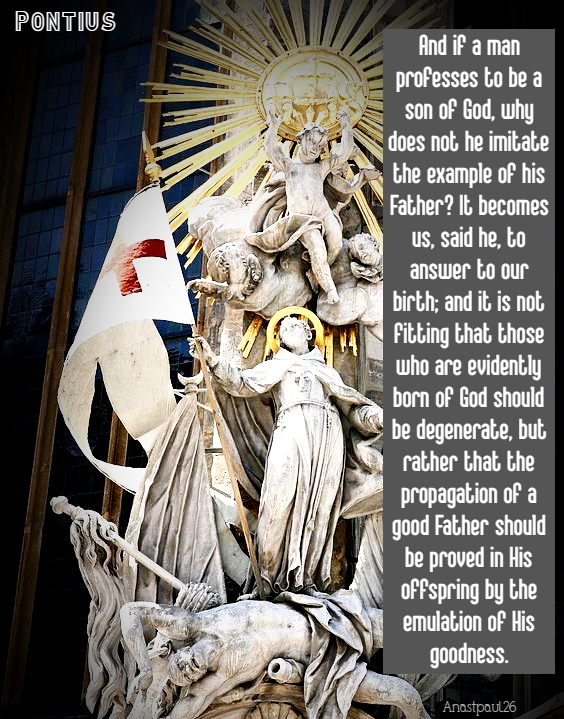
And if a man professes to be a son of God, why does not he imitate the example of his Father? It becomes us, said he, to answer to our birth; and it is not fitting that those who are evidently born of God should be degenerate, but rather that the propagation of a good Father should be proved in His offspring by the emulation of His goodness.
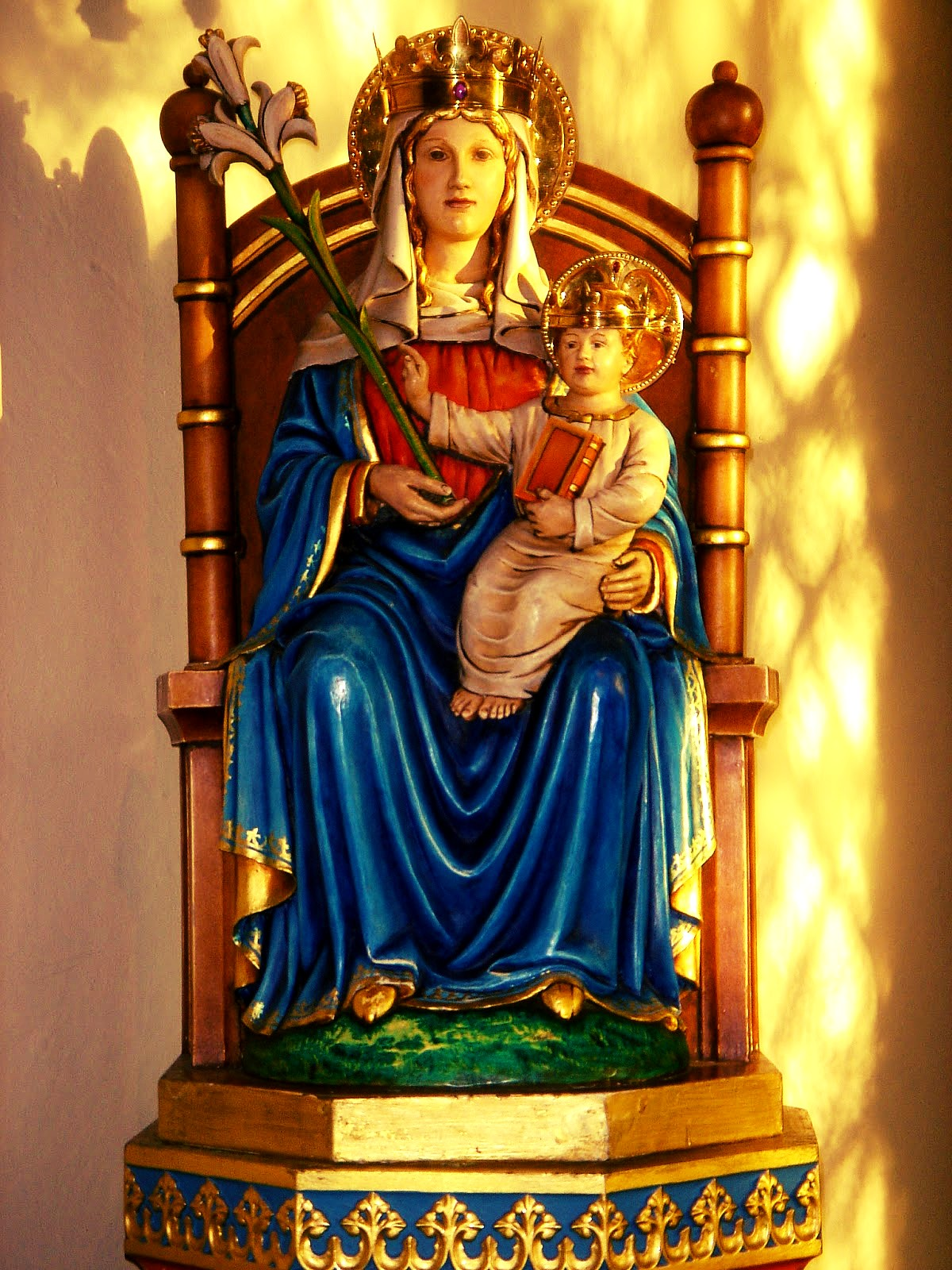
Our Lady of Walsingham / Virgin of the Sea (1061) – 24 September:
The story of the Walsingham Shrine begins in Saxon times. In 1061, the Lady of the Manor, Richeldis de Faverches, was taken in spirit to Nazareth, shown the House where the Annunciation took place and asked by Our Lady, to build a replica in Norfolk. She was promised that ‘Whoever seeks my help there will not go away empty-handed.‘ The simple wooden house that she built soon became the focus of special devotion to Our Lady. The ‘Holy House’ was later encased in stone to protect it from the elements.
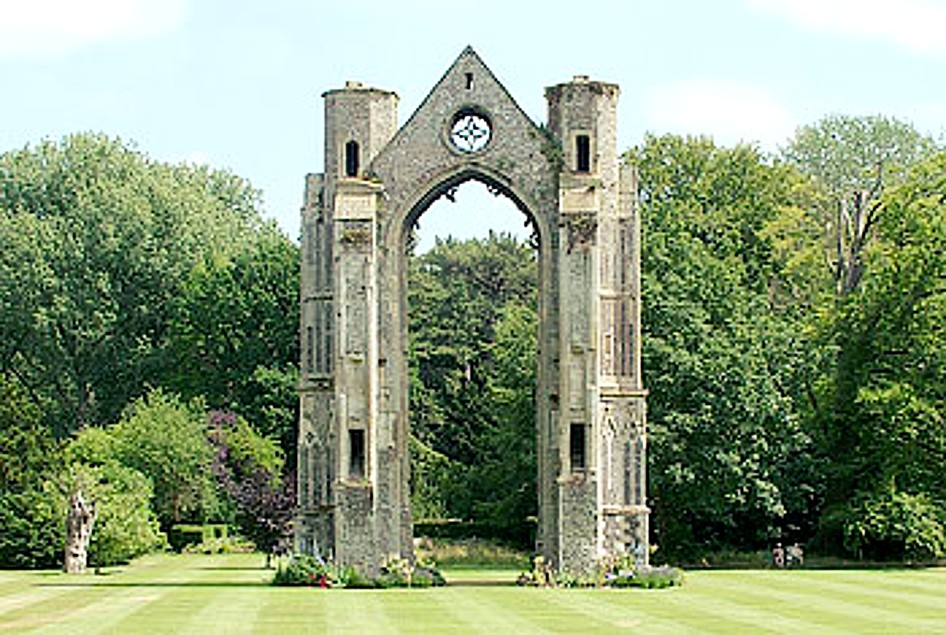
In 1153, the Augustinian Canons founded a Priory to care for the spiritual needs of the pilgrims. Their magnificent Priory Church was added in the fifteenth century. Only the ruin of the Priory Arch remains and archaeology has placed the site of the ‘Holy House’ in its shadow.
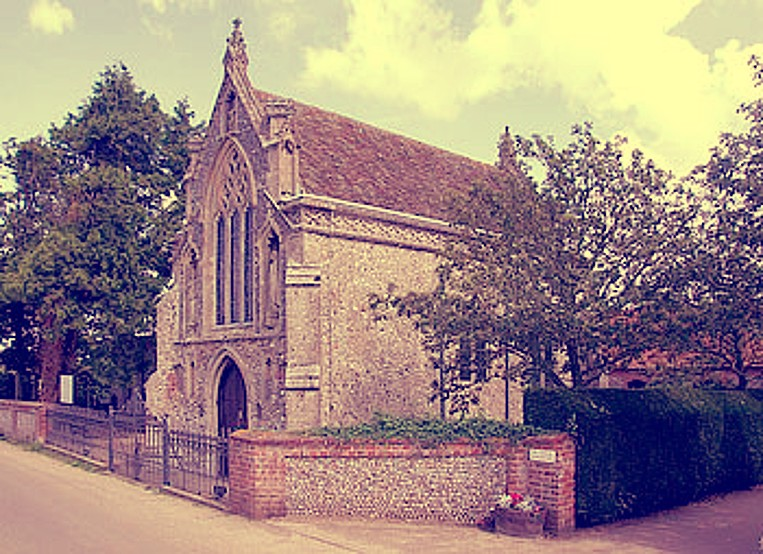
Walsingham became one of the foremost Shrines of medieval Christendom. Among the pilgrims to the ‘Holy House’ were many royal visitors. Henry III in 1226, Edward I (eleven times), Edward II in 1315, Edward III in 1361, Richard II in 1383, Edward IV in 1469, Henry VI in 1487 (and many other times) and Henry VIII in 1511, in thanksgiving for the birth of his son, Prince Henry. In 1340, the Slipper Chapel was built at Houghton St Giles, a mile outside Walsingham. This was the final ‘Station’ Chapel on the way to Walsingham. It was here, that pilgrims would remove their shoes to walk the final ‘Holy Mile’ to the Shrine barefoot.
The Slipper Chapel
Erasmus, the Dutch scholar, visited Walsingham in 1513 and was impressed by the splendour of the Shrine. He wrote:
‘When you look inside, you would say, it is the abode of saints, so brilliantly does it shine with gems, gold and silver … Our Lady stands in the dark at the right side of the Altar … a little image, remarkable neither for its size, material or workmanship.’
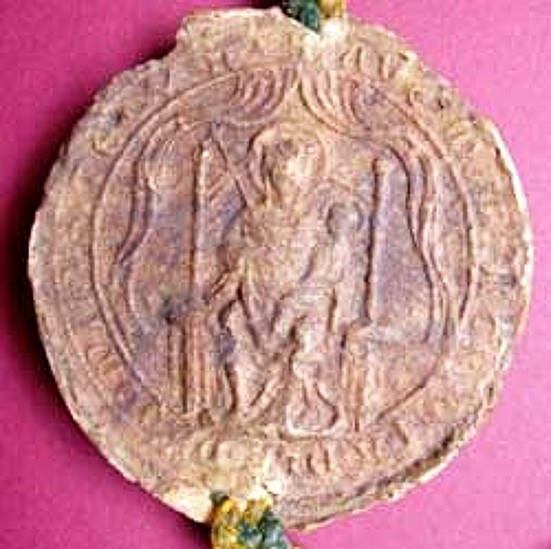
This was soon to come to an end. Henry VIII ordered the dissolution of the monasteries and in 1538 the Priory was closed, the ‘Holy House’ burned to the ground and the Statue of Our Lady taken to London to be destroyed. In 1896 Miss Charlotte Boyd bought the Slipper Chapel, which had seen centuries of secular use. She devoted herself to its restoration. The Statue of the Mother and Child was carved at Oberammergau and based on the design of the original statue – a design found on the medieval seal of Walsingham Priory, an imprint of which is in the British Museum.
The Walsingham seal: around the edges Ave Maria gratia plena dominus tecum
The first Mass since the Reformation was offered in the Slipper Chapel on 15 August 1934 and a few days later Cardinal Francis Bourne led a pilgrimage of 10,000 people to the Chapel and declared it to be the Catholic National Shrine of Our Lady.
St Chuniald Bl Colomba Matylda Gabriel St Coprio St Erinhard St Felix of Autun
St Gerard Sagredo OSB (980-1046) Bishop and Martyr, “The Apostle of Hungary,” Venetian nobleman, Benedictine monk, Prior of San Giorgio, Missionary to Hungary, Adviser to King Saint Stephen, Tutor to Prince Saint Emeric, Hermit, Bishop of Csanád, Writer, Reformer
St Pacificus of Severino OFM (1653-1721) Priest, Franciscan Friar, Mystic, Miracle-worker, Missionary, Superior of the Friary of San Severino and joyful sufferer for Christ.
St Paphnutius of Egypt Bl Robert Hardesty St Rusticus of Clermont St. Rupert of Salzburg St Terence of Persaro (c 210-c 247) Martyr Layman St Thyrsus of Autun St Ysarn of Saint Victor Bl William Spenser — Martyrs of Chalcedon – (49 saints): Forty-nine Christian choir singers of the church in Chalcedon in Asia Minor who were martyred together in their persecutions of Diocletian in 304.
Martyred in the Spanish Civil War: • Blessed Antonio Pancorbo López • Blessed Esteban García y García • Blessed José María Ferrándiz Hernández • Blessed Juan Francisco Joya Corralero • Blessed Luis de Erdoiza Zamalloa • Blessed Manuel Gómez Contioso • Blessed Melchor Rodríguez Villastrigo • Blessed Pascual Ferrer Botella • Blessed Rafael Rodríguez Mesa • Blessed Santiago Arriaga Arrien
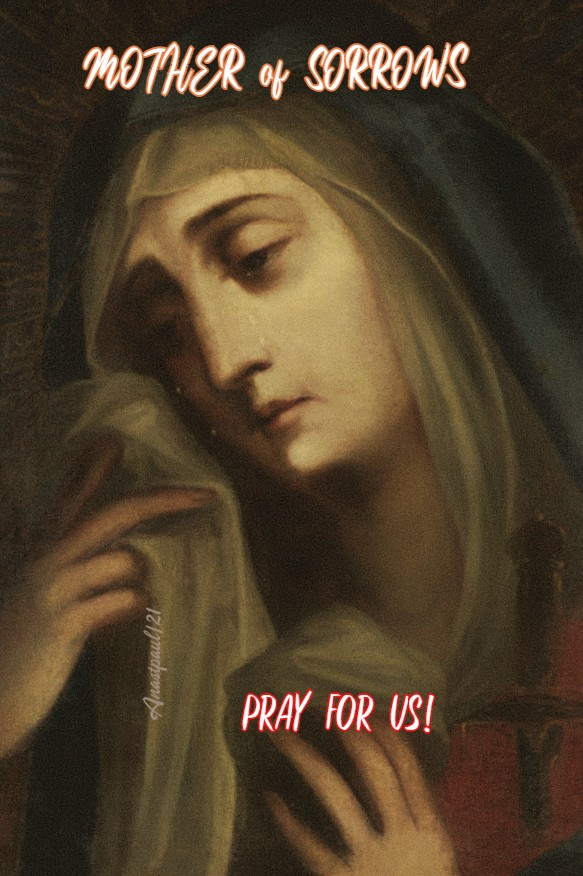
Our Morning Offering – 24 September – “Month of the Seven Sorrows of Mary”
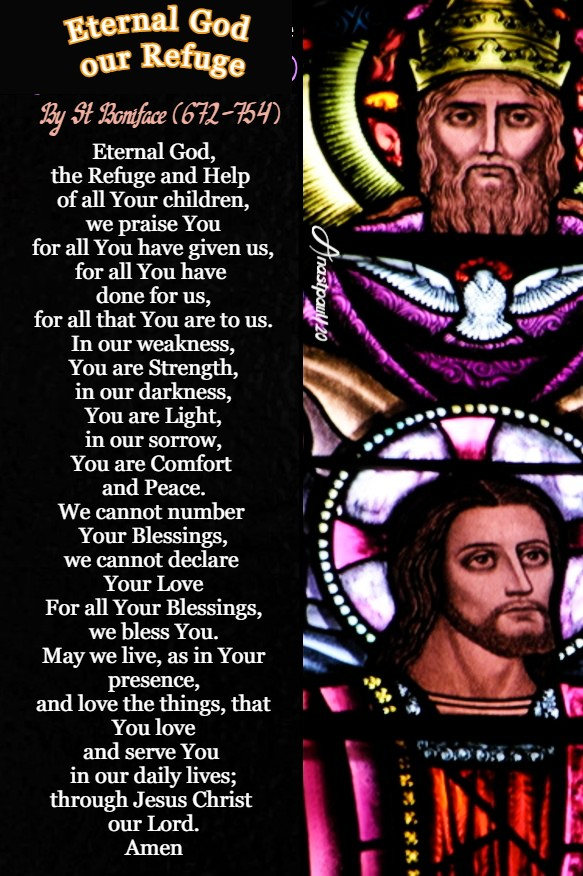
Eternal God, our Refuge By St Boniface (672-754)
Eternal God, the Refuge and Help of all Your children, we praise You for all You have given us, for all You have done for us, for all that You are to us. In our weakness, You are Strength, in our darkness, You are Light, in our sorrow, You are Comfort and Peace. We cannot number Your Blessings, we cannot declare Your Love For all Your Blessings, we bless You. May we live, as in Your presence, and love the things, that You love and serve You in our daily lives; through Jesus Christ our Lord. Amen
One Minute Reflection – 28 September – –“Month of the Seven Sorrows of Mary” – Readings: Ps 118:137; 118:124, Ps 118:1, Eph 4:1-6, Matt 22:34-46
One body and one Spirit, even as you were called in one hope of your calling; one Lord, one faith, one Baptism, one God and Father of all, Who is above all, and throughout all, and in us all, Who is blessed forever and ever. Amen.
Eph 4:1-6
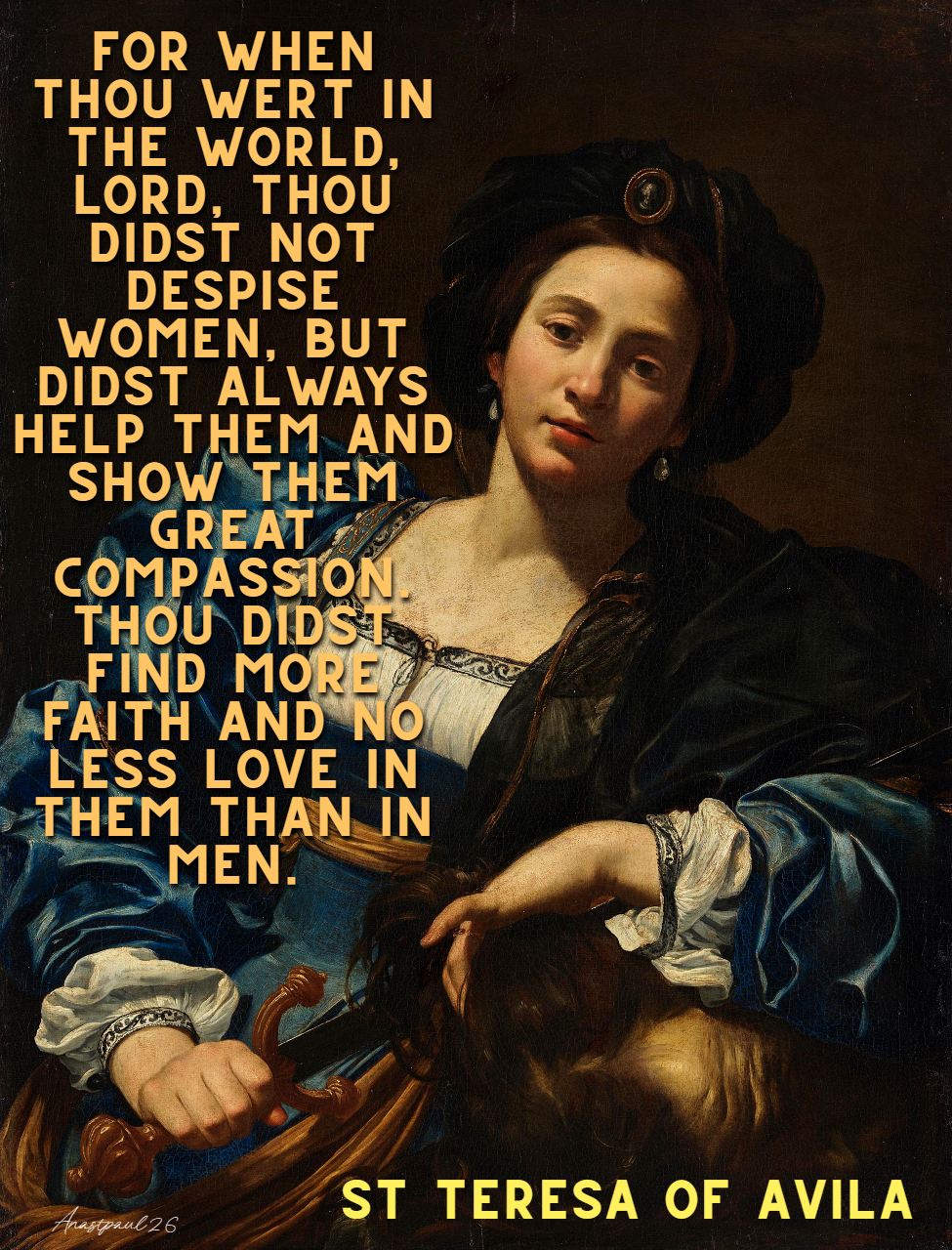
REFLECTION –Since Thou, my Creator, art not ungrateful, I do not think Thou wilt fail to do what they beseech of Thee, for when Thou wert in the world, Lord, Thou didst not despise women, but didst always help them and show them great compassion. Thou didst find more faith and no less love in them than in men, and one of them was Thy most sacred Mother, from whose merits we derive merit, and whose habit we wear, though our sins make us unworthy to do so.We can do nothing in public that is of any use to Thee, nor dare we speak of some of the truths over which we weep in secret, lest Thou shouldst not hear this our just petition.
Yet, Lord, I cannot believe this of Thy goodness and righteousness, for Thou art a righteous Judge, not like the judges in the world, who, being, after all, men and sons of Adam, refuse to consider any woman’s virtue as above suspicion. Yes, my King, but the day will come when all will be known. I am not speaking on my own account, for the whole world is already aware of my wickedness, and I am glad that it should be known, but, when I see what times are like, I feel it is not right to repel spirits which are virtuous and brave, even though they be the spirits of women.
St Teresa of Avila
PRAYER – Lord God, You hold out the Light of Your Word to those who do not know You. Strengthen in our hearts, the faith You have given us and the Credo we profess, so that no trials may quench the fire Your Spirit has kindled in us. May the intercession of all the Apostles, grant us the grace of following the way of the Cross, to stand beneath it with our afflicted Mother, the Mother of God, Ave Maria! We make our prayer through Jesus Christ with the Holy Spirit, one God forever, amen.
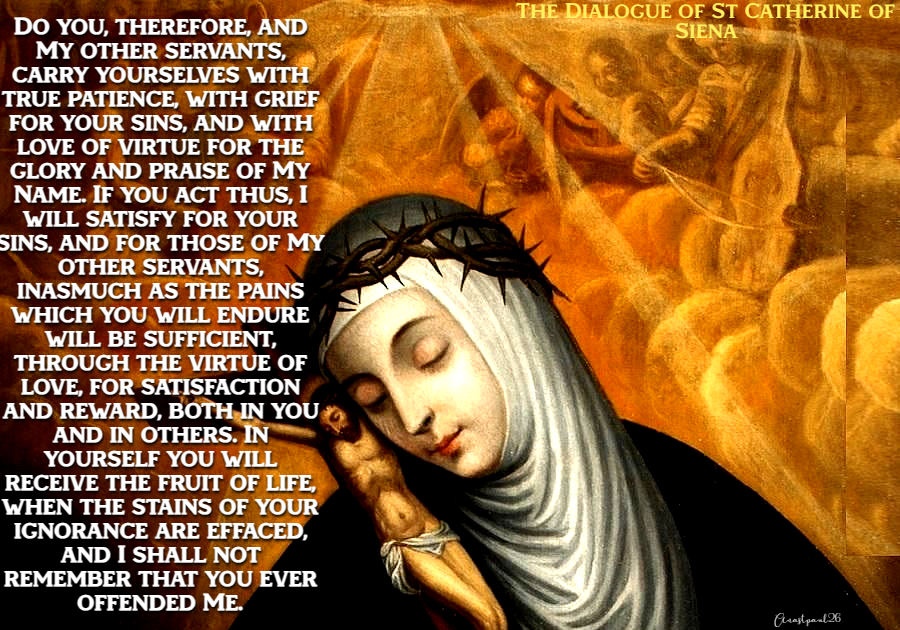
Do you, therefore, and My other servants, carry yourselves with true patience, with grief for your sins, and with love of virtue for the glory and praise of My Name. If you act thus, I will satisfy for your sins, and for those of My other servants, inasmuch as the pains which you will endure will be sufficient, through the virtue of love, for satisfaction and reward, both in you and in others. In yourself you will receive the fruit of life, when the stains of your ignorance are effaced, and I shall not remember that you ever offended Me.
The Dialogue of St Catherine of Siena
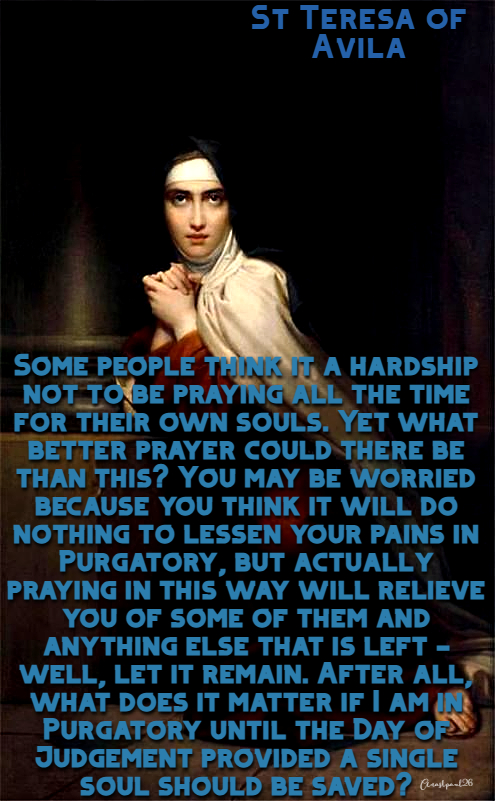
Some people think it a hardship not to be praying all the time for their own souls. Yet what better prayer could there be than this? You may be worried because you think it will do nothing to lessen your pains in Purgatory, but actually praying in this way will relieve you of some of them and anything else that is left – well, let it remain. After all, what does it matter if I am in Purgatory until the Day of Judgement provided a single soul should be saved?
St Teresa of Avila
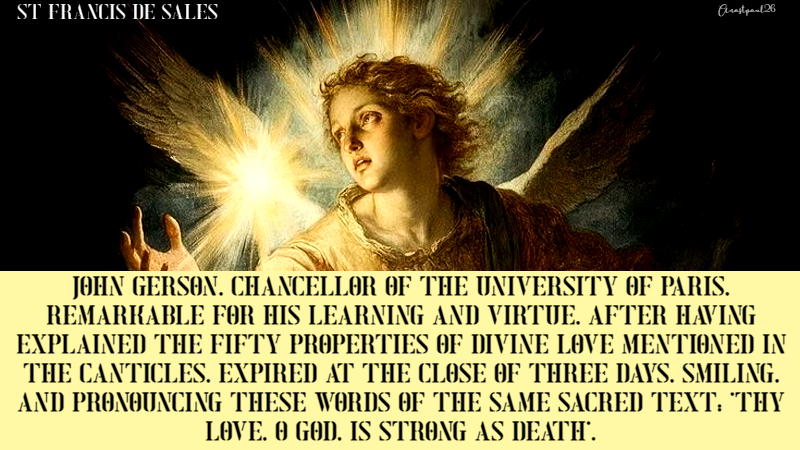
John Gerson, Chancellor of the University of Paris, remarkable for his learning and virtue, after having explained the fifty properties of divine love mentioned in the Canticles, expired at the close of three days, smiling, and pronouncing these words of the same sacred text: ‘Thy love, O God, is strong as death’.
St Francis de Sales
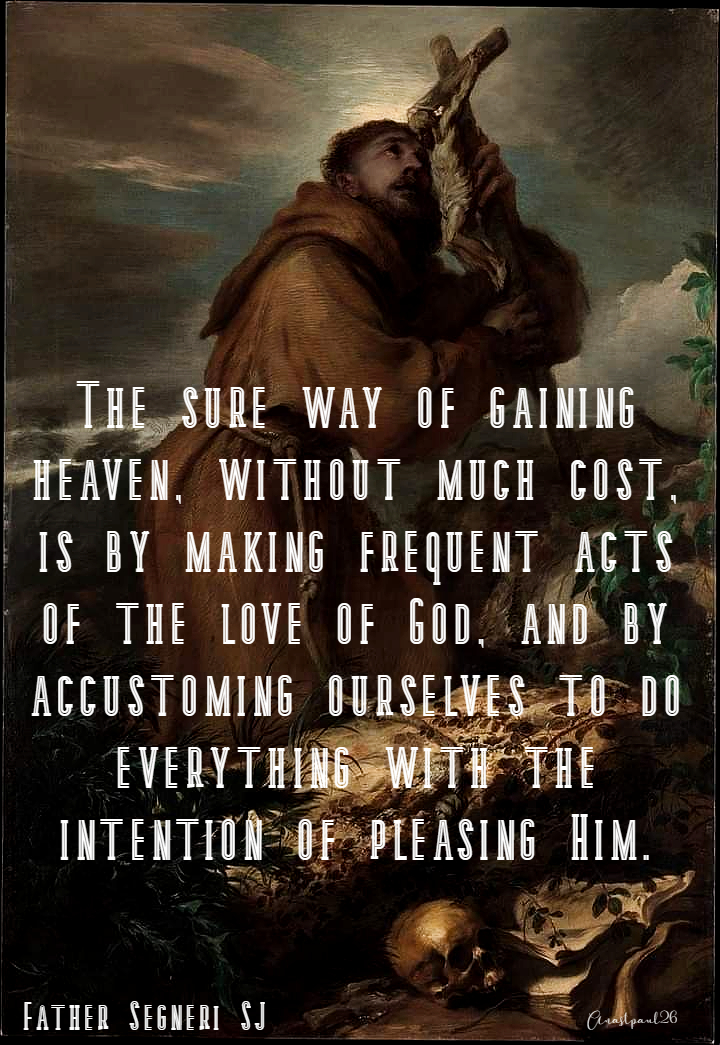
The sure way of gaining heaven, without much cost, is by making frequent acts of the love of God, and by accustoming ourselves to do everything with the intention of pleasing Him.
Father Segneri SJ
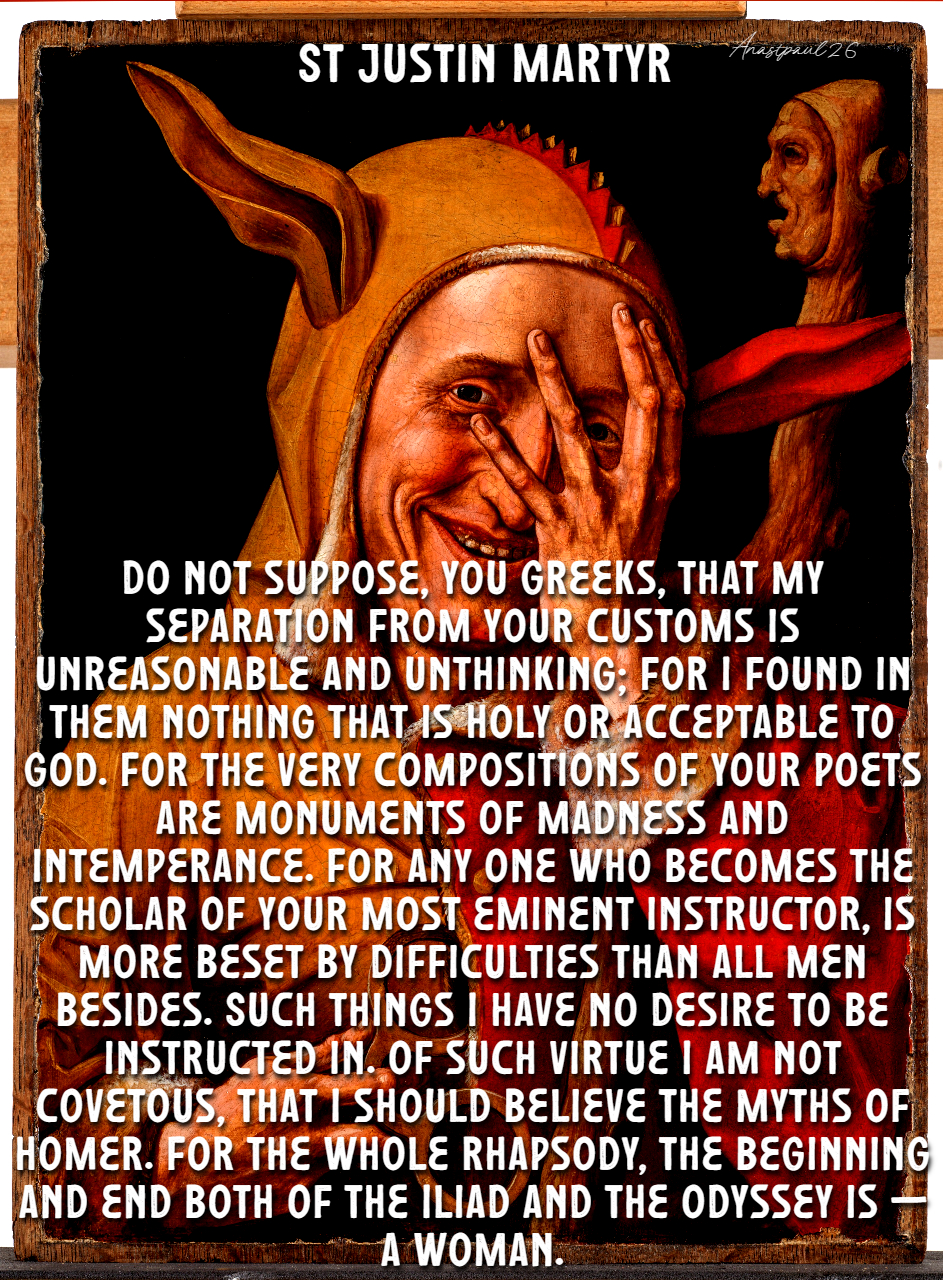
Do not suppose, you Greeks, that my separation from your customs is unreasonable and unthinking; for I found in them nothing that is holy or acceptable to God. For the very compositions of your poets are monuments of madness and intemperance. For any one who becomes the scholar of your most eminent instructor, is more beset by difficulties than all men besides. Such things I have no desire to be instructed in. Of such virtue I am not covetous, that I should believe the myths of Homer. For the whole rhapsody, the beginning and end both of the Iliad and the Odyssey is — a woman.
St Justin Martyr
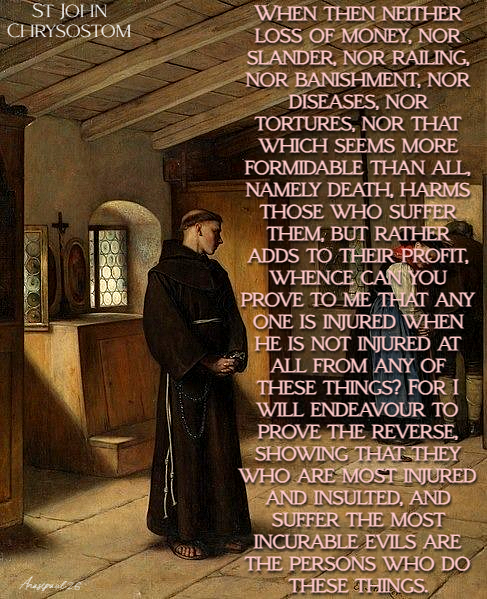
When then neither loss of money, nor slander, nor railing, nor banishment, nor diseases, nor tortures, nor that which seems more formidable than all, namely death, harms those who suffer them, but rather adds to their profit, whence can you prove to me that any one is injured when he is not injured at all from any of these things? For I will endeavour to prove the reverse, showing that they who are most injured and insulted, and suffer the most incurable evils are the persons who do these things.
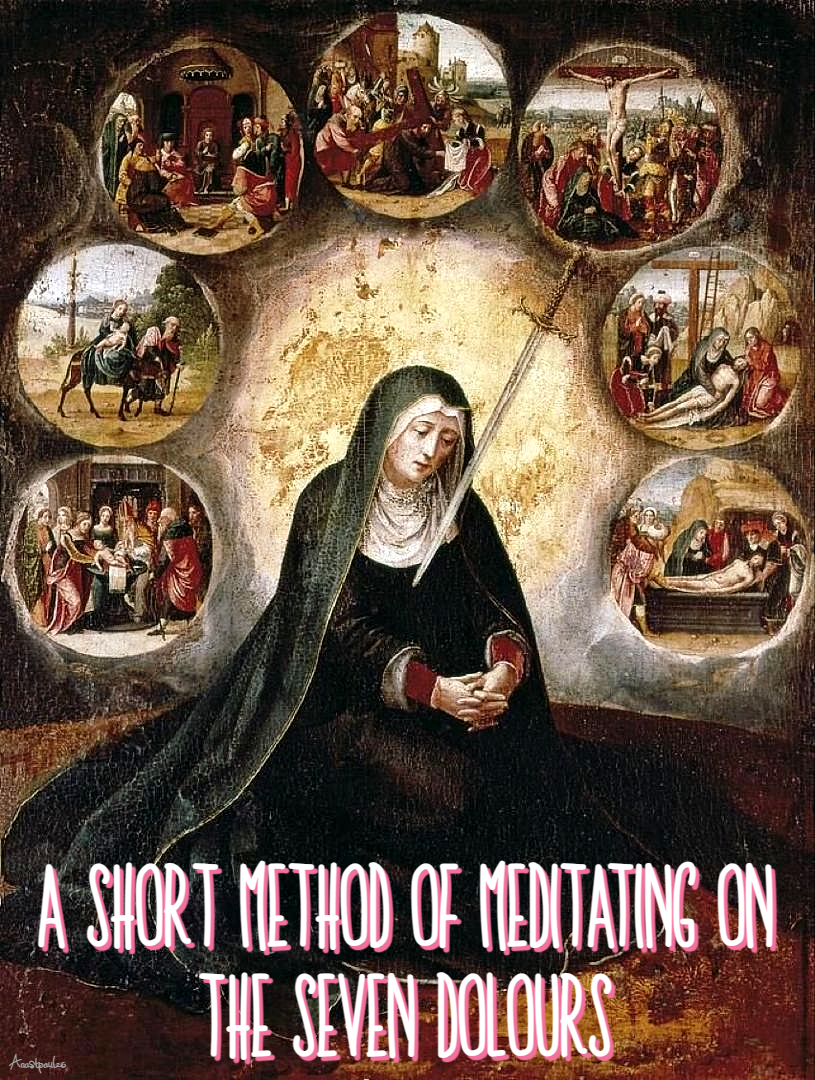
Manual of Devotions in Honour of The Seven Dolors of the Blessed Virgin Mary by Father Sebastian
A SHORT METHOD OF MEDITATING ON THE SEVEN DOLOURS
I. Place yourself in spirit at the feet of the Queen of Martyrs, and offer her your meditation. II. Ask her blessing and assistance. III. Think what Mary suffers in the Dolour on which you wish to meditate. IV. Think who Mary is that suffers. V. Think why Mary suffers. VI. Think how Mary suffers. VII. Think how you suffer. VIII. Think which is the principal virtue taught by Mary in that Dolour upon which you are meditating. IX. Think whether you practice that virtue or not; if not, beg pardon of God, and promise amendment. X. Finish by making some very praсtical resolutions, and by praying to Mary for relief in all your wants, both spiritual and temporal.
Prayer to the Most Desolate Virgin. Hail Mary, full of sorrows, the Crucified is with thee; most sorrowful art thou amongst women, and most sorrowful is the fruit of thy womb, Jesus. Holy Mary, Mother of the Crucified, beg tears for us, the crucifiers of thy Son, now and in the hour of our death. Amen.
An Indulgence of 100 days was granted by his Holiness Pius IX., on December 23rd, 1847, for each recital of this prayer.



You must be logged in to post a comment.