Blessed Delphine, also known as Delphina, was born in 1284 in region of Provence, now part of France. She died on 26 November 1358, having lived as a Franciscan tertiary for most of her life. Delphine was the daughter and heiress of the Count of Puy-Michel. Left an orphan in her infancy, she was placed under the guardianship of her uncles, and was brought up under the direction of her aunt, who was the abbess of the Convent of St. Catherine of Sorps, at Bauduen. As a young girl, she took a vow of virginity.
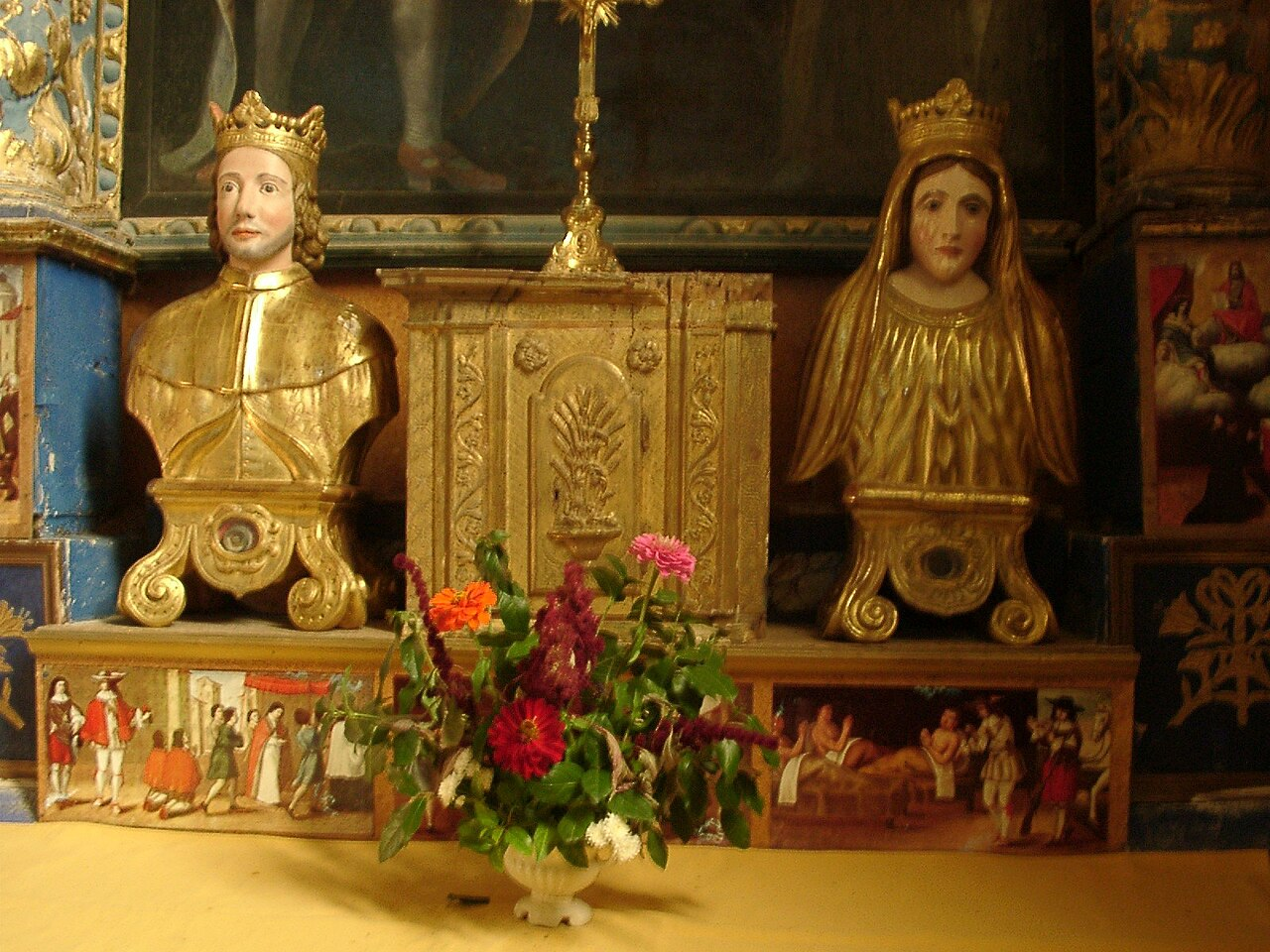
Reliquaries of St. Elzéar and Bl. Delphine in the Franciscan church of Ansouis, France
Despite her vow, at the age of twelve she was espoused to the ten-year-old Elzéar, Count of Sabran. They were married three years later at the castle of Puy-Michel. Having grown up together, they regarded each other as brother and sister, rather than husband and wife. Inspired by her example, her husband also took a vow of celibacy, which both honored throughout their married life.
Elzear took his place as a trusted aide at the court in Aix-en-Provence. The couple, having both received the habit of the Third Order of St. Francis, lived together at their castle in Ansouis in the practice of prayer, penance and charity towards the poor. After seven years, they moved to Puy-Michel. When Elzear had to go to Naples to see to some inherited property, they kept up a regular correspondence.
Elzear died on an errand to Paris in the interests of the king. Delphina wept bitterly when she heard the news. Nevertheless she prayed:
“My God, may Thy most holy will be done!”
Urged by the spirit of God toward still greater perfection, Blessed Delphina presently renounced all temporal goods and added to her vow of chastity the vow of holy poverty and retired first to Naples and then to Cabrières, which was the location of the castle where her husband had born. She finally returned to Apt where her husband had been buried. Upon her death, she was buried with him in the church of the Friars Minor there, wearing the habit of the Order.
The veneration that had begun to be given to Delphine was confirmed by Pope Urban V, godson of Elzéar, who canonized her husband at that time.
September 27: Our Lady of Happy Assembly, Le Laus, France (1664)
Le Laus is a little village in southeastern France, 60 miles to the southeast of Grenoble. The story of Mary’s shrine there centers around a young woman named Benoite Rencurel, who was born on September 29, 1647 of humble parents in the little village of Saint Etienne, not far from Le Laus. Her father died when she was seven and after his death her mother found life rather difficult. So, when Benoite was 12, she went to work on a neighboring farm, tending the farmer’s sheep. Each day while the flock grazed she spent a few minutes praying to the Blessed Virgin at a little wayside chapel.
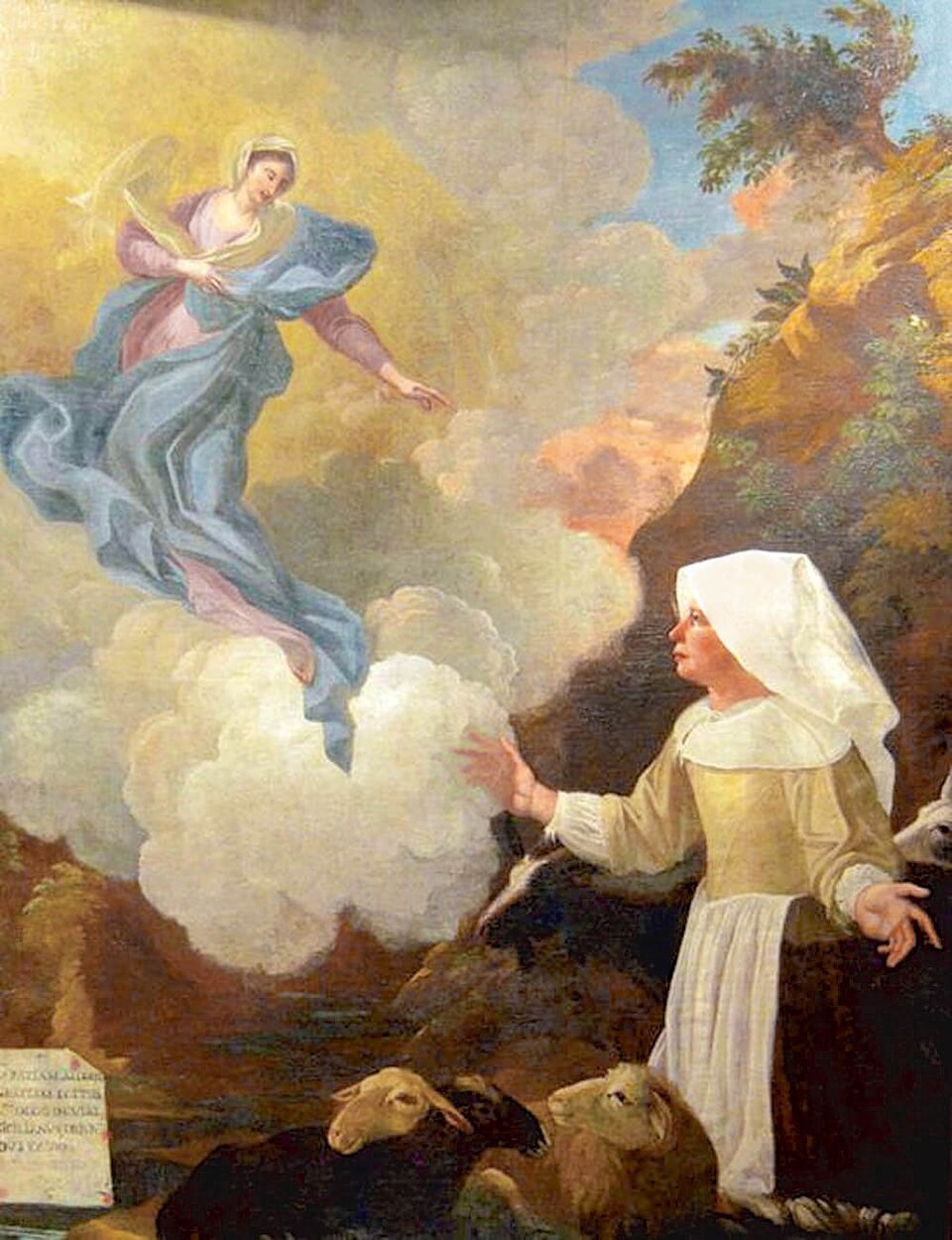
One day, in 1664, Benoite led her little flock into a small valley near Saint Etienne and there toward the end of the afternoon, a Lady and Child appeared to her, standing on top of a rock, a large rock, known locally as Les Flours. The Lady did not speak to Benoite, but smiled in a very friendly way and after a few minutes Lady and Child vanished. However, similar apparitions continued almost daily for two months. Of course, rumors of what was occurring gradually spread around the neighboring countryside.
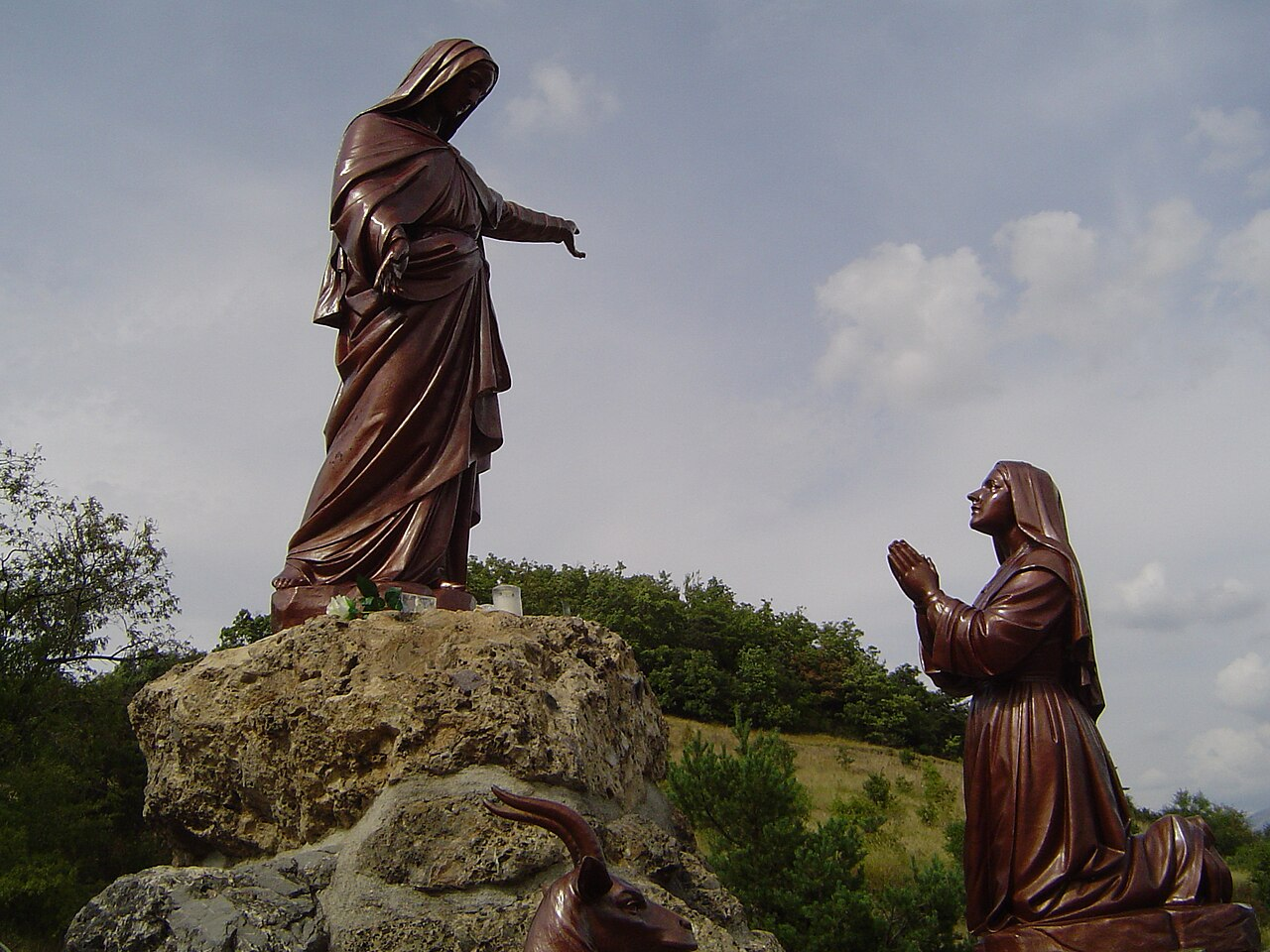
The Monument of Pindreau, in Saint-Étienne-le-Laus, depicting the apparition of the Virgin Mary to Benoîte Rencurel.
Finally, M. Grimaud, a district magistrate, questioned Benoite at length and suggested that if the lady appeared again, Benoite should ask her who she was. The girl agreed; on the very next day the Lady appeared, she asked her to please say who she was – was she the Mother of God? The Lady answered:
“Yes, I am Mary, the Mother of Jesus. My Son wishes to be especially honored in this valley, but not on this spot.”
With these words she vanished. Benoite did not see her again for a few days. On September 29, while tending her flock at another pasture, Pindreau, a very brilliant light suddenly appeared on top of some rocks. In the center of the light stood the Blessed Virgin. She told Benoite to go to Le Laus, where she would find a little chapel, filled with a delicious perfume, and there she would also see her. Benoite soon found herself at the little chapel of Our Lady of Good Meeting or Happy Assembly (Notre-Dame de Bon Recontre) and going in, she saw the Blessed Virgin over the high altar, on which stood her image. And the Virgin said to Benoite,
“On this spot I wish a church built – a privileged sanctuary, wherein many sinners will repent. Means will not be wanting, despite the poverty of the country people around.”
The news of this event soon spread; crowds came to the little chapel, which was too small to contain them. So, in 1665, Msgr. Lambert, Vicar General of the Archdiocese, gave permission for a church to be built over the little chapel.
Since there was very little money available with which to hire workmen, the villagers and peasants for miles around carried the stones and built the walls for Our Lady of Happy Assembly – aided by the many pilgrims who came to worship and remained a while to help in the building of the church.
In 1692, during an invasion by the Duke of Savoy the church was partly destroyed, but the statue of Our Lady of Happy Assembly was not damaged. The church was soon repaired and restored. In 1716 a new statue of the Virgin was carved and enshrined behind the main altar of the church. It is said that Benoite wished the new statue to be named Our Lady of Happy Assembly of Laus. The original statue was transferred to a chapel behind the main altar. In 1885 Pope Pius IX gave official recognition to the title of Our Lady of Laus of Happy Assembly, when he ordered the new statue to be solemnly crowned. Benoite Rencurel died on December 28, 1718, and was buried in a vault in front of the altar in the church at Le Laus.
For 54 years, the Virgin Mary continued to appear to Benoîte throughout her life. Benoîte became a Dominican Tertiary and was called “Sister Benoîte”. She was given by Mary the mission to welcome the pilgrims. Benoîte was also given the gift of reading souls, to help the pilgrims make good confessions to the priests, by making them know their sins, remember the forgotten ones, and confess them and repent. There have been many testimonies saying that a heavenly perfume would fill the church every time Mary would appear to Benoîte. In addition to Marian apparitions, Benoîte also had apparitions of angels, several saints, and mystical experiences such as visions of Paradise.
Between 1669 and 1684, she was also granted the vision of the crucified Christ on the cross of Avançon five times. On a Friday in July of 1673, according to Benoîte, Jesus on the cross told her: “My daughter, I show myself in this state so that you can participate in my Passion.” United with Him, she lived a “mystical crucifixion” every Friday for several years and bore stigmata.
French philosopher and theologian Jean Guitton said, “The Shrine of Laus is one of the most hidden and also most powerful treasures in the history of Europe.”
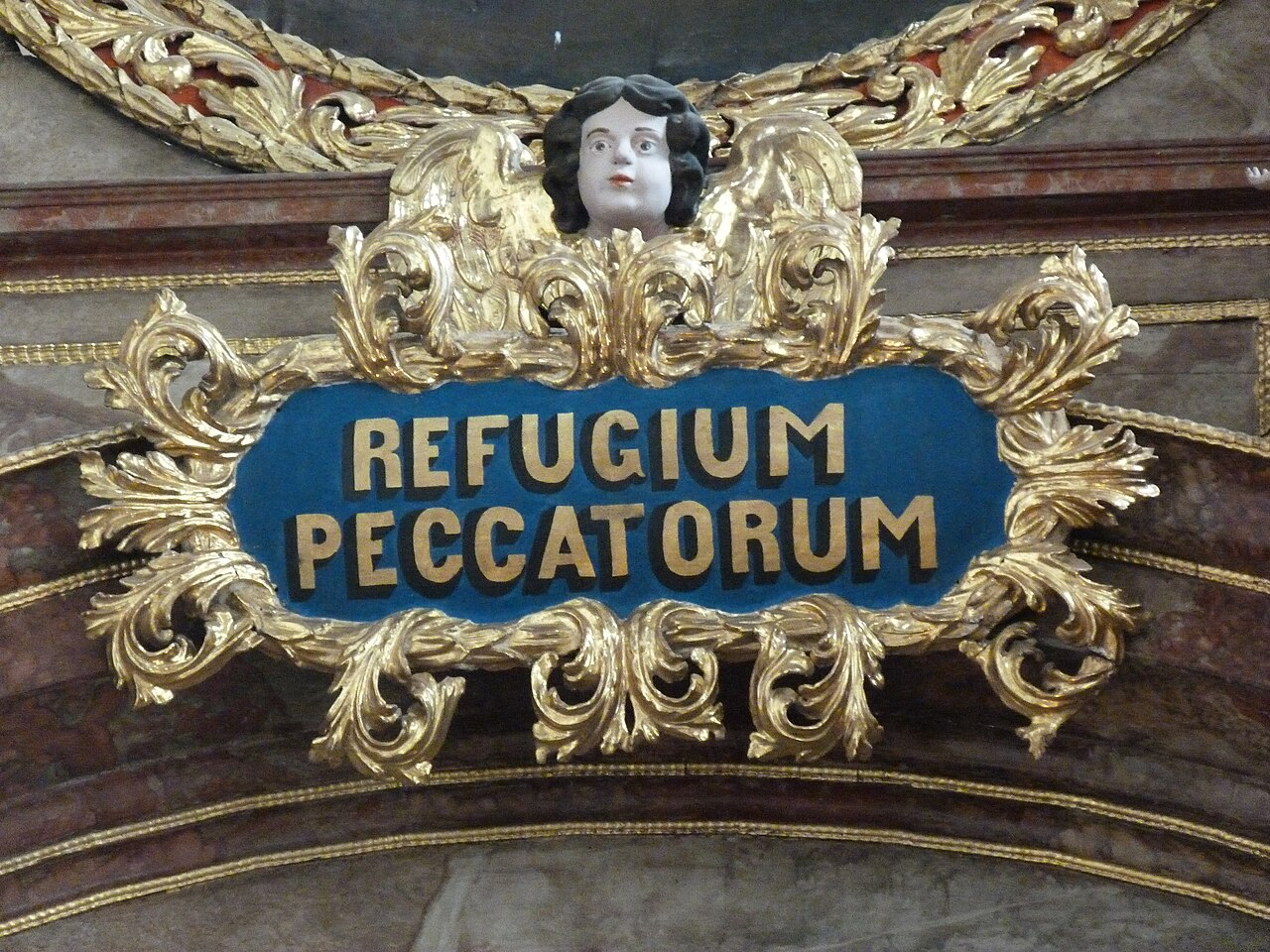
Refugium Peccatorum/ Refuge of Sinners
St Vincent de Paul CM (1581-1660) (Memorial) Known as the “Great Apostle of Trumpets” – Priest, Founder, Apostle of Charity, Doctor of Canon Law, Reformer of Society and Priests, Founder of Hospital and Orphanages. Born on 24 April 1581 near Ranquine, Gascony near Dax, southwest France – the Town is now known as Saint-Vincent-de-Paul, Landes, France. His body is incorrupt.
St Adheritus St Adolphus of Cordoba St Antonio de Torres St Barrog the Hermit
St Ceraunus of Paris St Chiara of the Resurrection St Deodatus of Sora Saint Delphina of Glandenes St Elzear of Sabran TOSF (1285-1323) Layman, Member of the Third Order of St Francis St Epicharis St Fidentius of Todi St Florentinus the Hermit St Gaius of Milan St Hilary the Hermit St Hiltrude of Liessies Bl Jean-Baptiste Laborie du Vivier St John of Cordoba
Blessed Lorenzo of Ripafratta OP (c 1373-1456) Dominican Priest and Friar, Penitent, Vicar General, Teacher, Reformer, brilliant Preacher and Spiritual director – known as “the Ark of Science.”
St Marcellus of Saint Gall St Terence of Todi — Martyrs of Aegea – (3 saints)
Martyred in the Spanish Civil War: • Blessed Crescencia Valls Espí • Blessed Herminia Martínez Amigó de Martínez • Blessed José Fenollosa Alcaina • Blessed Maria Carme Fradera Ferragutcasas • Blessed Maria Magdalena Fradera Ferragutcasas • Blessed Maria Rosa Fradera Ferragutcasas
Our Morning Offering – 27 September – the Memorial of St Vincent de Paul (1581-1660)
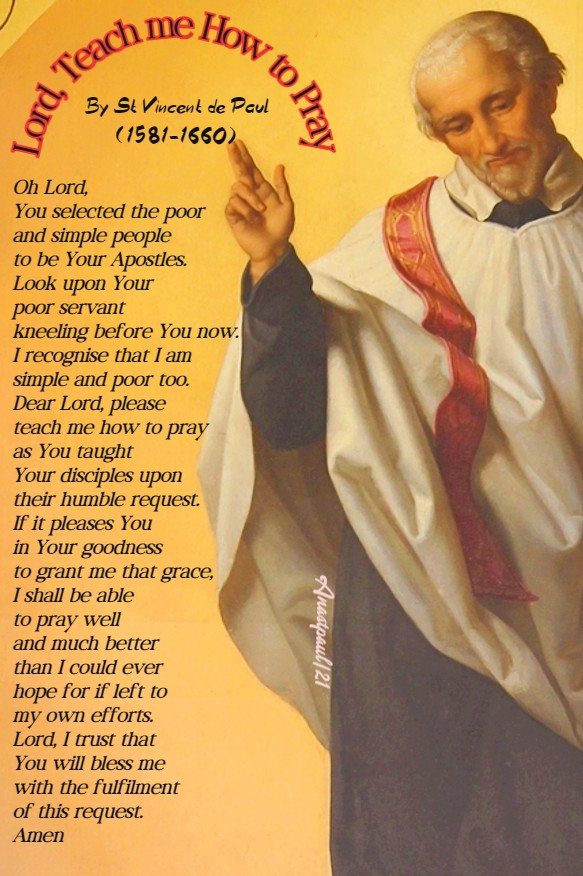
Lord, Teach me How to Pray By St Vincent de Paul (1581-1660)
Oh Lord, You selected the poor and simple people to be Your Apostles. Look upon Your poor servant kneeling before You now. I recognise that I am simple and poor too. Dear Lord, please teach me how to pray as You taught Your disciples upon their humble request. If it pleases You in Your goodness to grant me that grace, I shall be able to pray well and much better than I could ever hope for if left to my own efforts. Lord, I trust that You will bless me with the fulfilment of this request. Amen
One Minute Reflection – 27 September – “Month of the Seven Sorrows of Mary” – Readings: Eccli 36:18, Ps 121:1, 1 Cor. 1:4-8, Matt 9:1-8
Then He said to the paralytic – Arise, take up your pallet and go to your house. And he arose, and went away to his house.
Matt 9:1-8
REFLECTION –The incurable paralytic was lying on his stretcher. Having exhausted medical art he was carried by his relatives to the only true physician: the physician who comes from heaven. But when he had been set down in front of the one who could cure him it was his faith that drew the Lord’s attention. To demonstrate that this faith destroyed sin, Jesus immediately said: “Your sins are forgiven.” Now perhaps you will say to me: “This man wanted to be cured of his sickness, so why did Christ make known to him the remission of his sins?” This was so you might learn that God sees a person’s heart in silence, soundlessly, and beholds the paths of all the living. For, as scripture says: “Each one’s ways are plain to the Lord’s sight; all their paths he surveys”.
All the same, when Christ said: “Your sins are forgiven”, he left the field open to the incredulity of those standing by; the forgiveness of sins cannot be seen by eyes of flesh. So when the paralytic stood up and walked, he gave proof that Christ possesses the power of God.

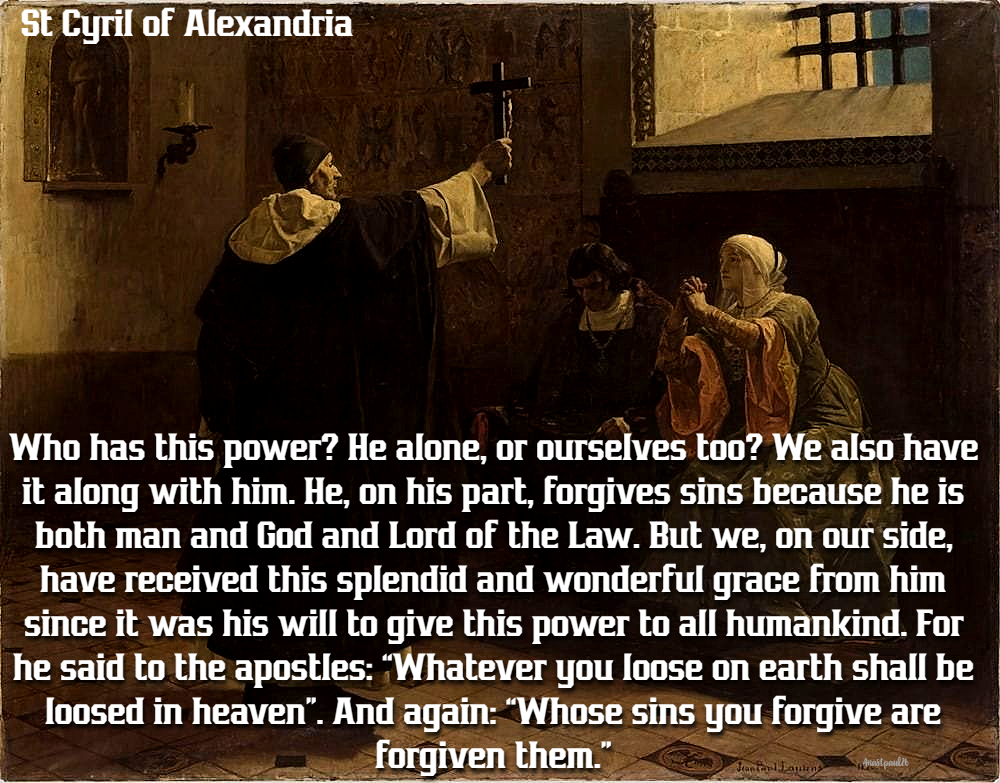
Who has this power? He alone, or ourselves too? We also have it along with him. He, on his part, forgives sins because he is both man and God and Lord of the Law. But we, on our side, have received this splendid and wonderful grace from him since it was his will to give this power to all humankind. For he said to the apostles: “Whatever you loose on earth shall be loosed in heaven”. And again: “Whose sins you forgive are forgiven them.”
St Cyril of Alexandria
PRAYER – God our Father, Your rule is a rule of love, Your providence is full of mercy for Your people. Through the intercession of the Blessed Virgin, Mother of the Word made flesh and His sorrowful Mother, grant the spirit of wisdom and understanding in Your Word, Your Son Jesus Christ. Grant that by the healing Word our repentant hearts may know our way to our eternal home and strive to attain eternal joy there with You. Through Jesus Christ our Lord, with the Holy Spirit, one God forever and ever, amen.
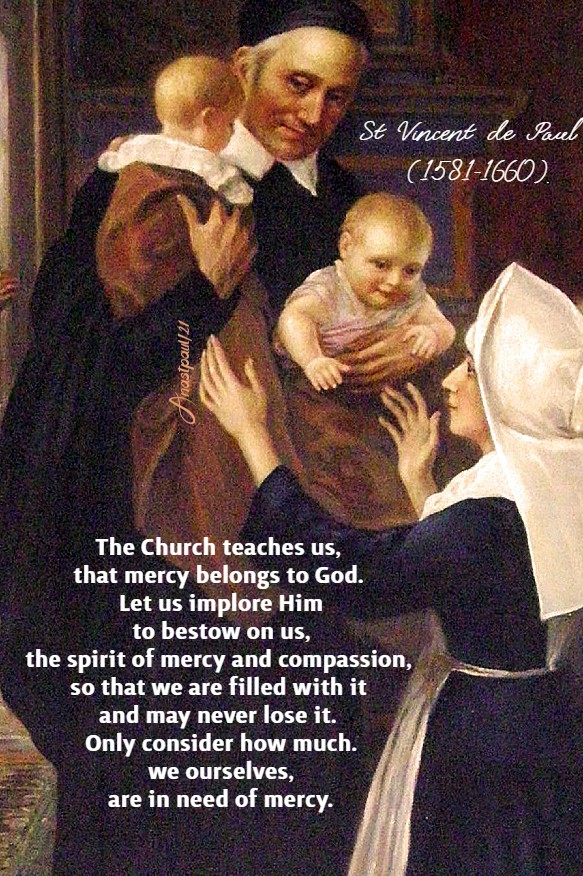
“The Church teaches us, that mercy belongs to God. Let us implore Him, to bestow on us the spirit of mercy and compassion, so that we are filled with it and may never lose it. Only consider how much we ourselves, are in need of mercy.”
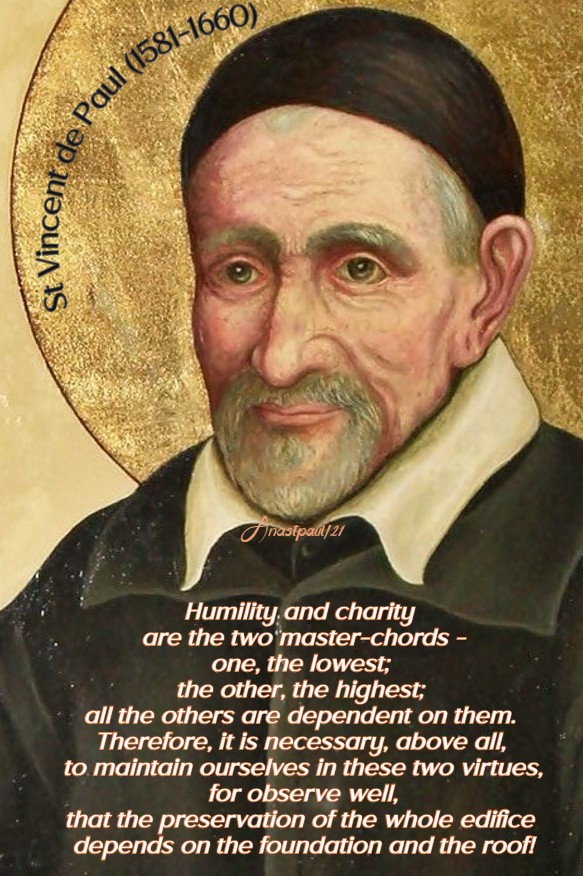
“Humility and charity are the two master-chords – one, the lowest; the other, the highest; all the others are dependent on them. Therefore, it is necessary, above all, to maintain ourselves in these two virtues, for observe well, that the preservation of the whole edifice depends on the foundation and the roof!”
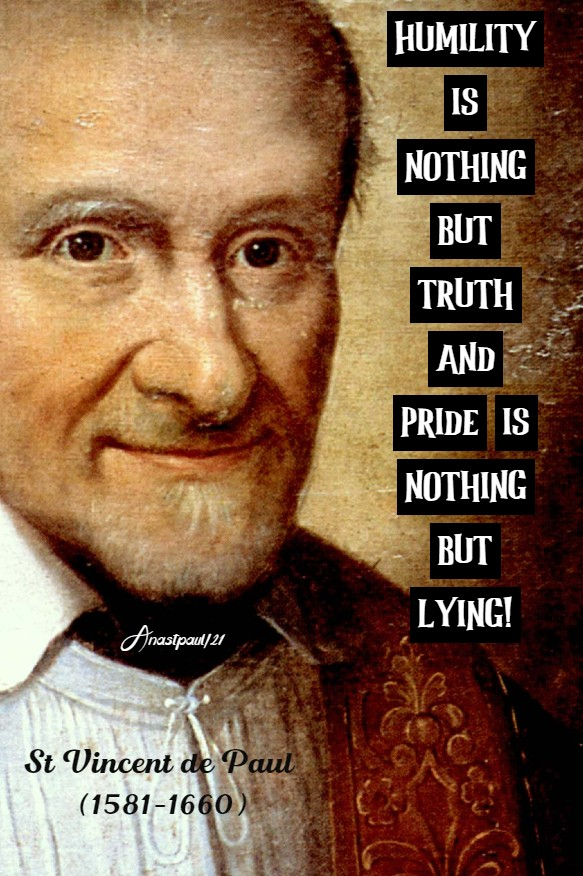
“Humility is nothing but truth and pride is nothing but lying!”
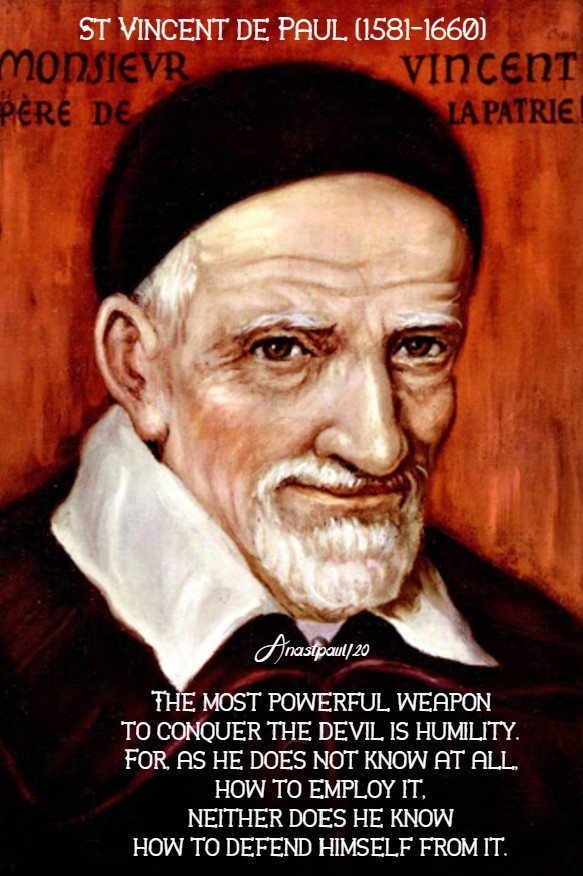
“The most powerful weapon to conquer the devil is humility. For, as he does not know at all, how to employ it, neither does he know how to defend himself from it.”
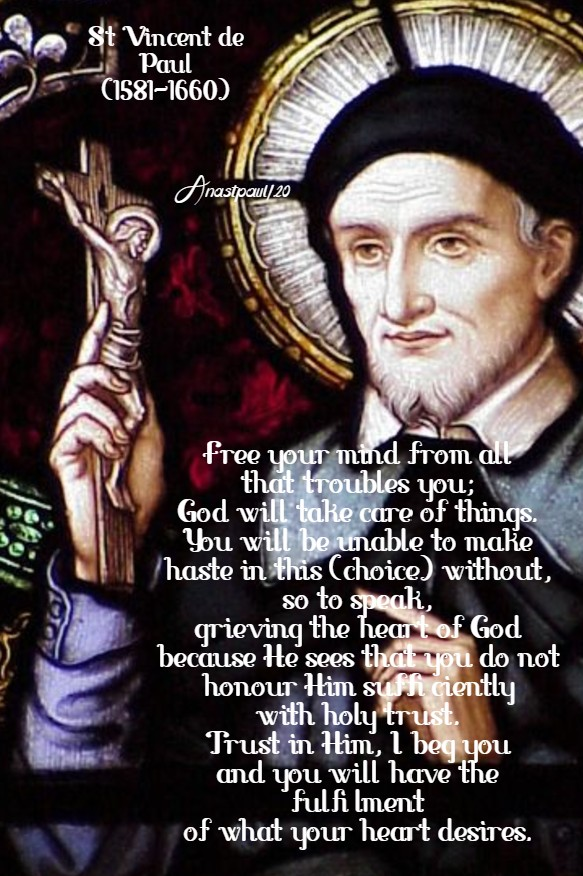
“Free your mind from all that troubles you; God will take care of things. You will be unable to make haste in this (choice) without, so to speak, grieving the heart of God because He sees that you do not honour Him sufficiently with holy trust. Trust in Him, I beg you and you will have thefulfilment of what your heart desires.”
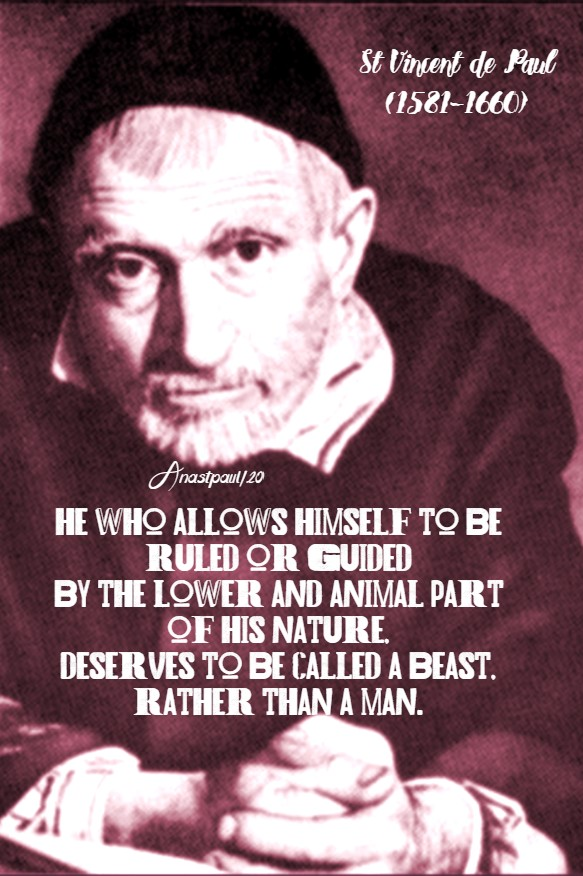
“He who allows himself to be ruled or guided by the lower and animal part of his nature, deserves to be called a beast, rather than a man.”
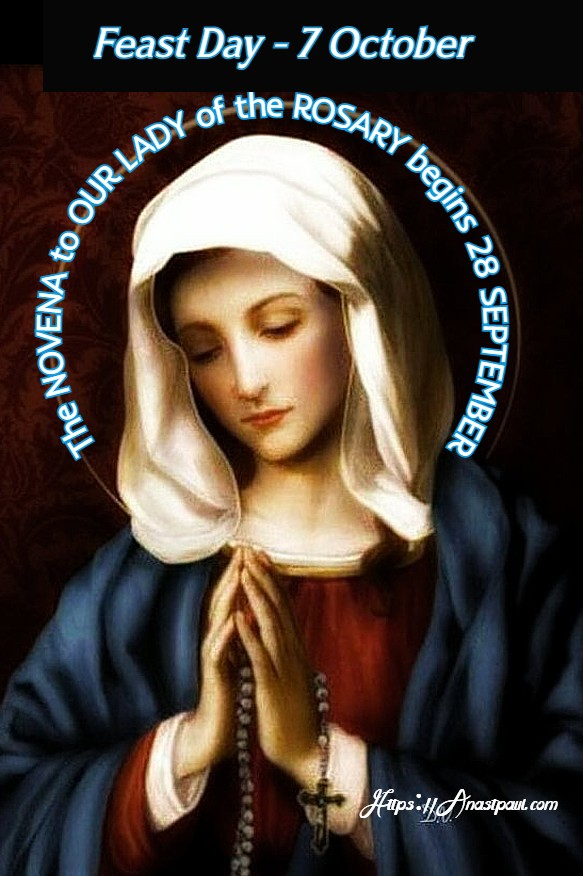
The Memorial of Our Lady of the Rosary is on 7 October.
Please join me in praying a Novena in honour of Our Lady of the Rosary for the nine days preceding her Feast on 7 October and, of course, October is the Month of the Holy Rosary.
This Feast was instituted to commemorate the victory of Christianity over the forces of Islam at the battle of Lepanto on 7 October 1571. The victory was brought about through the recitation of the Rosary. In thanksgiving for another victory over the same foes in Hungary in 1715, the Feast was extended to the entire Church.
In the course of centuries the Rosary has been a source of abundant blessings. In her apparitions at Lourdes, France, in 1858 and again at Fatima, Portugal, in 1917, Mary urged Catholics to pray the Rosary daily in order to bring about the conversion of sinners and a lasting world peace. Resolve to say your Rosary every day. Besides being a beautiful tribute of love and filial piety, to your Heavenly Mother, it will be your support and joy in life and your consolation at the hour of death.
Manual of Devotions in Honour of The Seven Dolors of the Blessed Virgin Mary by Father Sebastian
DEVOTION OF ST. PAUL OF THE CROSS TOWARDS THE DOLOURS OF THE BLESSED VIRGIN MARY
Extract from the Life of Saint Paul of the Cross, Founder of the Congregation of the Most Holy Cross and Passion of our Lord Jesus Christ.
The Dolours of Mary, in particular, were most vividly and profoundly imprinted in his heart. He always wore round his neck the devout little habit of our Lady of Sorrows, and in Missions fervently promoted the devotion to her Dolours. Though he was not in the habit of making processions, he sometimes, to increase devotion in the people towards the sorrows of our dear Lady, took them in procession to some church where our Lady of Sorrows is venerated. This he did at Ischia, the first time he gave a Mission there. With all the people, he went to visit the Church of the Servants of Mary, and, on arriving at the church door, made a very fervent discourse, wept bitterly, and severely disciplined himself. Compunction and tears were general amongst the people, and from that time sprang up a new fervour of filial devotion, and of tender loving compassion for our Lady of Sorrows, which remains even to this day.
To all, generally, he recommended meditation on the Dolours with great fervour. With the same zeal with which he promoted the remembrance of our Lord’s Passion, he promoted the devotion to the Dolours; for, as he said himself,if we go to the Cross, there is the Mamma; where the Mamma is, there is the Son. It was certainly enough to soften the hardest hearts to hear him speak of the bitter Dolours of Mary. He meditated and considered them with filial piety, great compassion and devotion. He sometimes imagined tender dialogues between the loving Mother and the suffering Son; but with such deep feeling that the hearers were dissolved in tears of compassion and grief.
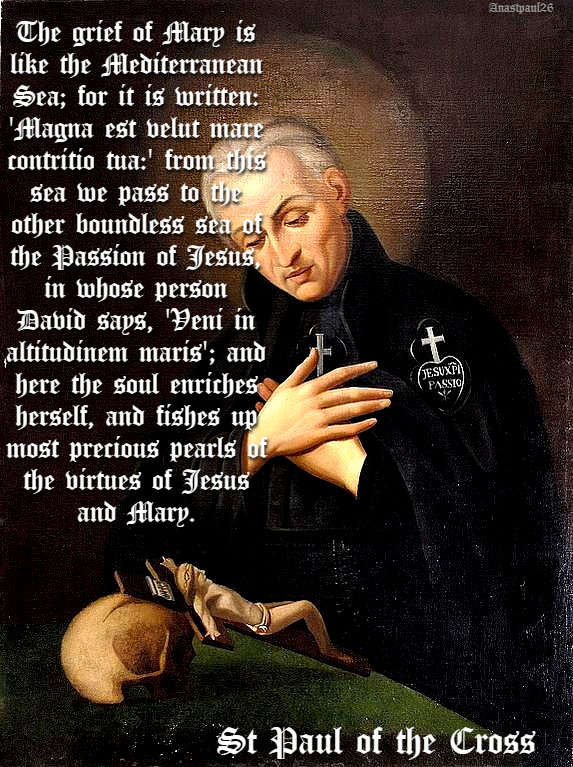
He compared the sufferings of the Son and the griefs of the Mother, to two seas, and said that we pass from the first to the second. “The grief of Mary (these are his words) is like the Mediterranean Sea; for it is written: ‘Magna est velut mare contritio tua:’ from this sea we pass to the other boundless sea of the Passion of Jesus, in whose person David says, ‘Veni in altitudinem maris’; and here the soul enriches herself, and fishes up most precious pearls of the virtues of Jesus and Mary.”
With the passion of Jesus he had always in his mouth the Dolours of Mary, and said, that his hopes lay in the Passion of the Son, and in the sorrows of the Mother. Though he spoke of them constantly, he always seemed to say something new, because he always spoke of them with new affection, so deeply was he penetrated with them in his heart. Most frequently when he spoke thus, he wept bitterly, and changed colour, becoming first red, then pale; he then burst forth into these words, which came from the profoundest depths of his heart: “Ah, poor Mother! Ah, dear Mother!” On Good Friday, as we have said, oppressed by grief, and spiritually drowned in the bitterness of that great day, he could not even take food. Often he was heard to say, that Mary’s greatest sorrow was when she saw her beloved Son dead in her arms, and saying this, he cried out, more by tears than words, with the affection of a truly loving heart, “Oh, grief above grief!” He himself related, in reference to this, that on one occasion, our Blessed Lady was seen in that most sorrowful act of receiving into her arms the lacerated Body of so dear a Son, and through her great sorrow and affliction, her face was like that of one dead.
We do not know precisely who had this vision, but we find it deposed in the processes, that the servant of God, speaking one day with a priest, a dear friend of his, on the Passion of Jesus and the Dolours of Mary, drew from his sleeve, with a countenance all on fire, as was customary with him when he felt devotion, a little picture, representing Our Lady of Sorrows, drawn by Cavaliere Conca, who, being at the same time a skilful and excellent painter and a good Christian, painted it with great skill and devotion, at the request of the servant of God, who begged him to express her grief as strongly as he could, saying to him : “Here, I give it to you because it is not sorrowful enough. I have seen her in greater sorrow;” and with these words gave him the holy picture, which is now preserved in the Monastery of Mount Carmel, at Vetralla.
In the last years of his life, also, this most merciful Mother condescended to show herself to her faithful servant pierced with grief, as she was at the time of the most bitter passion of her dear Son; for in the retreat of Saints John and Paul, when after Mass he was making his thanksgiving in the room next the little chapel where he celebrated, she appeared to him with a sword through her heart, and tears in her eyes; and speaking of her Dolours, gave him so deep a sense of them, and used words of such tenderness, that they would even have rent a heart of stone. She gave him to understand that her sufferings were beyond measure, terrible, and overpowering, from the ardent love she bore to her Son, and the incomparable amplitude of her soul, capable of a sea of sorrows; the Queen of Sorrows complained of the false devotion of those who say they are devout to the Blessed Virgin, and then outrage by sin her Beloved Son; and with great force and tenderness exhorted her dear servant to promote, as he always did, devotion to the Sacred Passion of her Son, and to her Dolours.
This Mother of Mercy, desiring to help a poor priest whose soul was in a wretched condition, manifested to Father Paul his necessities, and this priest having come into his presence afterwards, the servant of God, who saw his interior, said to him with a tone of certainty, “You appear to me as ugly as a devil.”
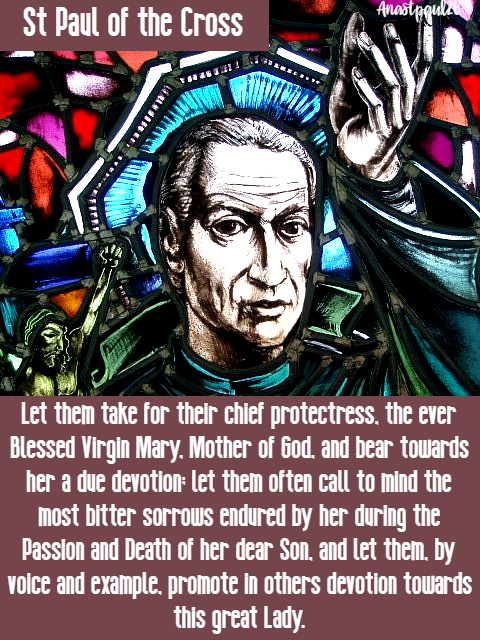
At these words, the priest entering into himself, and acknowledging his dreadful state, prostrated himself in confusion and grief at the venerable Father’s feet, promising to amend his life, and thus showed the truth of the apparition of Our Lady of Sorrows, who wished to draw him from the path of perdition. It is not, therefore, surprising that the servant of God, after such visions and so deep a perception of the Dolours of the Blessed Virgin, spoke of them with so much affection, tenderness, and compassion. As he knew what a treasure true devotion to our Blessed Lady is, he ardently desired that his children should enjoy the abundance of it. He inculcated, and with great fervour recommended, that they should be devout to our dear Lady. “Let them take,” he says in the rules, “for their chief protectress, the ever Blessed Virgin Mary, Mother of God, and bear towards her a due devotion; let them often call to mind the most bitter sorrows endured by her during the Passion and Death of her dear Son, and let them, by voice and example, promote in others devotion towards this great Lady.”



You must be logged in to post a comment.