Posted in GOD ALONE!, HOLY SATURDAY, HOLY WEEK, In the PRESENCE of GOD, LENT 2026, PURGATORY, QUOTES on HELL, QUOTES on HOPE, QUOTES on LOVE of GOD, Thomas Aquinas

Holy Saturday – 4 April – Our Lenten Journey With St Thomas Aquinas – Why Our LordDescended into Limbo

Holy Saturday – 4 April – Our Lenten Journey With St Thomas Aquinas (1225-1274) Doctor of the Church

Holy Saturday
Why Our Lord Descended into Limbo

Wisdom forsook not the just when he was sold but delivered him from sinners; she went down with him into the pit and in bands, she left him not.
Wis x. 13-14

From the descent of Christ to hell, we may learn, 4 lessons for our instruction:

  1. Firm hope in God.
    No matter what the trouble in which a man finds himself, he should always put trust in God’s assistance and rely on it.
    There is no trouble greater than to find oneself in hell.
    If then, Christ freed those who were in hell, any man who is a friend of God, cannot but have great confidence that he too shall be freed from whatever anxiety holds him captive.

    “Wisdom forsook not the just when he was sold but delivered him from sinners; she went down with him into the pit and in bands, she left him not”(Wis x. 13-14).
    And since, to His servants, God gives a special assistance, he who serves God should have still greater confidence.
    “He who fearth the Lord shall tremble at nothing and shall not be afraid: for He is his Hope” (Ecclus xxxiv. 16).
  2. We ought to conceive the fear of God and to rid ourselves of presumption.
    For although Christ suffered for sinners and descended into hell to set them free, He did not set all sinners free but only those who were free of mortal sin.
    Those who had died in mortal sin, He left there. Wherefore, for those who have gone down to hell in mortal sin, there remains no hope of pardon.
    They shall be in hell as the holy Fathers are in Heaven, that is, forever!
  3. We ought to be full of care.
    Christ descended into hell for our Salvation and we should be careful to go down there frequently too, meditating in our minds on hell’s pain and penalties, as did the holy King Ezechias as we read in the prophecy of Isaias, “I said, In the midst of my days, I shall go to the gates of hell” (Isaias xxxviii. 10).

Those, who in their meditations, often descend to hell during life, will not easily succomb at death.
Such meditations are a powerful arm against sin and a useful aid to protect a man and convert him from sin.
Daily we see men kept from evildoing by the fear of the law’s punishments.
How much greater care should they not take, on account of the punishment of hell, greater in its duration, in its bitterness and in its variety.
“Remember thy last end and thou shalt never sin” (Ecclus vii. 40).

  1. The fact is an example of Love for us.
    Christ descended into hell to set those who were His Own free.
    We too, therefore, should descend there to help our own. For those who are in Purgatory are themselves unable to do anything and, therefore, we ought to help them. Truly he would be a harsh man indeed, who failed to come to the aid of a kinsman who lay in prison, here on earth.
    How much harsher then, the man who will not aid the friend who is in Purgatory, for there is no comparison between the pain there and the pains of this world.
    “Have pity on me, have pity on me, at least you my friends because the Hand of the Lord hath touched me” (Job xix. 21).

We assist the souls in Purgatory, chiefly by these three means, by Holy Masses, by prayers and by almsgiving.
Is it not wonderful that we can do so, in this world – a friend can make satisfaction for a friend.

ST THOMAS AQUINAS (1225-1274)
Priest, Theologian, Dominican
Doctor Angelicus (Angelic Doctor)
Doctor Communis (Common Doctor)
Added by Pope Saint Pius V in 1568

Posted in GOOD FRIDAY, HOLY WEEK, LENT 2026, Quotes on SALVATION, QUOTES on SUFFERING, The MOST HOLY REDEEMER, Our SAVIOUR, The PASSION, The REDEMPTION, Thomas Aquinas

Good Friday – 3 April – Our Lenten Journey With St Thomas Aquinas – The Death of Christ

Good Friday – 3 April – Our Lenten Journey With St Thomas Aquinas (1225-1274) Doctor of the Church The Death of Christ

Good Friday
The Death of Christ

The Expediency of the Death of Christ:

  1. To complete our Redemption.
    For, although any Suffering of Christ had an Infinite Value because of its union with His Divinity, it was not, by no matter which of His Sufferings that the Redemption of mankind was completed but only, by His Death.
    So the Holy Ghost declared, speaking through the mouth of Caiaphas, “It is expedient for you that One Man shall Die for the people” (John xi. 50).
    Whence, St Augustine says, “Let us stand in wonder, rejoice, be glad, love, praise and adore, since it is by the Death of our Redeemer, we have been called from death to life, from exile to our own land, from mourning to joy.”
  2. To increase our faith, our hope and our charity.
    With regard to faith, the Psalm says (Ps cxl. 10), “I am alone until I pass from this world, that is, to the Father. When I shall have passed to the Father, then shall I be multiplied.”
    “Unless the grain of wheat falling into the ground and die itself, it remaineth alone” (John xii. 24).

As to the increase of hope, St Paul writes, “He Who spared not even His Own Son but delivered Him up for us all, how hath He not also, with Him, given us all things?“ (Rom viii. 32).
God cannot deny us this, for to give us all things is less than to give His Own Son to Death for us.
St Bernard says, “Who is not carried away to hope and confidence in prayer, when he looks upon the Crucifix and sees how Our Lord hangs there, His Head bent as though to kiss, His Arms outstretched in an embrace, His Hands pierced to give, His Side opened to love, His Feet nailed to remain with us.”

“Come, my dove, in the clefts of the rock” (Cant ii. 14). It is in the Wounds of Christ where the Church builds its nest and waits, for it is in the Passion of Our Lord she places her hope of Salvation and thereby trusts to be protected from the craft of the falcon, that is, of the devil.

With regard to the increase of charity, Holy Scripture says, “At noon he burneth the earth” (Ecclus xliii. 3), that is to say, in the fervour of His Passion, He burns up all mankind with His Love.
So St Bernard says, “The chalice Thou didst drink, O good Jesus, maketh Thee lovable above all things.”
The Work of our Redemption easily, brushing aside all hindrances, calls out in return the whole of our love. This it is which more gently draws our devotion, builds it more straightly, guards it more closely and fires it with greater ardour.

ST THOMAS AQUINAS (1225-1274)
Priest, Theologian, Dominican
Doctor Angelicus (Angelic Doctor)
Doctor Communis (Common Doctor)
Added by Pope Saint Pius V in 1568

Posted in HOLY COMMUNION, LENT 2026, MAUNDY THURSDAY, QUOTES on UNITY/with GOD, The HOLY EUCHARIST / The HOLY MASS, The PASSION, Thomas Aquinas
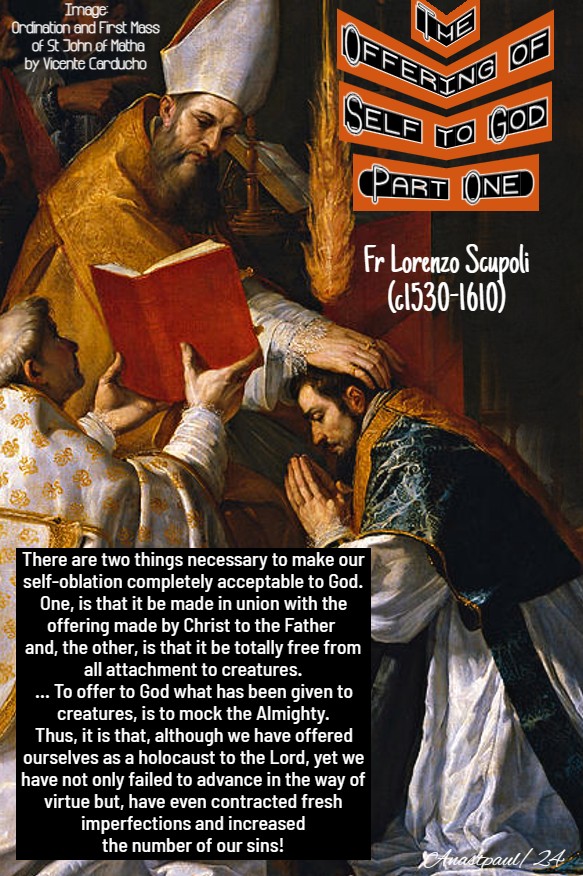
Maundy Thursday – 2 April – Our Lenten Journey With St Thomas Aquinas – The Last Supper

Maundy Thursday – 2 April – Our Lenten Journey With St Thomas Aquinas (1225-1274) Doctor of the Church

Maundy Thursday
The Last Supper

It was most fitting that the Sacrament of the Body of the Lord should have been instituted at the Last Supper.

  1. Because of what that Sacrament contains.
    For that which is contained in it, is Christ Himself. When Christ in His natural appearance was about to depart from His disciples, He left Himself to them in a Sacramental appearance, just as in the absence of the Emperor there is exhibited the Emperor’s image. Whence, St Eusebius says, “Since the Body He had assumed was about to be taken away from their bodily sight and was about to be carried to the stars, it was necessary that, on the day of His Last Supper, He should Consecrate for us, the Sacrament of His Body and Blood, so that which, as a Price was offered Once, should, through a Mystery, be worshipped unceasingly.”
  2. Because, without faith in the Passion, there can never be Salvation.
    Therefore, it is necessary that there should be forever among men, something which would represent the Lord’s Passion and the chief of such representationd in the Old Testament, was the Paschal Lamb.
    To this there succeeded in the New Testament, the Sacrament of the Eucharist which is commemorative of the past Passion of the Lord, as the Paschal Lamb was a foreshadowing of the Passion to come.

And, therefore, was it most fitting that, on the very eve of the Passion, the old sacrament of the Paschal Lamb having been celebrated, Our Lord should institute the new Sacrament.

  1. Because the last words of departing friends remain longest in the memory, our love being at such moments most tenderly alert.
    Nothing can be greater in the realm of sacrifice than that of the Body and Blood of Christ, no offering can be more effective.
    And hence, in order that the Sacrament might be held more securely in all veneration, it was in His last leave-taking of the Apostles, when Our Lord instituted it.

Hence, St Augustine says, “Our Saviour, to bring before our minds with all His Power, the heights and the depths of this Sacrament willed, ere He left the disciples to go forth to His Passion, to fix it in their hearts and their memories as His last Act.”

Let us note that this Sacrament has a threefold meaning:
(i) In regard to the past, it is commemorative of the Lord’s Passion which was a true Sacrifice and because of this, the Sacrament is called a Sacrifice.
(ii) In regard to a fact of our own time, i.e. to the unity of the Church and that through this Sacrament, mankind should be gathered together.
Because of this, the Sacrament is called Communion.
St John Damascene says, the sacrament is called Communion because, by means of it, we communicate with Christ and this because we hereby share in His Body and in His Divinity and because by it, we are communicated to and united with one another.
(iii) In regard to the future, the Sacrament foreshadows that enjoyment of God which shall be ours in our Fatherland.
On this account, the Sacrament is called “Viaticum” since it provides us with the means of journeying to that Fatherland.

ST THOMAS AQUINAS (1225-1274)
Priest, Theologian, Dominican
Doctor Angelicus (Angelic Doctor)
Doctor Communis (Common Doctor)
Added by Pope Saint Pius V in 1568

Posted in "Follow Me", AUGUSTINIANS OSA, CHRIST the WORD and WISDOM, CHRIST, the WAY,TRUTH,LIFE, DOCTORS of the Church, FATHERS of the Church, GOD ALONE!, GOD is LOVE, LOVE of NEIGHBOUR, QUOTES on LOVE, QUOTES on LOVE of GOD, REDEMPTORISTS CSSR, St Francis de Sales, St PAUL!, The WORD

Quote/s of the Day – 2 April – Maundy Thursday

Quote/s of the Day – 2 April – Maundy Thursday

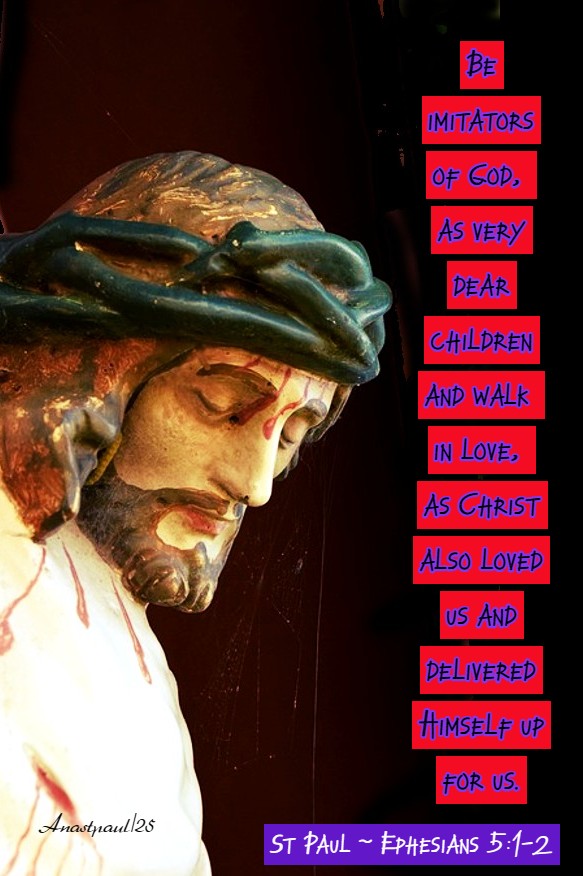
Be imitators of God, as very dear children
and walk in love, as Christ also Loved us
and delivered Himself up for us 
…”

St Paul … Ephesians 5:1-2

But I say to you,
Love your enemies 
…”

Matthew 5:44

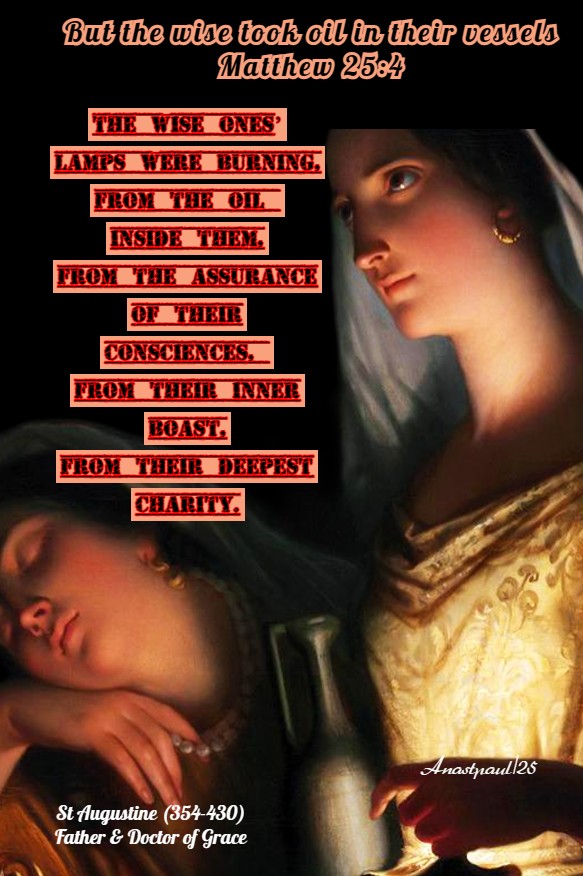
But the wise took oil
in their vessels

Matthew 25:4

The wise ones’ lamps were burning,
from the oil inside them,
from the assurance of their consciences,
from their inner boast,
from their deepest charity.

St Augustine (354-430)
Father & Doctor of Grace

“Father, forgive them.
With this prayer, He wanted to make us understand
the Love He bore us, undiminished
by any suffering and to teach us how
our heart should be toward our neighbour.

St Francis de Sales (1567-1622)
Doctor Caritas

“He Loves you as though He had
no-one else to love but you alone.
You, too, should love Him alone
and all others for His Sake.
Of Him you may say and, indeed, you should say:
My Beloved to me and I to Him (Cant, 2:16).
My God has given Himself all to me
and I give myself all to Him;
He has chosen me for His beloved
and I choose Him, above all others,
for my only Love.

How to Pray at All Times
By St Alphonsus Maria de Liguori (1696-1787)

Posted in LENT 2026, The PASSION, Thomas Aquinas

Wednesday in Holy Week – 1 April – Our Lenten Journey With St Thomas Aquinas –

Wednesday in Holy Week – 1 April – Our Lenten Journey With St Thomas Aquinas (1225-1274) Doctor of the Church

Wednesday in Holy Week
Three Elements are Symbolised
by the Washing of the Feet

He putteth water into a basin and began to wash the feet of the disciples and to wipe them with the towel wherewith he was girded”
John xiii. 5

There are three elements which this action may symbolise.

  1. The pouring of the water into the basin, is a Symbol of the pouring out of His Blood upon the earth.
    Since the Blood of Jesus has a Power of cleansing, it may in a sense, be called water.
    The reason why Water, as well as Blood, flowed from His Side, was to show that this Blood could wash away sin.

Again we might take the water as a figure of Christ’s Passion.
He putteth water into a basin, that is, by faith and devotion He stamped into the minds of faithful followers, the memory of His Passion.
“Remember My poverty and transgression, the wormwood and the gall” (Lam iii. 19).

  1. By the words, “and began to wash” it is human imperfection which is symbolised.
    For the Apostles, after their living with Christ, were certainly more perfect and yet, they needed to be washed, their souls were still stained.
    We are here made to understand that, no matter the degree of any man’s perfection, he still needs to be made more perfect; he is still contracting uncleanness of some kind, to some extent.
    So in the Book of Proverbs we read,“ Who can say My heart is clean I am pure from sin”(Prov. xx. 9).

Nevertheless, the Apostles and the just have this kind of uncleanness only in their feet.

There are, however, others who are infected, not only in their feet but wholly and entirely.
Those who make their bed upon the soiling attractions of the world, are made wholly unclean thereby.
Those who wholly, that is to say, with their senses and with their wills, cleave to their desire of earthly things, these are wholly unclean.

But they who do not thus lie down, they who stand, i.e. they who, in mind and in desire, are tending towards heavenly things, contract this uncleanness in their feet. Whoever stands must, necessarily, touch the earth at least with his feet.
And we too, in this life, where we must, to maintain life, make use of earthly things, cannot but contract a certain uncleanness, at least as far as those desires and inclinations are concerned which begin in our senses.

Therefore, Our Lord commanded His disciples to shake the dust from their feet. The text says, “He began to wash” because this washing the affection for earthly things is only a beginning.
It is only in the life to come that it will be really complete.

Thus, by putting water into the basin, the pouring of His Blood, is signified and by His beginning to wash the feet of His disciples, the washing away of our sins.

  1. Finally, there is Symbolised Our Lord’s taking upon Himself the punishment due to our sins.
    Not only did He wash away our sins but, He took upon Himself the punishment they had earned.
    For our pains and our penances would not suffice were they not founded in the Merit and the Power of the Passion of Christ.
    And this is shown in His wiping the feet of the disciples with the linen towel, the towel which is His Body!

ST THOMAS AQUINAS (1225-1274)
Priest, Theologian, Dominican
Doctor Angelicus (Angelic Doctor)
Doctor Communis (Common Doctor)
Added by Pope Saint Pius V in 1568

Posted in LENT 2026, QUOTES on HUMILITY, Thomas Aquinas

Tuesday in Holy Week – 31 March – Our Lenten Journey With St Thomas Aquinas – Christ Preparing to Wash the Apostle’s Feet

Tuesday in Holy Week – 31 March – Our Lenten Journey With St Thomas Aquinas (1225-1274) Doctor of the Church

Tuesday in Holy Week
Christ Preparing to Wash the Apostle’s Feet

He riseth from supper and layeth aside His garments, and having taken a towel, girded Himself.
John xiii. 4

  1. Christ, in His lowly office, shows Himself truly to be a Servant, in keeping with His Own Words, “The Son of Man is not come to be ministered to but to minister and to give His Life as a Redemption for many” (Matt. xx. 28).

Three things are looked for in a good servant or minister:
(i) He should be careful to keep before himself, the numerous details in which his serving may so easily fall short.
Now, for a servant to sit or to lie down during his service is to make this necessary supervision impossible.
Hence it is that servants stand.
And, therefore, the Gospel says of Our Lord, He riseth from supper. Our Lord himself also asks us, “For which is greater, he who sitteth at table or he who serveth?” (Luke xxii. 27).

(ii) He should show dexterity in performing, at the correct moment, all which his particular office calls for. Now, elaborate dress is a hindrance to this. Therefore, Our Lord layeth aside his garments. And this was foreshadowed in the Old Testament when Abraham chose servants who were well appointed (Gen xiv. 14).

(iii) He should be prompt, having ready to hand, all he needs.
St Luke (x. 40) says of Martha that she was busy about much serving. This is why Our Lord, having taken a towel, girded Himself with it. Thus, He was ready, not only to wash their feet but also to dry them.
So He (who came from God and goeth to God–John xiii. 3) as He washes their feet, crushes forever our swollen, human self-importance.

  1. “After that, He putteth water into a basin and began to wash their feet” (John xiii. 5).

We are given for our consideration this Service of Christ and in three ways His Humility is set for our example.
(i) The kind of service this was, for it was the lowest type f all!
The Lord of All Majesty bending to wash the feet of his slaves!
(ii) The number of services it contained, for, we are told, He put water into a basin, He washed their feet, He dried them and so forth.
(iii) The method of performing the Service, for He did not do it through others, nor even with others assisting Him.
He accomplished the Service Himself.
“The greater thou art, the more humble thyself in all things” (Ecclus iii. 20).

ST THOMAS AQUINAS (1225-1274)
Priest, Theologian, Dominican
Doctor Angelicus (Angelic Doctor)
Doctor Communis (Common Doctor)

Added by Pope Saint Pius V in 1568

Posted in CATECHESIS, DOCTORS of the Church, FATHERS of the Church, GOD ALONE!, In the PRESENCE of GOD, Quote on SELF-ABANDONMENT, QUOTES on SELF-DENIAL, Quotes Self-Oblation, SELF-DISTRUST, St Francis de Sales, St PETER!

Quote/s of the Day – 31 March – Teach us St Peter!

Quote/s of the Day – 30 March – Tuesday of Holy Week – Jeremias 11:18-20 – Mark 14:32-72; 15, 1-46– – Scripture search here: https://www.drbo.org/

Before the cock crows twice,
thou shalt thrice deny Me.
And he began to weep 
…”

Mark 14:72

The first time Peter denied,
he did not weep because the Lord
had not looked at him.
He denied a second time and did not weep
because the Lord still did not look at him.
He denied a third time;
Jesus looked at him
and he wept very bitterly (Lk 22:62).
… Teach us what use your tears were to you.
But you taught it without delay for,
having fallen before you wept,
your tears caused you to be chosen to guide others,
you who, to begin with, did not know
how to guide yourself
!”

St Ambrose (340-397)
Father & Doctor

“ I am very certain,
it was our Lord’s Holy Look
which pierced his heart
and opened his eyes, to make him
recognise his sin (Lk 22:61)…
From that time on, he never stopped weeping,
above all when he heard the cock crow at night
and in the morning…
In this way, from being a great sinner,
he became a great Saint
!

A person who is conscious of his misery,
can certainly have great confidence in God.
In fact, he cannot have true confidence in Him,
without this consciousness of his misery.
This knowledge and acknowledgement
of our misery, leads us to the Presence of God.

St Francis de Sales (1567-1622)
Doctor Caritatis

Posted in CONFESSION/PENANCE, HOLY WEEK, LENT 2026, QUOTES on HEAVEN, QUOTES on PURITY, QUOTES on WILL (Reasonable or Superior), QUOTES on Will (Sensual or Inferior), Thomas Aquinas

Monday in Holy Week – 30 March – Our Lenten Journey With St Thomas Aquinas – It is Necessary that We be Wholly Clean

Monday in Holy Week – 30 March – Our Lenten Journey With St Thomas Aquinas (1225-1274) Doctor of the Church

Monday in Holy Week
It is Necessary that We be Wholly Clean

“If I wash thee not, thou shaft have no part with me
John xiii. 8

  1. “If I wash thee not, thou shaft have no part with me” (John xiii. 8).
    No-one can be made a sharer in the inheritance of eternity, a co-heir with Christ, unless he is spiritually cleansed, for in the Apocalypse it is so stated.
    “There shall not enter into it anything defiled” (Apoc xxi. 27) and in the Psalms we read, “Lord who shall dwell in Thy tabernacle?” (Ps xiv.) Who shall ascend into the mountain of the Lord; or who shall stand in His holy place?
    The innocent in hands and clean of heart (Ps xxiii. 3, 4).

It is, therefore, as though Our Lord said, If I wash thee not, thou shalt not be cleansed and if thou art not cleansed, thou shalt have no part with me.

  1. Simon Peter saith to Him: “Lord, not only my feet but also my hands and my head” (John xiii. 9).
    Peter, utterly stricken, offers his whole self to be washed, so confounded is he with love and with fear.
    We read, in fact, in the book called The Journeying of Clement that Peter used to be so overcome by the Physical Presence of Our Lord Whom he had most fervently loved that whenever, after Our Lord’s Ascension, the memory of that dearest Presence and most holy company came to him, he used so to melt into tears that his cheeks seemed all worn out with them.

We can consider three parts in man’s body, the head, which is the highest, the feet, which are the lowest part, and the hands which lie in-between.
In the interior man, i.e. in the soul, there are likewise three parts.
Corresponding to the head – there is the higher reason, the power by means of which the soul clings to God.
For the hands – there is the lower reason, by which the soul operates in good works.
For the feet –there are the senses and the feelings and desires arising from them.
Now Our Lord knew the disciples to be clean, as far as the head was concerned, for He knew they were joined to God by faith and by charity.
He knew their hands also were clean, for He knew their good works.
But as to their feet, He knew that the disciples were still somewhat entangled in those inclinations of earthly things which are derived from the life of the senses.

Peter, alarmed by Our Lord s warning (v. 8), not only consented that his feet should be washed but begged that his hands and his head should be washed too.

Lord, he said, not only my feet, but also my hands and my head.
As though to say, “I know not whether hands and head need to be washed. For I am not conscious myself of anything, yet am I not hereby justified (i Cor iv. 4). Therefore, I am ready not only for my feet to be washed that is, those inclinations which arise out of the life of my senses but also my hands, that is, my works and my head too, that is, my higher reason.”

  1. “Jesus saith to him: He that is washed needeth not but to wash his feet but is clean wholly. And you are clean” (John xiii. 10).
    Origen, commenting on this text, says that the Apostles were clean but needed to be yet cleaner. For reason should ever desire gifts which are better still, should ever set itself to achieve the very heights of virtue, should aspire to shine with the brightness of justice itself. “He who is holy, let him be sanctified still” (Apoc xxii. 11).

ST THOMAS AQUINAS (1225-1274)
Priest, Theologian, Dominican
Doctor Angelicus (Angelic Doctor)
Doctor Communis (Common Doctor)
Added by Pope Saint Pius V in 1568

Posted in DOCTORS of the Church, franciscan OFM, GOD is LOVE, HOLY WEEK, LENT 2026, PRAYERS of the SAINTS, QUOTES for CHRIST, QUOTES on BLASPHEMY, QUOTES on COURAGE, QUOTES on LOVE, QUOTES on LOVE of GOD, St Francis de Sales, The MOST HOLY REDEEMER, Our SAVIOUR, The PASSION, The SECOND COMING

Quote/s of the Day – 30 March – ‘… For love of Thy Love …’

Quote/s of the Day – 30 March – Monday of Holy Week

I Beg Thee, Lord
By St Francis of Assisi (c1181–1226)

I beg Thee, Lord,
let the fiery, gentle power
of Thy Love
take possession of my soul
and snatch it away,
from everything under Heaven,
that I may die,
for love of Thy Love,
as Thou saw fit, to die
for love of mine!
Amen

Now it is that we are to show
an invincible courage towards our Saviour,
serving Him purely for the love of His Will,
not only without pleasure
but amid this deluge of sorrows,
horrors, distresses and assaults,
as did His glorious Mother and St John,
upon the day of His Passion.
Amongst so many blasphemies,
sorrows and deadly distresses,
they remained constant in love 
…”

St Francis de Sales (1567-1622)
Doctor Caritatis

Posted in HOLY WEEK, LENT 2026, QUOTES on CHARITY, QUOTES on HUMILITY, QUOTES on OBEDIENCE, QUOTES on PATIENCE, QUOTES on THE WORLD, The PASSION, Thomas Aquinas

Holy Week Palm Sunday – 29 March – Our Lenten Journey With St Thomas Aquinas – The Example of Christ’s Passion

Holy Week Palm Sunday – 29 March – Our Lenten Journey With St Thomas Aquinas (1225-1274) Doctor of the Church

Holy Week: Palm Sunday
The Example of Christ’s Passion

Thinkest thou that I cannot ask My Father and He will give Me presently more than twelve legions of angels?
Matt xxvi. 53

The Passion of Christ is, of itself, sufficient to form us in every virtue.
For whoever wishes to live perfectly, need do no more than scorn what Christ scorned on the Cross and desire what He there desired.
There is no virtue of which, from the Cross, Christ does not give us an example.

If you seek an example of Charity, “Greater love than this, no man hath, than that a man lay down His life for his friends” (John xv. 13) and this Christ did on the Cross.
And since it was for us that He gave His Life, it should not be burdensome to bear, whatever evils come our way, for His sake.
“What shall I render to the Lord, for all He hath rendered to me” (Ps cxv. 12).

If you seek an example of Patience, in the Cross you find the best of all.
Great patience shows itself in two ways.
Either when a man suffers great evils patiently, or when he suffers what he could avoid and forbears to avoid. Now Christ on the Cross, suffered great evils. “O all ye who pass by the way, attend and see, if there be any sorrow like to My sorrow” (Lam i. 12).
And He suffered them patiently, for, when He Suffered He threatened not (i Pet ii. 23) but led as a sheep to the slaughter, He was dumb as a lamb before His shearer (Isaias liii. 7).

Also it was within His Power to avoid the Suffering and He did not.
“Thinkest thou that I cannot ask My Father and He will give Me presently more than twelve legions of angels?” (Matt xxvi. 53).
The Patience of Christ then on the Cross, was the greatest Patience ever shown.
Let us run by patience to the fight proposed to us, looking upon Jesus, the Author and finisher of faith, Who having joy set before Him, endured the Cross, despising the shame (Heb xii. i, 2).

If you seek an example of Humility, look at the Crucified. For it is God Who Wills to be judged and to Die at the will of Pontius Pilate.
“Thy cause hath been judged as that of the wicked” (Job xxxvi. 17).
“Truly as that of the wicked, for let us condemn Him to a most shameful Death” (Wis ii. 20).
The Lord Willed to Die for the slave, the life of the angels, for man.

“If you seek an example of Obedience, follow Him Who became Obedient unto Death” (Phil ii. 8), “ for as by the disobedience of one man, many were made sinners; so also by the Obedience of One, many shall be made just” (Rom v. 19).

If you seek an example in the scorning of the things of this world, follow Him Who is the King of Kings and the Lord of Lords, in Whom are all the treasures of Wisdom. Lo! on the Cross, He hangs naked, fooled, spit upon, beaten, crowned with thorns, sated with gall and vinegar and dead.
“My garments they parted among them; and upon My vesture, they cast lots” (Ps. xxi. 19).

Error to crave for honours, for He was exposed to blows and to mockery.
Error to seek titles and decorations, for platting a Crown of Thorns, they put it upon His Head and a reed in His Right Hand.
“And bowing the knee before Him, they mocked Him, saying, Hail, King of the Jews” (Matt, xxvii. 29).

“Error to cling to pleasures and comfort. for they gave Me gall for My food and in My Thirst they gave me vinegar to drink” (Ps. Ixviii. 22).

ST THOMAS AQUINAS (1225-1274)
Priest, Theologian, Dominican
Doctor Angelicus (Angelic Doctor)
Doctor Communis (Common Doctor)

Posted in DIVINE Mercy, Goodness, Patience, LENT 2026, QUOTES on FORGIVENESS, QUOTES on MERCY, QUOTES on PERSECUTION, QUOTES on SPIRITUAL WORKS of MERCY, Thomas Aquinas

Passion Saturday – 28 March – Our Lenten Journey With St Thomas Aquinas – How We Should Wash Each Others’ Feet

Passion Saturday – 28 March – Our Lenten Journey With St Thomas Aquinas (1225-1274) Doctor of the Church

Passion Saturday
How We Should Wash Each Others’ Feet

If I then, being your Lord and Master, have washed your feet; you too ough to wash one another’s feet”
John xiii. 14

Our Lord wishes His disciples to imitate His Example.
He says, therefore, If I, Who am the greater, being your Master and the Lord, have washed your feet, you too, all the more who are the lesser, who are disciples, slaves even, ought to wash each others’ feet.
“Whosoever will be the greater among you, let him be your minister . . . . Even as the Son of Man is not come to be ministered unto but to minister” (Matt xx. 26-28).

St Augustine says, every man ought to wash the feet of his fellowmen, either actually or in spirit.
And, it is by far the best and true beyond all controversy, that we should do it actually, lest Christians scorn to do what Christ did.
For when a man bends his body to the feet of a brother human, emotion is stirred in his very heart, or, if it be there already, it is strengthened.
If we cannot actually wash his feet, at least we can do it in spirit.
The washing of the feet signifies the washing away of stains.
You, therefore, wash the feet of your brother when, as far as lies in your power, you wash away his stains.

And this you may do in three ways:
(i) By forgiving the offences he has done to you. “Forgive one another, if any have a complaint against another: even as the Lord hath forgiven you, so do you also” (Coloss iii. 13).
(ii) By praying for the forgiveness of his sin, as St James bids us, “Pray for one another that you may be saved” (James v. 16).
This way of washing, like the first, is open to all the faithful.
(iii) The third way is for Prelates, who should wash, by forgiving sins through the authority of the Keys, according to the Gospel, “Receive ye the Holy Ghost; those whose sins you shall forgive , they are forgiven them” (John xx. 23).

We can also say that in this one act, Our Lord showed all the Works of Mercy.
He who gives bread to the hungry, washes their feet, as also does the man who harbours the harbourless, or he who clothes the naked.
“Communicating to the necessities of the saints” (Rom xii. 13).

ST THOMAS AQUINAS (1225-1274)
Priest, Theologian, Dominican
Doctor Angelicus (Angelic Doctor)
Doctor Communis (Common Doctor)
Added by Pope Saint Pius V in 1568

Posted in CHRIST the WORD and WISDOM, DOCTORS of the Church, FATHERS of the Church, HOLY WEEK, LENT 2026, OUR Cross, PRAYERS of the SAINTS, Quote on SELF-ABANDONMENT, QUOTES on GRATITUDE, QUOTES on THANKSGIVING, QUOTES on the CROSS of CHRIST, QUOTES on THE WORLD, SEPTEMBER-The SEVEN SORROWS of MARY and The HOLY CROSS, St Francis de Sales, The HOLY CROSS, The PASSION, The WILL of GOD, The WORD

Quote/s of the Day – 28 March – ‘… Cling to that which we believe. …’

Quote/s of the Day – 28 March – Saturday in Passion Week – Jeremias18:18-23, John 12:10-36 – Scripture search here: https://www.drbo.org/

He who loves his life, loses it
and he who hates his life
in this world,
keeps it unto life everlasting.
If anyone serves Me,
let him follow Me
and where I am,
there also shall My servant be
.”

John 12:25-26

For he who will save his life, will lose it
and he who will lose his life
for My sake, will find it.
 ”

Matthew 16:25

Let us detach ourselves in spirit
from all that we see
and cling to that which we believe.
This is the Cross
which we must imprint
on all our daily actions and behaviour.

St Peter Damian (1007-1072)
Bishop, Father and Doctor of the Church

O My God, I Thank Thee
An Act of Abandonment
to the Divine Will
By St Francis de Sales (1567-1622)
Doctor Caritas

O my God, I thank Thee
and I praise Thee
for accomplishing Thy Holy and all-lovable Will
without any regard for mine.
With my whole heart,
in spite of my heart,
do I receive this cross I feared so much!
It is the cross of Thy choice,
the cross of Thy Love.
I venerate it;
nor for anything in the world
would I wish it had not come,
since Thou hast willed it.
I keep it with gratitude and with joy,
as I do everything which comes from Thy Hand
and I shall strive to carry it
without letting it drag,
with all the respect
and all the affection
which Thy works deserve.
Amen

My soul, live henceforward
amid the scourges and the thorns
of thy Saviour and there,
as a nightingale in its bush, sing sweetly:
Live Jesus, Who didst die
that my soul might live!
Ah, Eternal Father!
What can the world return Thee
for the gift Thou hast made it of Thy only Son?
Alas! to redeem a thing so vile as I,
the Saviour delivered Himself to death
and, unhappy me!
I hesitate to surrender my nothingness to Him,
Who has given me everything!
”“

St Francis de Sales (1567-1622)
Doctor Caritas

Posted in LENT 2026, MATER DOLOROSA - Mother of SORROWS, SEPTEMBER-The SEVEN SORROWS of MARY and The HOLY CROSS, The PASSION, Thomas Aquinas

Passion Friday – 27 March – Our Lenten Journey With St Thomas Aquinas – Our Lady’s Suffering During the Passion

Passion Friday – 27 March – Our Lenten Journey With St Thomas Aquinas (1225-1274) Doctor of the Church

Passion Friday
Our Lady’s Suffering During the Passion

Thy own soul a sword shall pierce
Luke ii. 35

In these words there is noted the close association of Our Lady with the Passion of Christ.
Four elements, most especially, rendered the Passion excrutiatingly bitter for her.

Firstly, the Goodness of her Son, Who did notsin (i Pet ii. 22).

Secondly, the cruelty of those who Crucified Him, shown, for example, in this – as He was Dying they refused Him even water, nor would they allow His Mother, who would most lovingly have given it, to help Him.

Thirdly, the disgrace of the punishment, “Let us condemn Him to a most shameful Death” (Wis ii. 20).

Fourthly, the cruelty of the torment. “O ye that pass by the way, attend and see if there be any sorrow like to My Sorroiv (Lam i. 12).

The words of Simeon, “Thy own soul a sword shall pierce,“ Origen and other scholars with him, explain with reference to the pain felt by Our Lady during he Passion of Christ.
St Ambrose, however, says that by the sword is signified Our Lady’s prudence, thanks to which she was not without knowledge of the heavenly Mystery.
“For the Word of God is a living thing, strong and keener than the keenest sword” (cf. Heb iv. 12).

Other writers again, St Augustine for example, understand by the sword, the stupefaction which overcame Our Lady at the Death of her Son, not the doubt which goes with lack of faith but, a certain fluctuation of bewilderment, a staggering of the mind.
St Basil too say,s as Our Lady stood by the Cross with all the detail of the Passion before her and in her mind the testimony of Gabriel, the message which words cannot tell of her Divine conception and all the vast array of miracles, her mind swayed, for she saw Him, the Victim of such vileness and yet, knew Him as the Author of such Wonders.

Although Our Lady knew by faith, it was God’s Will that Christ should Suffer and although, she brought her will into unity with God’s Will in this matter, as the Saints do, nevertheless, sadness filled her soul at the Death of Christ. This was because her lower will revolted at the particular horrors she had witnessed and this is not contrary to perfection.

ST THOMAS AQUINAS (1225-1274)
Priest, Theologian, Dominican
Doctor Angelicus (Angelic Doctor)
Doctor Communis (Common Doctor)
Added by Pope Saint Pius V in 1568

Posted in GOD is LOVE, LENT 2026, Thomas Aquinas

Passion Thursday – 26 March – Our Lenten Journey With St Thomas Aquinas – Which is the Greatest Sign of His Love?

Passion Thursday – 26 March – Our Lenten Journey With St Thomas Aquinas (1225-1274) Doctor of the Church

Passion Thursday
Which is the Greatest Sign of His Love?

Greater love than this no man hath, that a man lay down His life for his friends“
John xv. 13

It would seem Christ gave us a greater Sign of His Love by giving us His Body as our food, than by Suffering for us.
For the Love which will be in the life to come, is a more perfect element than the Love which is in this life.
And the benefit which Christ bestows upon us by giving us His Body as food, is more like to the Love of the life to come in which we shall fully enjoy God.
The Passion which Christ underwent for us is, on the other hand, more like to the Love which is of this life, in which we, too, are to suffer for Christ.
Therefore, it is a greater Sign of Christ’s Love that He delivered His Body to us as our food, than that He Suffered for us.

Nevertheless, it is an argument against this that in St John’s Gospel, Our Lord Himself says, “Greater love than this no man hath, that a man lay down His life for his friends“ (John xv. 13).

The strongest of human loves is the love with which a man loves himself.
Therefore, this love must be the measure, by comparison with which we estimate the love by which a man loves others than himself.
Now, the extent of a man’s love for another, is shown by the extent of good desired for himself which he forgoes for his friend.
As Holy Scripture says, “He who neglecteth a loss for the sake of a friend, is just” (Prov xii. 26).

Now, a man wishes well to himself as to three things, namely, his soul, his body and external items outside himself.
It is then already a sign of love that, for another, a man is willing to suffer loss of things outside himself.

It is a greater sign if he is also willing to suffer loss in his body for another, that is, by bearing the burden of work or undergoing punishment.
It is the greatest of all signs of love, if a man is willing, by dying for his friend, to lay down his very life.

Therefore, that Christ, in Suffering for us, laid down His Life, was the Greatest of all Signs of His Love for us.
That He has given us His Body for our food in the Sacrament, does not entail any loss for Him.
It follows then, that the first is the Greater Sign.
Also, this Sacrament is too, a Memorial and Figure of the Passion of Christ.
But the truth is always greater than that which figures it, the fact is always greater than the memorial which recalls it.

The showing forth of the Body of Christ in the Sacrament has about it, it is true, a certain Figure of the Love with which God Loves us in the life to come.
But Christ’s Passion is associated with that Love itself, by which God calls us from perdition to the life to come.
The Love of God, however, is not greater in the life to come than it is in this present life.

ST THOMAS AQUINAS (1225-1274)
Priest, Theologian, Dominican
Doctor Angelicus (Angelic Doctor)
Doctor Communis (Common Doctor)

Added by Pope Saint Pius V in 1568

Posted in QUOTES on DEATH, QUOTES on THE WORLD, QUOTES on UNITY/with GOD, The PASSION, Thomas Aquinas

Passion Wednesday – 25 March – Our Lenten Journey With St Thomas Aquinas – On Being Buried Spiritually

Passion Wednesday – 25 March – Our Lenten Journey With St Thomas Aquinas (1225-1274) Doctor of the Church

Passion Wednesday
On Being Buried Spiritually

You are dead with Christ, to the things which are vain and fleeting and your life is hidden with Christ in God
Col iii. 3

Col iii. 3

The Sepulchre is a figure by which is signified the contemplation of heavenly things.
So, St Gregory, commenting on the words of Job (iii. 22), They rejoice exceedingly when they have found the grave, says, “As in the grave the body is hidden away when dead, so in Divine contemplation, there lies concealed the soul, dead to the world. There, at rest from the world’s clamour, it lies, in a three days burial through, as it were, its triple immersion in Baptism. Thou shalt hide them in the secret of Thy Face from the disturbance of men (Ps xxx. 21). Those in great trouble, tormented by the hates of men, enter the Presence of God in spirit and then, are at rest.”

Three elements are required for this spiritual burial in God, namely, that the mind be perfected by the virtues, that the mind be all bright and shining with purity and that it be wholly dead to this world.
All these are shown figuratively in the Burial of Christ.

The first is shown in St Mark’s Gospel where we read how Mary Magdalene anointed Our Lord for His Burial by anticipation, as it were. “She hath done what she could, she is come beforehand to anoint My Body for the Burial” (Mark xiv. 8).
The ointment of precious spikenard (ibid iii) stands for the virtues, for it is a thing very precious and, in this life, nothing is more precious than the virtues.
The soul who wishes to be holy and to be buried in Divine contemplation, must first then. anoint itself by the exercise of the virtues.
Job (v. 26) says, “Thou shalt enter into the grave in abundance and the Gloss explains the grave as meaning here, ‘divine contemplation’ as a heap of wheat is brought in its season and the explanation given in the Gloss is that eternal contemplation is the prize of a life of action and, therefore, it must be that the perfect, first of all, exercise their souls in the virtues and then, afterwards, bury them in the barn where all quiet is gathered.

The second of the three elements required, is also noted in St Mark, where we read (xv. 46) that Joseph bought a winding sheet that is, a sheet of fine linen which is only brought to its dazzling whiteness with great labour.
Hence, it signifies that brightness of the soul, which also is not perfectly attained except with great labour. “He who is just, let him be justified still”(Apoc xxii. 11).
“Let us walk in newness of life” (Rom vi. 4), going from good to better, through the justice inaugurated by faith to the glory for which we hope.
Therefore, it is that men, bright with a spotless interior life, should be buried in the sepulchre of Divine contemplation. St Jerome, commenting on the words, “Blessed are the clean of heart, for they shall see God” (Matt v. 8), says, “The clean Lord, is seen by the clean of heart.”

The third point for consideration is given by St John where, in his Gospel (xix. 30), he writes, “Nicodemus came too, bringig a mixture of myrrh and aloes, about a hundred pound weight.”This hundred pounds weight of myrrh and aloes, brought to preserve the Dead Body, symbolises that perfect mortification of the external senses, the means by which the spirit, dead to the world, is preserved from the vices which would corrupt it.
Although our outward man is corrupted, yet the inward man is renewed day by day (2 Cor. iv. 16), which is as much as to say, the inward man is most thoroughly purified from vices by the fire of tribulation.

Therefore, man’s soul with Christ, must firstly die to this world and then, be buried with Him in the hiding place of Divine contemplation.
St Paul says, “You are dead with Christ, to the things which are vain and fleeting and your life is hidden with Christ in God” (Col iii. 3).

ST THOMAS AQUINAS (1225-1274)
Priest, Theologian, Dominican
Doctor Angelicus (Angelic Doctor)
Doctor Communis (Common Doctor)
Added by Pope Saint Pius V in 1568

Posted in "Follow Me", APRIL -MONTH of the RESURRECTION and the BLESSED SACAMENT, BAPTISM, LENT 2026, QUOTES on DEATH, The PASSION, The RESURRECTION, The SECOND COMING, Thomas Aquinas

Passion Tuesday – 24 March – Our Lenten Journey With St Thomas Aquinas – The Burial of Christ

Passion Tuesday – 24 March – Our Lenten Journey With St Thomas Aquinas (1225-1274) Doctor of the Church

Passion Tuesday
The Burial of Christ

She hath wrought a good work upon Me.
She in pouring this ointment upon Me hath done it for My Burial.

Matt xxvi. 10-12.

It was fitting that Christ should be Buried.

  1. It proved that He had really died.
    No-one is placed in the grave unless he is undeniably dead. And, as we read in St Mark (ch xv), Pilate, before he gave leave for Christ to be Buried, made careful enquiry to assure himself that Christ was indeed Dead.
  2. The very fact that Christ rose again from the grave, gives a hope of rising again through Him, to all others who lie in their graves.
    “As it says in the gospel, All who are in the grave shall hear the Voice of the Son of God. And they who hear shall live.”(John v. 28, 25),
  3. It was an example for those who, by the Death of Christ, are spiritually dead to sin, for those, that is, who are hidden away from the turmoil of human affairs.
    So St Paul says, “You are dead and your life is hidden with Christ in God” (Col iii. 3).
    So too, those who are Baptised, since by the Death of Christ they die to sin, are as it were, buried with Christ in their immersion, as St Paul again says, We are buried together with Christ by Baptism unto death (Rom vi. 4).

As the Death of Christ efficiently wrought our salvation, so too, is His Burial effective for us.
St Jerome, for example, says, “By the Burial of Christ, we all rise again” and explaining the words of Isaias (liii. 9), He shall give the ungodly for His Burial, “This means He shall give to God the Father, the nations lacking in filial devotion, for through His Death and Burial He has obtained possession of them.”

The Psalm (Ps Ixxxvii. 6) says, “I am become as a man without help, free among the dead.”
Christ, by being Buried showed Himself free among the dead indeed, for His being enclosed in the Tomb, was not allowed to hinder His coming forth in the Resurrection.

ST THOMAS AQUINAS (1225-1274)
Priest, Theologian, Dominican
Doctor Angelicus (Angelic Doctor)
Doctor Communis (Common Doctor)
Added by Pope Saint Pius V in 1568

Posted in JULY - The MOST PRECIOUS BLOOD, LENT 2026, QUOTES on HEAVEN, QUOTES on MORTAL SIN, QUOTES on REPARATION/EXPIATION, QUOTES on SIN, The MOST PRECIOUS BLOOD, Thomas Aquinas

Passion Monday – 23 March – Our Lenten Journey With St Thomas Aquinas – The Passion of Christ is a Remedy Against Sin

Passion Monday – 23 March – Our Lenten Journey With St Thomas Aquinas (1225-1274) Doctor of the Church

Passion Monday
The Passion of Christ is a Remedy Against Sin

Having confidence in entering into the Holies by the Blood of Christ
Heb x. 19

We find in the Passion of Christ a remedy against all the evils which we incur through sin.
Now, these evils are five in number.
(i) We ourselves become unclean.
When a man commits any sin, he soils his soul, for just as virtue is the beauty of the soul, so sin is a stain upon it.
“How happen it, O Israel that thou art in thy enemies land? Thou art grown old in a strange country, thou art defiled with the dead” (Baruch iii. 10, 11).
The Passion of Christ takes away this stain.
For Christ, by His Passion, made of His Blood a bath wherein He might wash sinners.
The soul is washed with the Blood of Christ in Baptism, for it is from the Blood of Christ, the Sacrament draws its Power of giving New Life.
When, therefore, one who is Baptised soils himself again by sin, he insults Christ and sins more deeply than before!

(ii) We offend God.
As the man who is fleshly-minded loves what is beautiful to the flesh, so God Loves spiritual beauty, the beauty of the soul.
When the soul’s beauty is defiled by sin, God is offended and holds the offender in hatred.
But the Passion of Christ takes away this hatred, for it does what man himself could not possibly do, namely, it makes full satisfaction to God for the sin.
The Love and Obedience of Christ, was greater than the sin and rebellion of Adam.

(iii) We ourselves are weakened.
Man believes that, once he has committed the sin, he will be able to keep from sin for the future.
Experience shows, however, that which really happens is quite the otherwise.
The effect of the first sin is to weaken the sinner and make him still more inclined to sin.
Sin dominates man more and more and man, left to himself, whatever his powers, places himself in such a state, he cannot arise from this state of sin.
Like a man who has thrown himself into a well, there he must lie, unless he is drawn up by Divine Power.
After the sin of Adam then, our human nature was weaker, it had lost its perfection and men were more prone to sin.
But Christ, although He did not utterly make an end of this weakness, nevertheless, greatly lessened it.
Man is so strengthened by the Passion of Christ and the effect of Adam’s sin is so weakened, man is no longer dominated by sin.
Assisted by the Grace of God, given him in the Sacraments which derive their Power from the Passion of Christ, man is now able to make an effort and so arise from his sins.
Before the Passion of Christ, there were few who lived without mortal sin but since the Passion, many have lived and do live without it.

(iv) Liability to the punishment earned by sin.
This, the Justice of God demanded, namely – for each sin the sinner should be punished, the penalty to be measured according to the sin.
Whence, since mortal sin is infinitely wicked, seeing that it is a sin against what is Infinitely Good, i.e., God Whose commands the sin despises, the punishment due by mortal sin is infinite too.
But by His Passion, Christ took away from us this penalty, for He endured it Himself.
“Who, His own self bore our sins, that is the punishment due to us for our sins, in His Body upon the tree”(i Pet ii. 24).
So great was the power and value of the Passion of Christ that it was sufficient to expiate all the sins of all the world, calculated in millions though they be.
This is the reason why Baptism frees the baptised from all their sins and why the Priest can forgive sin.
This is why the man who more and more fashions his life in conformity with the Passion of Christ and makes himself like to Christ in His Passion, attains an ever fuller pardon and ever greater Graces.

(v) Banishment from the Kingdom.
Subjects who offend the king are sent into exile.
So too, man was expelled from Paradise.
Adam, having sinned, was straightaway ejected and the Gates barred against him.
But, by His Passion, Christ opened those Gates and called back the exiles from banishment.
As the Side of Christ opened to the soldier’s lance, the Gates of Heaven opened to man and as Christ’s Blood flowed, the stain was washed away, God was appeased, our weakness strengthened, reparatiion made for our sins and the exiles were recalled.

Thus it was that Our Lord said immediately to the repentant thief, “This day thou shalt be with Me in Paradise” (Luke xxiii. 43).
Such a thing was never before said to any man, not to Adam nor to Abraham, nor even to David.
But This Day, the day on which the Gate is opened, the thief does but ask and he finds.
“Having confidence in entering into the Holies by the Blood of Christ” (Heb x. 19).

ST THOMAS AQUINAS (1225-1274)
Priest, Theologian, Dominican
Doctor Angelicus (Angelic Doctor)
Doctor Communis (Common Doctor)
Added by Pope Saint Pius V in 1568

Posted in CHRIST the WORD and WISDOM, DOCTORS of the Church, DYING / LAST WORDS, GOD ALONE!, LENT 2026, QUOTES on DEATH, QUOTES on ETERNAL LIFE, QUOTES on PURITY, QUOTES on SUFFERING, St Francis de Sales, The PASSION, The WORD

Quote/s of the Day – 22 March – How to escape death …

Quote/s of the Day – 22 March – Passion Sunday – Hebrews 9:11-15, John 8:46-59 – Scripture search here: https://www.drbo.org/

Amen, amen, I say to you,
if anyone keep My word,
he will never see death
.”

John 8:51

Your purity of life, your devotion,
deserve and call for a reward
because you are acceptable
and pleasing to God.
Your purity of life must be made purer still,
by frequent buffetings,
until you attain perfect sincerity of heart.
If, from time to time, you feel the sword
falling upon you with double or treble force,
this also should be seen as sheer joy
and the mark of love!

St Raymond of Peñafort (1175-1275)

We must live a dying life
and we must die a living death
in the life of our Lord
.”
(The Spirit of St. François de Sales, XV, 6 )

Unhappy is death,
without the love of Christ;
unhappy is love,
without the Death of Christ
!”

(Treatise on the Love of God,
Book 12, Chapter 13)

We are dying,
little by little;
so, we are to make
our imperfections die
with us, day by day. 

(Letters to Persons in the World I:5)

St Francis de Sales (1567-1622)
Doctor Caritas

Posted in DOCTORS of the Church, Our MORNING Offering, PRAYERS of the SAINTS, St Francis de Sales, The PASSION

Our Morning Offering – 22 March – Hail, Sweet Jesus! Prayer to Christ in His Passion and Death

Our Morning Offering – 22 March – Passion Sunday

Hail, Sweet Jesus!
Prayer to Christ
in His Passion and Death
By St Francis de Sales (1567-1622)
Doctor Caritas

Hail, sweet Jesus!
Praise, honour and glory be to Thee, O Christ,
Who, of Thou own accord, embraced death,
and recommending Thyself to Thy heavenly Father,
bowing down Thy venerable Head,
did yield up Thy Spirit.
Truly thus giving up Thy life for Thy sheep,
Thou hast shown Thyself, to be the Good Shepherd.
Thou died, O Only-begotten Son of God.
Thou died, O my beloved Saviour,
that I might live forever.
O how great hope,
how great confidence have
I reposed in Thy Death and Thy Blood!
I glorify and praise Thy Holy Name,
acknowledging my infinite obligations to Thee.
O good Jesus,
by Thy bitter Death and Passion,
give me grace and pardon.
Give unto the faithful departed,
rest and life everlasting.
Amen.

Posted in LENT 2026, The PASSION, Thomas Aquinas

Saturday of the 4th Week of Lent – 21 March – Our Lenten Journey With St Thomas Aquinas – There was No More Fitting Way to Free the Human Race than Through the Passion of Christ

Saturday of the 4th Week of Lent – 21 March – Our Lenten Journey With St Thomas Aquinas (1225-1274) Doctor of the Church

Saturday of the Fourth Week
There was No More Fitting Way to Free the Human Race
than Through the Passion of Christ

“God commendeth His Charity towards us because, when as yet we were sinners, Christ died for us”
Rom v. 8

The suitability of any particular way, for the attainment of a given end, is reckoned according to the greater or lesser number of elements useful to that end which, the way in question brings about.
The more helpful to the end by the method chosen, the better and more suitable is that method or way.
Now owing to the fact that it was through the Passion of Christ that man was delivered, many other elements, helpful to man’s salvation, came about in addition to his being freed from sin.

(i) Thanks to the fact that it was through the Passion that man was delivered, man learns how much God Loves him and is, thereby stimulated to that love of God, in which is to be found the perfection of man’s salvation.
“God commendeth His Charity towards us because, when as yet we were sinners, Christ died for us” (Rom v. 8).
(ii) In the Passion He gave us an example of obedience, humility, constancy, justice and of other virtues also, all of which we must practise if we are to be saved.
“Christ suffered for us, leaving you an example that you should follow His Steps” (i Pet ii. 21).
(iii) Christ, by His Passion, not only delivered man from sinbut also, merited for man, the grace which makes him acceptable to God and the glory of life with God for eternity.
(iv) The fact that it is through the Passion that man has been saved, impresses upon man the need of keeping himself free from sin.
Man has only to realise, t it was at the price of the Blood of Christ that he was bought from sin.
“You are bought by a great Price.
Glorify God and bear Him in your body” (i Cor vi. 20).
(v) The fact that the Passion was the way chosen heightens the dignity of human nature.
As it was man who was deceived and conquered by the devil, so now, it is man by whom the devil in turn is conquered.
As it was man who once earned death, so it is Man, Who, by Dying, has overcome death.
“Thanks be to God Who hath given us the victory through Our Lord Jesus Christ” (i Cor xv. 57).

ST THOMAS AQUINAS (1225-1274)
Priest, Theologian, Dominican
Doctor Angelicus (Angelic Doctor)
Doctor Communis (Common Doctor)

Added by Pope Saint Pius V in 1568

Posted in The MOST PRECIOUS BLOOD, The PASSION, The REDEMPTION, Thomas Aquinas

Friday of the 4th Week of Lent – 20 March – Our Lenten Journey With St Thomas Aquinas – The Precious Blood

Friday of the 4th Week of Lent –20 March – Our Lenten Journey With St Thomas Aquinas (1225-1274) Doctor of the Church

Friday of the Fourth Week
The Precious Blood

Through the Blood of Christ the New Testament was confirmed. This Chalice is the New Testament in My Blood.”
i Cor xi. 25

Testament has a double meaning.
(1) It may mean any kind of agreement or pact.
Now God has twice made an agreement with mankind.
In one pact, God promised man temporal prosperity and deliverance from temporal losses and, this pact is called the Old Testament.
In another pact, God promised man spiritual blessings and deliverance from spiritual losses and this is called the New Testament, “I will make a new covenant, saith the Lord, with the house of Israel and with the house of ]uda, not according to the covenant which I made with their fathers, in the day I took them by the hand to bring them out of the land of Egypt but this shall be the covenant: I will give My Law in their bosoms and I shall write it in their hearts and I shal be their God and they shall be My people” (]er xxxi. 31-33).
Among the ancients, it was customary to pour out the blood of some victim in confirmation of a pact.
This Moses did when, taking the blood, he sprinkled it upon the people and he said, “This is the blood of the covenant which the Lord hath made with you” (Exod xxiv. 8).
As the Old Testament was thus confirmed in the figurative blood of oxen, so the New Testament or pact, was confirmed in the Blood of Christ, shed during His Passion.

(2) Testament has another more restricted meaning when it signifies the arrangement of an inheritance among the different heirs, i.e. a will.
Testaments, in this sense, are only confirmed by the death of the testator.
As St Paul says, “For a testament is of force, after men are dead, otherwise, it is as yet of no strength, whilst the testator liveth” (Heb ix. 17).
God, in the beginning, made an arrangement of the eternal inheritance we were to receive but, under the figure of temporal goods.
This is the Old Testament.
But afterwards He made the New Testament, explicitly promising the eternal inheritance which indeed, was confirmed by the Blood of the Death of Christ.
And, therefore, Our Lord, speaking of this, says, “This Chalice is the new testament in My Blood” (i Cor xi. 25) as though to say, “By that which is contained in this Chalice, the new testament, confirmed in the Blood of Christ, is commemorated.” (In 1 Cor xii.)

  1. There are other features which make the Blood of Christ Precious.
    It is:
    (i) A cleansing of our sins and uncleanness.
    “Jesus Christ hath loved us and washed us from our sins in His Own Blood” (Apoc. i. 5).
    (ii) Our Redemption, “Thou hast Redeemed us in Thy
    Blood” (ibid. v. 9).
    (iii) The Peacemaker between us and God and His Angels, “making peace through the Blood of His Cross, both as to the things which are on earth and the things which are in the heavens” (Coloss. i. 20).
    (iv) A draught of life to all who receive it.
    “Drink ye all of this”(Matt xxvi. 27).
    ”That they might drink the purest blood of the grape ”(Deut xxxii. 14).
    (v) The opening of the Gate of Heaven.
    “Having, therefore brethren, a confidence in the entering into the holies by the Blood of Christ” (Heb x. 19) that is to say, a continuous prayer for us to God.
    “For His Blood daily cries for us to the Father, as again we are told, You are come to the sprinkling of Blood which speaketh better than that of Abel” (ibid xii. 22-24).
    The blood of Abel called for punishment.
    The Blood of Christ calls for pardon.
    (vi) Deliverance of the saints from hell.
    “ Thou also, by the blood of thy testament, hast sent forth thy prisoners out of the pit, wherein is no wate” (Zach ix. 11).

ST THOMAS AQUINAS (1225-1274)
Priest, Theologian, Dominican
Doctor Angelicus (Angelic Doctor)
Doctor Communis (Common Doctor)
Added by Pope Saint Pius V in 1568

Posted in LENT 2026, ORIGINAL SIN, QUOTES on DEATH, QUOTES on SIN, Thomas Aquinas

Thursday of the 4th Week of Lent –19 March – Our Lenten Journey With St Thomas Aquinas – The Death of Lazarus

Thursday of the 4th Week of Lent –19 March – Our Lenten Journey With St Thomas Aquinas (1225-1274) Doctor of the Church

Thursday of the Fourth Week
The Death of Lazarus

Lazarus our friend, sleepeth
John xi. 11

Our friend, for the many benefits and services he rendered us and, therefore, we owe it, not to fail in his necessity. Sleepeth, therefore, we must come to his assistance; “a brother is proved in distress” (Prov xvii. 17).

He sleepeth, I say, as St Augustine says, to the Lord.
But to men he was dead, nor had they power to raise him.

Sleep is a word we use with various meanings.
We use it to mean natural sleep, negligence, blameworthy inattention, the peace of contemplation, the peace of future glory and, we use it also, to mean death.
We will not have you ignorant, concerning the last sleep, that you be not sorrowful, even as others who have no hope, says St Paul (i Thess. iv. 12).

Death is called sleep because of the hope of resurrection and so it has been customary to give death this name since the time when Christ Died and was Raised again, “I have Slept and have taken My rest”(Ps. iii. 6).
“I go that I may awake him out of sleep” (John xi. n).

In these words, Jesus gives us to understand that He could raise Lazarus from the tomb as easily as we raise a sleeper from his bed.
Nor is this to be wondered at, for He is none other than the Lord Who raiseth up the dead and giveth life (John v. 21). And hence, He is able to say, “The hour ccmeth when all who are in the graves, shall hear the Voice of the Son of God (ibid. v. 28).

“Let us go to Him” (John xi. 15).

Here it is the mercifulness of God which we are shown.
Men, living in sin and, as it were, dead, unable by any power of their own to come to Him, He mercifully draws them, anticipating their desire and need.
Jeremias speaks of this when he says, “Thus saith the Lord, I have Loved thee with an Everlasting Love, therefore, have I drawn thee, taking pity on thee”(Jer. xxxi. 3).

“Jesus, therefore, came and found, he had been in the grave, four days already” (John xi. 17).

St Augustine sees in the four day dead Lazarus, a figure of the fourfold spiritual death of the sinner.
He dies, in fact, through Original Sin, through actual sin, against the natural law, through actual sin against the written law, through actual sin against the law of the Gospel and of Grace.

Another interpretation is that the first day represents the sin of the heart, “Take away the evil of your thoughts” says Isaias (i. 16); the second day represents sins of the tongue, “Let no evil speech proceed from your mouth” says St Paul (Eph iv. 29); the third day represents the sins of evil action, “Cease to act perversely” (Isaias i. 16); the fourth day represents the sins of wicked habit.

Whatever explanation we give, Our Lord at times does heal those who are four days dead, i.e, those who have broken the law of the Gospel and are bound fast by habits of sin.

ST THOMAS AQUINAS (1225-1274)
Priest, Theologian, Dominican
Doctor Angelicus (Angelic Doctor)
Doctor Communis (Common Doctor)
Added by Pope Saint Pius V in 1568

Posted in AUGUSTINIANS OSA, DOCTORS of the Church, FATHERS of the Church, MARCH the month of ST JOSEPH, PRAYERS & NOVENA to St Joseph, PRAYERS TO St Joseph, PRAYERS to the SAINTS, QUOTES for CHRIST, QUOTES on HUMILITY, QUOTES on POVERTY, QUOTES on WISDOM, St Francis de Sales, St JOSEPH

Quote/s of the Day – 19 March – Glorious St Joseph!

Quote/s of the Day – 19 March – The Month and Feast of St Joseph

So, taking Christ’s genealogy from Joseph –
a husband in chastity,
he was father in the same way. …
Are you saying that he did not conceive Jesus
through the operation of nature?
Well then, what the Holy Ghost operated,
He did for them both.
For Joseph was “a just man,” Matthew tells us (1:19).
Both husband and wife were just.
The Holy Spirit dwelt within their mutual justice
and gave each of them, a Son!

St Augustine (354-430)
Father and Doctor of Grace

How faithful in humility was the great Saint
we are celebrating!
That cannot be said in all its perfection,
for, in spite of what he was,
in what poverty and lowliness he lived,
all the days of his life – a poverty and lowliness
beneath which. he kept hidden and concealed,
his great virtues and dignity! …
Truly, I am free of doubt that the Angels came,
beside themselves with admiration, rank upon rank,
to behold and wonder at his humility,
while he sheltered that dearest Child
in the poor workshop where he worked at his employment,
so as to feed the little Boy and the Mother entrusted to him.

Behold, the Angel of the Lord
appeared to him in his sleep
 …”
Matthew 1:20

And what wisdom did he not have? 
For God gave him his most glorious Son to care for …
the universal Prince of Heaven and earth …
Nevertheless, you can see how low
and humbled he was brought,
more than can be said or imagined …
he went to his own Country and Town of Bethlehem
and none but he was turned away from all those inns …
Notice how the Angel turns him about with both hands.
He tells him he has to go to Egypt and he goes;
he orders him to return and he returns.
God wants him to be always poor …
and he submits to it with love and, not only for a while,
for he was poor his whole life long!”

St Francis de Sales (1567-1622)
Doctor of the Church

Glorious St Joseph!
Prayer for the Intercession
of St Joseph in All Our Needs

By St Francis de Sales (1567-1622)
Doctor Caritatis

Glorious St Joseph, Spouse of Mary,
grant us thy paternal protection,
we beseech thee, by the Heart of Jesus Christ.
O thou, whose power extends
to all our necessities
and can render possible for us,
the most impossible things.
Open thy fatherly eyes
to the needs of thy children.
In the trouble and distress
which afflicts us,
we confidently have recourse to thee.
Deign to take under thy charitable charge
this important and difficult matter,
cause of our worries.
Make its happy outcome
be for God’s glory
and for the good of His devoted servants.
Amen

Posted in "Follow Me", GOD ALONE!, LENT 2026, QUOTES for CHRIST, QUOTES on FRIENDSHIP, QUOTES on LOVE of GOD, Thomas Aquinas

Wednesday of the Fourth Week of Lent – 18 March – Our Lenten Journey With St Thomas Aquinas – The Divine Friend

Wednesday of the Fourth Week of Lent –18 March – Our Lenten Journey With St Thomas Aquinas (1225-1274) Doctor of the Church

Wednesday of the Fourth Week
The Divine Friend

His sisters sent to Him saying :
Lord, behold, he whom Thou lovest, is ill.”

John xi. 3

Three things here call for thought.

  1. God’s friends are afflicted from time to time in the body.
    It is not, therefore, in any way a proof that a man is not a friend of God if he is ill and ailing.
    Eliphaz argued falsely against Job when he said, “Remember, I pray thee, who ever perished being innocent?or when were the just destroyed?” (Job iv. 7).

The Gospel corrects this when it says, “Lord, behold, he whom Thou lovest is ill” and the Book of Proverbs, too, where we read, “For whom the Lord loveth, He chastiseth and as a father in the son, He pleaseth Himself” (Prov. iii. 12).

  1. The sisters do not say, “Lord, come and heal him.”
    They merely explain that Lazarus is ill, they say, he is sick. This is to remind us that, when we are dealing with a friend, it is enough to make known our necessity, we do not need to add a request.
    For a friend, since he wills the welfare of his friend, as he wills his own, is as anxious to ward off evil from his friend as he is to ward it off from himself.
    This is true, most of all in the case of Him Who, of all friends, Loves most truly.
    “The Lord keepeth all those who love Him”(Ps cxliv. 20).
  2. These two sisters, who so greatly desire the cure of their ill brother, do not come to Christ personally, as did the centurion and the man ill of the palsy.
    From the special Love and familiarity which Christ had shown them, they had a special confidence in Him.
    And, possibly, their grief kept them at home, as St Chrysostom thinks.
    “A friend, if he continue steadfast, shall be to thee, as thyself, and shall act with confidence among those of thy household” (Ecclus vi. 11).

ST THOMAS AQUINAS (1225-1274)
Priest, Theologian, Dominican
Doctor Angelicus (Angelic Doctor)
Doctor Communis (Common Doctor)
Added by Pope Saint Pius V in 1568

Posted in "Follow Me", CHRIST, the WAY,TRUTH,LIFE, LENT 2026, QUOTES on DEATH, QUOTES on the CROSS of CHRIST, The HOLY CROSS, The PASSION, Thomas Aquinas

Tuesday of the 4th Week of Lent –16 March – Our Lenten Journey With St Thomas Aquinas – The Example of Christ Crucified

Tuesday of the 4th Week of Lent –16 March – Our Lenten Journey With St Thomas Aquinas (1225-1274) Doctor of the Church

Tuesday of the Fourth Week
The Example of Christ Crucified

Christ Suffered for us, leaving you an example that you should follow His steps”
I Pet ii.
21

Christ assumed human nature in order to restore fallen humanity.
He had, therefore, to Suffer and to execute, according to human nature, all which could serve as a remedy against the sin of the fall.

Man’s sin consists in this – that he so cleaves to bodily goods that he neglects what is good spiritually.
It was, therefore, necessary for the Son of God to show this in the humanity He had taken, through all He did and Suffered, so that men should repute temporal things, whether good or evil, as nothing, for otherwise, hindered by an exaggerated affection for them, they would be less devoted to spiritual things.

Christ, therefore, chose poor people for His Parents, people nevertheless, perfect in virtue, so that none of us should glory in the mere rank or wealth of our parents.

He led the life of a poor man, to teach us to set no store by wealth.

He lived the life of an ordinary man, without any rank, to wean men from an undue desire for honours.

Toil, thirst, hunger, the aches of the body, all these He endured, to encourage men, whom pleasures and delights attract, not to be deterred from virtue by the austerity a good life entails.

He went as far as to endure even Death, lest the fear of death might at any time tempt man to abandon the Truth.
And lest any of us might dread to die, even a shameful death for the Truth, He chose to Die by the most Accursed Death of all, by Crucifixion.

That the Son of God, made man, should Suffer Death was also fitting for this reason – by His example, He stimulates our courage and so, makes true what St Peter said, “Christ Suffered for us, leaving you an example that you should follow His steps” (I Pet ii. 21).

Christ truly Suffered for us, leaving us an example in anxieties, contempts, scourgings, the cross, death itself, that we might follow in His Steps.
If we endure our own anxieties and sufferings for Christ, we shall also reign together with Christ in the happiness which is everlasting.
St Bernard says, “How few are they, O Lord, who yearn to go after Thee and yet, there is no-ne who desireth not to come to Thee, for all men know that in Thy Right Hand are delights which will never fail.
All desire to enjoy Thee but not all to imitate Thee.
They would willingly reign with Thee but spare themselves from suffering with Thee.
They have no desire to look for Thee, Whom yet they desire to find.

ST THOMAS AQUINAS (1225-1274)
Priest, Theologian, Dominican
Doctor Angelicus (Angelic Doctor)
Doctor Communis (Common Doctor)

Posted in LENT 2026, QUOTES on MERIT, The PASSION, Thomas Aquinas

Monday of the 4th Week of Lent –16 March – Our Lenten Journey With St Thomas Aquinas – Christ, by His Passion, Merited to be Exalted

Monday of the 4th Week of Lent –16 March – Our Lenten Journey With St Thomas Aquinas (1225-1274) Doctor of the Church

Monday of the 4th Week
Christ, by His Passion, Merited to be Exalted

“He became obedient unto death, even to Death on the Cross; for which Cause, God hath exalted Him.
Phil ii. 8.

Merit implies a certain equality of justice.
Thus, St Paul says, “To him who worketh, the reward is reckoned according to debt”(Rom iv. 4).

Now, since a man who commits an injustice takes for himself more than is due to him, it is just that he suffer loss even in what is actually due to him.
If a man steals one sheep, he shall give back four as it says in Holy Scripture (Exod xxii. i).
And this is said to be merited, inasmuch as in this way the man’s evil will is punished.
In the same way, the man who acts with such justice that he take less than what is due to him, merits that more shall be generously added to what he has, as a reward for his just will .
So, for instance, the Gospel tells us, “he who humbleth himself shall be exalted” (Luke xiv. 11).

Now in His Passion, Christ humbled Himself below His Dignity in four respects:
(i) In respect of His Passion and His Death – He underwent these Sufferings, for which He did not owe a debt.
(ii) In respect of locations – for His Body was placed in a grave and His Soul in hell.
(iii) In respect of the Confusion and Shame which He endured.
(iv) In respect of His being delivered to human authority – as He said to Pilate Himself, “Thou shouldst not have any power against Me, unless it were given thee from above” (John xix. 11).

Therefore, on account of His Passion, He Merited a fourfold Exaltation.
(i) A glorious Resurrection.
It is said in the Psalm (Ps cxxxviii. 1), “Thou hast known My Sitting down that is, the humiliation of My Passion and My Rising up.”
(ii) An Ascension into Heaven.

Whence it is said, “He Descended first into the lower parts of the earth – He who Descended is the same Who Ascended above all the heavens” (Eph iv. 9, 10).
(iii) To be seated at the Right Hand of the Father, with His Divinity made manifest.
Isaias says, He shall be Exalted and Extolled, and shall be exceeding high. As many have been astonished at thee, so shall His visage be inglorious among men and St Paul says, “He became obedient unto Death, even to the Death on the Cross. For which Cause God hath Exalted Him and hath given Him a Name which, is above all names” (Phil ii. 8, 9) that is to say, He shall be named God by all and all shall pay Him reverence as God.
And this is why St Paul adds,“In the Name of Jesus every knee should bow, of those who are in Heaven, on earth, and under the earth” (ibid. x).
(iv) A Power of Judgement.
For it is said, “Thy Cause hath been judged as that of the wicked. Cause and judgement thou shalt recover” (Job xxxvi. 17).

ST THOMAS AQUINAS (1225-1274)
Priest, Theologian, Dominican
Doctor Angelicus (Angelic Doctor)
Doctor Communis (Common Doctor)
Added by Pope Saint Pius V in 1568

Posted in AUGUSTINIANS OSA, CHRIST the WORD and WISDOM, CHRIST, the WAY,TRUTH,LIFE, DIVINE Mercy, Goodness, Patience, DOCTORS of the Church, QUOTES on FORGIVENESS, QUOTES on PRAYER, QUOTES on REPENTANCE, St Francis de Sales, The MOST HOLY REDEEMER, Our SAVIOUR

Quote/s of the Day – 16 March – Help us, O God, our Saviour

Quote/s of the Day – 16 March – Monday of the Fourth Week of Lent – 3 Kings 3:16-28; John 2:13-25 – Scripture search here: https://www.drbo.org/

Remember not our former iniquities,
let Thy mercies speedily prevent us,
for we are become exceeding poor.
Help us, O God, our Saviour
and for the glory of Thy Name, O Lord,
deliver us and forgive us our sins,
for Thy Name’s sake.

Psalm 78:8-9

… There is one Road
and one only,
well secured against all possibility
of going astray
and, this Road is provided
by One, Who is Himself
both God and Man.
As God, He is the Goal,
as Man, He is the Way.

St Augustine (354-430)
Father and Doctor of Grace

Prayer, appeases the anger of God;
He pardons the sinner
when he prays with humility.

St Lawrence Justinian (1381-1455)

Our misery.
is the throne
of God’s mercy.

St Francis de Sales (1567-1622)
Doctor Caritatis

Posted in LENT 2026, QUOTES on HEAVEN, The PASSION, Thomas Aquinas

LAETARE – The 4th SUNDAY of Lent –15 March – Our Lenten Journey With St Thomas Aquinas – Christ, by His Passion, Opened the Gates of Heaven

LAETARE – The 4th SUNDAY of Lent –15 March – Our Lenten Journey With St Thomas Aquinas (1225-1274)
Doctor of the Church

The Fourth (LAETARE) Sunday
Christ, by His Passion, Opened, the Gates of Heaven

“We have a confidence in the entering into the holies by the Blood of Christ.”
Hebrews x. 19.

The closing of a gate is an obstacle hindering men’s entrance.
Now men are hindered by sin, from entrance to the Heavenly Kingdom, for Isaias says, “It shall be called the holy way, the unclean shall not pass over it”(Is xxxv. 8).

Now the sin which hinders man’s entrance into Heaven,is of two kinds.
There is, first of all, the sin of our first parents.
By this sin, access to the Kingdom of Heaven was barred to man.
We read in Genesis (iii. 24) that after the sin of our first parents God placed before the paradise of pleasure, Cherubim and a flaming sword, turning every way, to protect the way of the tree of life.
The other kind of hindrance arises from the sins of each individual, the sins each man commits by his own particular action.

By the Passion of Christ, we are freed not only from the sin common to all human nature and this both as to the sin and as to its appointed penalty, since Christ Pays the Price on our behalf but too, we are delivered from our personal sins if we are numbered among those who are linked to the Passion by faith, by charity and by the Sacraments of the Faith.
Thus, it is that through the Passion of Christ the Gates of Heaven are thrown open to us.
And hence, St Paul says that Christ, being a High Priest of the good things to come, by His Own Blood entered once into the holies, having obtained a redemption which is eternal (Heb ix. 11).

And this was foreshadowed in the Old Testament, where we read (Num xxxv. 25, 28), the Man-slayer shall abide there, that is, in the City of Refuge, until the Death of the High Priest, Who is anointe with holy oil. And after He is Dead, then shall the Man-slayer return to His own cCuntry.

The holy fathers who (before the coming of Christ) wrought works of justice earned their entrance into Heaven through faith in the Passion of Christ, as is written, “The saints, by faith, conquered kingdoms, wrought justice” (Heb xi. 33).
By faith, too, it was that individuals were cleansed from the sins they had individually committed.
But faith or goodness, no matter who the person was who possessed them, was not enough to be able to move the hindrance created by the guilty state of the whole human creation.
This hindrance was only removed at the Price of the Blood of Christ.
And, therefore, before the Passion of Christ, no-one could enter the Heavenly Kingdom, to obtain that eternal happiness which consists in the full enjoyment of God.

Christ by His Passion Merited for us, an entrance into Heaven, and removed what stood in our way.
By His Ascension, however, He, as it were, put mankind in possession of Heaven.
And, therefore, it is that He ascended, opening the way before them.

ST THOMAS AQUINAS (1225-1274)
Priest, Theologian, Dominican
Doctor Angelicus (Angelic Doctor)
Doctor Communis (Common Doctor)
Added by Pope Saint Pius V in 1568

Posted in LENT 2026, QUOTES on HELL, QUOTES on SIN, QUOTES on THE MYSTICAL BODY, The PASSION, Thomas Aquinas

Friday of the Third Week of Lent –13 March – Our Lenten Journey With St Thomas Aquinas – It is by the Passion of Christ that we have been Freed from the Punishment Due to Sin

Friday of the Third Week of Lent –13 March – Our Lenten Journey With St Thomas Aquinas (1225-1274) Doctor of the Church

Friday of the Third Week
It is by the Passion of Christ that we have been
Freed from the Punishment Due to Sin

Surely He hath borne our infirmities
and carried our sorrows.

Isaias liii. 4.

By the Passion of Christ we are freed from the liability to be punished for sin with the punishment which sin calls for, in two ways, directly and indirectly.

We are freed directly ,inasmuch as the Passion of Christ made sufficient and more than sufficient Satisfaction for the sins of the whole human race.
Now once sufficient Satisfaction has been made, the liability to the punishment mentioned is destroyed.

We are freed indirectl, inasmuch as the Passion of Christ causes the sin to be remitted and, it is from the sin that the liability to the punishment derives.

Souls in hell, however, are not freed by the Passion of Christ because the Passion of Christ shares its effect with those to whom it is applied by faith and by charity and by the Sacraments of faith.
Therefore, the souls in hell, who are not linked to the Passion of Christ in the way just mentioned, cannot receive its effects thereof.

Now, although we are freed from liability to the precise penalty which sin deserves, there is, nevertheless, enjoined to the repentant sinner, a penalty or penance of satisfaction. For, in order that the effect of the Passion of Christ be fully achieved in us, it is necessary for us to be made of like form with Christ.
Now we are made of like form with Christ in Baptism by the Sacrament, as is said by St Paul, “We are buried together with Him by Baptism into death” (Rom vi. 4).
Whence it is, no penalty of satisfaction is imposed on those who are Baptised.
Through the Satisfaction made by Christ, they are wholly set free.
But since Christ died Once for our sins (1 Pet iii. 18) Once only, man cannot, a second time, be made of like form with the death of Christ through the Sacrament of Baptism. Therefore, those who, after Baptism, sin again, must be made like to Christ in His suffering, through some kind of penalty or suffering which they endure in their own persons.

If death which is a penalty due to sin, continues to subsist, the reason is this: The Satisfaction made by Christ produces its effect in us, insofar as we are made of One Body with Him, in the way limbs are One Body with the Head.
Now it is necessary that the limbs be made to conform to the head. Wherefore since Christ at first had, together with the Grace in His Soul, a liability to Suffer in His Body and came to His glorious immortality through the Passion, so also should it be with us, who are His Limbs. By the Passion we are indeed delivered from any punishment as a debt applied to us but, we are delivered in such a way that it is in the soul we first receive the spirit of the adoption of sons, by which we are added to the list for the inheritance of eternal glory, while we still retain a body which an suffer and die.

It is only afterwards, when we have been fashioned to the Likeness of Christ in His Sufferings and Death that we are brought into the glory of immortality.
St Paul teaches this when he says, “If sons, heirs also heirs indeed of God and joint heirs with Christ yet so, if we suffer with Him, that we may be also glorified with Him” (Rom viii. 17).

ST THOMAS AQUINAS (1225-1274)
Priest, Theologian, Dominican
Doctor Angelicus (Angelic Doctor)
Doctor Communis (Common Doctor)
Added by Pope Saint Pius V in 1568

Posted in FATHERS of the Church, The GOOD SHEPherd Prayers, The HOLY CROSS, The PASSION, The SEVEN PASSION Feasts, Thomas a Kempis

Quote/s of the Day – 13 March – The Feast of the Five Holy Wounds

Quote/s of the Day – 13 March – The Feast of the Five Holy Wounds

By the Cross, death was slain
and Adam was restored to life.
The Cross is the glory of all the Apostles,
the Crown of the Martyrs,
the Sanctification of the Saints.
By the Cross, we put on Christ
and cast aside our former self.
By the Cross we, the sheep of Christ,
have been gathered into one flock,
destined for the Sheepfold of Heaven.

St Theodore the Studite (759-826)

If you cannot soar up as high as Christ
sitting on His Throne,
behold Him hanging on His Cross.
Rest in Christ’s Passion
and live willingly in His Holy Wounds.
You will gain marvellous strength
and comfort in adversities.
You will not care that men despise you!

Thomas à Kempis CRSA (1380-1471)

Ah! what is all that I do and suffer,
compared with what my Jesus did
and suffered for my sake?
O, that I might, for His honour,
be torn with scourges and pierced with nails
and expire on the Cross for Him!

St Andrew Avellino (1521–1608)