
Thought for the Day – 9 May – The Imitation of the Blessed Virgin Mary By Thomas à Kempis (1380-1471)
Extracts from The Imitation
of the Blessed Virgin Mary
By Thomas à Kempis CRSA (1380-1471)
Imprimatur 17 February 1947
Translated from the French
Dr Célestin Albin de Cigala (1865-1928)
PART ONE
THE JOYFUL MYSTERIES
Chapter II
OUR DUTIES TO MARY
i. Choose, O my son, Mary for mother, for advocate and for model, before all things.
Greet her everyday with the Angelic Salutation. This salutation pleases her above all others.
If sometimes, the devil tempts you and turns you from your duties as a devout servant of Mary, do not permit that to stop you from invoking her always.
Think always of Mary; repeat the name of Mary, over and over.
Honour Mary; glorify Mary in everything; prostrate yourself before Mary; give yourself again to Mary.
Live with Mary; meditate with Mary; rejoice with Mary; weep with Mary; work with Mary; watch with Mary; act with Mary; rest with Mary.
With Mary, bear Jesus in your arms; live at Nazareth with Mary.
Go to Jerusalem, go with Mary; search, as Mary did, for Jesus.
Remain near the Cross with Mary, weep for Jesus; weep for Him with Mary; with Mary bury Jesus in the tomb; rise with Jesus and with Mary.
Rise to Heaven with Jesus and with Mary! Live always with Mary in life and in death.
ii. If you know how to think and act in this way, you will advance rapidly in perfection.
Mary will protect you with all her power and, Jesus will hear you in His gentle mercy.
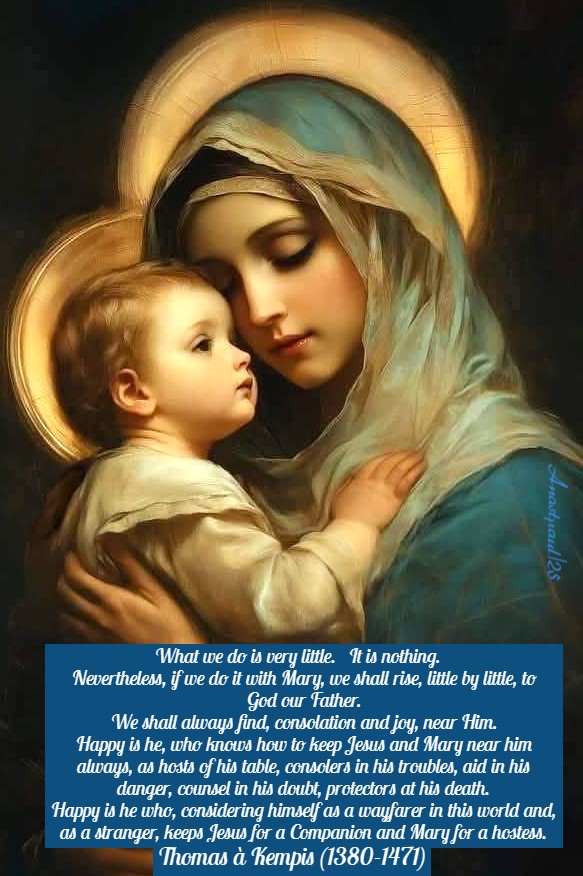
What we do is very little. It is nothing. Nevertheless, if we do it with Mary, we shall rise, little by little, to God our Father.
We shall always find, consolation and joy, near Him.
Happy is he, who knows how to keep Jesus and Mary near him always, as hosts of his table, consolers in his troubles, aid in his danger, counsel in his doubt, protectors at his death.
Happy is he who, considering himself as a wayfarer in this world and, as a stranger, keeps Jesus for a Companion and Mary for a hostess.
iii. Prayer:
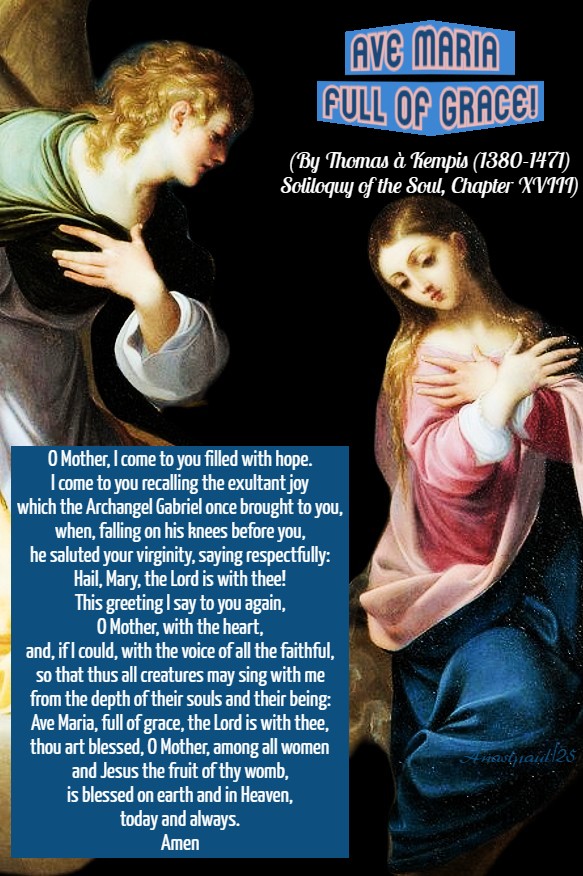
Ave Maria, Full of Grace!
O Mother, I come to you filled with hope.
I come to you recalling the exultant joy
which the Archangel Gabriel once brought to you,
when, falling on his knees before you,
he saluted your virginity, saying respectfully:
Hail, Mary, the Lord is with thee!
This greeting I say to you again,
O Mother, with the heart,
and, if I could, with the voice of all the faithful,
so that thus all creatures may sing with me
from the depth of their souls and their being:
Ave Maria, full of grace, the Lord is with thee,
thou art blessed, O Mother, among all women
and Jesus the fruit of thy womb,
is blessed on earth and in Heaven,
today and always.
(By Thomas à Kempis (1380-1471)
Soliloquy of the Soul, Chapter XVIII)












You must be logged in to post a comment.