Again, I see that the love of God directs towards the soul certain burning rays and shafts of light, which seem penetrating and powerful enough to annihilate not merely the body, but, were it possible, the very soul itself. These work in two ways ; they purify, and they annihilate. Look at gold : the more it is melted, the better it becomes ; and it could be melted so as to destroy every single defect. Such is the action of fire on material things.
Now the soul cannot be annihilated so far as it is in God, but only in itself ; and the more it is purified, so much the more it annihilates self, till at last it becomes quite pure and rests in God. Gold which has been purified to a certain point ceases to suffer any diminution from the action of fire, however great it be ; for the fire does not destroy gold, but only the dross that it may chance to have. In like manner the Divine fire acts on souls: God holds them in the furnace until every defect has been burnt away, and He has brought them, each in his own degree, to a certain standard of perfection. Thus purified, they rest in God without any alloy of self: their very being is God ; they become impassible because there is nothing left to be consumed. And if in this state of purity they were kept in the fire, they would feel no pain ; rather it would be to them a fire of Divine Love, burning on without opposition, like the fire of life eternal.
All the things of which I have spoken, when compared with that of which I am assured in my intelligence, so far as I am able to comprehend it in this life, are of such intensity, that, by the side of them, all things seen, all things felt, all things imagined, all things just and true, seem to me lies and things of naught. I am confounded at inability to find stronger words. I see that God is in such perfect conformity with the soul, that when He beholds it in the purity wherein it was created by His Divine Majesty, He imparts a certain attractive impulse of His burning love, enough to annihilate it, though it be im mortal ; and in this way so transforms the soul into Himself, its God, that it sees in itself nothing but God, who goes on thus attracting and in flaming it, until He has brought it to that state of existence whence it came forth that is, the spotless purity wherein it was created.
And when the soul, by interior illumination, perceives that God is drawing it with such loving ardour to Him self, straightway there springs up within it a corresponding fire of love for its most sweet Lord and God, which causes it wholly to melt away: it sees in the Divine light how considerately, and with what unfailing providence, God is ever leading it to its full perfection, and that He does it all through pure love ; it finds itself stopped by sin, and unable to follow the heavenly attraction, I mean that look which God casts on it to bring it into union with Himself : and this sense of the grievousness of being kept from beholding the Divine light, coupled with that instinctive longing which would fain be without hindrance to follow the enticing look, these two things, I say, make up the pains of the souls in purgatory.
Not that they think anything of their pains, however great they be ; they think far more of the opposition they are making to the will of God, which they see clearly is burning intensely with pure love to them. God meanwhile goes on drawing the soul to Himself by His looks of love mightily, and, as it were, with undivided energy : this the soul knows well ; and could it find another purgatory greater than this by which it could sooner remove so great an obstacle, it would immediately plunge therein, impelled by that conforming love which is between God and the soul.
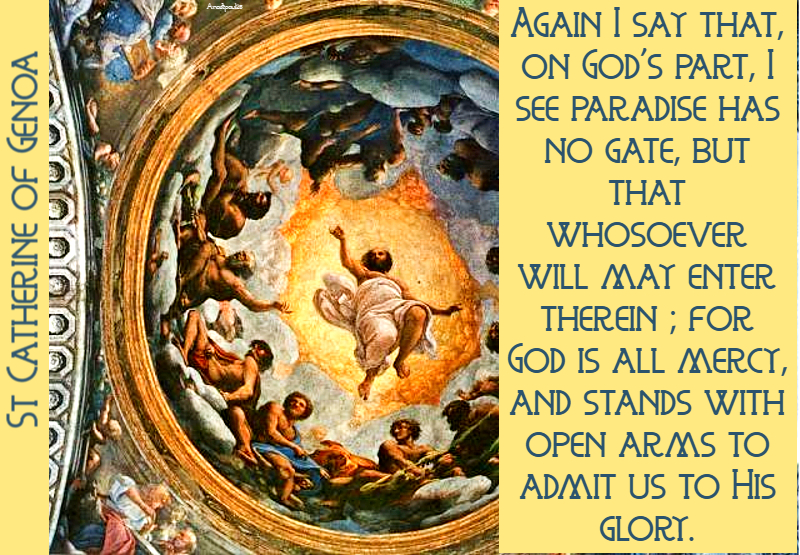
Again I say that, on God’s part, I see paradise has no gate, but that whosoever will may enter therein ; for God is all mercy, and stands with open arms to admit us to His glory. But still I see that the Being of God is so pure (far more than one can imagine), that should a soul see in itself even the least mote of imperfection, it would rather cast itself into a thousand hells than go with that spot into the presence of the Divine Majesty. Therefore, seeing purgatory ordained to take away such blemishes, it plunges therein, and deems it a great mercy that it can thus remove them.
No tongue can express, no mind can understand, how dreadful is purgatory. Its pain is like that of hell ; and yet (as I have said) I see any soul with the least stain of imperfection accept it as a mercy, not thinking it of any moment when compared with being kept from its Love. It appears to me that the greatest pain the souls in purgatory endure proceeds from their being sensible of something in themselves displeasing to God, and that it has been done voluntarily against so much goodness ; for, being in a state of grace, they know the truth, and how grievous is any obstacle which does not let them approach God.
As the soul cleansed and purified finds no place wherein to rest but God, this being its end by creation, so the soul in a state of sin finds no place for it but hell, this being its end by the appointment of God. No sooner, then, does the soul leave the body in mortal sin than it goes straight to hell as to its allotted place, with no other guide than the nature of sin ; and should a soul not find itself thus prevented by the justice of God, but excluded altogether from His appointment, it would endure a still greater hell for God’s appointment partakes of His mercy, and is less severe than the sin deserves ; as it is the soul, finding no place suited to it, nor any lesser pain provided for it by God, casts itself into hell as into its proper place.
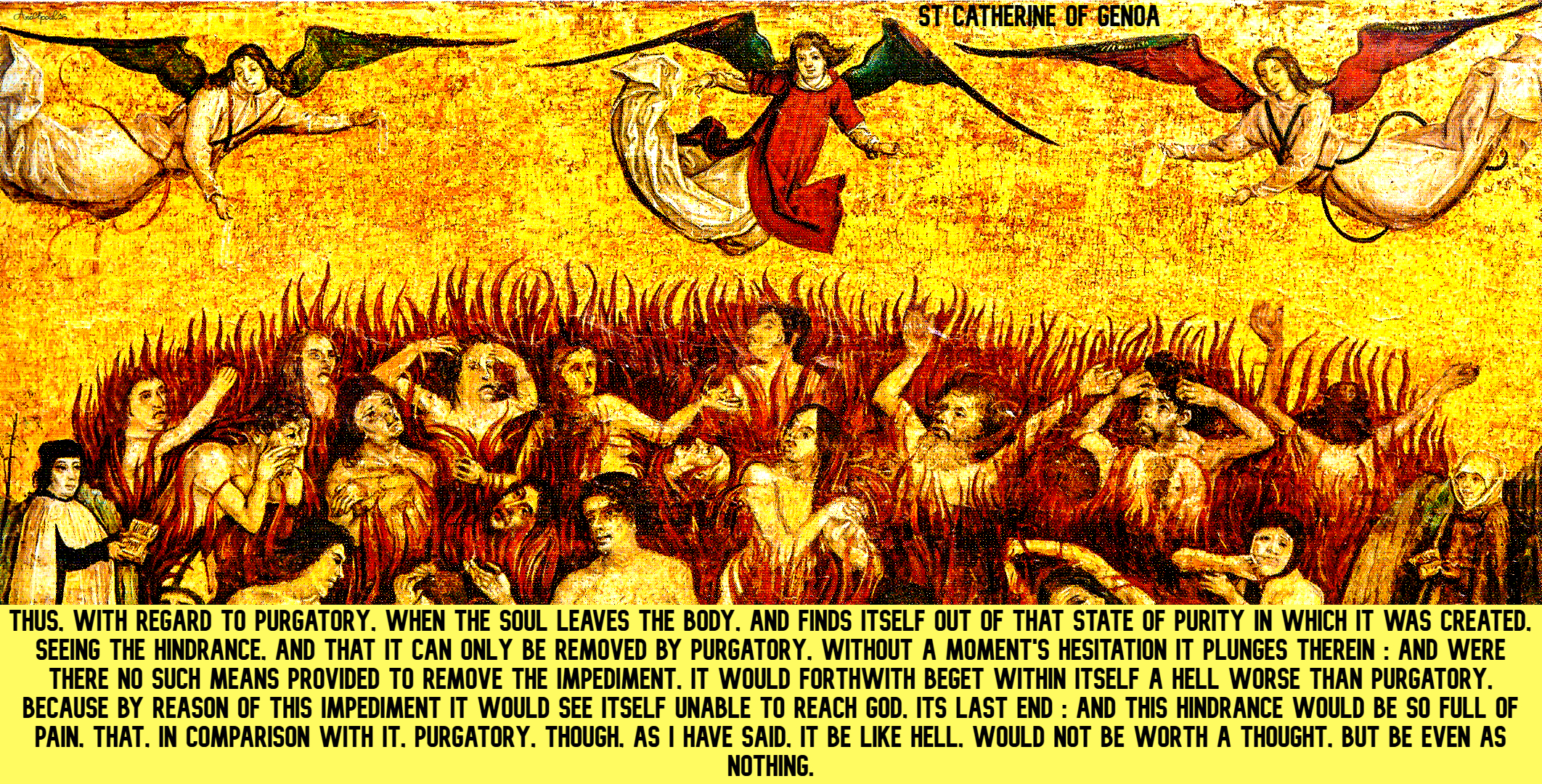
Thus, with regard to purgatory, when the soul leaves the body, and finds itself out of that state of purity in which it was created, seeing the hindrance, and that it can only be removed by purgatory, without a moment’s hesitation it plunges therein : and were there no such means provided to remove the impediment, it would forthwith beget within itself a hell worse than purgatory, because by reason of this impediment it would see itself unable to reach God, its last end : and this hindrance would be so full of pain, that, in comparison with it, purgatory, though, as I have said, it be like hell, would not be worth a thought, but be even as nothing.
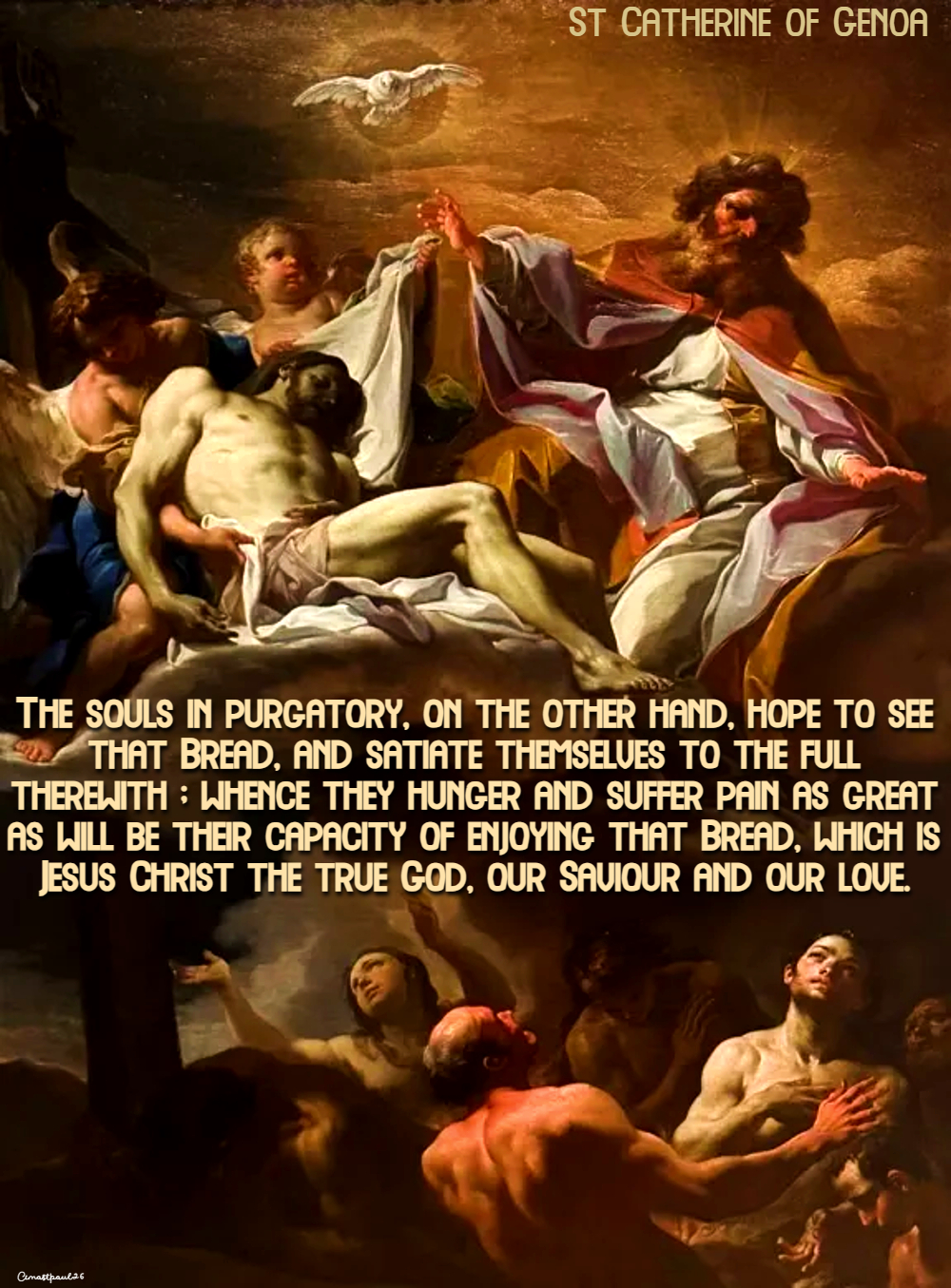
Let us suppose that there existed in the world but one loaf of bread to satisfy the hunger of every creature, and that the mere sight of it could do this. In such a case a man, having naturally, if in good health, a desire for food, would find himself, so long as he was kept from dying or falling sick, growing more and more hungry; for his craving would continue undiminished, he would know that the bread, and nothing but the bread, could satisfy him, and not being able to reach it, would remain in intolerable pain ; the nearer he got to the bread without seeing it the more ardently would he crave for it, and would direct himself wholly towards it, as being the only thing which could afford relief ; and if he were assured that he never could see the bread he would have within him a perfect hell, and become like the damned, who are cut off from all hope of ever seeing God their Saviour, who is the true Bread.
The souls in purgatory, on the other hand, hope to see that Bread, and satiate themselves to the full therewith ; whence they hunger and suffer pain as great as will be their capacity of enjoying that Bread, which is Jesus Christ the true God, our Saviour and our love.
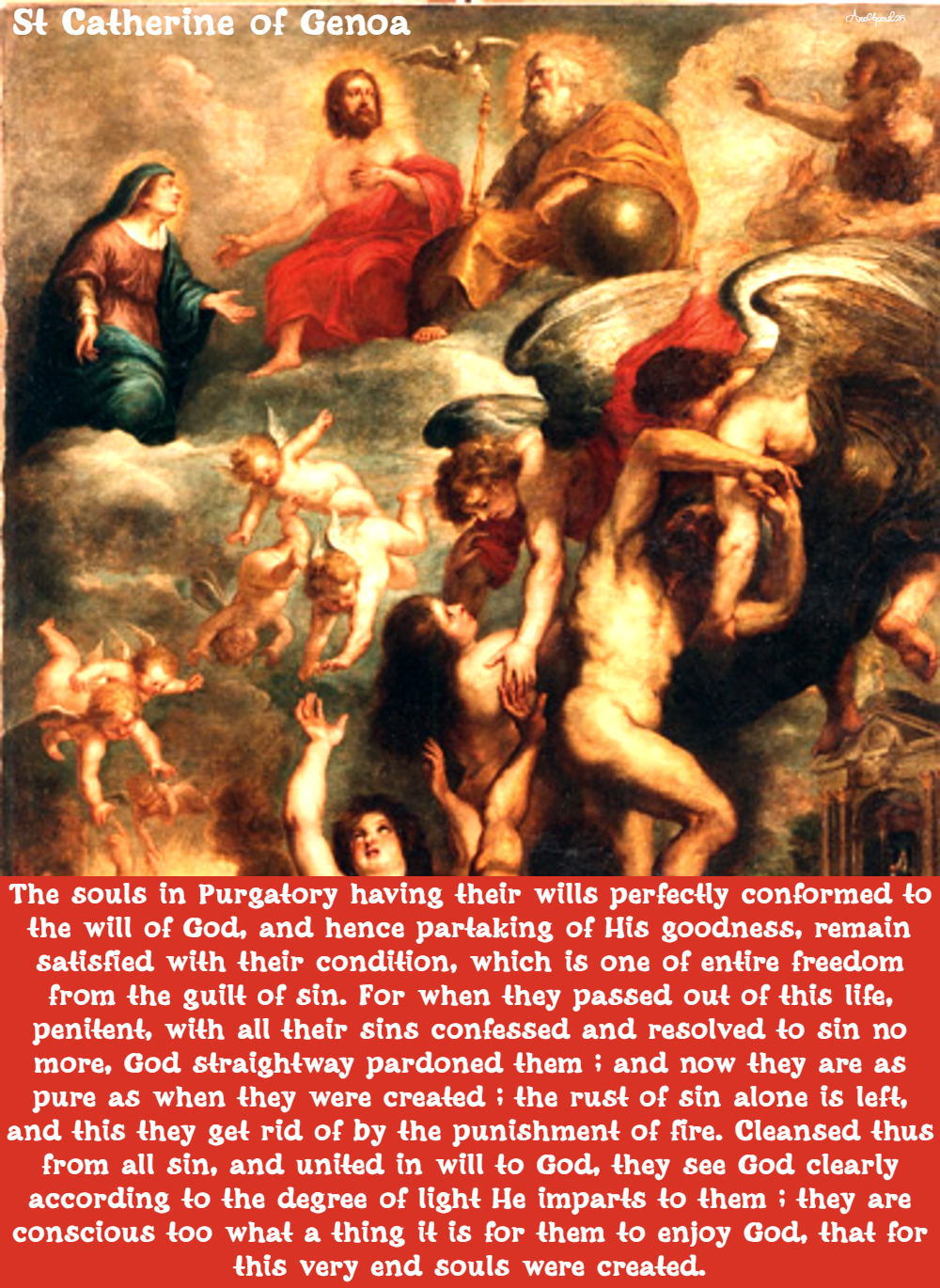
The souls in Purgatory having their wills perfectly conformed to the will of God, and hence partaking of His goodness, remain satisfied with their condition, which is one of entire freedom from the guilt of sin. For when they passed out of this life, penitent, with all their sins confessed and resolved to sin no more, God straightway pardoned them ; and now they are as pure as when they were created ; the rust of sin alone is left, and this they get rid of by the punishment of fire. Cleansed thus from all sin, and united in will to God, they see God clearly according to the degree of light He imparts to them ; they are conscious too what a thing it is for them to enjoy God, that for this very end souls were created.
Again, there is in them a conformity of will so uniting them to God, so drawing them to Him through that natural instinct whereby God is, as it were, bound up with the soul, that no description, no figure, no example can give a clear idea of it as it is actually felt and apprehended by inward consciousness ; nevertheless I will mention something like it which suggests itself to me.
From what has been said, it is clear that the guilt of sin consists in the perverse opposition of the will to the will of God, and that so long as the will continues thus evilly perverse the guilt will continue. For those, then, in hell, who have departed this life with an evil will, there is no remission of sin, neither can be, be cause there can be no more change of will. In passing out of this life the soul is fixed for good or evil according to its deliberate purpose at the time ; as is written, “Where shall I find thee (that is, at the hour of death, with a will either to sin or sorry for sin and penitent), there will I judge thee : ” and this judgment is final ; because after death the will can never again be free, but must remain fixed in the condition in which it was found at the moment of death.
The souls in hell having been found at the moment of death with a will to sin, have with them an infinite degree of guilt ; and the punishment they suffer, though less than they deserve, is yet, so far as it exists, endless. But the souls in purgatory have only the punishment for sin, and not its guilt ; for the guilt was effaced at the moment of death, in that they were found then deploring their sins and penitent for having offended the Divine Goodness ; so their punishment has a limit, and goes on diminishing in duration, as has been said.
O misery above every misery ! and so much the greater because men in their blindness consider it so little. The punishment of the damned is not, indeed, infinite in amount ; for the sweet goodness of God sheds the rays of His mercy even in hell. A man who has died in mortal sin deserves a punishment infinite in pain and infinite in duration ; but God in His mercy has made it infinite only in duration, and has limited the amount of pain. He might most justly have given them a far greater punishment than He has. O how perilous is a sin committed through malice ! for hardly does a man repent of it ; and not repenting, his guilt remains, and will remain, so long as there is any affection for the sin committed, or any purpose of committing it afresh.
All the pains of purgatory take their rise from sin, original or actual. God created the soul perfectly pure and free from every spot of sin, with a certain instinctive tendency to find its blessedness in Him. From this tendency it is drawn away by original sin, and still more by the addition of actual sin ; and the farther off it gets, the more wicked it becomes, because it is less in conformity with God. Things are good only so far as they participate in God.
To irrational creatures God communicates Himself, without fail, as He wills, and as He has determined ; to the rational soul more or less, according as He finds it purified from the impediment of sin ; so that, when a soul is approaching to that state of first purity and innocence which it had when created, the instinctive desire of seeking happiness in God develops itself, and goes on increasing through the fire of love, which draws it to its end with such impetuosity and vehemence, that any obstacle seems intolerable, and the more clear its vision, the more extreme its pain.
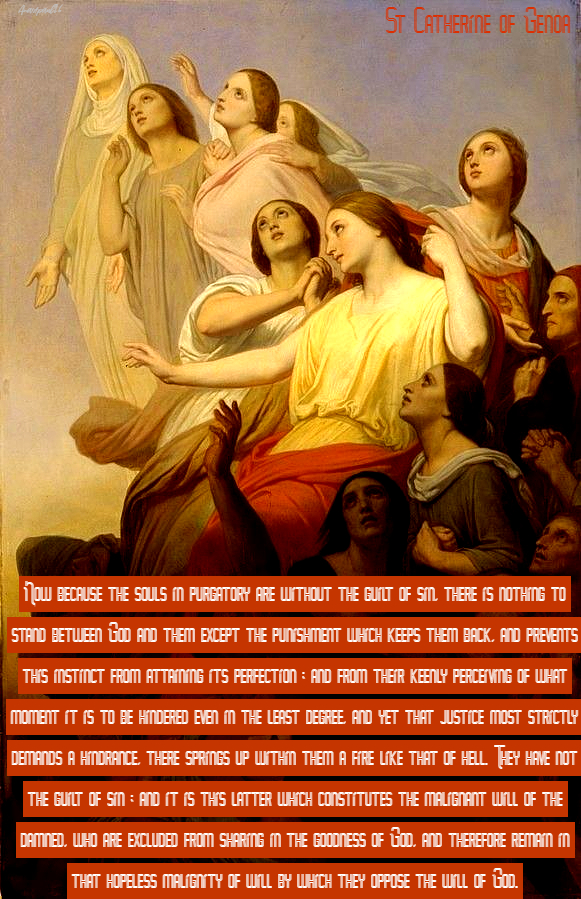
Now because the souls in purgatory are without the guilt of sin, there is nothing to stand between God and them except the punishment which keeps them back, and prevents this instinct from attaining its perfection ; and from their keenly perceiving of what moment it is to be hindered even in the least degree, and yet that justice most strictly demands a hindrance, there springs up within them a fire like that of hell. They have not the guilt of sin ; and it is this latter which constitutes the malignant will of the damned, who are excluded from sharing in the goodness of God, and therefore remain in that hopeless malignity of will by which they oppose the will of God.
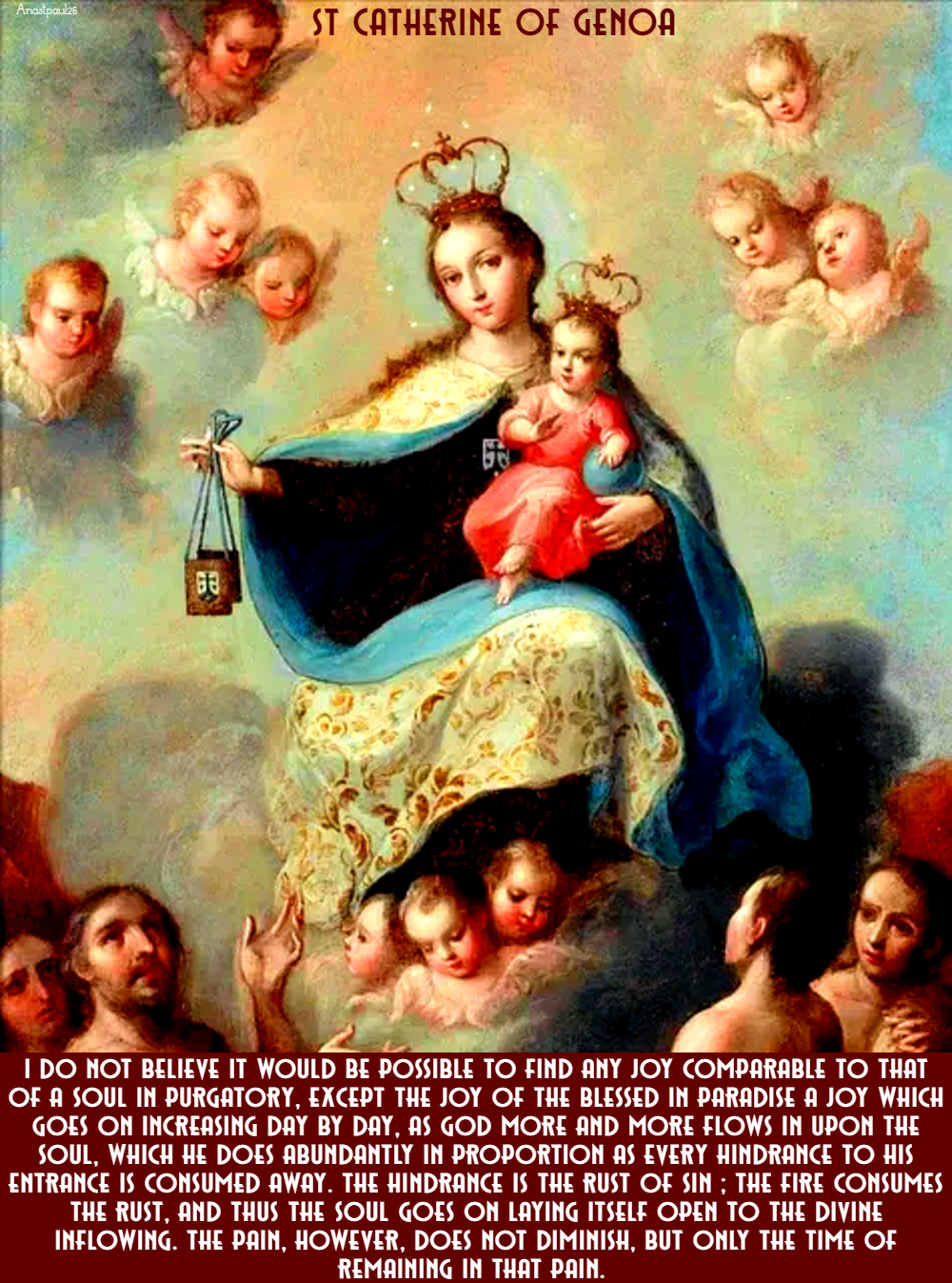
I do not believe it would be possible to find any joy comparable to that of a soul in purgatory, except the joy of the blessed in paradise a joy which goes on increasing day by day, as God more and more flows in upon the soul, which He does abundantly in proportion as every hindrance to His entrance is consumed away. The hindrance is the rust of sin ; the fire consumes the rust, and thus the soul goes on laying itself open to the Divine inflowing.
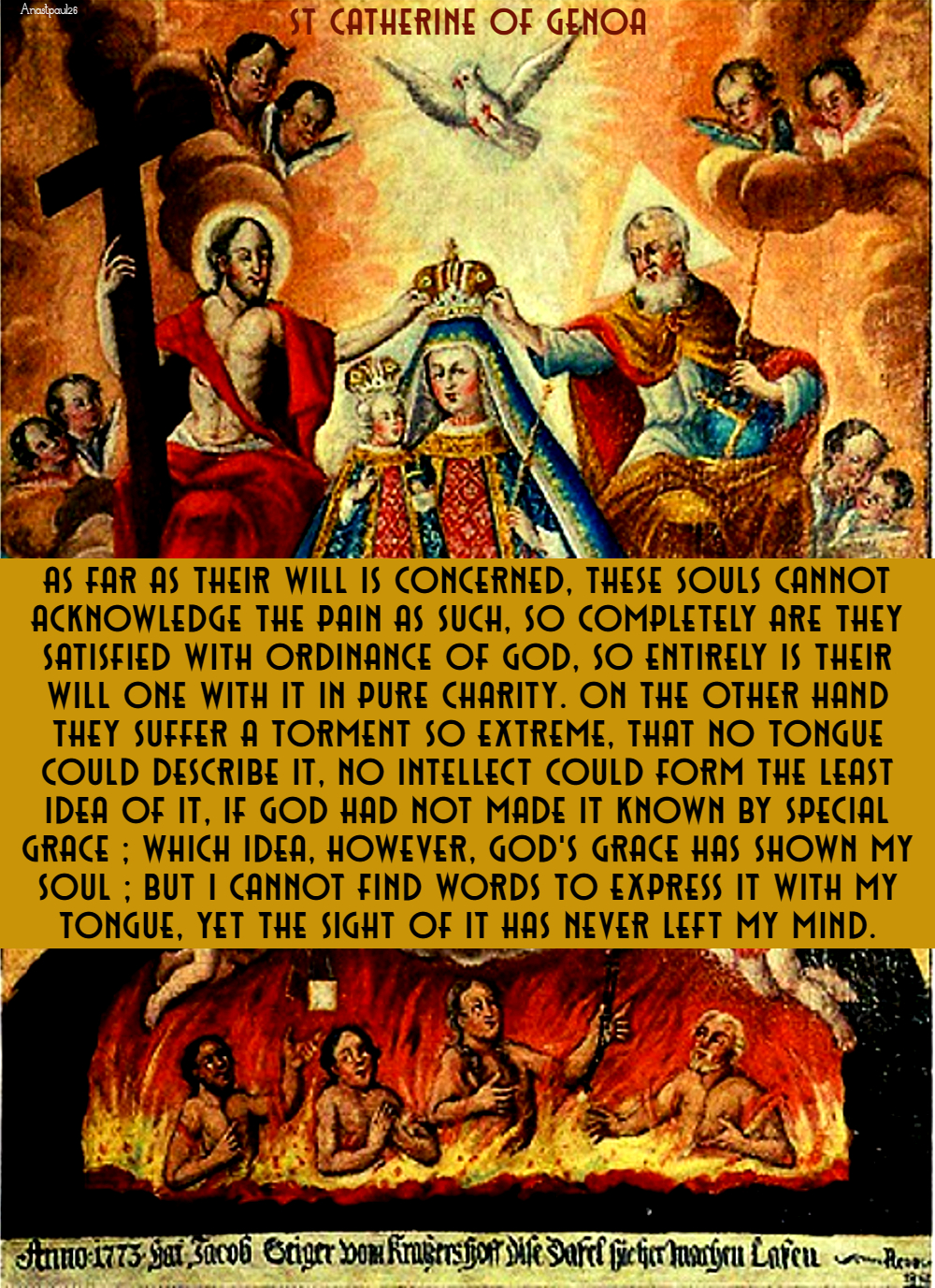
The pain, however, does not diminish, but only the time of remaining in that pain. As far as their will is concerned, these souls cannot acknowledge the pain as such, so completely are they satisfied with ordinance of God, so entirely is their will one with it in pure charity. On the other hand they suffer a torment so extreme, that no tongue could describe it, no intellect could form the least idea of it, if God had not made it known by special grace ; which idea, however, God’s grace has shown my soul ; but I cannot find words to express it with my tongue, yet the sight of it has never left my mind. I will describe it as I can : they will understand it whose intellect the Lord shall vouchsafe to open.
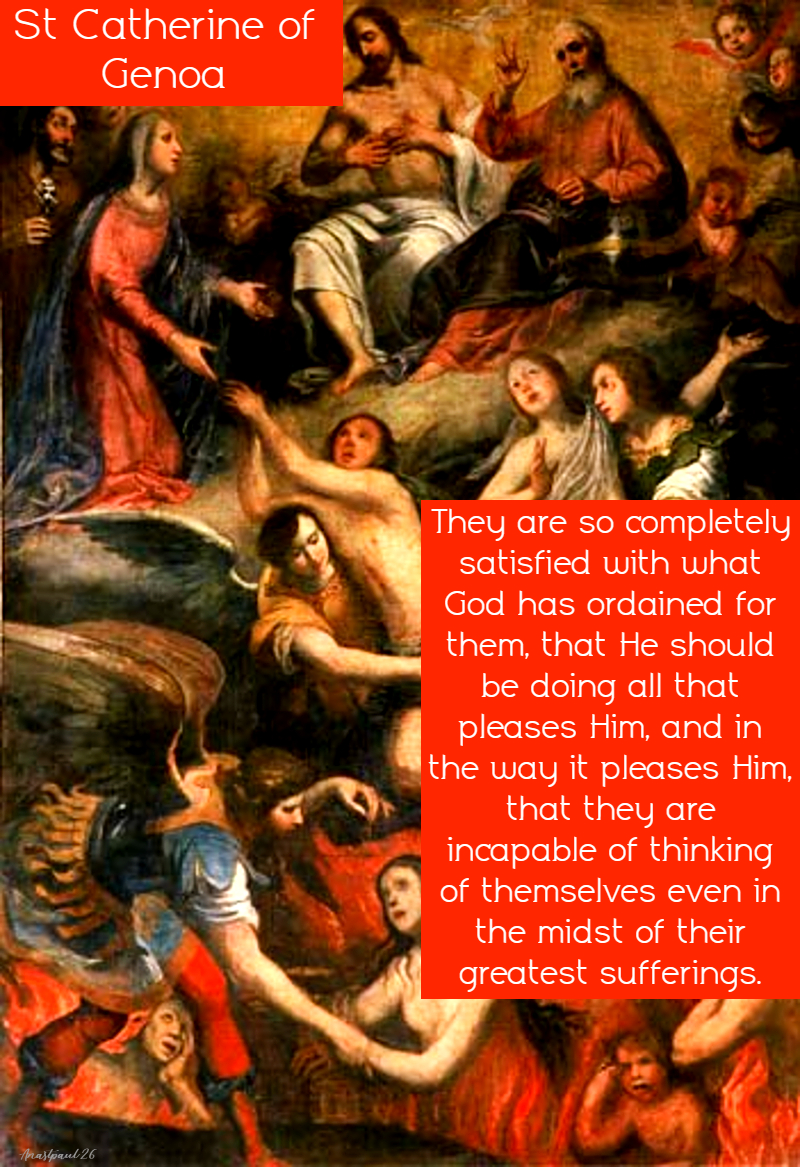
The souls in purgatory, as far as I can understand the matter, cannot but choose to be there ; and this by God’s ordinance, Who has justly decreed it so. They cannot reflect within themselves and say, ” I have done such and such sins, for which I deserve to be here; ” nor can they say, “Would that I had not done them, that now I might go to Paradise ;” nor yet say, “That soul is going out before me;” nor, “I shall go out before him.” They can remember nothing of themselves or others, whether good or evil, which might increase the pain they ordinarily endure ; they are so completely satisfied with what God has ordained for them, that He should be doing all that pleases Him, and in the way it pleases Him, that they are incapable of thinking of themselves even in the midst of their greatest sufferings.
They behold only the goodness of God, whose mercy is so great in bringing men to Himself, that they cannot see anything that may affect them, whether good or bad ; if they could, they would not be in pure charity. They do not know that their sufferings are for the sake of their sins, nor can they keep in view the sins themselves ; for in doing so there would be an act of imperfection, which could have no place where there can be no longer any possibility of actually sinning. Once, in passing out of this life, they perceive why they have their purgatory ; but never afterwards, otherwise self would come in.
On All Souls’ Day we offer this prayer for those who are not only saints, but saints on the very threshold of paradise, waiting to be admitted to the immediate presence of God. It is always a privilege to do a service to the friends of God, it is so above all when those who need our help will in a short time behold His face in heaven, and will gratefully remember to all eternity each little prayer offered on their behalf.
These saints waiting for heaven cry out to us to help them. They have a claim on us by reason of the intensity of their suffering. No words can tell what they suffer, and their very love for God increases their pain. Every compassionate heart will desire to do something to relieve them and to shorten the time of their banishment. Yet how little I do for them!
They are moreover, unable to help themselves. If we saw one whom we knew to be a saint enduring some affliction in which he could do nothing in his own behalf, we should be eager to assist him. The holy souls are utterly helpless, their own prayers avail them nothing. To us they look for aid, to us for an abridgement of their time of punishment. Do I respond to their appeal as I ought?
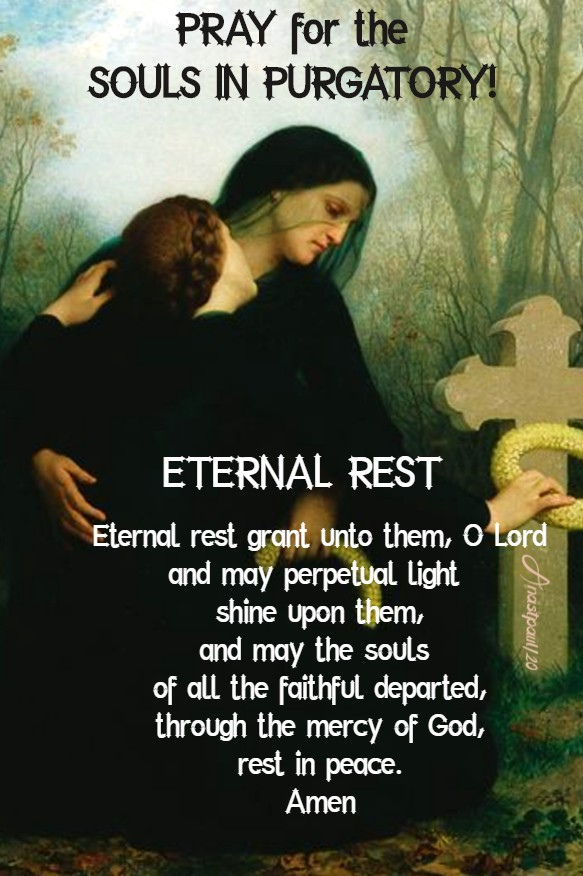
ETERNAL REST
Eternal rest grant unto them, O Lord and may perpetual light shine upon them and may the souls of all the faithful departed, through the mercy of God, rest in peace. Amen
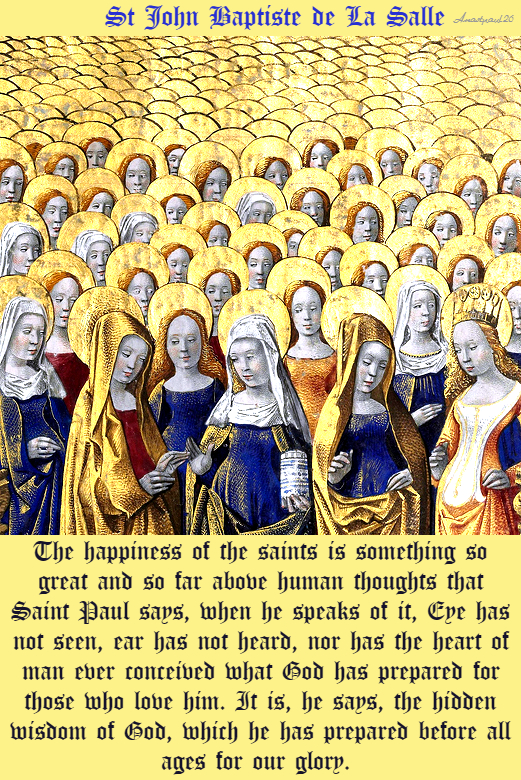
The happiness of the saints is something so great and so far above human thoughts that Saint Paul says, when he speaks of it, Eye has not seen, ear has not heard, nor has the heart of man ever conceived what God has prepared for those who love him. It is, he says, the hidden wisdom of God, which he has prepared before all ages for our glory. We know, says Saint John, that when Jesus appears, we will be like him because we will see him as he is.
What a joy for the saints to be made like God through participation in his nature and in the divine perfections! There God is truly in the saints by a holy sharing in his greatness, and the saints are in God, because their entire being is penetrated by God so that they can think and love only God. Today, pay homage to the saints, but let it be in God, because it is in him that you find them all. Admire how great is the happiness they enjoy in heaven, how wonderful is this glory they recieve, and beg them to obtain from God for you the grace to share in their glory after death.
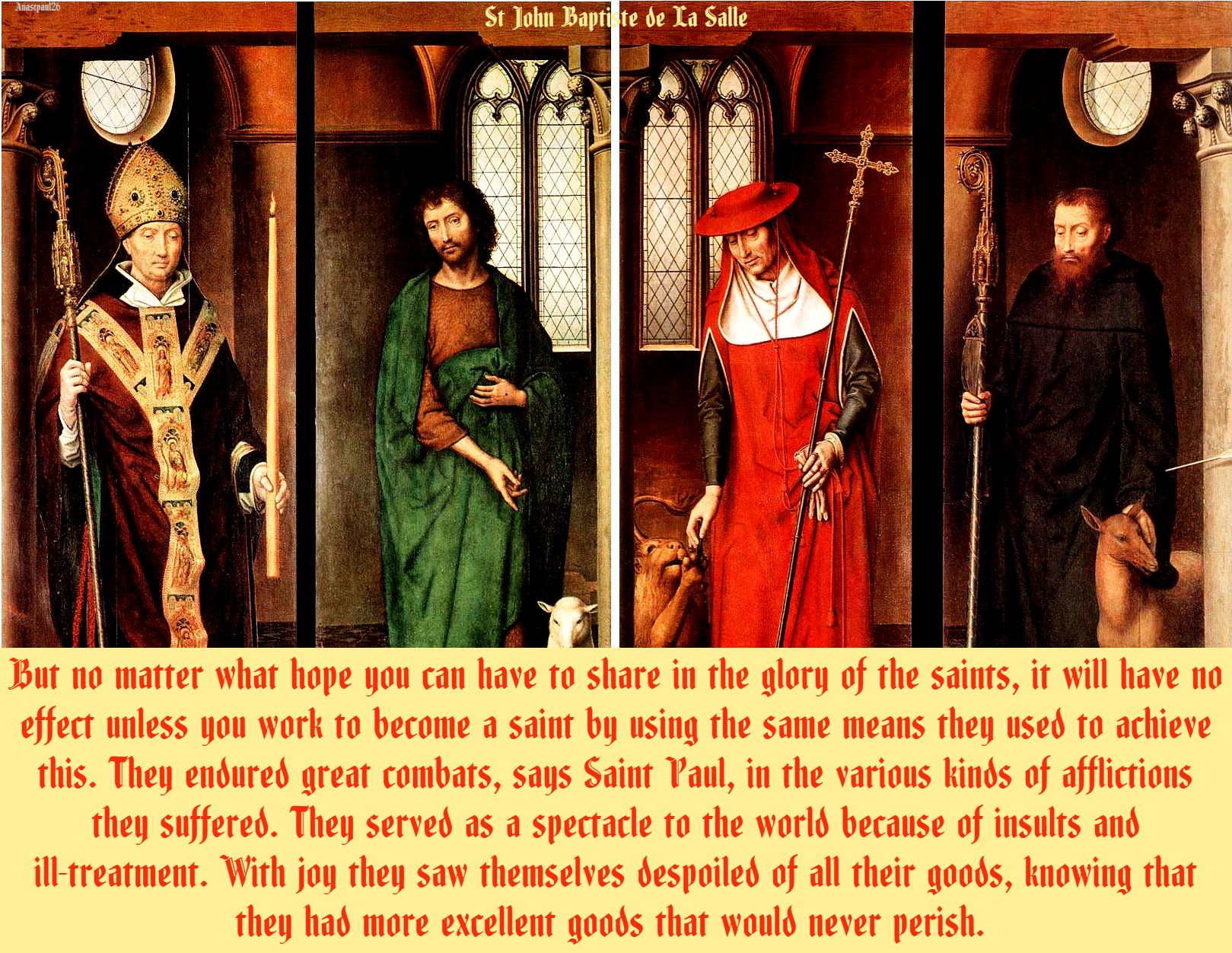
But no matter what hope you can have to share in the glory of the saints, it will have no effect unless you work to become a saint by using the same means they used to achieve this. They endured great combats, says Saint Paul, in the various kinds of afflictions they suffered. They served as a spectacle to the world because of insults and ill-treatment. With joy they saw themselves despoiled of all their goods, knowing that they had more excellent goods that would never perish. Elsewhere he says they endured mockeries, scourgings, chains, and prisons, some were stones, others sawed in two, some were put to death by the sword, others wandered about garbed in sheepskins and goatskins, being abandoned, tormented, and persecuted, others, finally, of whom the world was not worthy, passed their life wandering in deserts and on mountains, living in dens and caves of the earth.
All these saints, tormented in various ways, were unwilling to rescue their present life but chose to find a better one in the resurrection. For, adds the same Apostle, these are only the afflictions that produce the eternal weight of glory to which we are destined in the next life. Yearn then, for sufferings every day, as did many of the saints, in the desire and the hope of being clothed with them one day with the immortality of heaven.
OCTOBER TWENTY-NINTH. The Angels who favoured particular Saints.
Let us consecrate this day to ‘those blessed Spirits who specially favoured some of the Saints; as the Angels who released St. Peter from his prison, and revealed to St. John the secrets of futurity ; those who gave the monastic rule to St. Pachomius: who imprinted the holy stigmas in the body of St. Francis; wounded the heart of St. Teresa; and those who gave the holy communion to St. Stanislas Kotska; who conversed with St. Rose, and conferred on St. Thomas the gift of perfect chastity. Thus we will please those great servants of God, and obtain their intercession.
Practice—Three spiritual communions in honour of these Angels.
Asp.—O all ye holy Saints and Angels ! intercede for us.
OCTOBER THIRTIETH. All the Angels because they assist us in Death
We are born but to live—we live but to die—and our lot for eternity depends on the manner in which we breathe our last. We ought, then, to “make for ourselves friends,” for that critical moment, of the holy Angels, by a true, sincere, persevering devotion to them. If we do, it is then indeed they will show how they loved us.
Practice—Prayer to the Blessed Virgin for a happy death. Asp.—O holy Angels—-Spirits of God ! pray for us now and at the hour of our death—Amen.”
OCTOBER THIRTY-FIRST. All the Angels because they will contribute to our happiness in eternity.
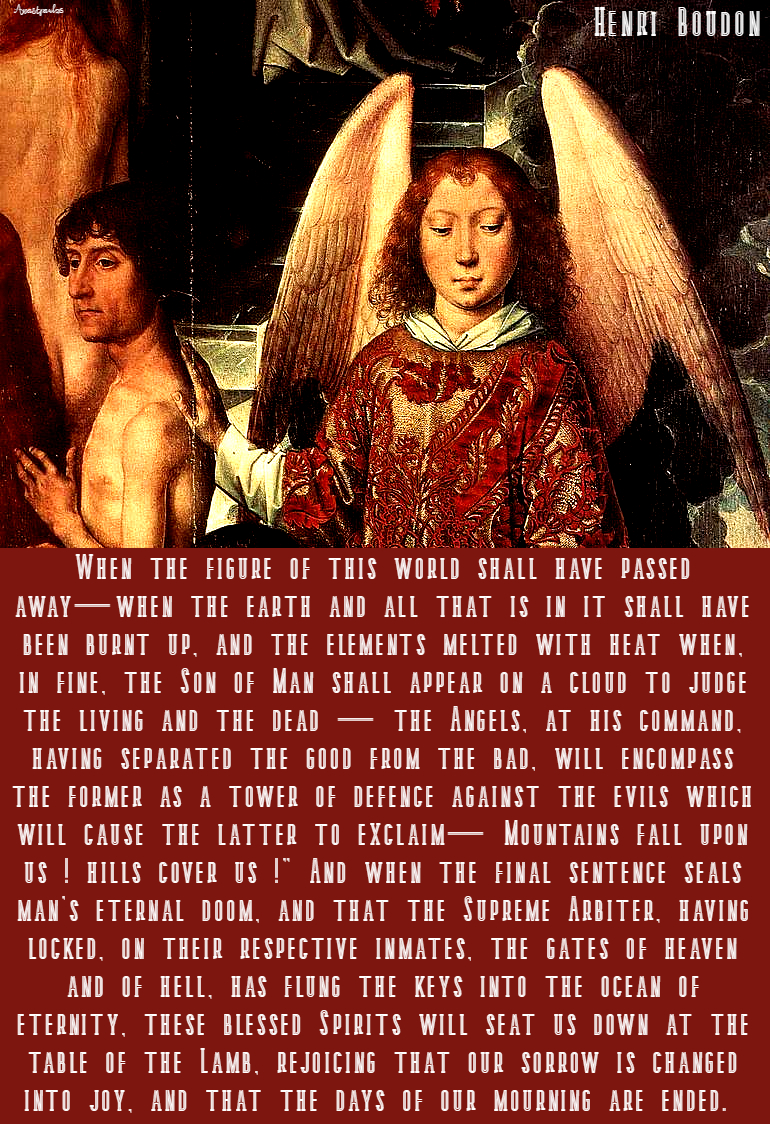
When the figure of this world shall have passed away—when the earth and all that is in it shall have been burnt up, and the elements melted with heat when, in fine, the Son of Man shall appear on a cloud to judge the living and the dead — the Angels, at his command, having separated the good from the bad, will encompass the former as a tower of defence against the evils which will cause the latter to exclaim— Mountains fall upon us ! hills cover us !” And when the final sentence seals man’s eternal doom, and that the Supreme Arbiter, having locked, on their respective inmates, the gates of heaven and of hell, has flung the keys into the ocean of eternity, these blessed Spirits will seat us down at the table of the Lamb, rejoicing that our sorrow is changed into joy, and that the days of our mourning are ended. Let us love these holy Angels, but let us love them perseveringly. Perseverance crowns the work. If they deserved our homage yesterday, they as well and better deserve it to day.
Practice—Excite others to be devout to the Angels. Asp.—Alleluia! Salvation to our God, that sits upon the throne: and may all his Angels say, Amen.
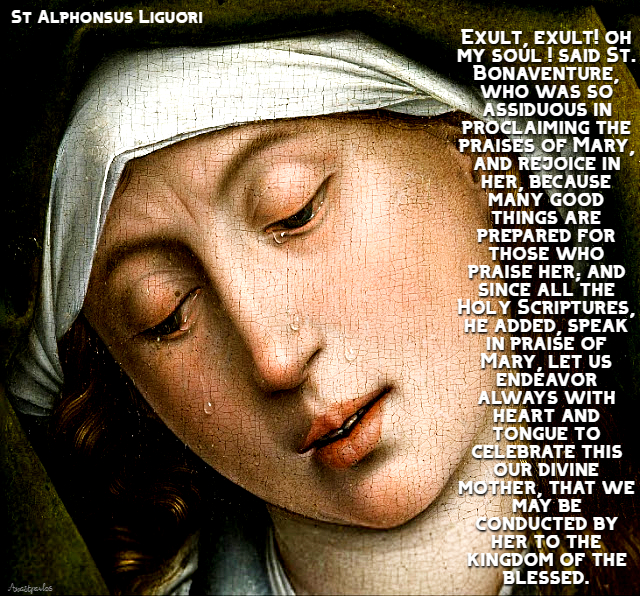
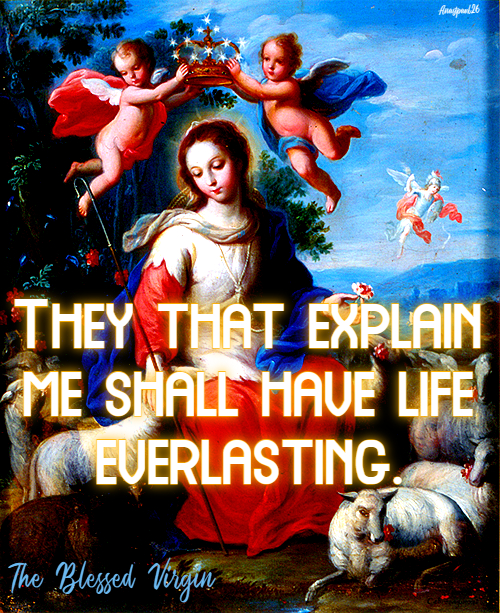
Exult, exult! oh my soul ! said St. Bonaventure, who was so assiduous in proclaiming the praises of Mary, and rejoice in her, because many good things are prepared for those who praise her; and since all the Holy Scriptures, he added, speak in praise of Mary, let us endeavor always with heart and tongue to celebrate this our divine mother, that we may be conducted by her to the kingdom of the blessed.
St Alphonsus Liguori
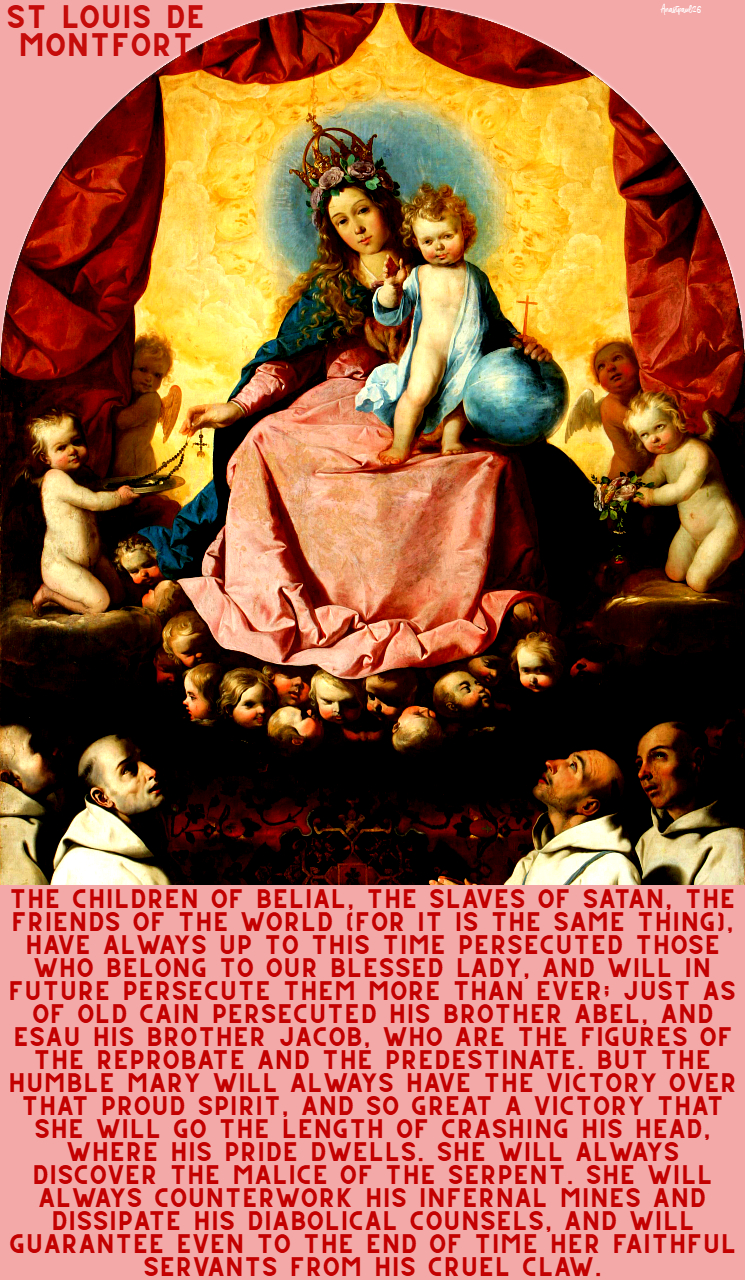
The children of Belial, the slaves of Satan, the friends of the world (for it is the same thing), have always up to this time persecuted those who belong to our Blessed Lady, and will in future persecute them more than ever; just as of old Cain persecuted his brother Abel, and Esau his brother Jacob, who are the figures of the reprobate and the predestinate. But the humble Mary will always have the victory over that proud spirit, and so great a victory that she will go the length of crashing his head, where his pride dwells. She will always discover the malice of the serpent. She will always counterwork his infernal mines and dissipate his diabolical counsels, and will guarantee even to the end of time her faithful servants from his cruel claw.
St Louis de Montfort
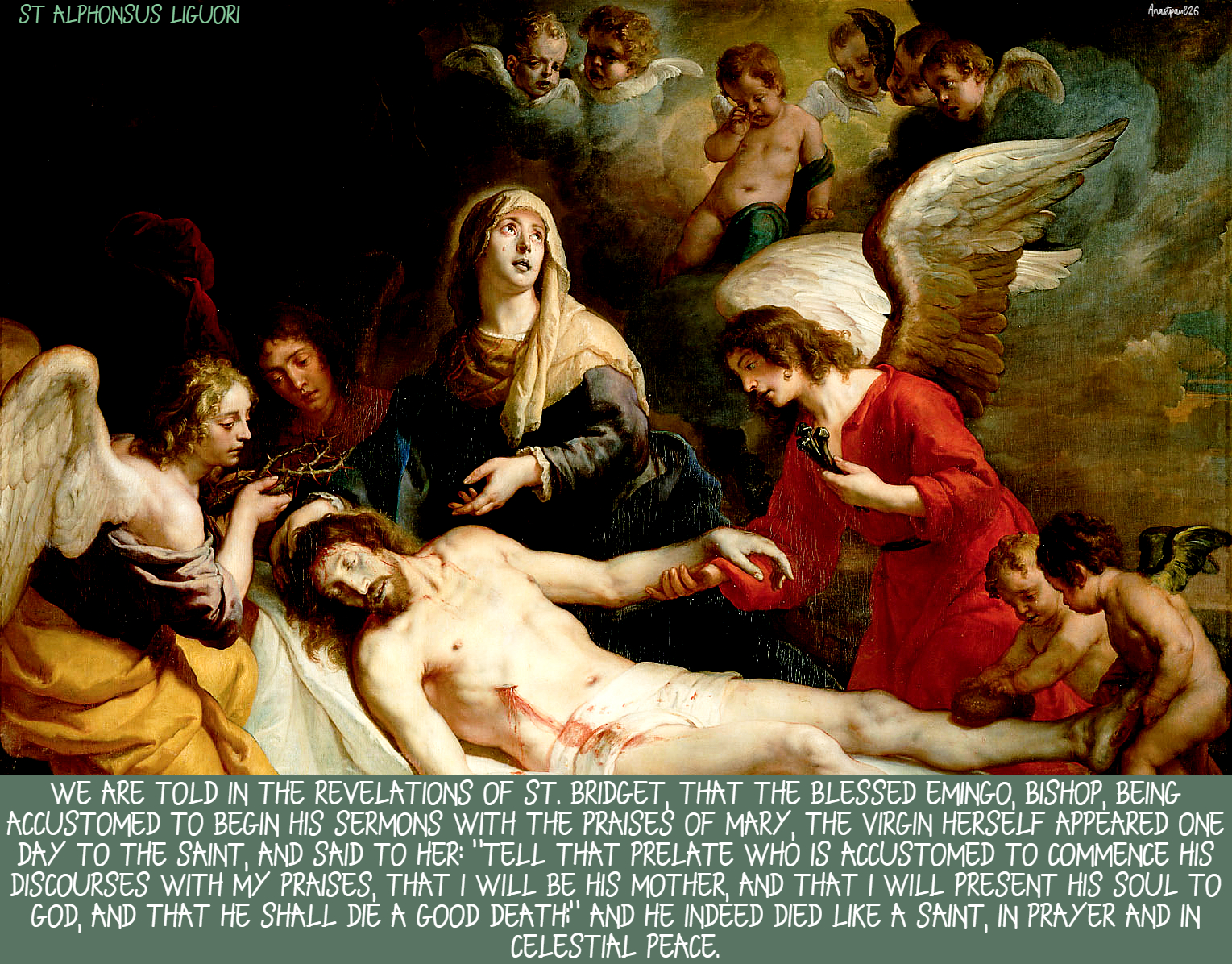
We are told in the revelations of St. Bridget, that the blessed Emingo, Bishop, being accustomed to begin his sermons with the praises of Mary, the Virgin herself appeared one day to the saint, and said to her: “Tell that prelate who is accustomed to commence his discourses with my praises, that I will be his mother, and that I will present his soul to God, and that he shall die a good death;” and he indeed died like a saint, in prayer and in celestial peace.
St Alphonsus Liguori
If you follow Mary, you will not swerve from the right path, if you pray to her, you will not fall into despair, if she holds you, you will not fall, if she protects you, you need not fear, if she leads you, you will never weary, and if she befriends you, you will be safe.
St Bernard
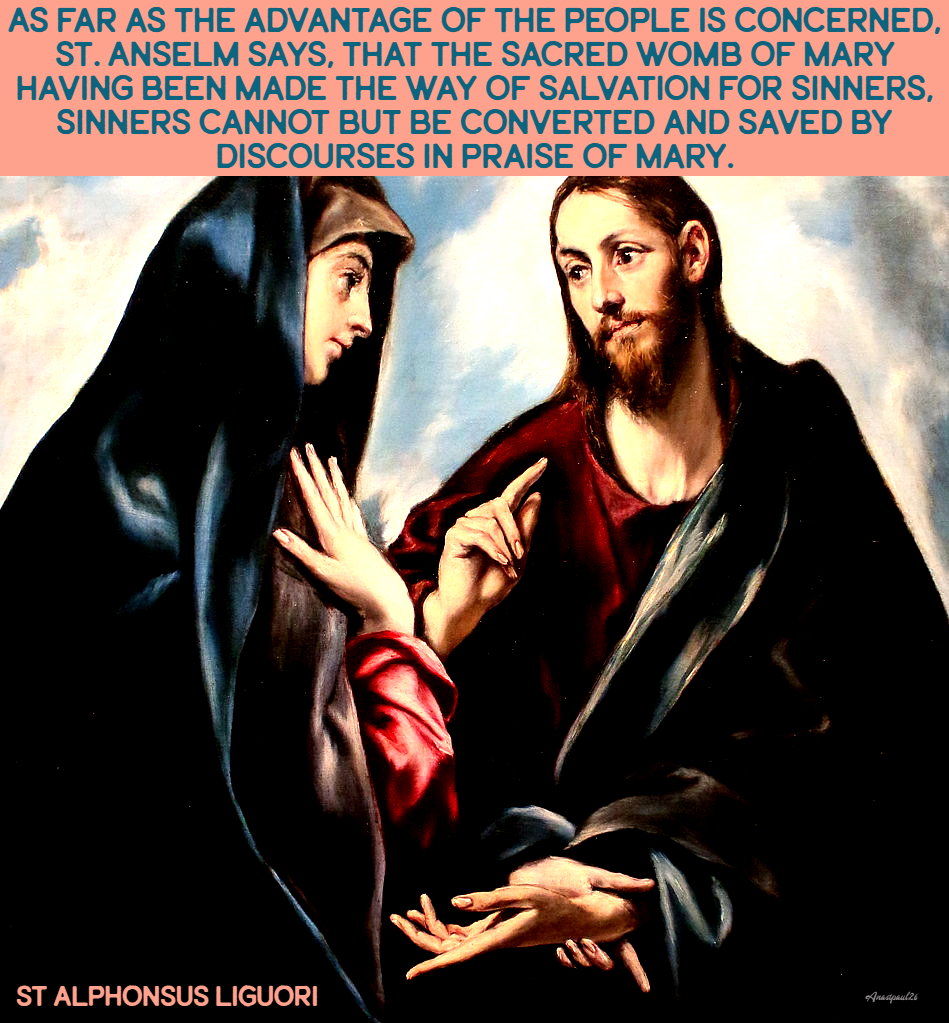
As far as the advantage of the people is concerned, St. Anselm says, that the sacred womb of Mary having been made the way of salvation for sinners, sinners cannot but be converted and saved by discourses in praise of Mary.
St Alphonsus Liguori
All Christians have a great devotion to Mary except those old and hardened sinners who, for a very long time, having lost the faith, wallow in the slime of their brute passions. The Devil tries to keep them in this state of blindness until that moment when death opens their eyes. Ah! If they had but the happiness to have recourse to Mary they would not fall into Hell, as will happen to them! No, my dear children, let us not imitate such people! On the contrary, let us follow the footsteps of all those true servants of Mary.
St John Vianney
And if then you are greatly alarmed and lose courage in view of the sins you have committed, she will come to comfort you as she came to Adolphus, Count of Alsace, who, having quitted the world and become a Franciscan, as the chronicles relate, was very devoted to the mother of God. His last days arrived, and at the remembrance of the life he had led in the world, and the rigor of divine justice, he began to fear death and doubt of his salvation. Then Mary, who never sleeps when her faithful servants are in trouble, accompanied by many saints, appeared to him, and encouraged him with these tender words of consolation : “My dear Adolphus, thou art mine, thou hast given thyself to me, then why dost thou so greatly fear death?” The servant of Mary was consoled by these words, every fear disappeared, and he died in great peace and contentment.
St Alphonsus Liguori
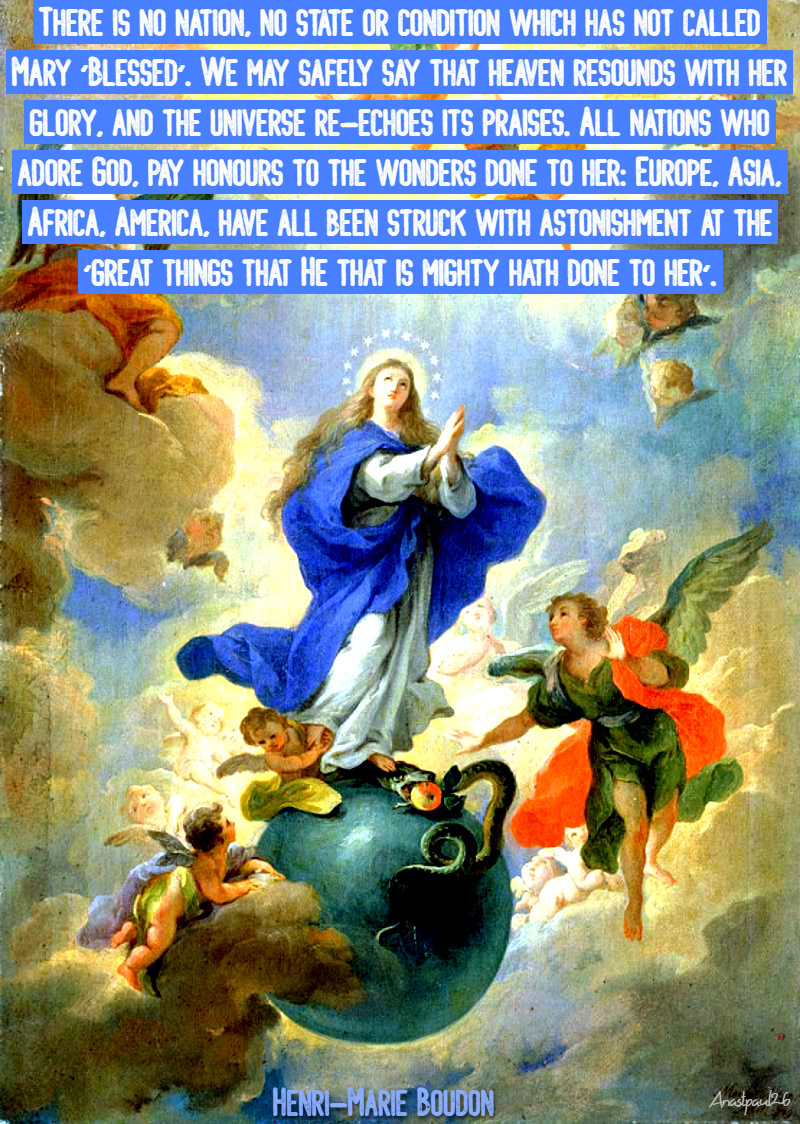
There is no nation, no state or condition which has not called Mary ‘Blessed’. We may safely say that heaven resounds with her glory, and the universe re-echoes its praises. All nations who adore God, pay honours to the wonders done to her: Europe, Asia, Africa, America, have all been struck with astonishment at the ‘great things that He that is mighty hath done to her’.
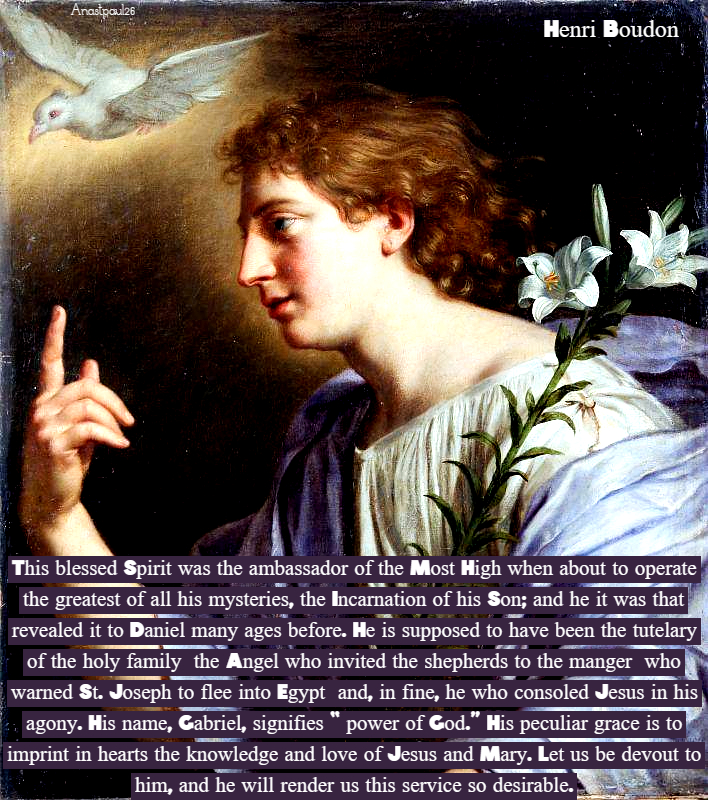
This blessed Spirit was the ambassador of the Most High when about to operate the greatest of all his mysteries, the Incarnation of his Son; and he it was that revealed it to Daniel many ages before. He is supposed to have been the tutelary of the holy family—the Angel who invited the shepherds to the manger—who warned St. Joseph to flee into Egypt—and, in fine, he who consoled Jesus in his agony. His name, Gabriel, signifies “ power of God.” His peculiar grace is to imprint in hearts the knowledge and love of Jesus and Mary. Let us be devout to him, and he will render us this service so desirable.
Practice—Say in honour of this blessed Angel seven times in his own words to the Blessed Virgin—Hail Mary ! &c. Asp.—O Angel of the Lord!” extend in all hearts the empire of Jesus and Mary.
OCTOBER TWENTY-SIXTH. St. Michael
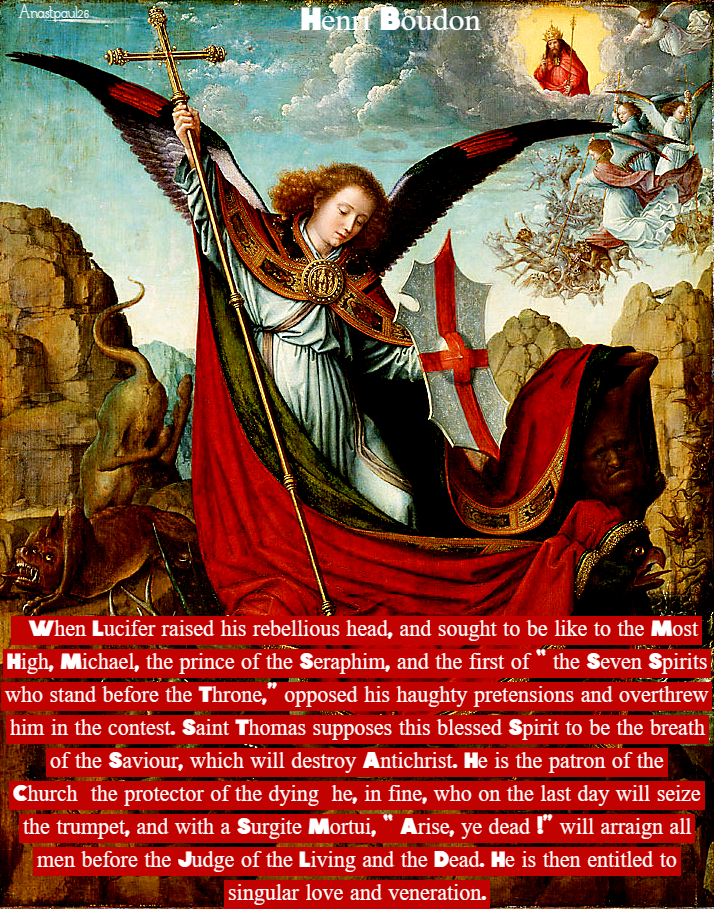
“When Lucifer raised his rebellious head, and sought to be like to the Most High, Michael, the prince of the Seraphim, and the first of “ the Seven Spirits who stand before the Throne,” opposed his haughty pretensions and overthrew him in the contest. Saint Thomas supposes this blessed Spirit to be the breath of the Saviour, which will destroy Antichrist. He is the patron of the Church—the protector of the dying—he, in fine, who on the last day will seize the trumpet, and with a Surgite Mortui, “ Arise, ye dead !” will arraign all men before the Judge of the Living and the Dead. He is then entitled to singular love and veneration.
Practice—Nine Gloria Patria, in honour of St. Michael, as chief of the Nine Choirs. Asp.— O holy Michael the Archangel! defend us in the combat, lest we perish in the Day of Judgment.
OCTOBER TWENTY-SEVENTH. The Angels of bad and ignorant Catholics.
That there are numbers who belong to the one fold of Jesus Christ, unmindful of their duty to those holy Angels, whom they know to be their guardians and protectors, and many more altogether ignorant of this consoling truth—is as undeniable as it is afflicting. Let us this day supply their deficiency by our homage and respect.
Practice.—Assist at Mass in honour of these Angels. Asp.—For all who despise or forget you, I love and venerate you, holy Angels.
OCTOBER TWENTY-EIGHTH. The Angels who visit and console the souls in Purgatory.
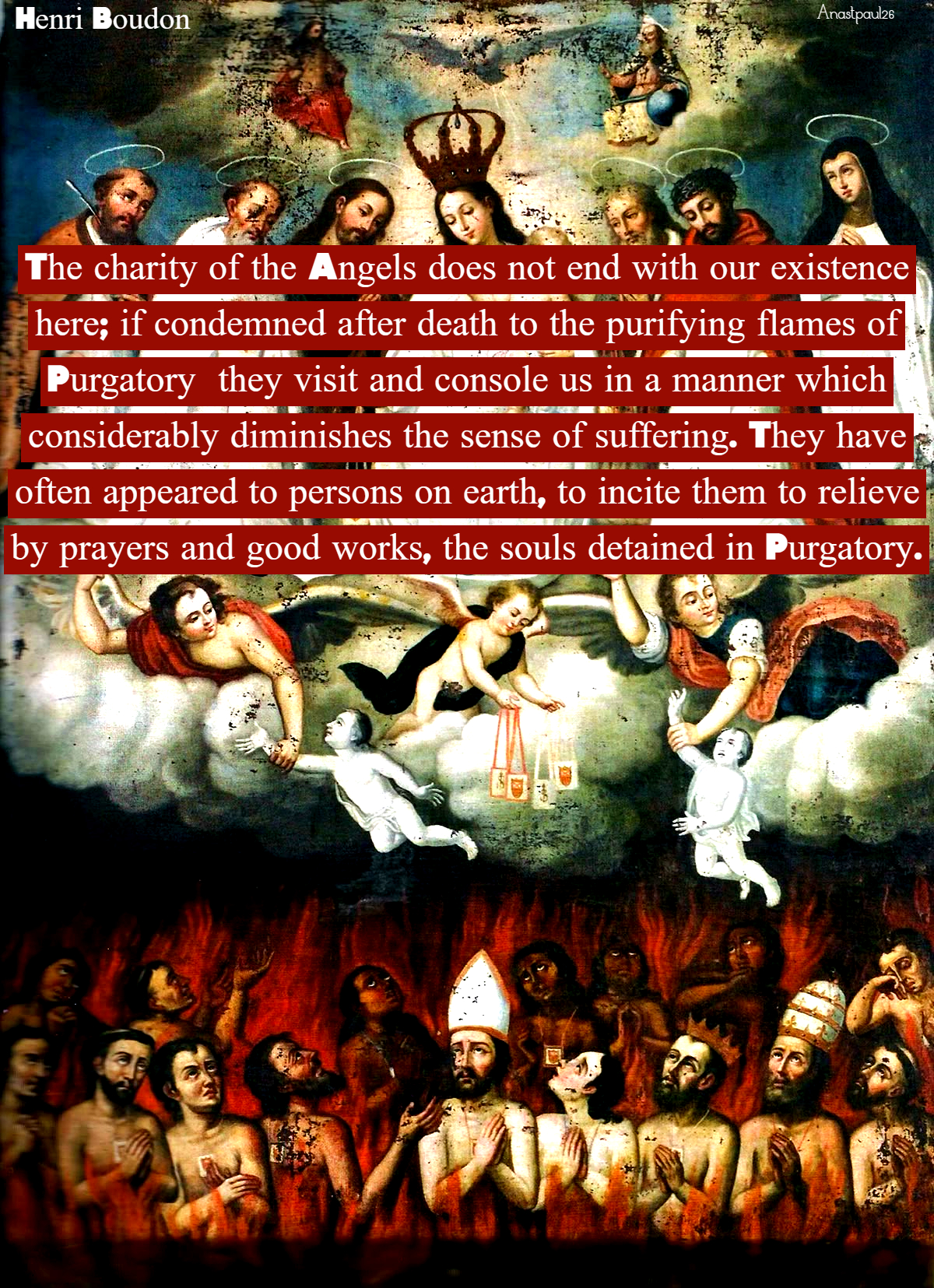
The charity of the Angels does not end with our existence here; if condemned after death to the purifying flames of Purgatory—they visit and console us in a manner which considerably diminishes the sense of suffering. They have often appeared to persons on earth, to incite them to relieve by prayers and good works, the souls detained in Purgatory.
Practice—Sacrifice something at meals in honour of these Angels. Asp.—Holy Angels, I thank you.
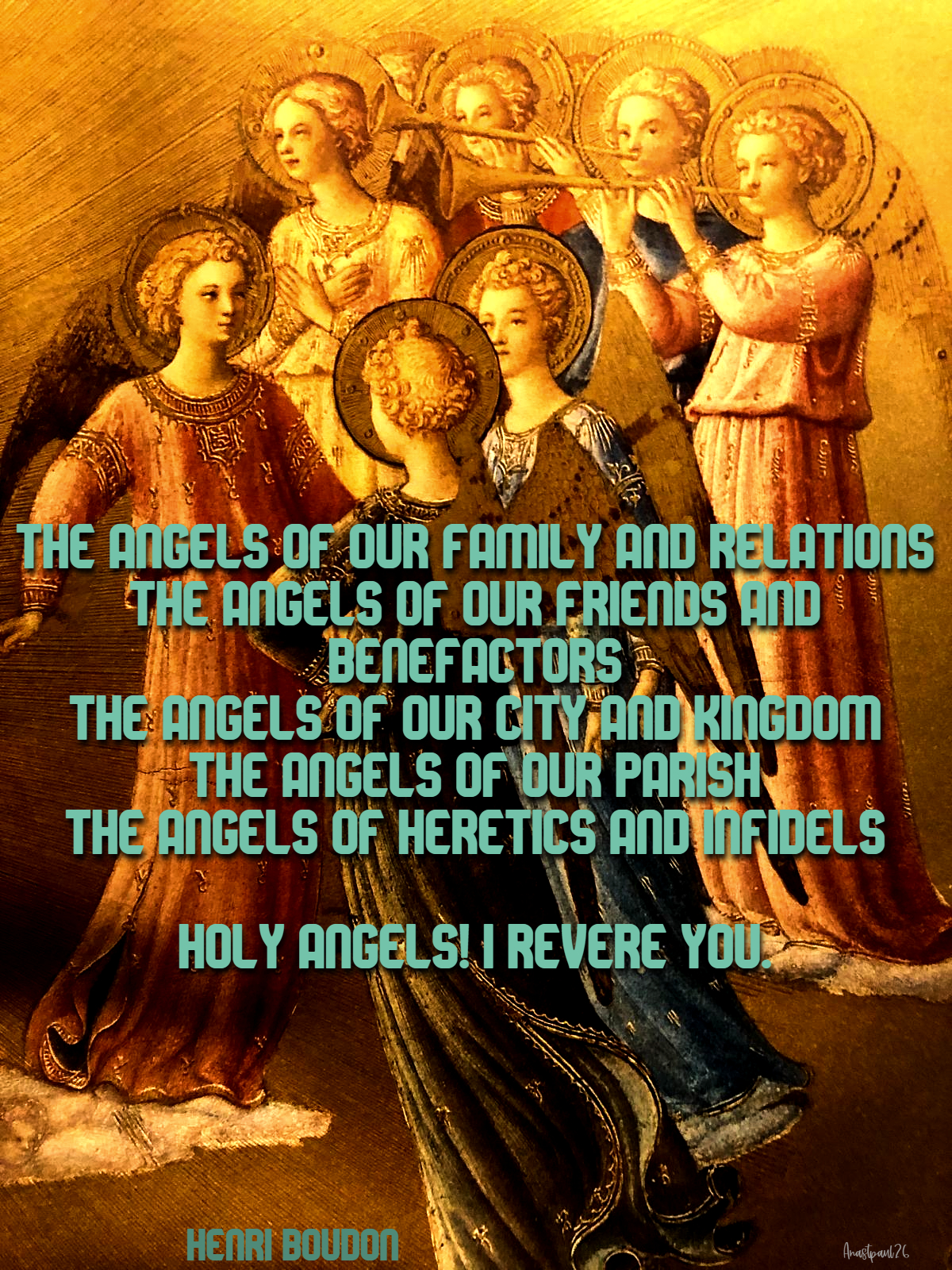
OCTOBER NINETEENTH. The Angels of our Family and Relations.
Honour the Angels of your family and relations; they often render services which yo would not receive from your own Angels, perhaps because of some advantage which is derived from some good which you do for those of whom they have charge.
Practice—A communion in honour of these Angels. Asp.—Holy Angels! I revere you.
OCTOBER TWENTIETH. The Angels of our Friends and Benefactors.
Pay particular respect to those holy Spirits who are entrusted with the guardianship of your friends and benefactors, knowing that the services which they render to you are often prompted by these blessed Angels. Your Confessor being your best friend, his Angel deserves special devotion and affection. Practice—Pay a visit to these Angels : read 3d Motive, 1st part of the preceding work. Asp.—Lord ! charge thy Angels to keep us in all our ways.
OCTOBER TWENTY-FIRST. The Angels of our City and Kingdom.
That God has appointed certain Angels, to watch over and defend kingdoms and provinces, we are assured of in the Book of Genesis. Towns and cities too have their respective Angels. We ought often and earnestly recommend these places to their guardian care, and beg, while we thank them for past protection, so that they would arrest by their prayers the torrent of vice and immorality, which so loudly demands vengeance.
Practice—Say the Office of the Angels Asp.—In sight of thy Angels, O Lord! will I sanctify thy name.
OCTOBER TWENTY-SECOND. The Angels of our Parish.
Invoke the Angels of your parish, that they may avert from it the wrath of the Most High, excited by the continual offences committed against him. Father le Fevre, first companion of St. Ignatius, used to invoke the Angels of the different places in which he preached, that they might dispose the people to profit by his sermons,
Practice—Say the Litany of the Angels, for the reign of God in your parish. Asp.—O Holy Angels ! preserve us from all evil, especially that of sin.
OCTOBER TWENTY-THIRD. The Angels of Heretics and Infidels.
Spend this day in making reparation to the Angels for the ill return made for all their cares by Heretics and Infidels. The former blaspheme against them, whilst the latter are in total ignorance or disbelief of them.
Practice—Interiorly salute the Angels of all whom you meet.
Asp.—May every creature praise the Angels!
OCTOBER TWENTY-FOURTH. St. Raphael.
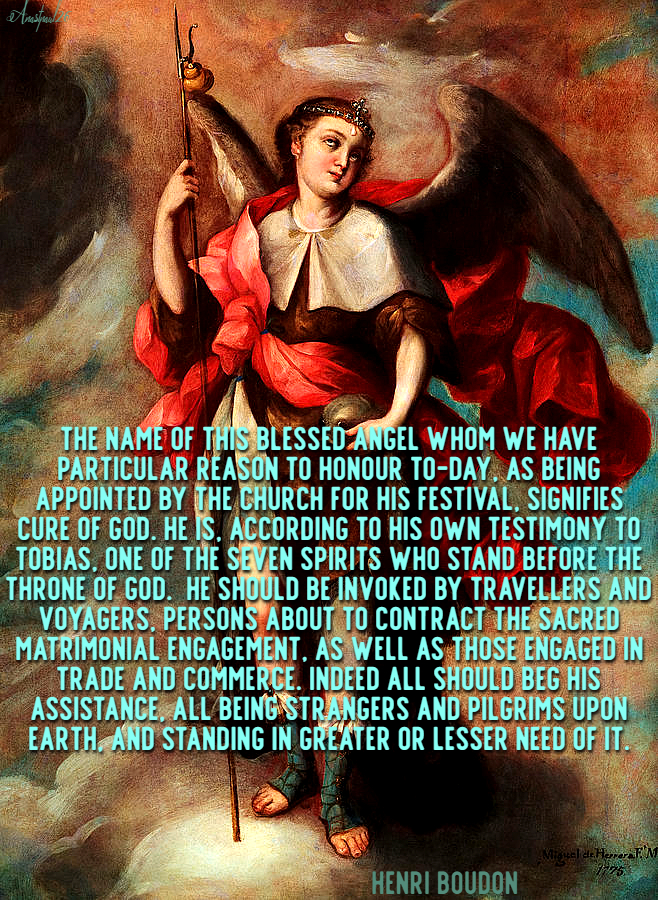
The name of this blessed Angel whom we have particular reason to honour to-day, as being appointed by the Church for his festival, signifies cure of God. He is, according to his own testimony to Tobias, one of the seven Spirits who stand before the Throne of God. From having so safely conducted that good man in his journey to Rages, and the many helps afforded by him during his stay in that city, he should be invoked by travellers and voyagers, persons about to contract the sacred matrimonial engagement, as well as those engaged in trade and commerce. Indeed all should beg his assistance, all being strangers and pilgrims upon earth, and standing in greater or lesser need of it.
Practice—Consult St. Raphael on all your affairs, and say the 90th Psalm. Asp.—O Angel of God, illumine, defend and preserve me this day, and for ever.
OCTOBER FIFTEENTH. Let us devote thin day to the veneration of the Angels who appeared at the Sepulchre of Jesus.
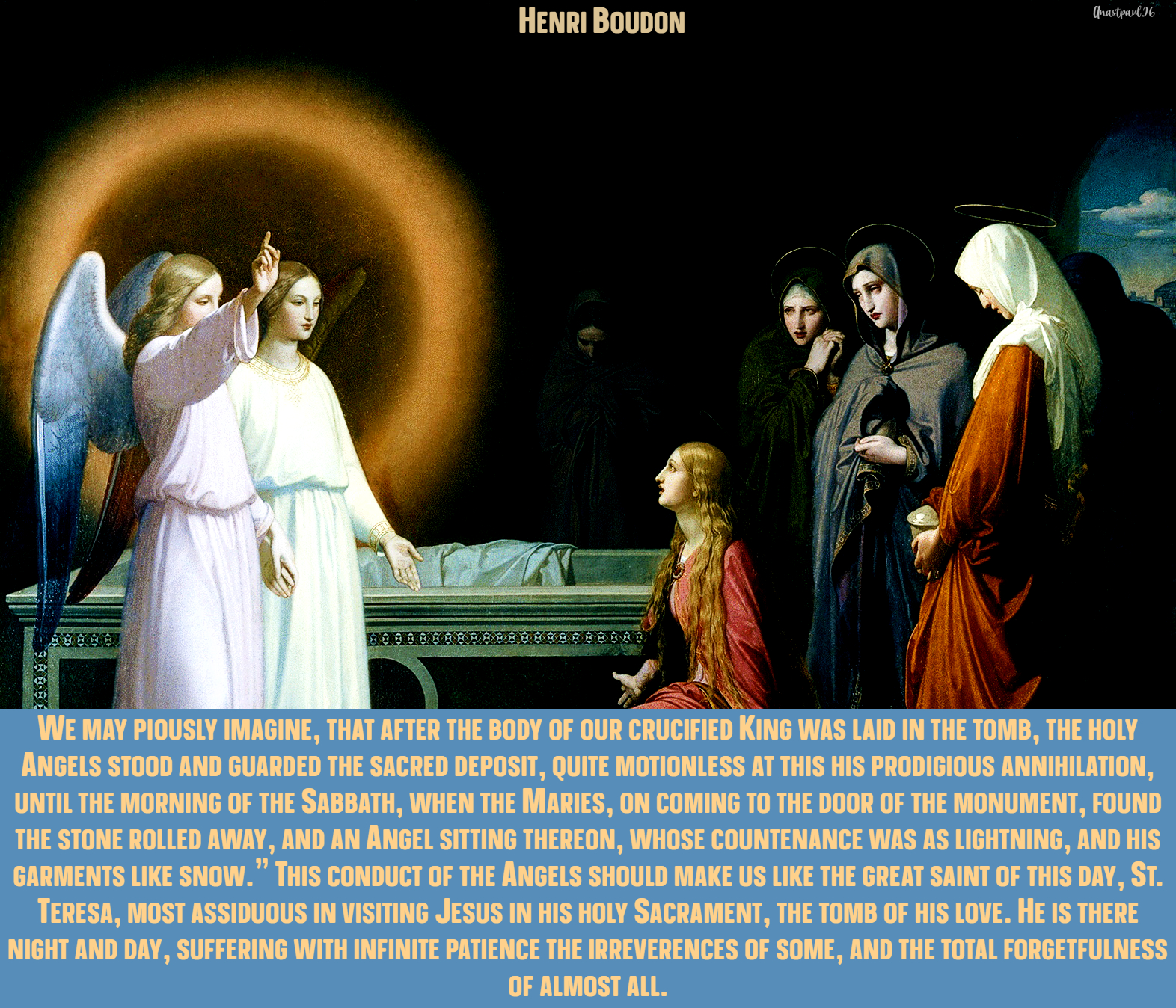
We may piously imagine, that after the body of our crucified King was laid in the tomb, the holy Angels stood and guarded the sacred deposit, quite motionless at this his prodigious annihilation, until the morning of the Sabbath, when the Maries, on coming to the door of the monument, found the stone rolled away, and an Angel sitting thereon, whose countenance was as lightning, and his garments like snow.” This conduct of the Angels should make us like the great saint of this day, St. Teresa, most assiduous in visiting Jesus in his holy Sacrament, the tomb of his love. He is there night and day, suffering with infinite patience the irreverences of some, and the total forgetfulness of almost all.
Practice—A visit to the Holy Sacrament, to beg a great devotion towards it, and the Angels. Asp.—Ah ! blessed Angels ! teach us to honour Jesus in the Sacrament of his love.
OCTOBER SIXTEENTH. Let us this day honour the Angels who appeared at the Ascension of Jesus Christ.
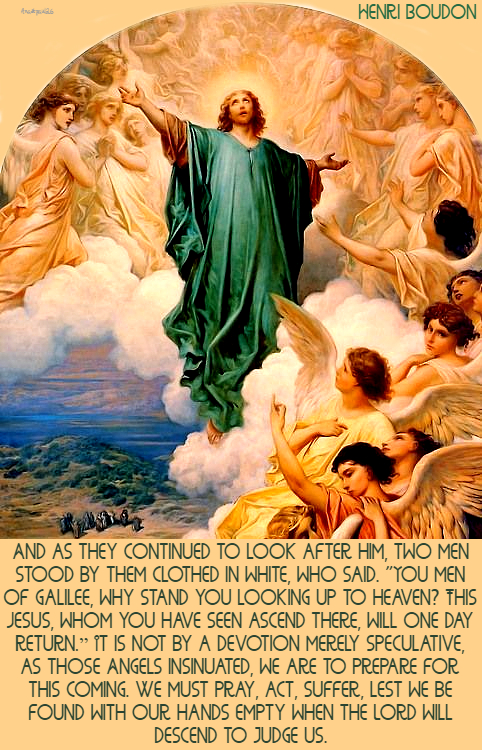
The time being come in which Jesus was to pass out of the world, and ascend to his Father, he led his disciples to Olivet, and having given them his last instructions, he was taken up into heaven, and a cloud took him out of their sight. And as they continued to look after him, two men stood by them clothed in white, who said. “You men of Galilee, why stand you looking up to heaven? This Jesus, whom you have seen ascend there, will one day return.” It is not by a devotion merely speculative, as those Angels insinuated, we are to prepare for this coming. We must pray, act, suffer, lest we be found with our hands empty when the Lord will descend to judge us.
Practice—Examine for five minutes if your devotion be in accordance with the Spirit of God—whether it show itself by the subjection of the passions, &c., or in mere external forms only. Asp.—O ! blessed Spirits ! render us adorers in spirit and truth.
Lecture—10th Motive
OCTOBER SEVENTEENTH. This day is dedicated to our good Angel.
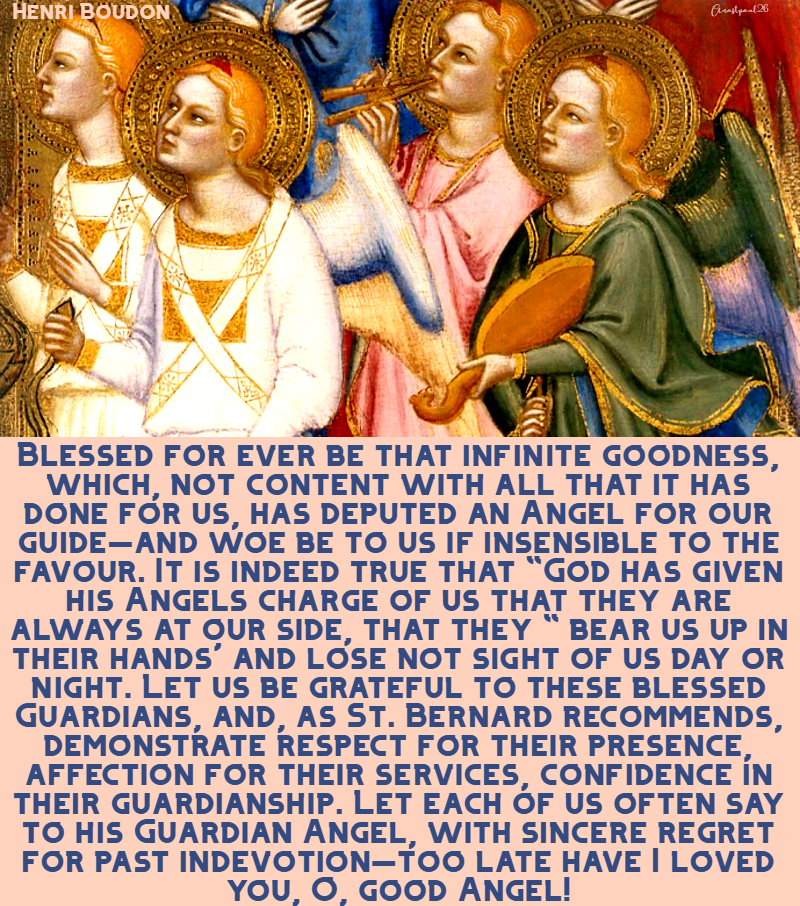
Blessed for ever be that infinite goodness, which, not content with all that it has done for us, has deputed an Angel for our guide—and woe be to us if insensible to the favour. It is indeed true that “God has given his Angels charge of us that they are always at our side, that they “ bear us up in their hands’ and lose not sight of us day or night. Let us be grateful to these blessed Guardians, and, as St. Bernard recommends, demonstrate respect for their presence, affection for their services, confidence in their guardianship. Let each of us often say to his Guardian Angel, with sincere regret for past indevotion—too late have I loved you, O, good Angel!
Practice—The Litany of the Angel Guardian. Asp.—O Blessed Angel! I love you, and I wish to love you more. Lecture—Half 5th Motive
OCTOBER EIGHTEENTH. The Angel of our Patron Saint.
Let us this day honour the Angel Guardian of our Patron, as this blessed Intelligence has done so much for his or her sanctification. It is gratifying to them that we may pay them our respects; they will not fail to acknowledge it.
Practice—Visit the Angel of your Patron, to thank him, and beg his intercession. Asp.—Holy Angel of my Patron; I venerate you. Lecture—Finish yesterday’s Motive in preceding work.
OCTOBER TWELFTH. The Angels of the Ancient People of God.
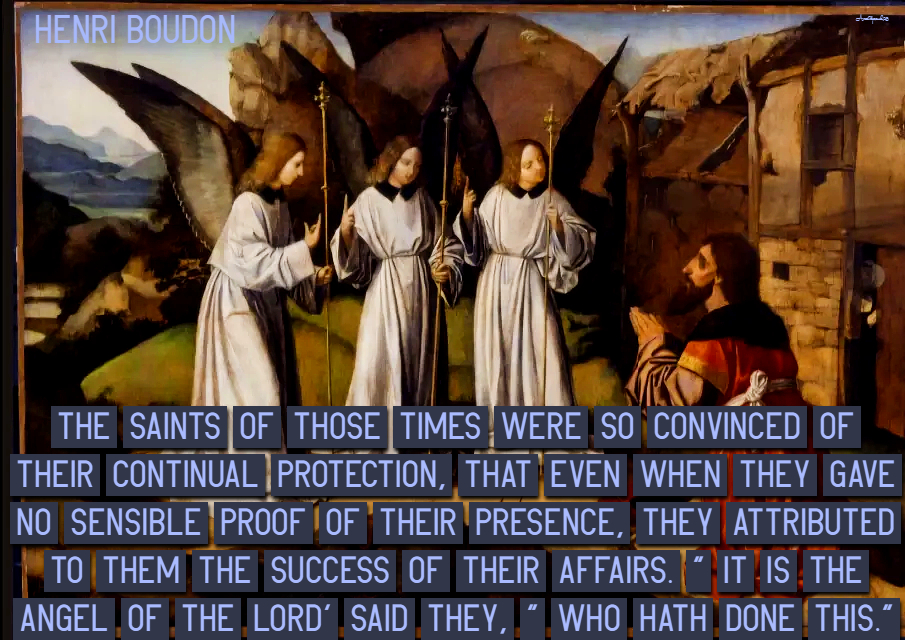
Let us this day venerate the Angels who guarded the ancient people of God. Abraham, Isaac, Jacob, Moses, were often favoured with their visits. It was one of these blessed Spirits who gave the law on Mount Sinai, and conducted the Israelites through the desert, in the pillar of a’cloud. The Saints of those times were so convinced of their continual protection, that even when they gave no sensible proof of their presence, they attributed to them the success of their affairs. “ It is the Angel of the Lord’ said they, “ who hath done this.”
Practice—The “ Benedicite,” in thanksgiving for this protection of the Angels. Asp.—Holy Angels ! “ leaders of the house of Israel,” intercede for us.
OCTOBER THIRTEENTH. The Angels who adored Jesus at the moment of his Incarnation and Nativity.
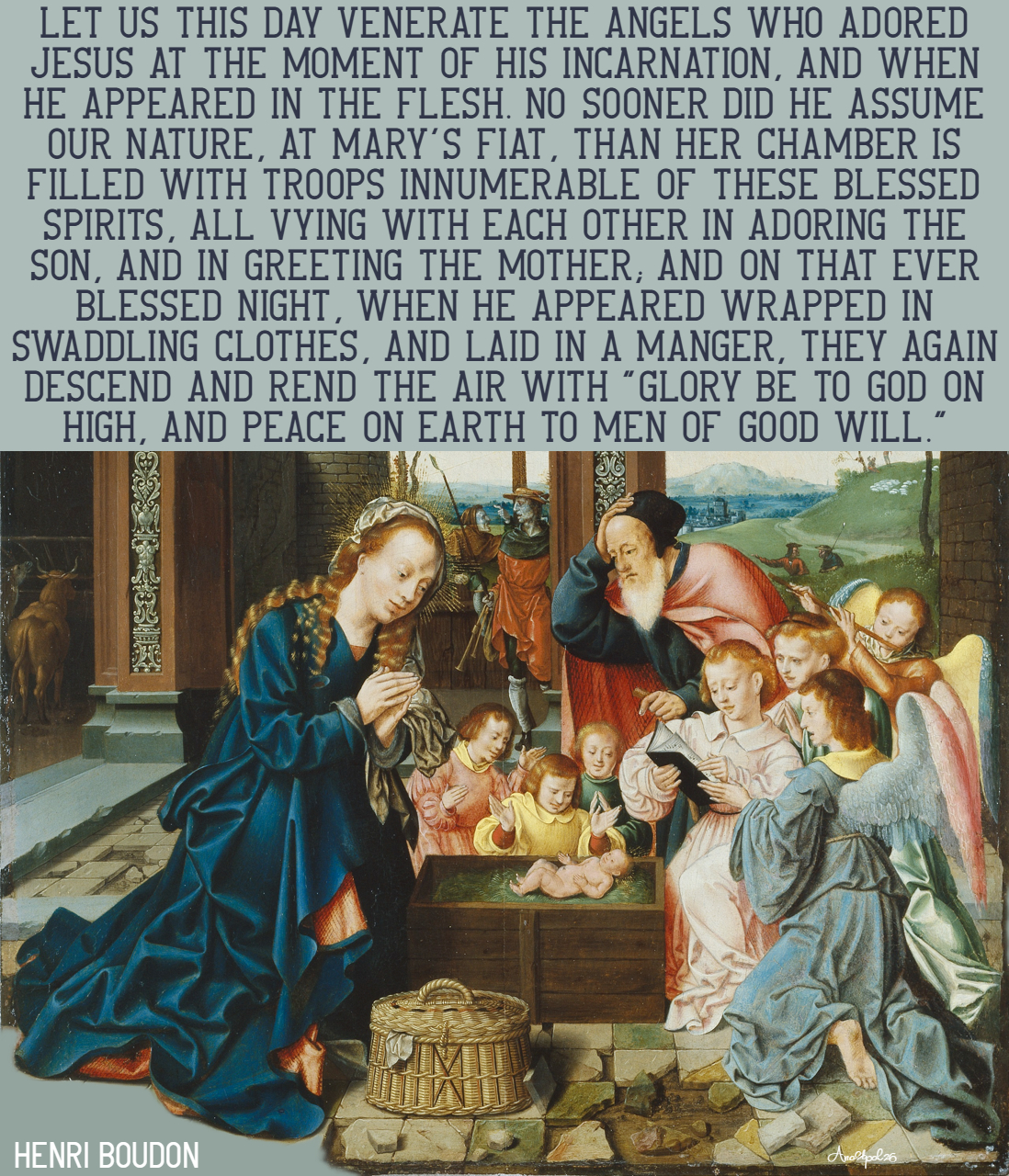
Let us this day venerate the Angels who adored Jesus at the moment of his Incarnation, and when he appeared in the flesh. No sooner did he assume our nature, at Mary’s Fiat, than her chamber is filled with troops innumerable of these blessed Spirits, all vying with each other in adoring the Son, and in greeting the Mother; and on that ever blessed night, when he appeared wrapped in swaddling clothes, and laid in a manger, they again descend and rend the air with “Glory be to God on high, and peace on earth to men of good will.”
Practice—In honour of these Angels the “ Gloria in excelsis,” and hymn “Alma Redemptoris.” Asp.—Glory be to God—honour to the Angels, and peace to men of good will!
OCTOBER FOURTEENTH. Let us this day venerate the Angels who ministered to Jesus Christ after his fast in the desert.
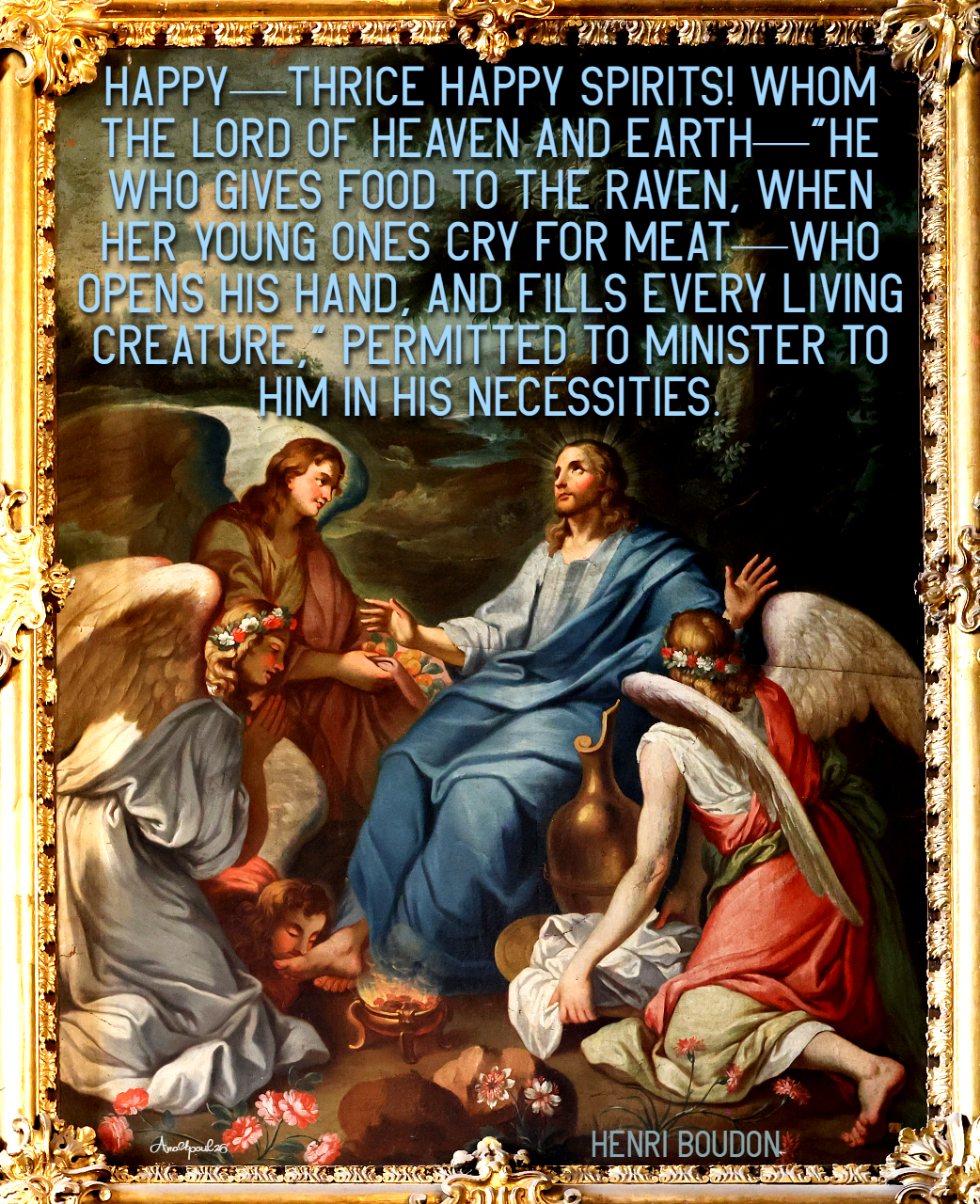
The time being come in which the Saviour of men was to manifest himself to Israel—having prepared for his mission by “a fast of forty days and forty nights, he was,” says the Evangelist, “ afterwards hungry, and Angels came and ministered to him.” Happy—thrice happy Spirits! whom the Lord of Heaven and Earth—“he who gives food to the raven, when her young ones cry for meat—who opens his hand, and fills every living creature,” permitted to minister to him in his necessities. It rests with us to be sharers in their happiness, for Jesus is still upon earth, in the persons of his poor—and what we do for them, he considers as done for himself.
Practice—Give some alms in the spirit of these Angels ministering to our Lord. Asp.—Holy Angels, ministering spirits to Jesus Christ, intercede for us.
Zeal for the divine glory distinguishes the Dominations. They are devoured. by their concern for the interests of God— their principal office is to manifest his will. We, too, ought to be interested for all that involves the honour of this ever adorable Being, as the conversion of sinners, the perfection of the just, the decoration of altars. We should also beg of God to manifest his will to us by these blessed Intelligences—and then take care to fulfil it scrupulously, as being the shortest way to perfection and sanctity.
Practice—Give practical proof of your zeal for the glory of God; do something for his reign in souls, as instructing the ignorant, &c. Asp.—Holy Dominations ! animate us with your zeal. Lecture—Half 7th Motive
OCTOBER NINTH. The Thrones—the Seventh Choir.
The Scripture says of the Lord, that He is seated on Thrones. Hence, then, blessed Spirits are called Angels of Peace—beings calm, tranquil, immovable. Address yourselves to them for that peace of soul which is the fruit of a good conscience. Invoke them for such as are prone to hatred, passion, and impatience; and, after their example, be you yourself meek, calm, peaceful with all.
Practice—In the morning, dispose yourself to great sweetness and patience—and every hour make an act thereof. Asp.—O Holy Thrones! obtain that that divine peace, which surpasses all understanding, may keep our hearts and minds in Christ Jesus, our Lord.” Lecture—Conclude 7th Motive in preceding work, commenced yesterday.
OCTOBER TENTH. The Cherubim—the Eighth Choir.
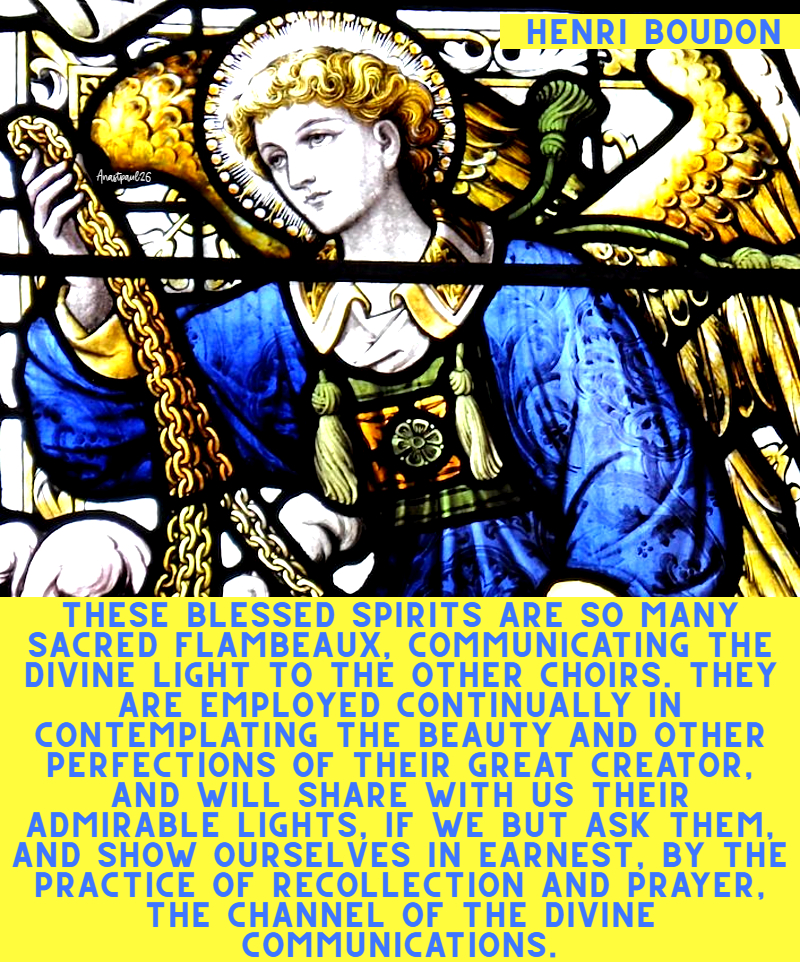
These blessed Spirits are so many sacred flambeaux, communicating the divine light to the other Choirs. They are employed continually in contemplating the beauty and other perfections of their great Creator, and will share with us their admirable lights, if we but ask them, and show ourselves in earnest, by the practice of recollection and prayer, the channel of the divine communications.
Practice—Spend this day in great silence and recollection; be occupied with the consideration of the Divine perfections endeavour to “ know God, and him whom he has sent, Jesus Christ.”
Asp.—Ah ! blessed Cherubim ! teach us to pray.
OCTOBER ELEVENTH. The Seraphim—the Ninth Choir.
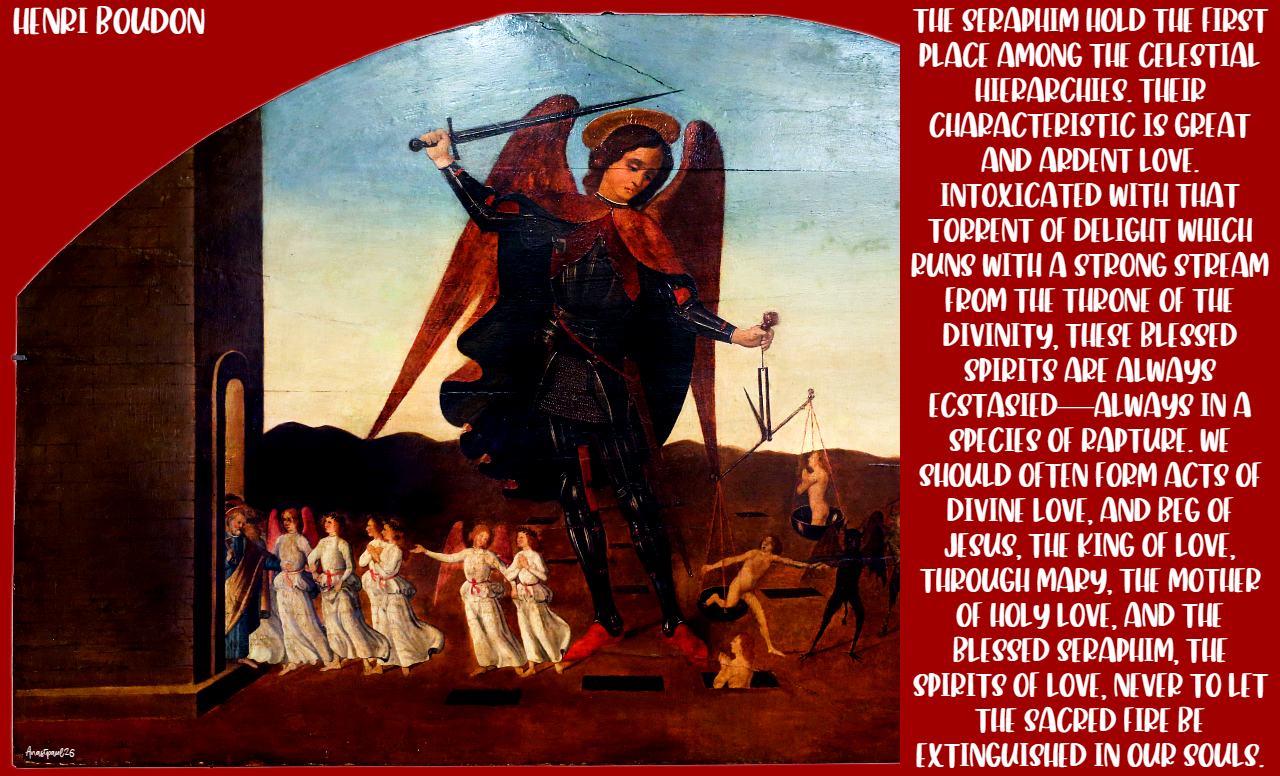
The Seraphim hold the first place among the Celestial Hierarchies. Their characteristic is great and ardent love. Intoxicated with that torrent of delight which runs with a strong stream from the throne of the Divinity, these blessed Spirits are always ecstasied—always in a species of rapture. We should often form acts of divine love, and beg of Jesus, the King of love, through Mary, the mother of holy love, and the blessed Seraphim, the Spirits of love, never to let the sacred fire be extinguished in our souls.
Practice—Try to become a Seraph in love; let this be your habitual disposition. “Love, and do what you will.” Ask this great gift fervently. Asp.—Ah ! blessed Seraphim! make us love.
The Principalities, who form the Third Choir, are charged to watch over empires, provinces, diocesses, religious communities, &c, and avert from them the effects of the divine wrath. They are also appointed to transmit to the Angels of the last two Choirs the orders of the Most High. Purity of intention is the virtue ascribed to them, for in their high functions they never seek but the honour and interest of God alone. Let us imitate them. It is the intention which stamps the action with merit or demerit.
Practice—In all you do and say, seek the greater glory of God. Refer all to this end. Asp.—O holy Spirits! may we, like you, seek God, for God alone. Lecture—12th Motive, 1st part of preceding work.
OCTOBER SIXTH. To the Powers—the Fourth Choir.
The Angels of this Choir have received from God unlimited sway over the wicked Spirits; they are endowed with great intelligence, so as to be able to discover their schemes and plans for our destruction. Their power is so amazing, that one only of them would be able to destroy all the infernal host. It is well to invoke them in temptation : but to merit their assistance, we must take care to avoid the occasions of sin.
Practice—Resist the attacks of vice and passion frequently make acts of diffidence in self and confidence in God; combat your evil inclinations. Asp.—Lord ! send thy Angels to assist us. Lecture—Half 8th Motive
OCTOBER SEVENTH. To the Virtues—the Fifth Choir.
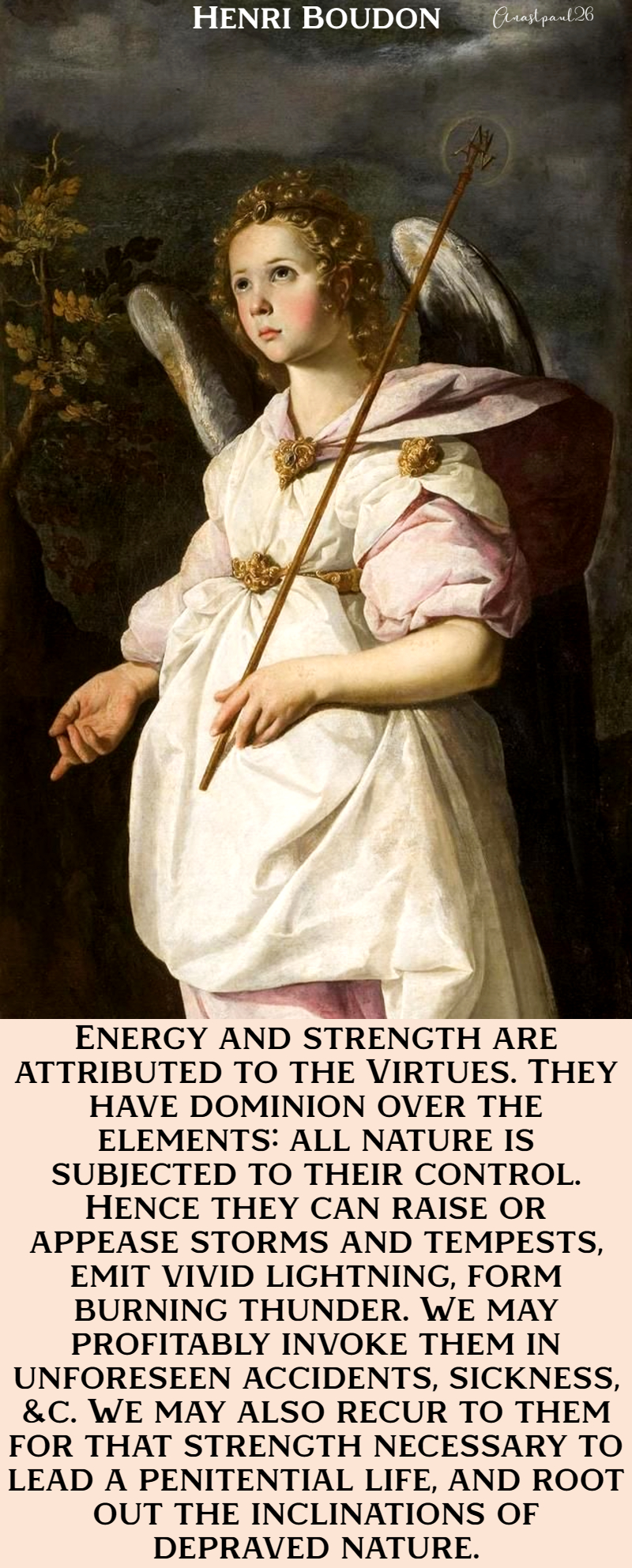
Energy and strength are attributed to the Virtues. They have dominion over the elements: all nature is subjected to their control. Hence they can raise or appease storms and tempests, emit vivid lightning, form burning thunder. We may profitably invoke them in unforeseen accidents, sickness, &c. We may also recur to them for that strength necessary to lead a penitential life, and root out the inclinations of depraved nature.
Practice—Visit the Holy Sacrament to obtain grace to overcome your evil inclinations, &c. Asp.—Holy Virtues ! strengthen and fortify us. Lecture—Finish the reading of 8th Motive, referred to yesterday.
The Angels as Servants and Subjects of the Blessed Virgin Mary
OCTOBER SECOND, OR ROSARY SUNDAY
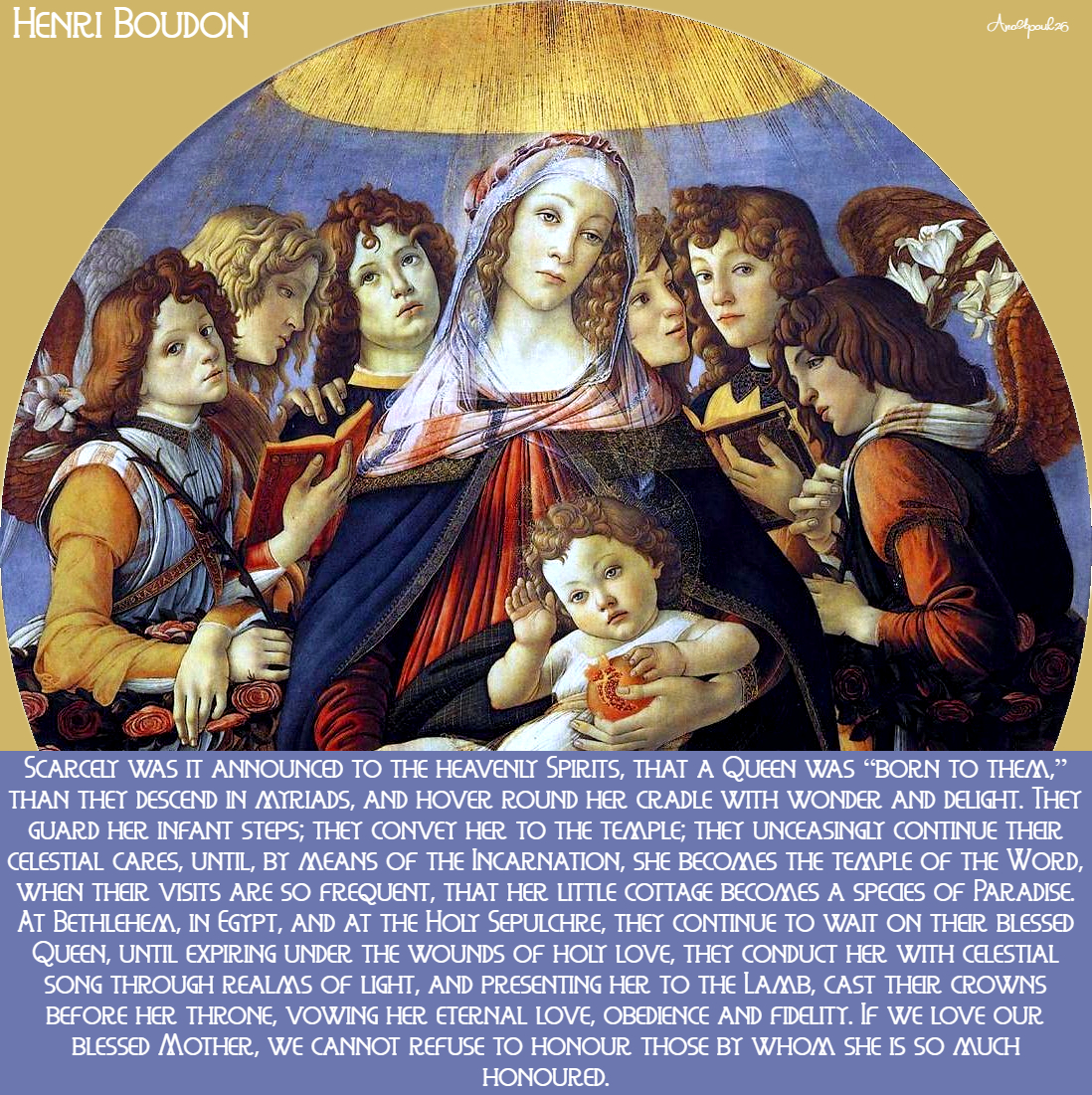
Scarcely was it announced to the heavenly Spirits, that a Queen was “born to them,” than they descend in myriads, and hover round her cradle with wonder and delight. They guard her infant steps; they convey her to the temple; they unceasingly continue their celestial cares, until, by means of the Incarnation, she becomes the temple of the Word, when their visits are so frequent, that her little cottage becomes a species of Paradise. At Bethlehem, in Egypt, and at the Holy Sepulchre, they continue to wait on their blessed Queen, until expiring under the wounds of holy love, they conduct her with celestial song through realms of light, and presenting her to the Lamb, cast their crowns before her throne, vowing her eternal love, obedience and fidelity. If we love our blessed Mother, we cannot refuse to honour those by whom she is so much honoured.
Practice.—In honour of the Blessed Virgin and the Angels, say three times the Hail Holy Queen Aspiration—O Mary ! Mistress of the Angels and Queen of the holy Rosary, intercede for us! Lecture—11th Motive, 1st part of the preceding work.
OCTOBER THIRD. Sacred to the Angels of the First Choir.
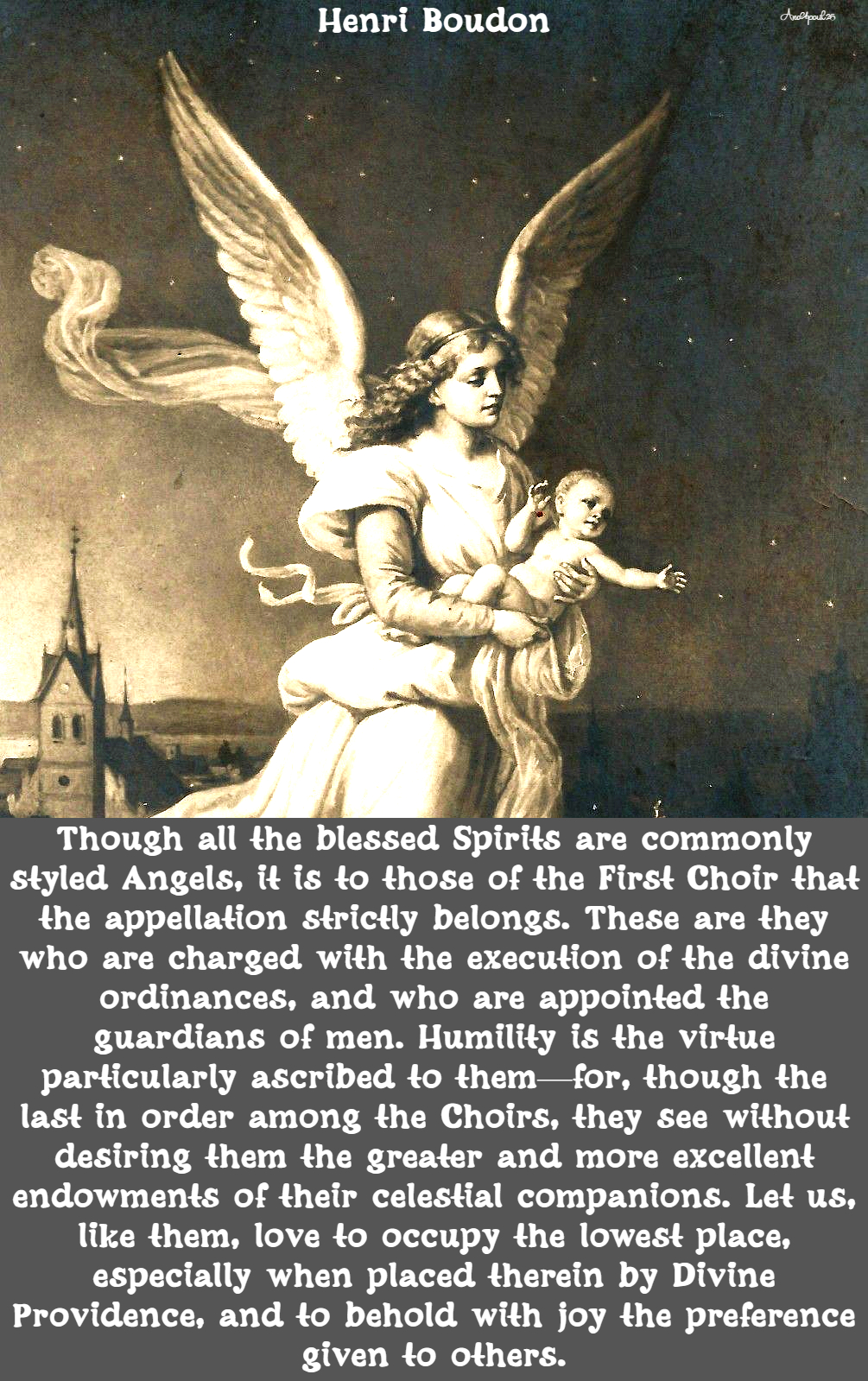
Though all the blessed Spirits are commonly styled Angels, it is to those of the First Choir that the appellation strictly belongs. These are they who are charged with the execution of the divine ordinances, and who are appointed the guardians of men. Humility is the virtue particularly ascribed to them—for, though the last in order among the Choirs, they see without desiring them the greater and more excellent endowments of their celestial companions. Let us, like them, love to occupy the lowest place, especially when placed therein by Divine Providence, and to behold with joy the preference given to others.
Practice—Three Acts of Humility, interior, or exterior. Asp.—“ Who is like God?’ Lecture—1th Motive, 1st part of the preceding work.
OCTOBER FOURTH. To the Archangels—Second Choir.
The Archangels are distinguished from the Angels by the greater importance of their functions. They are supposed to be the guardians of the Pope, of the Bishops, and of all invested with authority, in Church and State—and are remarkable for love and care of men. Let us imitate them, doing our neighbour all the good we can, and invoking in his behalf these blessed Spirits.
Practice—Two Acts of Charity, with great affection. Asp.—Holy Archangels ! pray for us. Lecture—2d Motive, 1st part of preceding work.
THE MONTH OF OCTOBER, DEDICATED TO THE HOLY ANGELS, BY A SERIES OP PIOUS PRACTICES
Some persons, devout to the holy Angels, wished to dedicate to these holy Spirits a whole month—that of October. They, during that period, perform the following practices. It commences the evening of St. Michael’s Day, by the following offering:— O all ye holy Angels ! who contemplate without ceasing the uncreated beauty of the Divinity, in company with your ever glorious Queen—I, your unworthy servant, present and offer to you all the practices of this month of October, consecrated to your glory, not only as a means of obtaining (here specify your request,) but also as a reparation for my past ingratitude, and that of all men. Deign to accept it, O amiable Spirits! in union with the love and devotion of such Saints as were specially devout to you—and obtain for me to spend this time so fervently, that it may be the commencement of that angelical life which I hope to live for ever with you in Heaven. Amen.
A Memorare to the Angels
Remember, O holy Angels! that Jesus, the eternal Truth, assures us that you “rejoice more at the conversion of one sinner, than at the perseverance of many just.” Encouraged thereby, I, the last of creatures, humbly entreat you to receive me as your servant, and make me unto you a cause of true joy. Do not, O blessed Spirits! reject my petition; but graciously hear and grant it. Amen.
OCTOBER FIRST The Creation of the Angels
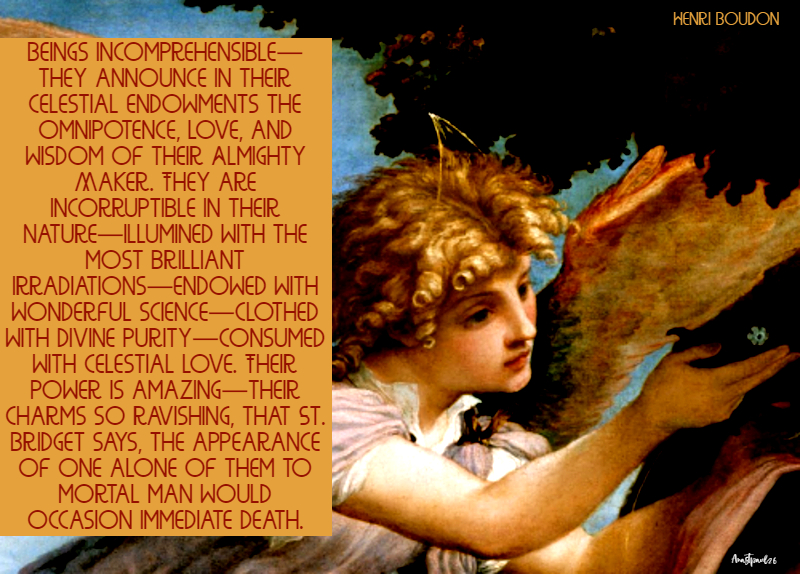
Anticipate all time—penetrate the eternal years—and contemplate in wonder and amazement that eventful moment in which the Deity, coming forth from that inaccessible light in which he dwelt, gave command to nothing, and created the Angels. Admirable Spirits ! their perfections are like a profound sea, which cannot be fathomed. Beings incomprehensible— they announce in their celestial endowments the omnipotence, love, and wisdom of their Almighty Maker. They are incorruptible in their nature—illumined with the most brilliant irradiations—endowed with wonderful science—clothed with divine purity—consumed with celestial love. Their power is amazing—their charms so ravishing, that St. Bridget says, the appearance of one alone of them to mortal man would occasion immediate death. Their sanctity exceeds that of all the Saints, since they have been replenished with the divine unction, and have never contracted actual stain. Their charity is exceeding great, since they have received more of that sacred fire, which, according to St. John, is the essence of the Godhead, than all other creatures. This is saying much; and yet it conveys but a faint idea of the perfection of these celestial Spirits.
Let us, while we confess their greatness, bless the hand of Him who made them, and commence this holy month as they began their angelic course, saying—Holy, Holy, Holy, Lord God of Sabbaoth ! the Heaens and the Earth are full of thy glory! Glory be to the Father !—Glory be to the Son !—Glory be to the Holy Ghost!
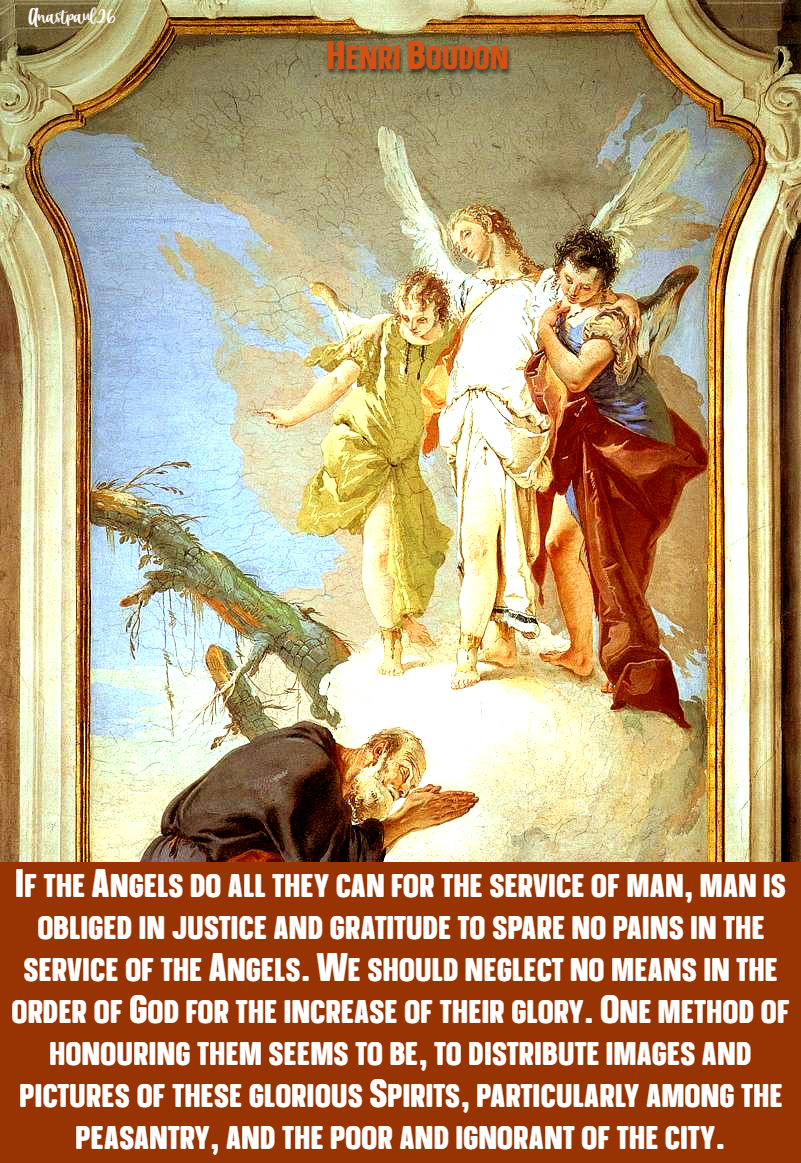
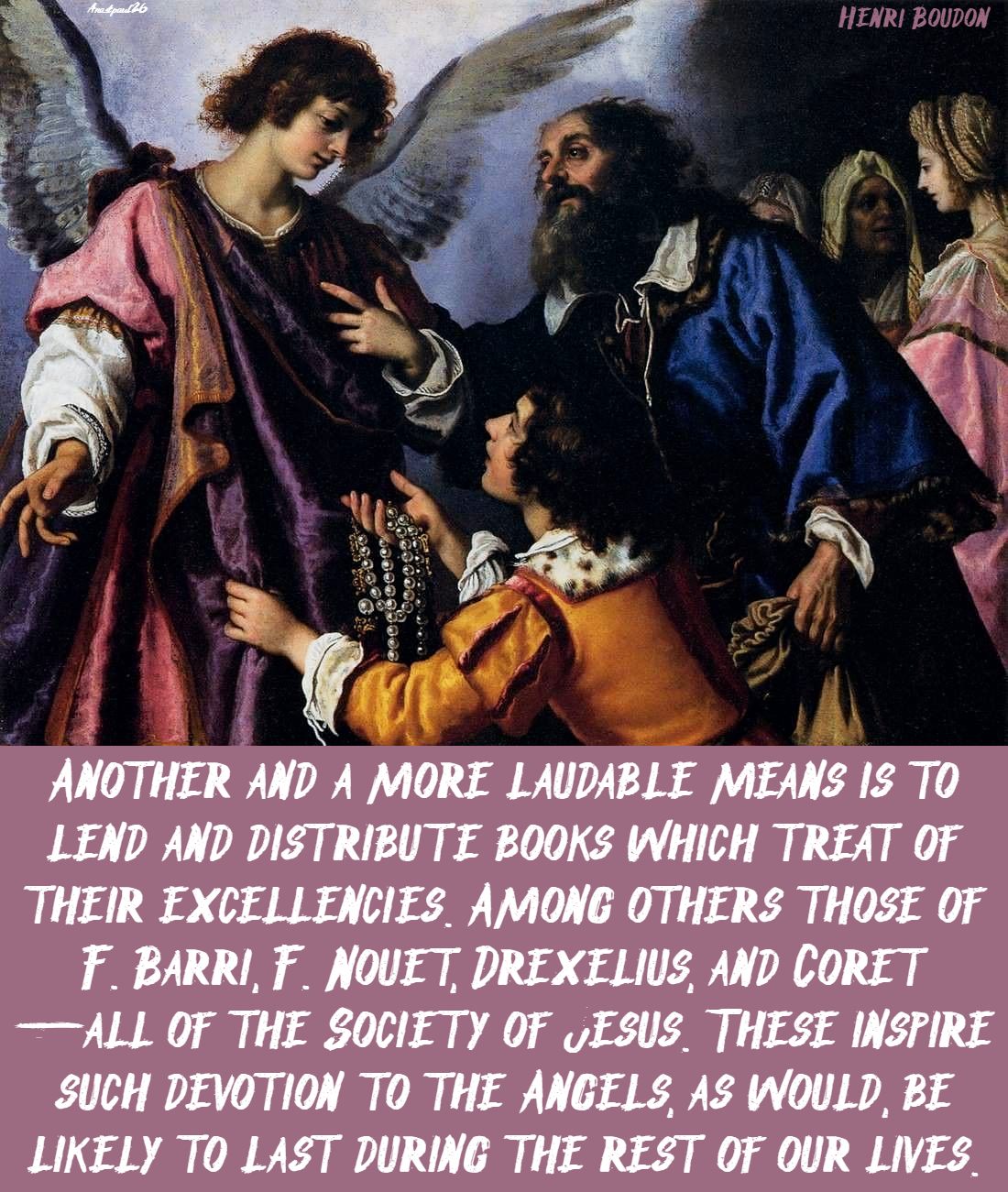
If the Angels do all they can for the service of man, man is obliged in justice and gratitude to spare no pains in the service of the Angels. We should neglect no means in the order of God for the increase of their glory. One method of honouring them seems to be, to distribute images and pictures of these glorious Spirits, particularly among the peasantry, and the poor and ignorant of the city. It would be well to recommend our friends to set up such pictures in their chambers or oratories—as also to make presents of them to some Chapel or Altar. Constantine the Great caused four images of the Angels to be wrought, and in the most exquisite manner. Another and a more laudable means is to lend and distribute books which treat of their excellencies. Among others those of F. Barri, F. Nouet, Drexelius, and Coret —all of the Society of Jesus. These inspire such devotion to the Angels, as would, be likely to last during the rest of our lives.
Preachers could greatly serve this devotion, by instructing their auditors in it from time to time—Seculars, by explaining it to their friends—a Master, in his house—a Father or Mother to their Children—a person in the country, to the peasants—a teacher, to his pupils—a friend, to his friend. But the best way to honour the Angels is to procure the establishment of some little sodality in their honour.
To labour for the Conversion of Sinners and the release of Souls from Purgatory—and to practise Virtue in honour of the Angels.
What can we do more agreeable to the Angels than to labour with them for the glory of our common Master? It is his glory which causes this almost infinite number of blessed Spirits to watch so indefatigably over us poor sinners ; and what wonder, when even the shadow of the interests of this divine being should be upheld at the risk of the annihilation of all creatures. O my God ! why are you not known by us ! This world is indeed a land of forgetfulness in your regard. A God-man having sacrificed his life, in the midst of an infinity of sufferings, for your divine interest, we should either renounce Christianity, or endeavour to advance it by every possible means. Here it is we should pour out floods of tears over the insensibility and blindness of men.
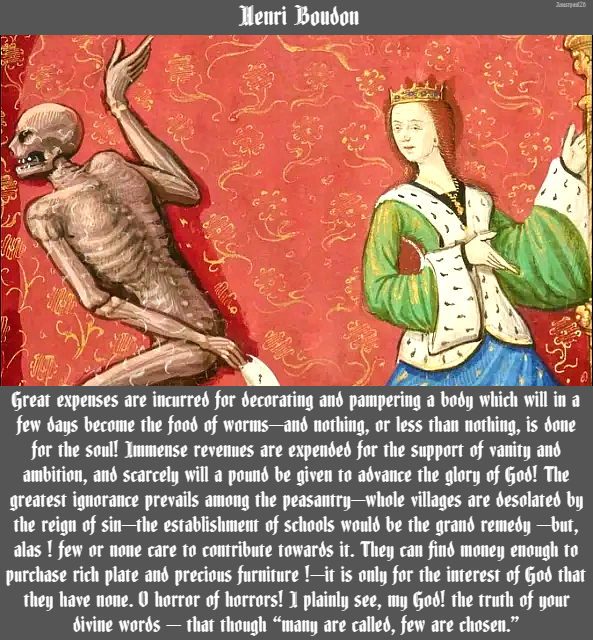
Great expenses are incurred for decorating and pampering a body which will in a few days become the food of worms—and nothing, or less than nothing, is done for the soul! Immense revenues are expended for the support of vanity and ambition, and scarcely will a pound be given to advance the glory of God! The greatest ignorance prevails among the peasantry—whole villages are desolated by the reign of sin—the establishment of schools would be the grand remedy —but, alas ! few or none care to contribute towards it. They can find money enough to purchase rich plate and precious furniture !—it is only for the interest of God that they have none. O horror of horrors! I plainly see, my God! the truth of your divine words — that though “many are called, few are chosen.”
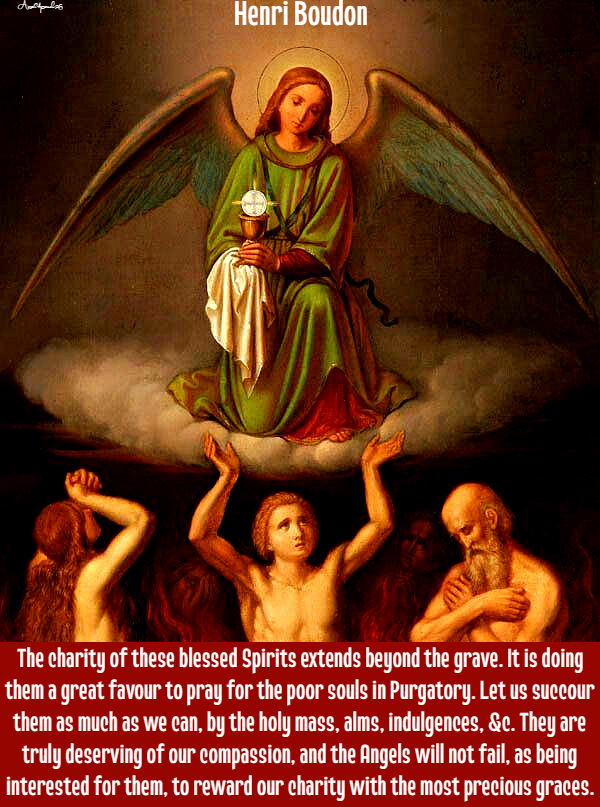
The example of the blessed Spirits should animate us to do and suffer all, in order to save our souls : it should also encourage us to labour for the salvation of others. Let us act in concert with these blessed Spirits for this end. The holy Angels faithfully continue their labours, and care for us during 40, or 60, or 80 years, or whatever be the term of our lives, though they are sure the object of them will reap no fruit or advantage, through his own malice. Hence, confessors, preachers, and all who labour in any shape for the extension of the reign of God, should be singularly devout to these holy Spirits. The charity of these blessed Spirits extends beyond the grave. It is doing them a great favour to pray for the poor souls in Purgatory. Let us succour them as much as we can, by the holy mass, alms, indulgences, &c. They are truly deserving of our compassion, and the Angels will not fail, as being interested for them, to reward our charity with the most precious graces.
The practice of chastity is absolutely necessary to gain the friendship of the Angels. Virginity is their favourite virtue, as it has been of Jesus, Mary, Joseph, and the two St. Johns. O Virgins! whoever you may be, remember you possess a treasure of inestimable price—one which assimilates you to the Angels. But, as in proportion to its excellence, you should have a more lively apprehension of its loss, so adopt more earnestly the necessary means in order to its preservation. These are mortification, guard of the senses, flight of the world, and true and sincere humility. This virtue of humility is one which the Angels require in those devoted to them; they cannot bear the proud. The practice of recollection and prayer is also most pleasing to them; they have been visibly seen assisting persons in this holy exercise. St. Bernard saw them noting the manner in which his religious made their prayer. But if we would be truly devout to the Angels, we should once for all take the resolution of avoiding deliberate faults and imperfections, of searching out and overcoming our predominant passion, the source of our most frequent irregularities.
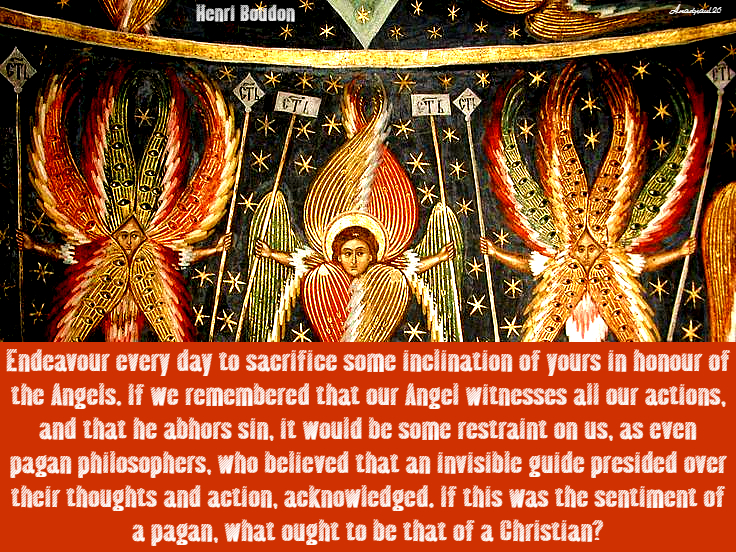
Endeavour every day to sacrifice some inclination of yours in honour of the Angels. If we remembered that our Angel witnesses all our actions, and that he abhors sin, it would be some restraint on us, as even pagan philosophers, who believed that an invisible guide presided over their thoughts and action, acknowledged. If this was the sentiment of a pagan, what ought to be that of a Christian?
To have a great Confidence in the Angels, and recur to them in all necessities.
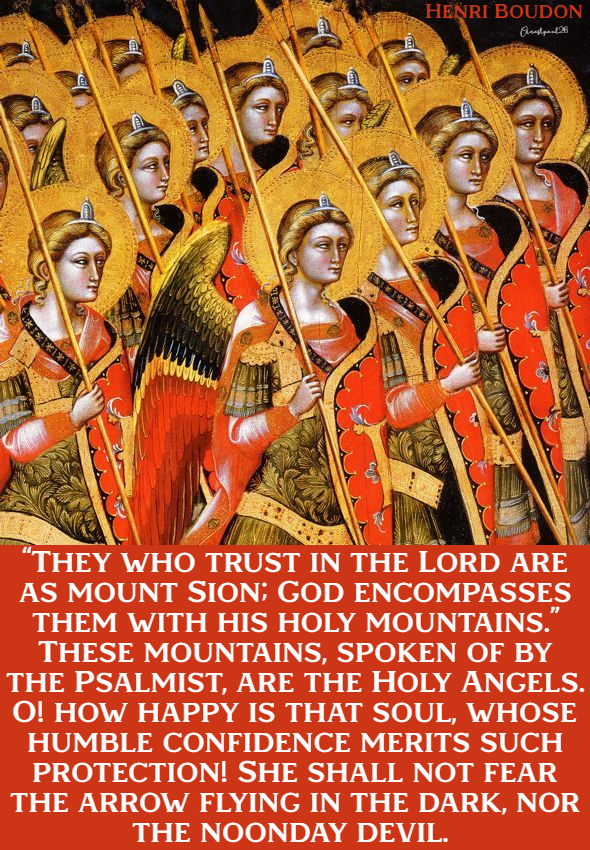
“They who trust in the Lord are as mount Sion; God encompasses them with his holy mountains.” These mountains, spoken of by the Psalmist, are the Holy Angels. O! how happy is that soul, whose humble confidence merits such protection! She shall not fear the arrow flying in the dark, nor the noonday devil.
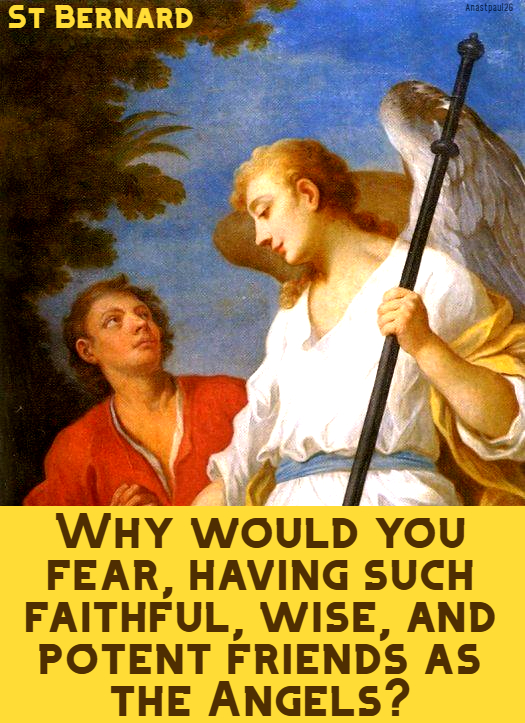
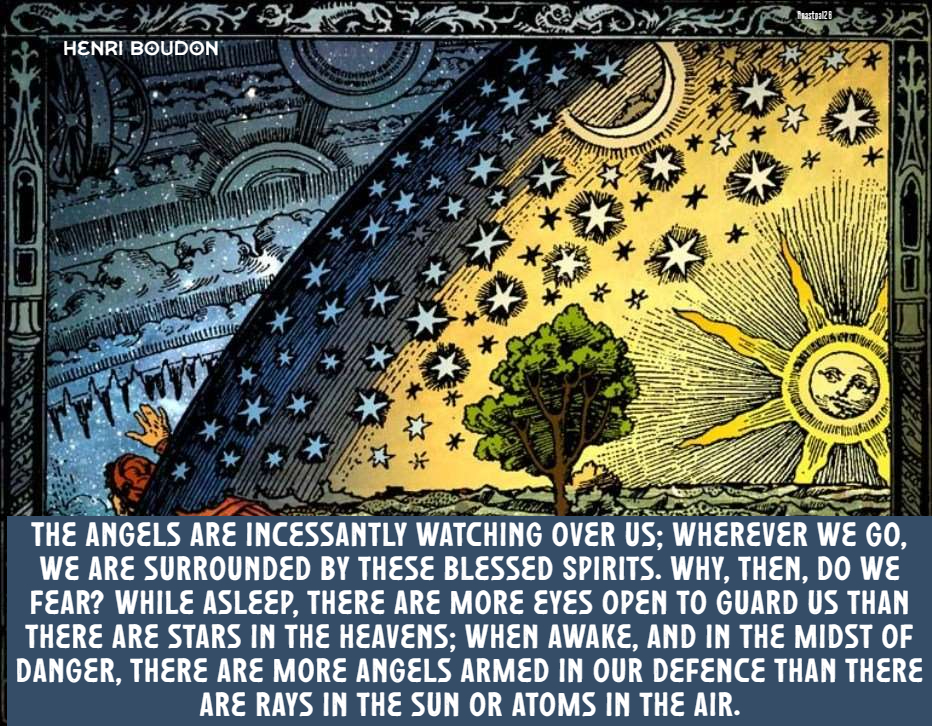
After all we have said, it would seem that you should not want a great confidence in the Angels. “Why would you fear,” says St. Bernard, “having such faithful, wise, and potent friends as the Angels?” “May joy be always with you,” said Raphael to Tobias; “I shall conduct you thither, and reconduct you hither.” The Angels are incessantly watching over us; wherever we go, we are surrounded by these blessed Spirits. Why, then, do we fear? While asleep, there are more eyes open to guard us than there are stars in the heavens; when awake, and in the midst of danger, there are more angels armed in our defence than there are rays in the sun or atoms in the air.
But, unhappy creatures !—nothing moves us but what strikes our senses. Here I must confess my utter astonishment at the little confidence of men in the protection of Heaven. O ! the avariciousness of the human heart! said our Lord once to St. Teresa. It seems to it that the whole world cannot supply its wants; it feels nothing but inquietude, both for temporal and spiritual things. Although there were no Providence, we could not place more reliance on human means. What a pity to see even spiritual persons counting so much on their own industry, and so much occupied with what concerns them. Let us place all our hope in the Lord, and all our confidence in his Providence. Let us beg of him to open our eyes to the protection of the Angels, as he did those of the servant of Elias.
Then seeing that “there is more for us than against us’ we cannot help confiding in such powerful patronage, nor fail to lift our hands, in our spiritual and corporeal dangers, to those holy mountains which the Lord has set for our defence, and appointed for our protection, through a marvellous excess of incomprehensible love.
To make Novenas in honour of the holy Angels—to take certain days to honour them—and to celebrate their Feasts with particular devotion.
The Catholic Church teaches, that we should not superstitiously attach ourselves to certain numbers; but there are some mysterious ones, consecrated by the piety of the faithful, which she sanctions and authorizes as that of three, which is the number of the holy Trinity; that of forty, which is the number of days our Lord spent in the wilderness; that of nine, which corresponds with the number of the angelic Choirs.
Any devotion practised for nine days is termed a Novena. St. Teresa was very partial to this practice, as she herself tells us. It is most useful to perform such a one in honour of the Angels; we ourselves have seen miraculous things effected by it.
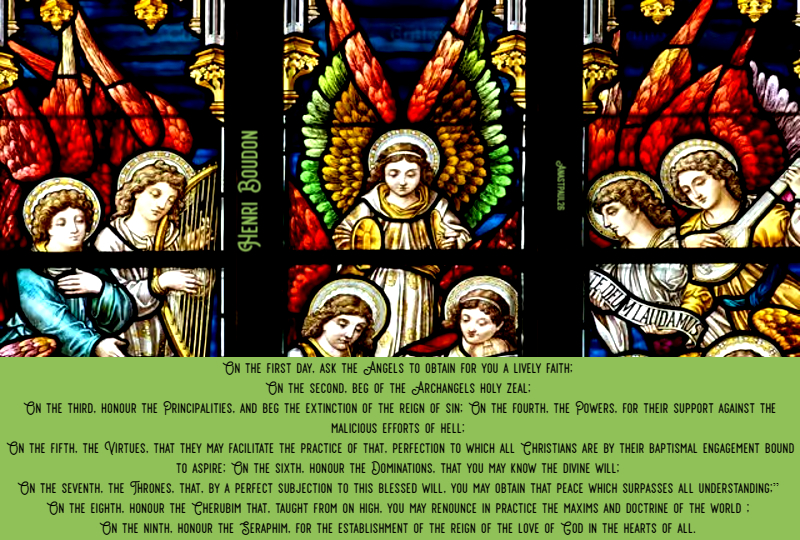
It may be as follows : the first day, honour the Angels of the last Choir by some prayer— nine Gloria Patris, for example—and ask them for the grace or favour you want; and thus ascend to all the choirs successively. If your object be the graces peculiar to each Choir, you can on the first day, ask the Angels to obtain for you a lively faith; on the second, beg of the Archangels holy zeal; on the third, honour the Principalities, and beg the extinction of the reign of sin; on the fourth, the Powers, for their support against the malicious efforts of hell; on the fifth, the Virtues, that they may facilitate the practice of that, perfection to which all Christians are by their baptismal engagement bound to aspire; on the sixth, honour the Dominations, that you may know the divine will; on the seventh, the Thrones, that, by a perfect subjection to this blessed will, you may obtain that peace which surpasses all understanding;” on the eighth, honour the Cherubim that, taught from on high, you may renounce in practice the maxims and doctrine of the world ; and, finally, on the ninth, honour the Seraphim, for the establishment of the reign of the love of God in the hearts of all.
This devotion of Novenas is also a useful preparation for the feasts of our Lord and his blessed Mother, as well as of the Angels. It may consist of any pious practice, as of nine acts of mortification, nine genuflections, nine visits to the Holy Sacrament, or nine Ave Marias, a devotion which our Lord revealed to St. Mechtilde. It is well to commence by receiving the Holy Sacraments, that our souls being cleansed from sin, God may be more ready to hear and grant our requests. Thus much for the devotion of the Novena.
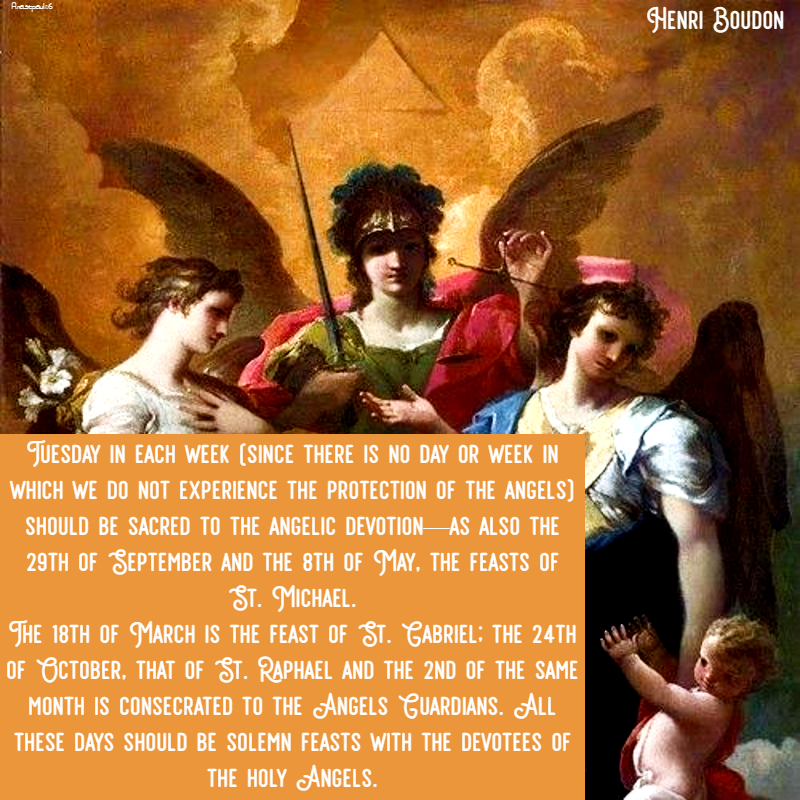
Tuesday in each week (since there is no day or week in which we do not experience the protection of the angels) should be sacred to the angelic devotion—as also the 29th of September and the 8th of May, the feasts of St. Michael. In Normandy, they devote the 16th of October to honour the apparition of this glorious Archangel on the Mount of Tornbe, commonly called Mount St. Michael. The church built there in his honour is frequented by crowds of pilgrims on this day, and numberless miracles are operated by his intercession.
The 18th of March is the feast of St. Gabriel; the 24th of October, that of St. Raphael and the 2nd of the same month is consecrated to the Angels Guardians. All these days should be solemn feasts with the devotees of the holy Angels. They would do well to prepare for them by some act of mortification, (St. Francis fasted forty days to prepare for the feast of St. Michael,) or by the Novena, and to celebrate the feast itself by approaching the Sacraments, reciting the Office of and Litany and Beads of these blessed Spirits, each one according to his time and devotion.
Behold another way of honouring the Angels : when about to celebrate the festival of a Saint, form the intention of honouring his or her guardian; thus you will keep a perpetual holiday in honour of the Angels. Love to visit churches and altars dedicated to them; you will thereby obtain, through their intercession, the most precious gifts and graces.
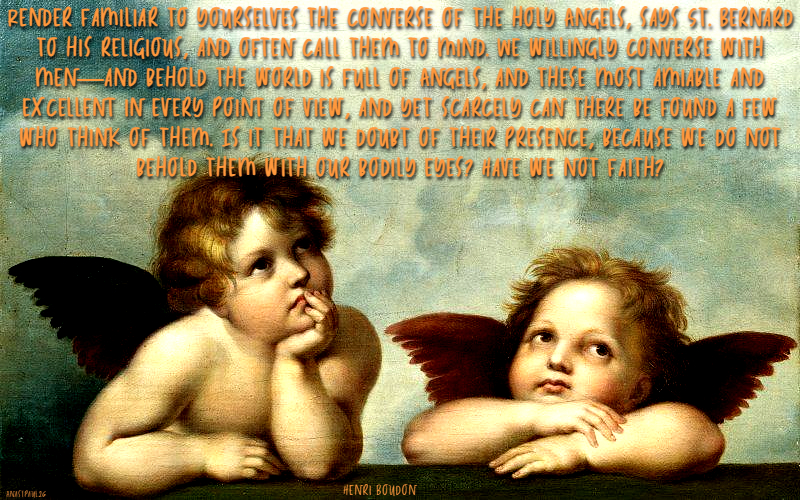
Render familiar to yourselves the converse of the holy Angels, says St. Bernard to his religious, and often call them to mind. We willingly converse with men—and behold the world is full of Angels, and these most amiable and excellent in every point of view, and yet scarcely can there be found a few who think of them. Is it that we doubt of their presence, because we do not behold them with our bodily eyes? Have we not faith?
When you walk through town, salute interiorly the Angels of those whom you meet. When you go to the country, pay homage to the blessed Spirits who are there even more neglected, because of the ignorance of the poor peasantry. When you enter into a church, or a public assembly, let holy faith manifest to you the presence of the Angels. When you make a journey, entertain yourself with the Angels of those who travel with you. When among your friends, say from time to time a little word to their Angels—and when alone with yourself, speak to and entertain these blessed Spirits.
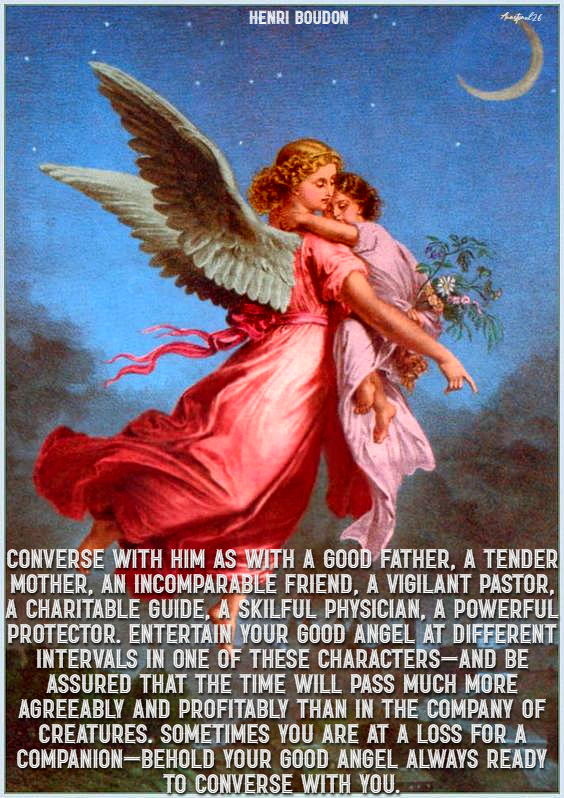
If we exhort you to be familiar with and devout to all the Angels, we are still more pressing in inviting you to honour that holy Spirit to whose care God committed you at the moment of your birth. He thinks continually of you; never lose sight of him. A little prayer, said morning and night, is too slight a testimony of your gratitude towards him. Take then, a quarter or half an hour sometimes to pay this good Angel your homage. Prostrate yourself before him; crave pardon for your past ingratitude; ask his blessing : tell him all you would wish to say to a most faithful friend.: Now speak to him of your weaknesses, miseries, temptations—and then of the obligations you have to him, of his beauty, his perfections, his admirable qualifications. Converse with him as with a good father, a tender mother, an incomparable friend, a vigilant pastor, a charitable guide, a skilful physician, a powerful protector. Entertain your good Angel at different intervals in one of these characters—and be assured that the time will pass much more agreeably and profitably than in the company of creatures. Sometimes you are at a loss for a companion—behold your good Angel always ready to converse with you.
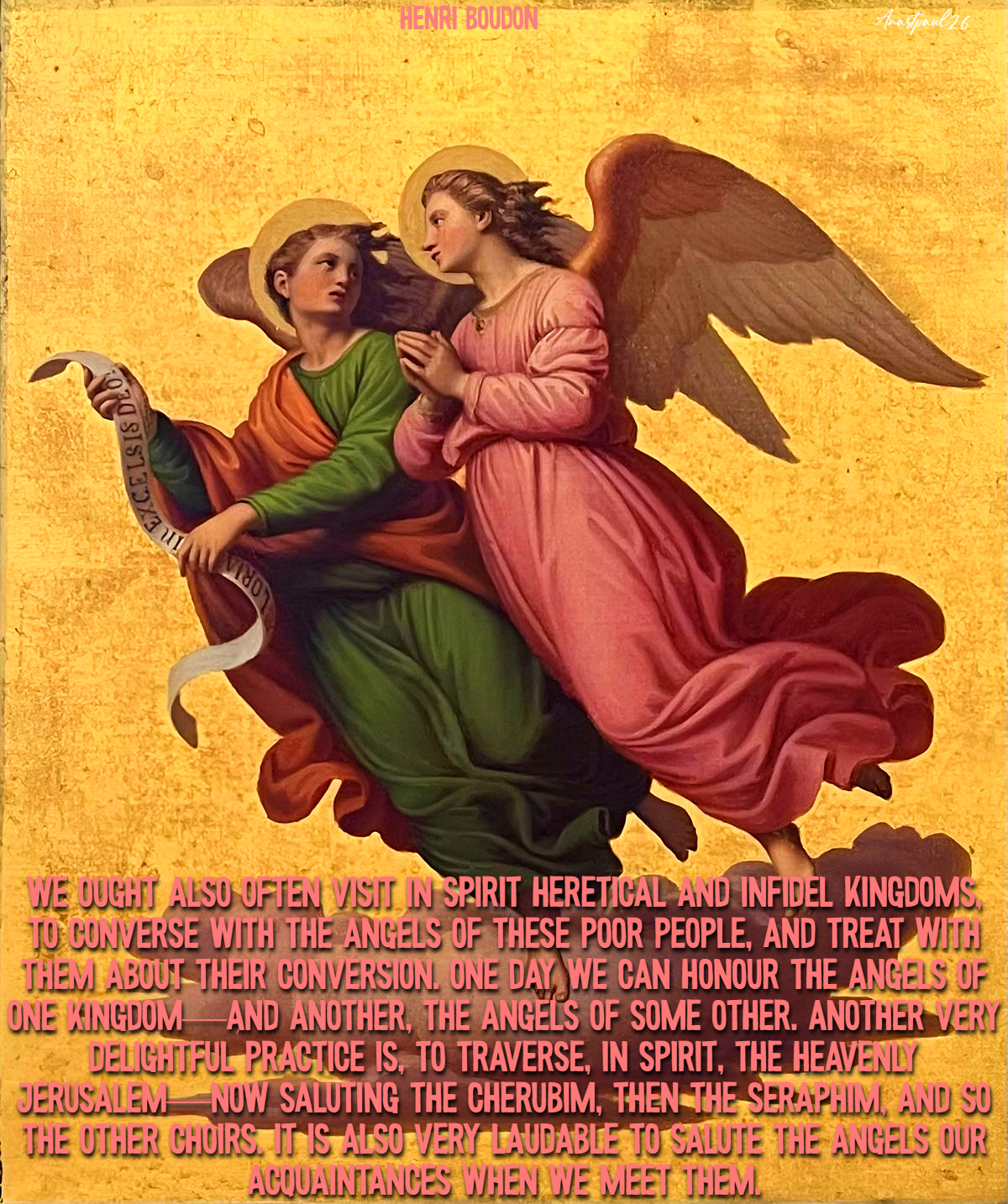
We ought also often visit in spirit heretical and infidel kingdoms, to converse with the Angels of these poor people, and treat with them about their conversion. One day we can honour the Angels of one kingdom—and another, the Angels of some other. Another very delightful practice is, to traverse, in spirit, the Heavenly Jerusalem—now saluting the Cherubim, then the Seraphim, and so the other Choirs. It is also very laudable to salute the Angels our acquaintances when we meet them. This is easier than some may imagine; it is only necessary to make a little compact with yourself, which you will renew at least every month, that, as often as you salute any person, you will also salute his Angel Guardian. On these occasions, when you remember it, say interiorly to these holy Angels, that you salute them.
By this means, the recollection of these blessed Spirits will be gradually facilitated. Some, when writing to friends, salute their Angel Guardians. I know it will be said, that these practices are rare. I admit that they are so—but maintain that they ought to be general. It is an extraordinary thing to see a real Saint: but as this deplorable truth should not hinder us from aspiring to sanctity—so, that want of devotion to the Angels, which is so general, cannot warrant us to refuse them our love and veneration.
To entertain a profound respect and extraordinary love for the Thrones, the Cherubim and Seraphim.
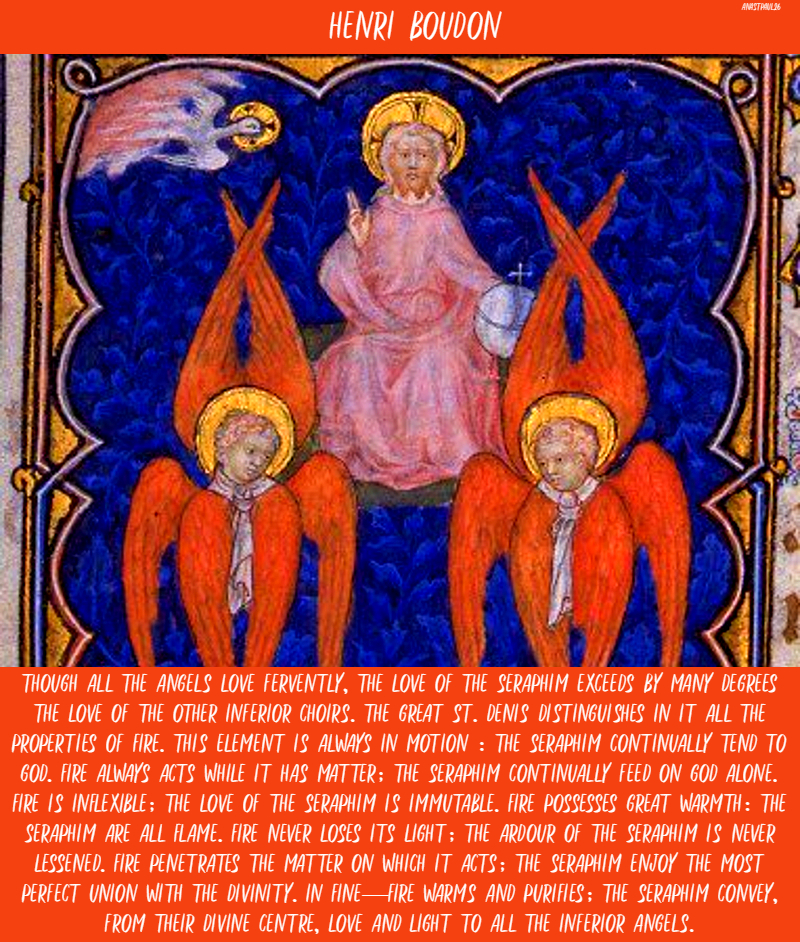
The first Hierarchy of the Angels is composed of the Thrones, the Cherubim and Seraphim. The latter excel in love—hence their name, Seraphim, which signifies ardour. Though all the Angels love fervently, the love of the Seraphim exceeds by many degrees the love of the other inferior choirs. The great St. Denis distinguishes in it all the properties of fire. This element is always in motion : the Seraphim continually tend to God. Fire always acts while it has matter; the Seraphim continually feed on God alone. Fire is inflexible; the love of the Seraphim is immutable. Fire possesses great warmth: the Seraphim are all flame. Fire never loses its light; the ardour of the Seraphim is never lessened. Fire penetrates the matter on which it acts; the Seraphim enjoy the most perfect union with the Divinity. In fine—fire warms and purifies; the Seraphim convey, from their divine centre, love and light to all the inferior Angels.
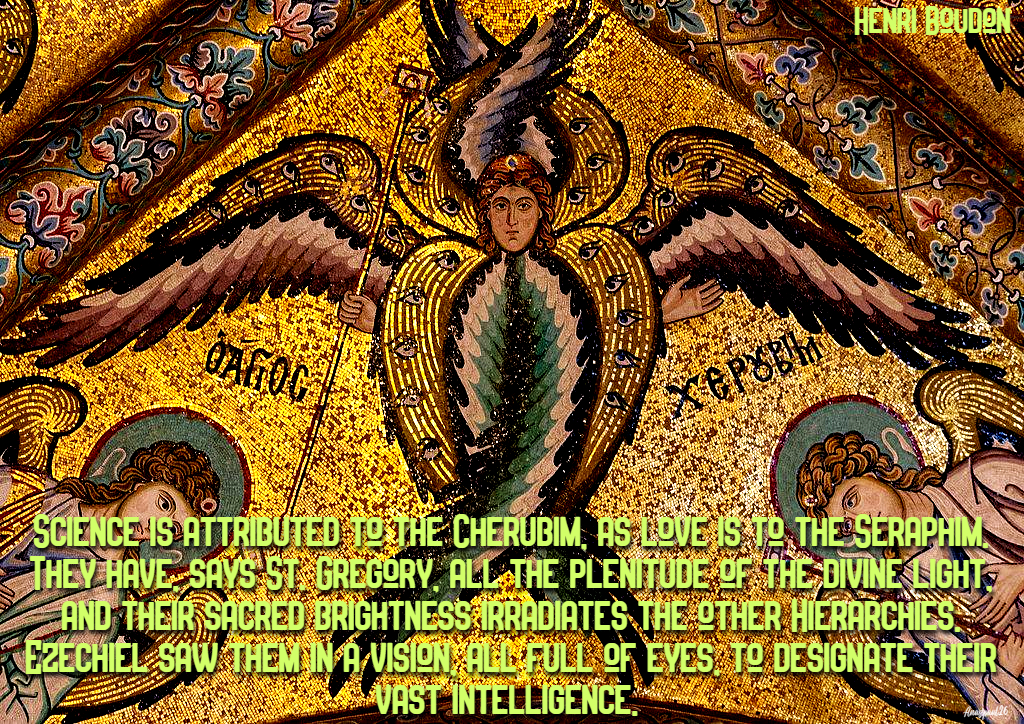
Science is attributed to the Cherubim, as love is to the Seraphim. They have, says St. Gregory, all the plenitude of the divine light, and their sacred brightness irradiates the other Hierarchies. Ezechiel saw them in a vision, all full of eyes, to designate their vast intelligence.
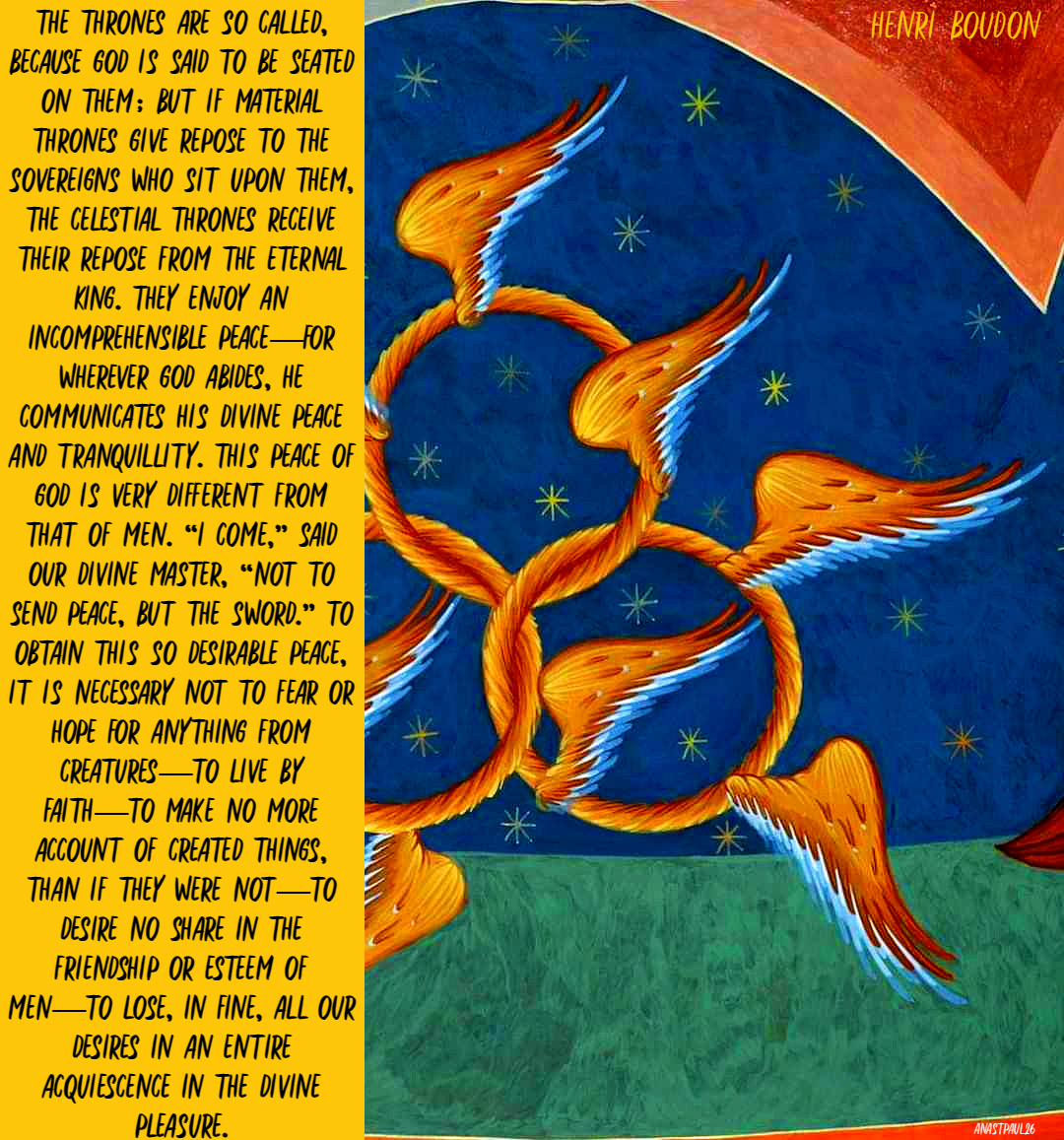
The Thrones are so called, because God is said to be seated on them; but if material thrones give repose to the Sovereigns who sit upon them, the celestial Thrones receive their repose from the Eternal King. They enjoy an incomprehensible peace—for wherever God abides, he communicates his divine peace and tranquillity. This peace of God is very different from that of men. “I come,” said our divine Master, “not to send peace, but the sword.” To obtain this so desirable peace, it is necessary not to fear or hope for anything from creatures—to live by faith—to make no more account of created things, than if they were not—to desire no share in the friendship or esteem of men—to lose, in fine, all our desires in an entire acquiescence in the divine pleasure. Be devout to the Thrones, and they will exert themselves in obtaining for you this greatest of all blessings. In like manner with the Cherubim.
It is said, that in the way of virtue we know more than we do but it is certain that perfect knowledge is rare. We speak of that of the saints. Few persons are practically convinced of the excellence of poverty and humiliation—of the advantages of the hidden and suffering life. It is in the school of a God, and at the feet of the crucifix, that this divine lesson is to be learned. Let us frequent it under the auspices of the Cherubim, the spirits of light, and we shall soon be illumined, and walk in the brightness of the children of God.
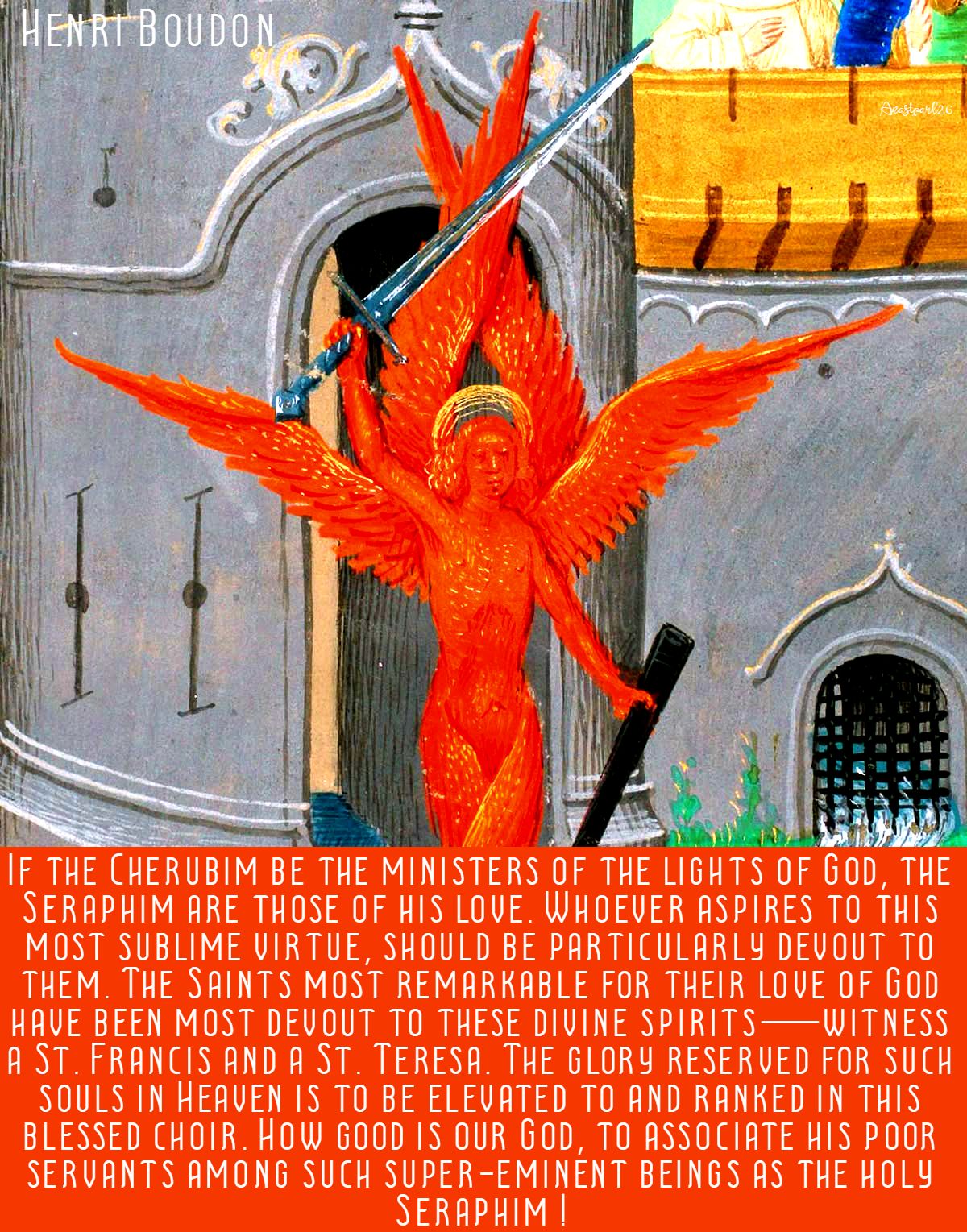
If the Cherubim be the ministers of the lights of God, the Seraphim are those of his love. Whoever aspires to this most sublime virtue, should be particularly devout to them. The Saints most remarkable for their love of God have been most devout to these divine spirits—witness a St. Francis and a St. Teresa. The glory reserved for such souls in Heaven is to be elevated to and ranked in this blessed choir. How good is our God, to associate his poor servants among such super-eminent beings as the holy Seraphim !
To honour specially the Powers, Virtues, and Dominations.
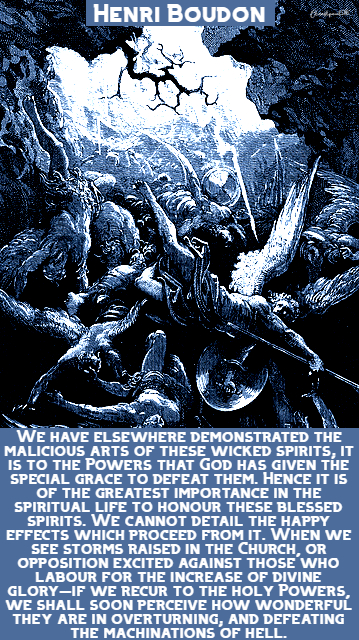
The Second Hierarchy of Angels is composed of the Powers, Virtues, and Dominations. The Dominations, as the principal Choir, give or dispense the orders which they receive from the higher Angels—the Virtues enable us to execute them— and the Powers to surmount the obstacles which the Devils oppose thereto. We have elsewhere demonstrated the malicious arts of these wicked spirits; it is to the Powers that God has given the special grace to defeat them. Hence it is of the greatest importance in the spiritual life to honour these blessed spirits. We cannot detail the happy effects which proceed from it. When we see storms raised in the Church, or opposition excited against those who labour for the increase of divine glory—if we recur to the holy Powers, we shall soon perceive how wonderful they are in overturning; and defeating the machinations of hell.
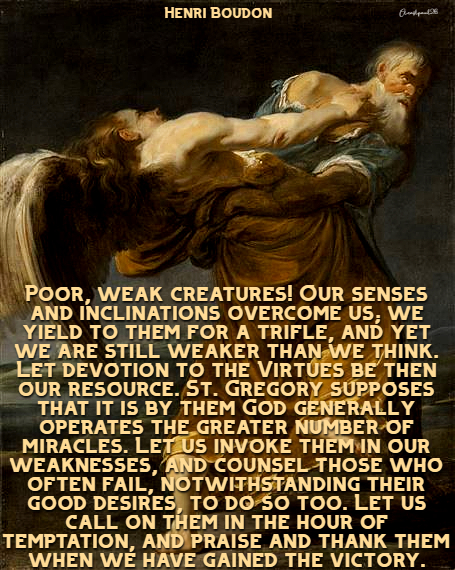
With all our good desires, we do very little; our tongues are longer than our arms. It seems as if nothing could arrest our course—and when we make a few steps, we grow tired and think of reposing. Poor, weak creatures! Our senses and inclinations overcome us; we yield to them for a trifle, and yet we are still weaker than we think. Let devotion to the Virtues be then our resource. St. Gregory supposes that it is by them God generally operates the greater number of miracles. Let us invoke them in our weaknesses, and counsel those who often fail, notwithstanding their good desires, to do so too. Let us call on them in the hour of temptation, and praise and thank them when we have gained the victory.
If the Dominations dispense the orders of God to the other Angels, they manifest his holy will to man. O! how happy should we be, if we always discerned this blessed will! But alas ! we often mistake for it the will of the creature, and still oftener, when we know it, we find it difficult to submit to it. We wish that the will of God may be done, but in such a manner as we wish. This is not true conformity. A soul touched with the love of God would fly to the remotest corner of the earth at his nod; she wishes that God may be absolute in her and in all creatures—that his will may be done as he pleases, and because he pleases. If at any time she is ignorant of this will, and prays to the Dominations, they will not fail to manifest it to her, being Secretaries of State to the great King Jesus.
O my God ! how just it appears, that all should serve and be subject to you ! “All the nations are before you as a drop of dew.” He who knows your will, and does it not, deserves punishment indeed. O! may it be done in all things—and may we seek our peace only in its accomplishment. Amen.
To have a singular Devotion to the holy Spirits of the First Choir—the Angels, Archangels, and Principalities.
The third or last Hierarchy of the Holy Angels is formed of three Choirs Angels, Archangels, and Principalities. They are particularly applied to the affairs of kingdoms and provinces, and in general to all that regards the happiness of man. Their goodness and kindness is so great, that we can never make them a suitable return. The principalities are so called, says St. Gregory, because they are the princes of the other two choirs, and communicate to them those lights and intelligences which they receive from the higher Hierarchies. The Archangels watch over kingdoms and provinces and the Angels are appointed the guardians of men.
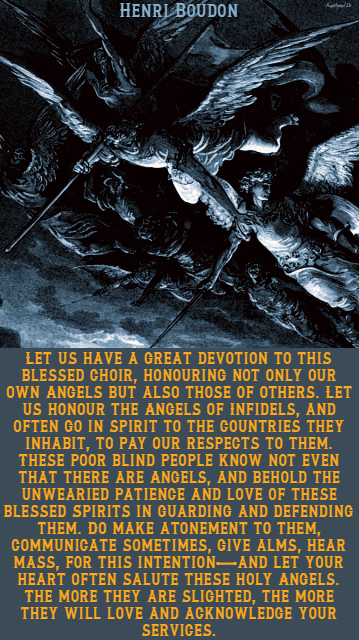
Let us have a great devotion to this blessed choir, honouring not only our own Angels but also those of others. Let us honour the Angels of Infidels, and often go in spirit to the countries they inhabit, to pay our respects to them. These poor blind people know not even that there are Angels, and behold the unwearied patience and love of these blessed Spirits in guarding and defending them. Do make atonement to them, communicate sometimes, give alms, hear mass, for this intention—and let your heart often salute these holy Angels. The more they are slighted, the more they will love and acknowledge your services. If a great king, in the revolt of his subjects, received considerable services from foreigners, he would not fail to acknowledge them gratefully, when reinstated in his dominions : hence judge what you may expect from the princes of the celestial realm. Do the same for the Angels of Heretics—for those of uninstructed Catholics, the greater number of whom know as little about these holy Spirits, as Pagans and Infidels. Pray for their conversion, that knowing the adorable Jesus, whom God has sent, and Mary his amiable mother, they may also know and honour the Angels.
Be devout to the Angels of your friends; these often render you services, which you would not receive from your own guardian. As, in the number of your friends, your confessor holds the first place, honour particularly his Angel, and pray him to bear on his mind a perfect knowledge of the designs of God on those whom he directs. Honour the Angels of your parents, relations, benefactors, and- of all with whom you have to do; they have more part than you think in the favours you receive by means of those persons. Be devout to the Angels of your enemies—it is the true way to gain them—or, if God wills that you should suffer the effects of their hatred, it is the best means of obtaining grace to love them cordially and make a good use of your sufferings. In fine, revere the Angels of the Sovereign Pontiff, the Bishops, the Clergy, and all persons in authority—that they may fitly discharge their obligations.
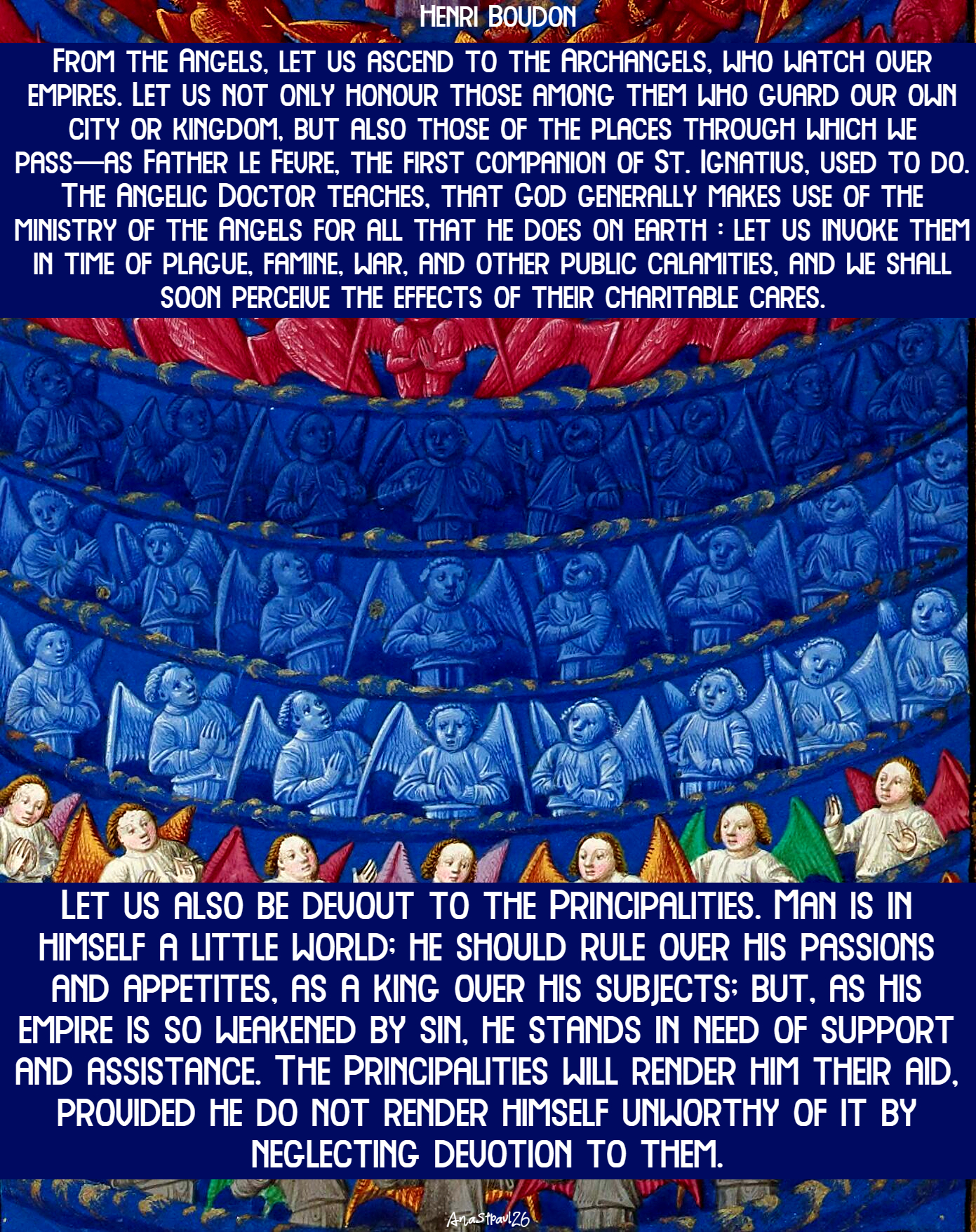
From the Angels, let us ascend to the Archangels, who watch over empires. Let us not only honour those among them who guard our own city or kingdom, but also those of the places through which we pass—as Father le Fevre, the first companion of St. Ignatius, used to do. The Angelic Doctor teaches, that God generally makes use of the ministry of the Angels for all that he does on earth : let us invoke them in time of plague, famine, war, and other public calamities, and we shall soon perceive the effects of their charitable cares.
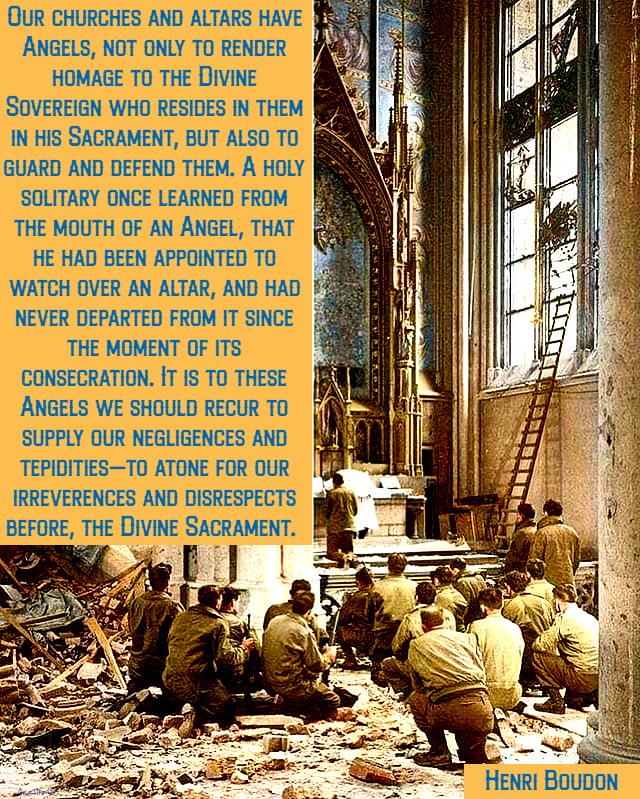
Our churches and altars have Angels, not only to render homage to the Divine Sovereign who resides in them in his Sacrament, but also to guard and defend them. A holy solitary once learned from the mouth of an Angel, that he had been appointed to watch over an altar, and had never departed from it since the moment of its consecration. It is to these Angels we should recur to supply our negligences and tepidities—to atone for our irreverences and disrespects before, the Divine Sacrament. It is well to unite in the love and homage which they continually render to it, and like the Psalmist, to “sing canticles of praise to our God in the presence of his Angels.”
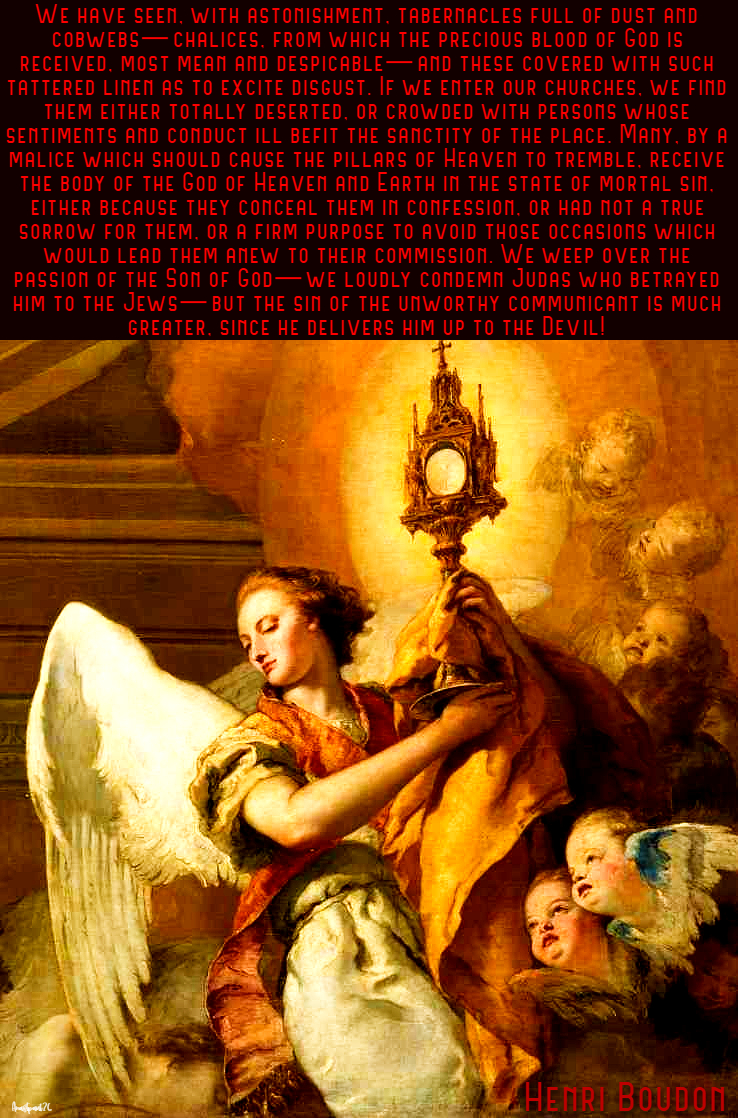
O my Lord and my God! here permit me to bewail, in the presence of your Divine Majesty, the deplorable blindness of Christians, who are the children of light, regarding your holy Sacrament. Is it then true, that they still believe you to be really present in this adorable mystery and behave as they do ? We are seized with horror when we reflect on the irreverences committed against you by Heretics and Infidels but those offered to you by Christians, who profess themselves ready to sacrifice their lives in defence of this adorable truth, are inconceivable. We have seen, with astonishment, tabernacles full of dust and cobwebs—chalices, from which the precious blood of God is received, most mean and despicable—and these covered with such tattered linen as to excite disgust. If we enter our churches, we find them either totally deserted, or crowded with persons whose sentiments and conduct ill befit the sanctity of the place. This is not all—the sufferings which love has imposed on our Sovereign stop not here. Many, by a malice which should cause the pillars of Heaven to tremble, receive the body of the God of Heaven and Earth in the state of mortal sin, either because they conceal them in confession, or had not a true sorrow for them, or a firm purpose to avoid those occasions which would lead them anew to their commission. We weep over the passion of the Son of God—we loudly condemn Judas who betrayed him to the Jews—but the sin of the unworthy communicant is much greater, since he delivers him up to the Devil!
O ! Angels of Paradise ! I address myself to you—knowing the obduracy of men, inspire them with all that respect for the adorable body of your Sovereign, which they are capable of conceiving—give them a knowledge of the dispositions with which it should be received:—that this abominable crime, this sin more hellish than human, may be no more committed. Inspire the rich to provide churches and altars, with suitable decorations—and repair, by your unceasing homage, the insults which have been offered to this mystery of inconceivable love.
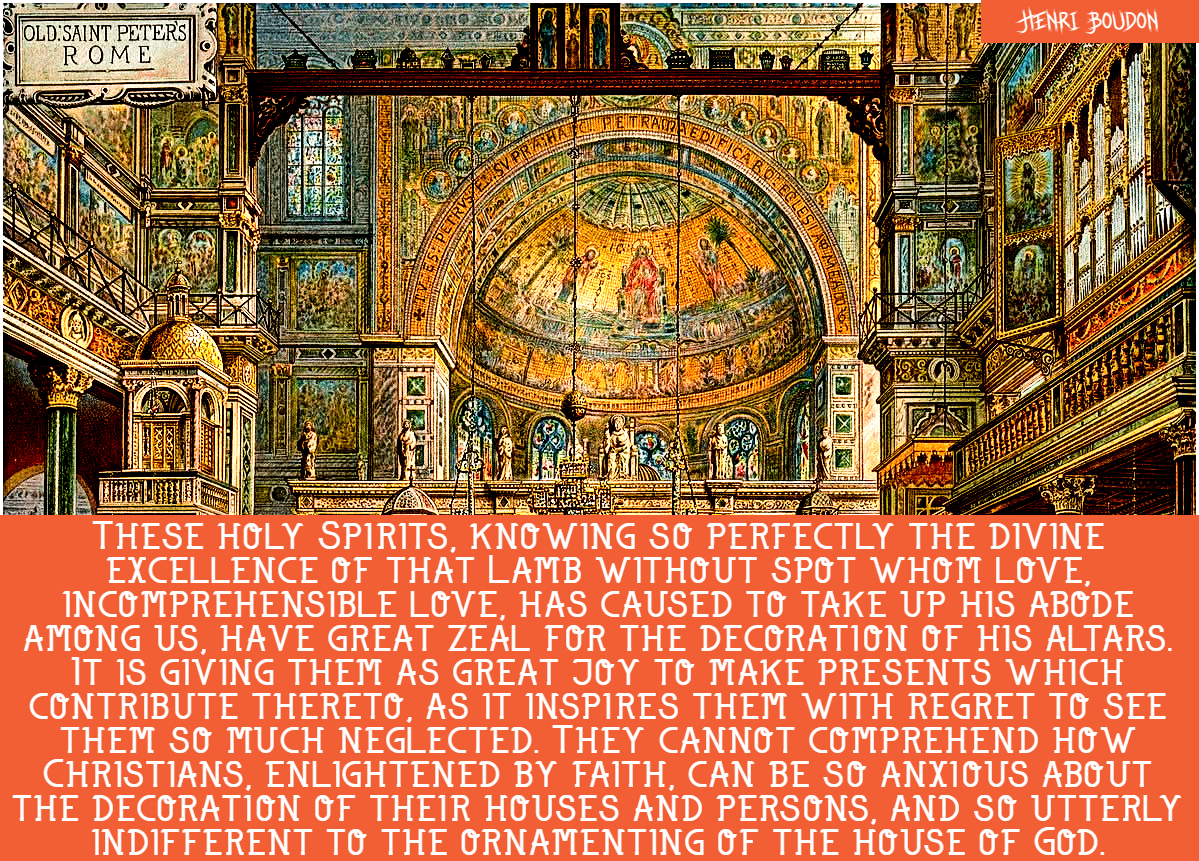
These holy Spirits, knowing so perfectly the divine excellence of that Lamb without spot whom love, incomprehensible love, has caused to take up his abode among us, have great zeal for the decoration of his altars. It is giving them as great joy to make presents which contribute thereto, as it inspires them with regret to see them so much neglected. They cannot comprehend how Christians, enlightened by faith, can be so anxious about the decoration of their houses and persons, and so utterly indifferent to the ornamenting of the house of God.
Let us also be devout to the Principalities. Man is in himself a little world; he should rule over his passions and appetites, as a king over his subjects; but, as his empire is so weakened by sin, he stands in need of support and assistance. The Principalities will render him their aid, provided he do not render himself unworthy of it by neglecting devotion to them.

























You must be logged in to post a comment.