Posted in MARIAN TITLES

Matka Boża Leśniańska / Blessed Mother of Leśna, Leśna Podlaska, Biała Podlaska, Lublin, Poland (1683) and Memorials of the Saints – 26 September

Matka Boża Leśniańska / Blessed Mother of Leśna, Leśna Podlaska, Biała Podlaska, Lublin, Poland (1683) – 26 September:
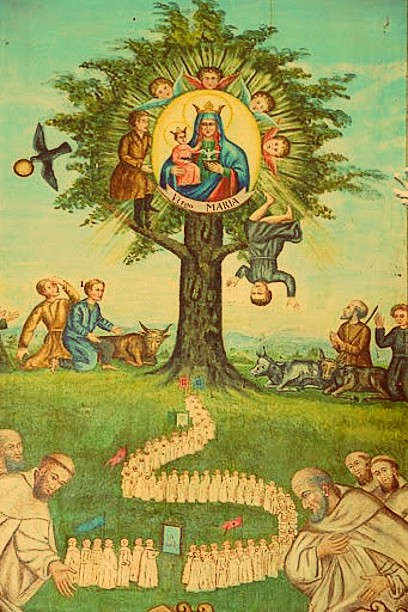
The Leśnia Sanctuary begins on 26 September 1683. On that day, two shepherds – Miron Makaruk and Aleksander Stelmaszuk – looking for the lost cattle in the bushes, noticed a stone image of the Mother of God hanging on a wild pear tree, which gave an extraordinary glow. Wanting to take the painting off, one of the bravest young men climbed the tree but each time fell to the ground. The local inhabitants, seeing what was happening, began to pray fervently. Soon, Zabłocki’s elders from nearby Bordziłówka arrived and only he, as an unusually prayerful man, took the painting off the tree. Droplets of “sweat” appeared on the image and this phenomenon continued for a long time. Then the painting was taken to the manor in Bukowice.

This extraordinary find deeply touched the religious and secular authorities of the time. Soon a wooden Church was erected on the site of the appearance of the Image. On 26 September 1695, a Parish was established in Lesna. From the very beginning, the Image attracted crowds of believers who experienced many favours thanks to the Blessed Mother, especially cures of illnesses. The Bishop of Lutsk, Franciszek Prażmowski, issued a decree in 1700, in which he stated that the appearance of the Image should be considered miraculous.
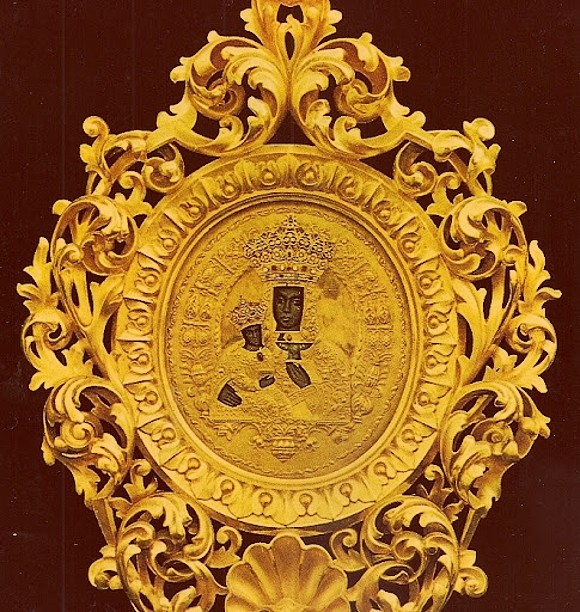
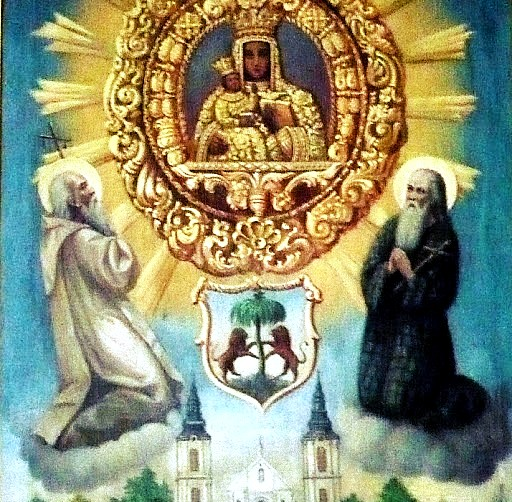
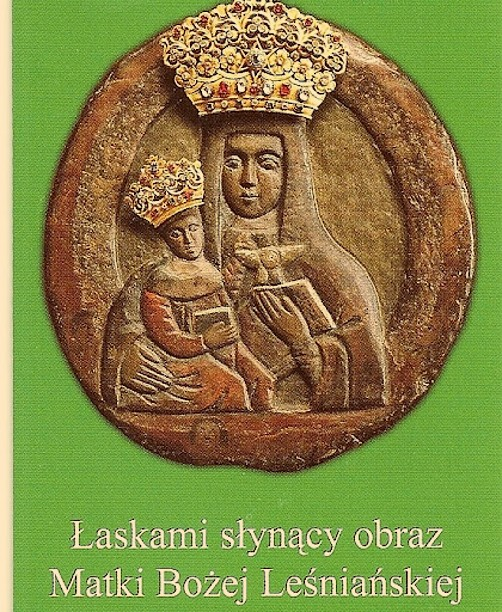
In the Lesnian Image, Mary is presented, embracing the Child Jesus with her right arm. The Child Jesus is holding the book with his right hand and his left hand is raised up in a gesture of teaching. Mary, standing in half-figure, is facing the viewer. In her left hand she holds an open book, on which, with outstretched wings, a dove – a symbol of the Holy Spirit – is supported. The figure of the Mother of God is covered with a coat.

The image of the Mother of God is a relief carved in field stone. The dimensions of the Image are: width 29.3 cm, height 31.4 cm, thickness 4.6 cm, weighs 9.5 kg.

On the site of the appearance of the Image of the Mother of God in 1718. a small Church was built. It exists to this day and is called the “Chapel of the Appearance of the Miraculous Image.” In 1727, the Parish of Leśna and the care of the Miraculous Image were taken over by the Pauline Fathers from Jasna Góra. They began the construction of a magnificent Church, which was erected in the years 1731 – 1758. It was consecrated under the invocation of the “Nativity of the Blessed Virgin Mary and the Holy Apostles Peter and Paul” on 8 September 1758. Huge crowds of the faithful of the Latin and Uniate rite were drawn to the Leśnia Sanctuary.
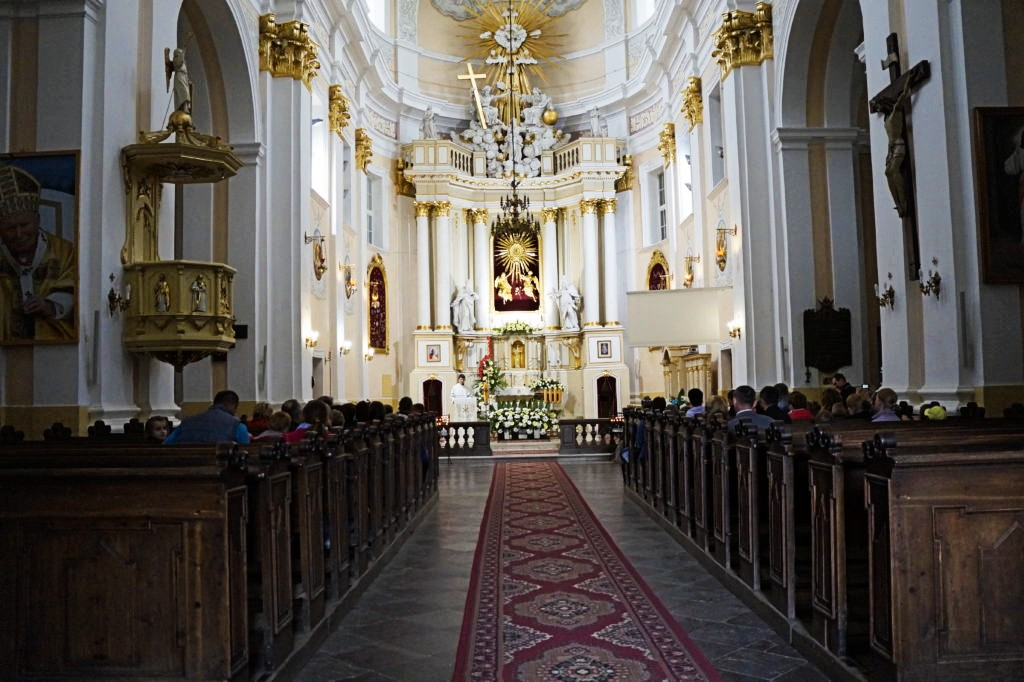
The situation changed with the partitions of Poland, when Leśna found itself under the Russian partition. After the fall of the January Uprising, the Lesnian Sanctuary found itself in a desperate situation. As part of the repression for helping the insurgents, on the night of 27-28 October 1864 , the Pauline Fathers were deported from Leśna. It was then, that the Bishop of Janów, Beniamin Szymanski, ordered to secretly take out the Miraculous Image and put a copy in its place. It was done in 1865. Soon the tsarist government abolished the Podlasie Diocese. The exiled Bishop took the Miraculous Picture with him to Łomża. He put it in the Church of the Benedictine Sisters. In 1875, the Church in Leśnia was taken over for the purposes of the Orthodox Church. Then the pilgrimages stopped. In 1889, an Orthodox nunnery was established in Lesna. It was to become the centre of Russification of Poles. In 1905 Tsar Nicholas II came to Lesna, whose relative was the superior of the nuns of Leśna. After the outbreak of World War I, the sisters left Leśna and took with them a copy of the painting of the Mother of God, still being firmly convinced that it was the original painting.

On 16 August 1915, the temple in Leśnia returned to Catholic worship. On 25 May 1919 . The Pauline Fathers returned to Lesna and immediately began renovation works in the Sanctuary. First of all, the search for the Miraculous Picture began, which was not found until 5 May 1926 in Łomża. It happened thanks to Fr. Aleksander Łaziński. After the canonical trial conducted by Bishop H. Przeździecki, the Miraculous Image returned in a triumphant parade from Siedlce to Leśna on 25 September 1927. It was a great celebration for the entire Podlasie Diocese and over 25,000 people attended this event. In the interwar period, the Pauline Fathers decorated the Sanctuary. They looked after the pilgrims who were again in large numbers at the feet of their Lesnian Mother.
In 1939, the difficult time of the Nazi occupation began. In the fall of 1940, the Germans occupied the Monastery and expelled the Pauline Fathers.
After the war, in 1951, under the direction of the Prior – Father Jerzy Tomziński, the Church received a Pulpit and an Organ.

On 18 August 1963 , the Primate of Poland, Cardinal Stefan Wyszyński, together with the Bishop of Podlasie, Ignacy Świrski, crowned the Miraculous Image with papal crowns. From 11 to 12 June 1970, Cardinal Karol Wojtyła stayed in Leśna. On 25 September 1977, the 50th anniversary of the return of the Miraculous Image was solemnly celebrated. In 1983, the solemn celebrations of 300 years of the appearance of the Miraculous Image took place and in 1984 the Church in Leśnia was elevated to the rank of a Minor Basilica. In 1992, a break-in was made to the temple in Leśnia and attempts were made to steal the golden crowns from the Miraculous Image. In 1995, the 300th anniversary of the establishment of the Parish in Leśna Podlaska was celebrated. This time the ceremony was presided over by the Primate of Poland, Cardinal Józef Glemp. In 1996, works on frescoes and paintings in the Basilica began and they were completed in 2002. On 26 September 2019, the Leśnia Sanctuary celebrated the 100th anniversary of the return of the Pauline Order to Leśna Podlaska.
St Cosmas (Optional Memorial)
St Damian (Optional Memorial)
(Died c 286 ) Martyrs. Twin brothers and Physicians, Apostles of Charity, Evangelists – born in the 3rd century, of Arabic descent and died by being tortured, without suffering any injury and finally they were beheaded c 286 in Aegea, Cilicia (modern Ayas, Turkey). The Martyr twins are remembered in the Roman Canon of the Mass in the prayer known as the Communicantes (from the first Latin word of the prayer). They are also recalled in the Litany of the Saints and in the older form of the Roman rite, in the Collect for Thursday in the Third Week of Lent, as the Station Church for this day is Santi Cosma e Damiano.

St Amantius of Tiphernum
St Callistratus of Constantinople
St Colman of Elo
St Cyprian of Antioch
St Eusebius of Bologna
St John of Meda Ord.Hum. (1100-1159) Priest, Monk, Abbot
St Justina of Antioch

St Marie Victoire Therese Couderc
St Meugant

St Nilus the Younger (910-1005) Abbot and Confessor and Founder of Italo-Greek Monasticism in southern Italy.. St Nilus was a charismatic leader and leading spiritual personality of his time.

St Senator of Albano
St Vigilius of Brescia
—
Martyrs of Korea – 12 saints: Twelve lay people in the apostolic vicariate of Korea who were imprisoned, tortured and martyred together in the persecutions in Korea.
• Saint Agatha Chon Kyong-Hyob
• Saint Carolus Cho Shin-Ch’ol
• Saint Catharina Yi
• Saint Columba Kim Hyo-Im
• Saint Ignatius Kim Che-Jun
• Saint Iulitta Kim
• Saint Lucia Kim
• Saint Magdalena Cho
• Saint Magdalena Ho Kye-Im
• Saint Magdalena Pak Pong-Son
• Saint Perpetua Hong Kum-Ju
• Saint Sebastianus Nam I-Gwan
They were beheaded September 1839 in Seoul Prison, South Korea and Canonised on 6 May 1984 by St Pope John Paul II.

Martyred in the Spanish Civil War:
• Blessed Amalia Abad Casasempere de Maestre
• Blessed Andreu Felíu Bartomeu
• Blessed Antonio Cid Rodríguez
• Blessed Josefa Romero Clariana
• Blessed Manuel Legua Martí
• Blessed María Jord´ Botella
• Blessed Pau Castell´ Barber´
• Blessed Teresa Rosat Balasch
Posted in SAINT of the DAY, Uncategorized

Saint of the Day – 26 September – Saint Gideon the Judge

Saint Gideon (‘destroyer; mighty warrior; feller of trees’) also known as Gedeon, Jerobaal, Jerubebbeth, Jerub-Baal, was an eleventh century BC Judge of Israel as well as military leader, and prophet. His calling and victory over the Midianites is described in Judges 6–8. Gideon was the son of Joash, from the Abiezrite clan in the tribe of Manasseh, and lived in Ephra.

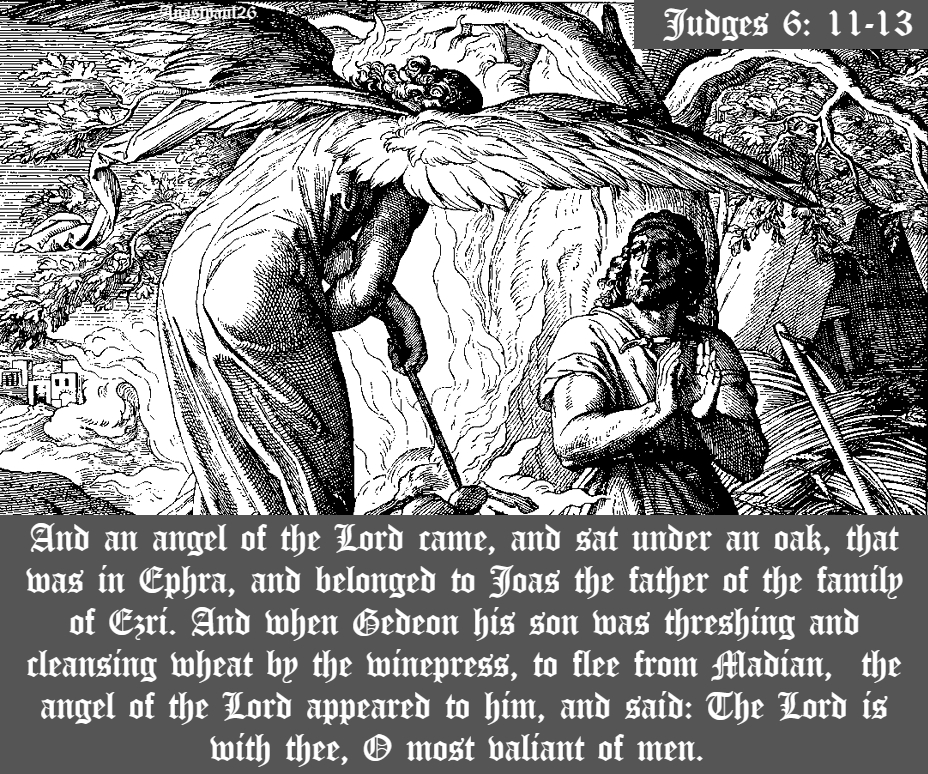
And an angel of the Lord came, and sat under an oak, that was in Ephra, and belonged to Joas the father of the family of Ezri. And when Gedeon his son was threshing and cleansing wheat by the winepress, to flee from Madian, the angel of the Lord appeared to him, and said: The Lord is with thee, O most valiant of men.

Judges 6:11-13

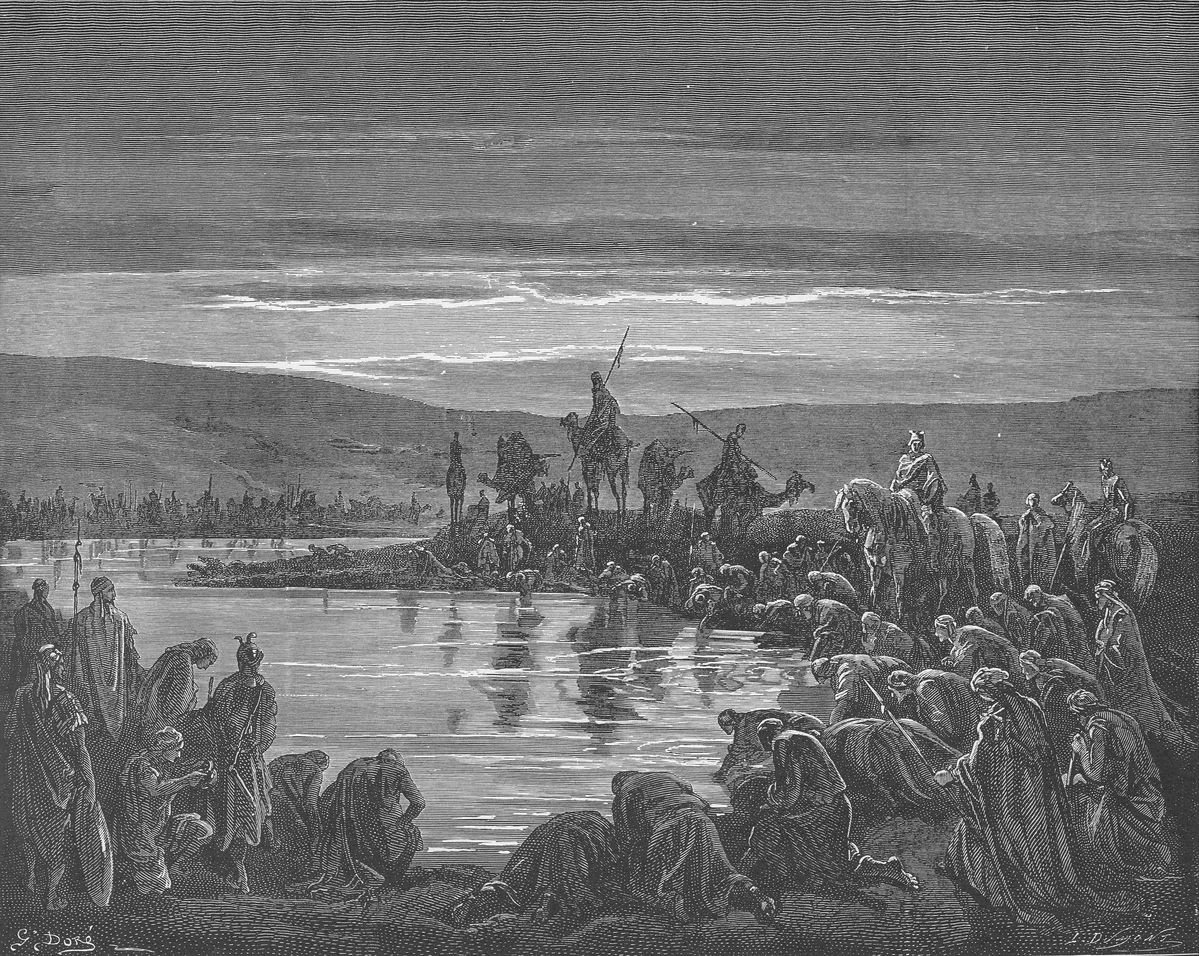
During the night, God instructed Gideon to approach the Midianite camp. There, Gideon overheard a Midianite man tell a friend of a dream in which “a loaf of barley bread tumbled into the camp of Midian”, causing their tent or camp to collapse. This was interpreted as meaning that God had given the Midianites over to Gideon. Gideon returned to the Israelite camp and gave each of his men a shofar and a clay jar with a torch hidden inside. Divided into three companies, Gideon and his 300 men marched on the enemy camp. He instructed them to blow the trumpet, give a battle cry and light torches, simulating an attack by a large force. As they did so, the Midianite army fled.

Gideon Chooses 300 Soldiers

Gideon sent messengers ahead into Israel calling for the Ephraimites to pursue the retreating Midianites and two of their leaders, Oreb and Zeeb. Gideon and the three hundred pursued Zebah and Zalmunna, the two Midianite kings. When he had asked for provisions in his pursuit, the men of Succoth and Peniel refused and taunted Gideon. After capturing the two kings, Gideon punished the men of Succoth, and pulled down the tower of Peniel killing all the men there. Gideon invited his eldest son, Jether, to slay Zebah and Zalmunna, but being still young at the time, he did not have the confidence to carry out his father’s request, so Zebah and Zalmunna called on Gideon to perform the deed himself. Gideon then killed Zebah and Zalmunna as justice for the death of his brothers.

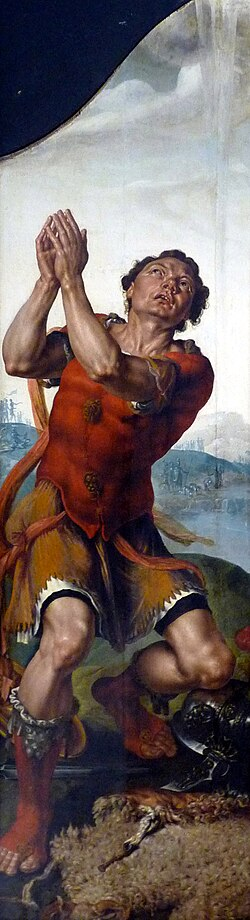
Gideon thanking God for the Miracle of the Dew

The Israelites invited Gideon to become their king and to found a dynasty, but he refused, telling them that only God was their ruler.

There was peace in Israel for 40 years during the lifetime of Gideon. As soon as Gideon died of old age, the Israelites again turned to worship the false god Baal Berith and ignored the family of their great Judge.

Gideon’s fleece, as symbol of Mary
Posted in Our MORNING Offering

Our Morning Offering – 26 September – Indulgenced Prayers to Our Lady

O Virgin Mary, Our Lady of the Most Blessed Sacrament, glory of the Christian people, joy of the universal Church, salvation of the world, pray for us, and awaken in all the faithful devotion to the Most Holy Eucharist, in order that they may render themselves worthy to receive it daily.

(500 days every time said)

Holy Mary, the deliverer, pray for us and for the souls in Purgatory.

(300 days every time said)

Mother of Perpetual Help, pray for us.

(300 days every time said)

Immaculate Queen of Peace, pray for us.

(300 days every time said)

Mother of orphans, pray for us.

(300 days every time said)

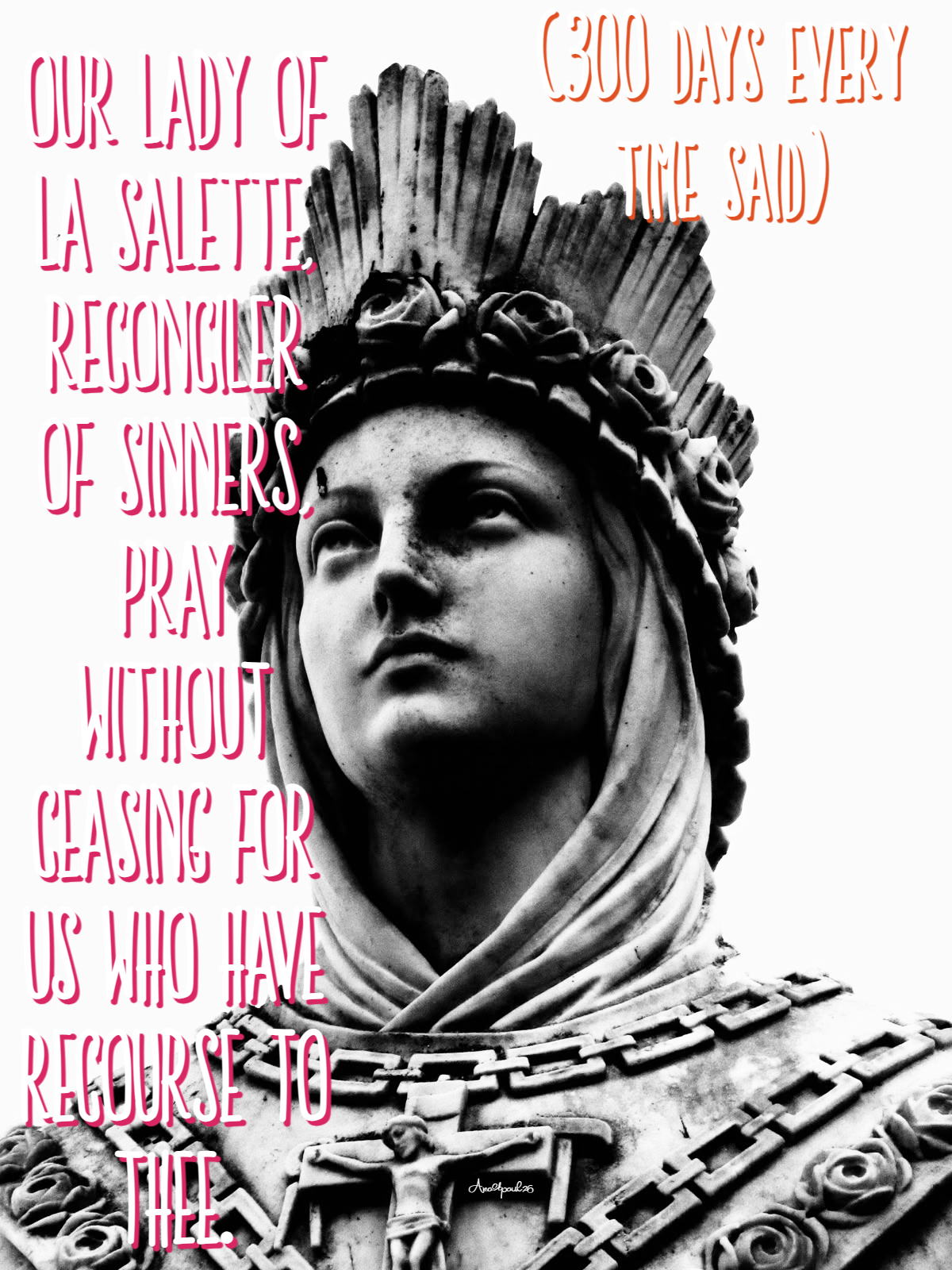
Our Lady of La Salette, reconciler of sinners, pray without ceasing for us who have recourse to thee.

(300 days every time said)

Queen of Apostles, pray for us.

(300 days every time said)

Almighty and merciful God, Who didst establish in Blessed Mary ever Virgin a refuge and help of sinners, grant that through her protection we, being absolved from all sins, may obtain the joyous effect of Thy mercy. Through Christ Our Lord. Amen.

(3 years every time said)

O Mary, queen of the clergy, pray for us; obtain for us numerous and holy priests.

(300 days every time said)

Cleanse my heart and my body, O holy Mary.

(300 days every time said)

Posted in ONE Minute REFLECTION

One Minute Reflection – 26 September – It may bear fruit in the future

One Minute Reflection – 26 September – “Month of the Seven Sorrows of Mary” – Readings: Ps 94:6-7, Ps 94:1, Lev 23:26-32, Luke 13:6-17

But he answered him and said, ‘Sir, let it alone this year too, till I dig around it and manure it. Perhaps it may bear fruit; but if not, then afterwards you shall cut it down.’

Luke 13:6-17

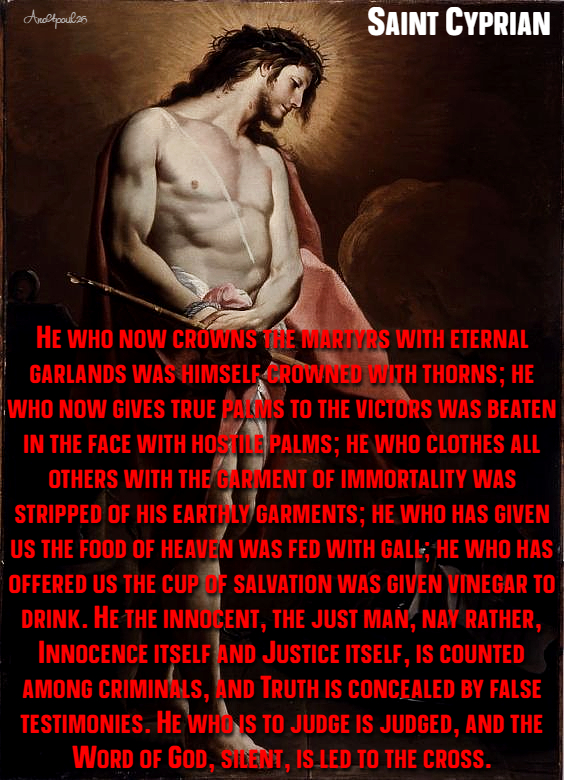
REFLECTION – This, beloved brethren, Jesus Christ, our Lord and our God, did not teach by words only but he also fulfilled by his deeds. In the very hour of his passion and cross, what violent abuses he listened to with patience, and what shameful insults he endured! He was even covered with the spittle of his revilers when, but a short time before, he had cured the eyes of the blind man with his own spittle. He who now crowns the martyrs with eternal garlands was himself crowned with thorns; he who now gives true palms to the victors was beaten in the face with hostile palms; he who clothes all others with the garment of immortality was stripped of his earthly garments; he who has given us the food of heaven was fed with gall; he who has offered us the cup of salvation was given vinegar to drink. He the innocent, the just man, nay rather, Innocence itself and Justice itself, is counted among criminals, and Truth is concealed by false testimonies. He who is to judge is judged, and the Word of God, silent, is led to the cross. And although the stars are confounded at the crucifixion of the Lord, the elements are disturbed and the earth trembles, yet he does not speak, nor is he moved, nor does he proclaim his majesty, even during the suffering itself. He endures all things even to the end with constant perseverance so that in Christ a full and perfect patience may find its realization.

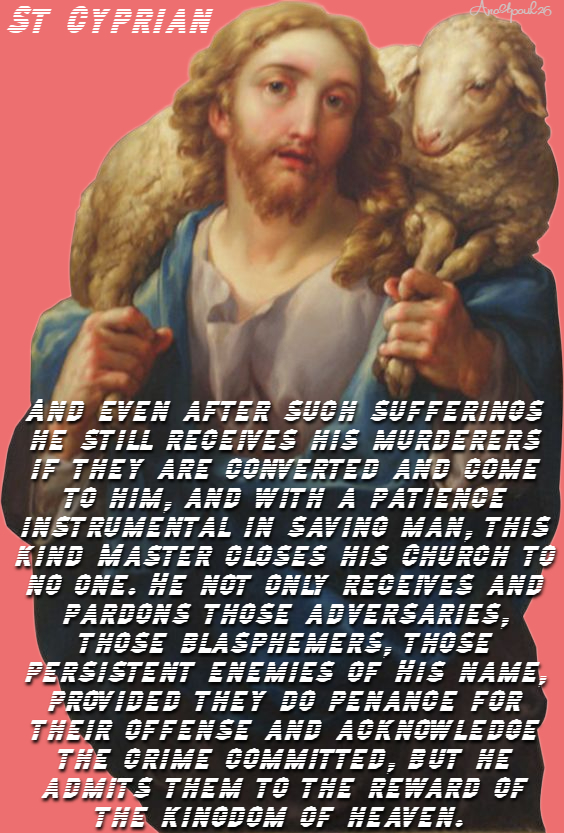
And even after such sufferings he still receives his murderers if they are converted and come to him, and with a patience instrumental in saving man, this kind Master closes his Church to no one. He not only receives and pardons those adversaries, those blasphemers, those persistent enemies of His name, provided they do penance for their offense and acknowledge the crime committed, but he admits them to the reward of the kingdom of heaven. What can be called more patient, what more kind? Even he who shed the blood of Christ is given life by the blood of Christ. Such is the wonderful patience of Christ. And unless it were so wonderful, the Church would not have had Paul, the great Apostle.

Saint Cyprian

PRAYER – Lord God, You hold out the Light of Your Word to those who do not know You. Strengthen in our hearts, the faith You have given us and the Credo we profess, so that no trials may quench the fire Your Spirit has kindled in us. May the intercession of the Mother of the Word made flesh and our Mother, grant us the grace of following the way of the Cross, to stand beneath it with our her, Ave Maria! We make our prayer through Jesus Christ with the Holy Spirit, one God forever, amen.

Posted in CATHOLIC Quotes

Quote/s of the Day – 26 September – The Mercy of God

When Jesus saw her, He called her to Him and said to her, Woman, you are delivered from your infirmity. And He laid His hands upon her, and instantly she was made straight, and glorified God.

Luke 13:6-17

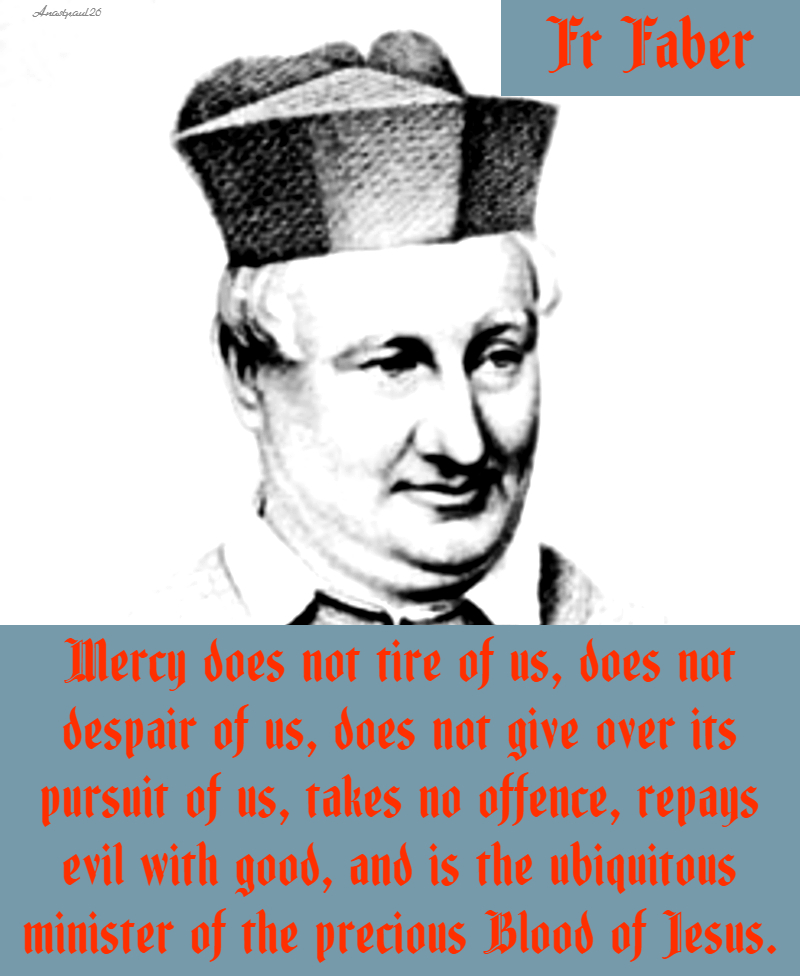
Mercy does not tire of us, does not despair of us, does not give over its pursuit of us, takes no offence, repays evil with good, and is the ubiquitous minister of the precious Blood of Jesus.

Fr Faber

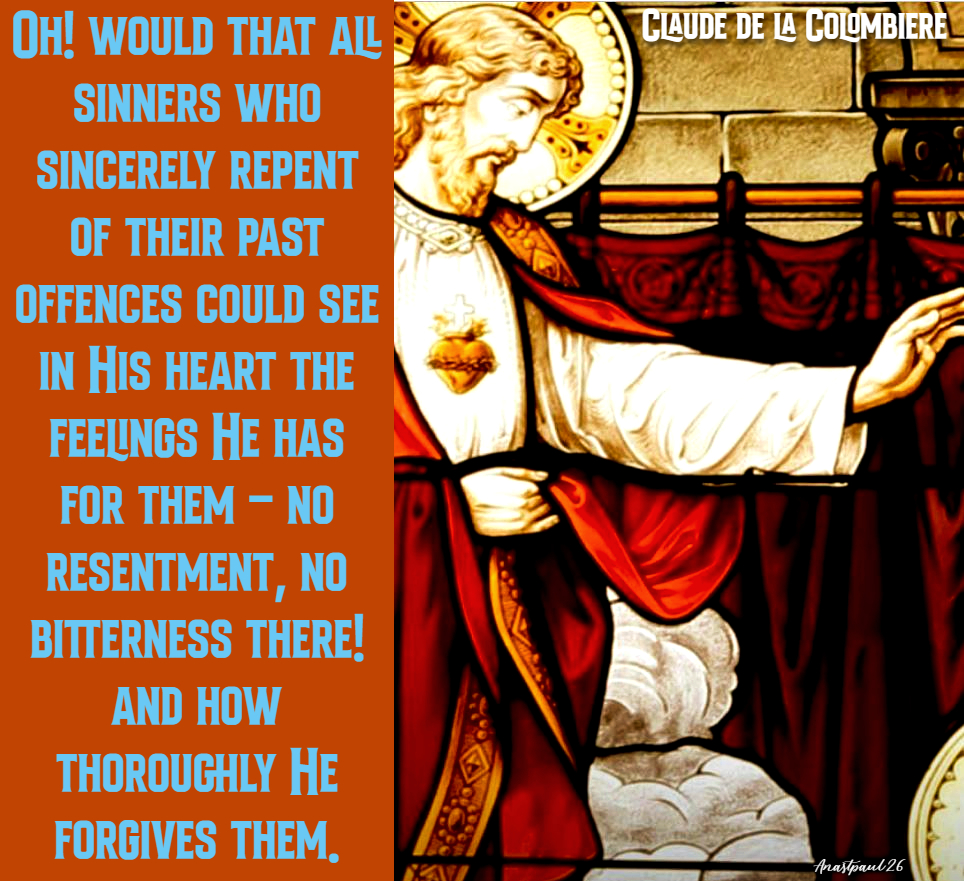
Oh! would that all sinners who sincerely repent of their past offences could see in His heart the feelings He has for them – no resentment, no bitterness there! and how thoroughly He forgives them.

Claude de la Colombiere

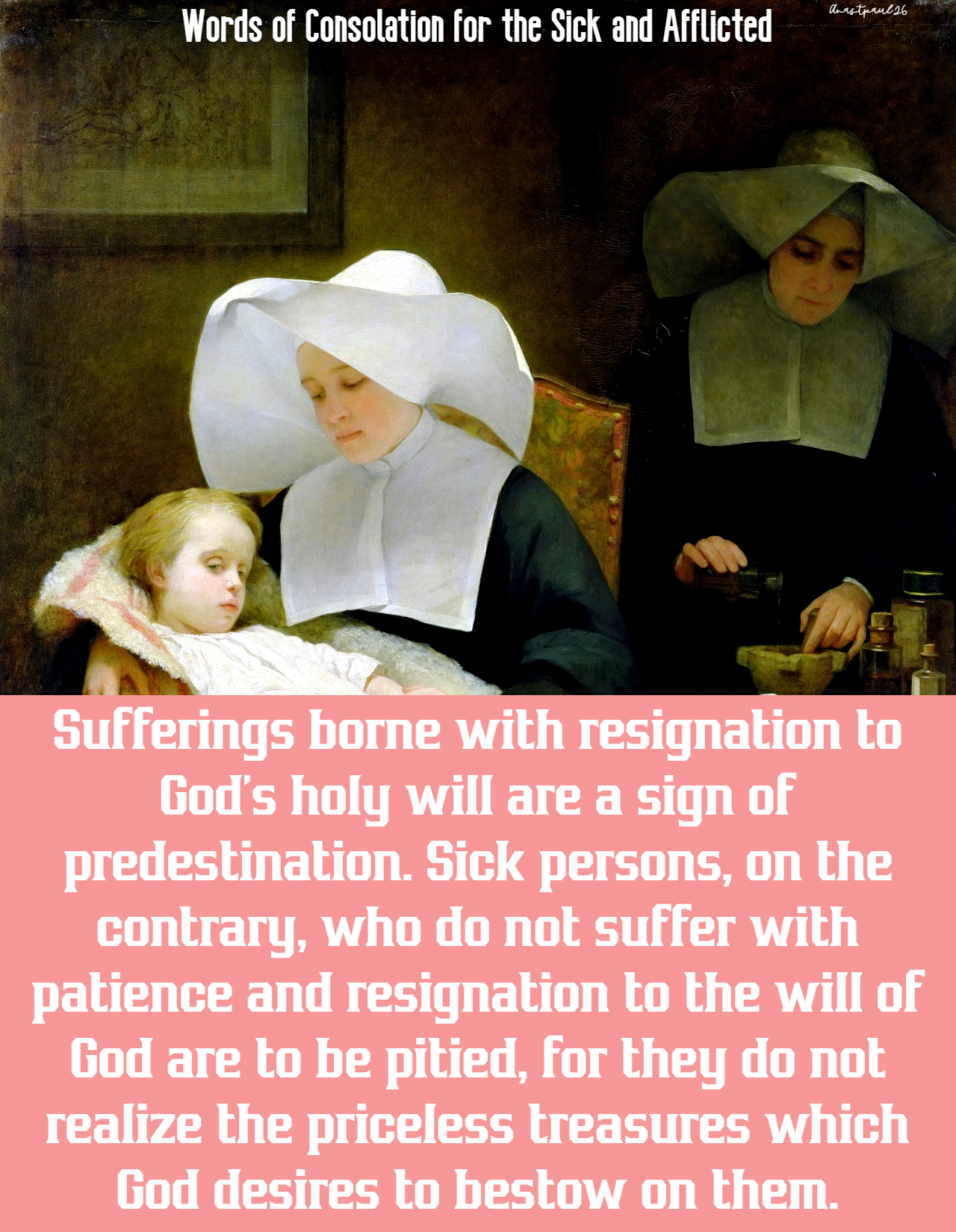
Sufferings borne with resignation to God’s holy will are a sign of predestination. Sick persons, on the contrary, who do not suffer with patience and resignation to the will of God are to be pitied, for they do not realize the priceless treasures which God desires to bestow on them.

Words of Consolation for the Sick and Afflicted

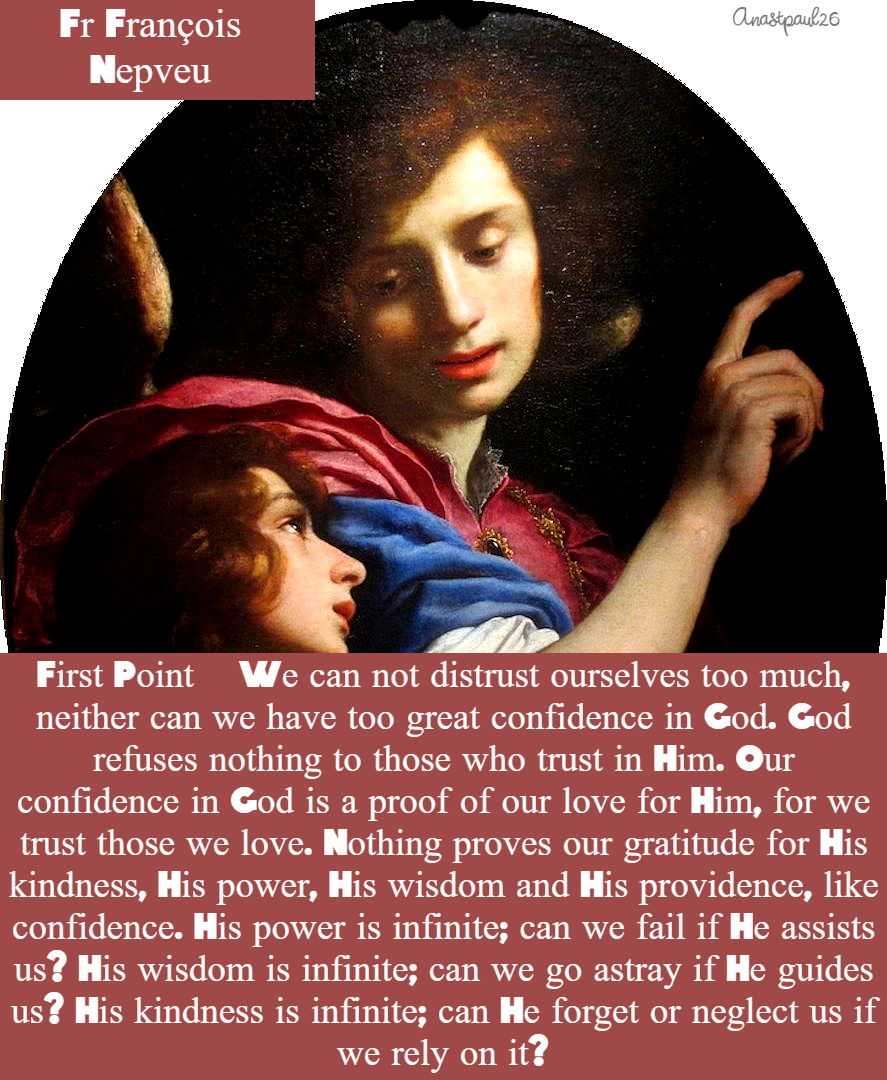
First Point – We can not distrust ourselves too much, neither can we have too great confidence in God. God refuses nothing to those who trust in Him. Our confidence in God is a proof of our love for Him, for we trust those we love. Nothing proves our gratitude for His kindness, His power, His wisdom and His providence, like confidence. His power is infinite; can we fail if He assists us? His wisdom is infinite; can we go astray if He guides us? His kindness is infinite; can He forget or neglect us if we rely on it?

Fr François Nepveu

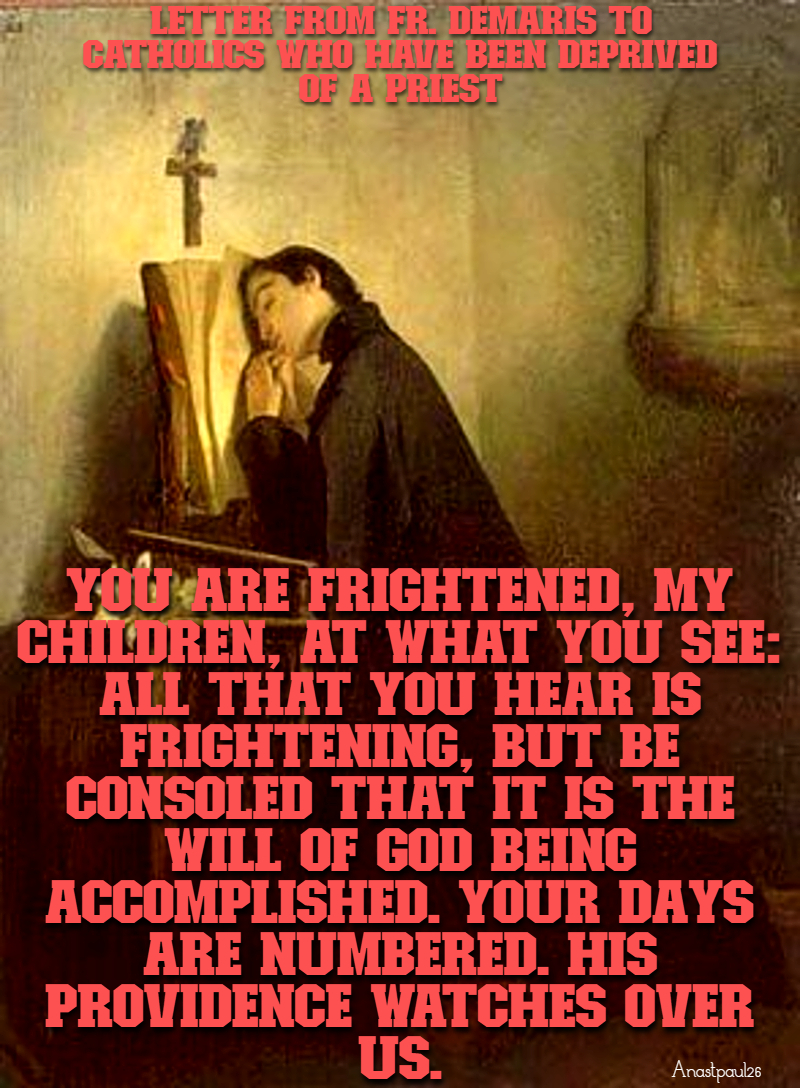
You are frightened, my children, at what you see: all that you hear is frightening, but be consoled that it is the will of God being accomplished. Your days are numbered. His Providence watches over us.

Letter from Fr. Demaris to Catholics Who Have Been Deprived of a Priest

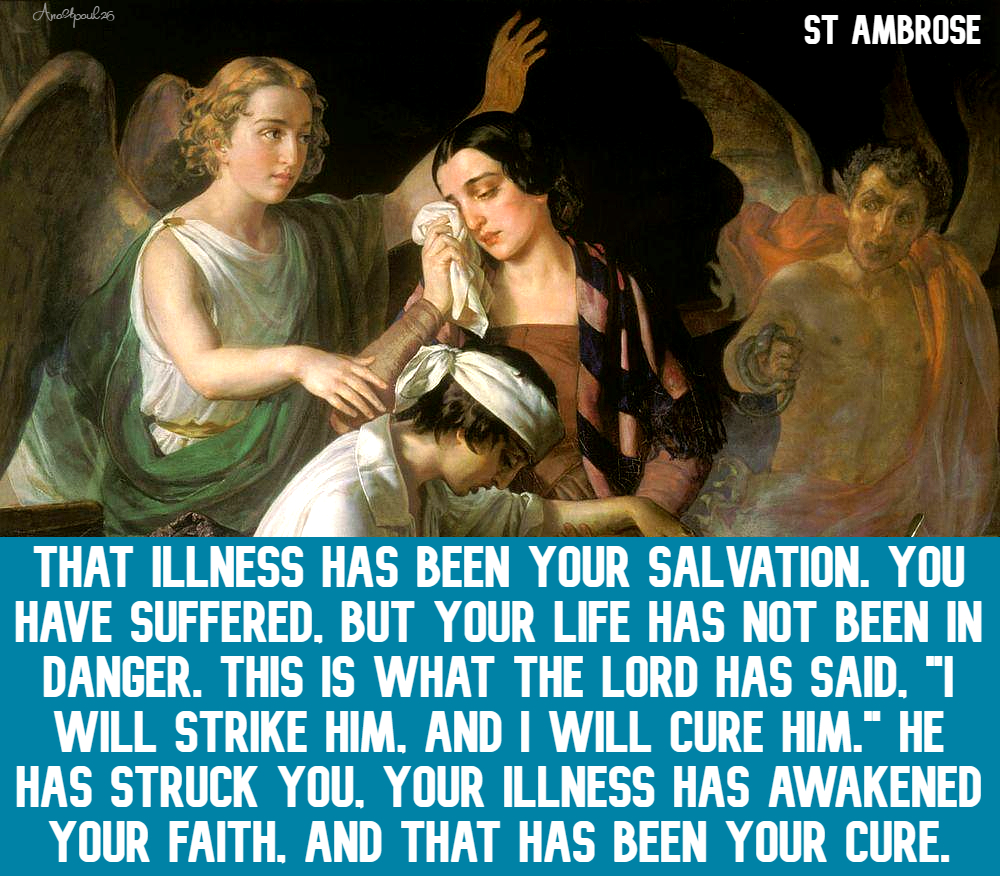
That illness has been your salvation. You have suffered, but your life has not been in danger. This is what the Lord has said, “I will strike him, and I will cure him.” He has struck you, your illness has awakened your faith, and that has been your cure.

St Ambrose

Posted in SEPTEMBER-The SEVEN SORROWS of MARY and The HOLY CROSS

Thought for the Day – 26 September – Manual of Devotions in Honour of The Seven Dolors

Manual of Devotions in Honour of The Seven Dolors of the Blessed Virgin Mary by Father Sebastian

OBLIGATIONS AND PRACTICES OF PIETY

The faithful who wear the Scapular of our Blessed Lady, are not bound by any particular obligation in order to gain the Indulgences attached. The visit to some Church of the Order, one of the conditions requisite for certain Indulgences, may be commuted by a confessor for any other pious work, when there is any infirmity or hindrance of a grave nature, which prevents such a visit being made; such for instance would be the too great distance from the church, and in such a case it would be well to ask the confessor to appoint in its place some other sanctuary, as for instance a parish church.

This faculty of commutation was granted by a brief of Clement XIII, on the 17th August, 1762. If there be any Confraternity of the Seven Dolours established in the place, they ought to endeavour to fulfil their obligations, the principal of which are to assist at the public exercises of the Confraternity ; to say daily seven Paters and Aves in memory of the Dolours of the Mother of God, and to repeat the same prayers at the death of any member of the association, for the repose of his soul. Lastly, the frequent recital of the Rosary is recommended.

INDULGENCES ATTACHED TO THE SCAPULAR OF THE DOLOURS

Plenary Indulgences

I. On the day on which the Scapular is received.

II. At the hour of death, by invok- ing by tongue or in heart the Holy Name of Jesus.

III. The day on which a member makes an hour’s spiritual exercise in honour of the Dolours.

IV. By assisting at the monthly procession, or by fulfilling what is ap- pointed by the confessor in place of said procession.

V. Once in the month for those who repeat daily three Paters in memory of our Saviour’s Passion, and three Aves in commemoration of the Dolours, for those that are in their last agony.

VI. Once in the month also for those who say every day seven Hail Marys and the verse:- “Holy Mary, pierce me through, In my heart each wound renew, Of my Saviour crucified.”

VII. During the Forty Hours Devotion.

VIII. Passion Sunday.

IX. Feast of the Seven Dolours.

X. The Saturday following the Commemoration of the Seven Dolours.

XI. The Annunciation of the Blessed Virgin Mary.

XII. The Assumption of our Blessed Lady.

PARTIAL INDULGENCES

I. Seven years and seven quarantines on the Feast of Christmas, the Annunciation, the Purification, the Assumption, and all Fridays throughout the year, by reciting five Our Fathers and five Hail Marys in memory of the Passion.

II. Five years and as many quarantines, when members accompany the Blessed Sacrament to the sick.

III. Three hundred days once a day for those who say seven Hail Marys, followed by the verse Holy Mother, &c.

IV. One hundred and fifty days every time they meditate on the Passion or on the Dolours, and say seven Our Fathers and seven Hail Marys with the “Stabat Mater,” or perform the spiritual exercises practised in the Churches of the Servites.

V. One hundred days for those who recite the “Stabat Mater.”

VI. Sixty days for each work of Charity.