
Reflections on each of the Seven Dolors of Mary by St Alphonsus Liguori
Of The Flight of Jesus Into Egypt
Herod having heard that the expected Messiah was born, foolishly feared that the new-born King would deprive him of his kingdom. Hence St. Fulgentius, reproving him for his folly, thus says: “Why, oh Herod, art thou that disturbed? This King who is born has not come to conquer kings by arms, but to subjugate them, in a wonderful manner, by his death.” The impious Herod, therefore, waited to learn from the holy magi where the King was born, that he might take from him his life; but finding himself deceived by the magi, he ordered all the infants that could be found in the neighborhood of Bethlehem to be put to death. But an angel appeared in a dream to St. Joseph, and said to him:” Arise, and take the child and his mother, and fly into Egypt.”
According to Gerson, immediately, on that very night, Joseph made this command known to Mary; and taking the infant Jesus, they commenced their journey, as it seems clearly from the Gospel itself: Who arose and took the child and his mother by night, and retired into Egypt.” And then the afflicted Mary knew that already the prophecy of Simeon, regarding her Son, was beginning to be verified: ” He is set for a sign which shall be contradicted.” Seeing that scarcely is he born,when he is persecuted to death. What suffering it must have been to the heart of Mary, writes St. John Chrysostom, to hear the tidings of that cruel exile of herself with her Son! Flee from thy friends to strangers, from the holy temple of the only true God, to the temples of demons. What greater tribulation than that a new-born child, clinging to its mother’s bosom, should be forced to fly with the mother herself!
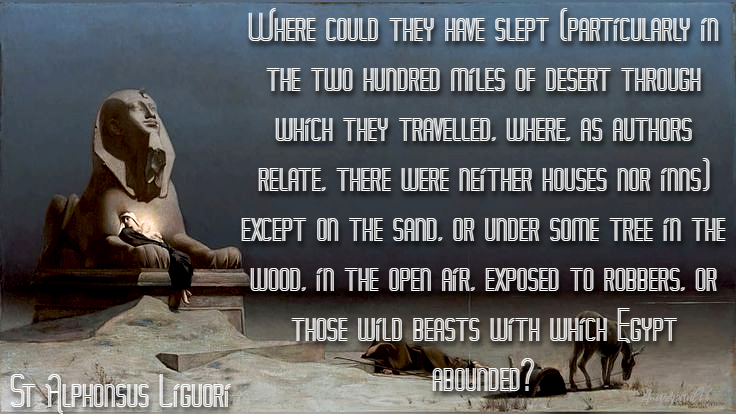
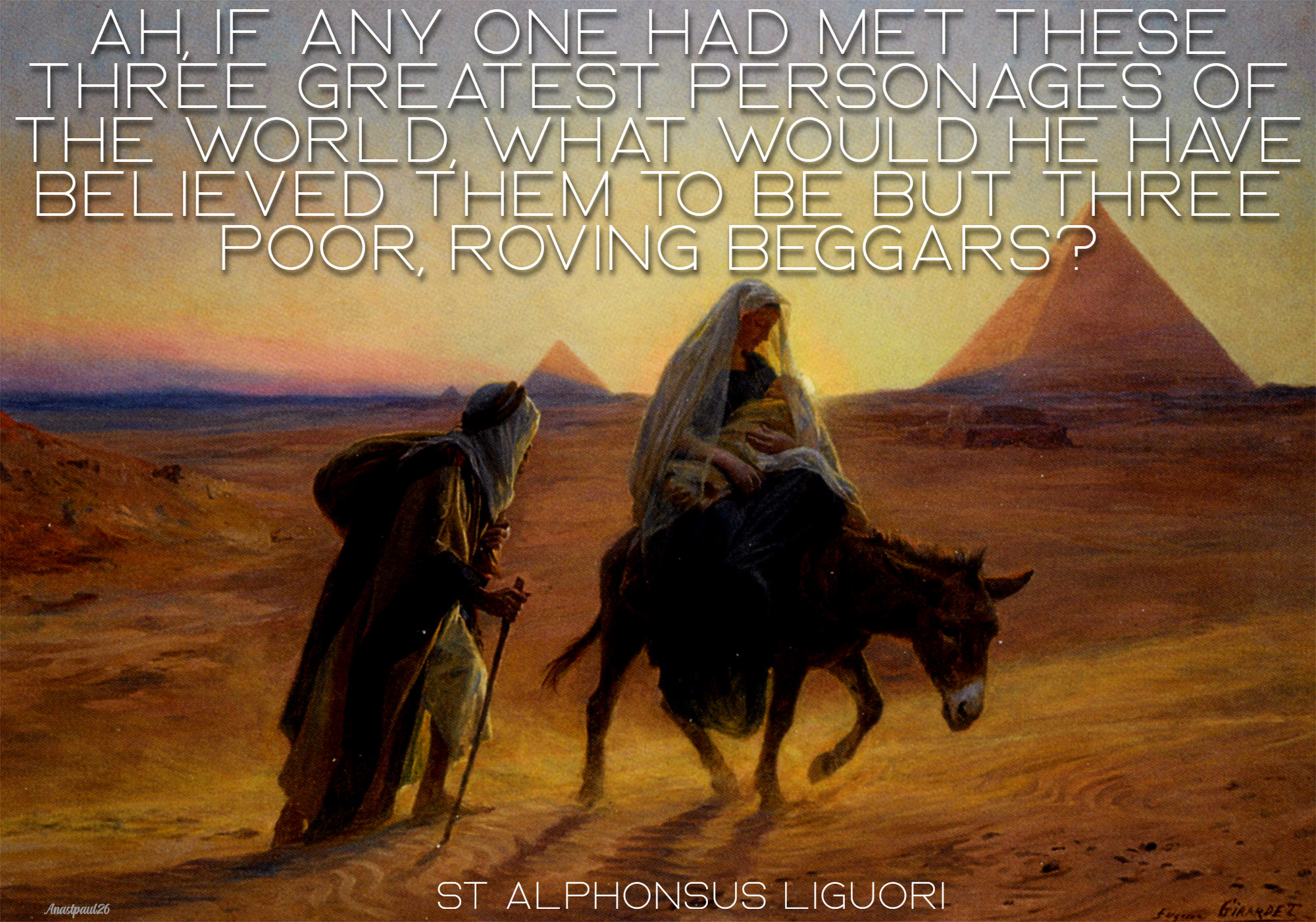
Every one can imagine how much Mary must have suffered on this journey. It was a long distance to Egypt. Authors generally agree with Barrada that it was four hundred miles; so that at least it was a journey of thirty days. The way, as St. Bonaventure describes it, was rough, unknown, through woods, and little frequented. The season was winter, and therefore they had to travel in snow, rain, wind, and storms, and through bad and difficult roads. Mary was then fifteen years of age, a delicate virgin, unaccustomed to such journeys. They had no servant to attend them. Joseph and Mary, said St. Peter Chrysologus, had no man servant nor maid-servant; they were themselves both masters and servants. Oh God, how piteous a spectacle it was to see that tender Virgin, with that newly born infant in her arms wandering through this world! St. Bonaventure asks, Where did they obtain food? Where did they rest at night? How were they lodged ? What other food could they have, than a piece of hard bread which Joseph brought with him or begged in charity? Where could they have slept (particularly in the two hundred miles of desert through which they travelled, where, as authors relate, there were neither houses nor inns) except on the sand, or under some tree in the wood, in the open air, exposed to robbers, or those wild beasts with which Egypt abounded? Ah, if any one had met these three greatest personages of the world, what would he have believed them to be but three poor, roving beggars?
They lived in Egypt, according to St. Anselm, Heliopolis, first called Memphis, and now Cairo. And here let us consider the great poverty they must have suffered for the seven years they were there, as St. Antoninus, St. Thomas, and others assert, They were foreigners, unknown, without revenues, without money, without kindred; hardly were they able to support them selves by their humble labors. As they were destitute, says St. Basil, it is manifest what effort they must have made to obtain there the necessaries of life. Moreover, Landolph of Saxony has written, and let it be repeated for the consolation of the poor, that so great was the poverty of Mary there, that sometimes she had not so much as a morsel of bread, when her Son, forced by hunger, asked it of her.
St. Matthew also relates that when Herod was dead, the angel again appeared, in a dream, to St. Joseph, and directed him to return to Judea. St. Bonaventure, speaking of his return, considers the greater pain of the blessed Virgin, on account of the sufferings which Jesus must have endured in that journey, having arrived at about the age of seven years an age, says the saint, when he was so large that he could not be carried, and so small that he could not go with out assistance.
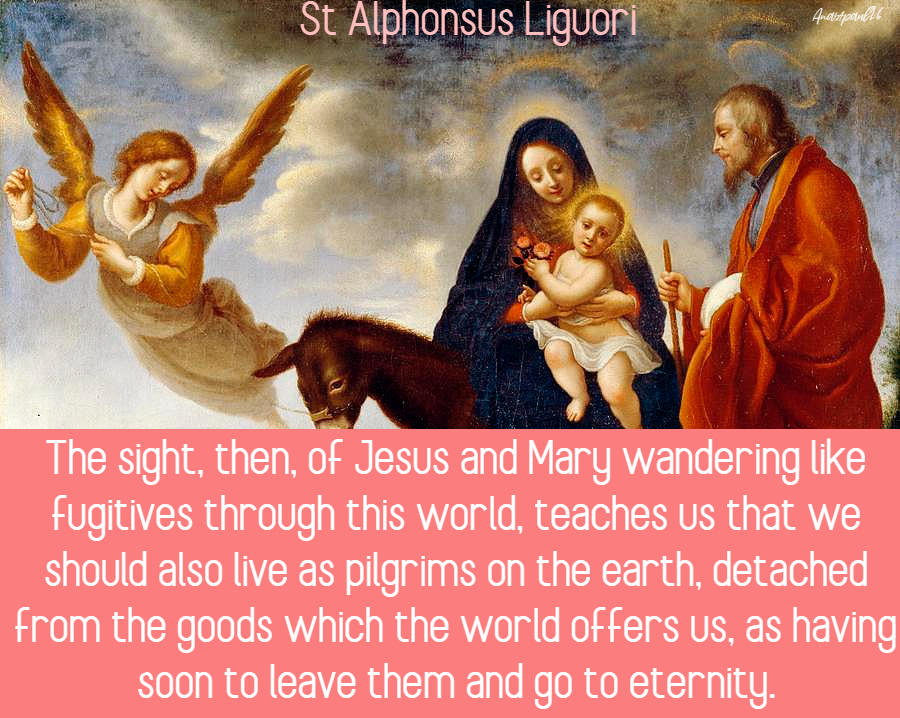
The sight, then, of Jesus and Mary wandering like fugitives through this world, teaches us that we should also live as pilgrims on the earth, detached from the goods which the world offers us, as having soon to leave them and go to eternity.

 AnaStpaul