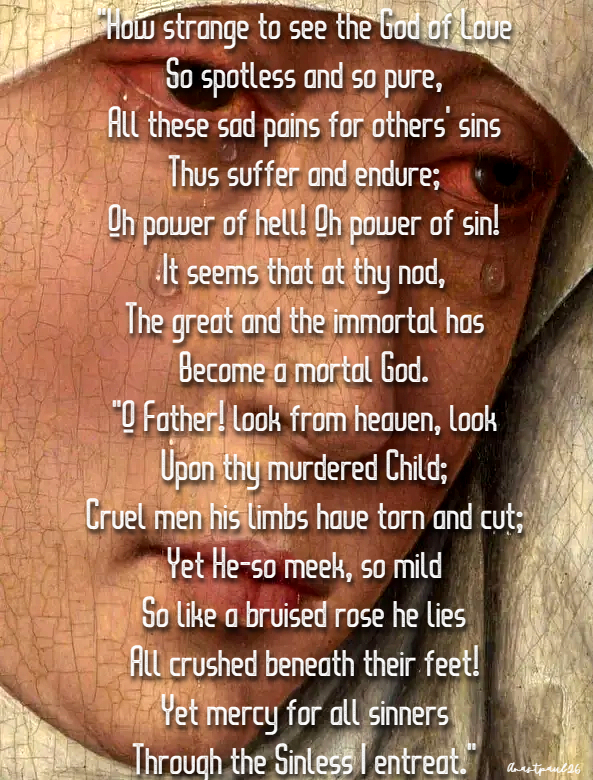
Posted in SEPTEMBER-The SEVEN SORROWS of MARY and The HOLY CROSS

Thought for the Day – 16 September – The Fifth Dolor

Reflections on each of the Seven Dolors of Mary by St Alphonsus Liguori

The Death of Jesus

And now we have to admire a new sort of martyrdom, a mother condemned to see an innocent son, whom she loved with all the affection of her heart, put to death before her eyes, by the most barbarous tortures. There stood by the cross of Jesus his mother: “Stabat autem juxta crucem mater ejus.” There is nothing more to be said, says St. John, of the martyrdom of Mary: behold her at the foot of the cross, looking on her dying Son, and then see if there is grief like her grief.

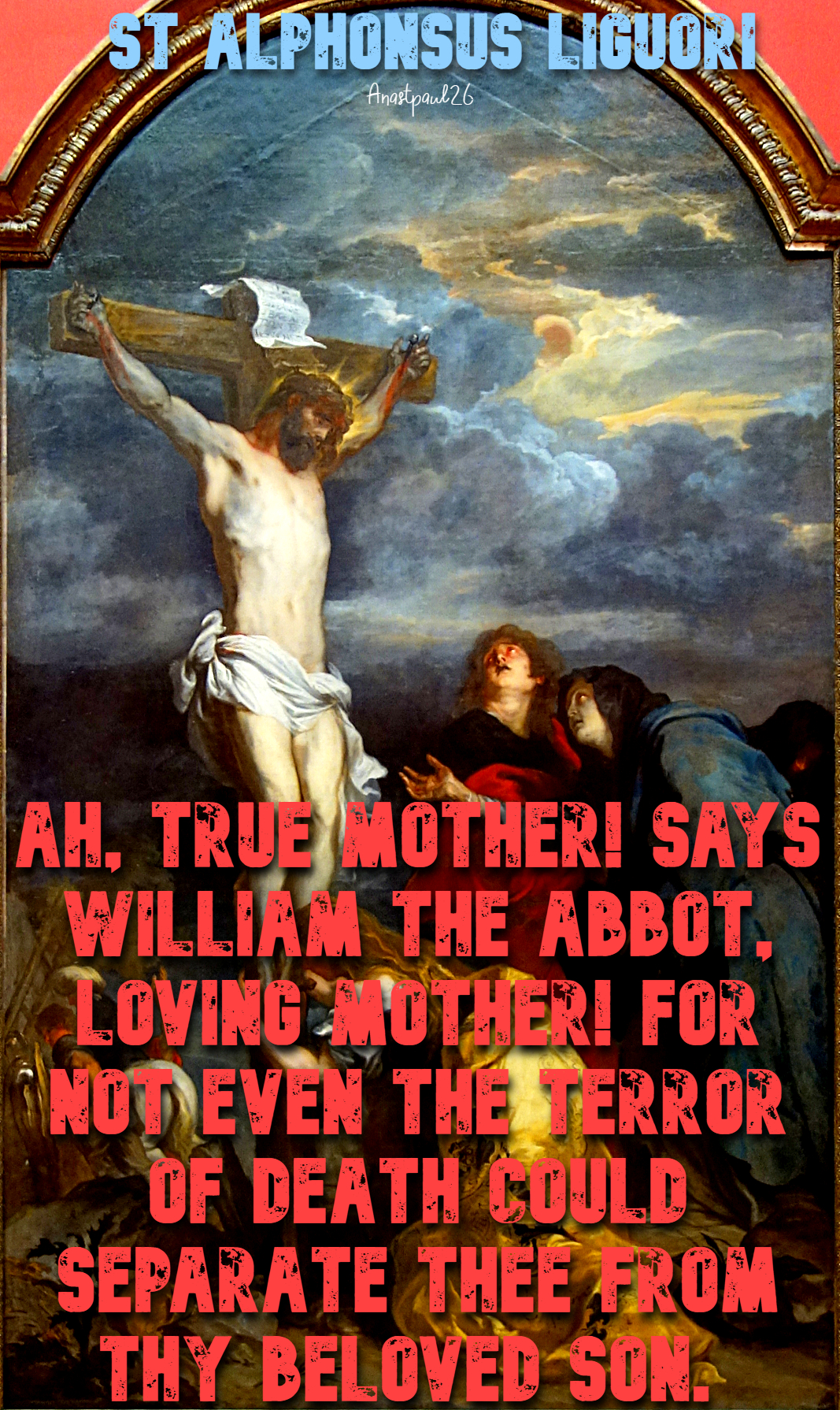
As soon as our afflicted Redeemer had ascended the hill of Calvary, the executioners stripped him of his garments, and piercing his sacred hands and feet with nails, not sharp, but blunt: “Non acutis, sed obtusis;” as St. Bernard says, and to torture him more, they fastened him to the cross. When they had crucified him, they planted the cross, and thus left him to die. The executioners abandon him, but Mary does not abandon him. She then draws nearer to the cross, in order to assist at his death. But what did it avail, oh Lady, says St. Bonaventure, to go to Calvary to witness there the death of this Son? Shame should have prevented thee, for his disgrace was also thine, because thou wast his mother; or, at least, the horror of such a crime as that of seeing a God crucified by his own creatures, should have prevented thee. But the saint himself answers: Thy heart did not consider the horror, but the suffering: “Non considerabat cor tuum horrorem, sed dolorem.” Ah, thy heart did not then care for its own sorrow, but for the suffering and death of thy dear Son; and therefore thou thyself didst wish to be near him, at least to compassionate him. Ah, true mother! says William the Abbot, loving mother! for not even the terror of death could separate thee from thy beloved Son. But, oh God, what a spectacle of sorrow, to see this Son then in agony upon the cross, and under the cross this mother in agony, who was suffering all the pain that her Son was suffering!

Mary also suffered all these pains of Jesus. Every torture inflicted on the body of Jesus, says St. Jerome, was a wound in the heart of the mother. Any one of us who should then have been on Mount Calvary, would have seen two altars, says St. John Chrysostom, on which two great sacrifices were consummating, one in the body of Jesus, the other in the heart of Mary. But rather would I see there, with St. Bonaventure, one altar only, namely, the cross alone of the Son, on which, with the victim, this divine Lamb, the mother also was sacrificed. 

Mothers fly from the presence of their dying children; but if a mother is ever obliged to witness the death of a child, she procures for him all possible relief; she arranges the bed, that his posture may be more easy; she administers refreshments to him; and thus the poor mother relieves her own sorrows. Ah, mother, the most afflicted of all mothers! oh Mary, it was decreed that thou shouldst be present at the death of Jesus, but it was not given to thee to afford him any relief. 

And what caused her the greatest sorrow was to see that, by her presence and her grief, she increased the sufferings of her Son. The sorrow itself, says St. Bernard, that filled the heart of Mary, in creased the bitterness of sorrow in the heart of Jesus. St. Bernard also says, that Jesus on the cross suffered more from compassion for his mother than from his own pains: he thus speaks in the name of the Virgin: I stood and looked upon him, and he looked upon me; and he suffered more for me than for himself. Passino writes that Jesus Christ himself, speaking one day to the blessed Baptista Varana, of Camerino, said to her, that he was so afflicted on the cross at the sight of his mother in such anguish at his feet, that compassion for his mother caused him to die without consolation. So that the blessed Baptista, being enlightened to know this suffering of Jesus, exclaimed: Oh my Lord, tell me no more of this thy sorrow, for I can not bear it.

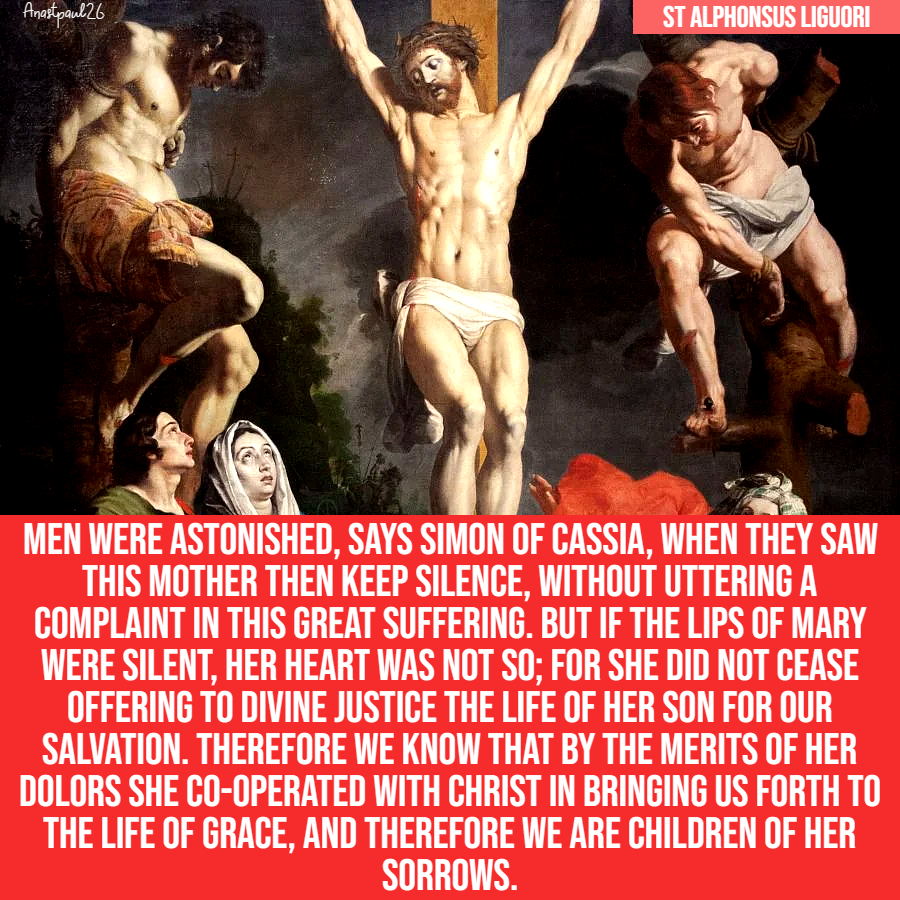
Men were astonished, says Simon of Cassia, when they saw this mother then keep silence, without uttering a complaint in this great suffering. But if the lips of Mary were silent, her heart was not so; for she did not cease offering to divine justice the life of her Son for our salvation. Therefore we know that by the merits of her dolors she co-operated with Christ in bringing us forth to the life of grace, and therefore we are children of her sorrows. And from that time Mary began to perform for us this office of a good mother; for, as St. Peter Damian declares, the penitent thief, through the prayers of Mary, was then converted and saved: Therefore the good thief repented, because the blessed Virgin, standing between the cross of her Son and that of the thief, prayed her Son for him; thus rewarding, by this favor, his former service. For as other authors also relate, this thief, in the journey to Egypt with the infant Jesus, showed them kindness; and this same office the blessed Virgin has ever continued, and still continues to perform.

Posted in SEPTEMBER-The SEVEN SORROWS of MARY and The HOLY CROSS

Thought for the Day – 13 September – On the Second Dolor

Reflections on each of the Seven Dolors of Mary by St Alphonsus Liguori

Of The Flight of Jesus Into Egypt

Herod having heard that the expected Messiah was born, foolishly feared that the new-born King would deprive him of his kingdom. Hence St. Fulgentius, reproving him for his folly, thus says: “Why, oh Herod, art thou that disturbed? This King who is born has not come to conquer kings by arms, but to subjugate them, in a wonderful manner, by his death.” The impious Herod, therefore, waited to learn from the holy magi where the King was born, that he might take from him his life; but finding himself deceived by the magi, he ordered all the infants that could be found in the neighborhood of Bethlehem to be put to death. But an angel appeared in a dream to St. Joseph, and said to him:” Arise, and take the child and his mother, and fly into Egypt.”

According to Gerson, immediately, on that very night, Joseph made this command known to Mary; and taking the infant Jesus, they commenced their journey, as it seems clearly from the Gospel itself: Who arose and took the child and his mother by night, and retired into Egypt.” And then the afflicted Mary knew that already the prophecy of Simeon, regarding her Son, was beginning to be verified: ” He is set for a sign which shall be contradicted.” Seeing that scarcely is he born,when he is persecuted to death. What suffering it must have been to the heart of Mary, writes St. John Chrysostom, to hear the tidings of that cruel exile of herself with her Son! Flee from thy friends to strangers, from the holy temple of the only true God, to the temples of demons. What greater tribulation than that a new-born child, clinging to its mother’s bosom, should be forced to fly with the mother herself!

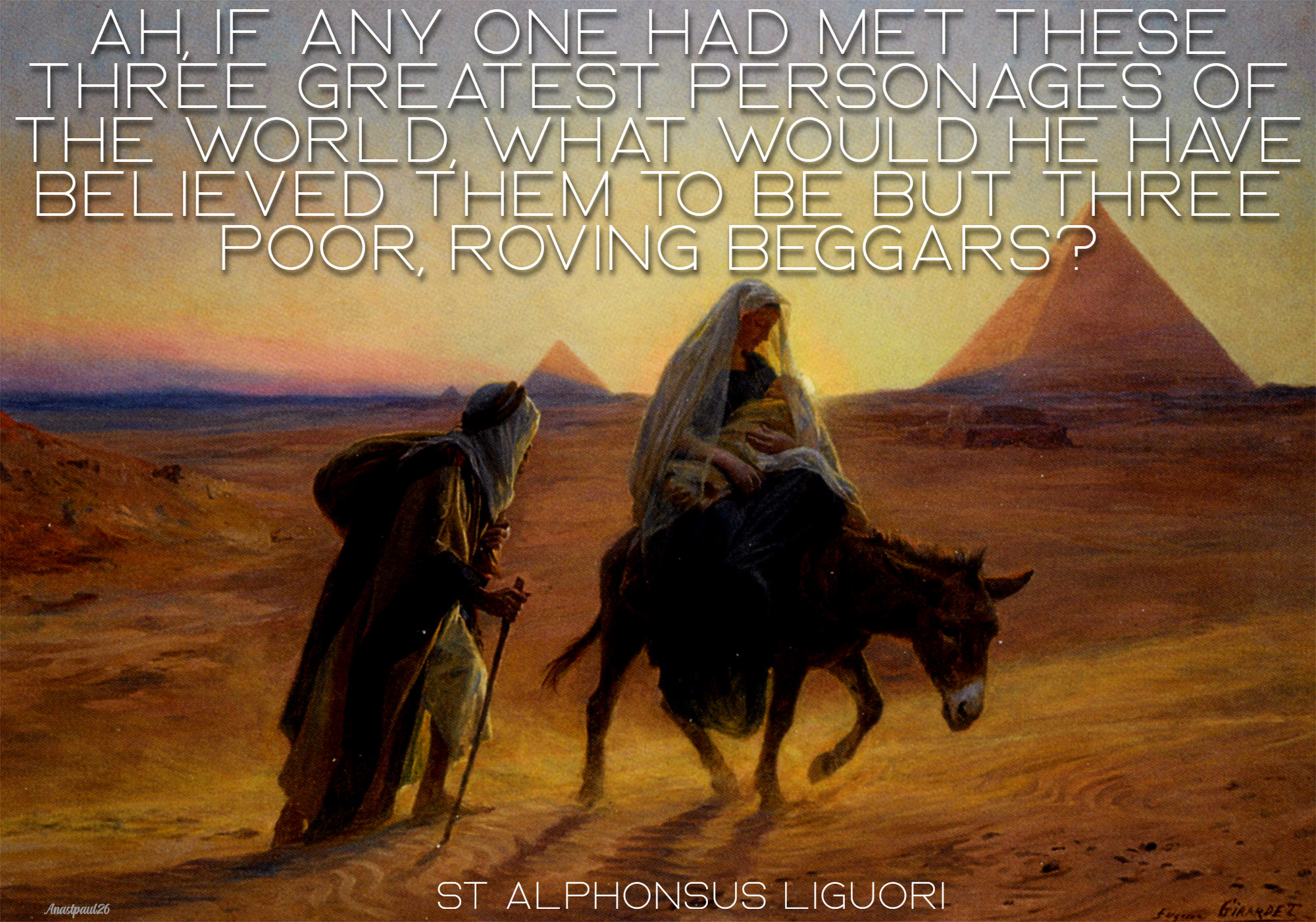
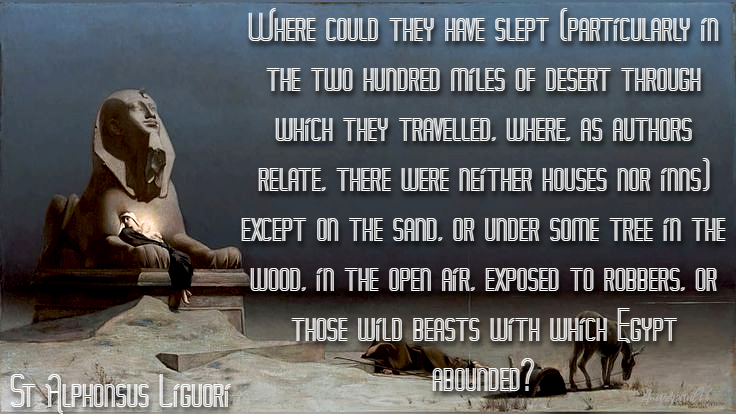
Every one can imagine how much Mary must have suffered on this journey. It was a long distance to Egypt. Authors generally agree with Barrada that it was four hundred miles; so that at least it was a journey of thirty days. The way, as St. Bonaventure describes it, was rough, unknown, through woods, and little frequented. The season was winter, and therefore they had to travel in snow, rain, wind, and storms, and through bad and difficult roads. Mary was then fifteen years of age, a delicate virgin, unaccustomed to such journeys. They had no servant to attend them. Joseph and Mary, said St. Peter Chrysologus, had no man servant nor maid-servant; they were themselves both masters and servants. Oh God, how piteous a spectacle it was to see that tender Virgin, with that newly born infant in her arms wandering through this world! St. Bonaventure asks, Where did they obtain food? Where did they rest at night? How were they lodged ? What other food could they have, than a piece of hard bread which Joseph brought with him or begged in charity? Where could they have slept (particularly in the two hundred miles of desert through which they travelled, where, as authors relate, there were neither houses nor inns) except on the sand, or under some tree in the wood, in the open air, exposed to robbers, or those wild beasts with which Egypt abounded? Ah, if any one had met these three greatest personages of the world, what would he have believed them to be but three poor, roving beggars?

They lived in Egypt, according to St. Anselm, Heliopolis, first called Memphis, and now Cairo. And here let us consider the great poverty they must have suffered for the seven years they were there, as St. Antoninus, St. Thomas, and others assert, They were foreigners, unknown, without revenues, without money, without kindred; hardly were they able to support them selves by their humble labors. As they were destitute, says St. Basil, it is manifest what effort they must have made to obtain there the necessaries of life. Moreover, Landolph of Saxony has written, and let it be repeated for the consolation of the poor, that so great was the poverty of Mary there, that sometimes she had not so much as a morsel of bread, when her Son, forced by hunger, asked it of her.

St. Matthew also relates that when Herod was dead, the angel again appeared, in a dream, to St. Joseph, and directed him to return to Judea. St. Bonaventure, speaking of his return, considers the greater pain of the blessed Virgin, on account of the sufferings which Jesus must have endured in that journey, having arrived at about the age of seven years an age, says the saint, when he was so large that he could not be carried, and so small that he could not go with out assistance.

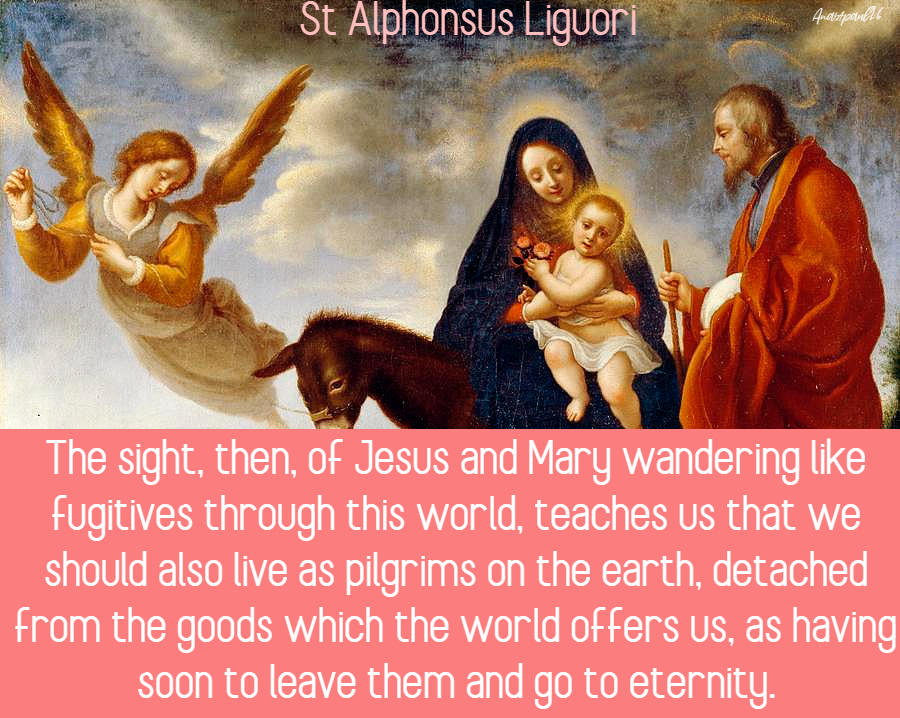
The sight, then, of Jesus and Mary wandering like fugitives through this world, teaches us that we should also live as pilgrims on the earth, detached from the goods which the world offers us, as having soon to leave them and go to eternity.

Posted in SEPTEMBER-The SEVEN SORROWS of MARY and The HOLY CROSS

Thought for the Day – 12 September – On the First Dolor

Reflections on each of the Seven Dolors of Mary by St Alphonsus Liguori

Saint Simeon’s Prophecy

In this valley of tears, every man is born to weep, and every one must suffer those afflictions that daily befall him. But how much more miserable would life be, if every one knew also the future evils which are to afflict him! Too unhappy would he be, says Seneca, whose fate was such. The Lord exercises his compassion towards us, namely, that he does not make known to us the crosses that await us; that if we are to suffer them, at least we may suffer them only once. But he did not exercise this compassion with Mary, who, because God wished her to be the queen of dolors, and in all things like his Son, and to see always before her eyes, and to suffer continually all the sorrows that awaited her; and those were the sufferings of the passion and death of her beloved Jesus. For St. Simeon in the temple, after having re ceived the divine child in his arms, predicted to her that this child was to be the mark for all the opposition and persecution of men; “Set for a sign which shall be contradicted;” and that therefore the sword of sorrow should pierce her soul: “And thy own soul a sword shall pierce.”

The holy Virgin herself said to St. Matilda, that at the announcement of St. Simeon all her joy was changed into sorrow. For, as it was revealed to St. Theresa, the blessed mother, although she knew before this that the life of her Son would be sacrificed for the salvation of the world, yet she then learned more particularly and distinctly the sufferings and cruel death that awaited her poor Son. She knew that he would be contradicted in all things.

When David, in the midst of all his pleasures and royal grandeur heard from Nathan the prophet, that his son should die “The child that is born to thee shall surely die” he could find no peace, but wept, fasted, and slept upon the ground. Mary received with the greatest calmness the announcement that her Son should die, and peacefully continued to submit to it; but what grief she must have continually suffered, seeing this amiable Son always near her, hearing from him words of eternal Iife and beholding his holy demeanor. Abraham suffered great affliction during the three days he passed with his beloved Isaac, after he knew that he was to lose him. Oh God ! not for three days, but for thirty three years, Mary had to endure a like sorrow. Like, do I say? A sorrow as much greater as the Son of Mary was more lovely than the son of Abraham. The blessed Virgin herself revealed to St. Bridget, that while she lived on the earth there was not an hour when this grief did not pierce her soul: As often, she continued, as I looked upon my Son, as often as I wrapped him in his swaddling clothes, as often as I saw his hands and his feet, so often was my soul overwhelmed as it were with a fresh sorrow, because I considered how he would be crucified. 

The evangelist says, that as Jesus Christ advanced in years, so also he advanced in wisdom and in grace with God and men. That is, he advanced in wisdom and in grace before men or in their estimation; and before God, according to St. Thomas, inasmuch as all his works would continually have availed to increase his merit, if from the beginning grace in its complete fulness had not been conferred on him by virtue of the hypostatic union. But if Jesus advanced in the esteem and love of others, how much more did he advance in Mary’s love! But oh God, as love increased in her, the more increased in her the grief of having to lose him by a death so cruel. And the nearer the time of the passion of her Son approached, with so much greater pain did that sword of sorrow, predicted by St. Simeon, pierce the heart of the mother; precisely this the angel revealed to St. Bridget, saying: “That sword of sorrow was every hour drawing nearer to the Virgin as the time for the passion of her Son drew nearer.”

If, then, Jesus our King and his most holy mother did not refuse, for love of us, to suffer during their whole life such cruel pains, there is no reason that we should complain if we suffer a little. Jesus crucified once appeared to sister Magdalene Orsini, a Dominican nun, when she had been long suffering a great trial, and encouraged her to remain with him on the cross with that sorrow that was afflicting her. Sister Magdalene answered him complainingly: “Oh Lord, thou didst suffer on the cross only three hours, but it is more than three years that I have been suffering this cross.” Then the Redeemer replied: “Ah! ignorant soul, what dost thou say? I, from the first moment I was conceived, suffered in heart what I afterwards suffered on the cross. ” If, then, we too suffer any affliction and complain, let us imagine that Jesus and his mother Mary are saying to us the same words.

Posted in Our MORNING Offering

Our Morning Offering – 11 September – Mother of Love, of Sorrow and of Mercy

Our Morning Offering – 4 September – “Month of the Seven Sorrows of the Blessed Virgin Mary

Mother of Love, of Sorrow and of Mercy
By St Bridget of Sweden (1303-1373)

O Blessed Virgin Mary,
Immaculate Mother of God,
who endured a martyrdom of love and grief,
beholding the sufferings and sorrows of Jesus!
Thou didst co-operate in the benefit of my redemption
by thy innumerable afflictions
and by offering to the Eternal Father,
His only-begotten Son, as a holocaust
and victim of propitiation for my sins.
I thank thee for the unspeakable love
which led thee to deprive thyself
of the Fruit of thy womb, Jesus,
true God and true Man, to save me, a sinner.
Oh! make use of the unfailing intercession
of thy sorrows with the Father and the Son,
that I may steadfastly amend my life
and never again crucify
my loving Redeemer by my sins
and that, persevering till death in His grace,
I may obtain eternal life
through the merits of His Cross and Passion.
Amen
Mother of love, of sorrow and of mercy, pray for us!

Posted in CATECHESIS, DYING / LAST WORDS, FEASTS and SOLEMNITIES, MARIAN REFLECTIONS, MATER DOLOROSA - Mother of SORROWS, QUOTES on CONSOLATION, QUOTES on COURAGE, St Francis de Sales, The PASSION, The SEVEN LAST WORDS of CHRIST

Thought for the Day – 15 September – ‘Her heart was crucified …’

Thought for the Day – 15 September – The Feast of the Seven Sorrows of the Blessed Virgin Mary – Our Lord’s Third Word … – By St Francis de Sales (1567-1622) Doctor Caritas

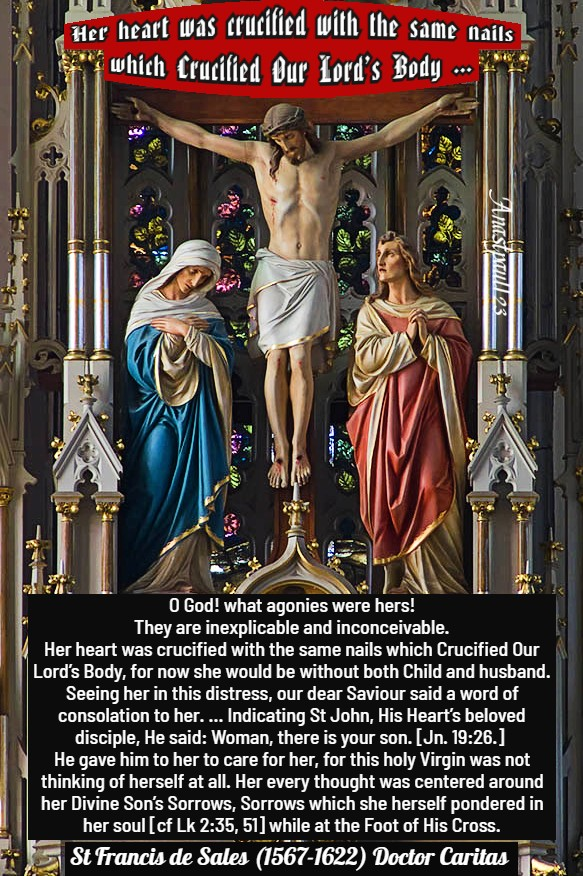
Her heart was crucified
with the same nails
which Crucified Our Lord’s Body …

OUR LORD’S THIRD WORD was one of consolation.
He spoke it to His sacred Mother who was at the foot of the Cross, pierced by a sword of sorrow [Lk 2:35] but certainly not swooning, nor with faint heart, as artists have falsely and impertinently painted her.
The Evangelist clearly says the contrary, insisting that she remained standing with an incomparable firmness [Jn.19:25].
That courage did not keep her from the grieving which she endured with the generous and magnanimous heart belonging to her alone.
O God! what agonies were hers!
They are inexplicable and inconceivable.
Her heart was crucified with the same nails which Crucified Our Lord’s Body, for now she would be without both Child and husband.

Seeing her in this distress, our dear Saviour said a word of consolation to her. But this consoling and tender word was not given to lift her heart from such great desolation.
The heart of this perfectly submissive and resigned holy Virgin needed to be extremely strong and Our Lord, Who knew her so well, dealt with her accordingly.
Indicating St John, His Heart’s beloved disciple, He said: Woman, there is your son. [Jn 19:26.] He gave him to her to care for her, for this holy Virgin was not thinking of herself at all. Her every thought was centered around her Divine Son’s Sorrows, Sorrows which she herself pondered in her soul [cf Lk 2:35, 51] while at the Foot of His Cross.
” – (Sermons of St Francis de Sales for or Lent).

Posted in FATHERS of the Church, MARIAN REFLECTIONS, MARY, MATER ECCLESIAE, MATER DOLOROSA - Mother of SORROWS, ONE Minute REFLECTION, Quotes on SALVATION, QUOTES on the CROSS of CHRIST, SEPTEMBER-The SEVEN SORROWS of MARY and The HOLY CROSS, The HOLY CROSS, The PASSION, The WORD

One Minute Reflection – 15 September – “Behold, thy mother” – John 19:27

One Minute Reflection – 15 September – “The Month of The Seven Sorrows of the Blessed Virgin Mary and The Holy Cross” and The Feast of the Seven Sorrows of the Blessed Virgin – Our Lady of Sorrows – Judith 13:22; 13:25, John 19:25-27 – Scripture search here:

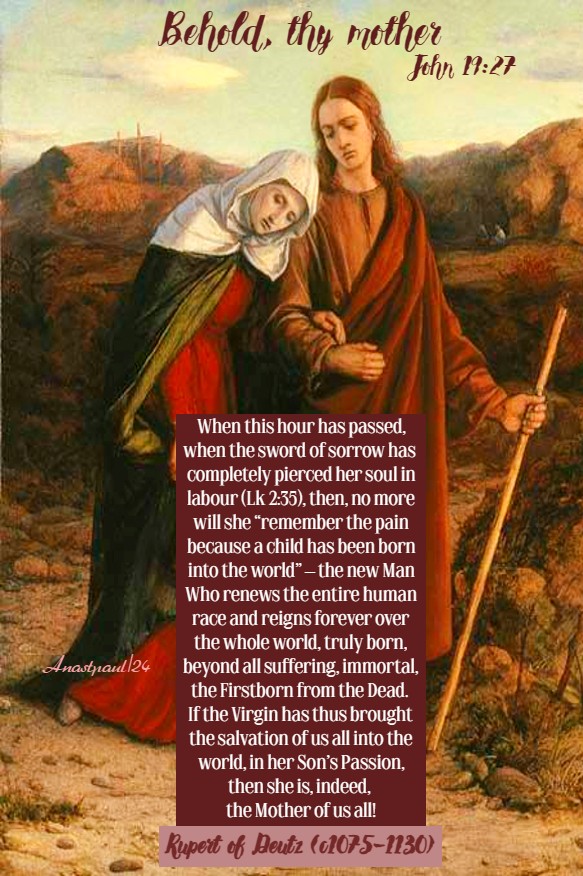
“Behold, thy mother” – John 19:27

REFLECTION – “Woman, this is thy son. This is thy mother.” By what right is the disciple. whom Jesus loved, the son of the Lord’s mother? By what right is she his mother? By the fact that, without pain, she brought into the world the salvation of us all, when she gave birth in the flesh to the God-Man. But now, she is in labour, with great pain as she stands at the foot of the Cross!

At the hour of His Passion, the Lord Himself rightly compared the Apostles to a woman in childbirth, when He said: “When a woman is in labour she is in anguish because a child is born into the world” (cf Jn 16:21). How much more, then, might such a Son compare such a Mother, the Mother standing at the foot of His Cross, to a woman in labour? What am I saying? “Compare?” She is indeed truly a woman and truly a mother and, at this hour, she is truly experiencing the pains of childbirth. When her Son was born she did not experience the anguish of giving birth in pain as other women do; it is now that she is suffering, that she is crucified, that she experiences sorrow; like a woman in labour because her hour has come ( Jn 16:21; cf 13:1; 17:1). …

When this hour has passed, when the sword of sorrow has completely pierced her soul in labour (Lk 2:35), then, no more will she “remember the pain because a child has been born into the world” – the new Man Who renews the entire human race and reigns forever over the whole world, truly born, beyond all suffering, immortal, the Firstborn from the Dead. If the Virgin has thus brought the salvation of us all into the world, in her Son’s Passion, then she is, indeed, the Mother of us all! – Rupert of Deutz (c1075-1130) Benedictine Monk, Theologian, Exegete and Writer – (Commentary on Saint Johns Gospel, 13).

PRAYER – O God, in Whose Passion the sword, according to the prophecy of blessed Simeon, pierced through the soul of Mary, the glorious Virgin and Mother, mercifully grant that we, who reverently commemorate her piercing through and her suffering, may, by the interceding glorious merits of all the Saints faithfully standing by the Cross, obtain the abundant fruit of Thine Passion. Who lives and reigns with God the Father, in the unity of the Holy Ghost, God, world without end. Amen (Collect).

Posted in INDULGENCES, MATER DOLOROSA - Mother of SORROWS, PRAYERS on the CROSS of CHRIST, QUOTES on CHARITY, QUOTES on SUFFERING, QUOTES on the CROSS of CHRIST, SEPTEMBER-The SEVEN SORROWS of MARY and The HOLY CROSS, The HOLY CROSS, The PASSION, The SIGN of the CROSS

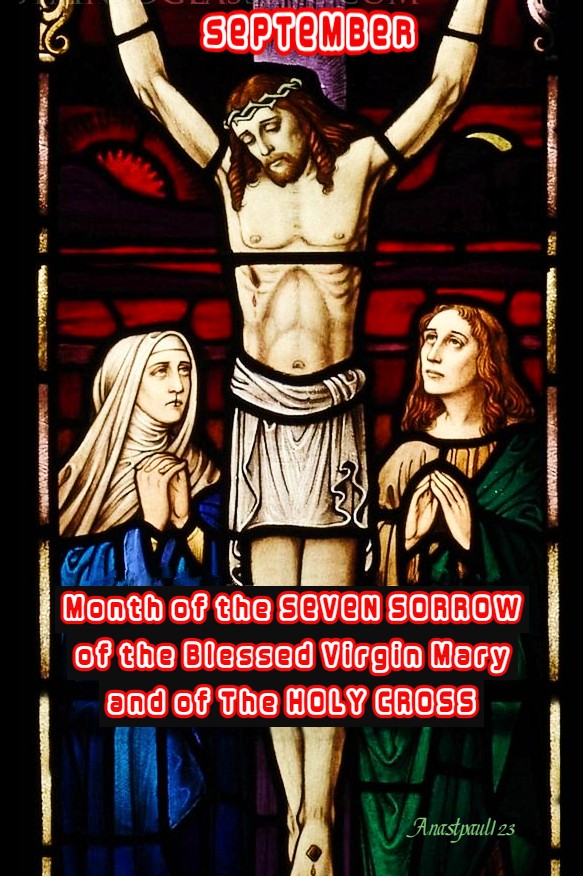
SEPTEMBER – Month of the Seven Sorrows of the Blessed Virgin Mary and The Holy Cross

SEPTEMBER

Month of The Seven Sorrows
of the Blessed Virgin Mary and
The Holy Cross

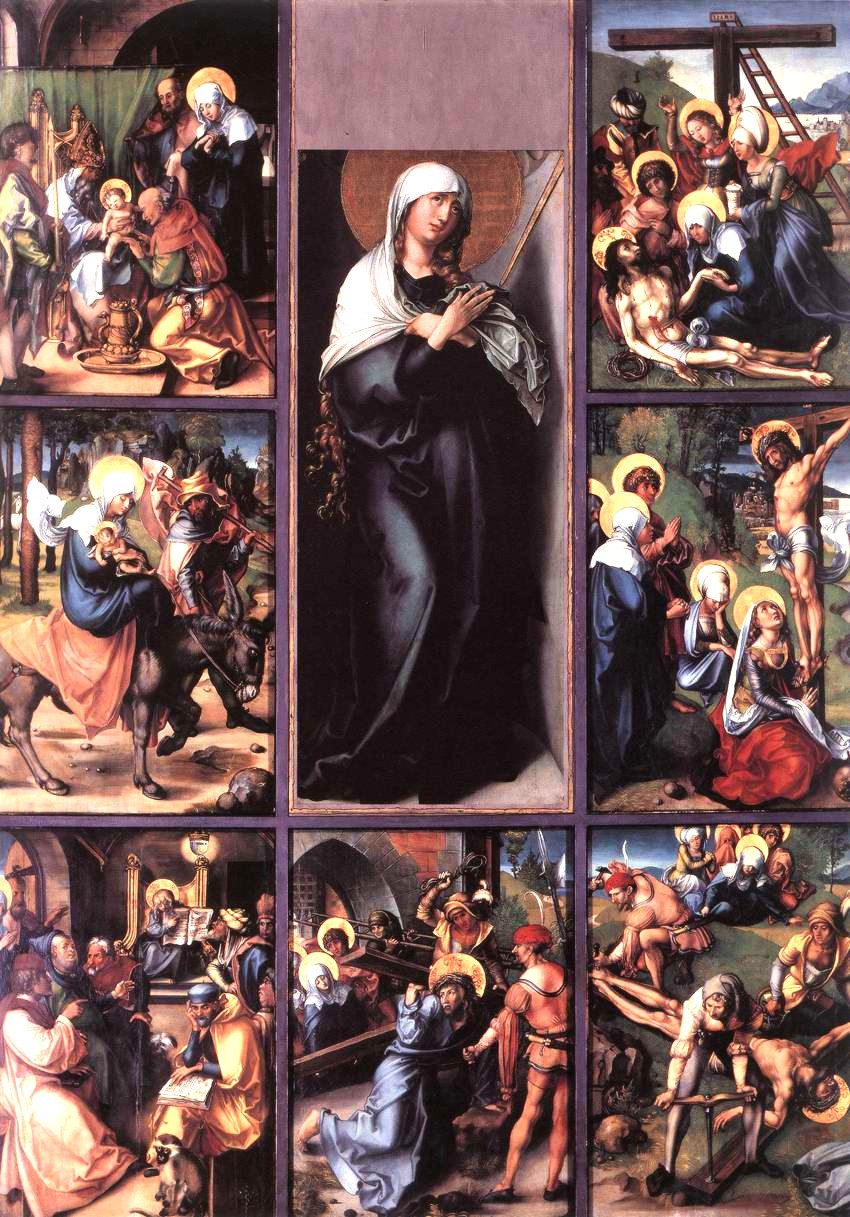
The Seven Sorrows of
the Blessed Virgin Mary

1, The prophecy of Simeon
2. The Flight to Egypt
3. Loss of Child Jesus for 3 days
4. Meeting Jesus carrying His Cross
5. The Crucifixion of Jesus
6. The Pieta – receiving Jesus’ Body
The Burial of Jesus

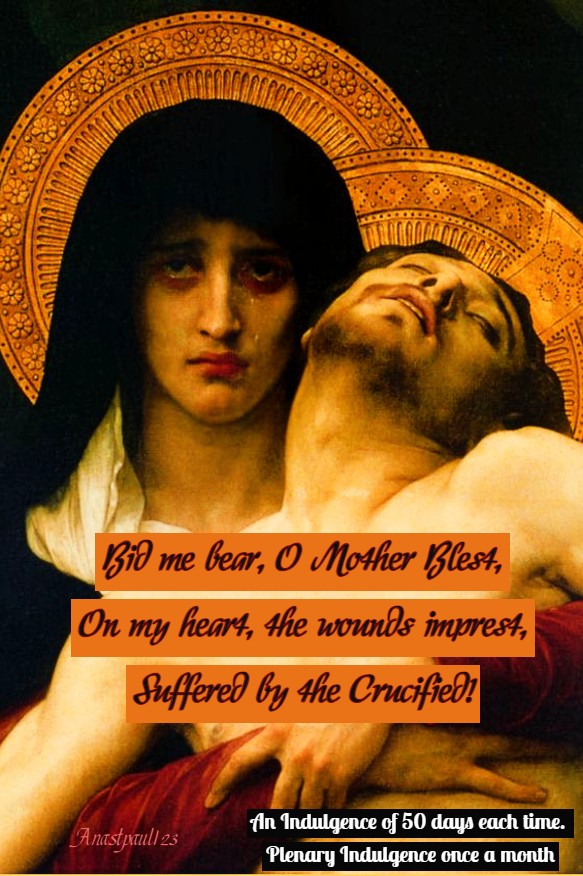
Bid me bear, O Mother Blest,
On my heart, the wounds imprest,
Suffered by the Crucified!

An Indulgence of 50 days each time.
Plenary Indulgence once a month under the usual conditions.

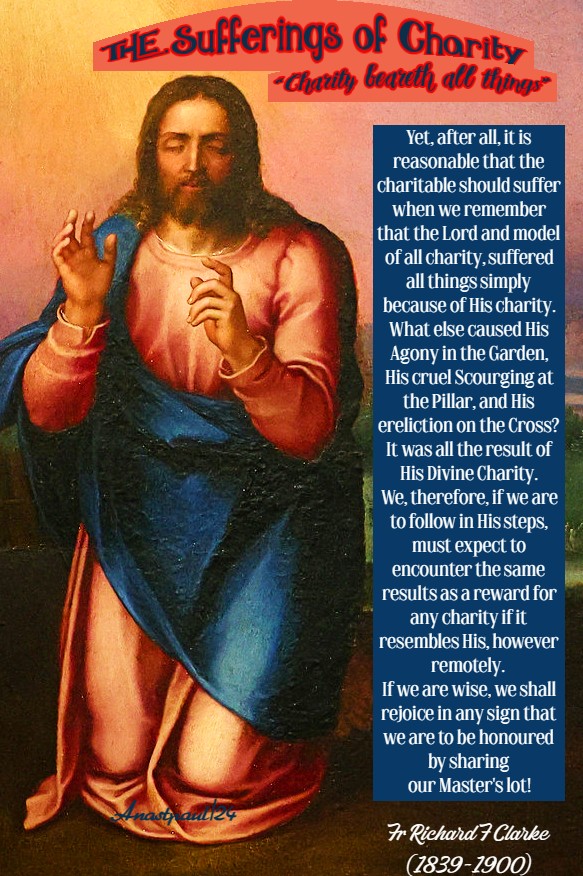
Yet, after all, it is reasonable that the charitable should suffer when we remember that the Lord and model of all charity, suffered all things simply because of His charity. What else caused His Agony in the Garden, His cruel Scourging at the Pillar, and His dereliction on the Cross? It was all the result of His Divine Charity.
We, therefore,, if we are to follow in His steps, must expect to encounter the same results as a reward for any charity if it resembles His, however remotely. If we are wise, we shall rejoice in any sign that we are to be honoured by sharing our Master’s lot!
Fr Richard Frederick Clarke SJ (1839-1900)

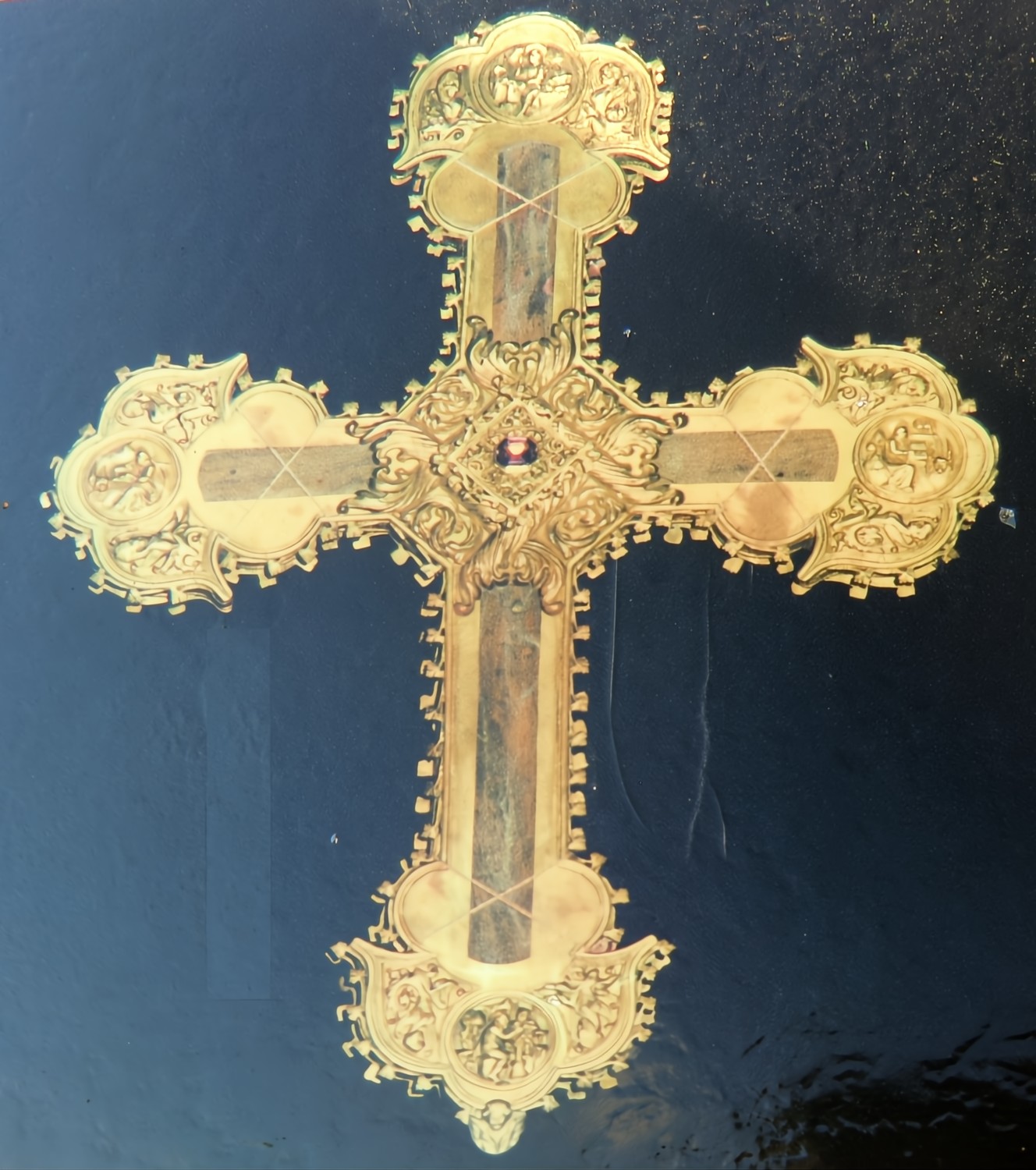
Relic of the Holy Cross