Posted in MARIAN TITLES

Notre-Dame de Piedmont / Our Lady of Pignerol, Savoy, France (1098) and Memorials of the Saints – 15 November

Notre-Dame de Piedmont / Our Lady of Pignerol, Savoy, France (1098) – 15 November:
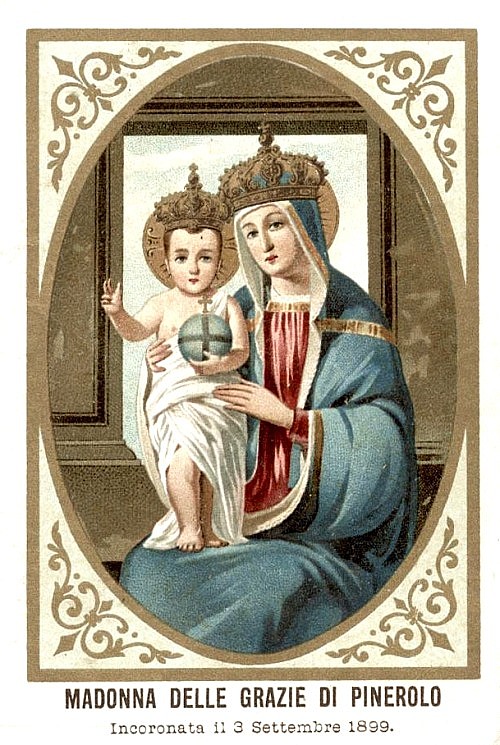
Our Lady of Pignerol, is also known as Our Lady of Pinerolo, Notre-Dame de Piedmont and Madonna delle Grazie di Pinerolo. The Shrine was built in honour of the Assumption of the Blessed Virgin in the year 1098, by Adelaide, Countess of Savoy. It is a National Shrine of Savoy.

Pinerolo is a Town in northern Italy near Turin in a region historically known as Savoy, which was annexed to France. The Town itself began just over 1,000 years ago, due to its central location along a trade route that ran between France and Italy.

The pious and far-seeing Countess anticipated, by almost one thousand years, the Dogma of the Assumption of Our Lady. Mary was publicly honoured under this beloved title and frequently repaid the generosity of her devout Adelaide, by answering the pleas of her children, crying to her for help in every need. Answering their prayers, curing their ills and obtaining miracles for the faithful, where human aid was despaired of,but where faith always conquered. When the Assumption of Our Lady was proclaimed a Dogma, the rejoicing at the Pignerolo Shrine was indescribable.

Pope Pius XII, on 1 November 1950, solemnly proclaimed:

“By the authority of Our Lord Jesus Christ, of the Blessed Apostles Peter and Paul and by our own authority, we pronounce, declare and define it to be a divinely revealed Dogma: that the Immaculate Mother of God, the ever Virgin Mary, having completed the course of her earthly life, was assumed body and soul into heavenly glory.”

Although this declaration of Pope Pius XII was made “ex cathedra,” belief in the Assumption of the Blessed Virgin Mary was a commonly held belief among early Catholics and the Fathers of the Church. In the Apocalypse of Saint John, Chapter 12, the woman mentioned is said to be an allusion to both the Church and our Blessed Mother:

“And a great sign appeared in heaven – A woman clothed with the sun,and the moon under her feet and on her head a crown of twelve stars; and being with child, she cried travailing in birth and was in pain to be delivered.”

This passage is generally interpreted as the church being clothed with the Son, or Son of God, while Our Lady has the moon beneath her feet, representing the things of the material world. She is crowned with 12 stars, the Apostles and is in labour to bring forth the children of God, amidst a world full of affliction and misery.

The shrine celebrates Our Lady annually on 15 November.
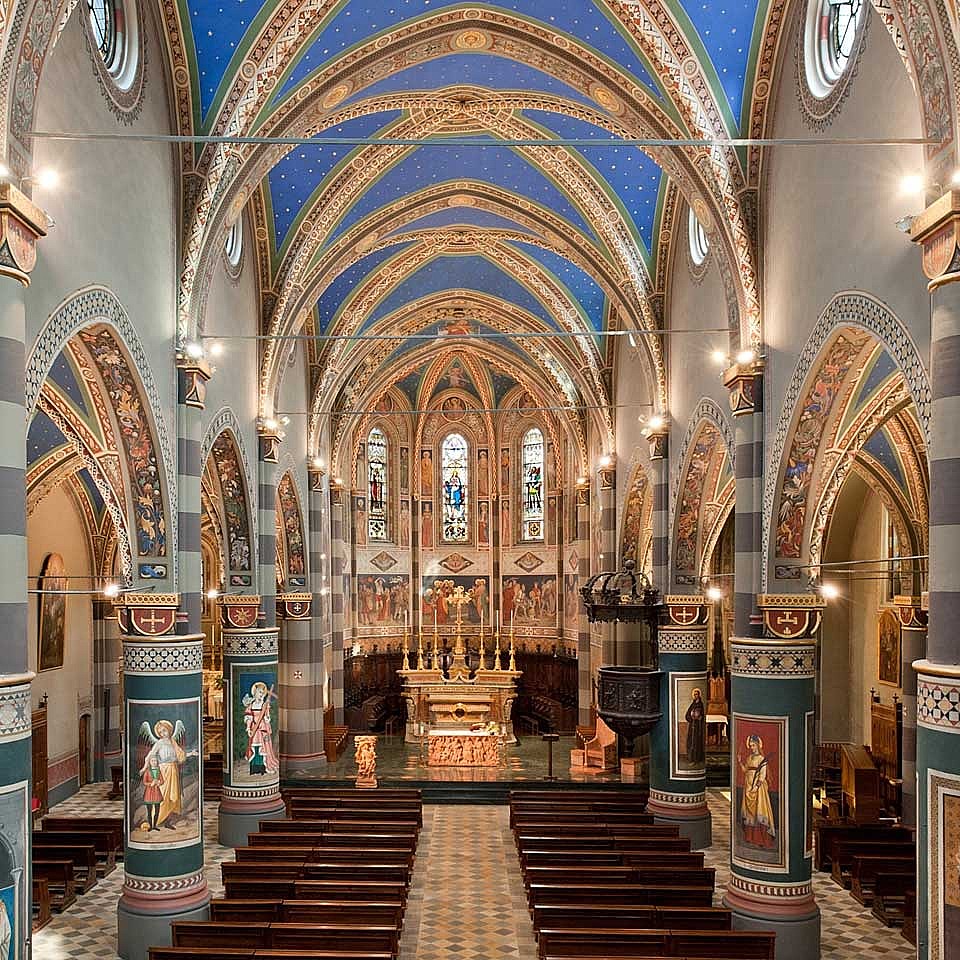
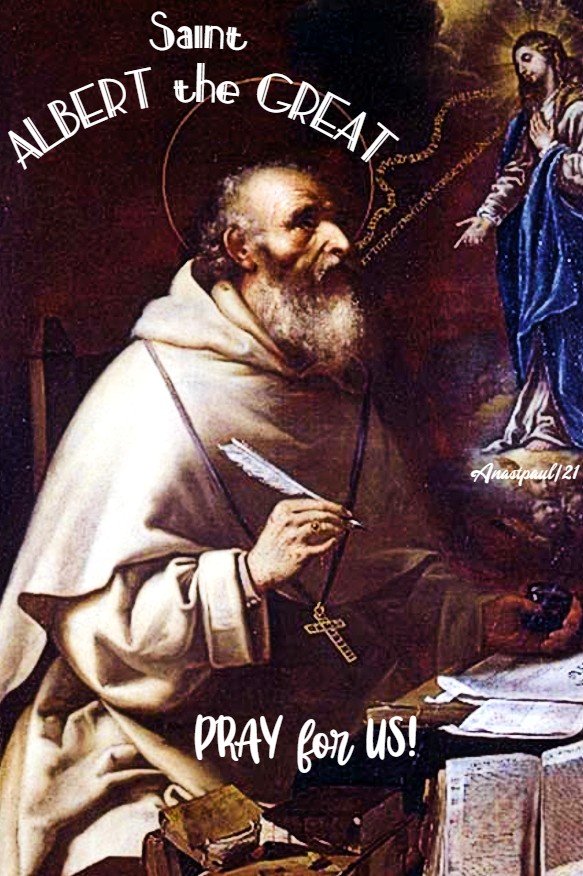
St Albertus Magnus OP (1200-1280) Doctor of the Church – Doctor Universalis (Universal Doctor) – Priest and Friar of the Order of Preachers, Bishop, Theologian, Scientist, Philospher, Teacher, Writer.

St Anianus of Wilparting
St Arnulf of Toul
Bl Caius of Korea
St Desiderius of Cahors
St Eugene of Toledo
St Felix of Nola
St Findan
St Fintan the Missionary
St Gurias of Edessa
Bl Hugh Faringdon
Bl John Eynon
Bl John Rugg
Bl John Thorne
St Joseph Mukasa

St Leopold III/Leopold the Good ( 1073 – 1136) “Leopold the Good,” Margrave of Austria.

Blessed Lucia (Lucy) of Narni OP (1476-1544) Virgin, Tertiary of the Order of Preachers, Mystic, Stigmatist, Her body is incorrupt.

St Luperius of Verona
St Machudd of Llanfechell
St Malo of Aleth
St Marinus of Wilparting

Bl Miguel Díaz Sánchez
St Paduinus of Le Mans
Bl Richard Whiting
Bl Roger James
St Shamuna of Edessa
St Sidonius of Saint-Saens
—
Martyrs of Hippo – 20 saints: 20 Christians martyred together and celebrated by Saint Augustine. The only details about them to survive are three of the names – Fidenziano, Valerian and Victoria. Hippo, Numidia (in north Africa).

Martyrs of North Africa – 3 saints: A group of Christians murdered for their faith in imperial Roman north Africa. The only details that have survived are the names of three of them – Fidentian, Secundus and Varicus.
Posted in SAINT of the DAY

Saint of the Day – 15 November – Blessed John Rugg

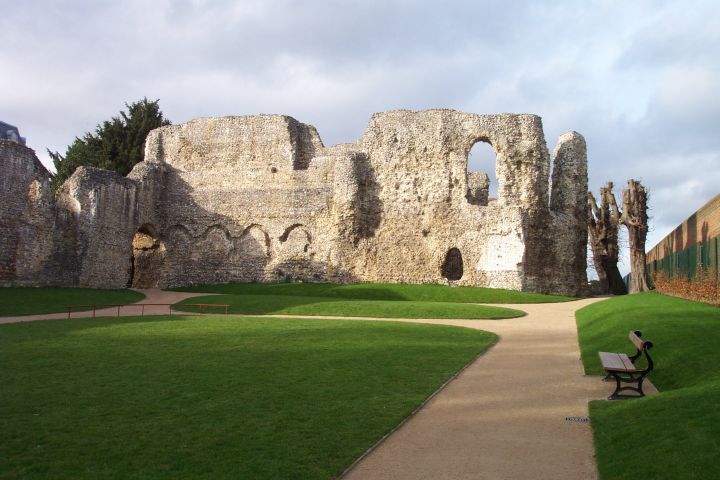
Blessed John Rugg was a martyr, priest and former fellow of the two Saint Mary Winton colleges during the reign of Henry the Eighth. He was the first holder of the Wykehamical prebend “Bursalis” at the Chichester Cathedral. Obtaining a dispensation from residence, John was living as a Benedictine monk at Reading, Berkshire in 1532.

Blessed John hid the hand of Saint Anastasius, a relic housed in the cathedral, when the king’s men seized the relics in the Reading abbey, and which was rediscovered during renovations in 1786. Rugg was arrested with Abbot Hugh and another priest, Blessed John Eynon, and all three were condemned for treason—that is, for refusing to accept the royal supremacy and for upholding the Catholic faith and the Holy See.

The ruins of Reading abbey

He was dragged through the streets, then hanged, drawn, and quartered on 15 November 1539 at the main abbey gateway in Reading, Berkshire. His body was left to rot in his chains as a warning for others. It was removed by locals and buried at Bere Court before his relics were re-interred in the 16th century.

He was beatified in 13 May 1895 by Pope Leo XIII.

But that lofty glory of so great a man must not be passed over without announcement, that now, when the world was swelling, and of its trust in its princes breathing out hatred of the Name, he was instructing God’s servants, as opportunity was given, in the exhortations of the Lord, and was animating them to tread under foot the sufferings of this present time by the contemplation of a glory to come hereafter.

Life and Passion of St Cyprian

Posted in Our MORNING Offering

Our Morning Offering – 15 November – Inflame our Hearts with Your Love

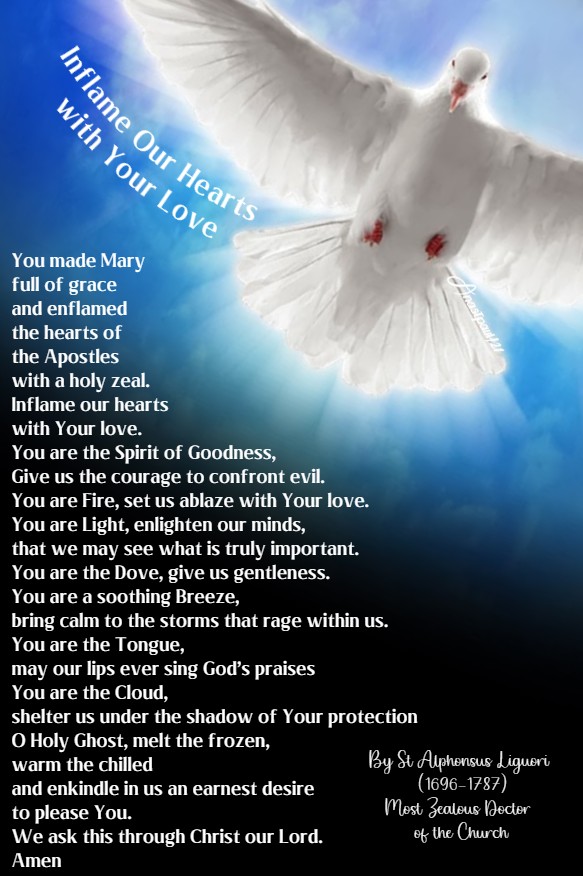
Inflame our Hearts with Your Love
Prayer To the Holy Spirit
By St Alphonsus Maria de Liguori (1696-1787)
Most Zealous Doctor of the Church

You made Mary full of grace
and enflamed the hearts of the Apostles
with a holy zeal.
Inflame our hearts with Your love.
You are the Spirit of Goodness,
Give us the courage to confront evil.
You are Fire, set us ablaze with Your love.
You are Light, enlighten our minds,
that we may see what is truly important.
You are the Dove, give us gentleness.
You are a soothing Breeze,
bring calm to the storms that rage within us.
You are the Tongue,
may our lips ever sing God’s praises
You are the Cloud,
shelter us under the shadow of Your protection
O Holy Ghost, melt the frozen,
warm the chilled
and enkindle in us an earnest desire
to please You.
We ask this through Christ our Lord.
Amen

Posted in ONE Minute REFLECTION

One Minute Reflection – 15 November – The word of God is a grain of mustard seed

One Minute Reflection – 15 November – Readings: Jer 29:11-12; 29:14, Ps 84:2, 1 Thess. 1:2-10, Matt 13:31-35

The kingdom of heaven is like a grain of mustard seed, which a man took and sowed in his field. This indeed is the smallest of all the seeds; but when it grows up it is larger than any herb and becomes a tree, so that the birds of the air come and dwell in its branches.

Matt 13:31-35

REFLECTION – The Word of God is like a grain of mustard seed: before cultivation it looks extremely small. But when it is cultivated in the right way it grows so large that the highest principles of both sensible and intelligible creation come like birds to revive themselves in it. For the principles – or inner essences of all things are embraced by the Word, but the Word is not embraced by anything. Hence the Lord has said that whoever has faith like a grain of mustard seed can move a mountain by a word of command, that is, he can destroy the devil’s dominion over us and remove it from its foundation.

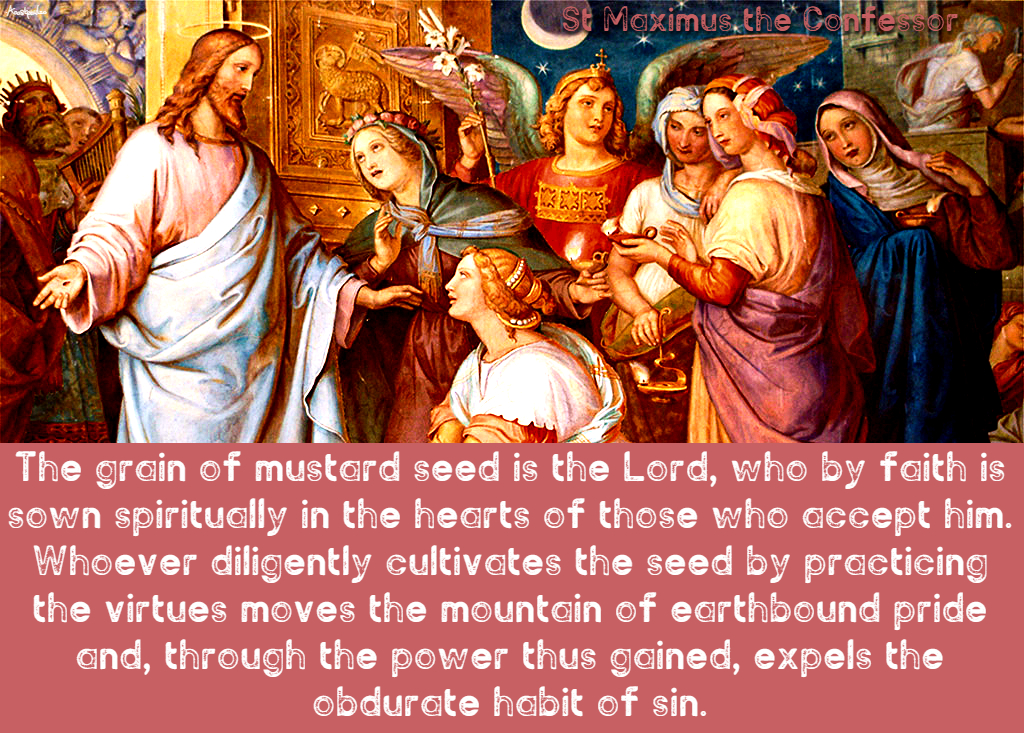
The grain of mustard seed is the Lord, who by faith is sown spiritually in the hearts of those who accept him. Whoever diligently cultivates the seed by practicing the virtues moves the mountain of earthbound pride and, through the power thus gained, expels the obdurate habit of sin. In this way the activity of the principles and qualities, or divine powers, present in the commandments is revived as though they were birds. Those who seek the Lord should not look for him outside themselves. On the contrary, they must seek him within themselves through faith made manifest in action.

For it is written: “The word is very near to you, in your mouth and in your heart”, that is, the word of faith, Christ being himself the word that is sought.

St Maximus the Confessor

PRAYER – Lord God, You made St Albert great by his gift for reconciling human wisdom with divine faith. Help us so to follow his teaching that every advance in science may lead us to a deeper knowledge and love of You. May his prayers on our behalf be a succour to us all. Through our Lord Jesus Christ with the Holy Spirit, one God for all eternity, amen.

Posted in CATHOLIC Quotes

Quote/s of the Day – 15 November– St Albert the Great

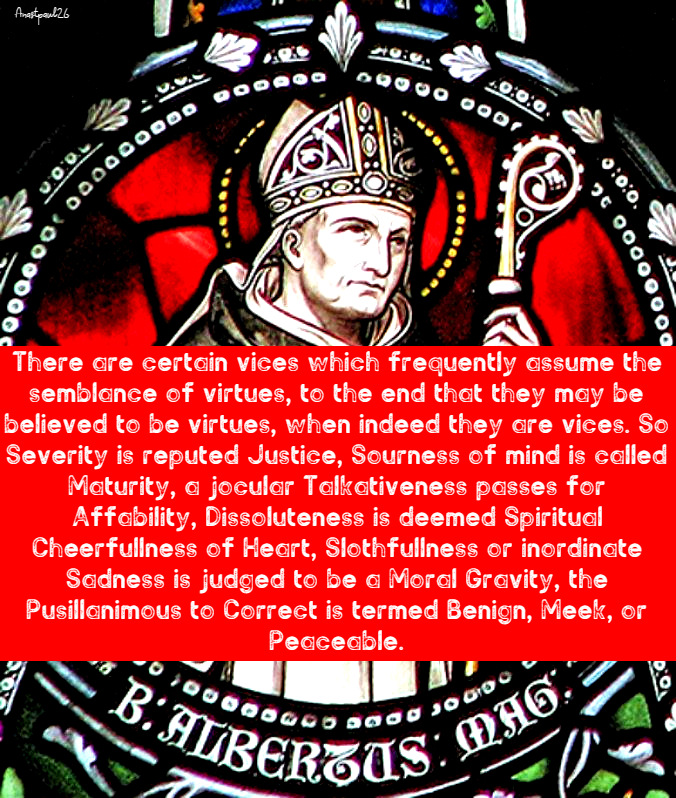
There are certain vices which frequently assume the semblance of virtues, to the end that they may be believed to be virtues, when indeed they are vices. So Severity is reputed Justice, Sourness of mind is called Maturity, a jocular Talkativeness passes for Affability, Dissoluteness is deemed Spiritual Cheerfullness of Heart, Slothfullness or inordinate Sadness is judged to be a Moral Gravity, the Pusillanimous to Correct is termed Benign, Meek, or Peaceable.

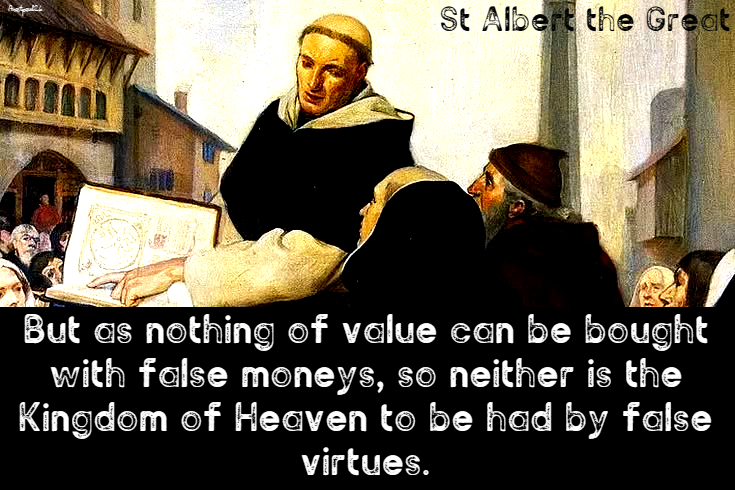
But as nothing of value can be bought with false moneys, so neither is the Kingdom of Heaven to be had by false virtues.

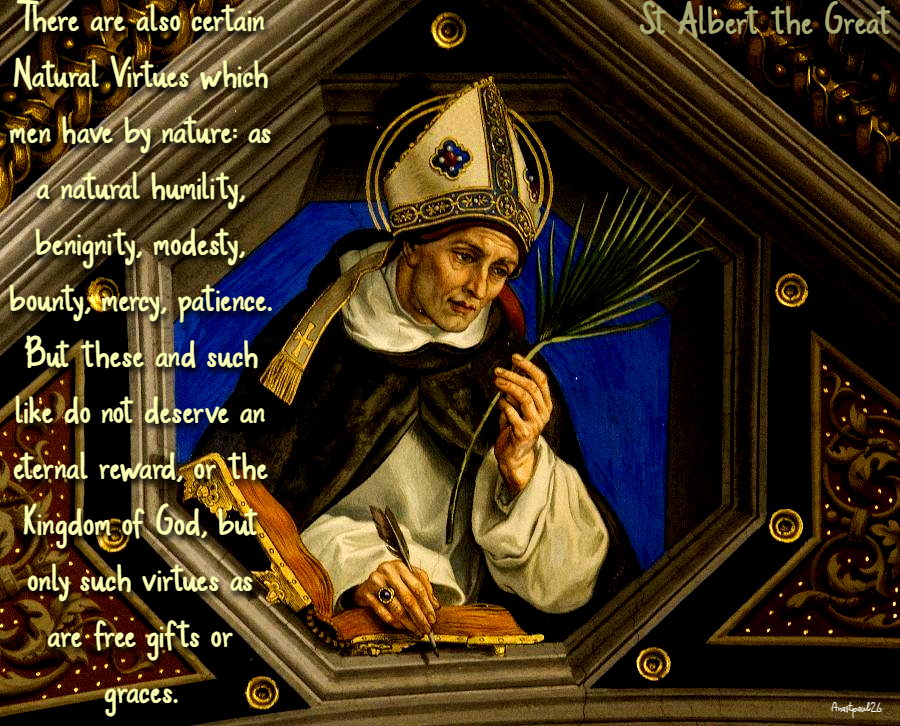
There are also certain Natural Virtues which men have by nature: as a natural humility, benignity, modesty, bounty, mercy, patience. But these and such like do not deserve an eternal reward, or the Kingdom of God, but only such virtues as are free gifts or graces.

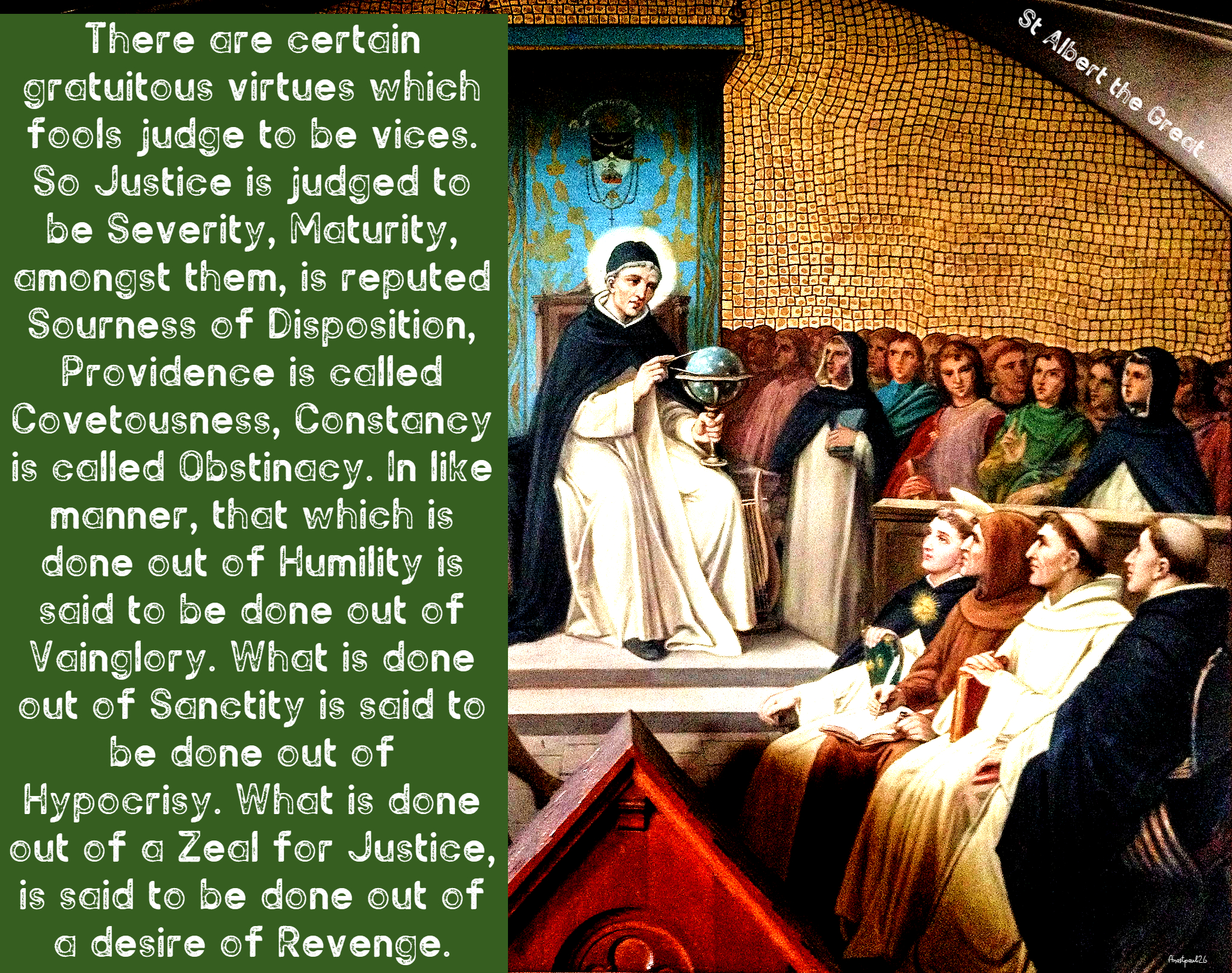
There are certain gratuitous virtues which fools judge to be vices. So Justice is judged to be Severity, Maturity, amongst them, is reputed Sourness of Disposition, Providence is called Covetousness, Constancy is called Obstinacy. In like manner, that which is done out of Humility is said to be done out of Vainglory. What is done out of Sanctity is said to be done out of Hypocrisy. What is done out of a Zeal for Justice, is said to be done out of a desire of Revenge.

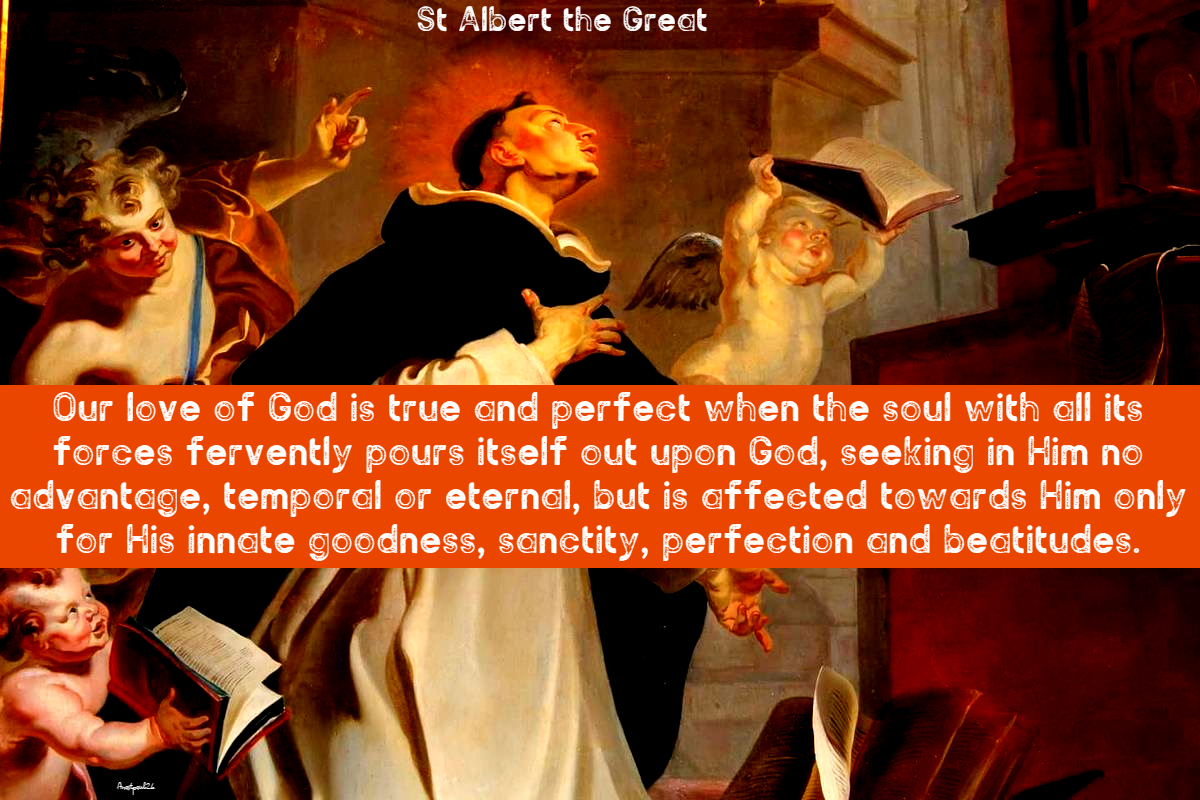
Our love of God is true and perfect when the soul with all its forces fervently pours itself out upon God, seeking in Him no advantage, temporal or eternal, but is affected towards Him only for His innate goodness, sanctity, perfection and beatitudes.

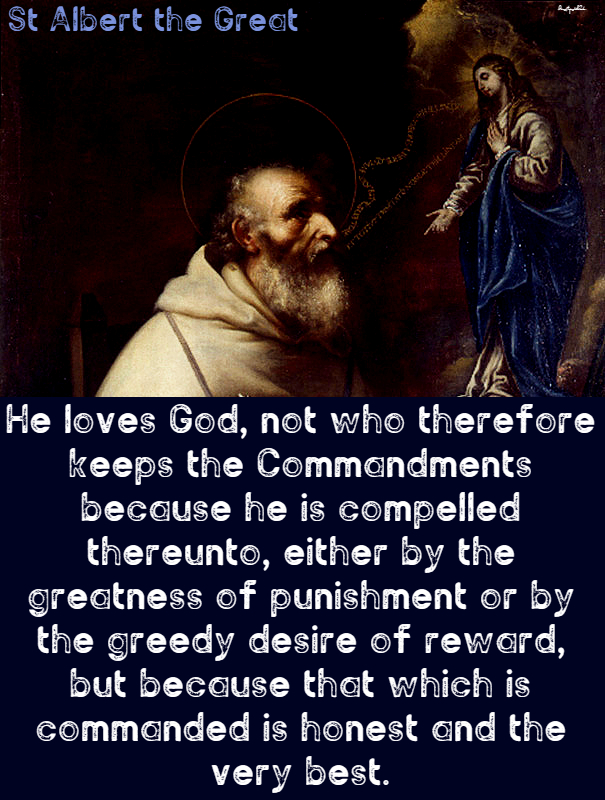
He loves God, not who therefore keeps the Commandments because he is compelled thereunto, either by the greatness of punishment or by the greedy desire of reward, but because that which is commanded is honest and the very best.

Posted in NOVEMBER - Month of the SOULS in PURGATORY

Thought for the Day – 15 November – On the submission to the will of God

Treatise on Purgatory

St Catherine of Genoa

CHAPTER XIV

These souls are so closely united, so transformed into the will of God, that in all things they are satisfied with His most holy decree ; and were a soul presented before God with ever so little to purge away, it would suffer grievous hurt and a torment worse than ten purgatories. That unspotted sanctity, that perfect justice, could not endure it ; to do so would be unbecoming on the part of God.

Should, then, the soul perceive that it lacked even a moment of satisfying God most completely, it would be to it a thing intolerable ; and rather than stand thus imperfectly cleansed in the presence of God, it would plunge at once into a thousand hells.