Posted in MARIAN TITLES

Feast of the Holy Relics, Nossa Senhora da Medalha Milagrosa / Our Lady of the Miraculous Medal, Monte Sião, Brazil (1939) and Memorials of the Saints

Feast of the Holy Relics

Nossa Senhora da Medalha Milagrosa / Our Lady of the Miraculous Medal, Monte Sião, Brazil (1939) – 5 November now moved to 27 November:
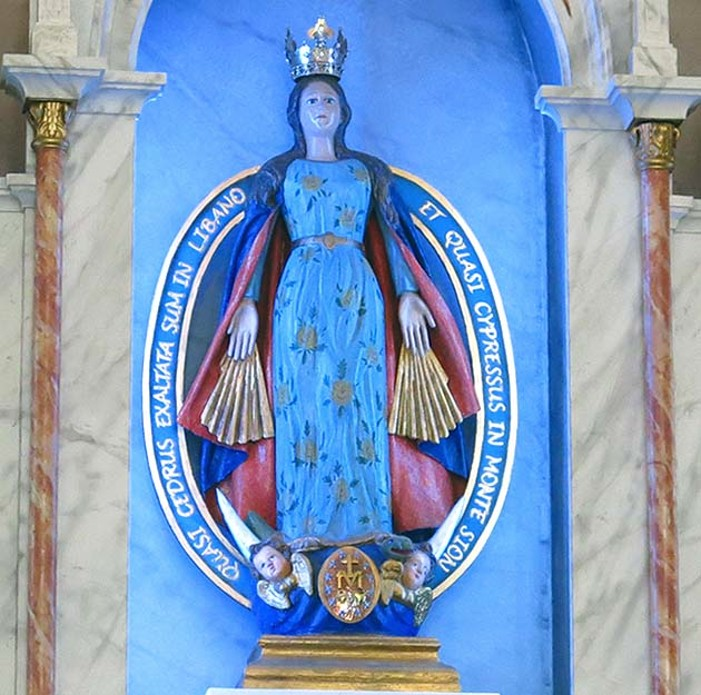
The first Church in Monte Sião appeared in 1849, dedicated to Our Lady of the Miraculous Medal, built by the founder of the place, Antonio Bernardes de Souza. The official Consecration of the Church took place on 13 April 1850. In the Parish of Father Luigi Cocoresi, from 1883 to 1890, more precisely in 1881, the Chapel was replaced by the Parish Church, built on top of in in the same square. The new Church was also built of clay based on strips of sawn wood.

In the parish administration of Fr. José Eugênio de Faria – Fr Zequinha – in 1934, the construction of the current Mother Church began, which is located in the same place as the previous two.

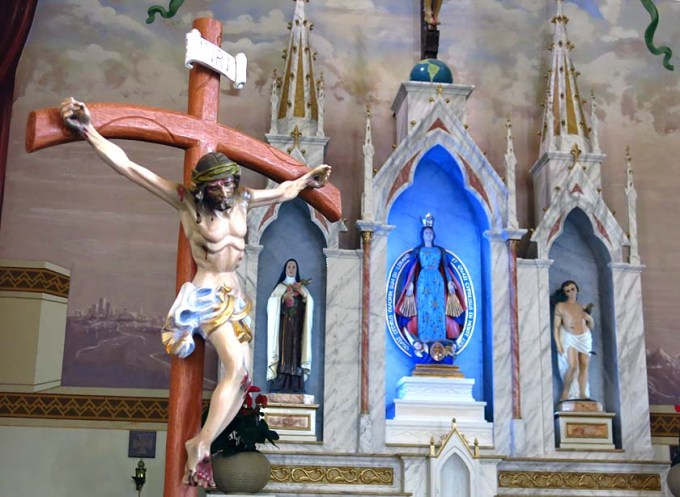
The Church’s architecture resembles the style of Roman art from the 12th century and the main Altar is entirely carved in wood, where the centenary image of the Patron Saint, the Blessed Mother, can be seen. The image of Our Lady of the Miraculous Medal, which adorns the main Altar, was brought to Monte Sião around 1860 and came from Portugal, through a Portuguese farmer, Mr João Pereira Batista Machado, who would have funded both its acquisition and the transportation. The image arrived at the Port of Rio de Janeiro and was brought to the City on the back of animals, inside a cargo jack and wrapped in dry corn husk.
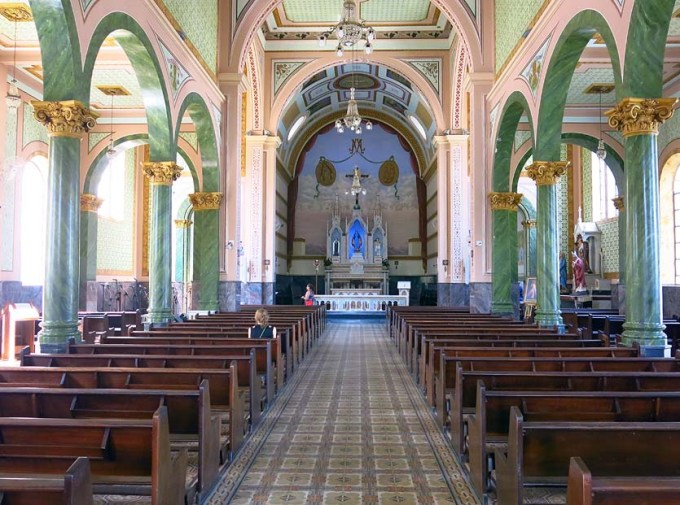
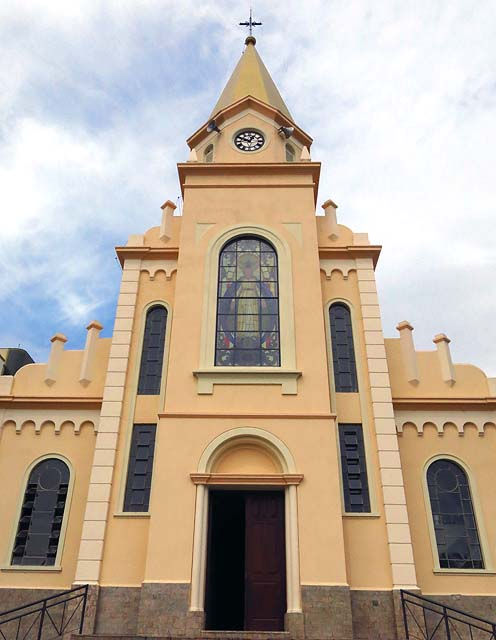
In 1937, at the request of the Bishop, the image was removed from the Altar and sent to a Chapel in the countryside, claiming that the Statue looked too modern.

The faithful greatly missed the Statue in the Igreja Matriz. It was then, that between 1937 and 1939, the City of Monte Sião was inflicted by a period of great drought. There was rain in every other City but not there. The people then associated the lack of rain with the absence of the Statue of their Patron and went to intercede with the Parish Priest, to bring the Statue back. On 5 November 1939, the Statue was allowed to return. The day was sunny and a procession was held to honour the Patroness.

When the Statue reached the City, the first drops began to fall and then a heavy rain, soaking everyone. This was called the rain miracle and after that, everything went smoothly. The Statue underwent a restoration in the year 2015, which returned all the original features to the image, which had been lost with previous restorations.

Although the Feast was 5 November it was moved to co-incide with the official Feast of the Miraculous Medal, 27 November, which is a local public holiday, when it is celebrated after a Novena between 18 and 26 November, with a Mass in honour of the Patron , the Blessed Maria of the Miraculous Medal.
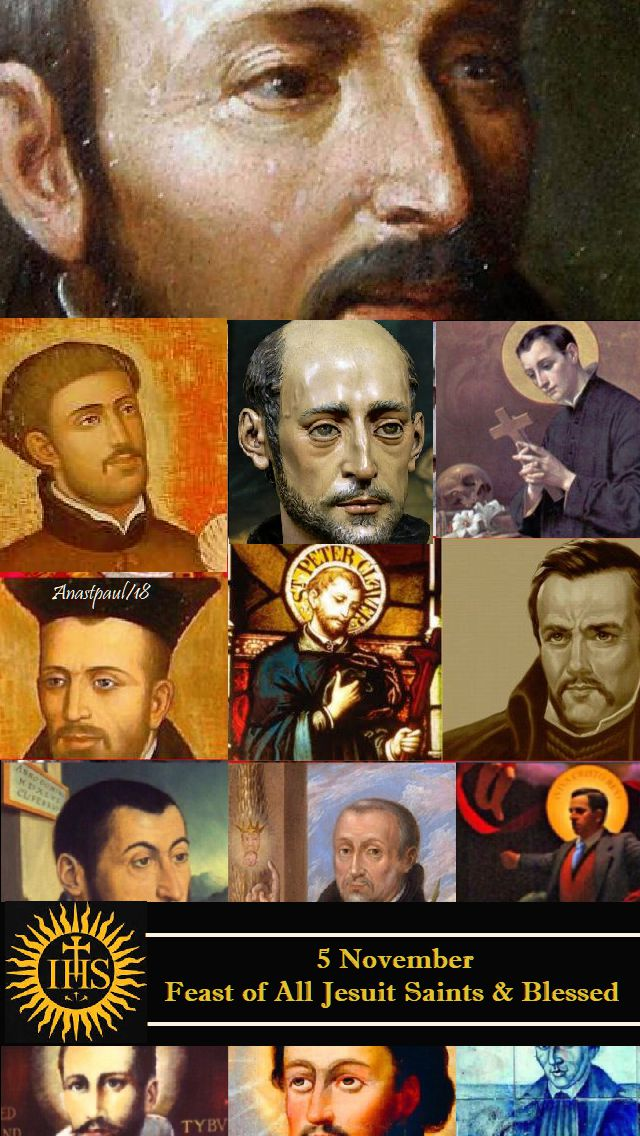
All Saints and Blesseds of the Society of Jesus:

The Society of Jesus, commonly known as the Jesuits, was Founded in 1534 by Saint Ignatius Loyola (1491-1556) at Montmartre, Paris, France. A body of clerics regular organised for Apostolic work, following a religious rule and relying on alms for their support. It was the chief instrument of the Catholic Reformation. Pope Paul III approved the new rule in 1540 and Ignatius was elected the first general of the order in 1541. The constitutions, drafted by him and based on his Spiritual Exercises were adopted in 1558. It was the first order which enjoined by its constitutions devotion to the cause of education. The ministry of the Society consists chiefly in preaching. teaching catechism. administering the sacraments. conducting missions in parishes, taking care of parishes. organising pious confraternities, teaching in schools of every grade, writing books, pamphlets, periodical articles, going on foreign missions and special missions when ordered by the current Holy Father, to whom they take a vow of total obedience. Our current Holy Father, Pope Francis is a Jesuit and has jokingly wondered aloud who is boss of whom in his Order. The general resides at Rome, Italy and has a council of assistants. The motto of the Society is Ad Majorem Dei Gloriam (For the greater glory of God).
St Augustine of Terracina
Bl Bernhard Lichtenberg
St Bertille (c 629-c 703) Abbess
St Canonica
St Comasia
St Ðaminh Mau
St Dominator of Brescia
St Elizabeth
St Domninus the Physician
St Epistemis
St Eusebius of Terracina
St Felix of Terracina
St Fibitius
St Galation
St Gerald of Beziers
Bl Gomidas Keumurjian
Bl Gregory Lakota
St Guetnoco
St Guido Maria Conforti
St Hermenegild
St Idda
St Juan Antoni Burró Mas
St Juan Duarte Martín
St Kanten
St Kea
St Laetus of Orleans
St Magnus of Milan
St Mamete
St Marco of Troia
Bl María del Carmen Viel Ferrando
Bl Simon Ballachi
St Spinulus of Moyen-Moûtier
St Sylvanus of Syria
St Zachary
—
Martyrs of Caesarea Maritima – 4 saints: Four young Christian men who were martyred together in the persecutions of Maximian – Aussenzius, Philotheus, Timothy and Theotimus. They were martyred in the arena at Caesarea Maritima, Palestine.

Martyred in the Spanish Civil War:
• Blessed Juan Antoni Burró Mas
• Blessed Juan Duarte Martín
• Blessed María del Carmen Viel Ferrando
Posted in Uncategorized

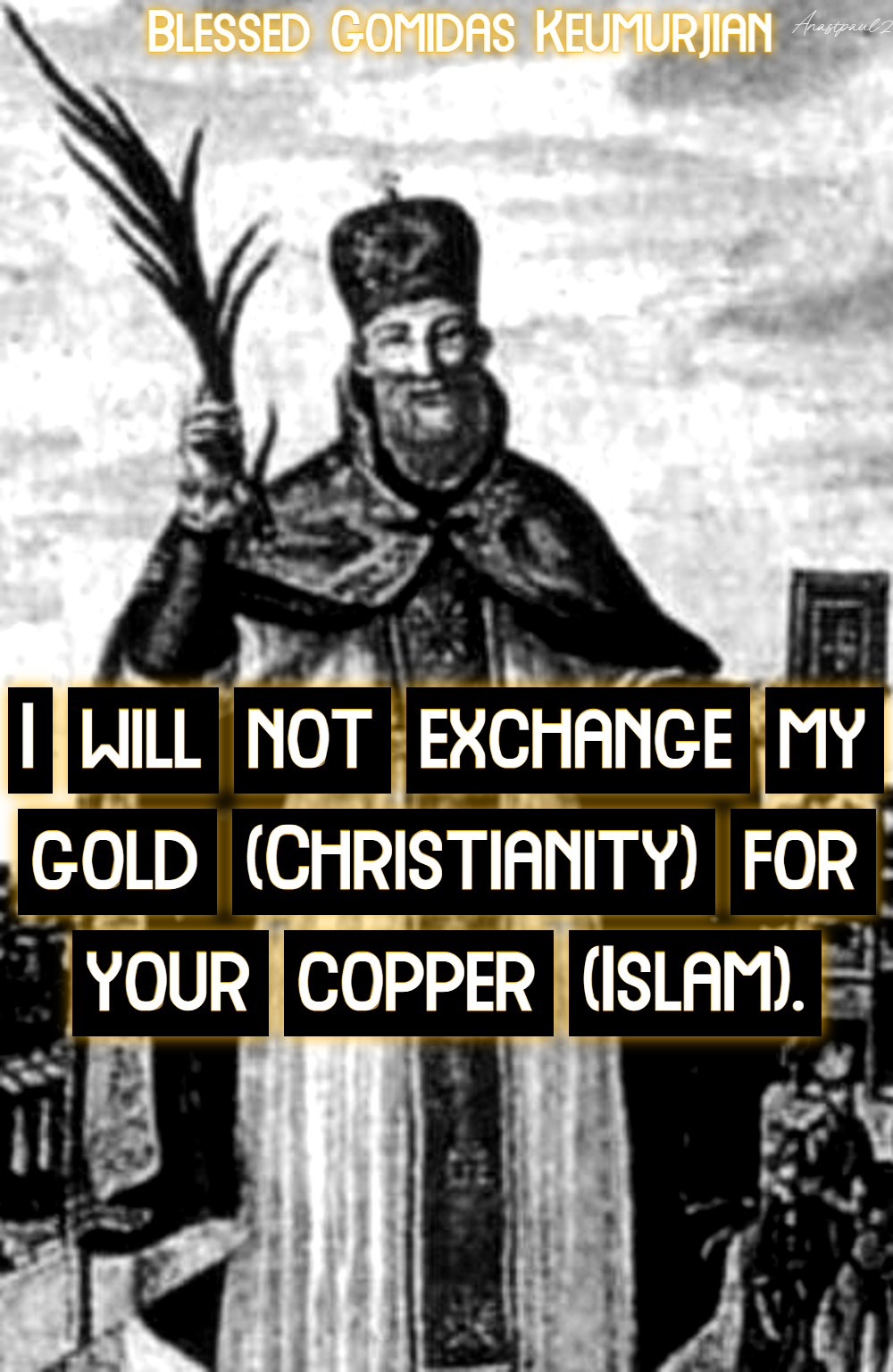
Saint of the Day – 5 November – Blessed Gomidas Keumurjian

Blessed Gomidas Keumurjian, also known as Gomida Keumurgian, Cosma de Carboniano, was a martyr. Originally a priest in the Armenian church, in 1696 he and his family made complete submission to the authority of Rome. His preaching attracted large audiences of not only Armenians, but also Ottoman Greeks and so many Muslims that he had to regularly preach sermons in Turkish. This angered the Armenian officials. Some of them falsely accused Gomidas of being a spy for Rome, which led to his arrest and execution by Turkish authorities.

At the insistence of the Armenian Apostolic Patriarch of Constantinople, Gomidas was tried before an Islamic court and sentenced to death by the Qadi for treason against the Ottoman Sultan and for secretly baptizing Muslims. Gomidas, however, was offered a full pardon and his immediate release in return for his conversion to Islam. The other eight priests with him immediately accepted the offer of pardon in exchange for conversion to Islam, and only Gomidas refused, saying, “I will not exchange my gold for your copper.”

Accompanied by his wife and children and a crowd of three thousand witnesses, Gomidas was led out of prison on 5 November 1707 to the Samatya quarter of Istanbul. Like the many other martyred priests under the Caesars, he was followed to the place of execution by his wife and children. His wife encouraged him to remain firm, while his sister, Irena, begged him not to bereave his family. Irena urged her brother to instead pretend to convert to Islam, while remaining a crypto-Christian. Unmoved, he continued until he reached the crossroads called Parmak Kapu, where he was ordered to kneel. Gomidas did so, facing Jerusalem, much to the dismay of the crowd, who repeatedly called in vain for him to turn and face Mecca instead. When the executioner approached with a drawn sword and also urged him to save his life through conversion to Islam, he replied, “No, do your work”, and began reciting the Nicene Creed in the Classical Armenian liturgical language. His prayer only ceased when he was beheaded.

Posted in Our MORNING Offering

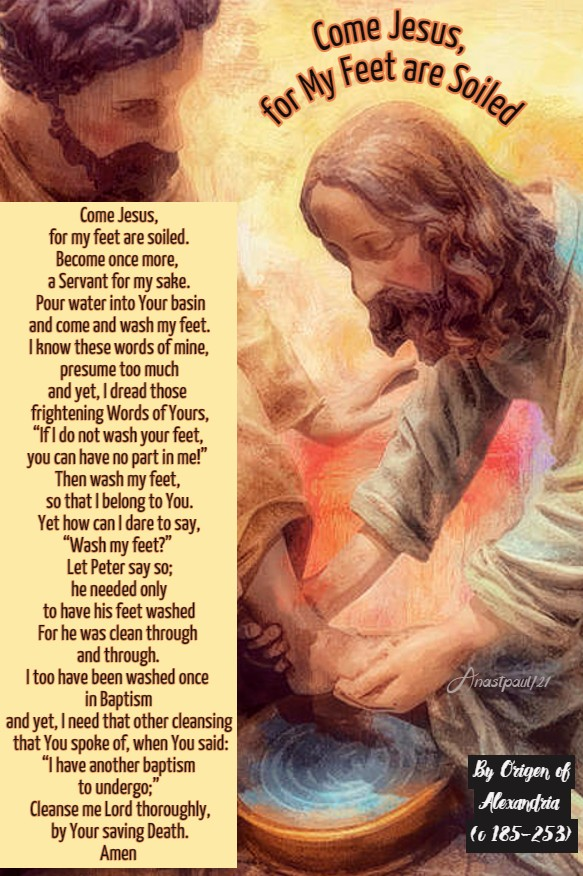
Our Morning Offering – 5 November – Come Jesus,for My Feet are Soiled

Come Jesus,
for My Feet are Soiled
By Origen of Alexandria (c 185-253)

Come Jesus,
for my feet are soiled.
Become once more,
a Servant for my sake.
Pour water into Your basin
and come and wash my feet.
I know these words of mine,
presume too much
and yet, I dread those
frightening Words of Yours,
“If I do not wash your feet,
you can have no part in me!”
Then wash my feet,
so that I belong to You.
Yet how can I dare to say,
“Wash my feet?”
Let Peter say so;
he needed only
to have his feet washed
For he was clean through and through.
I too have been washed once in Baptism
and yet, I need that other cleansing
that You spoke of,
when You said:
“I have another baptism to undergo;”
Cleanse me Lord thoroughly,
by Your saving Death.
Amen

Posted in ONE Minute REFLECTION

One Minute Reflection – 5 November – “Whoever believes in me will live”

One Minute Reflection – 5 November – “Month of the Holy Souls in Purgatory” – Readings: Jer 29:11-12; 29:14, Ps 84:2, Phil 3:17-21; 4:1-3, Matt 9:18-26

He said, “Begone, the girl is asleep, not dead.” And they laughed Him to scorn. But when the crowd had been put out, He went in and took her by the hand; and the girl arose.

Matt 9:18-26

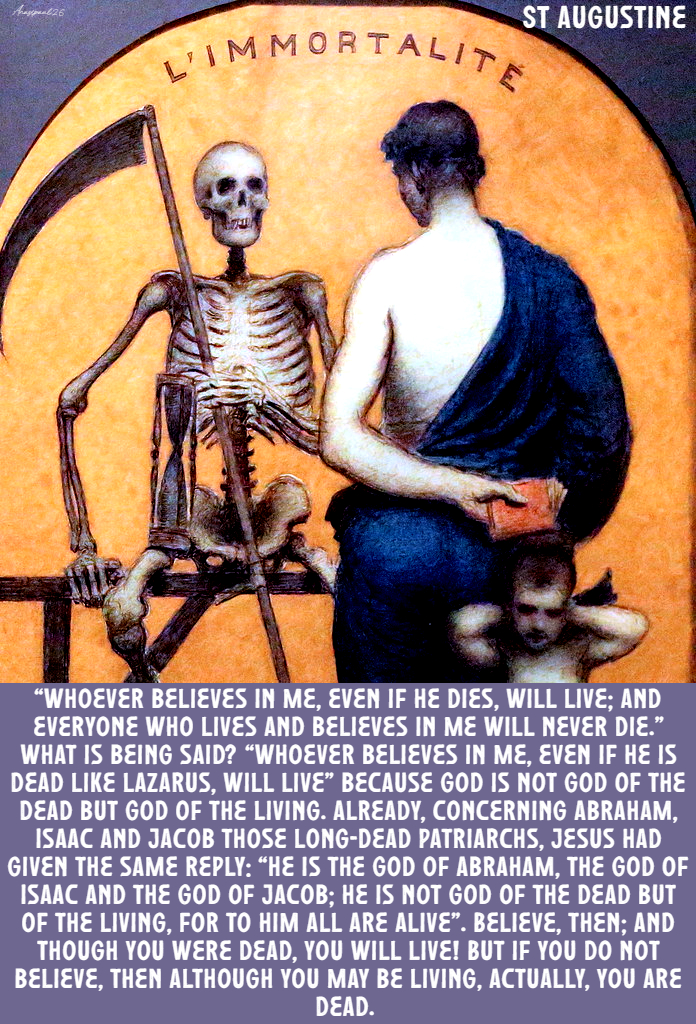
REFLECTION – “Whoever believes in me, even if he dies, will live; and everyone who lives and believes in me will never die.” What is being said? “Whoever believes in me, even if he is dead like Lazarus, will live” because God is not God of the dead but God of the living. Already, concerning Abraham, Isaac and Jacob those long-dead patriarchs, Jesus had given the same reply: “He is the God of Abraham, the God of Isaac and the God of Jacob; he is not God of the dead but of the living, for to him all are alive”. Believe, then; and though you were dead, you will live! But if you do not believe, then although you may be living, actually, you are dead. From where comes death in the soul? From the fact that faith is no longer there. From where comes the death of the body? From the fact that the soul is no longer there. The soul’s soul is faith.

“Whoever believes in me, even though he die in body will be alive in soul until the body itself rises again to die no more. And whoever lives in the flesh and believes in me, although he must die in his body for a season, will not die for ever because of the life of the Spirit and immortality of the resurrection.”

That is what Jesus' reply to Martha meant: “Do you believe this?” “Yes, Lord,” she answered, “I have come to believe that you are the Messiah, the Son of God, the one who is coming into the world. Believing this, I have believed you are the resurrection; I have believed you are the life; I have believed that whoever believes in you, though he die, will live; I have believed that whoever lives and believes in you will never die eternally.”

St Augustine

PRAYER – Lord God, teach us humility, to give and not to count ever the cost to ourselves, to take the lowest part and the back seat – teach us Lord, to strive and not to seek for glory, save for that of Your Kingdom. Let us see Your Face, His Face, He our Teacher, our Saviour in the face of all those in most need. May all those great Jesuit Saints standing before that Face, pray for us! We ask this through Jesus Christ, our Lord, who we beg, have mercy on us all, who seek rewards for our own sakes, amen.

Posted in CATHOLIC Quotes, QUOTES on PRIDE

Quote/s of the Day – 5 November – Their glory is in their shame

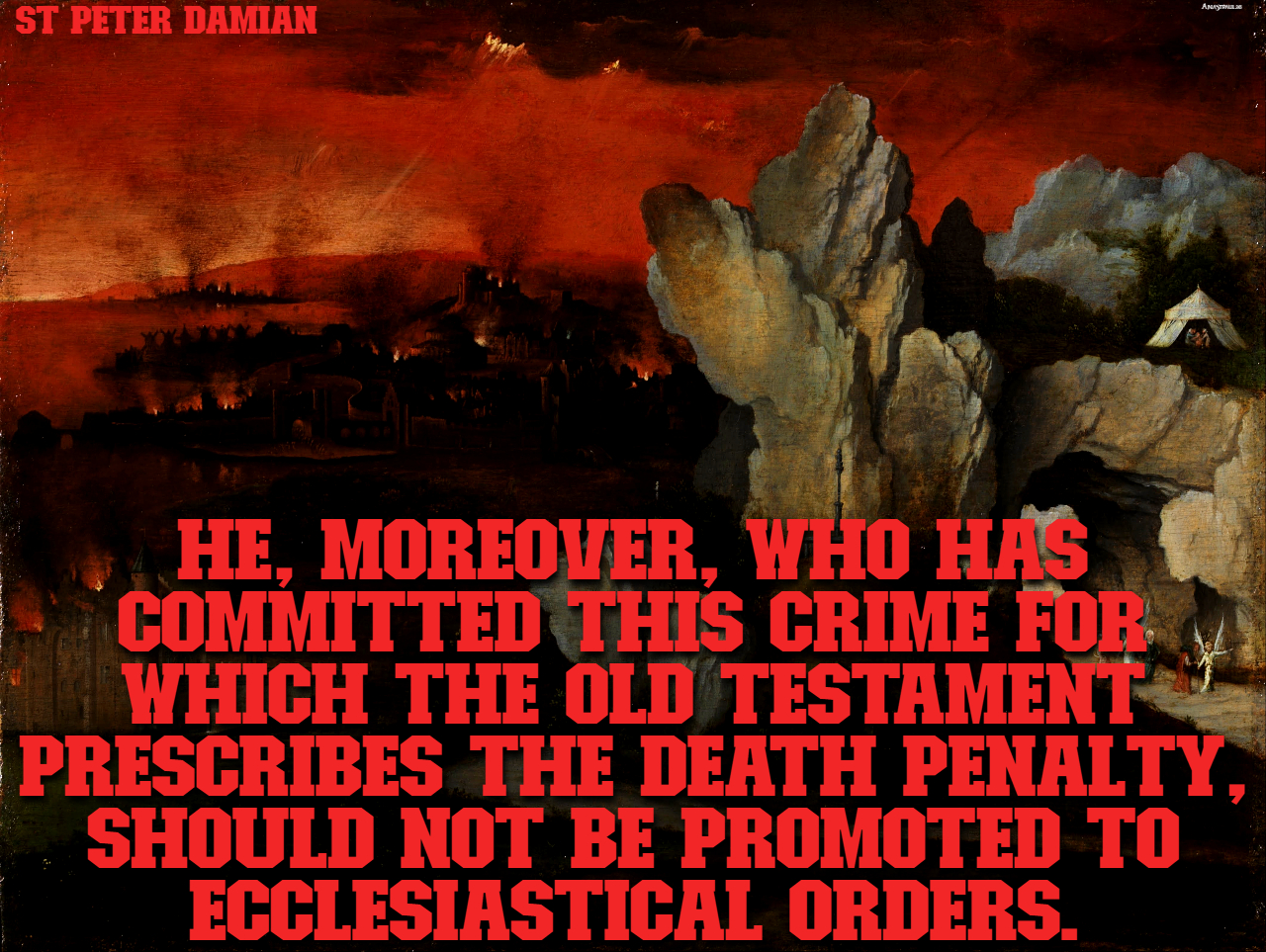
He, moreover, who has committed this crime for which the Old Testament prescribes the death penalty, should not be promoted to ecclesiastical orders.

St Peter Damian

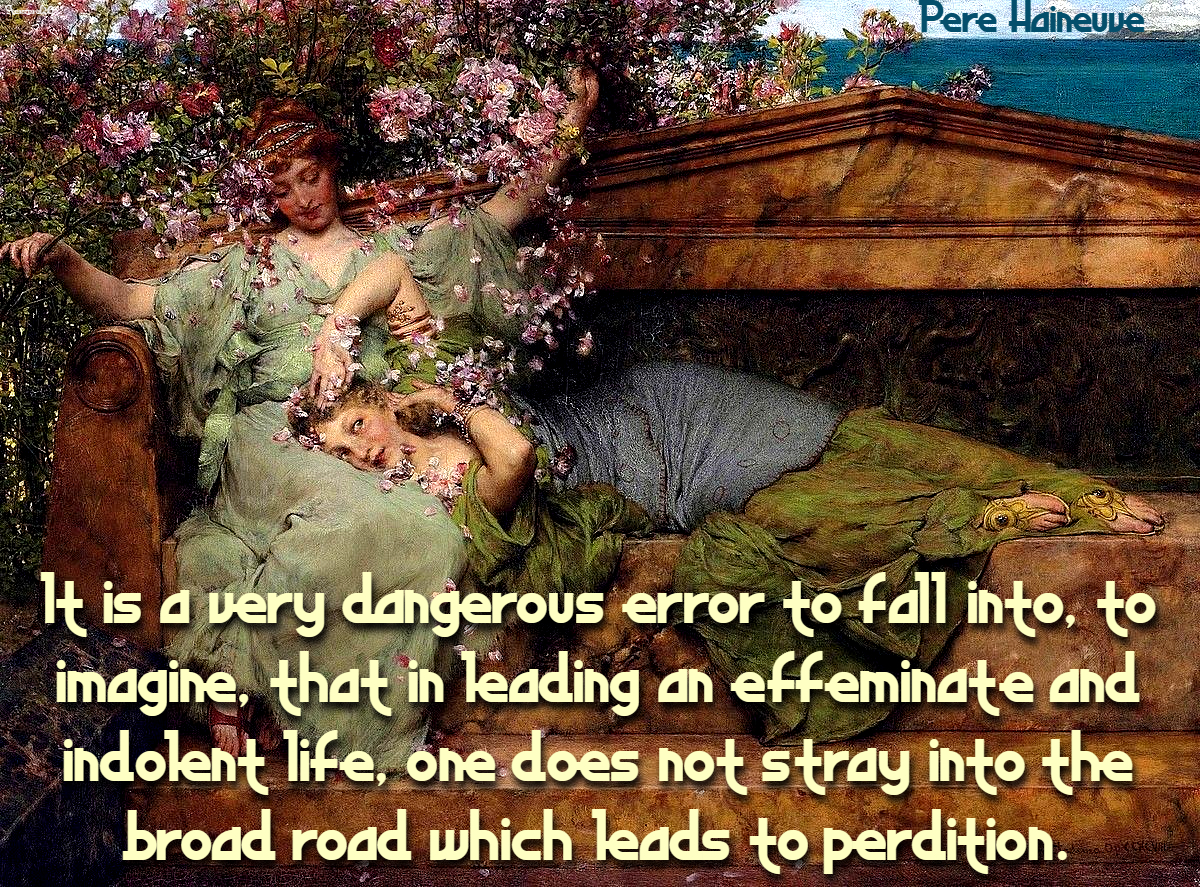
It is a very dangerous error to fall into, to imagine, that in leading an effeminate and indolent life, one does not stray into the broad road which leads to perdition.

Pere Haineuve

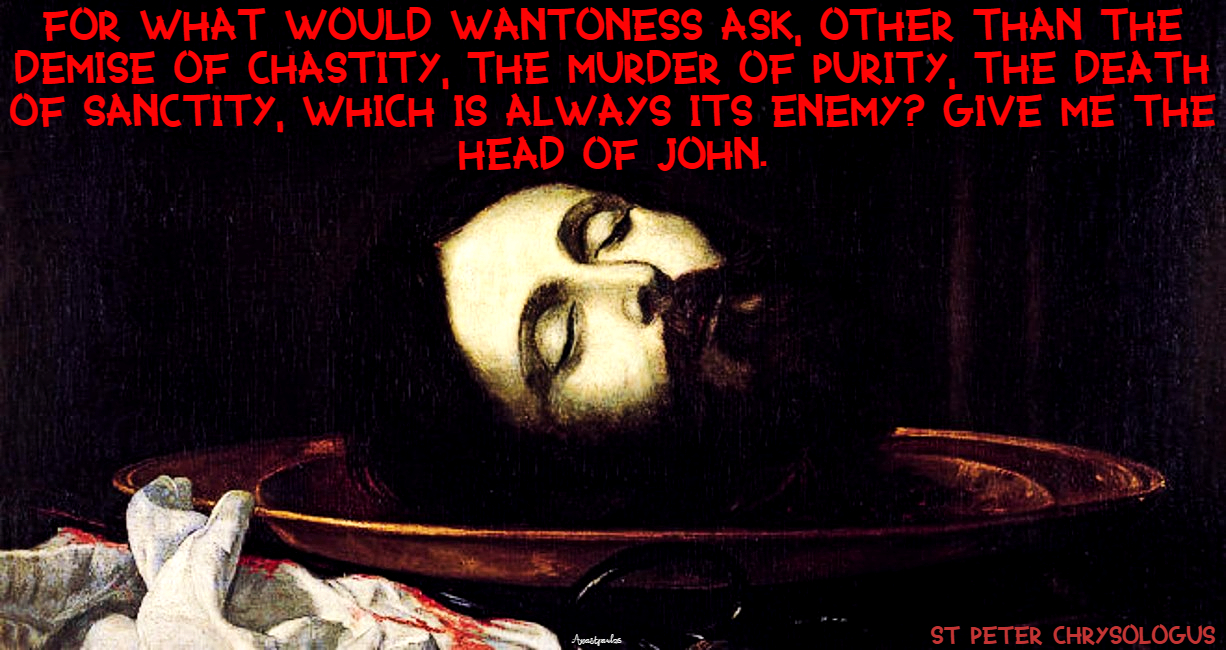
For what would wantoness ask, other than the demise of chastity, the murder of purity, the death of sanctity, which is always its enemy? Give me the head of John.

St Peter Chrysologus

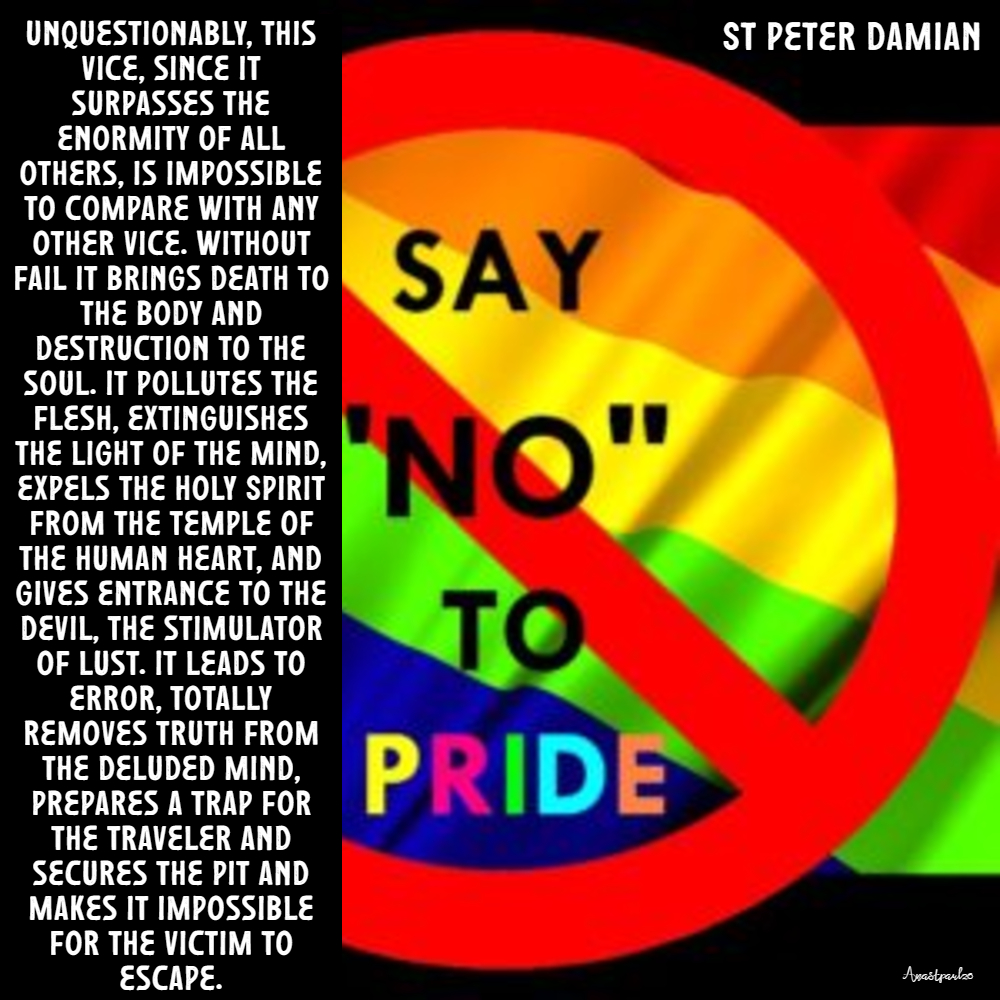
Unquestionably, this vice, since it surpasses the enormity of all others, is impossible to compare with any other vice. Without fail it brings death to the body and destruction to the soul. It pollutes the flesh, extinguishes the light of the mind, expels the Holy Spirit from the temple of the human heart, and gives entrance to the devil, the stimulator of lust. It leads to error, totally removes truth from the deluded mind, prepares a trap for the traveler and secures the pit and makes it impossible for the victim to escape.

St Peter Damian

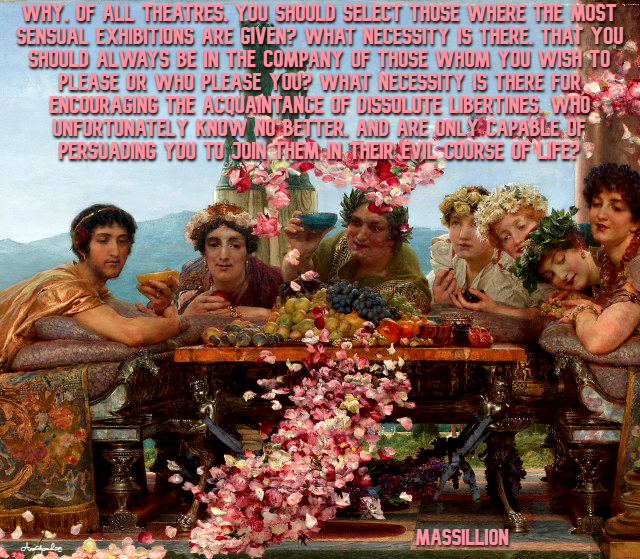
Why, of all theatres, you should select those where the most sensual exhibitions are given? What necessity is there, that you should always be in the company of those whom you wish to please or who please you? What necessity is there for encouraging the acquaintance of dissolute libertines, who unfortunately know no better, and are only capable of persuading you to join them in their evil course of life?

Massillion

Listen, you do-nothing superiors of clerics and priests. Listen, and even though you feel sure of yourselves, tremble at the thought that you are partners in the guilt of others; those, I mean, who wink at the sins of their subjects that need correction, and who by ill-considered silence allow them license to sin. Listen, I say, and be shrewd enough to understand that all of you alike “are deserving of death, that is, not only those who do such things, but also they who approve those who practice them.”

St Peter Damian

Posted in NOVEMBER - Month of the SOULS in PURGATORY

Thought for the Day – 5 November – The difference between the souls in hell and purgatory

Treatise on Purgatory

St Catherine of Genoa

CHAPTER IV

From what has been said, it is clear that the guilt of sin consists in the perverse opposition of the will to the will of God, and that so long as the will continues thus evilly perverse the guilt will continue. For those, then, in hell, who have departed this life with an evil will, there is no remission of sin, neither can be, be cause there can be no more change of will. In passing out of this life the soul is fixed for good or evil according to its deliberate purpose at the time ; as is written, “Where shall I find thee (that is, at the hour of death, with a will either to sin or sorry for sin and penitent), there will I judge thee : ” and this judgment is final ; because after death the will can never again be free, but must remain fixed in the condition in which it was found at the moment of death.

The souls in hell having been found at the moment of death with a will to sin, have with them an infinite degree of guilt ; and the punishment they suffer, though less than they deserve, is yet, so far as it exists, endless. But the souls in purgatory have only the punishment for sin, and not its guilt ; for the guilt was effaced at the moment of death, in that they were found then deploring their sins and penitent for having offended the Divine Goodness ; so their punishment has a limit, and goes on diminishing in duration, as has been said.

O misery above every misery ! and so much the greater because men in their blindness consider it so little. The punishment of the damned is not, indeed, infinite in amount ; for the sweet goodness of God sheds the rays of His mercy even in hell. A man who has died in mortal sin deserves a punishment infinite in pain and infinite in duration ; but God in His mercy has made it infinite only in duration, and has limited the amount of pain. He might most justly have given them a far greater punishment than He has. O how perilous is a sin committed through malice ! for hardly does a man repent of it ; and not repenting, his guilt remains, and will remain, so long as there is any affection for the sin committed, or any purpose of committing it afresh.