Posted in MARIAN TITLES

The Last Sunday after Pentecost and Memorials of the Saints – 20 November

The Last Sunday after Pentecost

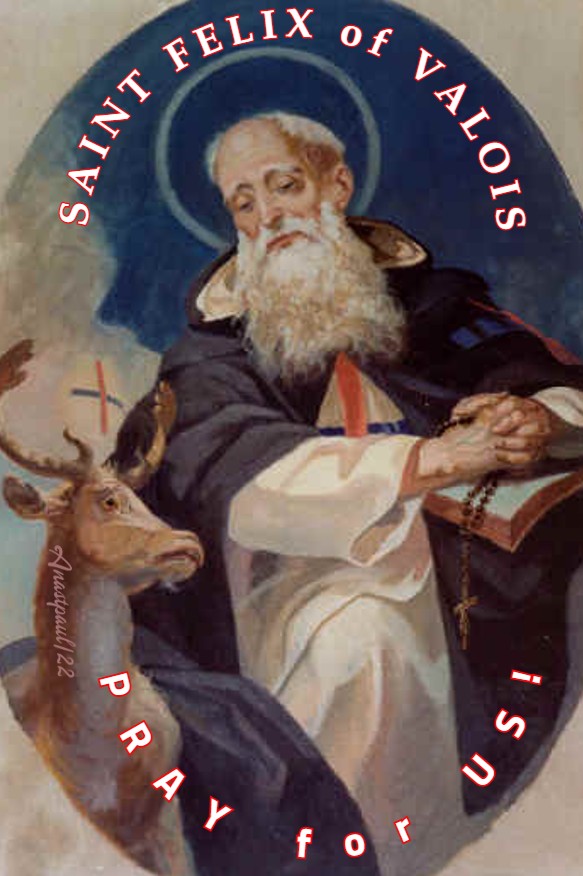
St Felix of Valois (1127-1212) Confessor, Priest, Hermit and Co-Founder of the Trinitarians.

St Agapius of Caesarea
Bl Ambrose of Camaldoli
St Ampelus of Messina
St Anatolius of Nicea
St Apothemius of Angers
St Autbodus of Valcourt
St Basil of Antioch
St Bernerio of Eboli
St Crispin of Ecija
St Cyprian of Calamizzi (c 1125-1190) Abbot
St Dasius of Dorostorum
St Dorus of Benevento
St Edmund of East Anglia
St Eudo of Carméry
St Eustachius of Nicea
St Eval of Cornwall
St Francisca Desamparados Honorata Lloret Martí
St Gaius of Messina
St Gregory Decapolites
St Hippolytus of Belley
St Humbert of Elmham
St Leo of Nonantula
St Maxentia of Beauvais
St Milagros Ortells Gimeno
St Nerses of Sahgerd and Companions
St Simplicius of Verona
St Sylvester of Châlons-sur-Saône
St Thespesius of Nicea
St Teonesto of Vercelli

Martyrs of Antioch – 3 Saints: Group of three Christians executed together for their faith. No details have survived except their names – Basil, Dionysius and Rusticus. They were martyred in Antioch (Antakya, Turkey).

Martyrs of Heraclea – 3 Saints: A group of 43 Christians Martyred together. The only details about them to survive are three of their names – Agapitus, Bassus and Dionysius. They were martyred in Heraclea, Thrace.

Martyrs of Turin – 3 Saints: Three Christian Martyrs whose original stories were lost and somehow came to be associated with the Theban Legion. They are – Adventor, Octavius and Solutor. They were beheaded in 297 in Turin, Italy. Patronage – Turin, Italy.

Posted in SAINT of the DAY

Saint of the Day – 20 November – Saint Edmund of East Anglia

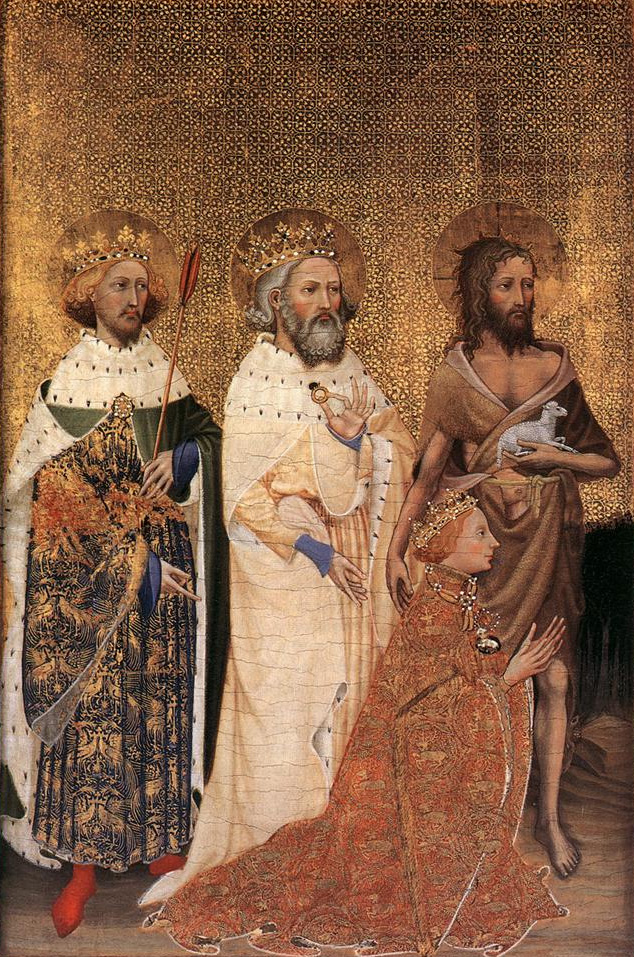
Saint Edmund of East Anglia, martyr and king. Also known as Edmund the Martyr and King of the East Angles. Becoming King of East Anglia at age 14, Edmund was crowned on Christmas Day 855 by Saint Humbert of Elmham. Edmund was a model ruler, concerned with justice for his people and his own spirituality; he spent a year sequestered at Hunstanton learning the Psalter by heart.

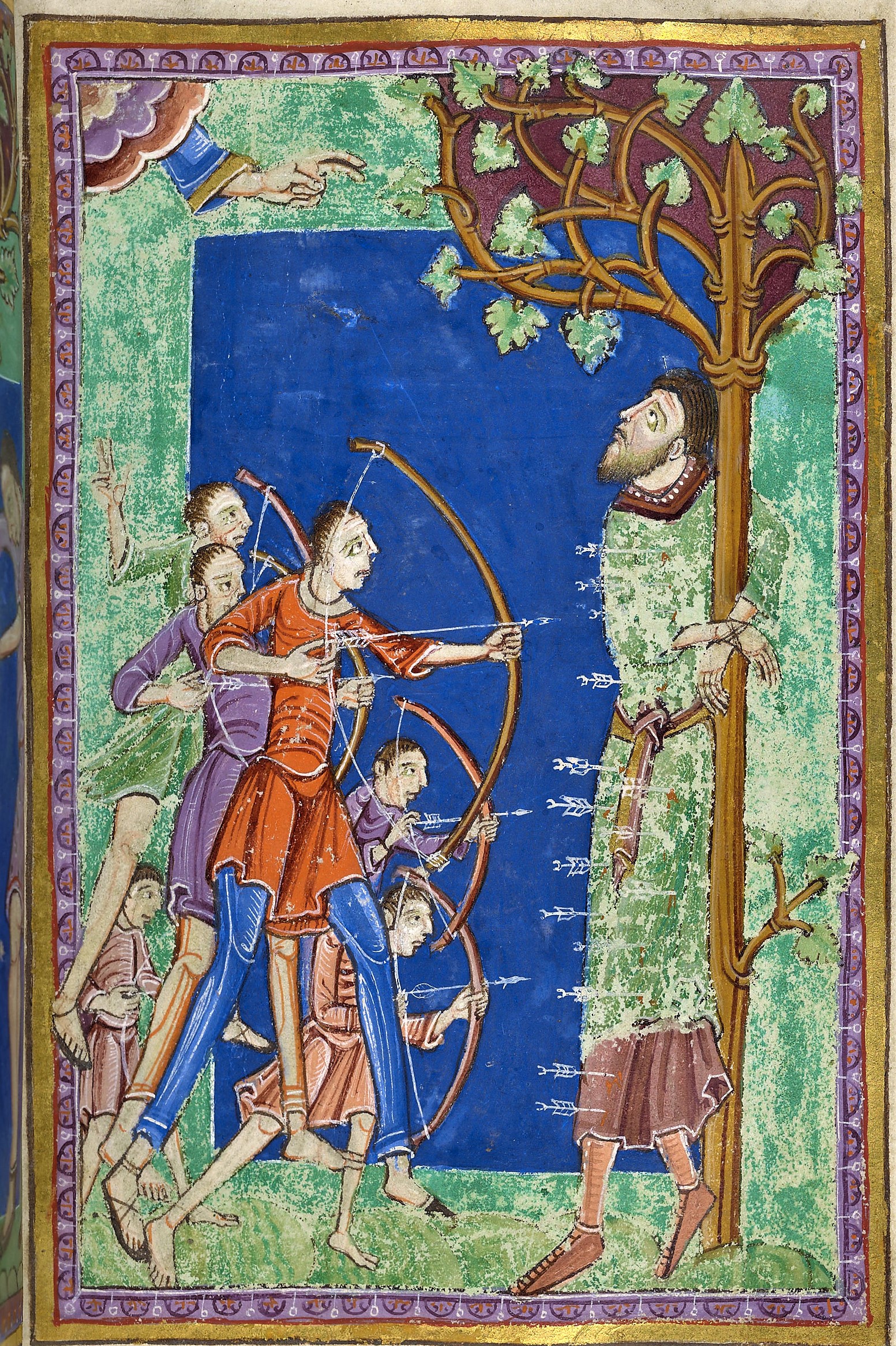
Following one of a series of armed engagements with the invading Danes, he was captured. He was ordered to give his Christian people to the pagan invaders; he refused, and was beaten, whipped, shot with arrows then beheaded at Hoxne, Suffolk, England 20 November 870. Abbo named one of Edmund’s killers as Ivar the Boneless, son of Ragnar Lodbrok.

“King Edmund, against whom Ivar advanced, stood inside his hall, and mindful of the Saviour, threw out his weapons. He wanted to match the example of Christ, who forbade Peter to win the cruel Jews with weapons. Lo! the impious one then bound Edmund and insulted him ignominiously, and beat him with rods, and afterwards led the devout king to a firm living tree, and tied him there with strong bonds, and beat him with whips. In between the whip lashes, Edmund called out with true belief in the Saviour Christ. Because of his belief, because he called to Christ to aid him, the heathens became furiously angry. They then shot spears at him, as if it was a game, until he was entirely covered with their missiles, like the bristles of a hedgehog (just like St Sebastian was).

When Ivar the impious pirate saw that the noble king would not forsake Christ, but with resolute faith called after Him, he ordered Edmund beheaded, and the heathens did so. While Edmund still called out to Christ, the heathen dragged the holy man to his death, and with one stroke struck off his head, and his soul journeyed happily to Christ.”

— Ælfric of Eynsham, Old English

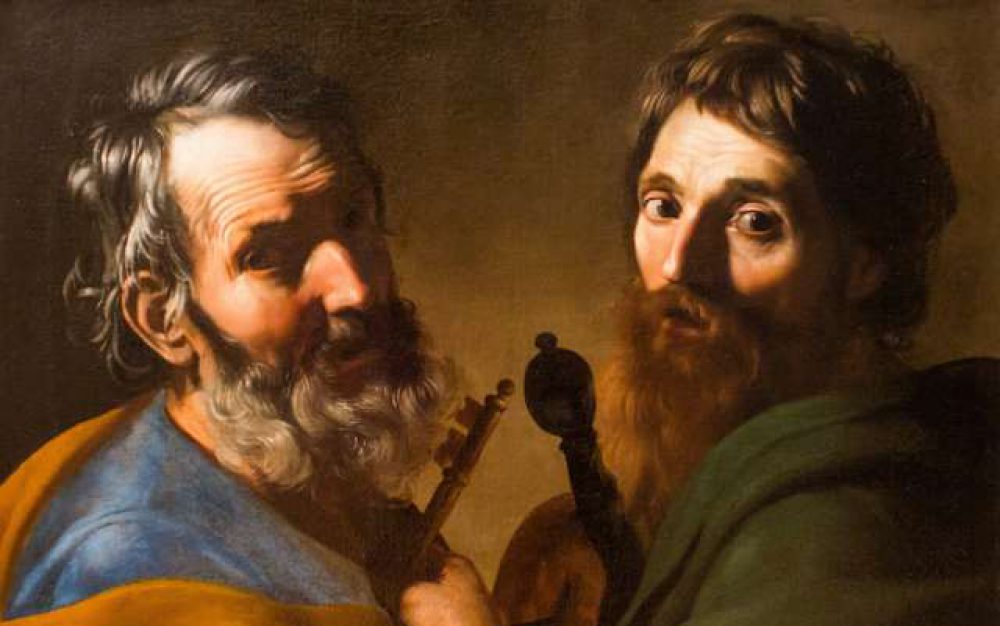
St Edmund on left

Buried at Hoxne, his relics were moved to Beodricsworth, England (modern Bury Saint Edmunds (Borough of Saint Edmunds)) in 915. From there they were moved to the Cathedral of Saint Paul in London in 1010, ahead of an invading Viking force. His relics were then returned to Bury Saint Edmunds in 1113, to be re-enshrined in a new church in a Benedictine monastery built by King Canute in 1020. Following a battle in Lincoln, England in 1217, French troops claim to have taken the relics.

Patronage: against plague, the diocese of East Anglia, England, kings, torture victims, wolves

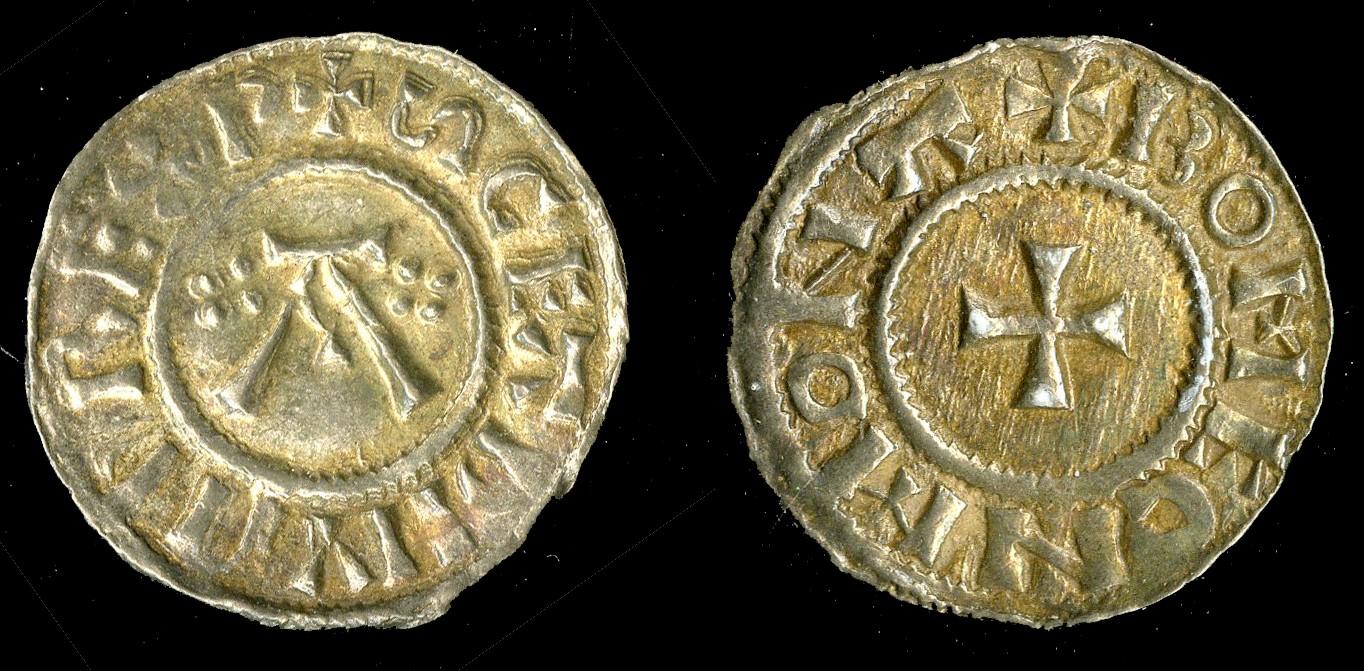
EADMVND REX—’O St Edmund the king!’
St Edmund

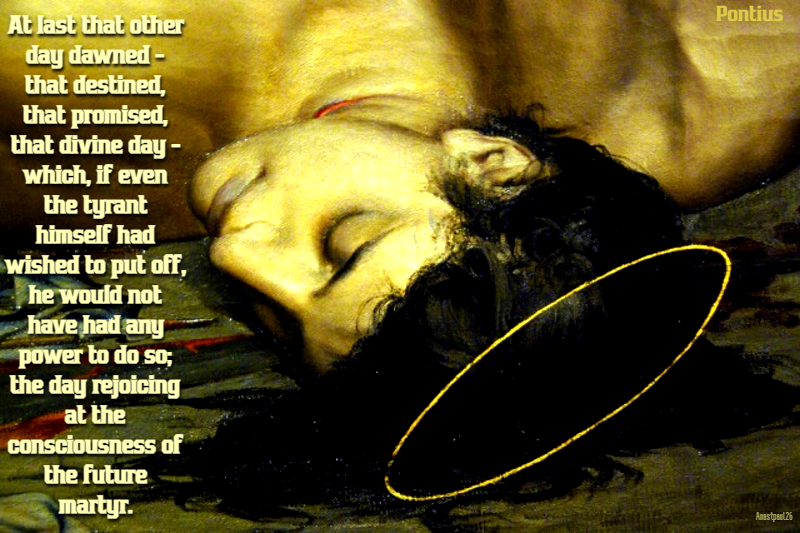
At last that other day dawned — that destined, that promised, that divine day — which, if even the tyrant himself had wished to put off, he would not have had any power to do so; the day rejoicing at the consciousness of the future martyr.

The Life and Passion of St Cyprian

Posted in Our MORNING Offering

Our Morning Offering – 20 November – Indulgenced Prayers or the Faithful Departed

Eternal rest grant unto them, O Lord, And let perpetual light shine upon them. May they rest in peace. Amen.

(300 days every time said. Applicable only to the dead)

Dear Lord Jesus, grant them eternal rest.

(300 days every time said. Applicable only to the dead)

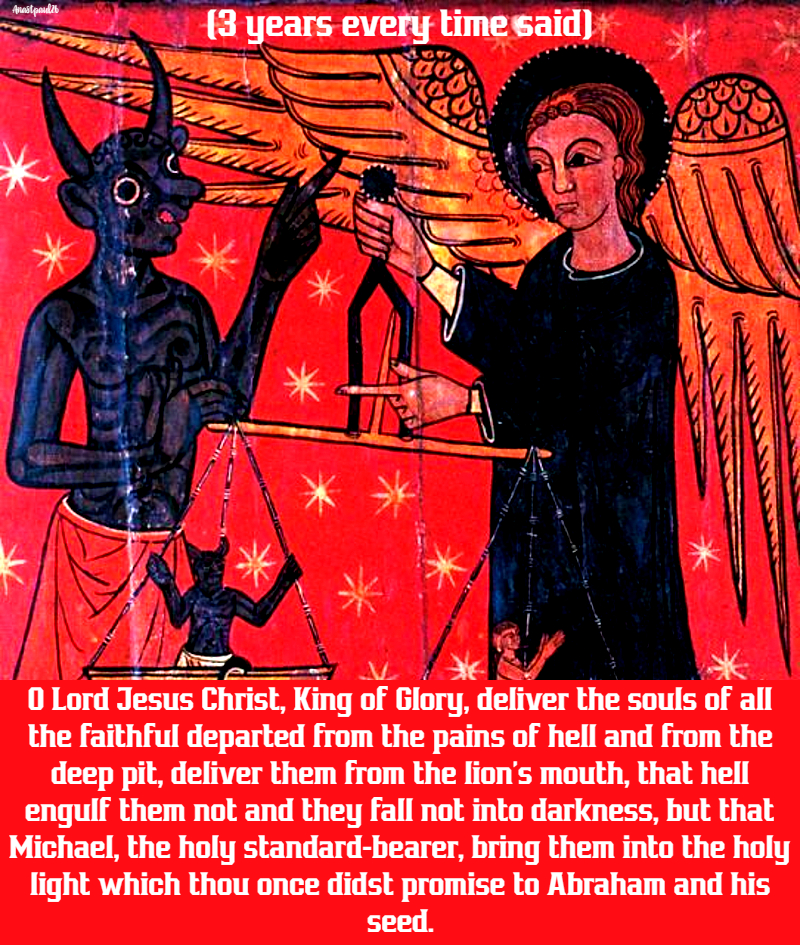
O Lord Jesus Christ, King of Glory, deliver the souls of all the faithful departed from the pains of hell and from the deep pit, deliver them from the lion’s mouth, that hell engulf them not and they fall not into darkness, but that Michael, the holy standard-bearer, bring them into the holy light which thou once didst promise to Abraham and his seed.

(3 years every time said)

Posted in ONE Minute REFLECTION

One Minute Reflection – 20 November – I have waited, I have waited for the Lord

One Minute Reflection – 20 November – The Last Sunday after Pentecost – St Felix of Valois (1127-1212) Confessor – Readings: Ps 91:13-14, Ps 91:2, 1 Cor. 4:9-14, Luke 12:32-34

We are reviled and we bless, we are persecuted and we bear with it, we are maligned and we entreat, we have become as the refuse of this world, the offscouring of all, even until now!

1 Cor. 4:9-14

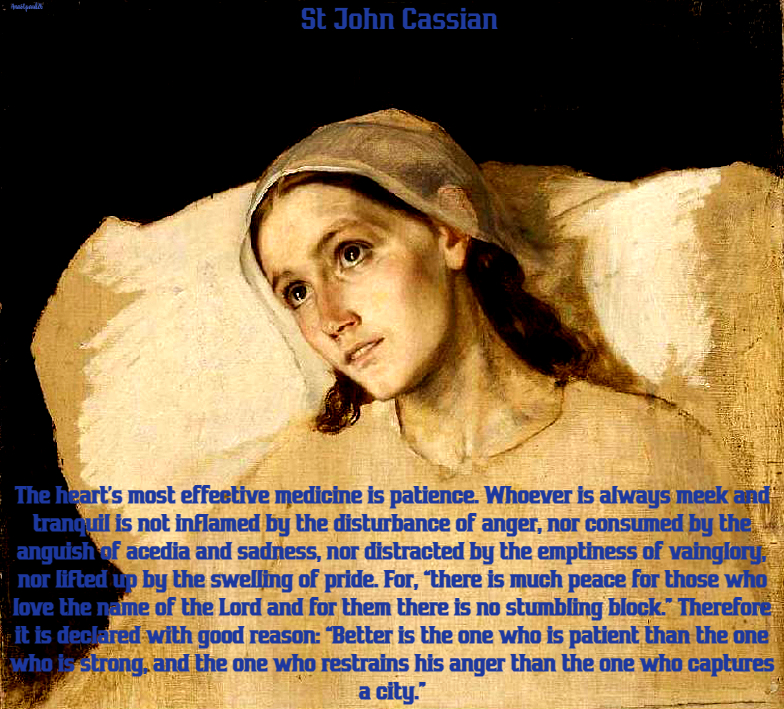
REFLECTION – The heart’s most effective medicine is patience. According to the words of Solomon: “The gentle man is the physician of the heart.” So true is this that it uproots not only all the vices of anger, sadness, acedia, vainglory and pride, but also that of wantonness along with them. For, as Solomon says: “In long-suffering is the patience of kings.” Whoever is always meek and tranquil is not inflamed by the disturbance of anger, nor consumed by the anguish of acedia and sadness, nor distracted by the emptiness of vainglory, nor lifted up by the swelling of pride. For, “there is much peace for those who love the name of the Lord and for them there is no stumbling block.” Therefore it is declared with good reason: “Better is the one who is patient than the one who is strong, and the one who restrains his anger than the one who captures a city.”

Until we deserve to acquire this firm and perpetual peace we shall inevitable be assailed by numerous attacks and frequently repeat this verse with groaning and tears: “I have become wretched and I am afflicted beyond measure. All the day I went about mournfully for my loins are filled with illusions.” Until a person arrives at this state of purity, he has to be trained frequently by these discrepancies until, confirmed by the grace of God in the purity he is seeking, he is worthy to say in truth: “I have waited, I have waited for the Lord, and he turned to me, he heard my plea. He drew me out of the pit of wretchedness and from the miry bog. He set my feet upon a rock and guided my steps.”

St John Cassian

PRAYER – OGod, Who by heavenly inspiration graciously called forth blessed Felix, Thy Confessor, from the desert to the work of ransoming captives; grant, we beseech Thee, that by his intercession and liberated by Thy grace from the captivity of our sins, we may be led into our heavenly fatherland. Through Jesus Christ, Thy Son our Lord, Who lives and reigns with Thee, in the unity of the Holy Ghost, God, world without end. Amen

Posted in NOVEMBER - Month of the SOULS in PURGATORY, PURGATORY

Quote/s of the Day – 20 November – How To Avoid Purgatory

TO AVOID PURGATORY, DO AS FOLLOWS

Fr Paul O’ Sullivan

1. In every prayer you say, every Mass you hear, every Communion you receive, every good work you perform, have the express intention of imploring God to grant you a holy and happy death and no Purgatory. Surely God will hear a prayer said with such confidence and perseverance.

2. Always wish to do God’s will. It is in every sense the best for you. When you do or seek anything that is not God’s will, you are sure to suffer. Say fervently, therefore, each time you recite the Our Father: “Thy will be done.”

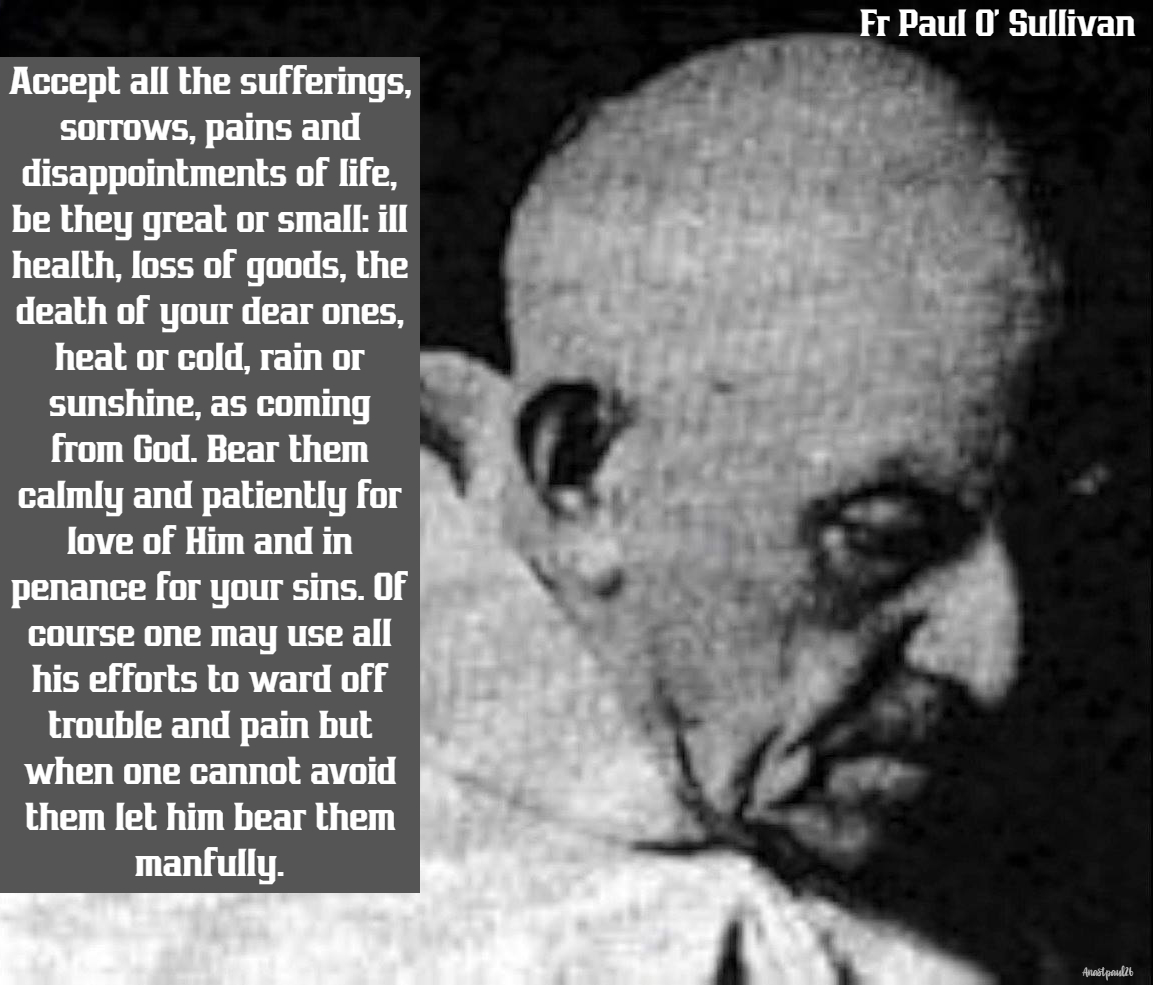
3. Accept all the sufferings, sorrows, pains and disappointments of life, be they great or small: ill health, loss of goods, the death of your dear ones, heat or cold, rain or sunshine, as coming from God. Bear them calmly and patiently for love of Him and in penance for your sins. Of course one may use all his efforts to ward off trouble and pain but when one cannot avoid them let him bear them manfully.

Impatience and revolt make sufferings vastly greater and more difficult to bear.

4. Christ’s life and actions are so many lessons for us to imitate.

The greatest act in His life was His Passion. As He had a Passion, so each one of us has a passion. Our passion consists in the sufferings and labours of every day. The penance God imposed on man for sin was to gain his bread in the sweat of his brow. Therefore, let us do our work, accept its disappointments and hardships and bear our pains in union with the Passion of Christ. We gain more merit by a little pain than by years of pleasure.

5. Forgive all injuries and offences, for in proportion as we forgive others, God forgives us.

6. Avoid mortal sins and deliberate venial sins and break off all bad habits. Then it will be relatively easy to satisfy God’s justice for sins of frailty. Above all, avoid sins against charity and against chastity, whether in thought, word or deed, for these sins, and the expiation for them are the reason why many souls are detained in Purgatory for long years.

7. If afraid of doing much, do many little things, acts of kindness and charity, give the alms you can, cultivate regularity of life, method in work and punctuality in the performance of duty; don’t grumble or complain when things are not as you please; don’t censure and complain of others; never refuse to do a favour to others when it is possible.

These and suchlike little acts are a splendid penance.

8. Do all in your power for the Holy Souls in Purgatory. Pray for them constantly, get others to do so, join the Association of the Holy Souls and ask all those you know to do likewise. The Holy Souls will repay you most generously.

9. There is no way more powerful of obtaining from God a most holy and happy death than by weekly Confession, daily Mass and daily Communion.

10. A daily visit to the Blessed Sacrament–it need only be three or four minutes–is an easy way of obtaining the same grace. Kneeling in the presence of Jesus with eyes fixed on the Tabernacle, sure that He is looking at us, let us for a few minutes repeat some little prayer like these: “My Jesus, mercy.” “My Jesus, have pity on me, a sinner” “My Jesus,I love You” “My Jesus, give me a happy death.”
Posted in CATHOLIC Quotes

Thought for the Day – 20 November – The Difficulty of Purgatory

These souls waiting for heaven are one and all holy. No spot of sin, no attachment to sin, no imperfection dwells within them. They love God with all the force of their regenerate nature, and God loves them with the fondest affection. They are to be His friends and companions forever. The throne in heaven is ready for each of them, and nothing can deprive them of it. The saints and angels are longing for their company, yet they cannot enter heaven. How strange it seems! What holds them back in their spotless purity from the bosom of their God?

The doctrine of purgatory is, like all the teaching of the Church, perfectly reasonable. There are many good men and women loving God above all things, who have often made good acts of contrition for their past sins, who are nevertheless still very imperfect. It would be strange if they who commit many daily faults, of which some are deliberate and are done with a full knowledge that they displease God, should at once take their place in the company of saints. It would jar upon our ideas of what is required by the holiness and majesty of God.

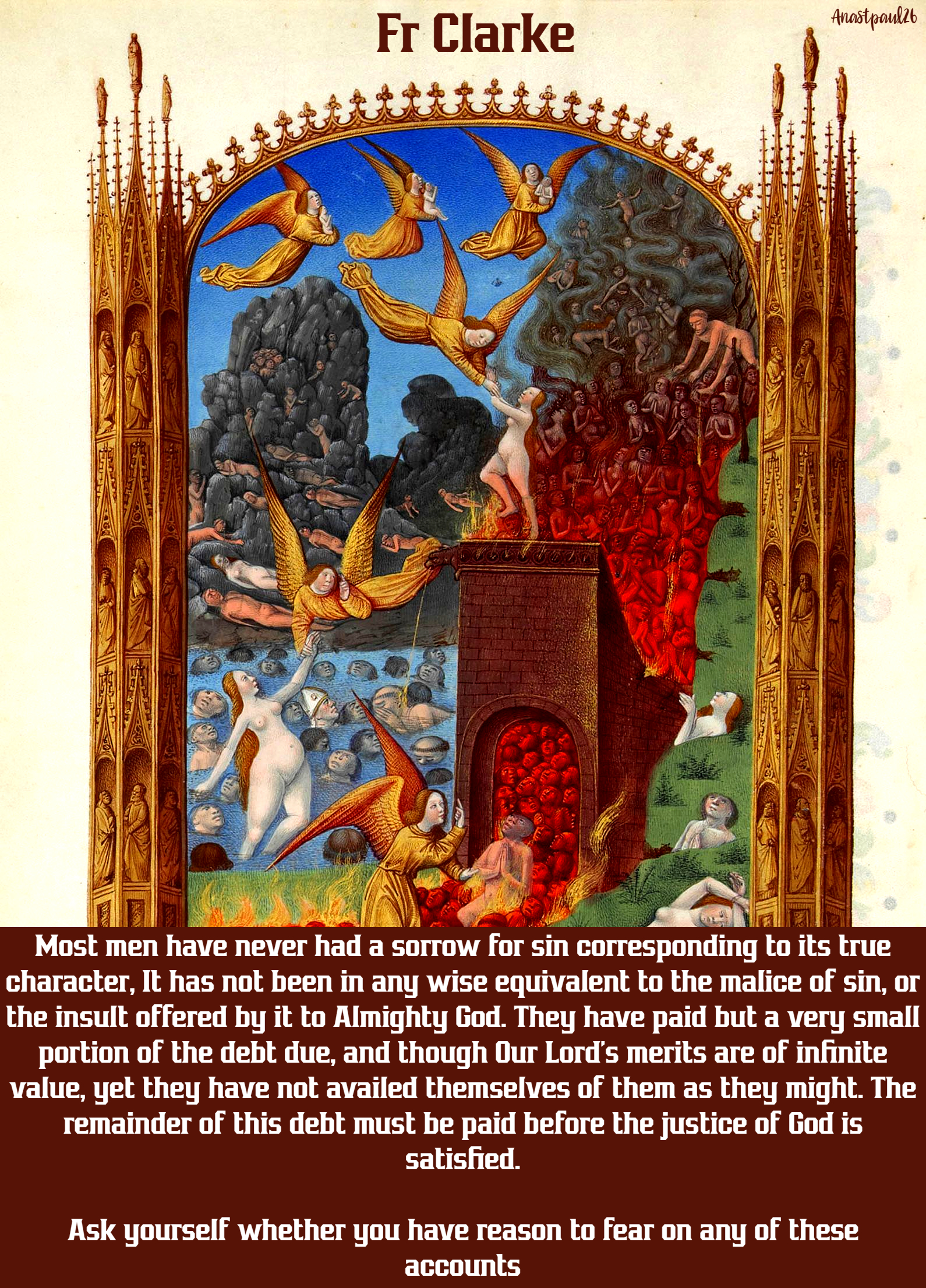
Most men have never had a sorrow for sin corresponding to its true character, It has not been in any wise equivalent to the malice of sin, or the insult offered by it to Almighty God. They have paid but a very small portion of the debt due, and though Our Lord’s merits are of infinite value, yet they have not availed themselves of them as they might. The remainder of this debt must be paid before the justice of God is satisfied.

Ask yourself whether you have reason to fear on any of these accounts.