Posted in MARIAN TITLES

Santa Maria alla Porta Luigi / Our Lady of Port Louis, Milan and Memorials of the Saints – 4 November

Santa Maria alla Porta Luigi / Our Lady of Port Louis, Milan, Italy – 4 November:
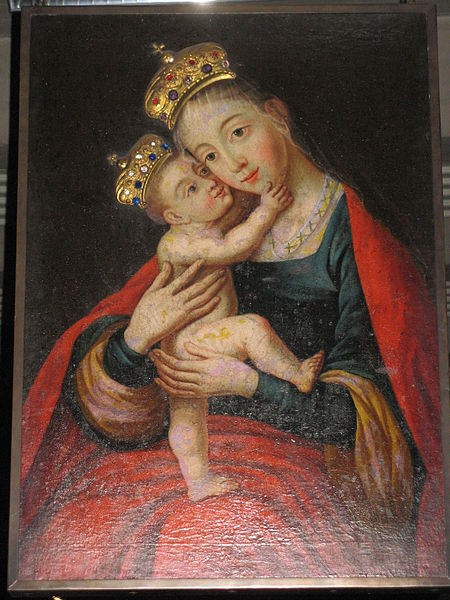
The ancient City of Milan, Italy, has had three completely different systems of walls defending the City throughout the ages. The oldest walls were Roman, built in the Republican and Imperial eras. The second wall was built in the 12th century, shortly after the City was razed by Frederick Barbarossa. The third, and final wall system was built in the 16th century by the Spanish rulers of Milan. Even though in most places there is little left of the walls, the gates, or “ports” contributed to the layout of the City as the streets passed through the gates from a central hub. The Roman gates were Porta Romana, Porta Ticinese, Porta Vercellina and so on, with each wall having gates with a variety of names. None of them, however, has had the name of Porta Luigi There is no Church in Milan to St. Louis and I can find no reference to this feast of Mary, that was once famous enough to have a date on the calendar. (https://www.roman-catholic-saints.com/our-lady-of-port-louis.html).

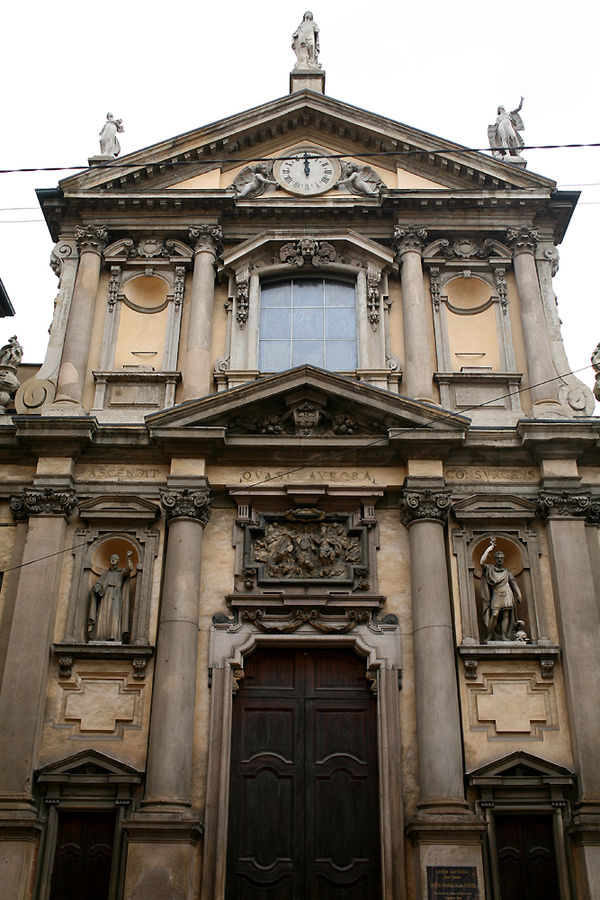
I (Ana) have found a Church called “Santa Maria alla Porta” (Holy Mary at the Gate), see below, which dates from very early times, certainly before the 12th Century. Although a Church already stood in the same Milanese location since before the year 1105, the present Church was erected in 1652 under Spanish rule.
St Charles Borromeo (1538-1584) Archbishop of Milan (Memorial)

St Agricola of Bologna
St Amandus of Avignon
St Amandus of Rodez
St Birstan
St Clarus the Hermit
St Clether
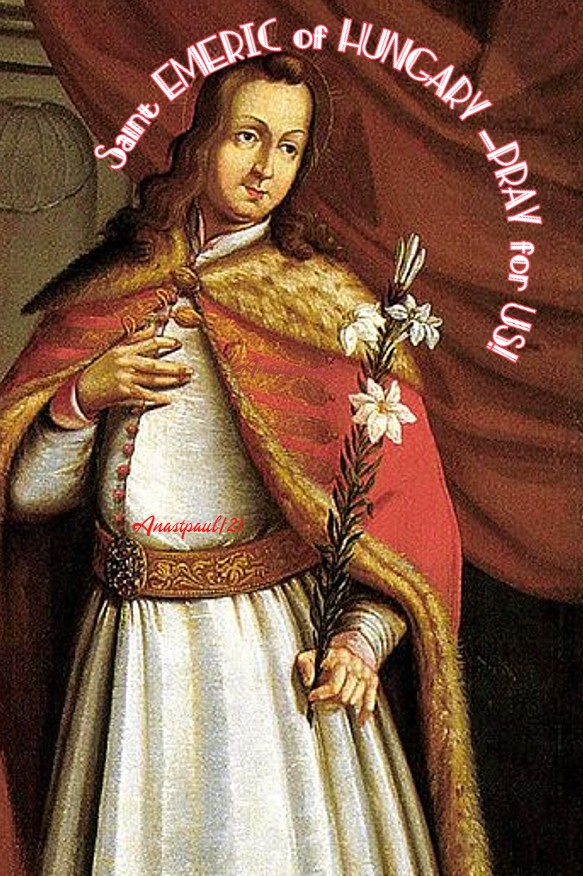
St Emeric of Hungary (c 1007-1031) Confessor, Prince and heir to the Hungarian Throne, Son of St Stephen, King of Hungary

Bl Frances d’Amboise
St Gerard de Bazonches
St Gregory of Burtscheid
Bl Helen Enselmini
Bl Henry of Zweifalten
St Hermas of Myra
Bl Joan Antoni Burró Mas
St Joannicus of Mount Olympus
St John Zedazneli
St Modesta of Trier
St Nicander of Lycia
St Patrobas
St Perpète
St Philologus
St Pierius
St Proculus of Autun
Bl Teresa Manganiello
St Vitalis of Bologna
Posted in SAINT of the DAY

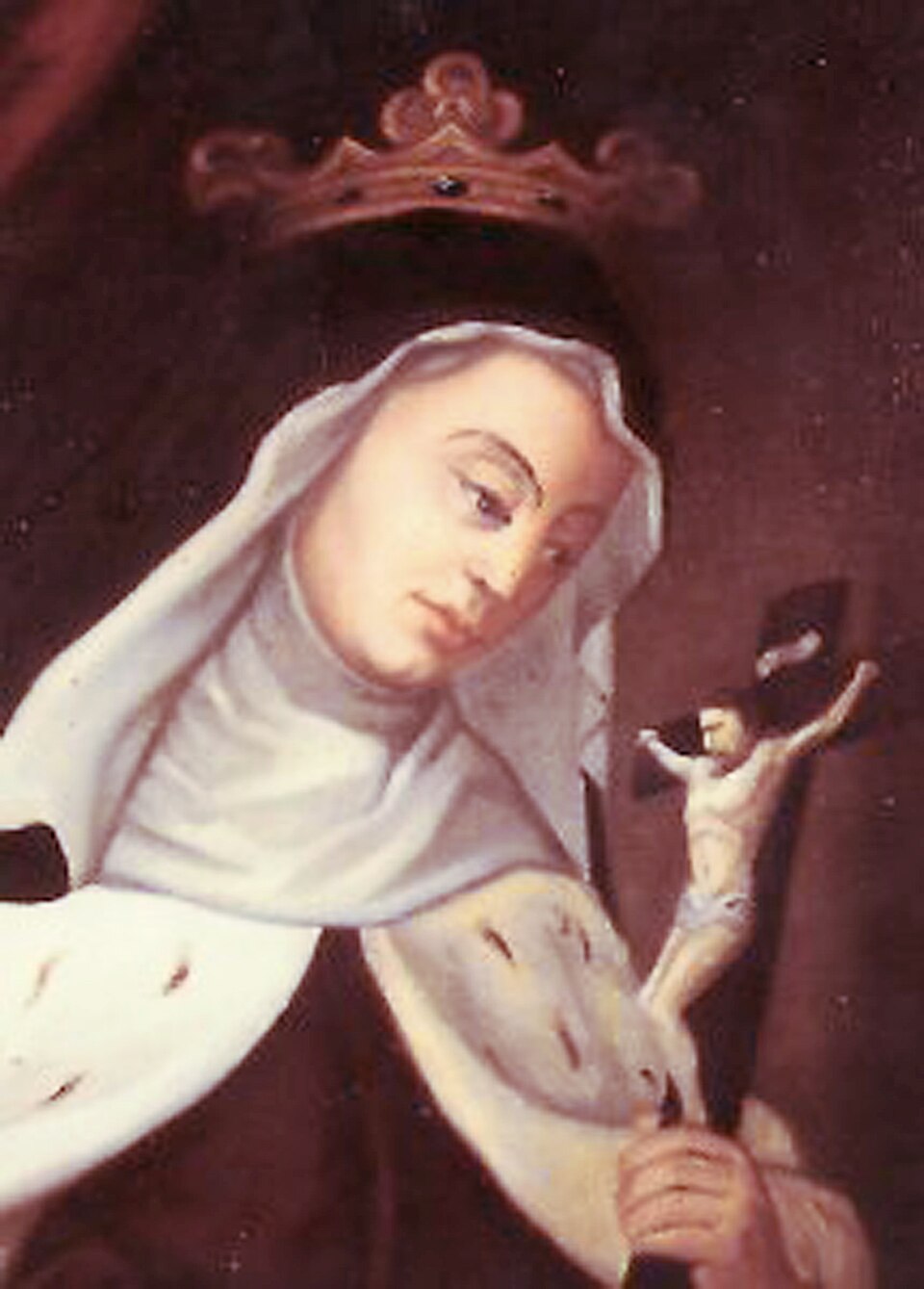
Saint of the Day – 4 November – Blessed Frances d’Amboise

Blessed Frances d’Amboise, also known as Francisca de Amboise, Françoise d’Amboise, was a daughter of Louis d’Amboise, Viscount de Thouars, and the Duchess of Brittany, being married to Peter II, Duke of Brittany at age 15.

Born on 28 September 1427 in Thouars, Deux-Sèvres, France, her marriage was not a happy one, and Peter sometimes abused her, but Frances softened Peter over the years, and he assisted in her charitable work. She established a Poor Clare convent at Nantes, France, and worked for the canonization of Saint Vincent Ferrer. She supported the Dominican convent at Nantes. Widowed in 1457, she entered into a conflict with King Louis XI who wanted to marry her, but ultimately was able to devote herself to religious life. Frances joined the Carmelite nuns at Bondon on 25 March 1468, making her final vows in 1469. She was a spiritual student of Blessed John Soreth. After working in the infirmary for a while, she was elected prioress for life in 1473. She is considered the foundress of the Carmelite nuns in France.

She died on 4 November 1485 at Les Couêts, Nantes, France of natural causes, and while in a religious ecstasy. Miracles were reported at her tomb. Her body had to be moved to save it during the Huguenot wars, and again in the French Revolution. She was beatified on 16 July 1863 by Pope Pius IX.

Posted in Our MORNING Offering

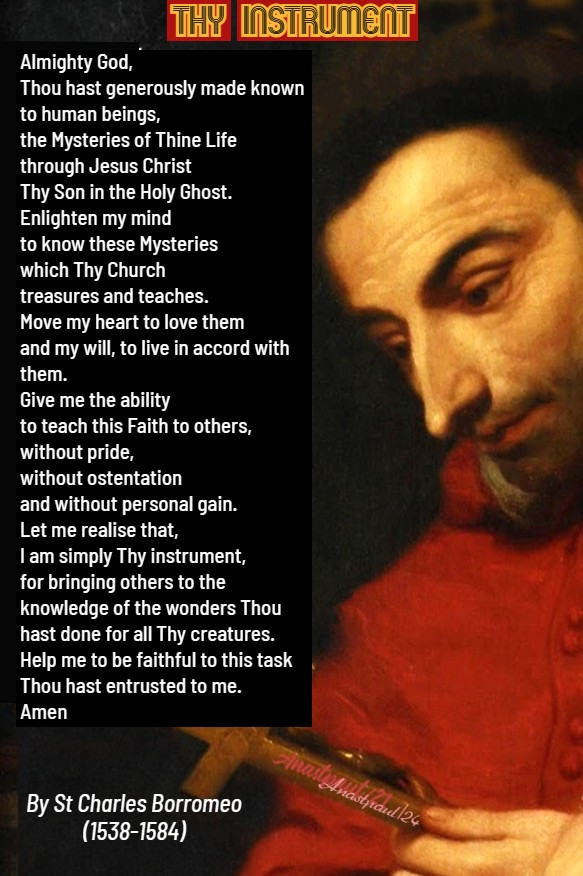
Our Morning Offering – 4 November – Your Instrument – Prayer of St Charles Borromeo

Thy Instrument
By St Charles Borromeo (1538-1584)

Almighty God,
Thou hast generously made known
to human beings,
the Mysteries of Thine Life
through Jesus Christ
Thy Son in the Holy Ghost.
Enlighten my mind
to know these Mysteries
which Thy Church
treasures and teaches.
Move my heart to love them
and my will, to live in accord with them.
Give me the ability
to teach this Faith to others,
without pride,
without ostentation
and without personal gain.
Let me realise that,
I am simply Thy instrument,
for bringing others to the knowledge
of the wonders Thou hast done
for all Thy creatures.
Help me to be faithful to this task
Thou hast entrusted to me.
Amen

Posted in ONE Minute REFLECTION

One Minute Reflection – 4 November – Follow me

One Minute Reflection – 4 November – “Month of the Holy Souls in Purgatory” – Readings: Sir 45:30, Ps. 131:1, Sir 44:16-27; 45:3-20, Matt 25:14-23

The Lord made a covenant of friendship with him, and made him a prince; that he should possess the dignity of priesthood forever.

Sir 45:30

REFLECTION – May those who have been disinherited of wealth learn from the Church that, according to the judgment of God himself, poverty is not a disgrace, and that there is no need to blush with shame if you have to earn your daily bread through work. Jesus Christ Our Lord confirmed this by his example, he who for the salvation of men “made himself poor though he was rich.” He who was the Son of God and God himself wanted to be taken for the son of a worker in the eyes of the world. He went so far as to spend a large part of his life in doing paid work. “Is this not the carpenter, the son of Mary?”

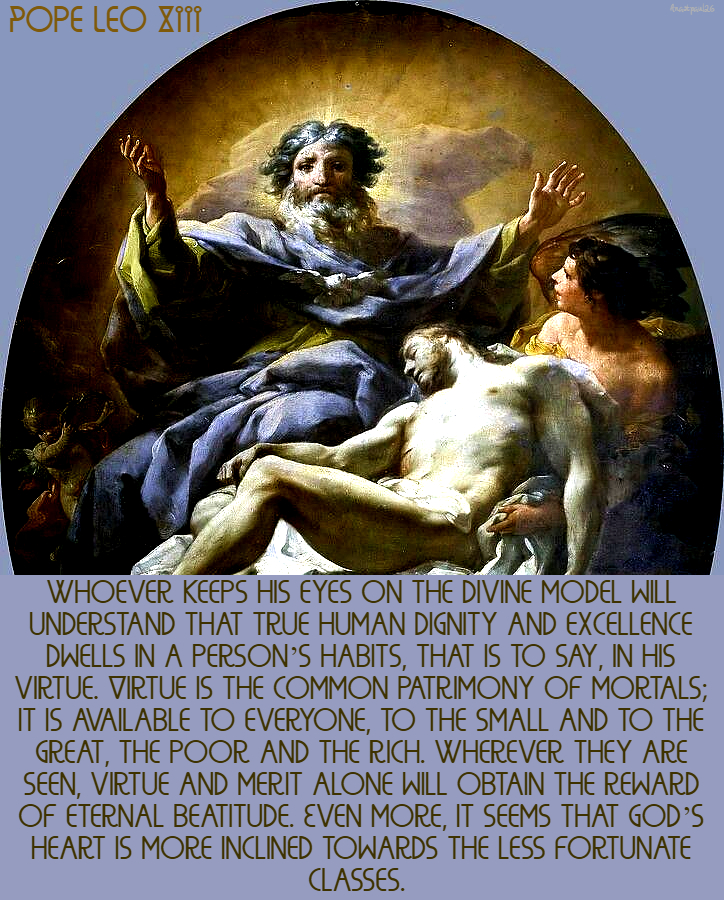
Whoever keeps his eyes on the divine model will understand that true human dignity and excellence dwells in a person’s habits, that is to say, in his virtue. Virtue is the common patrimony of mortals; it is available to everyone, to the small and to the great, the poor and the rich. Wherever they are seen, virtue and merit alone will obtain the reward of eternal beatitude. Even more, it seems that God’s heart is more inclined towards the less fortunate classes. Jesus Christ calls the poor blessed. With love he invites all who suffer and weep to come to him so that he might console them; he embraces with a more tender charity those who are small and oppressed. These teachings are certainly given in order to humble the haughty soul of the rich and to make him more compassionate, to raise the courage of those who suffer and to inspire them with trust.

Pope Leo XIII

PRAYER – Lord God, in Your wisdom, You created us, by Your providence You rule us, penetrate our inmost being with Your holy light, so that our way of life, may always be one of faithful service to You. With great love we thank You for the great gifts You shower upon us and for being our Father, who seeks and finds us when we are lost. Grant that by the intercession of St Charles Borromeo and St Emeric, we may ever seek to stay true to our baptism. Through Jesus, our Lord, with the Holy Spirit, God forever, amen.

Posted in CATHOLIC Quotes

Quote/s of the Day – 4 November – Talents

And to one he gave five talents, to another two, and to another one, to each according to his particular ability, and then he went on his journey.

Matt 25:14-23

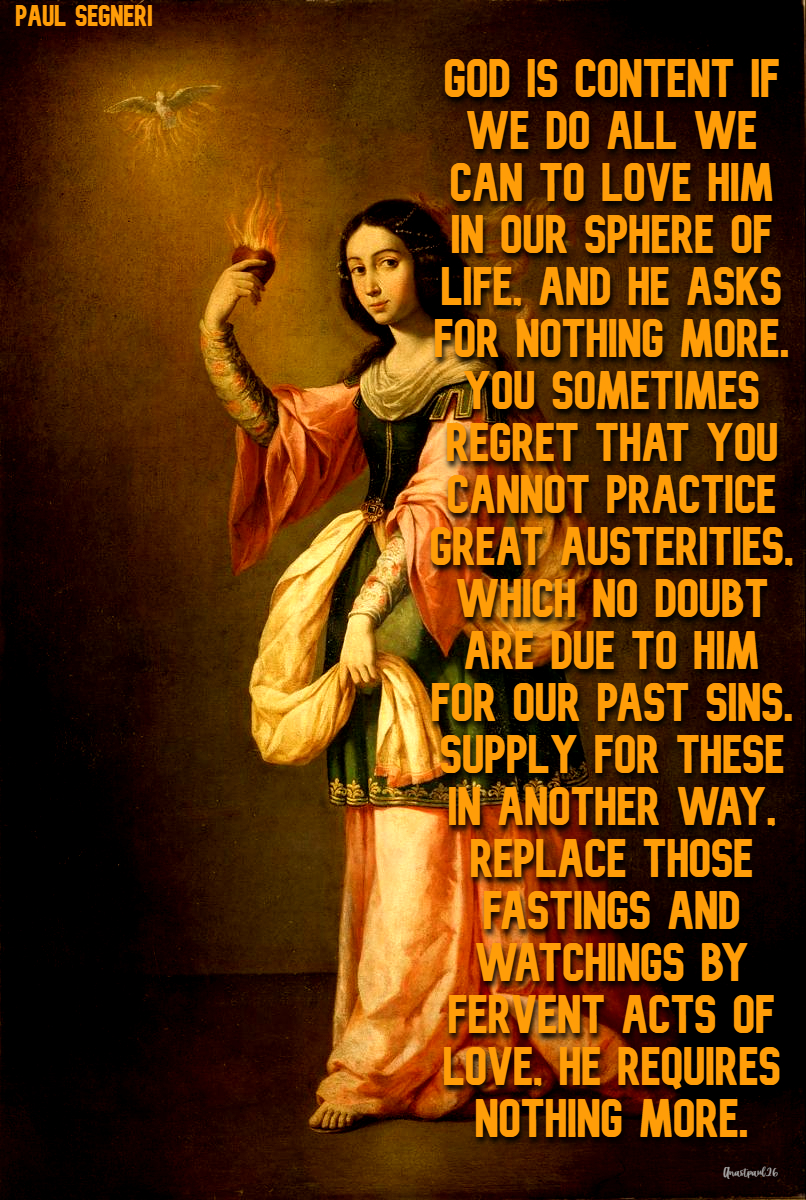
God is content if we do all we can to love Him in our sphere of life, and He asks for nothing more. You sometimes regret that you cannot practice great austerities, which no doubt are due to Him for our past sins. Supply for these in another way, replace those fastings and watchings by fervent acts of love, He requires nothing more.

Paul Segneri

If you are always ready to do His will and to submit to it, then be sure that you love Him. Conformity to the will of God also makes a man happy as God, who is happiness itself.

Le Pere Nepveu

They reverenced even the scourges which God had sent to chasten them. The early Christians blessed the hands that struck them.

Massillon

According to St Augustine, the Divine Word falls on a weak and sensitive element, and it becomes a sacrament. This word also falls on impure hearts, and it makes them chaste, on the wicked, and makes them saints. It finds them in sin, and it converts them to God.

La Pere Antoine de la Porte

However enlightened and clever we may be, we must not, on account of that, neglect the assistance of holy instructions, however bright may be our intellect, we can easily go astray, however learned and scientific, we can always learn something from hearing the Word of God.

Massillion

Nothing can excuse the neglect of the duties of the position in life which God has conferred upon us. No amount of external work, not the unsleeping universal heroism of a St Vincent de Paul, can make up for the want of attention to our own souls.

Fr Faber

Posted in NOVEMBER - Month of the SOULS in PURGATORY

Thought for the Day – 4 November – Separation from God

Treatise on Purgatory

St Catherine of Genoa

CHAPTER III

All the pains of purgatory take their rise from sin, original or actual. God created the soul perfectly pure and free from every spot of sin, with a certain instinctive tendency to find its blessedness in Him. From this tendency it is drawn away by original sin, and still more by the addition of actual sin ; and the farther off it gets, the more wicked it becomes, because it is less in conformity with God. Things are good only so far as they participate in God.

To irrational creatures God communicates Himself, without fail, as He wills, and as He has determined ; to the rational soul more or less, according as He finds it purified from the impediment of sin ; so that, when a soul is approaching to that state of first purity and innocence which it had when created, the instinctive desire of seeking happiness in God develops itself, and goes on increasing through the fire of love, which draws it to its end with such impetuosity and vehemence, that any obstacle seems intolerable, and the more clear its vision, the more extreme its pain.

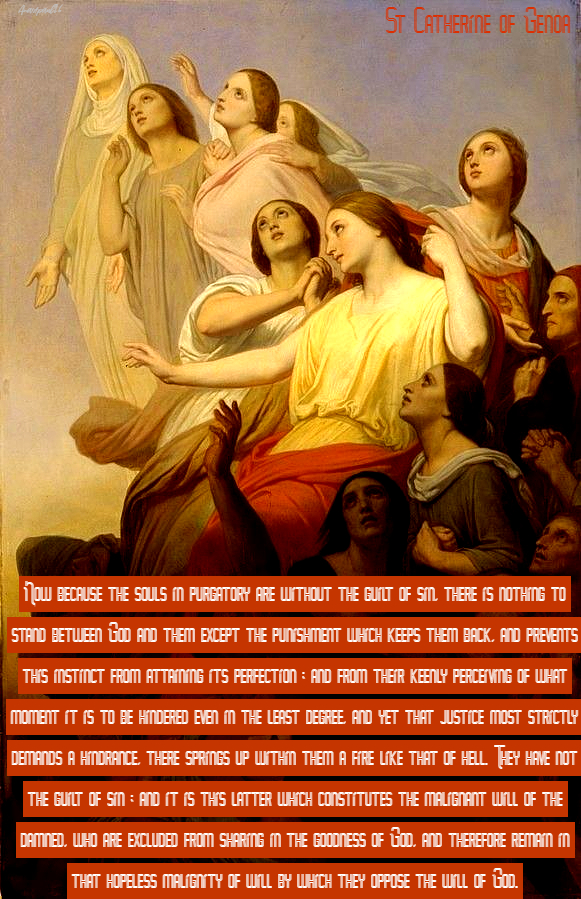
Now because the souls in purgatory are without the guilt of sin, there is nothing to stand between God and them except the punishment which keeps them back, and prevents this instinct from attaining its perfection ; and from their keenly perceiving of what moment it is to be hindered even in the least degree, and yet that justice most strictly demands a hindrance, there springs up within them a fire like that of hell. They have not the guilt of sin ; and it is this latter which constitutes the malignant will of the damned, who are excluded from sharing in the goodness of God, and therefore remain in that hopeless malignity of will by which they oppose the will of God.