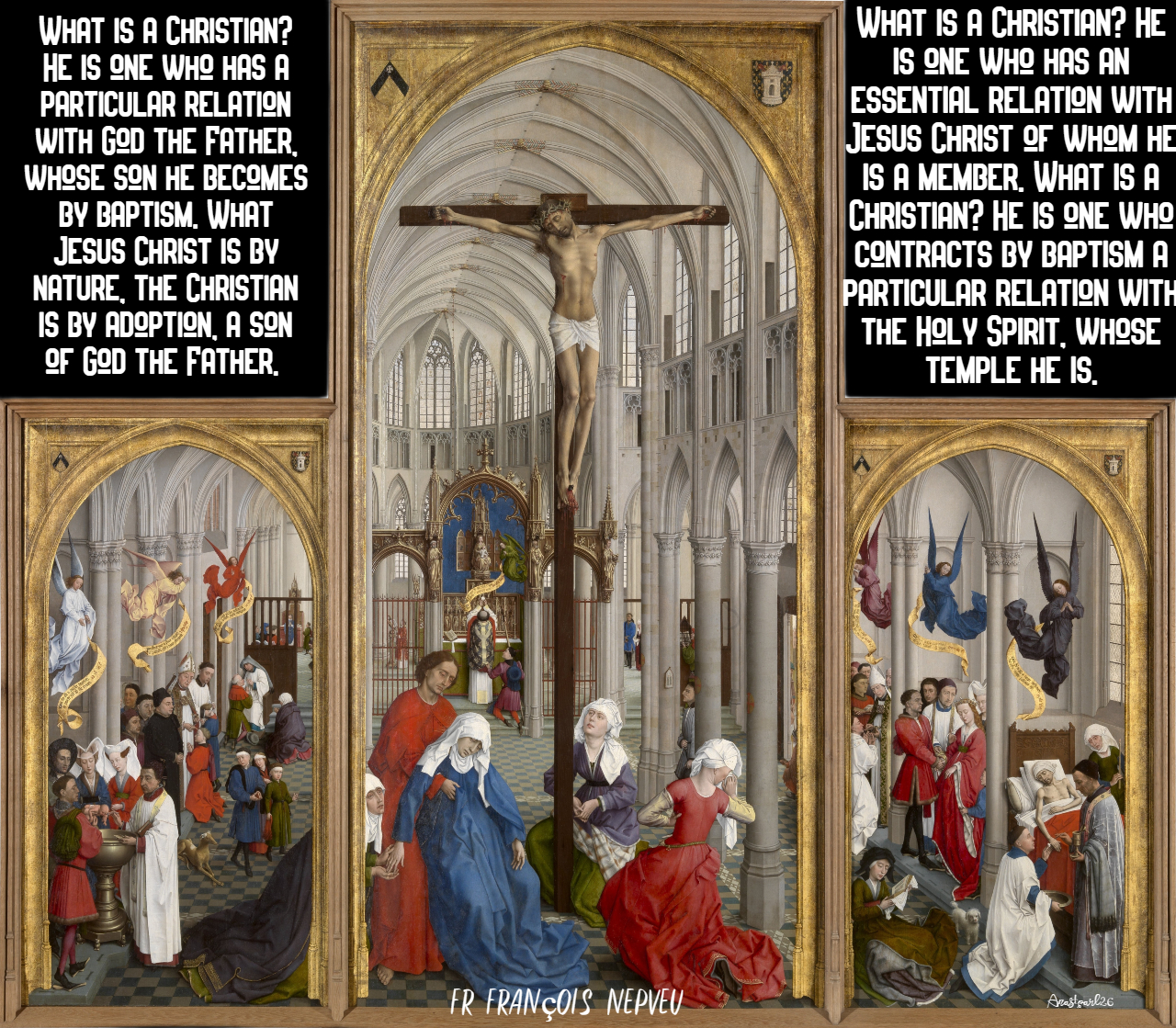
What is a Christian? He is one who has a particular relation with God the Father, whose son he becomes by baptism. What Jesus Christ is by nature, the Christian is by adoption, a son of God the Father. What is a Christian? He is one who has an essential relation with Jesus Christ of whom he is a member. What is a Christian? He is one who contracts by baptism a particular relation with the Holy Spirit, whose temple he is.
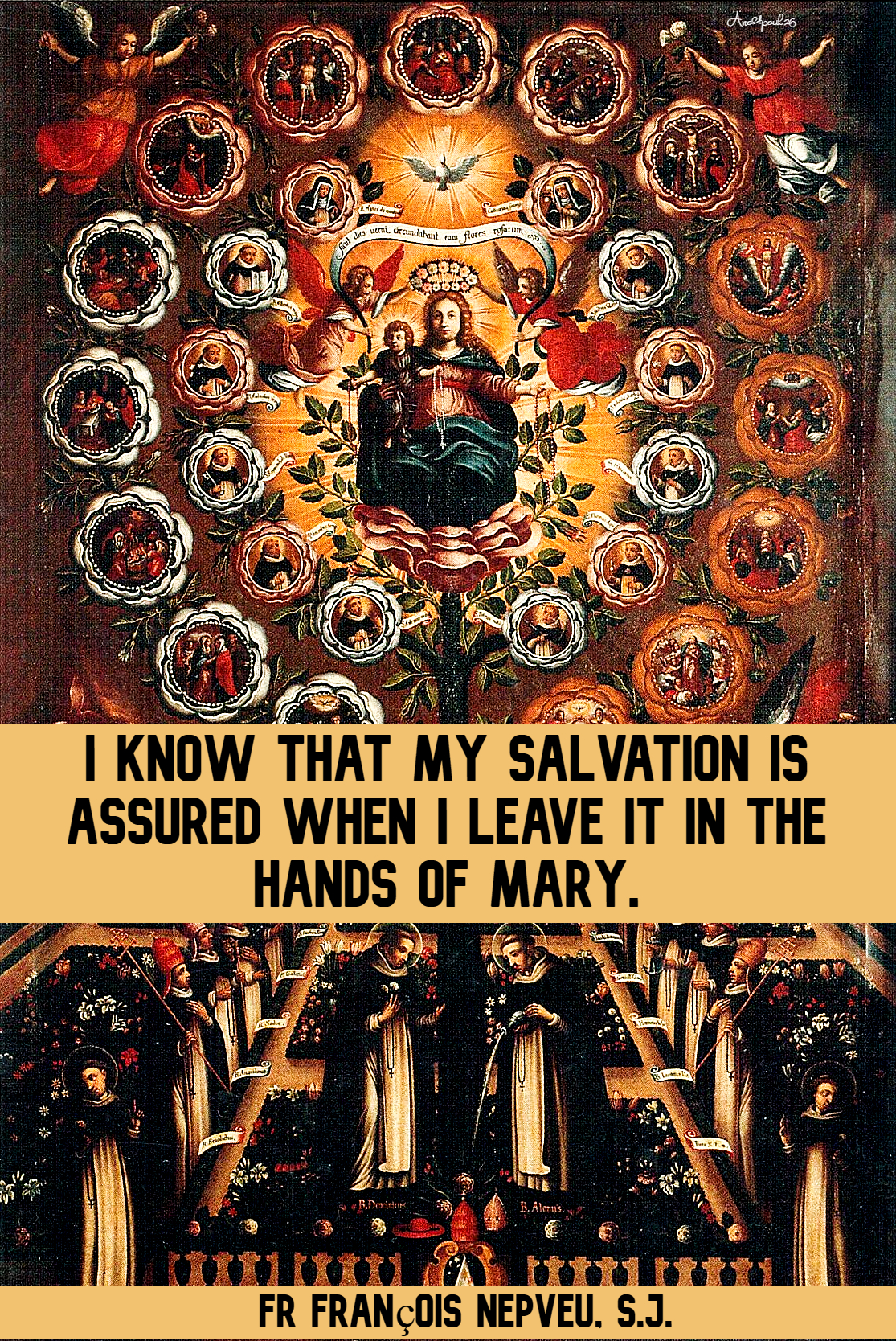
Fr François Nepveu
Never forget that the way which leads to heaven is narrow; that the gate leading to life is narrow and low; that there are but few who find it and enter by it; and if there be some who go in and tread the narrow path for some time, there are but very few who persevere therein.
St. Clare of Assisi
Vain is the man who puts his trust in men, in created things. Do not be ashamed to serve others for the love of Jesus Christ and to seem poor in this world. Do not be self-sufficient but place your trust in God. Do not think yourself better than others lest, perhaps, you be accounted worse before God Who knows what is in man. Do not take pride in your good deeds, for God’s judgments differ from those of men and what pleases them often displeases Him.
The Imitation of Christ
No, saith God, “There is no peace unto the wicked.” In the first place, sin bears about with it the fear of Divine Justice. If any one has a powerful enemy, he can neither eat nor sleep in peace ; and he who has God for an enemy, how can he rest in peace? Besides this, sin bears about with it the remorse of conscience, which, like a cruel worm, is ever gnawing. The wretched sinner may seek amusement in various ways at the play, in the dance, at the banquet ; but his conscience is ever whispering to him, “Thou art at enmity with God; if thou shouldst die, whither wilt thou go?
St Alphonsus Liguori
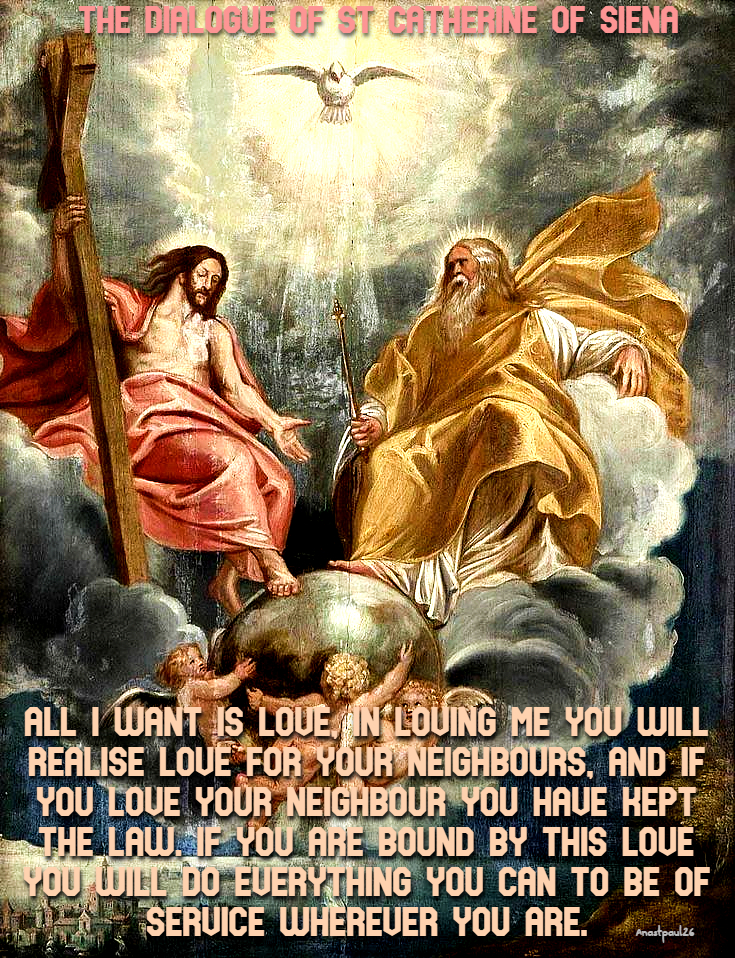
All I want is love, in loving me you will realise love for your neighbours, and if you love your neighbour you have kept the law. If you are bound by this love you will do everything you can to be of service wherever you are.
The Dialogue of St Catherine of Siena
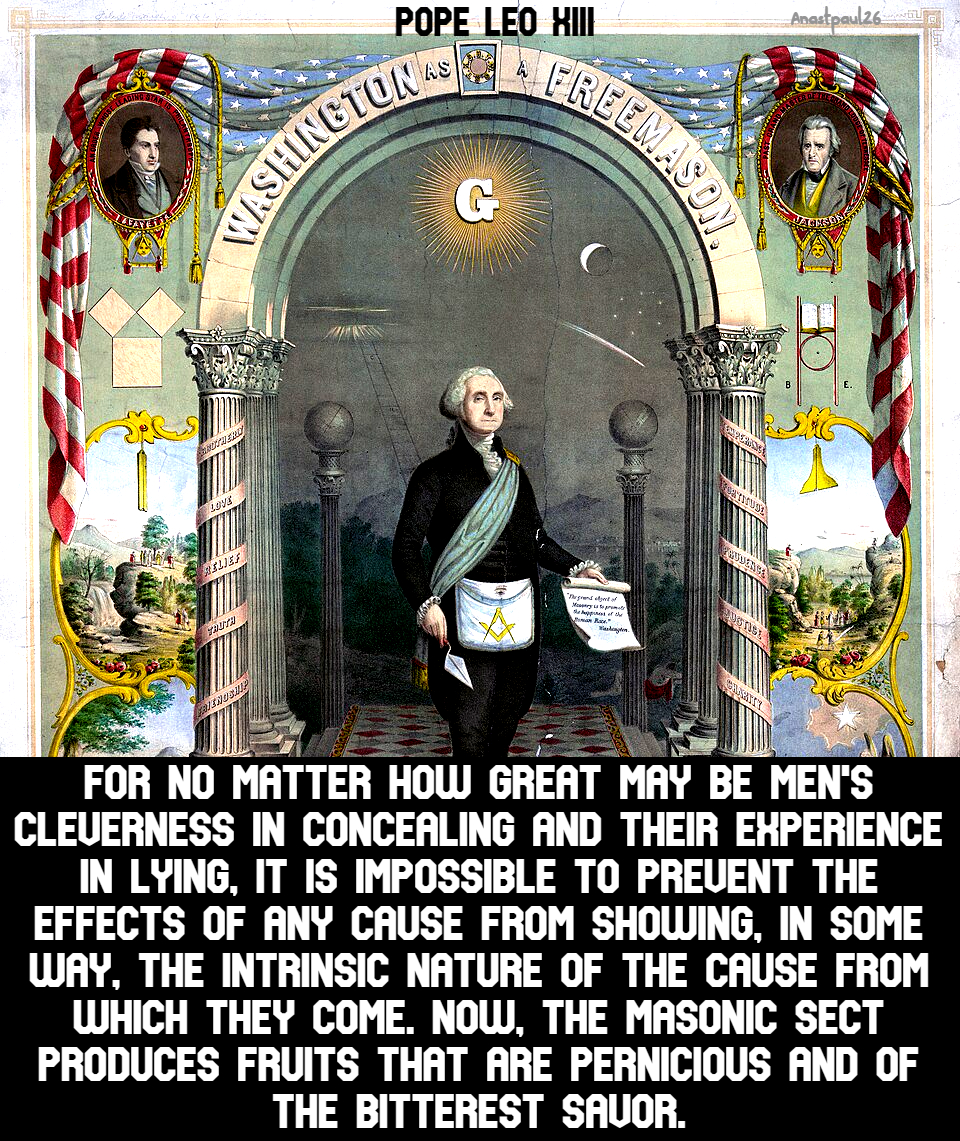
For no matter how great may be men’s cleverness in concealing and their experience in lying, it is impossible to prevent the effects of any cause from showing, in some way, the intrinsic nature of the cause from which they come. Now, the Masonic sect produces fruits that are pernicious and of the bitterest savor.
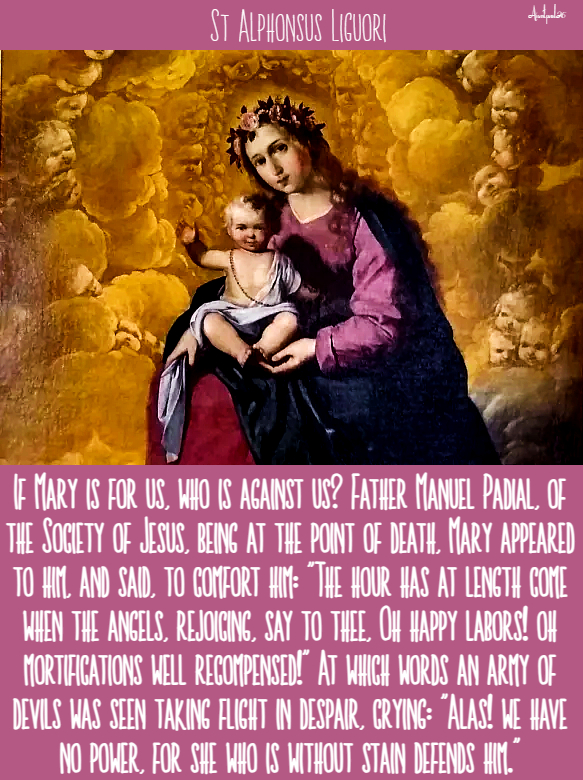
If Mary is for us, who is against us? Father Manuel Padial, of the Society of Jesus, being at the point of death, Mary appeared to him, and said, to comfort him: “The hour has at length come when the angels, rejoicing, say to thee, Oh happy labors! oh mortifications well recompensed!” At which words an army of devils was seen taking flight in despair, crying: “Alas! we have no power, for she who is without stain defends him.”
St Alphonsus Liguori
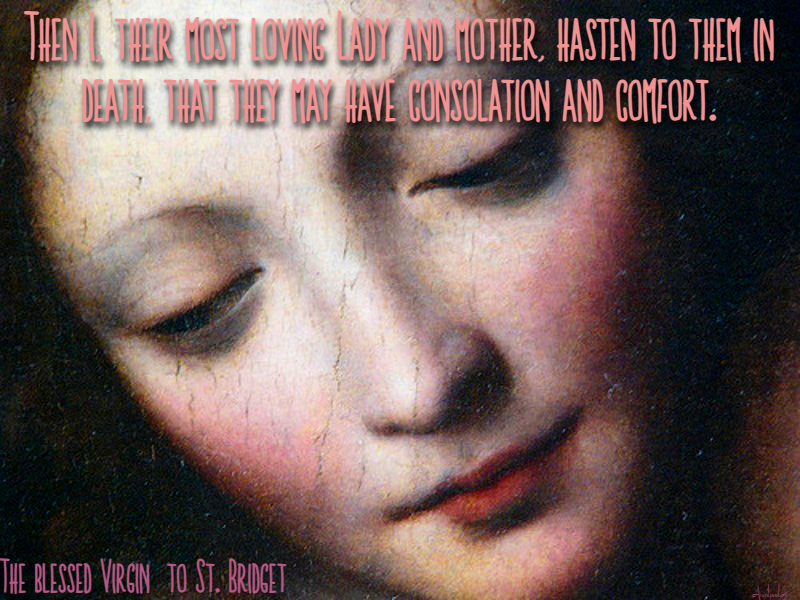
Then I, their most loving Lady and mother, hasten to them in death, that they may have consolation and comfort.
The blessed Virgin to St. Bridget
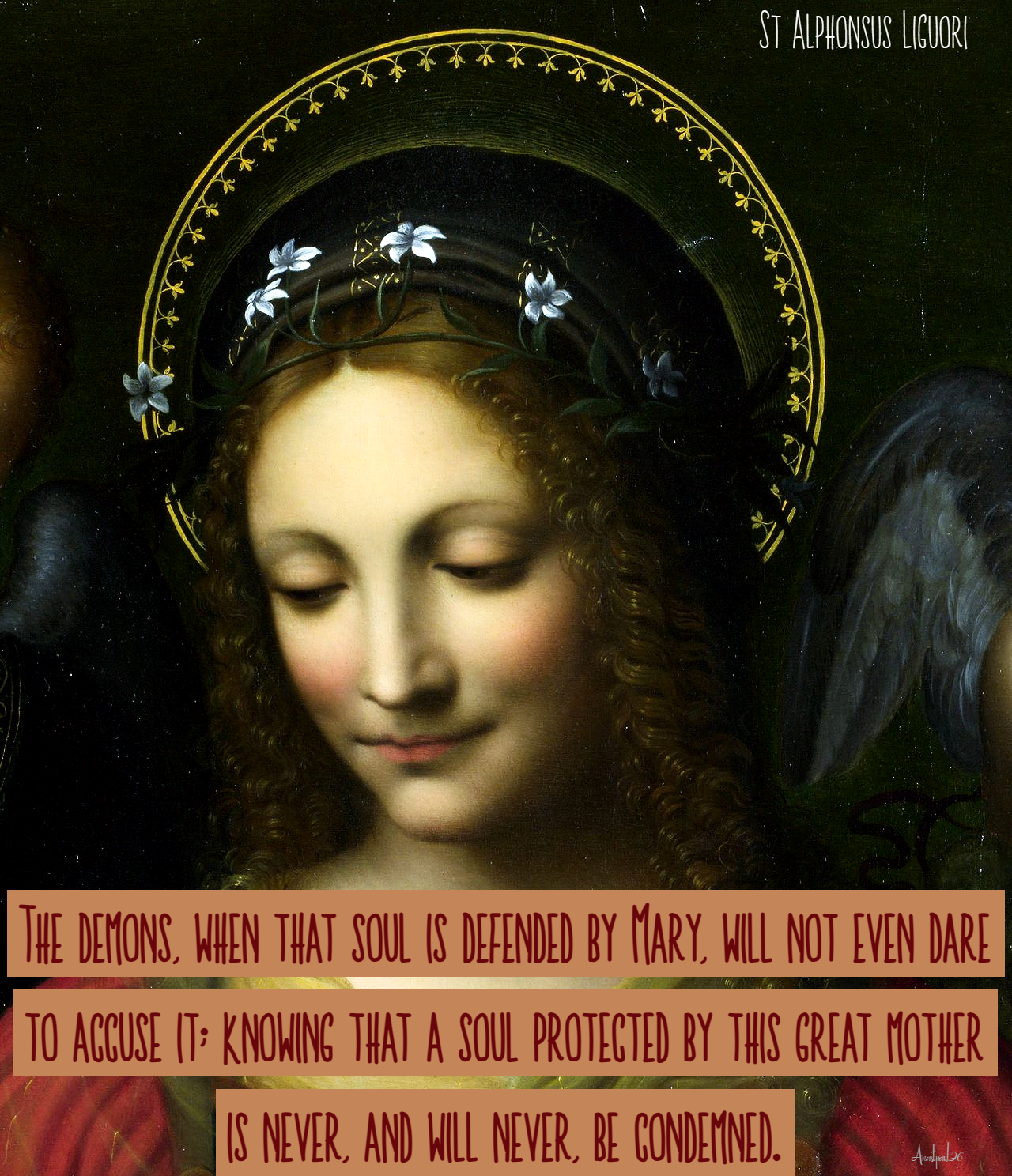
The demons, when that soul is defended by Mary, will not even dare to accuse it; knowing that a soul protected by this great mother is never, and will never, be condemned.
St Alphonsus Liguori
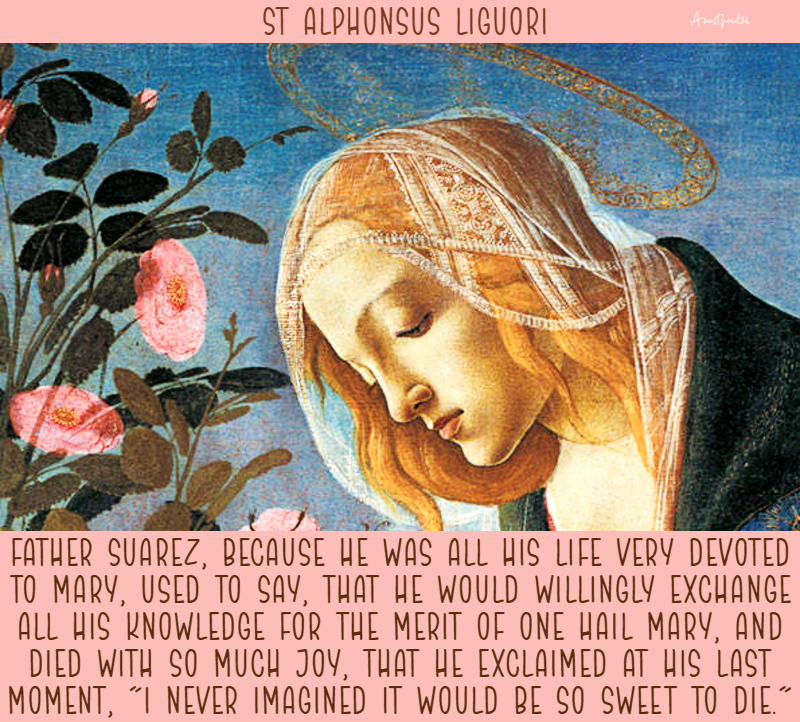
Father Suarez, because he was all his life very devoted to Mary, used to say, that he would willingly exchange all his knowledge for the merit of one Hail Mary, and died with so much joy, that he exclaimed at his last moment, “I never imagined it would be so sweet to die.”
St Alphonsus Liguori
Blessed art thou, oh brother, if in death thou shalt find thyself bound by the sweet chains of love for the mother of God! These chains are chains of salvation, which will secure to thee eternal salvation, and give thee in death that blessed peace which will be the commencement of thy eternal peace and rest.
St Alphonsus Liguori
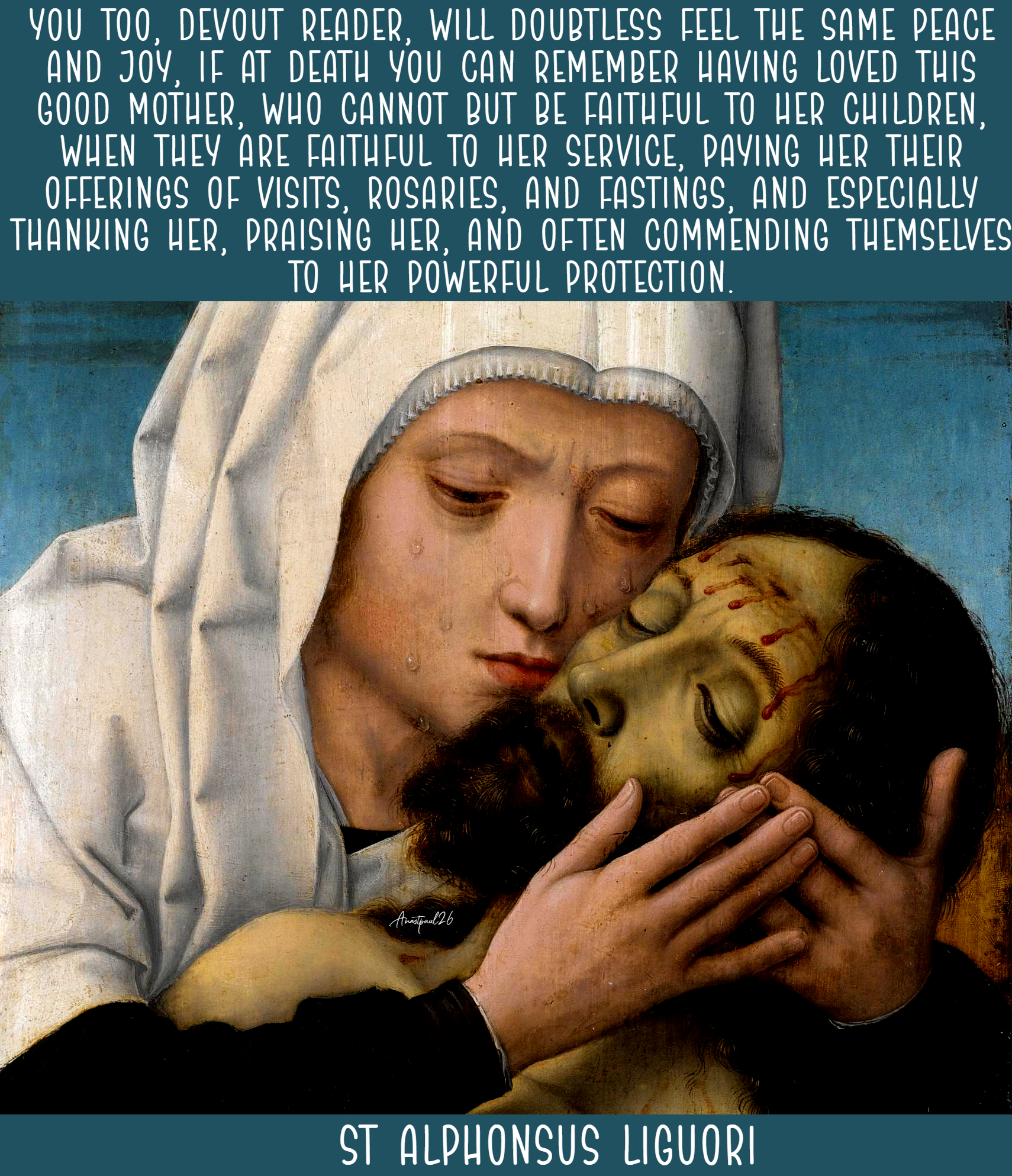
You too, devout reader, will doubtless feel the same peace and joy, if at death you can remember having loved this good mother, who cannot but be faithful to her children, when they are faithful to her service, paying her their offerings of visits, rosaries, and fastings, and especially thanking her, praising her, and often commending themselves to her powerful protection.
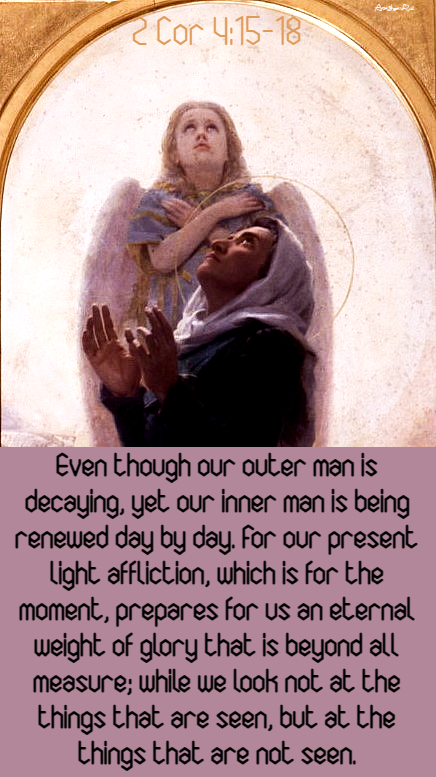
Even though our outer man is decaying, yet our inner man is being renewed day by day. For our present light affliction, which is for the moment, prepares for us an eternal weight of glory that is beyond all measure; while we look not at the things that are seen, but at the things that are not seen.
2 Cor 4:15-18
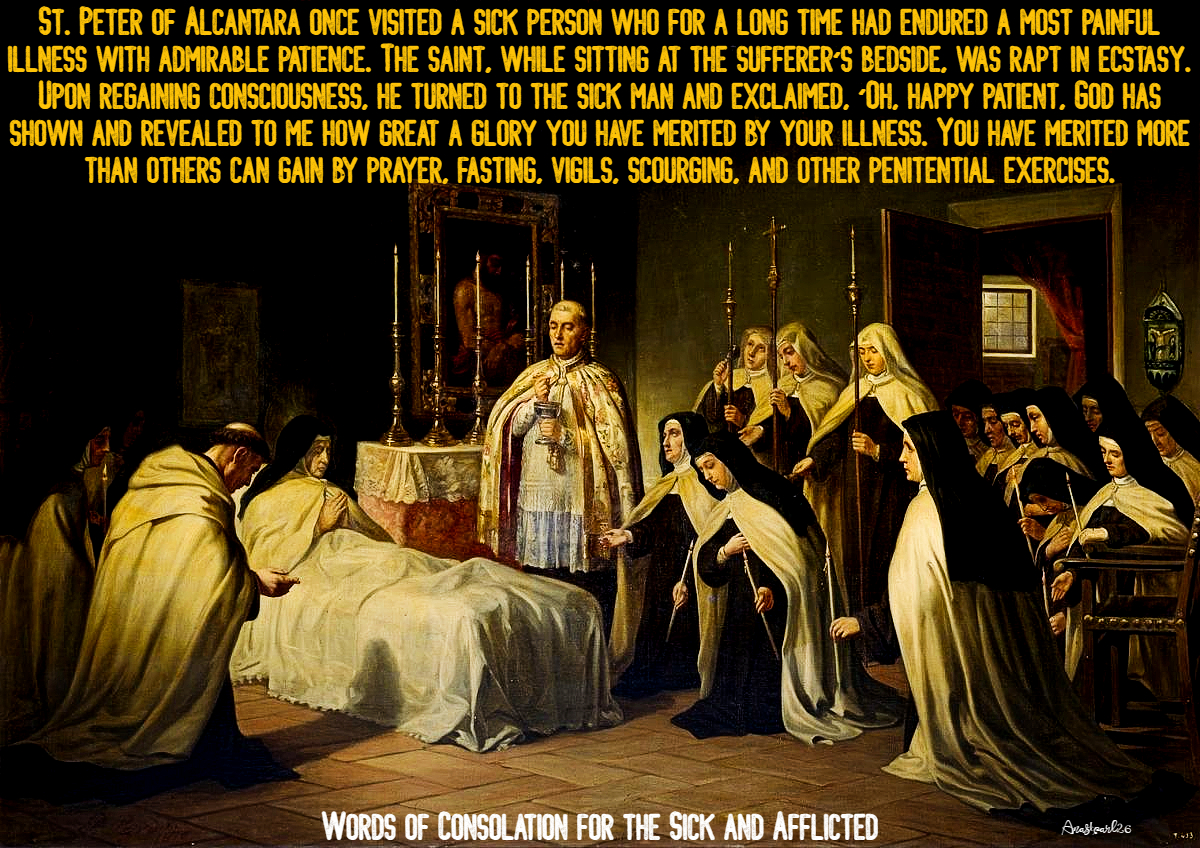
St. Peter of Alcantara once visited a sick person who for a long time had endured a most painful illness with admirable patience. The saint, while sitting at the sufferer’s bedside, was rapt in ecstasy. Upon regaining consciousness, he turned to the sick man and exclaimed, ‘Oh, happy patient, God has shown and revealed to me how great a glory you have merited by your illness. You have merited more than others can gain by prayer, fasting, vigils, scourging, and other penitential exercises.
Words of Consolation for the Sick and Afflicted
When one loves the Cross, one is fearless to kiss it and even enjoys death.
Fr. Demaris (18th century)
St Bonaventure says, that those who make a point of announcing to others the glories of Mary are certain of heaven, and this opinion is confirmed by Richard of St Lawrence, who declares ‘that to honour this Queen of Angels is to gain eternal life’ and he adds, ‘that this most gracious Lady will honour in the next world those who honour her in this.’
St Alphonsus Liguori
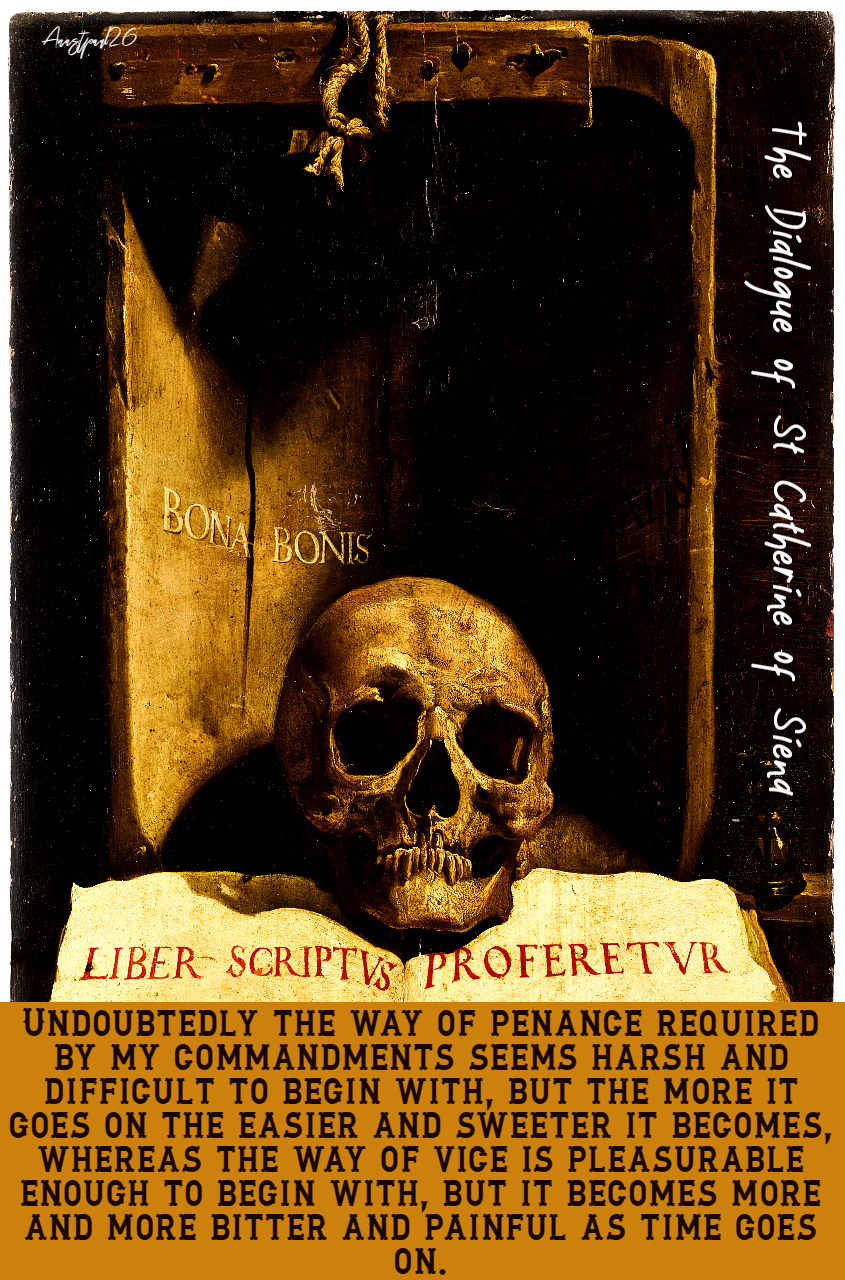
Bona bonis mala malis (Good things to the good, bad things to the bad) Liber scriptvs proferetvr (A written book will be brought forth) Tempvs breve est (Time is short)
Undoubtedly the way of penance required by my commandments seems harsh and difficult to begin with, but the more it goes on the easier and sweeter it becomes, whereas the way of vice is pleasurable enough to begin with, but it becomes more and more bitter and painful as time goes on.
The Dialogue of St Catherine of Siena
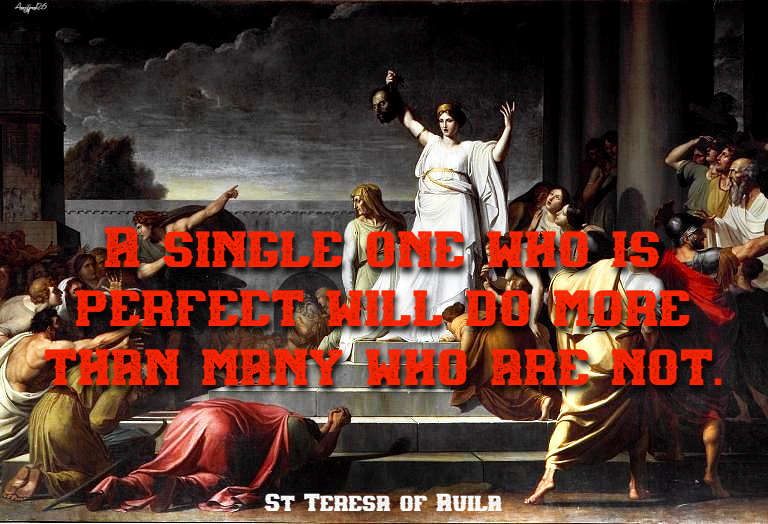
A single one who is perfect will do more than many who are not.
Be not vexed over evildoers, nor jealous of those who do wrong.
Ps 36:1
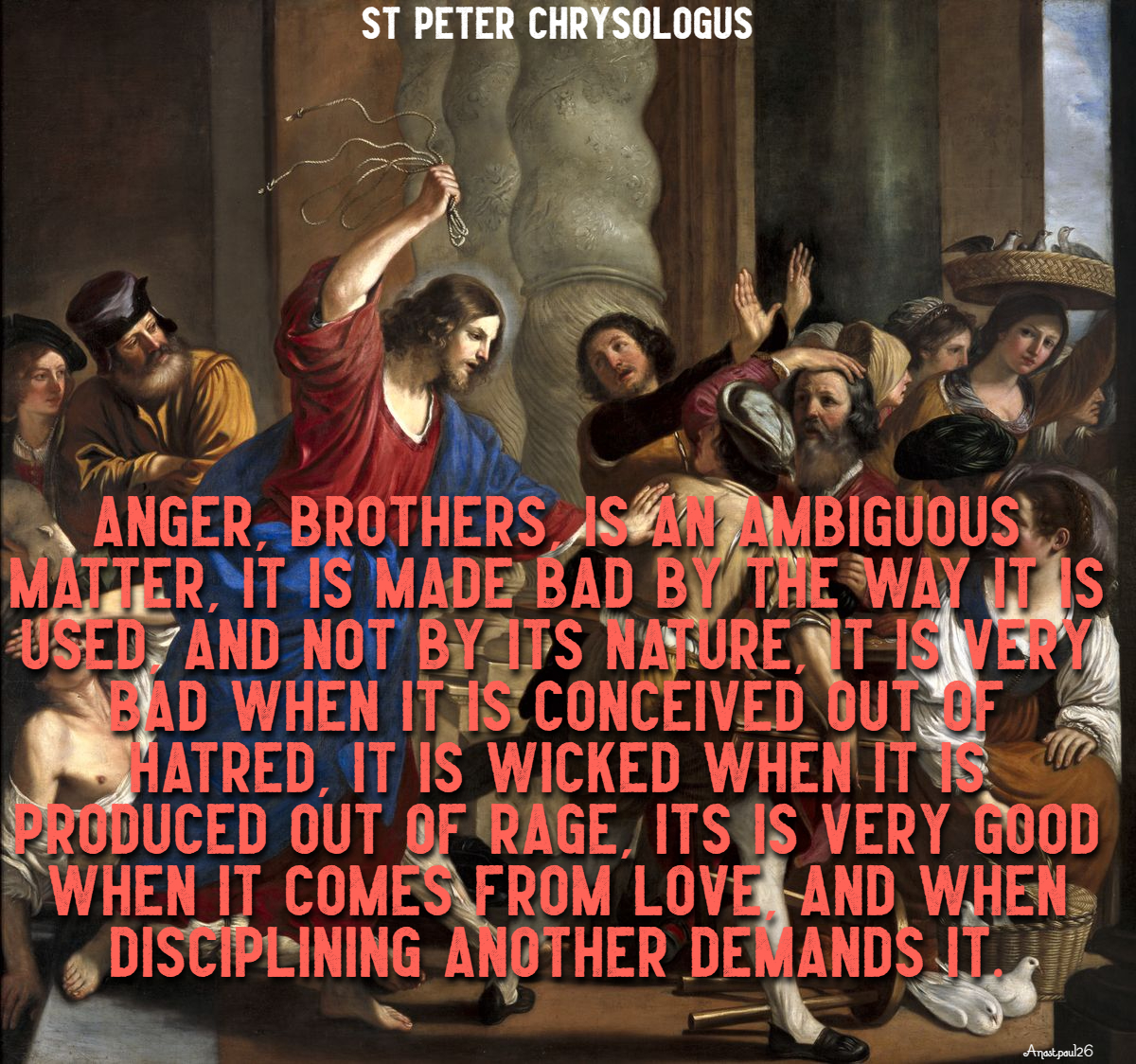
Anger, brothers, is an ambiguous matter, it is made bad by the way it is used, and not by its nature, it is very bad when it is conceived out of hatred, it is wicked when it is produced out of rage, its is very good when it comes from love, and when disciplining another demands it.
St Peter Chrysologus
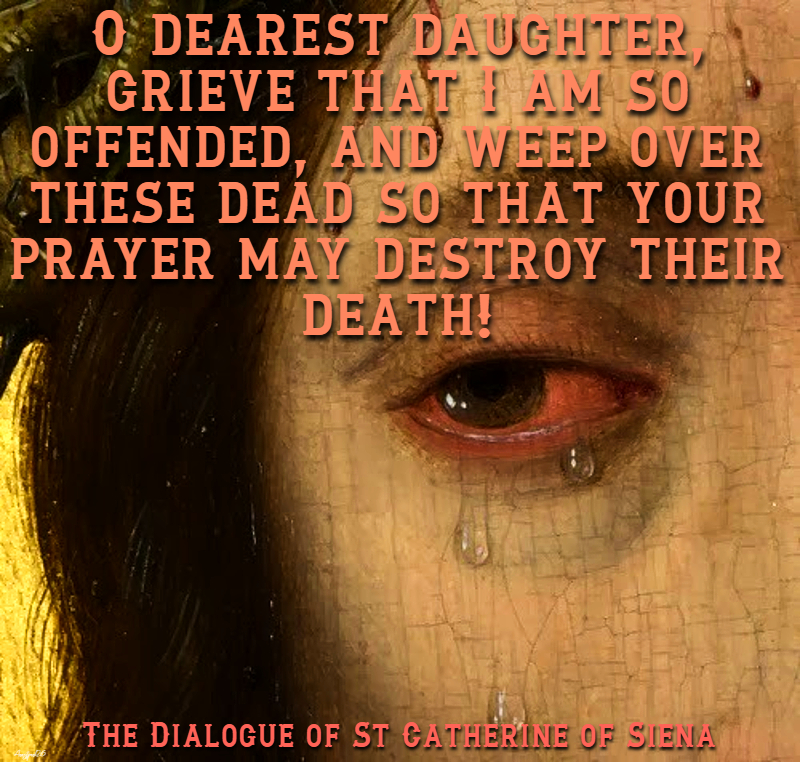
O dearest daughter, grieve that I am so offended, and weep over these dead so that your prayer may destroy their death!
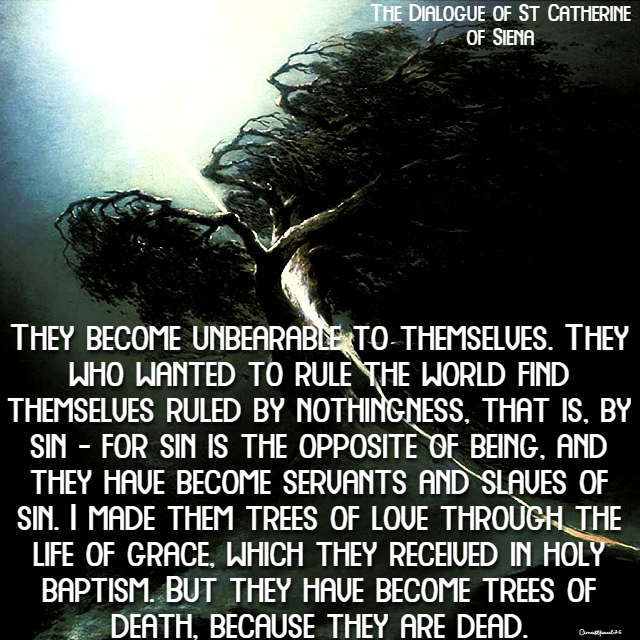
They become unbearable to themselves. They who wanted to rule the world find themselves ruled by nothingness, that is, by sin – for sin is the opposite of being, and they have become servants and slaves of sin. I made them trees of love through the life of grace, which they received in holy baptism. But they have become trees of death, because they are dead.
The Dialogue of St Catherine of Siena
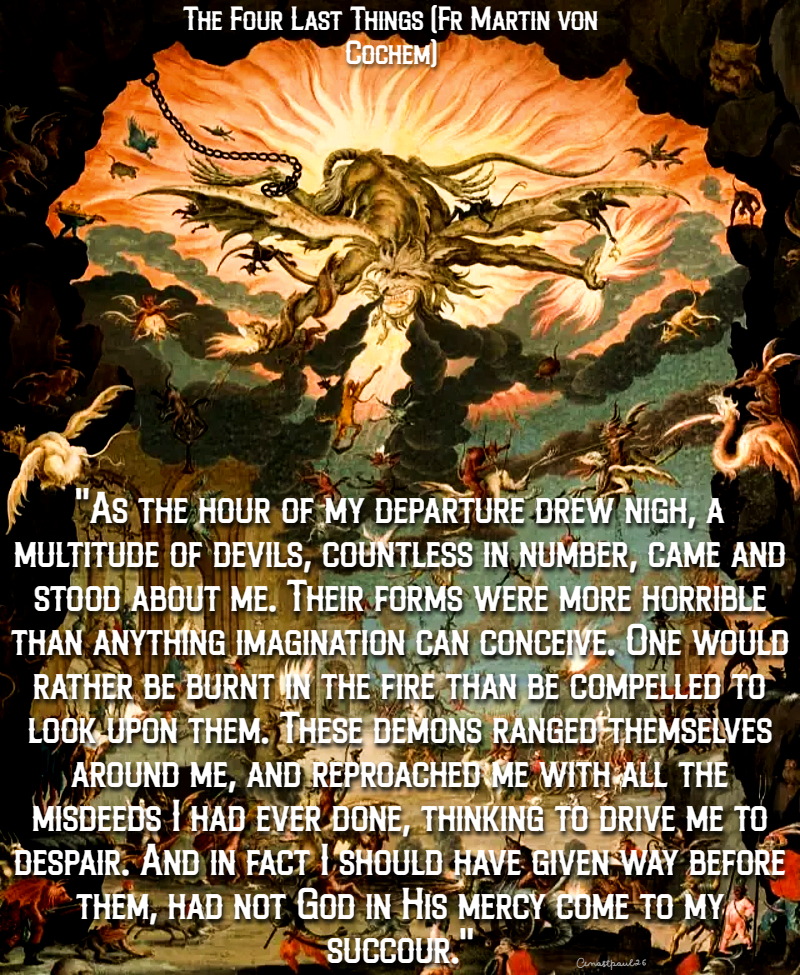
St. Cyril also, writing to St. Augustine, says that one of the three men who were raised from the dead told him: “As the hour of my departure drew nigh, a multitude of devils, countless in number, came and stood about me. Their forms were more horrible than anything imagination can conceive. One would rather be burnt in the fire than be compelled to look upon them. These demons ranged themselves around me, and reproached me with all the misdeeds I had ever done, thinking to drive me to despair. And in fact I should have given way before them, had not God in His mercy come to my succour.”
The Four Last Things (Fr Martin von Cochem)
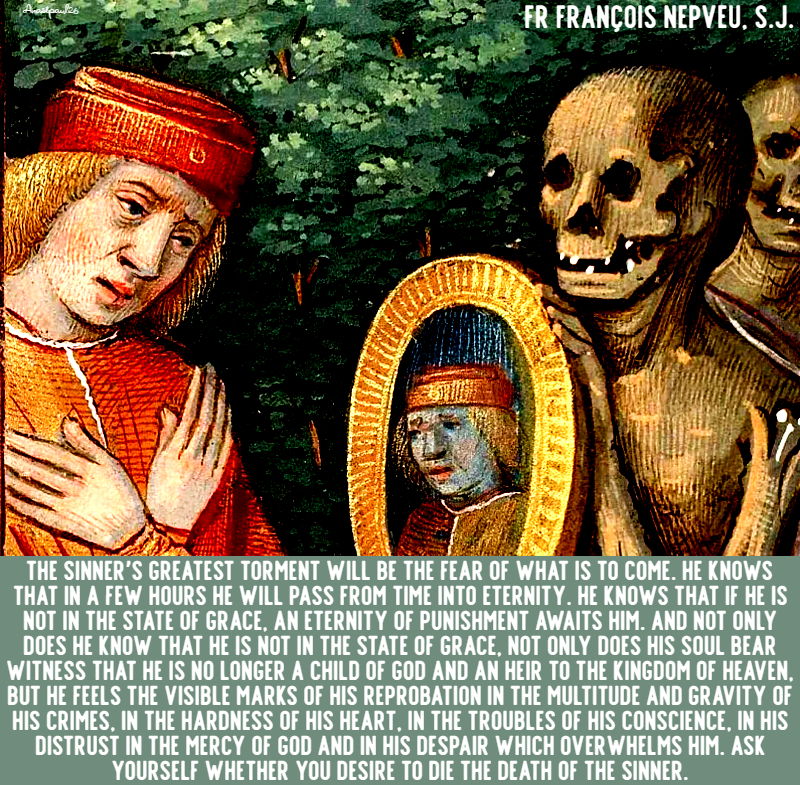
The sinner’s greatest torment will be the fear of what is to come. He knows that in a few hours he will pass from time into eternity. He knows that if he is not in the state of grace, an eternity of punishment awaits him. And not only does he know that he is not in the state of grace, not only does his soul bear witness that he is no longer a child of God and an heir to the kingdom of heaven, but he feels the visible marks of his reprobation in the multitude and gravity of his crimes, in the hardness of his heart, in the troubles of his conscience, in his distrust in the mercy of God and in his despair which overwhelms him. Ask yourself whether you desire to die the death of the sinner.
Fr François Nepveu, S.J.
Who are you, then, that you should be afraid of mortal man? Today he is here, tomorrow he is not seen. Fear God and you will not be afraid of the terrors of men. What can anyone do to you by word or injury? He hurts himself rather than you, and no matter who he may be he cannot escape the judgment of God.
The Imitation of Christ
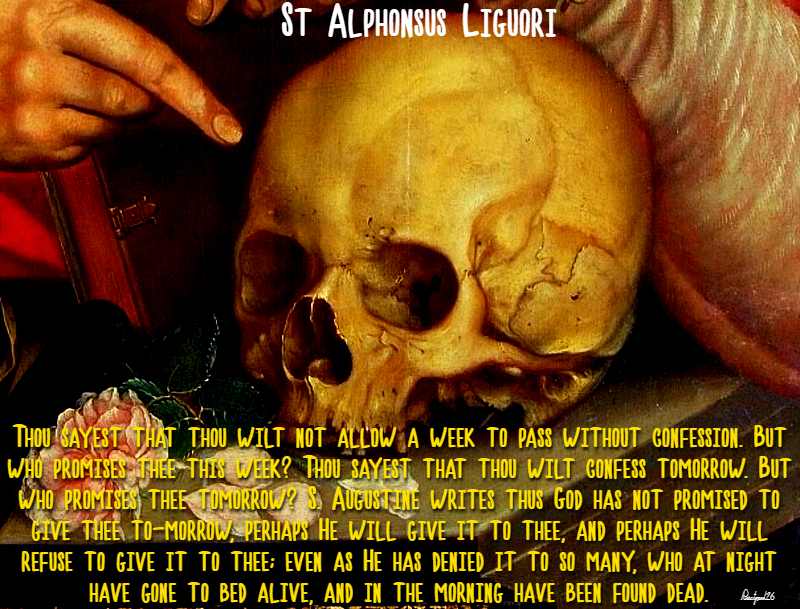
Thou sayest that thou wilt not allow a week to pass without confession. But who promises thee this week? Thou sayest that thou wilt confess tomorrow. But who promises thee tomorrow? S. Augustine writes thus God has not promised to give thee tomorrow, perhaps He will give it to thee, and perhaps He will refuse to give it to thee; even as He has denied it to so many, who at night have gone to bed alive, and in the morning have been found dead.
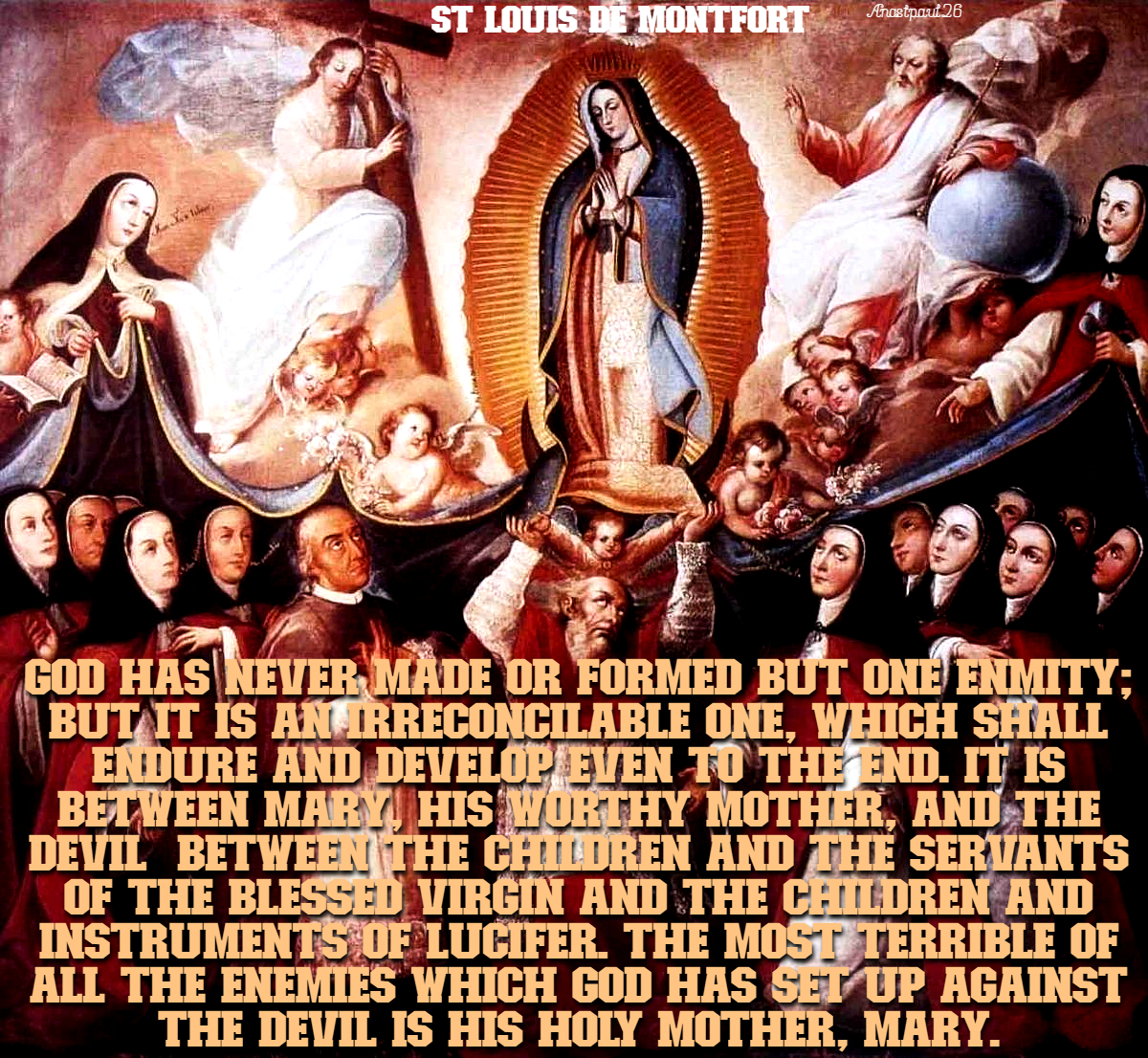
God has never made or formed but one enmity; but it is an irreconcilable one, which shall endure and develop even to the end. It is between Mary, His worthy Mother, and the devil—between the children and the servants of the Blessed Virgin and the children and instruments of Lucifer. The most terrible of all the enemies which God has set up against the devil is His holy Mother, Mary.
St Louis de Montfort
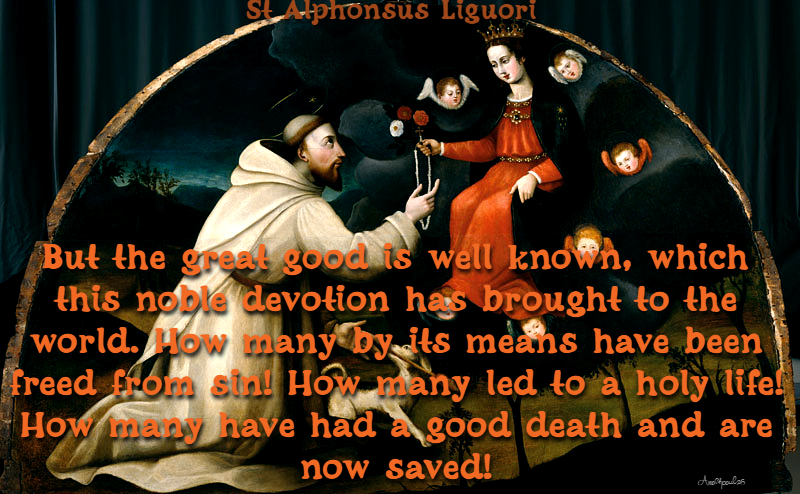
But the great good is well known, which this noble devotion has brought to the world. How many by its means have been freed from sin! How many led to a holy life! How many have had a good death and are now saved!
St Alphonsus Liguori
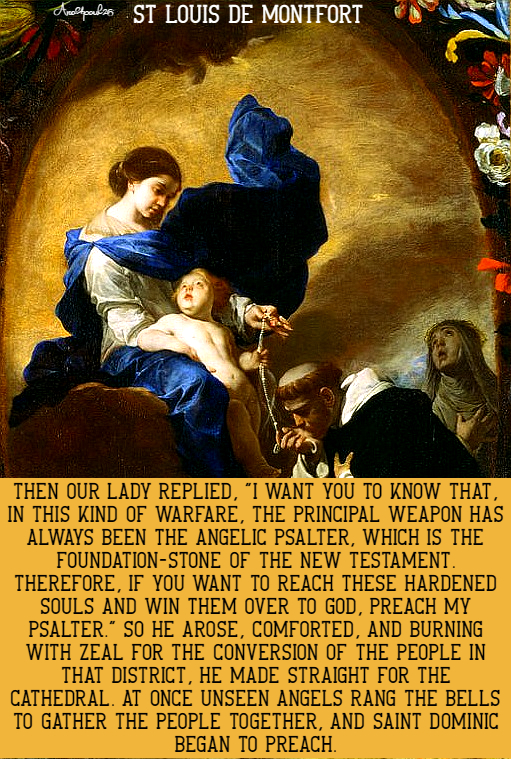
Then our Lady replied, “I want you to know that, in this kind of warfare, the principal weapon has always been the Angelic Psalter, which is the foundation-stone of the New Testament. Therefore, if you want to reach these hardened souls and win them over to God, preach my Psalter.” So he arose, comforted, and burning with zeal for the conversion of the people in that district, he made straight for the cathedral. At once unseen angels rang the bells to gather the people together, and Saint Dominic began to preach.
St Louis de Montfort
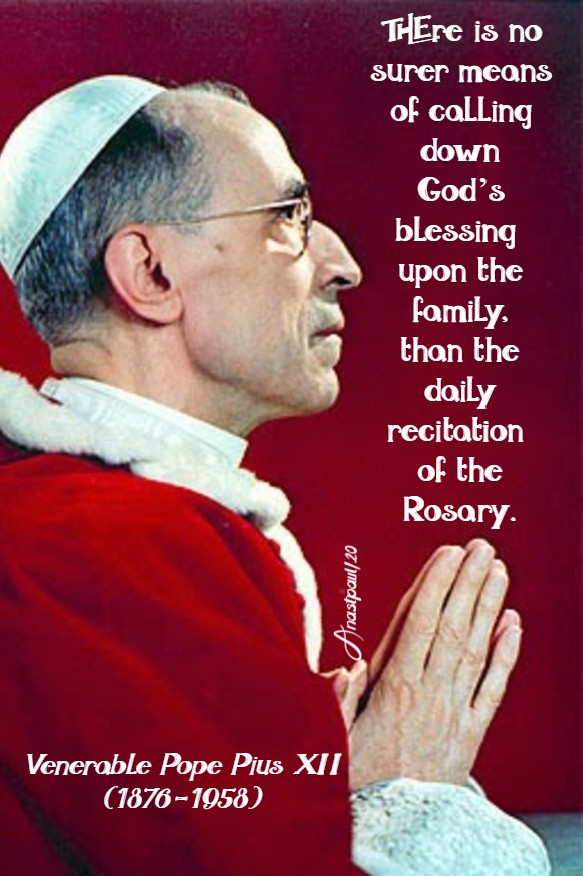
There is no surer means of calling down God’s blessing upon the family, than the daily recitation of the Rosary.
Pope Pius XII
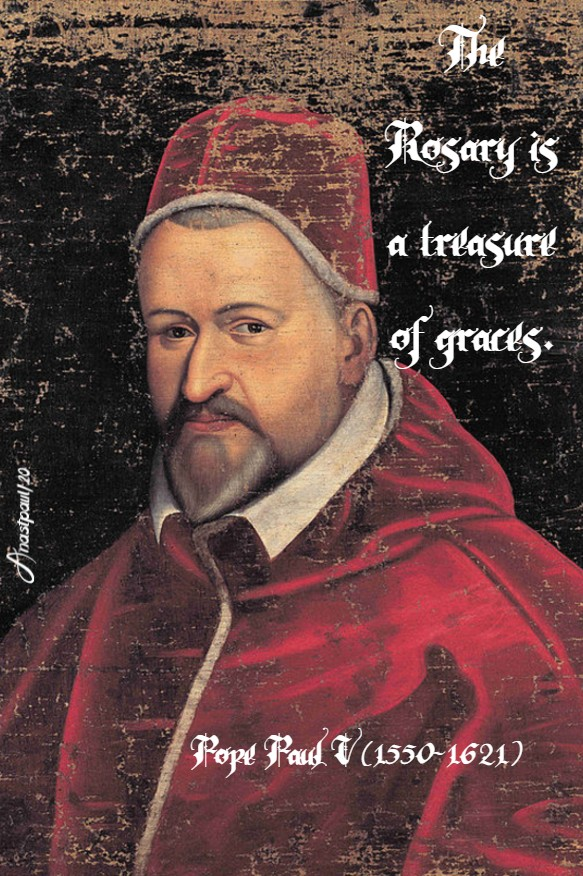
The Rosary is a treasure of graces.
Pope Paul V
I know that my salvation is assured when I leave it in the hands of Mary.
Our Morning Offering – 30 September – The last day of the Month of the Seven Sorrows of the Mother Mary
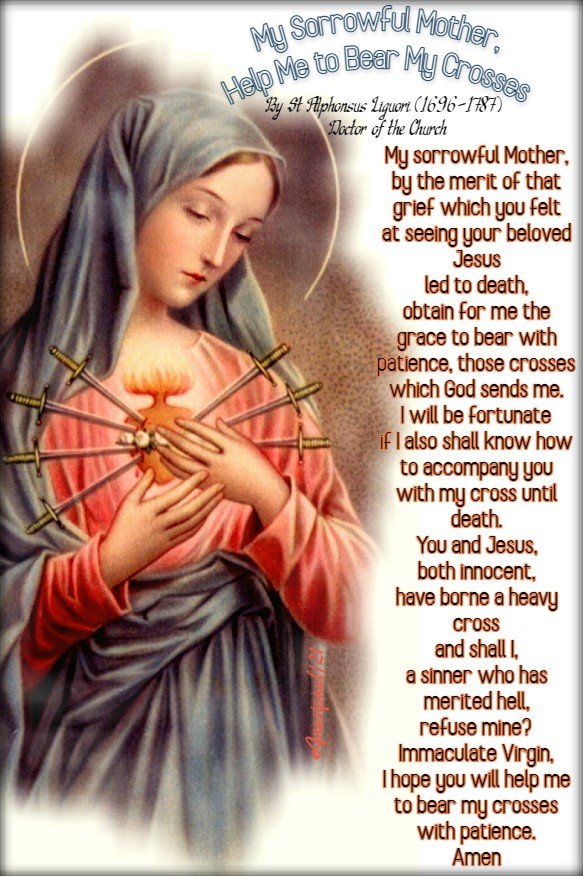
My Sorrowful Mother, Help Me to Bear My Crosses By St Alphonsus Liguori (1696-1787) Doctor of the Church
My sorrowful Mother, by the merit of that grief which you felt at seeing your beloved Jesus led to death, obtain for me the grace to bear with patience, those crosses which God sends me. I will be fortunate if I also shall know how to accompany you with my cross until death. You and Jesus, both innocent, have borne a heavy cross and shall I, a sinner who has merited hell, refuse mine? Immaculate Virgin, I hope you will help me to bear my crosses with patience. Amen
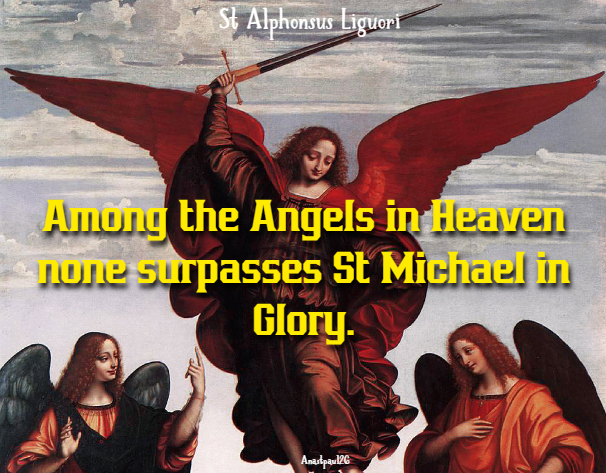
Among the Angels in Heaven none surpasses St Michael in Glory.
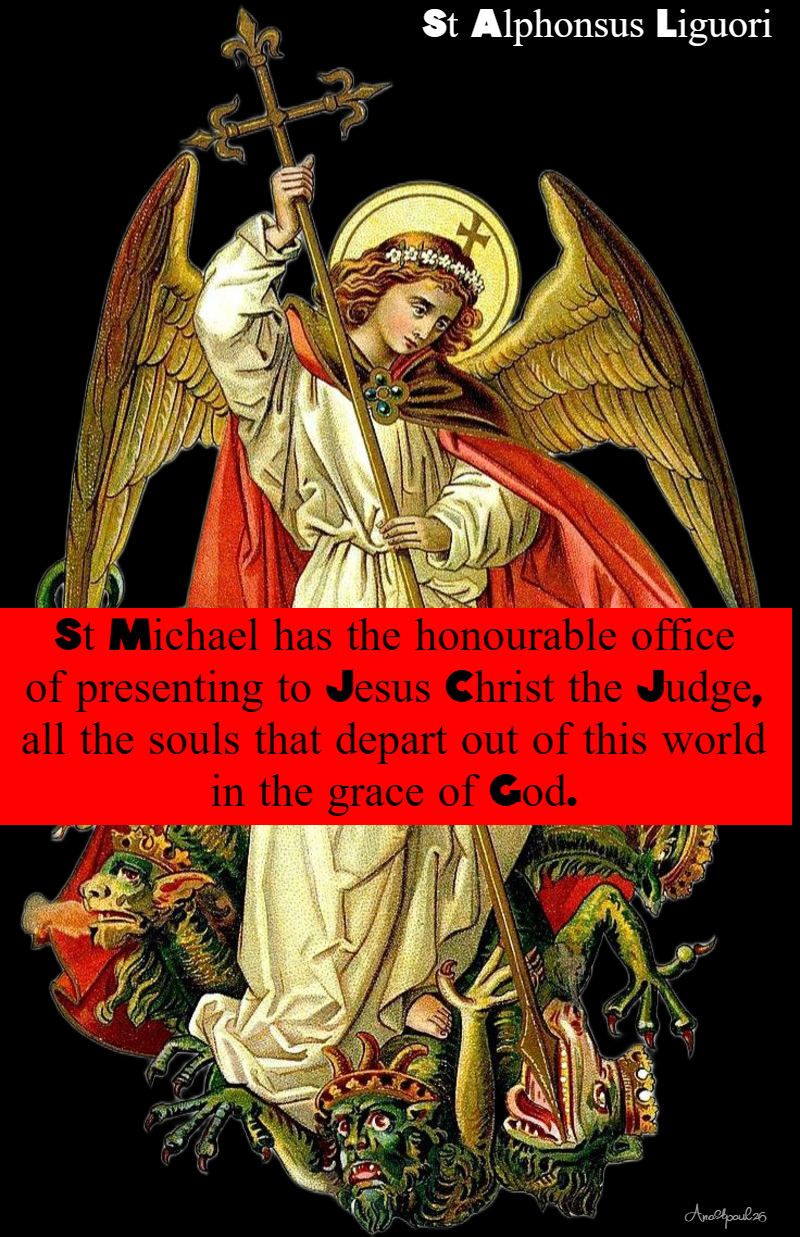
St Michael has the honourable office of presenting to Jesus Christ the Judge, all the souls that depart out of this world in the grace of God.
St Alphonsus Liguori
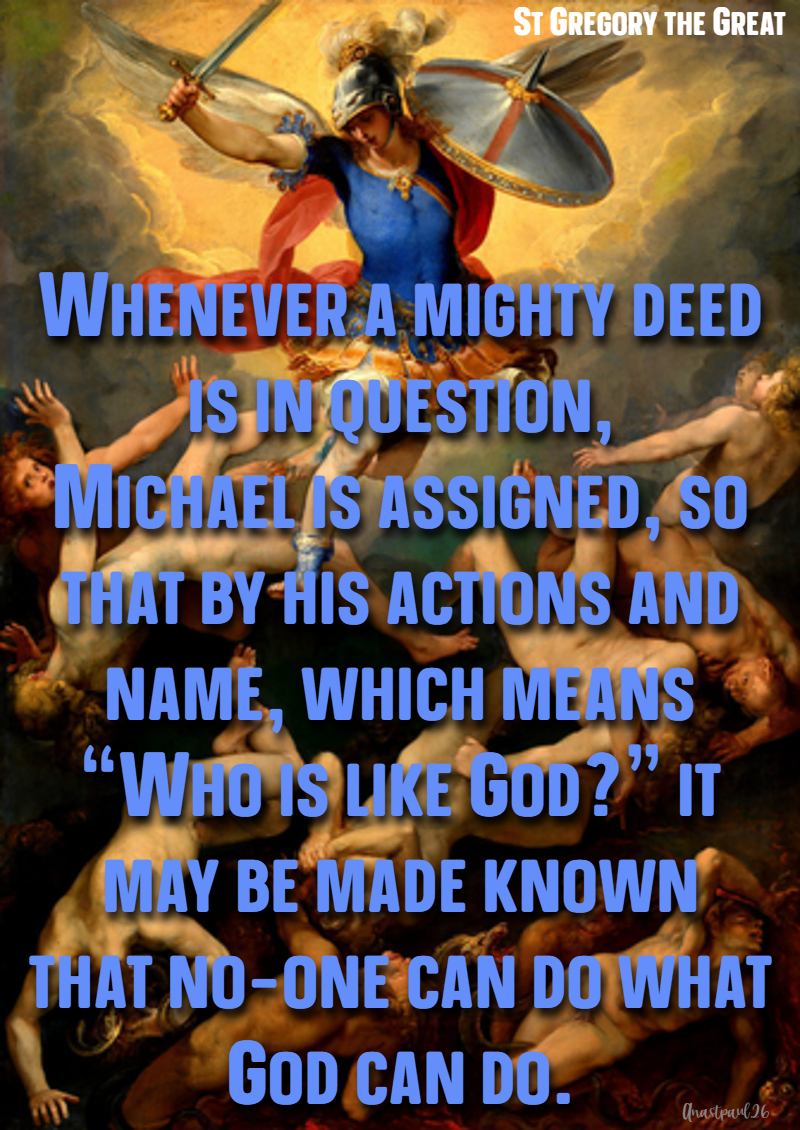
Whenever a mighty deed is in question, Michael is assigned, so that by his actions and name, which means “Who is like God?” it may be made known that no-one can do what God can do.
St Gregory the Great
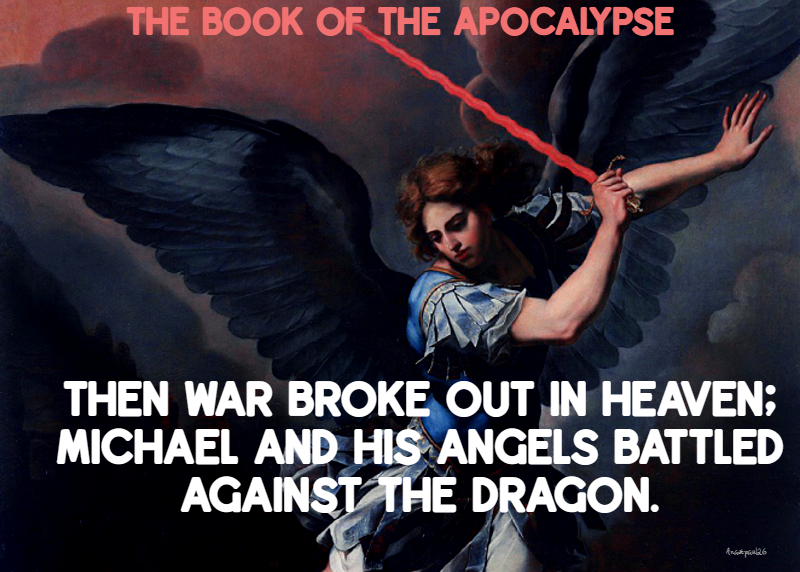
Then war broke out in Heaven; Michael and his angels battled against the dragon.
The Book of the Apocalypse
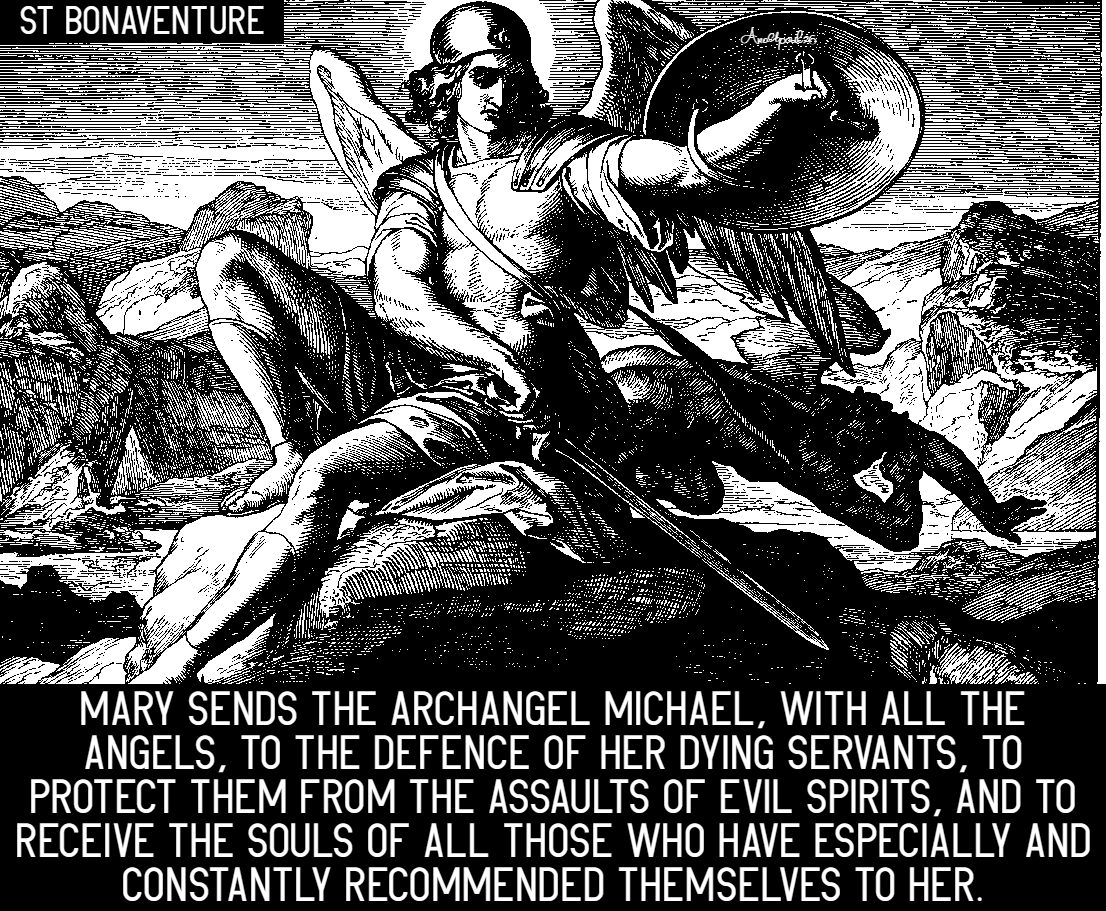
Mary sends the archangel Michael, with all the angels, to the defence of her dying servants, to protect them from the assaults of evil spirits, and to receive the souls of all those who have especially and constantly recommended themselves to her.
St Bonaventure
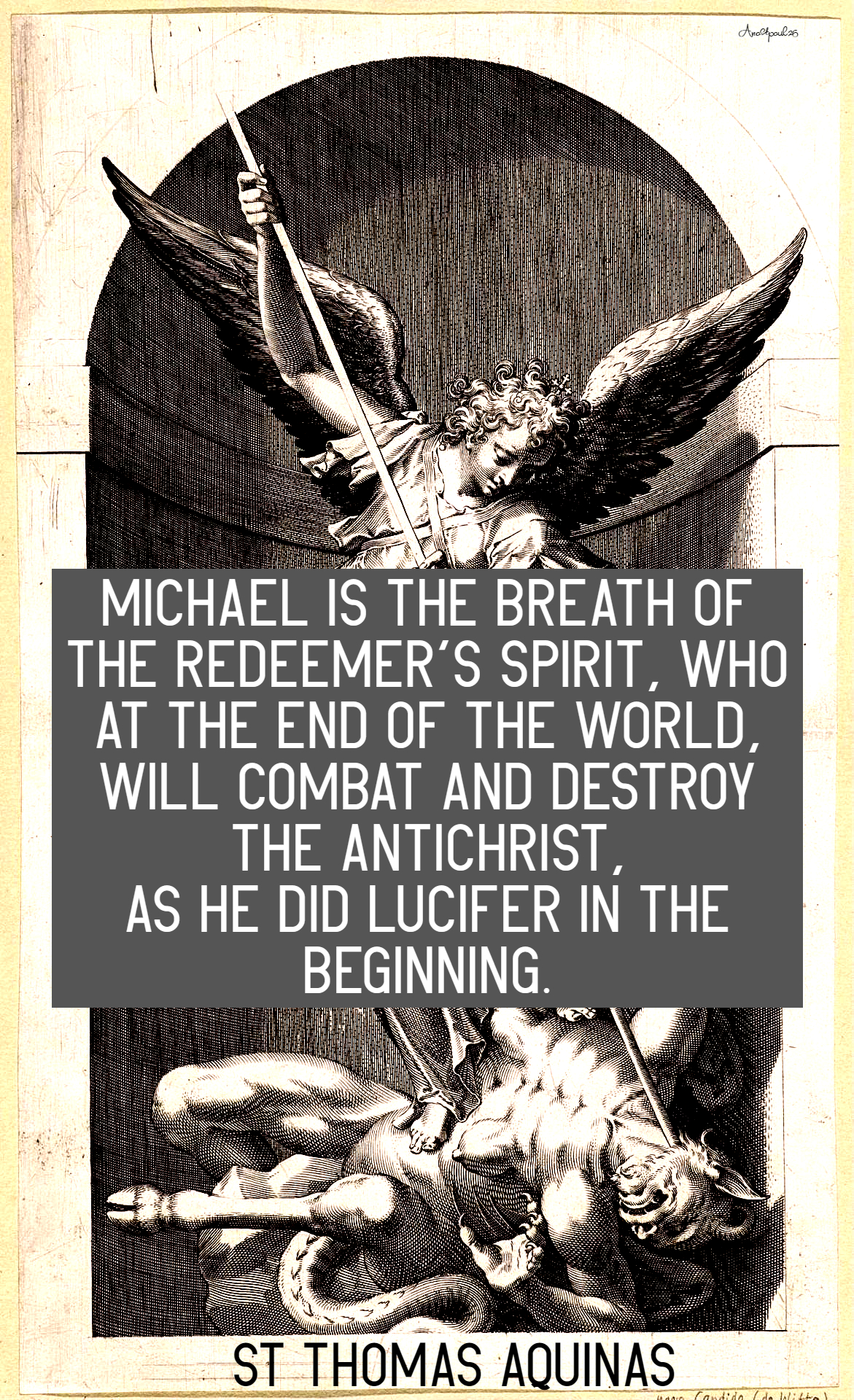
Michael is the Breath of the Redeemer’s Spirit, who at the end of the world, will combat and destroy the antichrist, as he did Lucifer in the beginning.
St Thomas Aquinas
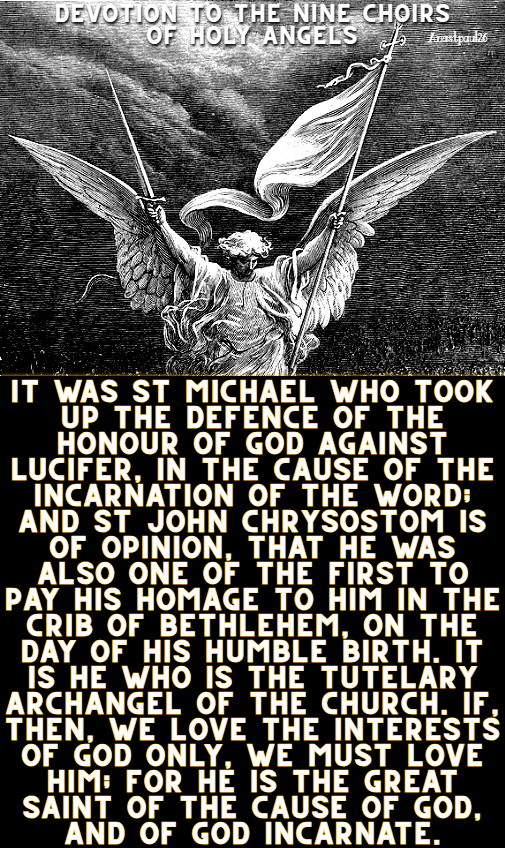
It was St Michael who took up the defence of the honour of God against Lucifer, in the cause of the Incarnation of the Word; and St John Chrysostom is of opinion, that he was also one of the first to pay his homage to Him in the crib of Bethlehem, on the day of His humble Birth. It is he who is the tutelary Archangel of the Church. If, then, we love the interests of God only, we must love him; for he is the great saint of the cause of God, and of God Incarnate.
Reflections on each of the Seven Dolors of Mary by St Alphonsus Liguori
The Burial of the Body of Jesus
When a mother is by the side of a suffering and dying child, she no doubt then feels and suffers all his pains; but when the afflicted child is really dead and about to be buried, and the sorrowful mother takes her last leave of him, oh God! the thought that she is to see him no more is a sorrow that exceeds all other sorrows. Behold, the last sword of sorrow which we are to consider, when Mary, after being present at the death of her Son upon the cross, after having embraced his lifeless body, was finally to leave him in the sepulchre, never more to enjoy his beloved presence.
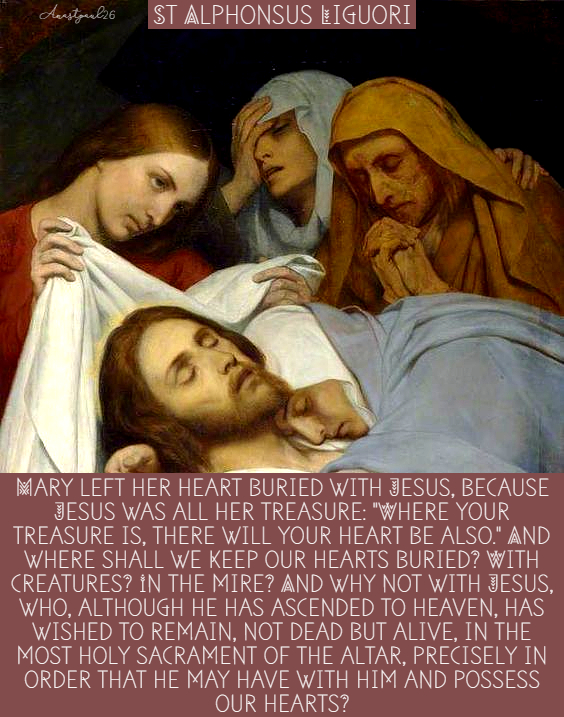
Thus Mary, clinging to her Son, was dissolved in grief; but those holy disciples, fearing lest this poor mother would expire there through agony, went to take the body of her Son from her arms, to bear it away for burial. Therefore, with reverential force they took him from her arms, and having embalmed him, wrapped him in a linen cloth already prepared, upon which our Lord wished to leave to the world his image impressed, as may be seen at the present day in Turin. And now they bear him to the sepulchre. The sorrowful funeral train sets forth; the disciples place him on their shoulders; hosts of angels from heaven accompany him; those holy women follow him; and the afflicted mother follows in their company her Son to the grave. When they had reached the appointed place, how gladly would Mary have buried her self there alive with her Son! “Oh how willingly,” said the Virgin to St. Bridget, “would I have remained there alive with my Son, if it had been his will!” But since this was not the divine will, the authors relate that she herself accompanied the sacred body of Jesus into the sepulchre, where, as Baronius narrates, they deposited the nails and the crown of thorns. In raising the stone to close the sepulchre, the disciples of the Saviour had to turn to the Virgin, and say to her: Now, oh Lady, we must close the sepulchre; have patience, look upon thy Son, and take leave of him for the last time. Then, oh my beloved Son, must the afflicted mother have said, then shall I see thee no more? Receive then, this last time that I look upon thee, receive the last farewell from me thy dear mother, and receive my heart which I leave buried with thee.
Mary left her heart buried with Jesus, because Jesus was all her treasure: “Where your treasure is, there will your heart be also.” And where shall we keep our hearts buried? With creatures? In the mire? And why not with Jesus, who, although he has ascended to heaven, has wished to remain, not dead but alive, in the most holy sacrament of the altar, precisely in order that he may have with him and possess our hearts? But let us return to Mary. Before quitting the sepulchre, according to St. Bonaventure, she blessed that sacred stone, saying: Oh happy stone, that doth now inclose that body which was contained nine months in my womb, I bless thee, and envy thee; I leave thee to guard my Son for me, who is my only good, my only love. And then turning to the eternal Father, she said: Oh Father, to thee I recommend him, who is thy Son and mine; and thus bidding a last farewell to her Son, and to the sepulchre, she returned to her own house. This poor mother went away so afflicted and sad, according to St. Bernard, that she moved many to tears even against their will: “Multos etiam invitos ad lacrymas provocabat;” so that wherever she passed, all wept who met her: “Omnes plorabant qui obviabant ei,” and could not restrain their tears. And he adds, that those holy disciples, and the women who accompanied her, mourned for her even more than for their Lord.
St. Bonaventure says, that her two sisters covered her with a mourning cloak: The sisters of our Lady wrapped her in a veil as a widow, covering as it were her whole countenance. And he also says, that passing, on her return, before the cross, still wet with the blood of her Jesus, she was the first to adore it : Oh holy cross, she exclaimed, I kiss thee and adore thee; for thou art no longer an infamous wood, but a throne of love, and an altar of mercy, consecrated by the blood of the divine Lamb, who has been sacrificed upon thee, for the salvation of the world.
Reflections on each of the Seven Dolors of Mary by St Alphonsus Liguori
The Piercing of the Side of Jesus and His Descent From the Cross
And now we are to consider to-day the sixth dolor which afflicted this sorrowful mother. Attend and weep. Hitherto the dolors of Mary tortured her one by one, but to-day they are all united to assail her.
That the joy of the following Paschal Sabbath should not be disturbed, the Jews wished the body of Jesus to be taken down from the cross; but because they could not take down a criminal until he was dead, they came with iron mallets to break his legs, as they had already done to the two thieves crucified with him. And Mary, while she remains weeping at the death of her Son, sees those armed men coming towards her Jesus. At this sight she first trembled with fear, then she said : Ah, my Son is already dead, cease to maltreat him, and cease to torture me a poor mother longer. She implored them not to break his legs : “Oravit eos, ne frangerent crura,” as St. Bonaventure writes. But while she is thus speaking, oh, God she sees a soldier with violence brandishing a spear, and piercing the side of Jesus : “One of the soldiers with a spear opened his side, and immediately there came out blood and water.” The cross shook at the stroke of the spear, and, as was revealed to St. Bridget, the heart of Jesus was divided : “Ita ut ambae paries essent divisse.” There came out blood and water, for only a few drops of blood remained, and those also the Saviour wished to shed, in order to show that he had no more blood to give us. The injury of that stroke was offered to Jesus, but the pain was inflicted on Mary: Christ, says the devout Lanspergius, shared with his mother the infliction of that wound, for he received the insult and his mother the pain. The holy Fathers explain this to be the very sword predicted to the Virgin by St. Simeon ; a sword, not of iron, but of grief, which pierced through her blessed soul in the heart of Jesus, where it always dwelt. Thus, among others, Si. Bernard says: The spear which opened his side passed through the soul of the Virgin, which could not be torn from the heart of Jesus. And the divine mother herself revealed the same to St. Bridget, saying: When the spear was drawn out, the point appeared red with blood; then I felt as if my heart were pierced when I saw the heart of my most dear Son pierced.” The angel told St. Bridget, that such were the sufferings of Mary, that she was saved from death only by the miraculous power of God. In her other dolors she at least had her Son to compassionate her; and now she had not even him to take pity on her.
The afflicted mother, still fearing that other injuries might be inflicted on her Son, entreats Joseph of Arimathea to obtain from Pilate the body of her Jesus, that at least after his death she may be able to guard it and protect it from injuries. Joseph went to Pilate, and made known to him the sorrow and the wish of this afflicted mother; and St. Anselm thinks that compassion for the mother softened the heart of Pilate, and moved him to grant her the body. of the Saviour. And now Jesus is taken from the cross. Oh most holy Virgin, after thou with so great love hadst given thy Son to the world for our salvation, behold the world returns him to thee again! But oh, my God, how dost thou return him to me? said Mary to the world. My Son was white and ruddy: “Dilectus meus candidus et rubicundus:” but thou hast returned him to me blackened with bruises, and red, not with a ruddy color, but with the wounds thou hast inflicted upon him; he was beautiful, now there is no more beauty in him; he is all deformity. All were enamored with his aspect, now he excites horror in all who look upon him. Oh, how many swords, says St. Bonaventure, pierced the soul of this mother, when she received the body of her Son after it was taken from the cross: ” O quot gladii animam matris pertransierunt!” Let us consider what anguish it would cause any mother to receive the lifeless body of a son!
She sees his mouth open, his eye shut, she examines the lacerated flesh, and those exposed bones; she takes off the crown, and sees the cruel injury made by those thorns, in that sacred head; she looks upon those pierced hands and feet, and says: Ah, my Son, to what has the love thou didst bear to men reduced thee!But what evil hath thou done to them, that they have treated thee so cruelly. Thou wast my Father, Bernardino de Bustis imagines her to say, my brother, my spouse, my delight, my glory, my all. Oh, my Son, behold how I am afflicted, look upon me and console me; but thou dost look upon me no more. Speak, speak to me but one word, and console me; but thou dost speak no more, for thou art dead. Then turning to those barbarous instruments, she said: Oh cruel thorns, oh nails, oh merciless spear, how could you thus torture your Creator? But what thorns, what nails? Alas! sinners, she exclaimed, it is you who have thus cruelly treated my Son.
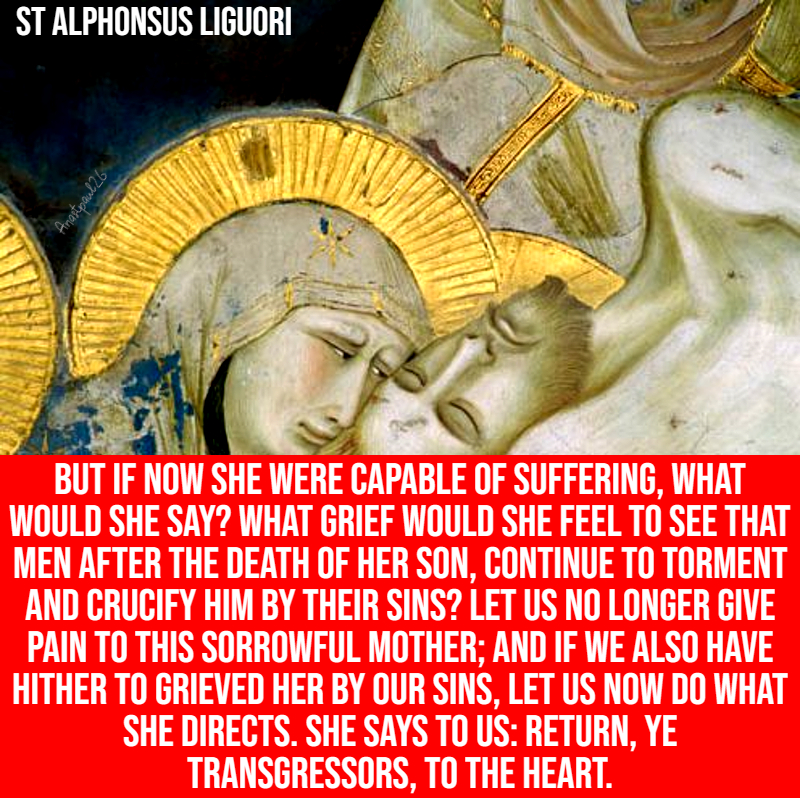
Thus Mary spoke and complained of us. But if now she were capable of suffering, what would she say? What grief would she feel to see that men after the death of her Son, continue to torment and crucify him by their sins? Let us no longer give pain to this sorrowful mother; and if we also have hither to grieved her by our sins, let us now do what she directs. She says to us: Return, ye transgressors, to the heart: “Redite, prsevaricatores, ad cor.” Sinners, return to the wounded heart of my Jesus; return as penitents, for he will receive you. Flee from him to him, she continues to say with Guerric the Abbot; from the Judge to the Redeemer, from the tribunal to the cross.
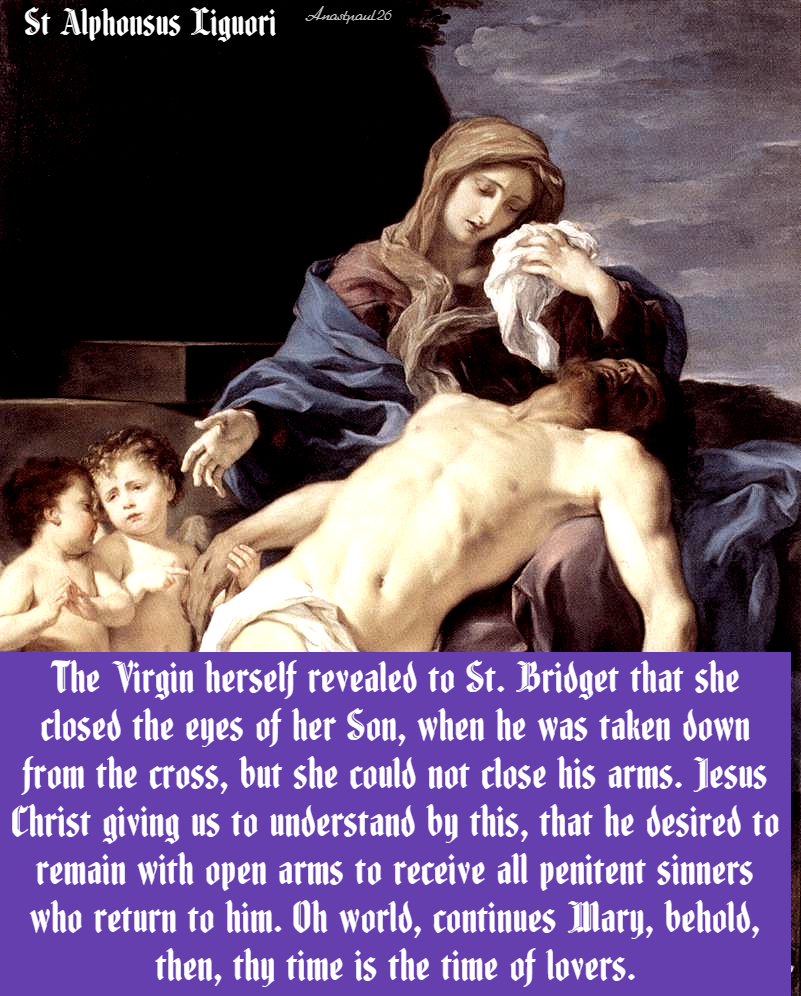
The Virgin herself revealed to St. Bridget that she closed the eyes of her Son, when he was taken down from the cross, but she could not close his arms: “Ejus brachia flectere non potui.” Jesus Christ giving us to understand by this, that he desired to remain with open arms to receive all penitent sinners who return to him. Oh world, continues Mary, behold, then, thy time is the time of lovers.
Reflections on each of the Seven Dolors of Mary by St Alphonsus Liguori
The Death of Jesus
And now we have to admire a new sort of martyrdom, a mother condemned to see an innocent son, whom she loved with all the affection of her heart, put to death before her eyes, by the most barbarous tortures. There stood by the cross of Jesus his mother: “Stabat autem juxta crucem mater ejus.” There is nothing more to be said, says St. John, of the martyrdom of Mary: behold her at the foot of the cross, looking on her dying Son, and then see if there is grief like her grief.
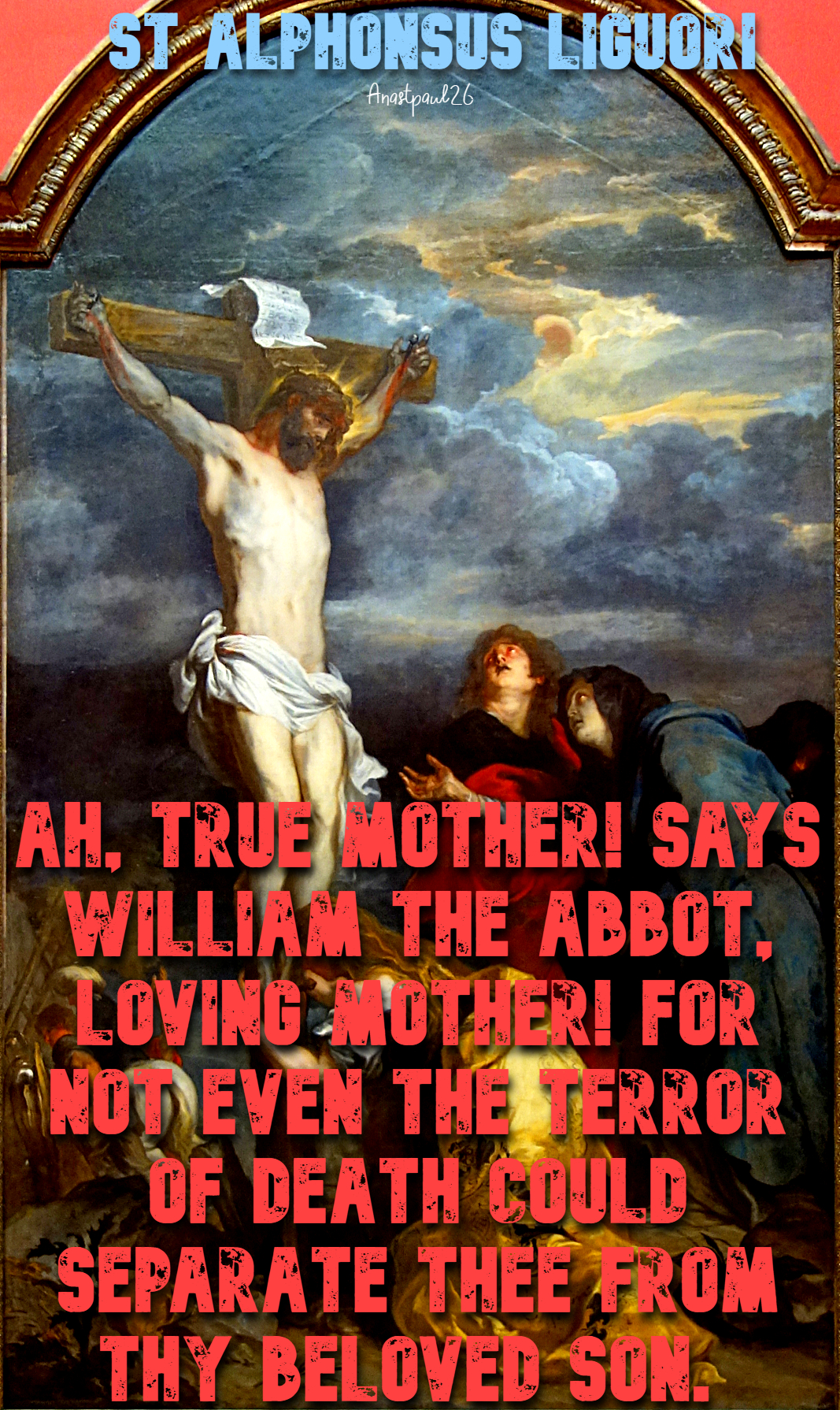
As soon as our afflicted Redeemer had ascended the hill of Calvary, the executioners stripped him of his garments, and piercing his sacred hands and feet with nails, not sharp, but blunt: “Non acutis, sed obtusis;” as St. Bernard says, and to torture him more, they fastened him to the cross. When they had crucified him, they planted the cross, and thus left him to die. The executioners abandon him, but Mary does not abandon him. She then draws nearer to the cross, in order to assist at his death. But what did it avail, oh Lady, says St. Bonaventure, to go to Calvary to witness there the death of this Son? Shame should have prevented thee, for his disgrace was also thine, because thou wast his mother; or, at least, the horror of such a crime as that of seeing a God crucified by his own creatures, should have prevented thee. But the saint himself answers: Thy heart did not consider the horror, but the suffering: “Non considerabat cor tuum horrorem, sed dolorem.” Ah, thy heart did not then care for its own sorrow, but for the suffering and death of thy dear Son; and therefore thou thyself didst wish to be near him, at least to compassionate him. Ah, true mother! says William the Abbot, loving mother! for not even the terror of death could separate thee from thy beloved Son. But, oh God, what a spectacle of sorrow, to see this Son then in agony upon the cross, and under the cross this mother in agony, who was suffering all the pain that her Son was suffering!
Mary also suffered all these pains of Jesus. Every torture inflicted on the body of Jesus, says St. Jerome, was a wound in the heart of the mother. Any one of us who should then have been on Mount Calvary, would have seen two altars, says St. John Chrysostom, on which two great sacrifices were consummating, one in the body of Jesus, the other in the heart of Mary. But rather would I see there, with St. Bonaventure, one altar only, namely, the cross alone of the Son, on which, with the victim, this divine Lamb, the mother also was sacrificed.
Mothers fly from the presence of their dying children; but if a mother is ever obliged to witness the death of a child, she procures for him all possible relief; she arranges the bed, that his posture may be more easy; she administers refreshments to him; and thus the poor mother relieves her own sorrows. Ah, mother, the most afflicted of all mothers! oh Mary, it was decreed that thou shouldst be present at the death of Jesus, but it was not given to thee to afford him any relief.
And what caused her the greatest sorrow was to see that, by her presence and her grief, she increased the sufferings of her Son. The sorrow itself, says St. Bernard, that filled the heart of Mary, in creased the bitterness of sorrow in the heart of Jesus. St. Bernard also says, that Jesus on the cross suffered more from compassion for his mother than from his own pains: he thus speaks in the name of the Virgin: I stood and looked upon him, and he looked upon me; and he suffered more for me than for himself. Passino writes that Jesus Christ himself, speaking one day to the blessed Baptista Varana, of Camerino, said to her, that he was so afflicted on the cross at the sight of his mother in such anguish at his feet, that compassion for his mother caused him to die without consolation. So that the blessed Baptista, being enlightened to know this suffering of Jesus, exclaimed: Oh my Lord, tell me no more of this thy sorrow, for I can not bear it.
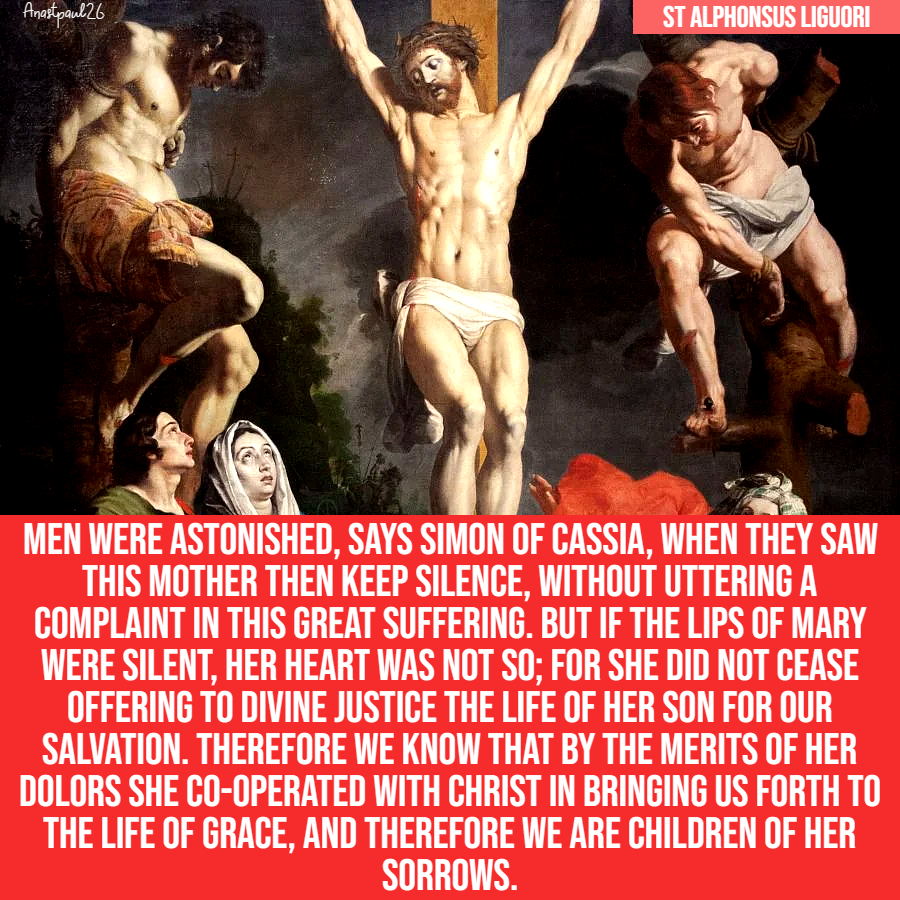
Men were astonished, says Simon of Cassia, when they saw this mother then keep silence, without uttering a complaint in this great suffering. But if the lips of Mary were silent, her heart was not so; for she did not cease offering to divine justice the life of her Son for our salvation. Therefore we know that by the merits of her dolors she co-operated with Christ in bringing us forth to the life of grace, and therefore we are children of her sorrows. And from that time Mary began to perform for us this office of a good mother; for, as St. Peter Damian declares, the penitent thief, through the prayers of Mary, was then converted and saved: Therefore the good thief repented, because the blessed Virgin, standing between the cross of her Son and that of the thief, prayed her Son for him; thus rewarding, by this favor, his former service. For as other authors also relate, this thief, in the journey to Egypt with the infant Jesus, showed them kindness; and this same office the blessed Virgin has ever continued, and still continues to perform.
Reflections on each of the Seven Dolors of Mary by St Alphonsus Liguori
Of The Flight of Jesus Into Egypt
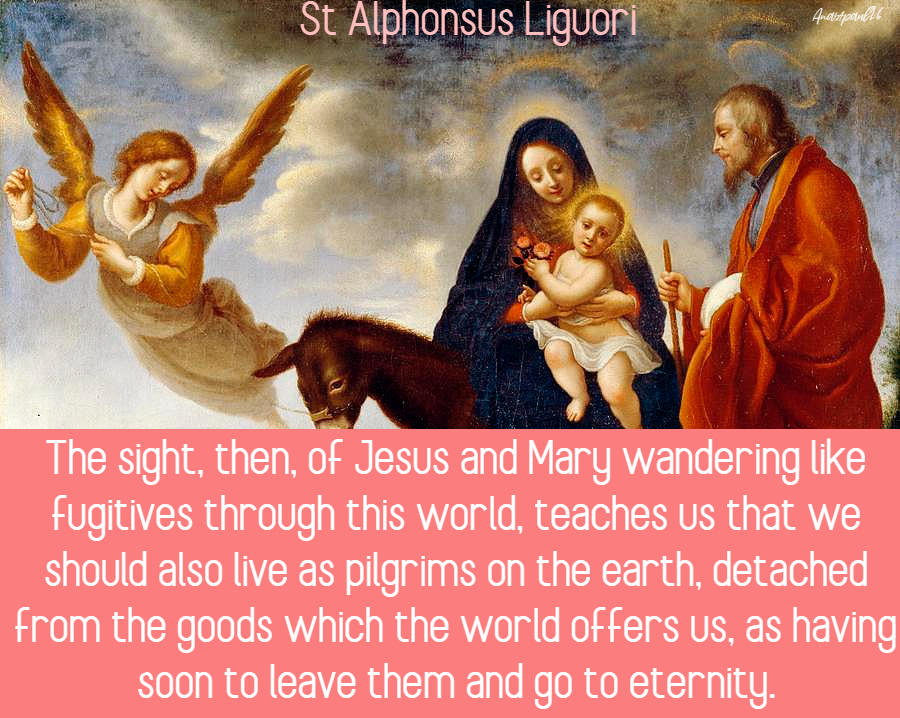
Herod having heard that the expected Messiah was born, foolishly feared that the new-born King would deprive him of his kingdom. Hence St. Fulgentius, reproving him for his folly, thus says: “Why, oh Herod, art thou that disturbed? This King who is born has not come to conquer kings by arms, but to subjugate them, in a wonderful manner, by his death.” The impious Herod, therefore, waited to learn from the holy magi where the King was born, that he might take from him his life; but finding himself deceived by the magi, he ordered all the infants that could be found in the neighborhood of Bethlehem to be put to death. But an angel appeared in a dream to St. Joseph, and said to him:” Arise, and take the child and his mother, and fly into Egypt.”
According to Gerson, immediately, on that very night, Joseph made this command known to Mary; and taking the infant Jesus, they commenced their journey, as it seems clearly from the Gospel itself: Who arose and took the child and his mother by night, and retired into Egypt.” And then the afflicted Mary knew that already the prophecy of Simeon, regarding her Son, was beginning to be verified: ” He is set for a sign which shall be contradicted.” Seeing that scarcely is he born,when he is persecuted to death. What suffering it must have been to the heart of Mary, writes St. John Chrysostom, to hear the tidings of that cruel exile of herself with her Son! Flee from thy friends to strangers, from the holy temple of the only true God, to the temples of demons. What greater tribulation than that a new-born child, clinging to its mother’s bosom, should be forced to fly with the mother herself!
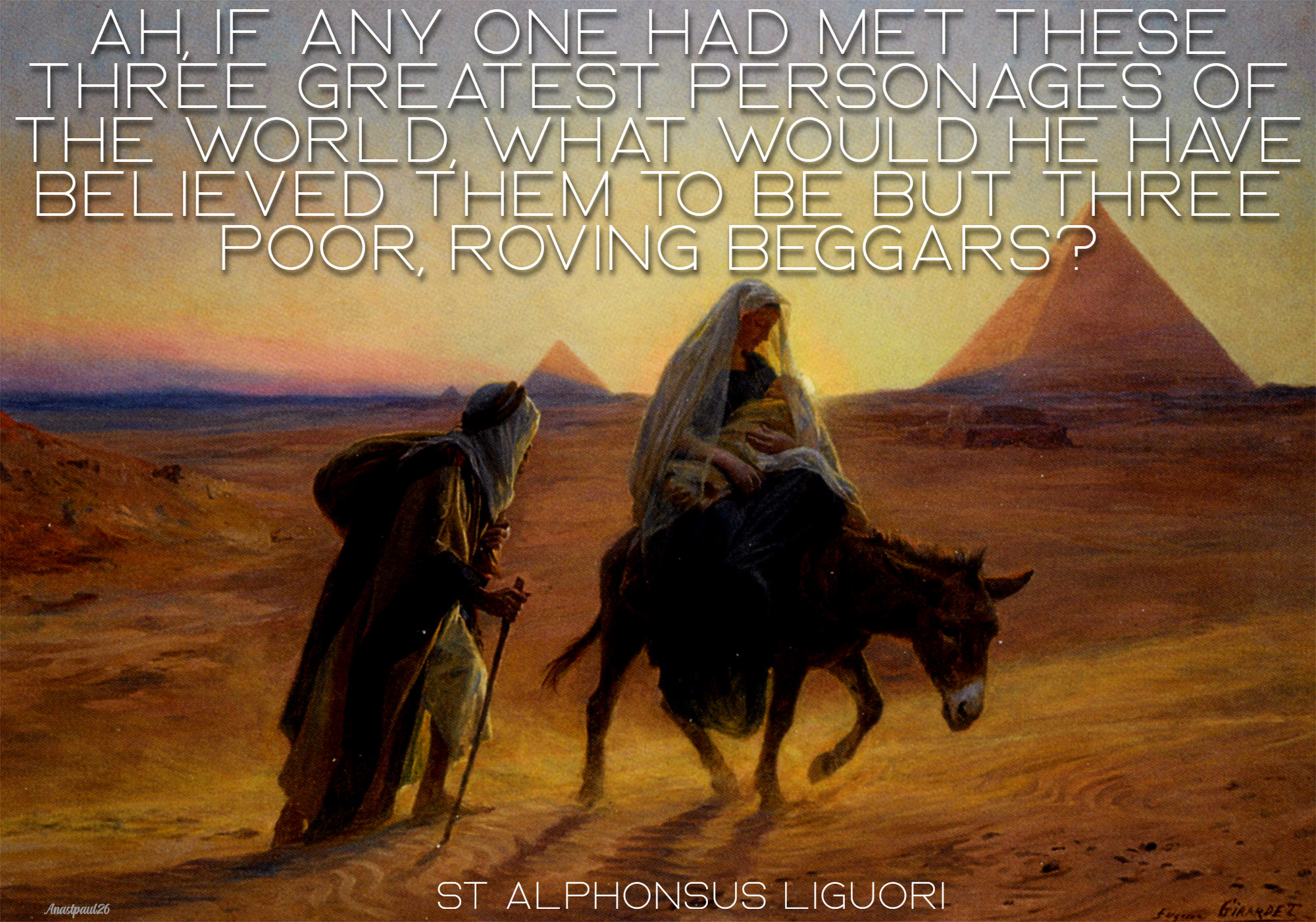
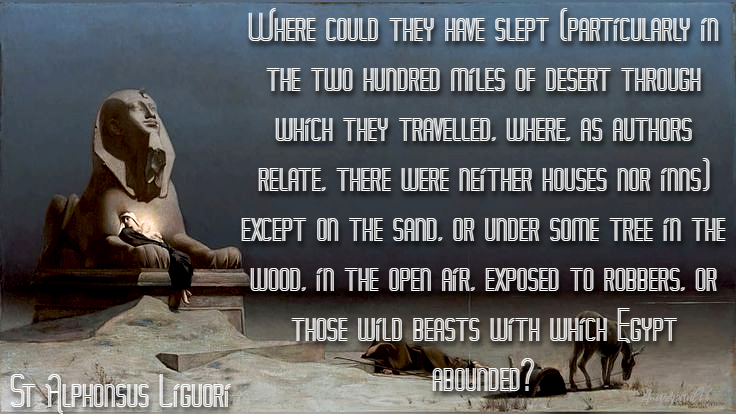
Every one can imagine how much Mary must have suffered on this journey. It was a long distance to Egypt. Authors generally agree with Barrada that it was four hundred miles; so that at least it was a journey of thirty days. The way, as St. Bonaventure describes it, was rough, unknown, through woods, and little frequented. The season was winter, and therefore they had to travel in snow, rain, wind, and storms, and through bad and difficult roads. Mary was then fifteen years of age, a delicate virgin, unaccustomed to such journeys. They had no servant to attend them. Joseph and Mary, said St. Peter Chrysologus, had no man servant nor maid-servant; they were themselves both masters and servants. Oh God, how piteous a spectacle it was to see that tender Virgin, with that newly born infant in her arms wandering through this world! St. Bonaventure asks, Where did they obtain food? Where did they rest at night? How were they lodged ? What other food could they have, than a piece of hard bread which Joseph brought with him or begged in charity? Where could they have slept (particularly in the two hundred miles of desert through which they travelled, where, as authors relate, there were neither houses nor inns) except on the sand, or under some tree in the wood, in the open air, exposed to robbers, or those wild beasts with which Egypt abounded?Ah, if any one had met these three greatest personages of the world, what would he have believed them to be but three poor, roving beggars?
They lived in Egypt, according to St. Anselm, Heliopolis, first called Memphis, and now Cairo. And here let us consider the great poverty they must have suffered for the seven years they were there, as St. Antoninus, St. Thomas, and others assert, They were foreigners, unknown, without revenues, without money, without kindred; hardly were they able to support them selves by their humble labors. As they were destitute, says St. Basil, it is manifest what effort they must have made to obtain there the necessaries of life. Moreover, Landolph of Saxony has written, and let it be repeated for the consolation of the poor, that so great was the poverty of Mary there, that sometimes she had not so much as a morsel of bread, when her Son, forced by hunger, asked it of her.
St. Matthew also relates that when Herod was dead, the angel again appeared, in a dream, to St. Joseph, and directed him to return to Judea. St. Bonaventure, speaking of his return, considers the greater pain of the blessed Virgin, on account of the sufferings which Jesus must have endured in that journey, having arrived at about the age of seven years an age, says the saint, when he was so large that he could not be carried, and so small that he could not go with out assistance.
The sight, then, of Jesus and Mary wandering like fugitives through this world, teaches us that we should also live as pilgrims on the earth, detached from the goods which the world offers us, as having soon to leave them and go to eternity.
There is nothing so bold, nothing more secure, than the fear of God. He who fears God, fears naught else, and he who has a dread of displeasing Him, or a fear of forfeiting His love, does not shrink from suffering – cares not if he lose all, provided he be in a state of grace.
Pere Nouet, SJ(17th century)
The continued prosperity of sinners, is the greatest of all misfortunes for them. The less our Lord disturbs their torpor, the more He punishes them after. It is at that time that vicious habits increase in power day by day, it is then that they indulge themselves the more, that they delude themselves, that they are blinded more and more, to the important interests of their salvation. But the mad multitude do not reason thus.
St Augustine
It is now that sinners try, as far as they can, to drive away the memory and the thought of death, and thus to find peace, although they never will do so, by leading a life of sin; but when in the agonies of death, they must enter into eternity when “destruction cometh and they shall seek peace, and there shall be none” then they will try to fly from the stings of their troubled consciences; they will seek peace, but what peace can a soul find which is laden with sin, which bites it like so many vipers ? What peace, knowing that in so short a time it will have to appear before Jesus Christ the Judge, whose law and friendship, until that moment, it has esteemed of so little worth?
St Alphonsus Liguori
Alas, my brethren, how many seem to be good Christians in the eyes of the world who are really tepid souls in the eyes of God, Who knows our inmost hearts….
St John Vianney
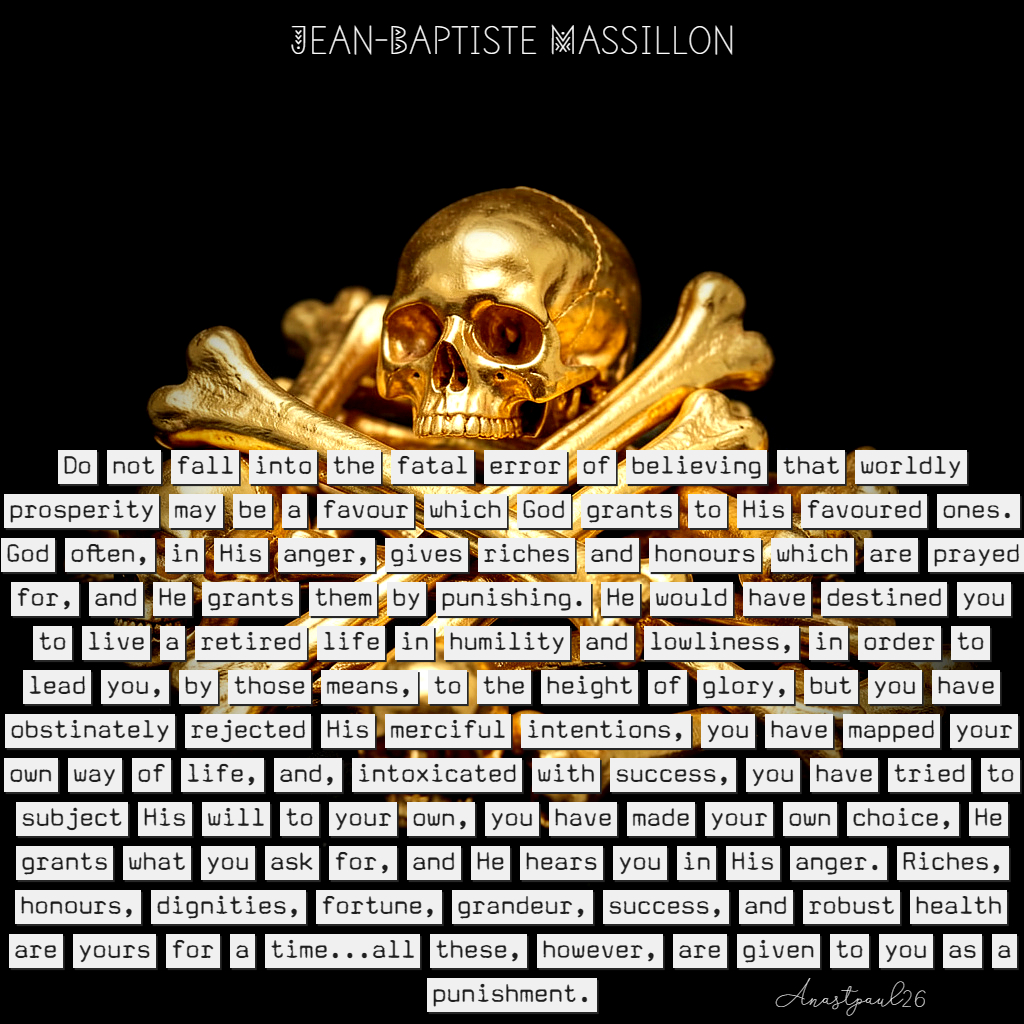
Do not fall into the fatal error of believing that worldly prosperity may be a favour which God grants to His favoured ones. God often, in His anger, gives riches and honours which are prayed for, and He grants them by punishing. He would have destined you to live a retired life in humility and lowliness, in order to lead you, by those means, to the height of glory, but you have obstinately rejected His merciful intentions, you have mapped your own way of life, and, intoxicated with success, you have tried to subject His will to your own, you have made your own choice, He grants what you ask for, and He hears you in His anger. Riches, honours, dignities, fortune, grandeur, success, and robust health are yours for a time…all these, however, are given to you as a punishment.
Quote/s of the Day – 17 August – “Month of the Immaculate Heart” – Readings: Ps 36:30-31, Ps 36:1, Sir 31:8-11, Luke 12:35-40
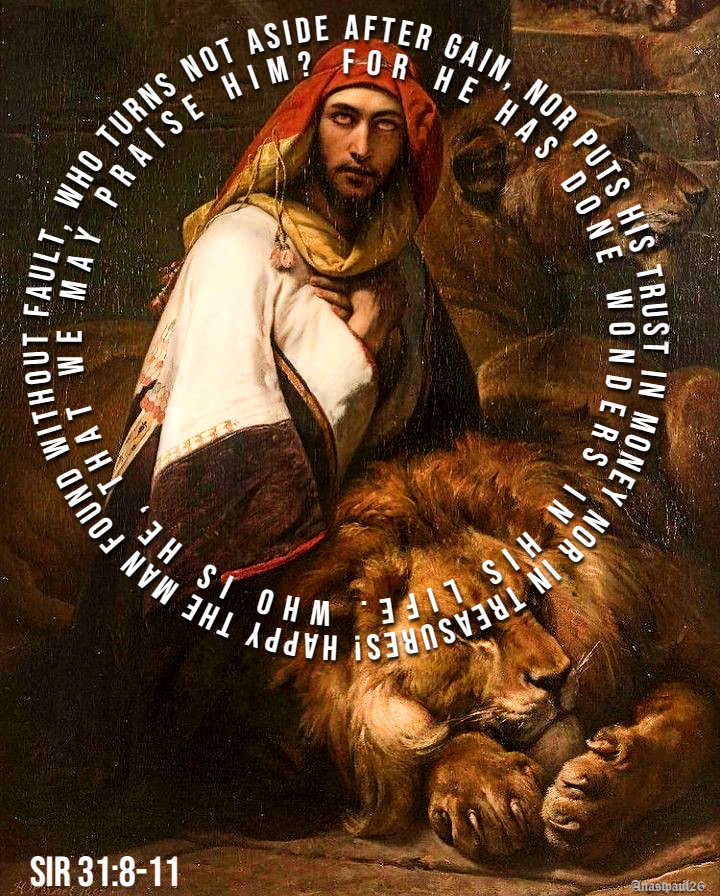
Happy the man found without fault, who turns not aside after gain, nor puts his trust in money nor in treasures! Who is he, that we may praise him? For he has done wonders in his life.
Sir 31:8-11
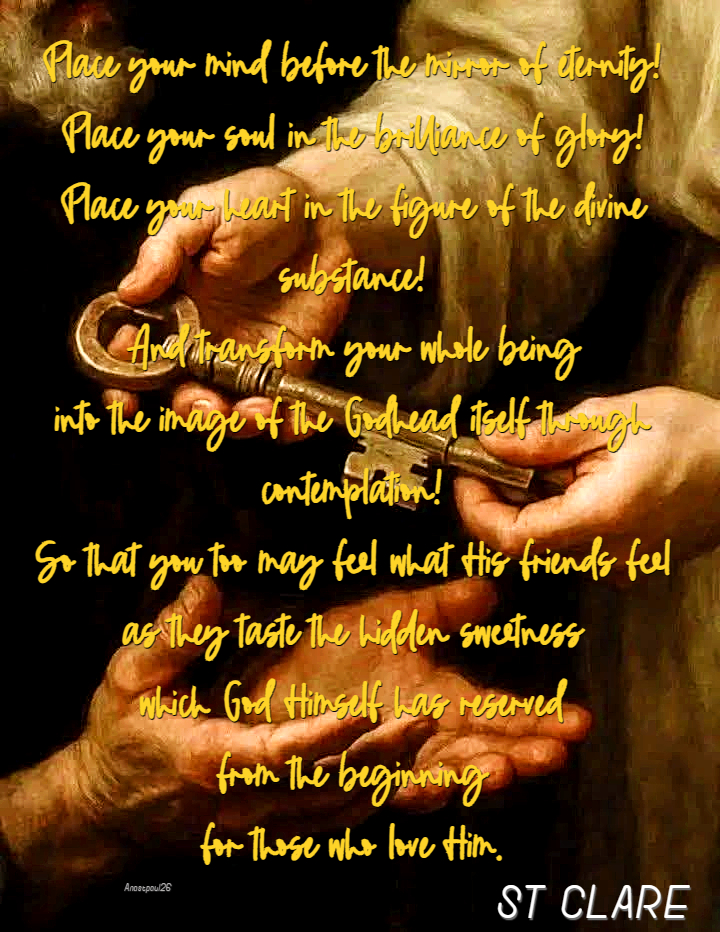
Place your mind before the mirror of eternity! Place your soul in the brilliance of glory! Place your heart in the figure of the divine substance! And transform your whole being into the image of the Godhead itself through contemplation! So that you too may feel what His friends feel as they taste the hidden sweetness which God Himself has reserved from the beginning for those who love Him.
St Clare
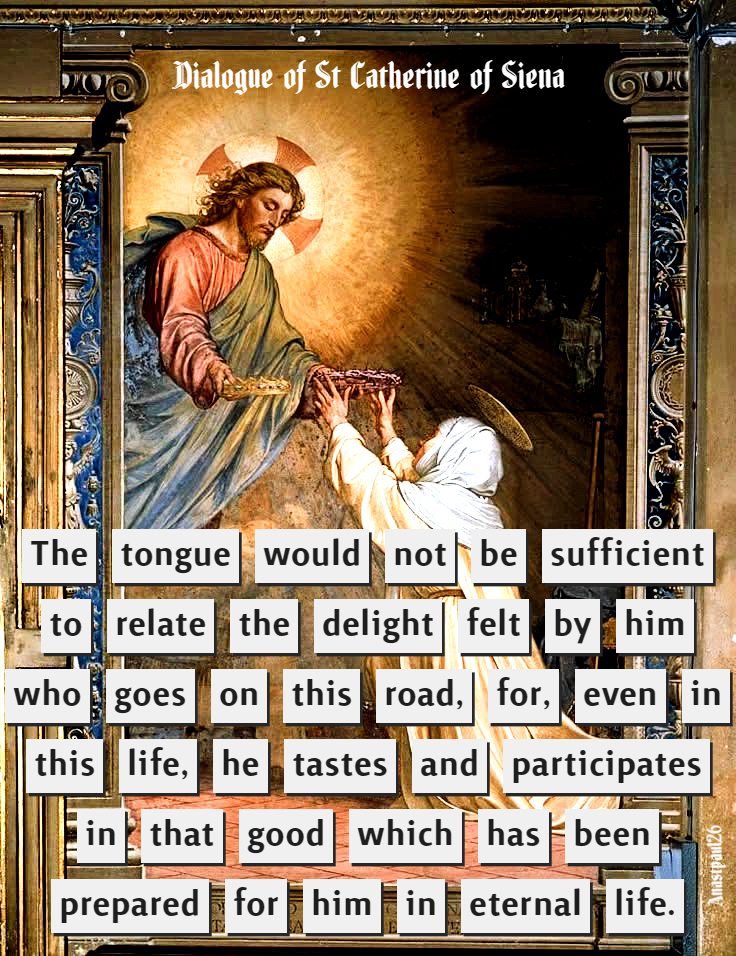
For those who cross by the Bridge, being still in the darkness of the body, find light, and, being mortal, find immortal life, tasting, through love, the light of Eternal Truth which promises refreshment to him who wearies himself for Me, who am grateful and just, and render to every man according as he deserves. Wherefore every good deed is rewarded, and every fault is punished. The tongue would not be sufficient to relate the delight felt by him who goes on this road, for, even in this life, he tastes and participates in that good which has been prepared for him in eternal life. He, therefore, is a fool indeed, who despises so great a good, and chooses rather to receive in this life, the earnest money of Hell, walking by the lower road with great toil, and without any refreshment or advantage.
The Dialogue of St Catherine of Siena
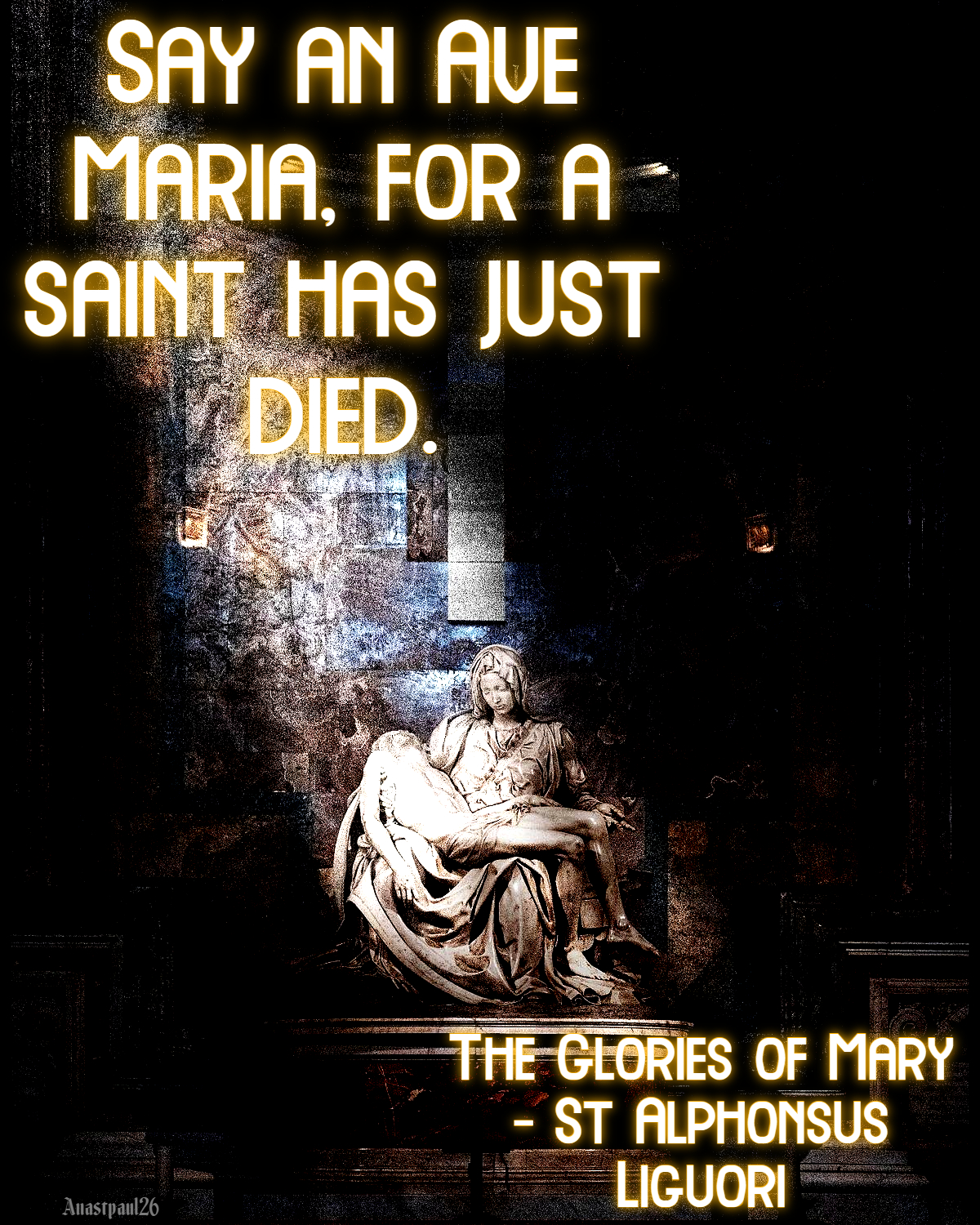
Yet they were consoled by seeing that the saint often turned his eyes, as if seeking help, towards a devout image of Mary, for they remembered that he had often said in life, that in the hour of his death, Mary must be his refuge. It finally pleased God to terminate this struggle by a glorious victory, for the agitation of his body ceased, his countenance gained its natural shape and color, and fixing his eyes tranquilly on that image, he devoutly bowed his head to Mary, who, it is believed, then appeared to him, as if to thank her, and quietly breathed forth in her arms his blessed soul, with heavenly peace depicted on his countenance. At the same time a Capuchin nun, in her agony, turned to the religious who were with her and said: “Say an Ave Maria, for a saint has just died.”
St Alphonsus Liguori
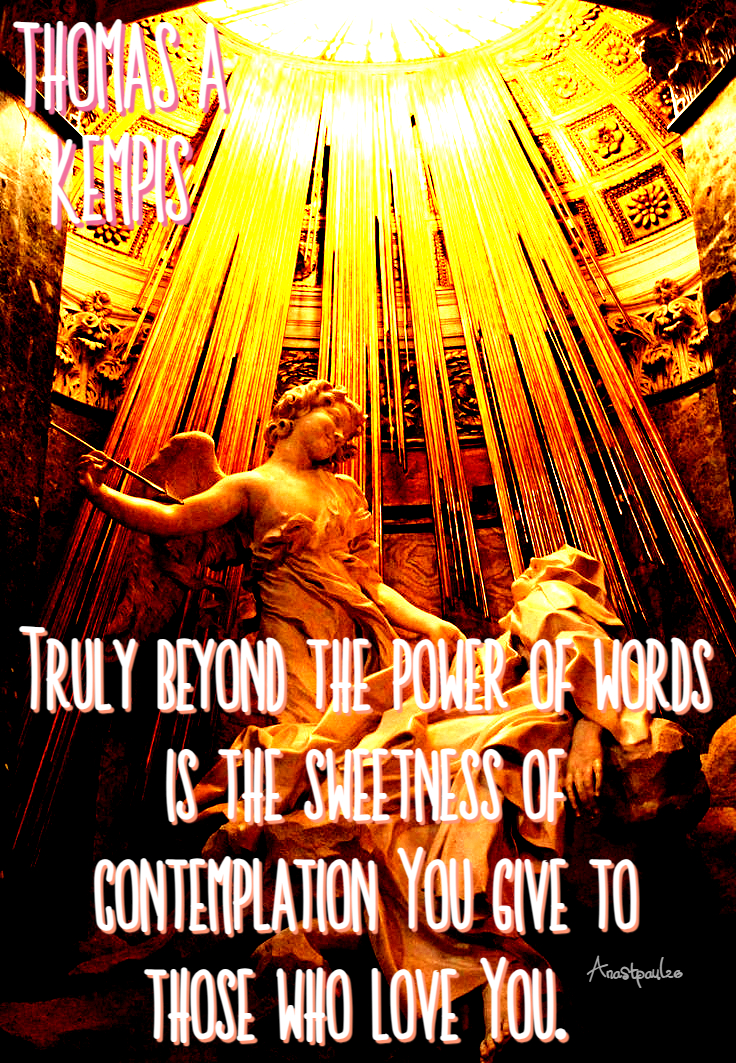
Truly beyond the power of words is the sweetness of contemplation You give to those who love You.
Thomas a Kempis
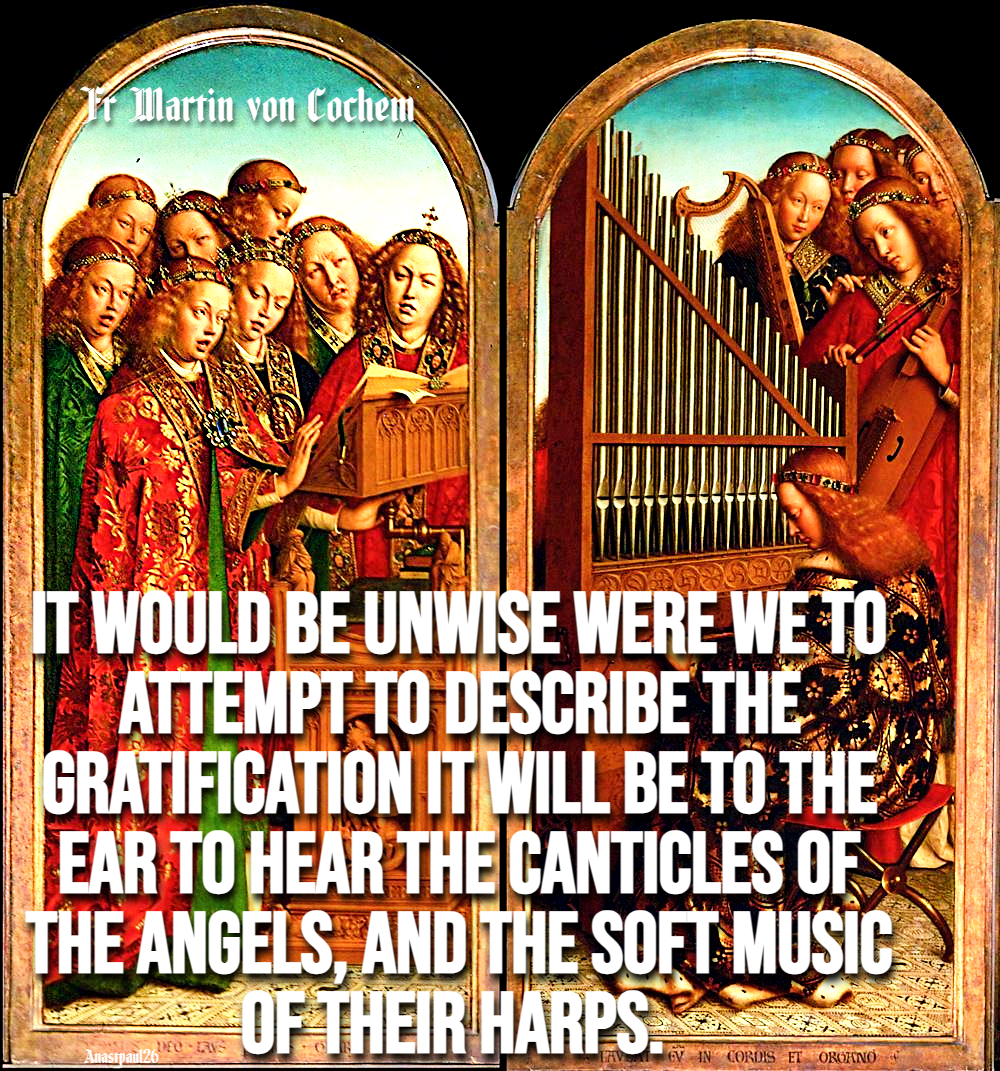
It would be unwise were we to attempt to describe the gratification it will be to the ear to hear the canticles of the Angels, and the soft music of their harps. The nine choirs of Angels will sing the praise of God, and the blessed will join them not only in heart, for they will mingle their voices also in the sweet harmony. Thus the powers of both soul and body will be exercised, and the praises of God will ascend in melodious hymns and celestial songs. For if we mortals are impelled by fervent love and heartfelt joy to lift our voice in song, how much more will the holy Angels and blessed Saints do so, who are all aflame with the love of God, and filled with joy unspeakable. Their hymns of praise will resound without ceasing through the courts of Heaven.
Quote/s of the Day – 15 August – Solemnity of the Assumption of the Blessed Virgin Mary into Heaven
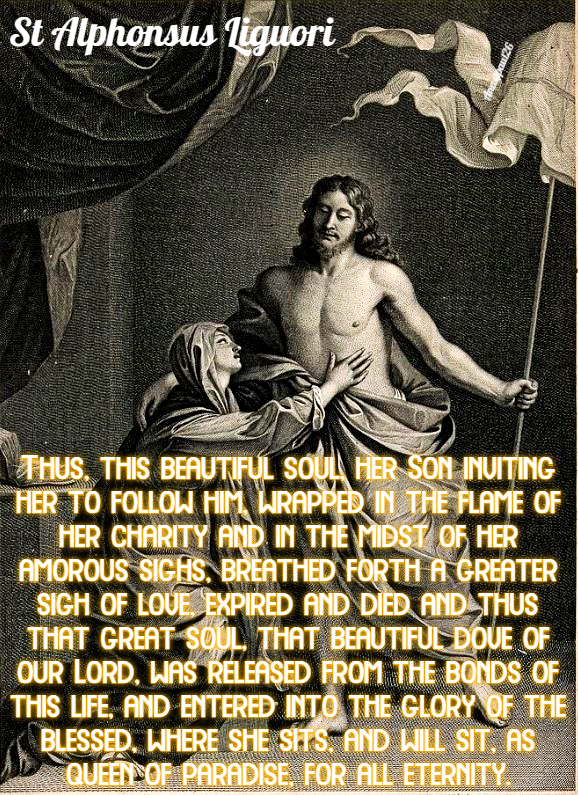
And now death came, not indeed clothed in mourning and sadness, as it comes to others, but adorned with light and joy. But why death, why death? Rather should we say that divine love came to cut the thread of that noble life. And as a lamp before going out, her life, amid these last flickerings, flashed forth more brightly, and then expired. Thus, this beautiful soul, her Son inviting her to follow him, wrapped in the flame of her charity and in the midst of her amorous sighs, breathed forth a greater sigh of love, expired and died and thus that great soul, that beautiful dove of our Lord, was released from the bonds of this life, and entered into the glory of the blessed, where she sits, and will sit, as queen of paradise, for all eternity.
St Alphonsus Liguori
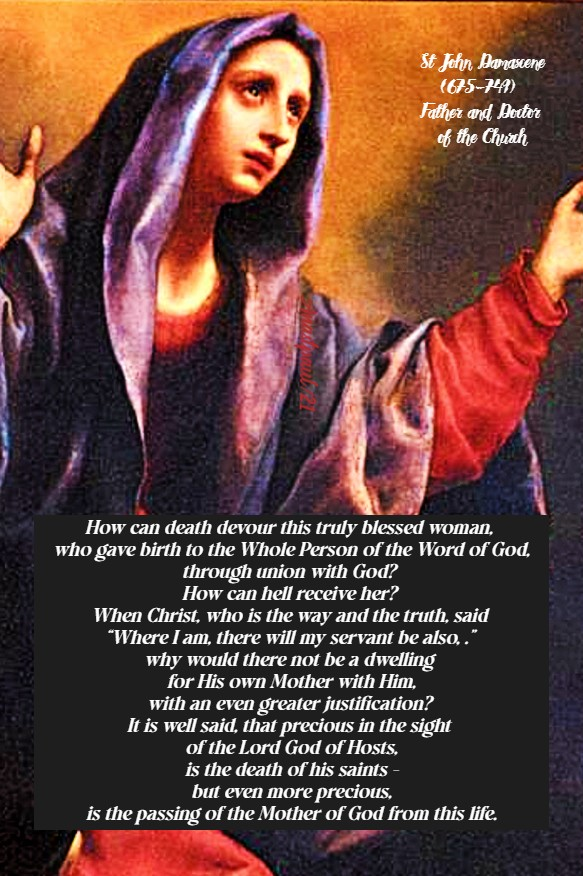
“How can death devour this truly blessed woman, who gave birth to the Whole Person of the Word of God, through union with God? How can hell receive her? When Christ, who is the way and the truth, said “Where I am, there will my servant be also, .” why would there not be a dwelling for His own Mother with Him, with an even greater justification? It is well said, that precious in the sight of the Lord God of Hosts, is the death of his saints – but even more precious, is the passing of the Mother of God from this life..”
St John Damascene
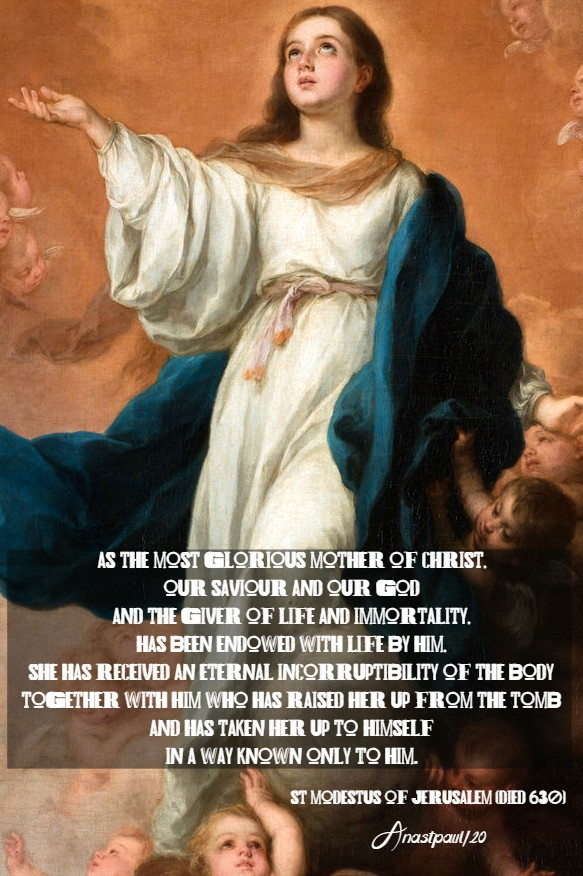
“As the most glorious Mother of Christ, our Saviour and our God and the giver of life and immortality, has been endowed with life by Him, she has received an eternal incorruptibility of the body together with Him who has raised her up from the tomb and has taken her up to Himself in a way known only to Him.”
St Modestus of Jerusalem
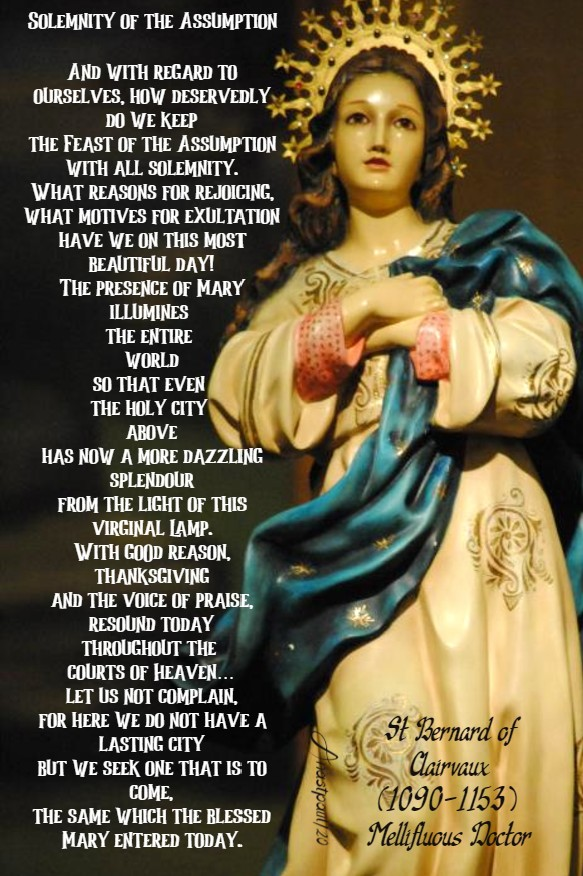
“And with regard to ourselves, how deservedly do we keep the Feast of the Assumption with all solemnity. What reasons for rejoicing, what motives for exultation have we on this most beautiful day! The presence of Mary illumines the entire world so that even the holy city above has now a more dazzling splendour from the light of this virginal Lamp. With good reason, thanksgiving and the voice of praise, resound today throughout the courts of Heaven… let us not complain, for here we do not have a lasting city but we seek one that is to come, the same which the blessed Mary entered today.”
St Bernard of Clairvaux
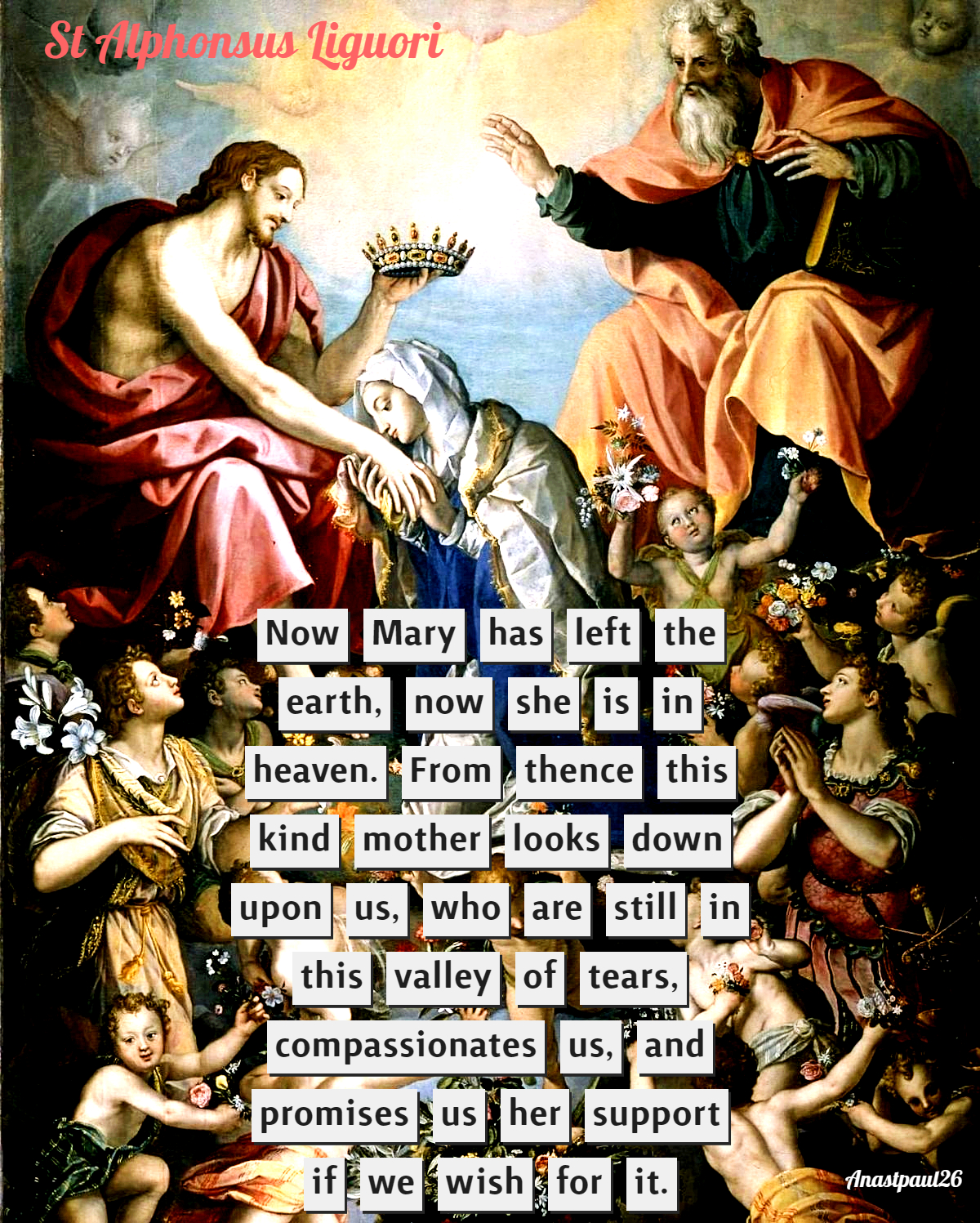
Now Mary has left the earth, now she is in heaven. From thence this kind mother looks down upon us, who are still in this valley of tears, compassionates us, and promises us her support if we wish for it. Let us pray her always that by the merits of her blessed death she may obtain for us a happy death; and if it please God, that she may obtain for us to die on a Saturday, which is dedicated to her honor, or on a day of the Novena, or of the octave of some of her feasts, as she has obtained for so many of her servants, and especially for St. Stanislas Kostka, for whom she obtained to die on the day of her glorious Assumption.
Our Morning Offering – 13 August – “Month of the Immaculate Heart of Mary”
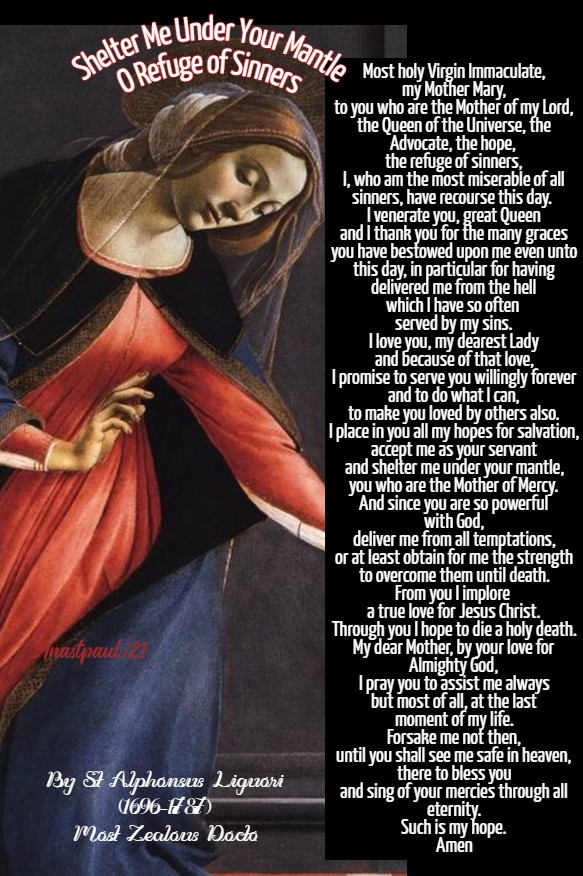
Shelter Me Under Your Mantle, O Refuge of Sinners By St Alphonsus Liguori (1696-1787) Most Zealous Doctor
Most holy Virgin Immaculate, my Mother Mary, to you who are the Mother of my Lord, the Queen of the Universe, the Advocate, the hope, the refuge of sinners, I, who am the most miserable of all sinners, have recourse this day. I venerate you, great Queen and I thank you for the many graces you have bestowed upon me even unto this day, in particular for having delivered me from the hell which I have so often served by my sins. I love you, my dearest Lady and because of that love, I promise to serve you willingly forever and to do what I can, to make you loved by others also. I place in you all my hopes for salvation, accept me as your servant and shelter me under your mantle, you who are the Mother of Mercy. And since you are so powerful with God, deliver me from all temptations, or at least obtain for me the strength to overcome them until death. From you I implore a true love for Jesus Christ. Through you I hope to die a holy death. My dear Mother, by your love for Almighty God, I pray you to assist me always but most of all, at the last moment of my life. Forsake me not then, until you shall see me safe in heaven, there to bless you and sing of your mercies through all eternity. Such is my hope. Amen
Quote/s of the Day – 10 August – Feast of Saint Lawrence, Deacon and Martyr, Readings: Ps 95:6, Ps 95:1, 2 Cor. 9:6-10, John 12:24-26
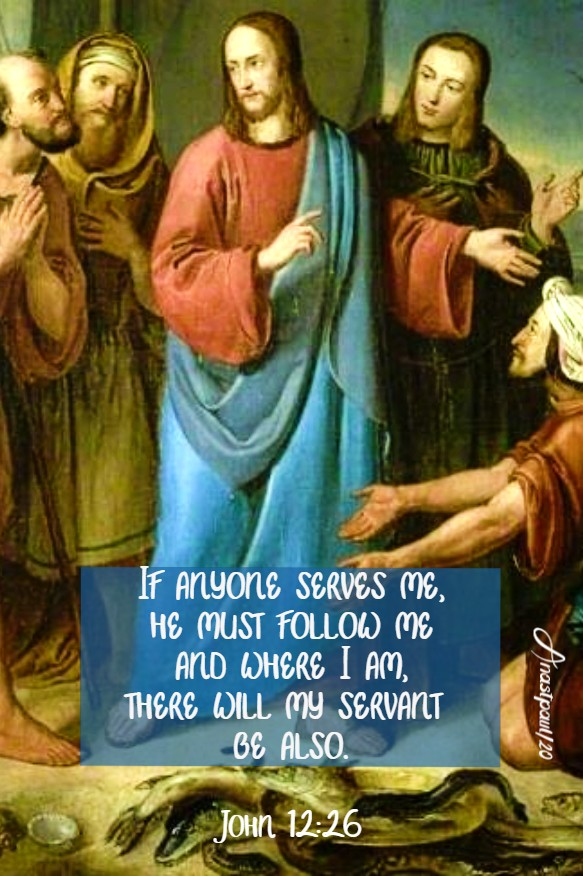
“If anyone serves me, he must follow me and where I am, there will my servant be also.”
John 12:26
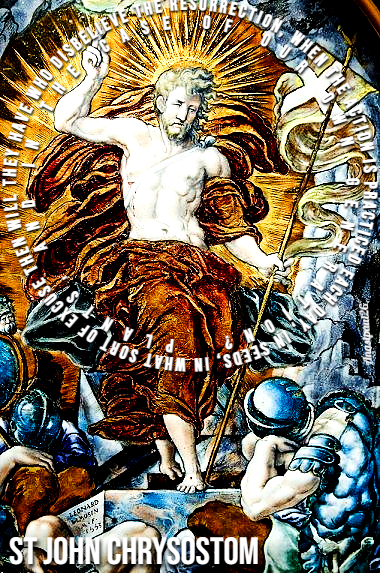
What sort of excuse then will they have who disbelieve the Resurrection, when the action is practiced each day, in seeds, in plants, and in the case of our own generation? For first it is necessary that the seed die, and that then the generation take place. But, in short, when God does anything, reasonings are of no use; for how did He make us out of those things that were not?
St John Chrysostom(Homily 66 on the Gospel of John)
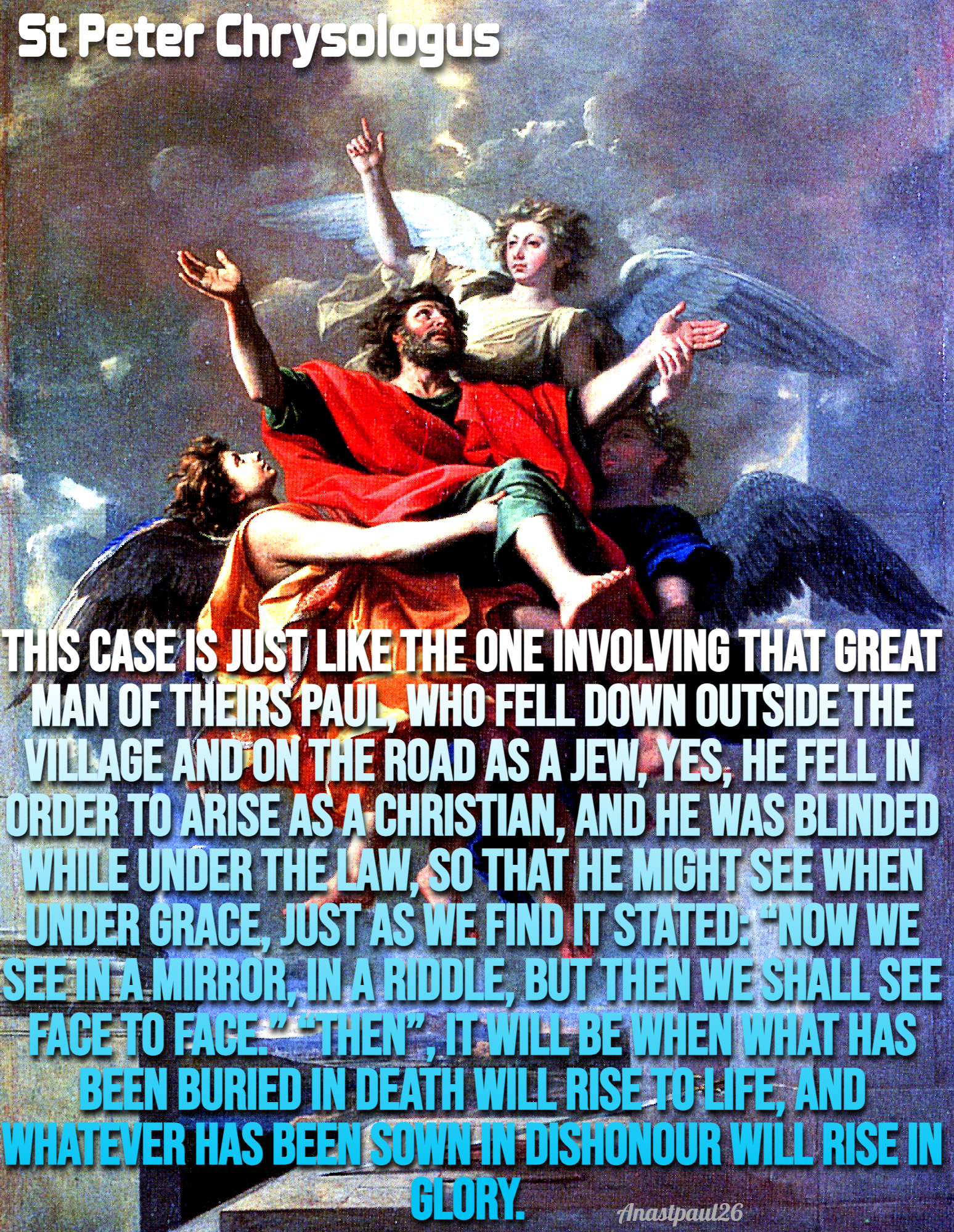
This case is just like the one involving that great man of theirs Paul, who fell down outside the village and on the road as a Jew, yes, he fell in order to arise as a Christian, and he was blinded while under the Law, so that he might see when under grace, just as we find it stated: “Now we see in a mirror, in a riddle, but then we shall see face to face.” “Then”, it will be when what has been buried in death will rise to life, and whatever has been sown in dishonour will rise in glory.
St Peter Chrysologus
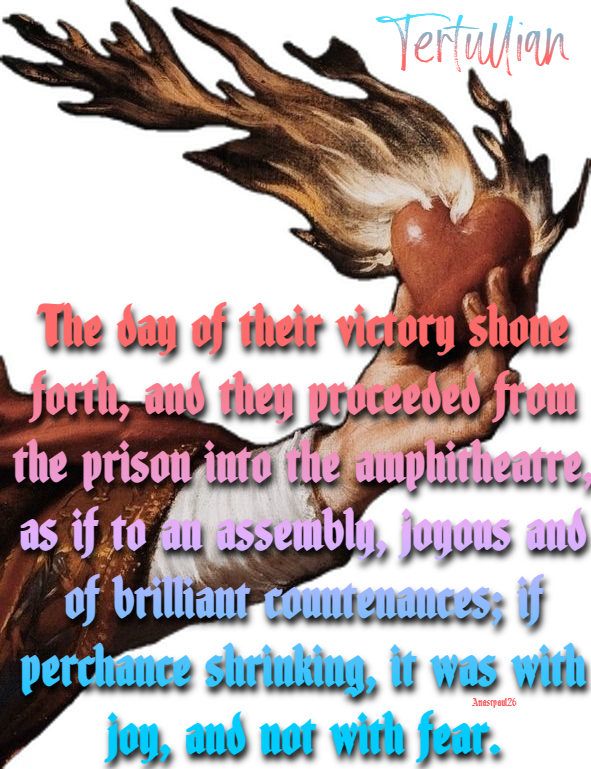
The day of their victory shone forth, and they proceeded from the prison into the amphitheatre, as if to an assembly, joyous and of brilliant countenances; if perchance shrinking, it was with joy, and not with fear.
Tertullian (The Passion of Perpetua and Felicity)
Not only does Solomon exclaim that the riches of this world are vanity which cannot satisfy, but he says that they are pains which torment the mind.” Behold, all is vanity and vexation of spirit.” (Eccles. i. 14.) Poor sinners ! they think to be happy in sin ; but they only find bitterness and remorse.” Destruction and unhappiness is in their ways, and the way of peace have they not known.” (Ps. xiv. 7.) What peace! what peace ! No, saith God, “There is no peace, unto the wicked.”What is a soul that lives without God ? Holy Scripture tells us that it is like a stormy sea. ” But the wicked are like the troubled sea, when it cannot rest.”
St Alphonsus Liguori (Preparation For Death)
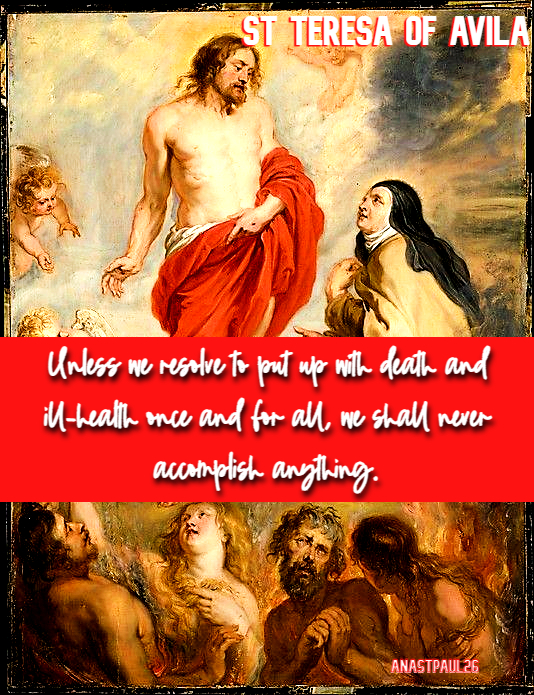
Unless we resolve to put up with death and ill-health once and for all, we shall never accomplish anything.
Quote/s of the Day – 8 August – “Month of the Immaculate Heart of Mary” – Readings: Ps 36:30-31, Ps 36:1, Sir 31:8-11, Luke 12:35-40
Amen I say to you, he will gird himself, and will make them recline at table, and will come and serve them. And if he comes in the second watch, and if in the third, and finds them so, blessed are those servants!
Luke 12:35-40
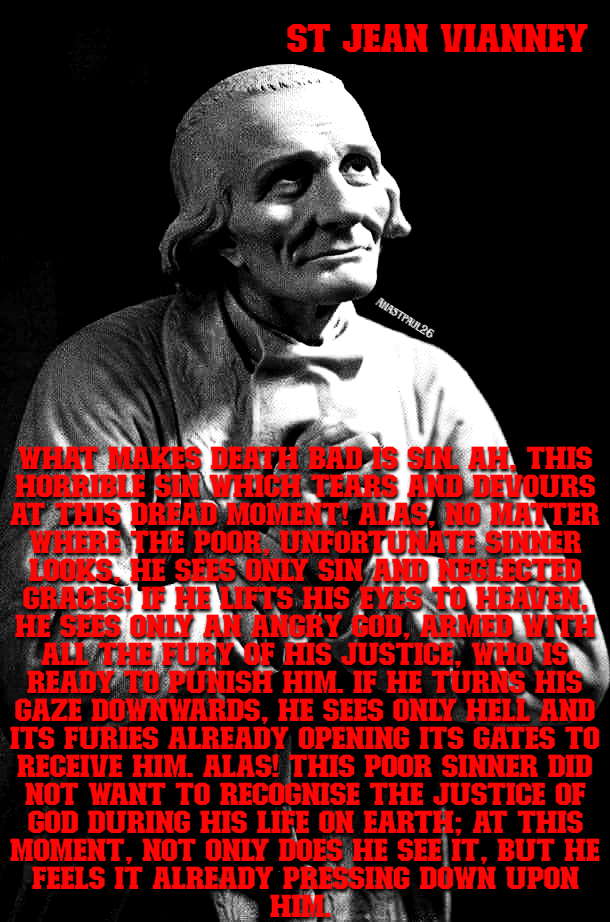
Finally, to die of the plague is not a dreadful death. St. Roch and St. Francis Xavier died of it. But what makes death bad is sin. Ah, this horrible sin which tears and devours at this dread moment! Alas, no matter where the poor, unfortunate sinner looks, he sees only sin and neglected graces! If he lifts his eyes to Heaven, he sees only an angry God, armed with all the fury of His justice, Who is ready to punish him. If he turns his gaze downwards, he sees only Hell and its furies already opening its gates to receive him. Alas! This poor sinner did not want to recognise the justice of God during his life on earth; at this moment, not only does he see it, but he feels it already pressing down upon him.
St John Vianney
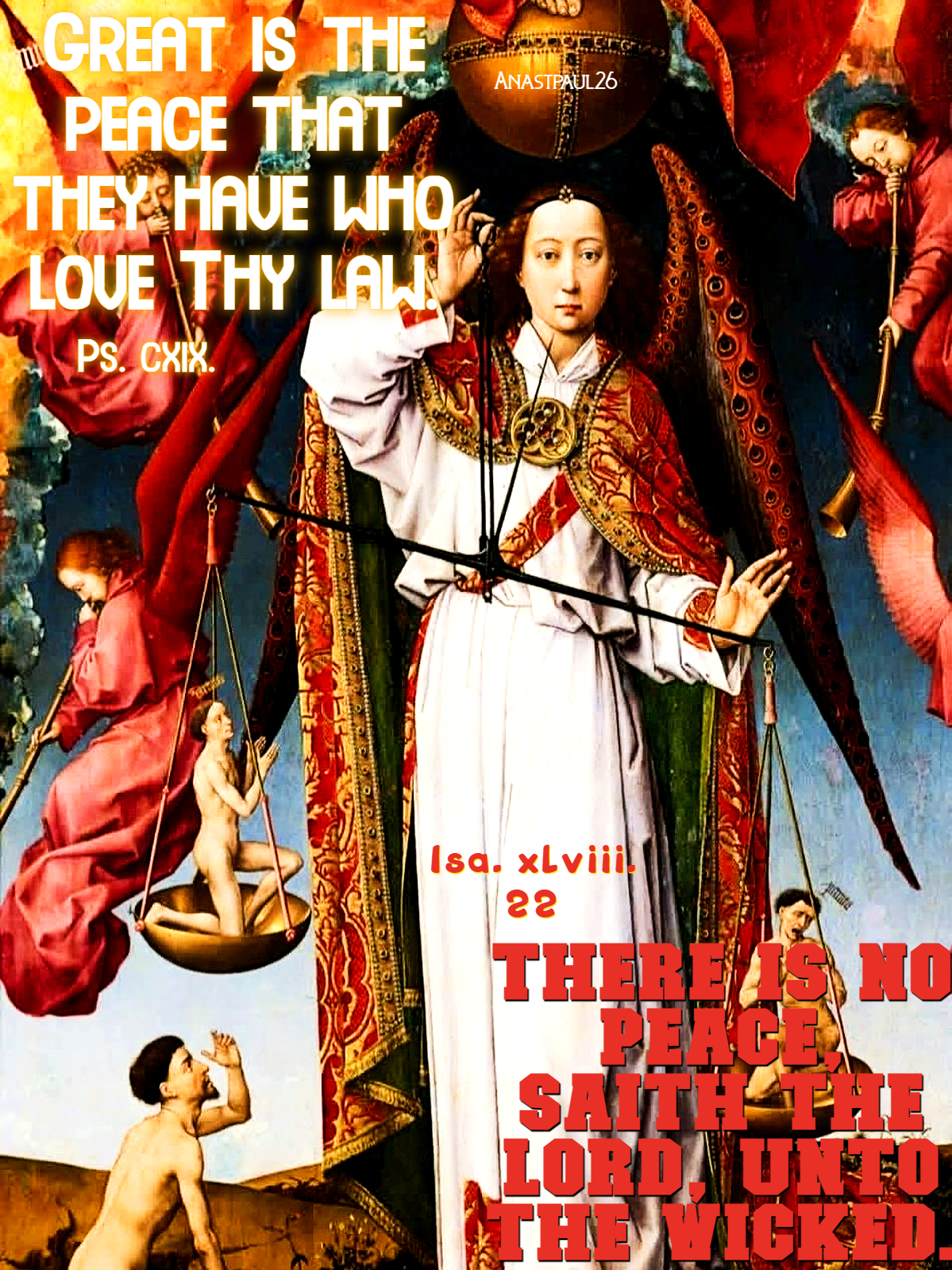
“There is no peace, saith the Lord, unto the wicked.”
Isa. xlviii. 22.
“Great is the peace that they have who love Thy law.”
Ps. cxix.
Hast thou the soul of a hog? Ah, wretched one, perhaps thou art like a beast, so that thou canst be satisfied with eating, with drinking, with sensual pleasures?
St Bernard of Clairvaux
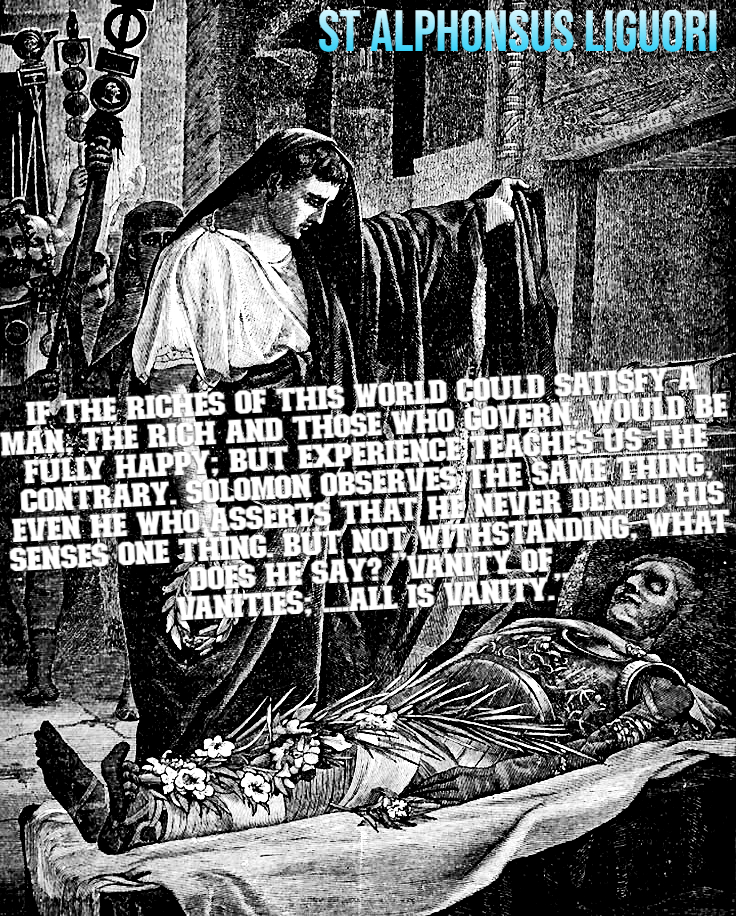
If the riches of this world could satisfy a man, the rich and those who govern, would be fully happy; but experience teaches us the contrary. Solomon observes the same thing, even he who asserts that he never denied his senses one thing. But not withstanding, what does he say? “Vanity of vanities; …. all is vanity.”
St Alphonsus Liguori
Wherefore when the time of discretion is come, the soul can, by her free will, make choice either of good or evil, according as it pleases her will; and so great is this liberty that man has, and so strong has this liberty been made by virtue of this glorious Blood, that no demon or creature can constrain him to one smallest fault without his free consent. He has been redeemed from slavery, and made free in order that he might govern his own sensuality, and obtain the end for which he was created. Oh, miserable man, who delights to remain in the mud like a brute, and does not learn this great benefit which he has received from Me! A benefit so great, that the poor wretched creature full of such ignorance could receive no greater.
Our Morning Offering – 2 August – The Memorial of St Alphonsus Maria de Liguori (1696-1787) Most Zealous Doctor of the Church and a Catholic Monday of the Holy Ghost
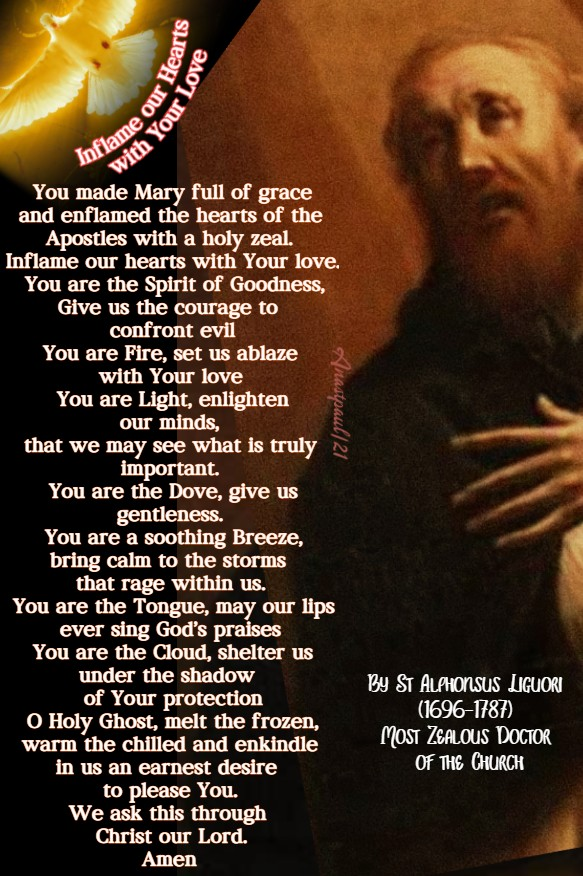
Inflame our Hearts with Your Love Prayer To the Holy Ghost By St Alphonsus Maria de Liguori (1696-1787) Most Zealous Doctor of the Church
You made Mary full of grace and enflamed the hearts of the Apostles with a holy zeal. Inflame our hearts with Your love. You are the Spirit of Goodness, Give us the courage to confront evil You are Fire, set us ablaze with Your love You are Light, enlighten our minds, that we may see what is truly important. You are the Dove, give us gentleness. You are a soothing Breeze, bring calm to the storms that rage within us. You are the Tongue, may our lips ever sing God’s praises You are the Cloud, shelter us under the shadow of Your protection O Holy Ghost, melt the frozen, warm the chilled and enkindle in us an earnest desire to please You. We ask this through Christ our Lord. Amen
One Minute Reflection – 2 August – “Month of the Immaculate Heart of Mary” – Readings: Ps 54:17-20; 54:23, Ps 54:2-3, 1 Cor. 12:2-11, Luke 18:9-14
I tell you, this man went back to his home justified rather than the other; for everyone who exalts himself shall be humbled, and he who humbles himself shall be exalted.
Luke 18:9-14
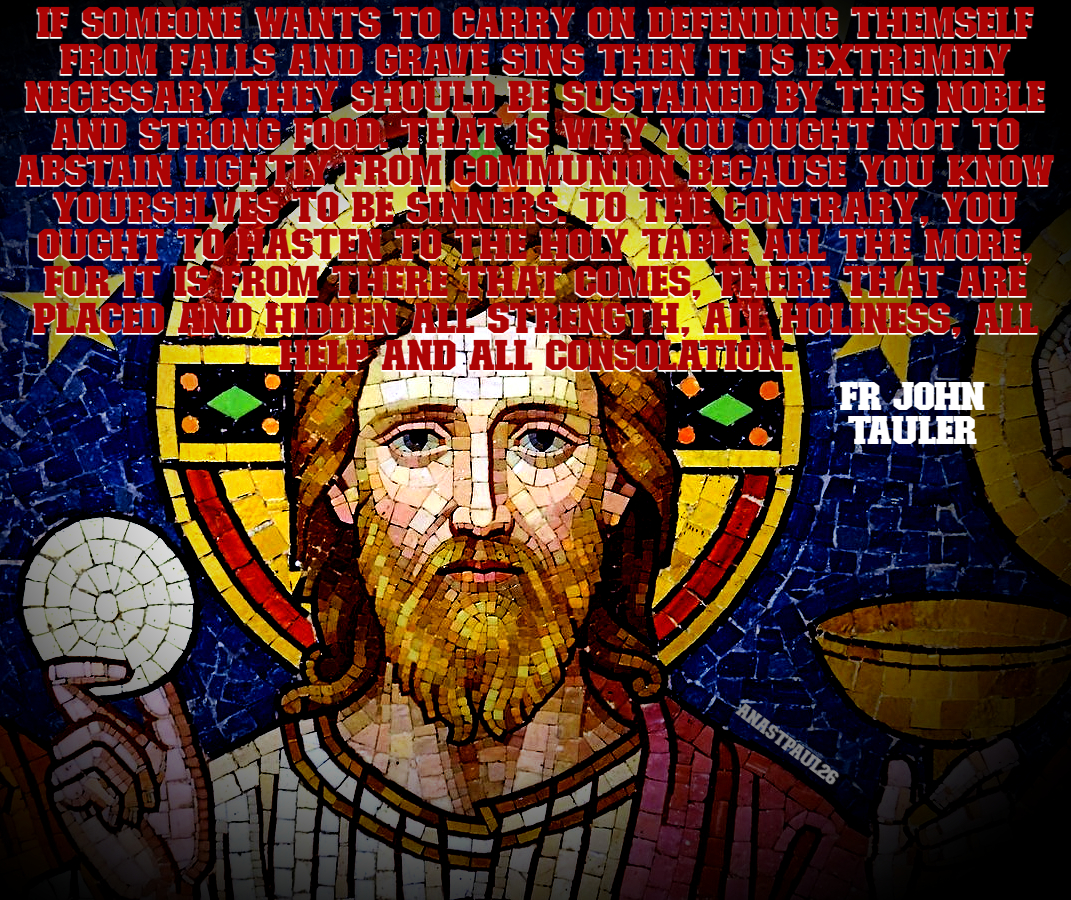
REFLECTION – Dear Sisters, be assured of this, truly, if I were to find someone who really possessed the publican’s feelings, who genuinely took themself for a sinner, so long as that person had a desire to be good while in this feeling of humility. I would give the body of our Lord to them every other day with a good conscience! If someone wants to carry on defending themself from falls and grave sins then it is extremely necessary they should be sustained by this noble and strong food. That is why you ought not to abstain lightly from communion because you know yourselves to be sinners. To the contrary, you ought to hasten to the holy table all the more, for it is from there that comes, there that are placed and hidden all strength, all holiness, all help and all consolation.
But you are not to judge those who don’t do this either… You should bear no judgment so as not to become like the Pharisee who glorified himself and condemned the man standing behind him. Watch yourselves against that as from the loss of your souls; watch yourselves against the dangerous sin of condemnation.
When someone reaches the heights of all perfection nothing has ever been more necessary to them than to plunge into the lowest depths and penetrate to to the roots of humility. This was why the publican, having acknowledged the ultimate depths of his lowliness to the point of not daring any more to raise his eyes to heaven, was raised up on high since “he went back to his house justified”.
Father John Tauler (1300-1361)
PRAYER – Forgive the sins of Your people Lord and since of ourselves, we are unable to do what pleases You, lead us on the way of salvation in Your divine Son who lives in us and gives us life. May the prayers of the Immaculate Heart of Mary, and most zealous Saint Alphonsus Liguori, help us to constantly meditate on Your eternal sustenance. Through, our Lord Jesus Christ, who lives and reigns with You and the Holy Spirit, God forever and ever, amen.
Quote/s of the Day – 2 August – The Memorial of St Alphonsus Maria de Liguori (1696-1787) Most Zealous Doctor of the Church
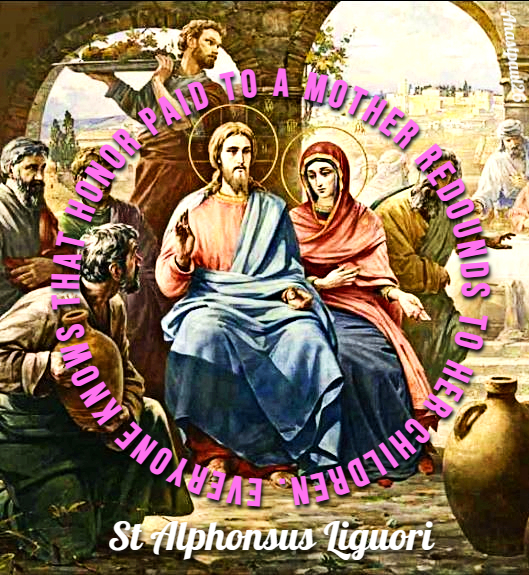
Everyone knows that honor paid to a mother redounds to her children. Hence St. Bernard says, let not any one think that by greatly praising the mother he will throw into the shade the glories of the Son; for the more he honors the mother, so much more he honors the Son. And there is no doubt that on account of the merits of Jesus, the great privilege has been granted to Mary to be the mediatrix of our salvation; not, indeed, mediatrix of justice, but of grace and intercession.
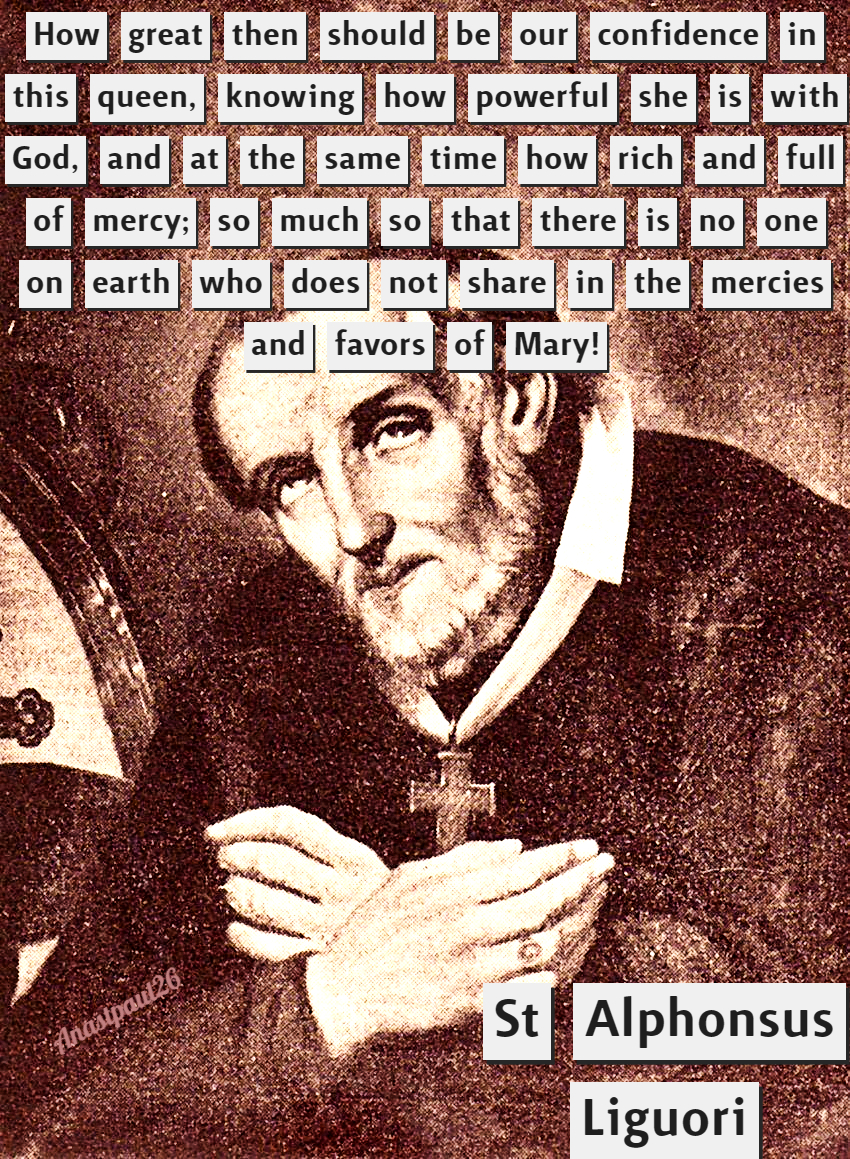
How great then should be our confidence in this queen, knowing how powerful she is with God, and at the same time how rich and full of mercy; so much so that there is no one on earth who does not share in the mercies and favors of Mary!
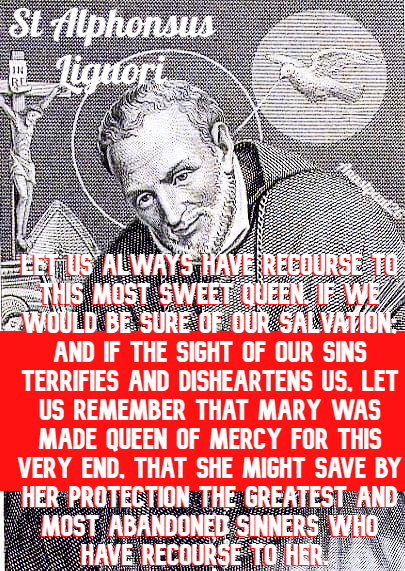
Let us always have recourse to this most sweet queen, if we would be sure of our salvation; and if the sight of our sins terrifies and disheartens us, Let us remember that Mary was made queen of mercy for this very end, that she might save by her protection the greatest and most abandoned sinners who have recourse to her.
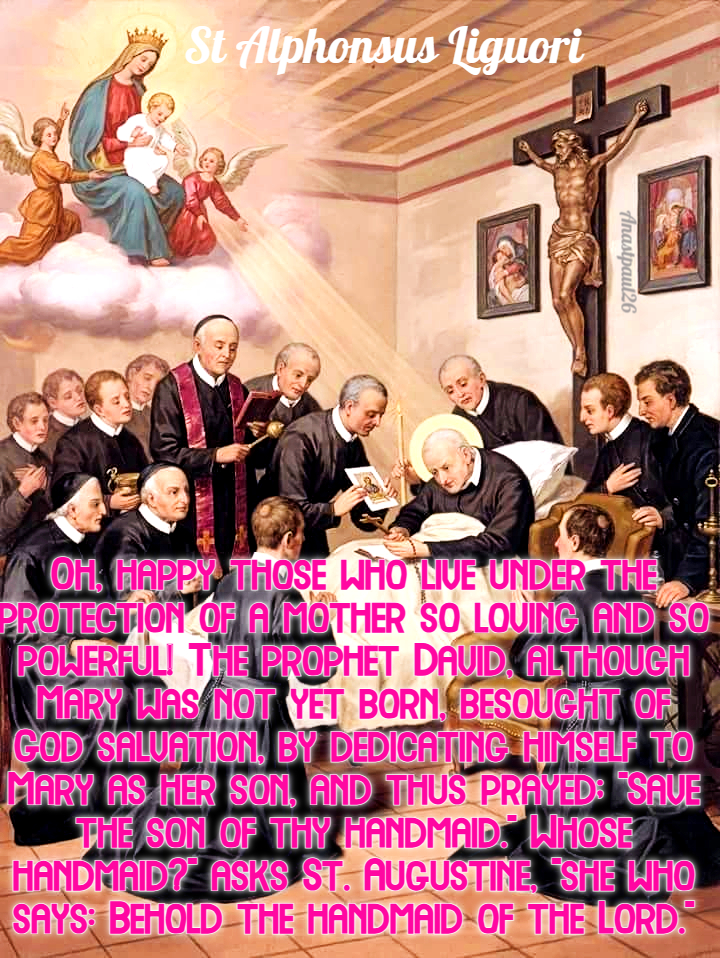
Oh, happy those who live under the protection of a mother so loving and so powerful! The prophet David, although Mary was not yet born, besought of God salvation, by dedicating himself to Mary as her son, and thus prayed; “Save the son of thy handmaid.” Whose handmaid?” asks St. Augustine, “she who says: Behold the handmaid of the Lord.”
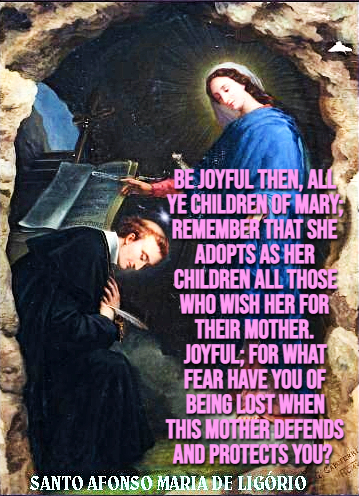
Be joyful then, all ye children of Mary; remember that she adopts as her children all those who wish her for their mother. Joyful; for what fear have you of being lost when this mother defends and protects you?
Every one who loves this good mother and trusts in her protection, should take cour age and repeat: What do you fear, oh my soul? The cause of thy eternal salvation will not be lost, as the final sentence depends upon Jesus, who is thy brother, and upon Mary who is thy mother. And St. Anselm full of joy at this thought, exclaims, in order to encourage us: Oh, blessed confidence! Oh, secure refuge! The mother of God is my mother also.
And because all men have been redeemed by Jesus, Mary loves and favors all. She was seen by St. John clothed with the sun: “And there appeared a great wonder in heaven, a woman clothed with the sun.” She is said to be clothed with the sun, because, as “There is no one that can hide himself from his heat,” so there is no one living on the earth who is deprived of the love of Mary.
Our Morning Offering – 4 July – “Month of the Precious Blood”
For those unable to attend Holy Mass today and for all of us, everyday!
Act of Spiritual Communion By St Alphonsus Maria de Liguori (1696-1787) Most Zealous Doctor
I desire, good Jesus, to receive Thee in Holy Communion and since I cannot now receive Thee in the Blessed Sacrament, I beseech Thee to come to me spiritually and to refresh my soul with Thy sweetness. Come, my Lord, my God and my All! Come to me and never let me ever again be separated from Thee by sin. Teach me Thy blessed ways, help me with Thy grace to imitate Thy example, to practise meekness, humility, charity and all the virtues of Thy Sacred Heart. My divine Master, my one desire is to do Thy will and to love Thee, more and more. Help me, that I may be faithful to the end, in Thy service. Bless me in life and in death, that I may praise Thee, forever in heaven, Amen
















You must be logged in to post a comment.