
Reflections on each of the Seven Dolors of Mary by St Alphonsus Liguori
The Piercing of the Side of Jesus and His Descent From the Cross
And now we are to consider to-day the sixth dolor which afflicted this sorrowful mother. Attend and weep. Hitherto the dolors of Mary tortured her one by one, but to-day they are all united to assail her.
That the joy of the following Paschal Sabbath should not be disturbed, the Jews wished the body of Jesus to be taken down from the cross; but because they could not take down a criminal until he was dead, they came with iron mallets to break his legs, as they had already done to the two thieves crucified with him. And Mary, while she remains weeping at the death of her Son, sees those armed men coming towards her Jesus. At this sight she first trembled with fear, then she said : Ah, my Son is already dead, cease to maltreat him, and cease to torture me a poor mother longer. She implored them not to break his legs : “Oravit eos, ne frangerent crura,” as St. Bonaventure writes. But while she is thus speaking, oh, God she sees a soldier with violence brandishing a spear, and piercing the side of Jesus : “One of the soldiers with a spear opened his side, and immediately there came out blood and water.” The cross shook at the stroke of the spear, and, as was revealed to St. Bridget, the heart of Jesus was divided : “Ita ut ambae paries essent divisse.” There came out blood and water, for only a few drops of blood remained, and those also the Saviour wished to shed, in order to show that he had no more blood to give us. The injury of that stroke was offered to Jesus, but the pain was inflicted on Mary: Christ, says the devout Lanspergius, shared with his mother the infliction of that wound, for he received the insult and his mother the pain. The holy Fathers explain this to be the very sword predicted to the Virgin by St. Simeon ; a sword, not of iron, but of grief, which pierced through her blessed soul in the heart of Jesus, where it always dwelt. Thus, among others, Si. Bernard says: The spear which opened his side passed through the soul of the Virgin, which could not be torn from the heart of Jesus. And the divine mother herself revealed the same to St. Bridget, saying: When the spear was drawn out, the point appeared red with blood; then I felt as if my heart were pierced when I saw the heart of my most dear Son pierced.” The angel told St. Bridget, that such were the sufferings of Mary, that she was saved from death only by the miraculous power of God. In her other dolors she at least had her Son to compassionate her; and now she had not even him to take pity on her.
The afflicted mother, still fearing that other injuries might be inflicted on her Son, entreats Joseph of Arimathea to obtain from Pilate the body of her Jesus, that at least after his death she may be able to guard it and protect it from injuries. Joseph went to Pilate, and made known to him the sorrow and the wish of this afflicted mother; and St. Anselm thinks that compassion for the mother softened the heart of Pilate, and moved him to grant her the body. of the Saviour. And now Jesus is taken from the cross. Oh most holy Virgin, after thou with so great love hadst given thy Son to the world for our salvation, behold the world returns him to thee again! But oh, my God, how dost thou return him to me? said Mary to the world. My Son was white and ruddy: “Dilectus meus candidus et rubicundus:” but thou hast returned him to me blackened with bruises, and red, not with a ruddy color, but with the wounds thou hast inflicted upon him; he was beautiful, now there is no more beauty in him; he is all deformity. All were enamored with his aspect, now he excites horror in all who look upon him. Oh, how many swords, says St. Bonaventure, pierced the soul of this mother, when she received the body of her Son after it was taken from the cross: ” O quot gladii animam matris pertransierunt!” Let us consider what anguish it would cause any mother to receive the lifeless body of a son!
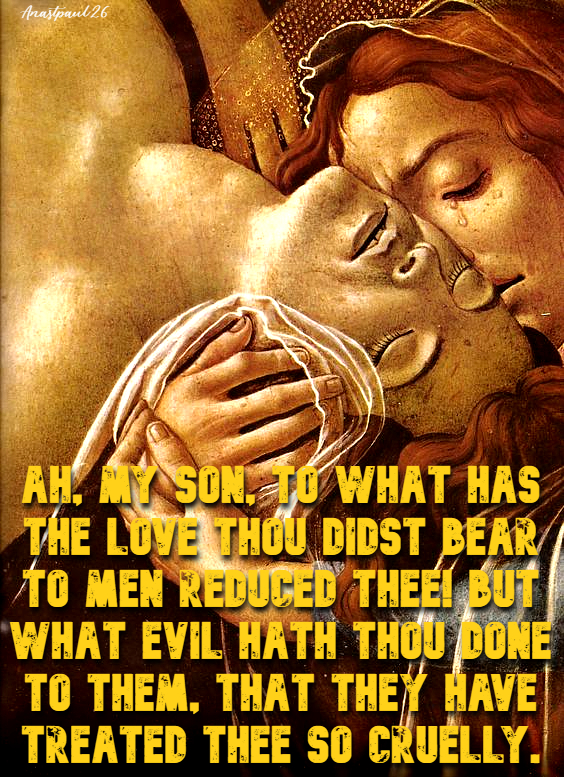
She sees his mouth open, his eye shut, she examines the lacerated flesh, and those exposed bones; she takes off the crown, and sees the cruel injury made by those thorns, in that sacred head; she looks upon those pierced hands and feet, and says: Ah, my Son, to what has the love thou didst bear to men reduced thee! But what evil hath thou done to them, that they have treated thee so cruelly. Thou wast my Father, Bernardino de Bustis imagines her to say, my brother, my spouse, my delight, my glory, my all. Oh, my Son, behold how I am afflicted, look upon me and console me; but thou dost look upon me no more. Speak, speak to me but one word, and console me; but thou dost speak no more, for thou art dead. Then turning to those barbarous instruments, she said: Oh cruel thorns, oh nails, oh merciless spear, how could you thus torture your Creator? But what thorns, what nails? Alas! sinners, she exclaimed, it is you who have thus cruelly treated my Son.
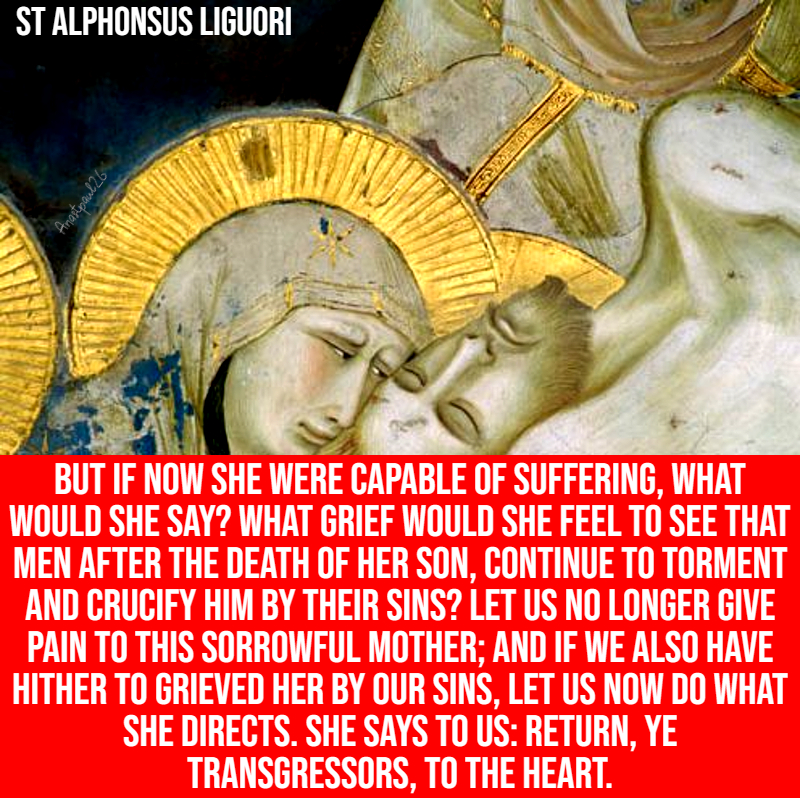
Thus Mary spoke and complained of us. But if now she were capable of suffering, what would she say? What grief would she feel to see that men after the death of her Son, continue to torment and crucify him by their sins? Let us no longer give pain to this sorrowful mother; and if we also have hither to grieved her by our sins, let us now do what she directs. She says to us: Return, ye transgressors, to the heart: “Redite, prsevaricatores, ad cor.” Sinners, return to the wounded heart of my Jesus; return as penitents, for he will receive you. Flee from him to him, she continues to say with Guerric the Abbot; from the Judge to the Redeemer, from the tribunal to the cross.
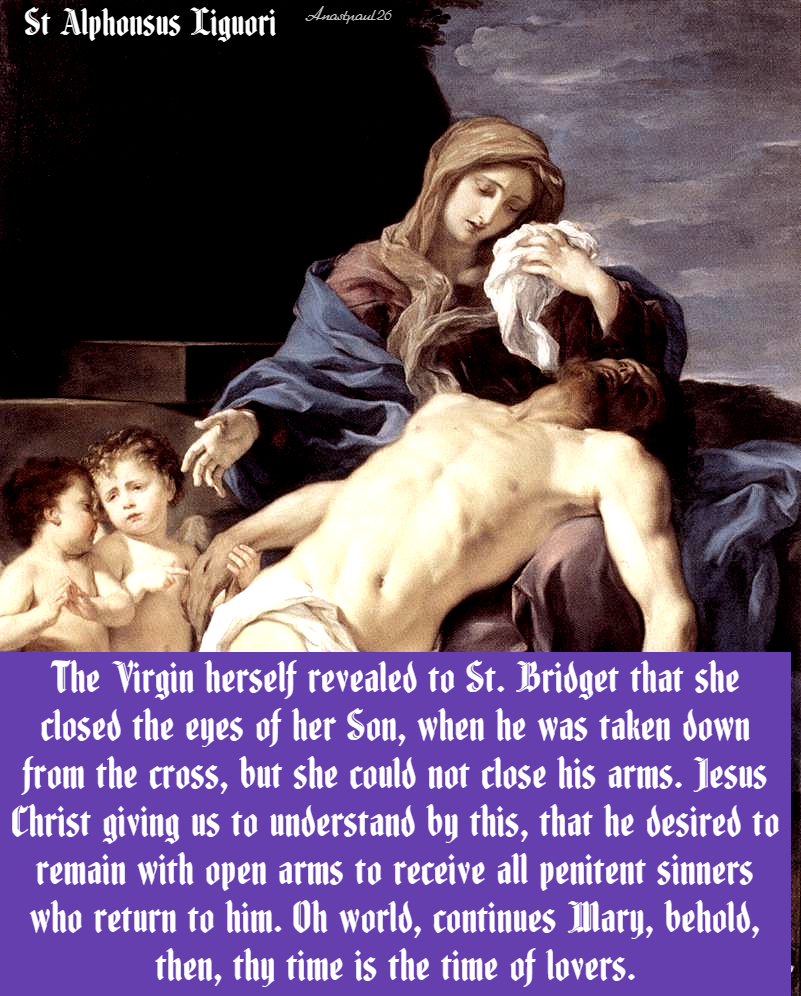
The Virgin herself revealed to St. Bridget that she closed the eyes of her Son, when he was taken down from the cross, but she could not close his arms: “Ejus brachia flectere non potui.” Jesus Christ giving us to understand by this, that he desired to remain with open arms to receive all penitent sinners who return to him. Oh world, continues Mary, behold, then, thy time is the time of lovers.

 AnaStpaul