Posted in SEPTEMBER-The SEVEN SORROWS of MARY and The HOLY CROSS

Thought for the Day – 18 September – The Seventh Dolor

Reflections on each of the Seven Dolors of Mary by St Alphonsus Liguori

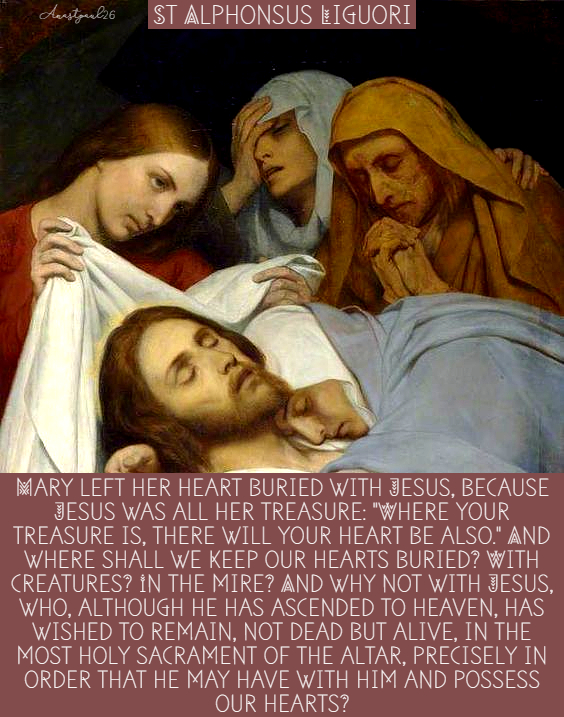
The Burial of the Body of Jesus

When a mother is by the side of a suffering and dying child, she no doubt then feels and suffers all his pains; but when the afflicted child is really dead and about to be buried, and the sorrowful mother takes her last leave of him, oh God! the thought that she is to see him no more is a sorrow that exceeds all other sorrows. Behold, the last sword of sorrow which we are to consider, when Mary, after being present at the death of her Son upon the cross, after having embraced his lifeless body, was finally to leave him in the sepulchre, never more to enjoy his beloved presence.

Thus Mary, clinging to her Son, was dissolved in grief; but those holy disciples, fearing lest this poor mother would expire there through agony, went to take the body of her Son from her arms, to bear it away for burial. Therefore, with reverential force they took him from her arms, and having embalmed him, wrapped him in a linen cloth already prepared, upon which our Lord wished to leave to the world his image impressed, as may be seen at the present day in Turin. And now they bear him to the sepulchre. The sorrowful funeral train sets forth; the disciples place him on their shoulders; hosts of angels from heaven accompany him; those holy women follow him; and the afflicted mother follows in their company her Son to the grave. When they had reached the appointed place, how gladly would Mary have buried her self there alive with her Son! “Oh how willingly,” said the Virgin to St. Bridget, “would I have remained there alive with my Son, if it had been his will!” But since this was not the divine will, the authors relate that she herself accompanied the sacred body of Jesus into the sepulchre, where, as Baronius narrates, they deposited the nails and the crown of thorns. In raising the stone to close the sepulchre, the disciples of the Saviour had to turn to the Virgin, and say to her: Now, oh Lady, we must close the sepulchre; have patience, look upon thy Son, and take leave of him for the last time. Then, oh my beloved Son, must the afflicted mother have said, then shall I see thee no more? Receive then, this last time that I look upon thee, receive the last farewell from me thy dear mother, and receive my heart which I leave buried with thee.

Mary left her heart buried with Jesus, because Jesus was all her treasure: “Where your treasure is, there will your heart be also.” And where shall we keep our hearts buried? With creatures? In the mire? And why not with Jesus, who, although he has ascended to heaven, has wished to remain, not dead but alive, in the most holy sacrament of the altar, precisely in order that he may have with him and possess our hearts? But let us return to Mary. Before quitting the sepulchre, according to St. Bonaventure, she blessed that sacred stone, saying: Oh happy stone, that doth now inclose that body which was contained nine months in my womb, I bless thee, and envy thee; I leave thee to guard my Son for me, who is my only good, my only love. And then turning to the eternal Father, she said: Oh Father, to thee I recommend him, who is thy Son and mine; and thus bidding a last farewell to her Son, and to the sepulchre, she returned to her own house. This poor mother went away so afflicted and sad, according to St. Bernard, that she moved many to tears even against their will: “Multos etiam invitos ad lacrymas provocabat;” so that wherever she passed, all wept who met her: “Omnes plorabant qui obviabant ei,” and could not restrain their tears. And he adds, that those holy disciples, and the women who accompanied her, mourned for her even more than for their Lord.

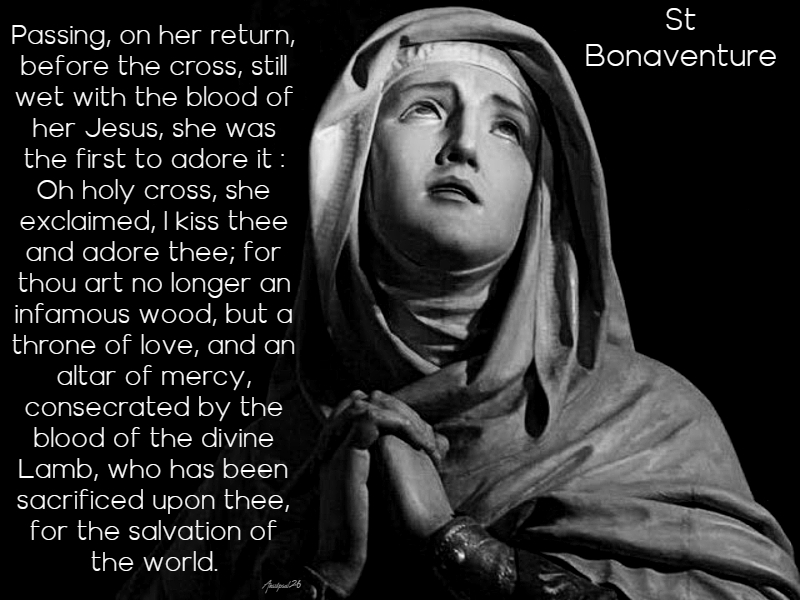
St. Bonaventure says, that her two sisters covered her with a mourning cloak: The sisters of our Lady wrapped her in a veil as a widow, covering as it were her whole countenance. And he also says, that passing, on her return, before the cross, still wet with the blood of her Jesus, she was the first to adore it : Oh holy cross, she exclaimed, I kiss thee and adore thee; for thou art no longer an infamous wood, but a throne of love, and an altar of mercy, consecrated by the blood of the divine Lamb, who has been sacrificed upon thee, for the salvation of the world.

Posted in SEPTEMBER-The SEVEN SORROWS of MARY and The HOLY CROSS

Thought for the Day – 17 September – On the Sixth Dolor

Reflections on each of the Seven Dolors of Mary by St Alphonsus Liguori

The Piercing of the Side of Jesus and His Descent From the Cross

And now we are to consider to-day the sixth dolor which afflicted this sorrowful mother. Attend and weep. Hitherto the dolors of Mary tortured her one by one, but to-day they are all united to assail her.

That the joy of the following Paschal Sabbath should not be disturbed, the Jews wished the body of Jesus to be taken down from the cross; but because they could not take down a criminal until he was dead, they came with iron mallets to break his legs, as they had already done to the two thieves crucified with him. And Mary, while she remains weeping at the death of her Son, sees those armed men coming towards her Jesus. At this sight she first trembled with fear, then she said : Ah, my Son is already dead, cease to maltreat him, and cease to torture me a poor mother longer. She implored them not to break his legs : “Oravit eos, ne frangerent crura,” as St. Bonaventure writes. But while she is thus speaking, oh, God she sees a soldier with violence brandishing a spear, and piercing the side of Jesus : “One of the soldiers with a spear opened his side, and immediately there came out blood and water.” The cross shook at the stroke of the spear, and, as was revealed to St. Bridget, the heart of Jesus was divided : “Ita ut ambae paries essent divisse.” There came out blood and water, for only a few drops of blood remained, and those also the Saviour wished to shed, in order to show that he had no more blood to give us. The injury of that stroke was offered to Jesus, but the pain was inflicted on Mary: Christ, says the devout Lanspergius, shared with his mother the infliction of that wound, for he received the insult and his mother the pain. The holy Fathers explain this to be the very sword predicted to the Virgin by St. Simeon ; a sword, not of iron, but of grief, which pierced through her blessed soul in the heart of Jesus, where it always dwelt. Thus, among others, Si. Bernard says: The spear which opened his side passed through the soul of the Virgin, which could not be torn from the heart of Jesus. And the divine mother herself revealed the same to St. Bridget, saying: When the spear was drawn out, the point appeared red with blood; then I felt as if my heart were pierced when I saw the heart of my most dear Son pierced.” The angel told St. Bridget, that such were the sufferings of Mary, that she was saved from death only by the miraculous power of God. In her other dolors she at least had her Son to compassionate her; and now she had not even him to take pity on her.

The afflicted mother, still fearing that other injuries might be inflicted on her Son, entreats Joseph of Arimathea to obtain from Pilate the body of her Jesus, that at least after his death she may be able to guard it and protect it from injuries. Joseph went to Pilate, and made known to him the sorrow and the wish of this afflicted mother; and St. Anselm thinks that compassion for the mother softened the heart of Pilate, and moved him to grant her the body. of the Saviour. And now Jesus is taken from the cross. Oh most holy Virgin, after thou with so great love hadst given thy Son to the world for our salvation, behold the world returns him to thee again! But oh, my God, how dost thou return him to me? said Mary to the world. My Son was white and ruddy: “Dilectus meus candidus et rubicundus:” but thou hast returned him to me blackened with bruises, and red, not with a ruddy color, but with the wounds thou hast inflicted upon him; he was beautiful, now there is no more beauty in him; he is all deformity. All were enamored with his aspect, now he excites horror in all who look upon him. Oh, how many swords, says St. Bonaventure, pierced the soul of this mother, when she received the body of her Son after it was taken from the cross: ” O quot gladii animam matris pertransierunt!” Let us consider what anguish it would cause any mother to receive the lifeless body of a son!

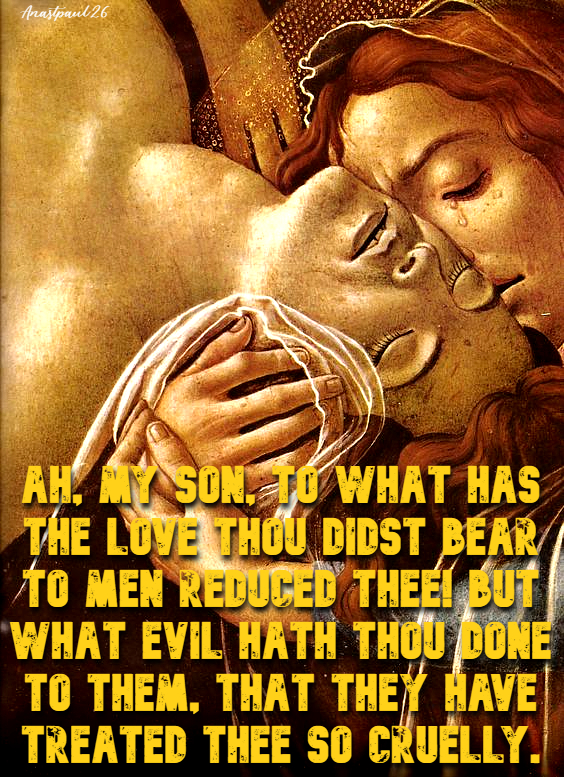
She sees his mouth open, his eye shut, she examines the lacerated flesh, and those exposed bones; she takes off the crown, and sees the cruel injury made by those thorns, in that sacred head; she looks upon those pierced hands and feet, and says: Ah, my Son, to what has the love thou didst bear to men reduced thee! But what evil hath thou done to them, that they have treated thee so cruelly. Thou wast my Father, Bernardino de Bustis imagines her to say, my brother, my spouse, my delight, my glory, my all. Oh, my Son, behold how I am afflicted, look upon me and console me; but thou dost look upon me no more. Speak, speak to me but one word, and console me; but thou dost speak no more, for thou art dead. Then turning to those barbarous instruments, she said: Oh cruel thorns, oh nails, oh merciless spear, how could you thus torture your Creator? But what thorns, what nails? Alas! sinners, she exclaimed, it is you who have thus cruelly treated my Son.

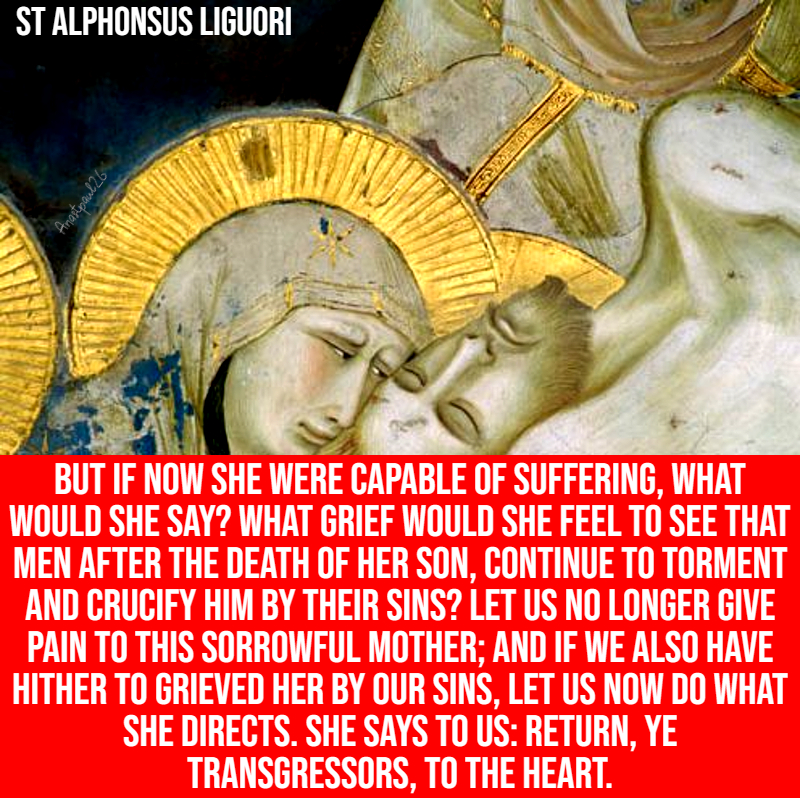
Thus Mary spoke and complained of us. But if now she were capable of suffering, what would she say? What grief would she feel to see that men after the death of her Son, continue to torment and crucify him by their sins? Let us no longer give pain to this sorrowful mother; and if we also have hither to grieved her by our sins, let us now do what she directs. She says to us: Return, ye transgressors, to the heart: “Redite, prsevaricatores, ad cor.” Sinners, return to the wounded heart of my Jesus; return as penitents, for he will receive you. Flee from him to him, she continues to say with Guerric the Abbot; from the Judge to the Redeemer, from the tribunal to the cross. 

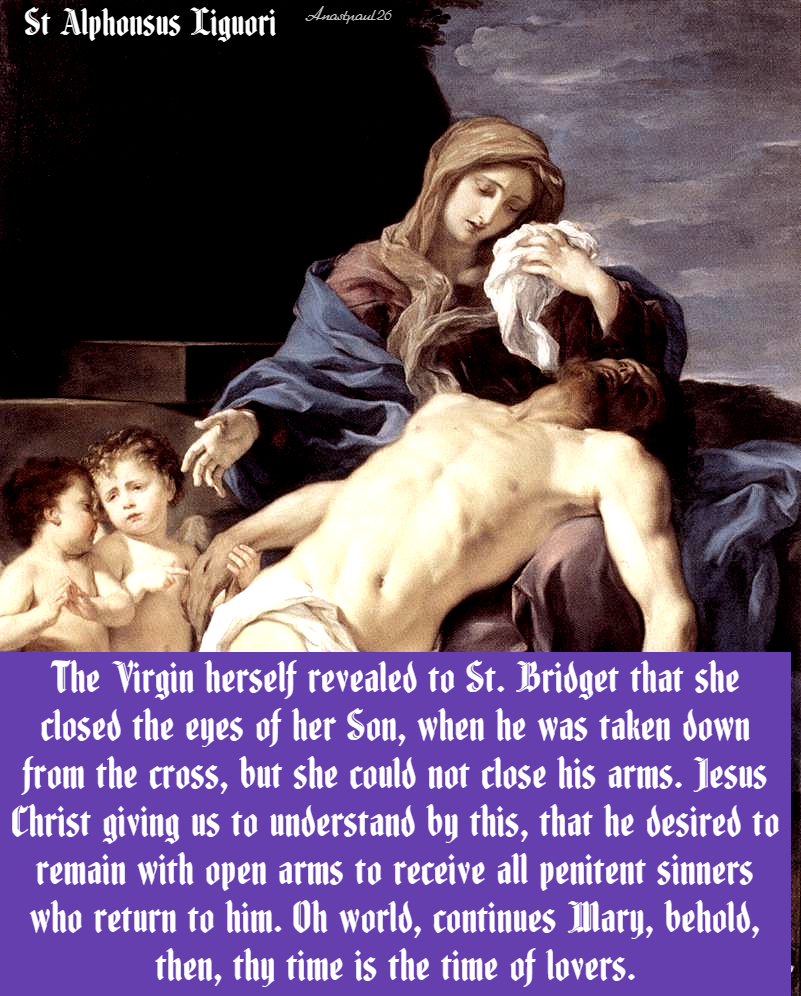
The Virgin herself revealed to St. Bridget that she closed the eyes of her Son, when he was taken down from the cross, but she could not close his arms: “Ejus brachia flectere non potui.” Jesus Christ giving us to understand by this, that he desired to remain with open arms to receive all penitent sinners who return to him. Oh world, continues Mary, behold, then, thy time is the time of lovers.

Posted in SEPTEMBER-The SEVEN SORROWS of MARY and The HOLY CROSS

Quote/s of the Day – 15 September – When Mary Weeps

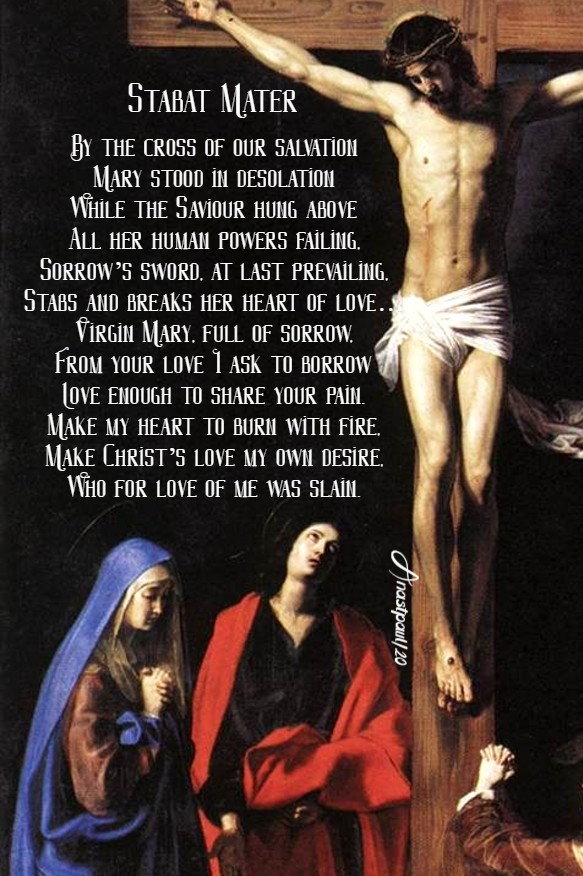
‘By the cross of our salvation
Mary stood in desolation
While the Saviour hung above
All her human powers failing,
Sorrow’s sword, at last prevailing,
Stabs and breaks her heart of love…
Virgin Mary, full of sorrow,
From your love I ask to borrow
Love enough to share your pain.
Make my heart to burn with fire,
Make Christ’s love my own desire,
Who for love of me was slain.’

Stabat Mater

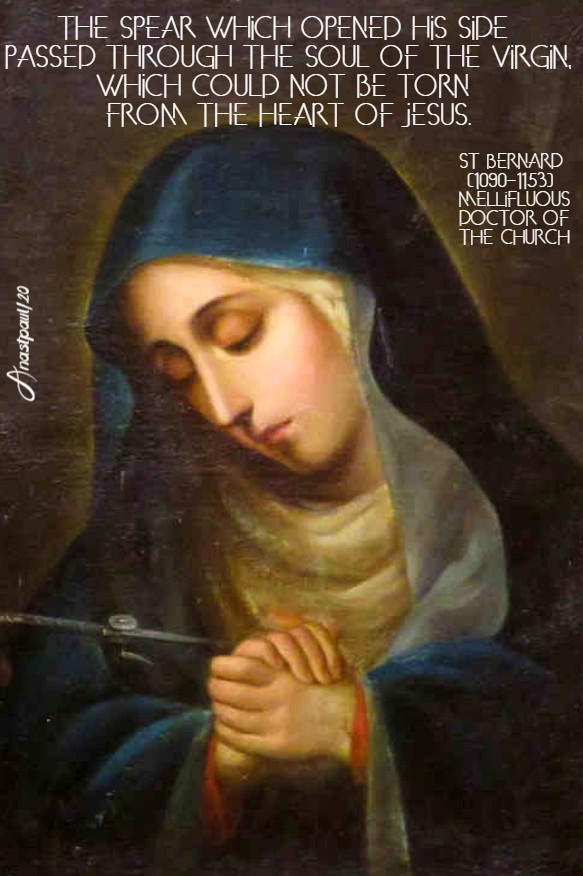
“The spear which opened His side
passed through the soul of the Virgin,
which could not be torn
from the heart of Jesus.”

St Bernard

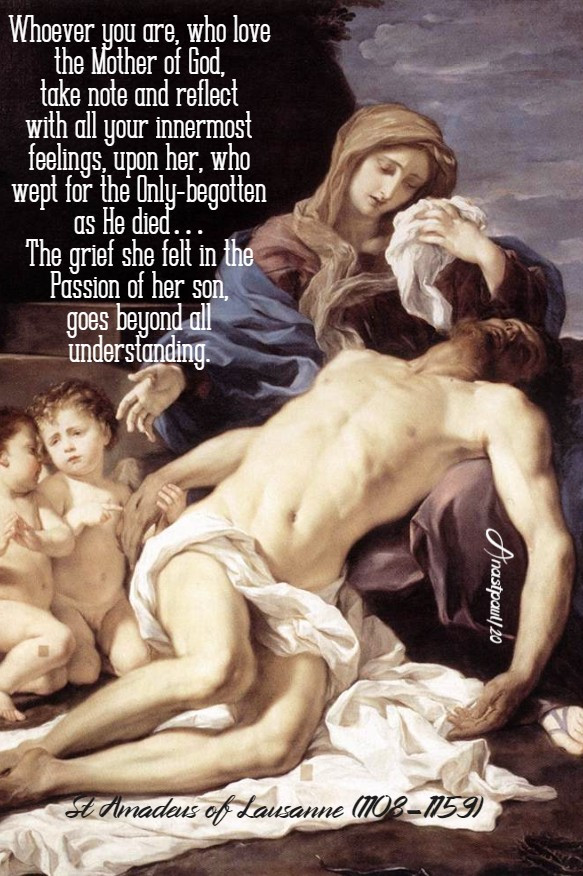
“Whoever you are, who love the Mother of God,
take note and reflect
with all your innermost feelings,
upon her, who wept for the Only-Begotten as He died…
The grief she felt in the Passion of her son,
goes beyond all understanding.”

St Amadeus of Lausanne

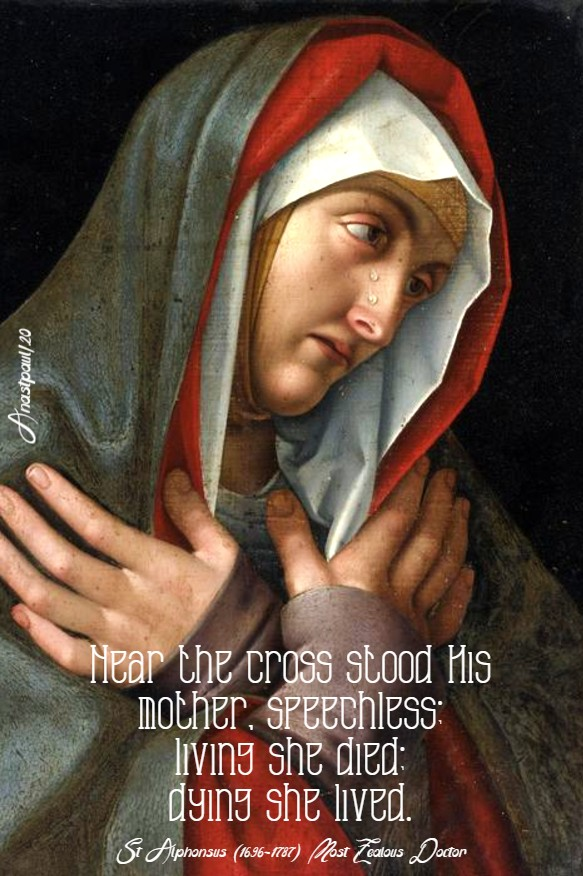
“Near the cross stood His mother, speechless;
living she died;
dying she lived.

St Alphonsus

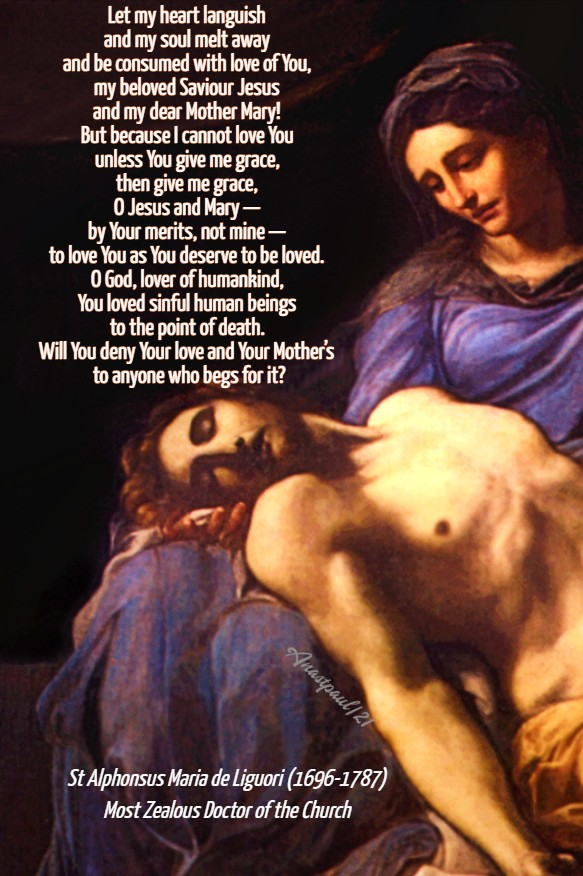
“Let my heart languish
and my soul melt away
and be consumed with love of You,
my beloved Saviour Jesus
and my dear Mother Mary!
But because I cannot love You
unless You give me grace,
then give me grace,
O Jesus and Mary —
by Your merits, not mine —
to love You as You deserve to be loved.
O God, lover of humankind,
You loved sinful human beings
to the point of death.
Will You deny Your love and Your Mother’s
to anyone who begs for it?”

St Alphonsus Maria de Liguori 

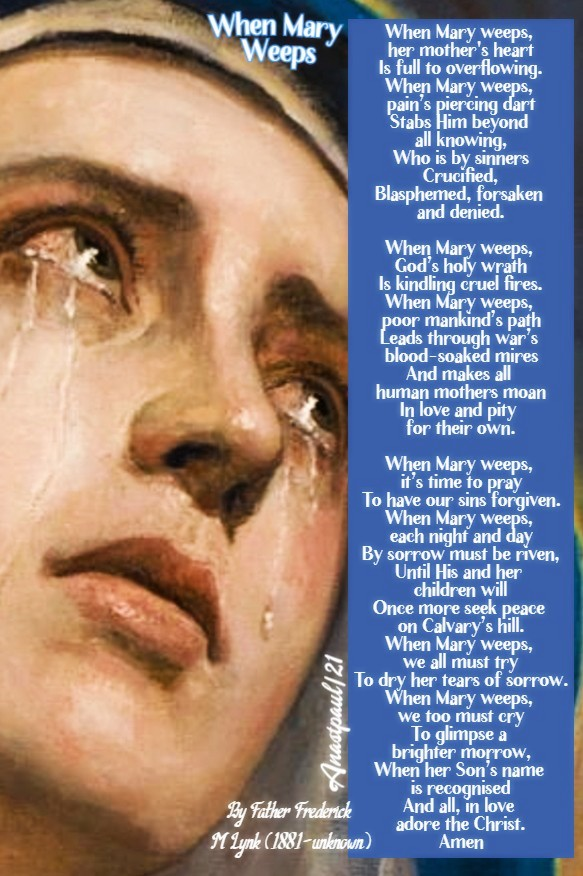
When Mary Weeps
By Father Frederick M Lynk (1881-unknown)

When Mary weeps, her mother’s heart
Is full to overflowing.
When Mary weeps, pain’s piercing dart
Stabs Him beyond all knowing,
Who is by sinners Crucified,
Blasphemed, forsaken and denied.

When Mary weeps, God’s holy wrath
Is kindling cruel fires.
When Mary weeps, poor mankind’s path
Leads through war’s blood-soaked mires
And makes all human mothers moan
In love and pity for their own.

When Mary weeps, it’s time to pray
To have our sins forgiven.
When Mary weeps, each night and day
By sorrow must be riven,
Until His and her children will

Once more seek peace on Calvary’s hill.
When Mary weeps, we all must try
To dry her tears of sorrow.
When Mary weeps, we too must cry
To glimpse a brighter morrow,
When her Son’s name is recognised
And all, in love adore the Christ.

Amen

Posted in SEPTEMBER-The SEVEN SORROWS of MARY and The HOLY CROSS

Thought for the Day – 14 September –On the Third Dolor

Reflections on each of the Seven Dolors of Mary by St Alphonsus Liguori

Of The Loss Of Jesus In the Temple

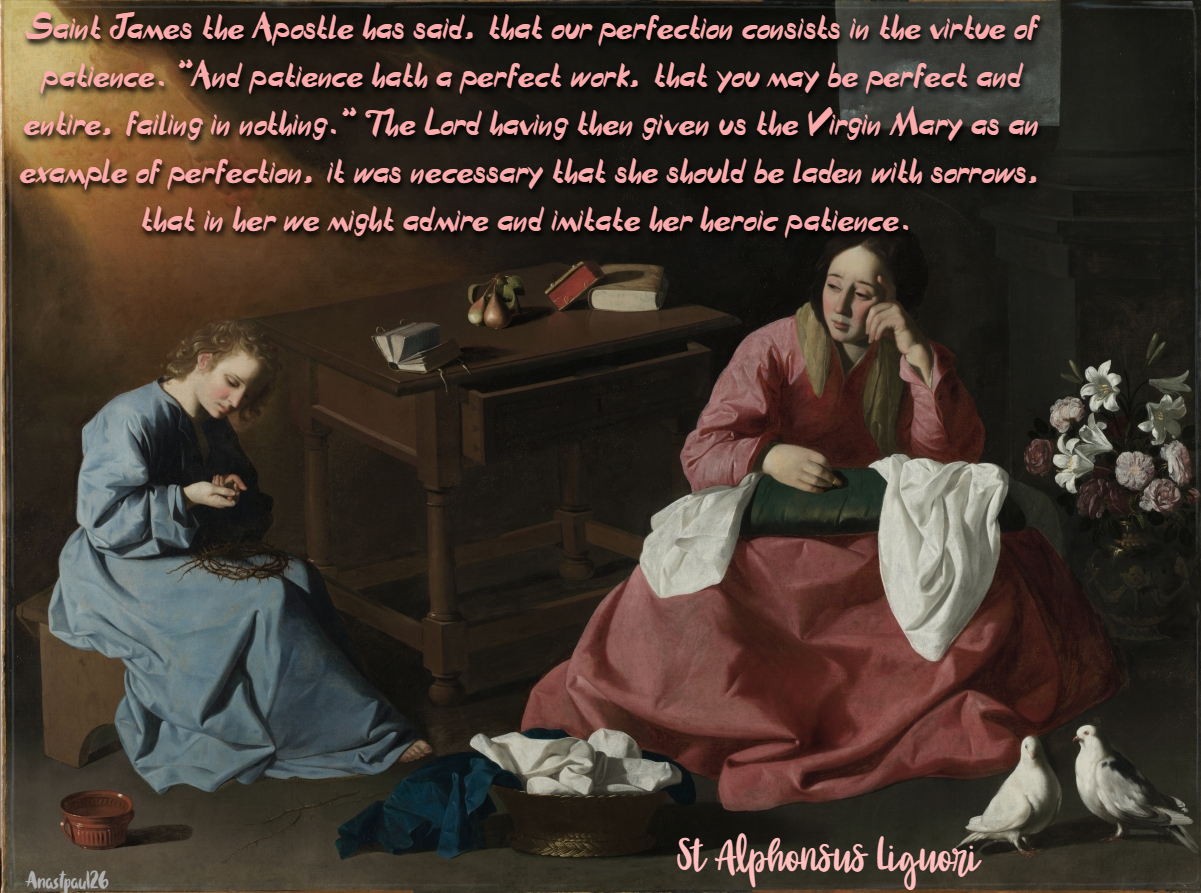
Saint James the Apostle has said, that our perfection consists in the virtue of patience. “And patience hath a perfect work, that you may be perfect and entire, failing in nothing.” The Lord having then given us the Virgin Mary as an example of perfection, it was necessary that she should be laden with sorrows, that in her we might admire and imitate her heroic patience. The dolor that we are this day to consider is one of the greatest which our divine mother Buffered during her life, namely, the loss of her Son in the temple. He who is born blind is little sensible of the pain of being deprived of the light of day; but to him who has once had sight and enjoyed the light, it is a great sorrow to find himself deprived of it by blindness. And thus it is with those unhappy souls who, being blinded by the mire of this earth, have but little knowledge of God, and therefore scarcely feel pain at not finding him. On the contrary, the man who, illuminated with celestial light, has been made worthy to find by love the sweet presence of the highest good, oh God, how he mourns when he finds himself deprived of it !

From this we can judge how painful must have been to Mary, who was accustomed to enjoy constantly the sweet presence of Jesus, that third sword which wounded her, when she lost him in Jerusalem, and was separated from him for three days.

Some writers assert, and not without reason, that this dolor was not only one of the greatest, but that it was the greatest and most painful of all. For in the first place, Mary in her other dolors had Jesus with her; she suffered when St. Simeon uttered the prophecy in the temple; she suffered in the flight to Egypt, but always with Jesus; but in this dolor she suffered at a distance from Jesus, without knowing where he was: “And the light of my eyes itself is not with me.” Thus, with tears, she then exclaimed: Ah, the light of my eyes, my dear Jesus, is no more with me; he is far from me, I know not where he is! Origen says, that though the love which this holy mother bore her Son, she suffered more at this loss of Jesus than any martyr ever suffered at death. Ah, how long: were these three days for Mary! they appeared three ages.

Secondly. Mary well understood the cause and end of the other dolors, namely, the redemption of the world, the divine will ; but in this she did not know the cause of the absence of her Son. The sorrowful mother was grieved to find Jesus withdrawn from her, for her humility, says Lanspergius, made her consider herself unworthy to remain with him any longer, and attend upon him on earth, and have the care of such a treasure. And perhaps, she may have thought within herself, I have not served him as I ought. Perhaps I have been guilty of some neglect, and therefore he has left me. They sought him, lest he perchance had left them, as Origen has said. Certainly there is no greater grief for a soul that loves God than the fear of having displeased him. And therefore Mary never complained in any other sorrow but this, lovingly expostulating with Jesus after she found him : “Son, why hast thou done so to us? Thy father and I have sought thee sorrowing.”! By these words she did not wish to reprove Jesus, as the heretics blasphemously assert, but only to make known to him the grief she had experienced during his absence from her, on account of the love she bore him.

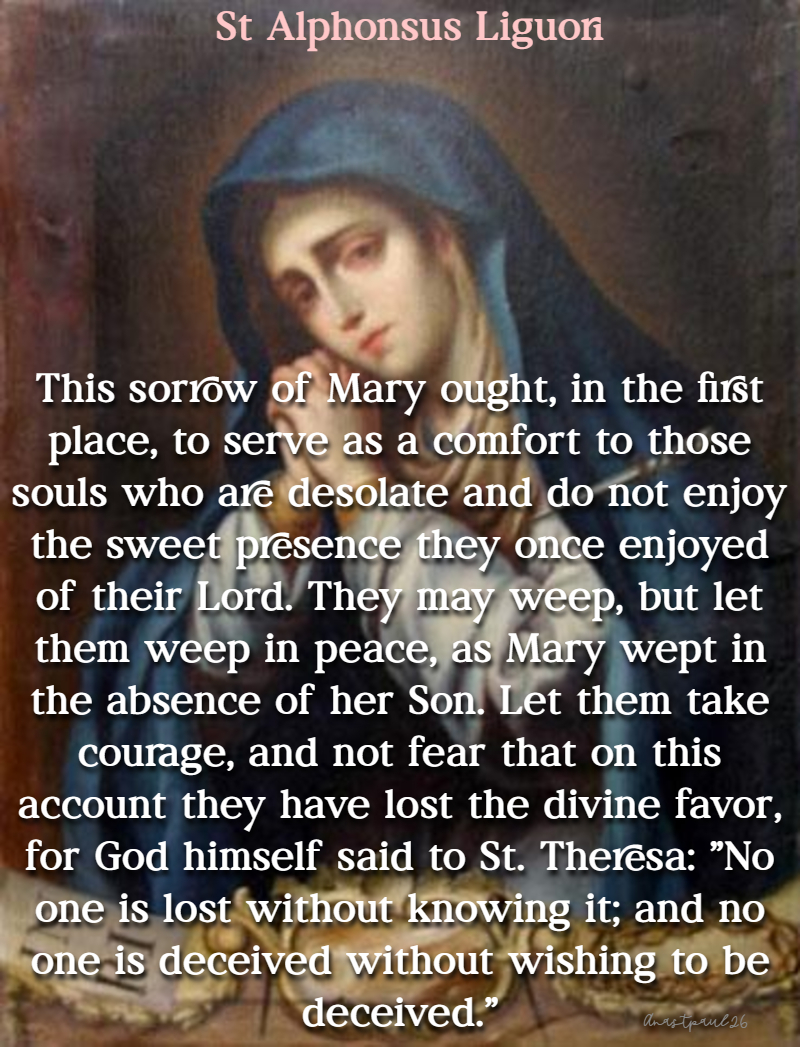
This sorrow of Mary ought, in the first place, to serve as a comfort to those souls who are desolate and do not enjoy the sweet presence they once enjoyed of their Lord. They may weep, but let them weep in peace, as Mary wept in the absence of her Son. Let them take courage, and not fear that on this account they have lost the divine favor, for God himself said to St. Theresa: “No one is lost without knowing it; and no one is deceived without wishing to be deceived.” If the Lord departs from the sight of that soul who loves him, he does not therefore depart from the heart. He often hides himself that she may seek him with greater desire and love. But those who would find Jesus must seek him, not amid the delights and pleasures of the world, but amid crosses and mortifications, as Mary sought him: We sought thee sorrowing, as she said to her Son: “Dolentes quasrebamus te.”

Moreover, in this world we should seek no other good than Jesus. Job was not unhappy when he lost all that he possessed on earth; riches, children, health, and honors, and even descended from a throne to a dunghill; but because he had God with him, even then he was happy. St. Augustine, speaking of him, says: He had lost all that God had given him, but he had God himself

Posted in Our MORNING Offering

Our Morning Offering – 11 September – Mother of Love, of Sorrow and of Mercy

Our Morning Offering – 4 September – “Month of the Seven Sorrows of the Blessed Virgin Mary

Mother of Love, of Sorrow and of Mercy
By St Bridget of Sweden (1303-1373)

O Blessed Virgin Mary,
Immaculate Mother of God,
who endured a martyrdom of love and grief,
beholding the sufferings and sorrows of Jesus!
Thou didst co-operate in the benefit of my redemption
by thy innumerable afflictions
and by offering to the Eternal Father,
His only-begotten Son, as a holocaust
and victim of propitiation for my sins.
I thank thee for the unspeakable love
which led thee to deprive thyself
of the Fruit of thy womb, Jesus,
true God and true Man, to save me, a sinner.
Oh! make use of the unfailing intercession
of thy sorrows with the Father and the Son,
that I may steadfastly amend my life
and never again crucify
my loving Redeemer by my sins
and that, persevering till death in His grace,
I may obtain eternal life
through the merits of His Cross and Passion.
Amen
Mother of love, of sorrow and of mercy, pray for us!

Posted in INDULGENCES, MATER DOLOROSA - Mother of SORROWS, PRAYERS on the CROSS of CHRIST, QUOTES on CHARITY, QUOTES on SUFFERING, QUOTES on the CROSS of CHRIST, SEPTEMBER-The SEVEN SORROWS of MARY and The HOLY CROSS, The HOLY CROSS, The PASSION, The SIGN of the CROSS

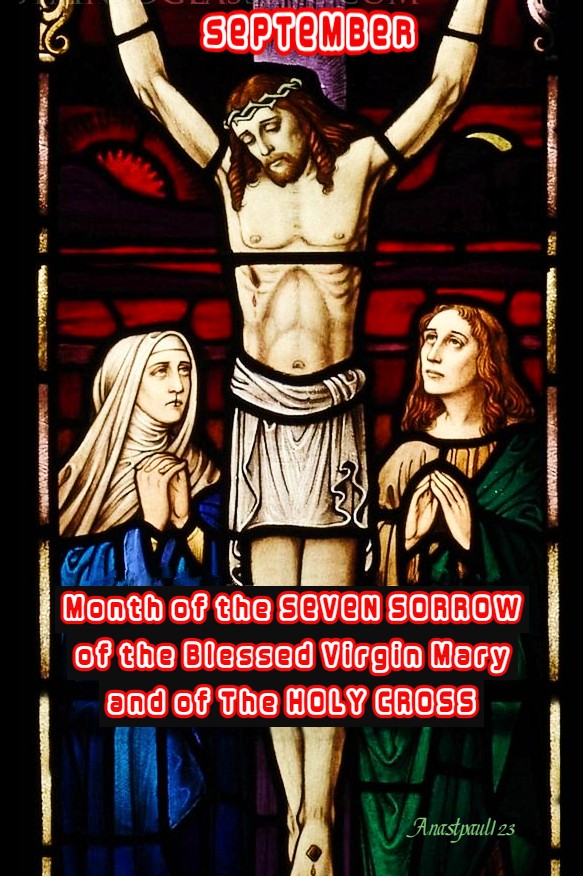
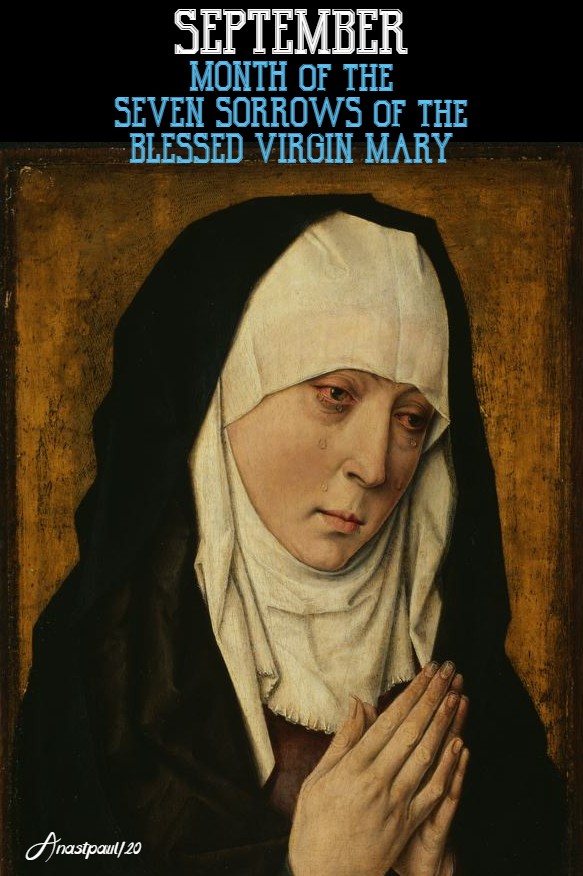
SEPTEMBER – Month of the Seven Sorrows of the Blessed Virgin Mary and The Holy Cross

SEPTEMBER

Month of The Seven Sorrows
of the Blessed Virgin Mary and
The Holy Cross

The Seven Sorrows of
the Blessed Virgin Mary

1, The prophecy of Simeon
2. The Flight to Egypt
3. Loss of Child Jesus for 3 days
4. Meeting Jesus carrying His Cross
5. The Crucifixion of Jesus
6. The Pieta – receiving Jesus’ Body
The Burial of Jesus

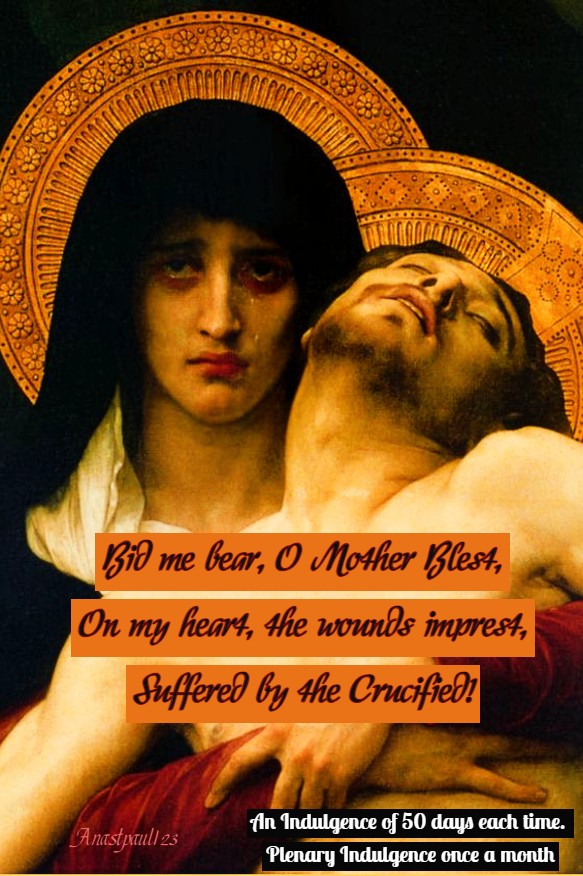
Bid me bear, O Mother Blest,
On my heart, the wounds imprest,
Suffered by the Crucified!

An Indulgence of 50 days each time.
Plenary Indulgence once a month under the usual conditions.

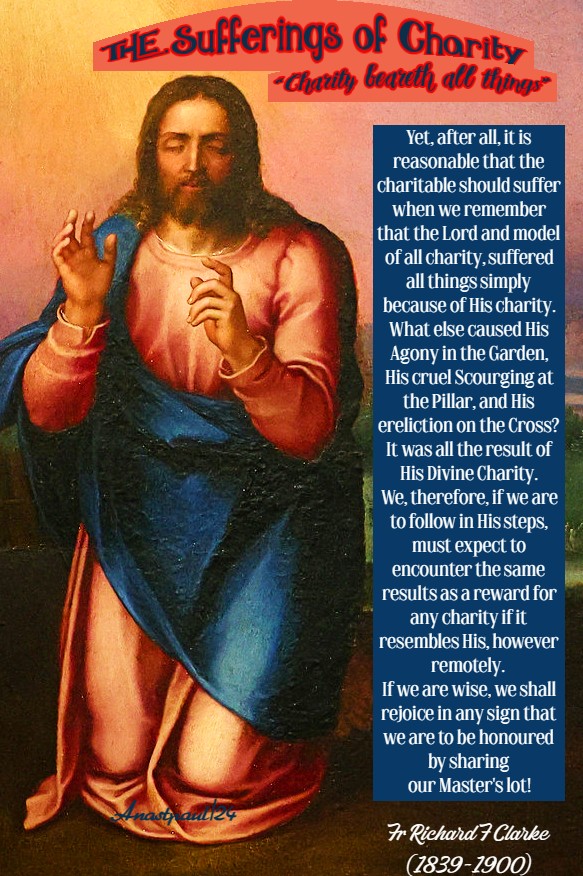
Yet, after all, it is reasonable that the charitable should suffer when we remember that the Lord and model of all charity, suffered all things simply because of His charity. What else caused His Agony in the Garden, His cruel Scourging at the Pillar, and His dereliction on the Cross? It was all the result of His Divine Charity.
We, therefore,, if we are to follow in His steps, must expect to encounter the same results as a reward for any charity if it resembles His, however remotely. If we are wise, we shall rejoice in any sign that we are to be honoured by sharing our Master’s lot!
Fr Richard Frederick Clarke SJ (1839-1900)

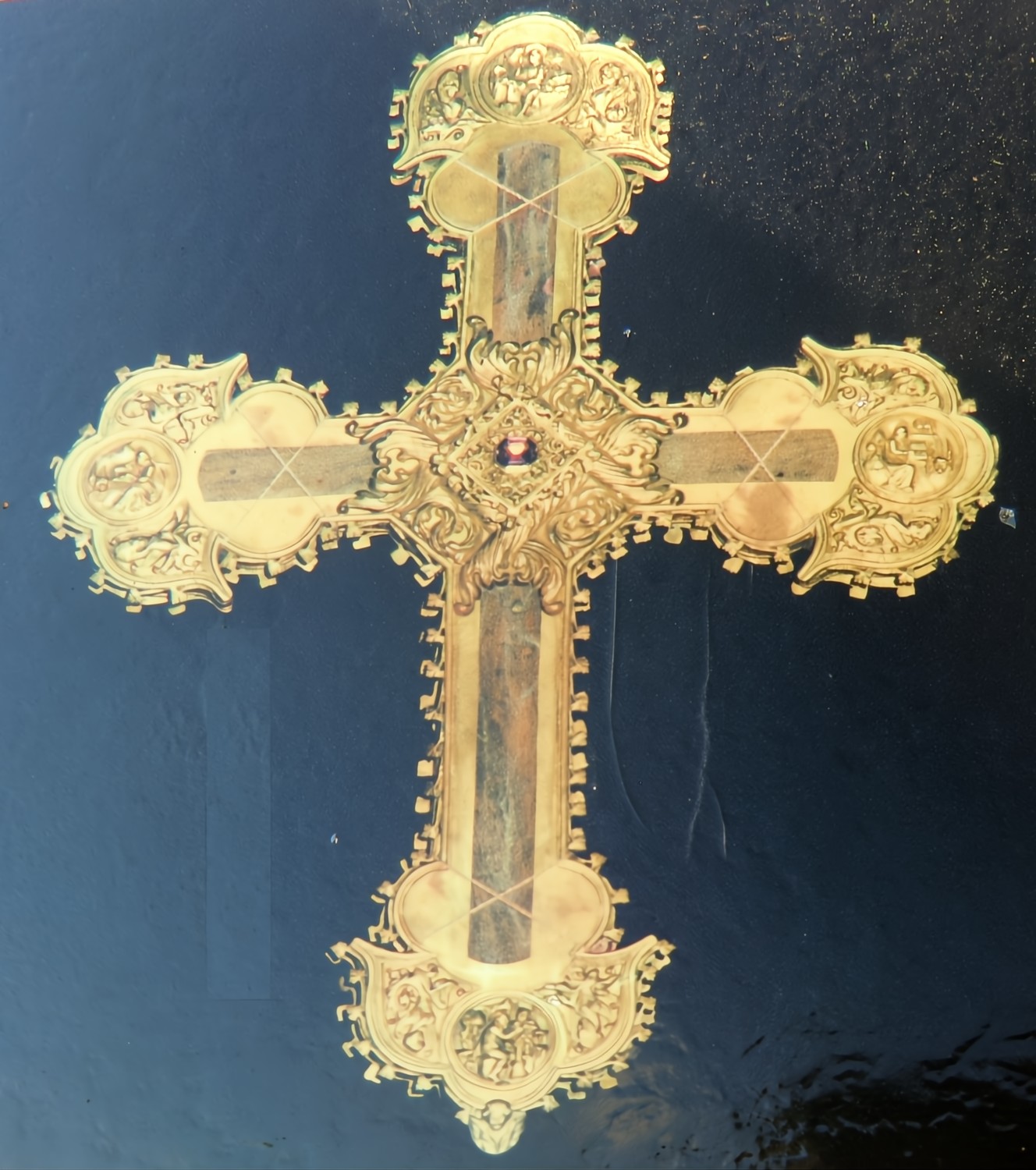
Relic of the Holy Cross
Posted in ART DEI, MARIAN DEVOTIONS, MARIAN REFLECTIONS, MARIAN TITLES, MATER DOLOROSA - Mother of SORROWS, QUOTES on the CROSS of CHRIST, SEPTEMBER-The SEVEN SORROWS of MARY and The HOLY CROSS, The HOLY CROSS

September Devotion – The Seven Sorrows of the Blessed Virgin Mary

September – Month of The Seven Sorrows of the Blessed Virgin Mary

The Seven Sorrows of
the Blessed Virgin Mary

1, The prophecy of Simeon
2. The Flight to Egypt
3. Loss of Child Jesus for 3 days
4. Meeting Jesus carrying His Cross
5. The Crucifixion of Jesus
6. The Pieta – receiving Jesus’ Body
The Burial of Jesus

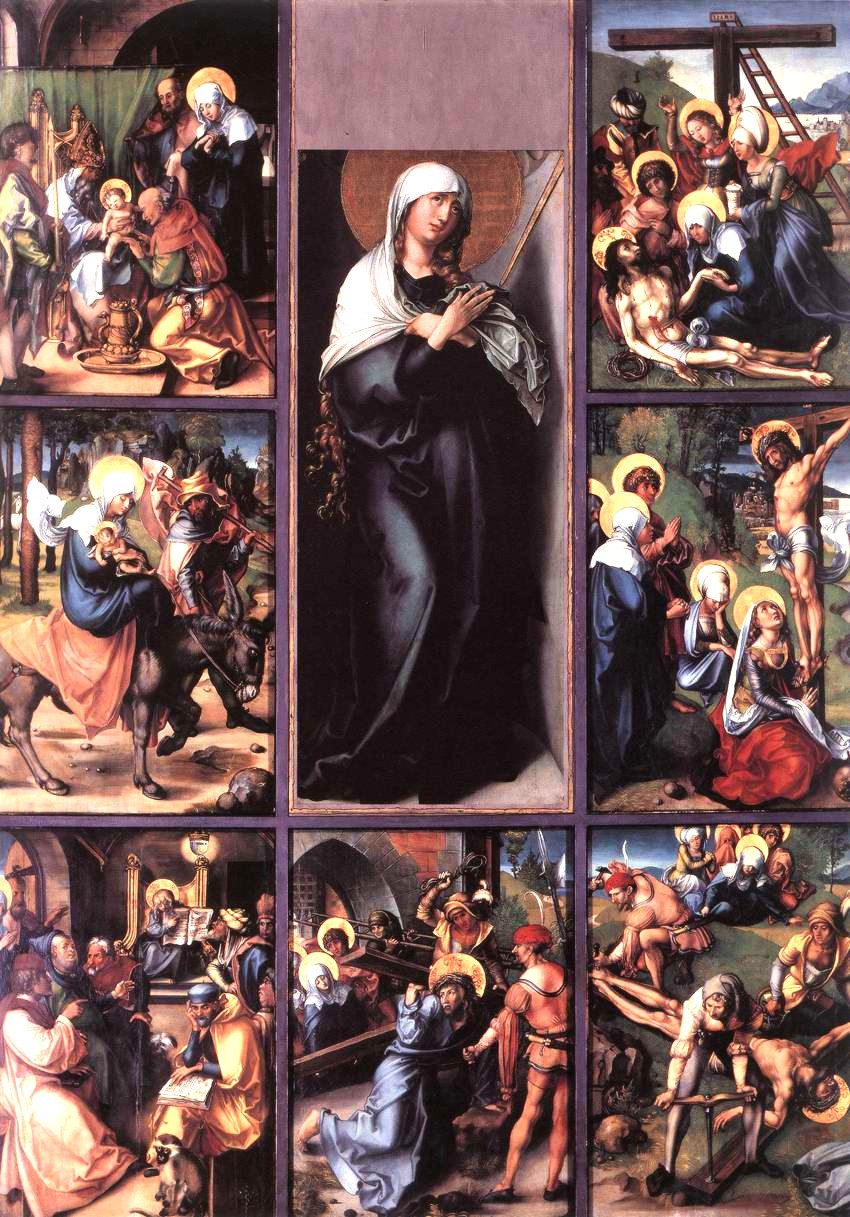
The Seven Sorrows of the Virgin – Altarpiece by Albrecht Dürer.

During this month of September, we are drawn into the spiritual Martyrdom which the Blessed Mother experienced during the physical Martyrdom of Jesus. The evils of sin are manifest but conquered through intense suffering. The Blessed Mother’s tears of anguish reflect God’s washing away of sin.

We see this theme of joy followed by affliction mirrored in the liturgical calendar in two September Feasts – the Exaltation of the Holy Cross on 14 September and the Feast of Our Lady of Sorrows on 15 September. Happy the heart of the blessed Virgin Mary! She, without dying, earned the treasure of Martyrdom beneath the Cross of our Lord for her anguish.

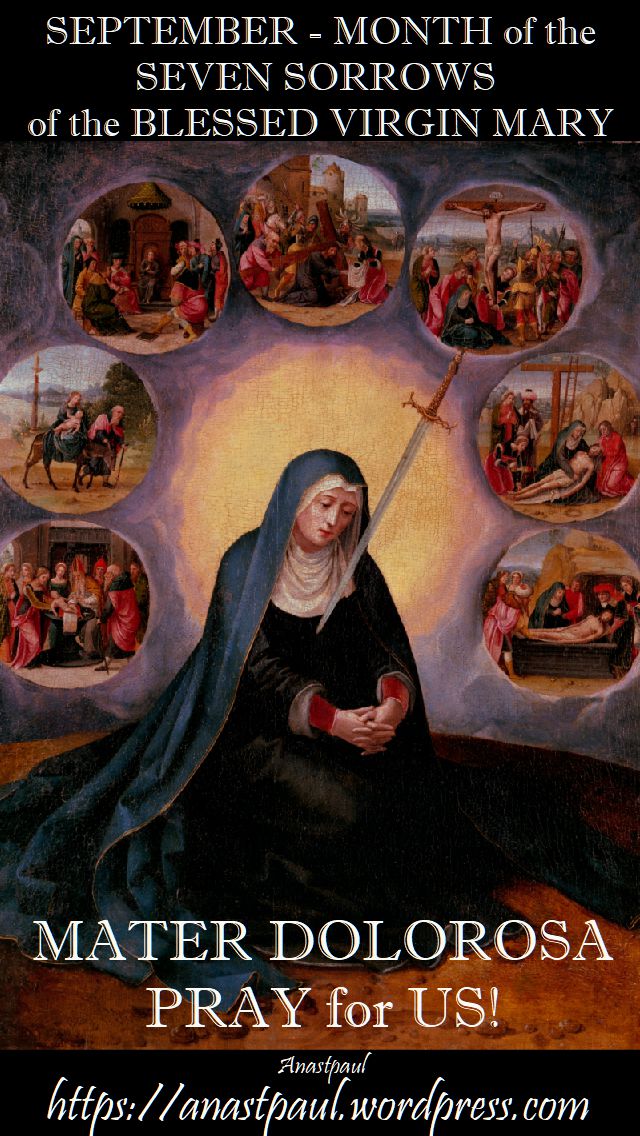
The name of Our Lady of Sorrows centres on the extraordinary and bittersweet suffering the Blessed Mother experienced during Christ’s Passion. As seen in the artwork above, her agony is composed of “The Seven Dolors,” that pierced the Heart of Mary. Dürer’s portrayal of each event encompasses the central figure of Christ’s sorrowful Mother.

Posted in MATER DOLOROSA - Mother of SORROWS, SEPTEMBER-The SEVEN SORROWS of MARY and The HOLY CROSS

September Devotion – The Seven Sorrows of the Blessed Virgin Mary

September – Month of The Seven Sorrows of the Blessed Virgin Mary

In 1668, a separate feast of the Seven Sorrows of Mary, celebrated on the third Sunday in September, was granted to the Servites.
Pope Pius VII introduced it into the General Roman Calendar in 1814.
In 1913, Pope Pius X, in view of his reform giving precedence to Sundays over ordinary feasts, moved this feast to 15 September the day after the Feast of the Cross.
It is still observed on this date.

The Seven Sorrows of
the Blessed Virgin Mary

  1. The prophecy of Simeon
  2. The Flight to Egypt
  3. Loss of Child Jesus for 3 days
  4. Meeting Jesus carrying His Cross
  5. The Crucifixion of Jesus
  6. The Pieta – receiving Jesus’ Body
  7. The Burial of Jesus

Our Lady of Sorrows is the Patron of:

people named Dolores, Dolorita, Lola and Pia.
Poland: the icon Our Lady of Sorrows, Queen and Patroness of Poland (see also: Patron saints of Poland § Primary) was canonically crowned by Pope Paul VI on 15 August 1967.
Malta: on Friday of Sorrows, almost all parishes in Malta hold devotional penitentiary processions with a life-size statue of Our Lady of Sorrows through the streets of the parish.
Slovakia: 15 September is also a national public holiday
the Congregation of Holy Cross
Order of the Servants of Mary
Mola di Bari and the Molise region of Italy
Nuestra Señora de la Soledad de Porta Vaga, Queen and Patroness of the City and Province of Cavite, Philippines
Mississippi, United States
Dolores, Abra, Philippines
Lanzarote, Canary Islands
Mater Dolorosa (Berlin-Lankwitz)
Pinabacdao, Samar, Philippines
Jia-an, Jiabong, Samar, Philippines
Ronda, Cebu, Philippines
Tanawan, Bustos, Bulacan, Philippines

Posted in CATHOLIC DEVOTIONS of the Month, MARIAN DEVOTIONS, MARIAN REFLECTIONS, MARIAN TITLES, MATER DOLOROSA - Mother of SORROWS

September Devotion – The Seven Sorrows of Mary

September Devotion

The Seven Sorrows of Mary

Christians of the twentieth century can truly identify with Our Lady’s experience of Sorrow.   The message of the Stabat Mater focuses on the spiritual and emotional bond which unites Mary and all Christians to the death of her Son on the Cross.   From this bond, each Christian can recognise the incredible compassion and holiness in Mary’s character.   The Blessed Mother demonstrated her maternal compassion to all generations of Christians by her presence and participation with her Son Jesus in the Sacrifice of the Cross.

There is a mother-son bond that unites Mary with Christ Jesus during His experience of suffering and death.   This empathetic bond indicates that Our Lady shared in her Son’s suffering.   Mary is Our Lady of Sorrows precisely because her Son, Christ Jesus, bore the sins of the world during His passion and death.   As the faithful disciple,   Our Blessed Mother invites us to unite our personal suffering with her own.   We can share in Jesus’ burden on the Cross, just as Mary did at Calvary.

As Our Lady of Sorrows, Mary also reminds us that Christians are called to expiate for his or her own sins and the sins of their neighbours, and the sins of the world. We can share in the bond between the Blessed Mother and Our Lord through fasting, prayer, and contrition for sin. Our Lady of Sorrows teaches us that the Crown of eternal life in Heaven can be reached when we each choose to share with Our Lord in His suffering and death on the Cross at Calvary.

The compassion of Mary is part of the mystery of the Church community’s sharing in, and offering, the Sacrifice of Jesus for the salvation of the world.   Each member of the Church has a role to play in redeeming the world.   Our Lady of Sorrows is a guide who inspires and teaches us how to be compassionate.

The Seven Sorrows of
the Blessed Virgin Mary

1. The prophecy of Simeon
2. The Flight to Egypt
3. Loss of Child Jesus for 3 days
4. Meeting Jesus carrying His Cross
5. The Crucifixion of Jesus
6. The Pieta – receiving Jesus’ Body
7. The Burial of Jesus

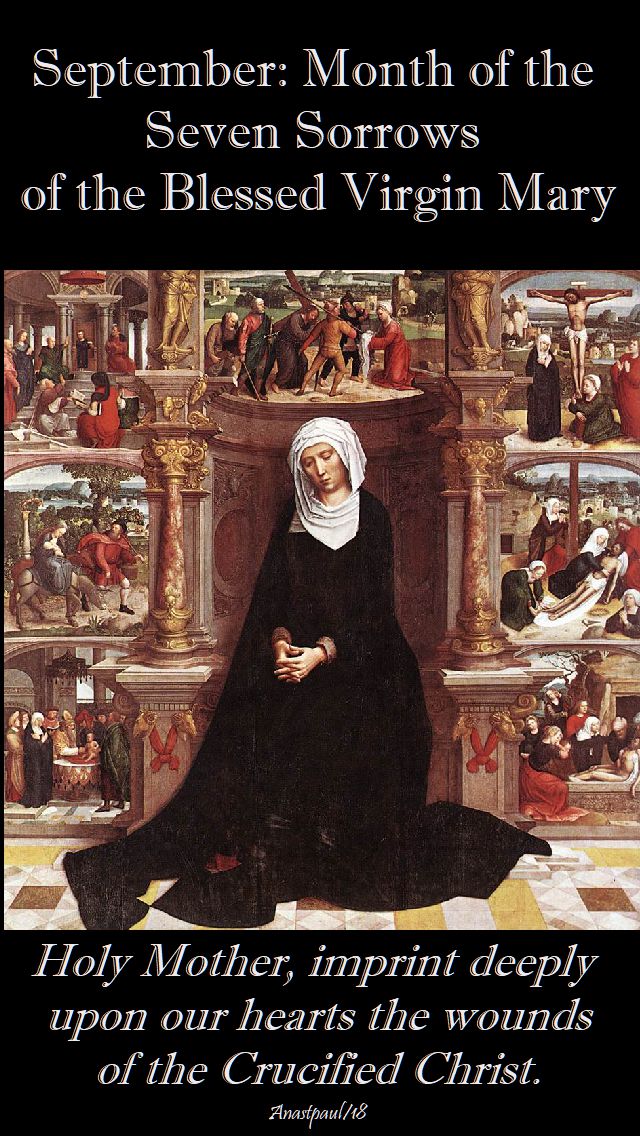
The name of Our Lady of Sorrows centres on the extraordinary and bittersweet suffering the Blessed Mother experienced during Christ’s Passion. As seen in the artwork below, her agony is composed of “The Seven Dolors,” that pierced the Heart of Mary.
During this month of September, we are drawn into the spiritual martyrdom that the Blessed Mother experienced during the physical martyrdom of Jesus. The evils of sin are manifest but conquered through intense suffering. The Blessed Mother’s tears of anguish reflect God’s washing away of sin. If you haven’t ever prayed the Seven Sorrows chaplet, you might want to consider exploring this devotion.

Holy Mother, imprint deeply upon our hearts

the wounds of the Crucified Christ.

sept-month-of-the-seven-sorrows-1-sept-2018.jpg

Posted in CATHOLIC DEVOTIONS of the Month, DOCTORS of the Church, MARIAN DEVOTIONS, MARIAN PRAYERS, MARIAN TITLES, MORNING Prayers, PRAYERS of the SAINTS, The BLESSED VIRGIN MARY

Devotion for September: The Seven Sorrows of the Blessed Virgin Mary

Devotion for September:
The Seven Sorrows of the Blessed Virgin Mary

The Seven Sorrows of
the Blessed Virgin Mary

1. The prophecy of Simeon
2. The Flight to Egypt
3. Loss of Child Jesus for 3 days
4. Meeting Jesus carrying His Cross
5. The Crucifixion of Jesus
6. The Pieta – receiving Jesus’ Body
7. The Burial of Jesus

Each month of the liturgical year is devoted to a particular Catholic tradition, usually centered on a Feast during that month. As August is the Month of the Immaculate Heart of Mary, September follows as the Month of Our Lady of Sorrows.
We see this theme of joy followed by affliction mirrored in the liturgical calendar in two September Feasts – the Exaltation of the Holy Cross on September 14 and the Feast of Our Lady of Sorrows on 15 September. Happy the heart of the blessed Virgin Mary! She, without dying, earned the treasure of martyrdom beneath the Cross of our Lord for her anguish.
The name of Our Lady of Sorrows centres on the extraordinary and bittersweet suffering the Blessed Mother experienced during Christ’s Passion. As seen in the artwork below, her agony is composed of “The Seven Dolors,” that pierced the Heart of Mary.
During this month of September, we are drawn into the spiritual martyrdom that the Blessed Mother experienced during the physical martyrdom of Jesus. The evils of sin are manifest but conquered through intense suffering. The Blessed Mother’s tears of anguish reflect God’s washing away of sin. If you haven’t ever prayed the Seven Sorrows chaplet, you might want to consider exploring this devotion.

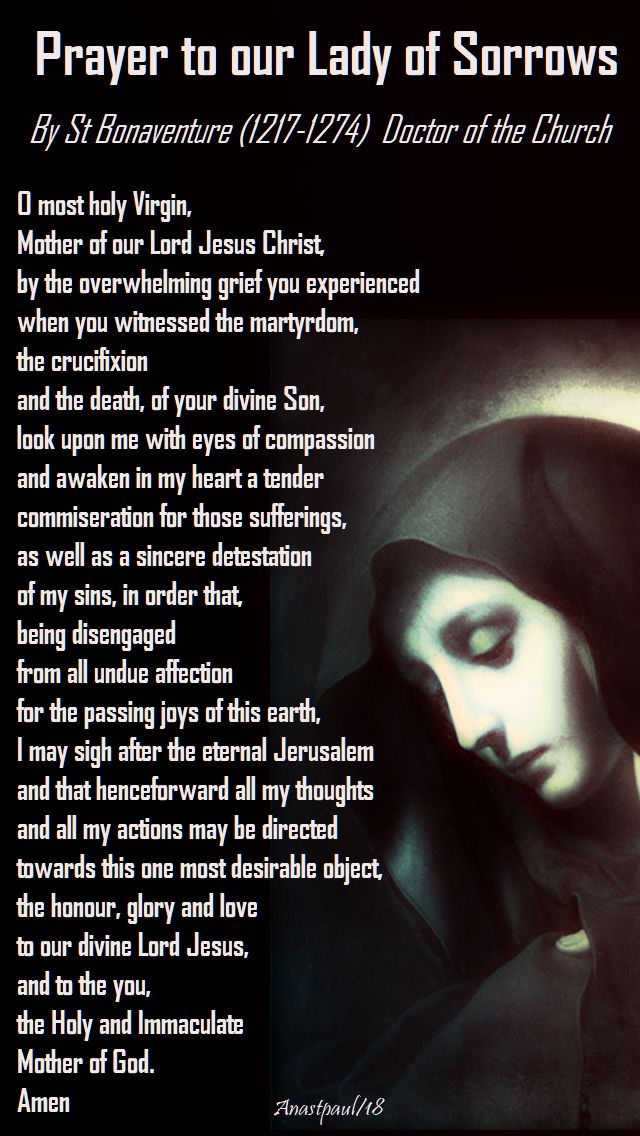
Prayer to our Lady of Sorrows
By St Bonaventure (1217-1274) Doctor of the Church

O most holy Virgin,
Mother of our Lord Jesus Christ,
by the overwhelming grief you experienced
when you witnessed the martyrdom,
the crucifixion
and the death, of your divine Son,
look upon me with eyes of compassion
and awaken in my heart a tender
commiseration for those sufferings,
as well as a sincere detestation
of my sins, in order that,
being disengaged from all undue affection
for the passing joys of this earth,
I may sigh after the eternal Jerusalem
and that henceforward all my thoughts
and all my actions may be directed
towards this one most desirable object,
the honour, glory and love
to our divine Lord Jesus,
and to the you,
the Holy and Immaculate
Mother of God.
Amenprayer to our lady of sorrows - st bonaventure - 1 sept 2018

Holy Mother, imprint deeply upon our hearts

the wounds of the Crucified Christ.sept month of the seven sorrows - 1 sept 2018

Posted in CATHOLIC DEVOTIONS of the Month, MORNING Prayers, The BLESSED VIRGIN MARY

September: Month of the Seven Sorrows of the Blessed Virgin Mary

September: Month of the Seven Sorrows of the Blessed Virgin Mary

The Seven Sorrows of
the Blessed Virgin Mary
1. The prophecy of Simeon
2. The Flight to Egypt
3. Loss of Child Jesus for 3 days
4. Meeting Jesus carrying His Cross
5. The Crucifixion of Jesus
6. The Pieta – receiving Jesus’ Body
7. The Burial of Jesus

The month of September is dedicated to the Seven Sorrows of Mary.
Devotion to the sorrows of the Virgin Mary dates from the twelfth century, when it made its appearance in monastic circles under the influence of St Anselm and St Bernard.
The Cistercians and then the Servites undertook to propagate it.
The Devotion became widespread in the fourteenth and especially the fifteenth centuries, particularly in the Rhineland and Flanders, where Confraternities of the Sorrowful Mother sprang up. It was in this context that the first liturgical formularies in her honour were composed. A provincial council of Mainz in 1423 made use of these in establishing a “Feast of the Sorrows of Mary” in reparation for Hussite profanations of her images.

In 1494 the feast appeared in Bruges, where the Precious Blood of Christ was venerated; later on it made its way into France. It did not, however, become widespread in France before Benedict XIII included it in the Roman Calendar in 1727.

God vouchsafed to select the very things about Him which are most incommunicable and in a most mysteriously real way communicate them to her.   See how He had already mixed her up with the eternal designs of creation, making her almost a partial cause and partial model of it.   Our Lady’s co-operation in the redemption of the world gives us a fresh view of her magnificence.   Neither the Immaculate Conception nor the Assumption will give us a higher idea of Mary’s exaltation than the title of co-redemptress.   Her sorrows were not necessary for the redemption of the world but in the counsels of God they were inseparable from it.   They belong to the integrity of the divine plan.   Are not Mary’s mysteries Jesus’ mysteries and His mysteries hers?   The truth appears to be that all the mysteries of Jesus and Mary were in God’s design as one mystery.   Jesus Himself was Mary’s sorrow, seven times repeated, aggravated sevenfold.   During the hours of the Passion, the offering of Jesus and the offering of Mary were tied in one.   They kept pace together;  they were made of the same materials;  they were perfumed with kindred fragrance;  they were lighted with the same fire;  they were offered with kindred dispositions.   The two things were one simultaneous oblation, interwoven each moment through the thickly crowded mysteries of that dread time, unto the eternal Father, out of two sinless hearts, that were the hearts of Son and Mother, for the sins of a guilty world which fell on them contrary to their merits but according to their own free will.

— Fr. Frederick Faber, The Foot of the Cross.

Mater Dolorosa, please pray for us!mater dolorosa pray for us