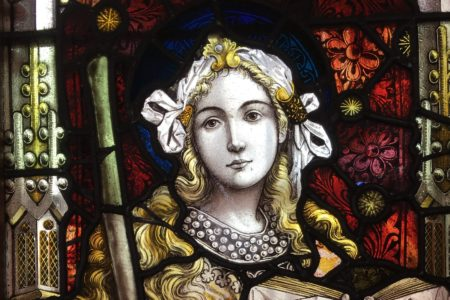
Saint Sidwell, also known as Sidwella, was a virgin saint from Devon, in England. She is the patroness of Exeter and sister of Saint Urith and Saint Juthwara. A Saxon living in Exeter in the 8th century, her father was a wealthy landowner named Benna, who died leaving his daughter in the care of a cruel stepmother, who was jealous of her beauty and virtue and coveted her inheritance.
The girl often left the city to bring food to the villagers working the fields outside the city walls. The Catalogus Sanctorum Pausantium in Anglia says she was beheaded by a couple of corn reapers, hired to do so by her stepmother. They cut off her head with a scythe, and where her head came to rest, water sprang up. A shaft of light shone over the site for three nights. She was buried at St Sidwells. Her ghost was seen carrying her severed head and putting it back on her shoulders at the spot where she was later buried. The spring became the Well of St Sidwell, and was a place of pilgrimage in Anglo-Saxon and Norman England.
The Church of St Sidwell, located just outside the site of Exeter’s east gate, still exists, and one of the main streets in Exeter is Sidwell Street.
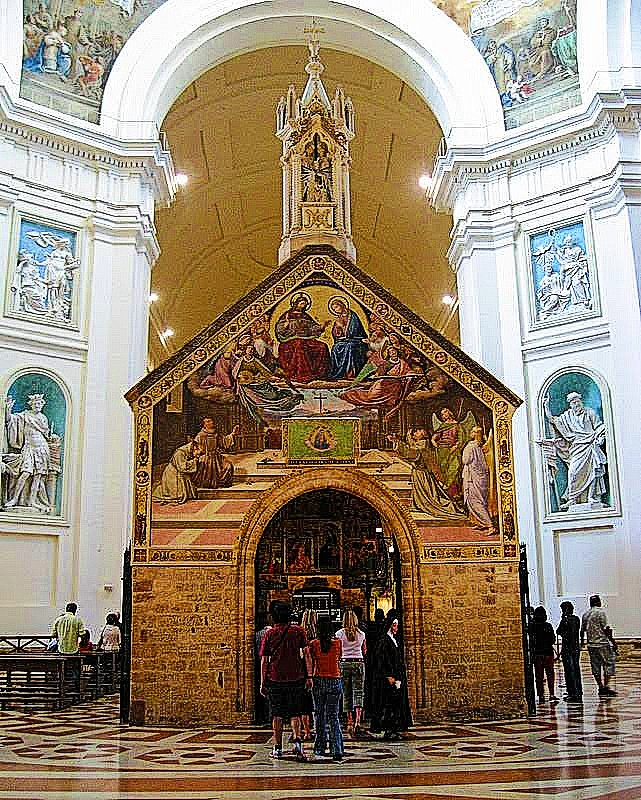
Santa Maria degli Angelis / Our Lady of Angels, Assisi, Italy (13th Century) Feast Day and Portiuncula Indulgence: 2 August
Our Lady of Angels, or of the Portiuncula, is located on the outskirts of the City of Assisi, in Italy. It was a desolate locality and apparently an unsettled one where robbers and the lawlessness flourished, for the Benedictines who had lived at the Monastery felt it was too hazardous to remain there. They abandoned the Monastery, relocating to Mount Subasio, which was a fortified Monastery.
The original chapel is thought to date from the 4th Century and was built by holy hermits who had come from the Valley of Josaphat. It is said that they brought relics of the Blessed Virgin with them to the region when they constructed the chapel.
The history of the feast is inspiring. St Francis of Assisi, in the early days of his conversion, while he was still uncertain as to what path to pursue, was praying earnestly for enlightenment before the Crucifix at the Church of San Damiano, when he heard within himself the command of the Crucified: “Build up my house, for it is nearly falling down.” Taking the words literally, Francis began to restore San Damiano and other dilapidated Churches in and near Assisi. The most famous of these was the Church of Our Lady of the Angels.
Some time after the restoration of this little chapel, an angel told St Francis to come to the church of Our Lady of Angels, or Portiuncula. There he found Our Lord, His Blessed Mother and the Angels waiting for him. Our Lord commended Francis because of his zeal for the salvation of souls and promised to grant him whatever he should ask on behalf of sinners. St Francis asked for this great favour – that all those who came to this church to pray and, truly sorry for their sins, confessed them, should “Obtain in perpetuity a Plenary Indulgence” so that they would have nothing to account for when God called them. This was the great favour he asked, but Our Lord granted it to him through Mary.
When Saint Francis came upon the little, run down and abandoned chapel of Our Lady of Angels, or Santa Maria degli Angelis, in the year 1208, it was almost completely hidden in shrubs and bush. Saint Francis entered the hidden church, which measured only (7 x 4 metres) twenty-two feet by thirteen feet and saw the ancient fresco that had been placed above the main Altar. It was an image of the Assumption of the Blessed Virgin surrounded by Angels. Some say that this is why the chapel was named Our Lady of Angels, although there are also legends that Angels could often be heard singing there.
The place took its name, the Little Portion, or Portiuncula in the native Italian, from the small section of fertile land that was gifted to the Monks to work for their support. It is said that this was the place where Saint Francis first understood his vocation, received visions and was also where the saint desired to live. The Benedictines had lived at that location for hundreds of years but the Benedictine Monks gave this Chapel to Saint Francis upon his request. It was certainly here that the Franciscan Order was founded.
At first Saint Francis wished the convent which he built there to be the principal one of his Order. He assembled the first General Chapter there, where there were five thousand religious. It was also where he yielded up his spirit on 3 October 1226, the twentieth of his conversion and the forty-fourth of his age. The cell in which the poor man of Assisi died can still be seen where it rests against one of the columns of the cupola under the choir bay.
The Roman Martyrology states of St Alphonsus today: “At Nocera-de-Pagani, Saint Alphonsus Maria de Liguori, Bishop of St Agatha of the Goths and Founder of the Congregation of the Most Holy Redeemer (the Redemptorists), distinguished by his zeal for the salvation of souls, by his writings, his preaching and his example.
He was inscribed on the Calendar of the Saints by Pope Gregory XVI in the year 1839, the 52nd after his happy death and , in 1871, was declared Doctor of the Universal Church by Pius IX, according to a decree of the Sacred Congregation of Rites.“
St Eusebius of Vercelli (c 283-371) Bishop (Optional Memorial) Bishop, Confessor, Founder of monasticism in his region of Italy.
St Peter Julian Eymard SSS (1811-1868) – “Apostle of the Eucharist”Priest, Founder of two religious institutes, Congregation of the Blessed Sacrament Fathers and Brothers and the Servants of the Blessed Sacrament.
St Auspicius of Apt St Betharius of Chartres St Centolla of Burgos St Etheldritha of Croyland Bl Frederic Campisani Bl Giustino Maria Russolillo Bl Gundekar of Eichstätt Bl Joanna of Aza Bl John of Rieti St Maximus of Padua St Pedro de Osma
St Peter Faber SJ (1506-1546) the “Second Jesuit” – as co-Founder with St Ignatius. He was the first Priest and theologian of the Order.
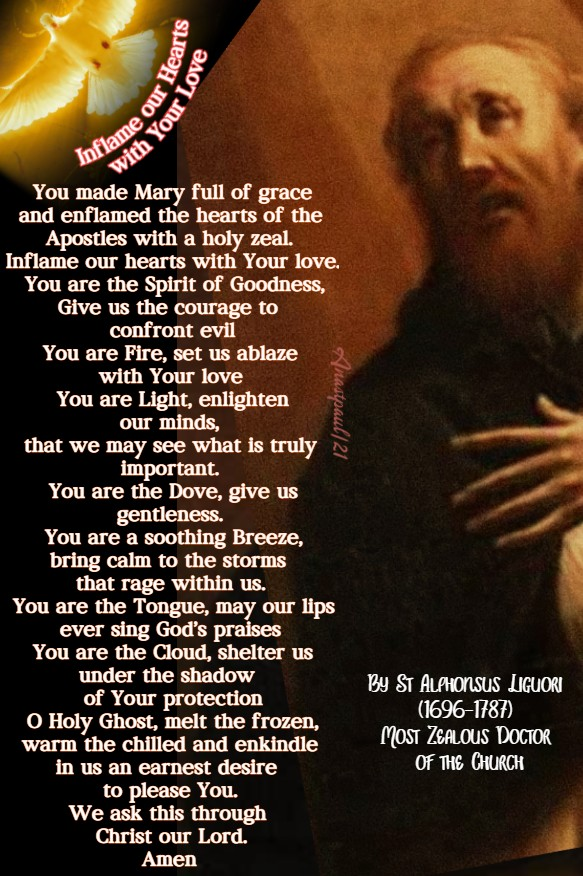
Our Morning Offering – 2 August – The Memorial of St Alphonsus Maria de Liguori (1696-1787) Most Zealous Doctor of the Church and a Catholic Monday of the Holy Ghost
Inflame our Hearts with Your Love Prayer To the Holy Ghost By St Alphonsus Maria de Liguori (1696-1787) Most Zealous Doctor of the Church
You made Mary full of grace and enflamed the hearts of the Apostles with a holy zeal. Inflame our hearts with Your love. You are the Spirit of Goodness, Give us the courage to confront evil You are Fire, set us ablaze with Your love You are Light, enlighten our minds, that we may see what is truly important. You are the Dove, give us gentleness. You are a soothing Breeze, bring calm to the storms that rage within us. You are the Tongue, may our lips ever sing God’s praises You are the Cloud, shelter us under the shadow of Your protection O Holy Ghost, melt the frozen, warm the chilled and enkindle in us an earnest desire to please You. We ask this through Christ our Lord. Amen
One Minute Reflection – 2 August – “Month of the Immaculate Heart of Mary” – Readings: Ps 54:17-20; 54:23, Ps 54:2-3, 1 Cor. 12:2-11, Luke 18:9-14
I tell you, this man went back to his home justified rather than the other; for everyone who exalts himself shall be humbled, and he who humbles himself shall be exalted.
Luke 18:9-14
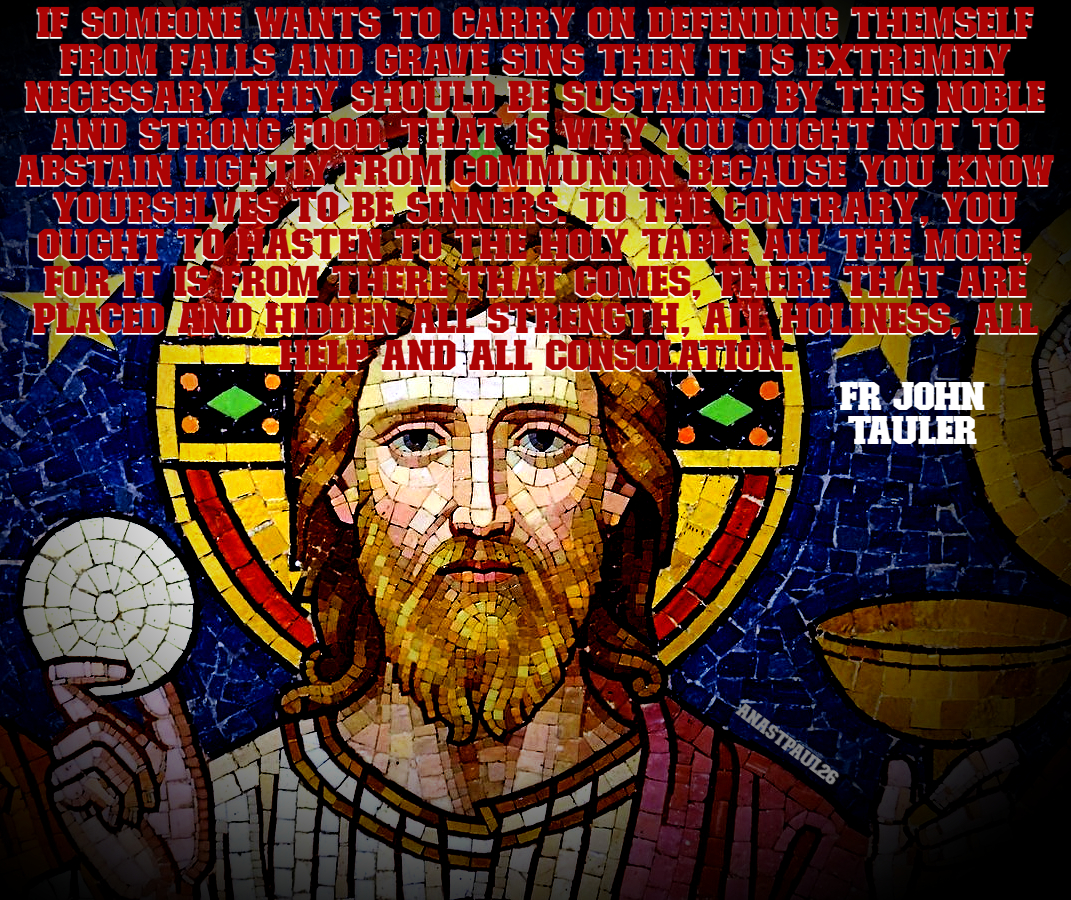
REFLECTION – Dear Sisters, be assured of this, truly, if I were to find someone who really possessed the publican’s feelings, who genuinely took themself for a sinner, so long as that person had a desire to be good while in this feeling of humility. I would give the body of our Lord to them every other day with a good conscience! If someone wants to carry on defending themself from falls and grave sins then it is extremely necessary they should be sustained by this noble and strong food. That is why you ought not to abstain lightly from communion because you know yourselves to be sinners. To the contrary, you ought to hasten to the holy table all the more, for it is from there that comes, there that are placed and hidden all strength, all holiness, all help and all consolation.
But you are not to judge those who don’t do this either… You should bear no judgment so as not to become like the Pharisee who glorified himself and condemned the man standing behind him. Watch yourselves against that as from the loss of your souls; watch yourselves against the dangerous sin of condemnation.
When someone reaches the heights of all perfection nothing has ever been more necessary to them than to plunge into the lowest depths and penetrate to to the roots of humility. This was why the publican, having acknowledged the ultimate depths of his lowliness to the point of not daring any more to raise his eyes to heaven, was raised up on high since “he went back to his house justified”.
Father John Tauler (1300-1361)
PRAYER – Forgive the sins of Your people Lord and since of ourselves, we are unable to do what pleases You, lead us on the way of salvation in Your divine Son who lives in us and gives us life. May the prayers of the Immaculate Heart of Mary, and most zealous Saint Alphonsus Liguori, help us to constantly meditate on Your eternal sustenance. Through, our Lord Jesus Christ, who lives and reigns with You and the Holy Spirit, God forever and ever, amen.
Quote/s of the Day – 2 August – The Memorial of St Alphonsus Maria de Liguori (1696-1787) Most Zealous Doctor of the Church
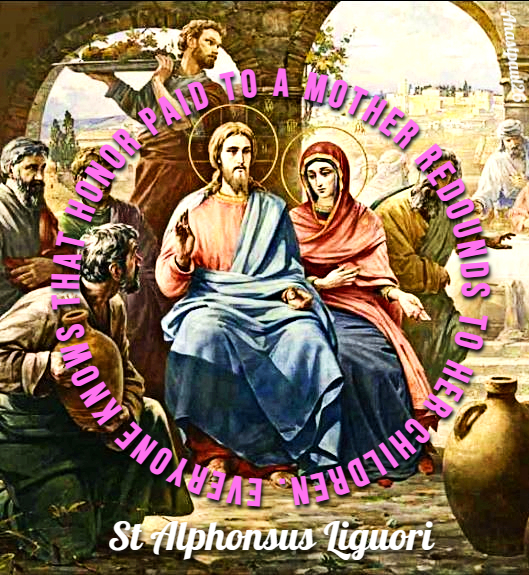
Everyone knows that honor paid to a mother redounds to her children. Hence St. Bernard says, let not any one think that by greatly praising the mother he will throw into the shade the glories of the Son; for the more he honors the mother, so much more he honors the Son. And there is no doubt that on account of the merits of Jesus, the great privilege has been granted to Mary to be the mediatrix of our salvation; not, indeed, mediatrix of justice, but of grace and intercession.
How great then should be our confidence in this queen, knowing how powerful she is with God, and at the same time how rich and full of mercy; so much so that there is no one on earth who does not share in the mercies and favors of Mary!
Let us always have recourse to this most sweet queen, if we would be sure of our salvation; and if the sight of our sins terrifies and disheartens us, Let us remember that Mary was made queen of mercy for this very end, that she might save by her protection the greatest and most abandoned sinners who have recourse to her.
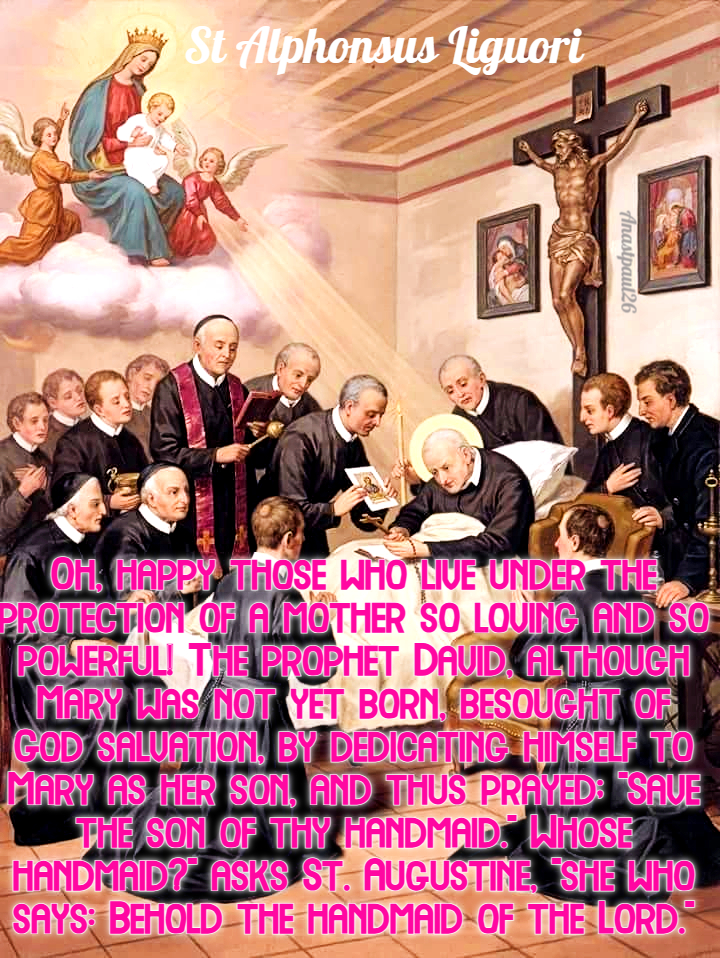
Oh, happy those who live under the protection of a mother so loving and so powerful! The prophet David, although Mary was not yet born, besought of God salvation, by dedicating himself to Mary as her son, and thus prayed; “Save the son of thy handmaid.” Whose handmaid?” asks St. Augustine, “she who says: Behold the handmaid of the Lord.”
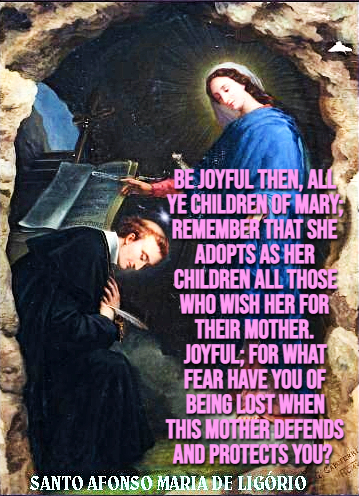
Be joyful then, all ye children of Mary; remember that she adopts as her children all those who wish her for their mother. Joyful; for what fear have you of being lost when this mother defends and protects you?
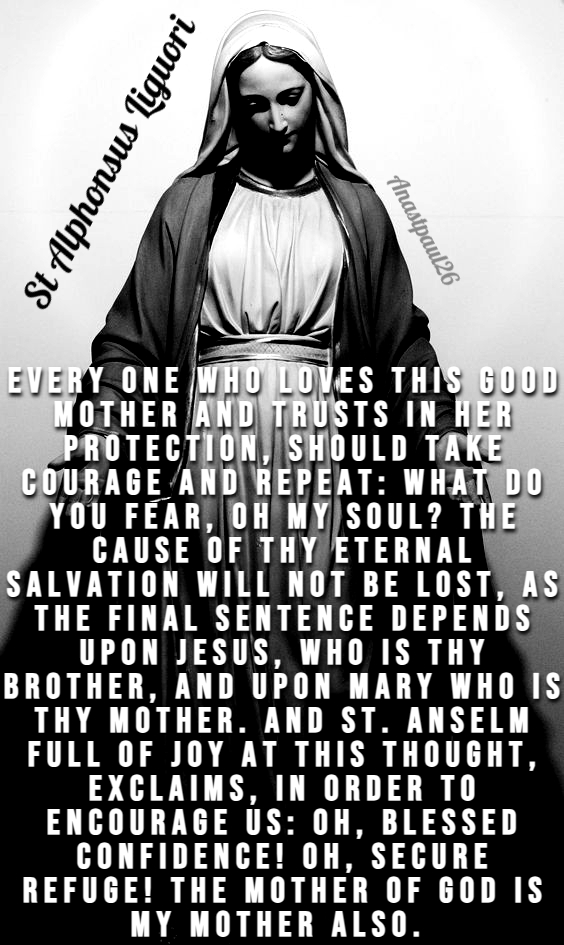
Every one who loves this good mother and trusts in her protection, should take cour age and repeat: What do you fear, oh my soul? The cause of thy eternal salvation will not be lost, as the final sentence depends upon Jesus, who is thy brother, and upon Mary who is thy mother. And St. Anselm full of joy at this thought, exclaims, in order to encourage us: Oh, blessed confidence! Oh, secure refuge! The mother of God is my mother also.
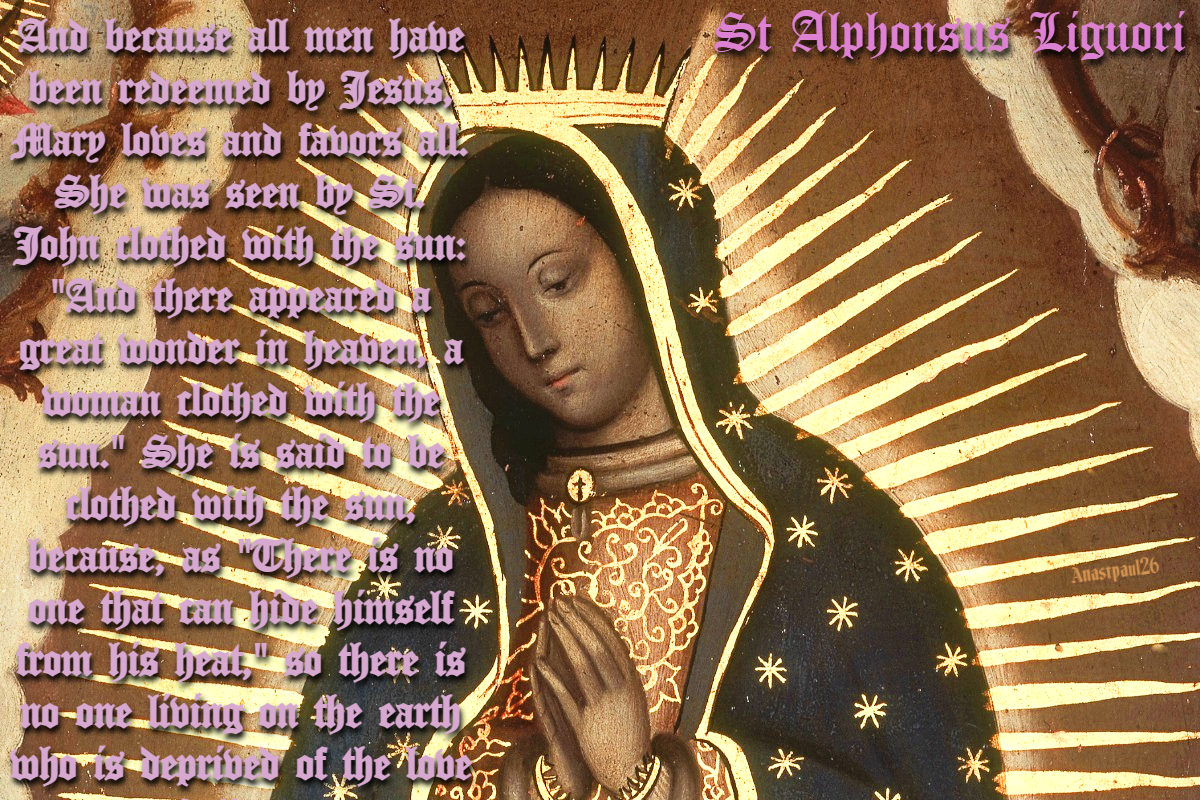
And because all men have been redeemed by Jesus, Mary loves and favors all. She was seen by St. John clothed with the sun: “And there appeared a great wonder in heaven, a woman clothed with the sun.” She is said to be clothed with the sun, because, as “There is no one that can hide himself from his heat,” so there is no one living on the earth who is deprived of the love of Mary.
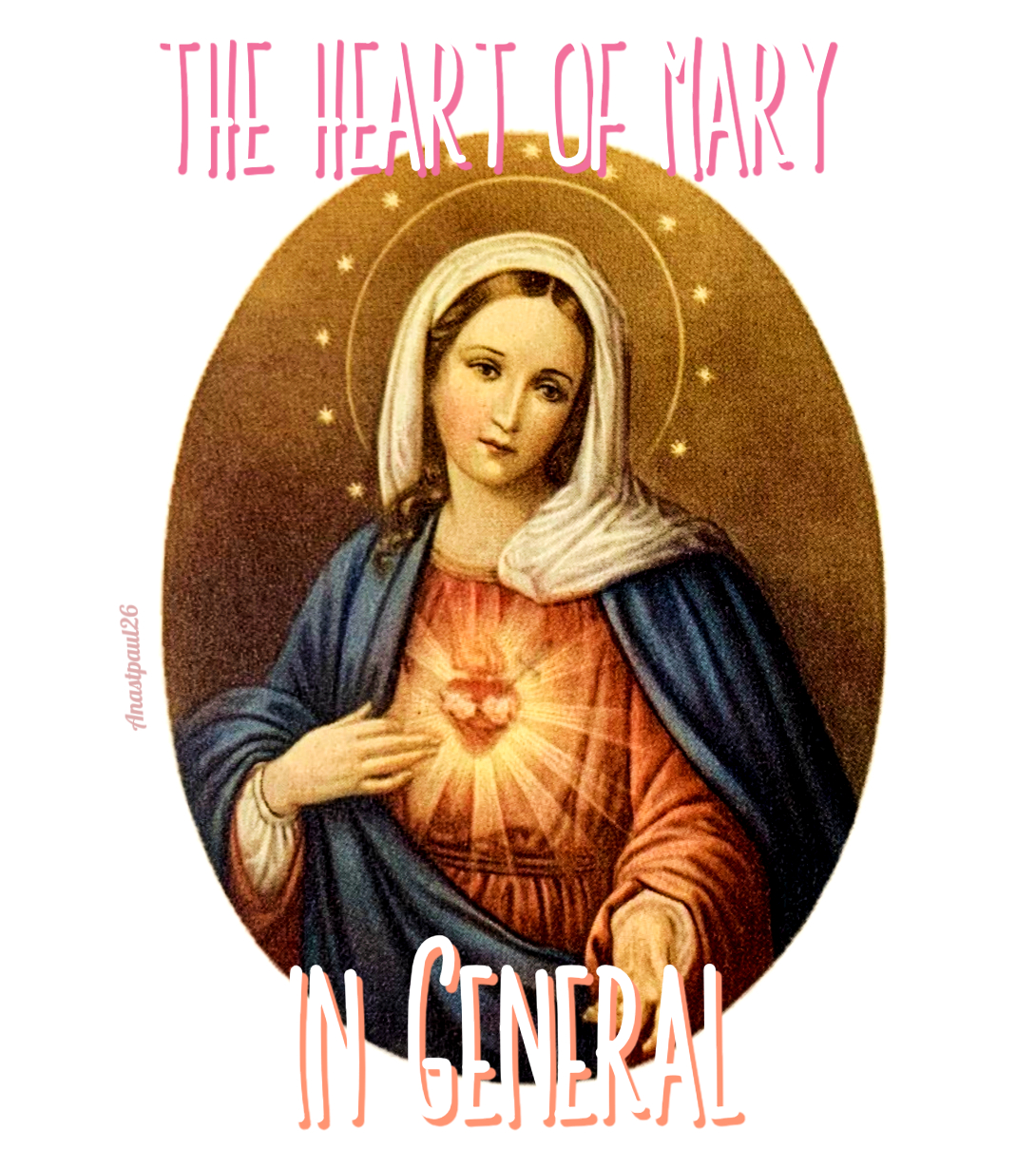
The first heart of Mary, the Mother of God, is the heart of flesh enclosed in her virginal breast. Although this heart is corporeal, it is nevertheless completely spiritualized by the spirit of grace and the spirit of God which fills it.
The second heart is her spiritual heart, made God-like, not indeed by the hypostatic union as in the Incarnate Word, but by a superlative participation in the divine perfections, as we shall see in the following pages. This heart is referred to by the words of the Holy Ghost: “All the glory of the king’s daughter is within,”
The third heart of Mary is divine and is truly God Himself, for it is none other than the love of God. This is the heart of which she says: “I sleep, and my heart watcheth,” which means according to the interpretation of several holy Doctors: “While I grant necessary rest to my body, my Son Jesus, who is my Heart and whom I love like my own heart, is always watching over me and for me.”
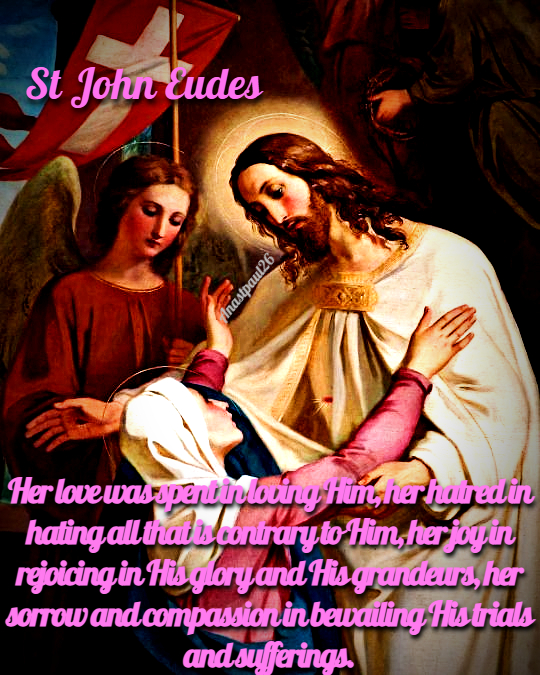
These three hearts of the Mother of God constitute a single Heart, through the holiest and most intimate union that ever was and will be, next to the hypostatic union. Of these three hearts, or rather, of this single Heart, the Holy Ghost has said twice: “Mary kept all these words, pondering them in her heart.” Our Lady cherished the mysteries and marvels of her Son’s life, first of all, in her material and corporeal heart, the principle of life, the seat of love and of the other physical emotions. All the movements, every beat of this virginal heart, the material functions that it accomplished and the emotions that swayed it, existed solely for Jesus and for the things that concerned Him. Her love was spent in loving Him, her hatred in hating all that is contrary to Him, her joy in rejoicing in His glory and His grandeurs, her sorrow and compassion in bewailing His trials and sufferings. The same may be said of every emotion of her bodily heart.
Secondly, Mary kept all these things in her spiritual heart, that is, in the noblest part of her soul, in the inmost recesses of her mind, All the faculties of her soul were constantly applied to contemplating and adoring everything that took place in the life of her Beloved Son, down to the very smallest details. Thirdly, Our Lady kept all these things in her divine Heart, that is, in her Son Jesus, who was the mind of her mind and the heart of her heart. He in turn kept them for her and recalled them to her mind when necessary, that she might feed herself in contemplation upon the mysteries of His life, rendering them due honor and adoration, and repeating them to the holy apostles and disciples, who were to preach them to the faithful.
This then is what is meant by the admirable Heart of the beloved Mother of God.









You must be logged in to post a comment.