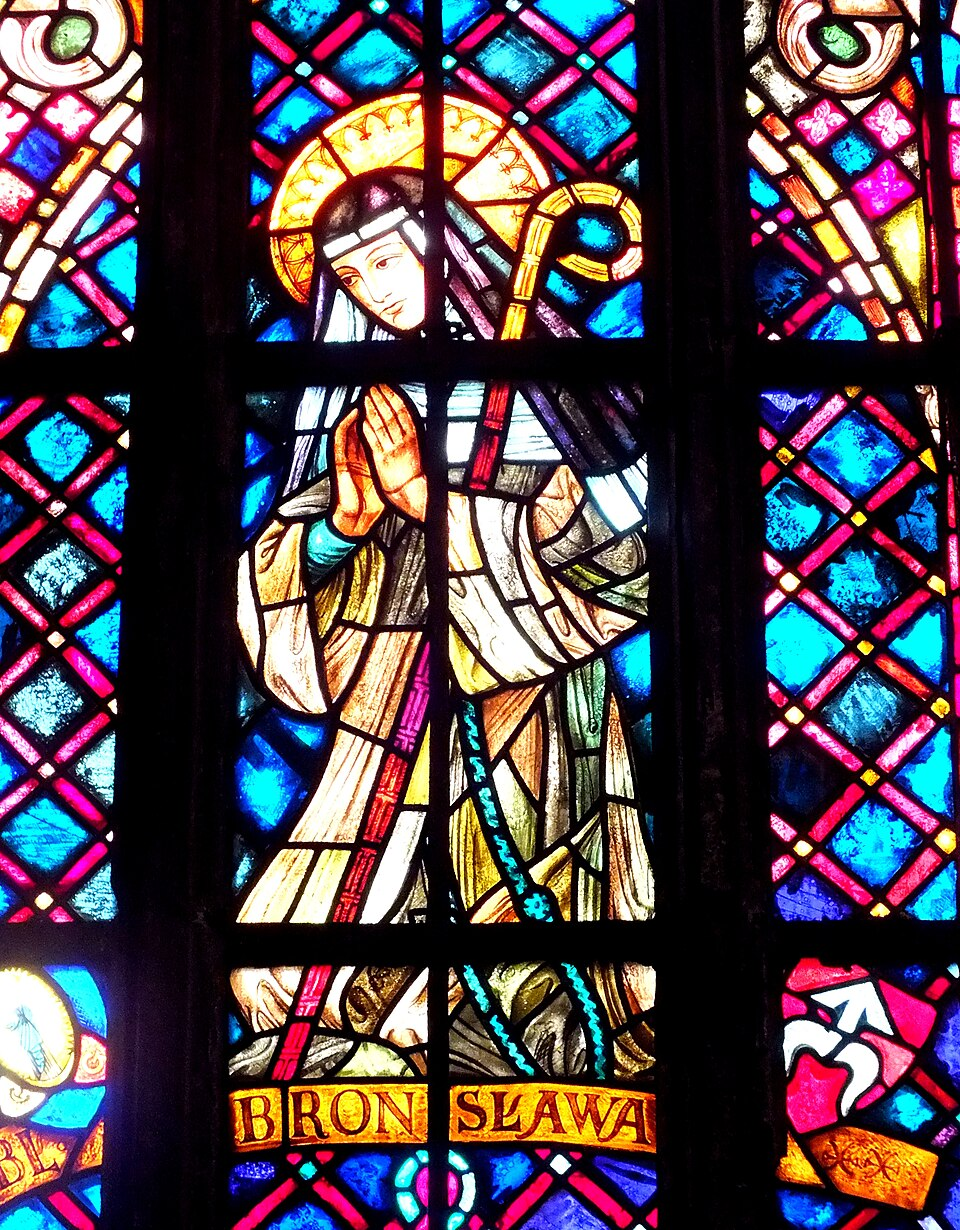
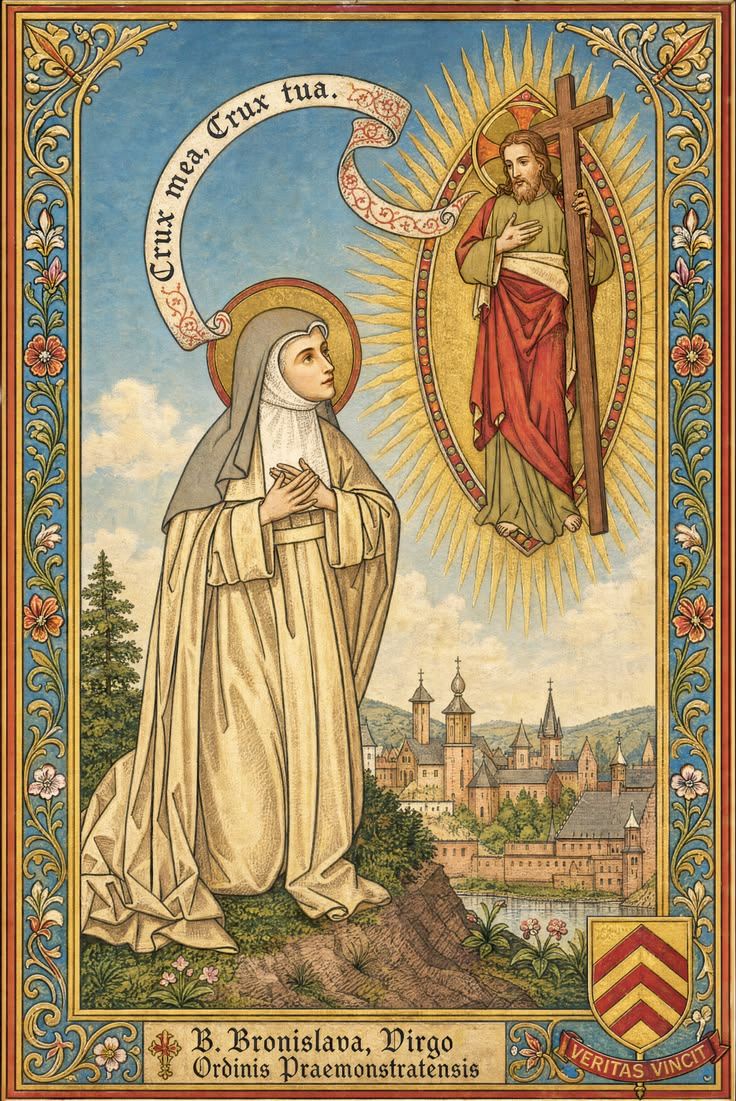
Blessed Bronislava of Poland, also known as Bronislava Odrowaz, Bronislava of Cracow, Bronislawa. She was a cousin of Saint Hyacinth and Blessed Czeslaw. The daughter of Count Stanislaus and Countess Anna of Prandata-Odrowaz, she was born at the castle of Kamien in Upper Silesia, Poland, in 1203, becoming at age sixteen a Premonstratensian nun at a convent founded by her maternal grandfather. Saint Hyacinth himself introduced her to this community of the Norbertines.
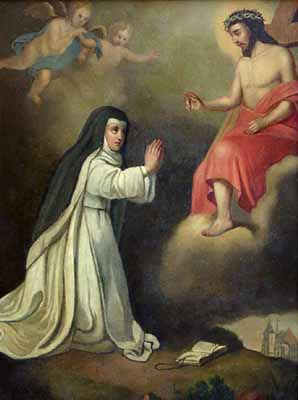
She was deeply devoted to the Holy Cross. After her profession in 1223, Christ Crucified appeared to her and said, “Bronislava, as my Cross has been your cross, so my glory will be your glory.” When the Tartars invaded Krakow in 1241, Bronislava, holding the cross in her hand, encouraged her sisters with the words, “Do not be afraid, the cross will save us.” She then knocked on the wall with her crucifix, at which a corridor opened before them and they all escaped into a nearby forest. Some of the Sisters joined another surviving convent, while Bronislava and a few others built huts on the ruins of their former home. They ministered to the poor, sick, and homeless of the surrounding countryside. The local population considered her their patroness on whom they could count when they needed protection.
The Norbertine rule was rigorous. They lived in cells that had dirt floors and no stoves; they suffered intensely from cold and frost, following a vow of extreme poverty and had no contact with the outside world. After 15 years of solitary, austere religious life, Bronislava accepted the burden of becoming a Superior. Later she became a hermitess on the hill of Sikornik. When Saint Hyacinth died, she received a vision of him ascending to heaven holding the hand of the Blessed Virgin.
Bronislava died on August 29, 1259, two years after her beloved cousin. Both of them had been devoted to the holy Mother of God and to her Rosary in its earliest form. Her body was taken to the convent church and she was invoked as a saint. Her relics were placed in a precious reliquary and were carried in solemn procession each year on the anniversary of her death. In 1707 she was designated a patroness of Krakow and Poland, of orphans, young people, a happy death and of the prevention of disease.
She was beatified by Pope Gregory XVI on 23 August 1839, after being attributed for protecting Zwierzyniec from cholera in 1835. The efforts of the Polish bishops toward the canonization of Bronislava in 1947 by Pope Pius XII were thwarted by 40 years of Communist rule.
St Adelphus St Adausia of Rome St Alberic of Bagno de Romagna St Basilia of Sirmium Bl Bronislava St Candida of Rome St Edwold the Hermit St Euthymius of Perugia St Maximian of Vercelli St Medericus St Nicaeus of Antioch St Paul of Antioch St Repositus of Velleianum Bl Richard Herst St Sabina of Troyes St Sator of Velleianum St Sebbe of Essex St Velleicus St Victor of La Chambon St Vitalis of Velleianum
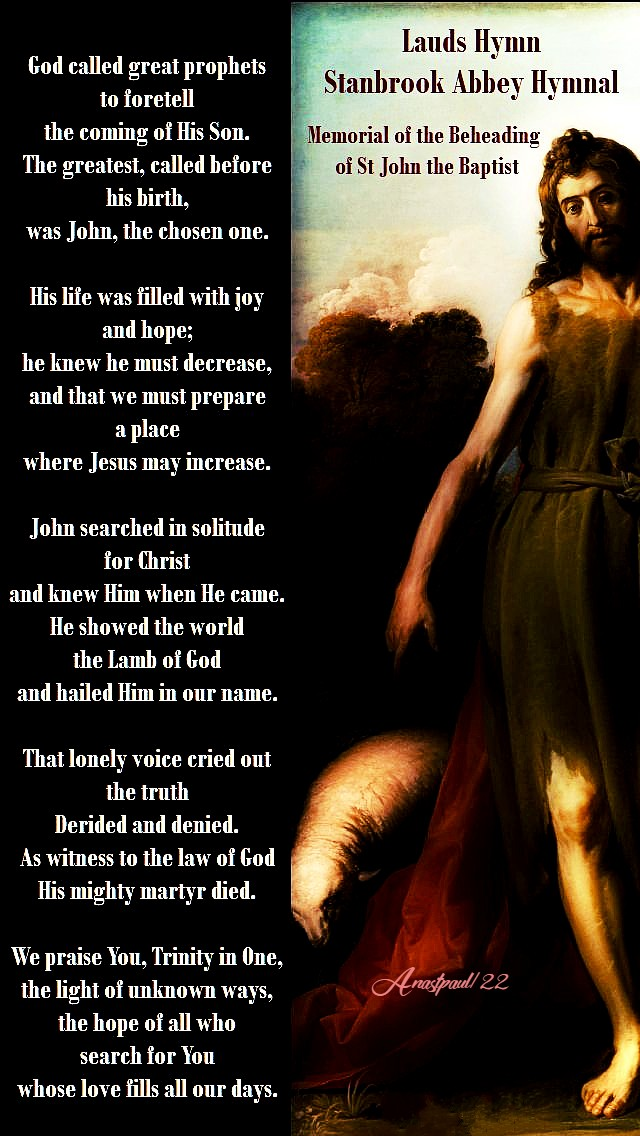
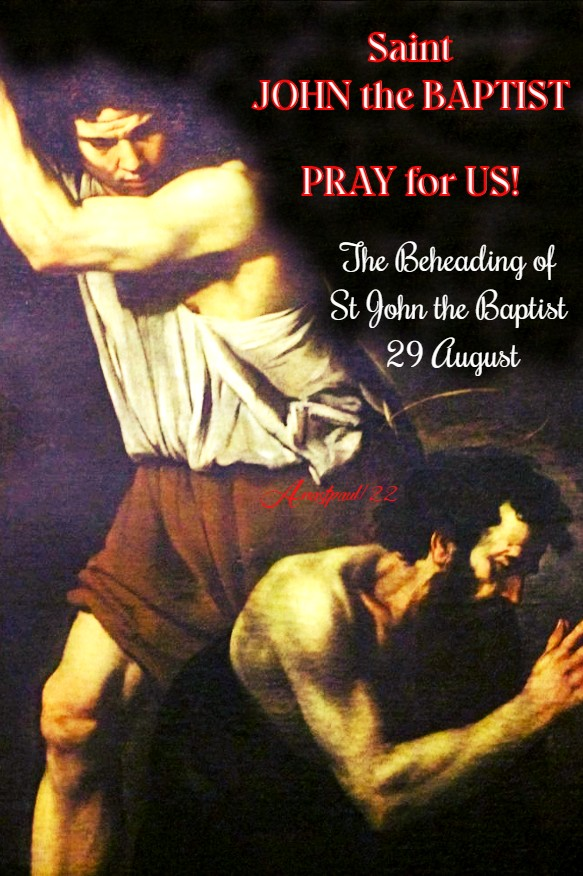
One Minute Reflection –29 August – The Beheading of Saint John the Baptist – Reading: Ps 118:46-47, Ps 91:2, Jer 1:17-19, Mark 6:17-29
For Herod feared John, knowing that he was a just and holy man.
Mark 6:17-29
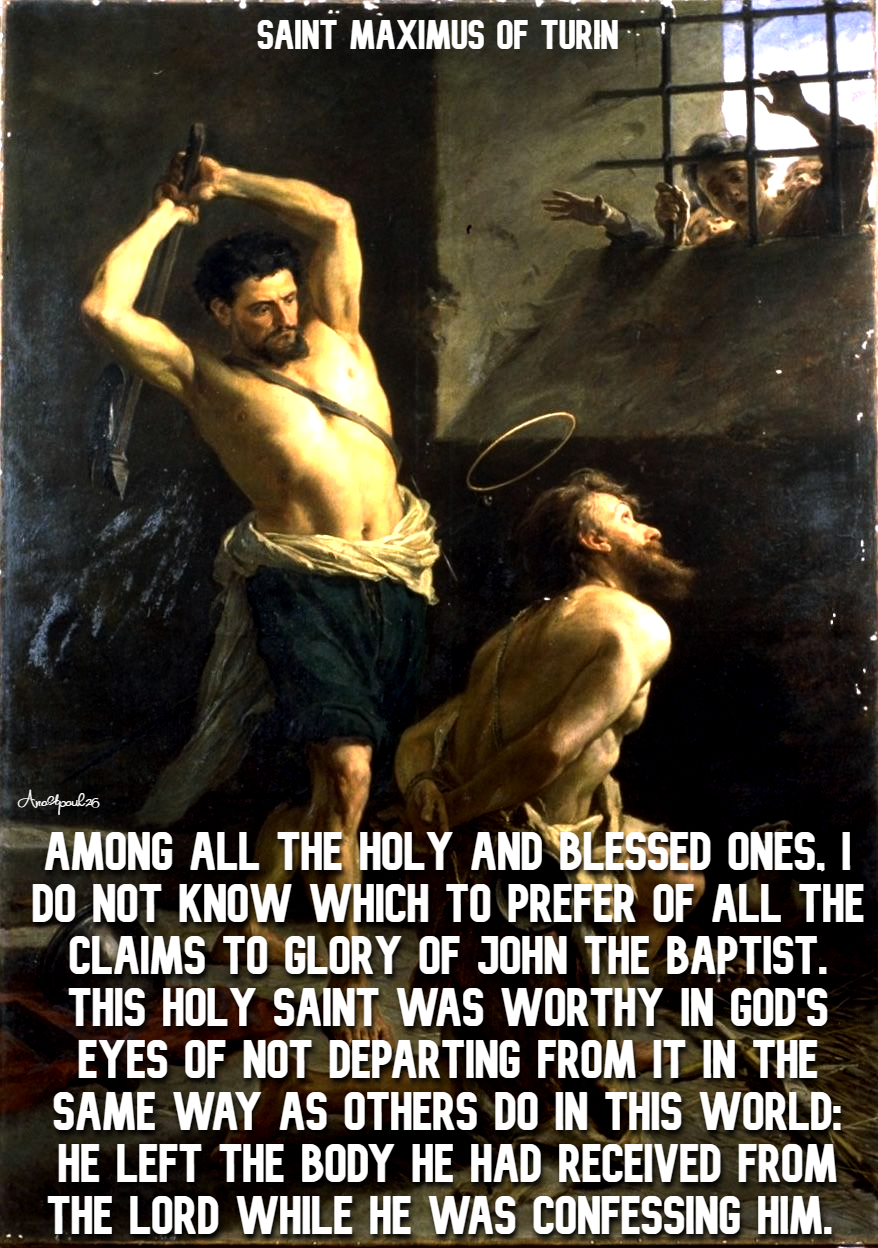
REFLECTION – Among all the holy and blessed ones, I do not know which to prefer of all the claims to glory of John the Baptist, whose feast we celebrate today : his miraculous birth or his even more miraculous death. His birth carried a prophecy with it, his death, the truth; his birth announced the Savior’s coming, his death condemned Herod’s incestuous relationship. This holy saint was worthy in God’s eyes of not departing from it in the same way as others do in this world: he left the body he had received from the Lord while he was confessing him. In all things John fulfilled God’s will since his life, like his death, corresponded to God’s designs.
Even while still in his mother's womb he celebrated the Lord's coming with joyful movements since he was unable to do so by word. Elizabeth said to blessed Mary: “When the voice of your greeting reached my ears, the child in my womb leaped for joy”. John, then, rejoiced before his birth, and even before his eyes could see what the world looks like, his spirit already recognised who is its Lord. I think that this is the meaning of the prophet's words: “Before I formed you in the womb, I knew you; before were born I had consecrated you”. So let us not be astonished if, locked up in the prison where Herod had put him, he went on preaching Christ by means of his disciples' mediation for, enclosed as he was in his mother's womb, he already proclaimed the Lord's coming with his bounds.
St Maximus of Turin
PRAYER – May the great festival of St John the Baptist, Thy Precursor and Martyr, we beseech Thee, O Lord, assure for us the results of Thy saving help. Who lives and reign with God the Father, in the unity of the Holy Spirit, God, world without end. Amen
Quote/s of the Day – 29 August – The Beheading of Saint John the Baptist
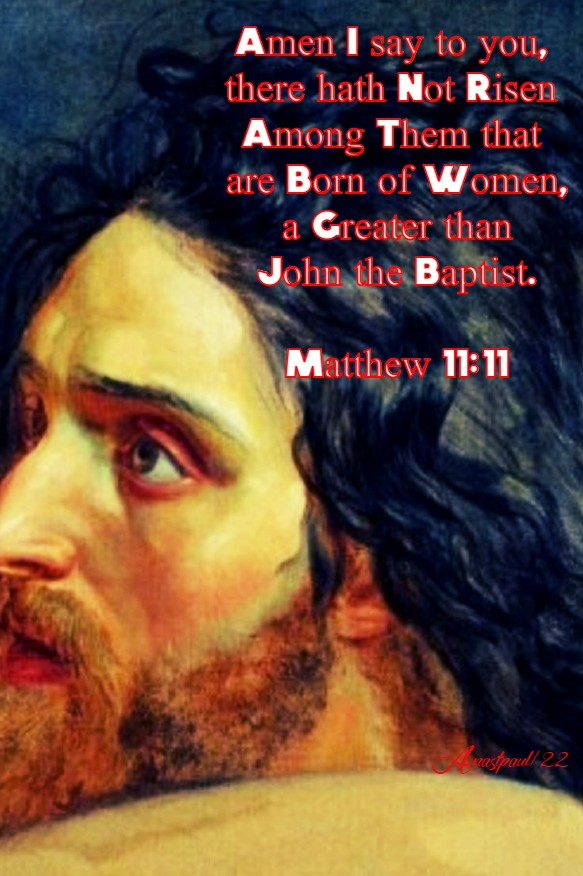
“Amen I say to you, there hath not risen among them that are born of women, a greater than John the Baptist.”
Matthew 11:11
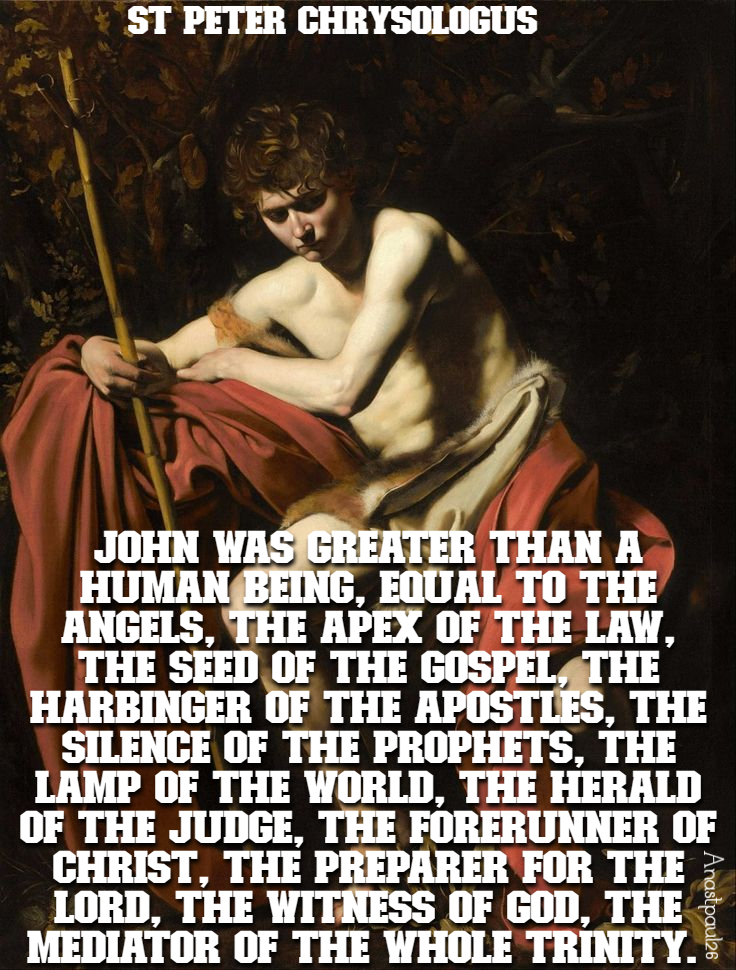
John was greater than a human being, equal to the angels, the apex of the Law, the seed of the Gospel, the harbinger of the apostles, the silence of the prophets, the lamp of the world, the herald of the Judge, the forerunner of Christ, the preparer for the Lord, the witness of God, the mediator of the whole Trinity.
St Peter Chrysologus
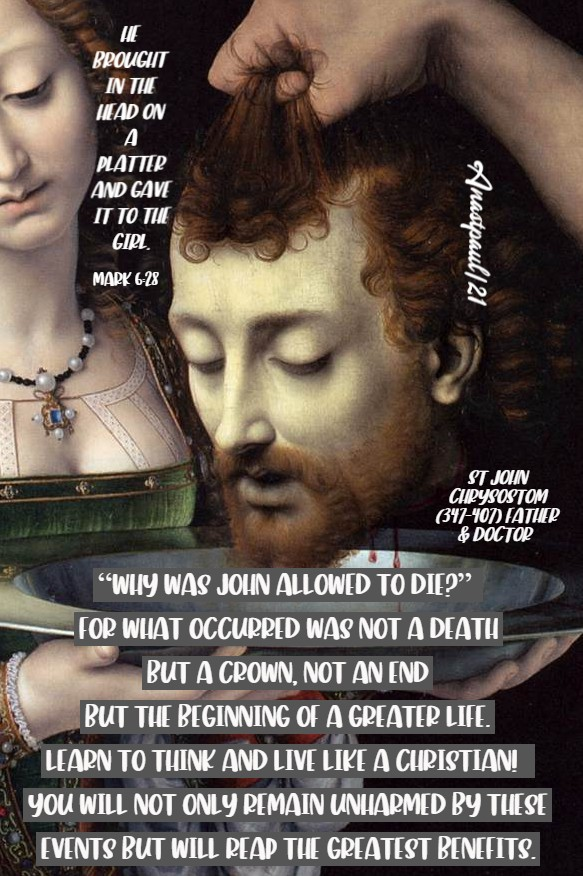
Why was John allowed to die? For what occurred was not a death but a crown, not an end but the beginning of a greater life. Learn to think and live like a Christian. You will not only remain unharmed by these events but will reap the greatest benefits.
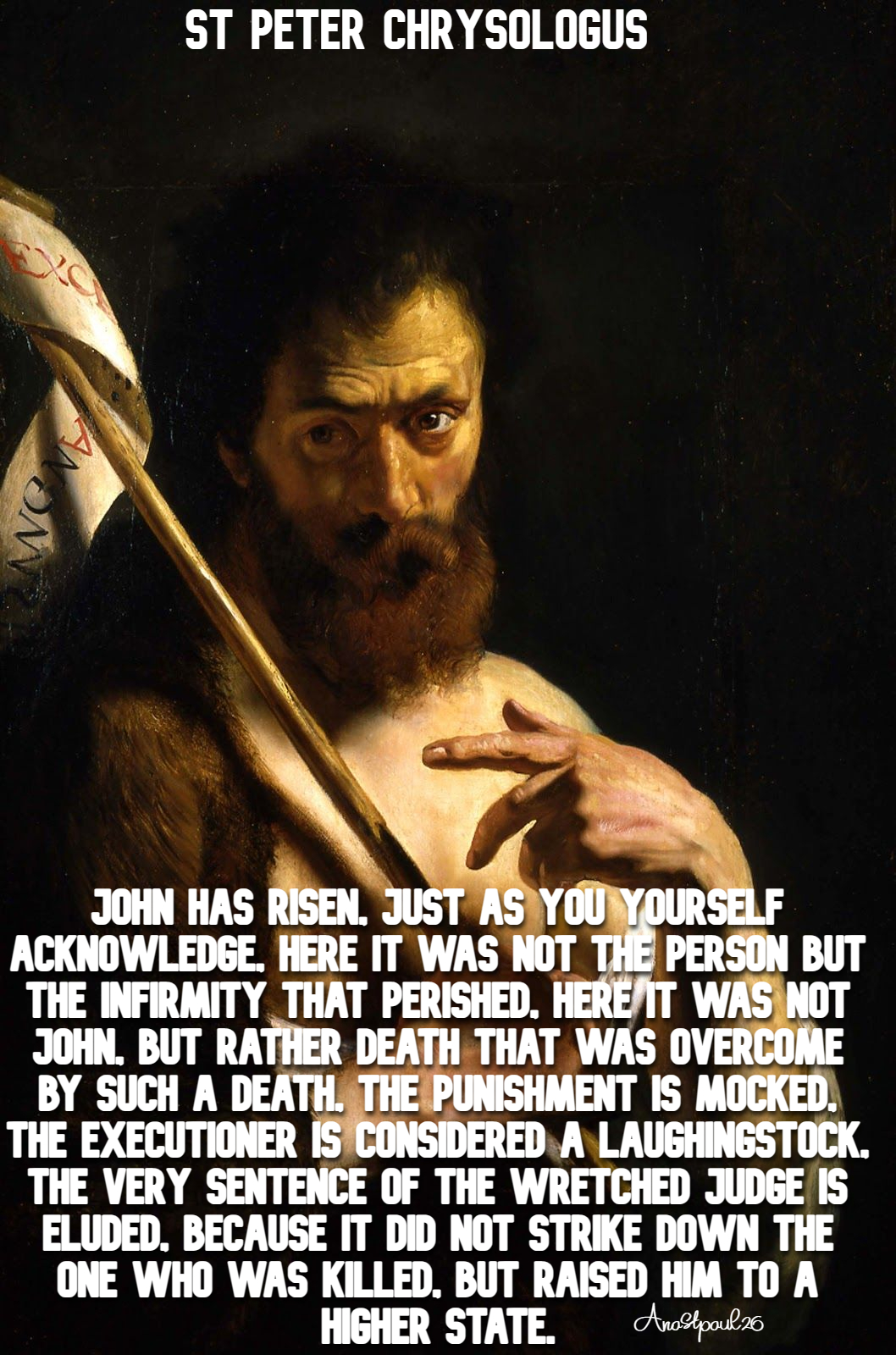
John has risen, just as you yourself acknowledge, here it was not the person but the infirmity that perished, here it was not John, but rather death that was overcome by such a death, the punishment is mocked, the executioner is considered a laughingstock, the very sentence of the wretched judge is eluded, because it did not strike down the one who was killed, but raised him to a higher state.
St Peter Chrysologus
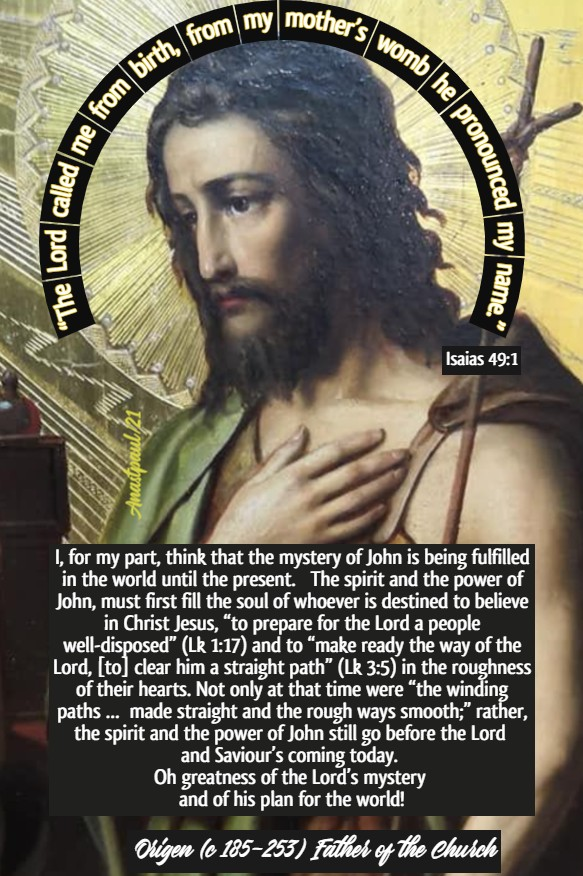
I, for my part, think that the mystery of John is being fulfilled in the world until the present. The spirit and the power of John, must first fill the soul of whoever is destined to believe in Christ Jesus, “to prepare for the Lord a people well-disposed” and to “make ready the way of the Lord, [to] clear Him a straight path” in the roughness of their hearts. Not only at that time were “the winding paths … made straight and the rough ways smooth;” rather, the spirit and the power of John still go before the Lord and Saviour’s coming today. Oh greatness of the Lord’s Mystery and of His plan for the world!
Origen
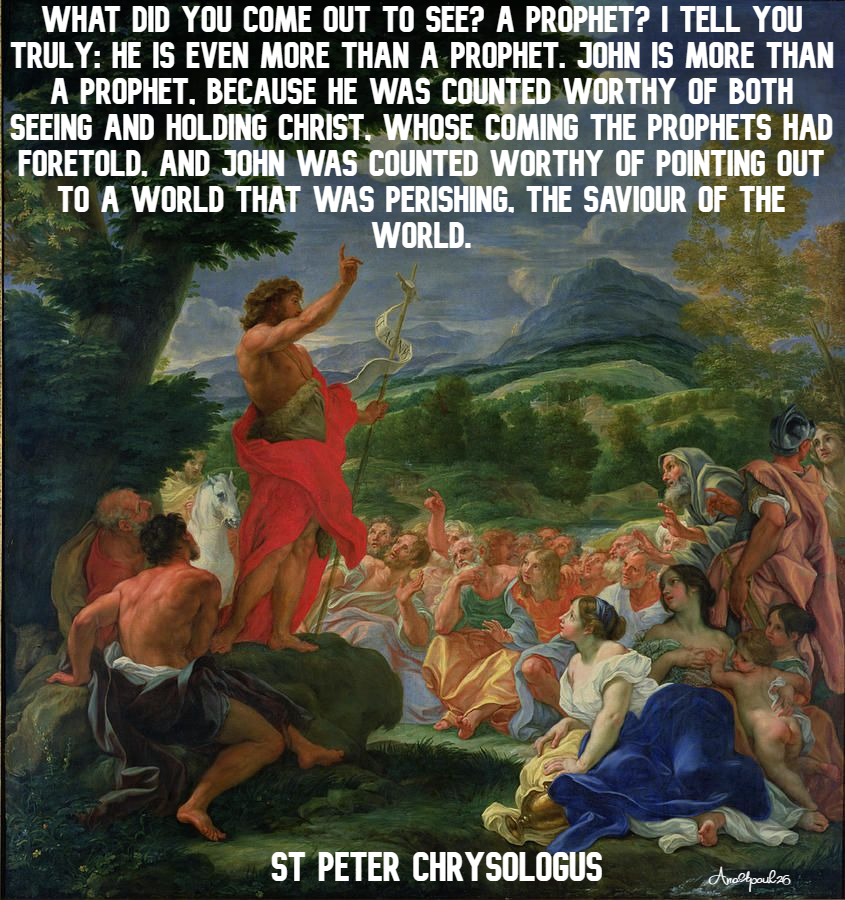
What did you come out to see? A prophet? I tell you truly: he is even more than a prophet. John is more than a prophet, because he was counted worthy of both seeing and holding Christ, whose coming the prophets had foretold, and John was counted worthy of pointing out to a world that was perishing, the Saviour of the world.
St Peter Chrysologus
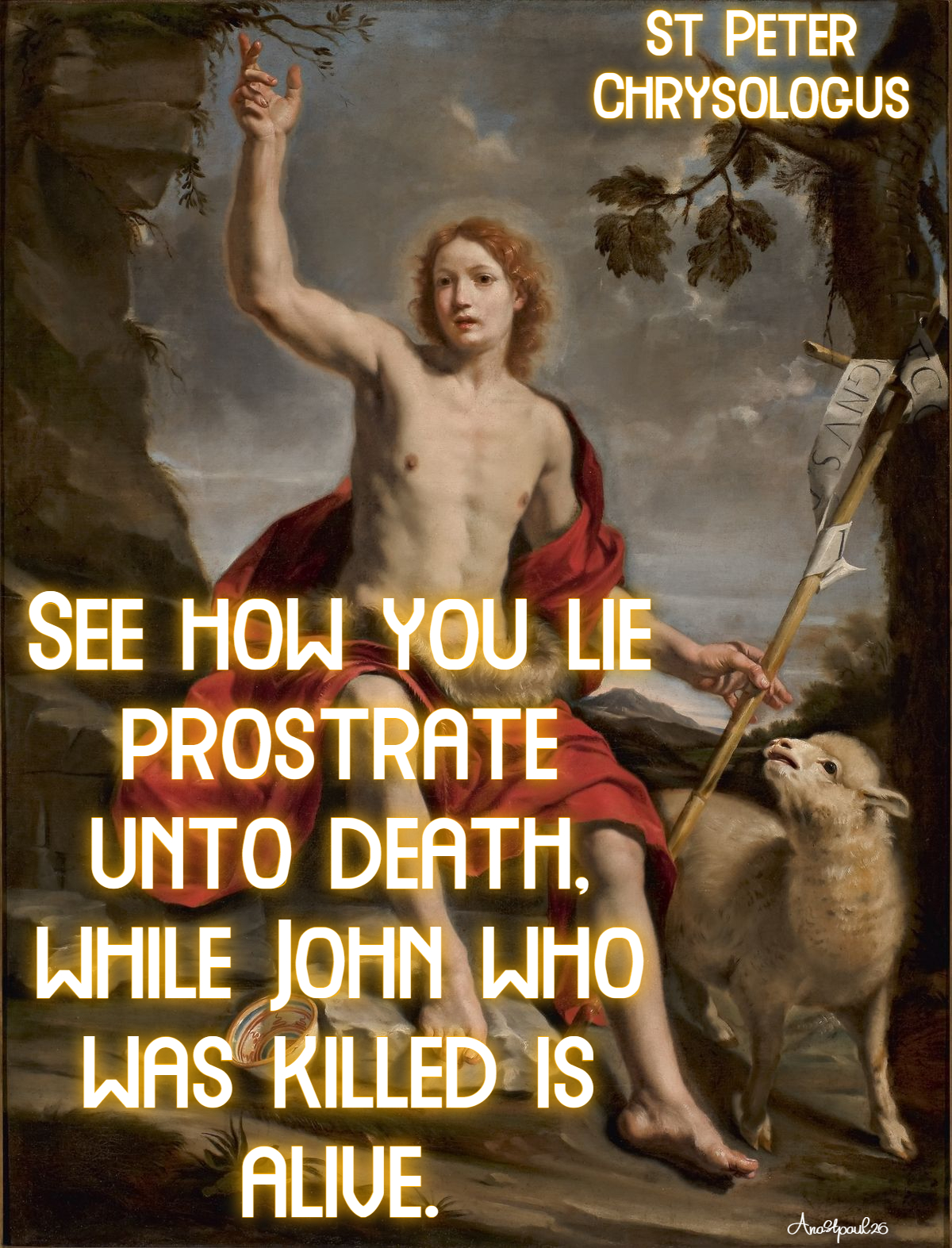
See how you lie prostrate unto death, while John who was killed is alive. You have lost the purple that received its colour from dye, John is forever gloriously clothed with the radiant purple from his blood. Your dinner guests are now made to share in your punishment, John partakes of the heavenly banquet with the choirs of angels. He hears the dulcet tones of heaven unceasingly; you hear forever the wailing and gnashing in hell. He, who was condemned as the price for your harlot and your dancing-girl, is now honoured with the kingdom and with heavenly rewards, for the sentence you gave, you have received recompense along with your daughter in Tartarus.
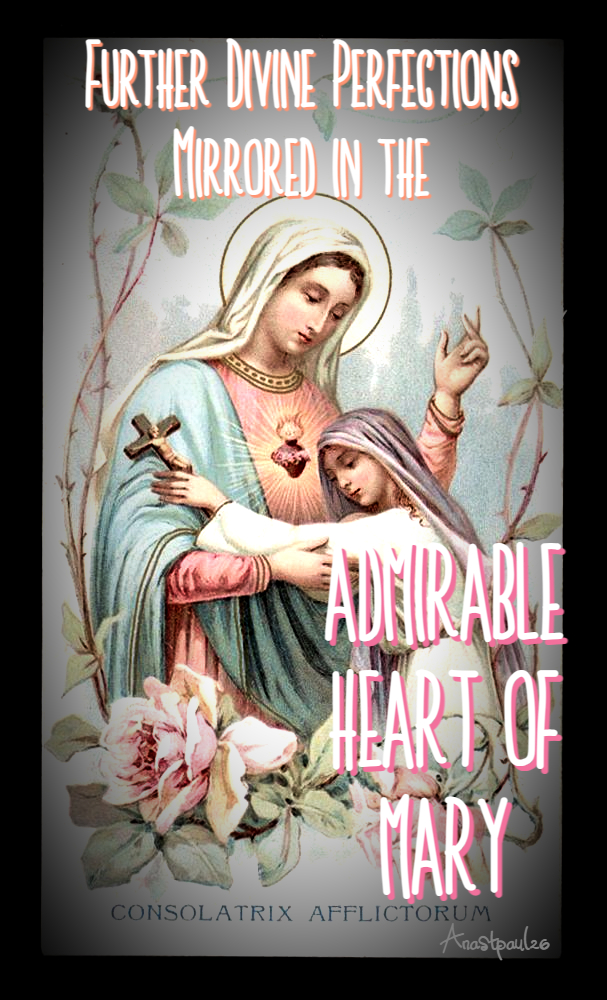
Further Divine Perfections Mirrored in the Admirable Heart of Mary
Divine Mercy is a perfection directed towards the miseries of creatures, tending to alleviate them and even to free them from created things when such a liberation enters into the designs of Divine Providence, which does all things with measure, number and weight. This adorable mercy extends, like goodness itself, to all God’s works: “His tender mercies are over all His works.” God’s mercy overshadows the works of nature, the works of grace and the works of glory.
Among the effects of divine Mercy, we must enumerate three principal realities, which in turn embody numberless effects. The first is the Incarnation of the God-Man; the second, His Mystical Body, namely Holy Church; the third is the Mother of the God-Man, namely the Most Blessed Virgin Mary. These constitute three admirable masterpieces of divine mercy.
Beyond this, God not only willed to become man that men might become partakers of the divine nature, but He willed that His only Son should become the Son of Man that men might become sons of God. God willed that His Son come into this world by being born of the seed of Adam and of a daughter of Adam that we might have the God-Man for our brother and the Mother of God for our mother. Thus we have the same father and the same mother as the Son of God Himself.We are His brothers, and as He is our mediator with His Father, so His heavenly Mother is a mediatrix between Himself and us.
In order to render His admirable Mother paramountly able to exercise her double office of Mother and Mediatrix, so that she might protect, favor and assist us with greater efficacy in all our needs, Divine Mercy constituted her, first of all, most agreeable and holy. Secondly, Mercy gave her dominion over everything in heaven and on earth. Thirdly, it gave her the mildest, sweetest and most loving heart save that of the God- Man. To the Heart of Mary God communicated in great abundance His merciful inclinations and established in it the throne and reign of His Mercy more gloriously than in the heart of any other creature, save the sacred humanity of Christ. Divine Mercy reigns so perfectly in Mary’s Heart that she bears the name of Queen and Mother of Mercy. And this most loving Mary has so completely won the heart of God’s mercy that He has given her the key to all His treasures and made her absolute mistress of them.
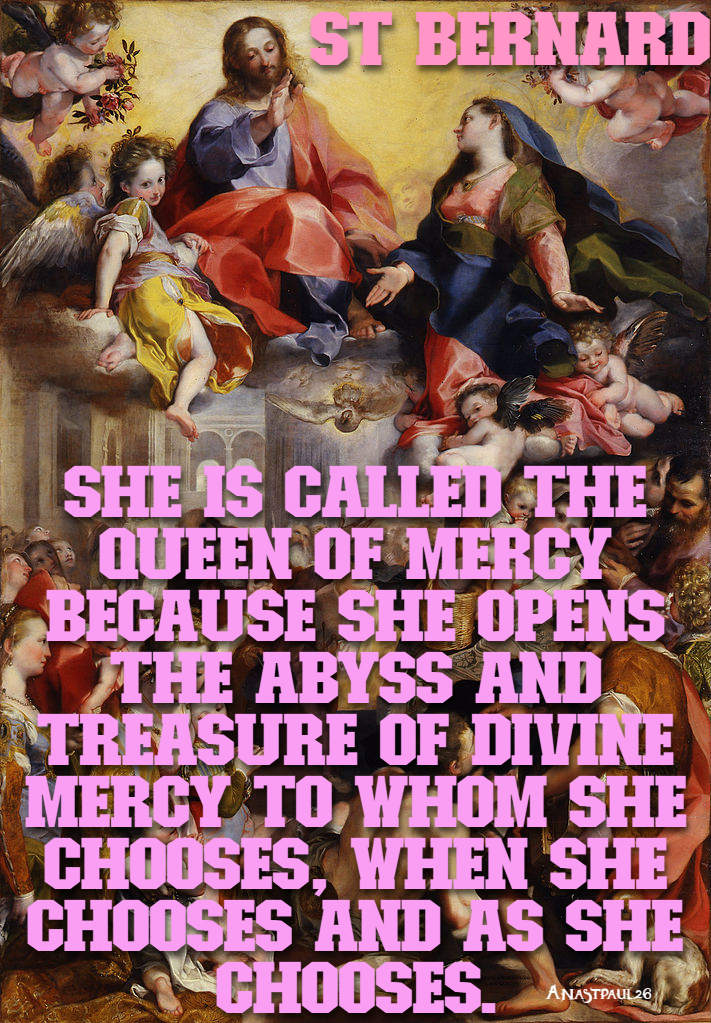
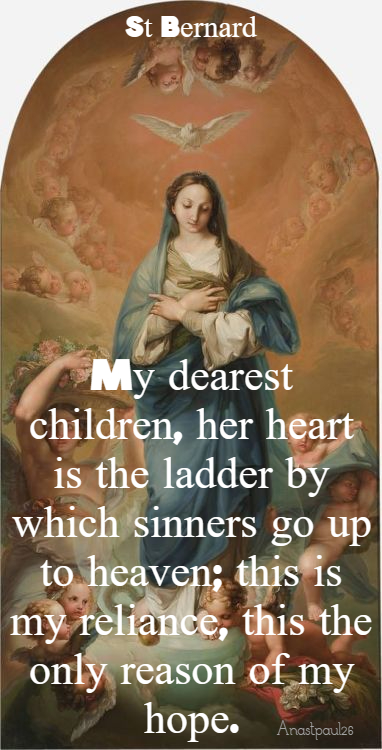
St. Bernard says: “She is called the Queen of Mercy because she opens the abyss and treasure of divine mercy to whom she chooses, when she chooses and as she chooses.” Divine Mercy holds such complete sway over Mary’s Heart and fills it with so much compassion for sinners and for all persons in need that St. Augustine addresses her thus: “Thou art the sinner’s only hope,” after God. “My dearest children,” says St. Bernard, “her heart is the ladder by which sinners go up to heaven; this is my reliance, this the only reason of my hope.” Euthymius, one of the ancient Fathers who lived over seven centuries ago, adds: “O most merciful Virgin, deign to cast thy pitiful eyes on thy poor servants, for, after God, we have placed all our hope in thee who are our life, our glory, and, as it were, our substance and our being.” St. John Damascene tells us that Our Lady is the only relief of the afflicted, the sovereign comforter of anguished hearts; and St. John Chrysostom declares her to be a boundless ocean of mercy.
Would you know in what further manner divine mercy lives and reigns in the Heart of the Mother of Mercy? Listen to St. Bonaventure: “Great was Mary’s mercy towards the wretched while she was living in exile here below; but immeasurably greater still now that she is happily reigning in heaven. She manifests this greater mercy through innumerable benefits, now that she possesses a clearer insight into the numberless woes of mankind. She does not require past merits, but grants the petitions of all men, out of charity, and opens the bosom of her clemency to everyone. She relieves every need and necessity with an incomparable affection and tenderness of heart.”
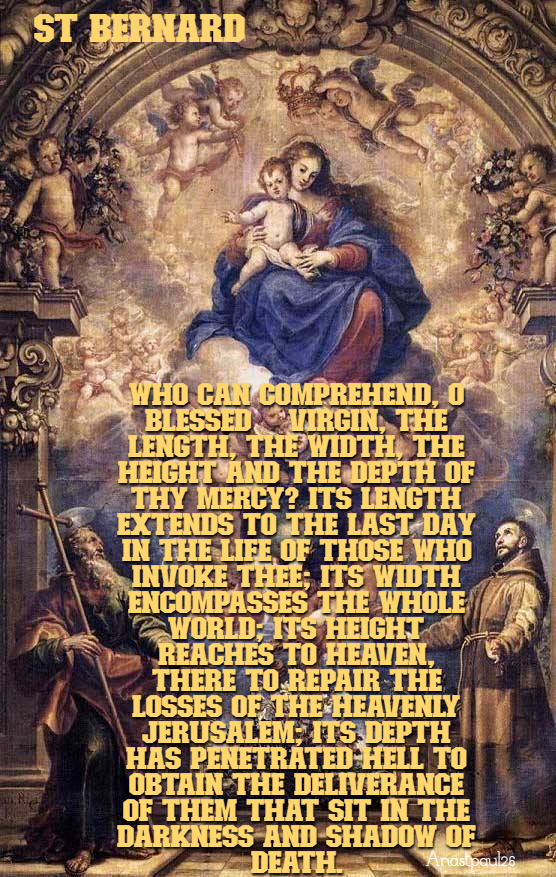
Her gentle Heart is so filled with mercy that it overflows on all sides and spreads itself in heaven, on earth and even in hell. Let us again listen to St. Bernard proclaiming this truth: “Who can comprehend, O Blessed – Virgin, the length, the width, the height and the depth of thy mercy? Its length extends to the last day in the life of those who invoke thee; its width encompasses the whole world; its height reaches to heaven, there to repair the losses of the heavenly Jerusalem; its depth has penetrated hell to obtain the deliverance of them that sit in the darkness and shadow of death.”
The virginal Heart of the Mother of Grace is filled with such exceeding mercy that she exercises it not only in favor of sinners who wish to be converted, but also towards many persons who never think of their eternal salvation. She implores her Blessed Son to inspire them, to excite in their hearts sentiments of fear of God and terror at the thought of His judgments. She asks Him to chastise them in divers ways, to raise in their midst persons leading holy and exemplary lives, whose example will draw them to Himself, and to use all other means of obtaining their conversion, or at least, if they will not mend their ways, to prevent them from multiplying their sins, that their damnation may be less terrible.
But what is even more, the Heart of Mary is so full of mercy that, using the extraordinary privileges God has granted to her alone, and out of her incomparable goodness, she often saves from eternal perdition souls who in the ordinary course of divine Justice would have been cast into hell. Such is the mind of that ancient and excellent author, Raymund Jourdain, who succeeded in hiding his name, but not the extent of his learning and holiness: “The Mother’s mercy often saves many whom the justice of the Son would have otherwise condemned.”
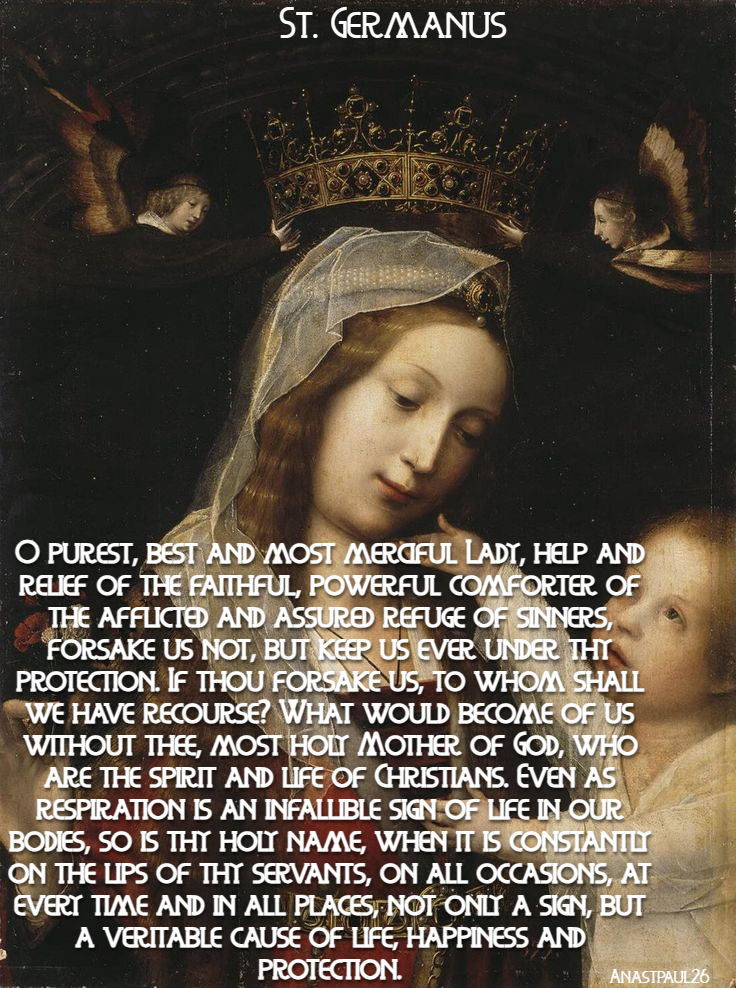
Hence St. Germanus, Patriarch of Constantinople, addresses these beautiful words to Mary: “O purest, best and most merciful Lady, help and relief of the faithful, powerful comforter of the afflicted and assured refuge of sinners, forsake us not, but keep us ever under thy protection. If thou forsake us, to whom shall we have recourse? What would become of us without thee, most holy Mother of God, who are the spirit and life of Christians. Even as respiration is an infallible sign of life in our bodies, so is thy holy name, when it is constantly on the lips of thy servants, on all occasions, at every time and in all places, not only a sign, but a veritable cause of life, happiness and protection.”





You must be logged in to post a comment.