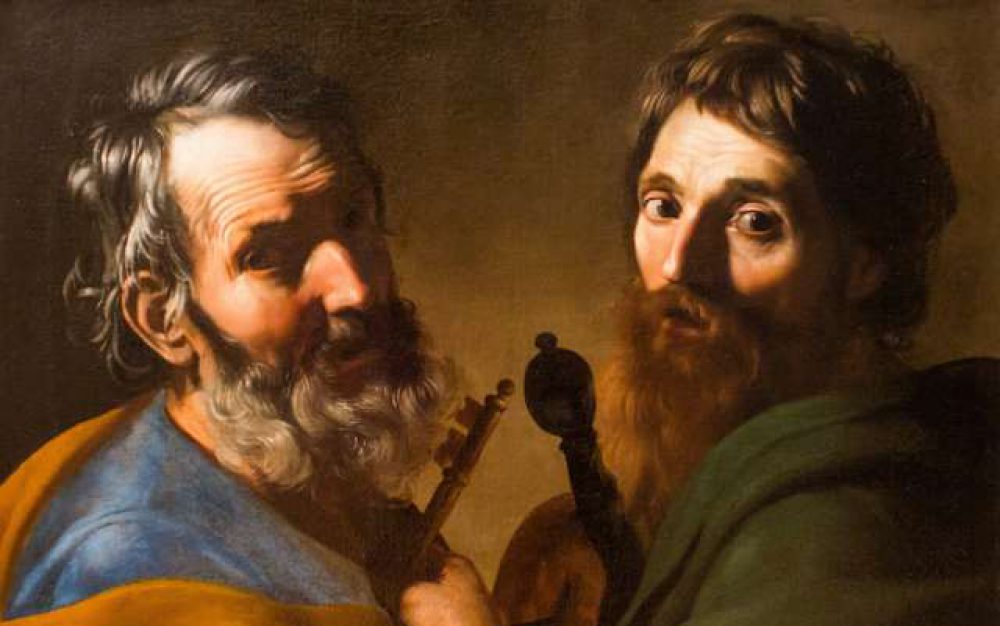
The Martyrdom Of St. Peter And St. Paul
by Arthur Stapylton Barnes
We do not believe in the historical existence of the Christ primarily because of the record of the Gospels, but because of the facts of Christianity. Suppose for a moment that the Gospels had never been written, or that they had perished as did almost every other Christian document of the times, in the persecutions of the third century the essential facts of Christianity would be quite unaffected.
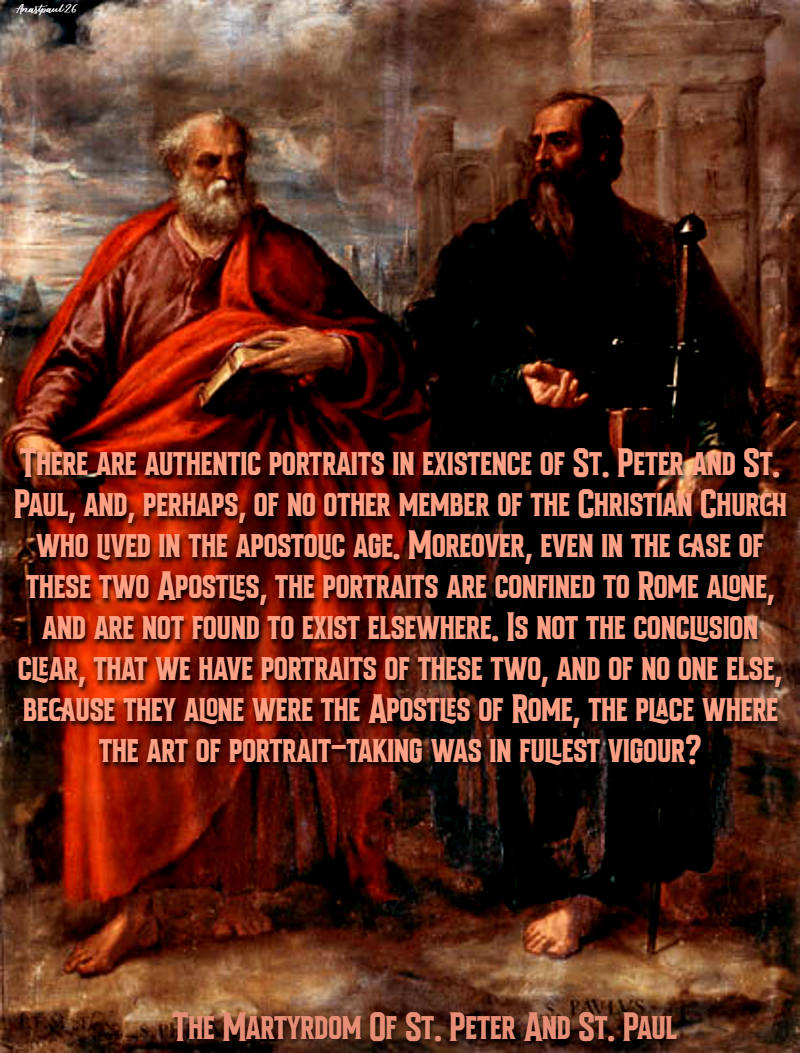
There are authentic portraits in existence of St. Peter and St. Paul, and, perhaps, of no other member of the Christian Church who lived in the apostolic age. Moreover, even in the case of these two Apostles, the portraits are confined to Rome alone, and are not found to exist elsewhere. Is not the conclusion clear, that we have portraits of these two, and of no one else, because they alone were the Apostles of Rome, the place where the art of portrait-taking was in fullest vigour?
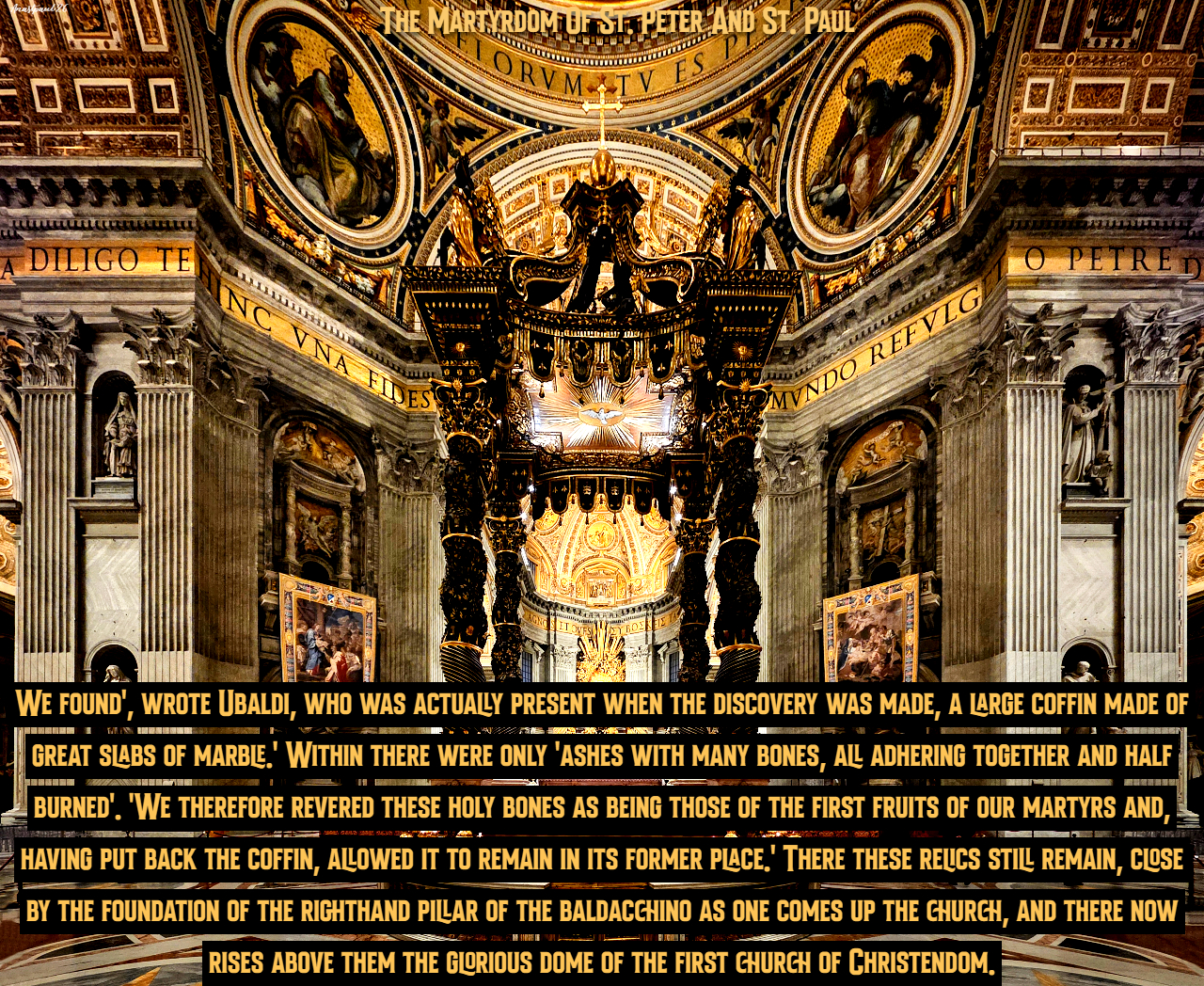
We found’, wrote Ubaldi, who was actually present when the discovery was made, a large coffin made of great slabs of marble.’ Within there were only ‘ashes with many bones, all adhering together and half burned’. ‘We therefore revered these holy bones as being those of the first fruits of our martyrs and, having put back the coffin, allowed it to remain in its former place.’ There these relics still remain, close by the foundation of the righthand pillar of the baldacchino as one comes up the church, and there now rises above them the glorious dome of the first church of Christendom.
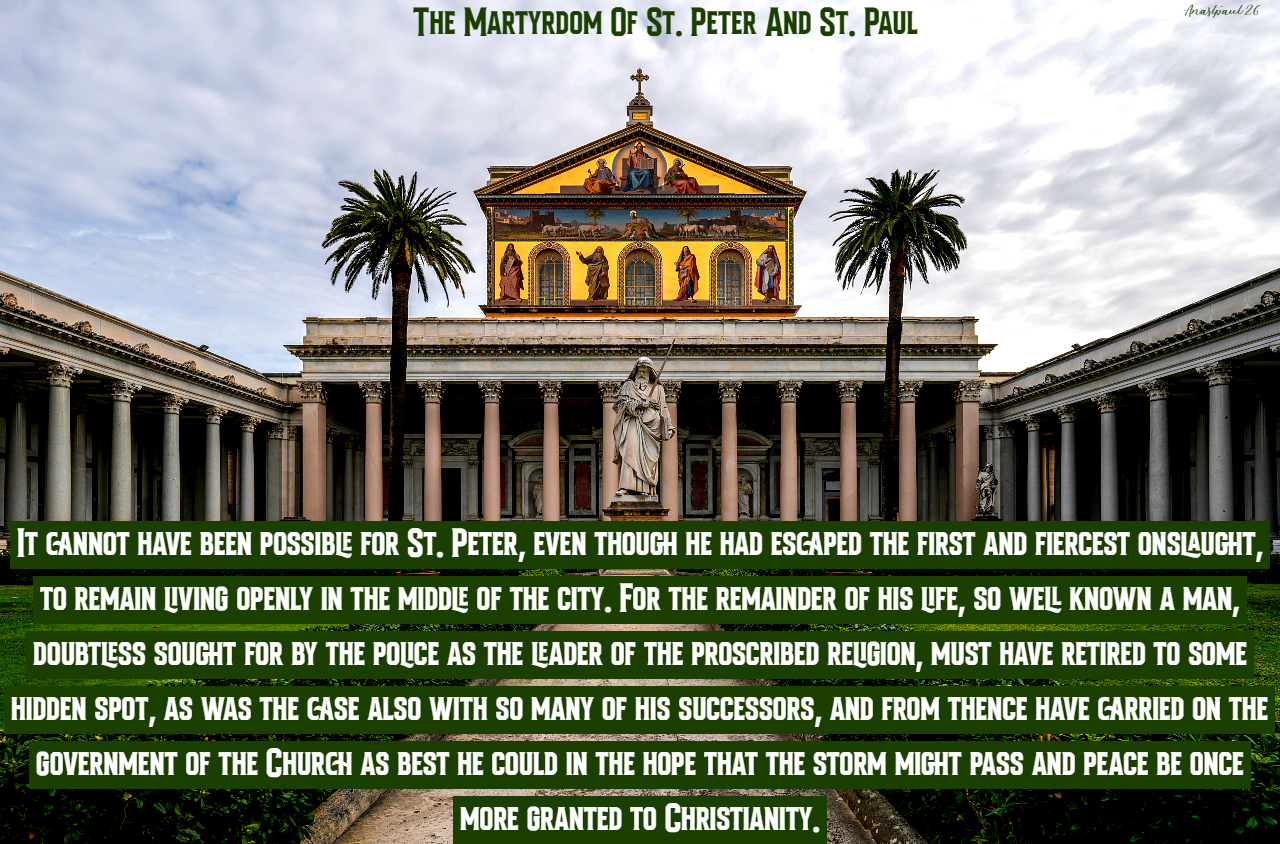
It cannot have been possible for St. Peter, even though he had escaped the first and fiercest onslaught, to remain living openly in the middle of the city. For the remainder of his life, so well known a man, doubtless sought for by the police as the leader of the proscribed religion, must have retired to some hidden spot, as was the case also with so many of his successors, and from thence have carried on the government of the Church as best he could in the hope that the storm might pass and peace be once more granted to Christianity.
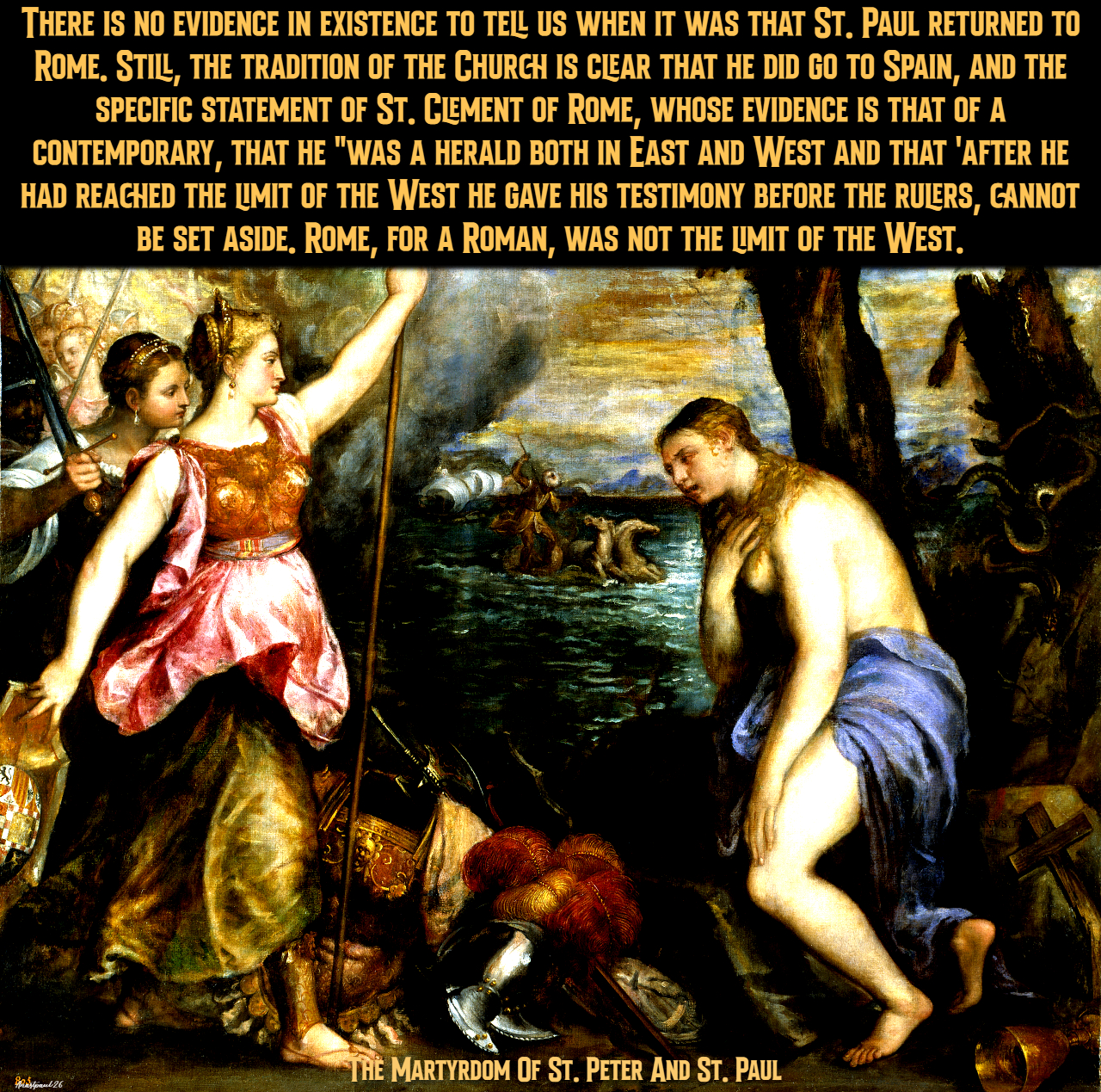
There is no evidence in existence to tell us when it was that St. Paul returned to Rome. Still, the tradition of the Church is clear that he did go to Spain, and the specific statement of St. Clement of Rome, whose evidence is that of a contemporary, that he “was a herald both in East and West and that ‘after he had reached the limit of the West he gave his testimony before the rulers, cannot be set aside. Rome, for a Roman, was not the limit of the West.
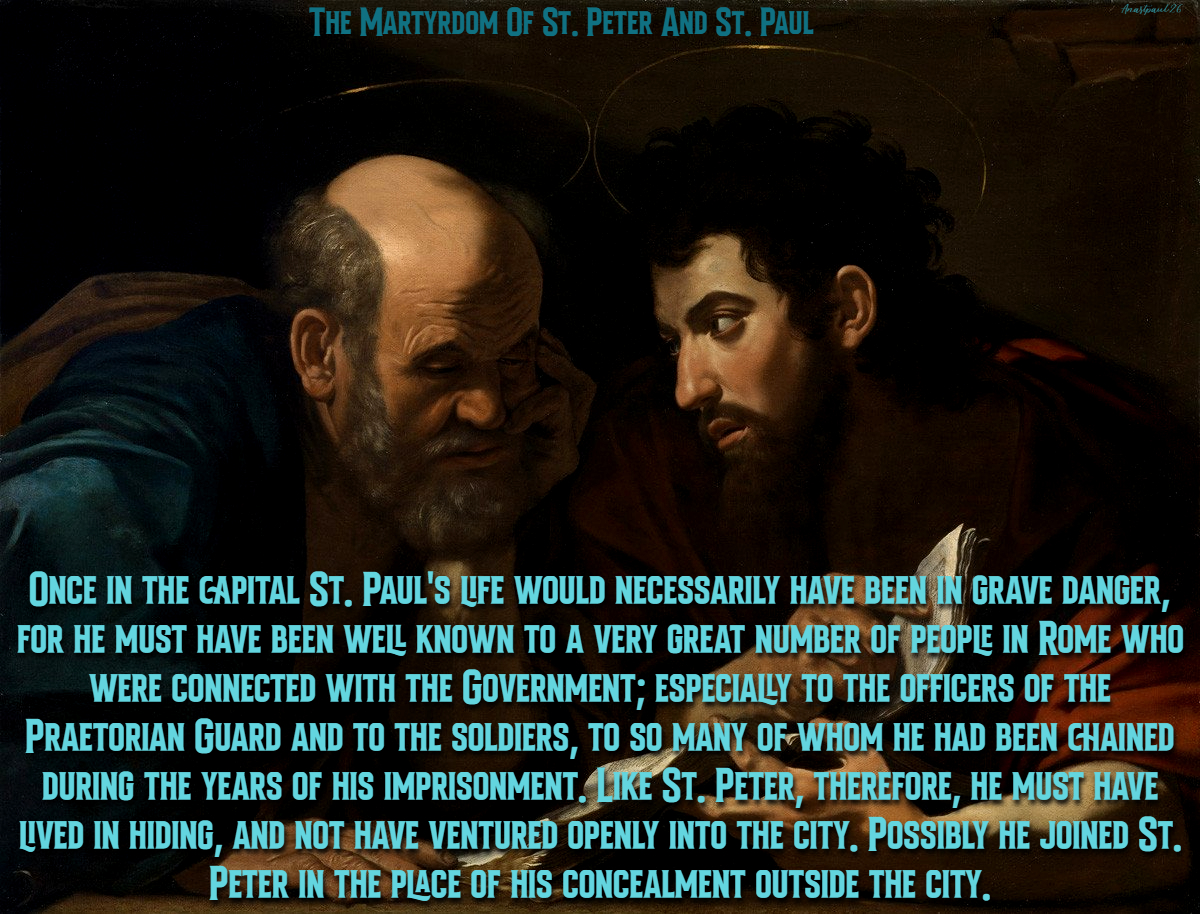
Once in the capital St. Paul’s life would necessarily have been in grave danger, for he must have been well known to a very great number of people in Rome who were connected with the Government; especially to the officers of the Praetorian Guard and to the soldiers, to so many of whom he had been chained during the years of his imprisonment. Like St. Peter, therefore, he must have lived in hiding, and not have ventured openly into the city. Possibly he joined St. Peter in the place of his concealment outside the city.


