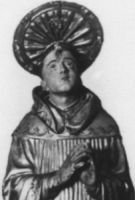
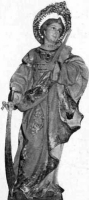
Siblings, and children of Almanzor, Muslim caliph of Lerida, Catalonia, Spain, during the Moorish Occupation in the 12th century. Saint Bernard converted and became a Benedictine Cistercian monk at Poblet, taking the name Bernard. He then converted his two sisters Gracia and Maria, and together they attempted to convert their other brother, Almanzor, who turned them over to Moorish authorities. They were martyred in 1180.
Saint Bernard
Saint Gracia
Saint Maria
The exact circumstances surrounding their deaths are not known. Bernard, Gracia and Maria are venerated as the patron saints of Alcira, Valencia, Spain.
Muslim army in Iberia
Stand fast in the faith, and love one another, all of you, and be not offended at my sufferings.
Our Morning Offering – 21 August – The Memorial of St Jane Frances de Chantal VHM (1572-1641)
Prayer of Abandonment By St Jane Frances de Chantal (1572-1641)
O sovereign goodness of the sovereign Providence of my God! I abandon myself forever to Thy arms. Whether gentle or severe, lead me henceforth whither Thou will. I will not regard the way through which Thou will have me pass but keep my eyes fixed upon Thee, my God, who guides me. My soul finds no rest without the arms and the bosom of this heavenly Providence, my true Mother, my strength and my rampart. Therefore I resolve with Thy Divine assistance, 0 my Saviour, to follow Thy desires and Thy ordinances, without regarding or examining why Thou does this rather than that but I will blindly follow Thee, according to Thy Divine will, without seeking my own inclinations. Hence I am determined to leave all to Thee, taking no part therein, save by keeping myself in peace in Thy arms, desiring nothing, except as Thou incites me to desire, to will, to wish. I offer Thee this desire, 0 my God, beseeching Thee to bless it. I undertake all it includes, relying on Thy goodness, liberality and mercy, with entire confidence in Thee, distrust of myself, and knowledge of my infinite misery and infirmity. Amen.
The Apparition in County Mayo in Ireland of Our Lady of Knock is reported to have occurred on the evening of 21 August 1879, the Vigil of the Octave of the Feast of the Assumption. Those who witnessed the miracle, ranged in age from five years old to seventy five.
The Apparition was described as follows: “Our Lady was wearing a large, brilliant crown and clothed in white garments. On her right was Saint Joseph, his head inclined toward her and on her left Saint John the Evangelist. To the left of Saint John was an Altar on which stood a Crucifix and a lamb.”
Standing only a few feet off the ground, the Blessed Virgin wore a white cloak and was described by witnesses as being incredibly beautiful. She wore a bright golden crown and appeared to be praying with her eyes looking toward Heaven with her arms bend in front of her with her palms facing inward.”
Fifteen parishioners stood, before the Apparition, for two hours as they recited the Rosary. Although it was daylight when the Apparition began, the weather changed and it began to rain heavily. The area around the Apparition appeared unaffected, however, as the ground remained dry, as long as the vision lasted. Our Lady did not speak but the gable of the Church where the Apparition occured was covered with a cloud of light.
Saint Joseph, also wore white robes and stood on the Virgin’s right. He inclined his head respectfully toward the Blessed Virgin. Saint John the Evangelist wore a miter and appeared to be preaching as he held a book in his left hand.
Since then thousands of people have made pilgrimages to Knock to pray to Our Lady. Their prayerful, penitential and reverential spirit, has been commended again and again by visitors from other lands. No sign of commercialism detracts from the purely religious atmosphere of that hallowed spot. People from all walks of life kneel in humble supplication before the Shrine of Our Lady, fully confident that she has sanctified that spot by her appearance there.
Organised pilgrimages from various Diocese are conducted frequently to the Shrine The Holy Rosary comprises the main portion of the devotion – the Shrine is, therefore, appropriately called the Rosary Shrine. The “Knock Shrine Annual” relates many wonderful accounts of cures and conversions effected at the Shrine.
St Jane Frances de Chantal VHM (1572-1641) – Mother, Widow, Foundress of the Congregation of the Visitation. Close friend of St Francis de Sales and St Vincent de Paul, both of whom guided and assisted her and her foundation, spiritually.
St Abraham of Smolensk (Died c 1222) Monk, Abbot, Priest, apostle of the poor, Preacher, Biblical scholar and spiritual adviser.
St Agapius of Edessa St Agathonicus of Constantinople St Anastasius Cornicularius St Aria of Rome St Avitus I of Clermont St Bassa of Edessa Bl Beatrice de Roelas St Bernhard of Lérida St Bernard de Alziva St Bonosus St Camerinus of Sardinia St Cameron St Cisellus of Sardinia St Cyriaca St Euprepius of Verona St Fidelis of Edessa Bl Gilbert of Valenciennes St Gracia of Lérida St Hardulph St Joseph Nien Vien Bl Ladislaus Findysz St Leontius the Elder St Luxorius of Sardinia St Maria of Lérida St Maximianus the Soldier St Maximilian of Antioch St Natale of Casale Monferrato St Paternus of Fondi St Privatus of Mende St Quadratus of Utica
St Sidonius Apollinaris (c 430 – 489) Bishop, Copnfessor, Poet, Diplomat, Writer, Scholar, Apostle of the poor and of exiles.
St Theogonius of Edessa St Zoticus the Philosopher
One Minute Reflection – 21 August – The 11th Sunday after Pentecost and the Memorial of St Jane Frances de Chantal VHM (1572-1641) – Readings: Ps 118:75; 118:120, Ps 118:1, Prov 31:10-31, Matt 13:44-52
I know, O Lord, that Your ordinances are just, and in Your faithfulness You have afflicted me. Pierce my flesh with Your fear; I fear Your ordinances.
Ps 118:75; 118:120
REFLECTION – “He shall rule the world with justice and the peoples with his truth.” Which justice and which truth? He will gather to him his chosen ones; the others he will separate, for he will place the former at his right and the latter at his left. What will be more just, more true than that? Those who did not want to practice mercy before the judge came, will not expect mercy from the judge. Those who wanted to practice mercy, will be judged with mercy. For he will say to those whom he has placed at his right: “Come. You have my Father’s blessing! Inherit the kingdom prepared for you from the creation of the world.” And he will attribute acts of mercy to them: “For I was hungry and you gave me food, I was thirsty and you gave me drink” and all that follows.
Because you are unjust, will the Judge not be just? Because you sometimes lie, will Truth not be truthful? If you want to meet a merciful judge, be merciful before he comes. Forgive if someone has offended you; give away the possessions of which you have an abundance. Give what you have received from him: “Name something you have that you have not received.”These are the sacrifices that are very pleasing to God: mercy, humility, gratitude, peace, charity. If that is what we bring in sacrifice, we will await with assurance the coming of the Judge, of him who “shall rule the world with justice and the peoples with his truth.”
Saint Augustine
PRAYER – Almighty and merciful God, Who endowed St Jane Frances, burning with love of Thee, with a wondrous strength of spirit through all the paths of life, in the way of perfection and willed through her, to ennoble Thy Church, by a new religious family, grant by her merits and prayers, that we who are aware of our weakness, may trust firmly in Thy power and, by the assistance of divine grace, overcome all obstacles in our way. Through Jesus Christ, Thy Son our Lord, Who lives and reigns with Thee, in the unity of the Holy Ghost, God, world without end. Amen
Quote/s of the Day – 21 August – The Memorial of St Jane Frances de Chantal VHM (1572-1641)
“All God wants is our heart.”
“We think not enough of this Truth – that God is present with us that He sees our thoughts, even long before we have them. That He knows what we think and shall think, better than we ourselves that He sees the folds and recesses, of our heart and of this other Truth – that NOTHING HAPPENS to us but by the order of Providence. We should all be Saints, if we well apprehended these Truths. And truly, it is a great consolation, to know that God sees the bottom of our heart.”
“Suffering borne … quietly and patiently, is a continual, very powerful prayer, before God.”
“Hold your eyes on God and leave the doing to Him. That is all the doing, you have to worry about.”
“Follow your own way of speaking to our Lord, sincerely, lovingly, confidently and simply, as your heart dictates.”
“In prayer one must hold fast and never let go, because the one who gives up, loses all. If it seems that no-one is listening to you, then cry out even louder. If you are driven out of one door, go back in by the other.”
“Must you continue to be your own cross? No matter which way God leads you, you change everything into bitterness by constantly brooding over everything. For the love of God, replace all this self-scrutiny, with a pure and simple glance at God’s goodness.”
Last in my series of symbolic pictures of the holy Heart of the spotless Virgin I show you Calvary, as it reveals the sorrows of the crucified Heart of Mary at the time of her Son’s Passion.
What is Calvary? It is a mountain, the most important and notable mountain of the Holy Land. What is the Heart of the Mother of God? Is it not also a mountain, the most illustrious mountain of that blessed land referred to in these words of Sacred Scripture: “Lord, thou has blessed the land.” This land is the Blessed Virgin Mary, and her Heart is the noblest and highest peak of her body and of her soul.
What is Calvary? It is Mount Moriahon which God commanded Abraham to slay his son, Isaac. The Hebrew rendition of the twenty second chapter of Genesis reads: “Go into the land of Moriah,” instead of the usual version: “Go into the land of vision.” ? It is the place where King David raised an altar and offered sacrifice that God might stop the plague that ravaged his people, and also the site on which Solomon erected the Temple of Jerusalem, for Mount Sion is the same as Mount Moriah, and Calvary is part of the same chain of hills.
What is Calvary? It is the place where the Cross of Jesus was raised. And was the Cross of Salvation not raised first of all in Mary’s holy Heart? What is Calvary? It is the place stained with the Precious Blood of Jesus Christ. But Mary’s Heart was bathed with It through love and compassion and the Precious Blood of her beloved Son penetrated and impregnated His Mother far more than it soaked the soil of Calvary.
On Calvary, we behold the thorns that wounded the adorable head of our Saviour, the nails that pierced His hands and feet, the lance that opened His Heart, the ropes that bound Him, the gall and vinegar He was given to drink, and the wounds which covered His body from head to foot. We can see the same wounds in the maternal Heart of His saintly Mother. “The Cross and the nails which crucified the Son’s body, crucified the Mother’s Heart as well.”St. Jerome quotes St. Sophronius, Patriarch of Jerusalem, as saying: “All the wounds which covered the body of Jesus, had their counterpart in Mary’s Heart. The whips, the thorns, the nails which pierced and tore the Saviour’s body, ran through His holy Mother’s Heart and shattered it. Every blow rending the body of the Son had its cruel echo in the Heart of His Mother.”
“O my Queen,” exclaims St. Bonaventure,“Thou art not only standing near the Cross, but thou art with Thy Son on the Cross; Thou dost suffer, thou art crucified with Him, the only difference being that while He suffers in His body, thou dost suffer in thy loving Heart. All the wounds scattered over His body are united in thy Heart, because the sword of sorrow has pierced thy very soul. Thy virginal Heart, O my sovereign Lady, is wounded by the lance, pierced by the nails and thorns, heaped with opprobrium, ignominy and imprecations, saturated with vinegar and gall. Why wouldst thou, most honored Lady, be immolated for us? Is not our Saviour’s Passion sufficient for our salvation? Must the mother also be crucified with her Son? O sweetest Heart, so full of love, must thou then be changed into bitter sorrow? I seek to behold thy loving Heart, my dearest Mistress, but it seems to have vanished and in its place I find only the bitterness of gall, myrrh and absinth. I seek the Mother of God and I find only thorns, nails, a lance, a sponge and vinegar. I look for Mary on the Cross, and I see only spittle, insults, lashes and wounds, so truly has she been overwhelmed by outrages.” I see my Redeemer crucified, suffering, agonizing, dying and finally dead on Calvary. I also behold His sorrows, suffering, agony and death in His Blessed Mother’s Heart. “She had lived of her Son’s life, and when He died on the Cross, she died with Him,” says a holy Premonstratensian Abbot.
“Both Mother and Son were nailed to the Cross, the Son in the body, the Mother in her Heart,” exclaims St. Lawrence Justinian,’ the sainted Patriarch of Venice. “Could not Mary die in her Heart, as Jesus died in His body?” asks St. Bernard.
On Calvary, the only Son of Mary gave us an inestimable gift, when in the excess of His incomprehensible goodness He addressed Himself to each one of us in the person of St. John and speaking of His holy Mother, said to us: “Behold thy Mother.” And from Calvary, the Mother of Jesus, whose sentiments and will are one with those of her beloved Son, gives herself to us to be our Mother with the same Heart and with an equal love. Having enshrined the words of her Son in her maternal Heart, she echoes them again, and adopts each one of us in particular. Thus both Jesus and Mary say to us: “Behold thy Mother.”




You must be logged in to post a comment.