Posted in AUGUST - The Immaculate Heart of Mary

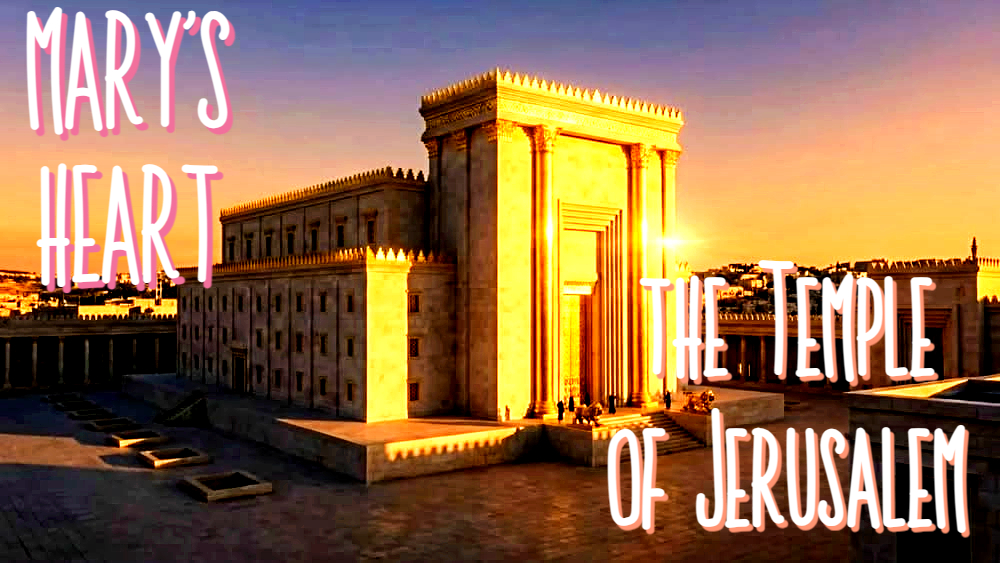
Thought for the Day – 19 August – Mary’s Heart, the Temple of Jerusalem

St John Eudes – The Admirable Heart of Mary

Mary’s Heart, the Temple of Jerusalem Part Two

St. Epiphanius and St. John Damascene, together with several other Doctors, tell us that the golden candlestick is a figure of the Holy Mother of God. Next to Jesus, her beloved Son, Mary is the most luminous torch and the brightest light of the House of God. “O virginal candlestick,” says St. Epiphanius,” which enlightened those who sat in the shadow of death! O virginal torch, which dissipated the gloom of hell, and caused the brilliance of heaven to shine in our souls! O radiant lamp, ever filled with the oil of grace and light, with the fire of divine love, lighting our minds and inflaming our hearts! This virginal light has spread its splendour throughout the world!”

The remarkable table in Solomon’s temple, described in the twenty fifth chapter of Exodus, was made by divine command from the wood of Setim, not a common variety of cedar, but according to the Septuagint, a most rare and altogether incorruptible wood. The table was completely covered with gold-plate and edged with a gold-plated cornice or border surrounding it like a crown while two additional golden crowns embellished it. It was designed to hold the loaves of proposition that were offered to God daily by the priests, and were thus named because they lay in the temple as a perpetual sacrifice proposed or exposed to the Divine Majesty. Afterwards they were consumed by the priests.

The Fathers of the Church all agree that the loaves of proposition were a figure of Our Lord Jesus Christ, the royal bread that came down from Heaven. Christ is the bread of the angels, the bread of God, the bread of the children of God, a bread which is the nourishment and life of the Christian soul, and all Christians are called priests in Sacred Scripture: Fecisti nos Deo nostro sacerdotes. Some are priests by office and bear the special character of consecrated priesthood; others share it by participation. What is the table bearing this divine bread, prefigured by the table carrying the loaves of proposition? St. Germanus, Patriarch of Constantinople, answers that it was the Blessed Virgin Mary and St. Epiphanius confirms his words.

Is not the table designed to receive the bread and food laid on it? Is it not true that the Heart of the Mother of God was the first to receive Our Lord as He came forth from the bosom of the Eternal Father? Did she not receive Him in order to give Him to us? Is it not true that the Eternal Father carries His Beloved Son in His all-glorious Heart from all eternity and that the Blessed Virgin will carry her Son in her Heart for all eternity? Hence we hear the words which the Holy Ghost puts on Mary’s lips: “I was with him,” that is, with the Eternal Father, “forming all things.” In the Hebrew version this passage reads: “I was with Him and near Him as a nurse,” which reveals Mary’s role as the Mother who gives nourishment to mankind.

Several learned interpreters of Sacred Scripture teach us that the altar of perfumes of the Mosaic temple represents the hearts of the faithful, which are symbolized as altars on which each one should offer a perpetual sacrifice of prayer and praise to God. Now if the hearts of the children of God were figured by this altar, how much more truly does it symbolize the Heart of the Mother of God, which is after the Heart of Jesus, the first and holiest of all altars? It is “the golden altar, which is before the throne of God,” mentioned in the eighth chapter of the Apocalypse. On this altar the Mother of the Saviour offered to God a sacrifice of love, adoration, praise, thanksgiving and prayer far more to His Divine Majesty than all the sacrifices that ever were or ever shall be offered on all other altars.

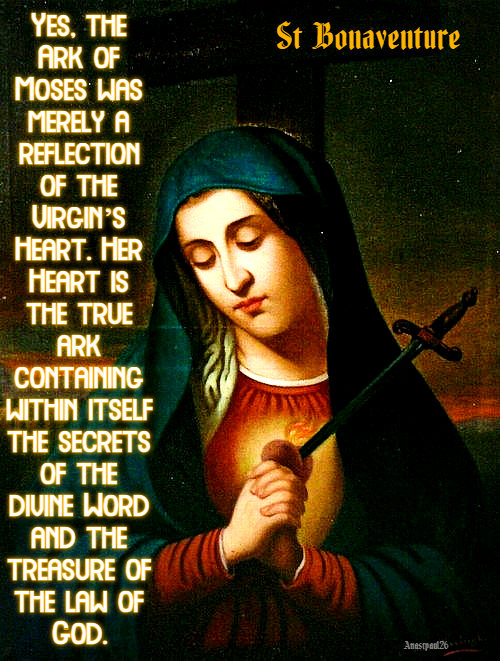
If we consult the Fathers of the Church we learn particularly from St. Ambrose that the Ark of the Covenant was a figure of the Blessed Virgin Mary, and therefore of her most holy Heart, the holy Heart, the first and noblest part of her person. “Yes,” exclaims the seraphic St. Bonaventure “the Ark of Moses was merely a reflection of the Virgin’s Heart. Her Heart is the true ark containing within itself the secrets of the divine Word and the treasure of the law of God.” A holy Abbot of the Cistercian Order calls Mary the Ark of Sanctification, containing revelations written by the hand of God. She is the holy Ark of the Covenant, the Covenant by which God reconciled us with Himself and pledged His alliance with us forever. Next to God, Mary’s Heart should be the first object to which we look up when we pray.


But let us remember that the Heart of Mary is a tower of ivory, zurris eburnea, which does not suffer within its precincts anything defiled and unclean. It is the tower of David, open only to those who follow the meekness of Jesus Christ, the true David.

St. Gregory of Nyssa states that the Tables of the Mosaic Law kept in the temple of Solomon were a figure symbolic of the hearts of the Saints. Now, if the hearts of the Saints are real tables of the evangelical law, what shall we say of the holy Heart of the Queen of Saints, who is the Mother of the Saint of saints? Her glorious Heart is the first and holiest table of the Christian law. It is not made of stone, but of gold, or better still, of diamond; it is not dead but living; not breakable like the tables of Moses but indestructible. On it the Holy Ghost, the finger of God, has written and engraved in golden letters, not merely the will of God and His laws, but all the counsels, maxims and-truths of the gospel as well. They are so deeply engraved that the united forces of hell and of earth could more easily snatch the sun from the sky and-destroy the world than remove a single iota or tarnish a single letter of this sacred writing.

The Propitiatory is regarded as another figure symbolic of the glorious Virgin because by her intercession the flame of God’s wrath was extinguished, His Divine Majesty was turned to look upon mankind with favor and His infinite mercy moved Him to compassion for our infirmities. For this reason St. Ildephonsus calls the Mother of Grace; Propitiatio humanae salutis. “The propitiation of man’s salvation.” St. Andrew of Crete styles Mary: Universi mundi commune propitiatorium. “The universal propitiatory of the entire world.”

St. Augustine, St. Gregory the Great, and several other Fathers say that the Altar of Holocausts also symbolized the hearts of all the Saints, who are the real altars on which God is honored by the spiritual sacrifices offered day and night to His Divine Majesty. Yet much more truly can this be said of the Holy Heart of Mary. “Her Heart is the true altar of holocaust,” says the illustrious John Gerson, “and on it the sacred fire of divine love blazed day and night.” The Mother of the Sovereign Priest constantly offered to God sacrifices of love, praise, thanksgiving, expiation for the sins of the world and every possible sacrifice. On the altar of her Heart Mary sacrificed to God all the things of the world and every creature of the universe as so many different victims. She sacrificed her being, life, body, soul, all her thoughts, words and actions, the employment of her senses and faculties, and in general, all that she was, all that she possessed and every power of her soul. She offered to the Divine Majesty the very sacrifice that her Son Jesus Christ offered on Calvary. Our adorable Saviour offered Himself to the Eternal Father only once on the altar of the Cross, but His holy Mother immolated Him ten thousand times on the altar of her pure Heart.

What veneration is then due to this sacred altar! Be thou blessed, O God of my heart, for having consecrated this most worthy altar to the glory of thy most adorable majesty. Deign to transform our cold hearts into glowing altars on which we may offer Thee an unremitting sacrifice of praise and love.

Posted in AUGUST - The Immaculate Heart of Mary

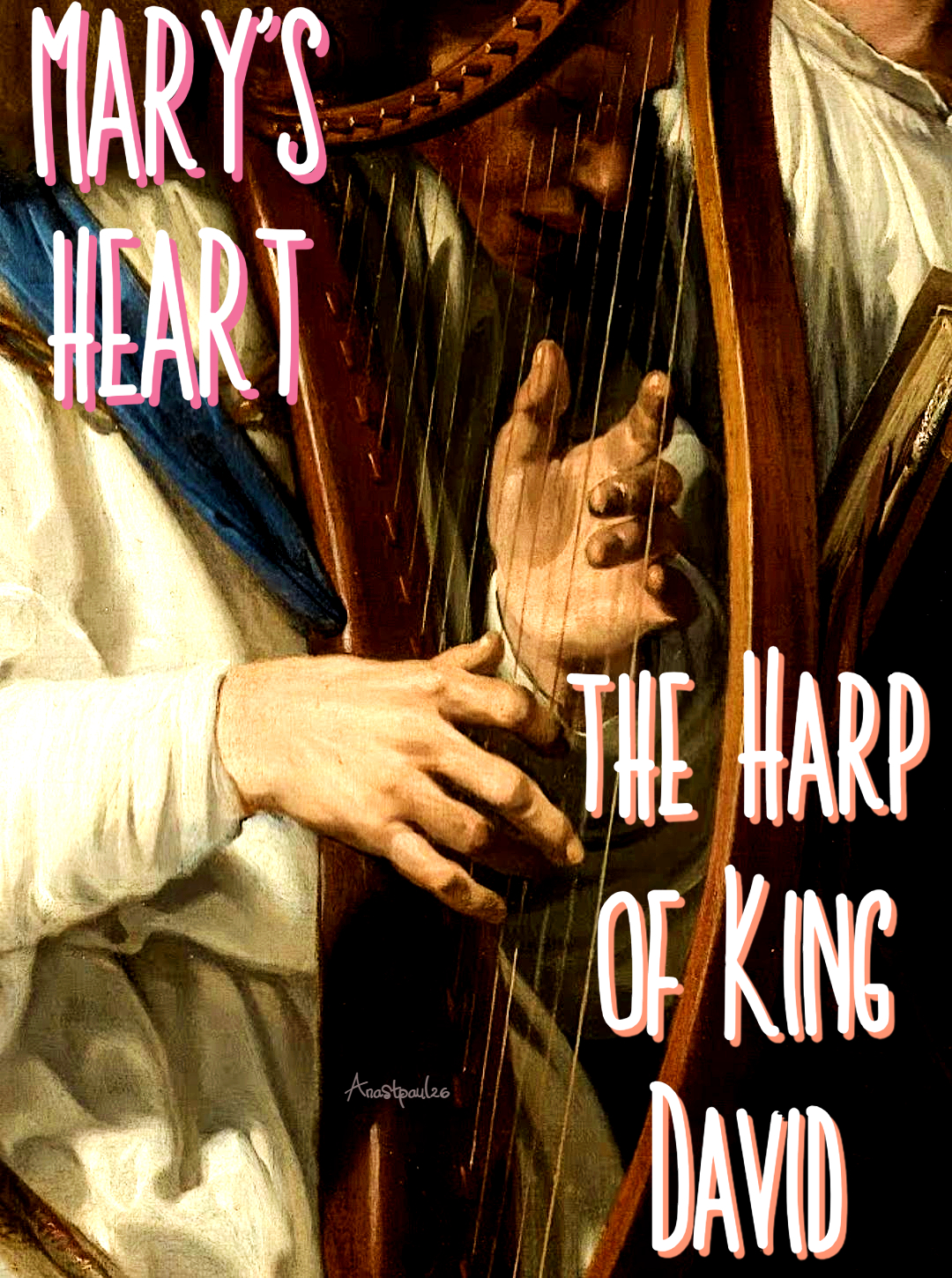
Thought for the Day – 16 August – Mary’s Heart, the Harp of King David

St John Eudes – The Admirable Heart of Mary

Mary’s Heart, the Harp of King David

The mysterious harp of King David, mentioned in several passages of Sacred Scripture, is another symbolic picture of the Holy Heart of Mary. It is an excellent representation because her pure Heart was indeed the harp of the true David, namely Our Lord Jesus Christ. He fashioned it with His own hands; He alone always possessed it. No other fingers but His ever evoked its melodies, because her virginal Heart never vibrated with sentiments, affections or impulses other than those inspired by the Holy Ghost.

The strings of this royal harp are the virtues of Mary’s Heart, especially her faith, hope, love of God, charity towards her neighbor, religion, humility, purity, obedience, patience, mercy, hatred of sin, love of the cross. On these twelve strings the Divine Spirit played with wondrous harmony melodious canticles of love which so greatly charmed the ears of the Eternal Father that He forgot His anger against sinners, He laid aside the thunderbolts wherewith He vowed to destroy mankind and gave His own Son to be the Saviour of humanity.

Sacred Scripture tells us that King David employed his harp specially on four great occasions and we see Jesus, the Son of David, using His mystical harp to accomplish four infinitely greater achievements. In the first instance, David, the man of God, by the mere sound of his harp, put to flight the evil spirit which possessed Saul. Similarly, the new David used the Heart of His loving Mother as a sublime harp and consequently freed by its divine music the human race that grovelled under the evil dominion of Satan.

The prophet David also employed His harp to sing many psalms and canticles to the honor and glory of God. Our true David, likewise, sang with His instrument five types of canticles in praise of the Most Blessed Trinity. The first were canticles of love, the strongest, purest, most perfect love that ever was or shall be. The second were canticles of praise and thanksgiving for the benefits of divine goodness on behalf of all creatures, for the Blessed Virgin Mary did not limit herself to thanking God for the infinite favors she received from His hand, but she praised Him unceasingly for the graces He pours on all created beings. The third were canticles of sorrow, of anguish and bereavement at the time of the sufferings and death of her beloved Son. The fourth were canticles of triumph for all the victories won by herself as general of the great King’s armies over His enemies and, we may truly say, over Himself, having so often disarmed divine vengeance when it stood ready to destroy the world and punish its innumerable crimes. The fifth were canticles of prophecy to announce the great designs of God for the future, many of which were foretold by the Queen of Prophets in the wonderful canticle she composed when greeting her cousin St. Elizabeth.

The third purpose for which King David used his harp was to praise God and especially to praise Him with joy. In like manner, Christ the second David, not only attuned His holy Mother’s Heart to praise and bless His divine Majesty in every way, but He also induced Mary to seek her joy and bliss exclusively in His praises, and in all the acts she performed for His glory and in His service.

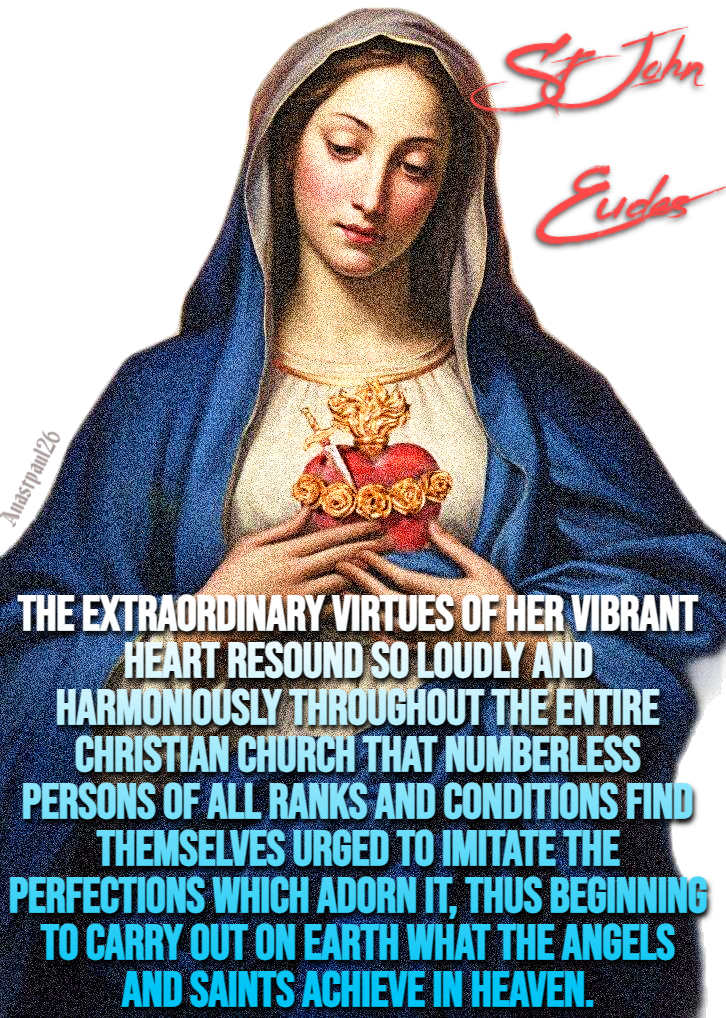
King David chose as the fourth function of his harp to excite and attract other men to the praise of God, with hearts full of joy and gladness like his own. So too Christ the King attracts innumerable souls to the love and praise of His heavenly Father by the sweet sound of His precious harp, that is, by means of the blessed Heart of His glorious Mother. The extraordinary virtues of her vibrant Heart resound so loudly and harmoniously throughout the entire Christian Church that numberless persons of all ranks and conditions find themselves urged to imitate the perfections which adorn it, thus beginning to carry out on earth what the angels and saints achieve in Heaven. In other words, they place their entire contentment and felicity in all that concerns the sovereign Monarch in Heaven and earth.

Posted in AUGUST - The Immaculate Heart of Mary

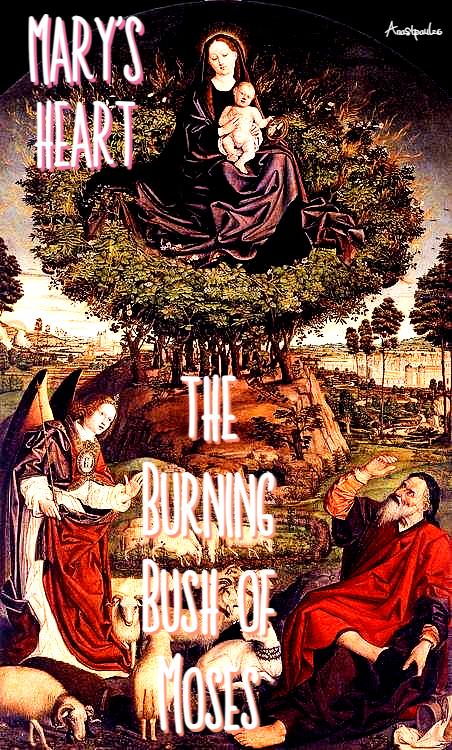
Thought for the Day – 15 August – Mary’s Heart, the Burning Bush of Moses

St John Eudes – The Admirable Heart of Mary

Mary’s Heart, the Burning Bush of Moses

John Gerson, very learned and devout chancellor of the famous University of Paris, when commenting on the Magnificat, says that Mary’s incomparable Heart was prefigured by the burning bush seen by Moses on Mount Horeb.! Gerson does not speak thus without good reason. The extraordinary spectacle of a bush burning in the midst of a blazing fire without being consumed is a beautiful representation of the Heart of Mary, which it excellently portrays in several ways.

First, we should consider that the mountain on whose slopes the bush grew is called in Sacred Scripture “the mountain of God,” mons Dei? It is also spoken of as “a holy mountain,” for Moses heard a voice saying to him: “The place whereon thou standest is holy ground.” We shall easily be convinced, therefore, that it represents the most Blessed Virgin Mary, who is the true mountain of God, a mountain of holiness of whom we can well say with St. Gregory the Great that she is the mountain foretold by the Prophet Isaias as the peak towering above all other heights: “A mountain . . . on the top of mountains,” because God has raised her in dignity, in sanctity and power above the chief Seraphim and the greatest saints.

Secondly, we ought not to despise this insignificant bush, a lowly shrub, the least of all plants. On the contrary, we should regard it with respect, since God so honored this bush as to choose it in preference to the tallest cedars of Lebanon for this manifestation of His glory, amid the fire and flames of its miraculous blaze. Would you know the reason of this? Listen to the Holy Ghost: “The Lord is high and looketh on the low: and the high he knoweth afar off.” Though God is most high and infinitely above His creatures, nevertheless it delights His divine Providence to look with a kind and loving eye at that which is small and lowly. While He draws near to the humble, He surveys the great and mighty from afar, as though He disregarded and despised them. Thus was He attracted by the humility of Mary, His handmaid. Respexit humilitatem ancillae suae.” St. Bernard speaks as follows of the profound humility of Mary’s Heart: “She who in her own mind and heart was the least of all creatures, has rightly been made the first, because, even though she was in fact the first, she considered herself as being the last.” This humility of the Heart of Heaven’s Queen is represented by the lowliness of the mysterious bush of Mount Horeb.

Thirdly, we must not be frightened or horrified by the sharp thorns which guard this bush on all sides, both outside and inside. This should, on the contrary, make us love it more, because God Himself loves it for this reason. It is obvious that God loves all His creatures and hates none of the works of His hands, for it is written: “Thou lovest all things that are, and hatest none of the things which thou hast made.” It is also obvious that God cherished a specially tender love for this little bush, that His Heart was there and that He took pleasure in it. He chose it to be His throne, the place where He would manifest His glory to His servant Moses, where He would speak to His prophet, disclose divine secrets and reveal His providential designs to deliver the Chosen People from Egyptian bondage.

God loved the burning bush because the fire that encompassed without consuming it represented the fire of divine love which filled the Heart of Mary, a love far greater than that of all the hearts of men and angels. The thorns symbolized the bitter sorrow and unspeakable anguish which pierced the Heart of the Mother of God, suffering that she accepted for the love of God and the salvation of mankind.

Moreover, God descended from Heaven into the bush on Mount Horeb and manifested Himself to Moses, “in the flame of fire,” to show His love and charity towards his people, and spoke “from the midst of the bush,” or according to another version “from the heart of the bush,” to declare His intention of delivering the children of Israel from the captivity of Pharaoh through the instrumentality of Moses. In like manner the Son of God, in the excess of His love, descended from the bosom of the Eternal Father into His Mother’s Heart, ablaze as it was with love for God and charity towards men, in order to bring about our redemption and to associate her with Himself as the instrument of this great work.

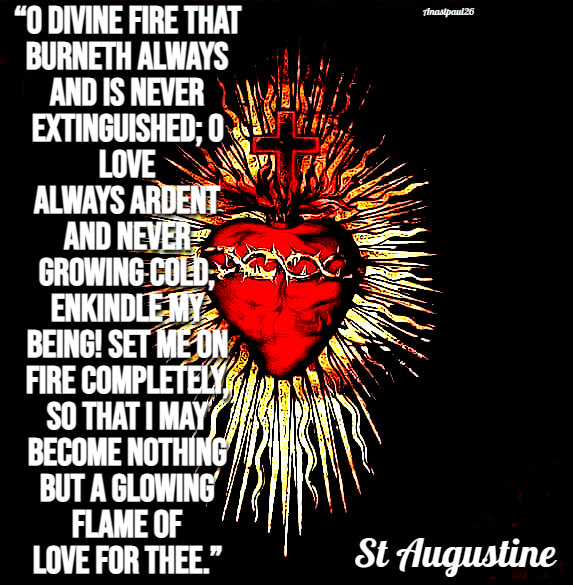
Likewise, dear reader, do not forget that your heart must burn with the loving fire that enkindled the virginal Heart of Mary, the fire that the Son of God came to spread upon earth, or else it must burn forever in the dreadful conflagration prepared for the devil and his cohorts. Oh, what a difference between these two kinds of fire! The devouring flames that torment eternally without consuming, and the delightful, joyous flames that constantly ravish the hearts of the ardent seraphim! Rejoice, each one of you who reads or listens to these words! Give thanks to God that you are still alive, that yours is still the power to choose which of these fires shall enkindle your heart. Strive earnestly to extinguish the flame of self-love, of worldliness, the burning of anger, lust, envy and ambition. Give your heart entirely to Jesus Christ, asking Him to set it on fire with His love. For this purpose there is no better prayer than the words of St. Augustine:
“O divine fire that burneth always and is never extinguished; O love always ardent and never growing cold, enkindle my being! Set me on fire completely, so that I may become nothing but a glowing flame of love for Thee.”

Posted in AUGUST - The Immaculate Heart of Mary

Thought for the Day – 13 August – Mary’s Heart, The Garden of Eden

St John Eudes – The Admirable Heart of Mary

Mary’s Heart, The Garden of Eden Part 1

The Garden of Eden described in the second and third chapters of Genesis is one of the most expressive figures drawn by the omnipotent and all-wise hand of God to represent the Heart of His beloved Daughter, the Blessed Virgin Mary. His infinite goodness has given us an excellent picture of her immaculate Heart. The earthly paradise of Scripture is the perfect representation of another paradise; it is the paradise of the first man, Adam, excellently portraying the paradise of the second man, Jesus Christ, Our Redeemer.

To view this picture in its true light, we must consider many aspects of it. Let us begin with the name. If we consult Sacred Scripture, we shall learn that the first paradise was called “a paradise of pleasure,” “a place of pleasure.” The name of the garden of delights can very properly be applied to the admirable Heart of the Mother of God, true paradise of the new man, Jesus Christ. It is a garden of the Beloved, a garden sealed and doubly barred, a garden of delights. The Divine Spirit gives three names to the Heart of His holy bride, and they contain many profound meanings.

In the first place Mary’s Heart is the Garden of the Beloved. Do we not hear the Holy Ghost inspiring her to say: “Let my beloved come into his garden.” Who is the beloved of whom she speaks? Is it not her Son Jesus, the single and only object of her love? Into what garden does she invite Him to come, if it be not her virginal Heart, into which He was attracted, as we have said, by her humility and her love? Such is the explanation of the learned Balingham. The Garden of the Beloved, therefore, is the Heart of the Beloved Bride; the Heart of Mary is the Garden of Jesus.

In the second place, the Admirable Heart of the Mother of God is a sealed garden. Her heavenly Spouse says of her: “My sister, my spouse, is a garden enclosed, a garden enclosed, a fountain sealed up.” But why does He twice repeat that it is an enclosed garden? He thereby means to teach us that the Heart of His Beloved Bride is absolutely shut against two things: it is shut against sin, which together with the serpent, the author of sin, never entered there: and it is shut against the world and all things of the world, against everything that is not God. He alone has always occupied this garden entirely, and there never existed place in it for anything else.

The third name given by the Holy Ghost has reference to the prophetic figure, the first Paradise, and He calls it a garden of delights, locus voluptatis, paradisus voluptatis.” Mary’s spotless heart is indeed a garden of rapture for the Son of God a garden where He experienced joys which were His greatest delights after those enjoyed from all eternity in the heart and bosom of His Eternal Father.

If Thou dost assure us, O Jesus, that Thy delight is to be with the children of men, even though they are full of sin, ingratitude and infidelities, what must not have been Thy delight in the most amiable Heart of Thy Blessed Mother, where Thou didst never meet anything displeasing to Thee, but found Thyself always praised, glorified and loved more perfectly than in the Paradise of the Cherubim and Seraphim? One can easily say that, after the adorable Bosom of the Eternal Father, no place ever was or will be so holy, so worthy of Thy majesty, so filled with glory and contentment for Thy delectation as the virginal Heart of Thy most amiable Mother.

I see three principal objects in the garden of the First Adam. I see the Tree of Life and the Tree of Knowledge of Good and Evil, planted in the centre of Paradise. I see also many other trees bearing all kinds of fruit, agreeable to look upon and delightful to taste. In the second Garden, I behold incomparably better trees, of which the first are but shadows. I see the real Tree of Life, Jesus Christ, the only Son of God, Whom the Father planted in the midst of this divine paradise of the virginal Heart of His most Holy Mother, when the Angel said to her: “The Lord is with thee.” St. Augustine thus explains this passage: “The Lord is with thee, to abide first in thy Heart and then in thy virginal womb, to fill thy soul before descending into thy chaste bosom.”

Was it not the fruit of this Tree of Life that restored to us the eternal life which we had lost by eating another fruit given to us by a woman whose name was Eve? Was not the fruit of everlasting life given to us by the hands of a celestial woman whose name was Mary? “What didst thou say, O Adam?” exclaims St. Bernard. “ “The woman whom Thou didst give to me gave me of the fruit, and I did eat” These words tend to increase thy guilt, rather than diminish it. Change this unjust excuse into words of gratitude, and say: ‘Lord, the woman thou gavest me, gave me of the fruit of the Tree of Life, and I did eat, and my mouth found it sweeter than honey, because by this precious fruit Thou hast restored me to life.’ ” Then the Saint adds: “O Marvellous Virgin, worthy of every honor! O woman to whom the highest veneration is due, who are admirable above all others, who hast repaired thy parents’ fault and hast imparted life to those who will come after thee!”

Such is the first tree I behold in the second Paradise, the Virginal Heart of Mary, which is more of Heaven than of earth. But I also see there the Tree of Knowledge of Good and Evil, because the luminous and most enlightened Heart of the Mother of God has been filled with the science of the Saints, with the wisdom and science of Jesus Christ, the Saint of Saints. Her Heart is the dwelling-place of the Sun, ever united to Him in Whom all the treasures of God’s wisdom and knowledge are hidden. Mary’s heart has therefore perfectly known the sovereign good, which is God, and the supreme evil, which is sin. She did not know sin, however, as Adam and Eve knew it, by transgressing the commands of God; she knows sin in the light of God and as God knows it, hating it as God hates it.

Posted in AUGUST - The Immaculate Heart of Mary

Novena to Our Lady of the Assumption – Day Seven – 12 August

Novena to Our Lady of the Assumption

DAY SEVEN:

Daily Prayer:
Lord Jesus Christ,
Thou has destroyed the power of death
and given the hope of eternal life,
for body and soul.
Thou granted Thy Mother
a special place in Thy glory
and did not allow decay to touch her body.
As we rejoice in the Assumption
of the Blessed Virgin Mary,
grant us renewed confidence
in the victory of life over death.
Amen

Day 7:
Mary, Queen of every heart,
accept all that we are
and bind us to Jesus and to thyself,
with the bonds of love,
so that we may be thine forever
and may be able to say in all truth:
“I belong to Jesus through Mary.”
Our Mother, Assumed into Heaven
and Queen of the Universe,
ever-Virgin Mother of God,
obtain for us our petitions,
if it be for the glory of God
and the good of our souls.
………………………………..
(Mention your request)

Our Mother, assumed into Heaven, we love thee.
Give us a greater love for Jesus
and for thee.
O Queen Assumed into Heaven, pray for us.
Amen

Posted in AUGUST - The Immaculate Heart of Mary

Thought for the Day – 12 August – The Blessedness of the Merciful

St John Eudes – The Admirable Heart of Mary

Mary’s Heart, The Sea

The Admirable Heart of the Blessed Virgin Mary is not only a fountain, as we have seen, it is also a sea, of which the ocean created by God on the Third Day is a beautiful figure. This is the fifth symbolic picture or representation of Our Lady’s immaculate Heart.

The Holy Ghost declares that Mary, His most worthy Bride, is a sea. A humble and learned writer who, while revealing his brilliant gifts in his excellent commentary on the psalms, has chosen that his name and person remain unknown, teaches us that the name of sea is given in Sacred Scripture to the glorious Virgin because she is indeed a sea of purity, vast in extent and in usefulness. We shall consider shortly that Mary is an ocean in purity and in extent. As for usefulness, this holy Doctor tells us that just as the sea does not permit the adjoining land to remain sterile, so the souls who approach the Mother of God with true devotion bring forth abundant fruits of benediction, thanks to the graces she lavishly bestows on them. Let us say of her Heart that it is a sea full of great and wondrous riches.

In the order of nature, the sea is one of the greatest marvels of God’s omnipotence. “Wonderful are the surges of the sea.” * God, Who is great everywhere, is especially admirable in the sea. “Wonderful is the Lord in the depths.” The holy Heart of Mary is an ocean of wonders and an abyss of miracles, It is the extraordinary masterpiece of essential and un-created Love, in which the effects of infinite power, wisdom and goodness shine more brilliantly than in all the hearts of angels and men.

What is the sea? It is the gathering of the waters, says Sacred Scripture, or if you prefer, it is the place where all the waters are gathered. “Let the waters that are under the heaven, be gathered together into one place.” And the sacred text adds: “The gathering together of the waters, he called Seas.” Now what is the august Heart of Mary? It is the place where are gathered and united the living waters of all graces springing from the Heart of God, as from their first source. St. Jerome says: “Grace is divided among other saints, but Mary possesses the plenitude of sanctity.”

All the graces of heaven and earth merge their waters in the great sea of the Holy Heart of the Mother of the Saint of Saints. “In me is all grace of the way and the truth.” In Mary’s Heart are all the graces of the angels and of men, all the graces of the Seraphim, Cherubim, Thrones, Dominations, Virtues, Powers, Principalities, Archangels and Angels, all the graces of the holy Patriarchs, Prophets, Apostles, Evangelists, disciples of Jesus, martyrs, priests and levites, confessors, hermits, virgins and widows, of the Holy Innocents and of all the blessed in heaven. There is no overflow of grace in Mary; she is not overwhelmed, for her Heart is worthy of all the gifts and all the liberalities of God’s infinite goodness, and is capable of receiving and using them all for the glory of His Divine Majesty.

St. Bernardine of Siena tells us that all the gifts and graces of the Holy Ghost descended into the soul and heart of this heavenly Virgin in such fulness, especially when she conceived the Son of God within her chaste womb, that her Heart forms an abyss of grace which no human or angelic intellect can comprehend. The mind of God, that of her Son, Jesus Christ, and her own, are alone capable of understanding the abundance and perfection of this ocean of grace.

The sea does not hoard its waters, but freely dispenses them to the earth through the rivers, which flow into the ocean only to come out of it again, that they may water the whole earth and make it bear all kinds of fruit. “Unto the place from whence the rivers come, they return, to flow again.” The Heart of our munificent Queen does not withhold any of the graces she receives from the generous hand of God. She returns them all to the first source, and waters the barren earth of our hearts to the extent needed to make them fruitful for God and for eternity. “That we may bring forth fruit to God.”

Her heart is an ocean more strong than the firmament itself, that sea of which St. John speaks in the Apocalypse: “And in the sight of the throne was, as it were, a sea of glass like to crystal; a sea of glass mingled with fire, and them that had overcome the beast . . . standing on the sea of glass, having the harps of God.”

Posted in AUGUST - The Immaculate Heart of Mary

Thought for the Day – 11 August – Mary’s Heart, The Inexhaustible Fountain Part 2

St John Eudes – The Admirable Heart of Mary

Mary’s Heart, The Inexhaustible Fountain Part 2

Her most generous Heart is indeed a fountain of living waters whose salutary streams flow on all sides, over the land of the wicked as well as of the just, in imitation of the All-good and All-merciful Heart of our Heavenly Father who causes His providential rain to fall on the good and the bad alike. This is the reason why the Holy Ghost calls the charitable Heart of the Mother of Mercy “the fountain of gardens,” fons hortorum. In another passage He names it the fountain that “shall water the torrent of thorns.” What are these gardens, what is this torrent of thorns, watered by this beautiful fountain?

The gardens are all the Orders of the Church that lead a truly Christian and holy life. They are delicious gardens for the Son of God, blooming with flowers and fruit that the Spouse longs for when she exclaims: “Stay me up with flowers, compass me about with apples: because I languish with love.” These mystical gardens likewise represent all holy souls, no matter what their state or condition, in whom the heavenly Bridegroom finds His delight among the flowers of holy thoughts, desires and affections, and among the refreshing fruits of virtues and good works.

The thorns represent the wicked, whose lives are infested with the thorns of their sins, This torrent is the world, which resembles an impetuous torrent, full of refuse and evil odors, making much noise, but flowing swiftly past, dragging the majority of men into the abyss of perdition. “The world passeth away, and the concupiscence thereof.”

But the Heart of the Mother of Mercy is so full of goodness that its effects are felt even by the torrent of thorns, or rather, by the poor thorns which are swept in this torrent to be thrown into the eternal whirlpool of hell. The wonderful waters of her holy fountain, coming in contact with these barren and dead thorns, fit only for eternal fire, cause many of them to awaken to new life, and some are even transformed into beautiful trees that bear quantities of good fruit, worthy to be placed on the table of the Eternal King. The reason is that this fountain’s divine waters are not only living, but lifegiving. Mary’s Heart is, therefore, not only a fountain of living waters but a fountain of life, and of life eternal.

But it is not enough to love life without furnishing the substance to nourish and sustain it. For this reason, Mary’s maternal Heart is not only a fountain of living and life-giving waters; it is, moreover, a fountain of milk, of honey, of oil and of wine.

The Heart of the Mother of Fair Love is a fountain of milk and honey for all her children, especially for those who are still weak, tender and delicate, not yet capable of taking more solid food.

Her Heart is also a fountain of oil, that is, of mercy for all sinners. It is, moreover, a fountain of wine to give strength and vigor to the weak and comfort to the sorrowful and afflicted, according to the divine words: “Give strong drink to them that are sad: and wine to them that are grieved in mind.”

All those who comfort other men for the sake of charity, and, above all, who work for the salvation of their neighbor, should be inebriated with the wine of divine love! To such as these our charitable Mother, ever burning with zeal for the salvation of souls, cries in a loud voice:

“Come, children, come beloved of my Heart, come, draw from the fountain of your Mother’s Heart the heavenly wine of divine love; drink long and deep; filled with the rapture of the spirit, you need fear no excess. Drink, and be inebriated, my dearly beloved. Drink of this pure wine, father of virginity and of all holy virgins. ‘Wine springing forth virgins.’

“This heavenly wine fills the Seraphim with delight; it inebriated the Apostles of my Divine Son; it filled the Redeemer Himself with holy rapture when, in the excess of His love for you, He renounced the grandeurs of His divinity and humbled Himself in the lowly crib and on the ignominious Cross. Drink with Him of this delicious wine, that you may forget and despise what the world loves and esteems, that you may love and value God alone, and exert yourself with all your might to establish the reign of His love and His glory in the souls of men. Thus will you become the beloved children of His Heart and of my own.”

Who will give me a voice strong enough to be heard in all the world, crying to all men: “All you that thirst, come to the waters: and you that have no money make haste, buy, and eat: Come ye, buy wine and milk without money, and without any price.”

You who thirst vainly after the false honors of the world, come instead to the most honorable Heart of the Queen of Heaven, and you will learn by the example of this Heart’s thirst for the glory of God alone, that true honor consists in following His Divine Majesty: “It is great glory to follow the Lord.” Every other honor is only smoke, vanity and illusion.

You who thirst after the riches of earth, come hither, and you will find incomparable treasures. You who thirst after worldly pleasures, come and you will find the contentment of the angels, the delights of God, the peace and joy of the children of God and of God’s Mother, according to the divine promise addressed to each faithful soul: “Behold I will bring upon her as it were a river of peace, and as an overflowing torrent the glory of the Gentiles.”

Emerge from the filth of the world’s horrible torrent, of the torrent of thorns that is whirling you into the abyss of perdition! Emerge and enter the sweet waters of the river of peace. Give yourself up in holy ecstasy to this torrent of delights.

Posted in AUGUST - The Immaculate Heart of Mary

Thought for the Day – 10 August – Mary’s Heart, The Inexhaustible Fountain

St John Eudes – The Admirable Heart of Mary

Mary’s Heart, The Inexhaustible Fountain Part 1

The fourth symbolic picture of Our Lady’s most blessed Heart is the wonderful fountain that God caused to spring from the ground at the beginning of the world, as described in the second chapter of Genesis. “A spring rose out of the earth, watering all the surface of the earth.” St. Bonaventure tells us that this fountain was a figure of the Blessed Virgin Mary. “She was prefigured in the fountain that sprang from the earth.” But we have equal reason to say that this represented her Heart, which is truly a living fountain whose heavenly waters irrigate not only the whole earth, but every created thing in Heaven as well as on earth. Mary is the sealed fountain of the holy Spouse, which her divine Bridegroom calls “a fountain sealed up,” for it remained sealed not only against the world, the devil and every kind of sin, but it was closed even to the Cherubim and Seraphim, who could not penetrate the marvellous secrets or comprehend the inestimable treasures hidden by God in Our Lady’s pure Heart.

All we can say is that Mary’s immaculate Heart is a fountain of light, a fountain of holy and blessed water, a fountain of living and life-giving water, a fountain of milk and honey and a fountain of wine. It is the source of a great river, nay, of four miraculous streams, and finally, it is the source of an infinity of blessings and goodness.

The Heart of Mary, as well as her name, which means “enlightened” or “the one who enlightens,” and also “star of the sea,” is indeed a true fountain of light. Holy Church considers and honors her as the resplendent door of pure light; Tu porta lucis fulgida, and salutes her as the portal through which divine Light entered the world: Salve porta, ex qua mundo lux est orta. Truly the Heart of Mary is the fountain of the sun, because Mary is the Mother of the Sun of Justice, and this divine Sun is the fruit of Mary’s Heart.

Mary’s Heart is a fountain of water, but one of blessed, holy and precious water. I here speak of the innumerable tears that poured from this sacred fountain and, united with those of the Redeemer Himself, cooperated in our redemption. O Mary, how many streams of tears have flowed from thine eyes, with their source in thy loving, charitable, devoted and merciful Heart! Tears of love, tears of charity, tears of joy, of sorrow and of compassion! How often did not the ardent love of the maternal Heart for thy infinitely lovable Son cause thee to shed bitter tears, beholding Him so little loved, so much hated, offended and dishonored by the majority of men, although it was the duty of man to serve Him? How often thy burning charity for souls caused thee to weep because through their own malice, millions of precious souls would be lost, notwithstanding all that He did and suffered in order to save them? How many times have the holy angels witnessed tears of sublime devotion coursing down thy beautiful face, as thou wast absorbed in holy communion with the Divine Majesty? All the saints were granted the gift of tears, which could not possibly have been wanting in the Mother of Sorrows who has assured us that she possesses the fulness of gifts bestowed on all the saints.

The most pure Heart of Mary is also a fountain of living water, which means a fountain of grace. This ought not to astonish us, for the Archangel Gabriel declared long ago that the Mother of the Saviour was full of grace, gratia plena, and the Church calls her Mater gratiae, Mother of Grace, and Mater divinae gratiae, Mother of Divine Grace. The Angelic Doctor, St. Thomas, affirms that Our Lady is so full of grace that out of her abundance she can dispense graces to all men.

Posted in AUGUST - The Immaculate Heart of Mary

Novena to Our Lady of the Assumption – Day Four – 9 August

Novena to Our Lady of the Assumption

DAY FOUR

Daily Prayer:
Lord Jesus Christ,
Thou has destroyed the power of death
and given the hope of eternal life,
for body and soul.
Thou granted Thy Mother
a special place in Thy glory
and did not allow decay to touch her body.
As we rejoice in the Assumption
of the Blessed Virgin Mary,
grant us renewed confidence
in the victory of life over death.
Amen.

Day 4:
O Dearest Mother Mary, Assumed into Heaven,
God placed thee at His right hand
that thou may intercede for his little ones
as the Mother of God.
In the midst of all the saints
thy stand as their Queen and ours —
dearer to the Heart of God
than any of creation.
Pray for thy children
and grant us every grace
won by our loving Saviour on the Cross.
Please intercede for us in our needs
and ask thy divine Son Jesus
to grant our request if it be for the
good of our souls.
………………………………..
(Mention your request)

O Queen Assumed into Heaven, pray for us.
Amen

Posted in AUGUST - The Immaculate Heart of Mary

Thought for the Day – 9 August – Mary’s Heart, The Centre of the Earth

St John Eudes – The Admirable Heart of Mary

Mary’s Heart, The Centre of the Earth

The third symbolic picture of the most noble Heart of Mary is described in the inspired words: “God hath wrought salvation in the midst of the earth.”

What is this earth and what is its center? I find several meanings of the word “earth” as mentioned in Sacred Scripture, among which two seem to be most important. The first is the earth created by God at the beginning of the world, which He gave to Adam and his descendants. “But the earth he has given to the children of men.” The second is the earth made for the new man, Jesus Christ, Our Lord, to whom the following words were spoken: “Lord, thou hast blessed thy land.” The first earth incurred the wrath of God because the first man sinned. Cursed is the earth in thy work.

The fallen earth is a land of misery and darkness, of disorder and death, a land of never-ending woe. In the words of Job, it is “a land of misery and darkness, where the shadow of death, and no order, but everlasting horror dwelleth.”

The second earth is a land of blessings, grace and light, a land of eternal life, a land that has become nobler, more august, more luminous and holier than all the heavens. What is this priceless renewed earth? It is the most Blessed Virgin Mary, of whom the first earth, considered as it left the hands of God and existed before being cursed by God, is only an imperfect image and sketch. Of this earth did the Holy Ghost speak in Scripture: when He said through the Prophet, Isaias: “Let the earth be opened, and bud forth a saviour.” It was in Mary, the center of this blessed earth, that God worked out the salvation of mankind. “He hath wrought salvation in the midst of the earth.” Both St. Jerome and St. Bernard apply these words to the Blessed Virgin Mary. Notice, however, that the Holy Ghost who uttered these words through the lips of the Royal Prophet, David, does not proclaim merely that God worked the salvation of the world in this earth, but in the midst of the earth, in medio terrae, or according to another version, in intimo terrae, in the center or in the heart of the earth. By that is meant the heart and bosom of the spotless Virgin Mary. Yes, it was in the midst of this “good earth,” or better, in the good and excellent Heart of Mary, Mother of Jesus Christ, “in a good and perfect heart,” that the Eternal Word, coming forth from the Father’s bosom to save mankind, was received and zealously nourished, producing fruit a hundredfold and one hundred thousand times a hundredfold.

Even as Mary conceived and will eternally bear her Son Jesus Christ in her Heart, she also conceives and holds forever in the same Heart all the holy members of our Divine Head. They are her beloved children, the fruits of her maternal Heart, and she offers them to the divine majesty as a perpetual sacrifice. Thus did Our Lady, “the good earth,” fructify the grain of wheat which she received from God. Her Son had to die even as the seed must die and, as it were, become annihilated that He might not remain alone, but might produce numberless other grains. In this sense did the King of Kings work out our salvation in the center of the earth.

I could quote many holy Fathers and illustrious Doctors to show how Almighty God saved mankind “in the midst of the earth,” that is, in the Holy Heart of Mary, Mother of Jesus. Her Heart cooperated with His divine mercy, having received such a plenitude of grace, according to the Angelic Doctor, St. Thomas, that she became enabled to cooperate with her Son in the salvation of all men. This inspires St. Bonaventure to say that her Heart is the source of universal salvation. “All salvation springs from Mary’s Heart.”

All this being conceded, what must be our obligations towards the most charitable Heart of our Blessed Mother! What gratitude can we show, what praises can we sing, what feast can we celebrate in honor of her Heart, that will be worthy of her excessive charity towards us, and of the favors granted to us by divine mercy through her intercession? Mary is the center of the earth in which our salvation was wrought. She is also the center of the renewed world, the Christian world, the world of the new man, the world of divine love and holy charity.

O Jesus, true Heart of Mary, take possession of our hearts, and draw them nigh to Thee. Inspire them to love, desire, seek and relish only Thee. May they ever long for Thee, may they always seek their rest and happiness in Thee, may they remain in Thee forever and be consumed in the ardent furnace of Thy Divine Heart so as to be transformed eternally in Thee!

Posted in AUGUST - The Immaculate Heart of Mary

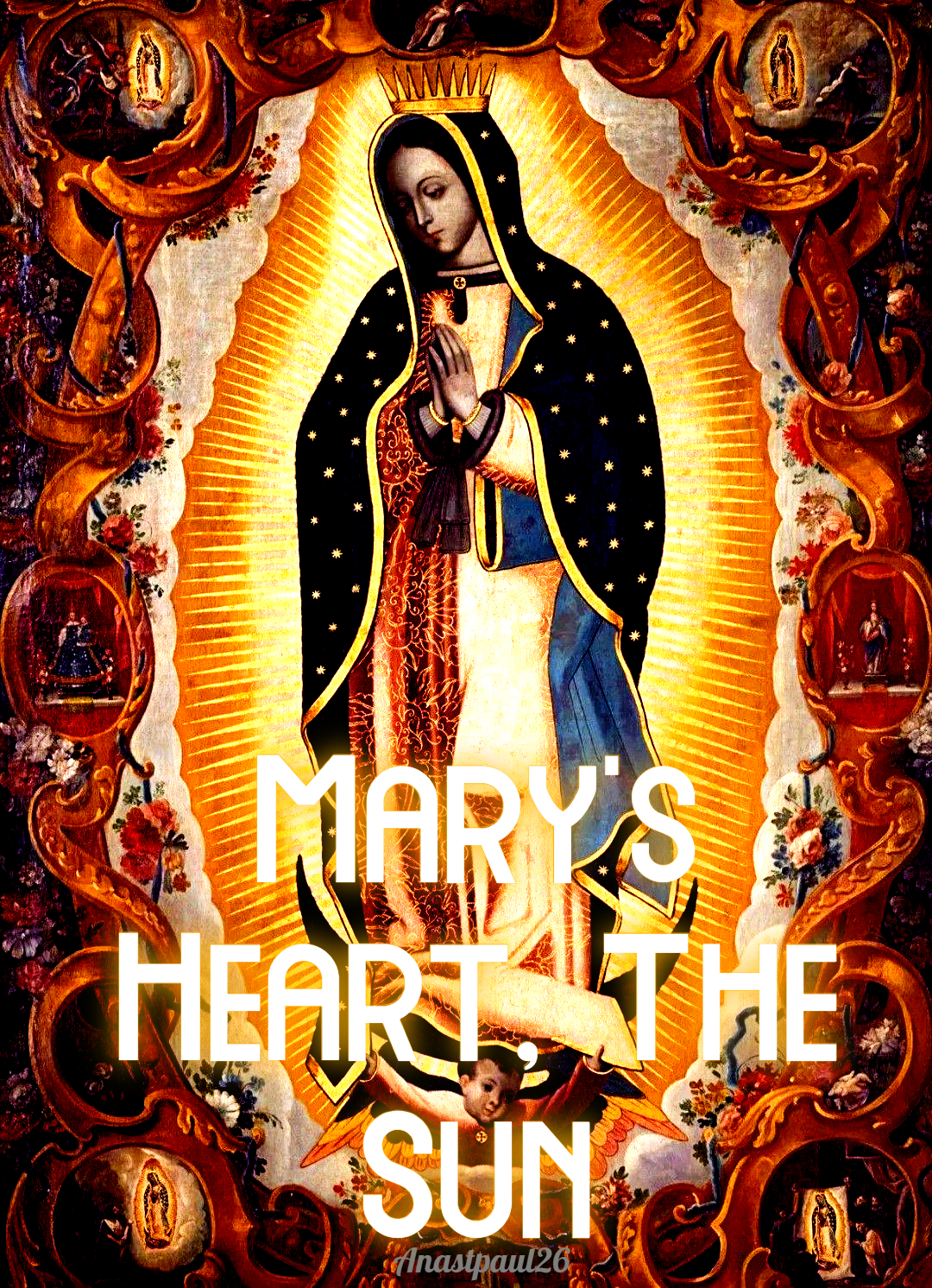
Thought for the Day – 8 August – Mary’s Heart, The Sun

St John Eudes – The Admirable Heart of Mary

Mary’s Heart, The Sun

The sun is the second symbolic picture which God, the Creator of heaven and earth, has deigned to give us of the Immaculate Heart of the Queen ~ of heaven and earth. God did not create the natural sun, our wonderful luminary, merely to enlighten our material world; He made it also to be a representation of the excellent perfections which shine in the luminous Heart of the world’s Sovereign Lady.

We should remember that the infinite power of God has divided this great universe into three different states or orders, namely the state of nature, the state of grace and the state of glory. His divine wisdom has nevertheless established such a perfect bond, relationship and resemblance among these three states and among the beings existing in these orders that whatever is in the order of nature is an image-of the things belonging to the order of grace, and whatever belongs to the order of nature and grace is a figure of what is to be seen in the state of glory.

Hence, the sun, which is truly the heart of the visible world, and the most beautiful and glowing gem of nature, gives us, in spite of its dazzling light, only a very faint shadow of our heavenly Sun, the Heart of the Mother of God.

Sacred Scripture calls the sun an admirable vessel, the work of the Sovereign Lord. “An admirable instrument, the work of the Most High. Great is the Lord that made him,” But we can say of the most excellent Heart of the Mother of God that it is an incomparable masterpiece of God’s almighty hand. It is a compendium of all the marvels He has worked in pure creatures, and will be the eternal object of the admiration and delight of angels and men. Great indeed is He who made it, because His divine magnificence appears in her admirable Heart more clearly than in all the other wonderful things of nature, grace and glory.

Mary’s Heart is surrounded, filled, penetrated by light, and her light is incomparably more brilliant and radiant than all the lights of the celestial spaces. It is all light, and after God, it is the first source of the lights which shine in the firmament of the Church. “I made that in the heavens there should rise light that never faileth.”

Yes, hers is indeed the heart of the entire world, the heart of Heaven and earth, the heart of the Church Militant, Suffering and Triumphant, since the Holy Spirit bids us sing: Vitam datam per Virginem, gentes redemptae plaudite. “All ye nations, redeemed by the Precious Blood of Jesus Christ, rejoice, sing the praises of your Redeemer and His glorious Mother! You were condemned to eternal death, and the Son of Mary has made you free; the Mother of Jesus has restored life to you, even eternal life, by giving you her Son, who is Life essential and the source of all life.”

The solar sun has been in perpetual motion since its creation in space, and it travels so rapidly that mathematicians calculate its speed to be over one million leagues an hour. Similarly, the holy Heart of Mary, from the moment of her Immaculate Conception, has been completely kept in motion by love for God and charity towards mankind. As long as Mary, the admirable Sun of Light and Purity, was on earth, she sped or rather flew with such celerity on the path of sanctity that the speed of our material sun is simply a shadow and a figure by comparison. For this holy Sun, Mary’s immaculate Heart, progressed incomparably farther in the mystical and supernatural way of the world of grace than the material sun which revolves around our visible world.

St. Germanus of Constantinople calls the Heart of Mary the happiness of the entire world. Commune mundi gaudium. And St. John Damascene says that it is an ocean of inexhaustible delight: Gaudii pelagus inexhaustum.

“Take away the sun that enlightens our material world,” says St. Bernard, “what will become of day or light? Take away Mary, the Star of the Sea, or take away the Heart of Mary, the true Sun of the Christian World, and what would be left? Without Mary’s radiance, nothing is left but enveloping darkness, the shadow of death and the frightful night of the grave.”

Posted in CATHOLIC Quotes

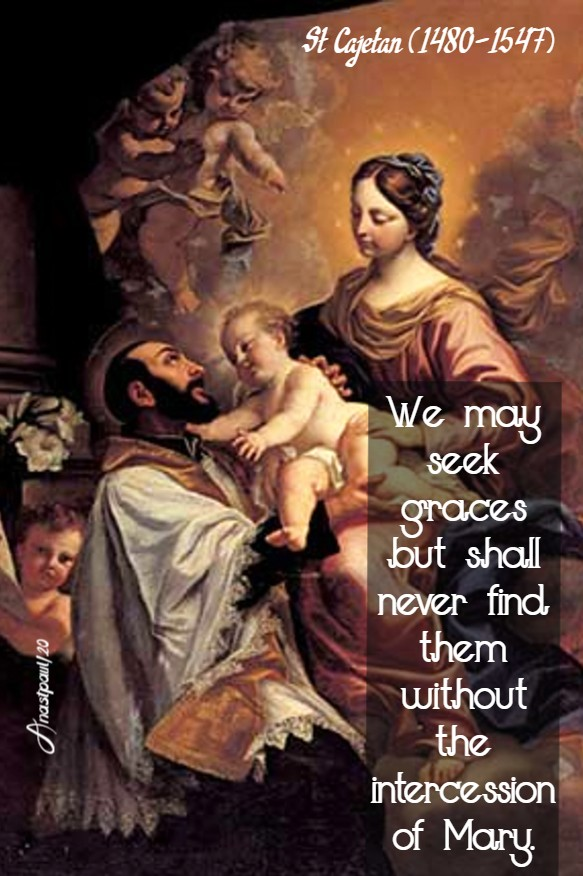
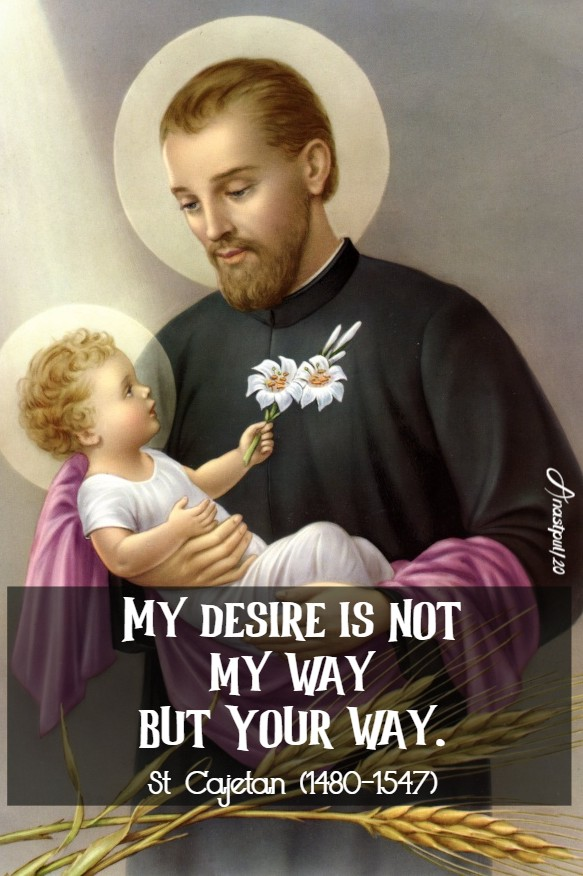
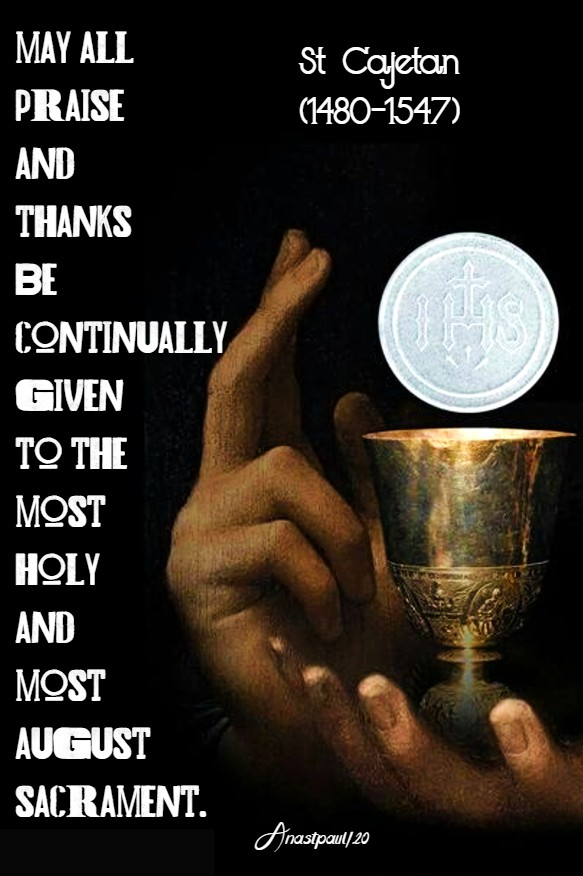
Quote/s of the Day – 7 August –St Cajetan

Quote/s of the Day – 7 August – “Month of the Immaculate Heart of Mary” – The Memorial of St Cajetan (1480-1547)

“We may seek graces
but shall never find them
without the intercession of Mary.”

“My desire is not my way
but Your way.”

“May all praise and thanks
be continually given
to the Most Holy
and Most August Sacrament.”

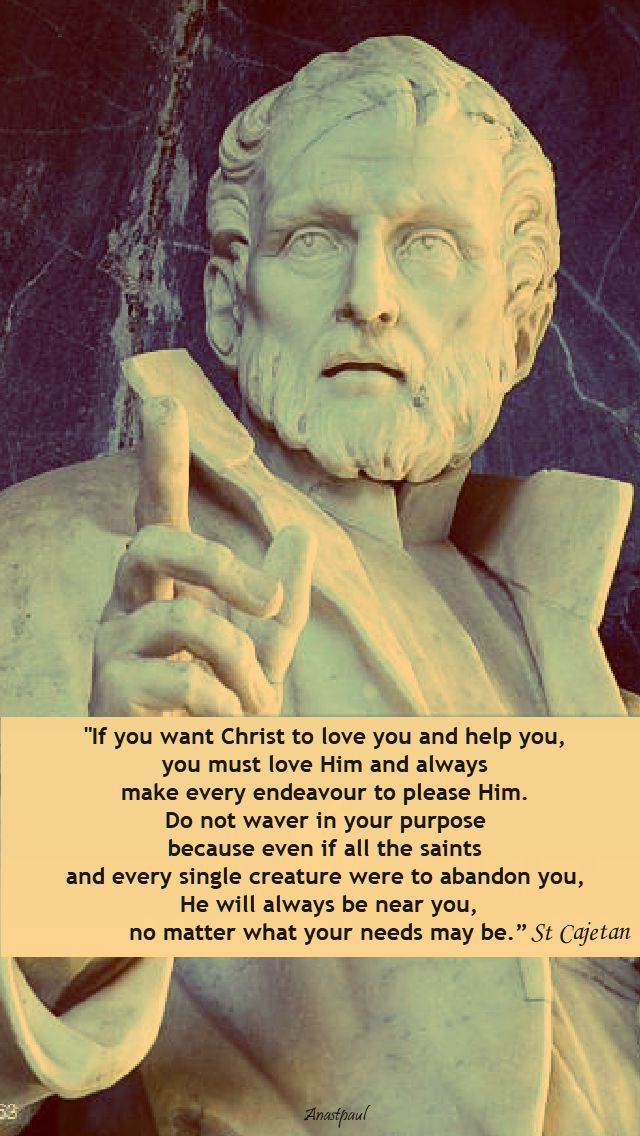
“If you want Christ to love you
and help you, you must love Him
and always make every endeavour to please Him.
Do not waver in your purpose
because even if all the saints
and every single creature were to abandon you,
He will always be near you,
no matter what your needs may be.”

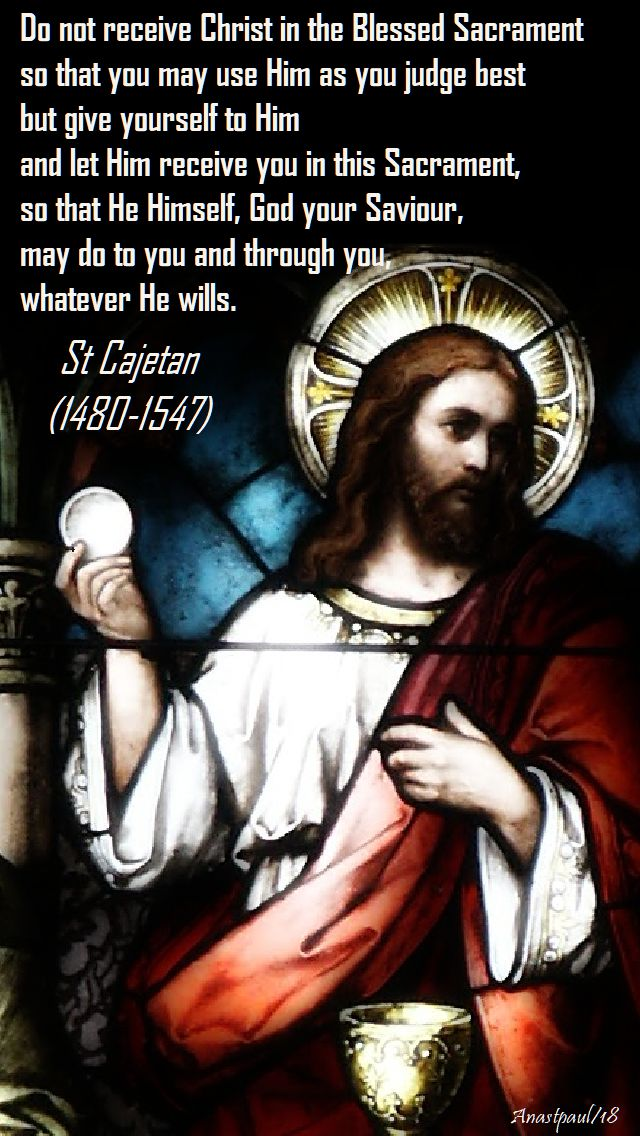
“Do not receive Christ in the Blessed Sacrament
so that you may use Him as you judge best
but give yourself to Him
and let Him receive you in this Sacrament,
so that He Himself, God your Saviour,
may do to you and through you, whatever He wills.”

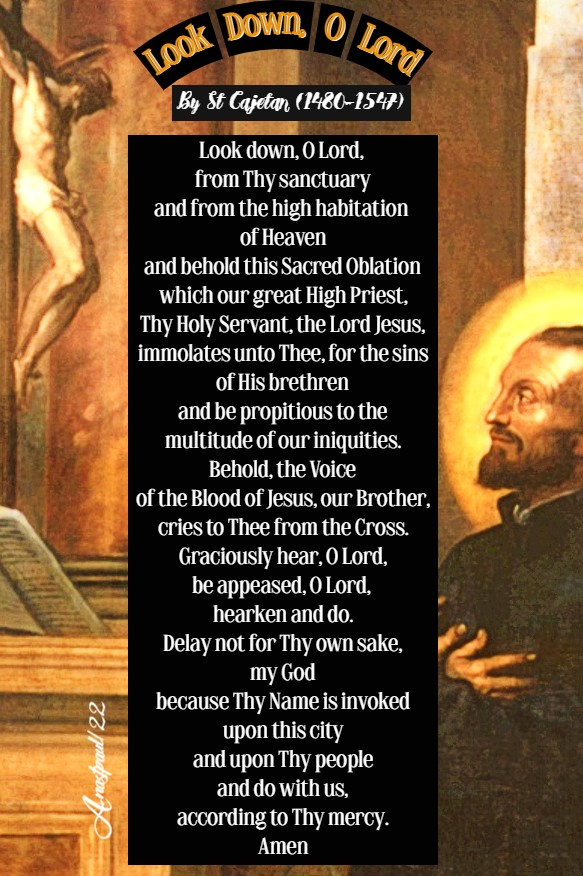
Look Down, O Lord
By St Cajetan (1480-1547)

Look down, O Lord, from Thy sanctuary
and from the high habitation of Heaven
and behold this Sacred Oblation
which our great High Priest,
Thy Holy Servant, the Lord Jesus,
immolates unto Thee, for the sins of His brethren
and be propitious to the multitude of our iniquities.
Behold, the Voice
of the Blood of Jesus, our Brother,
cries to Thee from the Cross.
Graciously hear, O Lord,
be appeased, O Lord, hearken and do.
Delay not for Thy own sake, my God
because Thy Name is invoked upon this city
and upon Thy people
and do with us,
according to Thy mercy.
Amen

Posted in AUGUST - The Immaculate Heart of Mary

Thought for the Day – 5 August – The Divine Heart of Mary

St John Eudes – The Admirable Heart of Mary

The Divine Heart of Mary

Jesus Christ, the Heart of the Eternal Father, is the Heart of His Holy Mother. Is not the heart the principle of life? And what is the Son of God to His dear Mother? He always was and will be forever the heart of her heart, the soul of her soul, the spirit of her spirit, and the sole principle of all the movements, uses and functions of her most holy life. St. Paul tells us that it is not himself who lives but Jesus Christ who lives in him. Our Lord is the life of all Christians: so who could doubt that He abides in His holy Mother, and that He is the life of her life, the heart of her heart, in a union incomparably more excellent even than with St. Paul and the other faithful saints?

Let us listen to what Our Lady revealed to St. Brigid: “My Son was truly my Heart to me. When He left my bosom to be born, it seemed as though half of my Heart were going forth from me. When He suffered, I felt His pain as though my Heart endured the identical sorrows and torments that He endured. When my Son was being scourged and torn with whips, my Heart was scourged and whipped with Him. When Hel ooked at me from the Cross, and I at Him, two streams of tears gushed from my eyes; and when He saw me oppressed with sorrow, He experienced such violent anguish at my desolation that the pain caused by His sorrow was my sorrow as His Heart was my Heart. Because Adam and Eve together betrayed the world for one, single forbidden fruit, so did my beloved Son wish that I should cooperate with Him in redeeming it with one Heart, quasi cum uno Corde.

Jesus lives in her soul and in her body, and in each faculty of her body and soul. He lives in her entirely, which means that whatever is in Jesus is also in Mary. His Heart abides in her heart, His soul in her soul, His spirit in her spirit. The memory, intellect and will of Jesus are alive in the memory, intellect and will of Mary; his interior and exterior senses in her interior and exterior senses. His passions in her passions; His virtues, mysteries and divine attributes are living in her Heart. Nay, more than living, they hold sovereign sway, producing inconceivably marvellous effects and impressing a living image of themselves as her Heart mirrors His Sacred Heart.

This veneration of Mary means honoring the corporeal Heart, the spiritual Heart and the divine Heart of Jesus, who are also the Hearts, or rather, the one and only Heart of Mary. It means giving glory to Our Lord, Jesus Christ, who is the Heart of the Eternal Father, and has willed to become the Heart of His Holy Mother. If Holy Church celebrates an annual feast in honor of the chains of St. Peter, the Prince of the Apostles, how great a solemnity does not the august Heart of the Queen of Apostles deserve!

Posted in AUGUST - The Immaculate Heart of Mary

Thought for the Day – 4 August– The Spiritual Heart of Mary

St John Eudes – The Admirable Heart of Mary

The Spiritual Heart of Mary

The Holy Ghost is wont to describe many things with few words. Wishing to praise the principal faculties of the body and soul of His Spouse, the Blessed Virgin Mary, and to exalt the merits of her Heart, He uses very few words, which nevertheless contain many meanings. What does He say? How does He praise Mary, the sovereign of hearts? He utters only three words: Quod intrinsecus latet (“what is hid within“). But these three words encompass all the great and admirable utterances that can be said or thought of her royal Heart; they reveal to us that it is a treasure hidden from the most enlightened eyes of heaven and earth, a treasure so filled with celestial riches that God alone can have a perfect knowledge of its wonders.

The spiritual heart of the Blessed Virgin Mary is the intellectual element of her soul, comprising her memory, intelligence, will and the supreme point of her spirit. This is the heart which expresses itself in the first words of her admirable Canticle, the Magnificat: “My soul doth magnify the Lord: and my spirit hath rejoiced in God my Saviour.” It is the spirit, the soul’s first and noblest part, which must, in a very special manner, glorify God and rejoice in Him. If the virginal heart beating in the consecrated breast of the Virgin of virgins, the most excellent organ of her holy body, is so admirable, as we have already seen, what must be the marvels of her spiritual heart, the noblest portion of her soul? Is it not true that, as the condition of the soul surpasses that of the body, so also does the spiritual heart excel the corporeal?

First of all, Divine Bounty miraculously preserved the heart of the Mother of Our Saviour from the stain of sin, which never touched it because God filled it with grace from the moment of its creation, and clothed it with purity so radiant that, next to God’s, it is impossible to conceive of greater purity. His Divine Majesty possessed her heart so completely from its first instant that it never ceased for a moment to belong entirely to Him and to love Him more ardently than all the holiest hearts of heaven and earth united.

In the second place, the Father of Light has filled this beautiful Sun with the most brilliant lights of nature and of grace. If we consider the natural illumination shining within Mary, we see that God gave to the chosen Spouse of the Holy Ghost a natural intellect more clear, lively, profound, vaster and more perfect in every way than any other intellect, an intellect worthy of the Mother of God, worthy of the woman destined to guide and rule Divine Wisdom, worthy of the Mistress of the Church and Queen Regent of the universe, worthy of her who was to converse familiarly on earth with the angels of heaven, and what is more, with the King of Angels, for thirty four years, an intellect worthy of the lofty functions and sublime contemplation to which she was consecrated.

As regards supernatural light, the luminous heart of Mary, Seat of Wisdom, was so filled with its radiance that the learned Albert the Great, nurtured in the school of the Mother of God, plainly teaches, together with many other holy Doctors, that there was nothing Our Lady did not know. They assert that she possessed infused knowledge of every science, and in a much more eminent degree than the most learned minds that ever existed.

The vast knowledge of the Blessed Virgin Mary was dedicated to a most holy use, employed only to urge her to love God with greater ardor, to procure the salvation of souls with greater fervor, to hate sin more vigorously, to humble herself more profoundly, to despise still further everything that the world esteems and to prize and embrace with greater affection the things it detests, namely poverty, abjections and suffering.

Posted in AUGUST - The Immaculate Heart of Mary

Thought for the Day – 3 August – The Corpreal Heart of Mary

St John Eudes – The Admirable Heart of Mary

The Corporeal Heart of Mary

Just as everything in Our Lord Jesus Christ is great and admirable, so also everything that concerns Mary, His holy Mother, is replete with grandeur and marvels. Every part of the sacred humanity of the Son of God is deified and raised to an infinite dignity through its union with the Divinity; so likewise everything in the Blessed Virgin Mary is ennobled and sanctified by her divine maternity. There is no part of the sacred body of the God-Man that is not worthy of the eternal admiration of angels and men, and there is nothing in the virginal body of the Mother of God that is unworthy of the eternal praise of all creatures.

There are five marvellous prerogatives of the corporeal heart of Mary which render it forever worthy to receive the veneration of men and angels.

The first prerogative consists in the fact that the heart is the principle of the life of our holy Mother. It is the principle of all the functions of her bodily, material life, ever holy in itself and in its every function and employment. It is the source of the life of the Mother of God, the life of her who gave birth to the only Son of God, the life of the woman through whom God gave life to all the children of Adam, sunk as they were in the abyss of eternal death. Finally, her heart is the source of a life so holy, so noble, so sublime that it is more precious in the sight of God than the lives of all the angels and men.

The second prerogative of the corporeal heart of Mary is that it produced the virginal blood with which the sacred body of the God-Man was formed in the chaste womb of His blessed Mother.

The third prerogative of Mary’s heart of flesh is that it was the source of the human, material life of the Infant Jesus during the nine months that He dwelt in Mary’s sacred womb. While the infant is in its mother’s bosom, the mother’s heart is to such an extent the source of the infant’s life that both mother and infant can be said to depend upon it for their existence. Mary’s admirable heart was therefore the source of the two most noble and precious lives, at once the source of the holy life of the Mother of God and of her only son, the humanly divine as well as the divinely human life of the God-Man.

The fourth prerogative of the amiable heart of Mary to Jesus, who is her Son and her Father, her Brother and her Spouse: “Our bed is flourishing,” that is, our bed is covered and perfumed with flowers. What is this bed? It is the pure heart of the Blessed Virgin where the divine Infant so gently rested?

It was a great privilege for St. John, the beloved disciple, to have rested once on the Saviour’s adorable breast, from which he drew such great light and derived the knowledge of so many marvellous secrets. But not only once but many times did our divine Saviour rest on the virginal heart of His dearest Mother. What abundance of lights, of grace and of blessings the Eternal Sun, the very source of light and grace, must have poured into that maternal heart, on which He rested so often! Her heart never interposed the slightest obstacle to divine grace. On the contrary, she was always disposed to welcome every celestial favor. Our Lord loved her heart more than all other hearts put together, and was in turn loved by it more perfectly than by the hearts of all the Seraphim. What union, what intimacy, what understanding, what correspondence between these two Hearts! What fire in these two furnaces of love constantly inflamed by the breath of the Holy Ghost!

And now we come to the fifth prerogative of this holy heart. It is the altar upon which a great and perpetual sacrifice, most agreeable to God, is constantly offered. On it are immolated all the natural passions which reside in the human heart.

We may consider the most pure body of Mary as a sacred temple, indeed as the most august temple that ever was or will be, next to the temple of the sacred humanity of Jesus Christ, her divine Son.

Posted in AUGUST - The Immaculate Heart of Mary

Our Morning Offering – 2 August – Inflame our Hearts with Your Love

Our Morning Offering – 2 August – The Memorial of St Alphonsus Maria de Liguori (1696-1787) Most Zealous Doctor of the Church and a Catholic Monday of the Holy Ghost

Inflame our Hearts with Your Love
Prayer To the Holy Ghost
By St Alphonsus Maria de Liguori (1696-1787)
Most Zealous Doctor of the Church

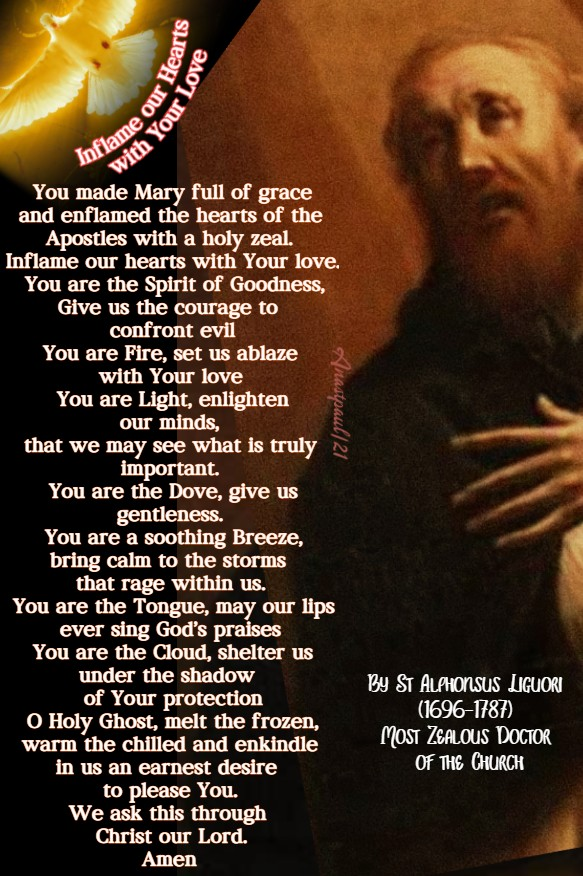
You made Mary full of grace
and enflamed the hearts of the Apostles
with a holy zeal.
Inflame our hearts with Your love.
You are the Spirit of Goodness,
Give us the courage to confront evil
You are Fire, set us ablaze with Your love
You are Light, enlighten our minds,
that we may see what is truly important.
You are the Dove, give us gentleness.
You are a soothing Breeze, bring calm to the storms that rage within us.
You are the Tongue, may our lips ever sing God’s praises
You are the Cloud, shelter us under the shadow of Your protection
O Holy Ghost, melt the frozen,
warm the chilled and enkindle in us an earnest desire to please You.
We ask this through Christ our Lord.
Amen

Posted in AUGUST - The Immaculate Heart of Mary

Quote/s of the Day – 2 August – St Alphonsus

Quote/s of the Day – 2 August – The Memorial of St Alphonsus Maria de Liguori (1696-1787) Most Zealous Doctor of the Church

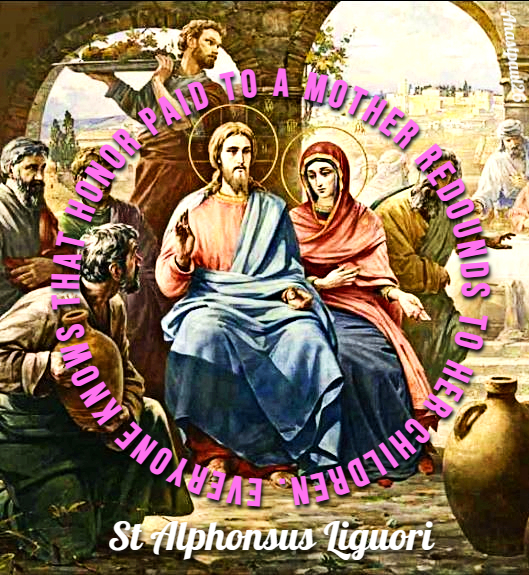
Everyone knows that honor paid to a mother redounds to her children. Hence St. Bernard says, let not any one think that by greatly praising the mother he will throw into the shade the glories of the Son; for the more he honors the mother, so much more he honors the Son. And there is no doubt that on account of the merits of Jesus, the great privilege has been granted to Mary to be the mediatrix of our salvation; not, indeed, mediatrix of justice, but of grace and intercession.

How great then should be our confidence in this queen, knowing how powerful she is with God, and at the same time how rich and full of mercy; so much so that there is no one on earth who does not share in the mercies and favors of Mary! 

Let us always have recourse to this most sweet queen, if we would be sure of our salvation; and if the sight of our sins terrifies and disheartens us, Let us remember that Mary was made queen of mercy for this very end, that she might save by her protection the greatest and most abandoned sinners who have recourse to her.

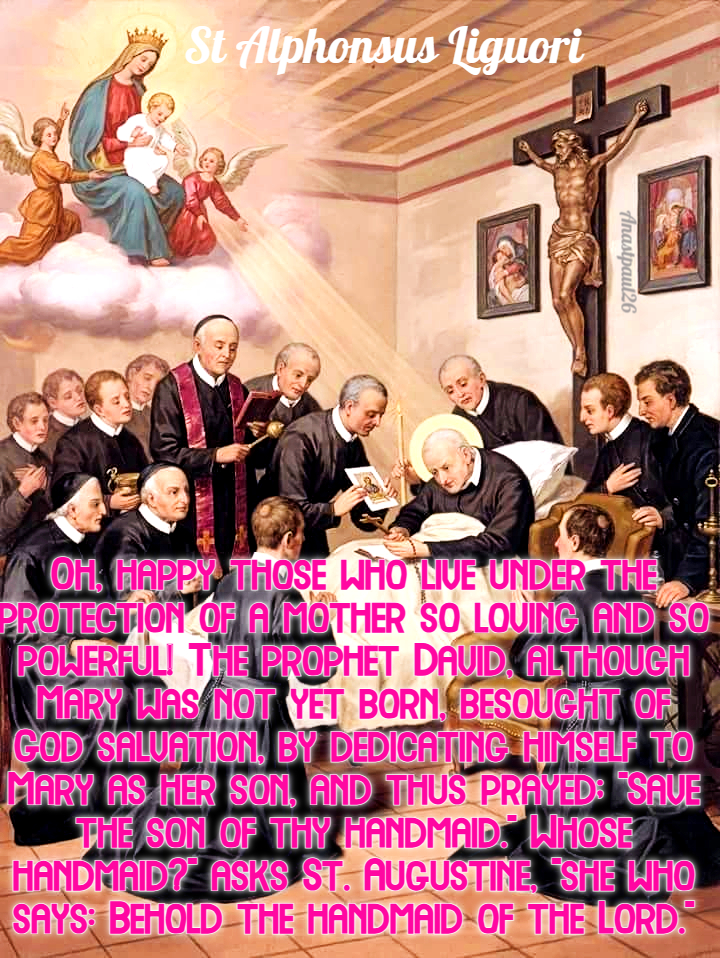
Oh, happy those who live under the protection of a mother so loving and so powerful! The prophet David, although Mary was not yet born, besought of God salvation, by dedicating himself to Mary as her son, and thus prayed; “Save the son of thy handmaid.” Whose handmaid?” asks St. Augustine, “she who says: Behold the handmaid of the Lord.”

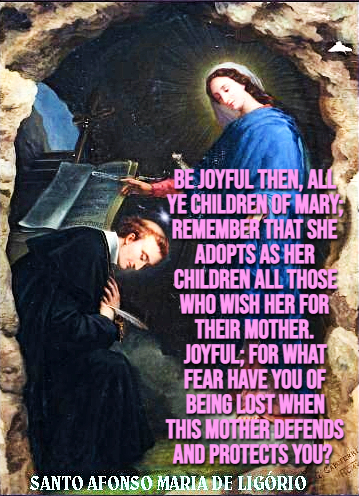
Be joyful then, all ye children of Mary; remember that she adopts as her children all those who wish her for their mother. Joyful; for what fear have you of being lost when this mother defends and protects you? 

Every one who loves this good mother and trusts in her protection, should take cour age and repeat: What do you fear, oh my soul? The cause of thy eternal salvation will not be lost, as the final sentence depends upon Jesus, who is thy brother, and upon Mary who is thy mother. And St. Anselm full of joy at this thought, exclaims, in order to encourage us: Oh, blessed confidence! Oh, secure refuge! The mother of God is my mother also. 

And because all men have been redeemed by Jesus, Mary loves and favors all. She was seen by St. John clothed with the sun: “And there appeared a great wonder in heaven, a woman clothed with the sun.” She is said to be clothed with the sun, because, as “There is no one that can hide himself from his heat,” so there is no one living on the earth who is deprived of the love of Mary. 

Posted in AUGUST - The Immaculate Heart of Mary

Thought for the Day – 2 August – The Heart of Mary in General

St John Eudes – The Admirable Heart of Mary

The Heart of Mary in General

The first heart of Mary, the Mother of God, is the heart of flesh enclosed in her virginal breast. Although this heart is corporeal, it is nevertheless completely spiritualized by the spirit of grace and the spirit of God which fills it.

The second heart is her spiritual heart, made God-like, not indeed by the hypostatic union as in the Incarnate Word, but by a superlative participation in the divine perfections, as we shall see in the following pages. This heart is referred to by the words of the Holy Ghost: “All the glory of the king’s daughter is within,”

The third heart of Mary is divine and is truly God Himself, for it is none other than the love of God. This is the heart of which she says: “I sleep, and my heart watcheth,” which means according to the interpretation of several holy Doctors: “While I grant necessary rest to my body, my Son Jesus, who is my Heart and whom I love like my own heart, is always watching over me and for me.”

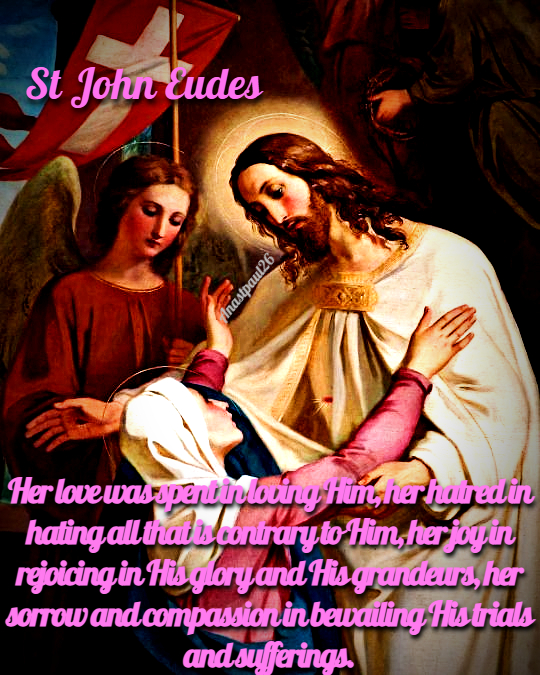
These three hearts of the Mother of God constitute a single Heart, through the holiest and most intimate union that ever was and will be, next to the hypostatic union. Of these three hearts, or rather, of this single Heart, the Holy Ghost has said twice: “Mary kept all these words, pondering them in her heart.” Our Lady cherished the mysteries and marvels of her Son’s life, first of all, in her material and corporeal heart, the principle of life, the seat of love and of the other physical emotions. All the movements, every beat of this virginal heart, the material functions that it accomplished and the emotions that swayed it, existed solely for Jesus and for the things that concerned Him. Her love was spent in loving Him, her hatred in hating all that is contrary to Him, her joy in rejoicing in His glory and His grandeurs, her sorrow and compassion in bewailing His trials and sufferings. The same may be said of every emotion of her bodily heart.

Secondly, Mary kept all these things in her spiritual heart, that is, in the noblest part of her soul, in the inmost recesses of her mind, All the faculties of her soul were constantly applied to contemplating and adoring everything that took place in the life of her Beloved Son, down to the very smallest details. Thirdly, Our Lady kept all these things in her divine Heart, that is, in her Son Jesus, who was the mind of her mind and the heart of her heart. He in turn kept them for her and recalled them to her mind when necessary, that she might feed herself in contemplation upon the mysteries of His life, rendering them due honor and adoration, and repeating them to the holy apostles and disciples, who were to preach them to the faithful.

This then is what is meant by the admirable Heart of the beloved Mother of God.

Posted in AUGUST - The Immaculate Heart of Mary

Quote/s of the Day – 1 August – Hail, holy Mother

Quote/s of the Day – 1 August – “Month of the Immaculate Heart of Mary” – Readings: Sedulius, Ps 44:2, Ecclus 24:14-16, Luke 11:27-28

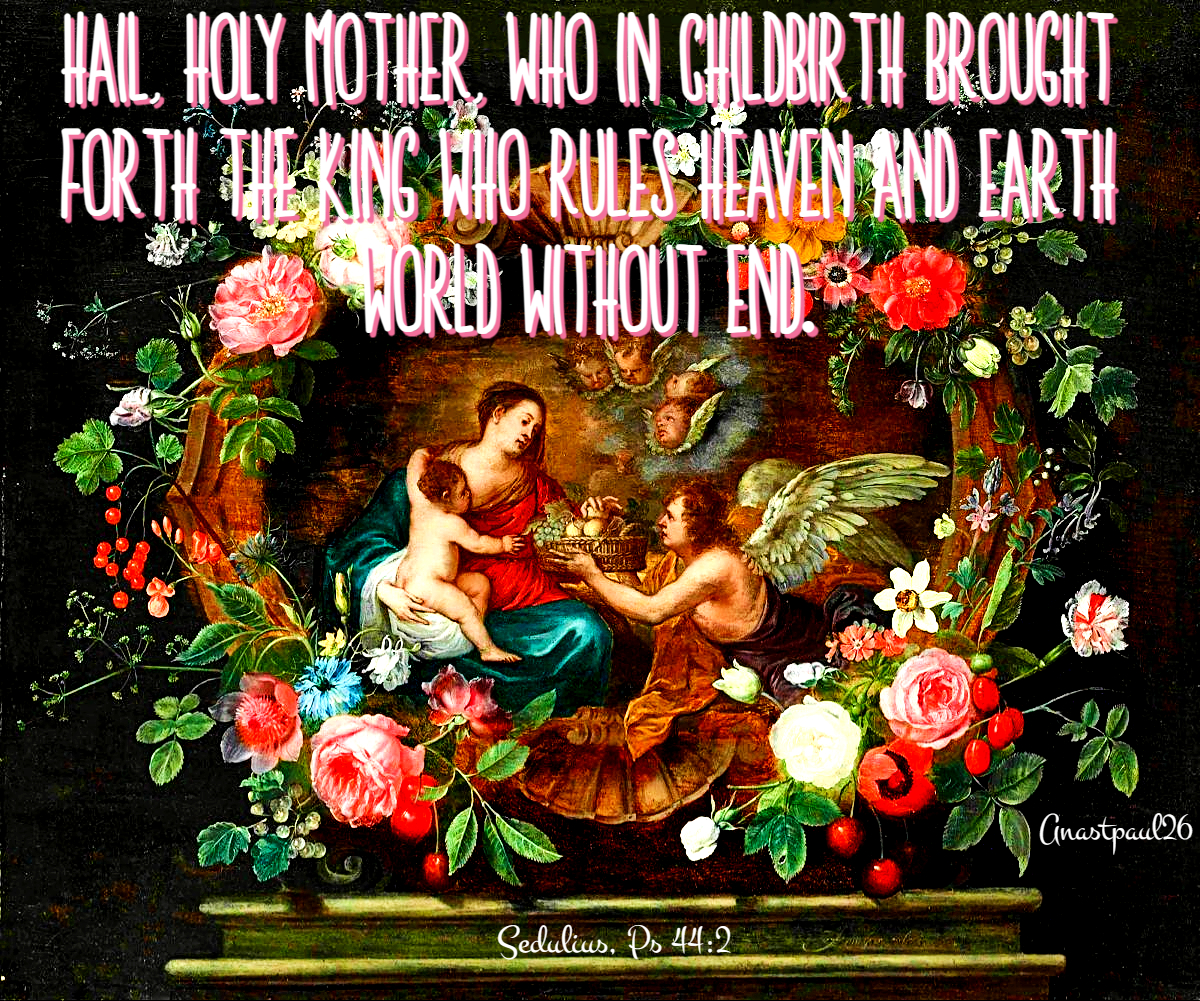
Hail, holy Mother, who in childbirth brought forth the King Who rules heaven and earth world without end.

Sedulius, Ps 44:2

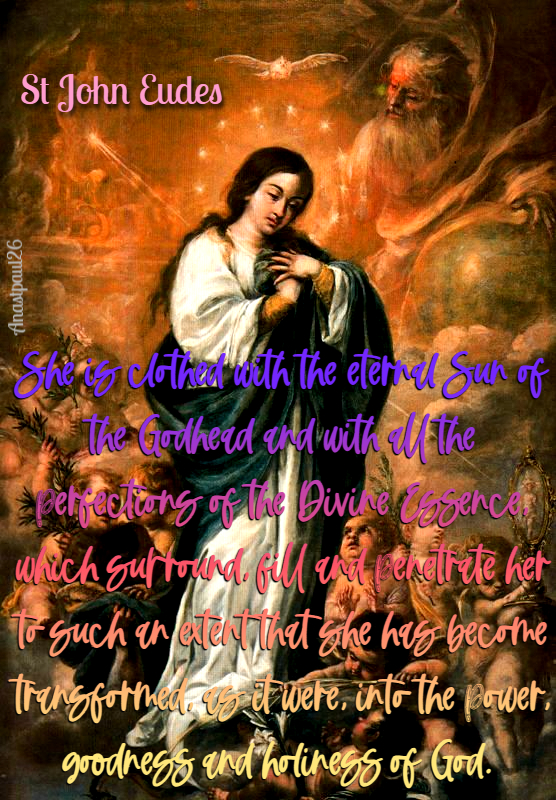
She is clothed with the eternal Sun of the Godhead and with all the perfections of the Divine Essence, which surround, fill and penetrate her to such an extent that she has become transformed, as it were, into the power, goodness and holiness of God.

St John Eudes (The Admirable Heart of Mary)

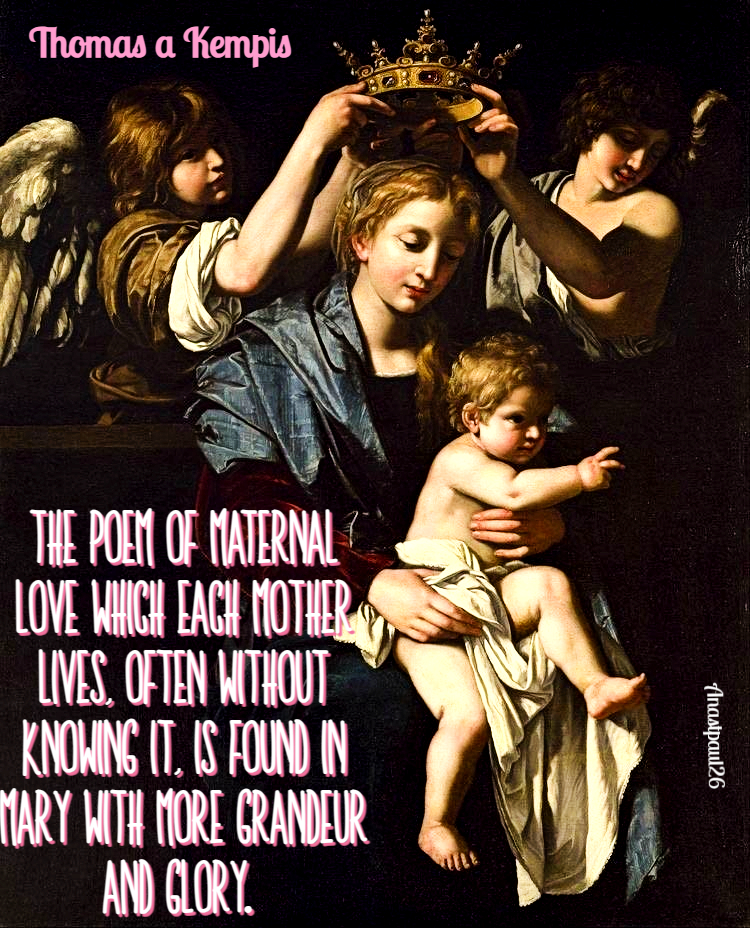
That which denotes the grandeur and the charm of maternity in a woman are grief and tenderness. Grief which rends the heart as it rends the body in order to give life. Tenderness which binds the child to the mother and the mother to the child in such a way as to form only one being, as they form only one flesh. All these characteristics are found physically in the human maternity of Mary, in her relations with Jesus, and mystically in the spiritual maternity of Mary vis-a-vis all Christians but more especially Religious. The poem of maternal love which each mother lives, often without knowing it, is found in Mary with more grandeur and glory.
Thomas a Kempis (The Imitation of Mary)

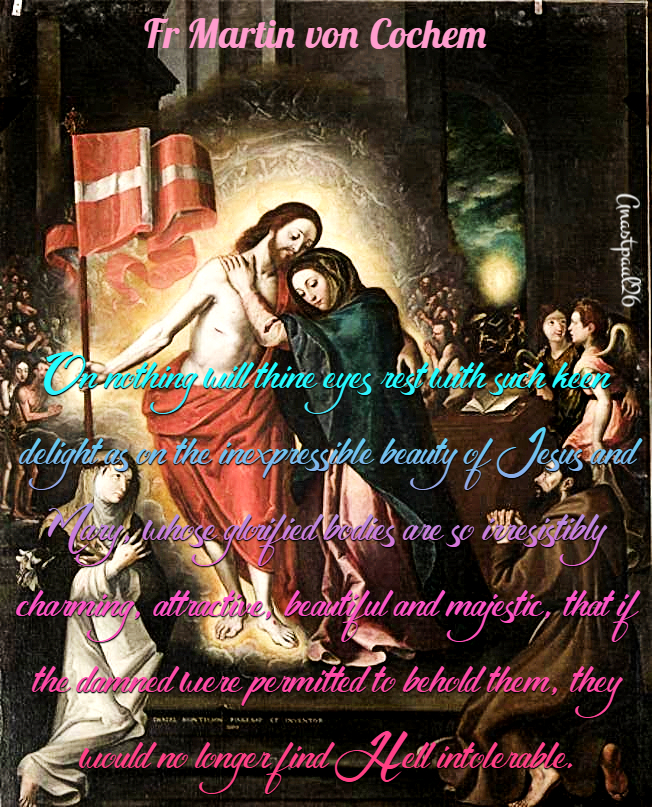
Fifthly, on nothing will thine eyes rest with such keen delight as on the inexpressible beauty of Jesus and Mary, whose glorified bodies are so irresistibly charming, attractive, beautiful and majestic, that if the damned were permitted to behold them, they would no longer find Hell intolerable.

Father Martin von Cochem (The Four Last Things: On Heaven)

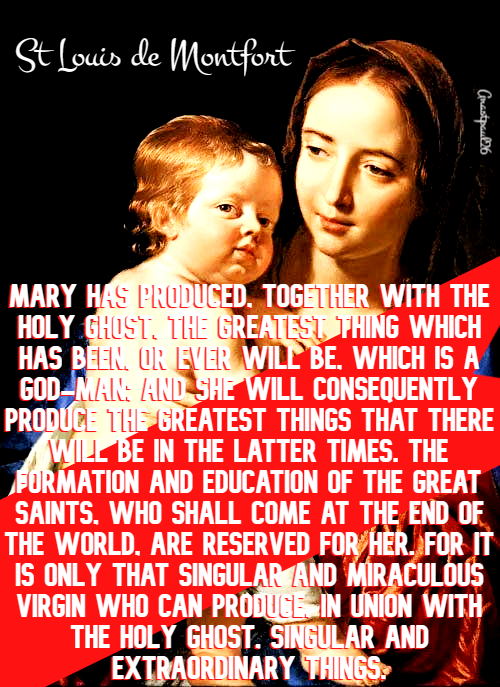
Mary has produced, together with the Holy Ghost, the greatest thing which has been, or ever will be, which is a God-Man; and she will consequently produce the greatest things that there will be in the latter times. The formation and education of the great Saints, who shall come at the end of the world, are reserved for her. For it is only that singular and miraculous Virgin who can produce, in union with the Holy Ghost, singular and extraordinary things.

St Louis de Montfort (True Devotion to Mary)

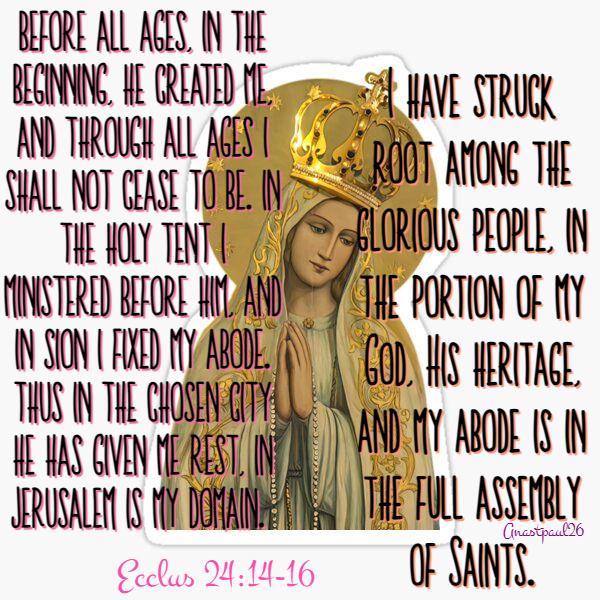
Before all ages, in the beginning, He created me, and through all ages I shall not cease to be. In the holy Tent I ministered before Him, and in Sion I fixed my abode. Thus in the chosen city He has given me rest, in Jerusalem is my domain. I have struck root among the glorious people, in the portion of my God, His heritage, and my abode is in the full assembly of Saints.

Ecclus 24:14-16

Posted in AUGUST - The Immaculate Heart of Mary

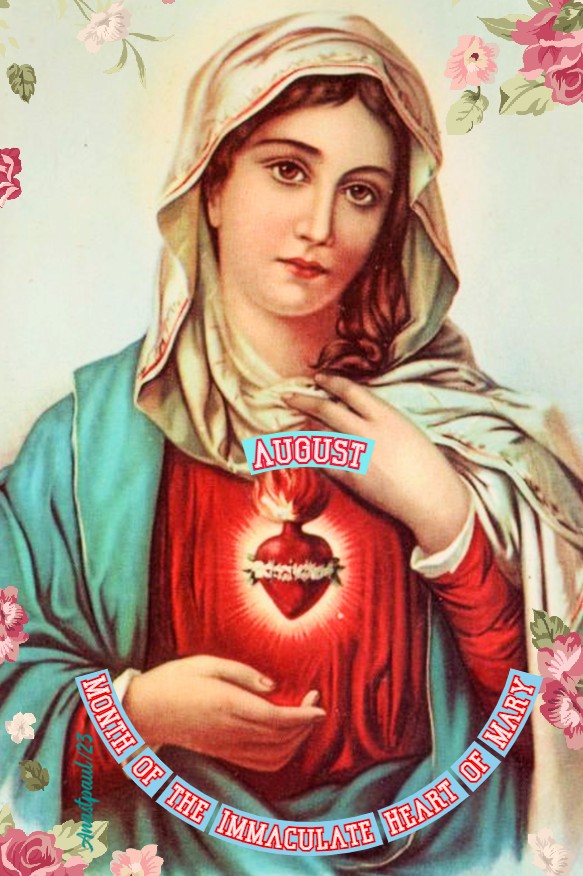
AUGUST – The Month of the Immaculate Heart of Mary

Do not be surprised if I say that the virginal Heart of this Mother of Fair Love is an admirable Heart indeed. Mary is admirable in her divine Maternity because as St. Bernardine of Siena says, “to be Mother of God is the miracle of miracles,” miraculum miraculorum.

But the august Heart of Mary is also truly admirable, for it is the principle of her divine Maternity and of the wonderful mysteries this privilege implies.

Of Mary’s admirable Heart I shall attempt to speak in this book although to speak and write worthily of the holy Heart of God’s own Mother one would need a heart of fire. To know and proclaim the perfections of the noble Heart of the Queen of Angels one should have the intellect of a cherub and the flaming love of a seraph. Nay more, it would be necessary to possess the mind, the heart, the tongue and the hand of Jesus Christ, the King of all hearts, to understand, honor, proclaim or commit to writing the treasures of sanctity contained in the holy Heart of Mary, the worthiest, most royal and most marvellous of all hearts after the most adorable Heart of our Saviour Himself.

Mary is truly admirable in all her perfections and in all her virtues?
But what is most admirable in her is her virginal heart. The heart of the
Mother of God is a world of marvels, an abyss of wonders, the source and principle of all the virtues which we admire in our glorious Queen: “All the glory of the king’s daughter is within.”

St John Eudes

Posted in AUGUST - The Immaculate Heart of Mary

Thought for the Day – 1 August – Reasons for the name ‘Admirable’

St John Eudes – The Admirable Heart of Mary

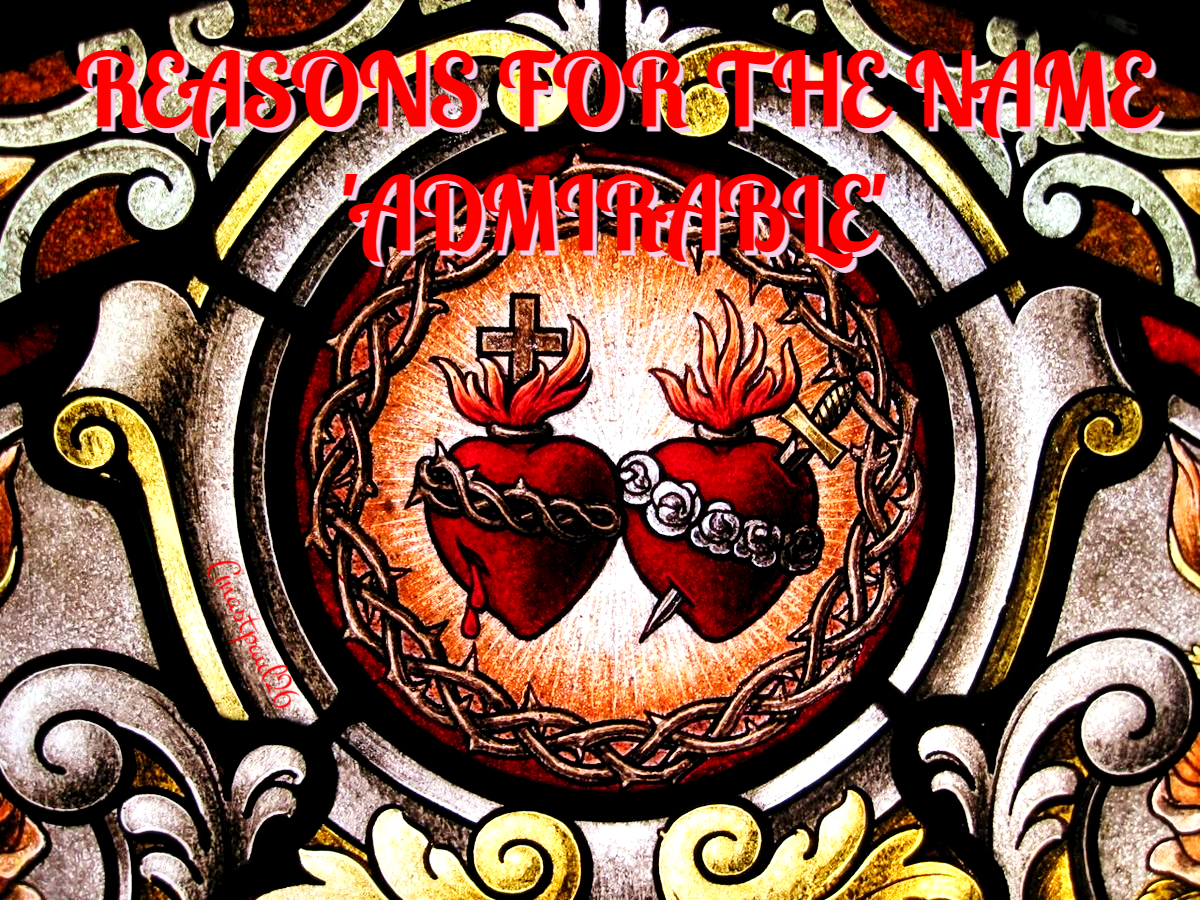
Reasons for the name ‘Admirable’

Jesus Christ, the Only-Begotten Son of God, chose the incomparable Virgin Mary from among all creatures to be His Mother and deigned to be nourished and governed by her. In His infinite goodness He also gave her to us to be our Queen, our Mother and our sure Refuge in all our needs. He therefore wishes us to honor her as He honors her and to love her as He loves her.

According to the Apostle St. Paul, Christ is the Head of His Mystical Body, the Church, and we are the members. We must therefore be animated by His Spirit; we must follow His inspirations, walk the path He has traced, and continue, as it were, His life on earth by practising the virtues which were His own. It follows that our devotion to His Holy Mother must be a continuation of His devotion to her. We must be filled with the sentiments of respect, submission and affection which He entertained for her on earth and still entertains in heaven. Mary always held and will hold forever the first place in the Sacred Heart of her Divine Son; she always was and will never cease to be the first object of His love after the Eternal Father; and so He wishes that, next to God, she should be the principal object of our devotion. For this reason, after the veneration we owe to the Divine Majesty of God, we cannot render a greater service to Jesus Christ or do anything more pleasing to Him than to serve and honor His most worthy Mother.

Among the divinely inspired passages of Sacred Scripture I select one from the twelfth chapter of the Apocalypse, which is a compendium of all the great things that can be said or thought of our marvellous Queen. “A great sign appeared in heaven: A woman clothed with the sun, and the moon under her feet, and on her head a crown of twelve stars.”

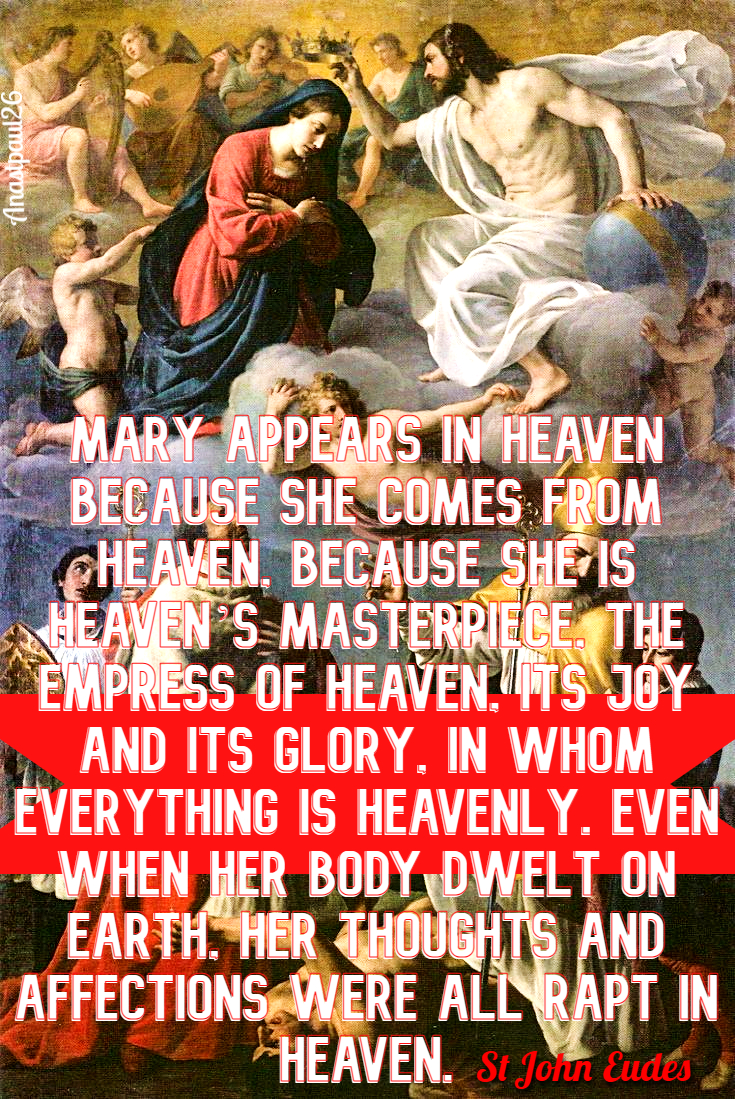
What is this great sign? Who is this miraculous woman? St. Epiphanius, St. Augustine, St. Bernard and many other holy doctors agree that the woman is Mary, the Queen among women, the Sovereign of angels and men, the Virgin of virgins. She is the woman who bore in her chaste womb the perfect man, the God-Man. “A woman shall compass a man.” Mary appears in heaven because she comes from heaven, because she is heaven’s masterpiece, the Empress of Heaven, its joy and its glory, in whom everything is heavenly. Even when her body dwelt on earth, her thoughts and affections were all rapt in heaven.

She is clothed with the eternal Sun of the Godhead and with all the perfections of the Divine Essence, which surround, fill and penetrate her to such an extent that she has become transformed, as it were, into the power, goodness and holiness of God. She has the moon under her feet to show that the entire world is beneath her. None is above her, save only God, and she holds absolute sway over all created things.

Posted in AUGUST - The Immaculate Heart of Mary, JESUIT SJ, MARIAN DEVOTIONS, MARIAN REFLECTIONS, SACRED and IMMACULATE HEARTS

August – The Month of theImmaculate Heart of Mary

August – The Month of the
Immaculate Heart of Mary

Messenger of the Sacred Heart of Jesus, 1876

Excerpt from – “Object Of This Devotion”

The object of the Devotion to the Immaculate Heart of Mary is twofold, material and spiritual; the former secondary, the latter primary. The material object is the material heart of the Mother of the Word Incarnate. The spiritual object is her spiritual heart, that is to say, the ardent charity with which she was inflamed for God, as well as that, which she bore towards men. There is neither distance, separation nor opposition between these two loves; it is precisely because she loves God that Mary loves us and, the more perfectly she loves God, the greater her affection for us.

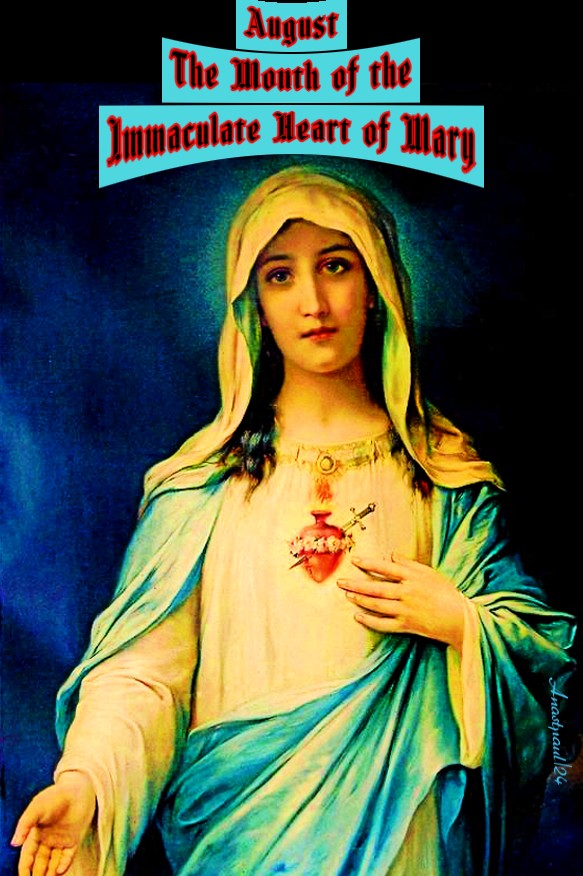
The love which Mary bears us is similar to that manifested towards us by her Divine Son, when, while on earth, He sought sinners rather than the just; our condition as sinners, far from opposing an obstacle, is rather a claim upon her. In this point, as in all others, Mary walks faithfully in the footsteps of her Son and model and, if she loves the just with a love of complacency because of their virtues, the love of compassion and mercy which she feels for sinners, is still greater, not because they are worthy of it but because, of their greater necessities. Finally the material heart of Mary, by means of which we should raise our thoughts to the spiritual, is ordinarily represented, not only with flames escaping from it which figure her love and crowned with flowers, emblems of her virtues but also, pierced with a sword, to call our attention to her sorrows.

The end proposed by devotion to the Immaculate Heart, is to urge us to a greater love towards Mary; for this object we are invited to consider her heart which is the most perfect masterpiece which nature and grace combined, have ever formed of a simple creature – besides this, in our regard, it is the heart of the most tender of mothers who loves us far better than we love ourselves. In these two considerations is to be found her claim upon our love –can we refuse it?
This general end contains several partial ones, some of which it will be well to indicate – such as gratitude towards Mary, confidence in her, lively compassion for her sufferings and imitation of her virtues.

Note: The Messenger of the Sacred Heart of Jesus is a Jesuit periodical of the Apostleship of Prayer.
It is printed in Dublin, Ireland and with monthly sales of around 52,000, it is still one of the largest-selling magazines in Ireland
and I believe there are versions in various countries around the world.