St Alessandro Dordi St Andreas Gim Gwang-Ok St Aredius of Limoges St Ebbe the Elder St Eusbius of Rome St Genesius of Arles St Genesius of Brescello St Genesius of Rome St Gennadius of Constantinople St Geruntius of Italica St Ginés de la Jara St Gregory of Utrecht St Gurloes of Sainte Croix St Hermes of Eretum St Hunegund of Homblieres St Julian of Syria St Julius of Eretum Bl Ludovicus Baba Bl Ludovicus Sasada Bl Luis Cabrera Sotelo St Maginus St Marcian of Saignon
St Maria Micaela of the Blessed Sacrament (1809-1865) “Mother Sacramento” was a Spanish professed Religious and the Founder of the Handmaids of the Blessed Sacrament, Apostle and martyr of charity. In 1922, Pope Pius XI, proclaimed Mother Sacramento’s heroic virtues. On 25 July 1925, he Beatified her and on 4 March 1934, he Canonised her. Her Life: https://anastpaul.com/2019/08/25/saint-of-the-day-25-august-saint-maria-micaela-of-the-blessed-sacrament-1809-1865/
St Menas of Constantinople Bl Miguel Carvalho St Nemesius of Rome St Patricia of Naples Bl Pedro de Calidis Bl Pedro Vázquez St Peregrinus of Rome St Petrus Gim Jeong-Duk St Pontian of Rome
Thought for the Day – 24 August – Meditations with Antonio Cardinal Bacci (1881-1971)
Holy Viaticum
“When the Prophet Elias was afraid and discouraged because the chosen people had abandoned God and slain all the other Prophets, he fled into the desert. One day he was tired and dejected and lay down to sleep in the shade of a Juniper tree. He was awakened suddenly by an Angel of the Lord, who showed him, on two successive occasions, a hearth cake which he pressed him to eat. The Prophet ate and drank “and walked in the strength of that food, forty days and forty nights, unto the mount of God” (Cf 3 Kings 19:4-8).
Some commentaters see, in this bread which Elias ate, an image of the Blessed Eucharist and, in his journey to the mount of God, our own voyage through life to eternity.
Sometimes, we too feel tired along the way and it seems to us that God has abandoned us. Often we are troubled and sorrowful, humbled by our many lapses into sin, despairing of ever becoming holy. On such occasions, like Elias, we need nourishment, the nourishment of the Blessed Sacrament. This spiritual food which contains the Real Living Jesus, the Author of Grace, is all that can give us the courage and strength, to continue our journey and to overcome the obstacles which we encounter on the way.
Let us have frequent recourse to this wonderful means of sustenance, through which, Jesus supplies us with the supernatural strength which we need. Then we shall be able to repeat the words of St Paul: “I can do all things in Him Who strengthens me.” (Phil 4:13).”
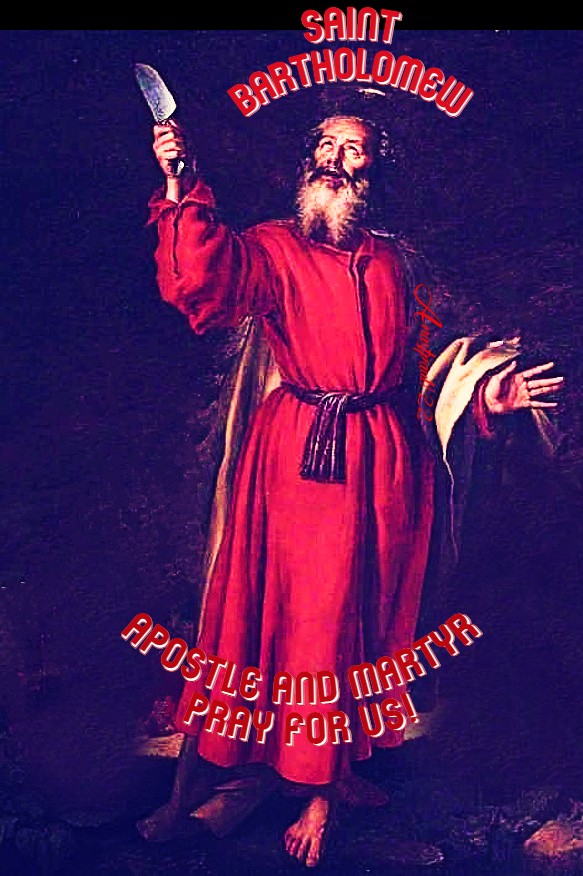
Quote/s of the Day – 24 August – St Bartholomew the Apostle and Martyr
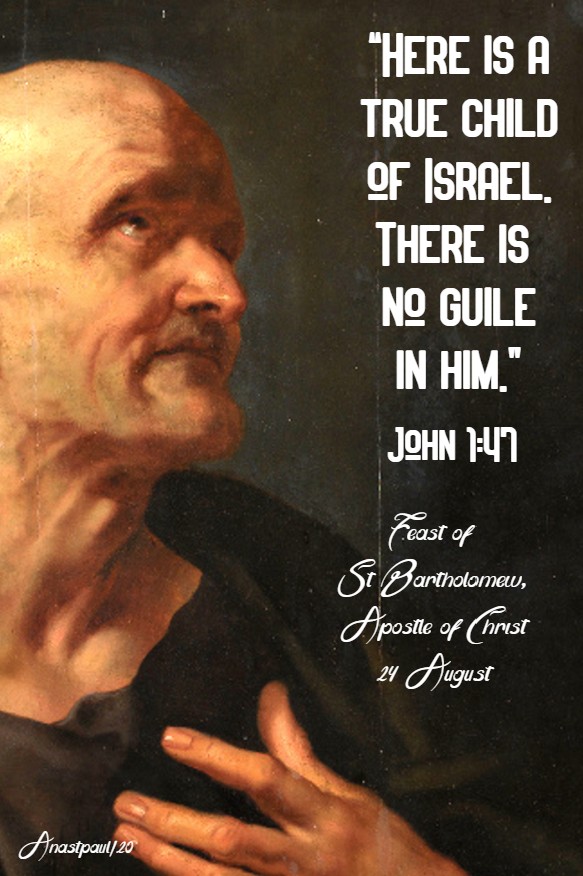
“Here is a true child of Israel. There is no guile in him.”
John 1:47
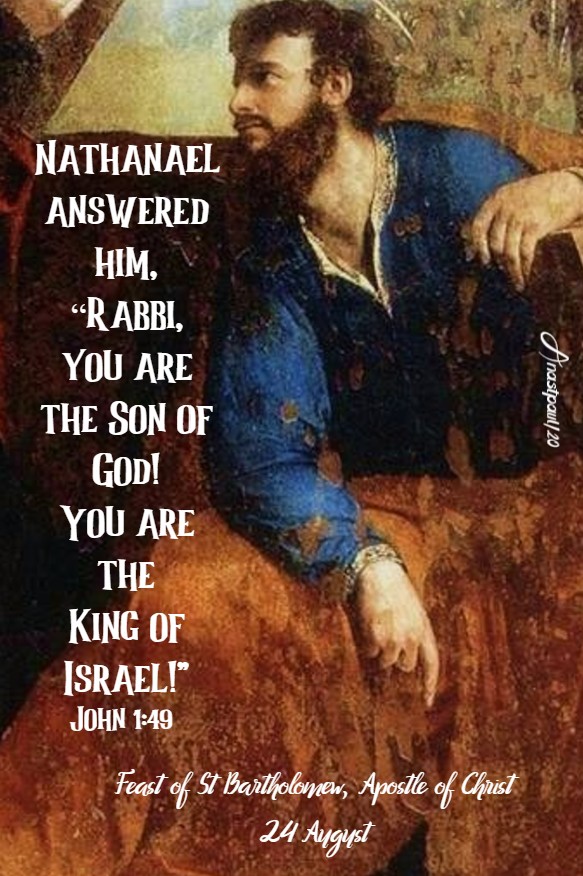
Nathanael answered him, “Rabbi, you are the Son of God! You are the King of Israel!”
John 1:49
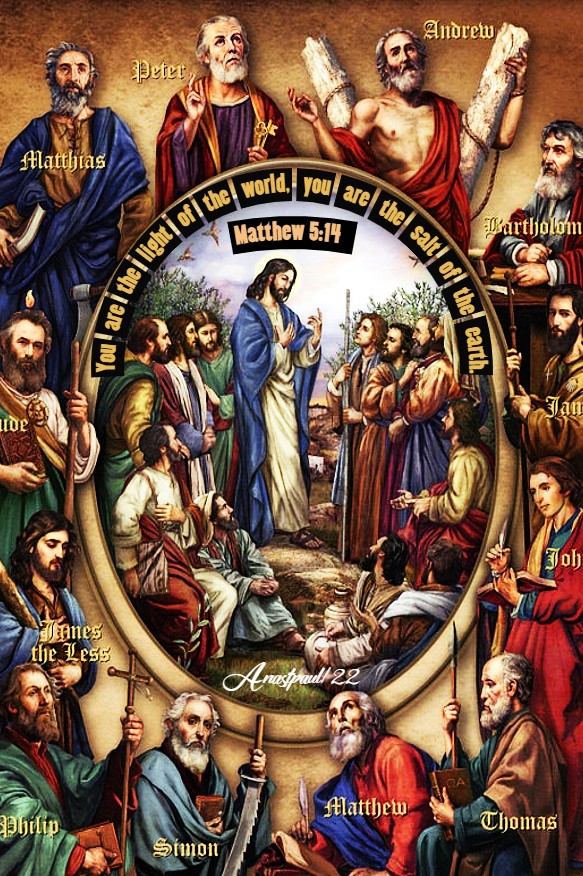
“You are the light of the world, you are the salt of the earth.”
Matthew 5:14
“Like peaceful conquerors, without any human weapons but backed by by the power of God, they divided the world amongst themselves, so that they might win it for Christ! The Roman Empire was small to them. They travelled, moreover, to the distant shores of Ethiopia and India, where the Eagle of Rome had never found its way! Surely, this is the most extraordinary Miracle of history?!
The Holy Spirit accomplished that, which human armies had never been able to do, save in part, or for a limited period of time. In this achievement, He used the weakest possible human means, namely, twelve poor fishermen! The earthly Empire of Rome, passed away but the Spiritual domain of Christ still remains, with its centre at Rome, as the only true Light, the only unfailing hope and the only pledge of salvation for individuals and nations.”
Antonio Cardinal Bacci (1881-1971)
O Fathers of Our Ancient Faith
O Fathers of our ancient faith, With all the heav’n, we sing your fame Whose sound went forth in all the earth To tell of Christ and bless His Name.
You took the Gospel to the poor, The Word of God alight in you, Which in our day is told again, That timeless Word, forever new.
You told of God, Who died for us And out of death triumphant rose, Who gave the Truth which made us free and changeless through the ages goes.
Praise Father, Son and Holy Spirit, Whose gift is faith that never dies, A light in darkness now, until The Day-Star in our hearts arise.
O Fathers of Our Ancient Faith is written by the Benedictine Nuns of Stanbrook Abbey. In the Divine Office it is sung at Morning Prayer in the Common of Apostles. It is set to the anonymous tune associated with the 7th century Latin hymn, Creator Alme Siderum.
One Minute Reflection – 24 August – St Bartholomew the Apostle and Martyr – 1 Corinthians 12:27-31, Luke 6:12-19
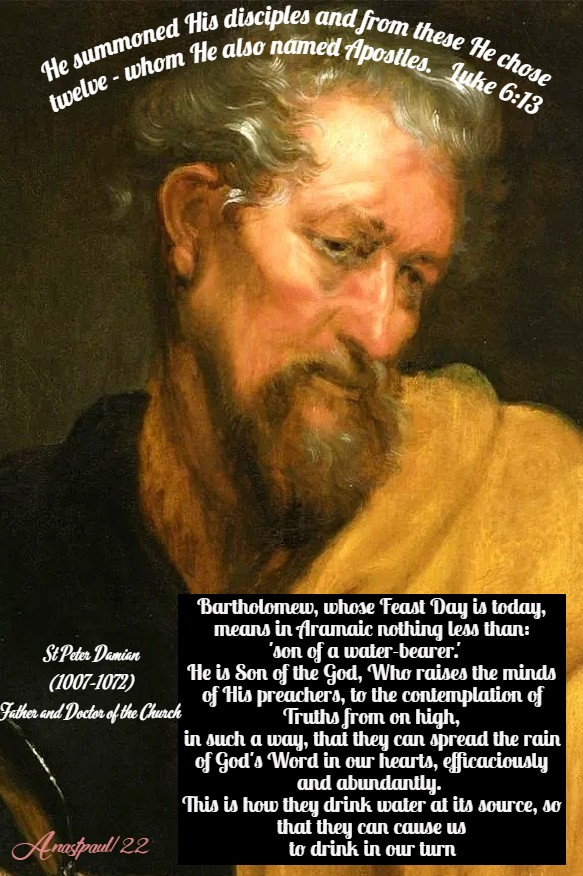
“And when day broke, He summoned His disciples and from these He chose twelve – whom He also named Apostles.” – Luke 6:13
REFLECTION – “The Apostles are those precious pearls that Saint John tells us, he beheld in his Revelation and of whom, the gates of the heavenly Jerusalem are composed ( Apoc. 21:21). … For indeed, when the Apostles reflect the Light of Divinity through their signs or miracles, they open the way, to the heavenly glory of Jerusalem to people who have been converted to faith in Christ. And whoever has been saved because of them, enters life, as one on a journey crosses a threshold. … It is of them, too, that the prophet says: “Who are these that fly like clouds?” (Is 60:8). These clouds pour down water, when they bedew the earth of our heart, with the rain of their instruction, making them fertile and apt to bear the seeds of good works.
Bartholomew, whose Feast Day is today, means in Aramaic nothing less than: ‘son of a water-bearer.‘ He is Son of the God, Who raises the minds of His preachers, to the contemplation of Truths from on high, in such a way, that they can spread the rain of God’s Word in our hearts, efficaciously and abundantly . This is how they drink water at its source, so that they can cause us to drink in our turn.” – St Peter Damian (1007-1072) Bishop, Father and Doctor of the Church (Sermon 42 the second for Saint Bartholomew).
PRAYER – Almighty, eternal God, Who bestowed on us the devout and holy joy of this day to celebrate the Feast of Thy blessed Apostle Bartholomew, grant unto Thy Church, we beseech Thee, both to love what he believed and to preach what he taught. Through Jesus Christ, Thy Son our Lord, Who lives and reigns with Thee, in the unity of the Holy Ghost, God, world without end. Amen (Collect).
Our Morning Offering – 24 August – St Bartholomew the Apostle and Martyr
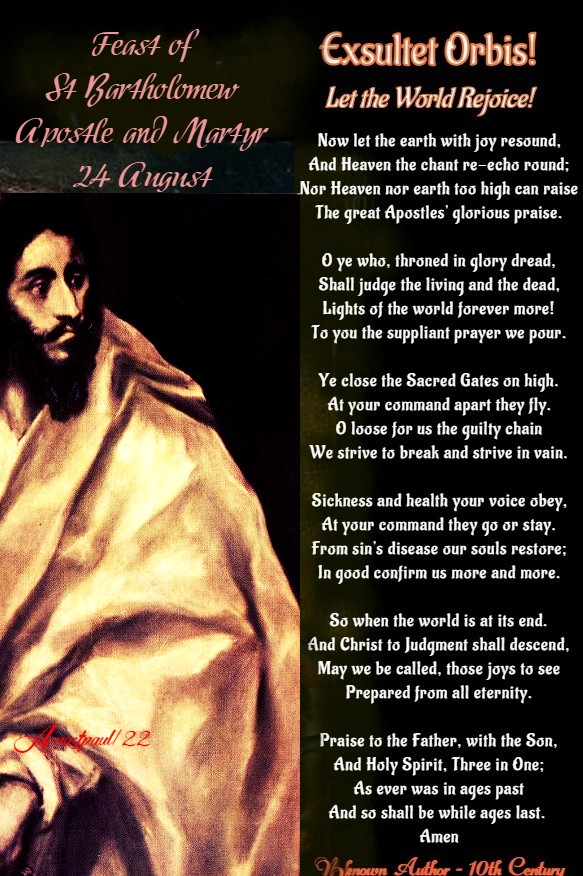
Exsultet Orbis! Let the World Rejoice! Unknown Author
Now let the earth with joy resound, And Heaven the chant re-echo round; Nor Heaven nor earth too high can raise The great Apostles’ glorious praise.
O ye who, throned in glory dread, Shall judge the living and the dead, Lights of the world forever more! To you the suppliant prayer we pour.
Ye close the Sacred Gates on high. At your command apart they fly. O loose for us the guilty chain We strive to break and strive in vain.
Sickness and health your voice obey, At your command they go or stay. From sin’s disease our souls restore; In good confirm us more and more.
So when the world is at its end. And Christ to Judgment shall descend, May we be called, those joys to see Prepared from all eternity.
Praise to the Father, with the Son, And Holy Spirit, Three in One; As ever was in ages past And so shall be while ages last. Amen
(Roman Breviary for the Common of Apostles) An Office Hymn that was traditionally prescribed for Vespers and Lauds on the Feasts of Apostles and Evangelists outside Easter time. The Hymn is found as early as the tenth century in a hymnal of Moissac Abbey.
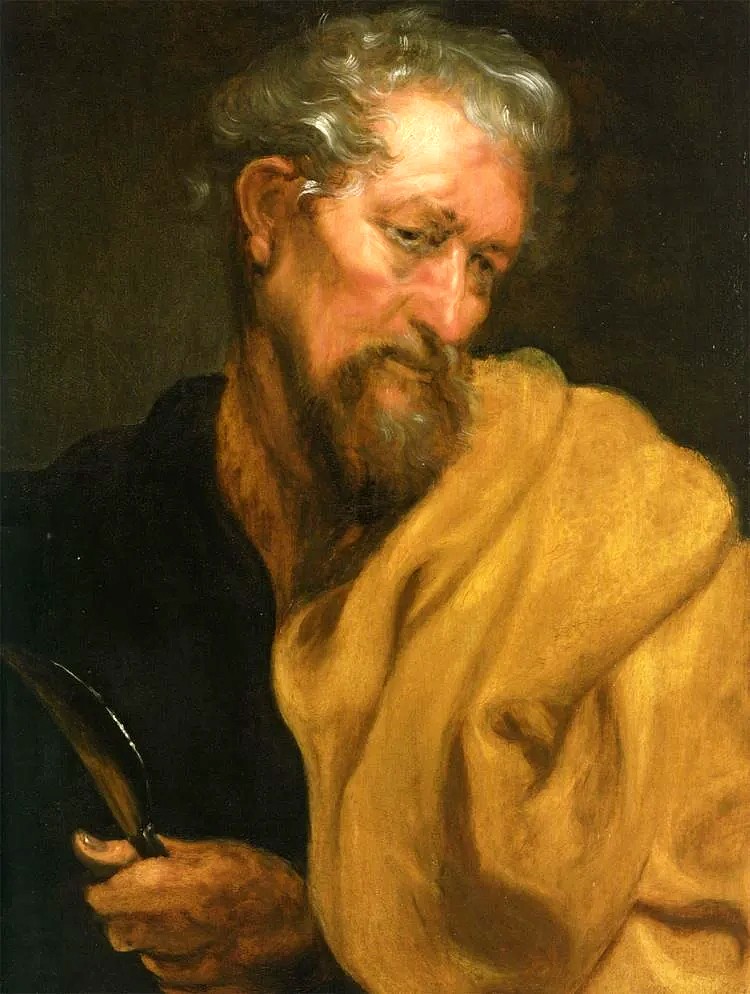
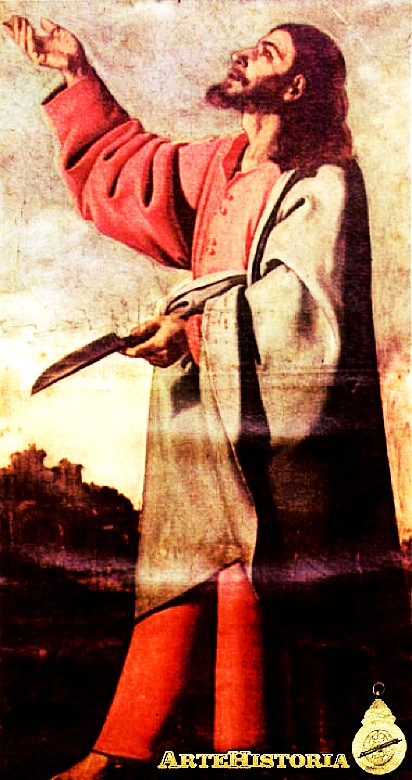
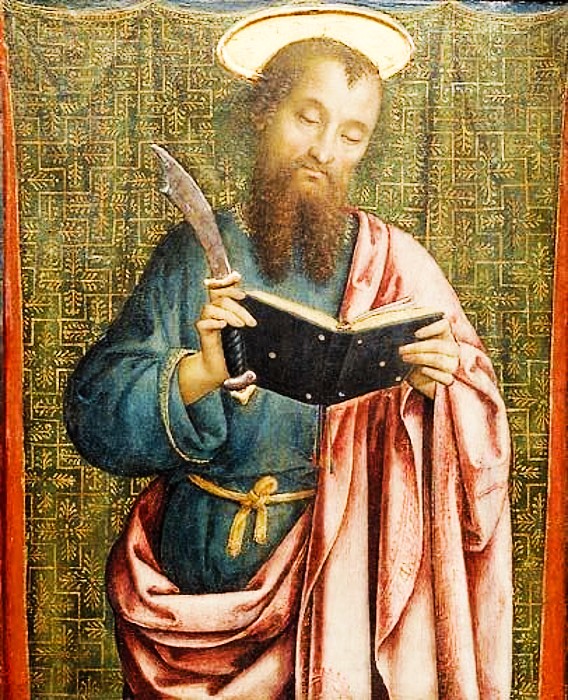
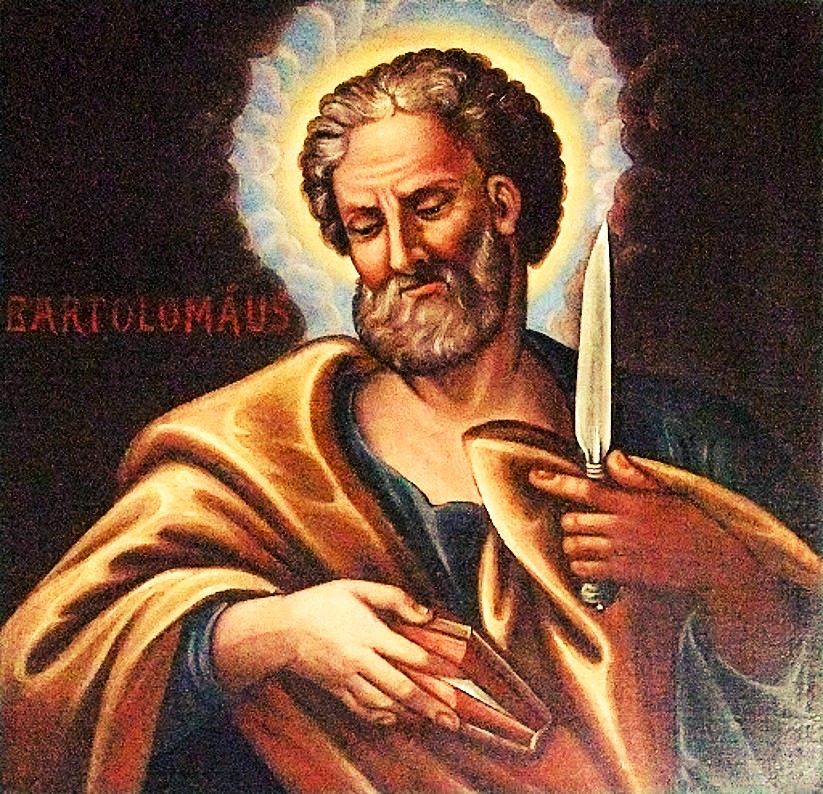
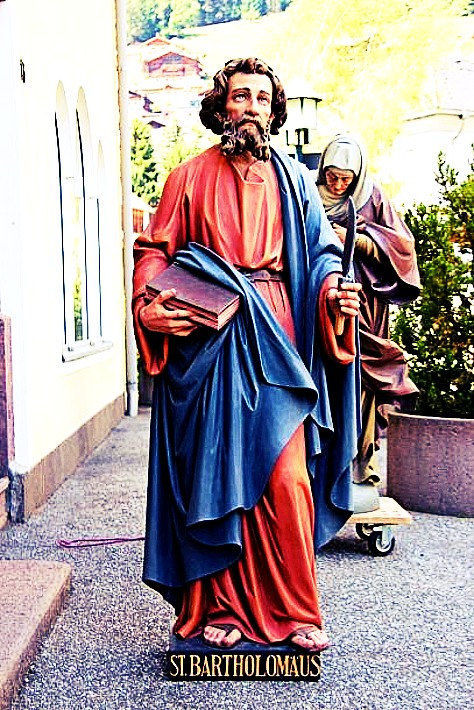
Saint of the Day – 24 August – St Bartholomew the Apostle and Martyr. Saint Bartholomew, whose name appears only in the lists of the Apostles, is believed to be Nathanael, whom Philip brought to Christ. He preached in Persia and Egypt and was flayed alive in Armenia. His relics are believed to be in the Church of Saint Bartholomew in Rome. Patronages –Armenia; bookbinders/publishers; butchers; Florentine cheese and salt merchants; Gambatesa, Italy; Catbalogan, Samar; Għargħur, Malta; leather workers; neurological diseases; plasterers/construction workers; shoemakers; tanners; trappers; skin diseases/rashes, against involuntary shaking disorders; Los Cerricos (Spain), 16 further cities all over the world.
Saint Bartholomew Apostle and Martyr Excerpt from The Liturgical Year By Prosper Guéranger OSB (1805-1875)
A witness of the Son of God, one of the princes who announced His glory to the nations, lights up this day with his apostolic flame.
Personally, who was this Apostle who borrowed such solemnity from the scene of his apostolic labours? Under the name or surname of Bartholomew (“Son of Tholmai“), the only mark of recognition given him, by the first three Gospels, do we see, as many have thought that Nathaniel, whose presentation to Jesus by Philip forms so sweet a scene in St John’s Gospel (1: 45-51)? A man of uprightness, innocence and simplicity, … for whom, the Man-God had choice graces and caresses from the very beginning.
Be this as it may, the lot which fell to our Saint among the Twelve, points to the special confidence of the Divine Heart. The heroism of the terrible Martyrdom which sealed his apostolate, reveals his fidelity. The dignity preserved by the nation he grafted onto Christ, in all the countries where it has been transplanted, witnesses to the excellence of the sap first infused into its branches. When, two centuries and a half later, St Gregory the Illuminator, so successfully cultivated the soil of Armenia, he did but quicken the seed sown by the Apostle, which the trials never wanting to that generous land, had retarded for a time but could not stifle. …
We learn from Eusebius and from St Jerome that before going to Armenia, his final destination, St Bartholomew evangelised the Indies, where Pantaenus a century later found a copy of St Matthew’s Gospel in Hebrew characters, left there by him. …
The City of Rome used to celebrate the Feast of St Bartholomew on the following day, as do also the Greeks who commemorate on 25 August – a translation of the Apostle’s relics. It is owing, in fact, to the various translations of his holy body and to the difficulty of ascertaining the date of his Martyrdom that different days have been adopted for his Feast ,by different Churches, both in the east and in the west. The 24th of this month, consecrated by the use of most of the Latin Churches, is the day assigned in the most ancient Martyrologies, including that of St Jerome. In the 13th Century, Pope Innocent III, having been consulted as to the divergence, answered that local custom was to be observed.
The Church gives just the following Lessons for the life of the Apostle of Armenia:
The Holy Apostle Bartholomew was a native of Galilee. It fell to his lot to preach the Gospel in western India;and he announced to those nations the coming of Our Lord Jesus Christ according to the Gospel of St Matthew. But after converting many souls to Jesus Christ in that Province and, undergoing much labour and suffering, he went into eastern Armenia.
Here he converted to the Christian Faith, the King Polymius and his Queen, as well as twelve Cities. This caused the pagan priests of that nation to be exceedingly jealous of him and they stirred up Astyages, the brother of King Polymius against the Apostle, so that he commanded him to be flayed alive and finally beheaded. In this cruel Martyrdom he gave up his soul to God.
His body was buried at Albanapolis, the town of eastern Armenia where he was Martyred but it was afterwards taken to the island of Lispari and thence to Beneventum. Finally it was translated to Rome by the Emperor Otto III and placed on the island of the Tiber, in a Church dedicated to God under his invocation.
On this day of thy Feast, O holy Apostle, the Church (in the Collect of the Mass) prays for grace to love what thou didst believe and to preach what thou didst teach. Not that the Bride of the Son of God, could ever fail, either in faith or in love but She knows, only too well that, although Her Head is ever in the light and Her heart ever united to the Spouse, in the Holy Ghost Who sanctifies Her, nevertheless ,Her members and particular Churches may detach themselves from their centre of life and wander away in darkness. O thou who didst choose the west as the place of thy rest, thou in whose precious relics Rome glories in possessing, bring back to St Peter, the nations thou didst evangelise, that we may together, enjoy the treasures of our concordant traditions and go to God, even at the cost of being despoiled of all things, by the course so grand and yet so simple, taught us by thy example and by thy sublime theology. Amen.
St Eutychius of Troas St George Limniotes St Irchard
St Jeanne-Antide Thouret (1765-1826) French Religious and the Founder of the Thouret Sisters – renamed the Sisters of Divine Charity., Apostle of Charity and the Poor and helpless, Teacher. Thouret’s life was one of service to children and the ill across France in schools and hospitals – some of which her order established. This active apostolate did not cease when the French Revolution forced her into exile. She continued her work in both Switzerland and the Kingdom of Prussia. St Jeanne-Antide was Canonised on 14 January 1934 by Pope Pius XI. Her Life: https://anastpaul.com/2019/08/24/saint-of-the-day-24-august-saint-jeanne-antide-thouret-1765-1826/
St Patrick the Elder St Ptolemy of Nepi St Romanus of Nepi St Sandratus St Taziano of Claudiopolis
Thought for the Day – 23 August – Meditations with Antonio Cardinal Bacci (1881-1971)
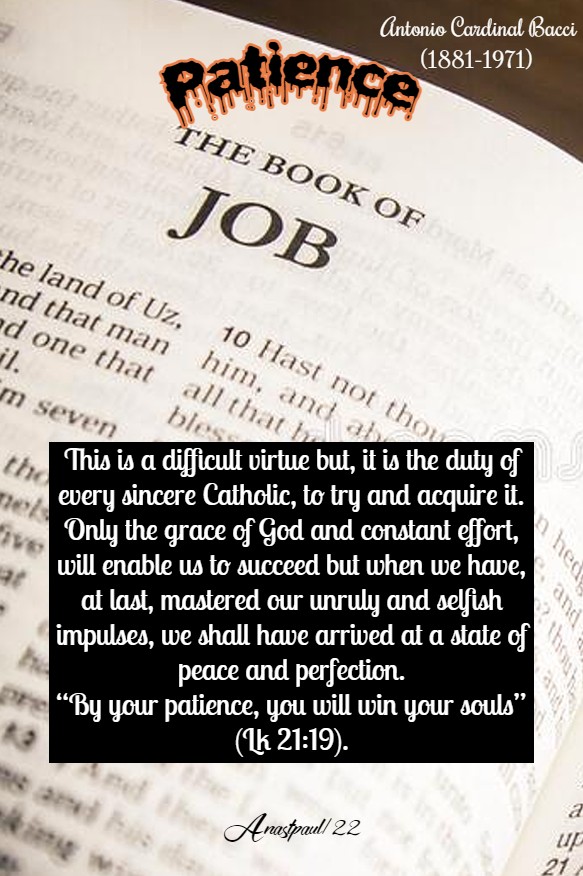
Patience
“An outward show of patience, will hardly avail us much in God’s eyes, unless it is accompanied by interior patience which, consists in the possession of complete mastery over all our faculties. We should be able to control our feelings, as well as our actions. This is a difficult virtue but, it is the duty of every sincere Catholic, to try and acquire it. Only the grace of God and constant effort, will enable us to succeed but when we have, at last, mastered our unruly and selfish impulses, we shall have arrived at a state of peace and perfection.
“By your patience, you will win your souls” (Lk 21:19).”
Quote/s of the Day – 23 August – St Philip Benizi OSM (1233-1285) Confessor
Doing great things for God, like St Philip Benezi
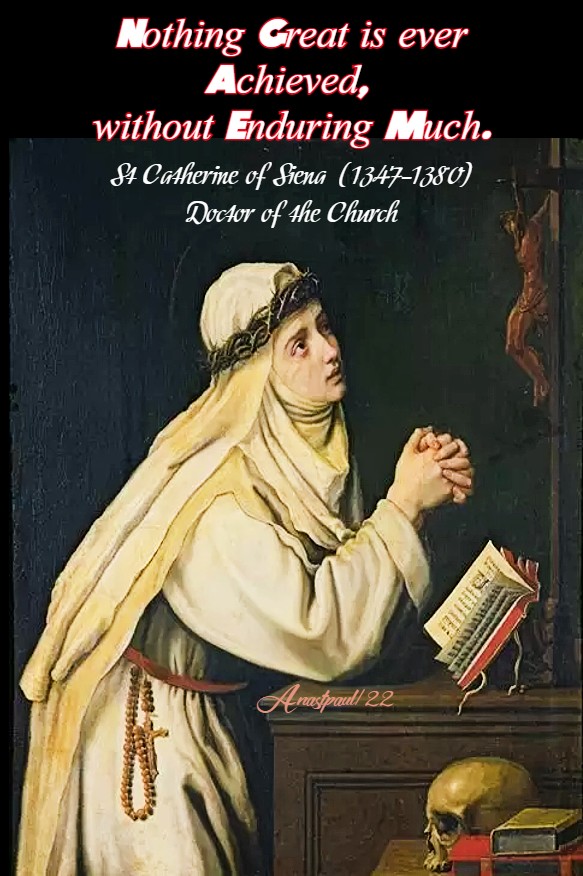
“Nothing great is ever achieved, without enduring much.”
St Catherine of Siena (1347-1380) Doctor of the Church
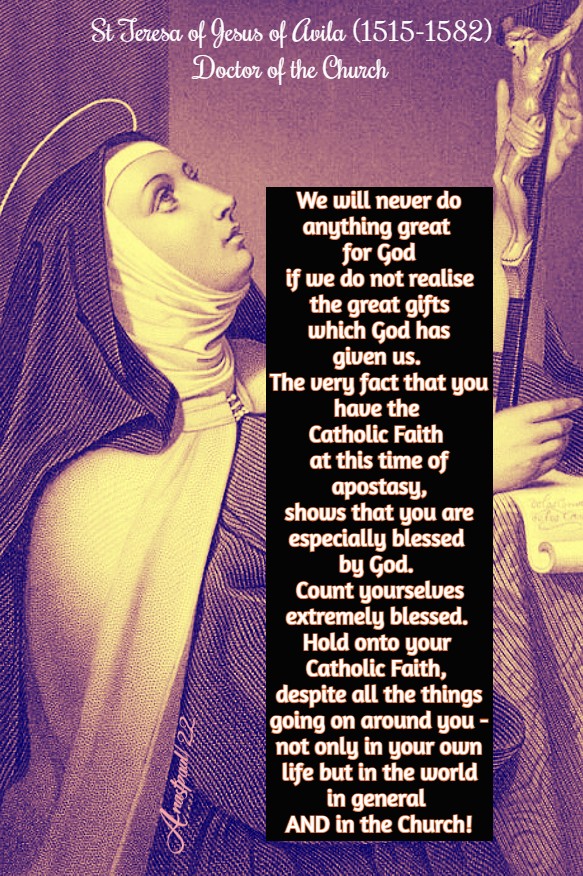
“We will never do anything great for God if we do not realise the great gifts which God has given us. The very fact that you have the Catholic Faith at this time of apostasy, shows that you are especially blessed by God. Count yourselves extremely blessed. Hold onto your Catholic Faith, despite all the things going on around you ,- not only in your own life but in the world in general AND in the Church!”
St Teresa of Jesus of Avila (1515-1582) Doctor of the Church
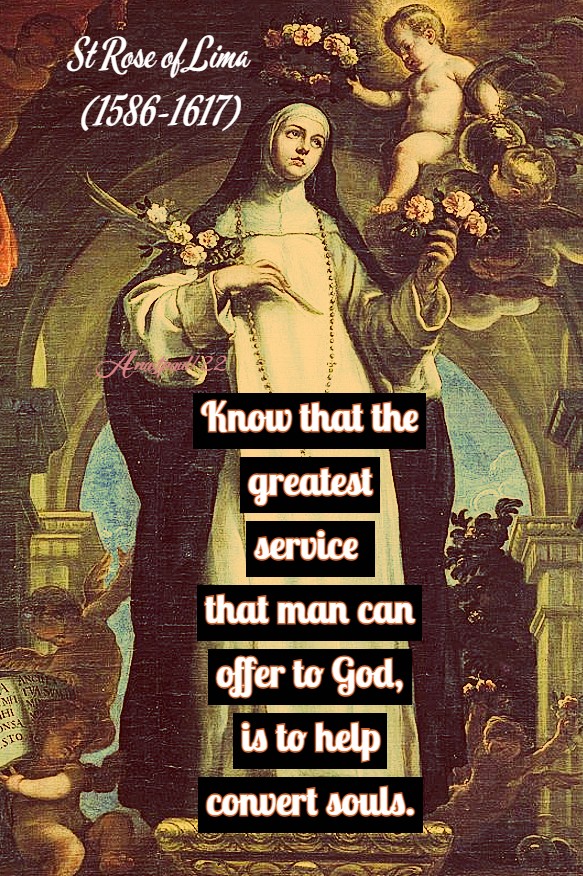
“Know that the greatest service that man can offer to God, is to help convert souls.”
One Minute Reflection – 23 August – St Philip Benizi OSM (1233-1285) Confessor – 1 Corinthians. 4:9-14, Luke 12:32-34
“For where your treasure is, there also will your heart be.” – Luke 12:34
REFLECTION – “All this is what that treasure brings about. Either through almsgiving, it raises the heart of a man into Heaven, or through greed it buries it in the earth. That is why He said, “For where your treasure is, there your heart will be also.” O man, send your treasure on, send it ahead into Heaven, or else your God-given soul will be buried in the earth! Gold comes from the depth of the earth — the soul, from the highest Heaven. Clearly it is better ,to carry the gold to where the soul resides, than to bury the soul, in the mine of the gold. That is why God orders those who will serve in His Army here below, to fight as men stripped of concern for riches and unencumbered by anything. To these He has granted the privilege of reigning in Heaven.” – St Peter Chrysologus (c 400-450) Bishop of Ravenna, “Doctor of Homilies” Father and Doctor of the Church (Sermon 22)
PRAYER – O God, Who through St. Philip, Thy Confessor, gave us an outstanding example of humility, grant that Thy household may follow his example by scorning worldly prosperity and, ever seek the things of Heaven Through Jesus Christ, Thy Son our Lord, Who lives and reigns with Thee, in the unity of the Holy Ghost, God, world without end. Amen (Collect).
Our Morning Offering – 23 August – – “The Month of the Immaculate Heart of Mary”
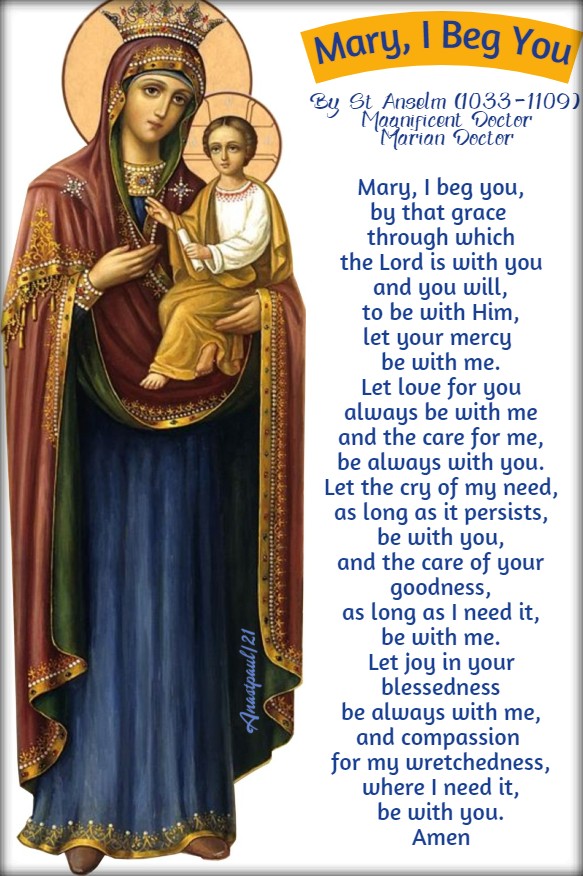
Mary, I Beg You By St Anselm (1033-1109) Magnificent Doctor Marian Doctor
Mary, I beg you, by that grace through which the Lord is with you and you will to be with Him, let your mercy be with me. Let love for you always be with me, and the care for me be always with you. Let the cry of my need, as long as it persists, be with you, and the care of your goodness, as long as I need it, be with me. Let joy in your blessedness be always with me, and compassion for my wretchedness, where I need it, be with you. Amen.
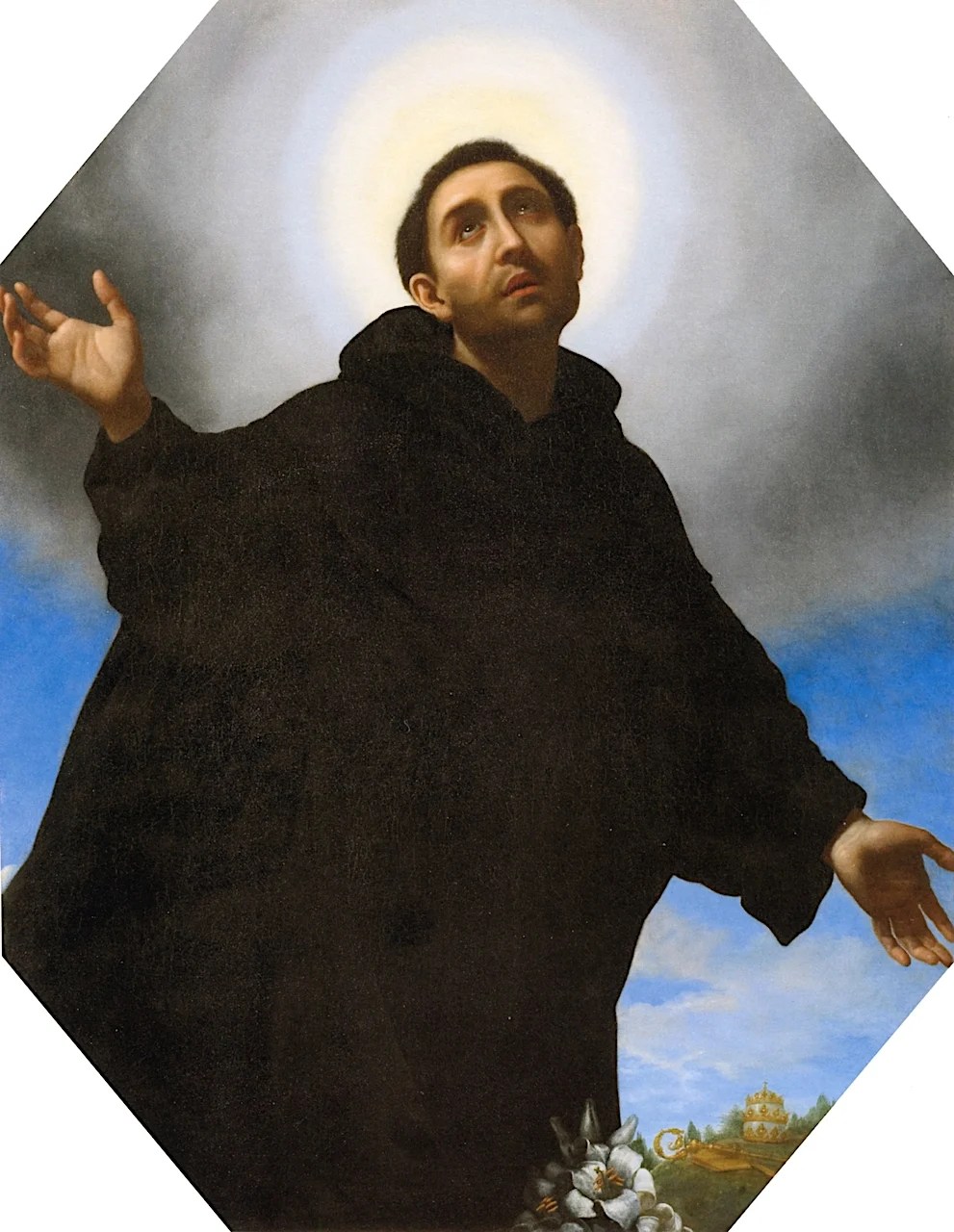
Saint of the Day – 23 August – St Philip Benizi OSM (1233-1285) Confessor, Priest and Co-Founder (one of the Seven Holy Founders of the Order of Servants of Mary) OSM, Servite Priest General of his Order, Reformer, Preacher, Medical Doctor., Miracle-worker.
St Philip Benizi, Confessor By Fr Francis Xavier Weninger SJ (1805-1888)
St Philip was born at Florence into the noble Florentine family of Benizi and before his birth, the Almighty had revealed to his pious mother, that he would become illustrious for his holiness. It seemed to her that a bright shining light emanated from her, which, spreading more and more, at last illumined the whole world with its rays. This was one of the inducements which led her to neglect nothing, which was necessary, to form in her son, the mind and heart of a Saint. She was still more strengthened in this decision, by the following event:
Two Religious of the newly founded Order of the Servites, came to her house. Philip, at that time only five months old, after looking at them for some moments, said: “Behold the servants of Mary, give alms to them, my mother.” All present, greatly surprised at this miracle, concluded, rightly that God had ordained a remarkable future for this child. The same might be divined from his entire conduct, while yet but a child: all his actions seemed to be imprinted with the seal of holiness.
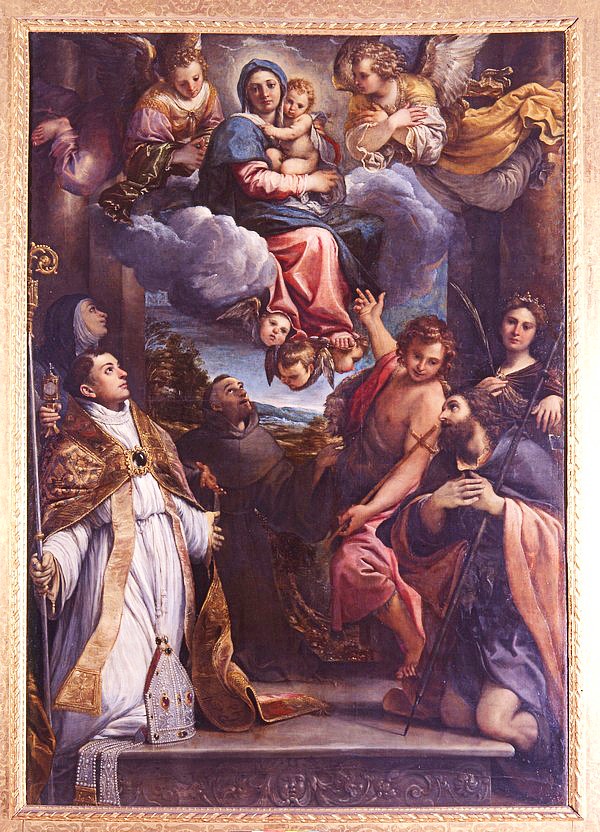
Having finished his studies, he was one day thinking about his vocation and it being the Thursday after Easter, he went into the Chapel of the Servites, which stood on the outskirts of Florence, to attend Holy Mass. At the Epistle were read the words of the Holy Ghost to St Philip: “Draw near and join thyself to the chariot.”” Having heard these words, he went into an ecstasy and it seemed to him that he was alone in a vast wilderness, where nothing was to be seen but sterile mountains, steep rocks and cliffs, or marshes overgrown with thorns, swarming with poisonous reptiles and full of snares. He screamed with fear and looking around, for a meabs to save himself, he saw, high in the air, the Blessed Virgin in a chariot, surrounded by Angels and Saints and holding in her hand, the habit of the Servites. At the same time, he heard from the lips of Mary the words which had just been read in the Epistle. “Draw near and join thyself to the Chariot.” After this revelation, Philip no longer doubted that he was called to enter the Order of the Servites and going, the following day, to the dwelling of the seven Founders of this Order, he requested to be received as a lay-brother.
He was readily accepted, but after having served in that capacity for a few years, his talent, knowledge and holiness were so manifest that he was Ordained Priest, after which, he was raised from one dignity to another, until he was at last made General of the entire Order.
Although he at first humbly opposed this choice, yet when forced to obey, he became zealous in his labours to disseminate the principles of the holy Order, whose object is to reverence the Blessed Virgin and to promote her honour. He sent some of the religious to Scythia, to preach the Gospel and to spread the veneration of the Blessed Virgin. He himself, with two companions went through an incredible number of Cities and Provinces, everywhere exhorting sinners to repentance, endeavouring to calm the contentions which, at that period, disturbed the Christian world, disabusing, by his sermons, those who refused obedience to the Pope and animating all, to greater love of God and devotion to the Blessed Virgin.
The Lord aided him visibly in all his undertakings and obtained for him, the highest regard from both clergy and laity. When the Cardinals, assembled at Viterbo to elect a new Pope, were unable to agree, they, at length, unanimously chose Philip, as all deemed him worthy of this high dignity. Philip, informed of it, was terrified and fled into the desert of Mount Thuniat, where he remained concealed in a cave, until another was elected Pope. This was not less an evidence, of his humility, than his election had been, of the high regard in which his virtues and the many miracles he had performed, were held by the Prelates of the Church.
His innocence and purity he carried unspotted to the grave but in order to preserve them, he was very severe to himself. He possessed in an eminent degree, the spirit of prayer, for, besides occupying a great portion of the night in devotional exercises, he also raised his mind to God, during his various occupations, by means of short aspirations. He never undertook anything without first recommending it in prayer to God and, the more important the affair, the longer and more fervent were his prayers.
The only object of his many and labourious voyages, was the glory of God and the good of men and his constant endeavour was, to prevent offences of the Divine Majesty and to work for the salvation of souls. But how shall we express his tender devotion to the Blessed Virgin, whom he had loved and honoured as a mother from his earliest childhood? In her honour, while yet a youth, he kept several festivals and performed many prayers.
He entered the Order of the Servites, because they regarded it their duty, to promote her veneration and honour. In every sermon, he admonished the people to honour Mary and to call upon her in all their troubles. In a word, he neglected nothing which he deemed necessary or useful, to institute and disseminate, due devotion to the Queen of Heaven. Although in many places, he had to endure much hardship and persecution, his love of God and the Blessed Virgin could not be discouraged from continuing in his apostolic labours.
Meanwhile, the weakness of his body manifested plainly that his last hour was approaching. He ,therefore, went to his Convent at Todi and there, first visited the Church. He prostrated himself before the Altar and when, after a long and fervent prayer, he again rose, he said: “Lord, receive my thanksgiving,; here is my place of rest.”
On the festival of the Assumption of Our Lady, he preached his last sermon, with such eloquence and unction, that all his listeners were greatly moved. On leaving the pulpit, he was seized with a fever, which, although by others thought of no consequence, was regarded by himself, as a messenger of death. Hence, he had himself carried into a special apartment and laid down but could not be persuaded to divest himself, of the rough hair-shirt which he constantly wore.
The days that he remained on earth after this, he employed in instructing and exhorting his religious, in prayers to God and invoking the intercession of the Blessed Virgin, in repenting of his sins and in longing to be admitted to the presence of the Most High. After having received,, with great devotion, the holy Sacraments, he requested his brethren to say the Litany of the Saints. When they came to the words: “We sinners. we beseech Thee to hear us!” he fell into an ecstasy and lost his consciousness to such a degree that he seemed already to have expired.
In this state he remained for three hours, when one of his friends loudly called him. He awakened as if from a deep slumber and related how fearful a struggle, he had had with Satan. How the latter had reproached him with his sins and endeavoured to make him despair of the mercy of God. But when the combat was at its height, the Blessed Virgin had appeared to him and, driving away Satan, had not only saved him from all danger,but had also shown him the crown which awaited him in the other world. Having related this to those around him, who were all awestruck, he requested what he called “his book,” the Crucifix and pressing it to his heart, he intoned the hymn of praise of St Zachary and after it, the 30th Psalm: “In thee, O Lord, have I hoped!” Arriving at the words: “Into thy hands I commend my spirit,” he looked once again at the Crucifix and ended his holy and useful life, on the Octave of Our Lady’s Assumption, in the year 1285.
The biography of this Saint contains many miracles which he performed during his life and many more which took place, by his intercession, after his happy death.
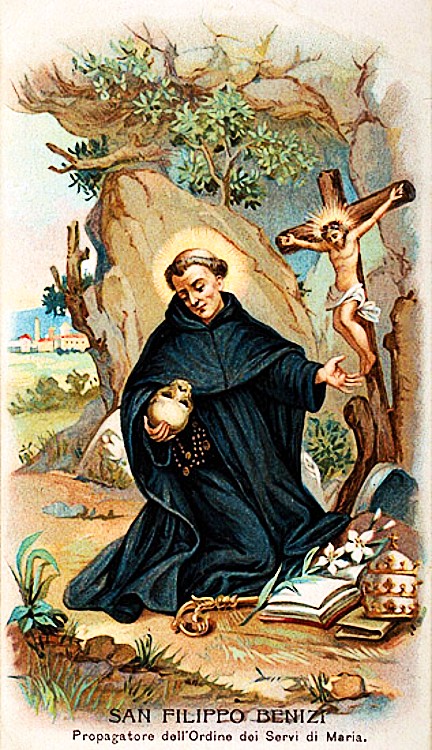
St Philip Benizi OSM (1233-1285) Confessor, Co-Founder (one of the Seven Holy Founders of the Order of Servants of Mary) OSM, Servite Priest Genera\Superior, Reformer, Preacher, Medical Doctor. St Philip was Beatified on 8 October 1645 by Pope Innocent X and Canonised on 12 April 1671 by Pope Clement X – he was first Servite to be Canonised. Biograph: https://anastpaul.wordpress.com/2017/08/23/saint-of-the-day-23-august-st-philip-benezi/
Notre-Dame de la Victoire de Valois / Our Lady of Victory of Valois, France (1328) – 23 August:
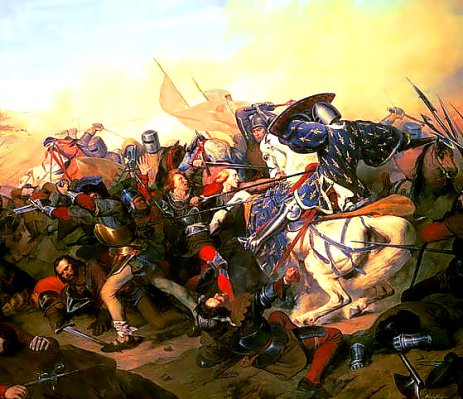
The Feast of Our Lady of Victory of Valois concerns Our Lady’s intercession in the Battle of Cassel, which was fought between the French, under Philip of Valois and the Flemish near Mount Cassel on 23 August in the year 1328. Philip of Valois, or King Philip VI, “Philip the Fortunate,” was the King of France beginning that year until his death in 1350.
Philip led his army against the band of Flemish rebels under Nicolas Zannekin, who were seeking independence from French rule. Having refused to pay what they considered to be excessive taxes to the Count of Flanders, they eventually imprisoned the King’s representative and captured several French towns. The Pope asked Philip to do what he could with the rebels but after having restored the Flemish aristocracy, the Flemish rebels had turned even on them, killing many of them. Philip was certain of victory, taking 2,500 knights and 12,000 infantry and archers with him into battle. Not knowing where he would attack, the Flemish rebels would have to divide their forces to protect their territory. Even so, the Flemish under Zannekin brought 15,000 soldiers into the field at Cassel.
For three days the two armies did nothing but taunt each other, although the Flemish commenced a direct attack on the French on the third day. Apparently, the French were caught off-guard, for many of them had taken off their armour because of the extreme heat that day. Fleeing in panic, the knights left the field, while much of the French nobility, who stood their ground were wounded. The Duke of Lorraine was slain and the situation appeared desperate.
It is recorded that Philip of Valois, being surrounded by Flemish soldiers as the flower of his nobility fell, had recourse to the Blessed Virgin, who immediately delivered him from that danger. The Dauphin of Vienne, Guigues VIII de la Tour-du-Pin, had been given the command of Philip’s 7th Corps. He led a counter attack which shattered the Flemish assault, while the knights regrouped and attacked the Flemish from the rear. The Flemish were defeated and victory assured by Our Lady of Victory of Valois.
Our of gratitude for this favour, when he made his entry into Paris, Philip went straight to Notre Dame Cathedral. Going into the Church on horseback, he proceeded the whole length of the nave to the Crucifix and there, laid down his arms. The picture of this Monarch on horseback, was, for a long time, to be seen in that Church, to which Philip gave a revenue of 100 livres, to be levied on his domain of Gatinais.
St Abbondius of Rome St Altigianus St Apollinaris of Rheims St Archelaus of Ostia St Asterius of Aegea St Claudius of Aegea St Domnina of Aegea St Eleazar of Lyons St Eonagh St Flavian of Autun Bl Franciszek Dachtera Bl Giacomo Bianconi of Mevania St Hilarinus St Ireneus of Rome Bl Jean Bourdon St Lupo of Novi St Luppus St Maximus of Ostia St Minervius of Lyons St Neon of Aegea St Quiriacus of Ostia St Theonilla of Aegea St Timothy of Rheims
Martyrs of Agea – 4 Saints: A group of Christian brothers, Asterius, Claudius and Neon, denounced by their step-mother who were then tortured and Martyred in the persecutions of Pro-consul Lysias. They were crucified in 285 outside the walls of Aegea, Cilicia (in Asia Minor) and their bodies left for scavengers.
Thought for the Day – 22 August – Meditations with Antonio Cardinal Bacci (1881-1971)
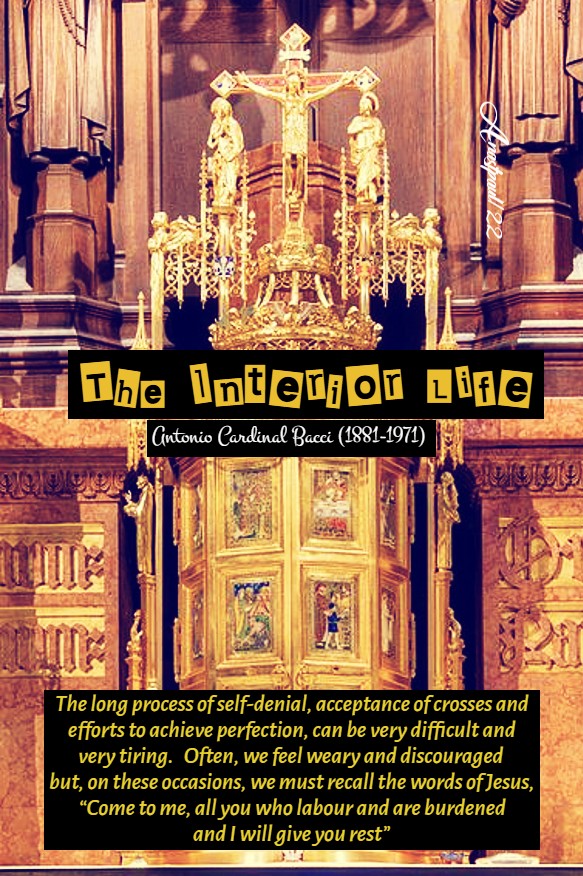
The Interior Life
“The daily struggle for existence, gradually wears down both the [physical and the intellectual life. The same can happen to the supernatural life. The long process of self-denial, acceptance of crosses and efforts to achieve perfection, can be very difficult and very tiring. Often, we feel weary and discouraged but, on these occasions, we must recall the words of Jesus, “Come to me, all you who labour and are burdened and I will give you rest” (Mt 11:28).”
Quote/s of the Day – 22 August – Month and Feast of the Immaculate Heart of Mary (Octave Day of the Assumption)
“In the end, my Immaculate Heart will triumph.”
Our Lady of Fátima 1917
“Let us decide to become one, with all the faithful, in offering the prayers and actions and sufferings of each day to the Sacred Heart of Jesus, through the Immaculate Heart of His Mother Mary. We shall certainly receive showers of graces, both for ourselves and for the salvation of the souls of our neighbours.”
Antonio Cardinal Bacci (1881-1971)
Prayer to the Two Holy Hearts of Jesus and Mary
O Heart of Jesus pierced for our sins and giving us Your Mother on Calvary! O Heart of Mary pierced by sorrow and sharing in the sufferings of your divine Son for our redemption! O sacred union of these Two Hearts! Praised be the God of Love who united them together! May we unite our hearts and every heart so that all hearts may live in unity and in imitation of that sacred unity which exists in these Two Hearts. Triumph, O Sorrowful and Immaculate Heart of Mary! Reign, O Most Sacred Heart of Jesus! – in our hearts, in our homes and families, in the hearts of those who as yet do not know You and in all nations of the world. Establish in the hearts of all mankind the sovereign triumph and reign of your Two Hearts so that the earth may resound from pole to pole with one cry: Blessed forever be the Most Sacred Heart of Jesus and the Sorrowful and Immaculate Heart of Mary! Obtain for me a greater purity of heart and a fervent love of the spiritual life. May all my actions be done for the greater glory of God in unions with the divine heart of Jesus and the Immaculate Heart of Mary. Hear and answer our prayers and intentions according to Your most merciful will. Amen
One Minute Reflection – 22 August – Month and Feast of the Immaculate Heart of Mary (Octave Day of the Assumption) – Ecclesiasticus 24:23-31, John 19:25-27
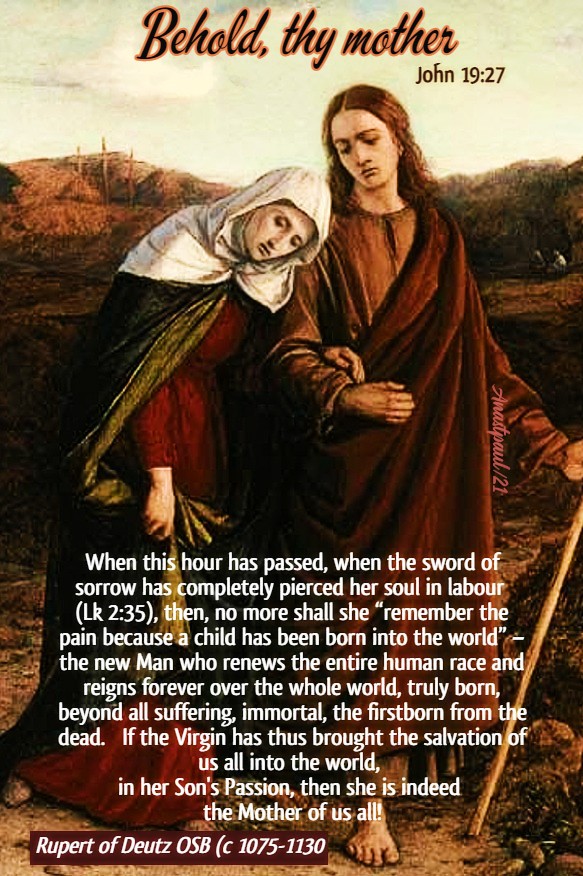
“Behold, thy mother” – John 19:27
REFLECTION – “Woman, this is your son. This is your mother.” By what right is the disciple whom Jesus loved, the son of the Lord’s mother? By what right is she his mother? By the fact that, without pain, she brought into the world the salvation of us all, when she gave birth in the flesh to the God-man. But now she is in labour with great pain as she stands at the foot of the Cross.
At the hour of His Passion, the Lord Himself rightly compared the Apostles to a woman in childbirth, when He said: “When a woman is in labour she is in anguish because a child is born into the world” (cf. Jn 16:21). How much more, then, might such a Son compare such a Mother, the Mother standing at the foot of His Cross, to a woman in labour? What am I saying? “Compare?” She is indeed truly a woman and truly a mother and, at this hour, she is truly experiencing the pains of childbirth. When her Son was born she did not experience the anguish of giving birth in pain as other women do; it is now that she is suffering, that she is crucified, that she experiences sorrow like a woman in labour because her hour has come ( Jn 16:21; cf.13:1; 17:1). …
When this hour has passed, when the sword of sorrow has completely pierced her soul in labour (Lk 2:35), then, no more shall she “remember the pain because a child has been born into the world” – the new Man who renews the entire human race and reigns forever over the whole world, truly born, beyond all suffering, immortal, the firstborn from the dead. If the Virgin has thus brought the salvation of us all into the world, in her Son’s Passion, then she is indeed the Mother of us all!” – Rupert of Deutz (c 1075-1130) Benedictine Monk, Theologian, Exegete and Writer – Commentary on Saint Johns Gospel, 13 ; PL 169, 789.
PRAYER – Almighty, everlasting God, Who in the Heart of the Blessed Virgin Mary, prepared a dwelling place worthy of the Holy Spirit, graciously grant, that we, who are devoutly keeping the Feast of her Immaculate Heart, may be able to live according to Thy Heart.Through esus Christ, Thy Son our Lord, Who lives and reigns with Thee, in the unity of the Holy Ghost, God, world without end. Amen (Collect).
Our Morning Offering – 22 August – Month and Feast of the Immaculate Heart of Mary (Octave Day of the Assumption)
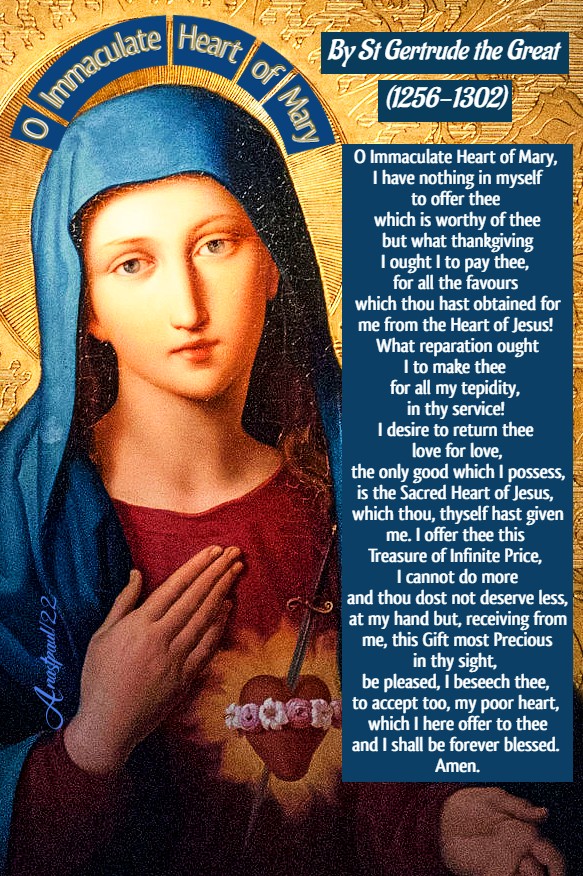
O Immaculate Heart of Mary By St Gertrude the Great (1256-1302)
O Immaculate Heart of Mary, I have nothing in myself to offer thee which is worthy of thee but what thankgiving I ought I to pay thee, for all the favours which thou hast obtained for me from the Heart of Jesus! What reparation ought I to make thee for all my tepidity, in thy service! I desire to return thee love for love, the only good which I possess, is the Sacred Heart of Jesus, which thou, thyself hast given me. I offer thee this Treasure of Infinite Price, I cannot do more and thou dost not deserve less, at my hand but, receiving from me, this Gift most Precious in thy sight, be pleased, I beseech thee, to accept too, my poor heart, which I here offer to thee and I shall be forever blessed. Amen.
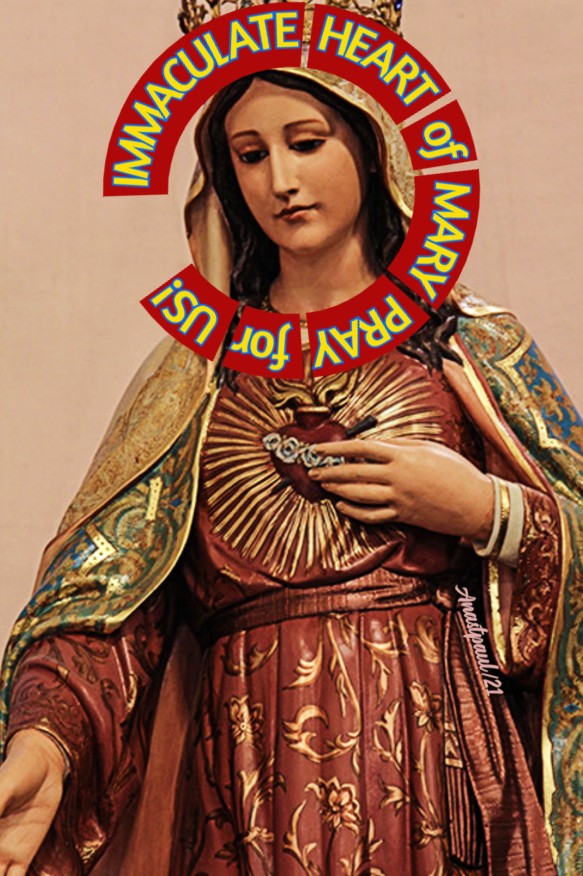
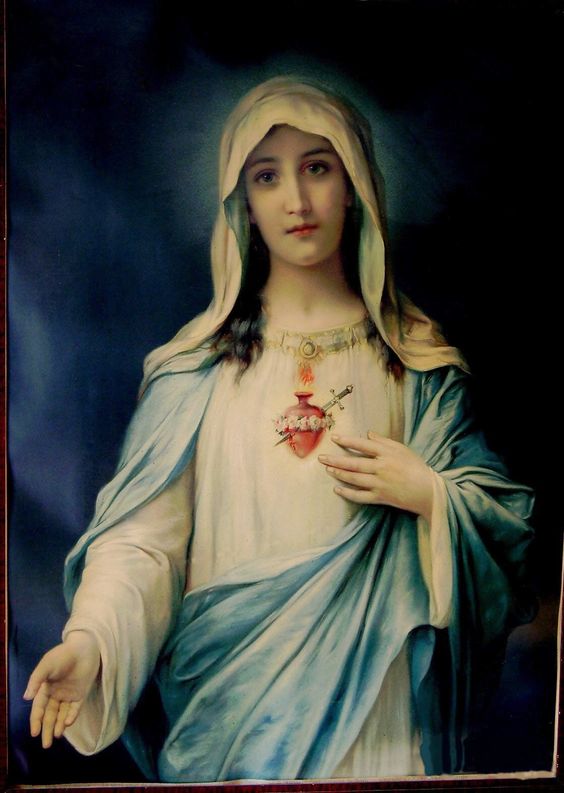
22 August – Feast of the Immaculate Heart of Mary (Octave Day of the Assumption).
Pope Pius XII instituted the Feast of the Immaculate Heart of Mary in 1944 to be celebrated on 22 August, coinciding with the traditional Octave Day of the Assumption of the Blessed Virgin.
In the midst of the second world war Pope Pius XII placed the whole world under the special protection of our Saviour’s Mother by Consecrating it to her Immaculate Heart and in 1944, he decreed that in the future, the whole Church should celebrate the Memorial of the Immaculate Heart of Mary.
In the seventeenth century, St John Eudes, preached it together with that of the Sacred Heart. In the nineteenth century, Pope Pius VII and Pope Pius IX, allowed several Churches to celebrate a Feast of the Pure Heart of Mary. Pope Pius XII instituted today’s Feast of the Immaculate Heart of Mary for the whole Church, so as to obtain by her intercession, “peace among nations, freedom for the Church, the conversion of sinners, the love of purity and the practice of virtue” (Decree of 4 May, 1944).
The attention of Christians was early attracted by the love and virtues of the Heart of Mary. The Gospel itself invited this attention with exquisite discretion and delicacy. What was first excited was compassion for the Virgin Mother. It was, so to speak, at the foot of the Cross that the Christian heart first made the acquaintance of the Heart of Mary. Simeon’s prophecy paved the way and furnished the devotion with one of its favourite formulae and most popular representations – the heart pierced with a sword. But Mary was not merely passive at the foot of the Cross; “she co-operated, through charity.” as St. Augustine says, “in the work of our redemption“.
It is only in the twelfth, or towards the end of the eleventh century, that indications of a regular devotion are perceived in a sermon by St Bernard (De duodecim stellis).
Stronger evidences are discernible in the pious meditations on the Ave Maria and the Salve Regina and also in the large book De laudibus B Mariae Virginis (Douai, 1625) by Richard de Saint-Laurent.
In St Mechtilde (died 1298) and St Gertrude (d.ied1302) the devotion had two earnest adherents. A little earlier it had been included by St Thomas Becket in the devotion to the joys and sorrows of Mary, by Blessed Hermann (died 1245), in his other devotions to Mary and somewhat later it appeared in St Bridget’s Book of Revelations.
St Ambrose perceived in her the model of a virginal soul. St Bernardine of Siena (died1444) was more absorbed in the contemplation of the virginal heart and it is from him, that the Church has borrowed the lessons of the Second Nocturn for the Feast of the Heart of Mary. St Francis de Sales speaks of the perfections of this heart, the model of love for God and dedicated to it, his Theotimus.
In the second half of the sixteenth century and the first half of the seventeenth, ascetic authors dwelt upon this devotion at greater length. It was, however, reserved to St John Eudes to propagate the devotion, to make it public and to have a feast celebrated in honour of the Heart of Mary, first at Autun in 1648 and afterwards, in a number of French Diocese.
In 1799 Pope Pius VI, then in captivity at Florence, granted the Bishop of Palermo the Feast of the Most Pure Heart of Mary for some of the Churches in his Diocese. In 1805 Pope Pius VII made a new concession, thanks to which the Feast was soon widely observed. Such was the existing condition when a twofold movement, started in Paris, gave fresh impetus to the devotion. The two factors of this movement were first of all the revelation of the “Miraculous Medal” in 1830 and all the prodigies that followed and then, the establishment at Notre-Dame-des-Victoires, of the Archconfraternity of the Immaculate Heart of Mary, Refuge of Sinners, which spread rapidly throughout the world and was the source of numberless graces. On 21 July 1855, the Congregation of Rites, finally approved the Office and Mass of the Most Pure Heart of Mary, without, however, imposing them upon the Universal Church.
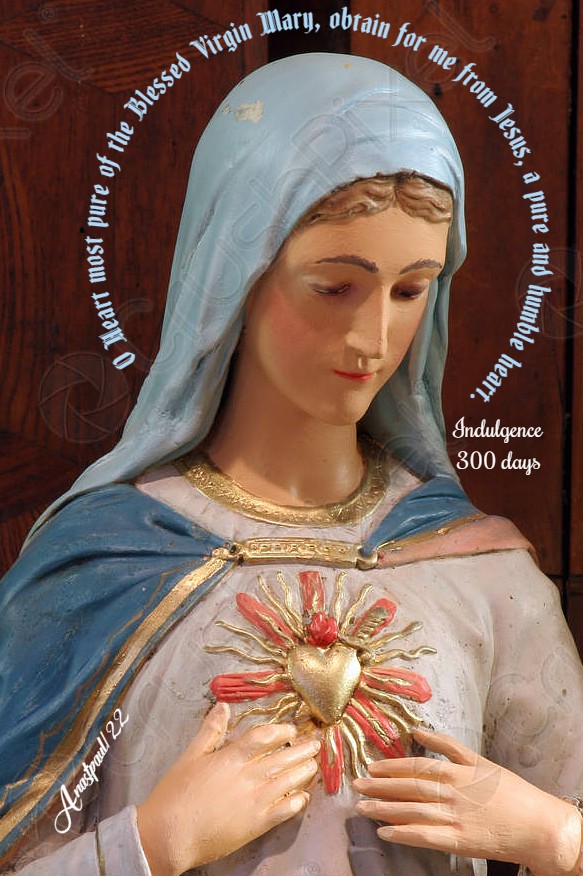
O Heart most pure of the Blessed Virgin Mary, obtain for me from Jesus, a pure and humble heart.
(1943 Raccolta–Indulgence 300 days)
Hail Mary! Prayer to the Immaculate Heart of Mary By St John Eudes (1601-1680) “The Apostle of Two Hearts”
Hail Mary! Mother of God the Son. Hail Mary! Spouse of the Holy Spirit. Hail Mary! Temple of the Most Blessed Trinity. Hail Mary! Pure Lily of the Effulgent Trinity. Hail Mary! Celestial Rose of the Ineffable Love of God. Hail Mary! Virgin pure and humble, of whom the King of Heaven willed to be born and, with thy milk to be nourished. Hail Mary! Virgin of Virgins, Hail Mary! Queen of Martyrs, whose soul a sword transfixed. Hail Mary! Lady most blessed! unto whom all power in Heaven and earth is given. Hail Mary! My Queen and my Mother! my Life, my Sweetness and my Hope, Hail Mary! Mother Most Amiable, Hail Mary! Mother of Divine Love, Hail Mary! Immaculate! Conceived Without Sin! Hail Mary! Full of Grace! The Lord is with Thee! Blessed art thou among women! And blessed is the Fruit of thy womb, Jesus! Blessed be thy spouse, Saint Joseph, Blessed be thy father, Saint Joachim, Blessed be thy mother, Saint Anne, Blessed be thy guardian, Saint John, Blessed be thy holy Angel, Saint Gabriel, Glory be to God the Father, Who chose thee, Glory be to God the Son, Who loved thee, Glory be to God the Holy Spirit, Who espoused thee.
O Glorious Virgin Mary, may all people love and praise thee.
St Andrew of Fiesole St Anthusa of Seleucia St Antoninus of Rome St Arnulf of Eynesbury St Athanasius of Tarsus Bl Bernard Perani St Dalmau Llebaría Torné St Epictetus of Ostia St Ethelgitha of Northumbria St Fabrician of Toledo St Felix of Ostia
St John Kemble (1599 – 1679) Martyr, Priest. Ordained in 1625, he returned to Monmouthshire and served more than 50 years as an itinerant Priest, winning admirers even among Protestants. After being dragged on a hurdle to Widemarsh Common, Kemble declared on the scaffold that he died for the religion that had made this country Christian and that he forgave all his enemies. He was then obliged to encourage the executioner, who had no stomach for his task. Biography: https://anastpaul.com/2018/08/22/saint-of-the-day-22-august-st-john-kemble-1599-1679-martyr/
St John Wall St Josep Roselló Sans St Julio Melgar Salgado St Maprilis of Ostia St Martial of Ostia St Maurus of Rheims St Narciso de Esténaga y Echevarría St Philibert of Toledo Bl Richard Kirkman St Saturninus of Ostia Bl Simeon Lukach St Sigfrid of Wearmouth St Symphorian of Autun
Thought for the Day – 21 August – Meditations with Antonio Cardinal Bacci (1881-1971)
The Sons of God
“We are, or ought to be, sons of God. We are His adopted sons by means of the grace which gives us a share in His Divine Life. This idea is contained, even in the Old Testament, “You are gods, all of you, sons of the Most High (Ps 81:6)” “The Spirit Himself,” explains St Paul, “gives testimony to our spirit that we are sons of God. But if we are sons, we are heirs also, heirs indeed of God and joint heirs with Christ” (Rom 8:16-17).
In other words, the grace of God transforms us and makes us His adopted sons. The supernatural life is grafted onto the soul, bringing forth a new man who is capable of actions which will deserve an everlasting reward. We must not allow the old tree, with its dead branches and barren fruit to spring up again within us, the old man with his defects and evil inclinations must remain dead.
If God’s life is extinguished in us,. we shall cease to be His heirs and co-heirs with Christ. We shall be incapable of doing anything good and shall be destined to eternal damnation.”
Quote/s of the Day – 21 August – The Memorial of St Jane Frances de Chantal VHM (1572-1641)
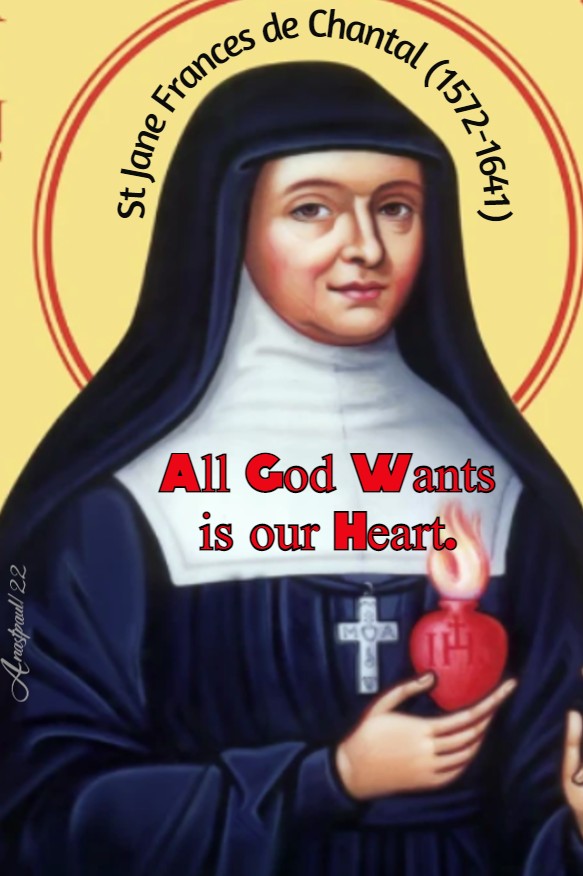
“All God wants is our heart.”
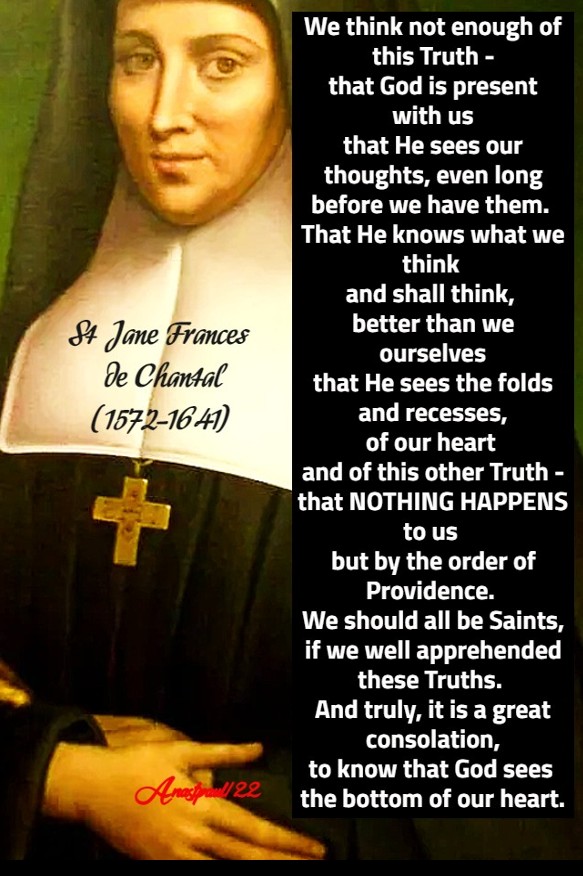
“We think not enough of this Truth – that God is present with us that He sees our thoughts, even long before we have them. That He knows what we think and shall think, better than we ourselves that He sees the folds and recesses, of our heart and of this other Truth – that NOTHING HAPPENS to us but by the order of Providence. We should all be Saints, if we well apprehended these Truths. And truly, it is a great consolation, to know that God sees the bottom of our heart.”
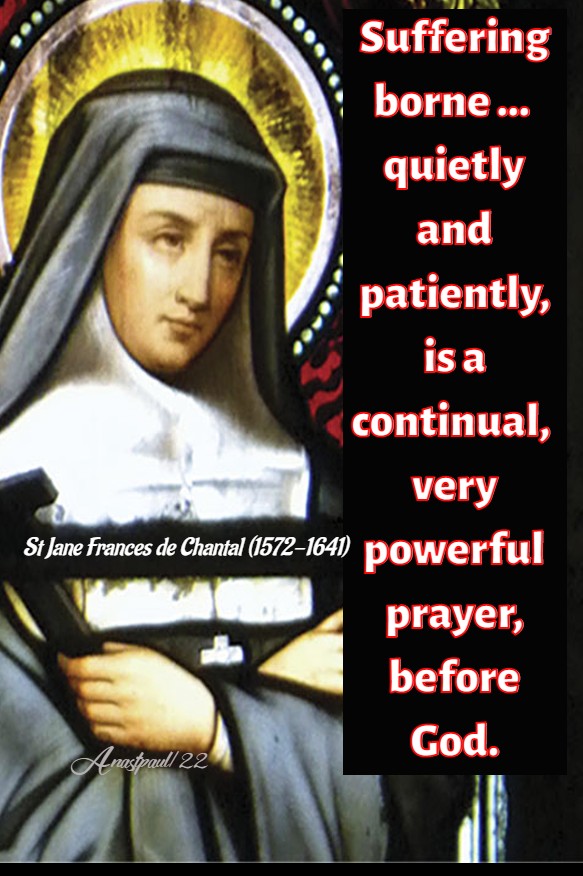
“Suffering borne … quietly and patiently, is a continual, very powerful prayer, before God.”
One Minute Reflection – 21 August – The 11th Sunday after Pentecost and the Memorial of St Jane Frances de Chantal VHM (1572-1641) – 1 Corinthians 15:1-10, Mark 7:31-37
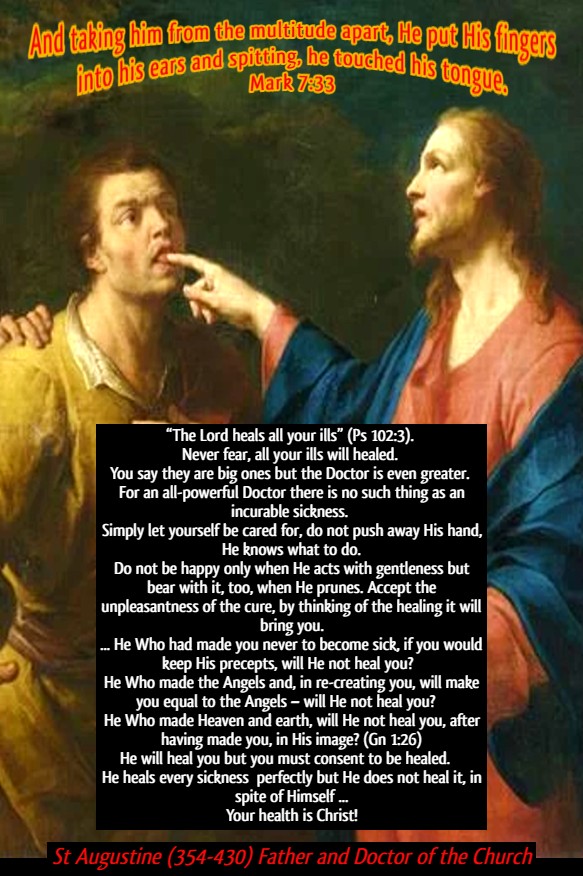
“And taking him from the multitude apart, He put His fingers into his ears and spitting, he touched his tongue.” – Mark 7:33
REFLECTION – “The Lord heals all your ills” (Ps 102:3). Never fear, all your ills will healed. You say they are big ones but the Doctor is even greater. For an all-powerful Doctor there is no such thing as an incurable sickness. Simply let yourself be cared for, do not push away His hand, He knows what to do. Do not be happy only when He acts with gentleness but bear with it, too, when He prunes. Accept the unpleasantness of the cure, by thinking of the healing it will bring you. Notice all those things, brethren, that people put up with in their physical ills, so as to prolong their lives a few days… You, at least, are not suffering for an uncertain result – He, who has promised you, your health, cannot be mistaken. Why is it that doctors are sometimes mistaken? Because they have not created the body they are treating. But God has made your body, God has made your soul. He knows how to re-create what He has created;, He knows how to re-fashion what He has formed. You have only to abandon yourself into His Doctor’s hands… Endure His hands, then, O soul that “blesses him and forgets not all his benefits – he heals all your ills” (P2 102[103]:2-3). He Who had made you never to become sick, if you would keep His precepts, will He not heal you? He Who made the Angels and, in re-creating you, will make you equal to the Angels – will He not heal you? He Who made Heaven and earth, will He not heal you, after having made you, in His image? (Gn 1:26) He will heal you but you must consent to be healed. He heals every sickness perfectly but He does not heal it, in spite of Himself … Your health is Christ!” – St Augustine (354-430) Father and Doctor of the Church – Sermon on the Psalms, Ps 102[103]: 5-6; PL 37, 1319
PRAYER – Almighty and merciful God, Who endowed St Jane Frances, burning with love of Thee, with a wondrous strength of spirit through all the paths of life, in the way of perfection and willed through her, to ennoble Thy Church, by a new religious family, grant by her merits and prayers, that we who are aware of our weakness, may trust firmly in Thy power and, by the assistance of divine grace, overcome all obstacles in our way. Through Jesus Christ, Thy Son our Lord, Who lives and reigns with Thee, in the unity of the Holy Ghost, God, world without end. Amen (Collect).
Our Morning Offering – 21 August – The Memorial of St Jane Frances de Chantal VHM (1572-1641)
Prayer of Abandonment By St Jane Frances de Chantal (1572-1641)
O sovereign goodness of the sovereign Providence of my God! I abandon myself forever to Thy arms. Whether gentle or severe, lead me henceforth whither Thou will. I will not regard the way through which Thou will have me pass but keep my eyes fixed upon Thee, my God, who guides me. My soul finds no rest without the arms and the bosom of this heavenly Providence, my true Mother, my strength and my rampart. Therefore I resolve with Thy Divine assistance, 0 my Saviour, to follow Thy desires and Thy ordinances, without regarding or examining why Thou does this rather than that but I will blindly follow Thee, according to Thy Divine will, without seeking my own inclinations. Hence I am determined to leave all to Thee, taking no part therein, save by keeping myself in peace in Thy arms, desiring nothing, except as Thou incites me to desire, to will, to wish. I offer Thee this desire, 0 my God, beseeching Thee to bless it. I undertake all it includes, relying on Thy goodness, liberality and mercy, with entire confidence in Thee, distrust of myself, and knowledge of my infinite misery and infirmity. Amen.
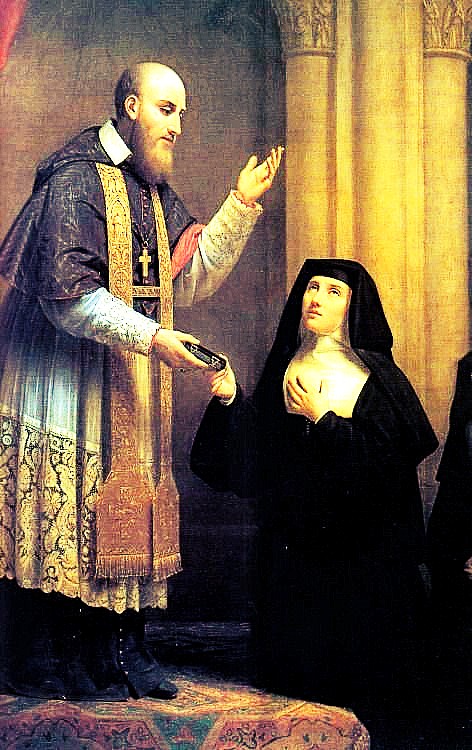
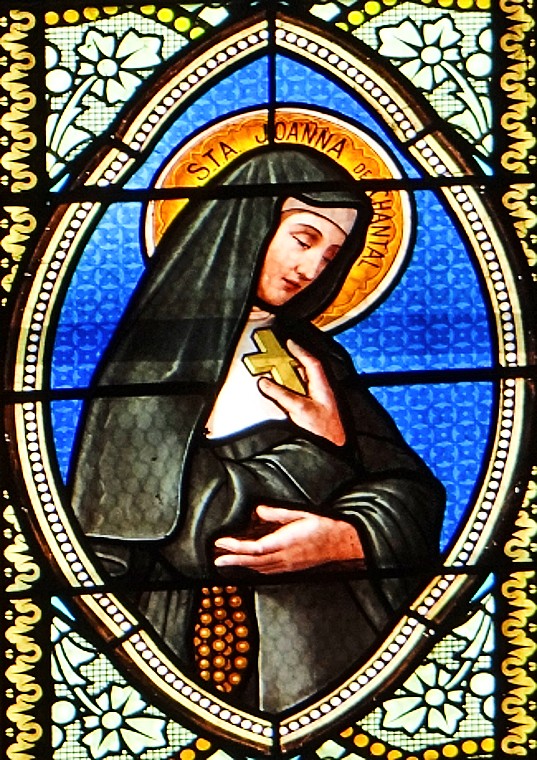
Saint of the Day – 21 August – St Jane Frances de Chantal (1572-1641) Widow, Mother, Foundress of the Congregation of the Visitation. Close friend of St Francis de Sales and St Vincent de Paul, both of whom guided and assisted her and her foundation, spiritually Patronages – against in-law problems, against the death of parents, forgotten people, parents separated from children, widows.
St Jane Frances de Chantal, Widow From the Liturgical Year, 1909
Jane Frances Freiniot de Chantal was born at Dijon in Burgundy, France, of noble parents and from her childhood gave clear signs of her future great sanctity. It was said that when only five years of age, she put to silence a Calvinist nobleman by substantial arguments, far beyond her age, and, when he offered her a little present, she immediately threw it into the fire, saying: “This is how heretics will burn in hell because they do not believe Christ when He speaks.”
When she lost her mother, she put herself under the care of the Virgin Mother of God,and dismissed a maid servant who was enticing her to love of the world. There was nothing childish in her manners. she shrank from worldly pleasures, and thirsting for martyrdom, she devoted herself entirely to religion and piety. She was given in marriage by her father to the Baron de Chantal and in this new state of life, she strove to cultivate every virtue and busied herself in instructing in faith and morals, her children, her servants and all under her authority. Her liberality in relieving the necessities of the poor was very great and more than once, God miraculously multiplied her stores of provisions – on this account, she promised never to refuse anyone who begged an alms in Christ’s Name.
Her husband, having been killed while hunting, she determined to embrace a more perfect life and bound herself ,by a vow of chastity. She not only bore her husband’s death with resignation but, overcame herself, so far, as to stand as the Godmother, to the child of the man who had killed him, in order to give a public proof that she pardoned him. She contented herself with a few servants and with plain food and dress, devoting her costly garments, to pious usages. Whatever time remained from her domestic cares, she employed in prayer, pious reading and good works. She could never be induced to accept offers of a second marriage, even though, honourable and advantageous. In order not to be shaken in her resolution of observing chastity, she renewed her vow and imprinted the most Holy Name of Jesus Christ upon her breast with a red-hot iron. Her love grew more ardent day by day. She had the poor, the abandoned, the sick and those, who were afflicted with the most terrible diseases, brought to her and not only sheltered, and comforted but also, nursed them. She washed and mended their filthy garments and did not shrink from putting her lips to their running sores.
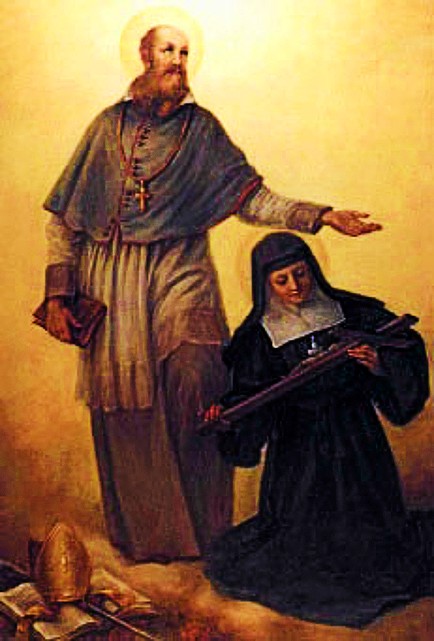
Having learnt the will of God from St Francis de Sales, her Director, she founded the Institute of the Visitation of Our Lady. For this purpose, she quitted, with unfaltering courage, her father, her father-in-law and even her son, over whose body she had to step, in order to leave her home, so violently did he oppose her vocation. She observed her Rule with the utmost fidelity and so great was her love of poverty that she rejoiced to be in want, of even the necessaries of life.
She was a perfect model of Christian humility, obedience, and all other virtues. Wishing for still higher ascensions in her heart, she bound herself by a most difficult vow, always to do what she thought most perfect. At length when the Order of the Visitation had spread far and wide, chiefly through her endeavours, after encouraging her sisters to piety and charity, by words and example and also, by writings full of divine wisdom, laden with merits, she passed to the Lord at Moulins, having duly received the Sacraments of the Church. She died on the 13 December, in the year 1641.
St Vincent de Paul, who was, at a great distance, saw her soul being carried to Heaven and St Francis de Sales coming to meet her. Her body was afterwards translated to Annecy. Miracles having made her illustrious, both before and after her death, Pope Benedict XIV. placed her among the Blessed and Pope Clement XIII. among the Saints. Pope Clement XIV. commanded her Feast to be celebrated by the Universal Church.
The 11th Sunday after Pentecost Sunday within the Octave of the Assumption
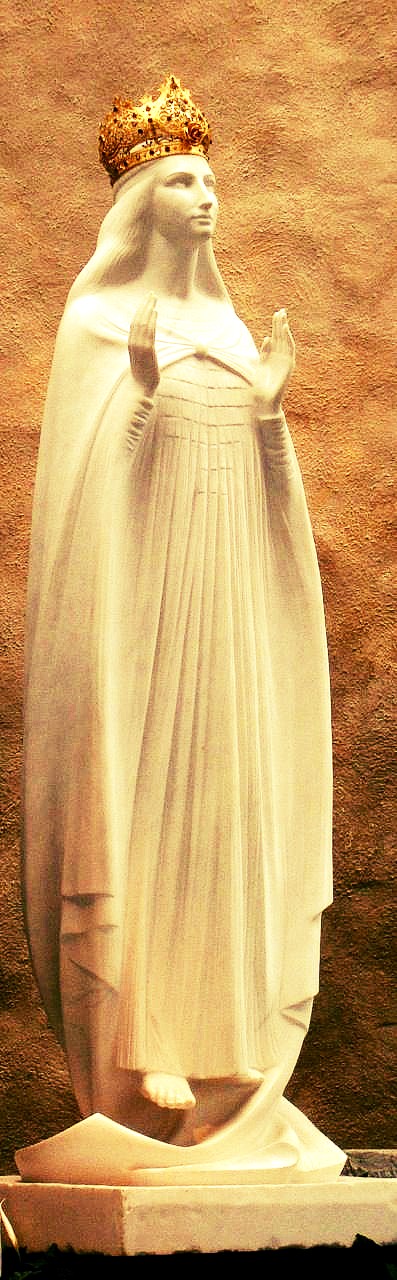
Our Lady of Knock, Ireland (1879) – 21 August:
The Apparition in County Mayo in Ireland of Our Lady of Knock is reported to have occurred on the evening of 21 August 1879, the Vigil of the Octave of the Feast of the Assumption. Those who witnessed the miracle, ranged in age from five years old to seventy five.
The Apparition was described as follows: “Our Lady was wearing a large, brilliant crown and clothed in white garments. On her right was Saint Joseph, his head inclined toward her and on her left Saint John the Evangelist. To the left of Saint John was an Altar on which stood a Crucifix and a lamb.” Standing only a few feet off the ground, the Blessed Virgin wore a white cloak and was described by witnesses as being incredibly beautiful. She wore a bright golden crown and appeared to be praying with her eyes looking toward Heaven with her arms bend in front of her with her palms facing inward.”
Fifteen parishioners stood, before the Apparition, for two hours as they recited the Rosary. Although it was daylight when the Apparition began, the weather changed and it began to rain heavily. The area around the Apparition appeared unaffected, however, as the ground remained dry, as long as the vision lasted. Our Lady did not speak but the gable of the Church where the Apparition occured was covered with a cloud of light.
Saint Joseph, also wore white robes and stood on the Virgin’s right. He inclined his head respectfully toward the Blessed Virgin. Saint John the Evangelist wore a miter and appeared to be preaching as he held a book in his left hand.
Since then thousands of people have made pilgrimages to Knock to pray to Our Lady. Their prayerful, penitential and reverential spirit, has been commended again and again by visitors from other lands. No sign of commercialism detracts from the purely religious atmosphere of that hallowed spot. People from all walks of life kneel in humble supplication before the Shrine of Our Lady, fully confident that she has sanctified that spot by her appearance there. Organised pilgrimages from various Diocese are conducted frequently to the Shrine The Holy Rosary comprises the main portion of the devotion – the Shrine is, therefore, appropriately called the Rosary Shrine. The “Knock Shrine Annual” relates many wonderful accounts of cures and conversions effected at the Shrine.
St Agapius of Edessa St Agathonicus of Constantinople St Anastasius Cornicularius St Aria of Rome St Avitus I of Clermont St Bassa of Edessa Bl Beatrice de Roelas St Bernhard of Lérida St Bernard de Alziva St Bonosus St Camerinus of Sardinia St Cameron St Cisellus of Sardinia St Cyriaca St Euprepius of Verona St Fidelis of Edessa Bl Gilbert of Valenciennes St Gracia of Lérida St Hardulph St Joseph Nien Vien Bl Ladislaus Findysz St Leontius the Elder St Luxorius of Sardinia St Maria of Lérida St Maximianus the Soldier St Maximilian of Antioch St Natale of Casale Monferrato St Paternus of Fondi St Privatus of Mende St Quadratus of Utica
Thought for the Day – 20 August – Meditations with Antonio Cardinal Bacci (1881-1971)
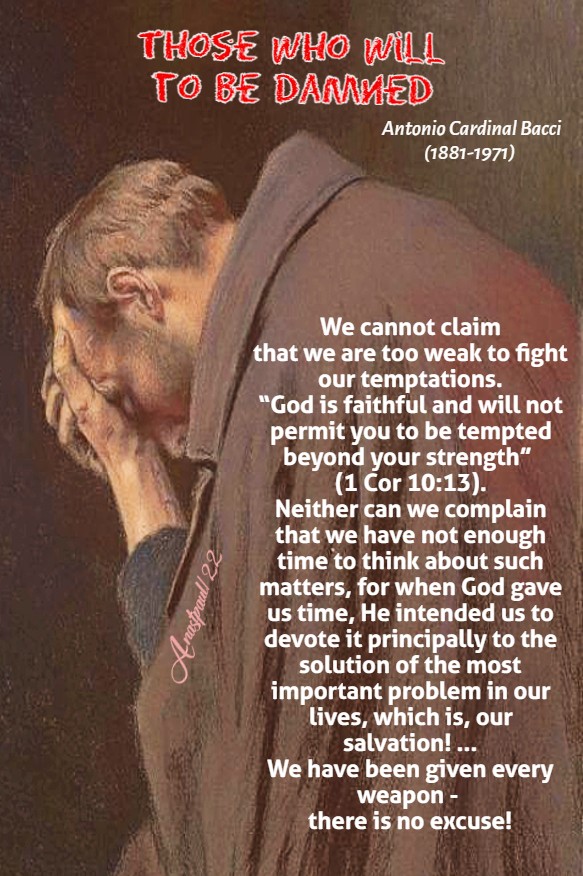
Those Who Will to be Damned
“We cannot claim that we are too weak to fight our temptations. “God is faithful and will not permit you to be tempted beyond your strength” (1 Cor 10:13). Neither can we complain that we have not enough time to think about such matters, for when God gave us time, He intended us to devote it principally to the solution of the most important problem in our lives, which is, our salvation! It is futile to insist that the devil is too strong for us, for, to quote St Augustine, he is like a chained mastiff which can bark at us with all his might but, cannot bite us, unless we approach too close to him.
We have been given every weapon – there is no excuse!”
Quote/s of the Day – 20 August – “The Month of the Immaculate Heart of Mary” and the Memorial of St Bernard (1090-1153) Abbot, Confessor, “Doctor Mellifluus” of the Church and the Last Father of the Church,“The Bard of Mary
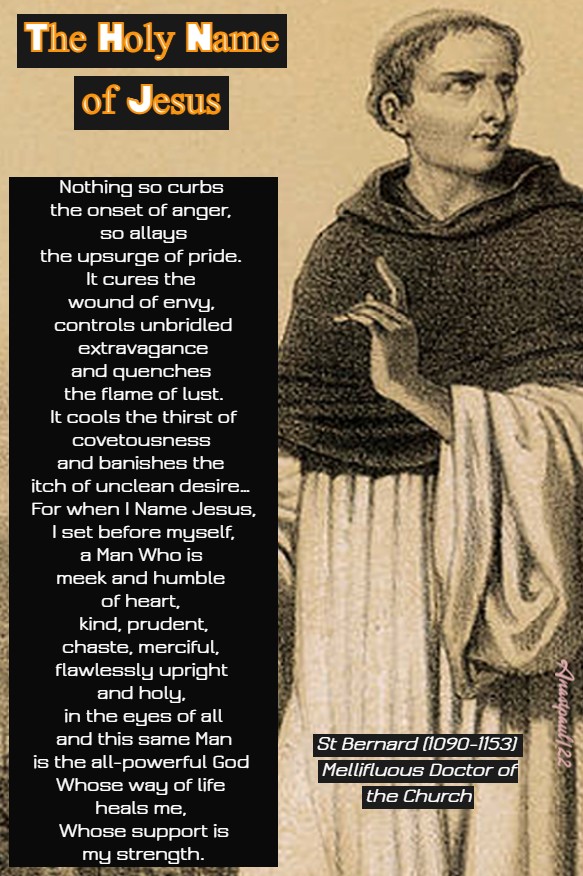
“Nothing so curbs the onset of anger, so allays the upsurge of pride. It cures the wound of envy, controls unbridled extravagance and quenches the flame of lust. It cools the thirst of covetousness and banishes the itch of unclean desire… For when I Name Jesus, I set before myself, a Man Who is meek and humble of heart, kind, prudent, chaste, merciful, flawlessly upright and holy in the eyes of all and this same Man is the all-powerful God Whose way of life heals me, Whose support is my strength.”
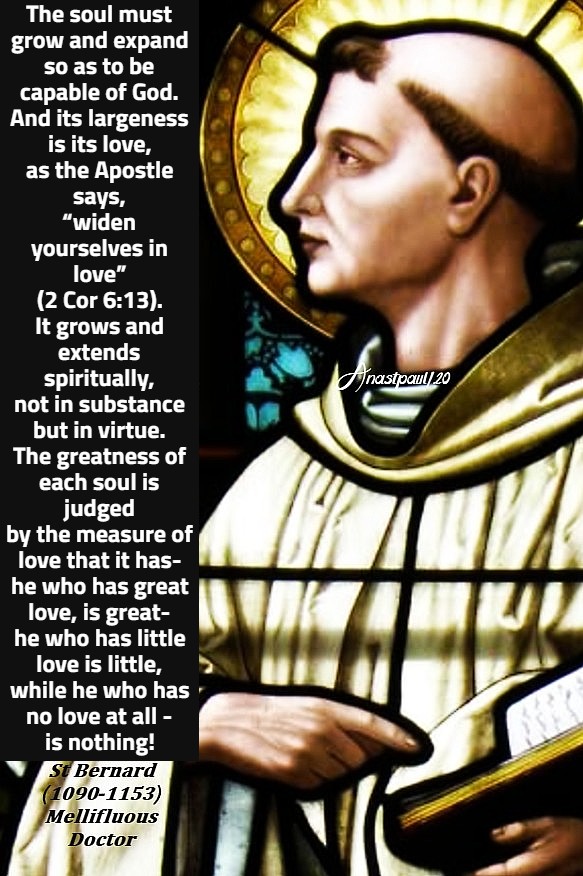
“The soul must grow and expand so as to be capable of God. And its largeness is its love, as the Apostle says, “widen yourselves in love” (2 Cor 6:13). It grows and extends spiritually, not in substance but in virtue. The greatness of each soul is judged by the measure of love that it has- he who has great love, is great- he who has little love is little, while he who has no love at all – is nothing!”
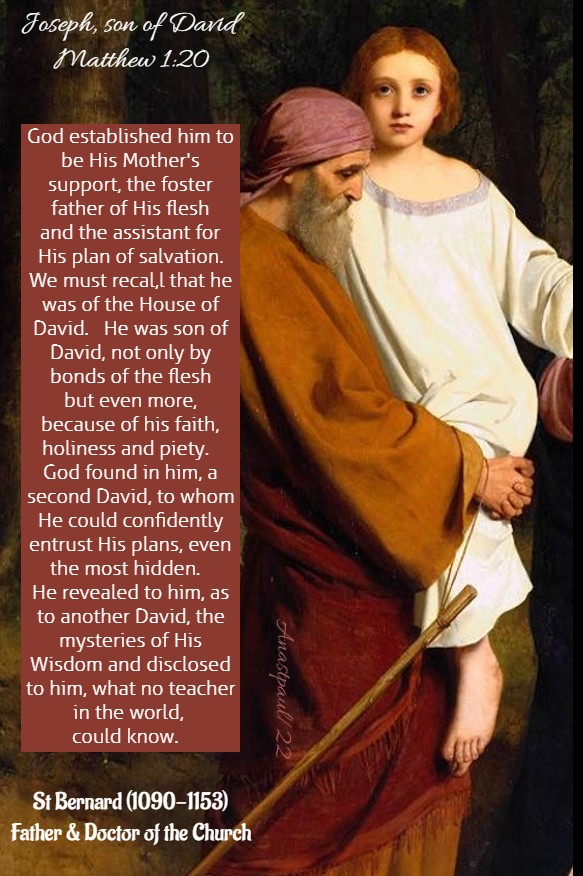
“God established him to be His Mother’s support, the foster father of His flesh and the assistant for His plan of salvation. We must recall, that he was of the House of David. He was son of David, not only by bonds of the flesh but even more, because of his faith, holiness and piety. God found in him, a second David, to whom He could confidently entrust His plans, even the most hidden. He revealed to him, as to another David, the mysteries of His Wisdom and disclosed to him, what no teacher in the world, could know.”
“O great, O gentle, O most lovable Mary, thy Holy Name cannot be spoken without inflaming the heart. To those who love thee, it is unspeakable consolation and joy even to think of thee; thou art a sweet memory to those who honour thee.”
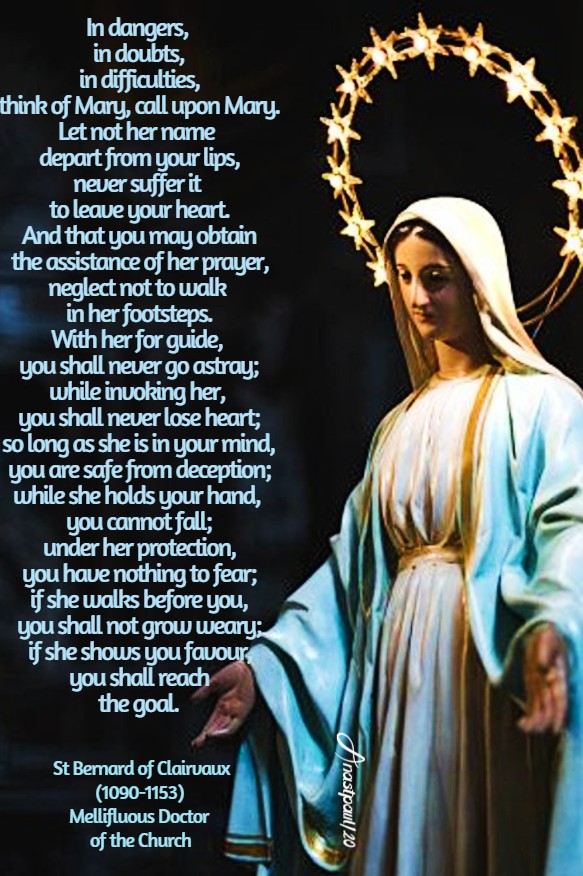
“In dangers, in doubts, in difficulties, think of Mary, call upon Mary. Let not her name depart from your lips, never suffer it to leave your heart. And that you may obtain the assistance of her prayer, neglect not to walk in her footsteps. With her for guide, you shall never go astray; while invoking her, you shall never lose heart; so long as she is in your mind, you are safe from deception; while she holds your hand, you cannot fall; under her protection you have nothing to fear; if she walks before you, you shall not grow weary; if she shows you favour, you shall reach the goal.”
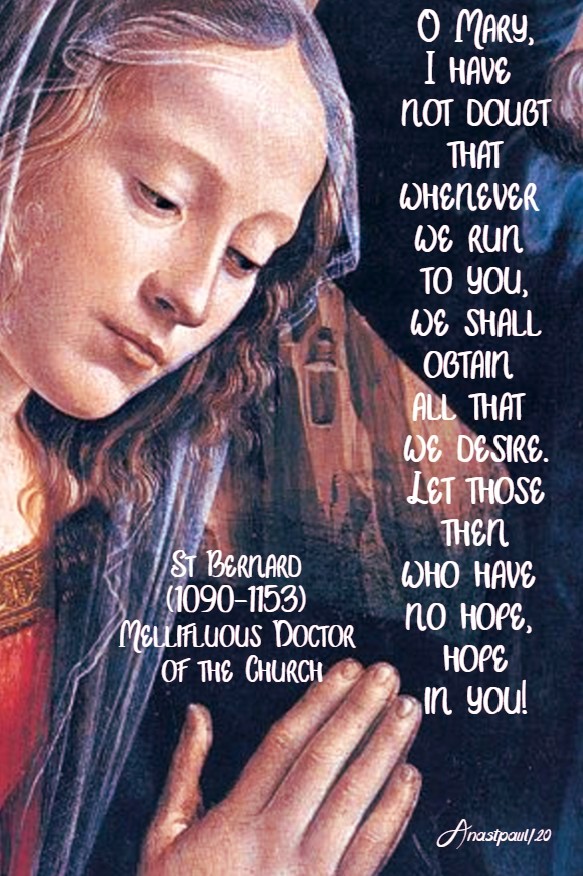
“O Mary, I have not doubt that whenever we run to you, we shall obtain all that we desire. Let those then who have no hope, hope in you!”
St Bernard (1090-1153) Mellifluous Doctor of the Church
One Minute Reflection – 20August – “The Month of the Immaculate Heart of Mary” and the Memorial of St Bernard (1090-1153) Confessor – Ecclesiasticus 39:6-14, Matthew 5:13-19
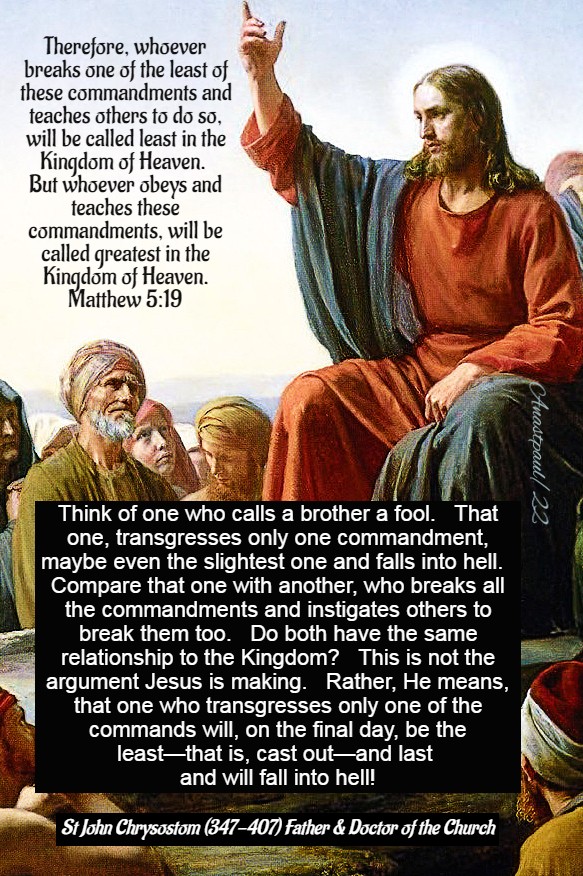
“Therefore, whoever breaks one of the least of these commandments and teaches others to do so, will be called least in the Kingdom of Heaven. But whoever obeys and teaches these commandments, will be called greatest in the Kingdom of Heaven.” – Matthew 5:19
REFLECTION – “For what reason then does He call some of these commandments “least,” although they are so magnificent and lofty? Jesus spoke this way because He was about to introduce His own teaching, as a new law . As He humbles Himself and speaks of Himself with great modesty, so He refers to His own teaching in the same manner. In this way, Jesus teaches us to practice humility in everything. And besides, since some suspected His teaching to be a new departure, He temporarily taught it in a more reserved way.
But when you hear “least in the Kingdom of Heaven,” you are to think of nothing but hell and punishment. For it was His practice to speak, not only of the joy the Kingdom brings but also, of the time of the resurrection and the fearful event of the Second Coming.
Think of one who calls a brother a fool. That one, transgresses only one commandment, maybe even the slightest one and falls into hell. Compare that one with another, who breaks all the commandments and instigates others to break them too. Do both have the same relationship to the Kingdom? This is not the argument Jesus is making. Rather, He means, that one who transgresses only one of the commands will, on the final day, be the least—that is, cast out—and last and will fall into hell!” – St John Chrysostom (347-407) Archbishop of Constantinople, Father and Doctor of the Church (The Gospel of Saint Matthew, Homily 16).
PRAYER – O God, Who gave to Thy people, blessed Bernard, as a minister of salvation, grant, we beseech Thee, that we, who cherished him on earth as a teacher of life, may be found worthy to have him as an intercessor in Heaven.Through Jesus Christ, Thy Son our Lord, Who lives and reigns with Thee, in the unity of the Holy Ghost, God, world without end. Amen (Collect).
Our Morning Offering – 20 August – “The Month of the Immaculate Heart of Mary” and the Memorial of St Bernard (1090-1153) Confessor, “The Bard of Mary”
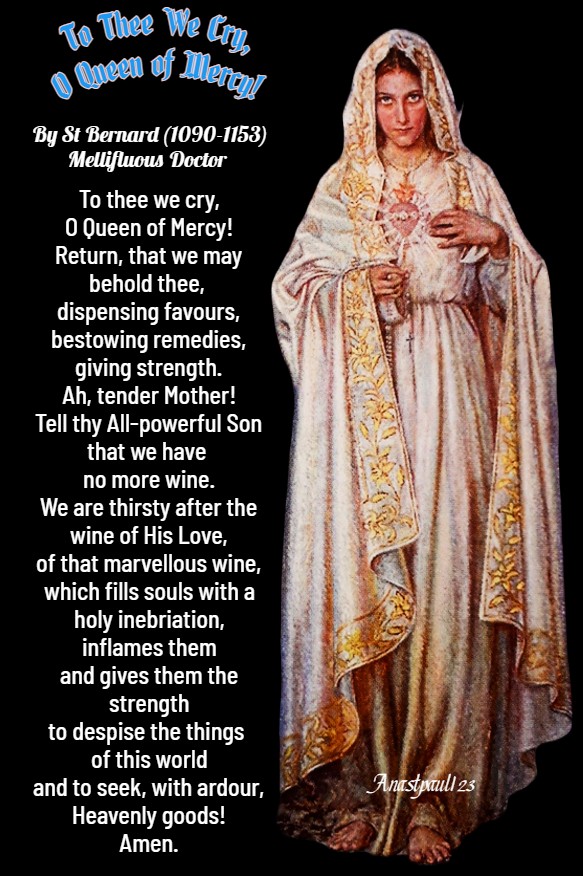
To Thee We Cry, O Queen of Mercy! By St Bernard (1090-1153) Mellifluous Doctor of the Church
To thee we cry, O Queen of Mercy! Return, that we may behold thee, dispensing favours, bestowing remedies, giving strength. Ah, tender Mother! Tell thy All-powerful Son that we have no more wine. We are thirsty after the wine of His Love, of that marvellous wine, which fills souls with a holy inebriation, inflames them and gives them the strength to despise the things of this world and to seek, with ardour, Heavenly goods. Amen.
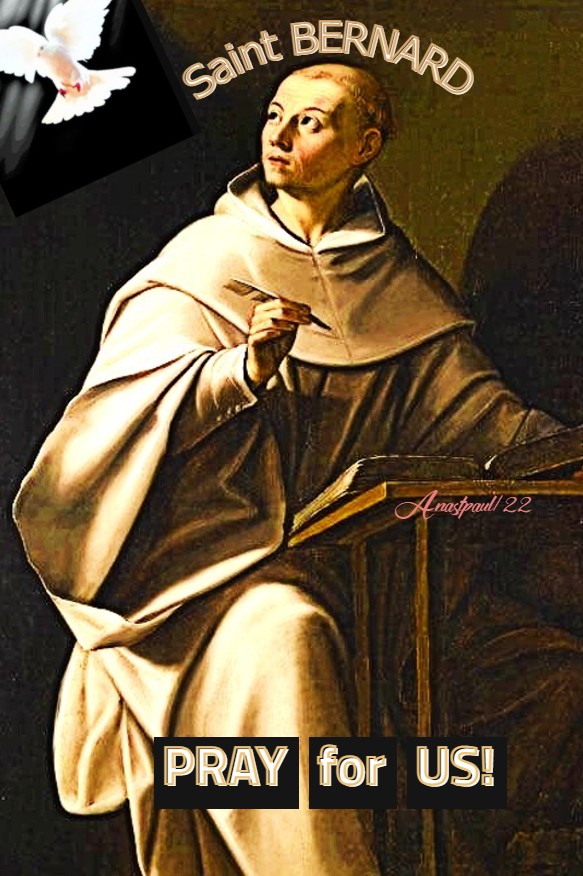
Saint of the Day – 20 August – St Bernard (1090-1153) Abbot, Confessor, “Doctor Mellifluus” of the Church and the Last Father of the Church,“The Bard of Mary.”
A Beautiful Portrait of the Saint Excerpt From “Saint Bernard” An Oracle of the 12th Century By Father Hugo Henry Hoever
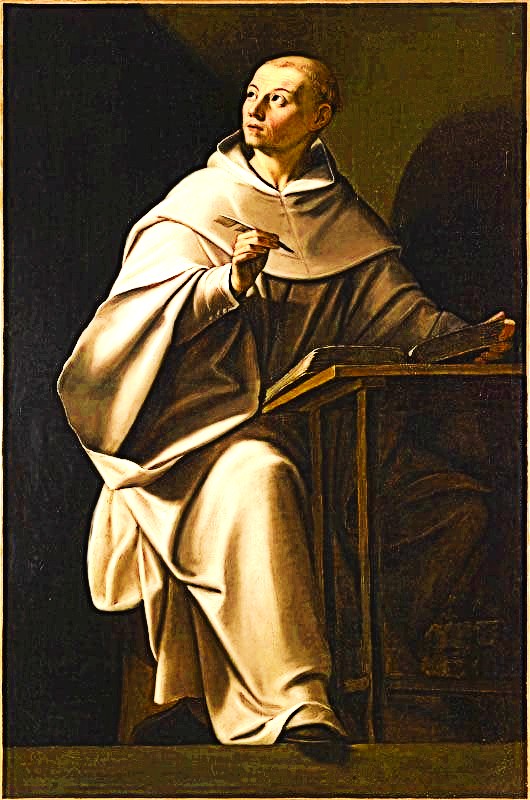
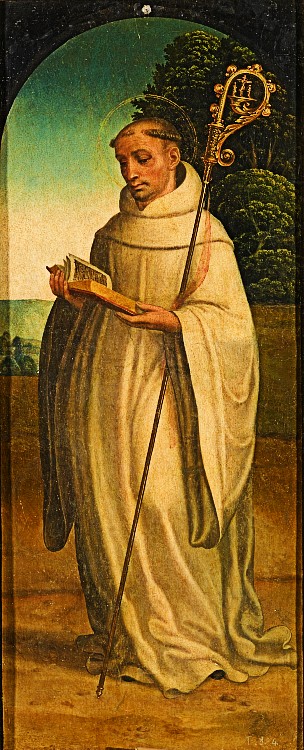
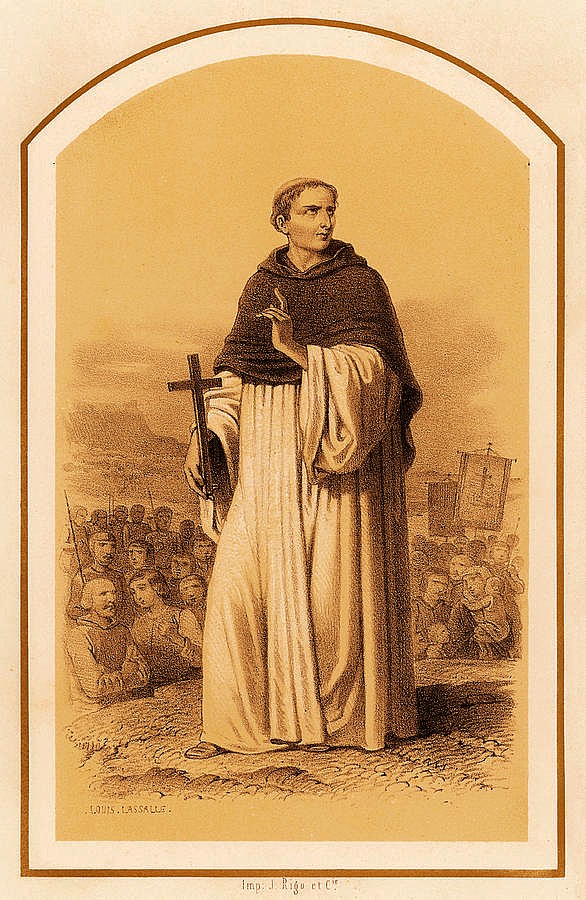
“The whole world knows that God glorified his servant Bernard, Abbot of Clairvaux, through miraculous signs. However, he displayed the greatest miracle ,in his own person. His gaze was serene and his appearance humble. In his sermons, he exercised prudent caution and, his actions were filled with fear of God. He was a man of meditation and prayer, who, in all his undertakings, trusted more in prayer than in his own abilities. God had given this holy soul a fitting body to assist him. A more spiritual, than sensual charm, enveloped his whole appearance. Heavenly glory brightened his face and from his eyes shone out, the innocence of an angel and the simplicity of a dove. So great was the interior beauty and fullness of grace of this man, that it was radiated in his bodily exterior. The body of the Saint was built most tenderly and almost completely without flesh. A fine red covered his cheeks. His hair was very fair and the reddish beard grew grey, in the last years of his life. Although he was only of medium height, Bernard appeared tall rather than short. If he could withdraw from exterior businesses, he prayed, read, wrote, taught his Monks or enjoyed silent meditation …
Clothing: With regard to clothing, Bernard liked poverty,but not uncleanliness. This would, he said, rather be a sign of negligence or reveal a proud man, who is intent on snatching some false glory from his fellowmen. In the later years of his life, by order of the visiting Abbots, he wore, besides the “Cuculla” (cowl) and tunic, a short woolen coat and a head-wear of similar material. In spite of his bodily sufferings, he could not be induced to put on a fur.
Gift of Speech: Notwithstanding his weak body, Bernard had a strong and beautiful voice which was given him by God because He had chosen him for the office of preacher. Bernard knew well how to adapt his speech to the audience. With people from the country hespoke like someone ,who himself, was reared in the country. When he was dealing with representatives of other classes, his words sounded as though he were familiar with their occupations in detail. This gift of eloquence which God had bestowed upon him, became evident also, by the fact, that the Germans, with great enthusiasm, listened to his sermons, although they did not understand his language. No interpretation in their own language, could have more edified, or more deeply affected them. They contritely beat their chests during his sermons and wept loudly.
Interior Recollection: When Bernard visited the Charter house (Chartreuse) near Grenoble, Prior Guigo was amazed by the refined saddlery of Bernard’s riding-animal which corresponded little with his poverty. When the holy Abbot learned of this, he was also surprised and asked what kind of saddle it was. Bernard had ridden from Clairvaux to the Charterhouse without taking notice of the saddle and up to this hour, he did not know what it looked like. The riding-animal, belonged to his uncle, a Cluniac Monk, who lived close by and who had lent it to him. Bernard had used the horse just as his uncle had left it. When the Prior heard this explanation, it was again his turn to be surprised. How must this servant of God have guarded his eyes! Bernard, on his long way, had not noticed what he (the Prior) had caught at first glance. In a similar way, Bernard travelled a whole day along the shore of Lake Geneva, without noting it, or at least without being conscious of it. When, in the evening, his companions spoke about the lake, he asked, to the surprise of all, the time during which they had passed the lake!
From the very first, Bernard always endeavoured to keep away from worldly things and to stay at the Monastery. For a certain time, he was able to carry out this plan, since the reference to his bodily weakness afforded a favourable excuse. But finally, the distressed condition of the Church of God and the command of the Pope, as well as of the Abbots of the Order, to whom he readily submitted all his affairs, compelled him to step out of his solitude. He was surprised, when he heard religious-minded people, laughing loudly. Often, we heard Bernard say, that, since he entered the Monastery, it was more difficult for him to laugh, than to suppress the laughter.
The Humble, Amiable Monk: Bernard had lived already for several years in Clairvaux, when one day he decided to pay a friendly visit to Bishop Hugo of Grenoble and the Carthusians living close by. The Bishop, who recognised the sanctity in his guest, received him with such respect, that he fell upon his knees before him. When the Abbot saw the aged Bishop in that position, he was much embarrassed. Immediately, he also went on his knees and then he received the Kiss of peace. From this time on, Bernard and the Bishop were intimate friends and seemed to be of one heart and soul.
With the same love and respect, the holy Abbot was received by Prior Guigo and the other Friars of the chartreuse. They were delighted to find in his person, the picture that they had formed of him, in their minds, from his letters. (Gaufrid, Vita Bernardi, lib. Ill, c. 1-3).
Bodily Sufferings and DeatH: Bernard’s health suffered from several bodily diseases. Especially dangerous, was a narrowing of his gullet which hardly permitted the reception of solid food. Moreover, he had a serious gastric condition. He found it difficult to stand for long periods – for this reason, he usually sat and moved around only a little.
After the holy Abbot had brought peace to Metz and all of Lorraine, he returned to the Monastery and suffered much from the infirmities of his slowly decaying body. However, he faced death gladly and cheerfully, just as one who enters the desired harbour and reefs the sails one by one. When Bishop Godfrey of Langres asked Bernard for his advice in an official affair, he was astonished at his indifference. Bernard replied: ‘Do not be surprised, I do not belong to this world any longer.’
He who desires further information on his sickness, can obtain this knowledge from a letter which Bernard, a few days before his death, sent to a friend: ‘I was glad to receive your letter but my condition does not permit me to enjoy it fully. How could one even speak of pleasure, when suffering prevails. Sleep eludes me, so that pain is not even interrupted for a time, by the blessing of drowsiness of the senses. A sick stomach is the cause of almost all my sufferings. Day and night it must be strengthened with beverages, since it inexorably rejects any solid food . . . The feet and legs are swollen like those of a dropsical person. That nothing remains concealed between friends, I want to add that in spite of all hardship, the spirit remains willing in the weak flesh. Pray to the Divine Redeemer, that He may not detain the imminent death but mercifully allow me to die.‘
Finally, when the mortal frame was completely shattered, the waiting soul returned home. When this day of death commenced which, for Bernard was the beginning of eternal reward, the neighbouring Bishops and many Abbots and Friars, gathered together. Now the loyal servant of our Lord, the first Abbot of Clairvaux, the (direct or indirect) Founder of more than 160 Monasteries! happily completed his course of life. He died at the age of almost 63, on 20 August 1153, in the presence of his spiritual sons.
On 22 August he was buried in front of the Altar of the Blessed Virgin and Mother, whose most devoted Priest he was. Upon his request a capsule with relics of St Thaddeus, which he had received that same year from Jerusalem, was laid on his chest. He desired to celebrate the day of general resurrection in communion with this Apostle.” (Gaufrid, Vita Bernardi lib. V, c. 2). St Bernard’s Tomb now rests in Troyes Cathedral, below.
























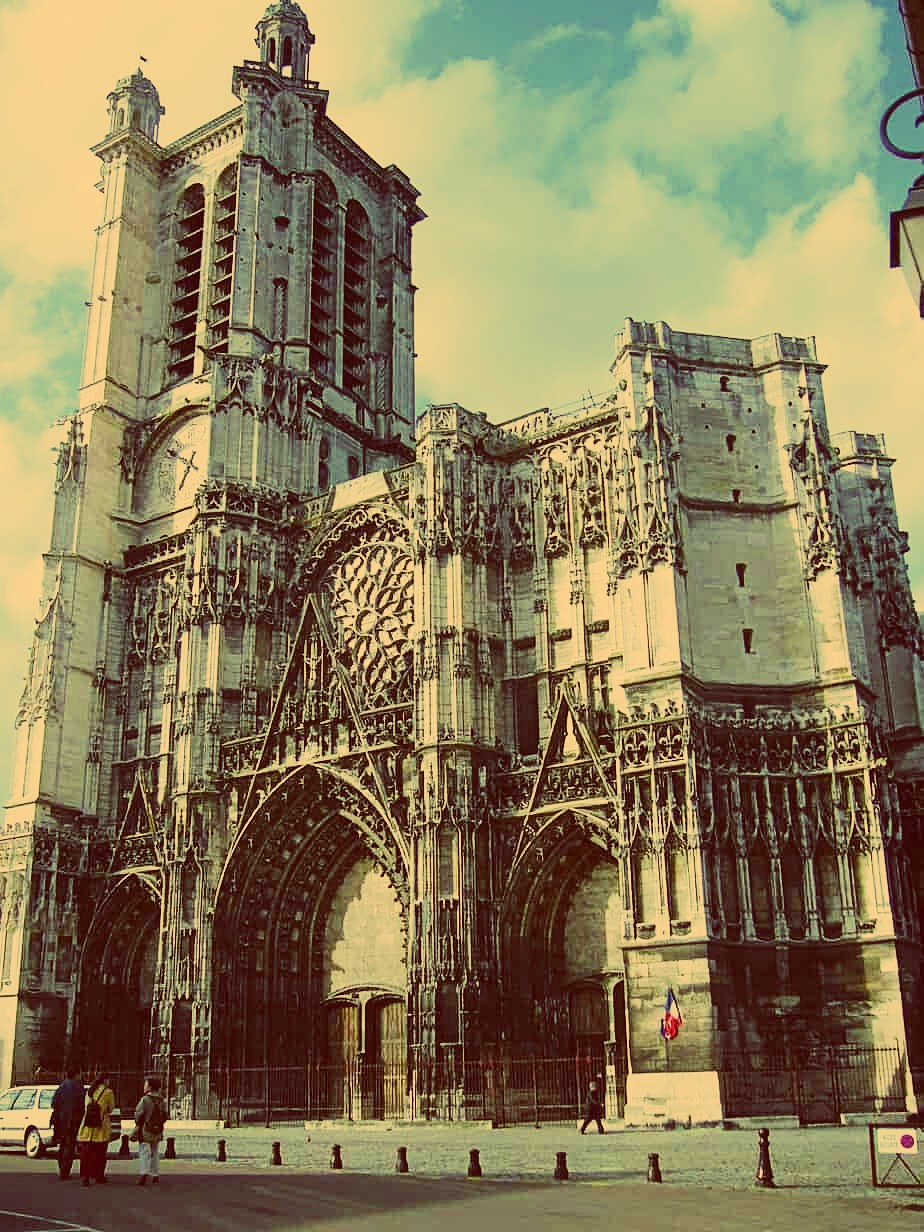
 AnaStpaul
You must be logged in to post a comment.