Saint of the Day – 8 December – Saint Romaric (Died 653) Married French noble layman, Abbot, Founder of the renowned Remiremont double Monastery in north-eastern France. Died in 653 of natural causes. He was Canonised on 3 December 1049 by Pope Leo IX. Also known as – Romaricus, Romary or Remire.
The Roman Martyrology reads today: “In the Monastery of Luxeuil, St Romericus, Abbot, who left the highest station at the Court of King Theodebert, renounced the world and surpassed all others in the observance of monastic discipline.”
Romaric was a Count Palatine, that is a Count attached to the Royal Court, operating there as an official or administrator. He lived at the Court of King Theodebert II. His parents were killed by Queen Brunhilda,and because of the enmity of his family with this Queen, he wandered without a home. However, with the fall of the Queen, he was received at the Court of Chlothar II and his lands were restored to him.
Disenchanted with life as a Courtier, Romaric experienced a religious conversion through the missionary efforts of St Amatus of Grenoble (c 560-c 627), a Monk of Luxeuil Abbey.
Romaric entered Luxeuil and trained in the ways of monastic life. With the approval of Abbot Eustace, Romaric and Amatus founded a double Monastery for men and women, later given the name of Remiremont (Romariki Mons). The Monastery was built on land belonging to Romaric. St Amatus served as the first Abbot with Romaric as the Prior. One of the earlier Monks in Remiremont was St Romaric’s friend St Arnulf (c 580-640), later the Bishop of Metz. See here:https://anastpaul.com/2021/07/18/saint-of-the-day-18-july-saint-arnulf-of-metz-c-580-640/
In around 625, Romaric succeeded Amatus as Abbot, a position he would hold for 30 years.. Many people were attracted to the holy life he established there and many they came to join him, including several members of his family who embraced religious life . tTwo of his daughters, Ozeltruda and Zeberga, his granddaughter Gebetruda and his grandson Adelphus.
Romaric died in 653 while on a mission to the Frankish Court to petition for Dagobert to receive the crown. Romaric’s Relics were enshrined at the Altar of Remiremont in 1051but both Church and Relics were destroyed in the French Revolution.
St Gunthildis of Ohrdruf Bl Johanna of Cáceres St Macarius of Alexandria St Marin Shkurti St Patapius St Rafael Román Donaire St Romaric (Died 653) Married Layman, Abbot St Sofronius of Cyprus
PREPARATORY PRAYER: In thy conception, O Virgin Mary, thou wast immaculate; pray for us to the Father, Whose Son Jesus, conceived in thy womb by the Holy Ghost, thou didst bring forth.
Indulgence. 200 days, every time. (Pius VI, 21 November
MEDITATION: Early in the Christian era the Feast of Mary’s Immaculate Conception was observed in several countries. St Anselm (1033-1109) Bishop of Canterbury and Doctor of the Church, introduced it in England. A great number of Popes favoured the Doctrine of Mary’s absolute sinlessness and the adversaries of the Immaculate Conception, were bidden to be silent and not publicly assert or defend their view. In 1477, Pope Sixtus IV prescribed the Feast of the Immaculate Conception to be observed in the whole Church and made it obligatory on Priests, to recite the special canonical Office and to use the Mass formula published for the purpose. In 1846, the Bishops of the United States assembled in Plenary Council in Baltimore, elected the Blessed Virgin under the title of her Immaculate Conception, as Patroness of the Church in their country. Finally, Pope Pius IX, after consulting with the Bishops throughout the world and having implored the Holy Ghost for His guidance, in prayer and fasting, promulgated, on 8 December, 1854, the Dogma which teaches that the Blessed Virgin Mary, was in her conception, by a special grace and through the merits of her Divine Son, preserved from the stain of Original Sin. This Doctrine was received throughout the world, with ineffable joy and, indeed, no-one who loves the Blessed Virgin, can help rejoicing at this, her most glorious privilege. The invocation, “Queen conceived without the stain of Original Sin,” was added to the Litany of Loreto. In 1866, at the Second Plenary Council in Baltimore, the Feast of the Immaculate Conception was raised to the rank of a Holy Day of Obligation for the Church of the United States.
PRACTICE: In the inscrutable designs of His Providence, God ordained that the Mystery of the Immaculate Conception of the Blessed Virgin Mary should be proclaimed an Article of Faith, as late as the middle of the nineteenth century. But, then, its proclamation was attended by circumstances which. undeniably proved that the Holy Father. in pronouncing the Dogma, had been inspired and guided by the Holy Ghost. Let us praise God and thank Him for bestowing this glorious privilege on our beloved Mother and, let us often invoke her under her favourite title, the Immaculate Conception. St. Alphonsus Liguori tells us that the devotion to this Mystery, is especially efficacious in overcoming the temptations of impurity. Therefore, he was accustomed to recommend, to his penitents thus tempted, to recite three times, everyday, the Hail Mary in honour of our blessed Mother’s Immaculate Conception. And the Venerable John of Avila (1500-1569) assures us that he had never found anyone, who practised a true devotion to the Immaculate Conception of Mary, who did not, in a short time, obtain the gift of that virtue of purity, which renders us so dear to her Immaculate Heart.
PRAYER OF THE CHURCH: O God, Who through the Immaculate Conception of the Virgin didst prepare a worthy dwelling-place for Thy Divine Son, grant that, as in view of Thy Son, Thou didst preserve her from all taint, so Thou wouldst vouchsafe unto us that cleansed from all sin by her intercession, we too may arrive at Thine eternal glory. Through the same Christ our Lord. Amen.
PRAYER: O Living light of holiness, model of purity, Mary Immaculate, Virgin and Mother! As soon as thou wast conceived, thou didst profoundly adore thy God, giving Him thanks that, in thee, the ancient curse was revoked and blessing came again, upon the sinful sons of Adam. O make this blessing, kindle in my heart love for God and do thou, fan this flame of love, within me that I may love Him constantly and one day, in Heaven, eternally enjoy Him, there to thank Him more and more fervently, for all the wondrous privileges conferred upon thee and to rejoice with thee, for thy high Crown of Glory.
Thought for the Day – 7 December – Meditations with Antonio Cardinal Bacci (1881-1971)
Fasting and Abstinence
“Nowadays, fast and abstinence, takes the form of precepts of the Church which binds us under pain of mortal sin. Before, they were commanded by the Church, however, they had been commanded by God. God made the first law of this kind when He ordered Adam to obstain from the forbidden fruit. Moses made particular laws of fast and abstinence for the Jewish people. He also fasted himself, as did the Prophet Elias. “My knees totter from my fasting, writes King David, “and my flesh is wasted of its substance.” (Ps 108:24). “Prayer is good with fasting and alms,” (Tob 12:8) says Tobias. Jesus fasted for forty days as an example to us and He waqrned us that the devil can be conquered only by prayer and fasting (Mt 17:20). In a more general way, He warned us that: “Unless you repent, you will all perish” (Lk 13:5). One of the means of doing penance most often recommended in Sacred Scripture, is fasting and abstinence.
Why, you may ask, should Our Lord and the Church, command us to mortify ourselves in regard to food? There are powerful reasons. It is an act of obedience to God, our absolute Master, Who does not demand anything of us, save for our own welfare. Secondly, it is an act of reparation for our sins. In the third place, it enables us to subdue our carnal impulses and in this way, makes us more obedient to the law of God.
A man who cannot mortify his appetite for food, will certainly not be able to resist the temptations of the flesh. There is a connection between all these things. If we cannot subordinate our bodily appetites to our spiritual faculties and to the Divine law, we shall not be able to raise ourselves from the level of an animal existence, to contact with God, through prayer and the practice of virtue.”
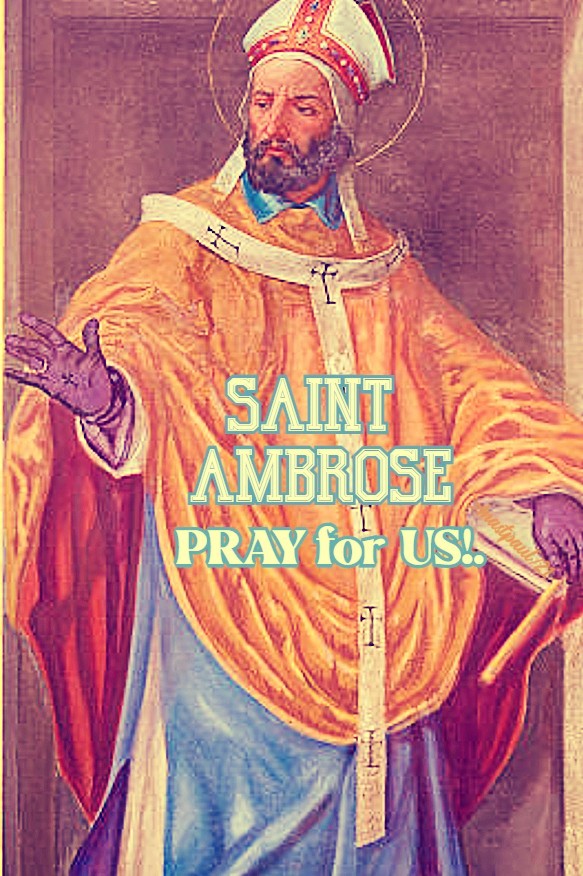
Quote/s of the Day – 7 December – St Ambrose (340-397) – Confessor, Bishop, Father and Doctor of the Church
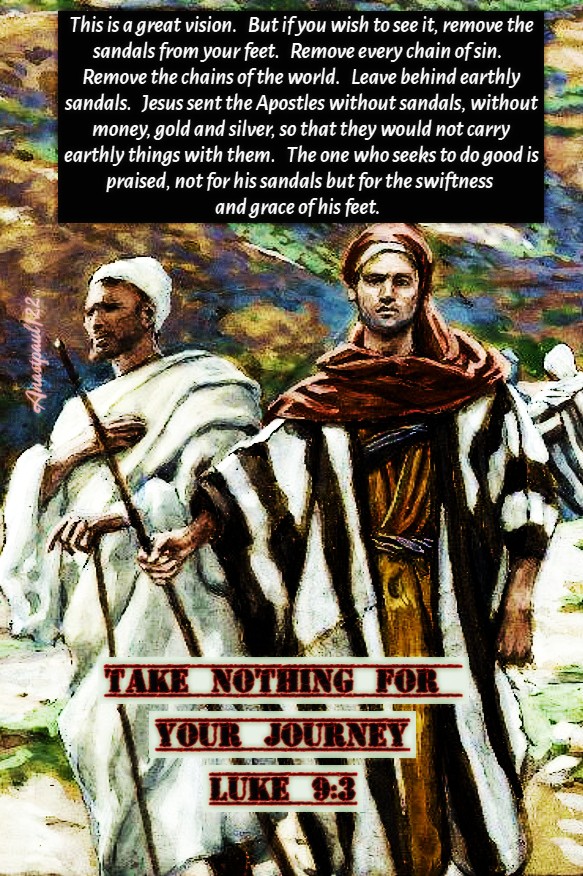
“Take nothing for your journey …”
Luke 9:3
“This is a great vision. But if you wish to see it, remove the sandals from your feet. Remove every chain of sin. Remove the chains of the world. Leave behind earthly sandals. Jesus sent the Apostles without sandals, without money, gold and silver, so that they would not carry earthly things with them. The one who seeks to do good is praised, not for his sandals but for the swiftness and grace of his feet. ”
“Let God alone be sought, as the Judge of loveliness, Who loves even, in less beautiful bodies, the more beautiful souls.”
“And now, let the feet of our minds. be stretched out. The Lord Jesus wills also, to wash our feet, For He says, not to Peter alone but to each of the faithful: If I wash not your feet you will have no part with Me. [ John 13: 8 ]”
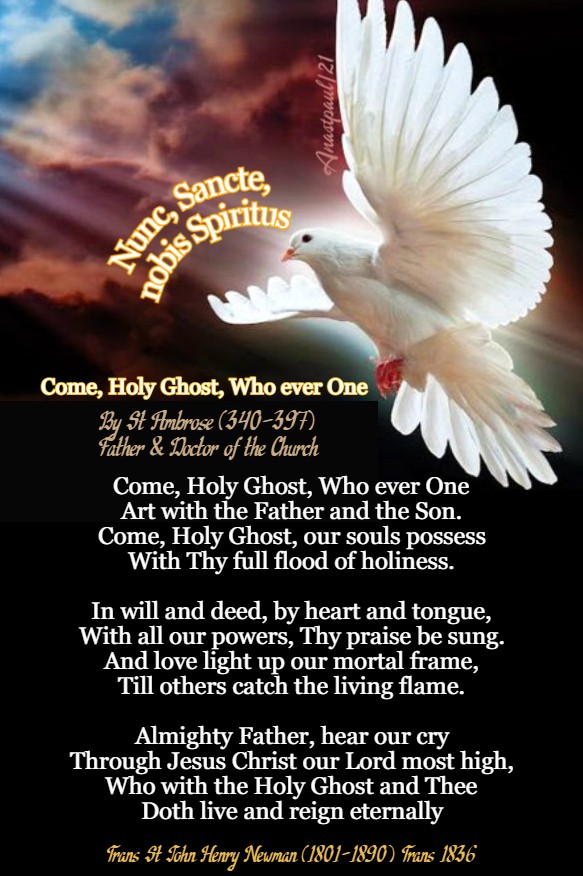
Nunc, Sancte, nobis Spiritus By St Ambrose (340-397) Come, Holy Ghost, Who ever One Trans John Henry Newman (1801-1890) Trans 1836
Come, Holy Ghost, Who ever One Art with the Father and the Son. Come, Holy Ghost, our souls possess With Thy full flood of holiness.
In will and deed, by heart and tongue, With all our powers, Thy praise be sung. And love light up our mortal frame, Till others catch the living flame.
Almighty Father, hear our cry Through Jesus Christ our Lord most high, Who with the Holy Ghost and Thee Doth live and reign eternally.
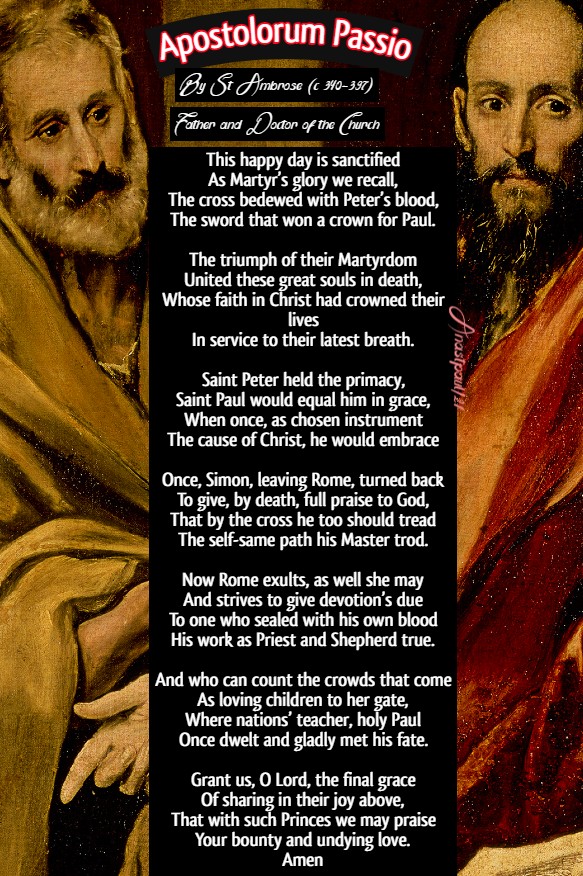
Apostolorum Passio By St Ambrose (c 340-397)
This happy day is sanctified As Martyr’s glory we recall, The cross bedewed with Peter’s blood, The sword that won a crown for Paul.
The triumph of their Martyrdom United these great souls in death, Whose faith in Christ had crowned their lives In service to their latest breath.
Saint Peter held the primacy, Saint Paul would equal him in grace, When once, as chosen instrument The cause of Christ, he would embrace
Once, Simon, leaving Rome, turned back To give, by death, full praise to God, That by the cross he too should tread The self-same path his Master trod.
Now Rome exults, as well she may And strives to give devotion’s due To one who sealed with his own blood His work as Priest and Shepherd true.
And who can count the crowds that come As loving children to her gate, Where nations’ teacher, holy Paul Once dwelt and gladly met his fate.
Grant us, O Lord, the final grace Of sharing in their joy above, That with such Princes we may praise Your bounty and undying love. Amen
Translation: The Benedictines of Saint Cecilia’s Abbey, Ryde, UK
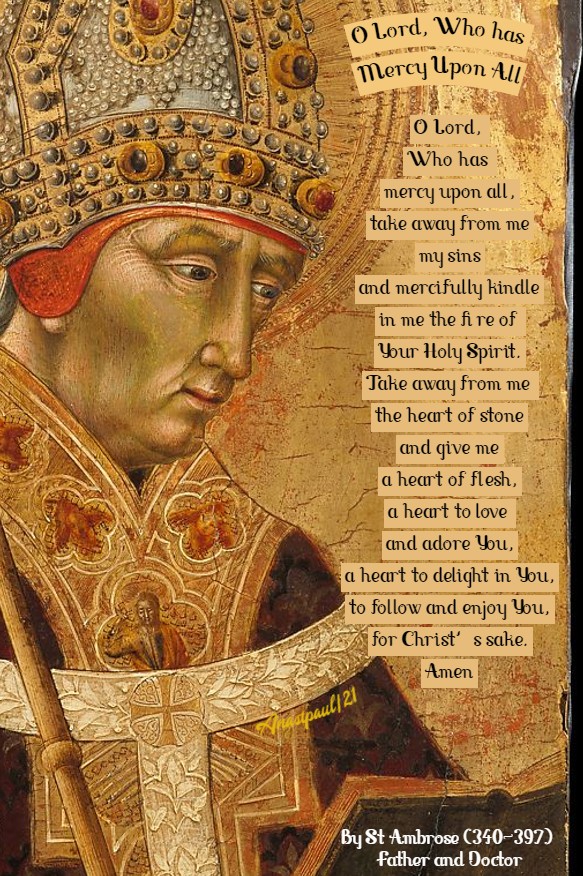
O Lord, Who has Mercy Upon All By St Ambrose (340-397)
O Lord, who has mercy upon all, take away from me my sins and mercifully kindle in me the fire of Your Holy Spirit. Take away from me the heart of stone and give me a heart of flesh, a heart to love and adore You, a heart to delight in You, to follow and enjoy You, for Christ’s sake. Amen
One Minute Reflection – 7 December – “The Month of the Divine Infant and the Immaculate Conception” – St Ambrose (340-397) – Confessor, Bishop, Father and Doctor of the Church – 2 Timothy 4:1-8, Matthew 5:13-19 – Scripture search here: https://www.drbo.org/
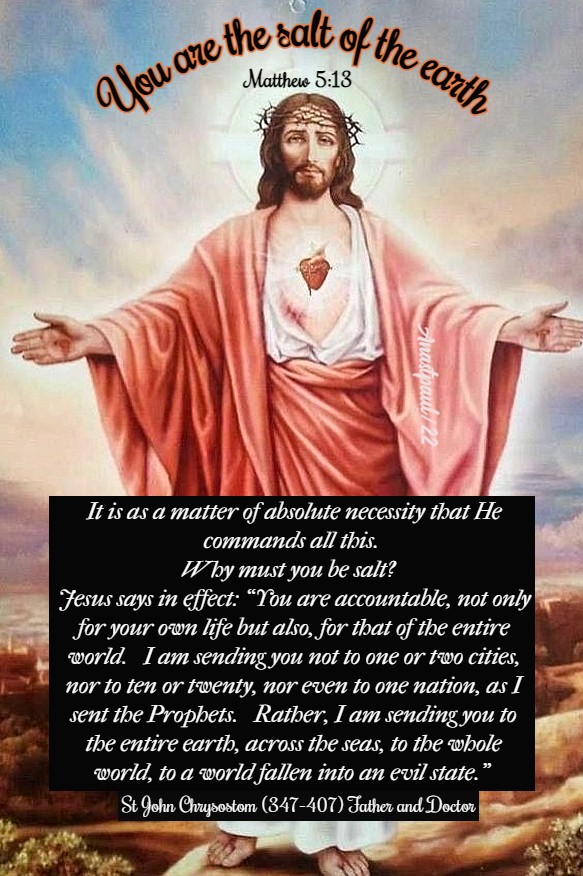
“You are the salt of the earth. But if salt loses its taste, with what can it be seasoned? It is no longer good for anything but to be thrown out and trampled underfoot.” – Matthew 5:13
REFLECTION – “It is as a matter of absolute necessity that He commands all this. Why must you be salt? Jesus says in effect: “You are accountable, not only for your own life but also, for that of the entire world. I am sending you not to one or two cities, nor to ten or twenty, nor even to one nation, as I sent the Prophets. Rather, I am sending you to the entire earth, across the seas, to the whole world, to a world fallen into an evil state.” For by saying, “You are the salt of the earth,” Jesus signifies, that all human nature itself has “lost its taste,” having become rotten through sin. For this reason, you see, He requires from His disciples, those character traits that are most necessary and useful for the benefit of all.” – St John Chrysostom (347-407) Archbishop of Constantinople, Father and Doctor (The Gospel of Matthew: Homily,15).
PRAYER – O God, Thou Who have given blessed Ambrose to Thy people as a help for eternal salvation, grant, we beseech Thee that we may be worthy to have him as our intercessor in Heaven, whom we have had as a teacher of life, on earth. ThroughJesus Christ, Thy Son our Lord, Who lives and reigns with Thee, in the unity of the Holy Ghost, God, world without end. Amen (Collect).
Our Morning Offering – 7 December – “The Month of the Divine Infant and the Immaculate Conception” – St Ambrose (340-397) – Confessor, Bishop, Father and Doctor of the Church
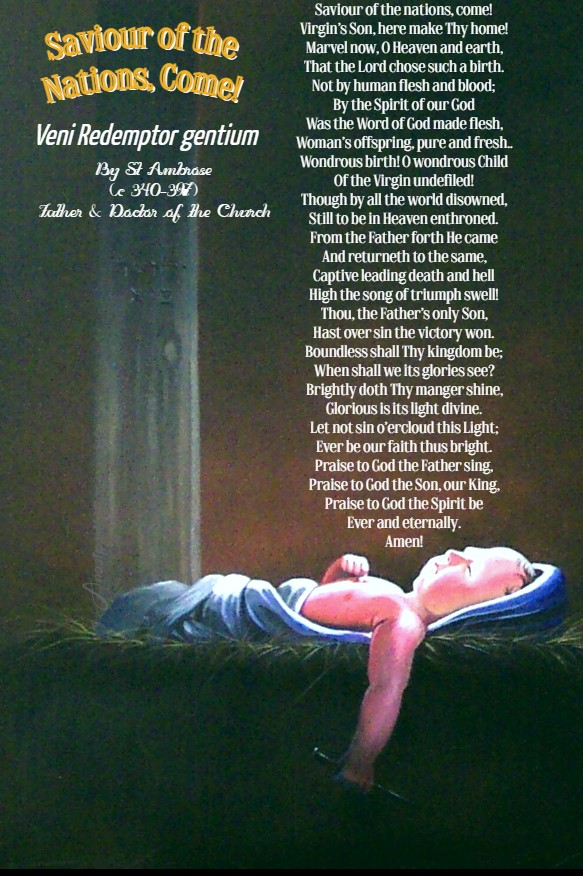
Veni Redemptor Gentium Saviour of the Nations, Come! St Ambrose’s Advent Hymn
Saviour of the nations, come! Virgin’s Son, here make Thy home! Marvel now, O Heaven and earth, That the Lord chose such a birth.
Not by human flesh and blood; By the Spirit of our God Was the Word of God made flesh, Woman’s offspring, pure and fresh.
Wondrous birth! O wondrous Child Of the Virgin undefiled! Though by all the world disowned, Still to be in Heaven enthroned.
From the Father forth He came And returneth to the same, Captive leading death and hell High the song of triumph swell!
Thou, the Father’s only Son, Hast over sin the victory won. Boundless shall Thy kingdom be; When shall we its glories see?
Brightly doth Thy manger shine, Glorious is its light divine. Let not sin o’ercloud this Light; Ever be our faith thus bright.
Praise to God the Father sing, Praise to God the Son, our King, Praise to God the Spirit be Ever and eternally. Amen!
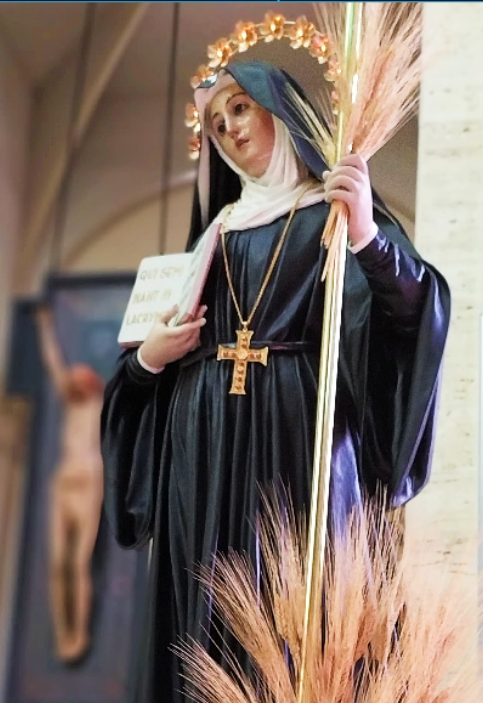
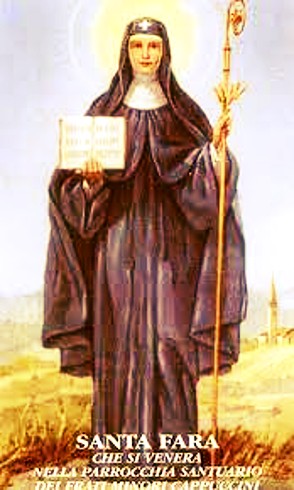
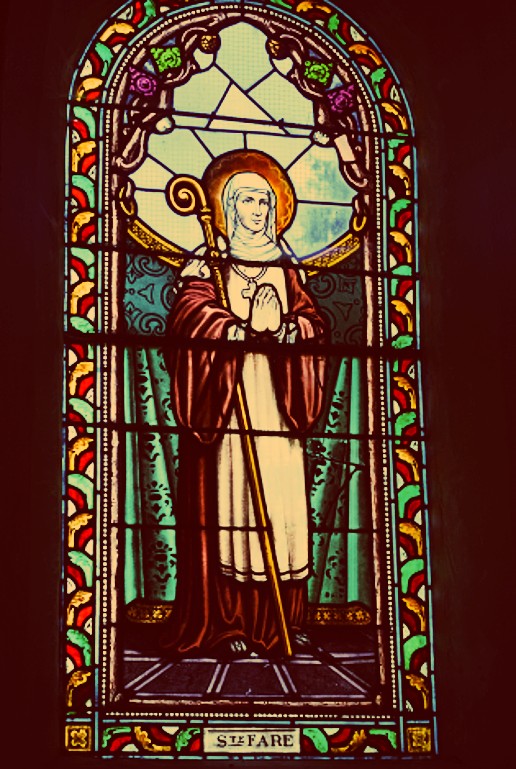
Saint of the Day – 7 December – St Burgundofara / more commonly known as Fara (c 595-c 643) Virgin, Nun, Abbess, Founder of the famous Evoriacum Monastery, near Paris in France, which after her death was renamed in her honour, Faremoutiers Abbey (Fara’s Monastery). The surrounding town is also knamed in her honour as is the Cathedral. Born in c 595 in Burgundy, France and died of natural causes in 643 or 655 or 657 near Meaux, France (records vary). Also known as – Burgondophora, Fare.Patronage – of Faremoutiers, France.
St Burgundofara in Faremoutiers Cathedral
Faremoutiers Abbey was the first “double” Monastery in France. These Celtic double Monasteries began in Ireland and they were places where both Monks and Nuns lived on the same monastic grounds, under the Rule of an Abbott or Abbess. The Nuns and Monks lived in separate quarters, but often worked and worshipped together.
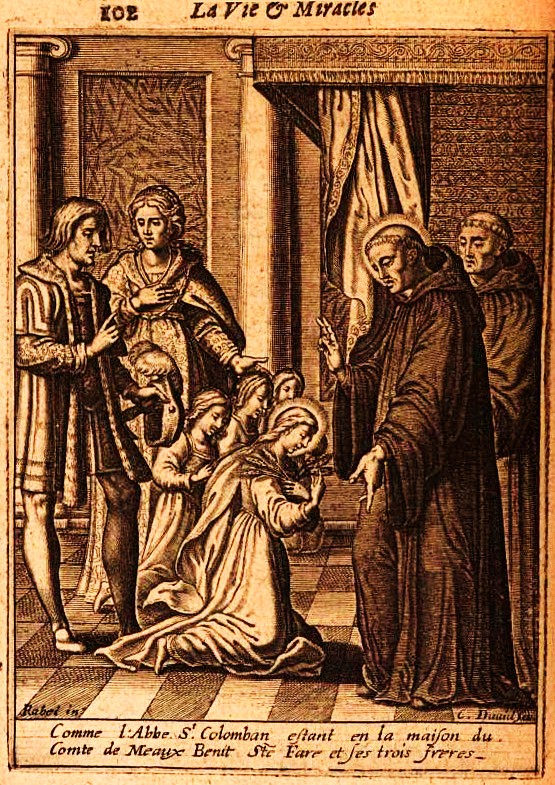
Burgundofara’s family was knowns as the Faronids, named after her brother Saint Faro (Died c 675) the Bishop of Meaux in France. Her name may mean: ‘She who moves the Burgundians.’ When Burgundofara was a child, St Columbanus, the famous Irish Monk, visited in her home and blessed and dedicated her to God. This left such an indelible mark upon her soul that she resisted her parents’ attempts to force her to marry a few years later. Burgundofara spoke boldly to her father about becoming a Nun. She said to him: “To lose my life for the sake of virtue and fidelity to the promise I have made to God, would be a great happiness.”
St Columbanus blesses Burgundofara
As Founder and Abbess of Faremoutiers Abbey, Burgundofara grew into a strong leader who was not afraid to speak her mind. Those who lived on her monastic grounds discovered that she was both tough and tender.
Interestingly, it is recorded by the 7th Century Columbanian Monk and Hagiographer of the renowned Life of St Columbanus (he also wrote Burgundofara’s Vita), Jonas of Bobbio that a Monk named Agrestius from one of Columbanus’ Monasteries “felt called” to patronise Burgundofara concerning his thoughts, on how she was not being a good Abbess. He castigated her for using the Rule of Columbanus (of which he did not approve) in her Monastery.
This is how Jonas of Bobbio recorded that historical confrontation, “Agrestius then made his way to Burgundofara to try, if he might defile her with his insinuations. But the virgin of Christ confounded him, not in a feminine manner but with a virile response: “Why have you come here, you confuter of truth, inventor of new tales, pouring out your honey-sweetened poison, to change healthy food into deadly bitterness? You slander those whose virtues I have experienced. From them I received the doctrine of salvation. Their erudition has opened the way to the Kingdom of Heaven for many. Recall the words of Isaiah: ‘Woe unto them that call evil good and good evil.’ Hurry and turn wholly away from this insanity.”
She was known for not only her personal courage, strength and toughness but also for her tender care, counsel and devotion, for those at Faremoutiers. Jonas of Bobbio wrote that after serving as Abbess of Faremoutiers for thirty-seven years, Burgundofara had a fever and died. She was so tough that miraculously, she managed to come back to life to make restitution with three Nuns, whom she had hurt. She received their forgiveness, lived six more months and then prophesied of the date and time of her death. When she died, it was recorded that her body smelled of sweet balsam.
A solemn Mass was held thirty days after Abbess Burgundofara’s final death. Hopefully, it is not blasphemous to ponder that they waited this long, to ensure that she would not come back to life. Her Will (Testamentum) confirmed that all the servants she had freed in her lifetime, would continue to be free.
The Faremoutiers Monastic grounds still exist, 1400 years later. Sadly, the French Revolution destroyed her monastic buildings but in 1931, a group of Benedictine Nuns came to reoccupy a building on the very spot of the ruins of the old Abbey. A few Nuns still live and serve there.
Yes, Abbess Burgundofara was a strong, powerful, and deeply spiritual leader.
Vigil of the Immaculate Conception of the Blessed Virgin Mary – 7 December: On this vigil day, Catholics stand in the remains of the night as the dawn makes its appearance. This resplendent dawn is that Singular Conception, the Immaculate Conception, who ushers in the Light of Christ. A day of Fast and Abstinence following the Rubrics of Pope Pius X for the Universal Calendar of the Church.
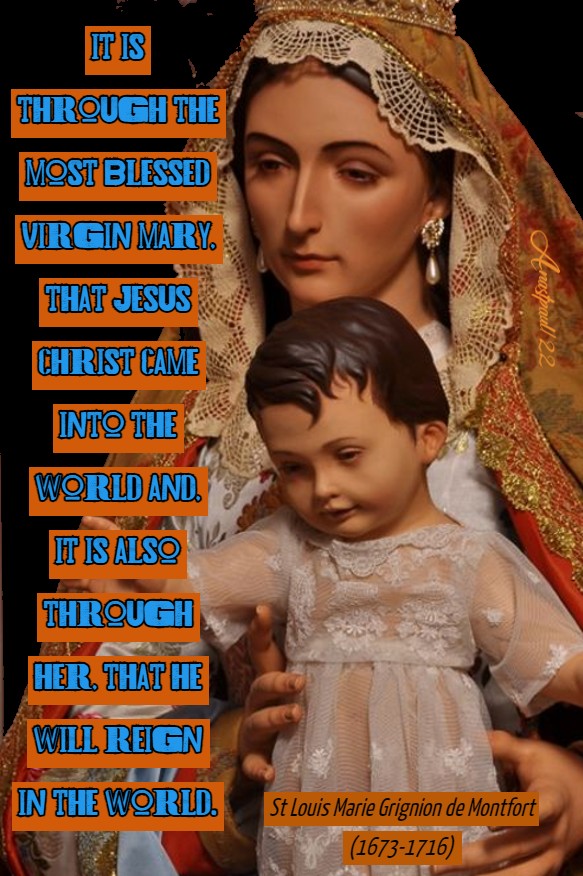
“It is through the most Blessed Virgin Mary, that Jesus Christ came into the world and, it is also through her, that He will reign in the world.” – St Louis Marie Grignion de Montfort (1673-1716)
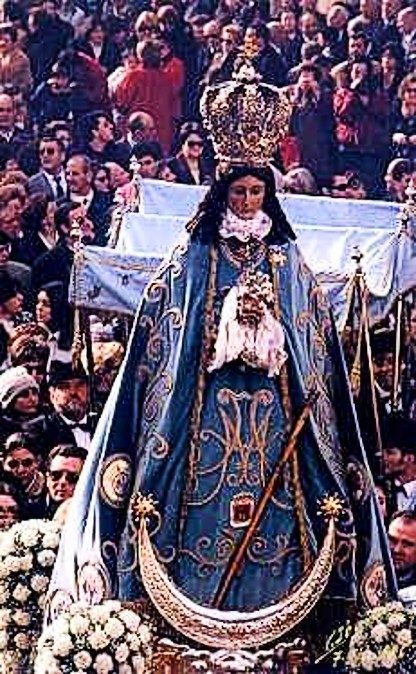
Virgen del Castillo, Inmaculada Concepción / Virgin of the Castle, Yecla, Spain (1642) – 7 and 8 December:
St Agatho of Alexandria St Anianas of Chartres St Athenodoros of Mesopotamia St Buithe of Monasterboice St Burgundofara / Fara (c 595-c 643) Nun, Abbess, Founder
PREPARATORY PRAYER: In thy conception, O Virgin Mary, thou wast immaculate; pray for us to the Father, Whose Son Jesus, conceived in thy womb by the Holy Ghost, thou didst bring forth.
Indulgence. 200 days, every time. (Pius VI, 21 November
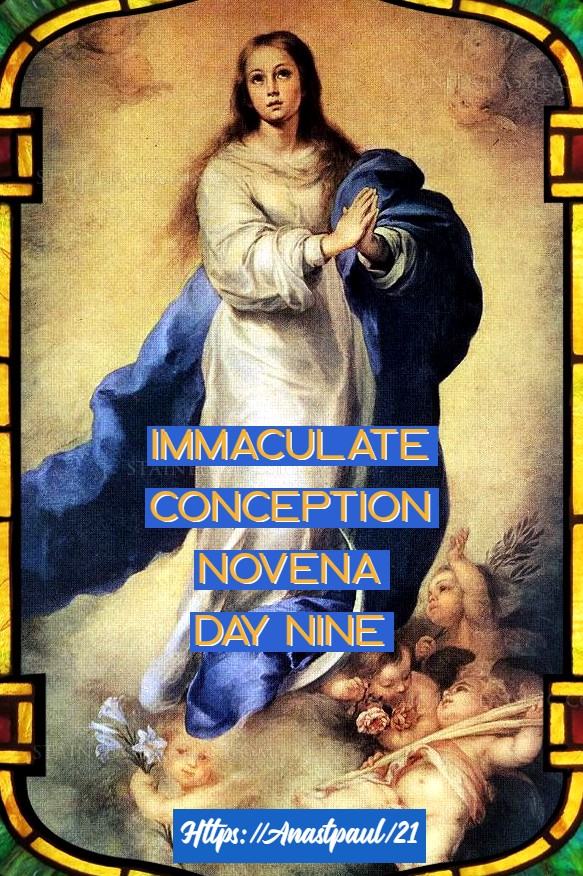
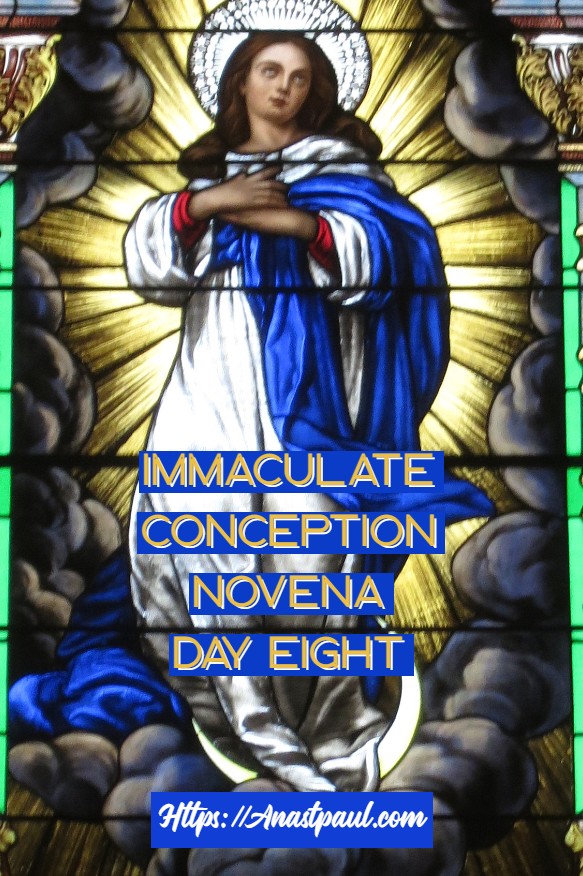
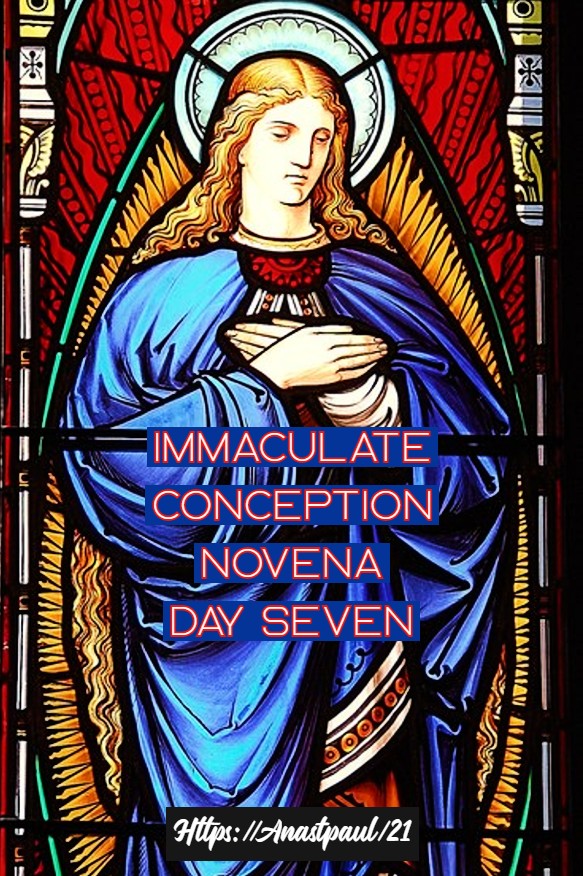
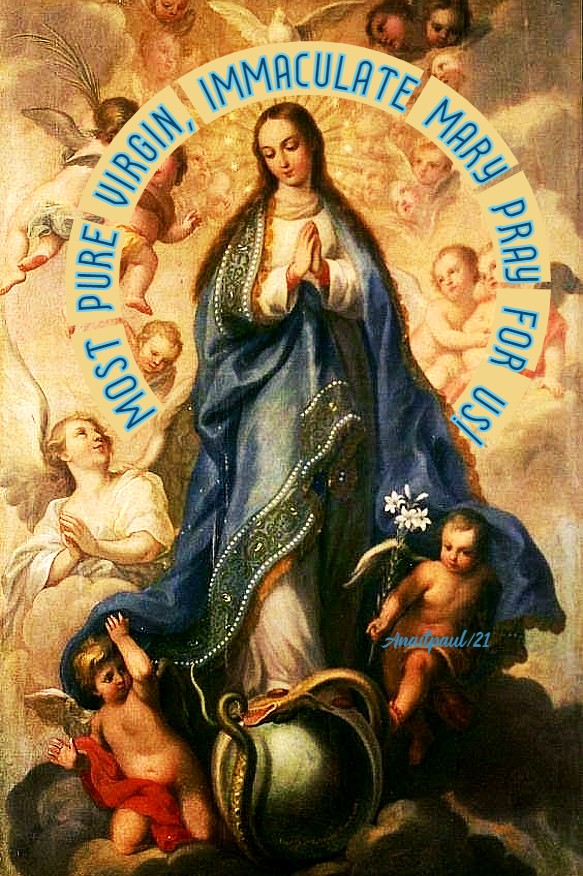
MEDITATION: Christian art often represents the Immaculate Conception as follows: The Blessed Virgin appears standing on a globe, about which is coiled a serpent holding an apple in its mouth. One of Mary’s feet rests upon the serpent, the other is placed on the moon. Her eyes are raised toward heaven; her hands are either joined in prayer, or she holds a lily in her right and places the left on her breast. Her dress is white; her ample mantle is of blue colour. A crown of twelve stars encircles her head. These emblems typify, in a most striking manner, Mary’s power and glory. “And a great sign appeared in heaven. A woman clothed with the sun and the moon under her feet and on her head a crown of twelve stars” (Apoc. xii. 1).
PRACTICEL The representation of the Immaculate Conception is very instructive. (1) Mary appears standing on the globe. This signifies that being human, she belongs to the earth and yet, is exalted above the world and sin; also, that she trampled under foot earthly possessions, vanities and joys. (2) A serpent is coiled about the globe, bearing an apple in its mouth. This reminds us of the fall of our first parents and of the consequences of their sin. (3) Mary’s foot rests on the serpent, indicating that she never was under Satan’s dominion but was preserved from sin in the first moment of her existence. (4) Mary stands on the moon. The moon, on account of its changes, is an emblem of inconstancy. We see it at Mary’s feet, to be reminded that we ought to be constant in faith and virtue. (5) Mary wears a crown, to indicate that she is a Queen. The crown is composed of twelve stars – she is the Queen of Heaven. (6) Mary’s dress is white, to denote her spotless purity and innocence. (7) She folds her hands in prayer, reminding us to imitate her example. (8) Or she holds a lily in her right hand, to indicate her virginity and chastity and the sweet odour of her virtues. (9) Mary’s mantle is blue, which colour is emblematic of royalty. Its folds are ample, to remind us that all who have recourse to her find a secure refuge in all dangers and necessities.
Therefore let us invoke her intercession in the words of Holy Church: “We fly to thy patronage, O holy Mother of God. Despise not our petitions but in thy mercy, deliver us from all danger, O glorious and Ever Virgin Mary!”
PRAYER OF THE CHURCH: O God, Who through the Immaculate Conception of the Virgin didst prepare a worthy dwelling-place for Thy Divine Son, grant that, as in view of Thy Son, Thou didst preserve her from all taint, so Thou wouldst vouchsafe unto us that cleansed from all sin by her intercession, we too may arrive at Thine eternal glory. Through the same Christ our Lord. Amen.
PRAYER: O Spotless sun! O Virgin Mary! I congratulate thee. I rejoice with thee because, in thy conception, God gave thee grace, greater and more boundless, than He ever shed on all His Angels and all the Saints, together with all their merits. I am thankful and I marvel at the surpassing beneficence of the Ever-Blessed Trinity, Who conferred on thee this privilege. O make me correspond with the grace of God and never abuse it. Change this heart of mine – make me now begin to amend my life.
Thought for the Day – 6 December – Meditations with Antonio Cardinal Bacci (1881-1971)
The Word of God
“We should hold the word of God in reverence and listen attentively to it. “He who hears you, hears Me” Jesus told His Apostles, “and he who rejects you, rejects Me” (Lk 10:16). The man who preaches the word of God, maybe imperfect and ill-trained but, we should not judge his message by his personal qualities, abilities and oratorical skills. We should focus our attention on the word of God and treasure that. God often employs weak and imperfect instruments and even unworthy ones, in order to accomplish His work, so that we may hear His word with humility and seek Him, rather than men. If we seek men, we shall find men but, if we seek God, we shall find God and His eternal Truth and Goodness.
We should listen humbly to God’s word and should remember that we have great need of it. Even if we are well instructed and feel that we are more learned than the preacher, it is still necessary for us to be attentive to the living word of God, so that it may transform us and make us holy.”
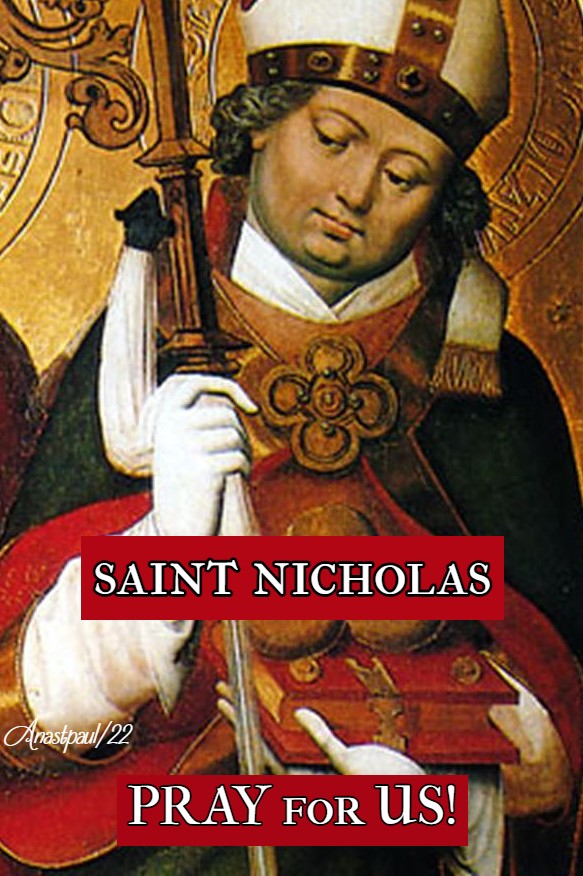
Quote/s of the Day – 6 December – St Nicholas (270-343) Confessor, Bishop – Hebrews 13:7-17, Matthew 25:14-23 – Scripture search here: https://www.drbo.org/
“And he who had received the five talents went and traded with them, and gained five more.”
Matthew 25:16
“I have chosen you and have appointed you, that you should go and should bring forth fruit and your fruit should remain, says the Lord.”
John 15:16
“… Are you debating what you will do? Worship Him as God. Worship the Wonder-worker. Worship One who worked good things on behalf of another!”
St Athansius (297-373) Father and Doctor of the Church
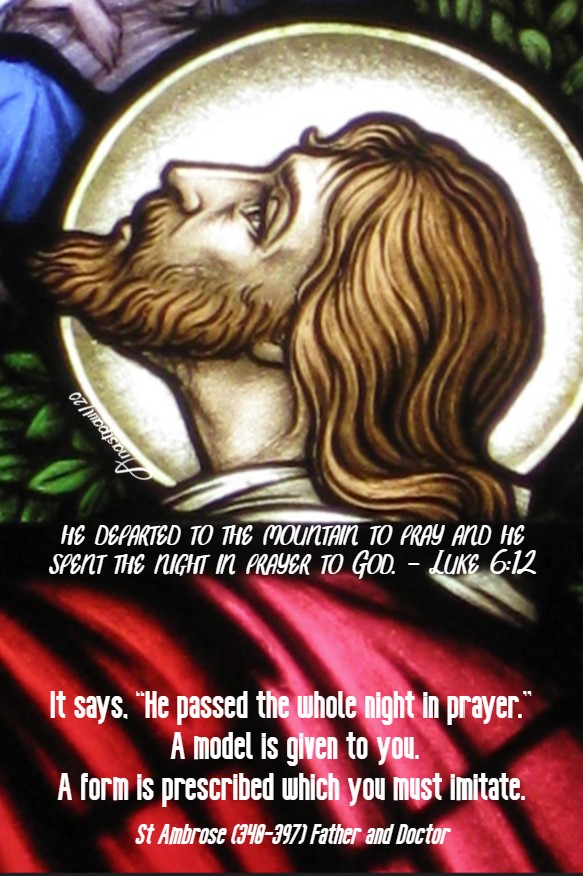
“In those days he departed to the mountain to pray and he spent the night in prayer to God.”
Luke 6:12
“It says, “He passed the whole night in prayer.” A model is given to you. A form is prescribed which you must imitate.”
St Ambrose (340-397) Father and Doctor of the Church
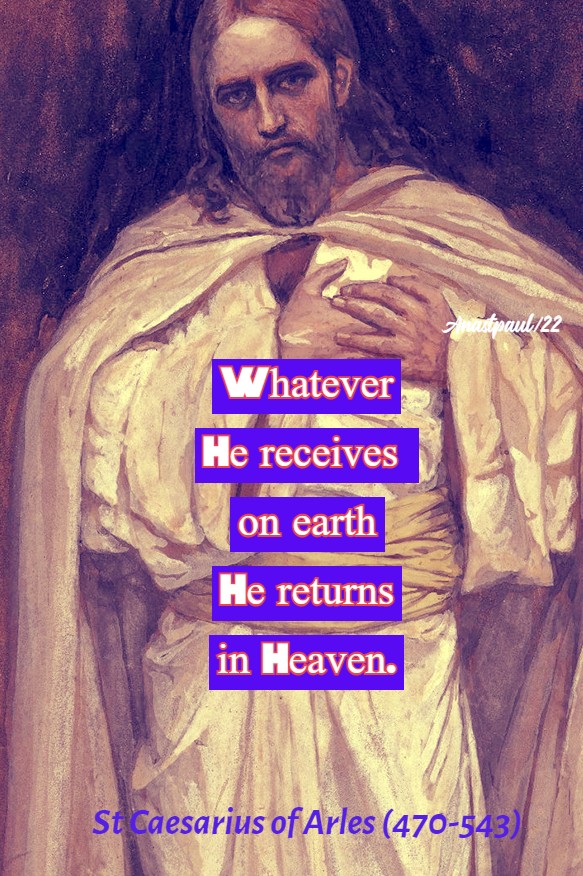
“Whatever He receives on earth, He returns in Heaven.”
St Caesarius of Arles (470-543)
“O God, grant that whatever good things I have, I may share generously with those who have not and whatever good things, I do not have, I may request humbly, from those who do.”
St Thomas Aquinas (1225-1274) Doctor Angelicus
“Rejoice and be happy! Persevere to the end and prefer to die rather than abandon the post, to which God has called you!”
St Catherine of Siena (1347-1380) Doctor of the Church
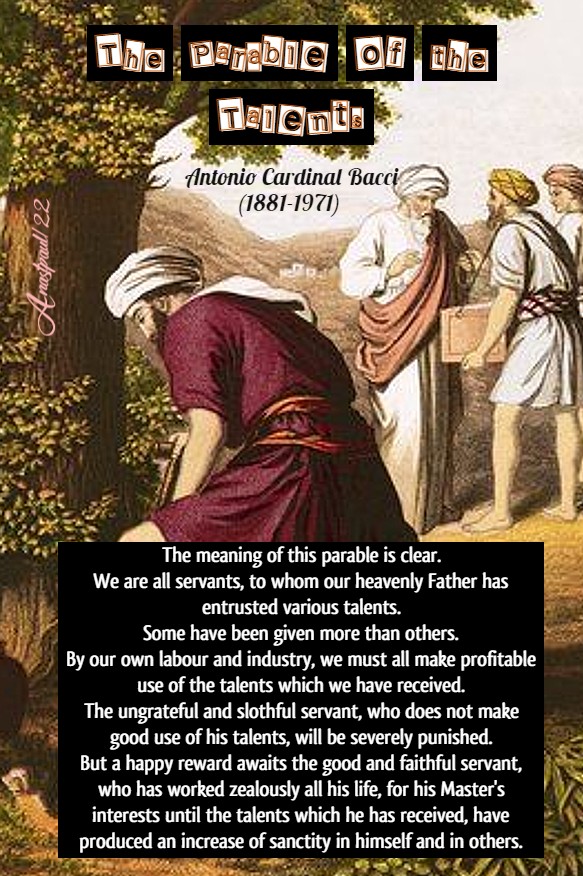
“The meaning of this parable is clear. We are all servants, to whom our heavenly Father has entrusted various talents. Some have been given more than others. By our own labour and industry, we must all make profitable use of the talents which we have received. The ungrateful and slothful servant, who does not make good use of his talents, will be severely punished. But a happy reward awaits the good and faithful servant, who has worked zealously all his life, for his Master’s interests until the talents which he has received, have produced an increase of sanctity in himself and in others.”
One Minute Reflection – 6 December – St Nicholas (270-343) Confessor, Bishop – Hebrews 13:7-17, Matthew 25:14-23 – Scripture search here: https://www.drbo.org/
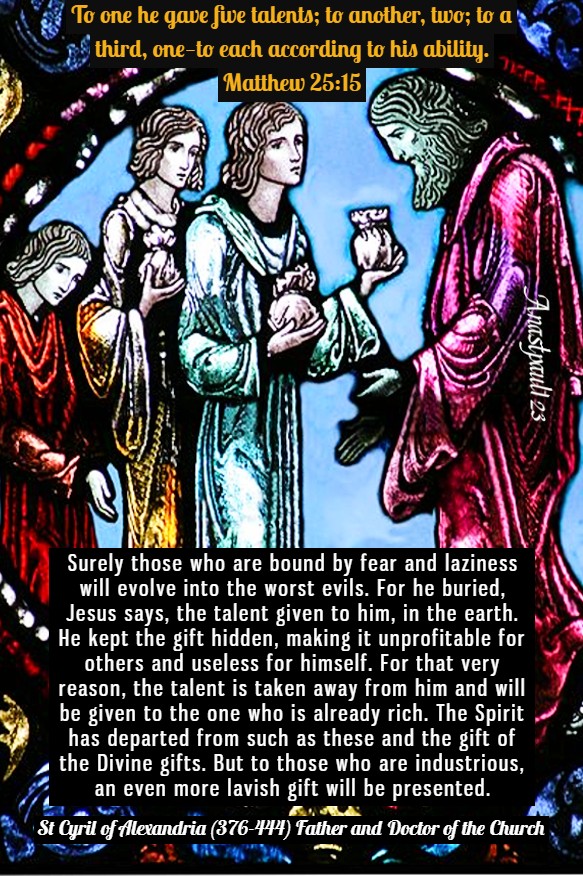
“To one He gave five talents; to another, two; to a third, one—to each according to his ability. Then he went away. Immediately …” – Matthew 25:15
REFLECTION – “The man who is the landowner is actually the Creator and Lord of all. The Word compares the time the landowner spends away from home, in the parable, to either the Ascension of Christ into Heaven, or, at any rate, to the unseen and invisible character of the Divine Nature. Now, one must conceive of the property of God, as those in each Country and City, who believe in Him. He calls His servants, those who, according to the times, Christ crowns with the glory of the Priesthood. For the holy Paul writes, “No-one takes this honour upon himself; he must be called by God.”
He hands over [His property] to those who are under Him, to each giving a spiritual gift, so that he might have character and aptitude. We think that this distribution of the talents, is not supplied to the household servants in equal measure because, each is quite different from the other, in their understanding. Immediately they head out for their labours, He says, directly, indicating to us here, that apart from the procrastination of one, they are fit to carry out the work of God.
Surely those who are bound by fear and laziness will evolve into the worst evils. For he buried, Jesus says, the talent given to him in the earth. He kept the gift hidden, making it unprofitable for others and useless for himself. For that very reason, the talent is taken away from him and will be given to the one who is already rich. The Spirit has departed from such as these and the gift of the divine gifts. But to those who are industrious, an even more lavish gift will be presented.” – St Cyril of Alexandria (376-444) Archbishop of Alexandria, Father and Doctor of the Church (Fragment 283)
PRAYER – O God, Thou Who made the holy Bishop Nicholas renowned for countless miracles, grant, we beseech Thee that by his merits and prayers, we may be saved from the fires of hell. Through Jesus Christ, Thy Son our Lord, Who lives and reigns with Thee, in the unity of the Holy Ghost, God, world without end. Amen (Collect).
Our Morning Offering – 6 December – “The Month of the Divine Infant and the Immaculate Conception”
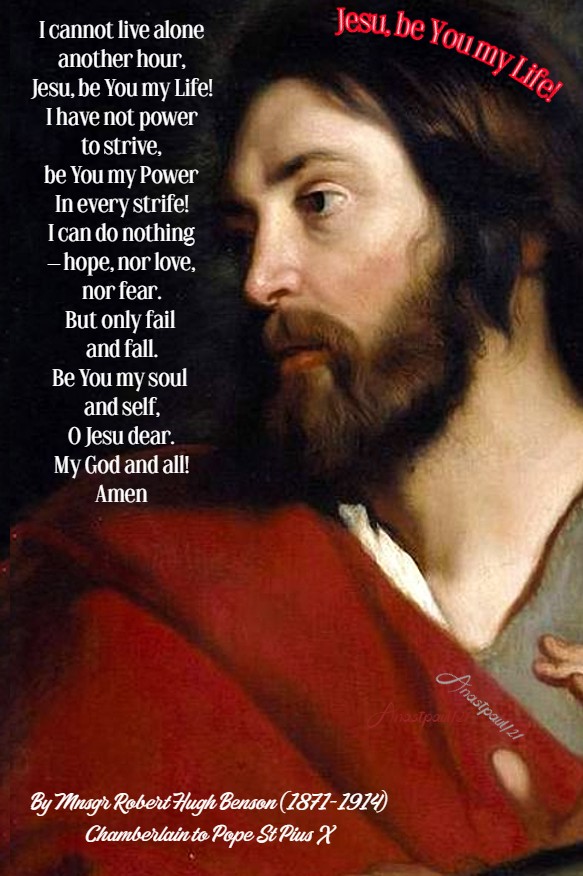
Jesu, be You my Life! Msgr Robert Hugh Benson (1871-1914) Chamberlain to Pope St Pius X
I cannot live alone another hour, Jesu, be You my Life! I have not power to strive, be You my Power In every strife! I can do nothing – hope, nor love, nor fear. But only fail and fall. Be You my soul and self, O Jesu dear. My God and all! Amen
Saint of the Day – 6 December – Saint Gerard of La Charité OSB (Died c 1109) Abbot, Founder of Monasteries, Reformer. Born towards the end of the 9th Century in the County of Namur in Belgium and died in 1109 of natural causes. Also known as – Gerhard of La-Charité-sur-Loire.
Gerard was born of a noble family towards the end of the ninth Century, in the County of Namur in Belgium. An engaging sweetness of temper, added to a strong inclination to piety and devotion, gained for him, from the cradle, the affection and esteem of all.
He at first followed the career of arms but never lost his piety amid the distractions and temptations of camp life. When sent on an important mission to the Court of France, by the Count of Namur, he was greatly edified by the fervour of the Benedictine Monks of Saint Denys in Paris and earnestly desired to join them and to consecrate himself to God. Returning home he settled his temporal affairs and returned to Monastery of St Denis, with great joy. He lived for eleven years with devout fervour in this Monastery, and then was Ordained a Priest.
So great was his reputation for holiness that in 931 he was sent by his Abbot to found an Abbey upon his own estate at Brogne, three leagues from Namur. He established this new Abbey, then built himself a little cell near the Church, where he lived as a recluse. But not for long, for he was then called to establish new Monasteries, which he did at Auxerre, Nevers, Bourges, Meaux, Paris, etc… Over the years, the foundations extended to England, Portugal, Venice and other Italian Cities.
The Abbey at La-Charité-sur-Loire.
A new mission was his next role – that of introducing strict monastic discipline in eighteen Abbeys. Gerard applied himself to this immense undertaking with energy and zeal and completed it successfully, assuming the duties of a Benedictine Abbot General over these and all the new foundations.
When he had spent almost twenty years in these zealous labours, feeling his end approaching, he requested permission to become a simple Monk and he again retired to his cell at the Abbey of Brogne, which is now named for him, to prepare his soul for the final journey. To this he was called on 3 October c 1109.
St Boniface the Martyr St Dativa the Martyr St Dionysia the Martyr St Gerard of La Charité (Died c 1109) Abbot, Founder of Monasteries St Gertrude the Elder St Isserninus of Ireland St Leontia the Martyr St Majoricus the Martyr
PREPARATORY PRAYER: In thy conception, O Virgin Mary, thou wast immaculate; pray for us to the Father, Whose Son Jesus, conceived in thy womb by the Holy Ghost, thou didst bring forth.
Indulgence. 200 days, every time. (Pius VI, 21 November
MEDITATION: Holy Scripture and the Fathers agree, in the statement that the Blessed Virgin Mary made the vow of perpetual virginity. For when the Archangel Gabriel brought God’s message to the Immaculate spouse of St Joseph, that she was to become the Mother of the Most High, she asked, “How shall this be done, for I know not man?” (Luke 1: 34.) Indeed, Mary would not have been, in the full and most excellent sense of the word, the “Virgin of virgins,” had she not, from her own free choice, vowed her virginity to God. During the whole Christian era there have been heroic souls who made the vow of perpetual chastity, consecrating themselves to God. Trusting in the powerful protection of the Immaculate Virgin, they persevered, in their resolve to bear this priceless treasure, before God’s throne, despite the dangers of the world, the temptations of concupiscence and the assaults of hell and, with the help of the Queen of Virgins, they achieved a triumphant victory!
PRACTICE: Since the fall of Adam our senses are in rebellion against the law of God. “I see another law in My members, fighting against the law of My mind and captivating Me in the law of sin” (Rom 7: 23). Chastity is the virtue which causes us the greatest struggles. St Augustine says: “The fiercest of all combats, is the one for the preservation of chastity and, we must engage in it, everyday!” Fierce as this combat is, the aid which Mary gives her children to achieve victory, is all-powerful. She sustains them by her maternal love and protection. Those who lead a chaste life receive the Divine Spirit, are happy in this life and will receive a special crown in Heaven.
Among the means for the preservation of chastity, the following are especially recommended: The assiduous and constant practice of self-denial; the frequentation of the Sacraments; the daily invocation of Mary for her aid and protection; scrupulous avoidance of the occasions of sin. St Chrysostom writes: “He errs who believes that he can overcome his sensual propensities and preserve chastity, by his own efforts. God’s mercy must extinguish nature’s ardour.” Have recourse to the intercession of the Immaculate Virgin and rest assured, you will obtain this mercy!
PRAYER OF THE CHURCH: O God, Who through the Immaculate Conception of the Virgin didst prepare a worthy dwelling-place for Thy Divine Son; grant that, as in view of Thy Son, Thou didst preserve her from all taint, so Thou wouldst vouchsafe unto us that cleansed from all sin by her intercession, we too may arrive at Thine eternal glory. Through the same Christ our Lord. Amen.
PRAYER: Mary Immaculate, rising morn of purity, I rejoice with thee, gazing in wonder upon thy soul, confirmed in grace, from the very first moment of thy conception and rendered inaccessible to sin. I thank and magnify the Ever-Blessed Trinity, Who chose thee, from all our race, for this special privilege. Holy Virgin, obtain for me, utter and constant hatred of all sin, and let me rather die, than ever again fall into sin.
Thought for the Day – 5 December – Meditations with Antonio Cardinal Bacci (1881-1971)
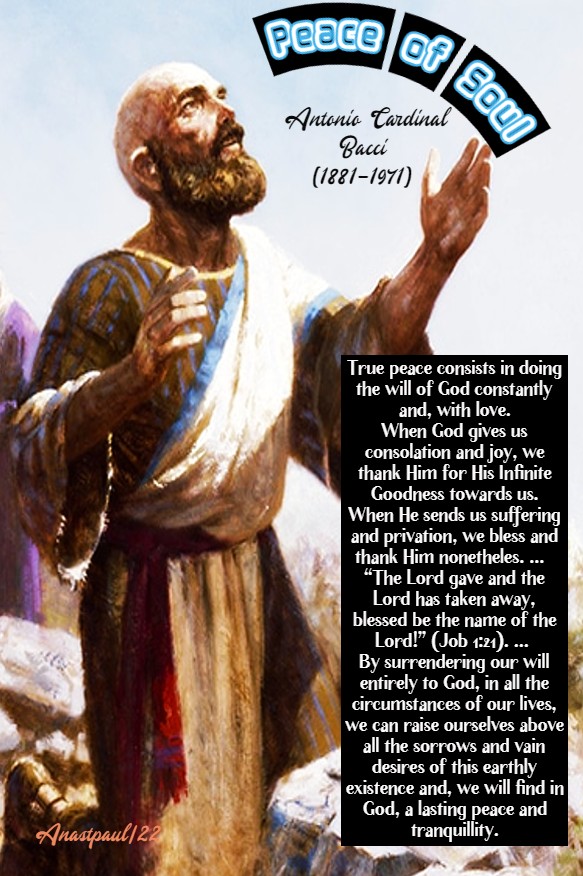
Peace of Soul
“True peace consists in doing the will of God constantly and, with love. When God gives us consolation and joy, we thank Him for His Infinite Goodness towards us. When He sends us suffering and privation, we bless and thank Him nonetheless. Let us recall the example of Job. When he had lost his children, his health and all his possessions and, was derided by his wife and distrusted by his friends, he exclaimed in a spirit of resignation:“The Lord gave and the Lord has taken away, blessed be the name of the Lord!” (Job 1:21).
All this may seem too difficult to us but, it is only on these conditions that we can obtain interior peace. By surrendering our will entirely to God, in all the circumstances of our lives, we can raise ourselves above all the sorrows and vain desires of this earthly existence and, we will find in God, a lasting peace and tranquillity.”
Quote/s of the Day – 5 December – “The Month of the Divine Infant and the Immaculate Conception” – The Second Week of Advent
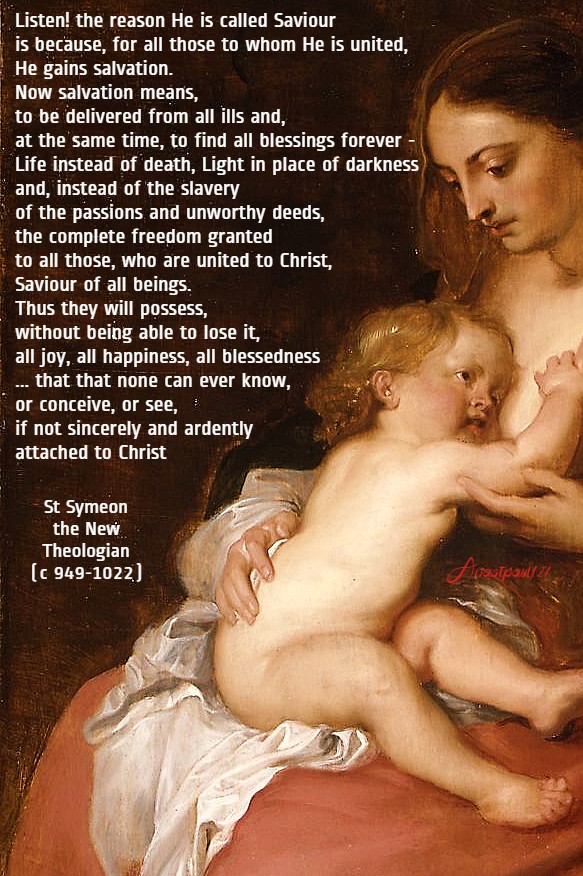
“Listen! the reason He is called Saviour is because, for all those to whom He is united, He gains salvation. Now salvation means, to be delivered from all ills and, at the same time, to find all blessings forever – Life instead of death, Light in place of darkness and, instead of the slavery of the passions and unworthy deeds, the complete freedom granted to all those, who are united to Christ, Saviour of all beings. Thus they will possess, without being able to lose it, all joy, all happiness, all blessedness (…) that that none can ever know, or conceive, or see, if not sincerely and ardently attached to Christ.”
St Symeon the New Theologian (c 949-1022)
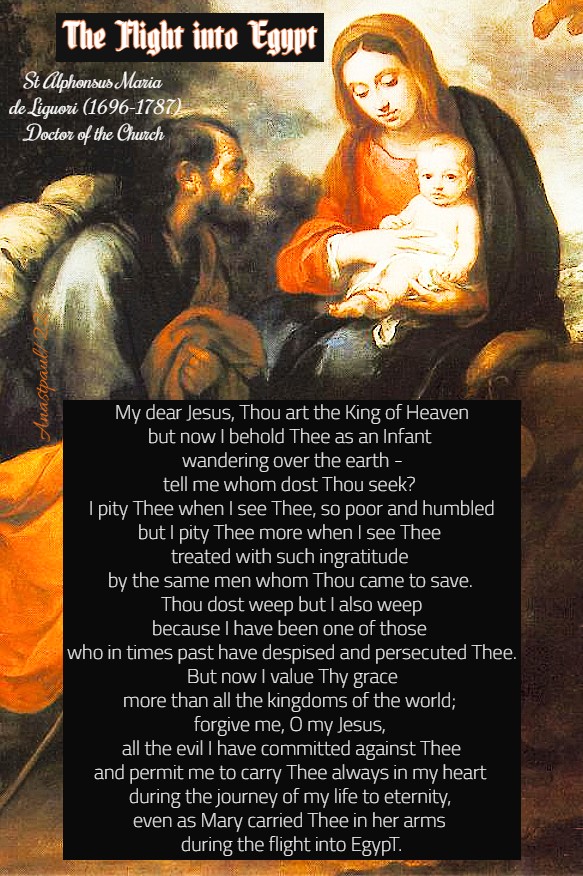
“My dear Jesus, Thou art the King of Heaven but now I behold Thee as an Infant wandering over the earth – tell me whom dost Thou seek? I pity Thee when I see Thee, so poor and humbled but I pity Thee more when I see Thee treated with such ingratitude by the same men whom Thou came to save. Thou dost weep but I also weep because I have been one of those who in times past have despised and persecuted Thee. But now I value Thy grace more than all the kingdoms of the world; forgive me, O my Jesus, all the evil I have committed against Thee and permit me to carry Thee always in my heart during the journey of my life to eternity, even as Mary carried Thee in her arms during the flight into Egypt.”
By St Alphonsus Maria de Liguori (1696-1787) Doctor of the Church
One Minute Reflection – 5 December – The Second Week of Advent – Romans 15:4-13, Matthew 11:2-10 – Scripture search here: https://www.drbo.org/
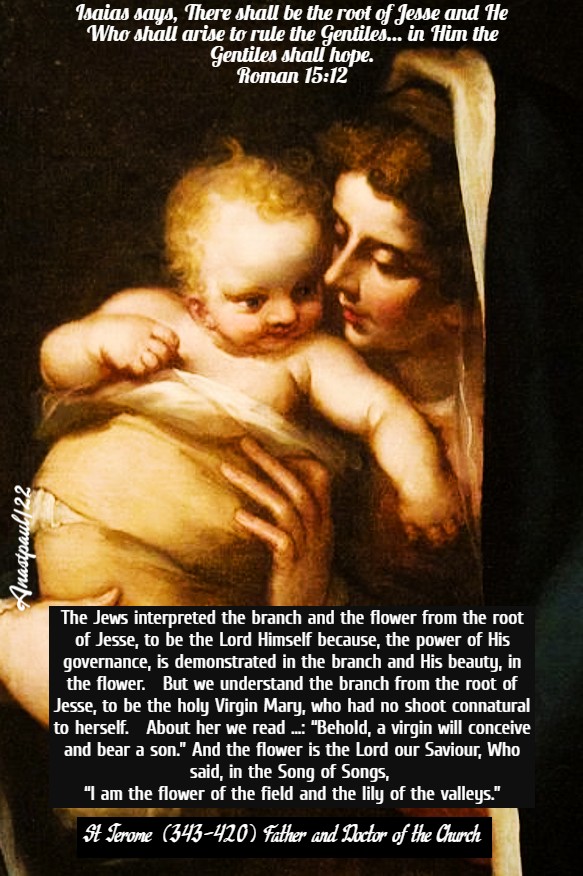
“And again Isaias says, There shall be the root of Jesse and He Who shall arise to rule the Gentiles… in Him the Gentiles shall hope.” – Roman 15:12
REFLECTION – “Until the beginning of the vision, or the burden of Babylon, which Isaias the son of Amos saw, his entire prophecy was about Christ, a prophecy which we want to explain piecemeal, lest the ideas and discussions thereof together, confuse the reader’s memory.
The Jews interpreted the branch and the flower from the root of Jesse, to be the Lord Himself because, the power of His governance, is demonstrated in the branch and His beauty, in the flower. But we understand the branch from the root of Jesse, to be the holy Virgin Mary, who had no shoot connatural to herself. About her we read …: “Behold, a virgin will conceive and bear a son.” And the flower is the Lord our Saviour, Who said, in the Song of Songs, “I am the flower of the field and the lily of the valleys.” In place of “root,” which only the Septuagint translated, the Hebrew text has geza, which Aquila and Symmachus and Theodotus, interpret as kormon, that is, “stem.” And they translated “flower,” which the Hebrew text calls nēṣer, as “bud,” to show that after a long time in Babylonian captivity, no longer possessing any glory from the sprout of the old kingdom of David, Christ would rise from Mary, as though from her stem. The educated of the Hebrews believe that what all the ecclesiastics sought in the Gospel of Matthew but could not find, where it was written “Because he will be called a Nazarene,” was taken from this place. But it should be noted that nēṣer was written here with the [Hebrew] letter ṣade [צ], the peculiar sound of which—somewhere between z and s—the Latin language does not express.” – St Jerome (343-420) Father and Doctor of the Church (Commentary on Isaias 4.)
PRAYER – O God, Who, by the message of an Angel, willed to take flesh in the womb of the Blessed Virgin Mary, grant that we, Thy suppliants, who believe her to be truly the Mother of God, may be helped by her intercession with Thee. Through Jesus Christ, Thy Son our Lord, Who lives and reigns with Thee, in the unity of the Holy Ghost, God, world without end. Amen (Collect).
Our Morning Offering – 5 December – “The Month of the Divine Infant and the Immaculate Conception”
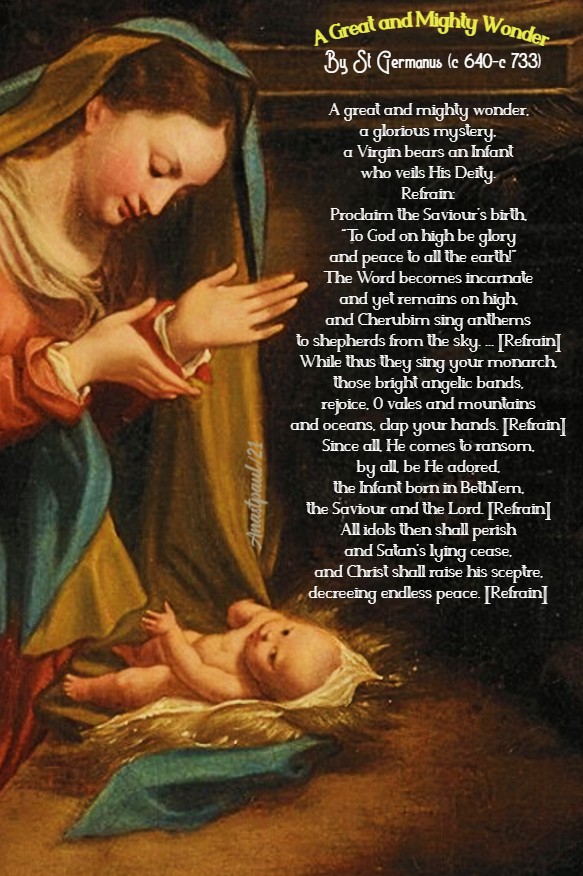
A Great and Mighty Wonder By St Germanus (c 640-c 733)
A great and mighty wonder, a glorious mystery, a Virgin bears an Infant who veils His Deity. Refrain: Proclaim the Saviour’s birth, “To God on high be glory and peace to all the earth!” The Word becomes incarnate and yet remains on high, and Cherubim sing anthems to shepherds from the sky. … [Refrain] While thus they sing your monarch, those bright angelic bands, rejoice, O vales and mountains and oceans, clap your hands. [Refrain] Since all, He comes to ransom, by all, be He adored, the Infant born in Bethl’em, the Saviour and the Lord. [Refrain] All idols then shall perish and Satan’s lying cease, and Christ shall raise His sceptre, decreeing endless peace. [Refrain]
St Germanus was one of the Greek hymnwriters and one of the grandest among the defenders of the Icons. He was born at Constantinople of a patrician family, was Ordained there and became subsequently, Bishop of Cyzicus. He was present at the Synod of Constantinople in 712, which restored the Monothelite heresy but, in after years, he condemned it. He was made Archbishop of Constantinople in 715. In 730 he was driven from the See, not without blows, for refusing to yield to the Iconoclastic Emperor, Leo the Isaurian. He died shortly afterwards in exile at a good old age. His Life below: https://anastpaul.com/2021/05/12/saint-of-the-day-12-may-saint-germanus-of-constantinople-c-640-733/
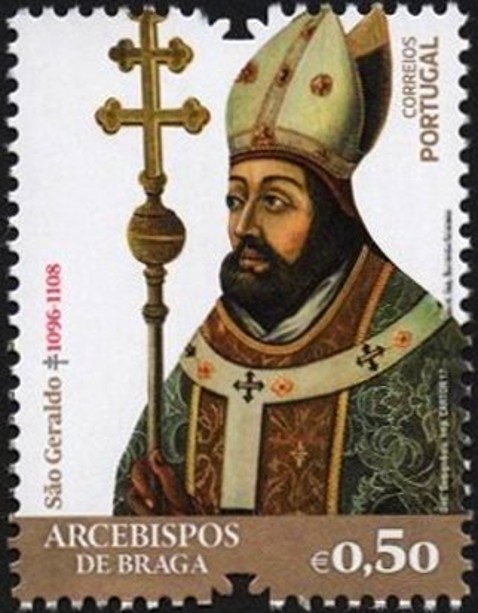
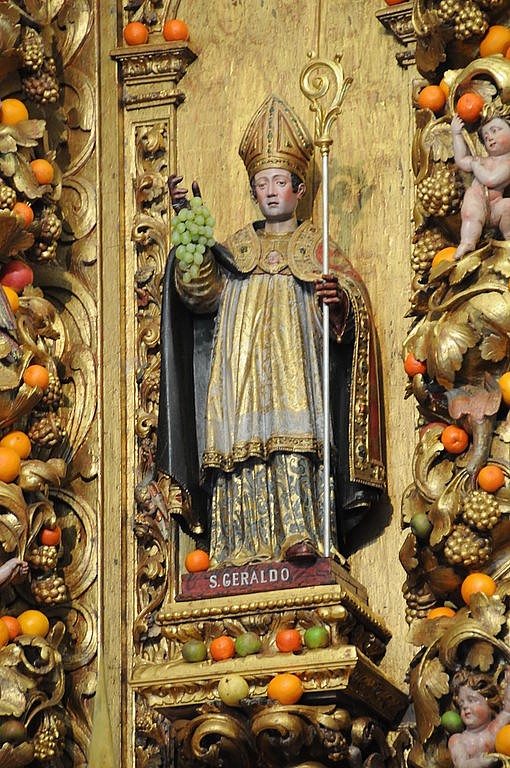
Saint of the Day – 5 December – Saint Gerald of Braga (Died 1109)Archbishop of Braga, Portugal, Abbot, Reformer. He renewed divine worship and restored Churches. Born in Cahors, Gascony, France and died on 5 December 1109 at Bornos, Portugal of natural causes. Patronage – of Braga, Portugal. Also known as – Geraldo, Gérald de Moissac.
The Vita Sancti Geraldi was written by one Bernard, a companion and fellow Cluniac Monk from France but we have no information from it.
In the latter half of the 11th Century, the Archbishop of Toledo named Bernard, was delegated by the Pope to bring about an Ecclesiastical reform in Spain. He called in various French Clerics and Monks, among whom was St Gerald, Abbot of Moissac, who was appointed choir director for the Cathedral of Toledo.
So well did this saintly man fulfill his duties and so much did he influence the faithfulf that, when the See of Braga became vacant, Gerald was selected by the clergy and people of that City, to be their Bishop.
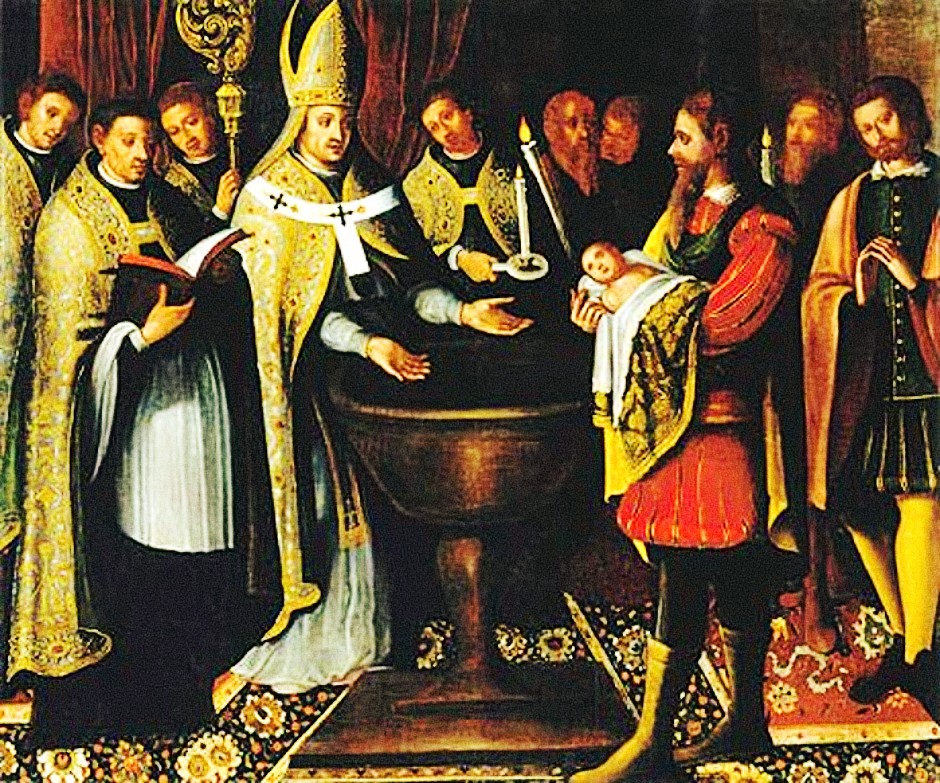
Gerald visited his entire Diocese, eradicating the abuse that had become rife there, especially that of the administering of Ecclesiastical investiture by laymen. It is known that St Gerald baptised the future King Afonso I (c 1106-1185) of Portugal, see image below.
This man of God was called to his heavenly reward on 5 December 1108, at Bornos, Portugal.
Blessed Bartholomew Fanti of Mantua O.Carm. (c 1428-1495) Carmelite Priest, renowned Preacher. Humble and gentle, Bartholomew gave an example to everyone of a life of prayer, of loving kindness and generosity to all and of faithful service to the Lord. He was remembered and revered, even during his life, for his great love ot the Blessed Sacrament, which was the source and the summit of his apostolic life, together with his love and devotion to the Virgin Mother. His Beatification received the Papal approval of Pope Pius X on 18 March 1909. Biography: https://anastpaul.com/2021/12/05/saint-of-the-day-5-december-blessed-bartholomew-fanti-o-carm-c-1443-1495/
St Basilissa of Øhren St Bassus of Lucera St Bassus of Nice St Cawrdaf of Fferreg St Christina of Markyate St Consolata of Genoa St Crispina St Cyrinus of Salerno St Dalmatius of Pavia St Firminus of Verdun St Gerald of Braga (Died 1109) Bishop St Gerbold St Gratus St Joaquín Jovaní Marín Bl Giovanni/John Gradenigo St Justinian St Martiniano of Pecco Bl Narcyz Putz St Nicetius of Trier St Pelinus of Confinium St Vicente Jovaní Ávila
Martyrs of Thagura – (12 Saints): A group of twelve African Christians who were Martyred together in the persecutions of Diocletian. The only details about them that have survived are five of their names – Crispin, Felix, Gratus, Juliua and Potamia. They died in 302 in Thagura, Numidia
PREPARATORY PRAYER: In thy conception, O Virgin Mary, thou wast immaculate; pray for us to the Father, Whose Son Jesus, conceived in thy womb by the Holy Ghost, thou didst bring forth.
Indulgence. 200 days, every time. (Pope Pius VI, 21 November1793).
MEDITATION: We carry the precious treasure of sanctifying grace in a frail vessel. Our inclination to evil remains with us and continues to impel us to that which is forbidden. On whom shall we call for aid? Call on Mary! She is conceived without sin. She, the lily among thorns, who never lost God’s friendship. She, is our advocate! Let her, who was found worthy to become the Mother of our Redeemer, inspire you with trust and confidence. The Church invokes her as the refuge of sinners and, under no other title, does she show her love for us more convincingly and, her power with God, more efficiently.
PRACTICE: We may trust confidently in Mary’s intercession and aid, in all temptations and trials, if we but have recourse to her. Therefore, St John Damascene writes: “Come to my aid, O Mother of my Redeemer! Thou art my help, my consolation in life. Come to my aid and I shall escape. unscorched. from the fire of temptation; amongst a thousand I shall remain unharmed; I shall brave the storms of assault unwrecked. Thy name is my shield, thy help my armour, thy protection my defence. With thee, I boldly attack the enemy and drive him off in confusion; through thee, I shall achieve a triumphant victory.” In all temptations, therefore, let us have recourse to Mary and through her intercession we shall overcome them.
PRAYER OF THE CHURCH: O God, Who through the Immaculate Conception of the Virgin didst prepare a worthy dwelling-place for Thy Divine Son; grant that, as in view of Thy Son, Thou didst preserve her from all taint, so Thou wouldst vouchsafe unto us that cleansed from all sin by her intercession, we too may arrive at Thine eternal glory. Through the same Christ our Lord. Amen.
PRAYER: Mary Immaculate, most brilliant star of purity, I rejoice with thee because thy Immaculate Conception has bestowed upon the Angels in Paradise, the greatest joy. I thank and bless the Ever-Nlessed Trinity, Who enriched thee with this high privilege. O let me, too, one day enter into this heavenly joy, in the company of Angels, that I may praise and bless thee, world without end.
Thought for the Day – 4 December – Meditations with Antonio Cardinal Bacci (1881-1971)
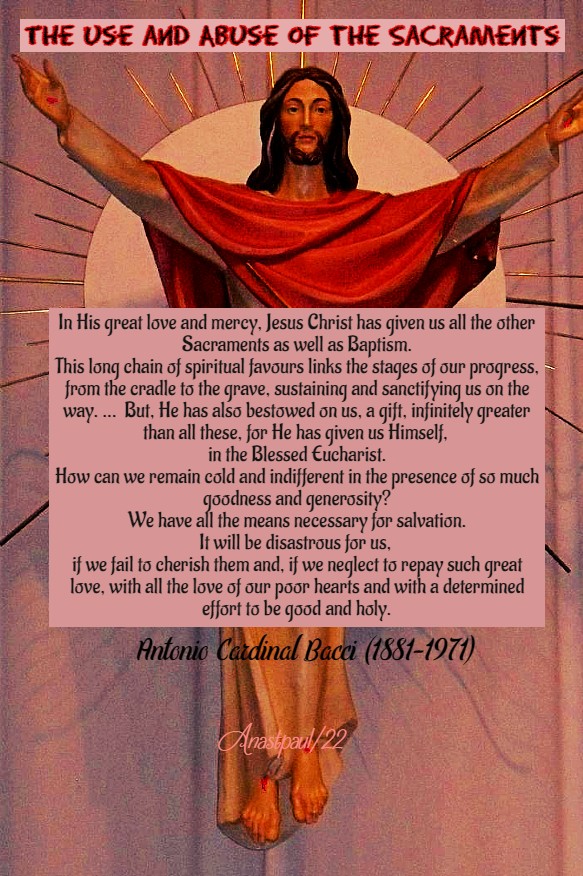
The Use and Abuse of the Sacraments
“In His great love and mercy, Jesus Christ has given us all the other Sacraments as well as Baptism. This long chain of spiritual favours links the stages of our progress, from the cradle to the grave, sustaining and sanctifying us on the way. Although His goodness is Infinite, God could not do any more for us. He has endowed us through the Sacrament of Baptism, with supernatural life; He has given us the light and strength of the Holy Spirit in Confirmation; He has granted us forgiveness in the Sacrament of Penance; power over His Real and His Mystical Body, in the Sacrament of Holy Orders and, a reflection of Divine Love, in the Sacrament of Matrimony. At the close of our lives, He will heal the scars of sin and comfort our weary hearts, by means of Extreme Unction. But, He has also bestowed on us, a gift, infinitely greater than all these, for He has given us Himself, in the Blessed Eucharist.
How can we remain cold and indifferent in the presence of so much goodness and generosity? We have all the means necessary for salvation. It will be disastrous for us, if we fail to cherish them and, if we neglect to repay such great love, with all the love of our poor hearts and with a determined effort to be good and holy.”
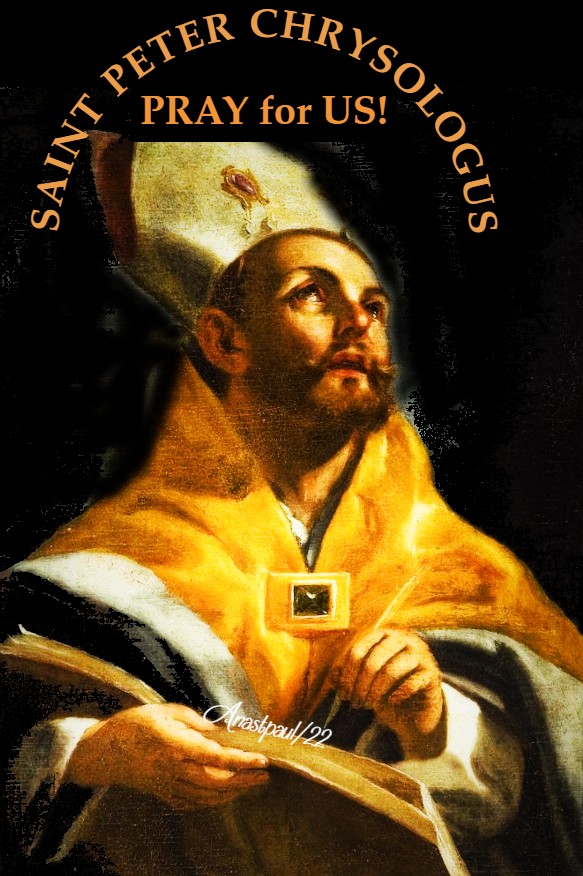
Quote/s of the Day – 4 December – St Peter Chrysologus (c 400-450) “Golden Words” Confessor, Father & Doctor of the Church
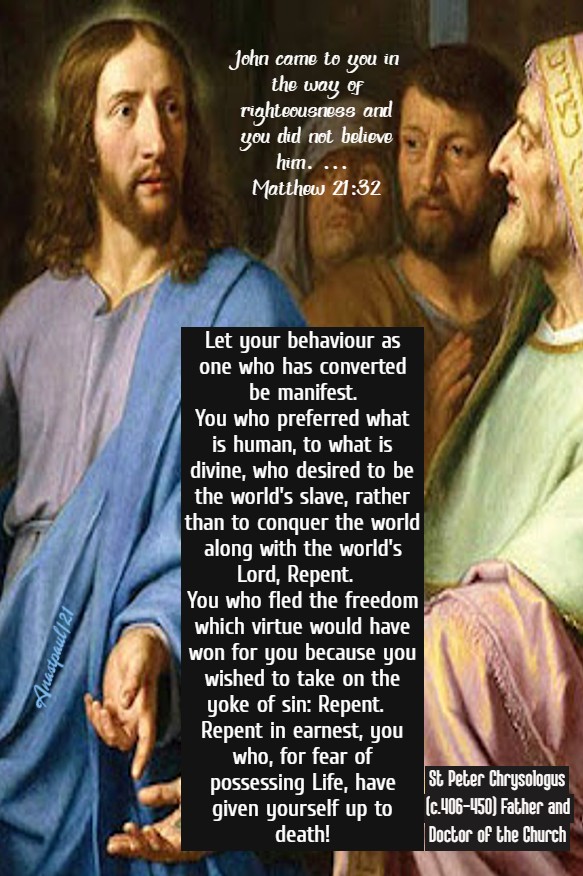
“John came to you in the way of righteousness and you did not believe him.”
Matthew 21:32
“Let your behaviour, as one who has converted, be manifest. You who preferred what is human, to what is divine, who desired to be the world’s slave, r ather than to conquer the world along with the world’s Lord, Repent. You who fled the freedom which virtue would have won for you because you wished to take on the yoke of sin: Repent. Repent in earnest, you who, for fear of possessing Life, have given yourself up to death!”
“O my brethren, if only we wanted to, if only we all wanted to perceive our soul’s paralysis in all its depth! Then we would see that it is lying on a stretcher of sins, deprived of strength. Christ’s action within us, would be a source of light and we would understand that each day He sees our lack of faith, harmful as it is, that He draws us towards healing remedies and sharply presses our rebellious wills. “My son” He says, “your sins are forgiven you.”
“For where your treasure is, there also will your heart be.”
Luke 12:34
“O man, send your treasure on, send it ahead into Heaven, or else your God-given soul, will be buried in the earth! Gold comes from the depth of the earth — rhe soul, from the highest Heaven. Clearly, it is better, to carry the gold to where the soul resides, than to bury the soul, in the mine of the gold. That is why God orders those who will serve in His Army here below, to fight as men stripped of concern for riches and unencumbered by anything. To these, He has granted the privilege of reigning in Heaven!”
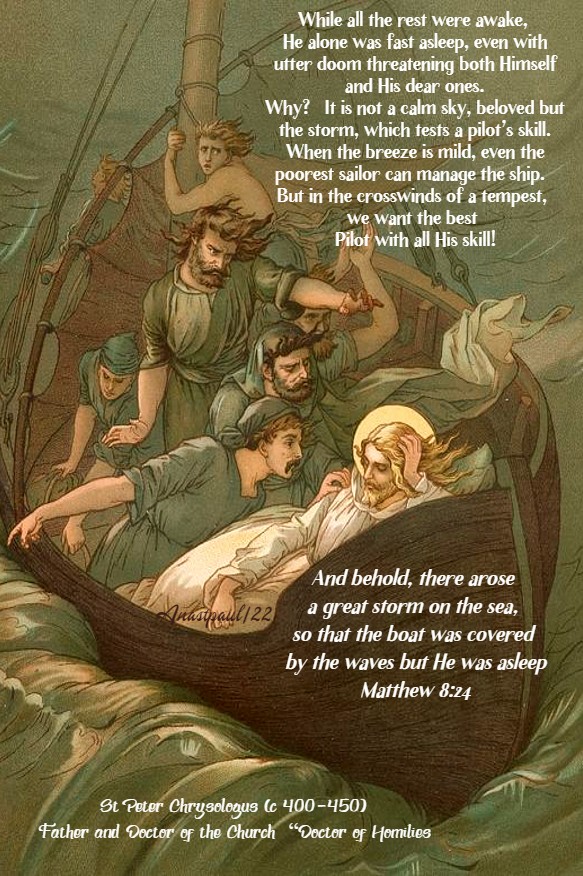
“And behold, there arose, a great storm on the sea, so that the boat was covered by the waves but He was asleep.”
Matthew 8:24
“While all the rest were awake, He alone was fast asleep, even with utter doom threatening both Himself and His dear ones. Why? It is not a calm sky, beloved but the storm, which tests a pilot’s skill. When the breeze is mild, even the poorest sailor can manage the ship. But in the crosswinds of a tempest, we want the best Pilot with all His skil!.”
One Minute Reflection – 4 December – The Second Sunday of Advent – St Peter Chrysologus (c 400-450) “Golden Words” Confessor, Father & Doctor of the Church – Romans 15:4-13, Matthew 11:2-10 – Scripture search here: https://www.drbo.org/
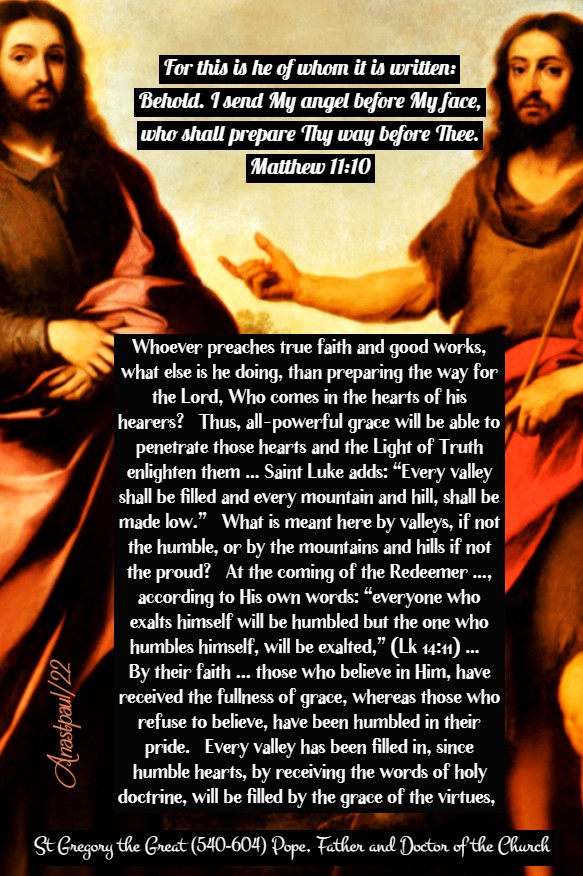
“For this is He of Whom it is written: Behold. I send My Angel before My face, who shall prepare Thy way before Thee.” – Matthew 11:10
REFLECTION – “It is obvious to any reader that John did not just preach but that he administered a baptism of repentance. However, he could not give a baptism which remits sins, since the remission of sins is only granted to us, with the baptism of Christ. That is why the Evangelist says, that he was “preaching a baptism of repentance for the forgiveness of sins,” (Lk 3:3) being unable himself to give the baptism that forgives sins, he announced that, which was to come. Just as the word of his preaching was the forerunner, of the Word of the Father made flesh, so, his baptism … preceded that of the Saviour, as shadow to the Truth (cf. Col 2:17).
This same John, when questioned as to who he was, replied: “I am the voice of one crying out in the desert,” (Jn 1:23; Is 40:3) . The Prophet Isaiah called him “voice” because, he came before the Word. As for what he cried out, that which follows teaches us: “Prepare the ways of the Lord, make straight his paths.” Whoever preaches true faith and good works, what else is he doing, than preparing the way for the Lord, Who comes in the hearts of his hearers? Thus, all-powerful grace will be able to penetrate those hearts and the Light of Truth enlighten them …
Saint Luke adds: “Every valley shall be filled and every mountain and hill, shall be made low.” What is meant here by valleys, if not the humble, or by the mountains and hills if not the proud? At the coming of the Redeemer …, according to His own words: “everyone who exalts himself will be humbled but the one who humbles himself, will be exalted,” (Lk 14:11) … By their faith in “the mediator between God and the human race, Christ Jesus, Himself, human” (1 Tim 2:5), those who believe in Him, have received the fullness of grace, whereas those who refuse to believe, have been humbled in their pride. Every valley has been filled in, since humble hearts, by receiving the words of holy doctrine, will be filled by the grace of the virtues, as it is written: “He made springs gush forth in the watercourses that wind among the valleys,” (cf. Ps 104:10).” – St Gregory the Great (540-604) Pope, Father and Doctor of the Church (Gospel Homilies no. 20).
PRAYER – O God, Who willed to foreshow divinely that blessed Peter Chrysologus would be a great Doctor to rule and teach Thy Church, grant, we beseech Thee that we may be worthy to have him as our intercessor in Heaven, who on earth was a teacher of life. Through Jesus Christ, Thy Son our Lord, Who lives and reigns with Thee, in the unity of the Holy Ghost, God, world without end. Amen (Collect).
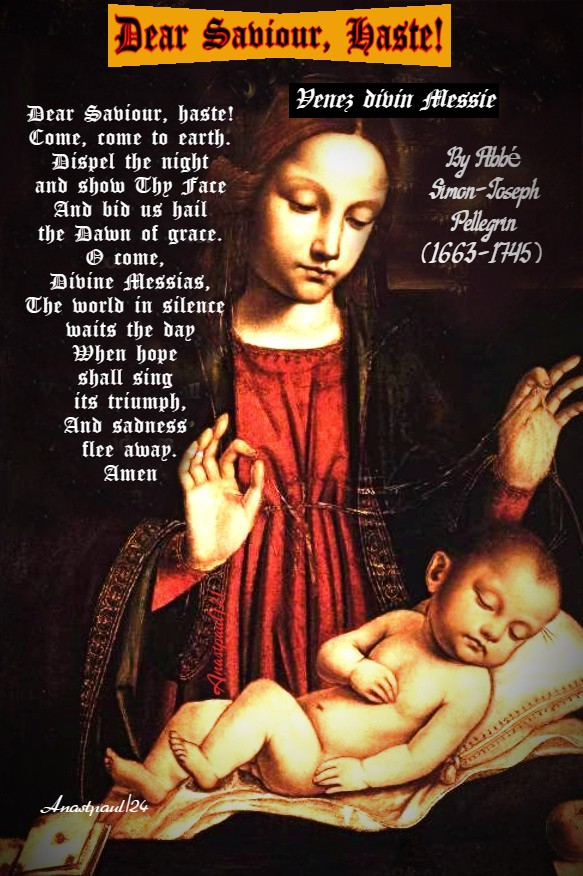
Dear Saviour, haste! Come, come to earth. Dispel the night and show Thy Face And bid us hail the Dawn of grace. O come, Divine Messias, The world in silence waits the day When hope shall sing its triumph, And sadness flee away. Amen
This is the Refrain from a beautiful Advent Hymn by Abbé Simon-Joseph Pellegrin, a French Cluniac Monk, Poet, Composer and Playwright.
Saint of the Day – 4 December – Saint Anno II (c 1010-1975) Archbishop of Cologne from 1056 until his death. From 1063 to 1065 he acted as Regent of the Holy Roman Empire for the minor Emperor Henry IV, Reformer, founder of Monasteries and builder of Churches. Born in c 1010 in Swabia, Germany and died on 4 December 1075 in Siegburg, Germany of natural causes. He is the Patron of gout sufferers.
He was a founder or co-founder of Monasteries (Michaelsberg, Grafschaft, St Maria ad Gradus, St George, Saalfeld and Affligem) and a builder of Churches, advocated clerical celibacy and introduced a strict discipline in a number of Monasteries. He was a man of great energy and ability, whose action in recognising Pope Alexander II (the authentic Pope during a time of strife in the Church) was of the utmost consequence, for Henry IV and for Germany.
Anno was born to a noble family in Swabia, Germany and was educated in Bamberg, where he subsequently became head of the Cathedral school. In 1046, he became Chaplain to the Emperor Henry III and accompanied him on his campaigns against King Andrew I of Hungary. In 1054, the Emperor appointed him the administrative and liturgical head, at the newly erected Cathedral of Goslar and Archbishop of Cologne two years later.
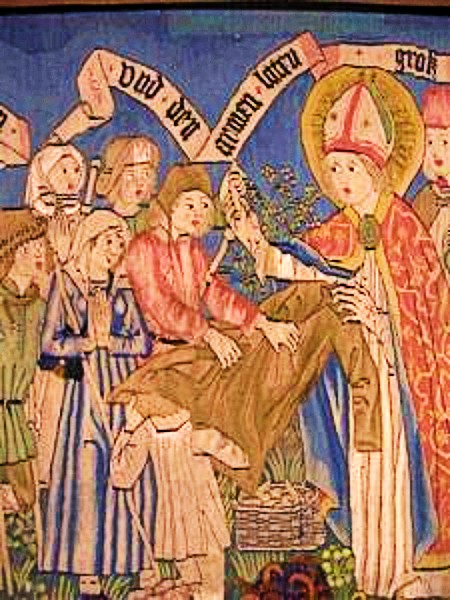
The tears he abundantly shed during the whole ceremony of his Consecration were a proof of his sincere humility and devotion. The foot of the altar was his soul’s delight, comfort and refuge. The poor he sought out in their cottages and carried to them, sometimes on his own shoulders, blankets and other necessaries. He fasted much, watched the greatest part of the night, subdued his body with hair shirts and preached to his flock with the assiduity and zeal of a St Paul. He reformed all the Monasteries of his Diocese and built two of Regular Canons at Cologne, and three of Benedictines in other parts.
According to contemporary sources, Anno led an extremely ascetic life . Nevertheless, he was a fearsome adversary to anyone perceived as a threat to the interests of his Archdiocese. His plans to seize the prosperous Monastery in Malmedy, challenging the authority of the Imperial Abbey of Stavelot-Malmedy, caused much controversy and ultimately failed. On the other hand, he founded the Benedictine Abbey of Michaelsberg, modelled on the Italian Abbey of Fruttuaria, which soon evolved into a centre of the Cluniac Reforms in Germany.
After the death of Emperor Henry III in 1056, the Archbishop took a prominent part in the government of the Empire, during the minority of the six-year-old heir to the throne, Henry IV. He was the leader of the party which, in April 1062, seized the person of Henry in the Coup of Kaiserswerth and deprived his mother, Empress Agnes, of power. Anno for a short time was able to exercise the chief authority in the Empire but he was soon obliged to share this with his fellow conspirators, Archbishop Adalbert of Bremen and Archbishop Siegfried of Mainz, retaining for himself, the supervision of Henry’s education and the title of Magister.
The office of Arch-Chancellor of the Imperial Kingdom of Italy was at this period regarded as an appanage of the Archbishopric of Cologne and this was probably the reason why Anno had a considerable share in settling a Papal dispute brewing since 1061,- relying on an assessment by his nephew, Bishop Burchard of Halberstadt, he declared Alexander II to be the rightful Pope at a Synod held at Mantua in May 1064 and took other steps to secure his recognition against Empress Agnes’ candidate Antipope Honorius II.
Returning to Germany, however, he found the chief power in the hands of Archbishop Adalbert of Bremen and as he was disliked by the young Emperor, Anno gradually lost ground at the Imperial Court, although he regained some of his former influence, when Adalbert fell from power in 1066. In the same year he was able to secure the succession of his nephew, Conrad of Pfullingen, as Archbishop of Trier. By 1072 he had become Imperial Administrator and thus, the second most powerful man, acting as an arbitrator in the rising Saxon Rebellion.
No City north of the Alps was so rich in great Churches, Sanctuaries, Relics and religious communities as Cologne was. It was known as the “German Rome,” With the growth of the municipal prosperity, the pride of the citizens and their desire for independence, also increased and caused them to feel more dissatisfied with the sovereignty of the Archbishop. This resulted in bitter feuds between the Bishops and the City which lasted for two centuries, with varying fortunes.
The first uprising occurred under Anno II, at Easter of the year 1074. The citizens rose against the Archbishop but were defeated within three days and severely punished. It was reported he had allied himself with William the Conqueror, King of England, against the Emperor. Having cleared himself of this charge, Anno took no further part in public business and died in Siegburg Abbey on 4 December 1075, where he was buried.
In 1064 Archbishop Anno,donated Relics to his favourite foundation, the Abbey of St. Michael on the Michaelsberg, where he also decided his burial place in the same Church which he had Consecrated in 1066 and,when he was Canonised in 1183 by Pope Lucius III, his bones were lifted out of the grave hewn into the rocky subsoil of the Abbey Church and laid in the magnificent Anno Shrine, which today, is the highlight of this beautiful pilgrim Church.
St Peter Chrysologus (c 400-450) “Golden Words” Confessor,, Father & Doctor of the Church – Bishop of Ravenna, Italy. Today we celebrate the Memorial of Saint Peter Chrysologus, a fifth-century Italian Bishop known for testifying courageously to Christ’s full humanity and divinity during a period of the heresy called “Monophysite.” The saint’s title, Chrysologus, signifies “golden speech” in Greek. Named as a Doctor of the Church in 1729 by Pope Benedict XIII., he is distinguished as the “Doctor of Homilies” for the concise but theologically rich reflections he delivered during his time as the Bishop of Ravenna. 176 of his sermons have survived – it is the strength of these beautiful explanations of the Incarnation, the Creed, the place of Mary and John the Baptist in the great plan of salvation, Mary’s perpetual Virginity, the penitential value of Lent, Christ’s Eucharistic presence and the Primacy of St Peter and his successors in the Church. FEAST DAY: 4 December (General Roman Calendar 1729-1969) https://anastpaul.com/2018/07/30/saint-of-the-day-30-july-st-peter-chrysologus-c-400-450-golden-words/
St Ada of Le Mans St Adelmann of Beauvais St Anno II (c 1010-1975) Archbishop of Cologne St Apro
St Bernardo degli Uberti St Bertoara of Bourges St Christianus St Clement of Alexandria St Cyran of Brenne St Eraclius St Eulogio Álvarez López St Ezequiel Álvaro de La Fuente St Felix of Bologna Bl Francis Galvez St Francisco de la Vega González St Heraclas of Alexandria St Jacinto García Chicote Bl Jerome de Angelis St John the Wonder Worker St Maruthas St Melitus of Pontus
























 AnaStpaul
You must be logged in to post a comment.