Thought for the Day – 6 April – Meditations with Antonio Cardinal Bacci (1881-1971)
The Night of the Passion
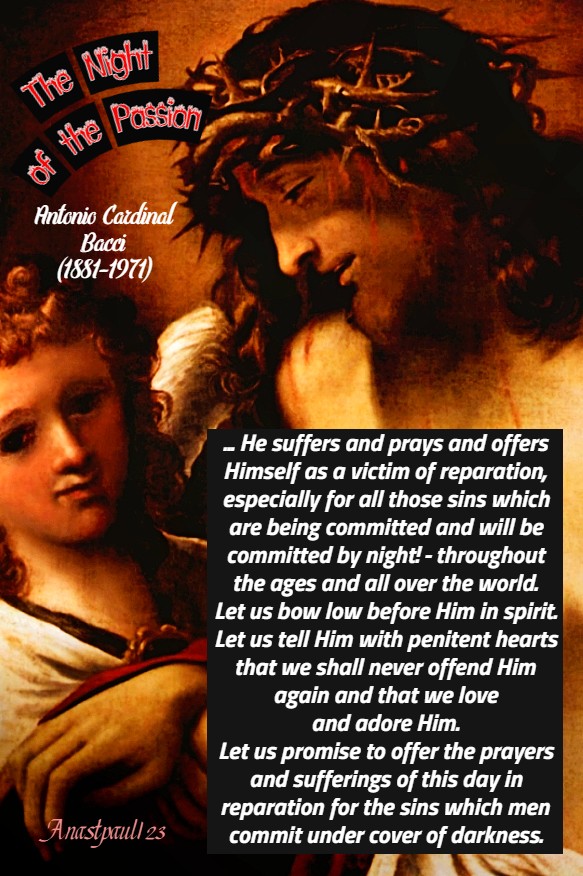
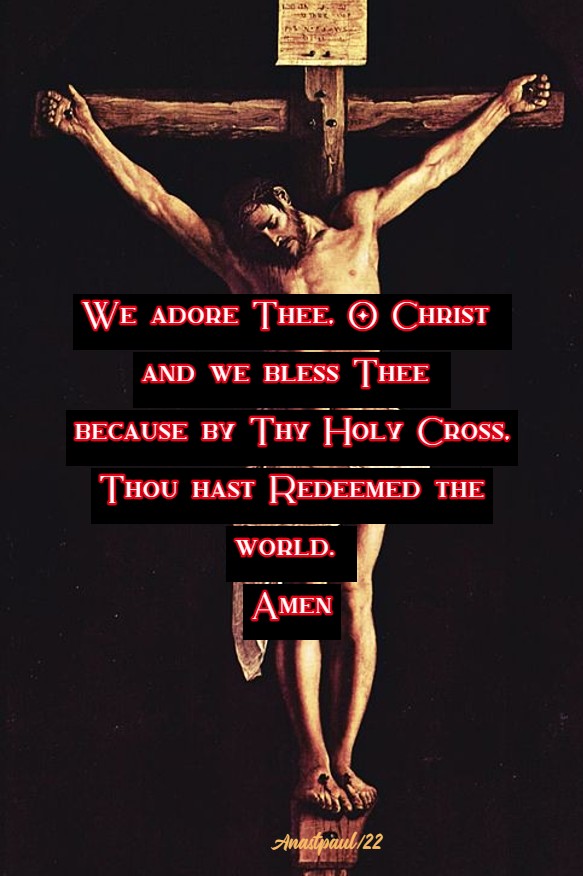
“Picture Jesus during this long and sorrowful night. Abandoned by everyone, betrayed by Judas, denied by Peter, unjustly judged worthy of death by the Hight Priest, buffered and mocked by the soldiers, He suffers and prays and offers Himself as a victim of reparation, especially for all those sins which are being committed and will be committed by night! – throughout the ages and all over the world.
Let us bow low before Him in spirit. Let us tell Him with penitent hearts that we shall never offend Him again and that we love and adore Him. Let us promise to offer the prayers and sufferings of this day in reparation for the sins which men commit under cover of darkness.”
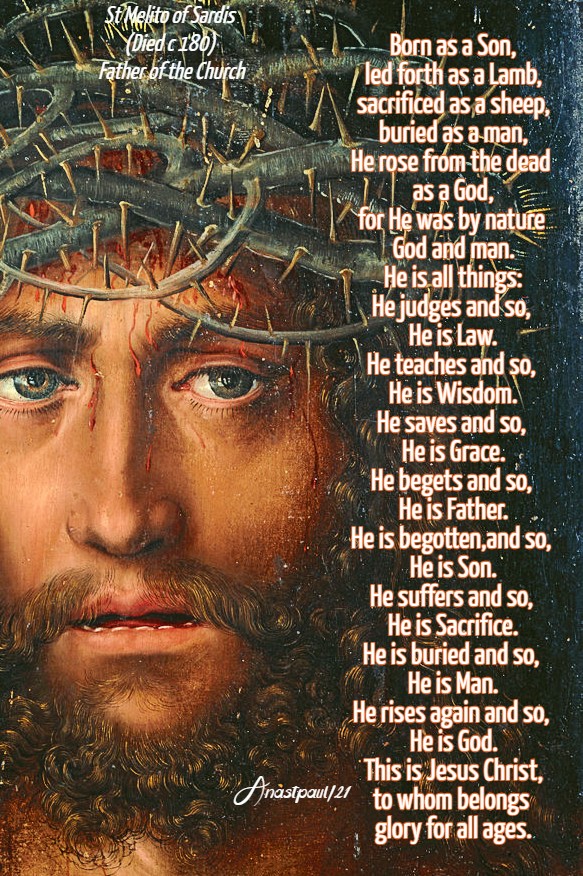
“Born as a Son, led forth as a Lamb, sacrificed as a sheep, buried as a man, He rose from the dead as a God, for He was by nature God and man.
He is all things – He judges and so, He is Law. He teaches and so, He is Wisdom. He saves and so, He is Grace. He begets and so, He is Father. He is begotten,and so, He is Son. He suffers and so, He is Sacrifice. He is buried and so, He is Man. He rises again and so, He is God. This is Jesus Christ, to Whom belongs glory for all ages.”
St Melito of Sardis (Died c 180) Bishop, Early Church Father
Our Lenten Journey with St Francis de Sales – 6 April – Maundy Thursday – Scripture search here: https://www.drbo.org/
“But could God not have provided the world with a remedy, other than that of His Son’s Death? ” St Francis de Sales
MAUNDY THURSDAY “Father, forgive them” St Francis de Sales (1567-1622) Doctor Caritas
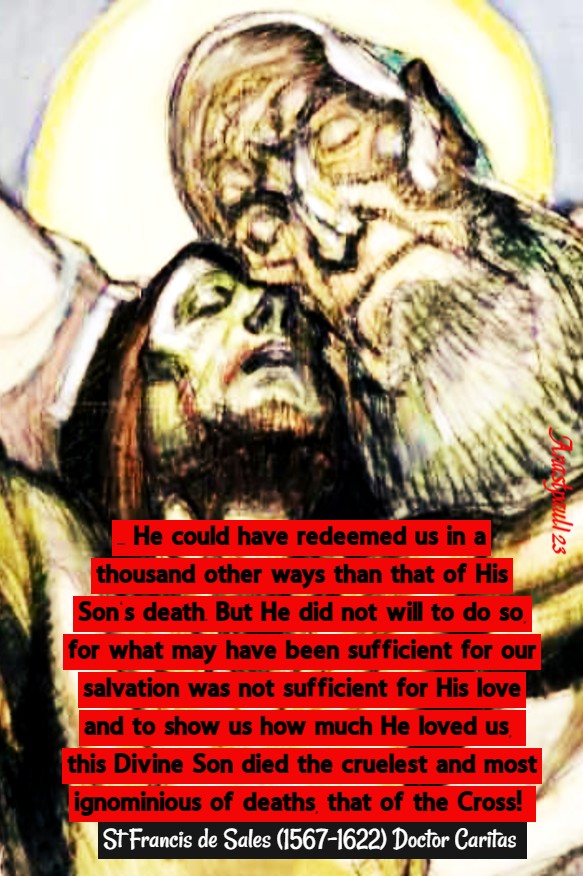
“BUT COULD GOD not have provided the world with a remedy, other than that of His Son’s Death? Certainly, He could have done so and by a thousand other means. Could He not have pardoned human nature with absolute power and pure mercy, not invoking justice or the intervention of any creature? Doubtless He could and who would have dared to question or criticise Him? No-one, for He is Sovereign Master and can do all He wills. Besides, if He had wanted some creature to undertake our redemption, would He not have created one of such excellence and dignity that, by its deeds or sufferings, it could have satisfied for all our sins? Assuredly and He could have redeemed us in a thousand other ways than that of His Son’s death. But He did not will to do so, for what may have been sufficient for our salvation was not sufficient for His love and to show us how much He loved us, this Divine Son died the cruelest and most ignominious of deaths, that of the Cross! …”
“OH, HOW GREAT was the flame of love which burned in the Heart of our gentle Saviour, since at the height of His sufferings, at a time when the vehemence of His torments seemed to take from Him, even the power of praying for Himself, He succeeded, through the strength of His charity in forgetting Himself but not His creatures and with a strong and intelligible Voice uttered these words: “Father, forgive them.” With this prayer, He wanted to make us understand the love He bore us, undiminished by any suffering and to teach us how our heart should be toward our neighbour.” – (Sermons of St Francis de Sales for Lent).
One Minute Reflection – 6 April – Maundy Thursday – 1 Corinthians 11:20-32, John 13:1-15 – Scripture search here: https://www.drbo.org/
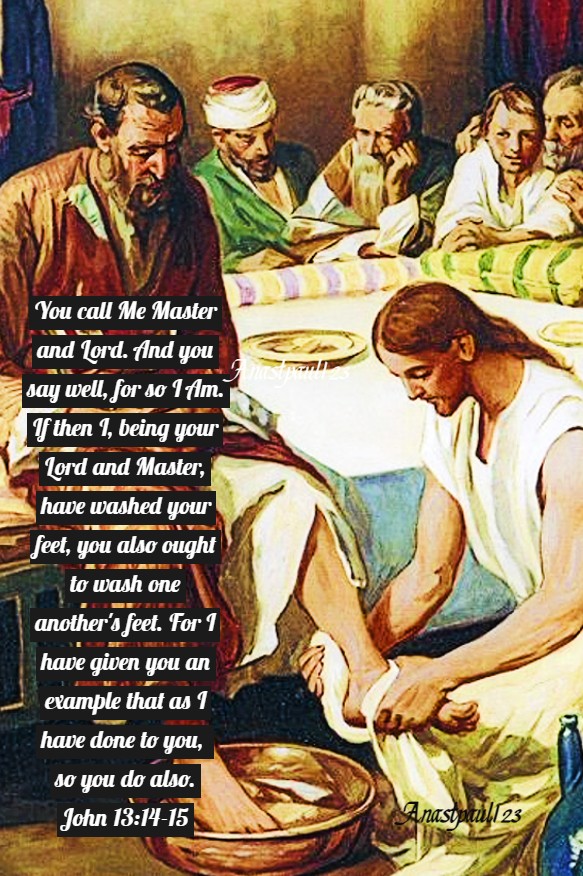
“You call Me Master and Lord. And you say well, for so I Am. If then I, being your Lord and Master, have washed your feet, you also ought to wash one another’s feet. For I have given you an example that as I have done to you, so you do also.” – John 13:14-15
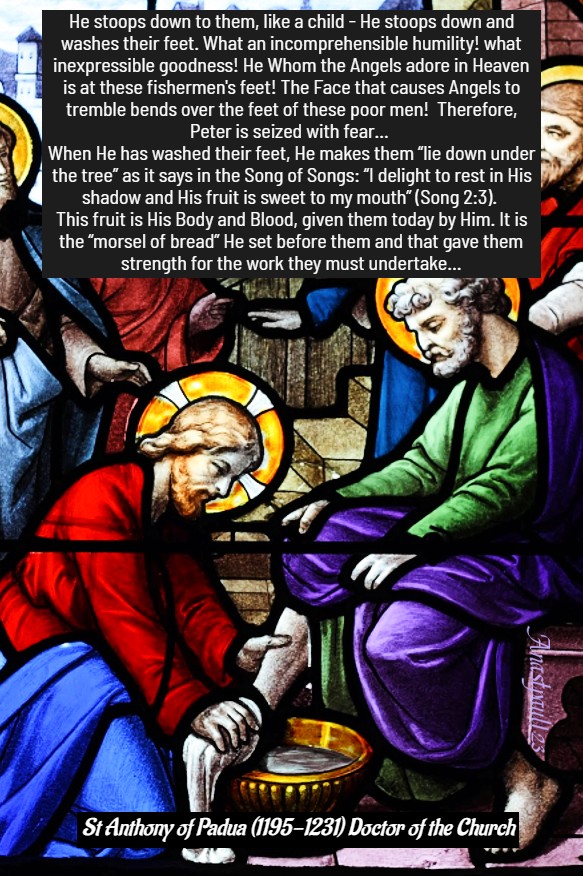
REFLECTION – “Jesus rose from supper and took off His outer garments. He took a towel and tied it around His waist. Then He poured water into a basin and began to wash the disciples’ feet. We read a story of the same kind in Genesis. Abraham says to the messengers – the three Angels who visit him: “Let some water be brought that you may bathe your feet and then rest yourselves under the tree; let me bring you a little food that you may refresh yourselves” (Gen 18:4-5). What Abraham did for the three Angels, Christ did for His Apostles, those messengers of the Truth, who were to preach faith in the Blessed Trinity, to all the world.
He stoops down to them, like a child – He stoops down and washes their feet. What an incomprehensible humility! what inexpressible goodness! He Whom the Angels adore in Heaven, is at these fishermen’s feet! The Face that causes Angels to tremble bends over the feet of these poor men!Therefore, Peter is seized with fear… When He has washed their feet He makes them “lie down under the tree” as it says in the Song of Songs: “I delight to rest in His shadow and His fruit is sweet to my mouth” (Song 2:3). This fruit is His Body and Blood, given them today by Him. It is the “morsel of bread” He set before them and that gave them strength for the work they must undertake…
Behold, “on this mountain the Lord of Hosts will prepare for all peoples a feast of rich meat with the marrow” (Is 25:6)… In the Upper Room where the Apostles are to receive the Holy Spirit on the day of Pentecost, the Lord of all the world, throws a feast today for all the peoples who believe in Him… This is what the Church does today throughout the world. It was for her sake that Christ prepared this feast on Mount Zion, this food that restores us, His True Body, rich in every spiritual virtue and charity. This He has given to His Apostles and has commanded them to give to those who believe in Him.” – St Anthony of Padua (1195-1231) Franciscan, Doctor of the Church (Sermons for Sundays and Feasts, Maundy Thursday).
PRAYER – O God, from Whom Judas received the punishment of his guilt and the thief the reward of his confession: grant unto us the full fruit of Thy clemency, that even as in His Passion, our Lord Jesus Christ gave to each a retribution according to his merits, so having taken away our old sins, He may bestow upon us the grace of His Resurrection. Who with Thee lives and reigns in the unity of the Holy Ghost, God, world without end. Amen (Collect).
Our Morning Offering – 6 April – Maundy Thursday in Holy Week
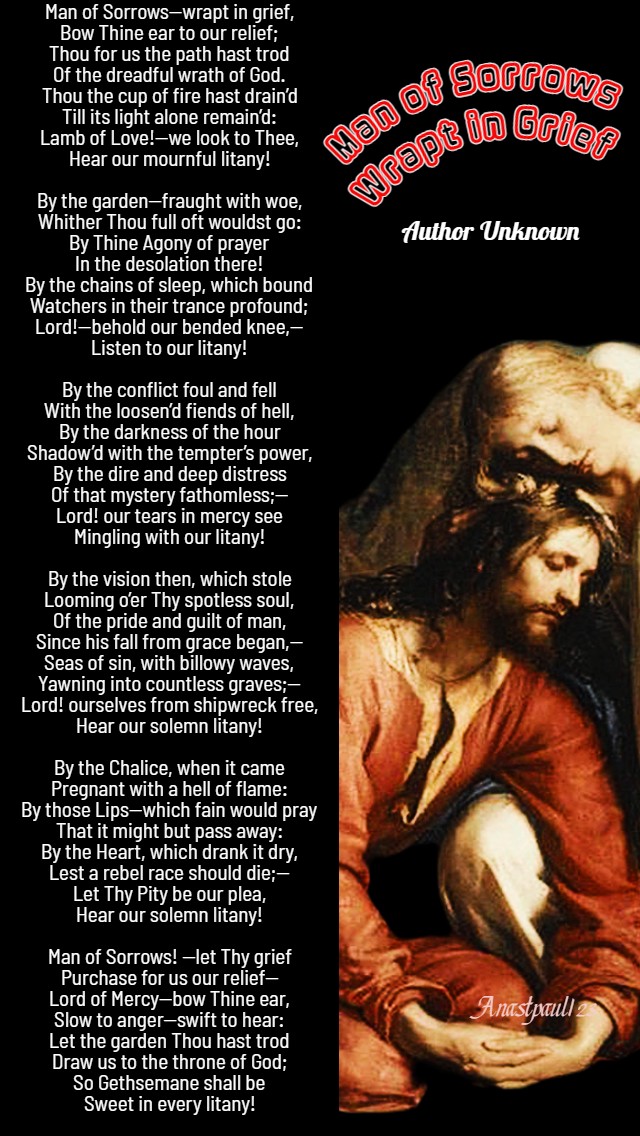
Man of Sorrows—Wrapt in Grief From an old French Hymn Author Unknown
Man of Sorrows—wrapt in grief, Bow Thine ear to our relief; Thou for us the path hast trod Of the dreadful wrath of God. Thou the cup of fire hast drain’d Till its light alone remain’d: Lamb of Love!—we look to Thee, Hear our mournful litany!
By the garden—fraught with woe, Whither Thou full oft wouldst go: By Thine Agony of prayer In the desolation there! By the chains of sleep, which bound Watchers in their trance profound; Lord!—behold our bended knee,— Listen to our litany!
By the conflict foul and fell With the loosen’d fiends of hell, By the darkness of the hour Shadow’d with the tempter’s power, By the dire and deep distress Of that mystery fathomless;— Lord! our tears in mercy see Mingling with our litany!
By the vision then, which stole Looming o’er Thy spotless soul, Of the pride and guilt of man, Since his fall from grace began,— Seas of sin, with billowy waves, Yawning into countless graves;— Lord! ourselves from shipwreck free, Hear our solemn litany!
By the Chalice, when it came Pregnant with a hell of flame: By those Lips—which fain would pray That it might but pass away: By the Heart, which drank it dry, Lest a rebel race should die;— Let Thy Pity be our plea, Hear our solemn litany!
Man of Sorrows! —let Thy grief Purchase for us our relief— Lord of Mercy—bow Thine ear, Slow to anger—swift to hear: Let the garden Thou hast trod Draw us to the throne of God; So Gethsemane shall be Sweet in every litany!
This translation by Matthew Bridges (1800-1894) (The Passion of Jesus 1852) Hymnist, Poet, Writer Converted to Catholicism in 1848, by the influence of John Henry Newman (1801-1890) Tune: “Anima Christi (English)” traditional English melody.
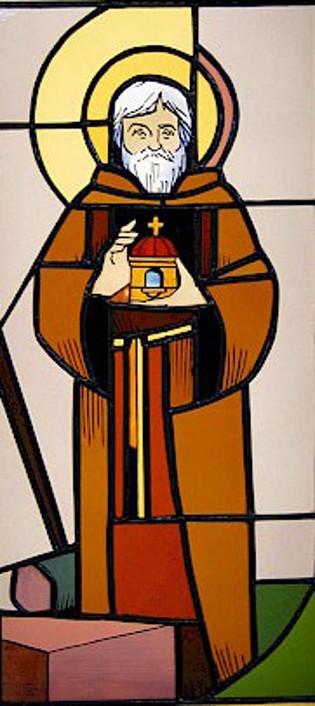
Saint of the Day – 6 April – St William of Eskilsoe (1125-1203) Priest, Abbot, Reformer – be it by his fervour, mortification, charity to the poor and uprightness of life. Born IN 1125 at Paris, France and died ion Easter Sunday, 6 April 1203 in Denmark of natural causes. Also known as – William of Aebelhold, William of Aebelholt, William of Ebelholt, William of Eskhill, William of Eskyll, William of Ise Fjord, William of Paris, William of the Paraclete, Wilhelm, Willem, Villem. St William was Canonised on 21 January 1224 by Pope Honorius III.
William was born of an illustrious family in Paris, about the year 1125 and received his education in the Abbey of St Germain-des-Prez, under his uncle Hugh, the Abbot. By the regularity of his conduct,and the sanctity of his manners, he was the admiration of the whole community. Having finished his studies, he was Ordained Deacon, then Priest and installed as a Canon in the Church of St Genevieve au-Mont. His assiduity in prayer, love of retirement and mortification,and exemplary life, seemed a troublesome censure of the slothful and worldly life of his colleagues and what ought to have gained him their esteem and affection, served to provoke their envy and malice against him.
Having in vain endeavoured to prevail on this reformer of their Chapter, as they called him, to resign his Canonry, in order to remove him, they presented him to the curacy of Epinay, a Church five leagues from Paris, depending on their chapter.
But not long after, Pope Eugenius III coming to Paris, in 1147 and being informed of the irregular conduct of these Canons, he commissioned the celebrated Sugar, Abbot of St Denys and Prime Minister to King Louis the Young, to expel them and introduce in their place, regular Canons from the Abbey of St Victor which was happily carried into execution, Eudo of St Victor’s being made the first Abbot. William with joy embraced this institution and was, by his fervour and devotion, a pattern of the most perfect Priest and Monk. He was in a short time chosen Sub-Prior.
The perfect spirit of religion and regularity which he established in that community, was an illustrious proof of the incredible influence which the example of a prudent Superior has over docile religious minds. His zeal for regular discipline, he tempered with so much sweetness and modesty in his injunctions, that made all to love the precept itself and, to practice with cheerfulness, whatever was prescribed them. The reputation of his wisdom and sanctity reached the ears of Absalon, Bishop of Roschild, in Denmark, who, being one of the most holy prelates of his age, earnestly sought to allure him into his Diocese. In 1161, he sent the provost of his Church, who seems to have been the learned historian Saxo the Grammarian, to Paris on this errand. A prospect of labours and dangers for the glory of God was a powerful motive with the Saint and, in 1165, he cheerfully undertook the voyage, taking with him 3 Monks.
The Bishop appointed him Abbot of Eskilsoe, a Monastery of Regular Canons which he had reformed. But when Abbot William arrived there were only six religious left at Eskilsoe, two of whom were dismissed when they refused to submit to the new rule. Here William sanctified himself by a life of prayer and austere mortification but had much to suffer from the persecutions of powerful men, from the extreme poverty of his house in a severe climate and, above all, from a long succession of interior trials but the most perfect victory over himself, was the fruit of his constancy, patience and meekness. On prayer was his chief dependence and it proved his constant support. And by his life of holiness, he soon filled the Monastery with new Monks who were drawn by the sanctity of their Abbot.
During the thirty years of his Abbacy, he had the comfort of seeing many walk with fervour in his steps. He never omitted wearing his hair-shirt, lay on straw and fasted every day. Penetrated with a deep sense of the greatness and sanctity of our Mysteries, he never approached the Altar without watering it with his tears, making himself a victim to God in the spirit of adoration and sacrifice, together with and through, the merits of the Holy Victim offered thereon: the dispositions in which every Christian ought to assist at it.
William died on 6 April, 1203, which that year was Easter Sunday. Numerous miracles were reported at his grave and in 1218 the Archbishop of Lund, Anders Sunesen, requested that Pope Honorius III appoint a local commission to investigate the claims of William’s sanctity. William was Canonised only 21 years after his death by Pope Honorius III in 1224. In 1238 St William’s Relics were translated to the new Church built at his Abbey of Eskilsoe. In time some of his Relics were shared in various Cathedrals and Churches across Denmark.
St Agrarius the Martyr St Amand of Grisalba St Berthanc of Kirkwall St Brychan of Brycheiniog Bl Catherine of Pallanza St Diogenes of Philippi St Elstan of Abingdon St Galla of Rome St Gennard St Irenaeus of Sirmium St Marcellinus the Martyr
St Philaret of Calabria St Platonides of Ashkelon St Prudentius of Troyes St Pope Sixtus I St Timothy of Philippi St Ulched St Urban of Peñalba St William of Eskilsoe (1125-1203) Priest, Abbpt St Winebald
Martyrs of Sirmium : 7 Saints – A group of fourth century Martyrs at Sirmium, Pannonia (modern Sremska Mitrovica, Serbia). We know little more than seven of their names – Florentius, Geminianus, Moderata, Romana, Rufina, Saturus and Secundus.









 AnaStpaul
You must be logged in to post a comment.