Thought for the Day – 18 April – Meditations with Antonio Cardinal Bacci (1881-1971)
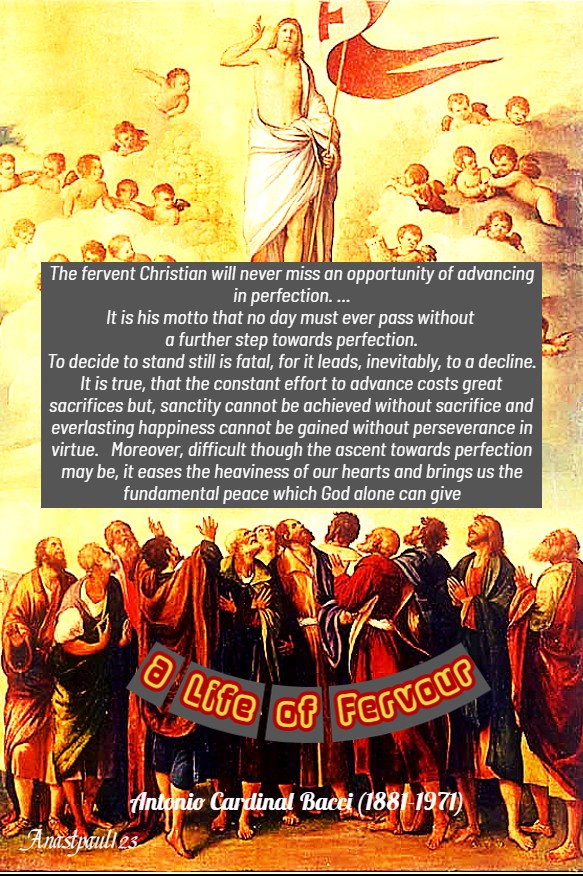
A Life of Fervour
“The fervent Christian will never miss an opportunity of advancing in perfection. When he feels that he is growing negligent, he combats the signs of spiritual retrogression and makes a new beginning, by telling God that he wishes to belong entirely to Him. It is his motto that no day must ever pass without a further step towards perfection. To decide to stand still is fatal, for it leads, inevitably, to a decline. It is true, that the constant effort to advance costs great sacrifices but, sanctity cannot be achieved without sacrifice and everlasting happiness cannot be gained without perseverance in virtue. Moreover, difficult though the ascent towards perfection may be, it eases the heaviness of our hearts and brings us the fundamental peace which God alone can give.”
Quote/s of the Day – 18 April – “The Month of the Resurrection” – Tuesday in the Second Week of Easter – 1 John 5:4-10, John 20. 19-31 – Scripture search here: https://www.drbo.org/
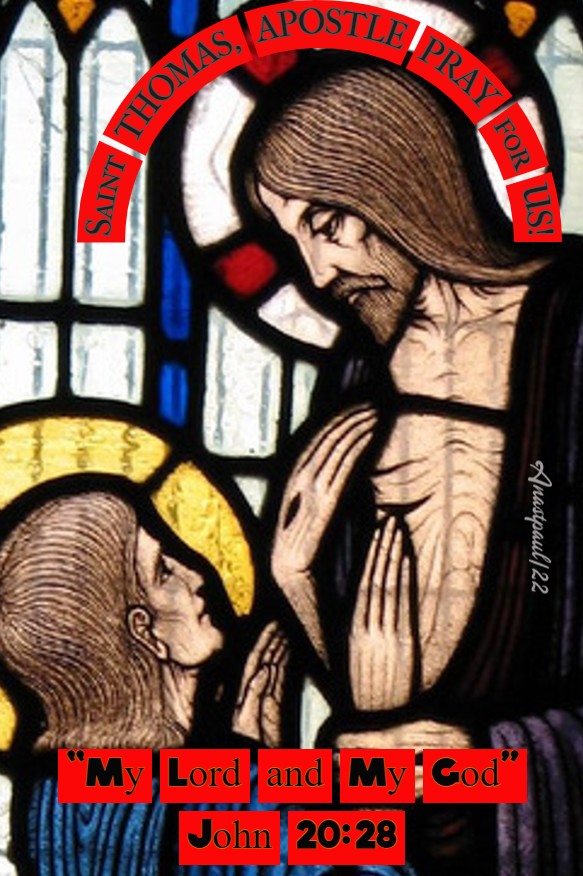
“My Lord and my God.”
John 20:28
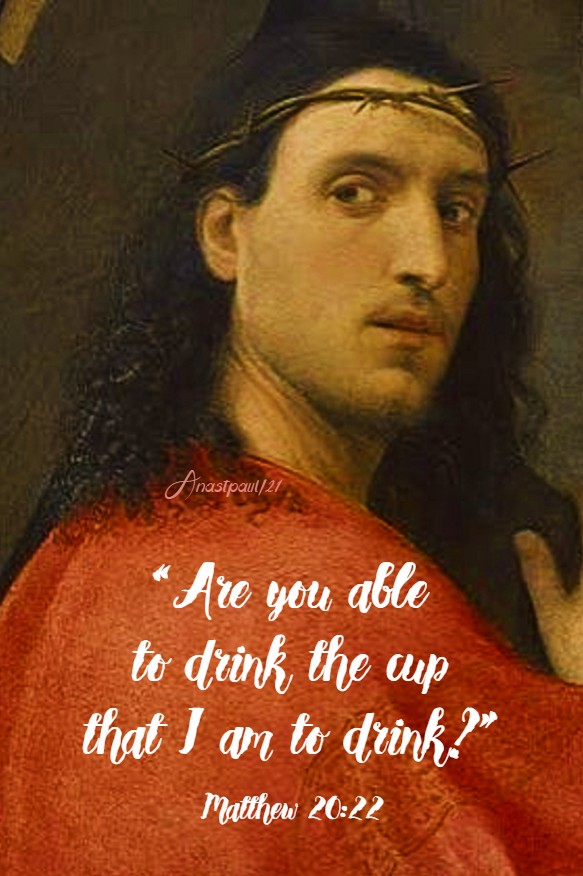
“Are you able to drink the cup that I am to drink?”
Matthew 20:22
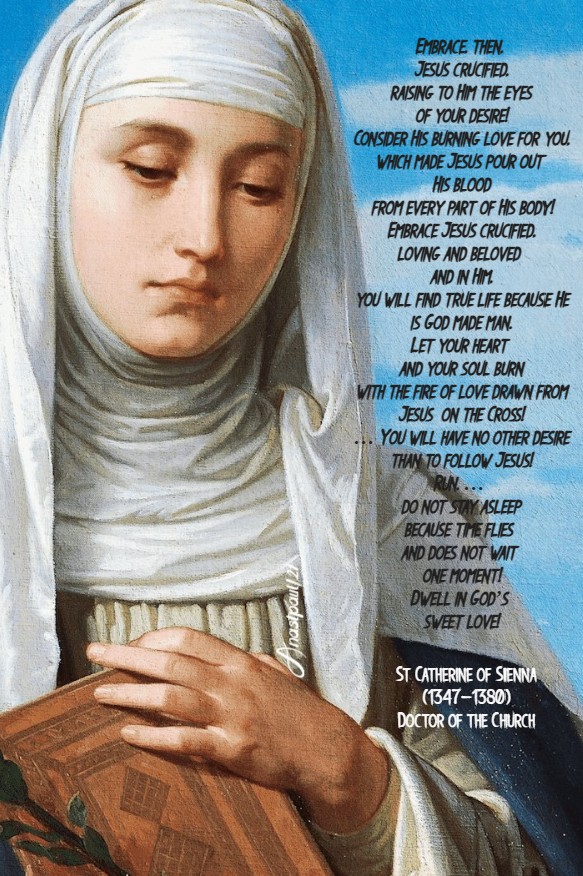
“Embrace, then, Jesus Crucified, raising to Him the eyes of your desire! Consider His burning love for you which made Jesus pour out His Blood from every part of His body! Embrace Jesus Crucified, loving and beloved and in Him, you will find true life because He is God made Man. Let your heart and your soul burn with the fire of love drawn from Jesus on the Cross! … You will have no other desire than to follow Jesus! Run, … do not stay asleep because time flies and does not wait one moment! Dwell in God’s sweet love!”
St Catherine of Sienna (1347-1380) Doctor of the Church
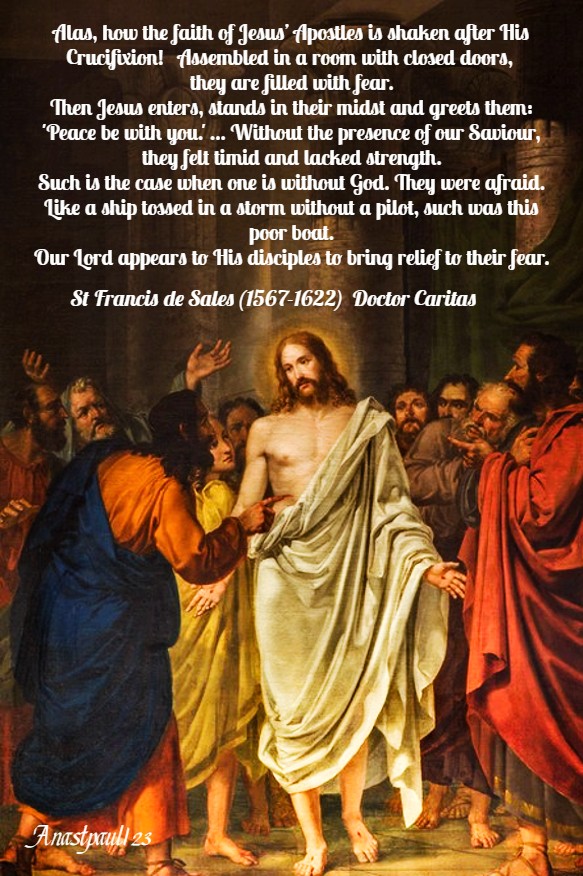
“Alas, how the faith of Jesus’ Apostles is shaken after His Crucifixion! Assembled in a room with closed doors, they are filled with fear. Then Jesus enters, stands in their midst and greets them: ‘Peace be with you.’ … Without the presence of our Saviour, they felt timid and lacked strength. Such is the case when one is without God. They were afraid. Like a ship tossed in a storm without a pilot, such was this poor boat. Our Lord appears to His disciples to bring relief to their fear.”
One Minute Reflection – 18 April – “The Month of the Resurrection” – Tuesday in the Second Week of Easter – 1 John 5:4-10, John 20. 19-31 – Scripture search here: https://www.drbo.org/
“Thomas answered and said to Him: My Lord and my God.” – John 20:28
REFLECTION – “ Why did Thomas seek proof for his faith in this way? … Your love, my brethren, would have preferred it, if lack of faith had left no-one in doubt after the Resurrection. But Thomas bore the uncertainty, not only of his own heart but of all people. And since he was to preach the Resurrection to the gentiles, he sought out, like a good workman, what he would base a Mystery on which demands so much faith. And the Lord showed all the Apostles what Thomas had sought so late. “Jesus came … and showed them His Hands and His Side” (Jn 20:19-20). Indeed, the Person Who entered when the doors were shut, might have been taken for a spirit, by the disciples, if he had not been able to show them that it was none other than He, the Wounds being the mark of His Passion.
Then He came to Thomas and said to him: ”Put your hand in My Side and do not be unbelieving but believe. May the Wounds you are opening make faith flow into the whole world once more, those Wounds which have already poured out the water of Baptism and the Blood of Redemption.” (Jn 19:34). Thomas replied: “My Lord and my God!” Let unbelievers come and hear and, as our Lord said, let them no longer be doubters but believers. Thomas makes known and declares that this is not just a human Body but that, by the Passion of His Body of Flesh, Christ is God and Lord. He Who comes out alive from death and Who rises out of His woundedness is God indeed!” – St Peter Chrysologus (406-450) Bishop of Ravenna, Father and Doctor of the Church (Sermon 84).
PRAYER – Grant, we beseech Thee, Almighty God that we, who have celebrated the Paschal Feast, may, by Thy bounty, retain its fruits in our daily habits and behaviour. Through Jesus Christ, Thy Son our Lord, Who lives and reigns with Thee, in the unity of the Holy Ghost, God, world without end. Amen (Collect).
Our Morning Offering – 18 April – Tuesday in the Second Week of Easter
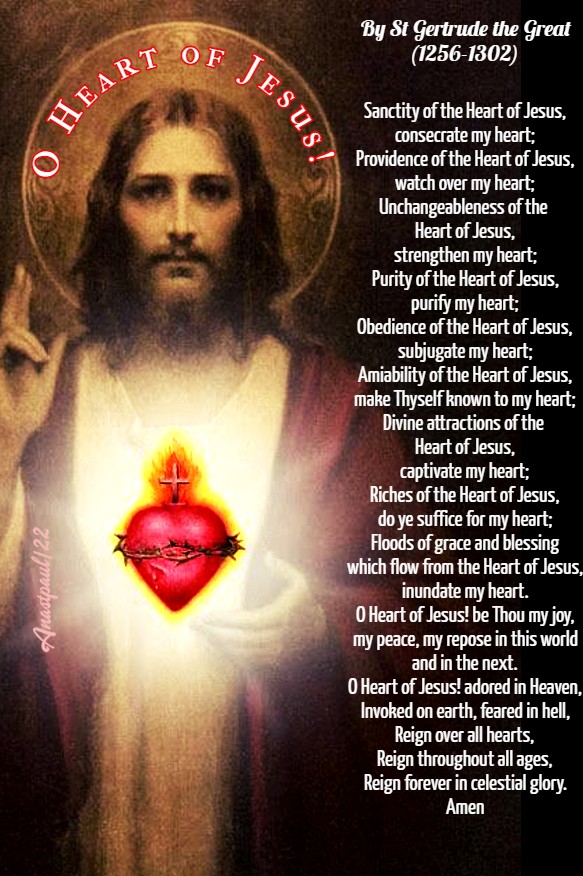
O Heart of Jesus! By St Gertrude the Great (1256-1302)
Sanctity of the Heart of Jesus, consecrate my heart; Providence of the Heart of Jesus, watch over my heart; Unchangeableness of the Heart of Jesus, strengthen my heart; Purity of the Heart of Jesus, purify my heart; Obedience of the Heart of Jesus, subjugate my heart; Amiability of the Heart of Jesus, make Thyself known to my heart; Divine attractions of the Heart of Jesus, captivate my heart; Riches of the Heart of Jesus, do ye suffice for my heart; Floods of grace and blessing which flow from the Heart of Jesus, inundate my heart. O Heart of Jesus! be Thou my joy, my peace, my repose in this world and in the next. O Heart of Jesus! adored in Heaven, Invoked on earth, feared in hell, Reign over all hearts, Reign throughout all ages, Reign forever in celestial glory. Amen
Saint of the Day – 18 April – Blessed Barbara Aurillot / Marie of the Incarnation OCD (1566-1618) Widow, Third Order Lay Discalced Carmelite Sister, Apostle of Charity, Mystic. Barbara is considered the Foundress of the French branch of Carmel. She was known for receiving visions and ecstasies and for supernatural gifts. Born on 1 February 1566 at Paris, France as Barbe Aurillot and died on 18 April 1618 at Pontoise, France of natural causes. Patronages – against impoverishment, against loss of parents, against poverty, parents separated from children, the poor, widows. Also known as – Le belle Acarie (the beautiful Acarie), as she was known in Paris, Barbara Aurillot, Barbara Avrillot, Barbe Acarie, Barbe Aurillot, Barbe Avrillot, Madame Acarie, Marie Acarie Marie or Mary of the Incarnation.
Barbara was the daughter of a French Government Official named Nicholas Aurillot,the Accountant General in the Paris Chamber and Chancellor of Marguerite of Navarre, first wife of Henri IV. Her mother, Marie Lhuillier. was a descendant of Etienne Marcel, the famous prévôt des marchands (Chief municipal Magistrate). She was educated at her Aunt’s Convent at Longchamps, the Minor Sisters of Humility of Our Lady.
Although Barbara was attracted to the religious life, at the age of 16 in 1684, through obedience, she was married to Pierre Acarie, the Viscount of Villemoran, a wealthy young man of high standing, who was a fervent Catholic and Government Treasury Official. She became the Mother of six children, three of whom became Carmelites Nuns and one a Priest.
Her husband, Pierre, supported the Catholic League, of which he was a staunch member, against Henry IV. Pierre was one of the sixteen who organised the resistance in Paris. When Henry became King, he seized the Acarie estates, impoverished the family and exiled Pierre from Paris, separated husband and father from his family. Barbara had to contend with creditors and irate businessmen. Although she had been severely injured due to a fall from her horse and medical treatment which had only made matters worse and left her an invalid for the rest of her life. Barbara still, legally challenged the matter and went to Court to fight and she won. The family was able to reclaim part of the their property and fortune.
Barbara was devoted to the writings of Saint Teresa of Avila. Her good works eventually won her the admiration and support of the same King Henry! who assisted her later when she was the greatest protagonist in bringing the reformed Carmelites of St Teresa to France. At this time, she received a vision of St Teresa who informed her that God wished Barbara to do this work.
At the beginning of the Seventeenth Century Madame Acarie was widely known for her virtue, her supernatural gifts and especially, for her charity towards the poor and the sick in the hospitals. To her residence came all the distinguished and devout people of the day. Among them was St Vincent de Paul and St Francis de Sales, the latter of whom became her Spiritual Counsellor.
Barbara was instrumental in bringing the Discalced Carmelites of Saint Teresa to France, founding five houses between 1604 and 1609. The Carmel spread rapidly and profoundly influenced the French religious and secular society of the day. In 1618, the year of Barbara’s death, Carmel numbered fourteen houses.
She also shared in two foundations of the day, that of the Oratory and of the Ursulines. She urged De Bérulle to refuse the tutorship of Louis XIII and on 11 November 1611, she, with St Vincent de Paul, assisted at the Mass of the installation of the Oratory of France.
Among the many postulants whom Mme Acarie received for the Carmel, there were some who had no vocation and she conceived the idea of getting them to undertake the education of young girls and broached her plan to her holy cousin, Mme. de Sainte-Beuve. To establish the new order they brought Ursulines to Paris and adopted their rule and name.
When Pierre died in 1613, his widow settled her affairs and begged leave to enter the Carmel, asking as a favour to be received as a lay sister in the poorest community. In 1614 she withdrew to the Monastery of Amiens, taking the name of Marie of the Incarnation. Her three daughters had preceded her into the cloister and one of them was Sub-prioress at Amiens. In 1616, by order of her Superiors for health reasons, she went to the Carmelite Convent at Pontoise, where she died at the aged of 52/53. St Francis de Sales considered her death in spiritual poverty as laudable as that of St Francis Xavier’s, who died in utter physical poverty.
Her cause was introduced at Rome in 1627 and she was Beatified on 24 April 1791 by Pope Pius VI – her Feast is widely celebrated in Paris on 18 April. Her mortal remains are in the Chapel of the Carmelites of Pontoise.
It has been said that the vigorous and saintly Madame Acarie, provided the first definite impulse towards that interior growth which made the exquisite and urbane St Francis de Sales, a fit guide for the soul of St Jane Frances de Chantal.
St Agia of Hainault St Anthia of Illyria St Antusa of Constantinople Saint Apollonius the Apologist
St Athanasia of Aegina
Blessed Barbara Aurillot / Marie of the Incarnation O.Carm (1566-1618) Widow, Lay Carmelite Sister St Bitheus St Calocerus of Brescia St Cogitosus St Corebus St Eleuterius of Illyria St Elpidius of Melitene St Eusebius of Fano St Galdinus of Milan St Gebuinus of Lyons St Genocus St Hermogenes of Melitene
Blessed Idesbald of Dunes O.Cist (c1095-1167) Cistercian Priest and Abbot of Ten Duinen Abbey, Our Lady of the Dunes. The Roman Martyrology states: “In Bruges in Flanders, in today’s Belgium, Blessed Idesbaldo, Abbot, who, soon became a widower and exercised for another thirty years, duties in the palace of the Counts, entered the Monastery of Dune at a mature age, which he held holy, as the third Abbot for twelve years.” Biography: https://anastpaul.com/2021/04/18/saint-of-the-day-18-april-blessed-idesbald-of-dunes-o-cist-c-1095-1167/











 AnaStpaul
You must be logged in to post a comment.