Thought for the Day – 30 April – Meditations with Antonio Cardinal Bacci (1881-1971)
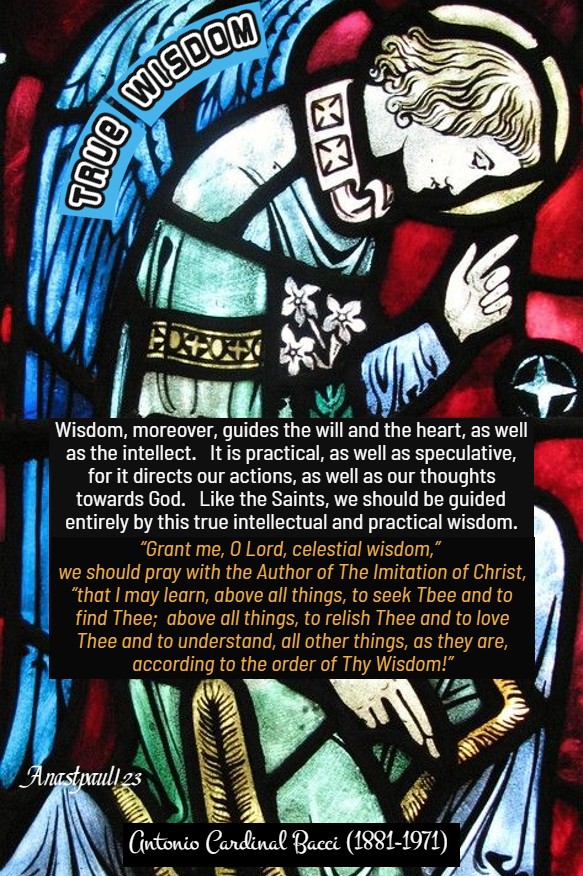
TRUE WISDOM
“According to Christian teaching, both knowledge and wisdom, properly understood, are gifts of the Holy Spirit. Only the Light and Grace of the Holy Spirit, can enable us to comprehend the Truth which, in its plenitude, is God Himself and to appreciate the vanity of human things, as long as they are not ordained to their final end which is God and the everlasting life of happiness.
St Thomas Aquinas holds that human and earthly things are the proper object of science, insofar however, as they ought to be directed towards God. “The man who has a correct approach to science, regards creatures as ordained to God, does not value them for more than they are worth and does not permit them to constitute the purpose of his life” (Summa Theologiae II-II q9 a4). “All creatures are ordained to God and to His glory,” he writes elsewhere, “in that they manifest the Divine Goodness in themselves; they are, moreover, the means to everlasting happiness” (Quaestiones disputate, De Caritate q1 a7).
Nature maybe said to be a sacrament which enables us to gain experience of God (Summa Theologiae III q60 a2 ad1). This is how knowledge becomes wisdom which is not content merely to have a proper estimation of human objects but, proceeds to penetrate, with the assistance of Revelation and of Grace, into the transcendent Mysteries of the Divinity. Wisdom, moreover, guides the will and the heart, as well as the intellect. It is practical, as well as speculative, for it directs our actions, as well as our thoughts towards God. Like the Saints, we should be guided entirely by this true intellectual and practical wisdom. “Grant me, O Lord, celestial wisdom,” we should pray with the Author of The Imitation of Christ, “that I may learn, above all things, to seek Tbee and to find Thee; above all things, to relish Thee and to love Thee and to understand, all other things, as they are, according to the order of Thy Wisdom!” (Bk III c27).”
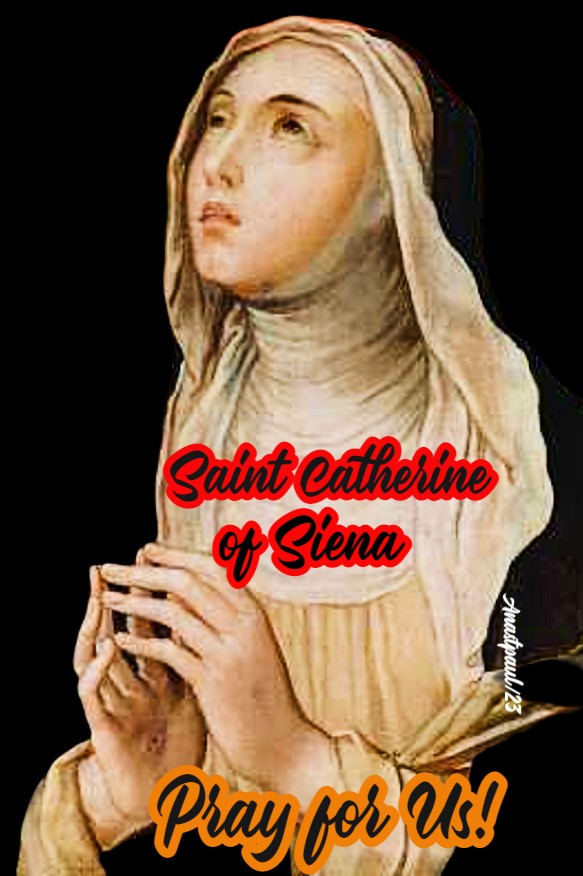
Quote/s of the Day –30 April – Prayers by St Catherine of Siena (1347-1380)
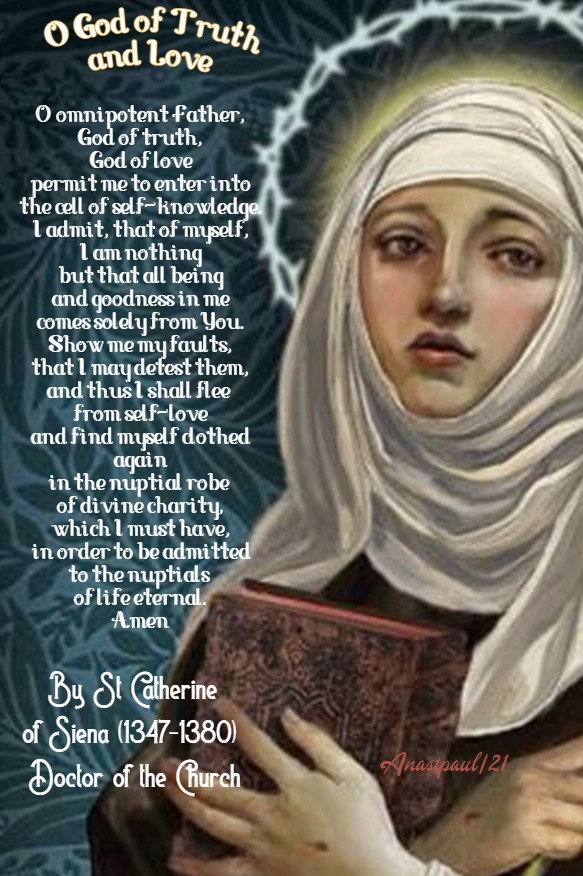
O God of Truth and Love
O omnipotent Father, God of truth, God of love permit me to enter into the cell of self-knowledge. I admit, that of myself, I am nothing but that all being and goodness in me comes solely from You. Show me my faults, that I may detest them, and thus I shall flee from self-love and find myself clothed again in the nuptial robe of divine charity, which I must have, in order to be admitted to the nuptials of life eternal. Amen
Holy Trinity, Holy Love
Holy Spirit, come into my heart; draw it to Thee by Thy power, O my God, and grant me charity with filial fear. Preserve me, O beautiful love, from every evil thought, warm me, inflame me with Thy dear love and every pain will seem light to me. My Father, my sweet Lord, help me in all my actions. Jesus, love, Jesus, love. Amen.
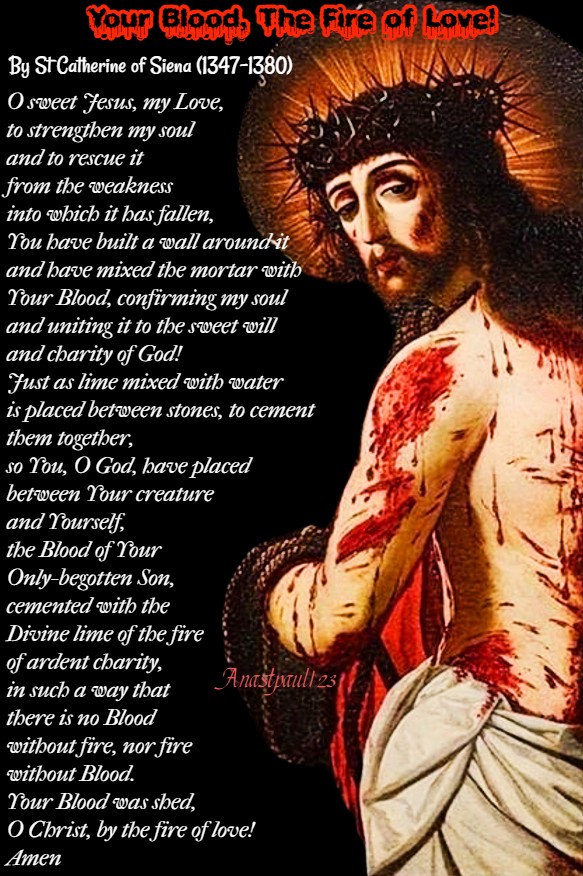
Your Blood, The Fire of Love!
O sweet Jesus, my Love, to strengthen my soul and to rescue it from the weakness into which it has fallen, You have built a wall around it and have mixed the mortar with Your Blood, confirming my soul and uniting it to the sweet will and charity of God! Just as lime mixed with water is placed between stones, to cement them together, so You, O God, have placed between Your creature and Yourself, the Blood of Your Only-begotten Son, cemented with the Divine lime of the fire of ardent charity, in such a way that there is no Blood without fire, nor fire without Blood. Your Blood was shed, O Christ, by the fire of love! Amen
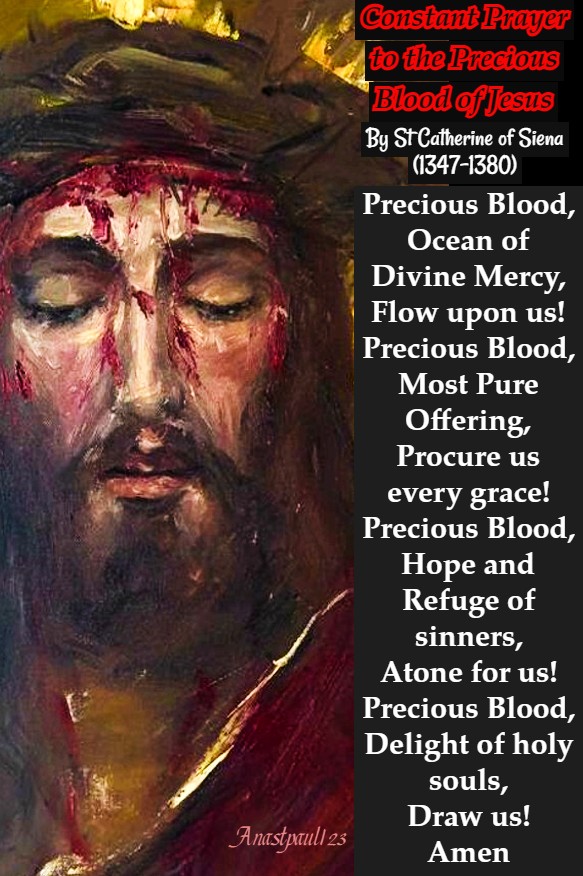
Constant Prayer to the Precious Blood of Jesus
Precious Blood, Ocean of Divine Mercy, Flow upon us! Precious Blood, Most Pure Offering, Procure us every grace! Precious Blood, Hope and Refuge of sinners, Atone for us! Precious Blood, Delight of holy souls, Draw us! Amen
One Minute Reflection – 30 April – EASTER III – St Catherine of Siena OP (1347-1380) Virgin – 1 Peter 2:11-19, John 16:16-22 – Scripture search here: https://www.drbo.org/
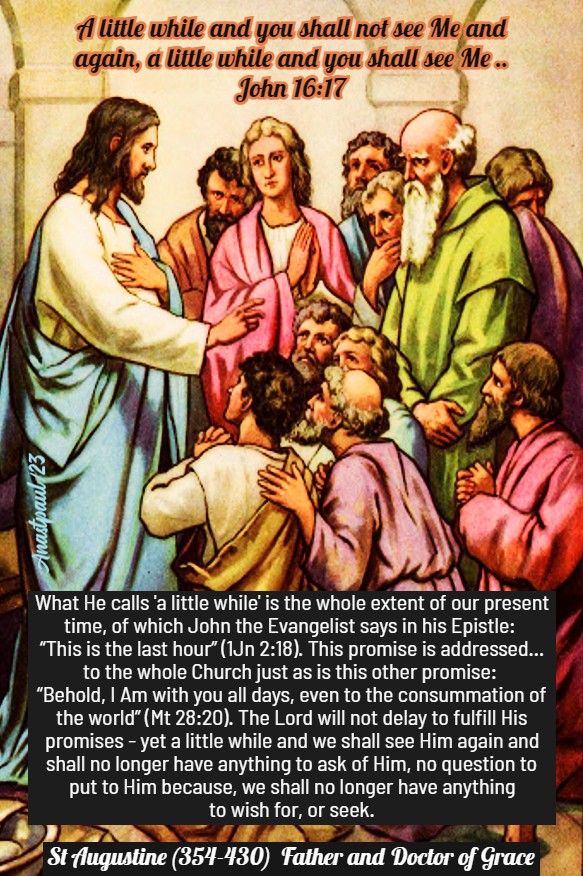
“A little while and you shall not see Me and again, a little while and you shall see Me …” – John 16:17
REFLECTION – “The Lord said: “A little while and you shall not see Me and again a little while and you shall see Me” (Jn 16:16). What He calls ‘a little while’ is the whole extent of our present time, of which John the Evangelist says in his Epistle: “This is the last hour” (1Jn 2:18). This promise is addressed… to the whole Church just as is this other promise: “Behold, I Am with you all days, even to the consummation of the world” (Mt 28:20). The Lord will not delay to fulfill His promises – yet a little while and we shall see Him again and shall no longer have anything to ask of Him, no question to put to Him because, we shall no longer have anything to wish for, or seek.
This “little while” seems long to us because it is still in process of taking place. But when it has come to an end, then we shall feel how short it was. So let our joy differ from that of the world, of which it is said that: “The world will rejoice.” In the birth pangs of this longing, let us not be without joy. Yet, as the Apostle Paul says: “Rejoice in hope, endure in affliction” (Rom 12:12). For the woman giving birth – to whom the Lord compares us – takes far more joy in the child she is about to bring into the world,than she feels sorrow at her own suffering.” – St Augustine (354-430) Bishop, Father and Doctor of Grace (Sermons on Saint John’s Gospel No 101).
PRAYER – Grant, we beseech Thee, O Almighty God, that we which do keep the birthday of Thy blessed Virgin Catherine and do year by year renew her memorial with solemn gladness in Thy presence, may likewise be conformed to the pattern of her saintly walk with Thee. Through Jesus Christ, Thy Son our Lord, Who lives and reigns with Thee, in the unity of the Holy Ghost, God, world without end. Amen (Collect).
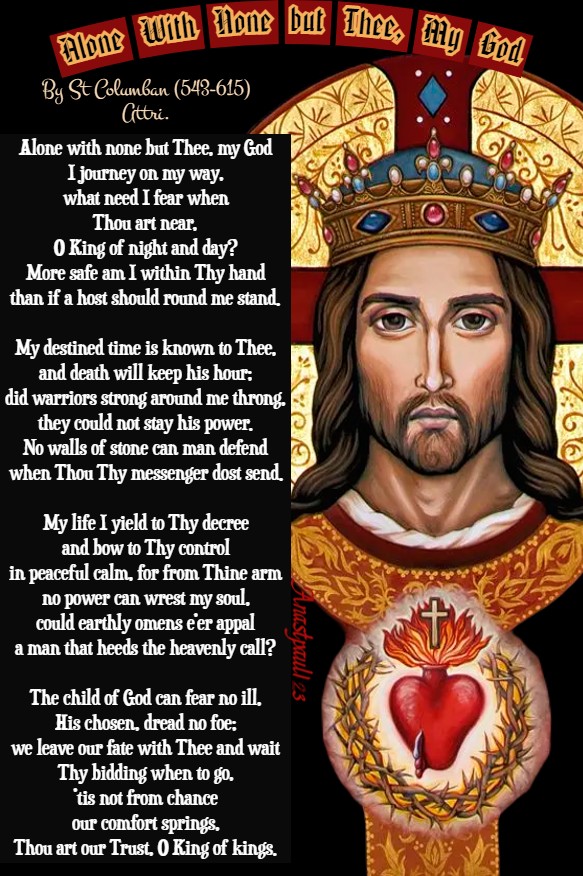
Alone With None but Thee, My God Attri. St Columban (543-615)
Alone with none but Thee, my God I journey on my way, what need I fear when Thou art near, O King of night and day? More safe am I within Thy hand than if a host should round me stand.
My destined time is known to Thee, and death will keep his hour; did warriors strong around me throng, they could not stay his power. No walls of stone can man defend when Thou Thy messenger dost send.
My life I yield to Thy decree and bow to Thy control in peaceful calm, for from Thine arm no power can wrest my soul, could earthly omens e’er appal a man that heeds the heavenly call?
The child of God can fear no ill, His chosen, dread no foe; we leave our fate with Thee and wait Thy bidding when to go, ’tis not from chance our comfort springs, Thou art our Trust, O King of kings.
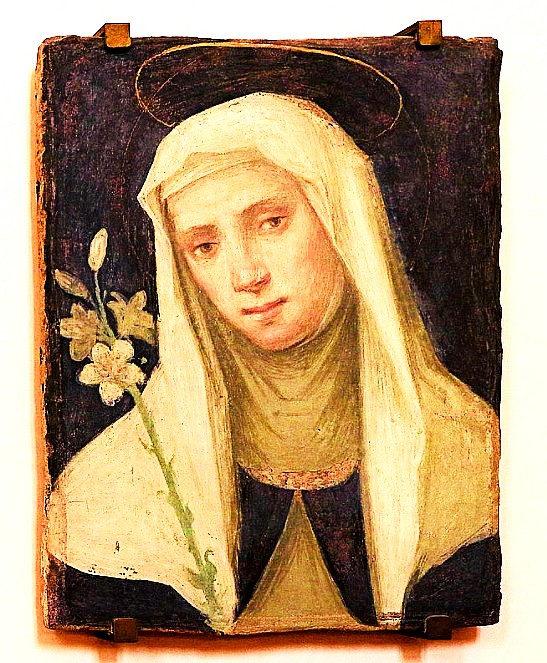
Saint of the Day – 30 April – St Catherine of Siena OP (1347-1380) Virgin. Revisiting St Catherine with Fr Weninger.
St Catherine of Sienna, Virgin By Fr Francis Xavier Weninger SJ (1805-1888)
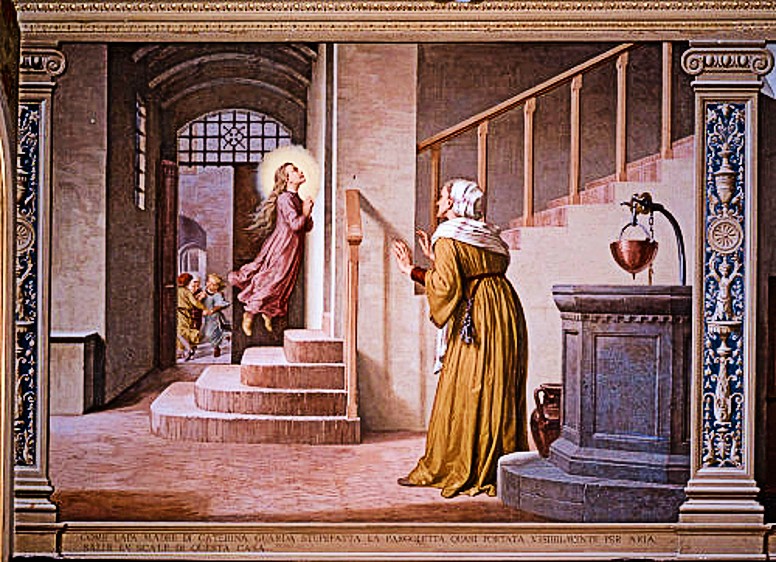
Sienna, in the Tuscan District, is the favoured place where, in 1347, Caterina / Catherine, first saw the light of this world. Her life from her childhood, was a continual exercise of the choicest virtues but, at the same time, a perpetual communication of Divine Grace. When scarcely five years of age, she was called “the little Saint” on account of her quietness and her love of prayer. Already, at that time, she greeted the Virgin Mother upon every step of the staircase with the words of the Angels: “Ave Maria!” When six years old, our Lord appeared to her with the Apostles Peter, Paul and John, together with St Dominic, looked tenderly at her and gave His blessing. This was the beginning of many and extraordinary visions with which the holy virgin was graced until her death. Her heart from this time was filled with intense love of God. She read most carefully the lives of the Saints and endeavoured to follow their example. In her seventh year she Consecrated her virginity to God. Her only pleasure was solitude, prayer, work and self-immolation.
Catherine’s Mother Sees Her Daughter Climbing the Stairs Suspended in the Air, by Alessandro Franchi and Gaetano Marinelli
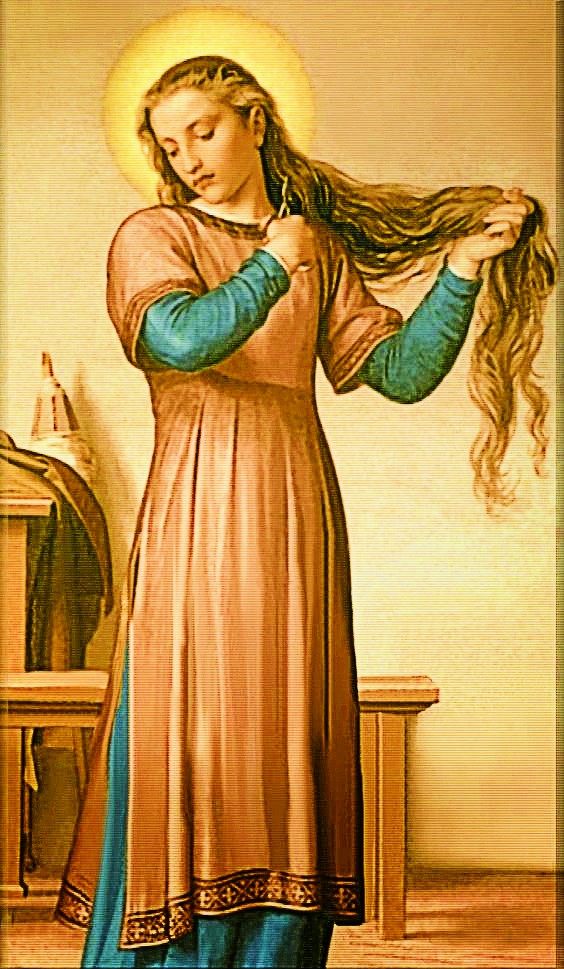
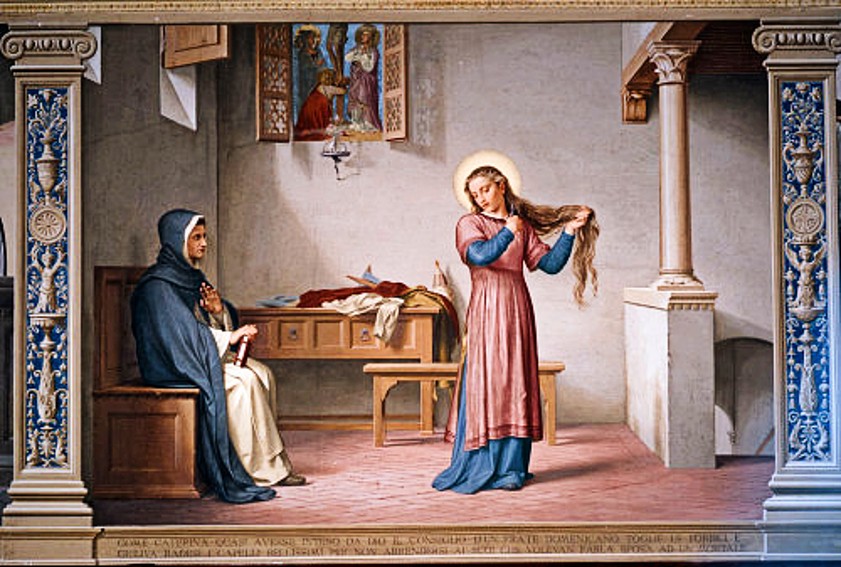
Persuaded by her sister, she once began to pay more attention to her dresses and to curl her hair after the prevailing fashion of the world. This lasted, however, only a short while, for she became aware, during her prayers, how much God was displeased with such vanities and how long her pious sister would have to suffer, on account of it in purgatory. Hencfprward, she refrained from it and repented of her folly, as long as she lived. Her parents desired her to marry but she replied: “I am already wedded to a most noble Spouse and shall never bestow my love on a human being” and cutting off her hair, she covered her head with a veil.
Catherine Cutting Off her Long Hair, by Alessandro Franchi and Gaetano Marinelli
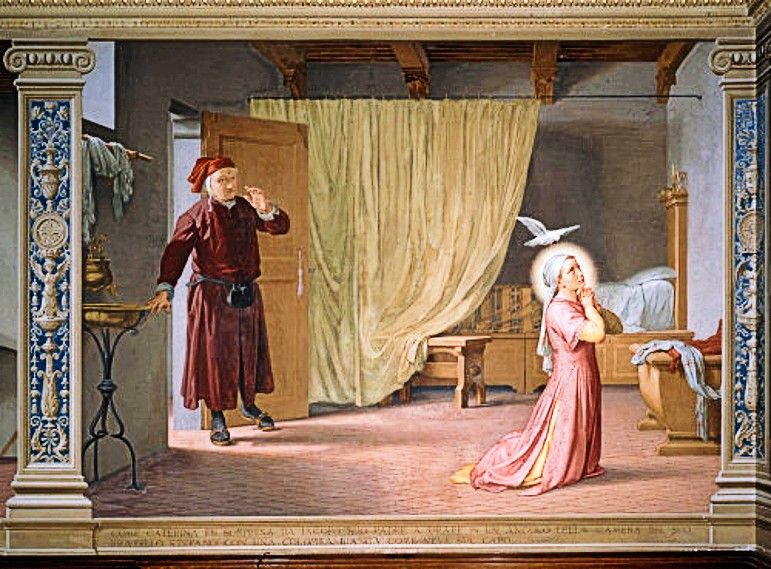
To drive all thoughts of entering a Convent out of her mind, her parents burdened her with the entire care of the house, as well as the most difficult work, so that no leisure was left her, either for prayer, or devotional reading. This was at first a sore trial to her,but she was told by Chris, to build a cell in her heart, where, in the midst of her employments, she might pray, namely, by offering her work to God and by pious ejaculations. Following these directions of Christ, her soul became filled with sweet consolation and she manifested, under the greatest drudgery, a most extraordinary happiness. This caused her parents to change their resolution and they permitted her to live according to her vocation. Hence, she now began to live in a more retired manner and with more austerity than before.
Catherine’s Father Finds Her Praying with the Dove of the Holy Ghost Above her Head,by Alessandro Franchi and Gaetano Marinelli
Bread, herbs and water were her only nourishment, two bare boards her bed. She was girded by a pointed chain which she continued to wear until a few hours before her death, when at the instance of her Confessor, she laid it aside. She only allowed herself one or two hours of sleep during the nigh,; the remainder she employed in prayer or in the contemplation of the Divine Mysteries. She scourged herself three times daily, sometimes until she drew blood. These austerities she observed from her eighteenth year until her death. After she had been received into the Third Order of St Dominic, she aspired most fervently after sanctification but Satan endeavoured, with the most loathsome imaginings and temptations, to trouble the repose of her soul and pervert her thoughts. Catherine, however, increasing her penance and her prayers, withstood him bravely but still, without feeling more relieved or more quiet. At length, when, one day, Christ appeared to her, she said: “O Lord, why hast Thou forsaken me?” “I was in thy heart,” answered the Saviour. “What” said she, “hast Thou been in my heart which was filled with such abominable thoughts? Hast thou then consented to them?!” “Hast thou been pleased with them?” asked Christ. “Oh, no!” replied Catherine, “it was most painful to me to be afflicted with them.” “And this was thy merit” said Christ “I have seen how thou hast battled and I have assisted thee.“ Thus ended her temptations which were succeeded by the most comforting visions of our Lord, His Blessed Mother and other Saints, the number of which is known only to God.
She frequently saw Christ as a lovely little Child in the holy Sacrament, for which Divine Mystery she entertained the most fervent devotion. She partook of it almost daily but always with renewed piety and shedding a flood of tears. It was very remarkable that the receiving of it preserved also her temporal life, for it is a fact that one year she partook of nothing else but the Blessed Eucharist from Ash Wednesday until Ascension day. When she was required, as an act of obedience, to take some food, she suffered so greatly by so doing that the request was not repeated.
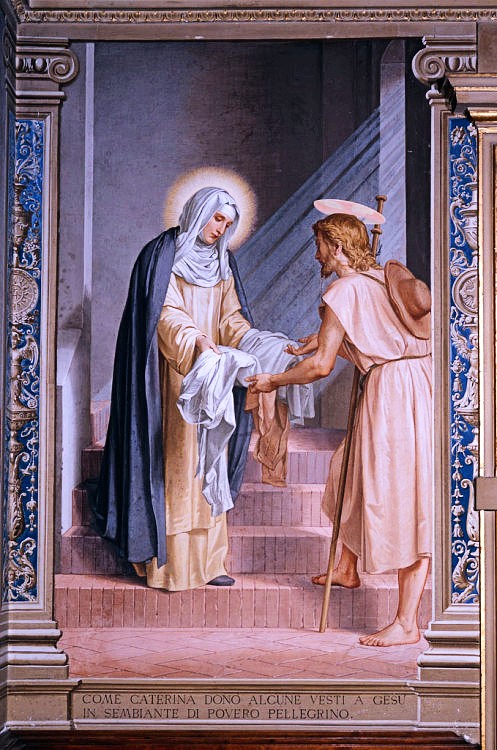
After some time, Christ commanded her to be kind and charitable to her neighbours and she began to nurse the sick with an indescribable loving care. Among others, she attended to two women, of whom one was afflicted with leprosy, the other with cancer. In nursing them, she evinced the most perfect self-control. She pressed the offensive matter out of the sores and cleansed them with water. Feeling disgust, she drank the purulent matter which she had kept in a vessel mixed with water, saying to her Confessor that she had never tasted anything more agreeable. Christ appeared to her on the following night, praised her self-mortification and rewarded her with great interior peace and tranquillity.
Catherine Gives her Cloak to Jesus in the Guise of a Poor Man, by Alessandro Franchi and Gaetano Marinelli
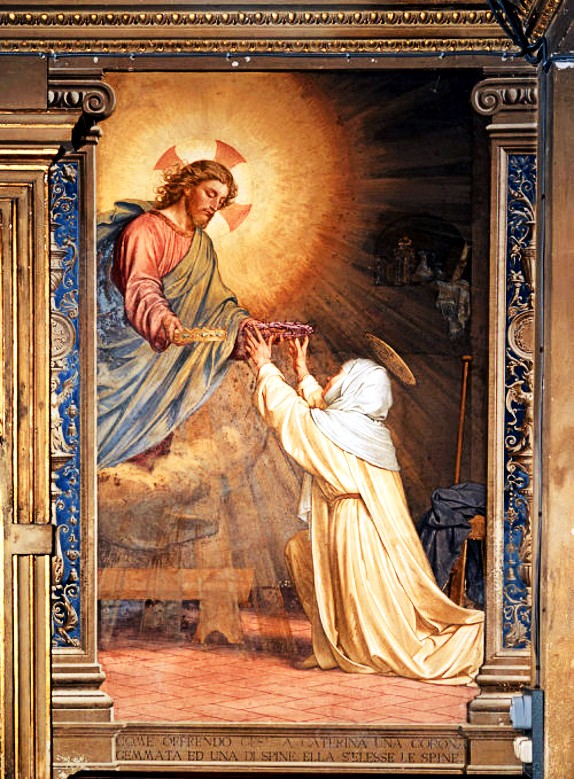
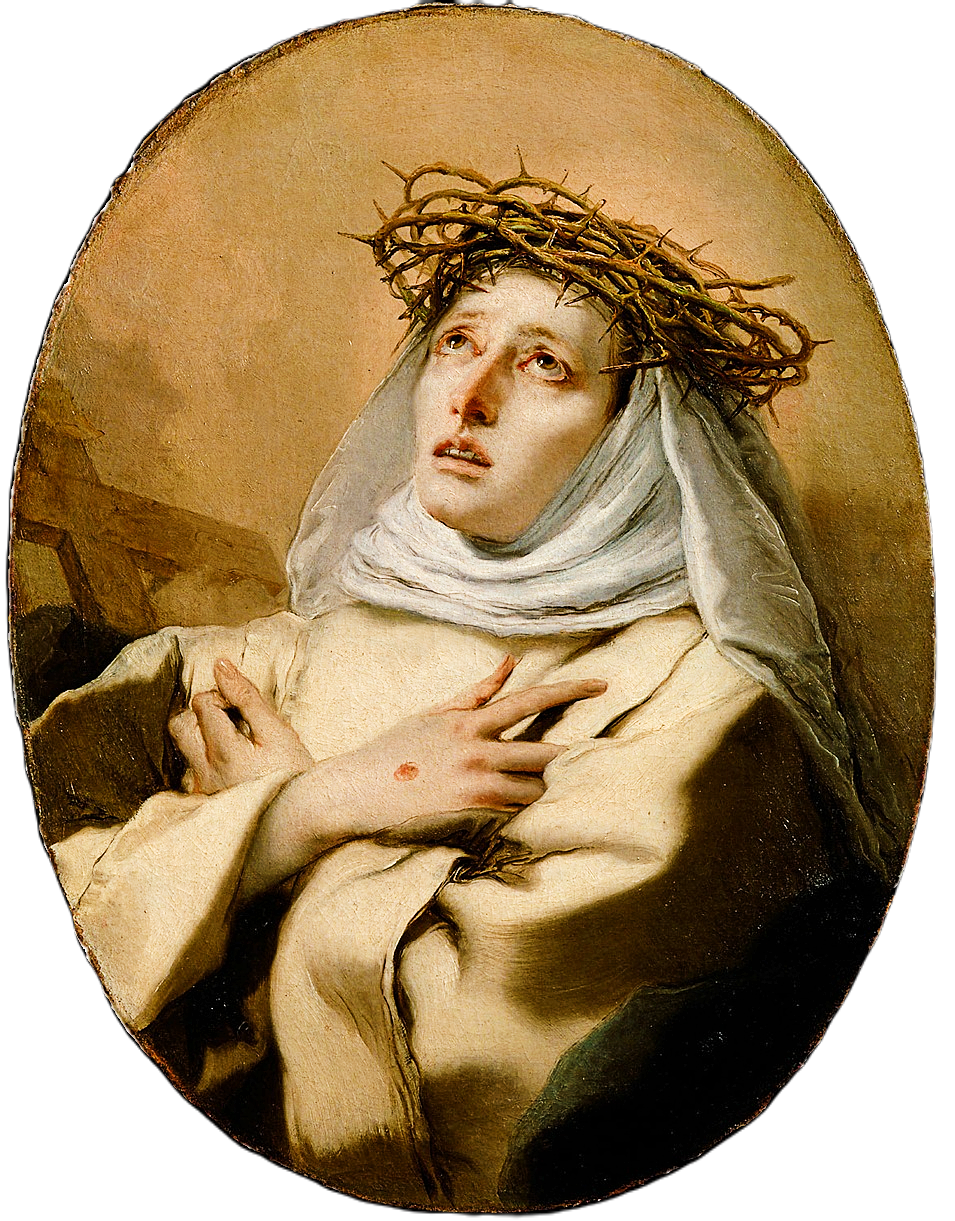
It was an awful cross for her to bear, when this very woman, whom she had so tenderly nursed, instigated by Satan, not only complained of her but slandered her in the whole City. But Christ visited her and presenting to her two crowns, one of gold, the other of thorns, said: “Which of these two do you desire?” Catherine answered: “Lord, I desire to resemble Thee in this life and it is a joy to me to suffer as Thou didst:” and with these words she took the crown of thorns and pressed it upon her head. Christ, upon this, commanded her to continue her charity towards the sick which she did with unprecedented patience and kindness.
Jesus Offering Catherine a Crown of Gold and a Crown of Thorns, by Alessandro Franchi and Gaetano Marinelli
Her love towards those whose souls were diseased, was still more tender and she offered for such, her prayers and many penances, through which means, she obtained from God, the conversion of many sinners, who otherwise would have gone to destruction. She prayed three whole days for a certain woman who was dangerously ill and, who hated the Saint most bitterly. At last, she said to Christ: “I will not move from this place until Thou givest me this soul.” He graciously complied with her request by converting the woman and giving her a happy death.
She was also gifted by God with the grace of reading the inmost thoughts of those who approached her, hence, her exhortations were always addressed to their weakest spot. If a lascivious person came near her, she always perceived so terrible an odour that she had to cover her nose and mouth. Many other graces God had bestowed upon her, to relate all of which would take too much space.
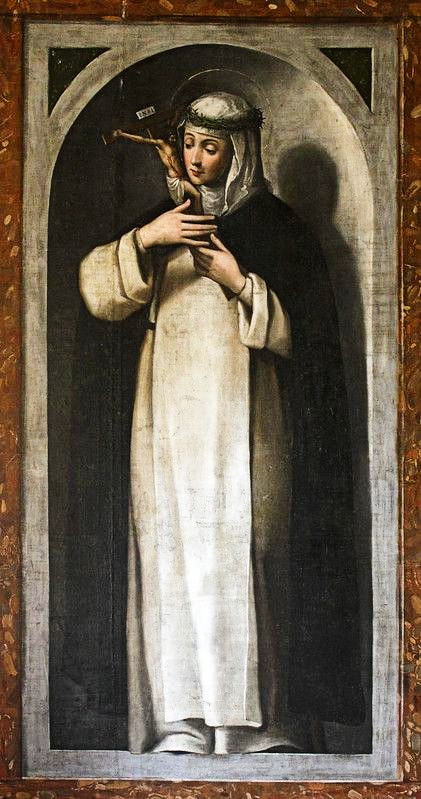
One of the most remarkable of these was, that Christ had impressed the marks of His Five Holy Wounds upon her but in such a manner that, exteriorly, nothing was to be seen, while she suffered all their pains. She had prayed to Christ for this grace in order that it might remain unknown to the world. The many miracles which she performed on the sick and possessed and the heavenly wisdom with which she was filled, secured her, not only the highest regard of the people but also of the prelates of the Church, as well as of worldly princes. She was even sent in times of strife and contention, as a messenger of peace and the effect of her wonderful talents, more than surpassed all expectations.
By Giovanni Battista Tiepolo
At Rome, whither she had been called by the Pope, she became dangerously sick and during four months, she suffered excruciating pain. She ceased not, however, praising and giving thanks to God. The Almighty, whose judgement, although inscrutable, is always just, sent her a last bitter trial after she had received the holy Sacrament – Satan reproached her that in her actions and ecstasies, she had only sought her own aggrandisement. But she overcame the enemy of her peace and, after this anguish of soul, she had a most consoling and tender discourse with Christ, Who visibly appeared to her and into Whose Hands she breathed her chaste soul, in the thirty-third year of her life. Her last words were: “Lord, into Thy Hands I commend my spirit.“
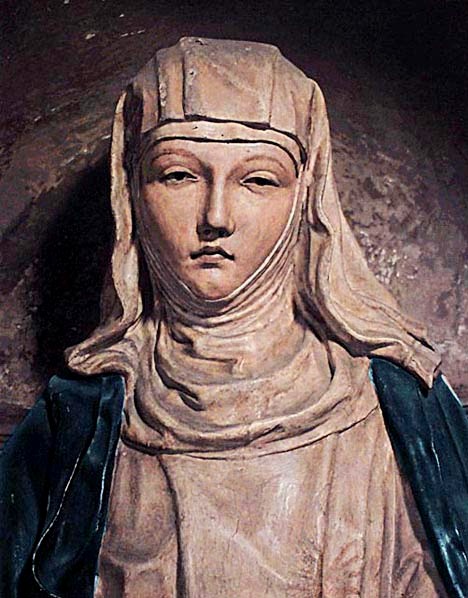
Statuette by Neroccio di Bartolomeo de’ Landi,(1475)
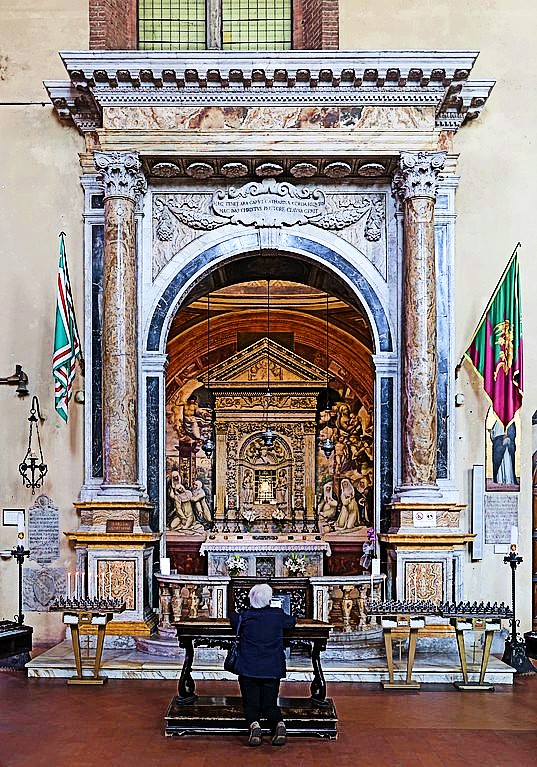
The Chapel of Saint Catherine, Basilica of San Domenico in Siena
Bl Hildegard the Empress St Lawrence of Novara St Louis of Córdoba St Mariano of Acerenza St Maximus of Ephesus St Mercurialis of Forlì St Peter of Córdoba St Pomponius of Naples St Quirinus of Rome St Rodopiano of Aphrodisias St Sophia of Fermo St Swithbert the Younger Bl Ventura of Spello
Martyrs of Montpellier: A group of 70 Mercedarian Friars, led by Blessed Luigi Puell, who were Martyred by Huguenots for trying to bring people back to the Catholic Church. They were Martyred in 1567 in Montpellier, France.






 AnaStpaul
You must be logged in to post a comment.