Thought for the Day – 4 July – Meditations with Antonio Cardinal Bacci (1881-1971)
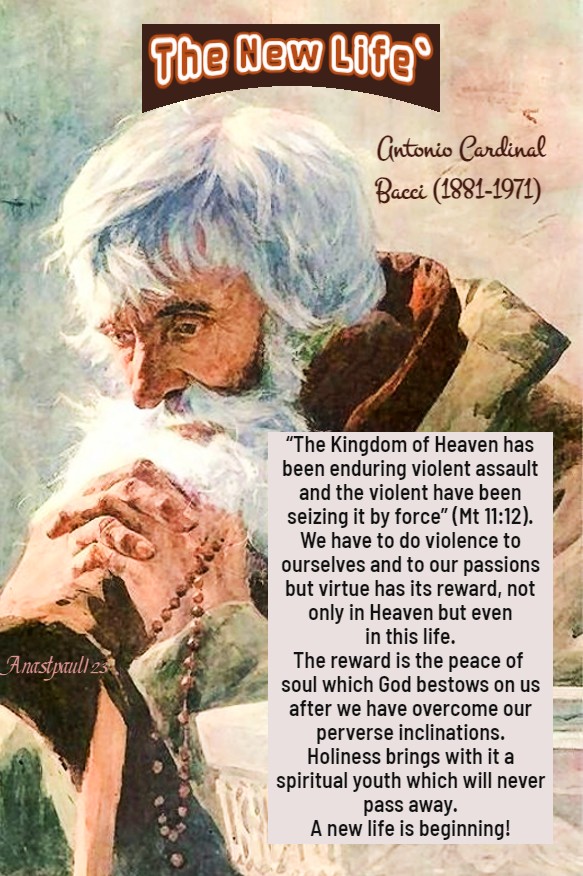
The New Life
“All this is difficult and may demand heroism. “The Kingdom of Heaven has been enduring violent assault and the violent have been seizing it by force” (Mt 11:12). We have to do violence to ourselves and to our passions but virtue has its reward, not only in Heaven but even in this life. The reward is the peace of soul which God bestows on us after we have overcome our perverse inclinations.
Holiness brings with it a spiritual youth which will never pass away. A new life is beginning!”
Quote/s of the Day – 4 July – St Andrew of Crete (c660-c740) Bishop, Father of the Church
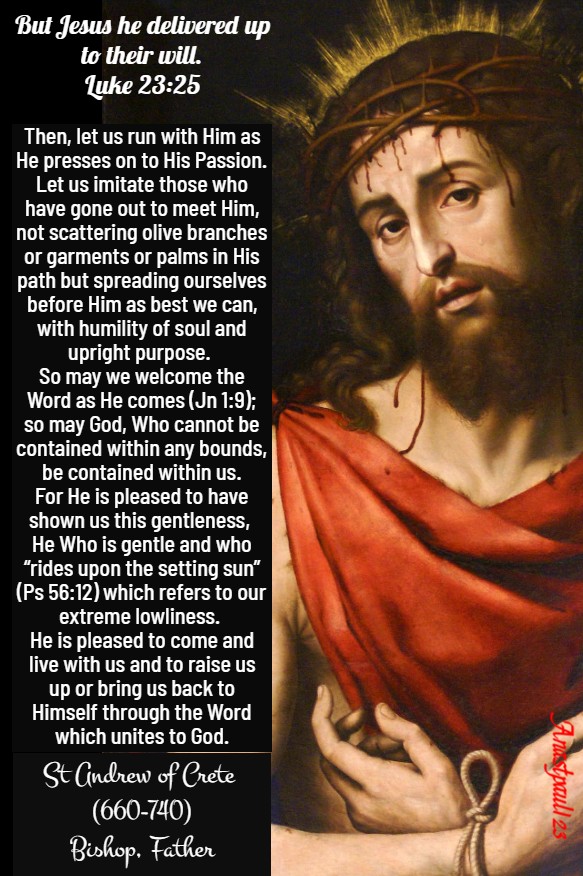
“But Jesus he delivered up to their will.” Luke 23:25
“Then, let us run with Him as He presses on to His Passion. Let us imitate those who have gone out to meet Him, not scattering olive branches or garments or palms in His path but spreading ourselves before Him as best we can, with humility of soul and upright purpose. So may we welcome the Word as He comes (Jn 1:9); so may God, Who cannot be contained within any bounds, be contained within us. For He is pleased to have shown us this gentleness, He, Who is gentle and who “rides upon the setting sun” (Ps 56:12) which refers to our extreme lowliness. He is pleased to come and live with us and to raise us up or bring us back to Himself
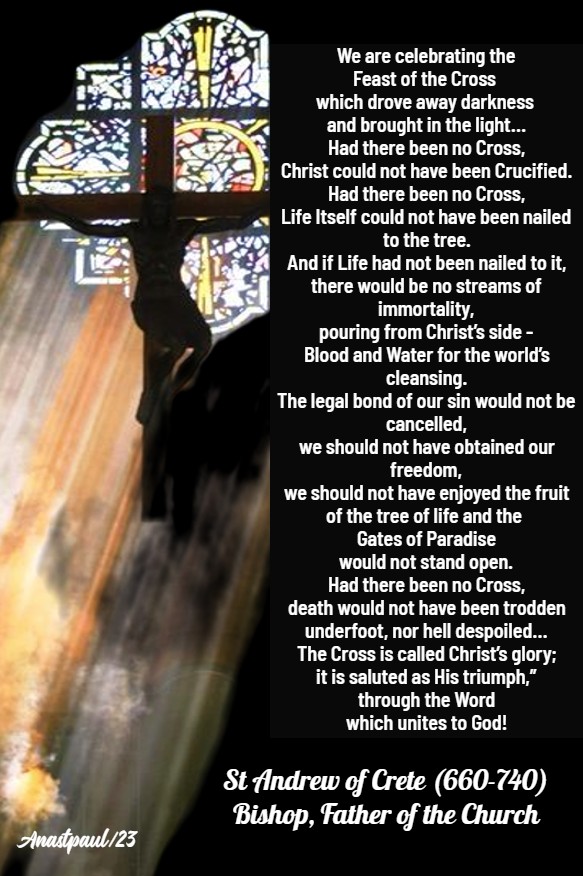
“We are celebrating the Feast of the Cross which drove away darkness and brought in the light… Had there been no Cross, Christ could not have been Crucified. Had there been no Cross, Life Itself could not have been nailed to the tree. And if Life had not been nailed to it, there would be no streams of immortality, pouring from Christ’s side – Blood and Water for the world’s cleansing. The legal bond of our sin would not be cancelled, we should not have obtained our freedom, we should not have enjoyed the fruit of the tree of life and the Gates of Paradise would not stand open. Had there been no Cross, death would not have been trodden underfoot, nor hell despoiled… The Cross is called Christ’s glory; it is saluted as His triumph, through the Word which unites to God!”
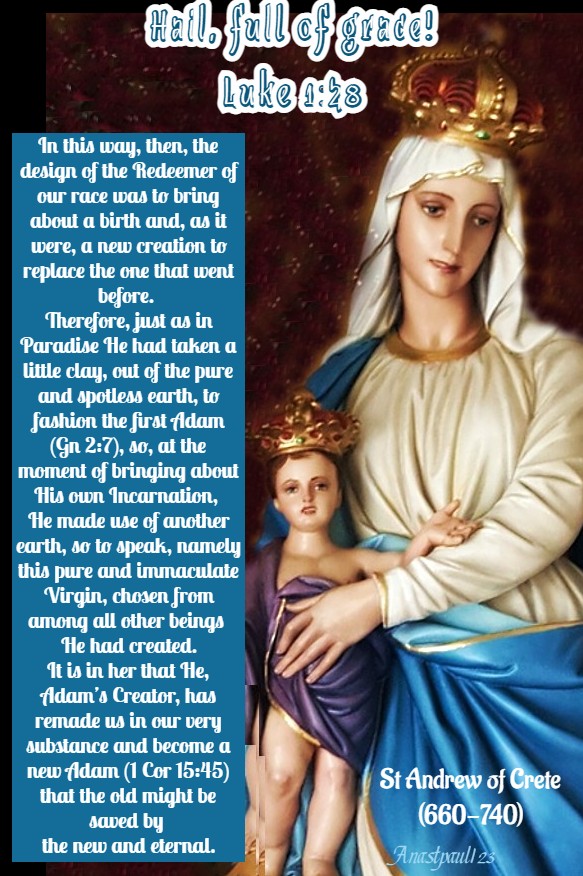
“… The design of the Redeemer of our race was to bring about a birth and, as it were, a new creation to replace the one that went before. Therefore, just as in Paradise, He had taken a little clay out of the pure and spotless earth, to fashion the first Adam (Gn 2,7), so, at the moment of bringing about His Own Incarnation, He made use of another earth, so to speak, namely, this Pure and Immaculate Virgin, chosen from among all other beings He had created. It is in her that He, Adam’s Creator, has remade us in our very substance and became a new Adam (1Cor 15,45) that the old might be saved by the new and eternal.”
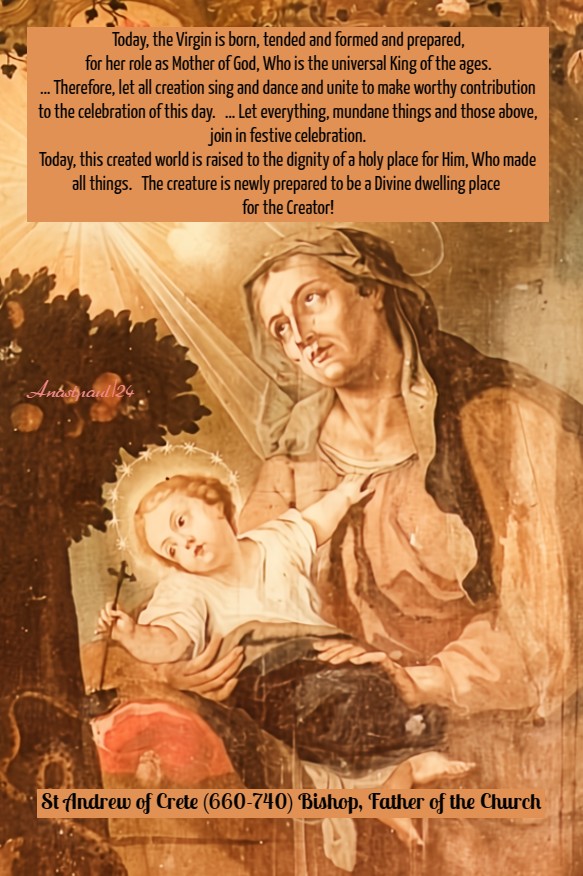
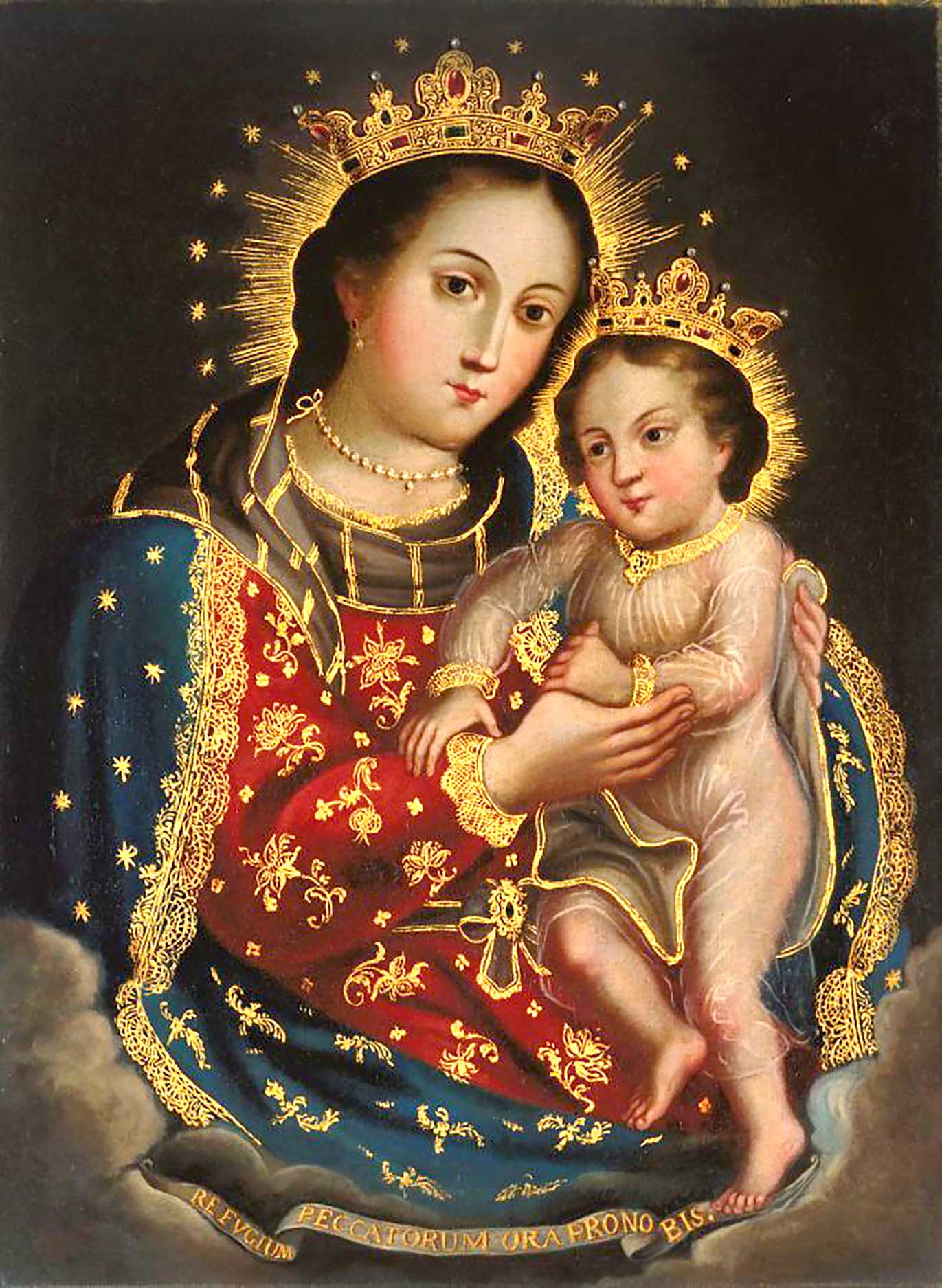
“Today the Virgin is born, tended and formed and prepared for her role as Mother of God, who is the universal King of the ages. … Therefore, let all creation sing and dance and unite, to make worthy contribution to the celebration of this day. … Let everything, mundane things and those above, join in festive celebration. Today, this created world is raised to the dignity of a holy place for Him, Who made all things. The creature is newly prepared to be a Divine Dwelling Place for the Creator.”
St Andrew of Crete (660-740) Bishop, Father of the Church
One Minute Reflection – 4 July – “The Month of the Most Precious Blood of Jesus” – Within the Octave of Sts Peter and Paul – Acts 5:12-16, Matthew 19:27-29 – Scripture search here: https://www.drbo.org/
“And everyone who has left house, or brethren, or sisters, or father, or mother, or wife, or children, or lands, for My Name’s sake, shall receive a hundredfold and shall possess life everlasting.” – Matthew 19:29
REFLECTION – “In almost every passage of Scripture, the spiritual meaning plays an important part. But in this passage especially, we must look for spiritual depth within the thread of its meaning. … How is it that He Himself can say: “Peace I leave with you, My own peace I give you” (Jn 14:27) if He has come to divide fathers from their sons, sons from their fathers, breaking their relationship? How can we be called “cursed if you dishonour your father” (Dt 27:16) yet fervent, if we abandon him?!
If we understand that religion comes first and filial devotion second, then we will understand, this question to be clarified – for we have to pass onto the human, after the Divine. For if we have duties towards our parents, how much more to the Father of our parents, to Whom we owe thanksgiving for our parents? … He does not say, then that we must give up those we love but that, we must prefer God before all else. Besides, do we not find in another book: “Whoever loves father or mother more than Me is not worthy of Me” (Mt 10:37). What is forbidden is not to love your parents but to prefer them to God. For our blood relations are among God’s blessings and no-one is to love the good things they have received, more than the God Who conserves the blessings He has given!” – St Ambrose (340-397) Father and Doctor of the Church (Commentary on the Gospel of Luke, 7)
PRAYER – God, Who hast consecrated this day to the Martyrdom of Thy Apostles Peter and Paul, give Thy Church a precept to follow them in all things. Through Jesus Christ, Thy Son our Lord, Who lives and reigns with Thee, in the unity of the Holy Ghost, God, world without end. Amen (Collect).
Our Morning Offering – 4 July – “The Month of the Most Precious Blood of Jesus”
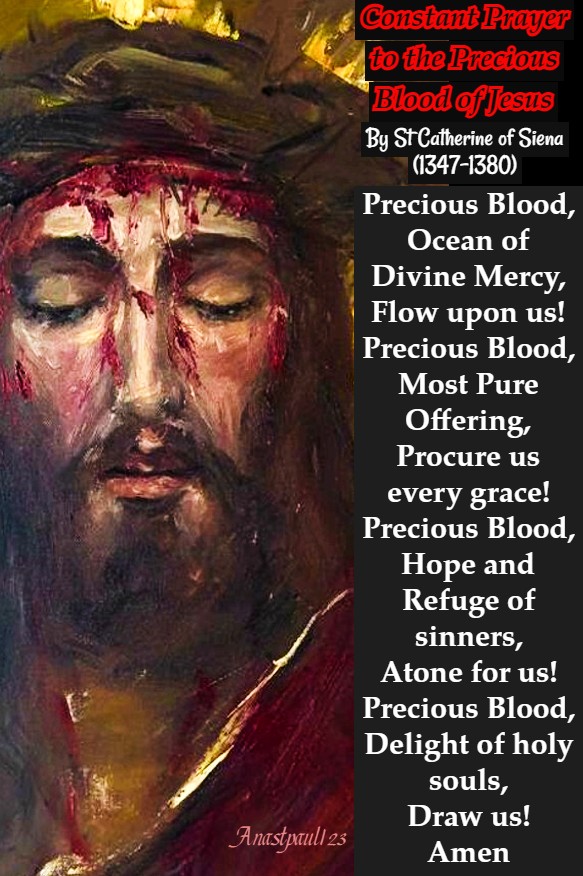
Constant Prayer to the Precious Blood of Jesus By St Catherine of Siena (1347-1380) Doctor of the Church
Precious Blood, Ocean of Divine Mercy, Flow upon us! Precious Blood, Most Pure Offering, Procure us every grace! Precious Blood, Hope and Refuge of sinners, Atone for us! Precious Blood, Delight of holy souls, Draw us! Amen
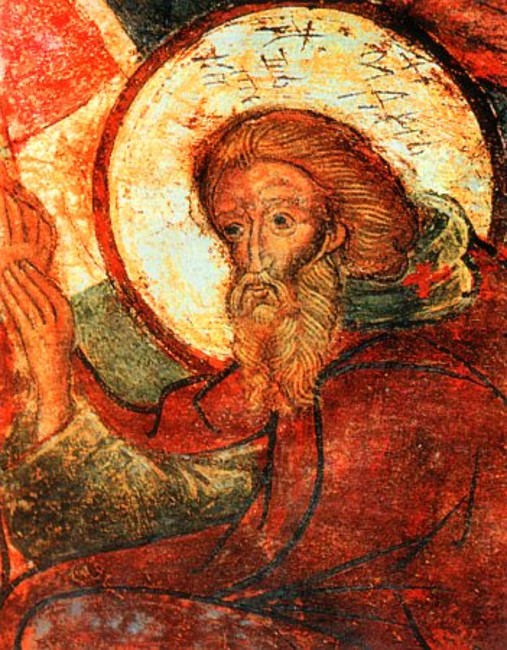
Saint of the Day – 4 July – Saint Andrew of Crete (c660-c740) Bishop of Gorvina, Constantinople, Monk at Mar Sabas, Noted and eloquent Preacher, Poet and Hymnist. Born in c660 at Damascus, Syria and died in c740 in Crete of natural causes. Also known as – Andrew of Jerusalem, Andrew of Gortina, Andrea, Andreas.
Andrew was born in Damascus around 660, i.e. towards the middle of the 7th Century. At the age of fifteen, having reached Jerusalem, he decided to enter the Monastery of San Sabas and the Holy Sepulchre.
In 685 Theodore, Bishop of Jerusalem, sent him as his delegate to the VI Ecumenical Council (known as Constantinopolitan III) to support the condemnation of Monothelitism, a heretical theory that supported one divine will of Christ. During his stay in the imperial capital, Andrew received Ordination as a Deacon and was entrusted with the management of an orphanage and a home for the elderly. It didn’t take long, before perhaps already around the year 700, he was elected to the Episcopal office at Gortyna, the metropolitan Arch-episcopal See of the island of Crete.
In 711 Philippicus Bardane ascended the throne and convened a Synod to try to overturn the response of the previous Synod and establish Monotheism as the official religion of the Empire. Andrew also participated in this Synod and for a short time he even came to recognise the heretical decrees but finally, Bardane was then expelled and the Bishop of Constantinople was left with nothing but to retract, in writing, to the Pope, apologising also in the name of those who had participated in the illegitimate synod.
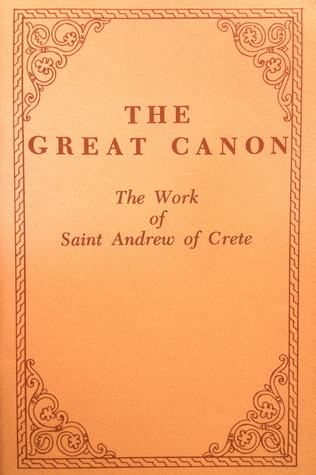
Andrea was famous as a preacher and composer of sacred Hymns. About fifty sermons have been handed down to us and tradition has arbitrarily attributed to him, the introduction of the type of Hymn, known as Kanon or Canon, typical of the Byzantine Liturgy. In reality, it is true, that he, nevertheless, wrote many of them, some of which are still sung today, remarkable for the originality of their metric and musical form. Among them, the so-called “Great Canon” stands out as his masterpiece, of a Lenten character and made up of two hundred and fifty stanzas!
His sermons proved to be important for the development of Marian devotion – in fact, he exalted the Virgin Mother of God as Immaculate and Assumed into Heaven, thus prefiguring the Dogmatic definitions of Popes Pius IX and Pius XII, which occurred in the 19th and 20th Centuries.
Sainy Andrew of Crete died on the Island of Lesbos in 740 and the Martyrologium Romanum commemorates him on 4 July.
St Albert Quadrelli St Andrew of Crete (c660-c740) Bishop St Anthony Daniel St Aurelian of Lyons St Bertha of Blangy St Carileffo of Anille Bl Catherine Jarrige St Cesidio Giacomantonio Bl Damiano Grassi of Rivoli St Donatus of Libya St Edward Fulthrop St Elias of Jerusalem St Finbar of Wexford St Fiorenzo of Cahors St Flavian of Antioch St Giocondiano Bl Giovanni of Vespignano St Haggai the Prophet Bl Hatto of Ottobeuren Bl Henry Abbot St Henry of Albano St Hosea the Prophet St Innocent of Sirmium Bl John Carey
Blessed John Cornelius SJ (1557– 1594) Martyr, English Priest of the Society of Jesus, Missionary. Additional Memorials – 29 October as one of the Martyrs of Douai, 1 December as one of the Martyrs of Oxford University. Fr Cornelius and his three companions, the Martyrs of England, were Beatified by Pope Pius XI on 15 December 1929. All their bodies were retrieved and given proper burial by Lady Arundell. His Life and Death: https://anastpaul.com/2021/07/04/saint-of-the-day-4-july-blessed-john-cornelius-sj-1557-1594-martyr/
St Jucundian St Laurian of Seville St Lauriano of Vistin St Namphanion the Archmartyr Bl Natalia of Toulouse St Odo the Good Bl Odolric of Lyon Bl Patrick Salmon St Sebastia of Sirmium St Theodore of Cyrene St Theodotus of Libya Bl Thomas Bosgrave Bl Thomas Warcop




 AnaStpaul
You must be logged in to post a comment.