
Saint of the Day – 7 August – Saint Victricius (c339-407) Confessor, Bishop of Rouen from 393 until his death in 407, of natural causes by the will of God, Victricius narrowly escaped Martyrdom, Miracle-worker, friend of St Martin of Tours, St Ambrose and other great Father Saints. Also known as – Victricius of Rouen, Victrice, Vittricio. Patronage – against blindness, of the blind, of eye disorders.
The Roman Martyrology reads: “At Rouen, the holy Bishop St Victricius. Whilst he was yet a soldier under Julian the Apostate, he threw away his military belt for Christ and after being subjected, by the Tribunal to many torments, was condemned to capital punishment. But, the executioner who had been sent to put him to death, being struck blind and, the Confessor’s chains being loosened, he made his escape. Afterwards, being made Bishop, by preaching the word of God, he brought the barbarous people of Belgic Gaul, to the Faith of Christ and finally, died a Confessor in peace.”
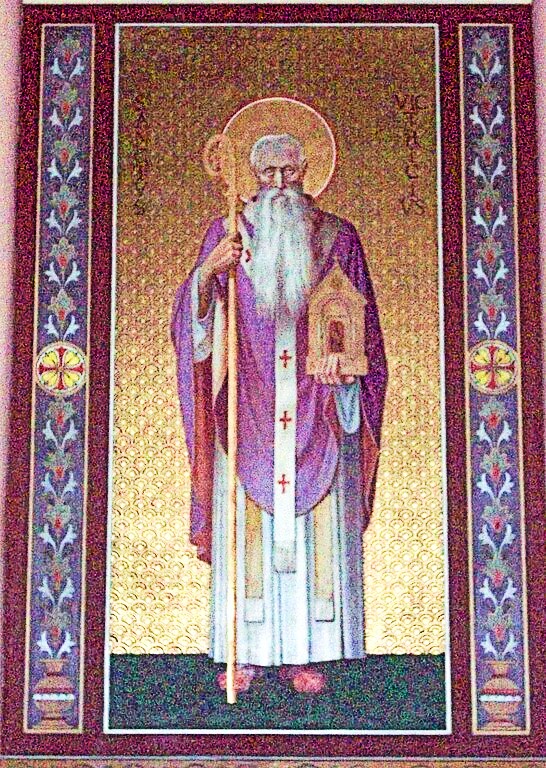
Victricius was born in the first half of the 4th Century on the borders of the Roman Empire. His family was illustrious and Victricius studied humanities before enlisting in the army, like Saint Martin (of Tours), his future friend. He served there for several years, the Christian religion was then honoured in the Roman army. The old soldiers of the first Christian Emperor, Constantine the Great, told of the marvellous appearance of the Cross ofd Christ which had announced victory to them on the banks of the Tiber, when they were marching against the pagan army of Maxentius.
From then on, the Cross had always been part of the Banners, ceremonial dress, stationery etc.
But, in 360, the son of Constantine, Constance, was succeeded, byJulian the Apostate. Julian, after having renounced the Christian Faith to return to the worship of idols, put great energy into fighting Christianity. We know that he wanted several times to force the soldiers of his army to offer sacrifices to idols. Because of this and also because his military time was coming to an end, Victricius wanted to leave the army and, henceforth, dedicate himself to the service of God.
One day during the military review, when the Colonel passed in front of him, Victricius came forward and said, throwing down his arms: “I am a Christian and I ask for my release because I now wish to dedicate myself to peace and Christian justice.” .
The Colonel was a pagan and took this action as a protest against the Emperor’s edicts. Immediately he had the soldier Victricius, our Saint, flogged and when he was nothing more than a wound, he was thrown into a dungeon where he remained lying on the floor for a long time. This did not reduce his faith, his courage and his trust in God and by his contual refusal to deny his Faith in Christ, he was condemned to death.
On the way to the place of execution, the executioner mocked his victim while tightly restraining Victricius by his neck. He said to Victricius: “We are going to cut off this head. What madness to allow oneself to be killed in this way, for a God Whom the Jews Crucified!” The poor man had not finished his blasheming when he was struck blind!
Another miracle followed closely on this one . The jailer had so tightened the chains that they entered the flesh of the condemned man. Victricius begged the soldiers, who accompanied him, to loosen them a little but they refused. Then he began to invoke aloud the help of Jesus Christ and immediately the chains fell off by themselves. Seized with amazement, the soldiers dared not kill a man whom the heavens was so visibly protecting. They re-traced their steps to tell this to the Colonel who, having observed the facts for himself, became Victricius’ friend and had him released.
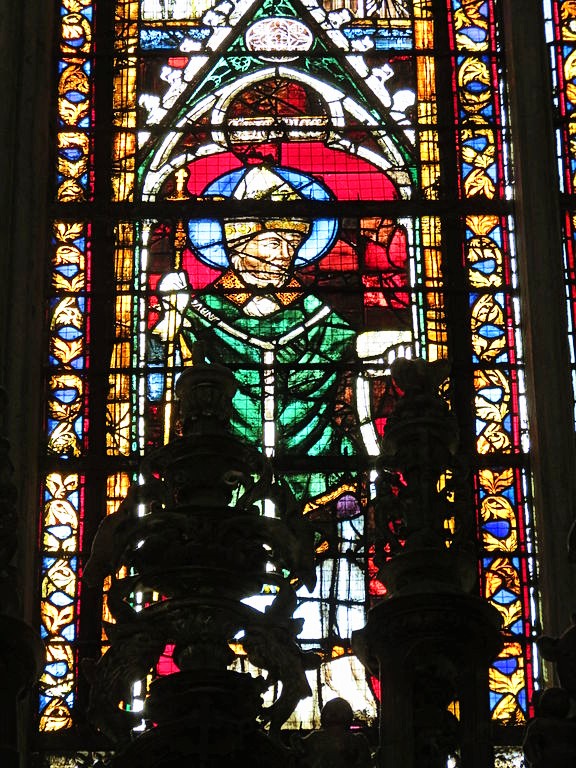
Victricius, his freedom regained, left to train in a Monastery, it is believed in Ligugé, near Poitiers, under the direction of Saint Hilairy and Saint Martin.
He became a great evangeliser in modern day Belgium. Many were converted and baptised by his preaching.
A few years later, he was appointed as the Archbishop of Rouen. There he established a deep affection with his co-Bishops – Saint Martin, Saint Ambrose, Saint Paulinus of Nola. There is still extant correspondence which testifies to this fraternal friendship.
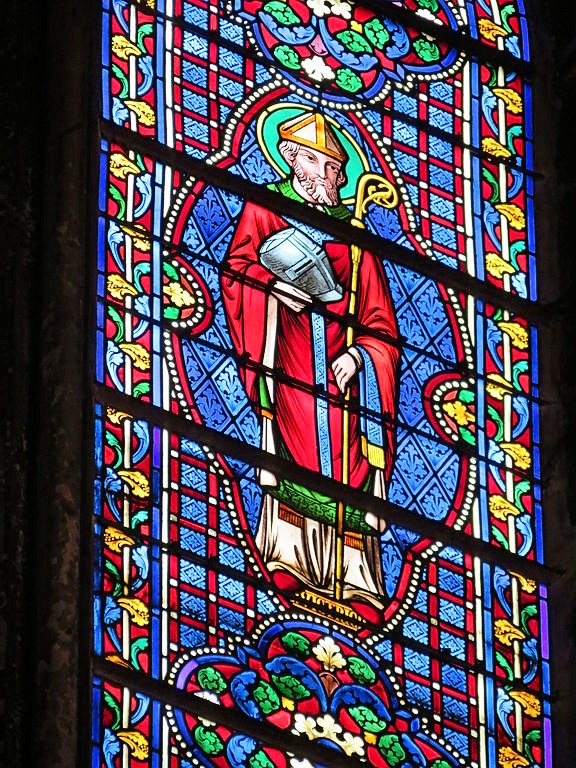
One day, in Chartres, while Saint Martin was there accompanied by Victricius, an inhabitant brought his daughter, who was blind from birth, to the holy Bishop, begging him to heal her. “Speak to the Bishop of Rouen,” replied Saint Martin, “he is more capable than us of obtaining these marvels for you.” Making the Sign of the Cross on the eyes of the child, the Bishop of Tours yielded and the child was immediately healed
Victricius had just returned to his Diocese when Saint Ambrose announced to him that he was sending him various Relics. Victriciud hastened to seek out this great treasure. So hehad a new Church built in Rouen to honourably place these precious Relics. When this was done, he made a great speech in which he exhorted the people to consider the Martyrs as their protectors:
“We must,” he said, “devoutly embrace these precious remains of the tortures and seek there, like the woman at the fringe of the mantle of the Saviour, the healing of our wounds…. for me, a soldier tested by years, aged in battles, fatigue and vigils, I only value present life in its relationship with eternity and, I never think myself richer, than when my hands are laden with the Relics of Saints. … The dwelling place of these blessed ones is in Heaven but, they are here as guests, to whom we can take our prayers.”
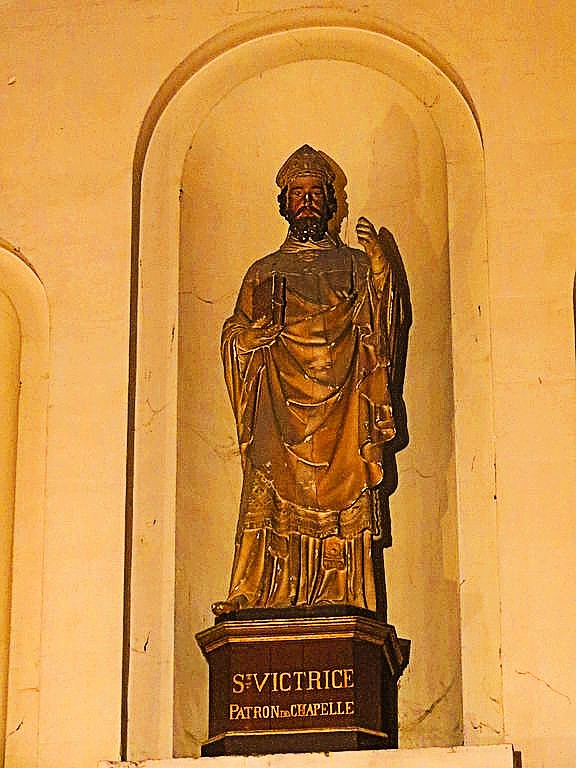
And he declared again that the small fragments of their remains. as well as larger parts. can be the instrument of many miracles… In 404, Pope Innocent I addressed an important Decree to Victricius on various points of discipline, about which the Bishop of Rouen had consulted him. At the same time, he instructed him to communicate this letter to his colleague Bishops in the surrounding Diocese.
Saint Victricius died in 407, his tomb was a source of miracles and remains in great veneration in Rouen.
In the middle of the 9th Century, to save his Relics from the devastation of Norman pirates, they were transported to the fortified castle of Braine, four leagues from Soissons. They were kept there until the revolution, that is to say, in 1793 when, fortunately, they were able to escape destruction. But it was not until 1865 – on 16 and 17 October that Cardinal de Bonnechose, Archbishop of Rouen, transferred the Relics of Saint Victricicious into a beautiful gilded copper casing, decorated with enamels and fine stones.
A most impressive article on Rouen Cathedral on Wikepedia:
https://en.wikipedia.org/wiki/Rouen_Cathedral



 AnaStpaul
One thought on “Saint of the Day – 7 August – Saint Victricius (c339-407) Confessor, Bishop”