Thought for the Day – 29 August – Meditations with Antonio Cardinal Bacci (1881-1971)
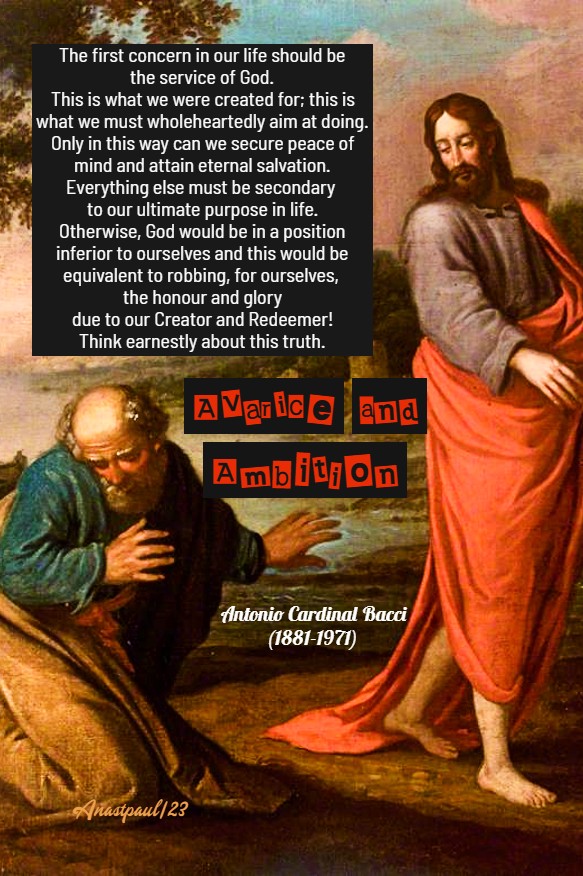
Avarice and Ambition
“What is our attitude in regard to these matters? We are not forbidden, naturally, to look after our own affairs and our work. In fact, it is our duty to do so, to whatever degree is demanded by the circumstances in which we live. Similarly, it is not forbidden to try to better our social position. But, all this must be done, however, with a due sense of proportion and by the proper means.
The first concern in our life should be the service of God. This is what we were created for; this is what we must wholeheartedly aim at doing. Only in this way can we secure peace of mind and attain eternal salvation. Everything else must be secondary to our ultimate purpose in life. Otherwise, God would be in a position inferior to ourselves and this would be equivalent to robbing, for ourselves, the honour and glory due to our Creator and Redeemer! Think earnestly about this truth.”
Quote/s of the Day – 29 August – The Beheading of Saint John the Baptist – Jeremias 1:17-19, Mark 6:17-29 – Scripture search here: https://www.drbo.org/
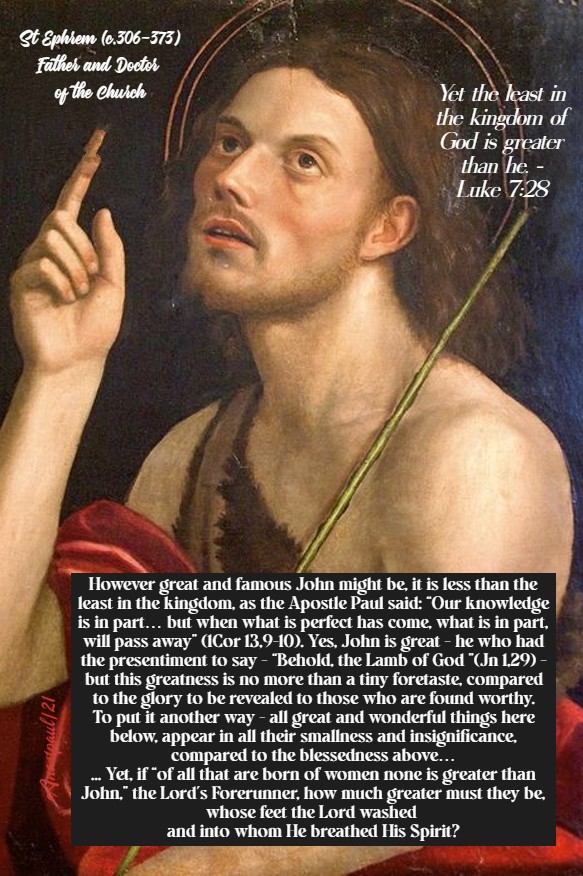
“Yet the least in the Kingdom of God is greater than he.” Luke 7:28
“However great and famous John might be, it is less than the least in the Kingdom, as the Apostle Paul said: “Our knowledge is in part… but when what is perfect has come, what is in part, will pass away” (1Cor 13,9-10). Yes, John is great – he who had the presentiment to say – “Behold, the Lamb of God ”(Jn 1,29) – but this greatness is no more than a tiny foretaste, compared to the glory to be revealed to those who are found worthy. To put it another way – all great and wonderful things here below, appear in all their smallness and insignificance, compared to the blessedness above… … Yet, if “of all that are born of women none is greater than John,” the Lord’s Forerunner, how much greater must they be, whose feet the Lord washed and into whom He breathed His Spirit?”
St Ephrem (306-373) Father and Doctor of the Church
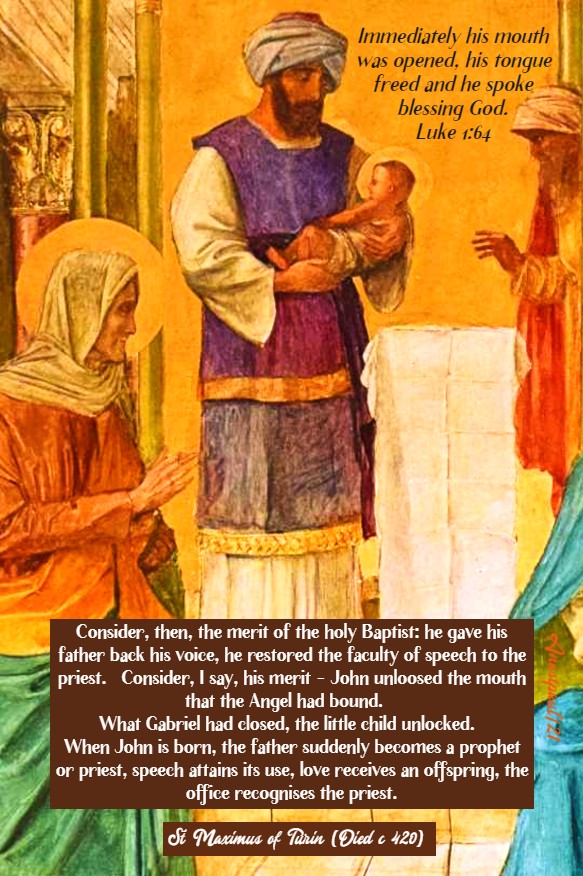
“Immediately his mouth was opened, his tongue freed and he spoke blessing God.” Luke 1:64
“Consider, then, the merit of the holy Baptist – he gave his father back his voice, he restored the faculty of speech to the priest. Consider, I say, his merit – John unloosed the mouth that the Angel had bound. What Gabriel had closed, the little child unlocked. When John is born, the father suddenly becomes a prophet or priest, speech attains its use, love receives an offspring, the office recognises the priest.”
One Minute Reflection – 29August – The Beheading of Saint John the Baptist – Jeremias 1:17-19, Mark 6:17-29 – Scripture search here: https://www.drbo.org/
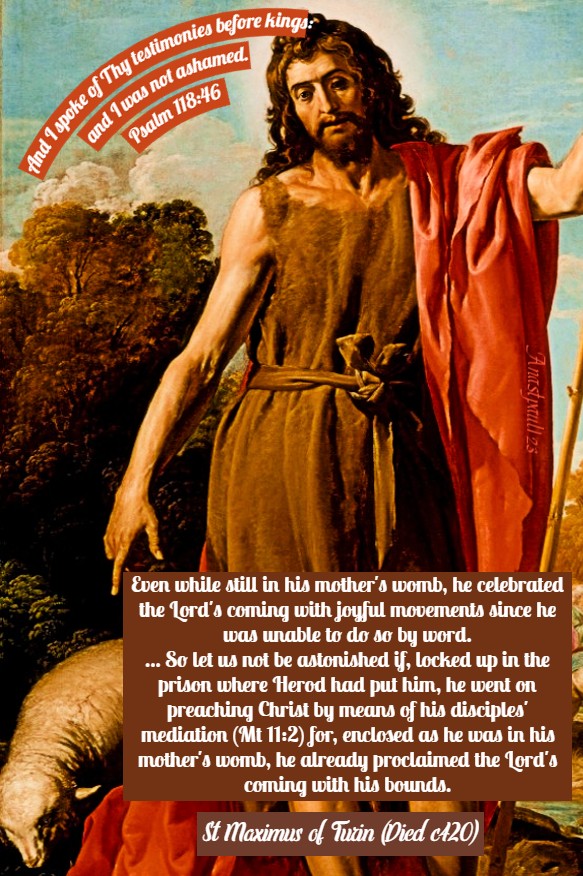
“And I spoke of Thy testimonies before kings:and I was not ashamed.” – Psalm 118:46 (Gradual)
REFLECTION – “Among all the holy and blessed ones, I do not know which to prefer, of all the claims to glory of John the Baptist, whose Feast we celebrate today – his miraculous birth or his even more miraculous death. His birth carried a prophecy with it (Lk 1:67) his death, the truth; his birth announced the Saviour’s coming, his death condemned Herod’s incestuous relationship. This holy Saint… was worthy, in God’s eyes, of not departing from it in the same way as others do in this world – he left the body, he had received from the Lord while he was confessing Him. In all things John fulfilled God’s will, since his life, like his death, corresponded to God’s designs …
Even while still in his mother’s womb, he celebrated the Lord’s coming with joyful movements since he was unable to do so by word. Elizabeth said to blessed Mary: “When the sound of thy greeting reached my ears, the child in my womb leaped for joy” (Lk 1:44). John, then, rejoiced before his birth and even before his eyes could see what the world looks like, his spirit already recognised who is its Lord. I think that this is the meaning of the Prophet’s words: “Before I formed you in the womb, I knew you; before you were born, I had consecrated you” (Jer 1:5). So let us not be astonished if, locked up in the prison where Herod had put him, he went on preaching Christ by means of his disciples’ mediation (Mt 11:2) for, enclosed as he was in his mother’s womb, he already proclaimed the Lord’s coming with his bounds.” – St Maximus of Turin (Died c420) Bishop, Father (Sermon 36).
PRAYER – May the great festival of St John the Baptist, Thy Precursor and Martyr, we beseech Thee, O Lord, assure for us the results of Thy saving help. Who lives and reign with God the Father, in the unity of the Holy Spirit, God, world without end. Amen (Collect).
Our Morning Offering – 29 August – The Beheading of Saint John the Baptist
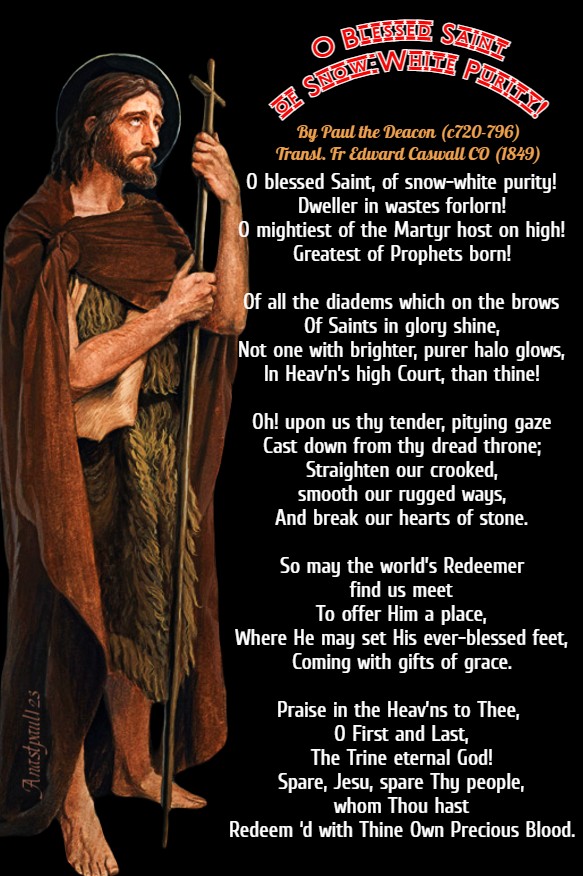
O Blessed Saint of Snow-White Purity! By Paul the Deacon (c720-796) Transl. Fr Edward Caswall C.Orat. (1814-1878) Breviary Hymn for Lauds
O blessed Saint, of snow-white purity! Dweller in wastes forlorn! O mightiest of the Martyr host on high! Greatest of Prophets born!
Of all the diadems which on the brows Of Saints in glory shine, Not one with brighter, purer halo glows, In Heav’n’s high Court, than thine!
Oh! upon us thy tender, pitying gaze Cast down from thy dread throne; Straighten our crooked, smooth our rugged ways, And break our hearts of stone.
So may the world’s Redeemer find us meet To offer Him a place, Where He may set His ever-blessed feet, Coming with gifts of grace.
Praise in the Heav’ns to Thee, O First and Last, The Trine eternal God! Spare, Jesu, spare Thy people,whom Thou hast Redeem ‘d with Thine Own Precious Blood.
The Beheading of Saint John the Baptist By Father Francis Xavier Weninger SJ (1805-1888)
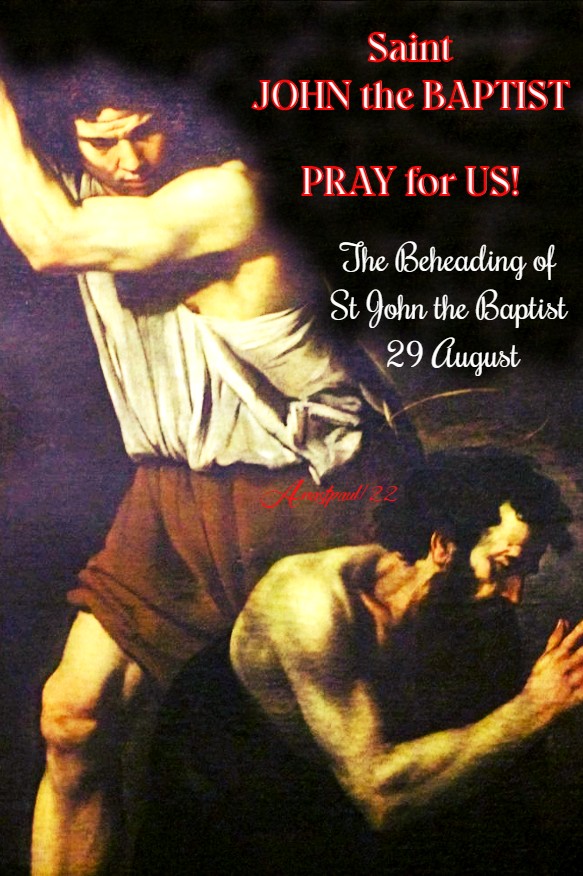
When St John, the Baptist and Precursor of Jesus Christ, of whose miraculous birth we have spoken elsewhere, by divine admonition left the desert, he repaired to the river Jordan, to preach repentance, thus to prepare men for the recognition of the Messiah. The abuses and vices which had crept in among the Jews and had become habitual with them, were rebuked by him without respect to persons. At that period there reigned in Judaea, King Herod, surnamed Antipas, a son of the Herod who murdered the Holy Innocents and a brother of the Herod who clothed Christ with a white garment and derided Him. This King had forcibly carried off Herodias, the wife of his still living brother, Philip and had married her. The whole country was scandalised at this criminal deed but no-one had dared to reproach the King for his unlawful conduct. St John alone would not be silent!
The Gospel says, that Herod was much pleased with St John’s preaching and followed many of his instructions. Hence, the Saint fearlessly approached the King and said to him: “It is not lawful for thee to take thy brother’s wife.” What more he may have said is not mentioned in the Gospel but these few bold words were enough to provoke the King to such a degree and awaken in himsuch hatred that he resolved to rid himself of the severe preacher. Fearing, however, a revolt among the people, who greatly esteemed the Saint, he dared not immediately lay hands on him. The godless Herodias, who felt herself also offended by the reproaches of John, incited the King more and more against the holy man, until she had succeeded in raising him to such wrath that he ordered him to be imprisoned.
The disciples of the Saint, however, went to him in the prison and listened with avidity to his holy instructions. We know that he sent some of them to Christ, to ask Him: “Art Thou He Who is to come, or do we look for another?” It is the opinion of the holy Fathers that John did not send this message to Christ because he doubted that He was the true Messiah but that, his disciples, by hearing Him preach and by witnessing the miracles He performed, might more readily believe what he had told them of the Saviour. It is believed that the imprisonment of John took place in December and lasted until the month of August. Herod’s birthday was celebrated in this month and among other festivities, he gave a splendid banquet, at which all the princes of Galilee were present. At the close of it, Salome, the daughter of Herodias, entered the banquet hall to entertain the guests by dancing.
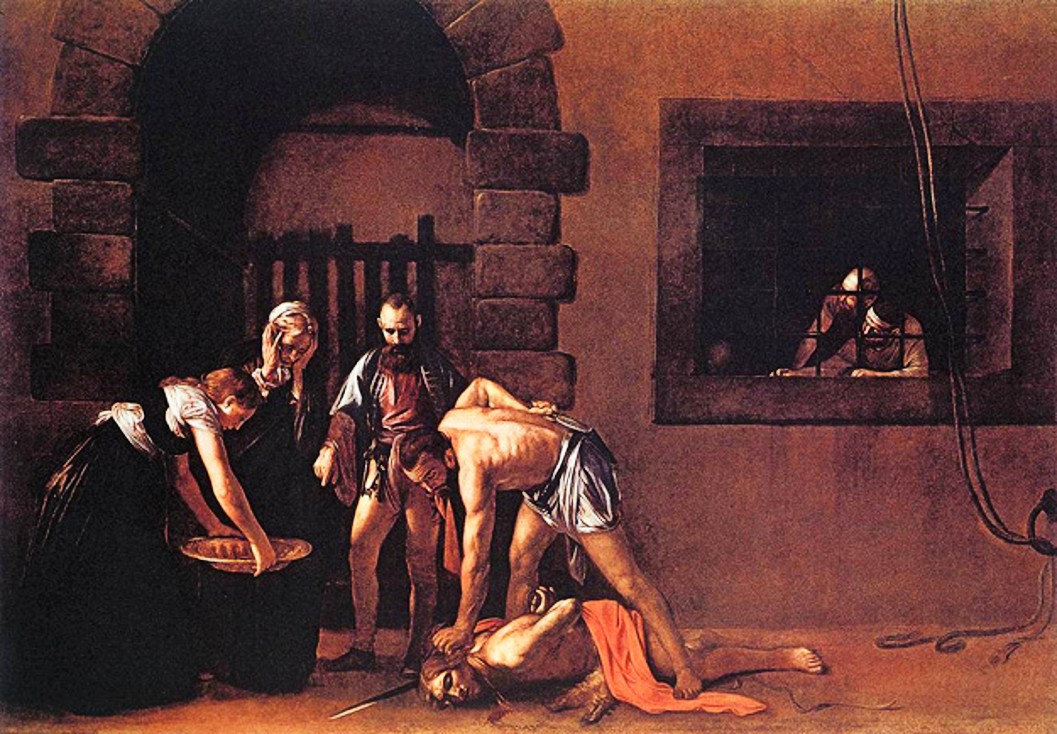
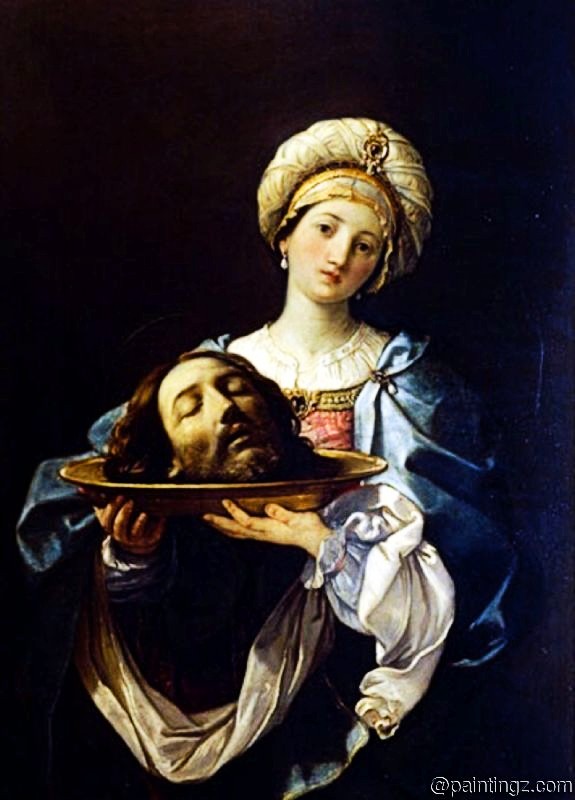
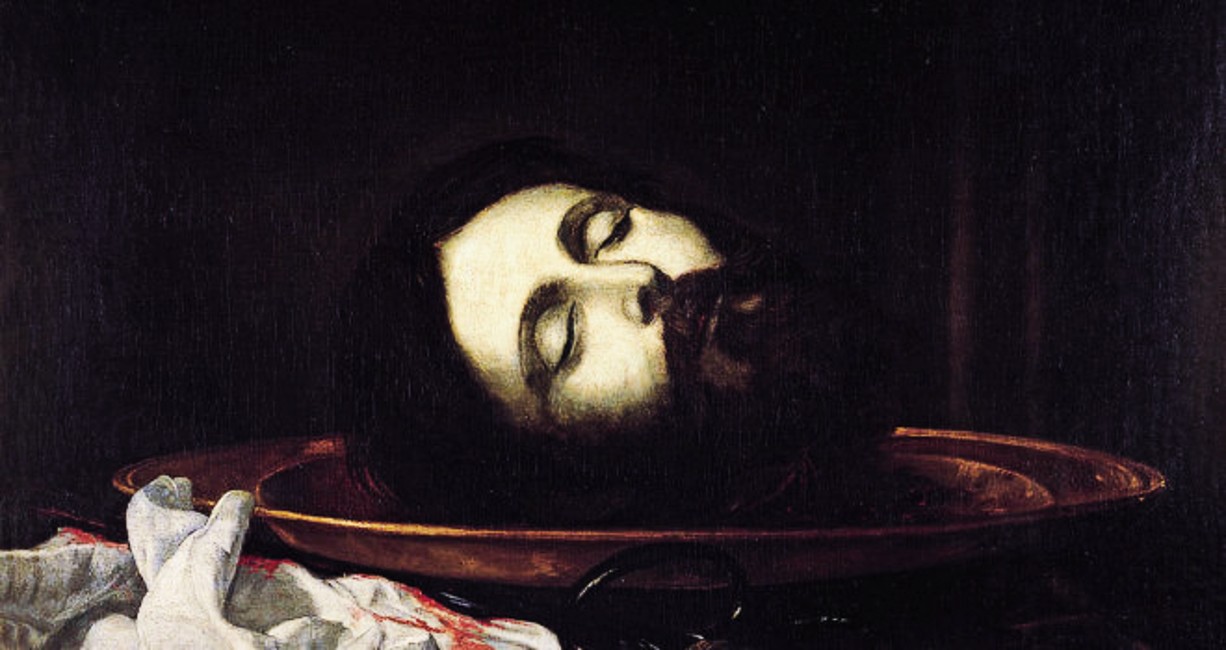
The King was so much pleased with her that he told her that she might ask him a favour and promised to grant it, even if it should cost him the half of his Kingdom. This thoughtless promise he confirmed by an oath. The frivolous dancer, not knowing what to request, asked the advice of her mother. The latter, who had long wished St John out of her way, in order that nothing might disturb her in her criminal lust, said quickly: “Go and ask for the head of John the Baptist. “ The wicked daughter, returning to the King, said boldly: “Give me here in a dish, the head of John the Baptist.” The King was struck with horror at her unexpected demand but not wishing to grieve her and being unwilling to break his rash oath, he sent a soldier of his body-guard into the prison to behead the Saint and bring his head in a dish.
The cruel and unjust order was forthwith executed and the holy head was brought in a dish to Salome, who handed it to her wicked mother. St Jerome relates that Herodias, to gratify her rage against the holy man, pricked his tongue with a bodkin, in revenge for the fearless reproofs it had given to the vices of the King. The disciples of St John buried the holy body of their beloved master between the two Prophets Eliseus and Abdias. The sacred head was buried by the unchaste Herodias in her palace, where it remained concealed many years, when it was discovered by an apparition of the Saint himself and has ever since been greatly venerated by the Christians. At the present day it is kept at Rome, in the Church of St. Sylvester.
The justice of God did not leave the cruelty and tyranny of Herod unpunished. The Jewish historian, Josephus, relates that he lost honour and crown – for the King of Arabia, whose daughter, the lawful wife of Herod had been repudiated, invaded his domains with his armies and defeated him. The Emperor Caligula, afterwards banished him to Lyons in France. From that City he fled with Herodias into Spain, where both, in punishment for their crimes, died in misery. The frivolous and wicked daughter of Herodias also received her deserts. Whilst she was walking over a frozen river, the ice broke and she sank to her neck in the water and the ice, rushing again together, severed her head entirely from her body. Thus ended this audacious and shameless dancer.
St Adelphus St Adausia of Rome St Alberic of Bagno de Romagna St Basilia of Sirmium Bl Bronislava St Candida of Rome St Edwold the Hermit St Euthymius of Perugia St Maximian of Vercelli St Medericus St Nicaeus of Antioch St Paul of Antioch St Repositus of Velleianum Bl Richard Herst St Sabina of Troyes St Sator of Velleianum St Sebbe of Essex St Velleicus St Victor of La Chambon St Vitalis of Velleianum







 AnaStpaul
You must be logged in to post a comment.