Thought for the Day – 21 August – Meditations with Antonio Cardinal Bacci (1881-1971)
Perseverance
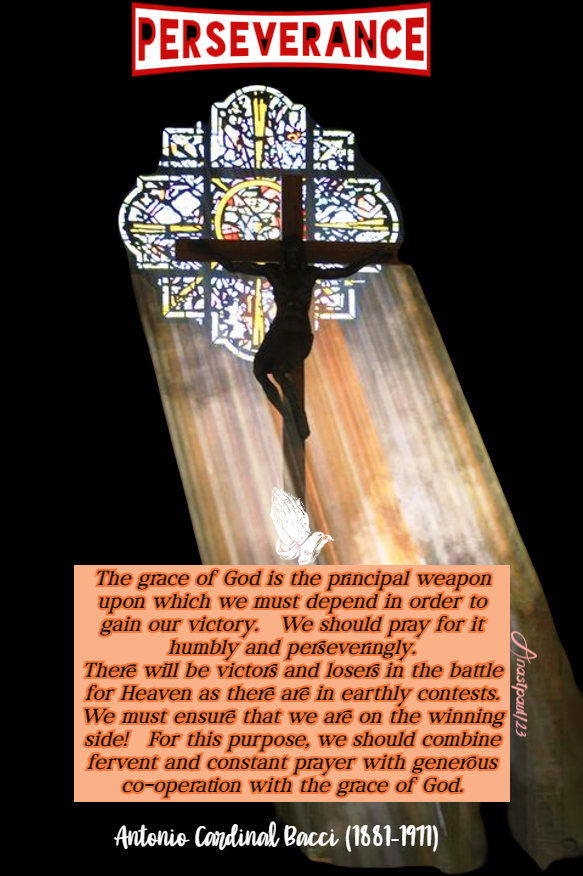
“The grace of God is the principal weapon upon which we must depend in order to gain our victory. We should pray for it humbly and perseveringly. There will be victors and losers in the battle for Heaven as there are in earthly contests. We must ensure that we are on the winning side! For this purpose, we should combine fervent and constant prayer with generous co-operation with the grace of God.”
Quote/s of the Day – 21 August – “The Month of the Immaculate Heart of Mary” – St Jane Frances de Chantal VHM (1572-1641) Widow
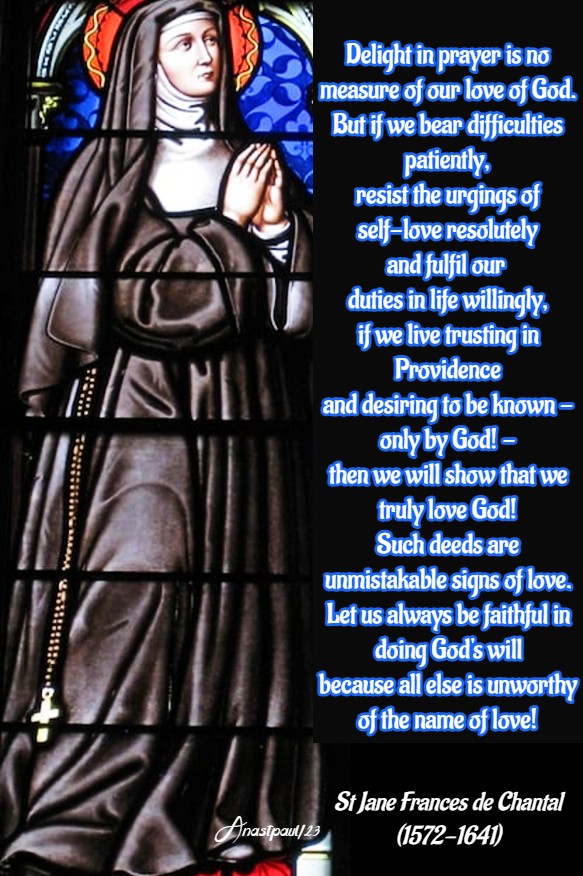
“Delight in prayer is no measure of our love of God. But if we bear difficulties patiently, resist the urgings of self-love resolutely and fulfil our duties in life willingly, if we live trusting in Providence and desiring to be known – only by God! – then we will show that we truly love God! Such deeds are unmistakable signs of love. Let us always be faithful in doing God’s will because all else is unworthy of the name of love!”
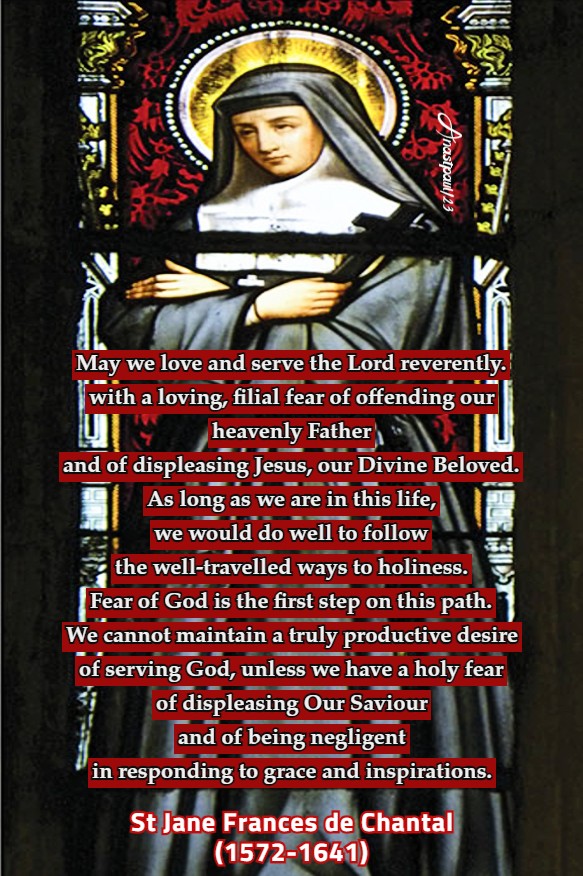
“May we love and serve the Lord reverently. with a loving, filial fear of offending our heavenly Father and of displeasing Jesus, our Divine Beloved. As long as we are in this life, we would do well to follow the well-travelled ways to holiness. Fear of God is the first step on this path. We cannot maintain a truly productive desire of serving God, unless we have a holy fear of displeasing Our Saviour and of being negligent in responding to grace and inspirations.”
“To be faithful, we must live simply. Then, being free from attachments, we are possessed by nothing. We live in such absolute openness to Divine Love that whatever pleases God, becomes our heart’s desire.”
Prayer of Abandonment By St Jane Frances de Chantal (1572-1641)
O sovereign goodness of the sovereign Providence of my God! I abandon myself forever to Thy arms. Whether gentle or severe, lead me henceforth whither Thou will. I will not regard the way through which Thou will have me pass but keep my eyes fixed upon Thee, my God, who guides me. My soul finds no rest without the arms and the bosom of this heavenly Providence, my true Mother, my strength and my rampart. Therefore I resolve with Thy Divine assistance, 0 my Saviour, to follow Thy desires and Thy ordinances, without regarding or examining why Thou does this rather than that but I will blindly follow Thee, according to Thy Divine will, without seeking my own inclinations. Hence I am determined to leave all to Thee, taking no part therein, save by keeping myself in peace in Thy arms, desiring nothing, except as Thou incites me to desire, to will, to wish. I offer Thee this desire, 0 my God, beseeching Thee to bless it. I undertake all it includes, relying on Thy goodness, liberality and mercy, with entire confidence in Thee, distrust of myself, and knowledge of my infinite misery and infirmity. Amen.
One Minute Reflection – 21 August – “The Month of the Immaculate Heart of Mary” – St Jane Frances de Chantal VHM (1572-1641) Widow – Proverbs 31:10-31, Matthew 13:44-52 – Scripture search here: https://www.drbo.org/
“The Kingdom of Heaven is like a treasure hidden in a field.” – Matthew 13:44
REFLECTION – “For the man who loves God, it is sufficient to please the One he loves and, there is no greater recompense to be sought, than the loving itself. For love is from God, by the very fact, that God Himself is love. The good and chaste soul is so happy to be filled with Him that it desires to take delight in nothing else. For what the Lord says is very true: – ‘Where your treasure is, there also will your heart be.’
What is a man’s treasure but the heaping up of profits and the fruit of his toil? For whatever a man sows, this too will he reap and each man’s gain, matches his toil and where delight and enjoyment are found, there the heart’s desire is attached. Now there are many kinds of wealth and a variety of grounds for rejoicing – every man’s treasure is that which he desires. If it is based on earthly ambitions, its acquisition makes men not blessed but wretched!
But those who enjoy the things that are above and eternal, rather than earthly and perishable, possess an incorruptible, hidden store, of which the prophet speaks: ‘Our treasure and salvation have come, wisdom and instruction and piety, from the Lord: these are the treasures of justice.’ Through these, with the help of God’s grace, even earthly possessions are transformed into heavenly blessings. It is a fact that many people use the wealth, which is either rightfully left to them or otherwise, acquired, as a tool of devotion. By distributing what might be superfluous to support the poor, they are amassing imperishable riches, so that what they have discreetly given, cannot be subject to loss. They have properly placed those riches, where their heart is, – it is a most blessed thing, to work to increase such riches, rather than to fear that they may pass away.” – St Pope Leo the Great (400-461) Bishop of Rome and Great Western Father and Doctor of the Church (An excerpt from Sermon 92).
PRAYER – Almighty and merciful God, Who endowed St Jane Frances, burning with love of Thee, with a wondrous strength of spirit through all the paths of life, in the way of perfection and willed through her, to ennoble Thy Church, by a new religious family, grant by her merits and prayers, that we who are aware of our weakness, may trust firmly in Thy power and, by the assistance of divine grace, overcome all obstacles in our way. Through the same Jesus Christ, Thy Son our Lord, Who lives and reigns with Thee, in the unity of the Holy Ghost, God, world without end. Amen (Collect).
Saint of the Day – 21 August – Saint Avitus I of Clermont (c525-c600) Bishop of Clermont, France, Miracle-worker. Avitus was the Bishop of the Diocese of Clermont in France in the 6th Century. Also known as – Avit, Avitius, Avito.
Avitus was born around the year 525. He was a scion of the noble Roman Avitii family which was connected to Emperor Avitus who had been the Bishop of Piacenza, Italy.
In 571, Bishop Cautinus of Clermont died from the plague. Avitus was chosen as the new Bishop and in 580, he began the building of the Basilica of Notre-Dame du Port in Clermont.
In 576, an event occurred between Avitus and the Jewish community in Clermont which was recorded by his contemporary St Gregory of Tours, who Avitus had himself Ordained, firstly as Deacon, then Priest. According to St Gregory, Avitus had been praying and calling on the Jews in Clermont to convert to Christ. One of the Jews listened to the Bishop and accepted Baptism at Easter. This convert also joined in the Easter procession through the City.
Another Jew then poured stinking oil on this convert’s head from a window above during the procession. The Christians were excessively enraged and wishedto stone this Jew, however, Avitus, of course, forbade such a violent un-Christian action..
Later, on the Feast of the Ascension, when Avitus was leading another procession through the City, a mob of Christians attacked the Jewish Synagogue in Clermont and burned it to the ground. Avitus sent a messenge to the Jews in Clermont, which (according to Gregory’s account) said: “I do not compel you by force to confess the Son of God but, nevertheless, I preach Him and I offer to your hearts, the salt of wisdom. I am the shepherd put in charge of the Lord’s sheep and as regards you, the true Shepherd Who suffered for us, said that He had other sheep which are not in His sheepfold but which should be brought in, so that there may be one flock and one Shepherd. And, therefore, if you are willing to believe as I, be one flock with me as your guardian but if not, depart from this place, for your own safety.”
St Gregory reports that three days after this message was sent, 500 Jews accepted Baptism.
Around 590, Avitus probably called and headed a Council of Eclestics in Clermont. Avitus once visited Menat in central France, where he visted sick children. While he was there, a Spring of water burst forth (the existing Fontaine Saint-Avit) which was able to miraculously cure the sick children and still today is renowned for miraculous cures.
Our Morning Offering – 21 August – “The Month of the Immaculate Heart of Mary” – Within the Octave of the Assumption of the Blessed Virgin into Heaven
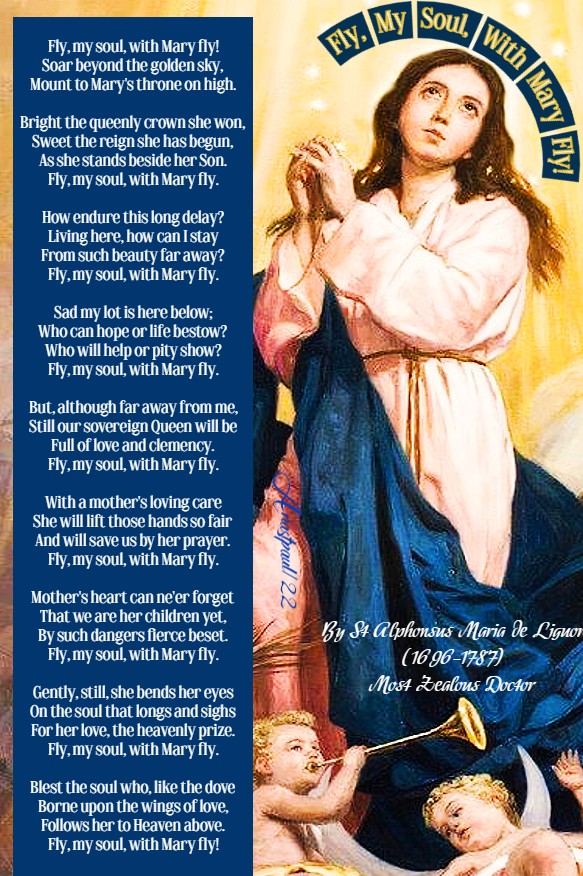
Fly, My Soul, with Mary Fly! By St Alphonsus Maria de Liguori (1696-1787) Most Zealous Doctor (From “The Glories of Mary”) Trans. Redemptoris Fathers, 1931)
Fly, my soul, with Mary fly! Soar beyond the golden sky, Mount to Mary’s throne on high.
Bright the queenly crown she won, Sweet the reign she has begun, As she stands beside her Son. Fly, my soul, with Mary fly.
How endure this long delay? Living here, how can I stay From such beauty far away? Fly, my soul, with Mary fly.
Sad my lot is here below; Who can hope or life bestow? Who will help or pity show? Fly, my soul, with Mary fly.
St Agapius of Edessa St Agathonicus of Constantinople St Anastasius Cornicularius St Aria of Rome St Avitus I of Clermont (c525-c600) Bishop St Bassa of Edessa Bl Beatrice de Roelas St Bernhard of Lérida St Bernard de Alziva St Bonosus St Camerinus of Sardinia St Cameron St Cisellus of Sardinia St Cyriaca St Euprepius of Verona St Fidelis of Edessa St Theogonius of Edessa St Gracia of Lérida St Hardulph St Joseph Nien Vien St Leontius the Elder St Luxorius of Sardinia St Maria of Lérida St Maximianus the Soldier St Maximilian of Antioch St Natale of Casale Monferrato St Paternus of Fondi St Privatus of Mende St Quadratus of Utica
Thought for the Day – 20 August – Meditations with Antonio Cardinal Bacci (1881-1971)
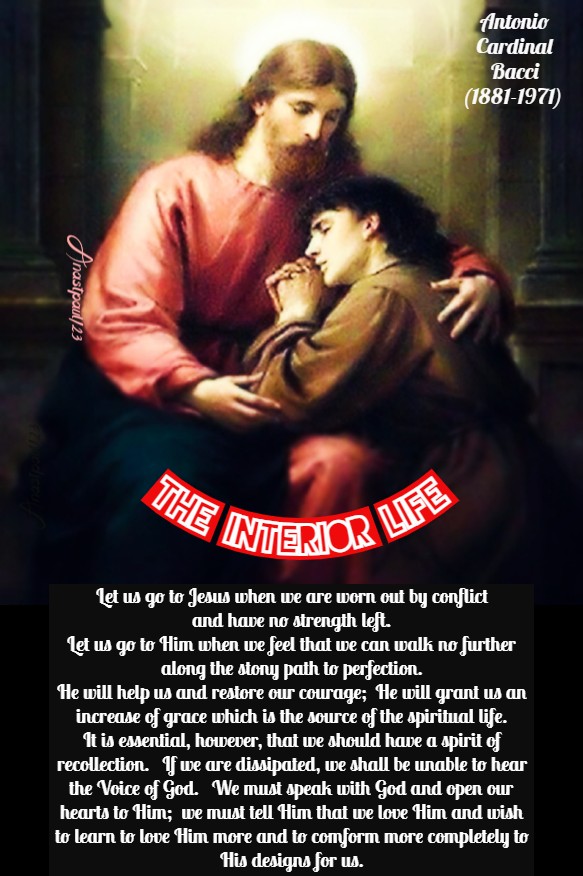
The Interior Life
“Let us go to Jesus when we are worn out by conflict and have no strength left. Let us go to Him when we feel that we can walk no further along the stony path to perfection. He will help us and restore our courage; He will grant us an increase of grace which is the source of the spiritual life.
It is essential, however, that we should have a spirit of recollection. If we are dissipated, we shall be unable to hear the Voice of God. We must speak with God and open our hearts to Him; we must tell Him that we love Him and wish to learn to love Him more and to comform more completely to His designs for us. Then, we shall find peace and contentment in the interior life, such as the world can neither know, nor communicate.”
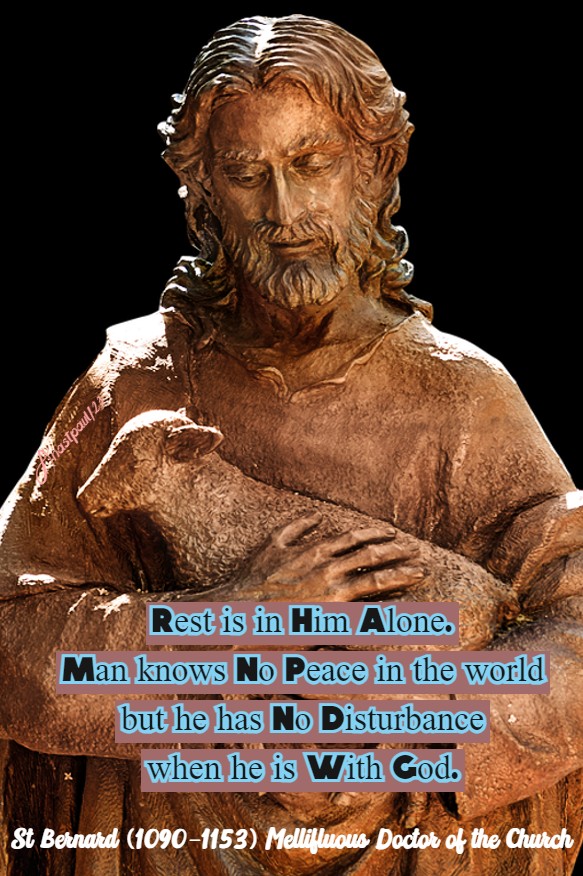
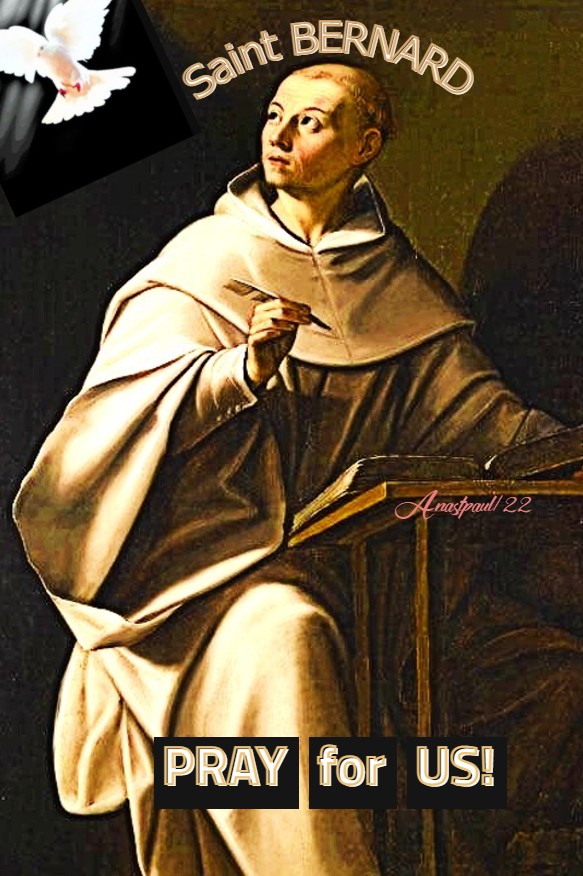
Quote/s of the Day – 20 August – St Bernard (1090-1153) Confessor
“Rest is in Him alone. Man knows no peace in the world but he has no disturbance when he is with God.”
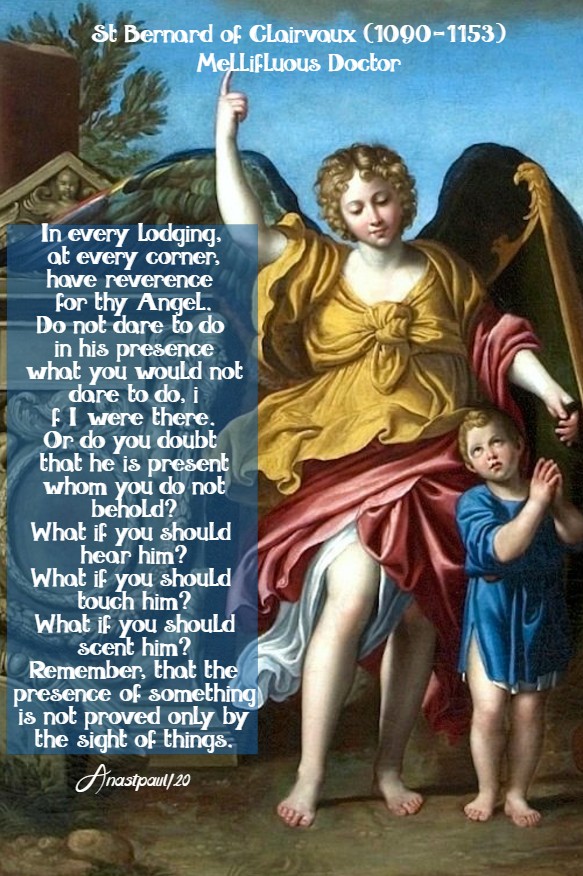
“In every lodging, at every corner, have reverence for thy Angel. Do not dare to do in his presence what you would not dare to do, if I were there. Or do you doubt that he is present whom you do not behold? What if you should hear him? What if you should touch him? What if you should scent him? Remember, that the presence of something is not proved only by the sight of things.”
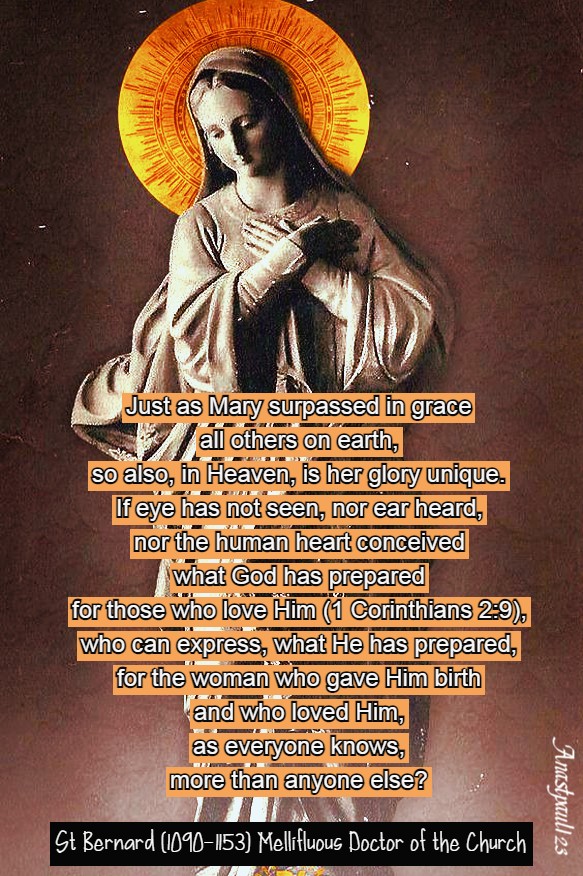
“Just as Mary surpassed in grace all others on earth, so also, in Heaven, is her glory unique. If eye has not seen, nor ear heard, nor the human heart conceived what God has prepared for those who love Him (1 Corinthians 2:9), who can express, what He has prepared, for the woman who gave Him birth and who loved Him, as everyone knows, more than anyone else?”
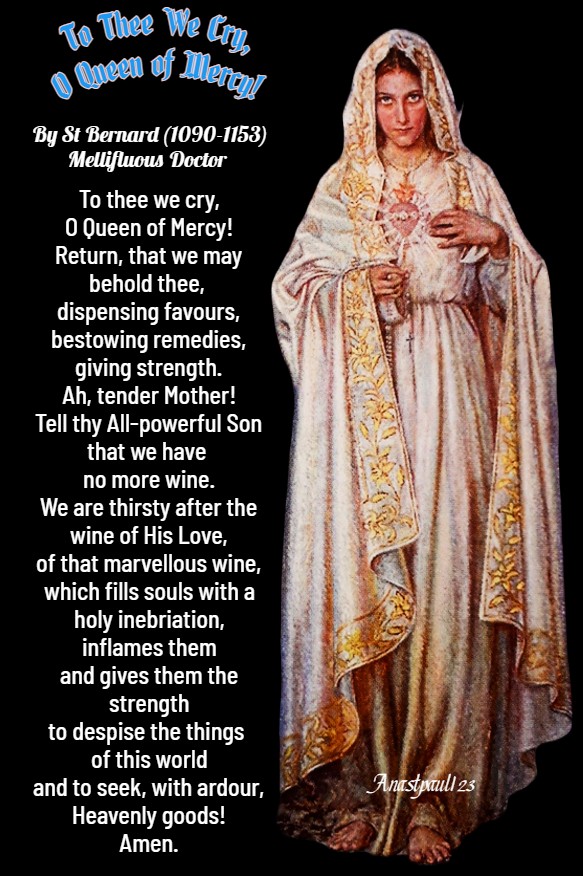
To Thee We Cry, O Queen of Mercy! By St Bernard (1090-1153) Mellifluous Doctor of the Church
To thee we cry, O Queen of Mercy! Return, that we may behold thee, dispensing favours, bestowing remedies, giving strength. Ah, tender Mother! Tell thy All-powerful Son that we have no more wine. We are thirsty after the wine of His Love, of that marvellous wine, which fills souls with a holy inebriation, inflames them and gives them the strength to despise the things of this world and to seek, with ardour, Heavenly goods! Amen.
One Minute Reflection – 20 August – “The Month of the Immaculate Heart of Mary” – St Bernard (1090-1153) Confessor – 2 Cor. 3:4-9, Luke 10:23-37 – Scripture search here: https://www.drbo.org/
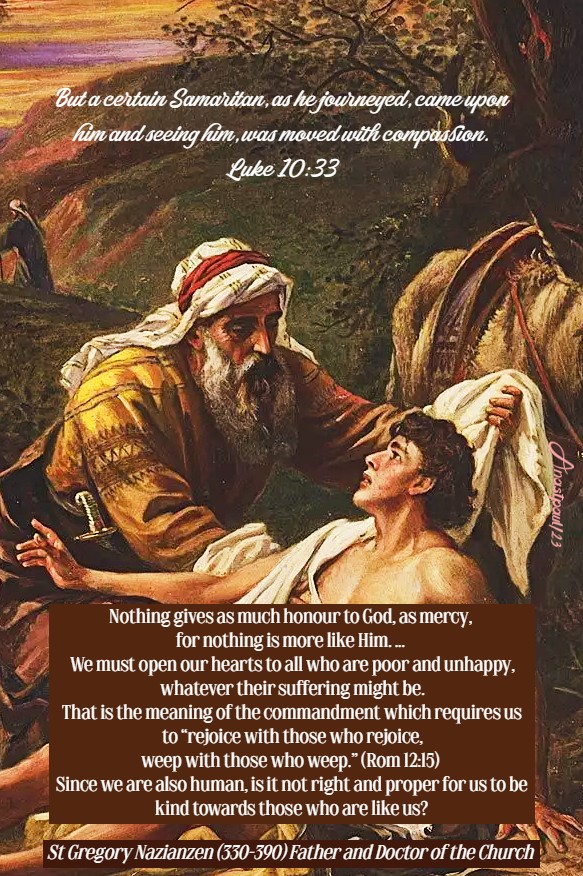
“But a certain Samaritan, as he journeyed, came upon him and seeing him, was moved with compassion.” – Luke 10:33
REFLECTION – “The first and the greatest of the commandments,that on which the Law and the prophets are based, (Mt 22:40) is love which, it seems to me, brings its greatest proof, in love of the poor, in tenderness and compassion for one’s neighbour. Nothing gives as much honour to God, as mercy, for nothing is more like Him. “Mercy and Truth go before Him,” (Ps 88:15) and He prefers mercy to judgement (Hos 6:6). Nothing attracts the kindness of the Friend of humankind, as much as kindness towards humankind, (Wis 1:6) His reward is just, He weighs and measures mercy.
We must open our hearts to all who are poor and unhappy, whatever their suffering might be. That is the meaning of the commandment which requires us to “rejoice with those who rejoice, weep with those who weep.” (Rom 12:15) Since we are also human, is it not right and proper for us to be kind towards those who are like us?” – St Gregory Nazianzen (330-390) Bishop, Father and Doctor of the Church (On Love of the Poor, 4-6).
PRAYER – O God, Who gave to Thy people, blessed Bernard, as a minister of salvation, grant, we beseech Thee, that we, who cherished him on earth as a teacher of life, may be found worthy to have him as an intercessor in Heaven. Through Jesus Christ, Thy Son our Lord, Who lives and reigns with Thee, in the unity of the Holy Ghost, God, world without end. Amen (Collect).
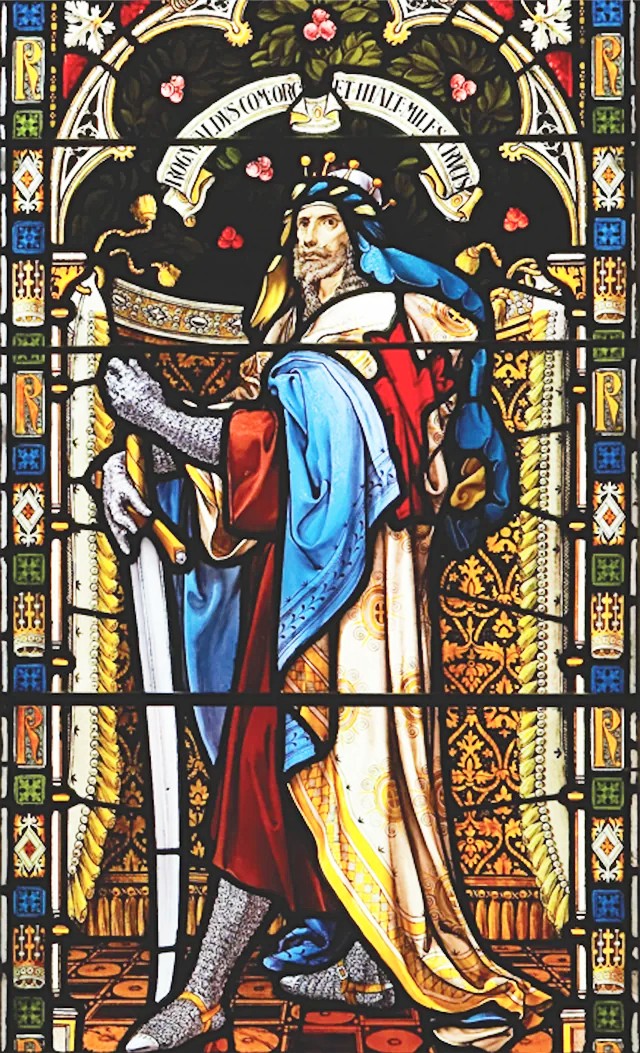
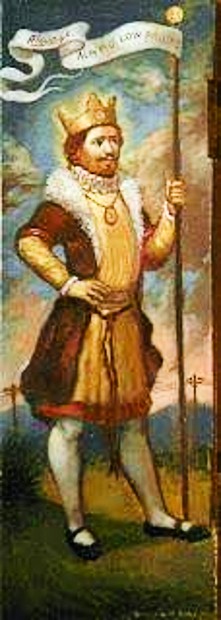
Saint of the Day – 20 August – St Ronald of Orkney (c1100-1158) Martyr, Confessor, Earl of Orkney and Shetland, Norwegian nobleman, renowned Skaldic poet, Founder of Kirkwall’s St. Magnus Cathedral, Also known as – Rögnvald Kali Kolsson, Ragnvald Kale Kollsson.
Ronald’s noble parents were Lendmann Kolr Kalisson and Gunnhildr Erlendsdottir, the sister of Magnus Erlendsson, Earl of Orkney. It was, therefore, through his mother, Gunnhildr, that Röonald had a claim on the Orkney Earldom.
We are unsure of the exact location of the birthplace of Ronald in Norway but the King’s estate at Lista is believed to be the possible location of both his birth and his childhood home. Ronald’s family owned several farms in Agder, in southern Norway where the boy might also have spent his childhood.
In 1129, King Sigurd I of Norway appointed Ronald as theEarl of Orkney and Shetland. Ronald should have had one half of Orkney as his uncle Magnus had but his second cousin, Paul Haakonsson, had just made himself sole ruler of the Islands and would not cede any of them. Ronald remained in Norway as one of the leading assistants of King Harald Gille.
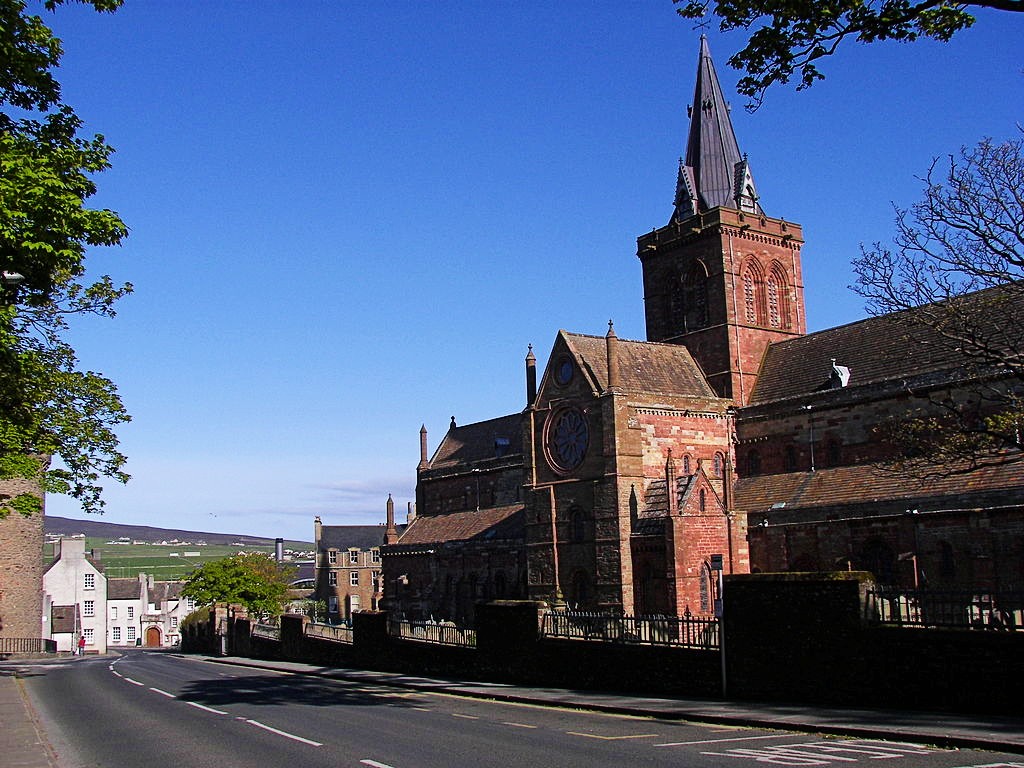
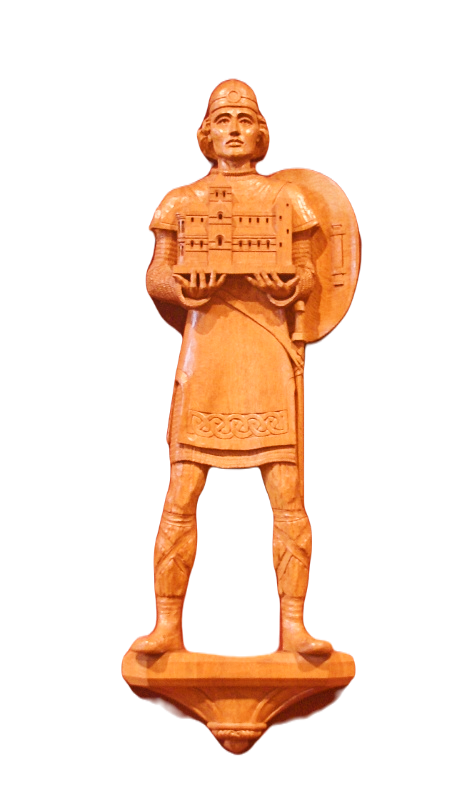
In 1137, Ronald initiated the building of St Magnus Cathedral in Kirkwall, Scotland. He also served as a guardian to Harald Maddadsson, the five-year-old nephew of Paul Haakonsson. In 1138 Ronald appointed Harald Maddadsson as Earl along with himself. Harald had inherited Caithness, Scotland,and thus was Ronald’s master over this area.
In 1151, Earl Ronald set out on a pilgrimage to the Holy Land. In August 1158, Ronald was attacked and murdered, by a group rebelling against him, his rule and his religion.
Ronald’s body was taken to Kirkwall and buried in the Cathedral he had built – St Magnus Cathedral. Many miracles occured at his grave as well as on the stone where he died. Ronald was Canonised in 1192 by Pope Celestine III.
St Brogan St Burchard of Worms St Christopher of Cordoba St Cristòfol Baqués Almirall St Gobert of Apremont St Haduin of Le Mans St Heliodorus of Persia St Herbert Hoscam St Leovigild of Cordoba St Lucius of Cyprus St Maximus of Chinon
St Porphyrius of Palestrina St Ronald of Orkney (c1100-1158) Martyr, Earl of Orkney and Shetland St Samuel the Patriarch St Zacchaeus (Died 1st Century) Disciple of Jesus “Salvation has come to this house”
Thought for the Day – 19 August – Meditations with Antonio Cardinal Bacci (1881-1971)
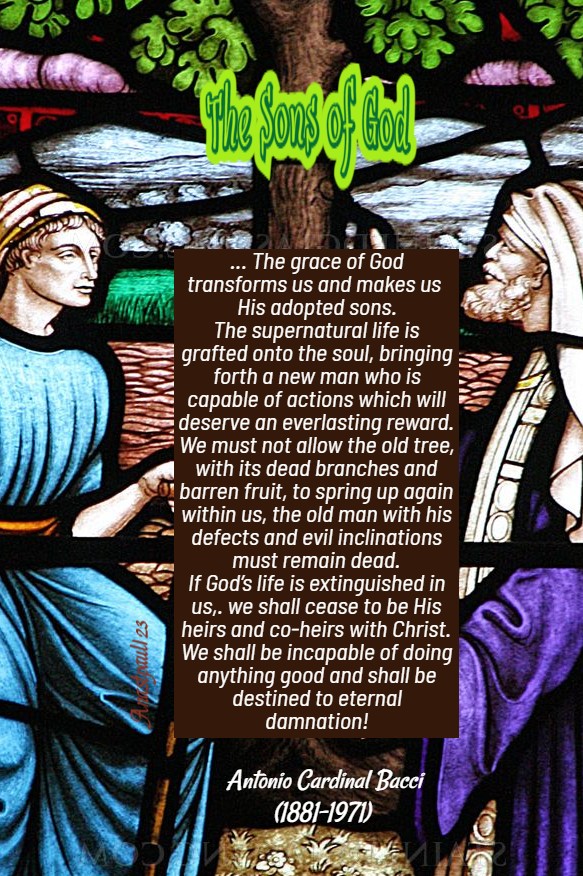
The Sons of God
“We are, or ought to be, sons of God. We are His adopted sons by means of the grace which gives us a share in His Divine Life. This idea is contained, even in the Old Testament, “You are gods, all of you, sons of the Most High (Ps 81:6)” “The Spirit Himself,” explains St Paul, “gives testimony to our spirit that we are sons of God. But, if we are sons, we are heirs also, heirs indeed of God and joint heirs with Christ” (Rom 8:16-17).
In other words, the grace of God transforms us and makes us His adopted sons. The supernatural life is grafted onto the soul, bringing forth a new man who is capable of actions which will deserve an everlasting reward. We must not allow the old tree, with its dead branches and barren fruit, to spring up again within us, the old man with his defects and evil inclinations must remain dead.
If God’s life is extinguished in us,. we shall cease to be His heirs and co-heirs with Christ. We shall be incapable of doing anything good and shall be destined to eternal damnation.”
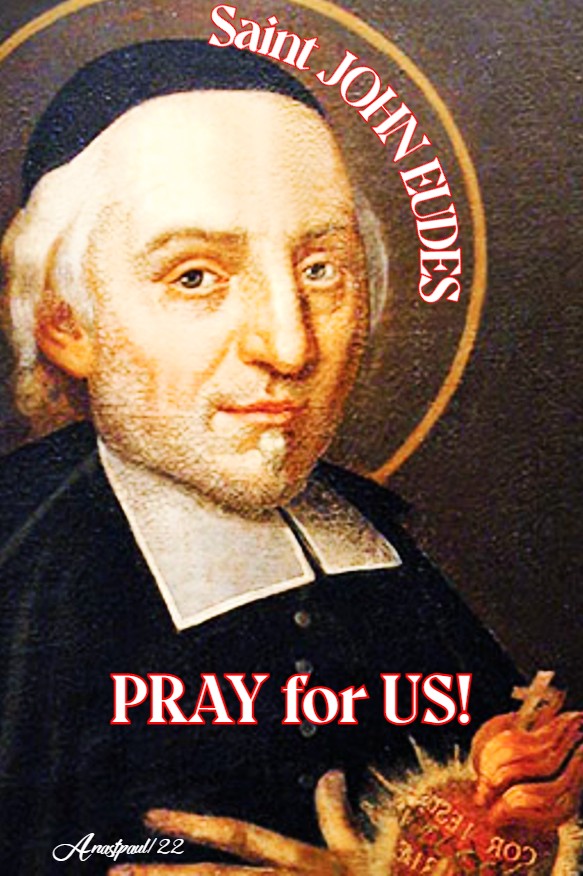
Quote/s of the Day – 19August – “The Month of the Immaculate Heart of Mary” – St John Eudes (1601-1680) Confessor, “The Apostle of Two Hearts”
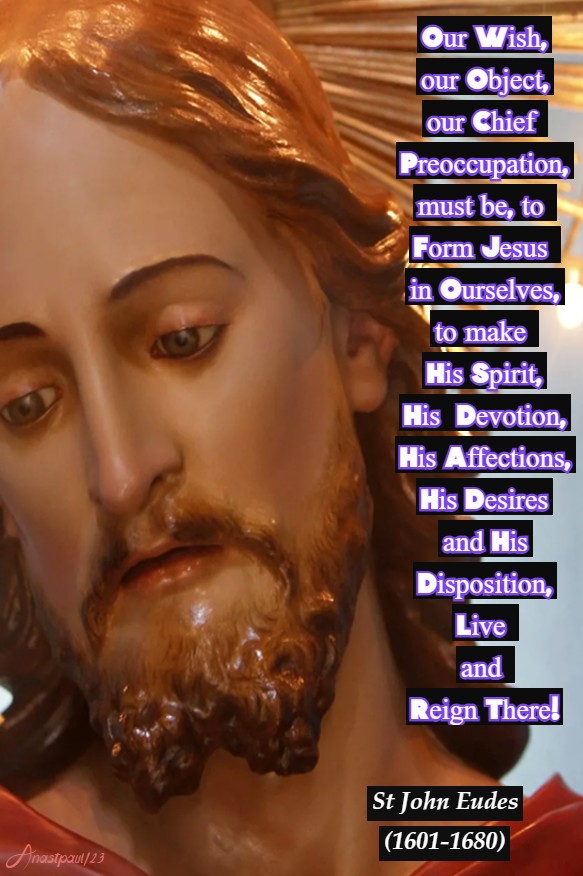
“Our wish, our object, our chief preoccupation, must be, to form Jesus in ourselves, to make His spirit, His devotion, His affections, His desires and His disposition, live and reign there!”
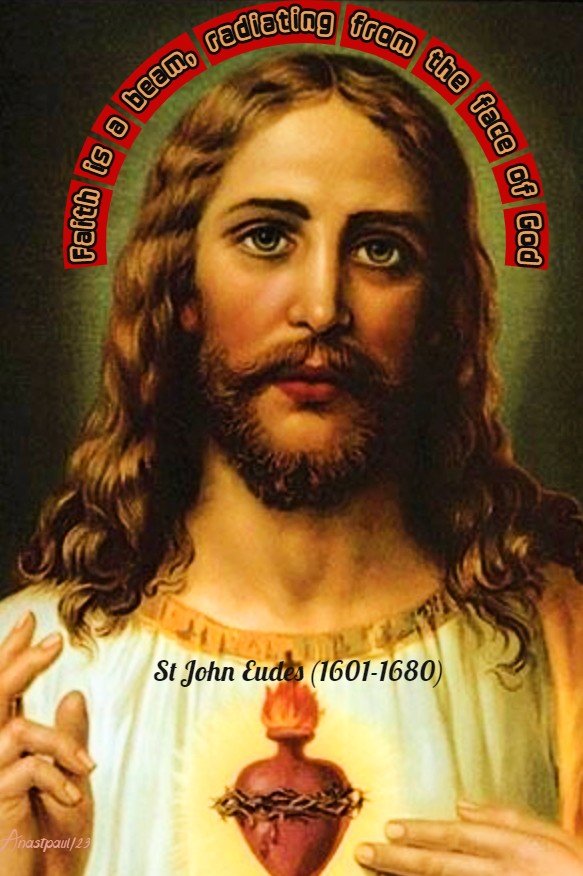
“Faith is a beam, radiating from the face of God.”
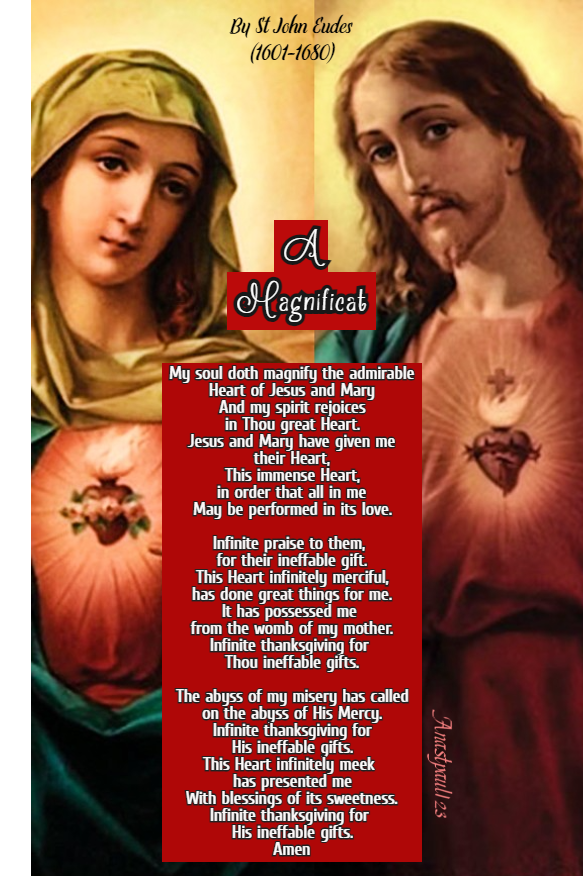
A Magnificat By St John Eudes (1601-1680) A Hymn of Praise and Thanksgiving to the Sacred Heart of Jesus and to the Holy Heart of Mary
My soul doth magnify the admirable Heart of Jesus and Mary And my spirit rejoices in Thou great Heart. Jesus and Mary have given me their Heart, This immense Heart, in order that all in me May be performed in its love.
Infinite praise to them, for their ineffable gift. This Heart infinitely merciful, has done great things for me. It has possessed me from the womb of my mother. Infinite thanksgiving for Thou ineffable gifts.
The abyss of my misery has called on the abyss of His Mercy. Infinite thanksgiving for His ineffable gifts. This Heart infinitely meek has presented me With blessings of its sweetness. Infinite thanksgiving for His ineffable gifts. Amen
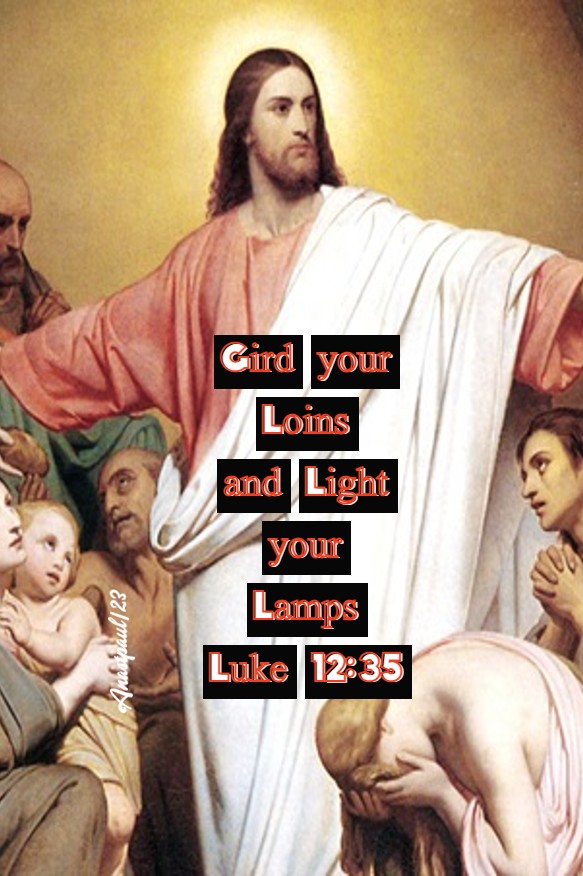
One Minute Reflection – 19August – “The Month of the Immaculate Heart of Mary” – St John Eudes (1601-1680) Confessor, “The Apostle of Two Hearts”– Sirach 31:8-11, Luke 12:35-40 – Scripture search here: https://www.drbo.org/
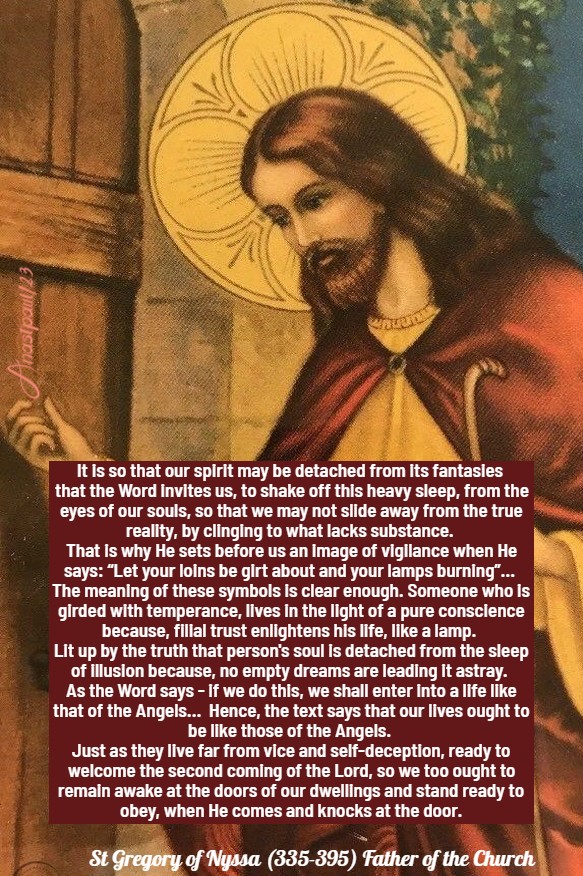
“Let your loins be girt about and your lamps burning …” – Luke 12:35
REFLECTION – “It is so that our spirit may be detached from its fantasies that the Word invites us, to shake off this heavy sleep, from the eyes of our souls, so that we may not slide away from the true reality, by clinging to what lacks substance. That is why He sets before us an image of vigilance when He says: “Let your loins be girt about and your lamps burning”… The meaning of these symbols is clear enough. Someone who is girded with temperance, lives in the light of a pure conscience because, filial trust enlightens his life, like a lamp. Lit up by the truth that person’s soul is detached from the sleep of illusion because, no empty dreams are leading it astray. As the Word says – if we do this, we shall enter into a life like that of the Angels…
Indeed, these are they who wait for the Lord at His return from the wedding and who are seated by the heavenly gates, with watchful eyes, so that the King of Glory (Ps 23:7) might once more pass through, when he returns from the marriage feast and enters again into the beatitude above the heavens. “Coming forth like the groom from his bridal chamber” (Ps 18:6)…, He united to Himself like a virgin, the nature we had prostituted to idols, once He had restored its virginal integrity, through sacramental regeneration. The nuptials, having now been accomplished, since the Church has been espoused by the Word… and brought into the chamber of His Mysteries, the Angels awaited the return of the King of Glory to the blessedness which matches His nature.
Hence, the text says that our lives ought to be like those of the Angels. Just as they live far from vice and self-deception, ready to welcome the second coming of the Lord, so we too ought to remain awake at the doors of our dwellings and stand ready to obey, when He comes and knocks at the door.” – St Gregory of Nyssa(335-395) Bishop, Father of the Church, Brother of St Basil the Great (Sermons on the Song of Songs No 11).
PRAYER – O God, Who wondrously enkindled St John, Thy Confessor, to promote the religious veneration of the Sacred Hearts of Jesus and Mary and through him, willed to found new religious families in the Church, grant, we beseech Thee that we may honour his holy merits and may learn from the example of his virtues. Through Jesus Christ, Thy Son our Lord, Who lives and reigns with Thee, in the unity of the Holy Ghost, God, world without end. Amen (Collect).
Our Morning Offering – 19 August – “The Month of the Immaculate Heart of Mary” – St John Eudes (1601-1680) Confessor, “The Apostle of Two Hearts”
Hail Mary! Prayer to the Immaculate Heart of Mary By St John Eudes (1601-1680) “The Apostle of Two Hearts”
Hail Mary! Mother of God the Son. Hail Mary! Spouse of the Holy Spirit. Hail Mary! Temple of the Most Blessed Trinity. Hail Mary! Pure Lily of the Effulgent Trinity. Hail Mary! Celestial Rose of the Ineffable Love of God. Hail Mary! Virgin pure and humble, of whom the King of Heaven willed to be born and, with thy milk to be nourished. Hail Mary! Virgin of Virgins, Hail Mary! Queen of Martyrs, whose soul a sword transfixed. Hail Mary! Lady most blessed! unto whom all power in Heaven and earth is given. Hail Mary! My Queen and my Mother! my Life, my Sweetness and my Hope, Hail Mary! Mother Most Amiable, Hail Mary! Mother of Divine Love, Hail Mary! Immaculate! Conceived Without Sin! Hail Mary! Full of Grace! The Lord is with Thee! Blessed art thou among women! And blessed is the Fruit of thy womb, Jesus! Blessed be thy spouse, Saint Joseph, Blessed be thy father, Saint Joachim, Blessed be thy mother, Saint Anne, Blessed be thy guardian, Saint John, Blessed be thy holy Angel, Saint Gabriel, Glory be to God the Father, Who chose thee, Glory be to God the Son, Who loved thee, Glory be to God the Holy Spirit, Who espoused thee.
O Glorious Virgin Mary, may all people love and praise the Amen!
Saint of the Day – 19 August – Blessed Hugh Green (c1584-1642) Priest, Martyr. Born in c1584 in London and died by a botched hanging and finally beheaded on 19 August 1642, at Dorchester, Dorset, England during the reign and persecutions of Charles I. Also known as – Ferdinand Brook/s or Ferdinand Brown. Additional Memorila on 29 October as one of the Martyrs of Douai. Hugh was Beatified on 15 December 1929 by Pope Pius XI.
Hugh Green was born in c1584 of Protestant parents. He took a Degree at Cambridge in 1605 but, in 1610, after converting to Catholicism Hugh travelled to Douai to study for the Priesthood.
He tried his vocation as a Capuchin Friar but left that Friars Minor in 1612, whereafter he was and was Ordained to the Priesthood and left to return to England as a Missionary to the persecuted Church.
Hugh returned to England and as a Chaplain at Chideock Castle, Dorset. Here Hugh served the Catholics of Dorset under the protection of Lady Blanche Arundell of Lanherne.
Just before the beginning of the Civil War, on 8 March 1641, Charles I, to placate the Puritan Parliament of England, issued a proclamation making the presence of Catholic Priests in England a crime punishable by death. Although Hugh intended to lpossibly eave England under this ban, he was too tardy in his exercise of this intention, probably because he could not desert his fellow Catholics, so much in need of their Priests.
He was captured near Lyme Regis, imprisoned and then executed on 19 August 1642. In prison his constancy so affected his fellow-captives that two or three women sentenced to die with him, sent him word that they would ask his absolution before death. They did so after confessing their sins on the scaffold to all the people watching the gruesome spectacle and were absolved by the Martyr, Fr Hugh.
The story of his execution is more appallingly cruel and barbaric than usual – there was no experienced executioner available, so a barber-cum-part-time-executioner spent almost half an hour trying to locate his heart while he was hanging by his neck on the scaffold. Finally, a soldier mercifully ended this torture by beheading him. When his head was severed, the Puritan mob used it as a football! As Archbishop Challoner noted, this was thankfully, not an event repeated in the annals of the English Martyrs.
Blessed Hugh Green is honoured at the Church of Our Lady, Queen of Martyrs and St Ignatius, Chideock, Dorset.
St Andrew the Tribune St Badulf of Ainay St Bertulf of Luxeuil St Calminius St Credan of Evesham St Donatus of Mount Jura St Elaphius of Châlons St Guenninus Bl Guerricus Blessed Hugh Green (c1584-1642) Priest Martyr
Blessed Jordan of Pisa OP (c 1255–1311) Dominican Friar, Theologian, Professor, renowned Preacher, Founder of the Confraternity of the Holy Redeemer at Pisa, Visionary, Marian devotee, promoter and daring innovator of the vernacular Italian language as a ‘church’ language and a tool for evangelisation. On 23 August 1833, Blessed Jordan’s cultus was confirmed by Pope Gregory XVI and in 1838 he was Beatified by Pope Gregory XVI. His Life: https://anastpaul.com/2019/08/19/saint-of-the-day-blessed-jordan-of-pisa-op-c-1255-1311/ St Julius of Rome
St Louis of Toulouse OFM (1274-1297) Prince and Bishop, Neapolitan Prince of the Capetian House of Anjou, Franciscan Friar and Priest, Apostle of Prayer, of Penance and of the poor and the sick. He had received the last sacraments on the Feast of the Assumption of Our Lady and on the 19th of August, 1297, while pronouncing the holy name of Mary, he yielded his soul to God. Because of the many miracles that were wrought at his tomb, he was Canonised as early as 1317, during the lifetime of his mother. Lovely St Louis: https://anastpaul.com/2020/08/19/saint-of-the-day-19-august-saint-louis-of-toulouse-ofm-1274-1297-prince-and-bishop/St Louis of Toulouse OFM (1274-1297) Prince and Bishop, Neapolitan Prince of the Capetian House of Anjou, Franciscan Friar and Priest, Apostle of Prayer, of Penance and of the poor and the sick. He had received the last sacraments on the Feast of the Assumption of Our Lady and on the 19th of August, 1297, while pronouncing the holy name of Mary, he yielded his soul to God. Because of the many miracles that were wrought at his tomb, he was Canonised as early as 1317, during the lifetime of his mother. Lovely St Louis: https://anastpaul.com/2020/08/19/saint-of-the-day-19-august-saint-louis-of-toulouse-ofm-1274-1297-prince-and-bishop/
St Magnus of Anagni St Magnus of Avignon St Magnus of Cuneo St Marianus of Entreaigues St Marinus of Besalu St Magino of Tarragona St Mochta St Namadia of Marsat St Rufinus of Mantua St Sarah the Matriarch St Sebaldus St Thecla of Caesarea St Timothy of Gaza
Martyrs of Nagasaki – 15 Beati: A group of missionaries and their laymen supporters who were executed for spreading Christianity in Japan. They are: Antonius Yamada, Bartholomaeus Mohyoe, Iacobus Matsuo Denji, Ioachim Díaz Hirayama, Ioannes Miyazaki Soemon, Ioannes Nagata Matashichi, Ioannes Yago, Laurentius Ikegami Rokusuke, Leo Sukeemon, Ludovic Frarijn, Marcus , kenoshita Shin’emon, Michaël Díaz Hori, Paulus Sankichi, Pedro de Zúñiga, Thomas Koyanag., They were beheaded on 19 August 1622 at Nagasaki, Japan and Beatified , 7 May 1867 by Pope Pius IX.
Thought for the Day – 18 August – Meditations with Antonio Cardinal Bacci (1881-1971)
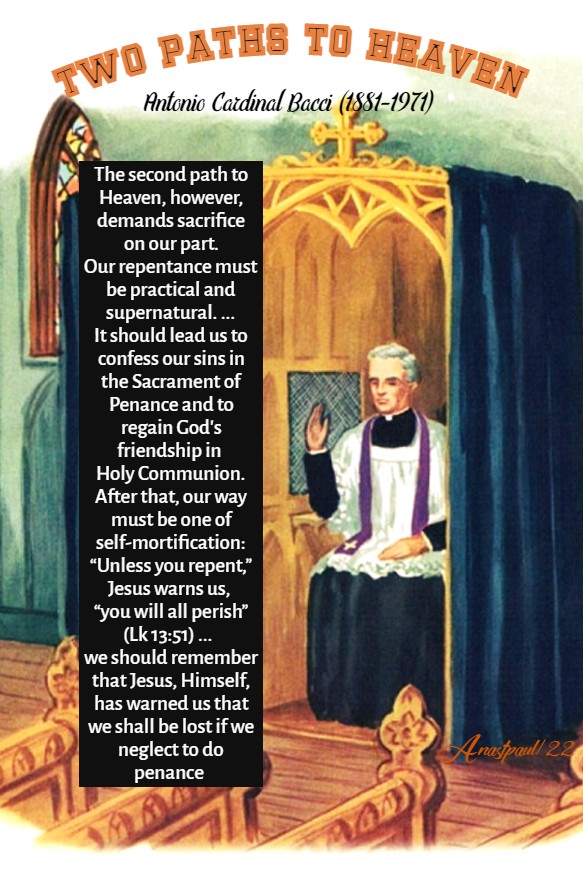
Two Paths to Heaven
“The second path to Heaven, however, demands sacrifice on our part. Our repentance must be practical and supernatural. It should lead us to confess our sins in the Sacrament of Penance and to regain God’s friendship in Holy Communion. After that, our way must be one of self-mortification: “Unless you repent,” Jesus warns us, “you will all perish” (Lk 13:51).
The first penance which we must perform, is to offer to God, all the physical and moral sufferings which are in store for us during life and at the hour of death. Then, we must add our own voluntary acts of self-denial. The generosity of the Saints, in this regard, was rewarded by the lasting friendship of God. As for ourselves, we should remember that Jesus, Himself, has warned us that we shall be lost if we neglect to do penance (Ibid).”
Quote/s of the Day – 18 August – “The Month of the Immaculate Heart of Mary” – Within the Octave of the Assumption of the Blessed Virgin into Heaven
“Mary is the new Tree of Life, who, instead of the bitter fruit picked by Eve, gives to mankind that Sweet Fruit on which the whole world is fed.”
St Ephrem (306-373) Father and Doctor of the Church
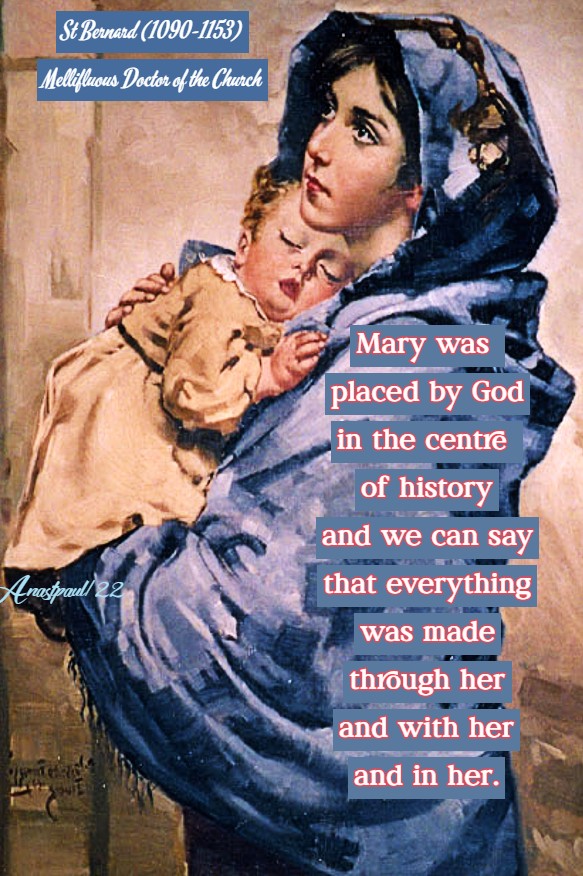
“Mary was placed by God in the centre of history and we can say that everything was made through her and with her and in her.”
“In the Immaculate Heart of Mary, I trust. Look to the Star, call upon Mary! In danger, in difficulty or in doubt, think of Mary, call upon Mary. Keep her name on your lips, never let it pass out of your heart.”
St Bernard (1090-1153) Mellifluous Doctor of the Church
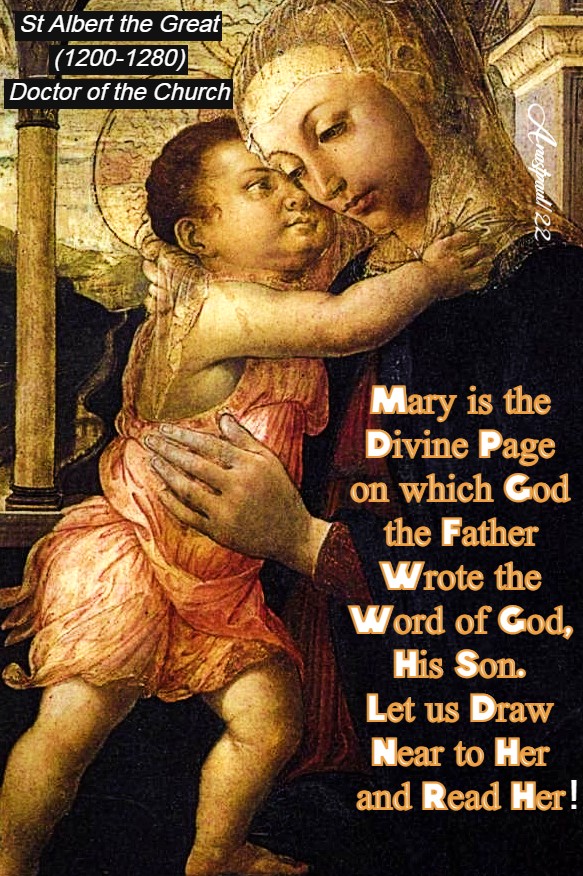
“Mary is the divine Page on which God the Father wrote the Word of God, His Son. Let us draw near to her and read her!”
St Albert the Great OP (1200-1280) Doctor of the Church
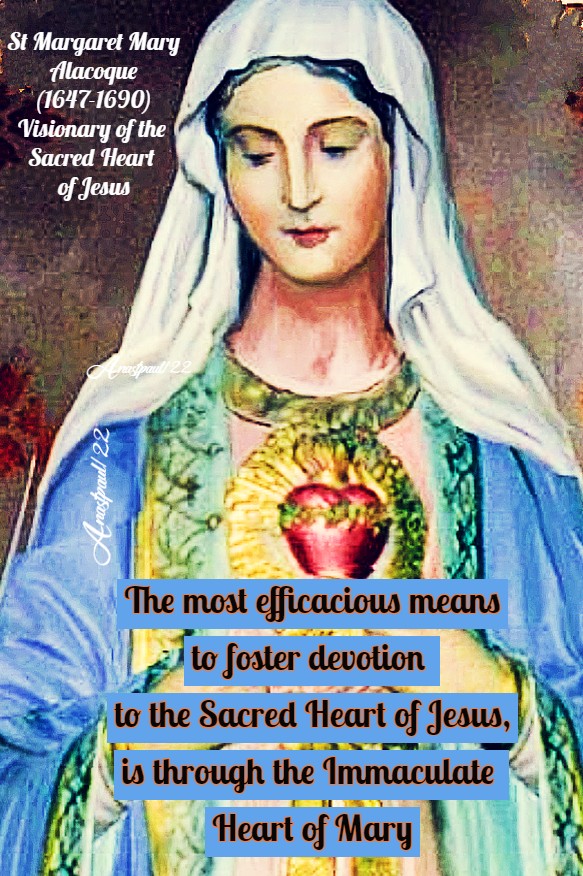
“The most efficacious means to foster devotion to the Sacred Heart of Jesus, is through the Immaculate Heart of Mary.”
St Margaret Mary Alacoque (1647-1690 Visionary of the Sacred Heart of Jesus
One Minute Reflection – 18 August – “The Month of the Immaculate Heart of Mary” – Within the Octave of the Assumption of the Blessed Virgin – Judith 13:22-25; 13:15; 13:10, Luke 1:41-50 – Scripture search here: https://www.drbo.org/
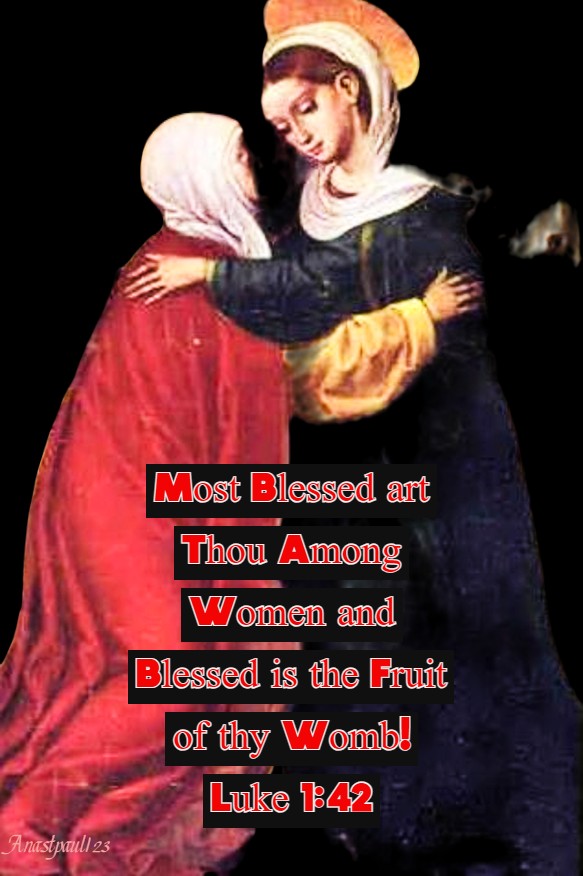
“Most blessed art thou among women and blessed is the fruit of thy womb.” – Luke 1:42
REFLECTION – “Let us honour the Queen of Heaven, Mother of life, Source of mercy, overflowing delights, leaning on her Beloved. Let us praise her, knowing full well that our praise will be insufficient.
Risen above the tallest trees of paradise and exalted above the highest peaks of mountains, she will penetrate Heaven with incredible majesty accompanied by the singing of the choirs of celestial Angels and surrounded by the dancing of Angels. Happy are those who dwell in Thy house, O Lord, they will praise Thee without end! In you we praise not Eve who introduced the poison but Mary who gave life, who is the Mother and nursemaid of all, the life of all the living. In you we praise even our own mother.
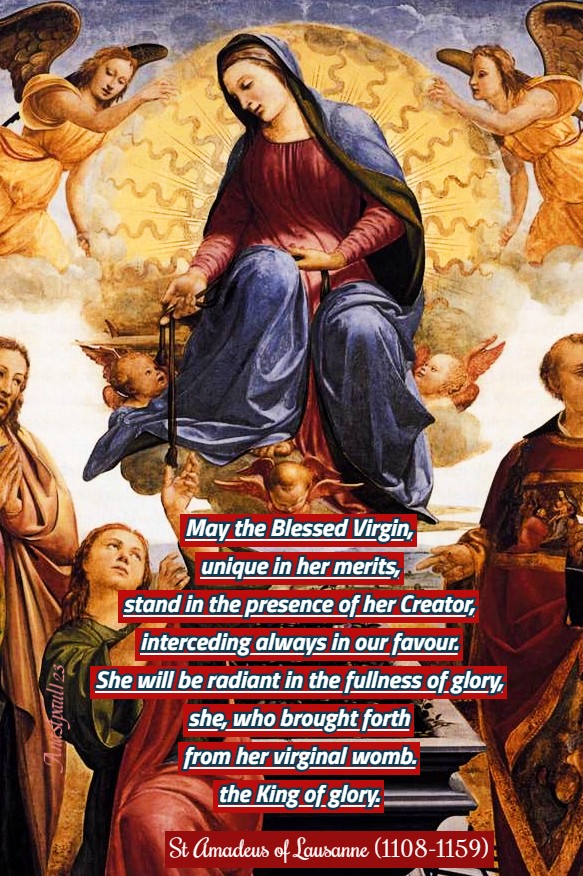
May all hear and rejoice, the humble Virgin rises, crowned, to the throne of glory, may the humble rejoice.May those who exalt themselves in their presumption fall. Mary, who gives herself as a holocaust to the fullness of grace. May the Blessed Virgin, unique in her merits, stand in the presence of her Creator interceding always in our favour. She will be radiant in the fullness of glory, she who brought forth from her virginal womb, the King of glory.” – St Amadeus of Lausanne (1108-1159) Bishop, Cistercian Monk (Marian Homily VIII).
PRAYER – O Lord, we beseech Thee, forgive the transgressions of Thy servants and, forasmuch as by our own deeds, we cannot please Thee, may we find safety through the prayers of the Mother of Thy Son and our Lord. Through the same Jesus Christ, Thy Son our Lord, Who lives and reigns with Thee, in the unity of the Holy Ghost, God, world without end. Amen (Collect).
Our Morning Offering – 18 August – “The Month of the Immaculate Heart of Mary” and the Memorial of St Macarius the Wonder-Worker (Died 850)
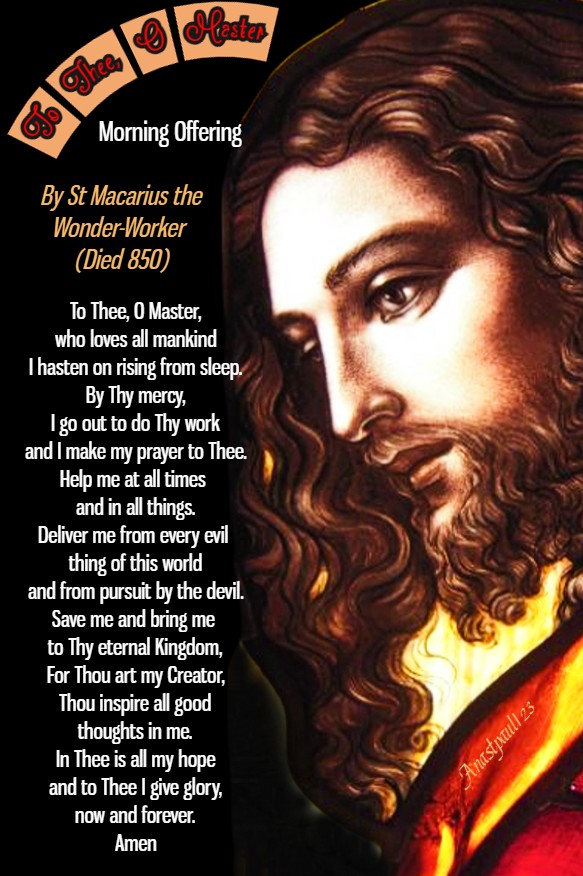
To Thee, O Master Morning Offering By St Macarius the Wonder-Worker (Died 850)
To Thee, O Master, who loves all mankind I hasten on rising from sleep. By Thy mercy, I go out to do Thy work and I make my prayer to Thee. Help me at all times and in all things. Deliver me from every evil thing of this world and from pursuit by the devil. Save me and bring me to Thy eternal Kingdom, For Thou art my Creator, Thou inspire all good thoughts in me. In Thee is all my hope and to Thee I give glory, now and forever. Amen
Saint of the Day – 18 August – Blessed Leonard of Cava (1232-1255) Abbot, an Administrator par excellence, a Peace-maker, a Monk devoted to the Rule of St Benedictine. He was known as a man of extraordinary gentleness and peace.
Portrait of a Benedictine Monk by Sir Anthony van Dijk
Successor of Blessed Balsamus, at the helm of the Benedictine Abbey of Trinità di Cava, he was elected on 13 December 1232, governing the Monastery for 23 years.
He was a sweet and peaceful man, wise and a skilled administrator. During the struggle between the Pope and the Emperor Frederick II which characterised the whole period, Leonard was able to manage all issues intelligently and highly effectively, without antagonising anyone, thus saving the Abbey from the prospect of closure and protecting its financial resources and treasures too.
In fact, Leonard was elected, by the Emperor in 1245, together with other Ecclesiastics, to plead his cause before the Council of Lyons – the Emperor himself and the Popes, Innocent IV and Alexander IV, multiplied the concessions and privileges to the Abbey, which assumed a notable role and importance throughout the Middle Ages.
A beautiful artwork of Trinità di Cava
He led by example and his brother Monks became known for their devotion to the Benedictine Rule. The Monks also generously assisted the people affected by the war. In 1249, the City of Benevento destroyed by the Germans, entrusted the Abbey with the custody of the Relics of St Bartolomew and the Diocesan treasury. When the Relics were returned to their rightful home, a portion of the head was donated and enshrined in the Abbey as a gift of appreciation.
The worthy and holy Abbot died on 18 August 1255 and was buried in the ‘Arsicia’ cave, the place incorporated into the Abbey Church, which was used by the Founder, St Alferius, as his initial hermitage.
In 1641 he was given a different burial in front of the choir door; currently his Relics are kept in a side Altar of the Abbey Church. His cult was confirmed by Pope Pius XI on 16 May 1928 – his liturgical Feast is celebrated on the date of his entrance into eternal life, 18 August.
St Crispus of Rome St Daig Maccairaill Bl Domenico de Molinar St Eonus of Arles St Ernan St Evan of Ayrshire St Firminus of Metz St Florus of Illyria Bl Francis of Francavilla Bl Gaspar di Salamanca St Hermas of Rome St John of Rome St Juliana of Myra St Juliana of Stobylum St Laurus of Illyria St Leo of Myra Blessed Leonard of Cava (1232-1255) Abbot St Maximus of Illyria Bl Milo of Fontenelle St Polyaenus of Rome St Proculus of Illyria
Blessed Rinaldo of Concorezzo (c 1245 – 1321) Bishop of Vicenza from 1296 until his 1303 appointment as the Archbishop of Ravenna-Cervia holding that until his death, Doctor of Canon Law, Papal envoy, Arbitrator and Peace-maker. Archbishop Rinaldo was also a close friend of Dante Alighieri. His Courageous Life: https://anastpaul.com/2020/08/18/saint-of-the-day-18-august-blessed-rinaldo-of-concorezzo-c-1245-1321/
St Ronan of Iona St Serapion of Rome
Massa Candida: Also known as Martyrs of Utica and the White Company: Three hundred 3rd Century Christians at Carthage, who were ordered to burn incense to Jupiter or face death by fire. Martyrs. Saint Augustine of Hippo and the poet Prudentius wrote about them. They were forced to cast themselves into a pit of burning lime c 253 at Carthage, North Africa.
Thought for the Day – 17 August – Meditations with Antonio Cardinal Bacci (1881-1971)
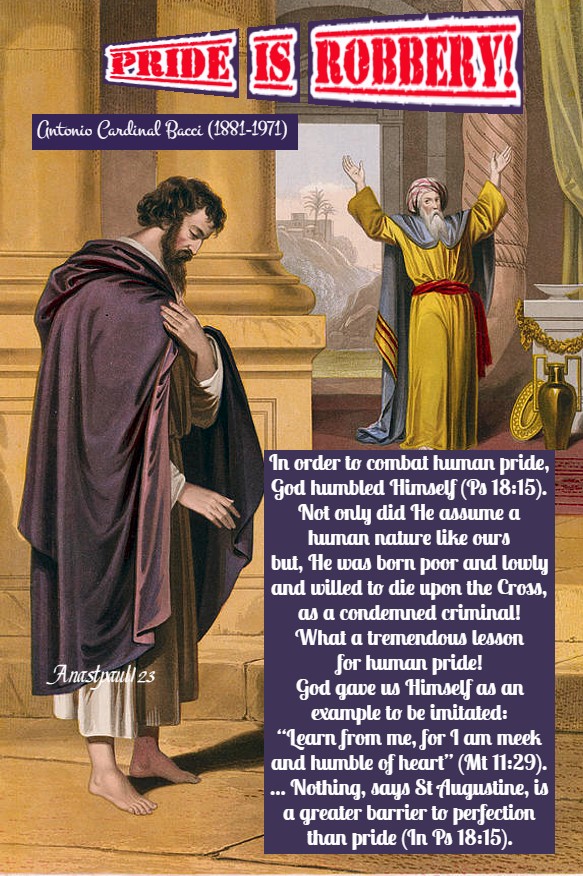
Pride is Robbery!
“In order to combat human pride, God humbled Himself (Ps 18:15). Not only did He assume a human nature like ours but, He was born poor and lowly and willed to die upon the Cross, as a condemned criminal!
What a tremendous lesson for human pride! God gave us Himself as an example to be imitated: “Learn from me, for I am meek and humble of heart” (Mt 11:29).
If we do not learn from this great lesson in humility, we shall never make any progress in the way of Christian perfection. Nothing, says St Augustine, is a greater barrier to perfection than pride (In Ps 18:15).
We must take care to lay the foundation stone of humility, therefore, before we can begin to build the edifice of Christian perfection.”
Quote/s of the Day – 17 August – St Hyacinth OP (1185-1257) ) Confessor – Sirach 31:8-11, Luke 12:35-40 – Scripture search here: https://www.drbo.org/
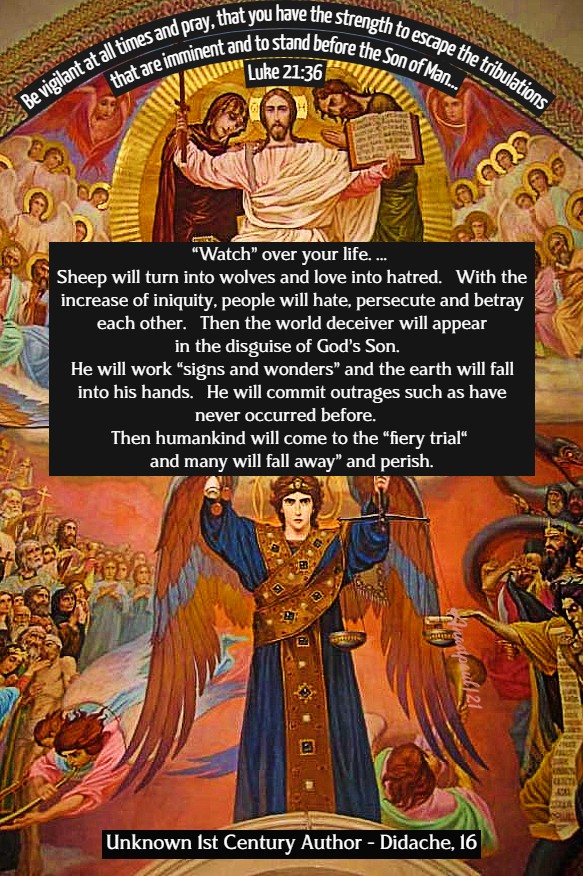
“Be vigilant at all times and pray, that you have the strength to escape the tribulations that are imminent and to stand before the Son of Man…” Luke 21:36
“Watch” over your life. … Sheep will turn into wolves and love into hatred. With the increase of iniquity, people will hate, persecute and betray each other. Then the world deceiver will appear in the disguise of God’s Son. He will work “signs and wonders” and the earth will fall into his hands. He will commit outrages such as have never occurred before. Then humankind will come to the “fiery trial“ and many will fall away” and perish.”
Unknown 1st Century Author (ACW) of this early Treatise (Didache, 16)
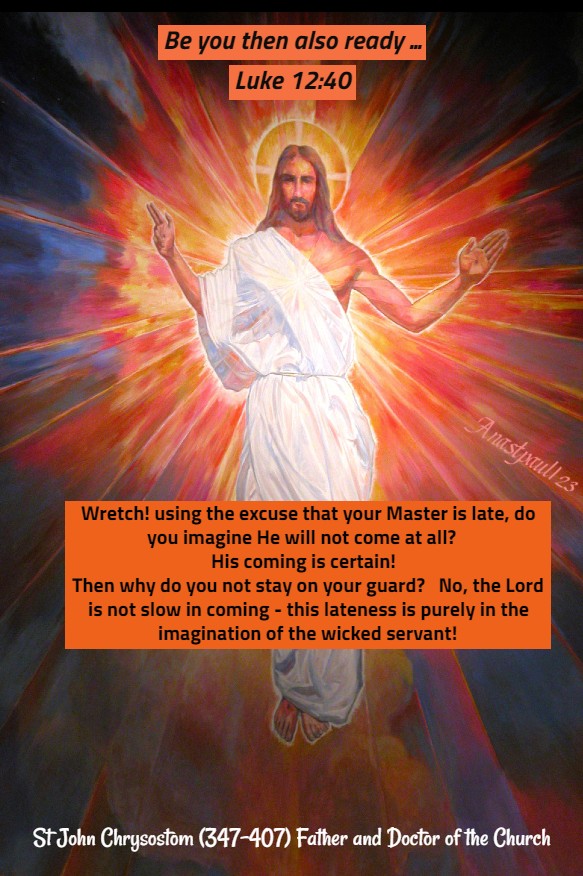
“Be you then also ready …” Luke 12:40
“Wretch! using the excuse that your Master is late, do you imagine He will not come at all? His coming is certain! Then why do you not stay on your guard? No, the Lord is not slow in coming – this lateness is purely in the imagination of the wicked servant!”
St John Chrysostom (347-407) Father and Doctor of the Church
“It is time now for us to rise from sleep!”
St Benedict (c 480-547)
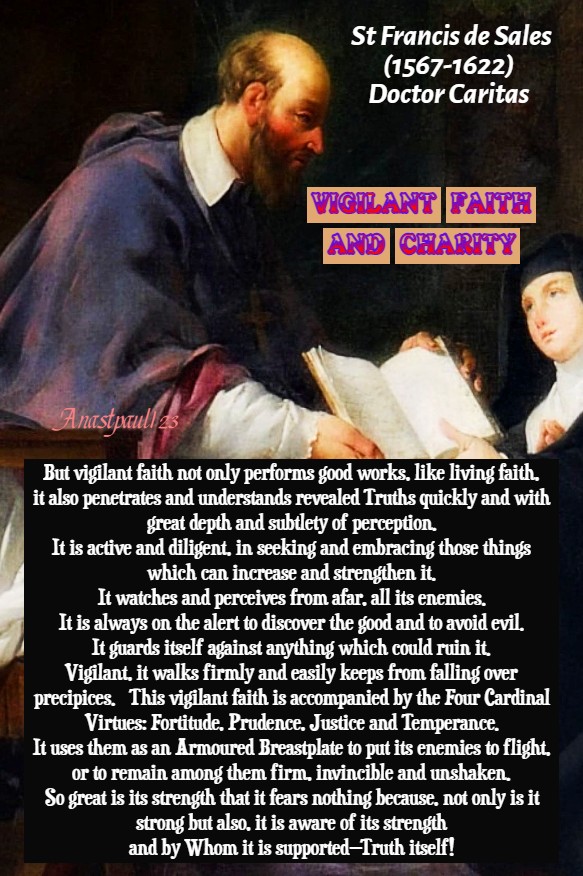
“But vigilant faith not only performs good works, like living faith, it also penetrates and understands revealed Truths quickly and with great depth and subtlety of perception. It is active and diligent, in seeking and embracing those things which can increase and strengthen it. It watches and perceives from afar, all its enemies. It is always on the alert to discover the good and to avoid evil. It guards itself against anything which could ruin it. Vigilant, it walks firmly and easily keeps from falling over precipices.
This vigilant faith is accompanied by the Four Cardinal Virtues: Fortitude, Prudence, Justice and Temperance. It uses them as an Armoured Breastplate to put its enemies to flight, or to remain among them firm, invincible and unshaken. So great is its strength that it fears nothing because, not only is it strong but also, it is aware of its strength and by Whom it is supported— Truth itself!”
(Sermon for Thursday after the First Sunday of Lent, 17 February 1622).
One Minute Reflection – 17 August – “The Month of the Immaculate Heart of Mary”– St Hyacinth OP (1185-1257) ) Confessor – Sirach 31:8-11, Luke 12:35-40 – Scripture search here: https://www.drbo.org/
“You also must be prepared, for at an hour you do not expect, the Son of Man will come.” – Luke 12:40
REFLECTION – “The Lord was looking to our days when He said, “When the Son of Man comes, will He find faith on earth?” (Lk 18:8) We see that what He foretold has come to pass. There is no faith in the fear of God, in the law of righteousness, in love, in good works …. That which our conscience would fear if it believed, it does not fear because it does not believe at all. If it believed, it would also take heed and if it took heed, it would be saved.
Therefore, beloved brothers, let us arouse ourselves as much as we can and break the slumber of our listlessness. Let us be watchful to observe and to do the Lord’s precepts. Let us be like He Himself, has bidden us to be, saying, “Gird your loins and light your lamps and be like servants who await their master’s return from a wedding, ready to open immediately, when He comes and knocks. Blessed are those servants, whom the Master finds vigilant on His arrival“.
We ought to be dressed for work, lest, when the day of setting forth comes, it should find us burdened and entangled. Let our light shine, in good works and glow, in such a way, as to lead us from the night of this world, to the daylight of eternal brightness. Let us always wait with solicitude and caution for the sudden coming of the Lord, so that when he knocks, our faith may be on the watch and receive from the Lord, the reward of our vigilance. If these commands be observed, if these warnings and precepts be kept, we will not be overtaken in slumber, by the deceit of the devil. But we shall reign with Christ in His Kingdom, as servants on the watch.” – St Cyprian (c 200-258) Bishop of Carthage and Martyr, Father of the Church (Treatise on the unity of the Church, 26-27).
PRAYER – God, Who gladden us with the annual feast of blessed Hyacinth, Thy Confessor, mercifully grant that, while honouring the anniversary of his death, we may also imitate his deeds. Through Jesus Christ, Thy Son our Lord, Who lives and reigns with Thee, in the unity of the Holy Ghost, God, world without end. Amen (Collect).
Our Morning Offering – 17 August – “The Month of the Immaculate Heart of Mary”
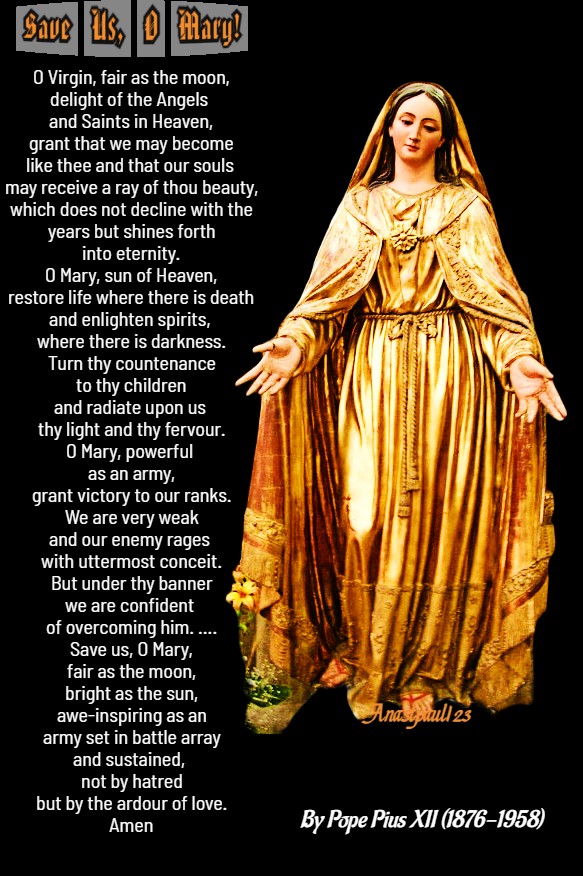
Save Us, O Mary! By Pope Pius XII (1876-1958) (Pontiff 1939-1958)
O Virgin, fair as the moon, delight of the Angels and Saints in Heaven, grant that we may become like thee and that our souls may receive a ray of thou beauty, which does not decline with the years but shines forth into eternity. O Mary, sun of Heaven, restore life where there is death and enlighten spirits, where there is darkness. Turn thy countenance to thy children and radiate upon us thy light and thy fervour. O Mary, powerful as an army, grant victory to our ranks. We are very weak and our enemy rages with uttermost conceit. But under thy banner we are confident of overcoming him. …. Save us, O Mary, fair as the moon, bright as the sun, awe-inspiring as an army set in battle array and sustained, not by hatred but by the ardour of love. Amen
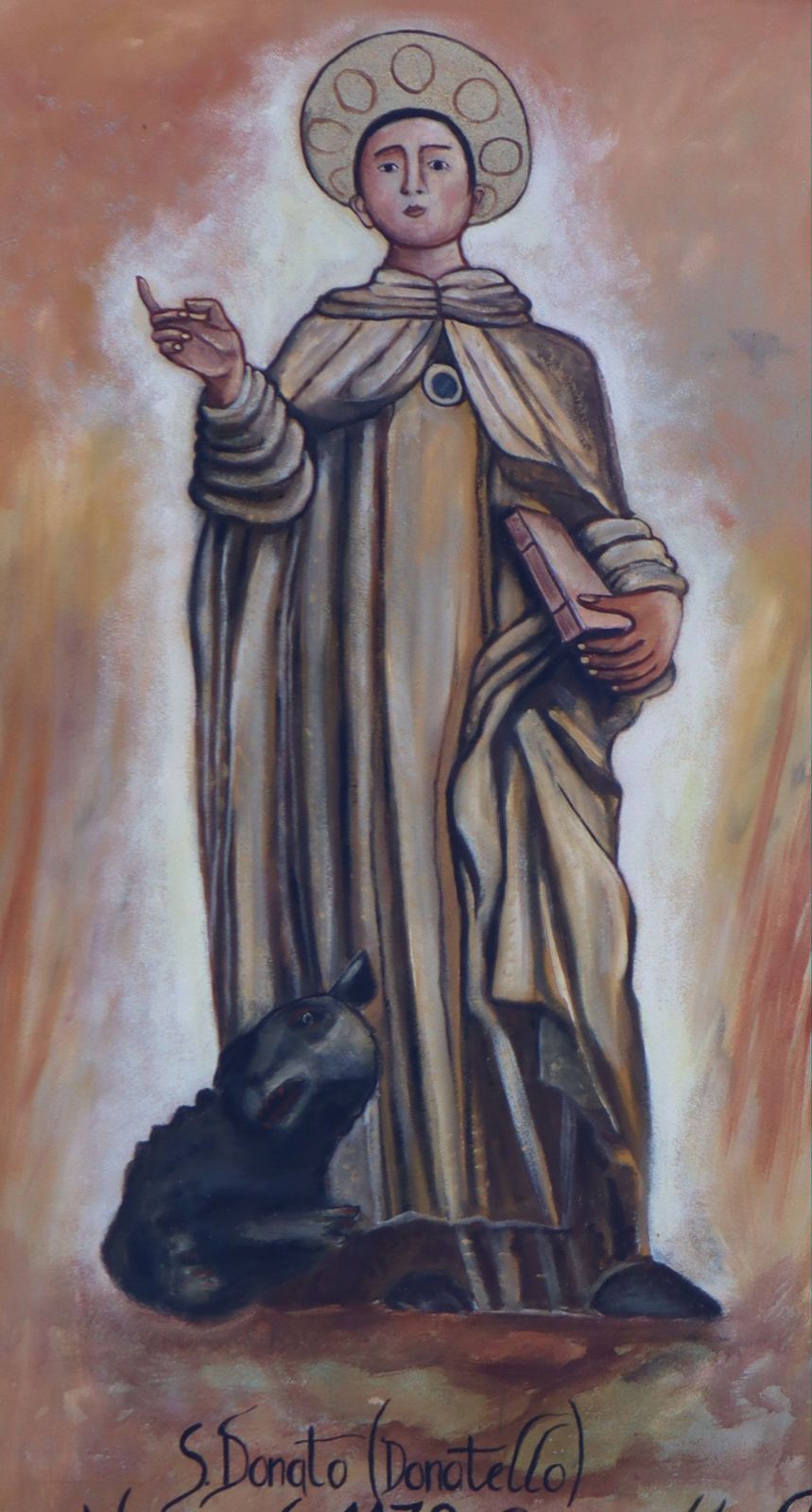
Saint of the Day – 17 August – St Donatus of Ripacandida OSB (1179-1198) Monk Born in 1179 at Ripacandida, Diocese of Rapallo, Italy and died on 17 August 1198 at the Onuphrios Monastery, near Petinand Salerno in Italy, of natural causes, aged just 19 years. Patronages – Auletta, Basilicata, Melfi, Montevergine, Rapolla, Ripacandida, Ruoti – all in Italy. Also known as – Donatello, Donato. The name of Donatus means “the gifted one” (Latin).
Mural next to the Church of San Donatus in Ripacandida
Donatus, son of a humble family, wanted to enter the Benedictine Monastery of Onuphrios near Petina, which is now in ruins, at the age of 14 but was rejected as too young. The following year Donatus was accepted into the Congregation founded by St William of Vercelli in the Monastery of Monte Vergine near Avellino. In 1195, Donatus returned, to the Onuphrios Monastery.
Ruins of Onuphrios Monastery at Petina
He strictly observed the Rules of the Order and practised obedience and self-denial. After a serious illness he died at the age of only 19 and the confreres saw a bright ray emanating from his dead body.
In 1202, at the request of his parents, Donatus’ bones were brought to Ripacandida. An arm Relic remained in the Donatus Chapel in Auletta near Salerno.
Donatus Church in Auletta with a relief of her Patron
The Church of San Donato in Ripacandida, which can be traced to 1054 and, at which a Monastery of Franciscan Observers was founded in 1605. This Church is is not dedicated to our Saint Donatus but to St Donatus of Arezzo, the Bishop and Martyr, whose Feast day occurs on 7 August. To distinguishthe two, our Saint today, St Donatus is ,therefore, referred to there as Donatello. Some researchers, therefore, regard the veneration of Donatus of Ripacandida, as a variant of the devotion to the once very popular St Donatus of Arezzo, which was widespread throughout Italy at that time.
St Amor of Amorbach St Anastasius of Terni St Benedicta of Lorraine St Carloman St Cecilia of Lorraine
St Clare of the Cross of Montefalco (c 1269-1308) Augustinian Nun and Abbess, before becoming a nun, St Clare was a member of the Third Order of St Francis (Secular), Mystic, Penitent, Spiritual adviser. Beatified by Pope Clement XII. On 8 December 1881, the Feast of the Immaculate Conception, Pope Leo XIII Canonised Clare. Her Life: https://anastpaul.com/2019/08/17/saint-of-the-day-17-august-saint-clare-of-the-cross-of-montefalco-c-1269-1308/
St Donatus of Ripacandida OSB (1179-1198) Monk St Drithelm St Elias the Younger St Eusebius of Sicily St James the Deacon St Jeroen of Noordwijk St Juliana of Ptolemais St Mamas St Myron of Cyzicus
St Nicolò Politi (1117-1167) Basilian Monk and Hermit. He was known for his miracles even during his childhood and was Venerated as a saint even before his death. St Nicolò was Canonised on 7SJune 1507, at Saint Peter’s Basilica, Rome, by Pope Julius II. About St Nicolò: https://anastpaul.com/2020/08/17/saint-of-the-day-17-august-st-nicolo-politi-1117-1167/





























 AnaStpaul
You must be logged in to post a comment.