Thought for the Day – 17 September – Meditations with Antonio Cardinal Bacci (1881-1971)
The Commandments and the Desires of Jesus Christ
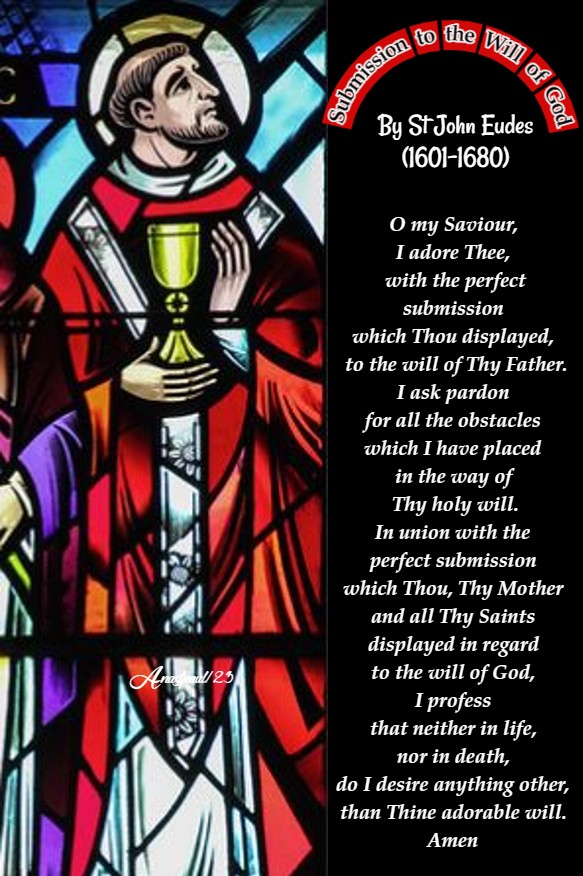
“O my Saviour, I adore Thee, with the perfect submission which Thou displayed to the will of Thy Father. I ask pardon for all the obstacles which I have placed in the way of Thy holy will. In union with the perfect submission which Thou, Thy Mother and all Thy Saints displayed in regard to the will of God, I profess that neither in life, nor in death, do I desire anything other, than Thine adorable will. Amen [St John Eudes (1601-1680)]”
Quote/s of the Day – 17 September – Ephesians 3:13-21, Luke 14:1-11 – Scripture search here: https://www.drbo.org/
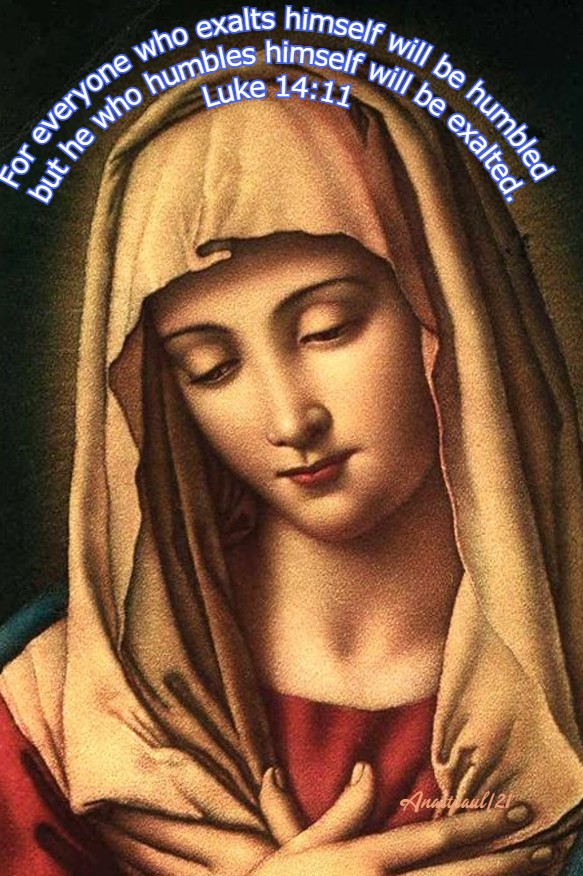
“For everyone who exalts himself, will be humbled and he who humbles himself, will be exalted.”
Luke 14:11
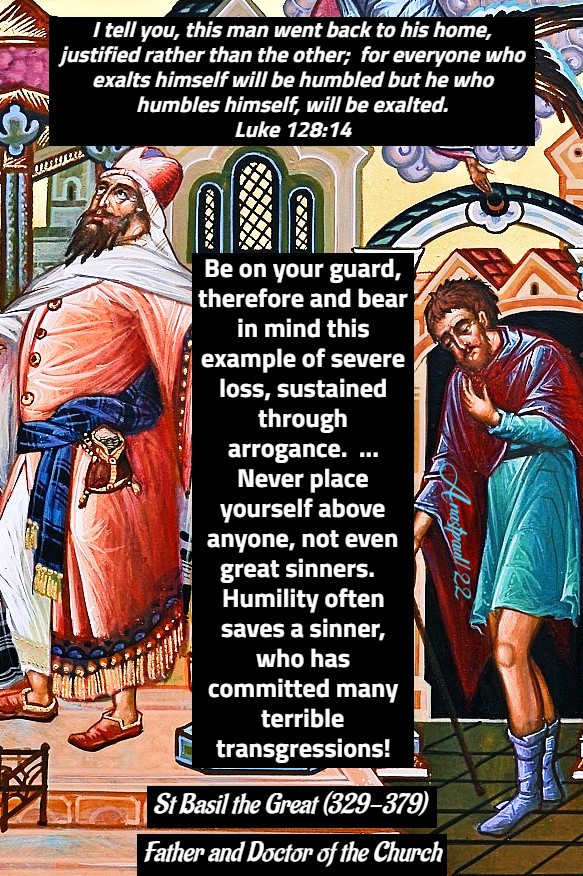
“I tell you, this man went back to his home justified, rather than the other; for everyone who exalts himself will be humbled but he who humbles himself, will be exalted” Luke 18:14
“Be on your guard, therefore and bear in mind, this example of severe loss, sustained through arrogance. … Never place yourself above anyone, not even great sinners. Humility often saves a sinner, who has committed many terrible transgressions!”
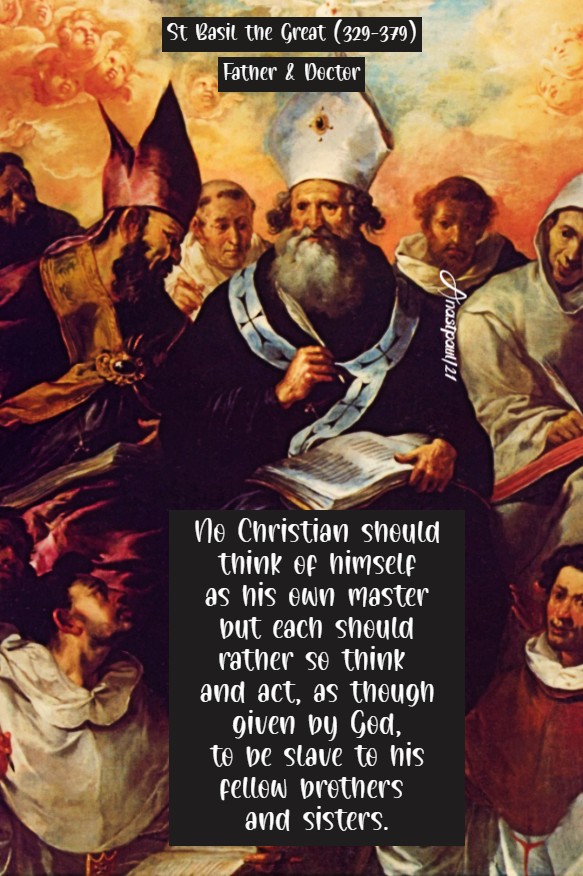
“No Christian should think of himself as his own master but each should rather so think and act, as though given by God, to be slave to his fellow brothers and sisters.”
St Basil the Great (329-379) Father and Doctor of the Church
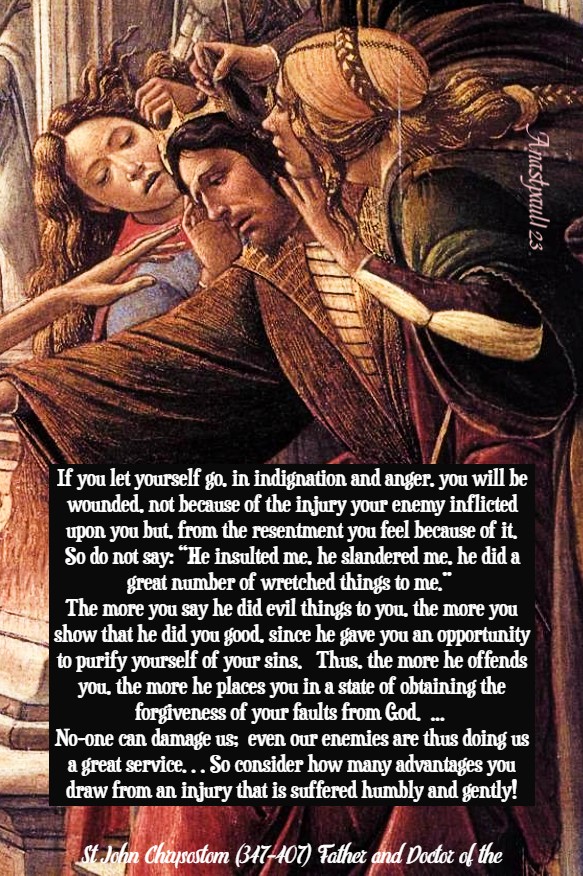
“What evil can your enemy do to you which would be comparable to that, which you do to yourself? … If you let yourself go, in indignation and anger, you will be wounded, not because of the injury your enemy inflicted upon you but, from the resentment you feel because of it. So do not say: “He insulted me, he slandered me, he did a great number of wretched things to me.” The more you say he did evil things to you, the more you show that he did you good, since he gave you an opportunity to purify yourself of your sins. Thus, the more he offends you, the more he places you in a state of obtaining the forgiveness of your faults from God. For if we want, no-one can damage us; even our enemies are thus doing us a great service… So consider how many advantages you draw from an injury that is suffered humbly and gently!”
St John Chrysostom (347-407) Father and Doctor of the Church
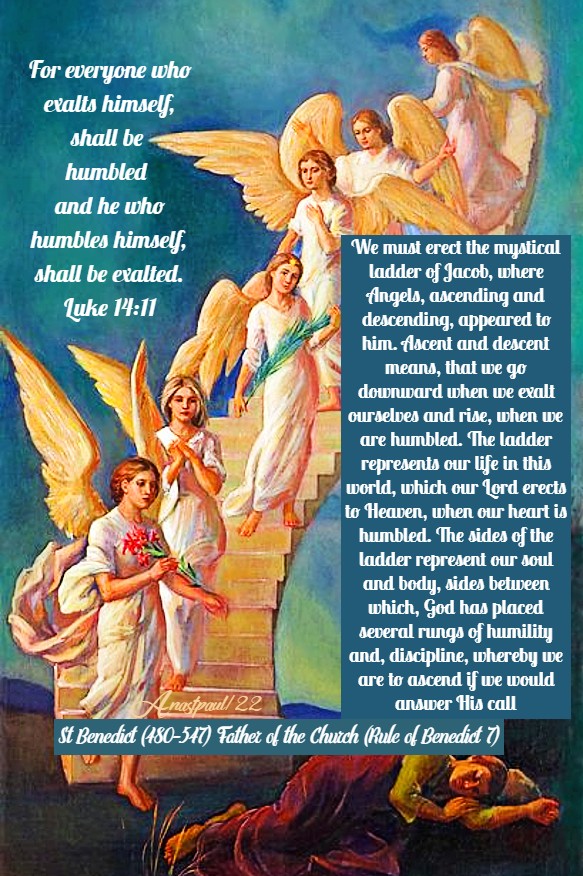
“We must erect the mystical ladder of Jacob, where Angels, ascending and descending, appeared to him. Ascent and descent means, that we go downward when we exalt ourselves and rise, when we are humbled. The ladder represents our life in this world, which our Lord erects to Heaven, when our heart is humbled. The sides of the ladder represent our soul and body, sides between which, God has placed several rungs of humility and, discipline, whereby we are to ascend if we would answer His call.”
One Minute Reflection – 17 September – Solemnity of the Seven Sorrows of the Blessed Virgin Mary – The 16th Sunday after Pentecost – The Commutation of the Stigmata of St Francis of Assisi – Ephesians 3:13-21, Luke 14:1-11 – Scripture search here: https://www.drbo.org/
“For everyone who exalts himself, shall be humbled and he who humbles himself, shall be exalted.” – Luke 14:11
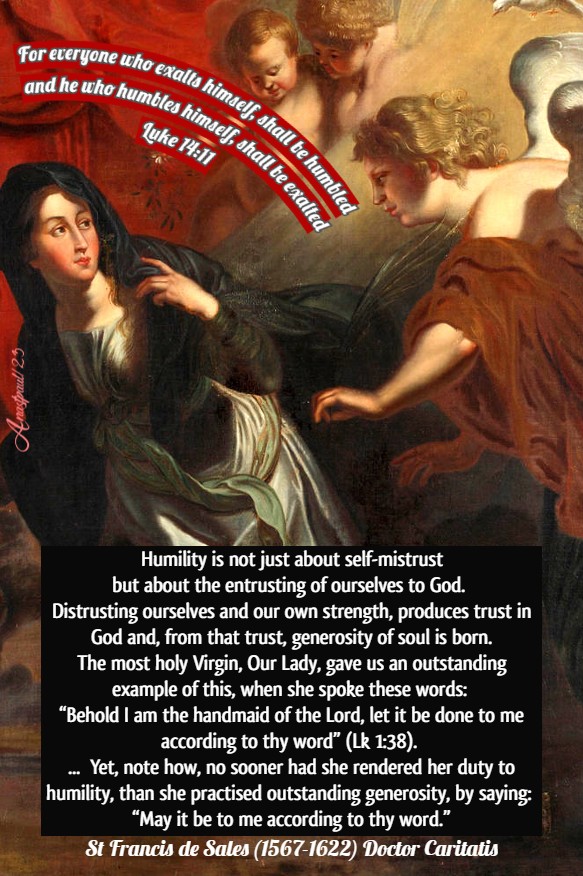
REFLECTION – “Humility is not just about self-mistrust but about the entrusting of ourselves to God. Distrusting ourselves and our own strength, produces trust in God and, from that trust, generosity of soul is born.The most holy Virgin, Our Lady, gave us an outstanding example of this, when she spoke these words: “Behold I am the handmaid of the Lord, let it be done to me according to thy word” (Lk 1:38). When she said she was the handmaid of the Lord, she was performing, the greatest act of humility, it is possible to do and, all the more so, in that, she was contradicting the praise given her by the Angel – that she would be mother of God, that the child to be born from her womb would be called Son of the Most High, a greater dignity than any we might imagine – I say, she opposed her lowliness and unworthines,to all these praises and greatness, by saying that she was the handmaid of the Lord. Yet, note how, no sooner had she rendered her duty to humility, than she practised outstanding generosity, by saying: “May it be to me according to thy word.”
What she wanted to say was – “It is true, I am in no way capable of this grace, if one is to consider ,what I am, of myself but, insofar as what is good in me, comes from God and what thou say to me, is His own most holy will, I believe it can happen and will happen.” And so, without the least hesitation, she said: “Let it be done to me according to thou word.” – St Francis de Sales (1567-1622) Bishop of Geneva, Doctor Caritatis (Conversations 5).
PRAYER – O Lord, Jesus Christ, Who, to inflame our hearts with the fire of Thy love, when the world was becoming cold in spirit, renewed in the flesh of most blessed Francis, the sacred marks of Thine own Passion, graciously grant that by his merits and prayers, we may steadfastly carry our cross and bring forth worthy fruits of penance. Through the same Jesus Christ, Thy Son our Lord, Who lives and reigns with Thee, in the unity of the Holy Ghost, God, world without end. Amen (Collect).
Our Morning Offering – 17 September – The 16th Sunday after Pentecost
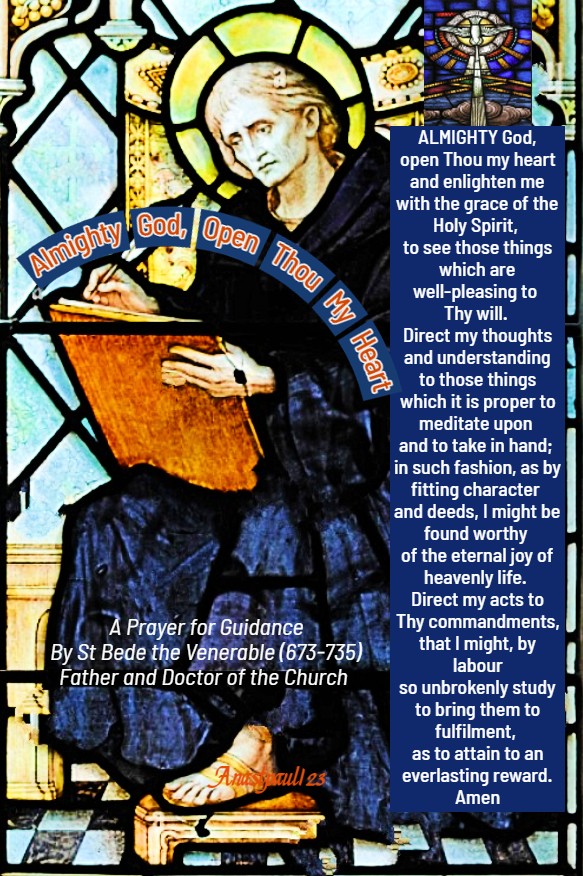
Almighty God, Open Thou My Heart A Prayer for Guidance By St Bede the Venerable (673-735) Father and Doctor of the Church
ALMIGHTY God, open Thou my heart and enlighten me with the grace of the Holy Spirit, to see those things which are well-pleasing to Thy will. Direct my thoughts and understanding to those things which it is proper to meditate upon and to take in hand; in such fashion, as by fitting character and deeds, I might be found worthy of the eternal joy of heavenly life. Direct my acts to Thy commandments, that I might, by labour so unbrokenly, study to bring them to fulfilment, as to attain to an everlasting reward. Amen
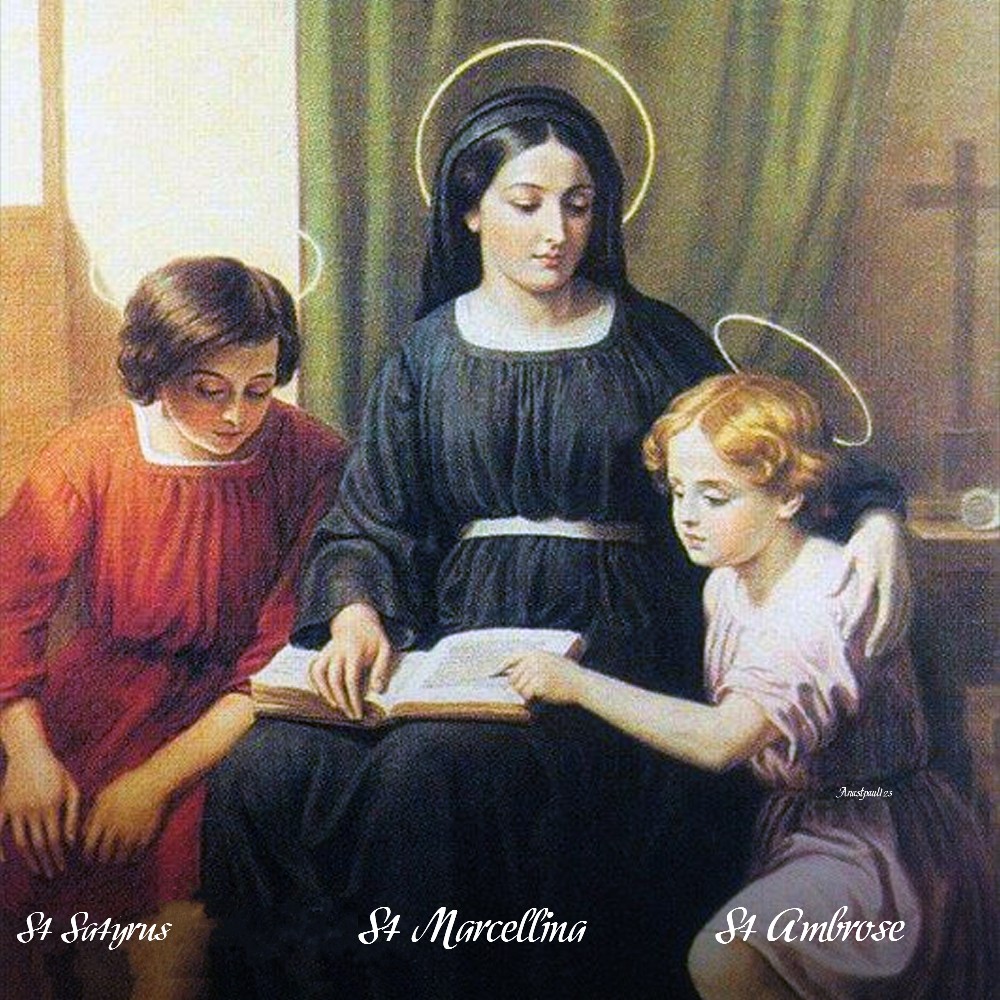
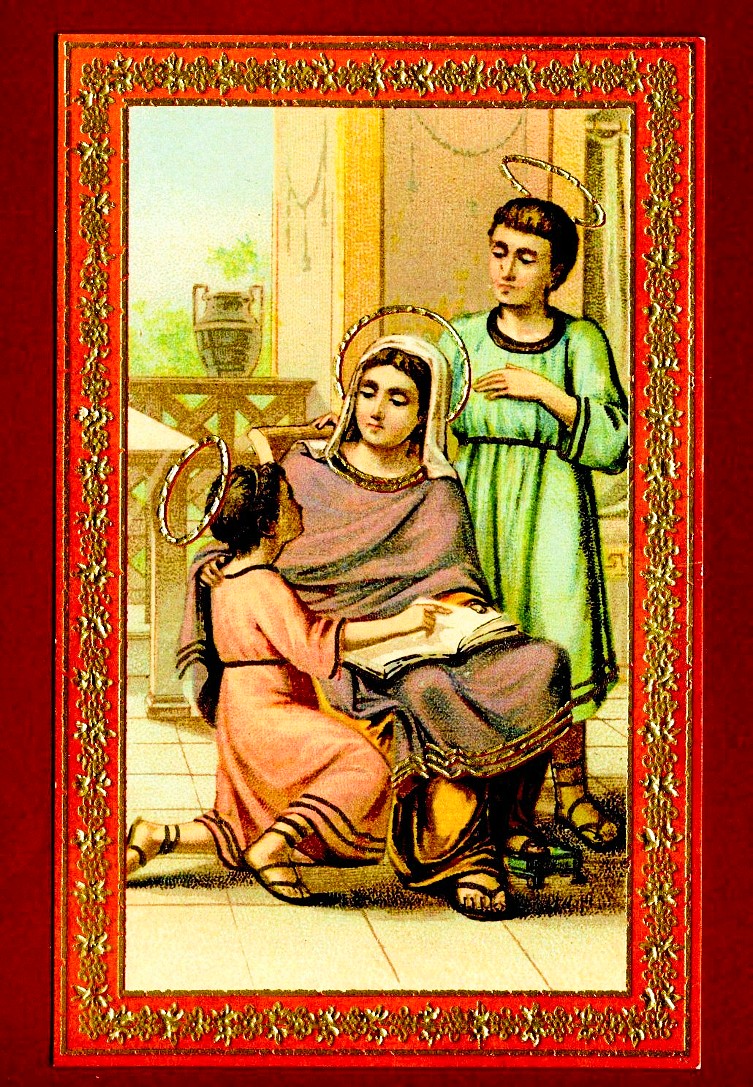
Saint of the Day – 17 September – St Satyrus of Milan (c335-c378) Confessor, Layman. Older brother of St Aurelius Ambrose (340-397) Father and Doctor and St Marcellina (c330-c398) Consecrated Virgin. Born as Uranio Satiro, probably in Trier, Germany and died in 378 in Milan of natural causes. Patronages – of Sacristans of the Archdiocese of Milan.
The Roman Martyrology reads today: “At Milan, the departure from this world of St Satyrus, Confessor, whose distinguished merits are mentioned by his brother, St Ambrose.”
Our only sources for Satyrus’ life are two orations delivered by his brother, one on the day of his death and the other, a week later. We know that he was the second of their parents’ three children, born after their sister, Marcellina; this puts his birth somewhere around 335, before his brother’s in 340, at either Trier, where their father reigned as Governor of a Roman Province, or at Rome. Being of the Senatorial Aristocracy, both brothers followed in the path of their father’s career and served as Governors of Roman Provinces but that assigned to Satyrus is unknown.
In 374, when St Ambrose was appointed as the Bishop of Milan, his brother left public office in order to help him with the administration of the Diocese, as well as to care for their sister and the family patrimony. St Ambrose praises him for his chastity in terms that clearly indicate that he was not married.
More than once, these duties required Satyrus to travel to Africa. Like many men of his class and period, whose public responsibilities were difficult to reconcile with the discipline of a Christian life, he long remained a Catechumen. (St Ambrose himself was a Catechumen at the time of his election as Bishop by popular acclamation. The Ambrosian Rite adds a commemoration of his Baptism to the Mass of St Andrew the Apostle on 30 November and keeps his principal Feast only a week later, on the day of his Episcopal Ordination). Ambrose, however, notes the following episode, in proof of his strong faith.
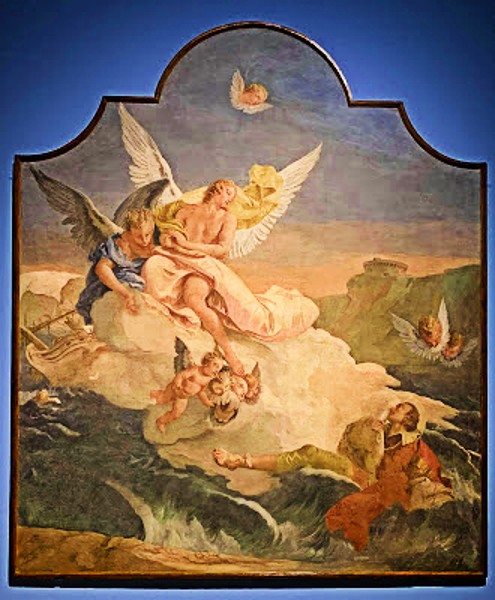
The Shipwreck of St Satyrus, by Giambattista Tiepolo, 1737′ It is kept in the Chapel dedicated to him, where his Relics were formerly kept, also within the Basilica of St Ambrose.
On Satyrus’ return from the last of his African journeys, his ship was wrecked on shoals, just off the coast of either Sicily or Sardinia. Before jumping off the boat, one of his fellow passengers gave him, at his request, a small piece of the Blessed Sacrament, which he then wrapped up in a small cloth and fastened around his neck. St Ambrose attributes his safe deliverance from the sea, to this, noting that Satyrus’ faith in God was so strong that he did not even bother to grab onto one of the planks of the broken vessel. After safely reaching land, he decided to be Baptised. He had, however, evidently already contracted the unknown disease which would take his life shortly thereafter. Having returned to Milan, he died in either 378 or 379 in the arms of his two siblings.
Devotion to St Satyrus is first attested in the 9th Century, when Anspert, Archbishop of Milan, built a small Church dedicated to him, his brother and St Silvester. This was later absorbed into a Church constructed by the Architect Donatello Bramante in 1476-1482 which is still, to this day, known as “St Mary near St Satyrus.” His name first appears in Liturgical books of the Ambrosian Rite in the 10th Century. In view of his role as his brother’s assistant in the administration of the Diocese, he is traditionally honoured in Milan as the Patron Saint of Sacristans.
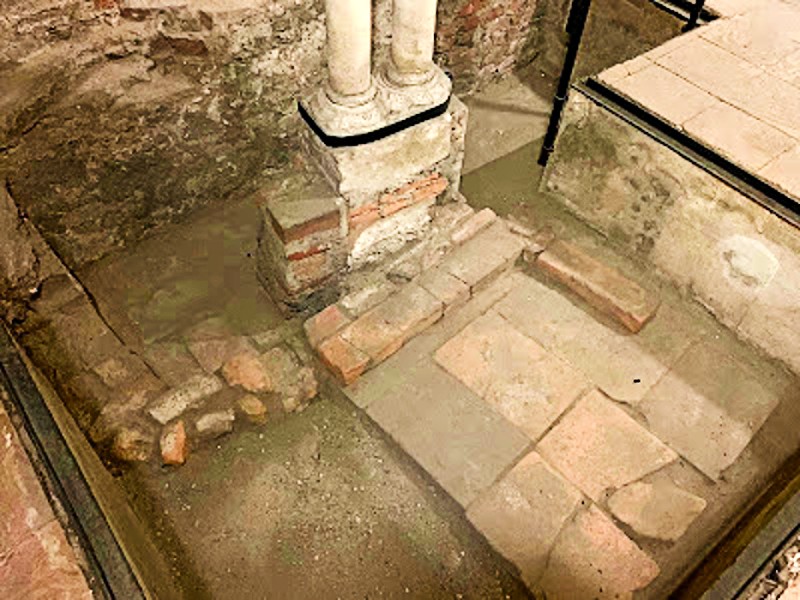
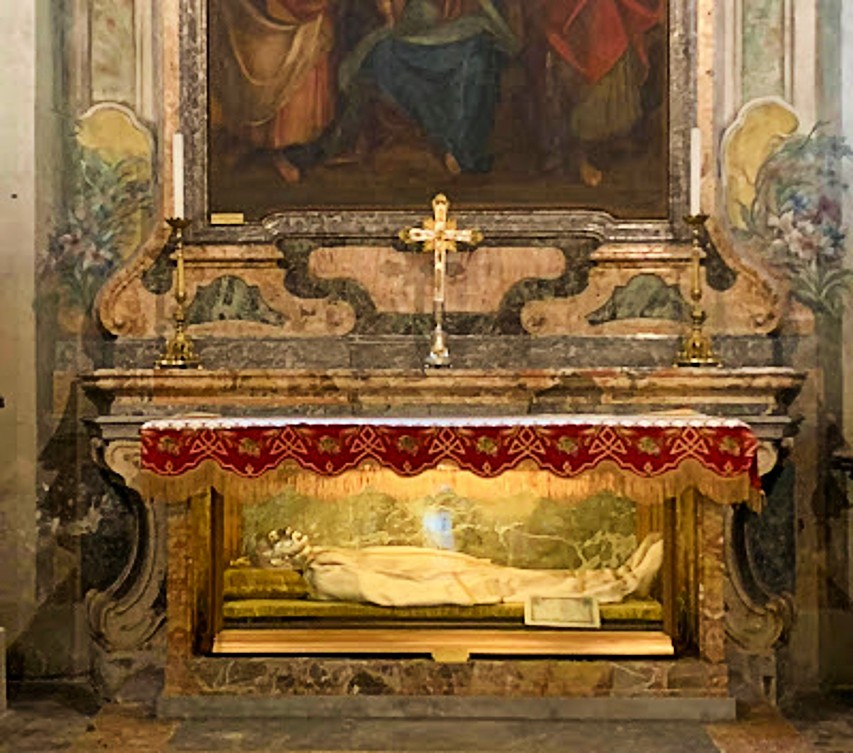
The original location of St Satyrus’ burial within the Chapel of St Victor.
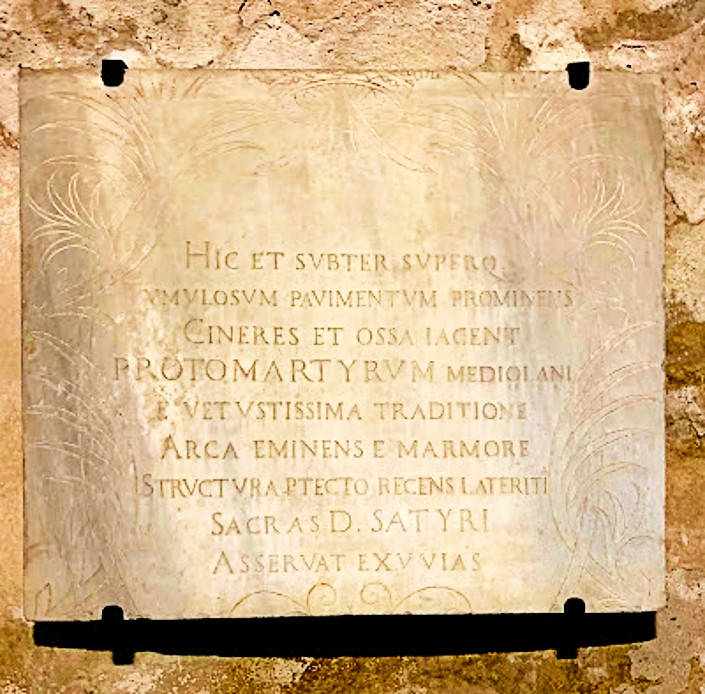
An inscription which notes the site as the place of his burial, alongside several early Martyrs of the Church of Milan.
The story told above about the shipwreck, forms a large part of the Ambrosian Preface for the Mass of St Satyrus:
“Truly it is worthy… eternal God, unceasingly praising Thy glory and proclaiming Thy greatness in Thy Saints. Who didst grant Thy blessed Confessor, Satyrus, such an abundance of virtues that he, having become, in many affairs, the colleague of his brother, the glorious Bishop Ambrose, the foremost Doctor and teacher of the Churches, was, for his diligence, deemed a most faithful and excellent champion of Christ, Thy Son. For while yet in the first service of the Faith, he so distinguished himself that, amid the waves of the sea, when he would have perished miserably by the wreck of his ship, although he was not yet washed by holy Baptism, he still did not lack for trust in Thy help. Therefore, he placed the Sacrament of the Lord’s Body, enclosed in a cloth, around his neck and did not hesitate, to entrust himself, to the frothing sea, supported by such an oar. And Thy, most mighty Right Hand which in the waves lifted up Peter, the Prince of the Apostles, lest he drown, with like power also brought this man safe and unharmed to the shore. This, O Lord, is the working of the fullness of Thy might. Through the same Christ our Lord. Through Whom the Angels praise Thy majesty…” (GREGORY DIPIPPO)
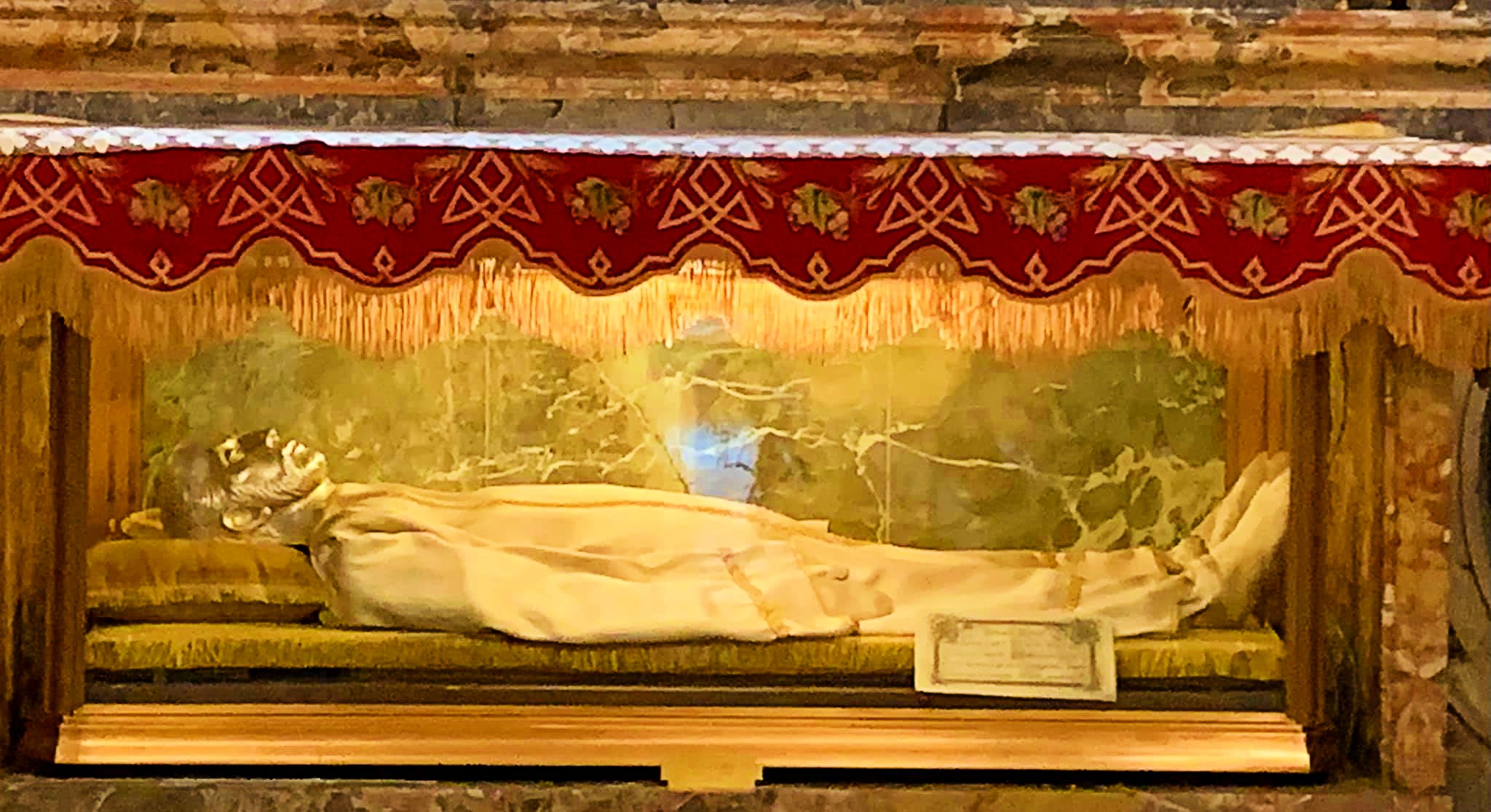
Right side Nave of St Ambrose Basilica. Saint Bartholomew and Saint Satyrus baroque-style Chapel. It preserves the Relics of Satyrus.
St Rodingus St Satyrus of Milan (c335-c378) Confessor, Older brother of St Ambrose (340-397) Father and Doctor and St Marcellina (c330-c398) Consecrated Virgin St Socrates St Stephen St Theodora St Uni of Bremen






 AnaStpaul
You must be logged in to post a comment.