Thought for the Day – 19 September – Meditations with Antonio Cardinal Bacci (1881-1971)
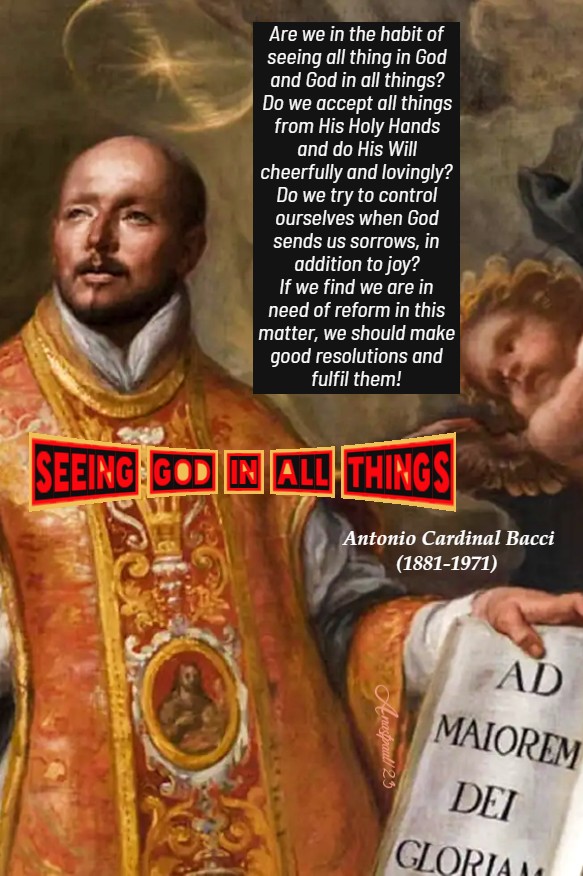
Seeing God in All Things
“Are we in the habit of seeing all thing in God and God in all things? Do we accept all things from His Holy Hands and do His Will cheerfully and lovingly?
Do we try to control ourselves when God sends us sorrows, in addition to joy? If we find we are in need of reform in this matter, we should make good resolutions and fulfil them!”
Quote/s of the Day – 19 September – Hebrews 10:32-38, Matthew 24:3-13 – Scripture search here: https://www.drbo.org/
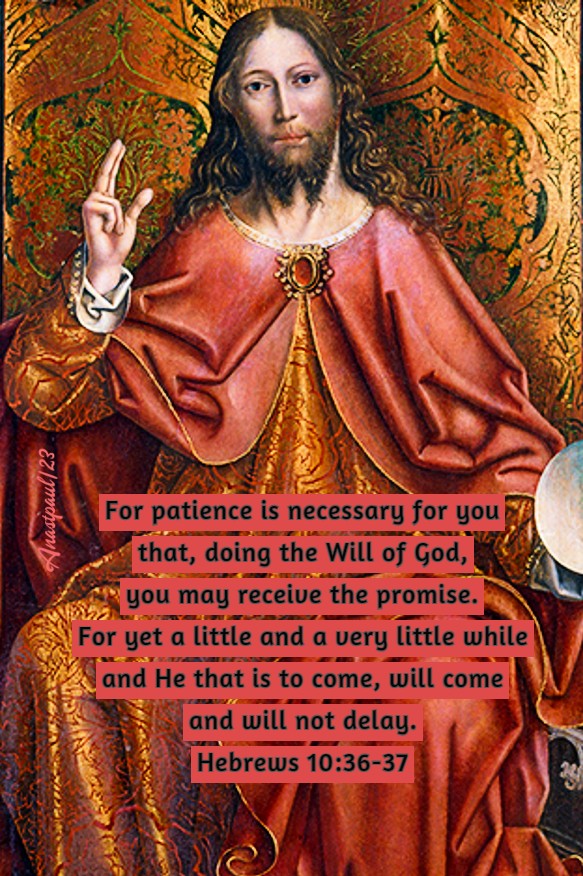
“For patience is necessary for you that, doing the Will of God, you may receive the promise. For yet a little and a very little while and He that is to come, will come and will not delay.”
Hebrews 10:36-37
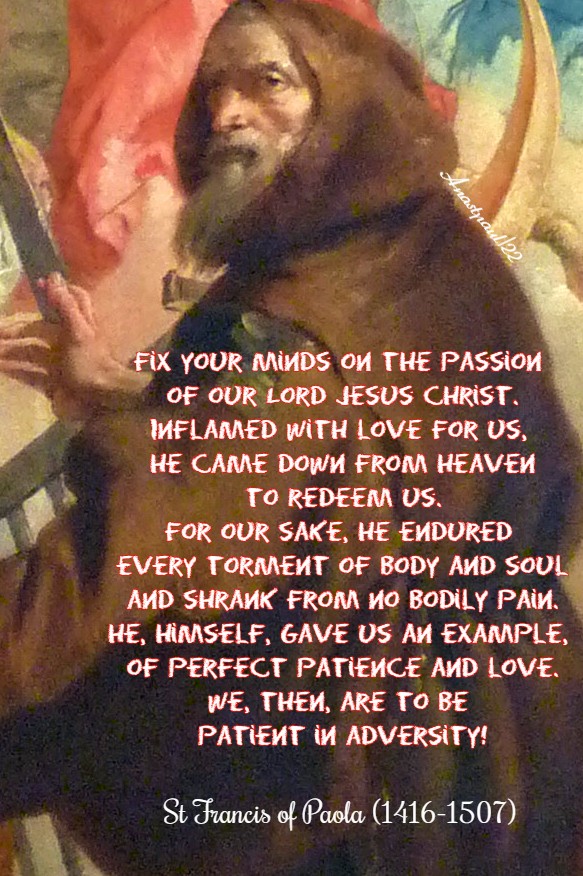
“Fix your minds on the Passion of our Lord Jesus Christ. Inflamed with love for us, He came down from Heaven to redeem us. For our sake, He endured every torment of body and soul and shrank from no bodily pain. He, Himself, gave us an example of perfect patience and love. We, then, are to be patient, in adversity!”
St Francis of Paola (1416-1507)
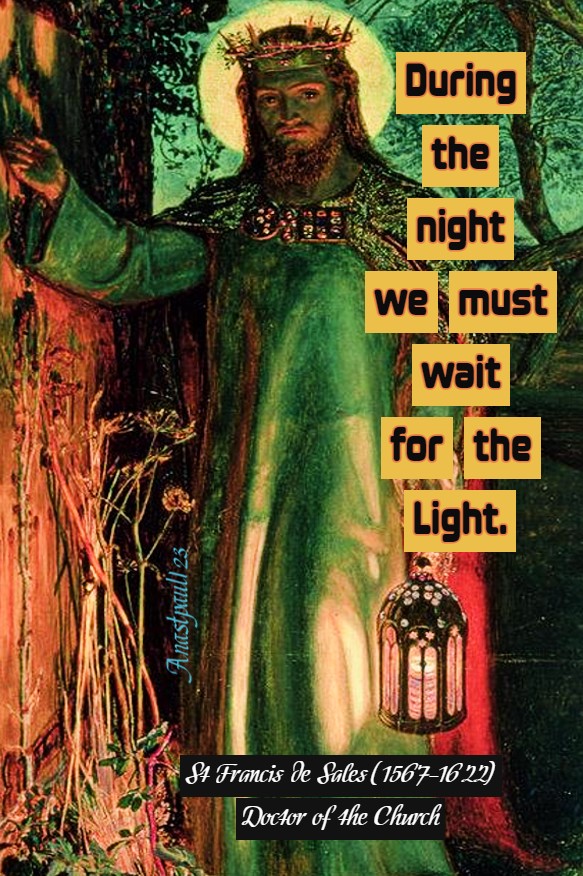
“During the night we must wait for the Light.”
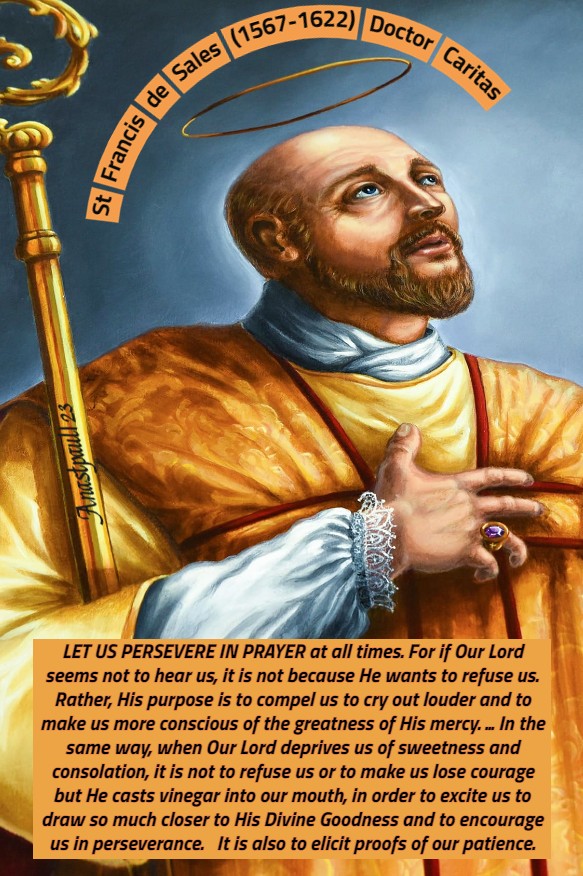
“LET US PERSEVERE IN PRAYER at all times. For if Our Lord seems not to hear us, it is not because He wants to refuse us. Rather, His purpose is to compel us to cry out louder and to make us more conscious of the greatness of His mercy. … In the same way, when Our Lord deprives us of sweetness and consolation, it is not to refuse us or to make us lose courage but He casts vinegar into our mouth, in order to excite us to draw so much closer to His Divine Goodness and to encourage us in perseverance. It is also to elicit proofs of our patience.”
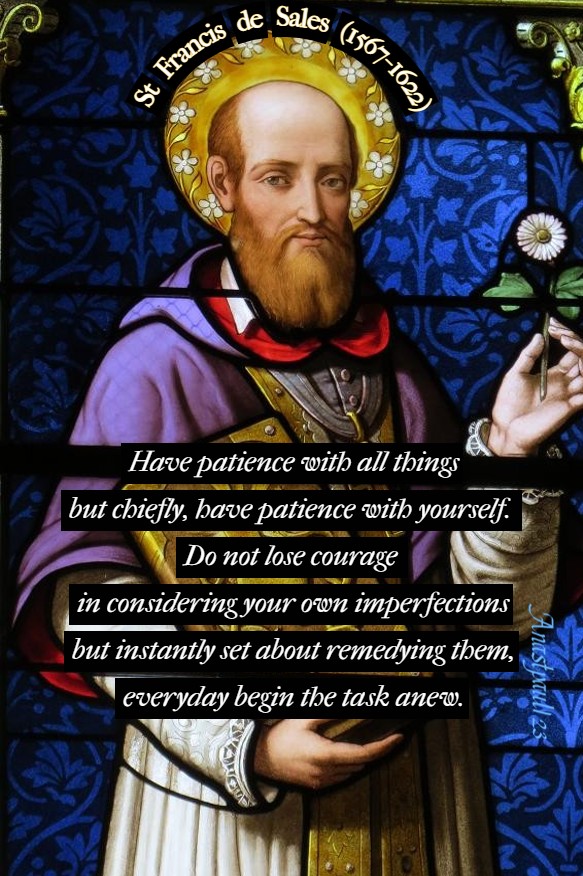
“Have patience with all things but chiefly, have patience with yourself. Do not lose courage in considering your own imperfections but instantly set about remedying them, everyday begin the task anew.”
St Francis de Sales (1567-1622) Doctor of the Church
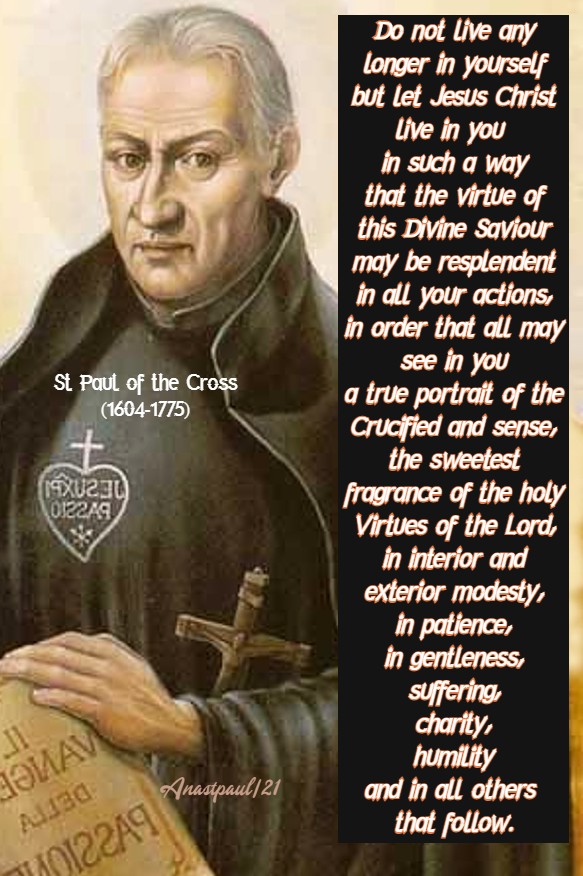
“Do not live any longer in yourself but let Jesus Christ live in you in such a way that the virtue of this Divine Saviour may be resplendent in all your actions, in order that all may see in you a true portrait of the Crucified and sense, the sweetest fragrance of the holy virtues of the Lord, in interior and exterior modesty, in patience, in gentleness, suffering, charity, humility and in all others that follow.”
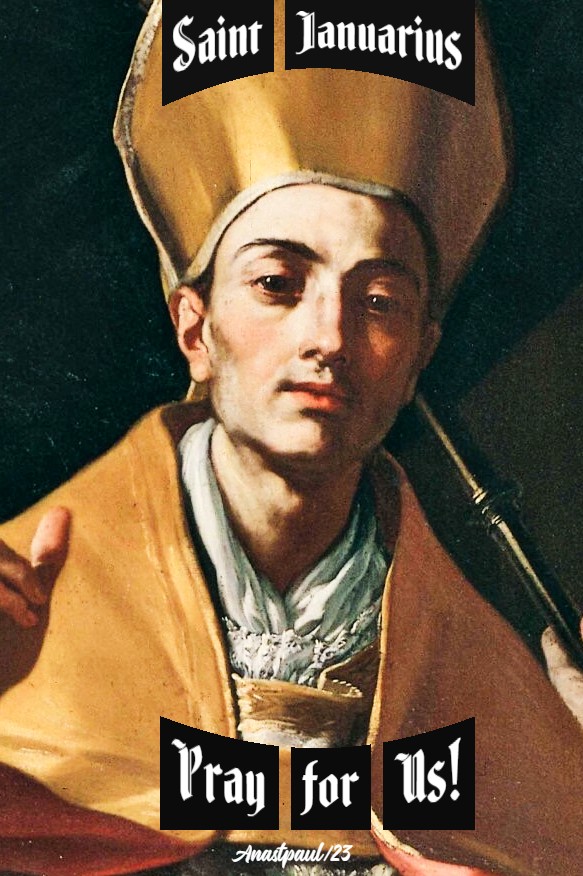
One Minute Reflection – 19 September – “Month of The Seven Sorrows of the Blessed Virgin Mary and The Holy Cross” – St Januarius of Naples (Died c304) Confessor, Bishop, Martyr and his Martyred Companions – Hebrews 10:32-38, Matthew 24:3-13 – Scripture search here: https://www.drbo.org/
“For yet a very little while and He, Who is to come, will come …” – Hebrews 10:37
REFLECTION – “ It is only right, my brothers, to celebrate our Lord’s coming with all possible devotion, so greatly does His comfort gladden us… and His love burn within us. But do not just think about His first coming, when He came “to seek and save the lost” (Lk 19:10); think, too, of that other coming when He will come to take us with Him. I should like to see you constantly occupied in meditating on these two comings… “resting among the sheepfolds” (Ps 67:14), for they are the two arms of the Bridegroom, in which the Bride of the Song of Songs took her rest: “His left arm is under my head and His right arm embraces me” (2:6)…
But, there is a third coming between the two, to which I have just referred and those who know of it, can rest in it, for their greater happiness. The other two are visible but this one is not. In the first, “ the Lord has appeared on earth and has spoken to us” (Bar 3:38)… in the last, “all mankind shall see the salvation of God” (Lk 3:6; Is 40:5)… But the one that comes between them is secret – it is that in which the elect alone see the Saviour within themselves and their souls find salvation.
In His first coming, Christ came in our flesh and in our weakness; in His coming in the midst of time, He comes in Spirit and power; in His final coming, He will come in His glory and majesty. But it is by the strength of the virtues that we attain to glory, as it is written: “The Lord, the King of armies, He is the King of glory” (Ps 23:10) and, in the same book: “That I may see Thy power and Thy glory” (Ps 62:3). And so, the second coming is like a road leading from the first to the last. In the first, Christ has been our Redemption; in the last, He will appear as our Life; in His coming between, He is our Rest and our Consolation!” – St Bernard (1091-1153) Cistercian Monk, The Last Father and Mellifluous Doctor of the Church (Sermons 4 and 5 for Advent).
PRAYER – O God, Who gladdens us by the annual festival of Thy Martyrs Januarius and Companions, grant that we, may be inspired by the example of those, in whose merits we rejoice.Through tJesus Christ, Thy Son our Lord, Who lives and reigns with Thee, in the unity of the Holy Ghost, God, world without end. Amen (Collect).
Our Morning Offering – 19 September – “Month of The Seven Sorrows of the Blessed Virgin Mary and The Holy Cross”
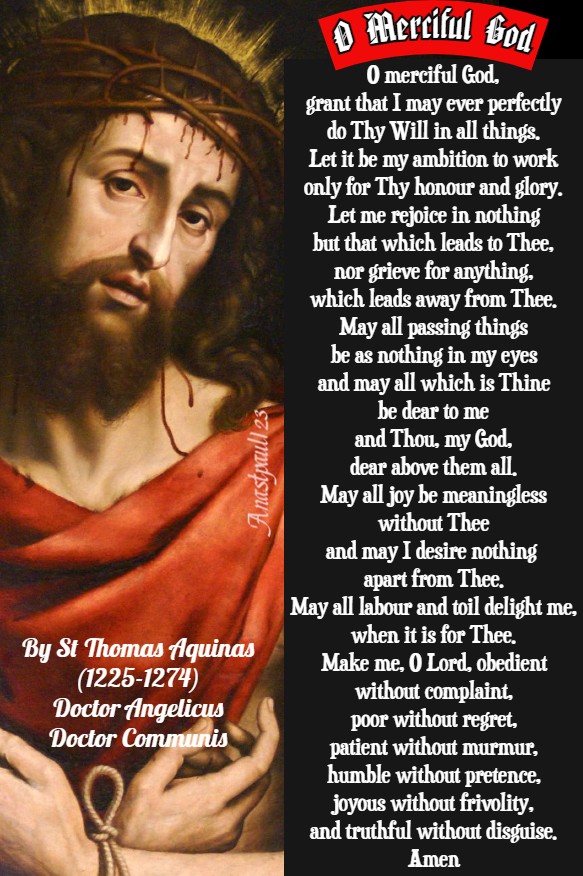
O Merciful God By St Thomas Aquinas (1225-1274) Doctor Angelicus Doctor Communis
O merciful God, grant that I may ever perfectly do Thy Will in all things. Let it be my ambition to work only for Thy honour and glory. Let me rejoice in nothing but that which leads to Thee, nor grieve for anything, which leads away from Thee. May all passing things be as nothing in my eyes and may all which is Thine be dear to me and Thou, my God, dear above them all. May all joy be meaningless without Thee and may I desire nothing apart from Thee. May all labour and toil delight me, when it is for Thee. Make me, O Lord, obedient without complaint, poor without regret, patient without murmur, humble without pretence, joyous without frivolity, and truthful without disguise. Amen
Saint of the Day – 19 September – Saint Goeric of Metz (c570-c643), Bishop of Metz. Goeric was married and a father, Courtier and Soldier of hjgh rank. In the official catalogues of the Diocese, Goeric is listed as the 30th Bishop of Metz, having governed that See from 625 to 642 or 643. Born in c570 in Aquitaine, Gaul and died in c643 in Metz, in today’s France, of natural causes. Also known as – Abbo I of Medtz, Abbone, Goerico, Goericus, Goëry, Goéry. Additional Memorial 15 April (Translation of Relics). In the Germanic Martyrologies, in that of Metz and other Cities of Gaul, he is remembered on 19 September as “Bishop and Confessor, admirable for holiness, amiable to his subjects.”
Goeric was born in Aquitaine, between 565 and 575, son, apparently, of Gamard and nephew of his predecessor Bishop, Saint Arnulf, whose remains he recognised in Remiremont in 641 and brought them back to Metz.
Goeric was a Courtier at the Court of King Dagobert I (628-639) and was married. He is said to have had two daughters – Vittorina and Precia (or Aprincia), the latter on whom, he himself imposed the veil of virginity as Bishop and, who later became a Saint.
According to all the documents that tell us about him, Goeric was a valiant warrior, he won numerous victories against the barbarians and thanks to his extraordinary skills as a Captain, he went through all the levels of his military career, reaching the highest dignities.
Being wounded in a clash, he lost his sight and that he bore this unhappiness with Christian patience. In response to what he felt was a supernatural command, he decided to make a pilgrimage to the Cathedral of St Stephen, the seat of the Bishop in Metz, where his uncle, Saint Arnulf (580-640), was the Bishop (613-628). He set off with his daughters Precia and Victorina. to guide him, and when they reached Metz, he went straight to the Church. There, he regained his sigh while praying. In gratitude, he decided to become a Priest and offer the rest of his life to God. The following year,, 628, when Arnulf resigned as Bishop, Goericus succeeded him in the Bishopric of Metz.
The Cathedral of St Stephen in Metz
Here he had the Church of St Pieter built. He was greatly honoured by King Dagobert, who named him in his will (636). Goeric enjoyed a vibrant correspondence with St Desiderius, Bishop of Cahors. As Bishop of Metz, Goeric founded a Nunnery at Epinal on the River Moselle, where his daughter St Precia became the first Abbess.
In the 10th Century, in Metz, there was a Church built in honour of St Goeric. A Breviary printed in Paris in 1535 and a Breviary of 1554, have an office composed by him.
In the 10th Century, his Relics were brought from Saint-Symphorien to Epinal. This event is commemorated in the local Calendar of Saints on 15 April.
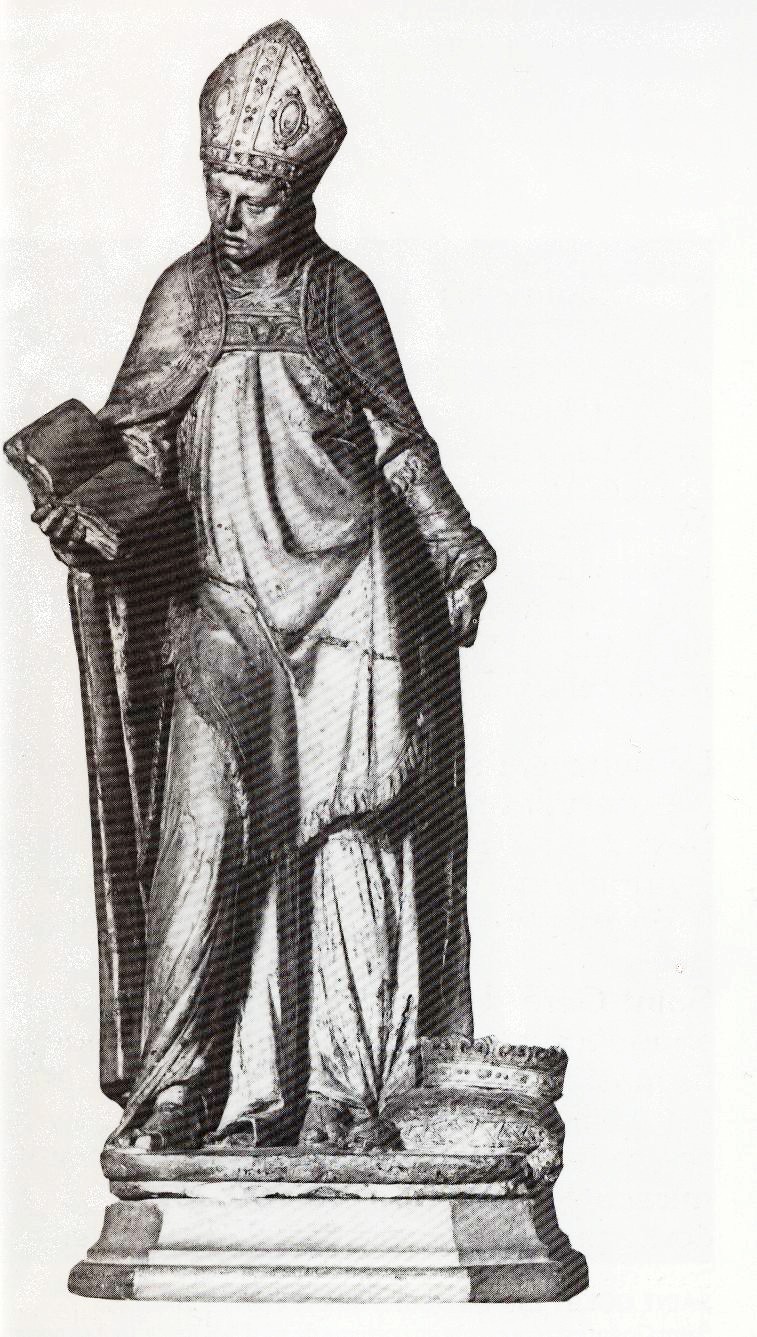
Illustration of Saint Goeric in the Church of Saint Maurice of Épinal
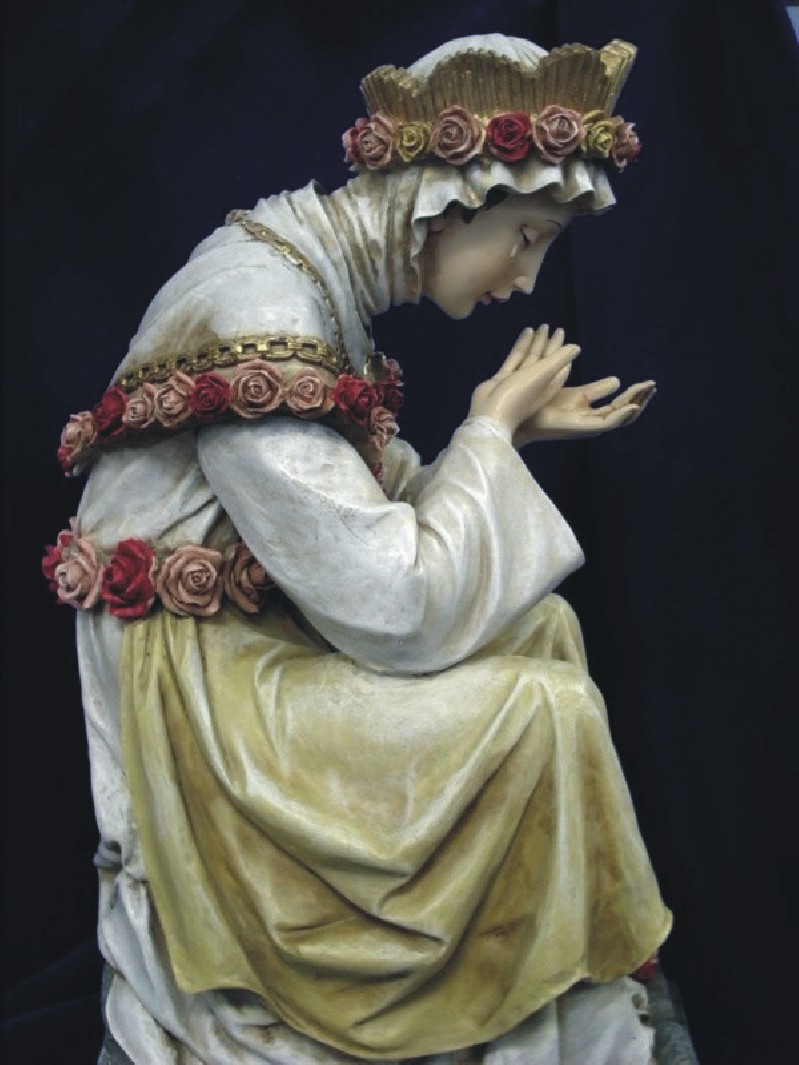
Notre-Dame de la Salette / Our Lady of La Salette), La Salette-Fallavaux, Isère, Rhône-Alpes, France (1846) 19 September: Our Lady appeared to two small children, Melanie Mathieu and Maximin Giraud, on the mountain of La Salette in the French Alps. She was crying and around her neck was a crucifix, with a hammer and pincers on either side – 19 September 1846. Approved by the Diocesan Bishop in 1851. Read the story here: https://anastpaul.wordpress.com/2017/09/19/feast-of-our-lady-of-la-salette-19-september/
St Arnulph of Gap Bl Carolus Hyon Song-Mun St Constantia of Nocera St Desiderius of Pozzuoli St Eustochius of Tours St Felix of Nocera St Festus of Pozzuoli St Goeric of Metz (c570-c643)Bishop
St Maria de Cervellón OdeM (1230 – 1290) Virgin, Catalan Superior of Second Order of the Mercedarians in her region. Mystic, graced with the gift of bilocation, Apostle of the poor, the abandoned, the needy. She was the first woman to wear the Habit of the ‘ Order of the Blessed Virgin Mary of Ransom. She is considered the Founder of the Mercedary Nuns. Her entry in the Roman Martyrology states: “At Barcelona in Spain, blessed Maria de Cervellione, Virgin of the Order of Our Lady of Ransom. She is commonly called Maria of Help on account of the prompt assistance she renders to those who invoke her.“ Patronages – Mercadarian Nuns and Sisters, Navigators, against shipwreck, Spanish sailors., of the abandoned. On 13 February1692, Pope Innocent XII gave a favourable judgement and confirmed her immemorial cult;and she was introduced into the Roman Martyrology as a Saint on 8 November 1729. Her body is Incorrupt. Her Holy Life: https://anastpaul.com/2021/09/19/saint-of-the-day-19-september-st-maria-de-cervellon-odem-1230-1290/ Please watch this video if you are able to spare the time. It is absolutely beautiful.
St Pomposa St Sequanus St Sosius of Puzzuoli St Theodore of Canterbury St Trophimus of Synnada
Martyrs of Antioch – 3 Saints: Christians imprisoned, tortured and executed in various ways in the persecutions of Emperor Probus; some names have come down to us – Dorymedon, Sabbatius and Trophimus. c 277 at Antioch (in modern Turkey).
Martyrs of Phunon – (4 aints): Four bishops in Egypt who were sentenced to forced labour in a rock quarry and martyred in the persecution of Diocletian. Noted for celebrating Mass in prison. – Elias, Nilus, Patermuzio and Peleus. They were burned to death in 310 at Phunon, near Petra in Palestine.










 AnaStpaul
You must be logged in to post a comment.