Thought for the Day – 23 November – Meditations with Antonio Cardinal Bacci (1881-1971)
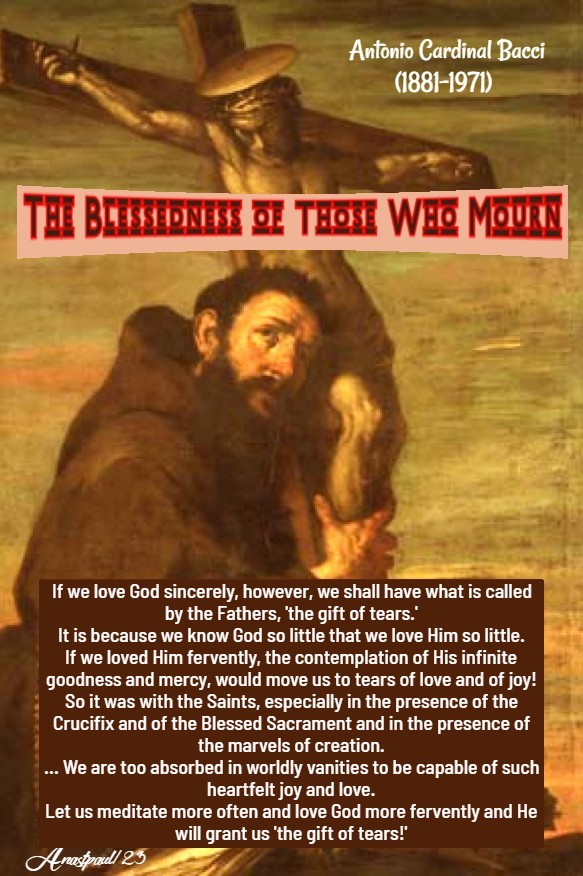
The Blessedness of Those Who Mourn
“Finally, the Christian will sometimes shed tears of joy. There are some people who are not easily moved. Rigid and inflexible, they proceed in all things, with mathematical precision and cannot be swayed by the promptings of the heart. They are incapable of shedding a tear.
If we love God sincerely, however, we shall have what is called by the Fathers, ‘the gift of tears.’ It is because we know God so little that we love Him so little. If we loved Him fervently, the contemplation of His infinite goodness and mercy, would move us to tears of love and of joy! So it was with the Saints, especially in the presence of the Crucifix and of the Blessed Sacrament and in the presence of the marvels of creation.
We are incapable of shedding tears of love and of joy because we know and love God so little. “Our love and knowledge of God are imperfect” (Summa Theologae I-II q 68 a2), writes St Thomas Aquinas. We are too absorbed in worldly vanities to be capable of such heartfelt joy and love.
Let us meditate more often and love God more fervently and He will grant us ‘the gift of tears!‘”
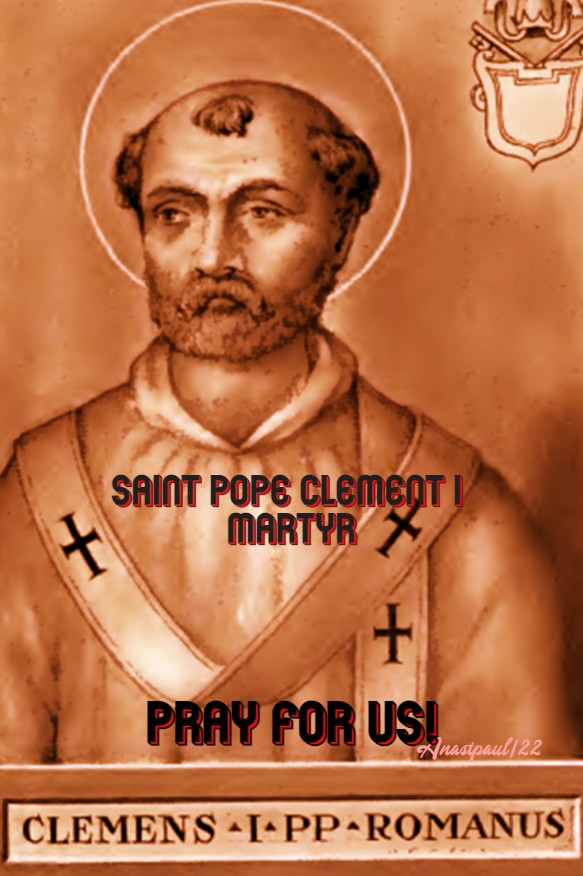
Quote/s of the Day – 23 November – St Clement I – Papacy (c88–c101) Pope Martyr, Apostolic Father.
“Through Him, our gaze penetrates the heights of Heaven and we see, as in a mirror, the most holy Face of God. Through Christ, the eyes of our hearts are opened and our weak and clouded understanding, reaches up toward the light.”
“Charity unites us to God. There is nothing unkind in charity, nothing arrogant. Charity knows no schism, does not rebel, does all things in concord. In charity all the elect of God have been made perfect.”
“Let us fix our thoughts on the Blood of Christ and reflect how Precious that Blood is, in God’s eyes, inasmuch, as its outpouring for our salvation, has opened the grace of repentance to all mankind.”
One Minute Reflection – 23 November – “The Month of the Holy Souls in Purgatory” – St Clement I – Papacy (c88–c101) Pope Martyr, Apostolic Father. – Philippians 3:17-21; 4:1-3, Matthew 16:13-19 – Scripture search here: https://www.drbo.org/
“Upon this rock I will build My Church” – Matthew 16:18
REFLECTION – “Brothers, when it comes to fulfilling my duties as Bishop, I discover that I am weak and slack, weighed down by the weakness of my own condition, while at the same time, I want to act generously and courageously. However, I draw my strength from the untiring intercession of the Almighty and Eternal Priest, Who, like us but equal to the Father, lowered His Divinity to the level of man and raised humankind to the level of God. The decisions He made, give me a just and holy joy. For, when He delegated many shepherds to care for His flock, He did not abandon watching over His beloved sheep. Thanks to that fundamental and eternal assistance, I in turn, have received the protection and support of the Apostle Peter, who also does not abandon his function. This solid foundation, on which the whole of the Church is built, never grows tired of carrying the whole weight, of the building which rests on it.
The firmness of faith, for which the first of the Apostles was praised, never fails. Just as everything which Peter professed in Christ remains, so that which Christ established in Peter, remains… The order willed by God’s Truth remains. Saint Peter perseveres in the solidity which he received; he has not abandoned the governance of the Church which was placed in his hands. That, my brothers, is what that profession of faith, inspired by God the Father, obtained in the heart of the Apostle. He received the solidity of a rock which no assault can shake. In the entire Church, Peter says everyday: “Thou art the Messiah, the Son of the living God.” – St Leo the Great (400-461) Pope, Father and Doctor of the Church (Sermon on the anniversary of his Consecration as Bishop).
PRAYER – Look forgivingly on Thy flock, Eternal Shepherd and keep it in Thy constant protection, by the intercession of blessed Clement Thy Martyr and Sovereign Pontiff, whom Thou didst constitute Shepherd of the whole Church. Through Jesus Christ, Thy Son our Lord, Who lives and reigns with Thee, in the unity of the Holy Ghost, God, world without end. Amen (Collect).
Our Morning Offering – 23 November – St Clement I – Papacy (c88–c101) Pope Martyr, Apostolic Father.
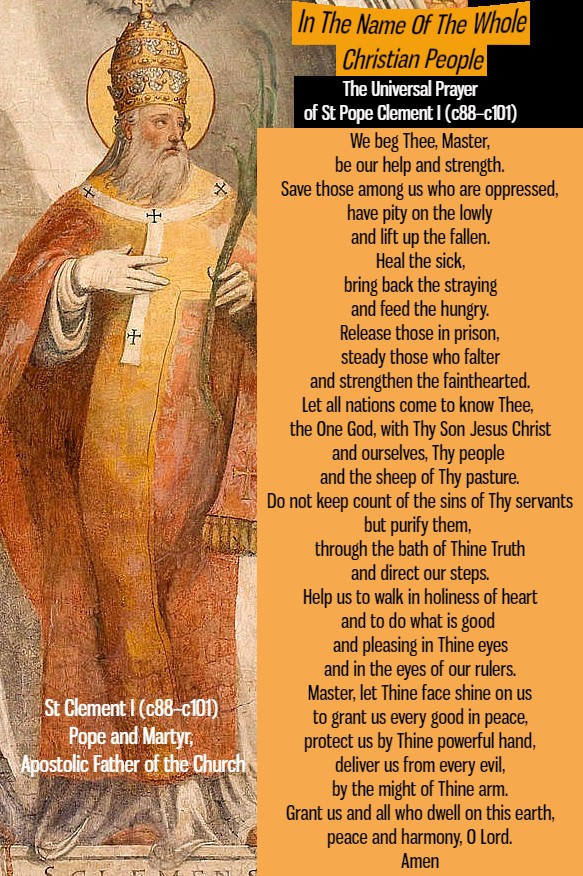
In The Name Of The Whole Christian People The Universal Prayer of St Clement I (c88–c101) Pope and Martyr, Apostolic Father of the Church
We beg Thee, Master, be our help and strength. Save those among us who are oppressed, have pity on the lowly and lift up the fallen. Heal the sick, bring back the straying and feed the hungry. Release those in prison, steady those who falter and strengthen the fainthearted. Let all nations come to know Thee, the One God, with Thy Son Jesus Christ and ourselves, Thy people and the sheep of Thy pasture. Do not keep count of the sins of Thy servants but purify them, through the bath of Thine Truth and direct our steps. Help us to walk in holiness of heart and to do what is good and pleasing in Thine eyes and in the eyes of our rulers. Master, let Thine face shine on us to grant us every good in peace, protect us by Thine powerful hand, deliver us from every evil, by the might of Thine arm. Grant us and all who dwell on this earth, peace and harmony, O Lord. Amen
Saint of the Day – 23 November – Saint Amphilochius of Iconium (c339-400) Bishop, Lawyer and Rhetorician, Poet, Writer and Theologian, Defender of Orthodoxy against heretics, Miracle-worker. First Cousin of St Gregory of Nazianzen and his great friend and so too, a close friend and confidante of St Basil the Great. Born in c339 in Cappadocia, Asia Minor (in modern Turkey) and died in 400 in Konya (in modern Turkey) of natural causes. Also known as – Amfilokius, Amphilochus, Anfilochio, Anfiloquio.
The Roman Martyrology reads today: “At Iconium, in Lycaonia, the holy Bishop, Amphilochius, who was the companion of St Basil the Great and of St Gregory Nazianzen in the desert and their colleague in the Episcopate. After many combats for the Catholic Faith, he rested in peace, with the reputation of a holy and learned Prelate.”
Amphilochius was born in c339 in Cappadocia in Asia Minor (now Turkey). He was a cousin of Saint Gregory of Nazianzen and a close friend and fellow student of Saint Basil the Great. The most important source of our information aregarding our Saint, is his correspondence with these two friends.
Amphilochius’ father was an eminent lawyer and his mother Livia, was remarkable for gentleness and wisdom. He was brought up in the highly religious atmosphere of the Christian aristocracy of his native Province.
He studied law and rhetoric in Antioch, under the renowned Libarius and, as a young man, he taught rhetoric in Constantinople. He was still young when he ran decided to retire to the country to seek spiritual solitude. He left the City in favour of a place near Nazianzen. There, he could live a quiet life, while taking care of his elderly father. We get a little insight into his life at this time, in a letter from Gregory, who seems to have supplied them with grain, in return for vegetables, from his Amphilochius’ family land.
He was soon drawn within the circle of influence around St Basil the Great and seems to have been, for a while, a member of the Christian “City of the Poor” which Basil had built at Cæsarea.
In 374, when Amphilochius was about 35 years old, he was appointed Bishop of Iconium (now Konya in Turkey). He was aware of what this position would entail and accepted with great reluctance. When his father complained to Gregory that he was going to miss his son’s care, Gregory replied that he was not to blame for the appointment and, in any case, he himself would miss Amphilochius’ company. Basil, who may well have been responsible for the appointment, wrote to encourage his friend, exhorting him to lead others and not be led by them. Amphilochius often consulted Basil and it was to him that Basil wrote his treatise on the Holy Ghost and, it was our Saint, Amphilochius, who gave the Eulogy at Basil’s funeral.
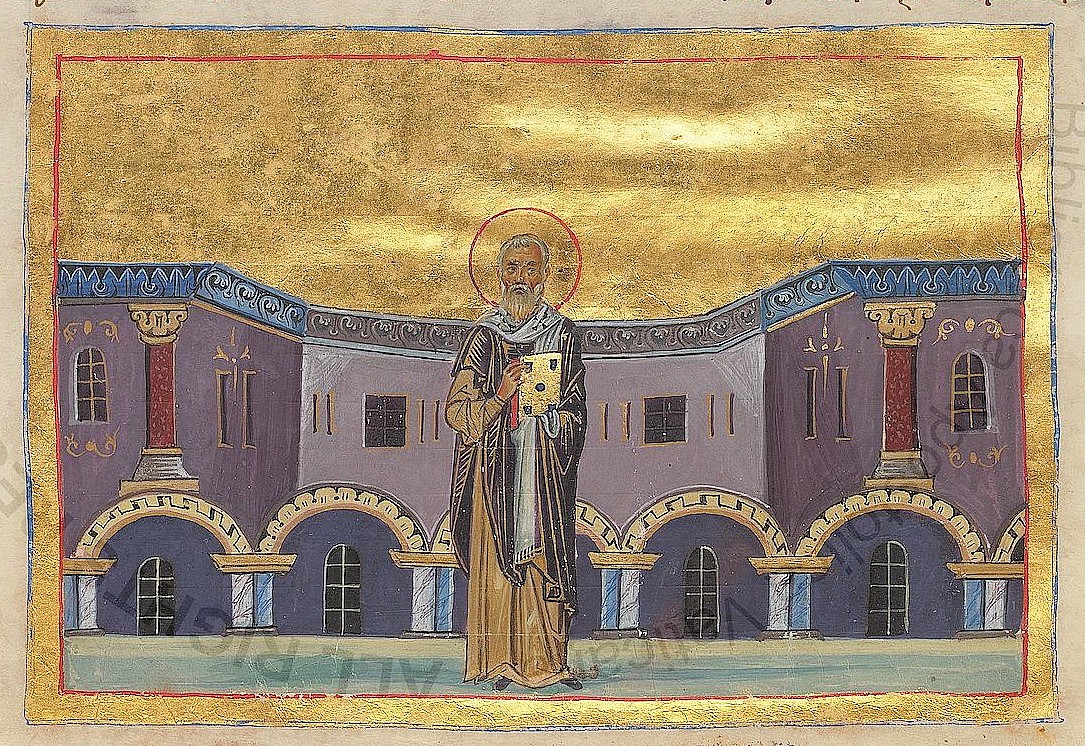
St Amphilochius Bishop of Iconium
Amphilochius was always zealous for the cause of orthodoxy and in 376 he held a Council at Iconium to condemn the Macedonian heresy which denied the deity of the Holy Ghost. In that connection, he wrote a book treating of the HolyGhost which was praised by Saint Jerome. He was present when Macedonianism was condemned at the Council of Constantinople in 381. He also urged Emperor Theodosios I (379-395) to forbid the Arians from holding their assemblies. At first, Theodosios refused because he considered such a measure, would be unnecessarily severe but Amphilochius eventually prevailed and persuaded him to promulgate a law making it illegal for Arians to meet in public or in private.
He was equally zealous in his opposition to the teachings of the Messalians, an Illuminist and Manichean sect which held that prayer alone is the essence of religion and the only way to salvation. In 394 he presided over a Synod at Sida in Pamphylia, where these heretics and their heresies were condemned.
Amphilochius wrote 333 verses in classical Greek poetry about the Christian life, several biblical commentaries and a writing against pseudo-ascetic practices.St Gregory Nazianzen described Amphilochius as a “herald of truth” and an exemplary and irreproachable Bishop and, his father confirmed that sick people had been healed by his prayers. He died in the year 400. His memorial day is 23 November.
In the history of theology. Amphilochius occupies a place of prominence for his defence of the divinity of the Holy Ghost, sadly this work is now lost, however, he read it to St Jerome on the occasion of their meeting at Constantinople. Most of Amphilochius’ works have been lost. Eight sermons have survived, including the oldest known sermon on the Feast of the Purification of the Blessed Virgin and the Presentation of Our Lord. His style and concern for historical accuracy puts Amphilochius in the place of a predecessor to St John Chrysostom, who may have been influenced by him.
St Adalbert of Casauria St Alexander Newski St Amphilochius of Iconium (c339-400) Bishop, First Cousin of St Gregory of Nazianzen and his great friend and so too, a close friend and confidante of St Basil the Great. St Augusta of Alexandria St Clement of Metz Bl Detlev of Ratzeburg St Falitrus of Chabris St Faustina of Alexandria St Gregory of Girgenti Bl Guy of Casauria St Loëvan of Brittany St Lucretia of Mérida Bl Margaret of Savoy St Mustiola of Chiusi St Paternian of Fano St Paulinus of Whitland St Rachildis of Saint-Gall St Severin of Paris St Sisinius of Cyzicus St Trudo of Hesbaye St Wilfetrudis of Nivelless







 AnaStpaul
You must be logged in to post a comment.