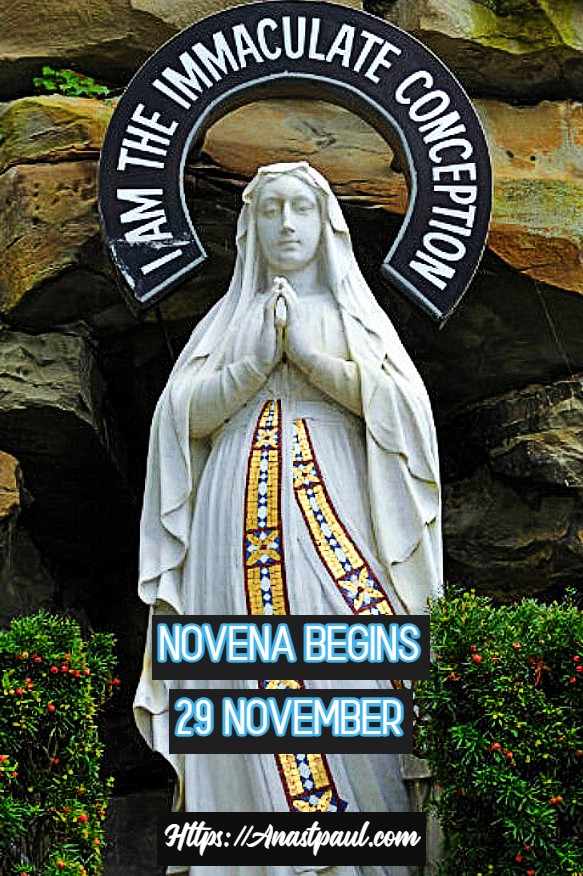
The Dogma was promulgated by Blessed Pius IX in 1854 in the Bull Ineffabilis Deus. This Dogma is rejected by all Protestants including the Orthodox – another reason why we cannot interact with these the way some do and the Vatican II church endorses.
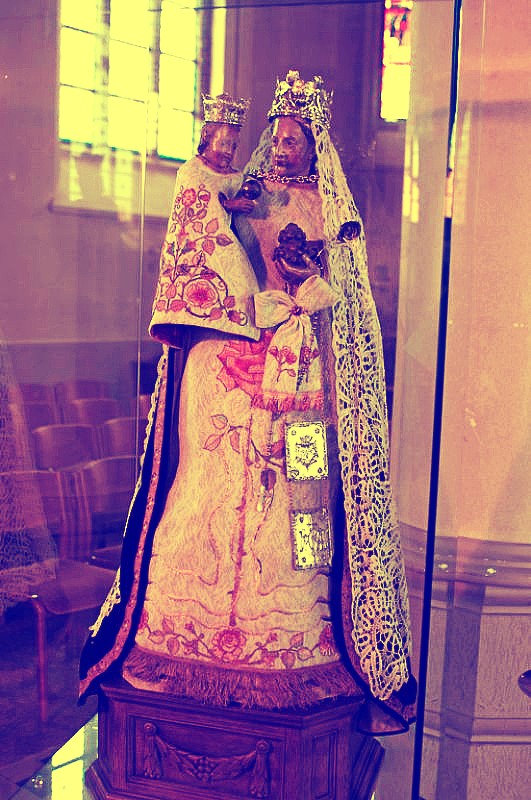
Let us Pray to our Mother, the Immaculate and Blessed Virgin Mary, conceived without sin.
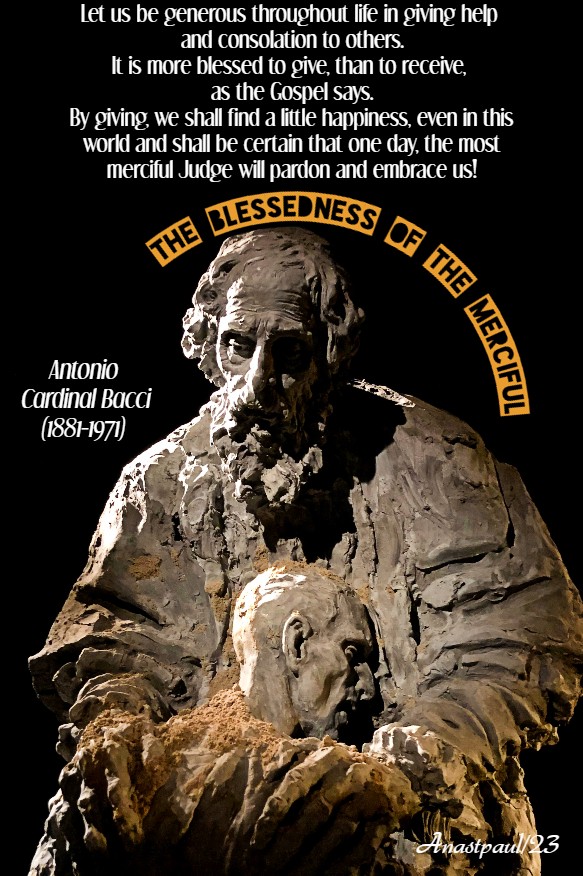
Thought for the Day – 26 November – Meditations with Antonio Cardinal Bacci (1881-1971)
The Blessedness of the Merciful
“Let us remember that we have often made ourselves God’s enemies, by our sins. We were often in need, when we were deprived of Divine grace. On these occasions, God was merciful to us, for He granted us His forgiveness and His friendship. These gifts of God, place an obligation on us, to behave in the same way to those who are in need, by assisting them willingly and generously and, to those who are unhappy, by consoling them as far as possible.
Let us remember, the great principle which Jesus Christ has given us. “Even as you wish men to do to you, so also, do you unto them … Do good to those who hate you … Do not judge and you shall not be judged; do not condemn and you shall not be condemned. Forgive and you shall be forgiven, give and it shall be given to you …” (Cf Lk 6:30-38). “With what judgement you judge, you shall be judged and with what measure you measure, it shall be measured to you” (Mt 7:1). So it shall be on the day of death, when we shall appear before the Supreme Judge!
Let us be generous throughout life in giving help and consolation to others. It is more blessed to give, than to receive, as the Gospel says. By giving, we shall find a little happiness, even in this world and shall be certain that one day, the most merciful Judge will pardon and embrace us!”
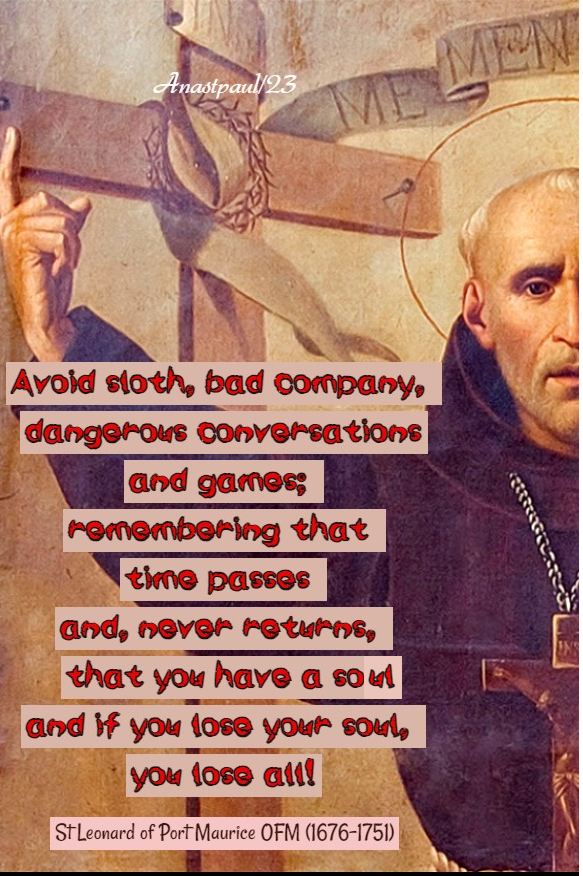
Quote/s of the Day – 26 November – St Leonard of Port Maurice OFM (1676-1751) Confessor, Priest
“Avoid sloth, bad company, dangerous conversations and games; remembering that time passes and never returns, that you have a soul and, if you lose your soul, you lose all!”
“Oh Most Sacred Name, Name of peace, Balsam of life, which is the centre of all the sighs, of the most fervent lovers of Jesus. The Sign of those, who truly love Jesus, is to bear Jesus imprinted in the heart and to name often and with devotion, the Most Holy Name of Jesus.”
One Minute Reflection – 26 November – “The Month of the Holy Souls in Purgatory” – St Sylvester Gozzolini OSB Silv. (1177– 1267) Priest, Abbot ; – Colossians 1:9-14; Matthew 24:15-35 – Scripture search here: https://www.drbo.org/
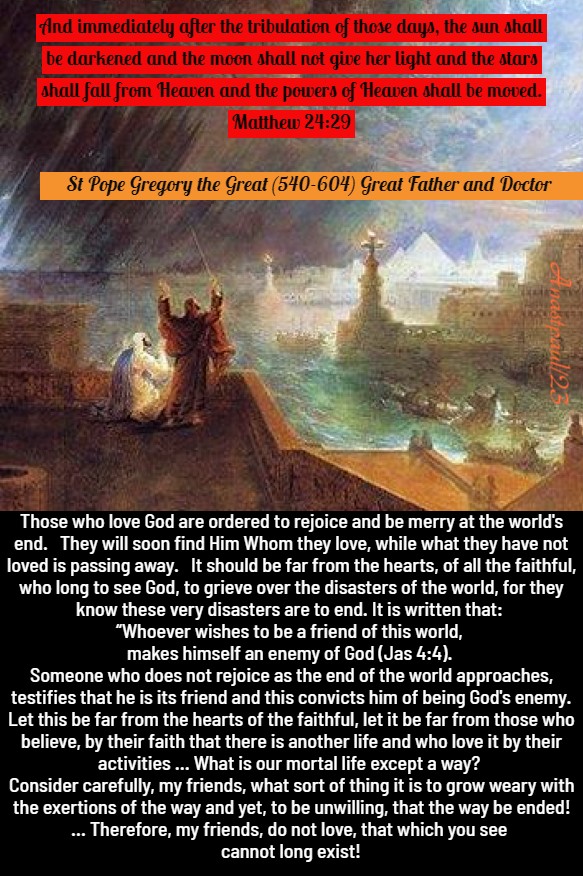
“And immediately after the tribulation of those days, the sun shall be darkened and the moon shall not give her light and the stars shall fall from Heaven and the powers of Heaven shall be moved. ” – Matthew 24:29
REFLECTION – “The powers of Heaven will be moved.” What does the Lord mean by the powers of Heaven, if not the Angels and Archangels, Thrones, Dominations, Rulers and Powers? (Col 1:6). At the coming of the severe Judge ,they will appear visibly before our eyes… “Then they will see the Son of Man coming on the clouds with great authority and majesty.” In other words, they are going to see, in power and majesty, Him Whom they chose not to hear in a state of humility … He said these things about the condemned; words of consolation for the elect follow at once: – “When these things begin to take place, look up and lift up your heads because your redemption is drawing near.” Truth is exhorting His elect by saying: “When the disasters of the world become more frequent … let your hearts exult! While the world – which is not your friend, is coming to an end, the redemption you have sought is coming near!”
Those who love God are ordered to rejoice and be merry at the world’s end. They will soon find Him Whom they love, while what they have not loved is passing away. It should be far from the hearts, of all the faithful, who long to see God, to grieve over the disasters of the world, for they know these very disasters are to end. It is written that: “Whoever wishes to be a friend of this world, makes himself an enemy of God (Jas 4:4). Someone who does not rejoice as the end of the world approaches, testifies that he is its friend and this convicts him of being God’s enemy.
Let this be far from the hearts of the faithful, let it be far from those who believe, by their faith that there is another life and who love it by their activities … What is our mortal life except a way? Consider carefully, my friends, what sort of thing it is to grow weary with the exertions of the way and yet, to be unwilling, that the way be ended! … Therefore, my friends, do not love, that which you see cannot long exist!” – St Pope Gregory the Great (540-604) Great Father and Doctor (Sermons on the Gospel).
PRAYER – Most merciful God, Who when the holy Abbot Sylvester was devoutly meditating upon the vanity of this world beside an open grave, graciously willed to call him into the desert and enrich him with unusual merits, we humbly pray that, following his example, despising the things of earth, we may thoroughly enjoy Thy everlasting presence. Through Jesus Christ, Thy Son our Lord, Who lives and reigns with Thee, in the unity of the Holy Ghost, God, world without end. Amen (Collect).
Our Morning Offering – 26 November – The Last Sunday after Pentecost
Consecration to Our Lady of the Eucharist After Holy Communion By the Claretian Fathers Teaching Ministr Order founded by St Anthony Mary Claret (1807-1870)
Mary is called Our Lady of the Eucharist, because without her, there would be no physical Body of Jesus to be present in the Eucharist. (See John 6:51)
Most kind Mother, we consecrate to thee, our bodies, which have just been honoured and sanctified, by the presence of thy Divine Son, our souls which have conversed with Him and our hearts which have loved Him. O dearest Mother, may the words which we have spoken, be made acceptable to Him. through thy intercession. Tell Him the things which we should have said but were unable to express. Love Him and beseech Him for us, thy poor children. Receive and keep us in thine heart. Warn us, protect us and guide us during this day that we may faithfully serve thy Divine Son and please Him in all our thoughts, desires and actions. Amen
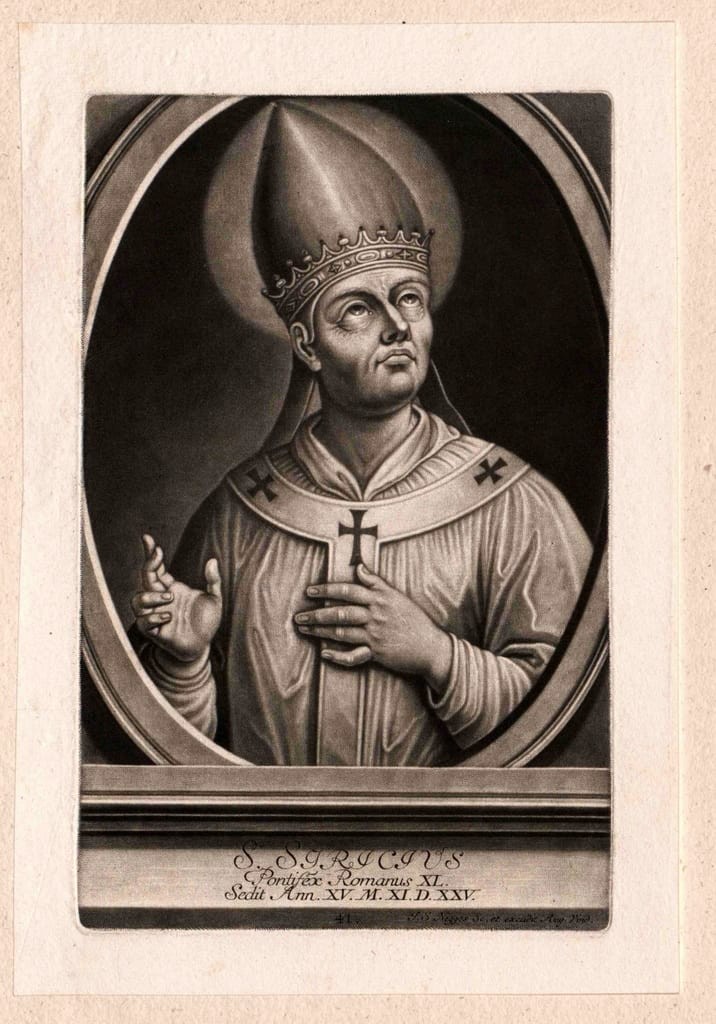
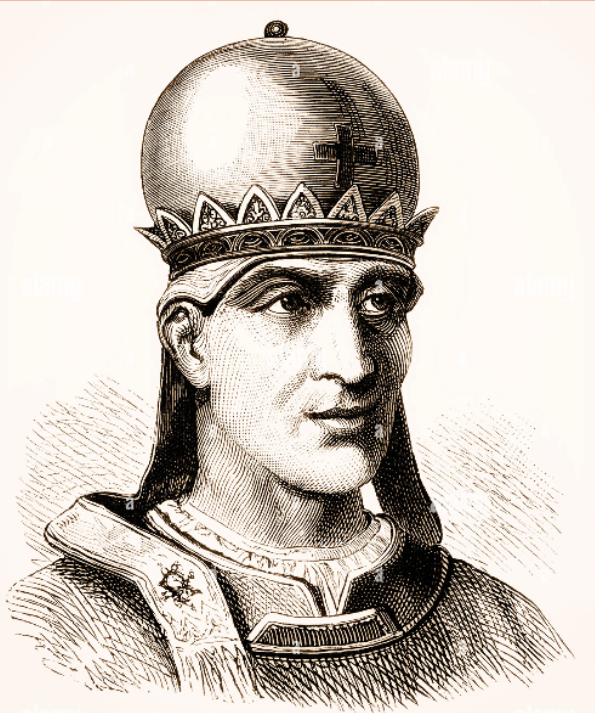
Saint of the Day – 26 November – St Pope Siricius (c334-399) the 38th Bishop of Rome from December 384 until his death on 26 November 399, Confessor, Defender of the Faith against heresies, Reformer of clerical discipline, Born in Rome and died there of natural causes aged around 64. In response to inquiries from Bishop Himerius of Tarragona, Siricius issued the Directa Decretal, containing Decrees of Baptism, Church discipline and other matters. His are the oldest completely preserved Papal Decrees. He is sometimes said to have been the first Bishop of Rome to call himself “Pope or Papa” – the word derived from the Greek, Papa, meaning Father.
The Roman Martyrology reads today: “At Rome, St Siricius, Pope and Confessor, celebrated for his learning, piety and zeal for religion, who condemned various heretics and published salutary laws concerning Ecclesiastical discipline.”
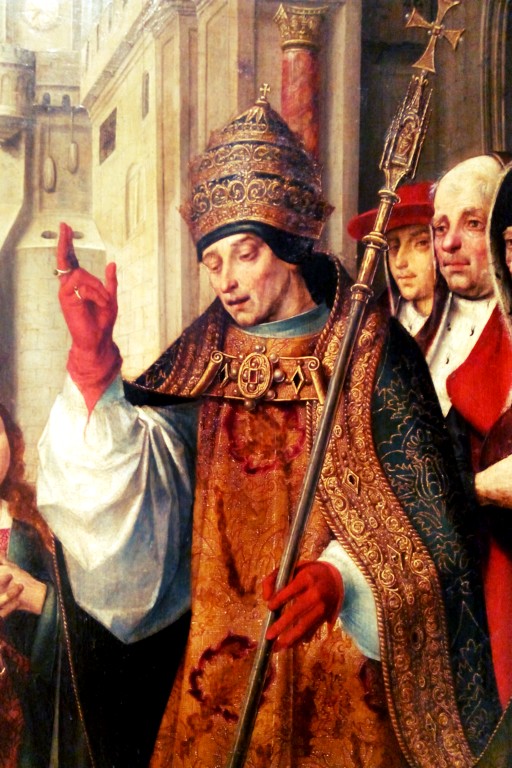
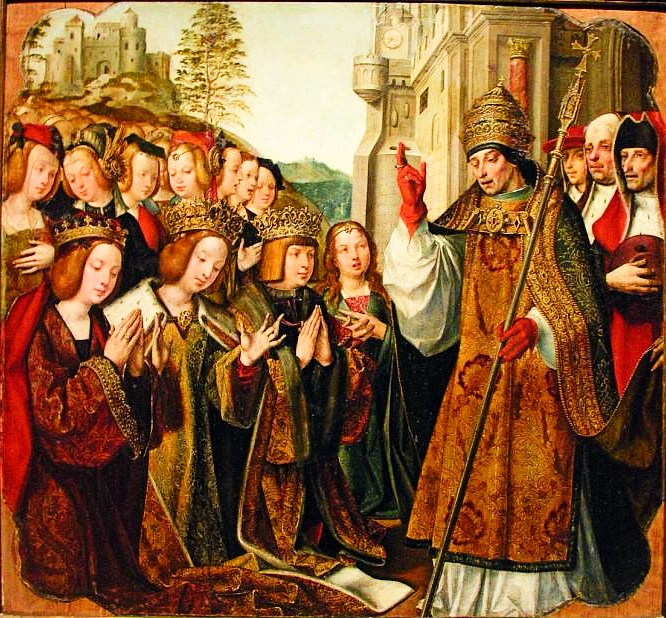
Image from the Saint Auta Altarpiece (Lisbon) of Pope Siricius blessing Saint Auta – see complete image below.
Saint Siricius was, a Roman and the son of Tiburtius. He entered the service of the Roman Church as a young man, most during the Pontificate of Liberius , first as Lector and later as Deacon. He was also a Deacon under Pope Damasus.
Although the antipope. Ursinus again stood as a candidate, in December 384 (the 15th?) Siricius was unanimously elected as Damasus’ successor. The election was confirmed with apparent satisfaction by the Emperor Valentinian II (375-392) in an edict of 25 February 385, probably mostly to cut off any intrigues in the Ursinian camp.
The Emperor gave further evidence of his approval by providing funds for the restoration and expansion to approximately its present size, of St Paul’s Basilica . The Pope Consecrated it in 390. A modern column outside the northern colonnade commemorates his Consecration of the Basilica.
The Church Father and Doctor, St Jerome or Hieronymus, had a justified hope of becoming Pope Damasus’ successor himself but he was banished from Rome, in an action Siricius must have, at least consented to. The disappointed Jerome describes the Pope as a simple man, gullible and easily deceived, while St Paulinus of Nola complained about his haughty unapproachability. In reality, he was an experienced and powerful Pope and, although he was as conscious as Damasus of the primacy of Rome and his own role as Peter ‘s successor, he was inevitably overshadowed by the contemporary St Ambrose, Bishop of Milan (340-397).
Siricius was probably not the first Pope to issue decretal speeches but his are the oldest preserved. A decretal speech is a directive or an authoritative decision on disciplinary matters. They were no longer in a tone of fraternal exhortation but held in the same authoritative style of imperial edicts and like them, had the same legal force as laws. The oldest preserved decretal speeches are from 11 February 385 and addressed to Himerius, Bishop of Tarragona in Spain, who had brought fifteen questions aconcerning Ecclesiastical discipline to Damasus I. They open with the demand that the Pope, or rather the Apostle Peter present in the papacy, bears the heavy burden of giving categorical rules in matters of Ecclesiastical discipline and Liturgical ordinances.
Siricius confirmed that Arians who were re-admitted to the Catholic Church were not to be re-Bbaptised and that Baptism could only be performed, in exceptional cases, at times other than Easter and Pentecost which had, nevertheless, previously been an old custom. Furthermore, he gave rules for age and qualifications before Ordination, insisted on Clerical abstinence and celibacy and gave rules for the discipline of penance. Siricius demanded that these general Decrees (decretalia generalia) which should be as binding as decisions (cwith a series of Canons) from Synods, should be communicated to the neighbouring Provinces in Africa, Spain and Gaul.
On 6 January 386, a Synod was held in Rome “at the Relics of the Apostle Peter” attended by 80 Bishops. A number of disciplinary decisions were made and the Pope sent nine Canons which were adopted at the Synod, to Africa and other Churches. They decided, inter alia that no Bishop should be Consecrated without “the knowledge of the Apostolic See” or by just a single Consecrator. Similarly, Siricius responded to requests from the Bishops of Gaul, with a series of Canons .
We believe that Siricius was the first Pope to reserve the exclusive right to use the title Pope/Papa. The word can also be seen as an anagram made from the initials of the words Petri Apostoli Potestatem Accipens (“He who has received power from the Apostle Peter”).
Siricius was no opponent of asceticism, as is sometimes misleadingly claimed. But around 388 the Monk Jovinian, who had had a great reputation for his strict life, came to Rome. Now, he began to assert that, after all, an austere life was a waste and that vows, chastity, fasting and good works, were of little use. In addition, he claimed that the Virgin Mary had lost her virginity when she gave birth to the Saviour. As a consequence of this vision, Jovinian, himself gave up his ascetic life and began to persuade many mMnks and Nuns to give up asceticism and get married. Shocked lay people asked the Pope to intervene. Siricius then held a Synod which condemned Jovinian’s theories and excommunicated him and his leading followers. The Pope sent three Priests to Milan to tell Saint Ambrose about the Synod. Ambrose himself held a Synod praising the Pope for his care and repeating the condemnation of Jovinian.
Later, the Pope condemned the view of Bonosus, bishop of Naissus that the Blessed Virgin had given birth to Joseph’s child after the birth of the Lord, leaving it to the bishop of Illyria, to judge the man himself.
The Pope also received a delegation from the East asking him to put an end to the long-standing schism over the Episcopate of Antioch. For years, two Bishops and their successors had been quarreling over the Episcopate. Siricius granted their plea to recognise the last survivor, Flavian, as a true Bishop and readmitted him to communion. On the Pope’s advice, a Council at Caesarea in Palestine,recognised that Flavian and not Evagrius, was the rightful Bishop.
In the mid-390s, Siricius incurred the wrath of St Jerome. St Jerome, who had now settled in Bethlehem and his friends in Rome, were enraged by the Pope’s positive attitude towards Bishop John of Jerusalem (died 417) and, towards Rufinus of Aquileia (died 410), both of whom, were at this time in St Jerome’s deepest displeasure.
During Siricius’ Pontificate, the great St Augustine became the Bishop of Hippo and wrote his Confessions.
The Eastern Emperor Theodosius I, who was very religious, came under the strong influence of St Ambrose. In 384 he issued a ban on pagan feasts and in 391 pagan sacrifices were banned. Violation of the ban was declared crimen maiestatis, treason. It led to a pagan revolt led by Rome. But Theodosius crushed the rebel army in a battle at Aquileia in 384, after which all the temples of Rome were closed and all the Senators forcibly Baptised. Christianity had finally and definitively, become the state religion. For Christianity, 392 is a special year. Then Emperor Theodosius announced that he would tolerate only one religion in his vast Empire. Both Christian heresy and pagan worship were banned.
Siricius died on 26 November 399 and was buried in the Basilica of Silvester near the Catacomb of Priscilla.
Although he was venerated as a Saint in the earliest Centuries, he was not included in the first edition (1584) of the Roman Martyrology, due to the criticism of Jerome and Paulinus of Nola. His name was added in 1748 by Pope Benedict XIV, who wrote a treatise to prove his holiness.
St Leonard of Port Maurice OFM (1676-1751) Confessor, Priest and Friar of the Friars Minor, reacher – in particular Parish Mission Preacher, Ascetic Writer, Spiritual Director. St Leonard founded many pious societies and confraternities and exerted himself to spread devotion to the Sacred Heart of Jesus, the Perpetual Adoration of the Most Blessed Sacrament, the Blessed Virgin Mary and the Passion of Christ. He was among the few to insist that the concept of the Immaculate Conception of Mary be defined as a Dogma of the Faith. He was Beatified on 19 June 1796 by Pope Pius VI and Canonised on 29 June 1867 by Pope Pius IX. Biography: https://anastpaul.com/2018/11/27/saint-of-the-day-27-november-st-leonard-of-port-maurice-ofm-1676-1751/
St Bertger of Herzfeld St Conrad of Constance Bl Delphine of Glandèves St Egelwine of Athelney St Ida of Cologne St James the Hermit St Magnance of Ste-Magnance St Marcellus of Nicomedia St Martin of Arades St Nicon of Sparta Bl Pontius of Faucigny St Sabaudus of Trier St Siricius, Pope (c334-399) Confessor, Bishop of Rome from December 384
St Stylinus St Vacz
Martyrs of Alexandria – 650+- Saints: A group of approximately 650 Christian Priests, Bishops and Laity Martyred together in the persecution of Maximian Galerius. We have the names and a few details only seven of them – Ammonius, Didius, Faustus, Hesychius, Pachomius, Phileas and Theodore. The were born in Egypt and were martyred there in c 311 in Alexandria, Egypt.
Martyrs of Capua – 7 Saints: A group of seven Christians Martyred together. The only details about them to survive are the names – Ammonius, Cassianus, Felicissimus, Nicander, Romana, Saturnin and Serenus. They were martyred in Capua, Campania, Italy, date unknown.
Martyrs of Nicomedia – 6 Saints: A group of six Christians Martyred by Arians. Few details have survived except their names – Marcellus, Melisus, Numerius, Peter, Serenusa and Victorinus. Martyred in 349 in Nicomedia, Bithynia, Asia Minor (modern Izmit, Turkey).






 AnaStpaul
You must be logged in to post a comment.