
Saint/s of the Day – 29 November – Saint Saturninus of Rome (Died c304) + Priest and Martyr and Saint Sisinius of Rome (Died c304) + Deacon and Martyr. Both our Saints were born in Carthage and died by being finally beheaded in c304 on the Via Nomentana, 2 miles outside Rome, during the persecutions of Diocletian and Maximian and after years of slave labour and horrific tortures. Saturninus is also known as – Saturninus of Carthage, Saturninus the Elderly. Sisinius is also known as Sysinnius. Their Feast is celebrated on the day of the final translation of their Relics – 29 November. NB – (not to be confused with Saint Saturninus of Toulouse, a Bishop and Martyr in France, whose Feast is also today).
The Roman Martyrology reads: “At Rome, on the Salarian road, the birthday of the holy Martyr Saturninus, an aged man and the Deacon Sisinius, in the time of the Emperor Maximian. After a long imprisonment, they were, by order of the Prefect of the City, placed on the rack, distended with ropes, scourged with rods and whips garnished with metal, then exposed to the flames, taken down from the rack and beheaded.”
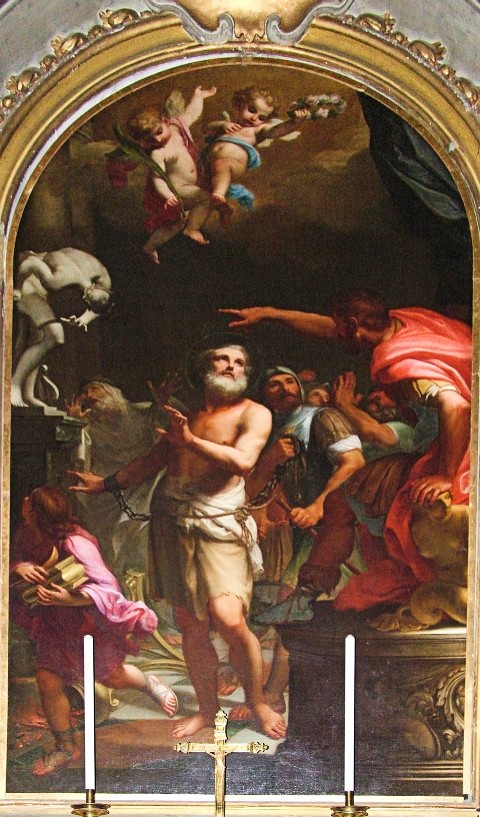
According to legend, Saturninus came from Carthage in North Africa and served as a Priest in Rome. He is described as an old man. Together with his Deacon Sisinnius, he was arrested and tortured during Christian persecutions. They were buried in the Cemetery of Saint Thraso on Via Salaria.
From the 1640 ‘General Legend of the Saints’ we read their story as follows:
“When the Emperors Diocletian (284-305) and Maximian (284-305) perceived that no torture or capital punishment could exterminate the Christians, nay, that the blood of the Martyrs was like seed, in which the life of one victim was in turn a hundred new believers, they invented a new way to oppress the Christians with long and painful tortures.
They had to carry stones and dig sand and do all the work necessary for the construction of public buildings. It was officially forbidden to sentence members of the nobility and soldiers to slave labour. But, precisely to humiliate the Christian faith even more, all Christians were sentenced, without respect to persons, to the slave labour of construction.
For example, Saturninus was among those in Rome who contributed to the construction of the bathhouses which Emperor Maximian had built for Diocletian because he had made him equal in rank to himself. Saturninus was already an elderly man and he was simply unable to do the heavy workwhich the overseers imposed on him. That is why he was helped by fellow Christians, especially by the Deacon Sisinnius. In his zeal, in addition to the burden imposed on himself, he also shouldered the burden of Saturninus. So he trudged to and fro, happily singing his Psalms to the Lord.
The imperial officials watched with great amazement at the great love and joy radiating from Sisinnius during his painful labours. They reported it to their Commander Espurius, who in turn, reported it to Emperor Maximian. He had Sisinnius and Saturninus brought before him. In vain he tried to have them sacrifice to idols under threats. When this came to nothing, he entrusted them to the Commander Landicius, with orders to force them to make sacrifices or else put them to death with his own hands. The Ruler threw them into prison. There they sat for several days, converting many pagans who came to visit them to the Christian faith. After thirty-three days the superior had them appear before him with their hands shackled and their feet bare. He perceived that they were still as steadfast and that they would rather die a thousand deaths, than deny Jesus Christ. He had an idol set up for them to worship. But Saturninus said, raising his voice:
“May the Lord put to shame the gods of the heathen.”
Immediately the statue fell to smithereens on the ground. At the same time two soldiers, named Papias and Maurus, began to shout that the Jesus Christ whom Saturninus and Sisinnius worshiped must be the true God!
The superior condemned the two Saints to the rack – then he had them lifted up, beaten with sharp scourges and torn their bodies apart with the instrument of torture, called the scorpion. But they sang with great joy, “Glory to Thee, Jesus Christ because Thou hast given us part in the glory of Thy servants.” When Papias and Maurus saw all this, they too began to long for the Martyr’s crown. They flew into a holy rage against the executioners and shouted, “How is it possible that the devil has such great power over you that he makes you so cruel to these two holy men?”
This angered Commander Landicius. He had them struck in the mouth with stones and then thrown into prison. In the days following, they were subjected to all kinds of torture. Meanwhile, he had the sides of Saturninus and Sisinnius scorched with flaming torches. But when he saw that this did nothing to their perfect faith either and that they were undergoing all this with joy, praising the Lord, he decided to have them taken half a mile outside Rome, to be beheaded along the road to Nomentana.
Their bodies were recovered by a rich, powerful and very devoted man named Thrassus; he spent all his possessions to support the Christians and assist the workers at the bathhouses. He buried them in his own yard. That happened on the twenty-ninth day of November. The Catholic Church has commemorated them on this day ever since. They were Martyred five years after the start of work on the construction of the bathhouses.‘”
The only definitive information which can be said with historical certainty is that Saturninus is a Martyr of the first Centuries of Christianity and that his feast was traditionally celebrated on 29 November at his grave on Via Salaria. On their grave stood a Church that fell into ruins in the Middle Ages.
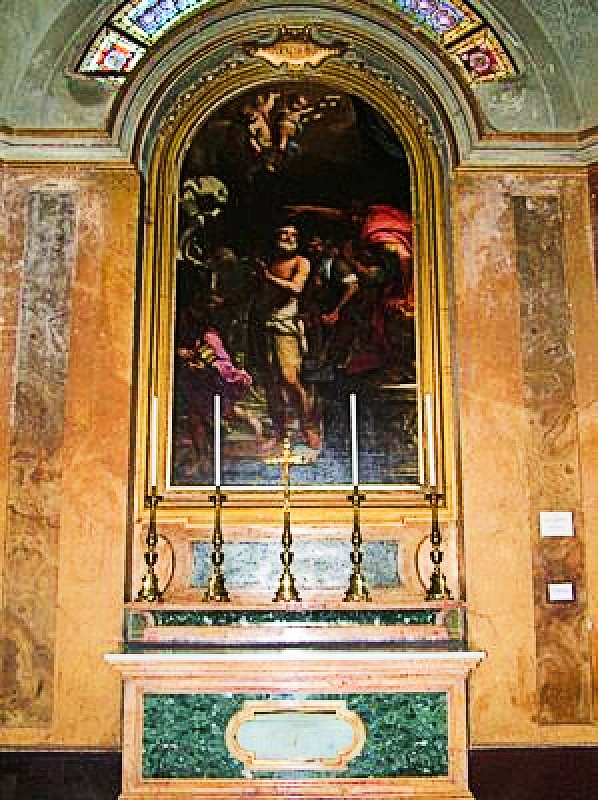
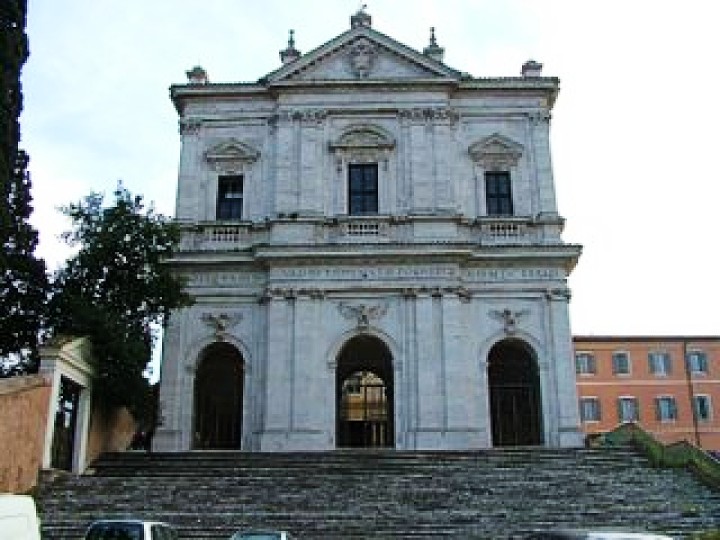
Their Relics were re-enshrined in the Church of Saints John and Paul (the ones mentioned in the Roman Canon). Finally, on 29 November 1987, most of the Relics were moved to the Church of St Gregory the Great and St Saturninus, in Rome, to an Altar newly dedicated in his honour. The image above resides above the Altar where some his Relics remain at Sts John and Paul.


 AnaStpaul
One thought on “Saint/s of the Day – 29 November – Saint Saturninus of Rome, Priest Martyr and Saint Sisinius of Rome, Deacon Martyr (Died c304)”